
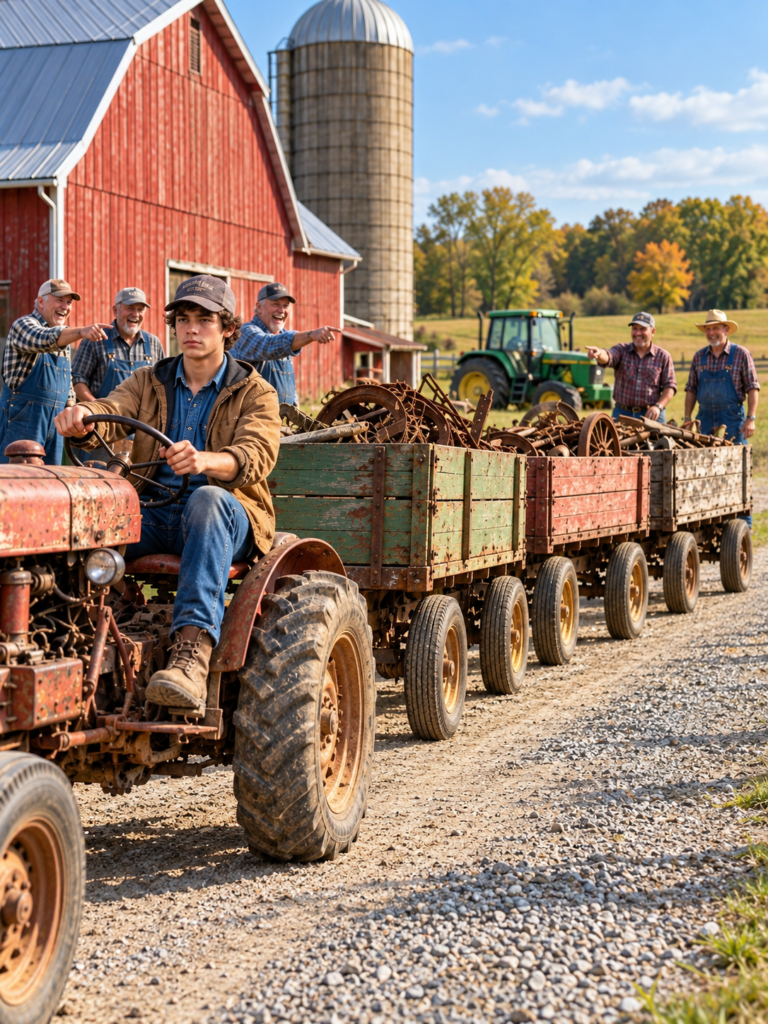
at seventeen, he dragged home three farm wagons everyone called worthless—then the same neighbors watched buyers line up at his family’s gate
Part 1
The third wagon came up the gravel lane at eleven miles an hour, and every board on it complained.
It was the last Saturday of October in Juniata County, Pennsylvania, the kind of afternoon when the sun hung low above harvested cornfields and turned everything the color of old brass. Dry leaves scraped across the road. Smoke from somebody’s woodstove rested in the valley. Beyond the Rhodes farm, the ridges were red and brown and nearly bare.
Seventeen-year-old Eli Rhodes sat stiff-backed on an old Ford tractor, one hand on the steering wheel and the other holding the throttle steady.
Behind him rolled a wooden gravity wagon that looked as if it had spent the last thirty years waiting to die.
Most of the red paint had disappeared.
One sideboard had split from top to bottom.
The right rear tire was almost flat.
Rust covered the running gear.
A vine hung from one corner like a green rope.
Eli looked over his shoulder every few seconds, mostly to make sure the wheel had not fallen off.
At the fence stood Walt Dunmire.
Walt had milked Holsteins on the next ridge for forty-four years before bad knees and low milk prices finally convinced him to sell the herd. He was seventy-three, thin as fence wire, and possessed the particular kind of patience old farmers reserved for watching younger people make mistakes.
When Eli shut down the tractor, Walt folded his arms.
“That’s three.”
Eli climbed down.
“Yes, sir.”
“I sold you one because you asked.”
“I remember.”
“I didn’t understand the first one.”
Eli smiled.
“I remember that too.”
Walt pointed at the newest wagon.
“This one cost you seventy-five dollars?”
“And diesel.”
“What are you going to do with it?”
Eli looked at the wagon.
Behind the machine shed sat the other two.
One had belonged to his grandfather.
The second came from Walt.
Both looked only slightly healthier than this one.
“I don’t know yet.”
Walt raised an eyebrow.
“That’s not much of a business plan.”
“It’s not a business.”
“Then why are you collecting dead wagons?”
Eli rubbed the back of his neck.
That was the problem.
He didn’t have a clean answer.
Not one an adult would respect.
“I think they’re useful.”
“For what?”
“I’ll tell you when I figure it out.”
Walt stared at him for several seconds.
Then he nodded.
“At least you didn’t lie.”
He started toward his truck.
At the door, he looked back.
“Your father know you bought another one?”
Eli winced.
“Not yet.”
Walt smiled.
“I’ll stay around.”
Dale Rhodes found out twenty minutes later.
He came from the dairy barn carrying a grease gun, stopped halfway across the yard, and stared at the wagon.
Dale was forty-eight.
His shoulders had begun rounding after three decades of lifting feed sacks, seed bags, chains, calves and everything else a small farm demanded. His hands were permanently cracked. His jeans always carried a line of dust above the boots.
He looked at Eli.
Then at the wagon.
Then at Walt.
“Don’t involve me,” Walt said.
Dale sighed.
“How much?”
“Seventy-five.”
“Where?”
“Harlan Bowman’s place.”
“The old place by the creek?”
“Yes.”
“Why?”
Eli glanced at Walt.
Walt immediately found the autumn sky fascinating.
“The gear’s solid.”
Dale walked around the wagon.
He kicked one tire.
It hissed.
“Solid.”
“Mostly.”
Dale touched the split sideboard.
“This wood’s rotten.”
“I can replace it.”
“The gate’s frozen.”
“I can free it.”
“Bearings?”
“Probably bad.”
“Probably?”
Eli swallowed.
“Bad.”
Dale looked at his son.
“You’ve spent almost three hundred dollars now.”
“Two seventy-five.”
“That’s supposed to make me feel better?”
“I earned it.”
That mattered.
Every dollar had come from Eli.
Mowing lawns.
Unloading produce.
Working weekends at a roadside stand.
Helping Walt repair fence.
Dale never took his son’s money.
But money was tight enough on the Rhodes farm that watching any of it disappear into abandoned machinery made his face tense.
“What exactly are you building back here?”
Eli looked toward the other wagons.
“I don’t know.”
Dale breathed slowly through his nose.
Eli waited for the lecture.
It never came.
Dale handed him the grease gun.
“Then figure it out before the weeds do.”
He walked toward the house.
Walt chuckled.
“That went better than I expected.”
Eli smiled.
“Me too.”
People later told the story as though Eli had seen the future that afternoon.
He hadn’t.
That version made him sound smarter.
The truth was simpler.
He hated seeing useful things thrown away.
His grandfather had taught him that.
Lester Rhodes had farmed the same ground with small tractors, wooden cribs and machinery repaired so many times that half of it no longer resembled its original design.
“Don’t ask what something’s worth after somebody else gives up on it,” Lester once told Eli. “Ask whether it still has a job.”
Lester died when Eli was twelve.
The first wagon had remained behind the barn ever since.
Dale intended to scrap it eventually.
Eli kept postponing the trip.
At fourteen, he started carrying a small spiral notebook in his coveralls.
He wrote things down.
Field.
Date.
Rainfall.
Planting depth.
Moisture.
Diesel.
Bushels.
Time between combine and bin.
His mother, Janet, called him her little accountant.
Kids at school called him worse.
Not cruelly most days.
Just enough to make seventeen feel seventeen.
“Wagon Boy.”
“Professor Corn.”
“Farmer Einstein.”
Eli laughed with them.
Then went home and kept writing.
The Rhodes farm was one hundred eighty-seven acres, most of it rented.
Corn.
Soybeans.
Wheat.
A small beef herd.
Enough to stay alive.
Not enough to make mistakes comfortably.
The farm had belonged to Dale’s family for three generations, but ownership did not mean security.
There was land debt.
Equipment debt.
Seed.
Fertilizer.
Fuel.
Property taxes.
Insurance.
Every January began with calculations.
Every harvest ended with different ones.
Some years they gained ground.
Others they merely survived.
That winter, Eli moved all three wagons into the old machine shed.
The building had a dirt floor, two broken windowpanes and a kerosene heater that smelled like a small refinery.
After school he changed into coveralls and worked until Janet called him for supper.
He removed wheels.
Drove out seized bearings.
Scraped grease from hubs.
He heated frozen bolts with a torch.
He rebuilt discharge gates.
One Saturday he spent four hours removing a bolt that cost sixty-nine cents.
When it finally came free, he stood holding it like a trophy.
His father walked in.
“That it?”
Eli grinned.
“That’s it.”
“Four hours.”
“It was stuck.”
“No kidding.”
Dale left a thermos on the workbench.
Coffee with too much sugar.
He never said he believed in the wagon project.
But he never told Eli to stop.
The hardest work was wood.
Eli replaced the worst sideboards with rough-cut oak from a sawmill thirty miles away.
He sanded the interior.
Repaired cracks.
Welded a fractured tongue.
The first weld was ugly.
His vocational agriculture teacher looked at it the next morning and said, “If you tow that loaded, somebody dies.”
Eli ground it out.
Started again.
The second one held.
By January the wagons looked less abandoned.
Not good.
Never good.
But alive.
One evening Dale came into the shed and leaned against the door.
Snow blew sideways across the farmyard.
“School okay?”
“Yeah.”
“Grades?”
“Fine.”
“Your mother says you’re skipping basketball games.”
“I’m working.”
“You’re seventeen.”
“I know.”
“You’re allowed to act like it occasionally.”
Eli looked at the wagon.
“I like this.”
Dale studied him.
“Then I suppose that counts.”
He picked up one of Eli’s notebooks.
“What’s all this?”
“Harvest numbers.”
Dale flipped pages.
“You wrote down how long every trip took?”
“Yes.”
“Why?”
“I wanted to know.”
“Know what?”
“What slows us down.”
Dale chuckled.
“The machinery.”
“Sometimes.”
“What else?”
“Distance. Moisture. Bin wait time. Unloading.”
“You planning to run a farm or invade France?”
Eli smiled.
“Both need logistics.”
Dale put the notebook down.
“You get that from your grandfather.”
“Writing things?”
“No.”
“What?”
“Not knowing when to quit.”
The compliment stayed with Eli longer than his father probably intended.
By spring, all three wagons rolled.
The gates opened.
Bearings spun.
Tires held air.
Dale let Eli use them during wheat harvest.
That was where reality arrived.
The wagons worked.
They simply did not work particularly well.
Modern gravity wagons on larger farms held far more grain.
Modern grain carts held five times as much.
Semi trucks made Eli’s old wagons look like toys.
The Rhodes combine could fill one quickly.
Then somebody had to pull it away.
Unload.
Return.
Time disappeared.
On the second afternoon Dale climbed down from the combine.
“It runs.”
Eli knew the rest.
“But?”
Dale wiped dust from his face.
“It’s slow.”
Eli looked toward the wagon.
“I know.”
“There’s nothing wrong with slow if slow does the job.”
“But harvest isn’t slow.”
Dale nodded.
Clouds were gathering west.
“Exactly.”
Four days later the combine broke.
The main drive failed halfway through the north field.
Rain was forecast in forty-eight hours.
The repair estimate was over five thousand dollars.
That night Dale sat at the kitchen table with bills spread around him.
Janet stood near the stove.
Eli sat opposite his father.
Nobody spoke for several minutes.
Finally Dale tapped the calculator.
“We don’t have it.”
Janet said, “We have some.”
“We have grocery money.”
“I’m talking savings.”
“So am I.”
Silence.
The farm had been struggling for three years.
Fertilizer costs had climbed.
A rented field had been sold for development.
Last year’s corn price barely covered expenses.
The combine repair was not catastrophic by itself.
Nothing on a farm was ever catastrophic by itself.
The danger came from small things arriving together.
Dale looked at Eli.
“The scrap place in Mifflintown will take the wagons.”
Eli’s chest tightened.
“All three?”
“We need cash.”
“They won’t give us much.”
“A few hundred.”
“I have money.”
“No.”
“Dad—”
“No.”
Eli looked at the table.
Dale’s voice softened.
“I’m not taking your savings.”
“The wagons are mine.”
“Technically one was mine.”
“You gave it to me.”
Dale rubbed both hands over his face.
“I’m not asking you to like this.”
Eli said nothing.
“I’m asking you to look at what we need.”
Eli understood.
That made it worse.
If Dale had been angry, Eli could have fought him.
His father was simply tired.
There was no villain at the kitchen table.
Only math.
The next morning Eli called the scrapyard.
Monday pickup.
Three wagons.
He hung up.
For the first time all winter, the machine shed felt foolish.
Three useless boxes.
Months of work.
Money spent.
People had been right.
He stood beside wagon number one and rested his forehead against the sideboard.
“Sorry, Grandpa.”
Saturday evening, Dale reminded him about a meeting at the Grange Hall.
Penn State Extension.
Small grains.
Eli almost refused.
“What for?”
“Because I can’t go.”
“Combine.”
“Combine.”
“What do you want me to learn?”
“Anything cheap.”
Eli smiled despite himself.
Dale tossed him a legal pad.
“Write down more than they say.”
The Grange Hall smelled of coffee, old wood and damp coats.
Thirty farmers sat on folding chairs.
Most were old enough to be Eli’s grandfather.
A few glanced at him.
Eli took a seat near the back.
The first hour covered soil fertility.
Then disease pressure.
Then varieties.
Eli filled half a page.
Near the end a woman stood.
Mid-forties.
Dark hair tied back.
Brown work boots beneath dress pants.
She introduced herself as Renata Alvarez, grain buyer for Broad Mountain Malt and Spirits near Harrisburg.
“We’re trying to source Pennsylvania-grown heritage rye,” she said.
A farmer near the front asked, “What’s wrong with regular rye?”
“Nothing, if you’re selling commodity grain.”
“What makes yours different?”
“Identity.”
Eli stopped writing.
Renata explained.
The distillery wanted specific rye varieties.
Each lot had to remain separate from planting through delivery.
No mixing with wheat.
No old corn residue.
No soybeans in wagon corners.
No mystery grain from an elevator pit.
Every load traceable to a field.
Moisture documented.
Cleanout documented.
Storage documented.
A man laughed.
“That’s a lot of paperwork for whiskey.”
Renata smiled.
“It becomes expensive whiskey.”
That got everyone’s attention.
“Our problem isn’t finding rye. Our problem is finding local growers able to keep a small lot separate and prove where it’s been.”
Eli stared at his legal pad.
Keep a load separate.
Prove where it’s been.
Something clicked.
Not dramatically.
No thunder.
No revelation from heaven.
Just a connection between two things nobody else in the room had reason to connect.
Small wagons were inefficient because they stayed separate.
Small wagons were valuable because they stayed separate.
Eli’s heart began beating faster.
When the meeting ended, he waited until the older farmers stopped talking to Renata.
Then approached.
“Ma’am?”
She turned.
“You’re young.”
“I’ve been told.”
“Do you grow rye?”
“Not yet.”
“Then what can I do for you?”
Eli held up the notebook.
“If somebody had individual wagons and recorded every field separately, would that work?”
“Depends.”
“On what?”
“Cleanliness. Traceability. Moisture. Variety. Handling.”
“I’ve got three wagons.”
“What kind?”
“Old.”
“How old?”
Eli hesitated.
“Old enough my dad wants to scrap them Monday.”
Renata laughed.
Then realized Eli wasn’t joking.
“What size?”
“About two hundred bushels each.”
“Wood?”
“Mostly.”
She thought.
“Wood can hold grain in cracks.”
“I can seal it.”
“Old wagons can carry residue.”
“I can clean them.”
“How do you prove it?”
Eli looked at his notebook.
“I’ll figure that out.”
Renata studied him.
Farmers had spent a lifetime promising buyers things.
Eli looked like a high school senior wearing mud on his boots.
Maybe she saw something sincere in him.
Maybe she was simply kind.
She reached into her folder.
“Here.”
A specification sheet.
Moisture maximum.
Foreign material tolerances.
Record requirements.
Approved heritage varieties.
Eli read it.
Renata put on her coat.
“If you can meet those requirements, call me.”
“Would you buy it?”
“If the grain passes.”
“How much?”
“Premium over commodity.”
“How much?”
She smiled.
“Build the system first.”
Eli drove home faster than he should have.
Dale was in the shop.
Eli entered holding the specification sheet.
“Call the scrapyard.”
Dale looked at him.
“What?”
“Cancel Monday.”
“Eli.”
“One week.”
“For what?”
“I think I found the job.”
Dale stared.
“What job?”
Eli looked through the open door toward the three unwanted wagons.
“The one Grandpa was talking about.”
Part 2
The scrapyard owner was not pleased.
“You called yesterday.”
“I know.”
“Truck’s already routed.”
“I’m sorry.”
“So am I.”
Eli paid twenty dollars for the inconvenience.
That twenty dollars hurt more than it should have.
He had less than four hundred dollars left.
But on Monday morning all three wagons remained behind the machine shed.
That was enough.
For the first time, the project had a direction.
Eli wrote one sentence at the top of a clean notebook page:
ONE WAGON = ONE LOT.
Below it:
PROVE EVERYTHING.
He spent the next week studying contamination.
Not chemicals.
Grain.
A few kernels of wheat hidden in a crack could contaminate a specialty rye lot.
Soybean dust could remain beneath old boards.
Musty wood could affect smell.
Rodents could ruin everything.
The wagons needed to become less like farm equipment and more like food-handling containers.
Dale listened while Eli explained.
“You’re going to make fifty-year-old wagons sanitary?”
“Clean enough.”
“That’s different.”
“I know.”
“You know what new wagons cost?”
“Too much.”
“Exactly.”
That was why the idea interested Dale despite himself.
No major loan.
No new equipment payment.
A small experiment.
If it failed, they would still own three functioning wagons.
Eli removed every interior board he could.
Sanded.
Vacuumed.
Sealed the wood with food-safe coating recommended by Renata’s quality manager.
He replaced deep-grooved floorboards with smooth material.
He added rubber seals around each discharge gate.
Built fitted tarp covers.
Mounted numbered aluminum plates.
WAGON 1.
WAGON 2.
WAGON 3.
Then he designed a cleanout checklist.
Previous crop.
Sweep.
Compressed air.
Corner inspection.
Gate inspection.
Flashlight.
Date.
Time.
Initials.
His mother found him at the kitchen table drawing it.
“Looks official.”
“It needs to be.”
“Who says?”
“I do.”
Janet smiled.
“What?”
“Nothing.”
“What?”
“You used to color tractors.”
“I was five.”
“Now you make inspection forms.”
“Mom.”
“I’m proud of both.”
At school, the wagons became a joke again.
A classmate named Trevor saw Eli photocopying forms in the library.
“Wagon Boy Incorporated?”
Eli ignored him.
Trevor picked one up.
“‘Foreign material inspection.’ What, you shipping corn to Europe?”
“Rye.”
“For whiskey?”
“Maybe.”
Trevor grinned.
“You’re going to get rich hauling booze?”
“No.”
“Then why do it?”
Eli paused.
“Because somebody needs it.”
Trevor shrugged.
“Okay.”
That was the thing about ridicule.
Most people were not committed enough to keep doing it.
They laughed because everybody else laughed.
Then they forgot.
Eli kept working.
The more difficult problem was land.
The Rhodes farm had no rye planted.
Renata could supply seed for a trial, but Eli needed ground.
Dale could not afford to sacrifice productive corn acreage on a teenage experiment.
So Eli asked Walt.
They stood beside Walt’s old back field.
Ten acres.
Poor drainage near one edge.
Idle for two seasons.
Goldenrod and weeds chest-high.
“Rent?” Walt asked.
“I don’t have much.”
“I know.”
“I’ll pay after harvest.”
“If harvest fails?”
“I clean up the field.”
Walt rubbed his jaw.
“What does your father think?”
“He thinks I’m asking you.”
“Smart man.”
Eli waited.
Walt looked across the field.
“My father planted rye here in ’58.”
“Really?”
“Used it as a cover crop.”
“So yes?”
“Didn’t say that.”
“Walt.”
The old man smiled.
“Pay me when it works.”
That September, Eli drilled three separate plots.
Different heritage rye lots.
He labeled them A, B and C.
Walt watched from the field edge.
“You going to name individual plants?”
“If necessary.”
“You’re sick.”
“I’ve been told.”
Winter came.
Rye survived beneath snow.
Spring returned.
Plants greened.
By June, heads filled.
Broad Mountain agreed to test whatever Eli delivered.
No guaranteed large contract.
No promise beyond one trial.
That kept pressure manageable.
Still, Eli checked the fields almost daily.
One Sunday Dale found him kneeling in rye.
“What are you doing?”
“Looking.”
“For?”
“Problems.”
“See any?”
“Not yet.”
“Then come eat.”
Harvest began in July.
Wagon 1 sat beneath the combine auger.
The first rye poured in.
Eli felt more nervous than he had taking his driver’s test.
He logged time.
Field.
Moisture.
Wagon number.
Lot.
Dale watched.
“Relax.”
“I am relaxed.”
“You wrote the date twice.”
Eli looked down.
He had.
Lot A went smoothly.
Lot B did not.
After unloading the field, the measured weight came up short.
Four bushels.
Dale shrugged.
“Field variability.”
Eli shook his head.
“My estimate should’ve been closer.”
He walked the route.
Halfway down the lane he found rye scattered in the gravel.
A gasket had shifted at the discharge gate.
Four bushels had leaked.
Dale stood beside him.
“Your notebook caught that?”
“The numbers did.”
Dale looked at his son differently.
They repaired the gasket.
Logged the loss.
Lot C created another problem.
Moisture sixteen percent.
Broad Mountain required fourteen or less.
Rain threatened.
Dale wanted to harvest.
“We can dry it.”
“Not with our setup.”
“We could blend.”
“No.”
“Eli, it’s one lot.”
“The specification says one field, one variety.”
“You’re going to lose it if weather comes.”
“Maybe.”
Dale looked at the sky.
Then his son.
“This is your call.”
Eli waited.
One day.
The rye dried.
The next afternoon it tested just below fourteen.
They harvested.
All three lots passed Broad Mountain’s lab.
Renata called on a Wednesday evening.
Eli answered in the barn.
“Hello?”
“Mr. Rhodes?”
He straightened automatically.
“Yes, ma’am.”
“Stop calling me ma’am.”
“Yes, ma—Renata.”
She laughed.
“The samples passed.”
Eli sat on a bale.
“All three?”
“All three.”
“Foreign material?”
“Within spec.”
“Moisture?”
“Fine.”
“Odor?”
“Fine, Eli.”
He breathed.
Renata continued.
“Tom wants to distill a trial batch.”
“When?”
“Next month.”
“Does that mean you’ll buy it?”
“We already are.”
She named the price.
Just over two dollars per bushel above the local elevator price.
Eli calculated quickly.
About five hundred bushels.
A little more than one thousand dollars premium.
Not wealth.
Not even close.
But it was real.
When the check arrived, Eli placed it on the kitchen table.
Dale picked it up.
Read it.
Put it down.
Janet stared at the number.
“That’s for the wagon grain?”
“Rye.”
“The old wagons?”
“Yes.”
She touched the check.
Then looked at Dale.
“How much was the combine repair?”
“Five thousand two hundred.”
Eli slid the check toward him.
“This helps.”
Dale immediately pushed it back.
“No.”
“It’s farm income.”
“It’s your project.”
“We used your combine.”
“We used your labor too.”
“Dad.”
Dale looked at him.
Pride entered the room before words did.
It complicated everything.
Janet rested her hand on the check.
“How about half goes to the combine, half stays with Eli’s operation?”
Neither liked compromise enough to object.
So that was what they did.
Janet left the check on the windowsill until morning.
Eli asked why.
She said, “I like looking at proof.”
The real change came in August.
Renata called again.
“The trial whiskey is good.”
“How good?”
“Tom used an expression I won’t repeat to a seventeen-year-old.”
Eli smiled.
“So good.”
“Very.”
Then her voice changed.
“We want more next year.”
“How much?”
“Four thousand bushels.”
Eli stopped smiling.
That was nearly eight times his trial.
Renata continued.
“Two other distillers are interested too.”
Eli walked outside.
Three wagons stood behind the shed.
Four thousand bushels.
He sat on wagon 1’s tongue.
“Can you do it?” Renata asked.
Eli wanted to say yes.
That was the word ambitious people were supposed to say.
Yes.
Figure it out later.
Borrow money.
Buy equipment.
Expand.
Everyone praised boldness after it worked.
Nobody visited during foreclosure.
“I don’t know,” Eli said.
“I need an answer in two weeks.”
“I’ll give you one.”
For the next eleven days, Eli calculated.
A specialty lot had to remain isolated while testing.
Wagons could not immediately rotate.
Cleaning required almost three hours if done properly.
Testing took roughly a day and a half.
Weather eliminated harvest days.
His family’s records showed an average rye window of about ten days with three commonly lost to rain.
Three wagons were not enough.
Dale favored expansion.
“We buy six newer wagons.”
“With what?”
“Operating loan.”
Eli stared at him.
“We already have equipment debt.”
“This is different.”
“How?”
“It’s tied to a contract.”
“A contract doesn’t stop rain.”
Dale looked frustrated.
“Somebody will fill that order.”
“I know.”
“Then why shouldn’t it be us?”
Walt disagreed.
He sat at the Rhodes table drinking coffee.
“Because borrowed money behaves nicely until the crop doesn’t.”
Dale shook his head.
“If we’d all followed that advice, we’d still plow with horses.”
“And if we’d all followed yours, half the county would belong to banks.”
Janet put down the coffee pot.
“Nobody is turning my kitchen into an agricultural debate society.”
Silence.
Eli spread notebooks across the table.
Four years.
Weather.
Harvest times.
Cleaning times.
Field travel.
He calculated.
Then recalculated.
Finally he looked at his father.
“Five wagons.”
Dale frowned.
“What?”
“I can safely handle twelve two-hundred-bushel lots with five wagons.”
“That’s twenty-four hundred bushels.”
“Yes.”
“They want four thousand.”
“I know.”
“We’d leave sixteen hundred on the table.”
“We’d deliver what we promise.”
Dale leaned back.
“You’re thinking too small.”
“Maybe.”
Walt said nothing.
Eli continued.
“I found two more old wagons. Repairs under fifteen hundred total.”
“Or we finance new ones and have capacity.”
“And payments.”
“And growth.”
Eli looked at his father.
For the first time, the difference between them had nothing to do with age.
Dale had spent his life trying to keep a small farm from becoming smaller.
When opportunity appeared, he wanted to run toward it.
Eli had watched debt squeeze his father’s sleep.
He wanted proof before speed.
Neither was foolish.
That made the disagreement harder.
“I want twenty-four hundred,” Eli said.
Dale shook his head.
“Renata may go somewhere else.”
“Then she goes.”
“You’re willing to lose a customer?”
“I’m not willing to lie to keep one.”
The kitchen went quiet.
Dale stared at him.
Eli almost backed down.
Then Walt spoke.
“Call her.”
Eli looked at him.
“Now?”
“You already know your answer.”
Eli dialed.
Renata picked up.
“Tell me good news.”
“I can’t do four thousand.”
Silence.
Eli swallowed.
“I can guarantee twenty-four hundred bushels in twelve documented lots. Same system. Five wagons. Anything beyond that depends on weather.”
Another silence.
Eli’s stomach tightened.
Then Renata said, “That’s the most useful answer anybody has given me this week.”
“What?”
“Three farms told me they can do whatever I need.”
“Maybe they can.”
“Maybe.”
“So you’re not canceling?”
“No.”
She paused.
“Twenty-four hundred with an option to increase if conditions allow.”
Eli exhaled.
“Yes.”
“Send me your lot plan.”
After hanging up, he looked at Dale.
His father slowly pulled one of the notebooks closer.
He read.
Cleaning times.
Rain days.
Capacity estimates.
Finally he looked up.
“I would’ve called all this messing around two years ago.”
Eli waited.
Dale tapped the page.
“This isn’t messing around anymore.”
“What is it?”
“Evidence.”
Part 3
The fourth wagon came from Walt.
The fifth came from a retired farmer near Thompsontown.
Neither was pretty.
Both were cheap.
Eli spent most of his eighteenth winter rebuilding them.
He graduated high school in June.
At the ceremony, Trevor signed Eli’s yearbook:
GOOD LUCK WITH THE WAGON EMPIRE.
Eli laughed.
He kept the yearbook.
Three weeks before rye harvest, two trucks turned into the Rhodes gravel lane.
Renata stepped from the first.
With her came Tom Gaffney, Broad Mountain’s head distiller, a quality manager named Denise Park, and a buyer from a Lancaster malt house.
A second truck carried representatives from two small distilleries.
Dale stood near the barn.
Walt sat on an overturned bucket.
Janet watched from the kitchen window.
Eli wiped his palms on his jeans.
Nobody had ever inspected anything he built.
Not officially.
The five wagons stood inside the machine shed.
Swept floor.
Numbered plates.
Tarp covers folded neatly.
Inspection logs in waterproof sleeves.
Denise entered wagon 2.
She ran her finger along a seam.
Looked underneath the gate.
Shined a flashlight into corners.
“Cleaning method?”
Eli handed her the checklist.
“Sweep first. Compressed air second. Then full flashlight inspection. Gate removed if residue remains. Sign-off goes in the log.”
“Who signs?”
“Whoever performs it and whoever verifies.”
“Two people?”
“Yes.”
“What if only one person is available?”
“We wait.”
She looked at him.
“How old are you?”
“Eighteen.”
She returned to the checklist.
“Demonstrate.”
Eli’s heart hammered.
He cleaned wagon 4 as though he had never cleaned anything before.
Sweep.
Air.
Gate.
Corners.
Flashlight.
Initial.
Denise watched silently.
Tom leaned against a post.
Renata said nothing.
Silence made every movement louder.
When Eli finished, Denise inspected.
Then wrote one line on her clipboard.
Eli tried not to stare.
They walked through the field records.
Seed source.
Planting date.
Lot identity.
Harvest route.
Moisture.
Temporary storage.
At the end, Renata stood beside wagon 1.
She looked at Dale.
“Most growers can tell me what they grew.”
Then she looked at Eli.
“Very few can prove where it’s been.”
They signed the supply agreement at the kitchen table.
Janet served coffee in mismatched mugs.
Nobody cheered.
Pens scratched paper.
Pages turned.
Dale signed the farm portion.
Eli signed the handling plan.
Renata shook his hand.
Only after the buyers left did Janet close the door, turn toward Eli and say, “Well?”
He grinned.
Then everyone started talking at once.
That year nearly everything that could go wrong tried.
Rain delayed harvest.
One wagon tire failed.
A tarp tore in wind.
Lot 7 tested above moisture specification.
A neighboring farmer offered dryer space, but the system had recently handled wheat.
Eli refused.
Dale nearly lost his temper.
“We can clean it.”
“Not enough.”
“It’s seventy-five thousand pounds of equipment sitting there.”
“And it handled wheat yesterday.”
“The buyer may never know.”
Eli went still.
Dale immediately regretted the sentence.
Nobody spoke.
Finally Dale said, “You’re right.”
He rubbed his forehead.
“I’m tired.”
“I know.”
“We’re losing the weather.”
“I know.”
Dale looked toward the field.
“This is harder than I thought.”
Eli smiled weakly.
“Me too.”
They waited.
Lot 7 dried naturally.
The entire contract shipped within specification.
Twenty-three hundred eighty-six bushels.
Slightly below plan because of field loss.
Broad Mountain accepted every one.
The premium paid better than commodity grain.
Again, not enough to make the Rhodes family rich.
Enough to matter.
Enough to cover costs.
Enough to pay Walt rent.
Enough to improve the farm’s winter cash position.
More important, the other buyers noticed.
The Lancaster malt house called.
Then a brewery looking for local barley.
Then a flour mill interested in segregated heritage wheat.
Eli did not say yes to all of them.
That surprised people.
“Why turn down business?” Dale asked.
“Because we’re not ready.”
“You have five wagons.”
“Exactly.”
Dale laughed.
“You spent two years getting me to respect those things, and now you’re using them as an excuse.”
Eli smiled.
“I’m learning from you.”
The first serious conflict came the following winter.
A neighboring farm family, the Millers, approached Eli.
They wanted to grow rye under the Broad Mountain program.
Their farm was larger.
Better equipment.
More acres.
But no segregation system.
Eli offered to handle their grain through his wagons.
Mr. Miller frowned.
“Those antiques?”
“Yes.”
“I can haul more in one semi.”
“Then the lots mix.”
“We wash the trailer.”
“After corn?”
“Sure.”
“How do you verify?”
Mr. Miller shrugged.
“It’s clean.”
“How do you prove it?”
The man looked irritated.
“Son, I’ve farmed thirty years.”
“I know.”
“And you’re telling me how to haul grain?”
“No. I’m telling you what the buyer requires.”
Word traveled.
Some farmers thought Eli had become arrogant.
That hurt.
He had grown up around them.
Men who fixed his bicycle.
Women who brought casseroles when his grandfather died.
He did not want success to turn him into someone walking around with a clipboard judging neighbors.
So he invited them to the farm.
Saturday morning.
Coffee.
No fee.
No sales pitch.
He showed the system.
The wagons.
Logs.
Cleaning.
Lot identification.
Why contamination mattered.
Seven farmers came.
Then twelve.
Mr. Miller came too.
At the end he said, “So you’re not selling wagons.”
“No.”
“What are you selling?”
Eli thought.
“Confidence.”
Walt, sitting behind him, smiled.
The program expanded.
Slowly.
Eli coordinated grain from three neighboring farms.
Then five.
He did not own their land.
He did not tell them how to farm beyond buyer specifications.
His role was handling and traceability.
At nineteen, he formed Rhodes Lot Grain Services.
His first office was a plywood desk in the machine shed.
His mother printed invoices.
His father still called the business “Eli’s wagon thing” until the income paid half of a new grain cleaner.
Then Dale stopped joking.
But success created new pressure.
A regional specialty grain company offered Eli a contract larger than everything he currently handled.
Twelve thousand bushels.
They required investment.
Steel bins.
Cleaning equipment.
Moisture monitoring.
Truck loading.
The bank was willing to finance.
For the first time, real money entered the decision.
Eli sat in a bank office across from loan officer Glenn Mercer.
Dale beside him.
Documents covered the table.
“You have good purchase commitments,” Mercer said.
“Yes.”
“Strong premium.”
“Yes.”
“Growing customer base.”
“Yes.”
“The expansion makes sense.”
Eli stared at the loan amount.
Two hundred eighty thousand dollars.
The number frightened him.
Dale sensed it.
“Equipment has value.”
“I know.”
“Bins last decades.”
“I know.”
Mercer leaned back.
“You’ve outgrown the wagons.”
Eli disliked that sentence more than he expected.
Not because it was wrong.
Because it felt like being told the very things that created the opportunity were now embarrassing.
“What happens if one buyer leaves?” Eli asked.
Mercer pointed at the contracts.
“You have others.”
“If two leave?”
“Business carries risk.”
“If grain premiums fall?”
Dale sighed.
“Eli.”
“I’m asking.”
Mercer studied him.
“Then you adjust.”
Adjust.
Farmers knew what that word meant.
Work more.
Spend less.
Sell something.
Refinance.
Hope.
Eli took the papers home unsigned.
For three nights he barely slept.
The old wagons stood in the shed.
He walked among them.
Number 1.
Number 2.
Number 3.
Then the two later additions.
He remembered a five-thousand-dollar combine repair nearly forcing them to sell scrap.
Now he was considering debt more than fifty times that amount.
On the fourth night Walt found him there.
The old man was eighty now.
Walking stick.
Slower.
Still sharp.
“Bank?”
“How’d you know?”
“Your father talks.”
Eli nodded.
“What do you think?”
Walt sat on an upside-down bucket.
“Doesn’t matter.”
“I asked.”
“You want permission.”
“No.”
“You want somebody old to tell you debt is dangerous so you can blame me if you stay small.”
Eli laughed.
“Maybe.”
Walt looked at the wagons.
“These taught you something.”
“What?”
“You don’t need the best tool.”
“I know.”
“No.”
Walt tapped his cane against the concrete.
“You learned the best tool is the one matched to the problem.”
Eli listened.
“The problem changed.”
Walt continued.
“These wagons solved separation. Now your problem is volume without losing separation.”
“So borrow?”
“I didn’t say that.”
“Then what?”
“Build the smallest thing that solves the next problem.”
The sentence followed Eli home.
Instead of five large bins, he redesigned the expansion around several smaller segregated bins.
Used grain cleaner.
Modular conveyors.
Leased truck rather than purchased.
The financing fell to ninety-eight thousand.
Still substantial.
But survivable.
Mercer disliked the smaller loan.
Dale liked it less than he admitted.
Eli signed anyway.
The equipment went in that summer.
For the first time, wagons were no longer the entire system.
But they remained part of it.
Small lots still began there.
Samples still followed wagon numbers.
Every new employee learned cleanout procedures using wagon 1.
Buyers continued coming.
Vehicles that once drove past the Rhodes lane now turned in.
A bourbon producer from Maryland.
A specialty flour company from Philadelphia.
A maltster.
A seed breeder.
They came for grain.
But mostly they came because they trusted the records behind it.
Dale watched one group tour the shed.
Afterward he leaned against the same fence where Walt had once questioned Eli.
“Remember the third wagon?”
“Yes.”
“I thought you’d lost your mind.”
“You were polite.”
“I was worried.”
“I know.”
Dale looked toward the new bins.
“I spent years thinking the farm needed bigger equipment.”
Eli waited.
“Maybe what we needed was a different customer.”
That sentence meant more to Eli than any contract.
Part 4
By Eli’s twenty-first birthday, the farm looked different.
Not rich.
Working farms rarely looked rich from the road.
But healthier.
The combine had been replaced with a used machine five years newer.
The cattle barn roof no longer leaked.
The bank balance did not collapse every February.
Janet stopped delaying dentist appointments because “maybe next month would be easier.”
Dale still woke at four-thirty.
Still worried.
Farmers did not retire from worry simply because income improved.
Yet something fundamental had changed.
They had breathing room.
The biggest test arrived during a drought.
Spring rain stopped early.
June turned hot.
July became brutal.
Corn curled in fields across Juniata County.
Pastures browned.
Creek levels dropped.
Rye had matured earlier and performed better than corn, but yields were down.
Specialty contracts remained.
Volume didn’t.
One buyer demanded full delivery anyway.
“Our contract specifies quantity.”
Eli sat at his desk.
“It also includes weather-related adjustment.”
“We scheduled production.”
“I know.”
“We’ll have to source elsewhere.”
“I know.”
“If we do, we may move future business too.”
The threat was polite.
That made it no less real.
Eli could have filled the order by purchasing commodity rye and blending it.
Nobody would easily detect it.
Same species.
Similar appearance.
Potentially enough to keep the customer.
He considered it for roughly thirty seconds.
Then hated himself for considering it.
“No.”
“What?”
“I can’t fill the shortage with unverified grain.”
“We didn’t ask you to.”
“You were about to.”
Silence.
The buyer’s voice cooled.
“You understand what losing this account means?”
“Yes.”
“Do you?”
Eli looked through the office window toward wagon 1.
“Yes.”
He lost the customer.
For two weeks he questioned the decision.
Revenue dropped.
Dale did not criticize him.
That almost made it worse.
Then Renata called.
Broad Mountain had heard what happened.
“True?”
“What?”
“You refused to substitute commodity grain.”
“Who told you?”
“Small industry.”
“Yes.”
“Why?”
“Because it would’ve been wrong.”
“That’s all?”
“What else is there?”
Renata was quiet.
Then she said, “We’re extending our contract three years.”
Eli sat straighter.
“Why?”
“Because I know what you do when telling the truth costs money.”
The drought year ended badly.
Not disastrously.
They survived.
Several neighboring farms did not fare as well.
One family auctioned equipment.
Another sold eighty acres.
Eli attended both sales.
He stood among men looking at machinery and remembered his own wagons waiting for the scrapyard.
At the second auction, he bought two small gravity wagons.
Dale saw them come up the lane.
He laughed so hard he had to sit down.
“Again?”
“Cheap.”
“You have bins now.”
“They’re useful.”
“For what?”
Eli smiled.
“I don’t know yet.”
Dale threw a glove at him.
History did not repeat exactly.
But it enjoyed jokes.
Meanwhile Walt grew weaker.
At eighty-four, he stopped driving at night.
At eighty-six, he sold the rest of his acreage to Eli on a long-term agreement below what a developer offered.
Eli refused at first.
“You’re giving up money.”
“I’m choosing a buyer.”
“Your daughters—”
“They agreed.”
“Why?”
Walt looked toward the back field where Eli had planted his first rye.
“Because I’d rather see rye than townhouses.”
Eli’s throat tightened.
“I can’t promise forever.”
“No one can.”
Walt held out his hand.
“Promise you’ll think before selling.”
Eli shook it.
“I promise.”
Dale’s health changed next.
Not dramatic.
A shoulder that no longer recovered.
A knee replacement.
Then a mild heart attack one March morning while loading mineral.
He survived.
But afterward the doctor said words Dale had spent his entire adult life avoiding.
“Slow down.”
At home he sat in the kitchen furious.
“Slow down doing what?”
Janet stared at him.
“Everything.”
“I have cattle.”
“Eli has cattle.”
“He has grain.”
“He also has employees.”
Dale looked betrayed by modern staffing.
“I am not sitting on a porch.”
Nobody asked him to.
Still, the shift was painful.
Farming had been his identity longer than fatherhood, marriage or any other role.
Eli gradually took more responsibility.
Dale complained.
Then advised.
Then complained about being asked for advice.
Then gave it anyway.
One afternoon they repaired wagon 1 together.
A crack had developed near a bolt.
Dale held the board.
Eli drilled.
“You could replace this whole side.”
“Could.”
“New wood.”
“Old one’s fine.”
Dale smiled.
“Sound familiar?”
Eli stopped drilling.
“What?”
“Nothing.”
They worked quietly.
Finally Dale said, “I owe you an apology.”
Eli looked at him.
“For what?”
“I almost sold these.”
“We needed money.”
“I should’ve listened.”
“You did.”
“Not at first.”
“Dad.”
Dale looked toward the open shed.
“I spent my life teaching you to respect what I knew.”
Eli waited.
“Didn’t always respect what you saw.”
There are apologies children wait years to hear without knowing they are waiting.
Eli set down the drill.
“You let me keep working.”
“Barely.”
“You left coffee.”
Dale laughed.
“I suppose I did.”
“That counted.”
Dale nodded.
“Your grandfather would’ve liked this.”
Eli looked at wagon 1.
“I hope so.”
“He would’ve told everybody it was his idea.”
That made them both laugh.
Two years later, Dale died.
Not in a field.
Not dramatically.
A second heart attack in his sleep.
Janet found him before sunrise.
Eli was twenty-seven.
Old enough to run the farm.
Young enough to still need his father.
The funeral filled the church.
Farmers came in clean shirts and uncomfortable jackets.
Renata drove from Harrisburg.
Mill workers.
Neighbors.
Former classmates.
Trevor hugged Eli and whispered, “Your dad was a good man.”
Walt sat in front.
Ninety years old.
At the graveside, wind moved across winter wheat.
Eli looked at his father’s coffin and remembered everything ordinary.
Coffee left on a workbench.
A hand on a steering wheel.
Arguments over grain moisture.
Boots beside the kitchen door.
Dale standing at the fence watching an ugly wagon arrive.
The things people missed after death were rarely speeches.
They missed repetition.
The person who was always there.
After everyone left, Eli returned to the machine shed.
Wagon 1 sat beneath dust.
He rested both hands on its side.
For years the wagon had represented opportunity.
That night it represented his father.
Not because Dale bought it.
Because he almost sold it.
Because he changed his mind.
Because he changed himself.
Janet found Eli there after dark.
“You coming inside?”
“In a minute.”
She stood beside him.
“Your father told me once he was afraid you’d leave.”
Eli looked at her.
“When?”
“Your senior year.”
“Why?”
“He thought you were too smart for this place.”
Eli almost smiled.
“That’s ridiculous.”
“I told him that.”
“Thanks.”
“I said smart people can make bad decisions anywhere.”
He laughed.
Then cried.
Janet held him.
The farm continued.
It had to.
Cows expected breakfast even after funerals.
Contracts still had dates.
Rain still arrived when inconvenient.
Life’s refusal to pause was both cruel and merciful.
Eli began understanding why older farmers talked about land as though it were a relative.
A farm remembered.
Not mystically.
Practically.
A bent gate showed where Dale backed into it.
The maple beside the house showed where Lester tied a swing.
A worn notch in the barn door came from decades of hands.
Human beings disappeared.
Work remained.
The following summer, buyers returned.
More than ever.
A national craft spirits company wanted Pennsylvania rye with farm-level traceability.
They sent six people.
Three SUVs turned into the lane.
Walt was sitting near the machine shed in a lawn chair.
He watched them unload clipboards and laptops.
Eli came from the office.
Walt nodded toward the parking area.
“Traffic problem.”
“Seems so.”
“Remember what I asked you?”
“When?”
“That third wagon.”
Eli smiled.
“What are you going to do with three?”
“Yeah.”
“I remember.”
Walt looked toward the visitors.
“I guess that’s the answer.”
Eli shook his head.
“No.”
“What?”
“The wagons weren’t the answer.”
“What was?”
Eli looked at him.
“The question.”
Part 5
Eleven years after Eli hauled the third wagon home, the Rhodes farm handled more grain in a week than his grandfather once handled in a season.
There were steel bins now.
A seed cleaner.
Moisture sensors.
Digital lot tracking.
A scale.
A loading system.
A grain cart that held more than all three original wagons combined.
The combine cab had air conditioning strong enough to make Janet complain.
Broad Mountain remained a customer.
So did malt houses, distilleries, bakers and specialty seed companies.
Several neighboring farms participated in the identity-preserved program.
Eli never became the largest grain handler in Pennsylvania.
He had no interest in that.
He wanted to be the one buyers trusted when a label promised something specific.
Pennsylvania rye.
One variety.
One region.
One documented path.
That reputation proved more durable than any piece of equipment.
Walt still visited during harvest.
At ninety, he moved slowly.
Eli kept a lawn chair near the shed specifically for him.
One July afternoon, a sixteen-year-old employee named Marcus Bell stopped beside wagon 1.
Marcus had grown up two towns over.
His father worked construction.
He knew little about farming beyond what Eli taught him.
He pointed at the faded wagon.
“Why do you keep that?”
Eli looked up from a sample jar.
“Because I want to.”
“You don’t use it.”
“Sometimes.”
“For what?”
“Training.”
Marcus ran one hand along the sideboard.
“It’s wood.”
“Excellent observation.”
“You have better equipment.”
“Also true.”
“The scrap yard would probably take it.”
From the lawn chair Walt called, “Careful.”
Marcus looked over.
“What?”
“That’s how all this started.”
Marcus frowned.
Eli smiled.
“Walt sold me wagon number two.”
“How much?”
“One fifty.”
Marcus looked amazed.
“That’s nothing.”
“At the time it was a lot to me.”
“What did you do with it?”
Eli looked around.
New bins.
Clean concrete.
Trucks waiting.
Employees sampling grain.
Fields beyond the lane.
“Nothing.”
Marcus stared.
Eli added, “It already did it.”
Later that afternoon a convoy arrived.
Two pickups.
One rental SUV.
A black sedan.
Representatives from a regional food company.
They were interested in traceable specialty wheat for premium flour.
Marcus watched people step out.
“They came all the way here?”
“Apparently.”
“To buy grain?”
“Hopefully.”
Marcus looked at wagon 1.
Then at Eli.
“You knew this would happen?”
Eli laughed.
“Absolutely not.”
“What did you know?”
“That old wagon wasn’t finished.”
The buyers toured.
Asked questions.
Inspected records.
One executive seemed surprised that the business had grown around old farm equipment.
“You built the original system with those?”
“Yes.”
“Why not start with dedicated bins?”
“Couldn’t afford them.”
The man smiled.
“Constraint drove innovation.”
Eli hated phrases that made simple necessity sound like a business seminar.
“We were broke,” he said.
The executive laughed.
“Fair enough.”
They eventually signed a pilot agreement.
Small first year.
Three farms.
Six lots.
Eli insisted on testing before expansion.
One of the executives asked why they were not moving faster.
Eli pointed toward his office.
“Because I have notebooks full of mistakes from moving too fast.”
That evening, after the buyers left, Marcus swept the shed.
Eli finished paperwork.
Walt slept in the lawn chair.
Sunlight stretched across the concrete.
Marcus said, “Can I ask you something?”
“Sure.”
“How do you know when junk isn’t junk?”
Eli stopped writing.
The question took him backward.
Seventeen.
Cold machine shed.
Broken bolt.
His father.
Grandfather.
Three wagons everyone else had finished judging.
“You don’t always know.”
“Then how did you?”
“I didn’t.”
Marcus waited.
Eli closed the notebook.
“You test it.”
“What if you’re wrong?”
“Then you learn cheap.”
“That’s it?”
“Mostly.”
Marcus leaned on the broom.
“My dad says you got lucky.”
Eli smiled.
“He’s right.”
Marcus looked surprised.
“Really?”
“Rain could’ve ruined the first rye. Broad Mountain could’ve hated the whiskey. Walt could’ve said no. My dad could’ve scrapped the wagons.”
“So it was luck.”
“Partly.”
“Then what’s the point?”
Eli looked toward the fields.
“Luck only matters if you’re standing where it can find you.”
Marcus thought about that.
Walt opened one eye.
“Kid.”
Marcus turned.
“Yeah?”
“Don’t listen to him when he starts sounding philosophical.”
Eli laughed.
Walt closed his eye again.
That fall Walt died.
Ninety-one.
At home.
His daughter called Eli before breakfast.
Eli drove to the Dunmire farm.
The barn stood empty.
No cows.
No machinery.
Only dust floating in morning light.
Walt’s lawn chair remained near the door.
His daughter Susan found Eli looking at it.
“He wanted you to have that.”
“The chair?”
“The field.”
Eli turned.
“What?”
“The back ten.”
“I bought the farm.”
“Not that part.”
She handed him an envelope.
Walt had retained a narrow parcel around the old rye field under a separate deed.
Eli had never realized.
Inside was a handwritten note.
Boy,
You paid me rent years ago, but that field paid me back better by giving me something interesting to watch.
Keep asking stupid questions.
Most useful ones sound stupid at first.
Walt.
Eli read it twice.
Then a third time.
His eyes blurred.
Susan smiled.
“He liked you.”
“I liked him too.”
“He knew.”
The back field became the only acreage Eli never placed into commercial rotation.
He planted rye there every autumn.
Not always for sale.
Sometimes simply because Walt once had.
Years continued.
The business expanded carefully.
Janet grew older.
Eli married a county veterinarian named Sarah Miller.
They had a daughter.
Then a son.
The children grew up under the same machine shed roof that had once leaked snow onto Eli’s workbench.
One winter afternoon his daughter, Lucy, age nine, found wagon 1.
“What is this?”
“A wagon.”
“It’s ugly.”
“Respect your elders.”
She climbed the tire.
“Did Grandpa Dale use it?”
“Yes.”
“Did Great-Grandpa?”
“Probably.”
“What did it carry?”
“Wheat. Rye. Corn. Whatever people needed.”
“Can I paint it?”
“No.”
“Why?”
Eli considered.
Most of the original red was gone.
Boards showed scratches.
Repairs.
Different generations of bolts.
Paint would make it prettier.
It might also erase the evidence.
“No.”
“Why?”
“Because I like seeing how old it is.”
Lucy looked skeptical.
Adults said many unreasonable things.
She climbed down.
“Can I drive the tractor?”
“Also no.”
She groaned.
Eli smiled.
He understood something then.
He had once believed the value of the wagons came from finding a better market.
That was true financially.
But incomplete.
The deeper lesson had nothing to do with rye.
Everybody was surrounded by things already judged.
Old tools.
Small farms.
Older workers.
Young people.
Abandoned buildings.
Fields too small for modern equipment.
Methods no longer fashionable.
Families did the same thing to people that markets did to machinery.
They assigned worth too early.
Too low.
Sometimes a person merely needed somebody to ask a different question.
Not:
What is this worth today?
But:
What problem can this solve?
Not:
Why isn’t this as good as something new?
But:
What can this do that the new thing cannot?
Eli learned that from machinery.
Then from people.
When a sixty-two-year-old mechanic named Ron applied for work after the dealership where he spent thirty years closed, another manager told Eli, “He’s too old to learn the tracking software.”
Eli hired him.
Ron learned.
Slowly.
Then became the best maintenance man on the property.
When Marcus struggled in college and wanted to quit, Eli did not call him lazy.
He asked what problem college was supposed to solve.
Marcus eventually switched to an agricultural technology program and returned to the farm.
Years later he managed operations.
When a neighboring widow, Carol Reed, could no longer farm her eighty acres alone, developers offered cash.
Eli offered something else.
A lease.
She kept the land.
Rhodes Grain farmed it.
Carol retained ownership.
Everybody won except the developer.
Eli never considered himself generous.
He considered himself experienced.
He knew what happened when people confused low immediate value with no future value.
On the twentieth anniversary of his first Broad Mountain contract, Renata returned.
Her hair had gone silver at the temples.
Broad Mountain had grown too.
Their whiskey now sold across several states.
She stood beside wagon 1.
“This thing still alive?”
“Barely.”
“You still clean it?”
“Of course.”
She laughed.
“I gave you that specification sheet because I felt sorry for you.”
Eli stared at her.
“What?”
“You were seventeen.”
“You could’ve told me that twenty years ago.”
“You looked so serious.”
“I was serious.”
“I know.”
She touched the wagon.
“I figured you’d call once, realize how hard it was, and quit.”
“Encouraging.”
“You didn’t.”
“No.”
“Why?”
Eli considered.
“My dad needed money.”
Renata nodded.
“That’ll do it.”
He looked toward the house.
Janet sat on the porch watching Lucy and her brother chase each other around the yard.
Dale should have been there.
Walt too.
Grandpa Lester.
People died before seeing the full result of things they started.
That was ordinary life.
No one got to see every harvest.
Renata asked, “You ever think of selling?”
“The business?”
“Yes.”
“Offers come.”
“And?”
“No.”
“Never?”
“Maybe someday.”
“Why not now?”
Eli looked around.
Because the farm was profitable.
Because his children loved it.
Because his mother’s kitchen window still faced the shed.
Because Dale’s coffee thermos remained on a shelf.
Because Walt’s field greened every autumn.
Because some forms of wealth made terrible numbers on balance sheets.
“I still have work.”
Renata smiled.
“Fair.”
That October, exactly twenty years after wagon 3 came up the gravel lane, Eli pulled it from storage.
Time had punished it.
Two boards needed repair.
Tires cracked.
Rust spread.
Marcus, now operations manager and father of two, stood nearby.
“You aren’t seriously rebuilding that.”
“I am.”
“For what?”
Eli looked at him.
Marcus groaned.
“Don’t.”
“What?”
“You’re going to give me the speech.”
“What speech?”
“What problem can it solve?”
Eli laughed.
“Actually, no.”
“Good.”
“I’m rebuilding it for the county fair.”
Marcus stared.
“That’s worse.”
Eli restored only what needed restoration.
He did not make it new.
The county agricultural museum displayed all three original wagons for a harvest-history exhibit.
Beside them they placed Eli’s first notebook.
A copy of Broad Mountain’s specification sheet.
The original cleanout checklist.
The canceled scrapyard receipt.
Visitors walked by.
Children climbed ropes nearby.
Older farmers stopped longer.
One elderly man touched wagon 2.
“Had one just like it.”
His grandson asked, “Was it good?”
The old man smiled.
“It was good when we needed it.”
Eli overheard.
That sentence followed him home.
Good when we needed it.
Maybe usefulness did not require permanence.
Maybe a thing could matter profoundly for one season and still deserve respect afterward.
His grandfather’s wagon no longer carried harvest efficiently.
That did not make its work irrelevant.
Dale was gone.
Walt was gone.
Their work remained inside Eli.
Even the farm would someday pass beyond him.
He finally understood why old people became sentimental about barns, tractors and kitchen tables.
Objects were easier to keep than time.
One evening, long after the fair, Eli returned wagon 1 to the machine shed.
Rain began.
The roof was metal now.
No leaks.
He turned off the lights.
Before leaving, he stopped.
His seventeen-year-old self seemed almost visible beside the wagon.
Skinny.
Grease-covered.
Unsure.
Holding a broken bearing and trying to convince himself everyone else might be wrong.
Eli wished he could speak to that boy.
He would not tell him the business would succeed.
Success was not guaranteed.
That lesson mattered.
He would say:
Keep your notebook.
Listen when people laugh, but don’t let laughter make your decisions.
Listen to your father even when you disagree.
Especially then.
Test things small.
Do not borrow big money to protect your pride.
If a customer asks you to lie, lose the customer.
When somebody old gives advice, determine whether it comes from fear or scars. Both matter, but they are not the same.
When somebody young sees something you missed, do not make them spend years earning permission to be right.
And when the whole room has decided something is worthless, look once more before hauling it to scrap.
Eli closed the shed.
Rain fell across the lane.
The same lane where Walt had once stood with folded arms.
The same lane where Dale had looked at a broken wagon and wondered what his son was doing.
The next morning a young farmer from three counties west arrived.
Twenty-two.
His family grew buckwheat.
He wanted to sell into specialty flour markets.
He had little money.
Old equipment.
No dedicated storage.
He sat across from Eli at the office desk.
“I don’t know whether I can do it.”
Eli nodded.
“Good.”
The young man frowned.
“Good?”
“People who are sure before they test are dangerous.”
“I thought you’d tell me what equipment to buy.”
“I won’t.”
“Why?”
“Because I don’t know your problem yet.”
Eli handed him a spiral notebook.
The farmer looked at it.
“What’s this?”
“Start writing.”
“What?”
“Everything.”
He smiled.
“Then we’ll see what you already own.”
Outside, sunlight crossed the machine shed.
Wagon 1 sat behind the open door.
Its paint was faded.
Its wood was scarred.
Its carrying capacity was laughable by modern standards.
Nobody would have paid much for it.
That was still true.
Its value had never been the price of the wood.
Or steel.
Or wheels.
It had been the possibility hidden inside a limitation.
A small wagon could not compete with a thousand-bushel grain cart.
It never needed to.
It only needed one job that the bigger equipment did not do as well.
That job saved it from scrap.
Then helped save a farm.
Then created a business.
Then taught a family how to look at almost everything differently.
Eli stood in the doorway while trucks moved through the yard.
One carried rye.
One carried wheat.
Another waited for a documented lot headed to a distillery.
His daughter crossed the yard carrying a sample jar.
Marcus called from the scale house.
Janet’s kitchen window stood open across the lane.
Life moved everywhere.
Eli rested a hand against the old wagon.
His father had been right about one thing.
At seventeen, Eli had not known what he was building.
He had merely known that something everyone else considered finished still seemed capable of work.
Sometimes that was enough.
A person did not need to see the entire road.
They needed to notice what others ignored.
Test what they could afford to lose.
Keep records.
Tell the truth.
And when the opportunity finally came up the gravel lane looking for exactly what they had built, they needed to be ready to open the gate.

