
Part 1
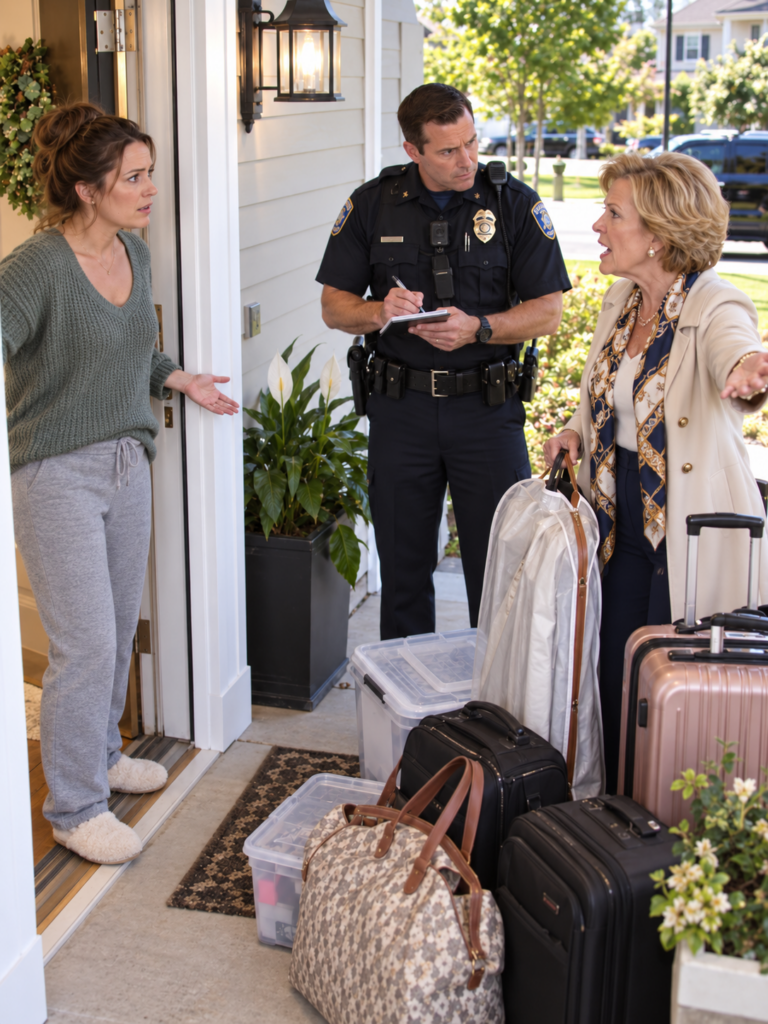
Officer Mercer held the deed between two fingers as though it were the one calm object on a porch crowded with bad decisions.
My mother-in-law, Eleanor, stared at him.
“What do you mean his name isn’t on it?”
Her voice had lost the authority it possessed when she first arrived.
Beside her were three rolling suitcases, two plastic storage tubs, a garment bag, a canvas tote filled with medication bottles, and a ceramic pot containing the drooping fern she had kept in her apartment window for years.
This was not overnight luggage.
This was not even weekend luggage.
This was a woman relocating.
My husband, Scott, stood near the porch steps with both hands shoved into his pockets.
Officer Mercer looked toward me.
“Mrs. Carter?”
“Rachel.”
“Rachel. Is this deed current?”
“Yes.”
“And you’re the sole owner?”
“Yes.”
Scott finally lifted his head.
“It’s more complicated than that.”
I looked at him.
“No, Scott. It really isn’t.”
Eleanor’s eyes moved between us.
She was seventy-three, silver-haired, neatly dressed even after an afternoon spent packing, and ordinarily so particular about appearances that she would straighten framed photographs in other people’s houses if she thought they were crooked.
Now a police cruiser sat in my driveway where every neighbor on our cul-de-sac could see it.
For Eleanor, humiliation had always been worse than inconvenience.
“You told me you bought this place,” she said to Scott.
“I said we got the house after we got married.”
“That is not the same sentence.”
His sister, Melanie, lowered the phone she had been using to record me.
Until then she had apparently expected the video to show an unreasonable daughter-in-law turning an elderly woman away.
Now the camera was facing the ground.
Officer Mercer handed the deed back to Scott.
“I’m not here to decide your family arrangements,” he said. “I need to understand why 911 was called.”
Eleanor straightened.
“Because she refused to let me into my son’s home.”
“The door has been open the entire time,” I said.
Mercer nodded.
He had already noticed.
“And do you currently live here, ma’am?” he asked Eleanor.
“I was supposed to starting today.”
“That isn’t what I asked.”
“No.”
“Have you ever lived here?”
“No.”
“Do you receive mail here?”
“No.”
“Do you keep belongings here?”
Eleanor glanced at the luggage.
“Not yet.”
That answer would have been funny under different circumstances.
Nothing felt funny then.
Officer Mercer turned to Scott.
“Did Rachel agree to your mother moving in?”
Scott hesitated.
That hesitation was the first honest thing he had offered all afternoon.
“No.”
Eleanor turned on him.
“You told me Rachel was fine with it.”
Scott winced.
“I said she would be.”
“You said it was settled.”
“So did he,” I said.
Scott looked at me.
“Rachel, not now.”
I actually laughed.
It came out once, sharp and joyless.
“Not now? Scott, your mother called emergency services because of something you told her, your sister is filming me on my own porch, and there are six containers of belongings waiting to cross my front door. When exactly would you prefer?”
Officer Mercer stepped slightly backward.
He had the look of a man who understood that whatever crime Eleanor had imagined was occurring, the real problem was marital.
He had no badge for that.
The entire disaster had started less than two hours earlier.
At 4:08 that afternoon, I was sitting in the downstairs room I used as an office.
I worked for a regional insurance administrator and spent three days a week at home handling complicated claims that required long stretches of concentration. The room was not glamorous. It held a desk, two monitors, locked file storage, a printer that jammed whenever I needed it most, and an old blue armchair that had belonged to my father.
But it mattered to me.
So did the house.
My father, Frank, had left it to me.
Not the exact house where I grew up, but the house he bought after my mother died. A modest four-bedroom colonial outside Columbus, Ohio, with maple trees along the back fence and a kitchen he renovated himself badly enough that one cabinet door still refused to close properly.
Dad lived there for nine years.
After he developed pancreatic cancer, I spent the final seven months sleeping in the guest room and driving him to appointments.
Scott helped sometimes.
I never denied that.
He picked up prescriptions. He repaired a gutter. He sat with Dad twice so I could attend work meetings in person.
After Dad died, the house came to me through his estate.
Scott and I sold the condo we had shared and moved in.
We used money from the condo sale for renovations and furniture. Scott contributed to household expenses.
But my father had been very deliberate.
“Keep the house in your name,” he told me months before he died. “Not because Scott is bad. Because having something secure in this world matters.”
I had felt uncomfortable when he said it.
At that point Scott and I had been married six years.
“Dad, we’re fine.”
“I hope you stay fine for fifty years. Keep the house in your name anyway.”
So I did.
Scott knew.
He signed documents acknowledging it during the estate process.
Apparently Eleanor did not.
At 4:08, my phone buzzed beside my keyboard.
Scott.
I opened the text.
Mom’s coming to stay with us. Melanie is bringing her over. We’ll use your office. It’s settled.
I read it twice.
Then a third time.
I called him.
He answered after four rings.
“Hey.”
“What does ‘it’s settled’ mean?”
A pause.
“Mom can’t keep paying for that apartment.”
“And?”
“And she needs somewhere stable.”
“I understand the problem, Scott. I’m asking when we discussed her moving here.”
“We’re discussing it now.”
“No. You just told me what’s happening.”
He sighed, already irritated.
That irritated sigh would later become almost as important to me as the text itself.
It meant he considered my objection a complication, not information.
“She’s my mother, Rachel.”
“I know who she is.”
“She’s seventy-three.”
“I know how old she is.”
“She got another rent increase.”
“I know. You told me Sunday.”
“So what do you expect her to do?”
“I expected my husband to talk to me before offering somebody a room in our home.”
“Our home.”
He emphasized the word our.
At the time, I did not understand why.
“Yes,” I said. “Our home. Which means we both decide.”
“You’re being technical.”
“I’m being married.”
He went silent.
Then he said, “Melanie can’t take her.”
“Why?”
“Her house is too small.”
Melanie lived in a four-bedroom home twelve minutes from Eleanor’s apartment.
I waited.
Scott finally added, “She needs the fourth bedroom for work.”
I looked around my office.
My laptop was open.
Both monitors were running.
A stack of claim files sat beside me.
“So Melanie’s office is essential.”
“Don’t make this about Melanie.”
“You just made it about Melanie.”
“You can work upstairs.”
“Where?”
“The guest room.”
“The guest room has a bed.”
“We can rearrange it.”
“For how long?”
Another pause.
“A few months.”
That was the first version.
Later I would learn there had been others.
“Call your mother,” I said. “Tell her not to come.”
“Rachel.”
“Call her.”
“She’s already packed.”
My stomach dropped.
“What?”
“It took her all day.”
“You knew about this before today.”
“It came together quickly.”
“How quickly?”
He didn’t answer.
“Scott?”
“I’ve got to go.”
Then he hung up.
Thirty-seven minutes later, Melanie’s silver SUV turned into my driveway.
I watched through the office window.
Eleanor climbed out of the passenger side.
Melanie opened the rear hatch.
The first suitcase came out.
Then the second.
Then the third.
By the time they pulled out the storage tubs, I understood that whatever Scott had told me about “a few months,” his mother had packed as though she expected permanence.
I went to the front door.
Eleanor was coming up the walkway carrying her fern.
She smiled.
“There you are.”
“Hi, Eleanor.”
“Scott said you’d probably still be working.” She looked past me. “Has he moved your desk yet?”
That was the moment my anger changed.
Until then, I had blamed Scott for being impulsive.
Now I realized there had been planning.
“No.”
She looked confused.
“No?”
“No one is moving my desk.”
Melanie came up behind her carrying a suitcase.
“Oh, Rachel. Please don’t make this difficult.”
I looked at her.
“You’ve been here thirty seconds.”
“And I already know that expression.”
“Then you also know this isn’t happening.”
Eleanor’s smile disappeared.
“What isn’t happening?”
“You moving in today.”
She looked almost amused.
“Scott said you might be emotional.”
That sentence hit harder than I expected.
Not because Eleanor said it.
Because Scott must have.
“Did he?”
“He said change makes you anxious and that you might need a little time to adjust.”
I stared at her.
Behind Eleanor, Melanie rolled the second suitcase toward the steps.
“Leave everything outside,” I said.
Melanie stopped.
“Excuse me?”
“Nothing comes in until Scott gets home.”
Eleanor’s cheeks reddened.
“Rachel, I don’t know what misunderstanding you and my son are having, but I gave notice on my apartment.”
That stopped me.
“You what?”
“I’m out by the end of the month.”
“Scott told me this was temporary.”
“It might take time to find somewhere else eventually.”
“Eventually?”
“He said I could stop worrying about housing.”
I looked toward Melanie.
She avoided my eyes.
A chill ran through me despite the August heat.
“When did he tell you that?”
Eleanor shifted the fern to her other hand.
“Two weeks ago.”
Two weeks.
Scott had spent two weeks eating dinner with me, watching television beside me, asking whether we needed milk, discussing a dentist appointment, and complaining about the lawn mower.
For fourteen days he had apparently known his mother believed she was moving into my house.
“You can come inside and have some water,” I said carefully. “But your belongings stay there.”
Eleanor stared at me.
“You can’t be serious.”
“I am.”
“My son told me this is my home now.”
“No. He told you it could become your home without asking me.”
“My son lives here.”
“Yes.”
“He pays bills here.”
“Yes.”
“Then he has every right to bring his mother home.”
“Not by pretending I agreed.”
Eleanor set the fern on the porch rail.
“Scott warned me you might do this.”
My throat tightened.
“What exactly did he warn you I might do?”
“Make everything about control.”
For a second, I could not speak.
Melanie stepped forward.
“Mom doesn’t deserve this.”
“Neither do I.”
“She needs help.”
“I know.”
“Then act like family.”
I looked at the SUV, the suitcases, the tubs, the garment bag.
“You had room in your car for all this, but not room in your house?”
Her face changed.
“My arrangement is different.”
“Of course it is.”
She pulled out her phone.
“What are you doing?”
“Documenting this.”
“For who?”
“In case you start changing your story.”
I should have been furious.
Instead, something in me became very calm.
“Please record.”
She blinked.
“Fine.”
“Start with the luggage.”
Eleanor reached for her phone and called Scott.
He didn’t answer.
She tried again.
Nothing.
Then she said the sentence that pushed the afternoon from family argument into something else.
“I am not being put on the street by a woman who thinks she owns my son’s house.”
I looked at her.
“Eleanor—”
“My son owns this house.”
I almost corrected her.
Then I stopped.
Not because I wanted to embarrass her.
Because I suddenly needed to know how far the lie went.
“Who told you that?”
She gave me an incredulous look.
“Scott did.”
Melanie’s phone remained raised.
“He told you he owns this house?”
“He said he put everything into it.”
That was not an answer, but it was close enough.
Eleanor called Scott once more.
No response.
Then she dialed 911.
Even Melanie lowered her phone.
“Mom, maybe don’t—”
Too late.
Eleanor told the dispatcher her daughter-in-law had locked her out of her son’s house.
The front door stood open behind me.
I did not argue with her while she was on the phone.
I did not grab the phone.
I did not raise my voice.
Something my father used to say came back to me.
When people are determined to be wrong loudly, let them finish.
So I let her finish.
At 5:26, Scott pulled into the driveway.
At 5:28, the police cruiser arrived.
And by 5:41, Officer Mercer was holding the deed.
Now, as the late afternoon sun stretched shadows across the lawn, Eleanor looked at her son with an expression I had never seen before.
Not anger.
Not yet.
Recognition.
“You lied to me.”
Scott rubbed his forehead.
“No, Mom.”
“You said it was yours.”
“I said Rachel and I live here together.”
“You said you had put years of money into this house.”
“I have.”
I spoke quietly.
“You’ve also known since probate that it belongs to me.”
Scott looked at me.
“Legally.”
There it was.
That word.
Legally.
As if reality came in two versions, and mine was merely paperwork.
Officer Mercer shifted his weight.
“I think I understand the situation.”
Scott turned toward him.
“So she can just stop my mother from coming inside?”
Mercer chose his words carefully.
“This is not a legal opinion about your marriage, sir. But your mother has told me she does not currently reside here. No one is physically preventing her from entering as a visitor. The disagreement is about whether she can establish residence here today.”
He glanced at the luggage.
“That is a civil and domestic matter. It is not something I can force Rachel to accept because you invited your mother.”
Scott’s jaw tightened.
Eleanor looked at him.
“You told me if Rachel caused trouble, the police would make her stop.”
My head turned.
So did Officer Mercer’s.
Scott’s face drained.
“I never said that.”
“You said she couldn’t legally keep me out because you live here.”
“I meant—”
“Scott.”
Eleanor said his name quietly.
He stopped.
And for the first time that afternoon, I understood something important.
Scott had not merely made one reckless promise.
He had built a different reality for each woman standing on that porch.
And those realities had finally collided.
Part 2
Officer Mercer left twenty minutes later.
No one was arrested.
No one was ordered inside.
No dramatic legal ruling settled our family.
The police cruiser simply backed out of the driveway, leaving us with the consequences.
In some ways that felt worse.
Eleanor stood beside her belongings.
Melanie leaned against the SUV with both arms crossed.
Scott turned to me.
“Can Mom at least stay tonight?”
I stared at him.
His ability to keep negotiating amazed me.
“Where?”
“The guest room.”
“You promised her my office.”
“For her things.”
“She asked whether you had moved my desk.”
He glanced at Eleanor.
“She misunderstood.”
Eleanor laughed once.
“No, I did not.”
It was the first time all afternoon she defended me.
Scott looked wounded by it.
“Mom.”
“You told me Rachel wanted the upstairs room for storage anyway.”
My eyes narrowed.
“What?”
Scott shook his head.
“That’s not exactly—”
“You said,” Eleanor continued, “‘Rachel hardly uses the downstairs office now. She keeps talking about moving upstairs.’”
I felt the ground shift beneath the argument.
Not because of the room.
Because months earlier, I had casually told Scott I sometimes wished the upstairs guest room had better light.
He had apparently transformed that harmless comment into evidence that I wanted to surrender my office.
“How long have you been discussing this?” I asked.
He didn’t answer.
Melanie did.
“Since Mom’s renewal notice came.”
“When was that?”
“Last month.”
A full month.
My anger became almost strangely pure.
No shouting.
No confusion.
Just clarity.
“You all discussed where I would work.”
Melanie frowned.
“We were trying to solve a problem.”
“You discussed moving my furniture.”
“Because Scott said you were okay with it.”
Eleanor looked at her daughter.
“He said she’d agreed in principle.”
Scott groaned.
“Everybody is twisting what I said.”
“No,” I told him. “Everybody is finally comparing what you said.”
That silenced him.
Eleanor eventually went home with Melanie.
Her apartment lease still had nine days left.
The luggage returned to the SUV.
The fern went last.
I stood on the porch as the hatch closed.
Before Eleanor got into the passenger seat, she looked at me.
“I owe you an apology for calling the police.”
Scott looked up sharply.
I said nothing.
She continued.
“But I am still deeply hurt that you would leave me with nowhere to go.”
There it was—the old pattern.
An apology immediately balanced by an accusation.
“I didn’t leave you anywhere,” I said. “I found out today that you were coming.”
She glanced at Scott.
“I don’t know what to believe anymore.”
Neither did I.
After they drove away, Scott followed me into the kitchen.
I went directly to the refrigerator and poured a glass of water.
My hands had begun shaking again now that no strangers were watching.
“Rachel.”
I drank.
“Can we talk?”
“We are going to.”
He sat across from me.
For several seconds, neither of us spoke.
The kitchen clock clicked loudly.
Finally he said, “I screwed up.”
It should have helped.
Instead I heard the language.
Not lied.
Not manipulated.
Not made decisions behind your back.
Screwed up.
Like he had forgotten to pay the electric bill.
“How long?”
“A few weeks.”
“How long?”
“About a month.”
“You told your mother she could move here a month ago.”
“I told her we would make sure she had somewhere.”
“That is not what she heard.”
“I was trying to calm her down.”
“So you lied.”
“I was buying time.”
“With my house.”
“Our house.”
I set my glass down.
“No.”
His expression hardened.
And there it was again.
That same invisible contest.
“Our marriage does not turn inherited property into something you can offer without asking me.”
“So now I’m a guest here?”
“I didn’t say that.”
“You’re making sure I know it’s yours.”
“You made your mother believe it was yours.”
He looked away.
I waited.
“Why?”
He rubbed both hands over his face.
“My family already thinks you’re more successful than me.”
I stared at him.
Of all the explanations I imagined, that was not one.
“What?”
“You earn more.”
“Barely.”
“You inherited a paid-off house.”
“My father died.”
“I know that.”
“Do you?”
He flinched.
I continued.
“This house wasn’t a prize, Scott. I changed Dad’s sheets when chemotherapy made him sick. I learned how to crush medication into applesauce. I held his hand when he died in the bedroom upstairs.”
“I was there for you.”
“Yes. And I loved you for it. Which makes what you did even harder to understand.”
He stood and walked to the sink.
“Mom always worried I was struggling.”
“So you told her you owned the house.”
“I let her assume.”
“That’s a coward’s version of the same thing.”
He gripped the counter.
“She talks differently about me when she thinks I’m doing well.”
I almost felt sorry for him.
Almost.
Because suddenly I could see the frightened son under the husband.
Eleanor had always compared Scott to his older brother, David, who ran a construction company in Cincinnati. David had the bigger house, newer truck, lake vacations, and framed business awards.
Scott had spent his childhood being described as “the sensitive one,” which sounded kind until you noticed it always came after a sentence about something David had accomplished.
So Scott had inflated himself.
He let his mother think the house was his.
He let her think my career was flexible.
He let her think he made final decisions.
None of it began with cruelty.
But insecurity can become cruelty when other people are forced to pay for it.
“You made me smaller so you could look bigger.”
Scott’s shoulders dropped.
“I didn’t think of it like that.”
“I know.”
That was the problem.
Over the next three days, I slept in the guest room.
Not because I feared Scott.
Because I could not lie beside him and pretend I understood who he was.
Eleanor stayed with Melanie after her lease ended.
This created a second crisis almost immediately.
Melanie discovered that an aging parent occupying a room was apparently more disruptive when the room was hers.
On the fourth day, she called Scott eleven times.
I knew because his phone kept lighting up on the kitchen counter.
He finally answered on speaker while making coffee.
“What?”
“You need to fix this.”
“Fix what?”
“Mom.”
From across the room, I nearly laughed.
Melanie continued.
“She rearranged my pantry.”
Scott pinched the bridge of his nose.
“She always does that.”
“She put labels on my flour.”
“So?”
“And she keeps taking calls in my office because she says the guest room gets bad reception.”
I looked up from my laptop.
Scott noticed.
I raised one eyebrow.
He took the phone off speaker.
I heard only fragments afterward.
“…not Rachel’s fault.”
Pause.
“No, I’m not asking again.”
Another pause.
“I said no.”
He ended the call.
I returned to work.
A minute later he said, “You enjoyed that.”
“I enjoyed nothing about this.”
“She gets your point now.”
“My point wasn’t that your mother is annoying.”
He frowned.
“Then what was it?”
“That nobody gets to sacrifice somebody else’s space because theirs matters more.”
He sat opposite me.
“What do you want me to do?”
It was the question he had begun asking constantly.
What do you want me to do?
At first it sounded cooperative.
Then I realized it was another way of handing me responsibility.
If I told him what to do, he could follow instructions and avoid making an adult choice.
“I want you to decide what kind of husband you are.”
“That doesn’t mean anything.”
“It means everything.”
He pushed his chair back.
“I apologized.”
“You apologized for the porch.”
“What else is there?”
I stared at him.
“The porch was where we found out.”
His expression changed.
I opened the notes app on my phone.
For days I had been writing things down.
Not secret accusations.
Facts.
Dates.
Things Eleanor and Melanie had repeated.
“You told your mother she could live here indefinitely.”
“I never used indefinitely.”
“You told me a few months.”
“I was guessing.”
“You told her I agreed in principle.”
“I thought you would.”
“You told Melanie I wanted to move my office.”
“You mentioned it.”
“I mentioned the sunlight upstairs.”
He opened his mouth.
I kept going.
“You told your mother the police could make me let her stay.”
“I absolutely did not say it like that.”
“You let her believe you owned the house.”
He looked toward the window.
“And you told all of them I was controlling.”
“I said you like things a certain way.”
“Scott.”
Silence.
“You didn’t just solve a problem badly. You created a version of me they could blame if your promises failed.”
He sat perfectly still.
That was the sentence that reached him.
I could see it.
Not enough to fix anything.
But enough to remove his defenses for a moment.
“I didn’t mean to.”
“I believe you.”
He looked surprised.
Then I said, “Intent doesn’t restore trust.”
Two days later, Eleanor called me.
Not Scott.
Me.
“I’d like to meet somewhere.”
I considered refusing.
Then curiosity won.
We met at a Panera halfway between Melanie’s house and mine.
Eleanor arrived ten minutes early.
Of course she did.
She had coffee waiting for me.
We sat near the window.
For the first few minutes, she talked about the weather.
Then she folded her napkin into a narrow rectangle.
“I found something.”
My stomach tightened.
“What?”
She pulled her phone from her purse.
“A text thread.”
She turned the screen toward me.
The messages were between her and Scott.
I read them slowly.
The first was dated thirty-two days earlier.
Eleanor: I can’t afford another increase. I don’t know what I’m supposed to do.
Scott: Don’t panic. We have room.
Eleanor: Rachel won’t want me there.
Scott: She knows family comes first.
A week later:
Eleanor: Are you sure about this?
Scott: Yes. The downstairs room will be yours.
Eleanor: Isn’t that Rachel’s office?
Scott: She doesn’t really need it anymore.
Then, six days before the move:
Eleanor: I need to tell the landlord tomorrow whether I’m leaving.
Scott: Tell him. You’re covered.
My fingers went cold.
Eleanor watched my face.
“There’s more.”
She scrolled.
Eleanor: I hate feeling like I’m imposing.
Scott: You won’t be. It’s my house too.
Then the message that made me stop breathing for a second.
Eleanor: Does Rachel know I’m giving up the apartment?
Scott: Yes.
One word.
Yes.
There was no ambiguity left.
No misunderstanding.
No insecurity-based exaggeration.
A direct lie.
Eleanor locked her phone.
“I wanted you to see that.”
“Why?”
“Because I blamed you.”
I looked at her.
She stared down at the table.
“I believed my son.”
Her voice broke slightly on the last word.
For the first time since the whole thing began, I saw her not as the imperious woman on my porch but as someone who had made a major decision based on a person she trusted.
“He told you I agreed.”
“Yes.”
“And you gave up your lease because of it.”
“Yes.”
“I’m sorry.”
Her eyes lifted.
“You have nothing to apologize for.”
I almost smiled at the irony.
A week earlier she had called the police on me.
Now she was defending me to myself.
Eleanor picked at the edge of her napkin.
“I also owe you something else.”
I waited.
“I have been… unfair about that house.”
“That’s one word for it.”
She accepted the correction.
“I thought Scott was carrying more than he was.”
“Why?”
She looked embarrassed.
“Because he wanted me to.”
There it was.
Eleanor told me about conversations I had never heard.
Scott had implied he paid the mortgage.
There was no mortgage.
He had suggested my salary mostly covered “extras.”
We kept separate retirement accounts and divided ordinary expenses proportionally.
He had said the renovations were mostly funded by him.
They were paid from the condo sale, to which we had contributed nearly equally.
“He made himself sound like a man supporting his wife,” Eleanor said.
“And what did I sound like?”
She didn’t answer.
“Eleanor.”
“Dependent.”
The word hurt more than I expected.
Not because I cared what Eleanor thought of my paycheck.
Because I remembered all the little comments I had ignored.
It’s wonderful Scott gives you such a comfortable life.
You’re lucky to have a husband who handles the big things.
At least Scott was able to put a roof over your head after your father died.
I had smiled tightly.
Changed subjects.
Protected Scott from embarrassment.
My silence had helped him maintain the lie.
Eleanor took a breath.
“There’s something else.”
I almost laughed.
“Of course there is.”
“Melanie knew.”
I stopped.
“About the house?”
“Not originally. But she knew before we came over.”
“How?”
“She asked Scott directly because she thought it was strange that you would give up your office.”
“And?”
“He admitted the deed was yours but said it didn’t matter because spouses have equal rights.”
I pictured Melanie holding up her phone.
Documenting me.
Knowing.
“She recorded me anyway.”
Eleanor nodded.
“She thought if you looked unreasonable enough, you’d back down once the family saw the video.”
That betrayal surprised me more than it should have.
Melanie and I had never been close, but I had attended her children’s birthdays for eleven years. I had brought casseroles after her surgery. I had driven two hours through snow when her husband was hospitalized.
She had stood on my porch knowing Scott had lied and decided the useful response was to publicly pressure me.
“Why are you telling me this?”
Eleanor’s mouth tightened.
“Because after three nights at her house, she asked me whether I could stay at a hotel until Scott ‘got you under control.’”
I stared at her.
“She said that?”
“Yes.”
A strange quiet settled between us.
For years Eleanor and I had competed without admitting we were competing.
For Scott’s loyalty.
For holidays.
For whose preferences mattered.
For who understood him best.
Now, sitting beneath the fluorescent lights of a chain café, we had stumbled upon an unpleasant truth.
Neither of us had actually been fighting the other.
We had been responding to versions of each other Scott had created.
I went home with screenshots Eleanor sent me.
Scott was in the garage.
I stood in the doorway.
“Did you tell your mother I agreed before she gave notice?”
He froze.
There are moments in a marriage when the answer arrives before words.
That was one.
“Rachel—”
“Yes or no.”
He put down the wrench he was holding.
“Yes.”
I nodded.
He stepped toward me.
“I can explain.”
“You’ve explained enough.”
“I panicked.”
“For a month?”
“I thought if I got everything moving, you’d eventually say yes.”
The honesty of it was almost breathtaking.
“You thought you could make it too difficult for me to say no.”
He did not answer.
“That’s not asking.”
“I know.”
“That’s not even assuming.”
“I know.”
“That’s trapping someone.”
His face folded.
“I know.”
I had imagined this moment.
I thought I would scream.
Instead I said, “I want you to leave.”
He stared at me.
“What?”
“I need space.”
“For how long?”
“I don’t know.”
“Where am I supposed to go?”
The question nearly undid me.
Not because it was difficult.
Because it was exactly the question his mother had asked on the porch.
Where am I supposed to go?
As though the person betrayed also had to solve housing.
“You have options.”
“Rachel, this is my home.”
“It has been your home. I am not pretending otherwise.”
“You can’t just kick me out.”
“I’m asking you to leave voluntarily while we decide whether this marriage can be repaired. If you refuse, we’ll speak to attorneys and handle everything properly.”
He stared at me.
“You already talked to a lawyer?”
“No.”
Not yet.
That came the following morning.
And what the attorney told me created the complication I had not expected.
Marriage, property, occupancy, and contributions were not as simple as Eleanor or I had made them sound on the porch.
The house had been inherited by me and titled solely to me, which mattered enormously.
But Scott had lived there for years.
There were financial questions.
Marital-property questions involving renovations.
Occupancy issues.
The attorney, a woman named Carolyn Pike, listened without drama while I explained the police call, the texts, and Scott’s family.
Then she said, “Do not turn this into a contest over who can throw whom out fastest.”
“I don’t want to.”
“Good. Because the emotional answer and the legal answer are not always identical.”
I appreciated that.
I also hated it.
I wanted one clean document to solve everything.
Life rarely offers one.
Scott went to stay with his brother David.
Three days later, I received an email from him.
He wanted counseling.
He admitted lying.
He admitted manipulating the situation.
He admitted using my reluctance to embarrass him as cover for years of misleading his family.
Then, at the bottom, came one sentence that shifted everything again.
There’s something about Mom’s housing I haven’t told anyone.
I read it three times.
Then I called him.
“What now?”
His voice sounded exhausted.
“I borrowed money from her.”
I sat down.
“How much?”
“Twenty-eight thousand.”
For several seconds, I heard nothing but the refrigerator.
“When?”
“Over the last three years.”
“For what?”
“Credit cards. The truck. Some trading losses.”
I closed my eyes.
Our finances were partly separate by mutual agreement.
We shared household bills but maintained personal accounts.
I knew Scott carried some credit-card debt.
I did not know about $28,000 from his mother.
“Does she know you can’t repay her?”
“She thinks I can.”
“Was that money part of her savings?”
“Yes.”
I felt physically sick.
Her rent increase suddenly looked different.
“How much does she have left?”
“I don’t know exactly.”
“You do know.”
Silence.
“Scott.”
“About eleven thousand liquid. Plus Social Security every month.”
I stood and walked to the kitchen window.
The fern-shaped empty spot on my porch flashed through my mind.
“Her housing emergency isn’t just rent.”
“No.”
“You took the money she would have used to survive the rent increase.”
“I planned to pay it back.”
“With what?”
He said nothing.
“And then when she needed help because you hadn’t paid her back, you promised her my office.”
“I know how it sounds.”
I gripped the edge of the counter.
“No. I don’t think you do.”
This was the twist beneath everything.
Scott had not simply wanted to rescue his mother.
He had helped create the emergency he was supposedly rescuing her from.
And he had planned to solve his guilt using my home.
Part 3
I asked Scott not to tell Eleanor before I could speak to Carolyn.
Not because I wanted to conceal his debt.
Because I wanted facts.
Over the next week, statements surfaced.
Transfers.
Checks.
A personal loan Eleanor had taken against a small certificate of deposit.
Scott had borrowed in pieces.
Four thousand.
Seven thousand.
Three thousand.
Another six.
He always had a reason.
A transmission repair.
Credit-card consolidation.
A “temporary investment opportunity.”
Medical insurance costs after his employer changed plans.
Individually, each story sounded manageable.
Together, they formed a pattern.
When Carolyn reviewed what I had gathered, she said, “This is less about your house than it looked initially.”
“I know.”
“No. I mean legally and emotionally. The house became the object everyone fought over, but the underlying problem is financial deception.”
That afternoon I invited Eleanor to come over.
Not to move in.
To talk.
She arrived alone.
For the first time since I had known her, she looked nervous standing at my front door.
“Come in.”
Her eyes flicked toward the office.
I noticed.
“So that room does exist.”
She smiled faintly.
“Apparently.”
We sat at the kitchen table.
I put copies of the transfers between us.
Eleanor stared at them.
“What is this?”
“Money you gave Scott.”
Her expression hardened.
“That is between my son and me.”
“Yes.”
“Then why do you have it?”
“Because I need to ask you something.”
She leaned back.
“All right.”
“Did Scott repay any of this?”
“Some.”
“How much?”
She looked toward the window.
“Eleanor.”
“I don’t keep score with my children.”
“That means no.”
Her lips tightened.
I slid another paper across the table.
It was a summary Scott had finally produced.
Her eyes moved down the page.
When she reached the total, she stopped.
“Twenty-eight?”
“Yes.”
“No.”
She read again.
“That cannot be right.”
“Scott confirmed it.”
“He said the money for the truck was temporary.”
“I know.”
“And the investment money was supposed to come back with interest.”
“It didn’t.”
Her face went pale.
“He told me he was doing well.”
“I know.”
“He told me—”
She stopped.
Neither of us needed the rest.
He told me.
The phrase had become the family refrain.
Eleanor looked very small sitting at my kitchen table.
I remembered the woman from the porch.
My son owns this house.
The certainty was gone.
“I used part of my savings because I thought he was established,” she said.
“I know.”
“I thought if anything happened, he could help me.”
“I know.”
Her eyes filled.
I looked away long enough to give her privacy.
Then she said, “Is that why he was so determined to move me here?”
“I think it was part of it.”
She covered her mouth.
“He was paying me back with your house.”
I had not phrased it that way.
She had.
And it was exactly right.
That evening, Eleanor asked Scott and Melanie to meet us.
At my house.
I agreed on one condition.
No cameras.
Melanie arrived defensive.
Scott arrived ten minutes later with David, his older brother.
I had not invited David, but when Scott asked whether he could come, I said yes.
Maybe because David had spent his entire life unknowingly participating in the comparison Scott feared.
Maybe because secrets had done enough damage.
We sat around the dining-room table.
For once, nobody knew where to begin.
Eleanor did.
“Twenty-eight thousand dollars.”
Melanie’s head turned.
David frowned.
Scott stared at the table.
Eleanor pushed the summary toward him.
“Tell them.”
“Mom.”
“Tell them.”
He looked at David.
Then Melanie.
“I borrowed money.”
“How much?” David asked.
Eleanor tapped the paper.
“Twenty-eight thousand.”
Melanie’s mouth fell open.
“From Mom?”
“Yes,” Scott said.
“What the hell?”
“Melanie,” Eleanor snapped.
She rarely objected to language.
That night she needed control of something.
David picked up the summary.
“Why?”
Scott’s shoulders rose and fell.
“Debt.”
“What debt?”
“Credit cards. Investments that went bad.”
David looked at him.
“You don’t invest.”
“I tried.”
“When?”
“Two years ago.”
“With Mom’s money?”
Scott didn’t answer.
David set the paper down.
For the first time, I saw something almost liberating happen on Scott’s face.
The worst version of him was finally visible.
He no longer had to perform.
“I was tired of being the one everyone worried about,” he said.
Eleanor stared at him.
“What does that mean?”
“You know what it means.”
“No, I don’t.”
“Yes, you do.”
His voice rose for the first time.
“David is the successful one. Melanie is the organized one. I’m the one you call and ask if I remembered to renew my registration.”
David leaned back.
“Don’t drag me into this.”
“I’m not blaming you.”
“You sound like you are.”
“I’m blaming me.”
That quieted the room.
Scott looked at his mother.
“I wanted you to think I had made it.”
Eleanor’s eyes narrowed.
“So you took my retirement savings?”
“I borrowed it.”
“You did not pay it back.”
“I planned to.”
“With what?”
Silence.
She pointed toward me.
“With Rachel’s house?”
Scott shut his eyes.
Melanie looked from him to me.
“I didn’t know about the money.”
“I believe you,” I said.
She seemed relieved.
“Then you understand why—”
“No.”
The relief disappeared.
“I understand you didn’t know about the money,” I said. “I don’t understand why you recorded me when you already knew the deed was mine.”
David turned toward her.
“You knew?”
Melanie reddened.
“That wasn’t the point.”
“What was the point?” I asked.
“Mom needed somewhere.”
“So you wanted to pressure me.”
“I wanted you to stop making everything harder.”
I nodded slowly.
“By filming me.”
“You were making Mom stand outside.”
“She could come inside.”
“With her things?”
“No.”
“Exactly.”
David muttered, “That’s not exactly.”
Melanie shot him a look.
Eleanor spoke before they could start.
“Enough.”
Everyone stopped.
She looked at Melanie.
“Why couldn’t I stay with you?”
Melanie blinked.
“You did.”
“That week. Before that.”
“You know my house.”
“I know it has four bedrooms.”
“One is my office.”
I watched Eleanor’s expression change.
It happened gradually.
Recognition moving through her own words.
“My office,” she repeated.
Melanie crossed her arms.
“I work from home.”
“So does Rachel.”
“Yes, but—”
“But what?”
Melanie stopped.
There are moments when hypocrisy does not need to be exposed.
It merely needs to hear itself.
Eleanor looked down at her hands.
“When you said your office mattered, I accepted it.”
Melanie’s face softened.
“Mom—”
“When Rachel said hers mattered, I called the police.”
No one spoke.
Eleanor turned to me.
“I am sorry.”
This time there was no but.
No balancing accusation.
No reminder of her age.
No explanation.
Just four words.
“I am truly sorry.”
I nodded.
“Thank you.”
Scott began repaying Eleanor the following month.
Not magically.
There was no secret account waiting to fix everything.
He sold his truck and bought an older used sedan.
He cashed out a small investment account.
He stopped several expensive subscriptions and took weekend contract work.
David helped him create a repayment schedule.
I did not.
That mattered to me.
Scott’s repair of the damage could not become another project assigned to his wife.
Eleanor did not move into my house.
She also did not end up homeless.
Carolyn connected me with a local senior-housing resource through a colleague who volunteered with an aging-services nonprofit. Eleanor qualified for a modest apartment in a nearby complex where rent was based partly on income.
The place was smaller than her old apartment.
At first she hated that.
Then she discovered the building had a garden club.
Within three months she was complaining that the woman in charge of the hydrangeas had “no sense of proportion,” which told me Eleanor had recovered enough to become herself again.
Her fern survived too.
Melanie apologized later.
That one took longer.
She came to my house alone one Saturday morning.
I almost did not open the door.
“I deleted the video,” she said.
“That’s good.”
“I never posted it.”
“That’s also good.”
She shifted awkwardly.
“I thought Scott had the right to make decisions because he lived here.”
“You thought he had the right to make decisions for me.”
She looked down.
“Yes.”
It was not a beautiful apology.
But it was accurate.
Sometimes accuracy is where repair begins.
“I’m sorry,” she said.
I accepted it without pretending we were suddenly close.
We weren’t.
Trust is not a light switch.
It is more like one of those old dimmer knobs.
Sometimes it comes back slowly.
Sometimes it never reaches full brightness again.
Scott and I began counseling six weeks after the police came.
For a while, everyone assumed that meant we were staying married.
It did not.
Counseling is not always a bridge back.
Sometimes it is a well-lit road toward the truth.
Our therapist, Dr. Warren, asked Scott a question during our third session.
“When you were telling your mother Rachel had agreed, what did you believe would happen?”
Scott looked at me.
Then he looked away.
“I thought once Mom was physically there, Rachel wouldn’t make her leave.”
“Why?”
“Because Rachel hates scenes.”
That sentence changed something in me.
He knew.
He knew exactly which part of my character he was exploiting.
My restraint.
My dislike of embarrassing people.
My instinct to smooth conflict.
The same qualities I had once thought made me a patient wife had become tools he counted on.
Dr. Warren turned to me.
“How does hearing that feel?”
“Clarifying.”
Scott started crying.
I did not.
That surprised both of us.
“I love you,” he said.
“I know.”
“I never wanted to hurt you.”
“I know.”
“Then why does that sound like goodbye?”
Because by then I understood that love and safety were not the same thing.
A person could love me and still construct circumstances designed to take away my ability to say no.
A person could love his mother and still take her savings.
A person could love his wife and still diminish her accomplishments because he was ashamed of his own.
Good intentions were not imaginary.
They were simply insufficient.
We separated permanently that winter.
The divorce was not theatrical.
There was no courtroom showdown.
No one gasped while a hidden document appeared.
The house remained mine.
Scott received an agreed share of certain marital assets and reimbursement considerations related to documented improvements, worked out by attorneys and mediation.
I did not try to punish him financially.
I wanted separation, not destruction.
He continued repaying Eleanor.
By the time our divorce was final the following spring, he had repaid nearly half.
He moved into a two-bedroom apartment across town.
One evening after mediation, we stood in my driveway while he loaded the last box of books he had left in the garage.
The same driveway where his mother’s suitcases once stood.
He shut the trunk.
“I keep thinking about that text.”
“What text?”
He gave me a sad smile.
“You know which one.”
I did.
Mom’s coming to stay. It’s settled.
“I thought I was being decisive,” he said.
“You were.”
“That’s not a compliment.”
“No.”
He leaned against the car.
“Do you think we could have survived if I’d asked instead?”
The question surprised me.
I considered it.
“If you had come home and said your mother was scared, rent had gone up, and you had borrowed money from her that you couldn’t repay?”
He nodded.
“We would have had a terrible week.”
He laughed softly.
“That bad?”
“Awful.”
“Would you have let her move in?”
“Maybe temporarily. Maybe not. We would have looked at everything.”
“I should have trusted you.”
“Yes.”
“I think I was afraid you’d say no.”
“That’s what asking means, Scott.”
He looked at me.
I continued.
“If the other person is not allowed to say no, it isn’t a conversation.”
He nodded.
For once, he did not defend himself.
Before leaving, he reached into his car and brought out something wrapped in newspaper.
My father’s old brass level.
Scott had borrowed it years earlier and apparently kept it in his toolbox.
“I think this belongs here.”
I took it.
Dad’s initials were scratched into one side.
F.C.
I ran my thumb across them.
“Thank you.”
Scott got into his car.
Then he lowered the window.
“For what it’s worth, I’m sorry I made your house into proof that I was somebody.”
I looked at him.
“You were already somebody.”
His face tightened.
“I wish I’d known that.”
“So do I.”
Then he drove away.
A year after the police call, Eleanor invited me to lunch.
Our relationship had become something neither of us would have predicted.
Not mother and daughter.
Not exactly friends.
Maybe two women who had survived the same man’s need to be admired and no longer had much interest in competing.
She chose a diner near her apartment.
Halfway through lunch, she took a photograph from her purse.
It showed her standing beside a raised garden bed with three other women from her building.
“You look happy,” I said.
“I am.”
Then she pointed at the corner of the photograph.
There was the fern.
Larger now.
Healthier.
“I thought you’d appreciate that.”
I smiled.
“I do.”
Eleanor stirred her coffee.
“You know, I still sometimes feel embarrassed about that day.”
“The police?”
“Yes.”
“You should.”
She looked up.
I smiled.
“So should Scott. So should Melanie. There was plenty to go around.”
She laughed.
Then grew serious.
“I thought ownership was the important part.”
“So did I for a while.”
“Wasn’t it?”
“Legally, it mattered.”
“And otherwise?”
I looked through the diner window at cars moving along the road.
“The bigger problem wasn’t whose name was on the deed.”
“What was?”
“That everyone thought my consent was less important than keeping Scott comfortable.”
Eleanor sat with that.
Then nodded.
“Yes.”
When I returned home that afternoon, the house was quiet.
Not lonely.
Quiet.
There is a difference.
I walked into the downstairs office.
My desk was still there.
So were the two monitors, the stubborn printer, and the blue armchair that had belonged to Dad.
On the shelf above it sat his brass level.
For years I had thought the house was the security he left me.
I finally understood he had tried to leave me something else too.
The belief that I was allowed to protect what mattered without apologizing for disappointing someone.
I opened the window.
Outside, the maple leaves shifted in the afternoon breeze.
No suitcases waited on the porch.
No one was standing at the door insisting a decision had already been made for me.
The room remained mine, but that was no longer the most important part.
The most important part was that when I sat down at my desk, I no longer needed a deed, a police officer, a husband, or an entire family to confirm something I should have trusted from the beginning.
My voice counted before anyone agreed with it.


