Part 1
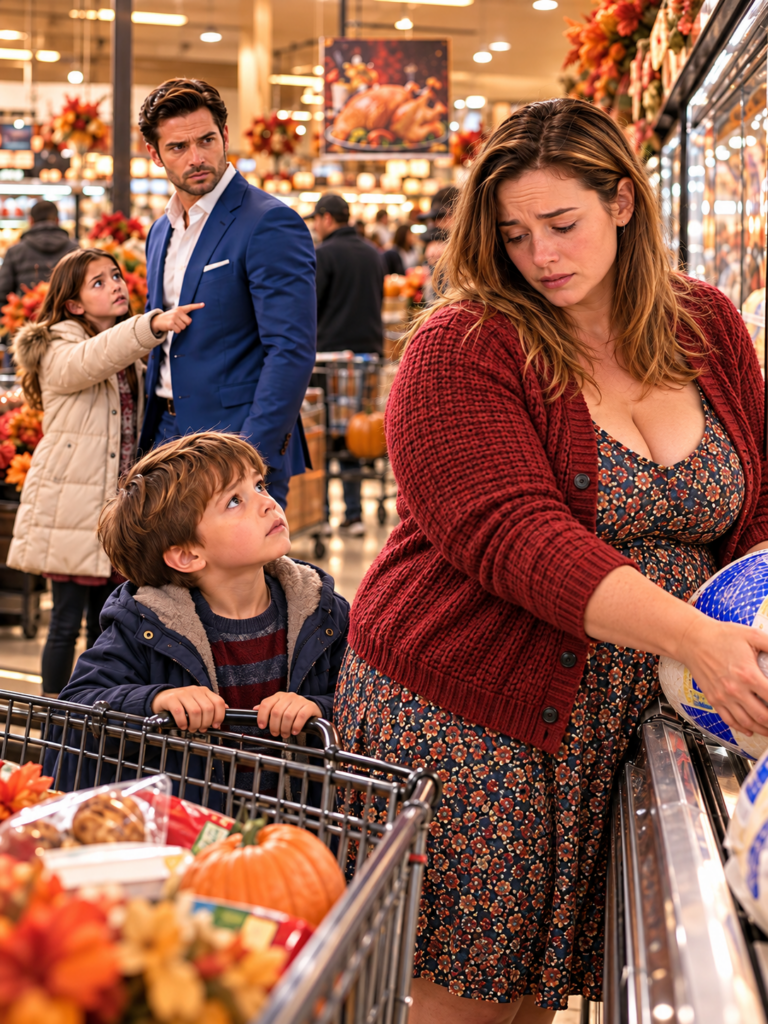
Two days before Thanksgiving, Lindall’s Market smelled of cinnamon from the bakery, wet wool, and the sharp cold people carried in on their coats.
Eric Thorson had come straight from work. His dark overcoat was still buttoned, his phone rested in one hand, and his eight-year-old daughter steered their cart with the grave concentration of someone entrusted with a mission.
Elsie stopped in front of the canned cranberry sauce.
“The kind with the ridges, Dad.”
Eric glanced from the ordinary can in her hand to the glass jars beside it. “The other kind has actual cranberries.”
“The ridges are the point.”
He considered arguing.
Then he dropped two cans into the cart.
Elsie nodded, satisfied.
For three years, it had been the two of them most of the time. They had become efficient at small things—school mornings, grocery runs, forgotten permission slips, takeout ordered before either of them admitted they were hungry. Eric had built efficiency into a way of life.
Just us, he sometimes said.
Elsie had stopped answering.
Near the dairy case, his phone buzzed. An operations problem. Glass stalled in Omaha. A driver waiting. A production schedule threatened.
Eric answered automatically, and his voice changed with it.
“Yes. Move the Sioux City load first. No, don’t wait until morning.”
Lower. Flatter.
The voice that ran Thorson Window Company.
Elsie drifted away with the cart because she knew what came next.
That was when she saw Milo Lowry.
He was a first grader at Hawthorne Elementary, small for his age, with a cowlick that no amount of water could persuade to lie flat. He stood beside his mother’s cart while she stared at her phone calculator.
Potatoes.
Stuffing.
Canned green beans.
Rolls.
A pumpkin pie.
A turkey.
Milo’s mother added the numbers again.
Greta Lowry wore a coat that looked too light for a South Dakota November. Her mouth moved silently as she counted.
Then she lifted the turkey from the cart.
Elsie watched.
Greta did not leave it beside cereal or canned soup the way rushed shoppers abandoned unwanted things. She carried it back to the refrigerated case, found the place where it had been, set it down, and even straightened the bird beside it.
The gesture bothered Elsie more than crying would have.
“Mom,” Milo said, “did we forget the turkey?”
Greta crouched in front of him.
“We’ve got plenty, bud. Potatoes. Stuffing. Pie.”
Her smile nearly worked.
“We’ll make it special.”
Milo looked toward the cooler.
Greta stood and pointed dramatically toward another aisle. “Okay. Major Thanksgiving decision. Shells or regular macaroni? One vote only.”
“Shells.”
“Strong choice. Shells it is.”
She pushed the cart away.
She never looked back.
Eric ended his call to find Elsie tugging his sleeve.
He bent toward her.
She whispered, “Dad, she can’t afford a Thanksgiving turkey for her child.”
He followed her gaze.
His hand moved toward his wallet before the thought fully formed.
Problem.
Money.
Solution.
That sequence had served him well for most of his adult life.
Then he noticed Greta’s posture.
Shoulders straight. Chin level. Every part of her arranged carefully, as though dignity had become something physical she had to carry without dropping.
He knew that posture.
He had worn it after his marriage collapsed, when neighbors asked if he needed anything and colleagues looked at him half a second too long. He had learned quickly that pity could make a person feel poorer than any bank account did.
Eric let his hand fall away from his wallet.
“Stay here.”
He approached Greta without money in his hands.
“Excuse me.”
She turned.
He kept his voice low enough that Milo, debating pasta shapes several feet away, would not hear.
“I don’t mean to intrude. If it would help at all—”
Her expression changed before he finished.
Color rose in her face.
“Thank you,” she said. “But no.”
“I only meant—”
“I know.”
Her eyes flicked briefly toward Milo.
“He’s had enough people feel sorry for him this year.”
The words were calm, but they stopped Eric more effectively than anger could have.
“We’re fine.”
Eric nodded.
“All right.”
He walked back to Elsie with nothing solved.
His phone buzzed again.
For perhaps the first time in years, he felt the peculiar helplessness of having the means to fix something and no right to use them.
He stepped toward the end of the aisle to answer the call.
Elsie watched him turn his back.
Then she looked at the turkey cooler.
Her decision required considerably less debate.
She took the same turkey Greta had returned and carried it to the express lane.
From her coat pocket, she removed a folded envelope.
BIRTHDAY MONEY, she had written on the front.
Twenty-three dollars.
She had been saving for something important, though lately she had not been sure what qualified.
The turkey cost $19.84.
Elsie pushed a twenty and three wrinkled one-dollar bills across the counter.
The teenage cashier glanced at her.
Elsie pointed to Greta and Milo unloading their groceries at the next register.
“Can you put it in their bags?”
The cashier looked uncertain.
“Please don’t tell them.”
Maybe something in Elsie’s face settled the matter.
The cashier rang up the turkey.
Outside, cold drizzle stung the parking lot.
Eric loaded groceries into his SUV while Elsie climbed into the back.
Across the lane, Greta buckled Milo into an aging Corolla, then opened her trunk.
She found the turkey.
For several seconds she did not move.
Then she looked across the parking lot.
She saw Eric.
She saw Elsie watching from the SUV.
And she understood the situation completely wrong.
Greta shut the trunk and crossed the parking lot.
Elsie pressed a hand to the window.
The woman did not look grateful.
She looked furious.
“I told you no,” Greta said.
Eric straightened, one grocery bag in each hand.
“I’m sorry?”
“In the store. I said no, and you went around me.”
He frowned. “I didn’t—”
“What kind of man uses his own little girl so a woman can’t refuse him?”
“Ma’am, I honestly don’t know what you’re—”
The SUV door opened.
Elsie stepped into the rain.
She carried the birthday envelope.
Empty.
“He didn’t know,” she said.
Greta turned.
Elsie held the envelope toward her like evidence.
“It was me. I used my birthday money.”
Even the parking lot seemed quieter.
Eric stared at his daughter.
Greta stared at the envelope.
Elsie stood between them in the rain, hair dampening around her face.
Greta crouched until they were eye level.
The anger left her slowly. What remained was exhaustion and something softer she seemed reluctant to show.
“That was a kind thing to do.”
Elsie waited.
“I’m keeping it,” Greta said. “For Milo.”
Elsie brightened.
“But I don’t take things I can’t pay back.”
“I don’t want money.”
Greta studied her.
“Then I’ll think of something better.”
She stood.
Her gaze met Eric’s for only a second before she returned to her car.
She did not thank him.
She owed him nothing.
Eric found that he respected her for making certain he understood that.
Greta’s apartment on the west side was small and carefully kept.
Milo’s paper-plate turkey hung crooked on the refrigerator. Beside it, under a magnet, was a pink notice from the landlord.
PAST DUE.
After Milo went to sleep, Greta sat at the kitchen table and did the numbers.
They did not improve through repetition.
Two years earlier, Luke Lowry had still been alive.
He had been a lineman, the sort of man who went thirty feet into the air during storms so other families could stay warm beneath electric lights. After his death, the crew had taken up a collection.
For Milo, they had said.
Mitch Kessle, Luke’s closest friend since high school, had handled it.
Mitch had handled nearly everything then.
He had later given Greta a job running the office at his heating-and-cooling company. She had been good at it. Then business slowed in August, and her job disappeared.
Above the stove sat Luke’s mother’s blue-speckled roaster.
Greta had not touched it since the funeral.
Across town, Eric’s house had room for twelve people at the dining table and, most nights, only two.
On Thanksgiving morning, his phone lit up with a message from Courtney.
Flights were a mess.
She was sorry.
Tell Els I’ll call.
Second holiday in a row.
Eric read the message twice before he found Elsie.
“Change of plans, kiddo. We’ll get takeout.”
“Okay.”
“We can make it fun.”
“Okay.”
She did not complain.
That bothered him more than if she had.
That afternoon, Greta climbed on a chair and took down the blue roaster.
She washed two years of dust from it.
She seasoned Elsie’s turkey the way Luke’s mother had taught her—sage, butter, too much black pepper—and the apartment filled with a smell that belonged to a life Greta had once assumed would simply continue.
Milo spent half the afternoon peering through the oven door.
At six, Greta filled a plate.
Turkey.
Stuffing.
Pie.
She covered it with foil.
Her mother’s old rule came back to her.
You never come to a table empty-handed.
Using the school family directory, she found the Thorson address.
When Eric opened the door, he looked surprised to see her.
Behind him stood the long dining table.
Two chairs pulled out.
Two half-eaten takeout cartons.
“This is for Elsie,” Greta said.
Elsie appeared beside her father.
“It’s her turkey. She should get to taste it.”
Elsie accepted the plate in both hands.
“Thank you.”
Eric looked from the plate to Greta.
“Thank you,” he said too.
Something in his voice made the words feel larger than food.
Elsie glanced at Greta.
“Does Milo have anybody besides you?”
Greta hesitated.
“He has me.”
“That’s a lot.”
Greta drove home with Milo drowsing behind her and the heater making a metallic rattle.
He has me.
It was true.
It should have sounded strong.
Instead, she kept hearing how lonely it had sounded.
At a red light, her phone buzzed.
Her landlord needed the full balance by December fifteenth.
Greta sat through part of the green light before the driver behind her tapped his horn.
That night, she called Mitch.
It was the first time in two years she had asked about the collection.
His voice was warm.
Puzzled.
Almost gentle.
“What money, Greta?”
“The crew money. For Milo.”
A pause.
Then Mitch reminded her of the funeral.
The casket.
Headstone.
Union hall luncheon.
“You told me to handle everything.”
“With the collection?”
“Some of it.”
“Mitch, there was almost fourteen thousand dollars.”
“Was it that much?”
His kindness made her skin crawl.
“You were in pieces, Greta. Nobody expects you to remember.”
After they hung up, she sat at her kitchen table until after two in the morning.
Grief had erased whole days after Luke’s death.
Maybe Mitch knew that.
Maybe he was counting on it.
On Monday, Hawthorne Elementary’s first graders were finishing a unit on the pilgrims.
Milo had built a Mayflower from a shoe box.
During reading-buddy time, his mast snapped.
His face crumpled.
Elsie found tape.
She did not fix it for him.
Instead she held the mast upright while Milo repaired it himself.
The first attempt leaned.
She held it again.
“There,” she said when they finished. “Now it’s been through a storm. Real ships have.”
At pickup, Milo talked about Elsie without stopping.
“She fixed my ship. I mean, I fixed it. She held it.”
Greta listened while checking her phone.
Two unanswered messages to Mitch.
Nothing.
“Hey.”
She looked up.
Eric Thorson stood nearby in the cold, coat collar lifted against the wind.
“I heard our kids are shipbuilders now.”
Greta almost smiled.
Her phone buzzed.
Her face changed before she could stop it.
Only the pharmacy.
Not Mitch.
Eric noticed.
“Everything okay?”
Greta could have said yes.
Instead she said, “Someone owes my son something. Now he’s saying it never existed.”
Eric was quiet.
“My company has an attorney. If you wanted me to make one call—”
“No.”
He stopped.
That was all.
No persuasion.
No offended look.
Greta studied him.
“I don’t want Mitch talking to a lawyer,” she said. “I want him talking to me. To my face. He owes Milo that much.”
Eric put both hands in his pockets.
“All right.”
A small answer.
But something inside Greta shifted.
He had offered a solution.
She had refused.
And he had put it down.
Men like Eric Thorson, she suspected, did not put solutions down easily.
Part 2
That night Greta stopped trying to decide whether grief had made her unreliable.
Instead, she remembered.
The union hall after Luke’s funeral.
Men in heavy work jackets standing around folding tables. Eyes red. Coffee going cold in paper cups.
A hard hat passed from hand to hand.
Someone counting bills.
Someone writing numbers down.
Gary Bjornstad.
Luke’s foreman for eleven years.
Retired now.
Greta drove to his house the following Saturday.
Gary listened to the entire story before saying a word.
Then he crossed his kitchen, opened a drawer, and removed a worn green ledger with cloth corners.
He put it on the table.
“Fourteen thousand six hundred dollars,” he said. “I counted it into Mitch’s hands myself.”
He touched the cover.
“And I have every name.”
Greta stared at him.
The relief was so violent it almost felt like anger.
She was not imagining it.
She had not forgotten.
The money had existed.
Gary would not let the ledger leave the house.
“Thirty years keeping crew books. They stay in my drawer.”
So Greta sat at his kitchen table and copied sixty-three names.
Donations of twenty dollars, fifty, a hundred.
One man had given four hundred despite having three children and a truck payment.
That night, Greta began calling.
She did not accuse Mitch.
She asked one question.
Do you remember what you gave?
Most people did.
She wrote everything down.
Names.
Dates.
Amounts.
Statements.
She had spent two years running Mitch’s office.
Records calmed her.
Evidence calmed her more.
Some calls lasted three minutes.
Others lasted thirty.
One widow cried while telling Greta about her own husband.
A lineman named Tony Reyes sent an old photograph of Luke at twenty-two, sunburned on top of a utility pole, grinning at the camera.
For the little guy, Tony wrote. So he knows.
Greta stood in her kitchen holding the phone.
She cried then.
Not much.
Not loudly.
Enough.
Around the fortieth call, another pattern emerged.
Mitch’s business had been struggling for a long time.
Payroll delays.
Repossessed trucks.
Loans from friends.
Debts.
Greta added those details to nothing.
She was not investigating his life.
She was accounting for Milo’s money.
The Hawthorne canned-food night came in December.
Eric arrived forty minutes late, still dressed from work.
Greta expected someone in his position to write a check, shake the principal’s hand, and leave.
Instead he carried boxes.
Then more boxes.
He taped cartons until his shirtsleeves were pushed to his elbows.
No photographs.
No announcement.
No donation story.
He simply stayed.
Greta found herself managing three tables at once.
“Vegetables there. Peanut butter under the sign. No, cereal goes against the wall.”
A box of glass jars split open.
She had a broom, volunteers redirected, and the aisle cleared before the principal had finished saying, “Oh no.”
Eric appeared beside her with a roll of packing tape.
“You’ve done this before.”
“I ran an office.”
“This looks less civilized.”
“It’s the same thing. More peanut butter.”
He laughed.
Greta looked at him.
Eric looked faintly surprised himself.
She had not thought much about his laugh before.
She preferred it to his CEO voice.
After the event, they walked toward the parking lot while Elsie and Milo ran ahead, testing a frozen puddle under the yellow lights.
“Can I tell you something?” Greta asked.
“Sure.”
She watched Milo slide, windmilling his arms.
“After Luke died, everybody promised Milo the same thing.”
Eric waited.
“Always.”
She shoved her hands deeper into her coat pockets.
“‘We’ll always be here.’ ‘Always call.’ ‘We’ll always look after you two.’”
The children laughed ahead of them.
“Within a year, most people were gone. Nobody was cruel. Life just became normal again for them.”
Eric said nothing.
“The biggest promise came from Mitch. He sat on our couch holding Milo and said, ‘I’ll always take care of you two.’”
She expected Eric to answer with something reassuring.
He did not.
He walked beside her.
Listened.
That was all.
Greta reached the parking lot before realizing he had allowed her to finish an entire thought without correcting it, solving it, or making it easier.
It should not have felt unusual.
It did.
Two nights later, the last woman Greta called said, “Mitch phoned me yesterday.”
Greta tightened her grip on the receiver.
“What did he want?”
“To know what you’ve been saying.”
The woman hesitated.
“He asked about some guy in a school picture.”
“What guy?”
“You and some tall man packing boxes. Somebody said he owns Thorson Window.”
The next morning, Mitch Kessle walked into Eric’s company headquarters without an appointment.
Eric took him upstairs because whatever this was, he did not want it happening in a lobby.
Mitch looked around his office as if silently estimating values.
Windows.
Furniture.
View.
Then he smiled.
“I just figured somebody ought to tell you what you’re stepping into.”
Eric remained standing.
“Go ahead.”
“Greta’s a good woman. One of the best. But she hasn’t been right since Luke died.”
Eric’s face gave away nothing.
“She’s fixated on money,” Mitch continued. “Calling everybody from the old crew. Upsetting people. Money that went into the ground with her husband.”
“She seems pretty clear-headed to me.”
“That’s how it looks.”
Mitch leaned forward.
“I’m trying to fix this.”
Eric almost smiled at the choice of verb.
“How?”
“You can afford it.”
There it was.
“Write her a check. Fourteen grand. Call it a gift. She gets what she thinks she’s owed. I get some peace. Everybody moves on.”
Eric studied him.
“That’s why you came here.”
Mitch’s smile thinned.
“You didn’t come to warn me about Greta. You came to ask me to pay your bill.”
Mitch stood.
At the doorway he paused.
“Did she ever tell you how Luke died?”
Eric said nothing.
“Ask her sometime.”
After Mitch left, Eric remained in the office.
Fourteen thousand dollars.
A manageable number.
One call to his bank.
One signature.
Problem gone.
His hand moved toward the telephone.
Then he remembered Greta in the grocery store.
He’s had enough people feel sorry for him this year.
And in the school pickup line.
I want him talking to me.
Eric withdrew his hand.
He got his coat.
Greta opened her apartment door wearing a sweatshirt, a dish towel over one shoulder.
“Eric?”
She immediately looked past him.
“Is Elsie okay?”
“She’s fine.”
Relief flashed across her face.
“I need to tell you something.”
She stepped into the hallway and pulled the door nearly shut behind her.
Eric told her everything.
Mitch coming to the office.
The story about grief.
The request for money.
Fourteen grand is nothing to a guy like you.
Greta’s face went pale.
“He went to you.”
“Yes.”
“A man he doesn’t know.”
“Yes.”
“And asked you to buy his way out.”
“Yes.”
Through the gap in the apartment door, Eric saw the refrigerator.
The paper turkey.
The pink notice.
DECEMBER 15.
Greta followed his gaze.
A difficult second passed between them.
He had seen the notice.
She knew he had.
He said nothing.
No wallet.
No offer.
No plan.
Something in her face eased.
“Thank you for telling me.”
She took a breath.
“Now promise me something.”
“All right.”
“Don’t pay him. Don’t pay me. Don’t pay anybody.”
Her voice remained quiet.
“If you pay him off, Mitch never has to look my son in the eye. That’s the one thing I won’t sell.”
Eric nodded.
“Then I won’t.”
He had the money.
She had the power to decide what happened.
For once, Eric understood that respect could look like doing absolutely nothing.
“There’s one other thing,” he said.
Greta waited.
“Mitch asked if you’d ever told me how Luke died.”
She went still.
“He said I should ask you.”
Something old crossed her face.
Grief, perhaps.
Or knowledge.
She folded the dish towel once.
Eric could have asked.
He wanted to.
Instead he stepped back.
“Good night, Greta.”
Her eyes lifted to his.
“Good night.”
After Milo went to sleep, Greta emptied his backpack looking for a permission slip.
Crackers fell out.
Then a fruit cup.
A granola bar.
Two small milk cartons.
More crackers.
Greta stared.
She went to his room.
“Bud?”
His eyes opened.
“Why is there food in your backpack?”
He was quiet so long she thought he might pretend to be asleep.
Then he whispered, “Because groceries cost too much.”
Greta sat on the edge of his bed.
All her smiling.
All the games.
All the careful insistence that things were fine.
She had thought she was protecting him.
Instead, he had learned to be frightened silently.
The next morning she put the food on the table between them.
“Money is tight.”
Milo looked down.
“That part’s true. But worrying about it is my job.”
She took his hand.
“We will always have dinner. I promise.”
The word always frightened her even as she said it.
Milo considered the crackers.
“Can I keep one? Just in case?”
Her throat tightened.
“One.”
The rent came due.
The day before, Greta took Luke’s climbing hooks, worn leather belt, and hand tools to a pawn shop.
The man named a price.
Enough.
Barely.
She signed.
She picked up evening cleaning shifts.
The rent was paid.
The notice disappeared from her refrigerator.
Luke’s tools disappeared from her closet.
She told no one.
A few days later, Elsie asked for a playdate.
Greta agreed.
Eric’s kitchen was enormous compared with hers, but the children filled it with enough noise to make size irrelevant.
They ate grilled cheese at the island.
Greta was rinsing her mug when she heard Milo say, “I still save one snack.”
Elsie frowned.
“Why?”
Milo shrugged.
Before he could explain, Eric crouched beside him.
His voice was gentle.
“Hey, buddy. You don’t ever need to save food here. You can always eat at our house.”
He ruffled Milo’s hair.
“Always.”
Milo smiled.
Elsie smiled.
Greta froze at the sink.
The word reached through her like a hand closing around an old bruise.
She waited until the children went upstairs.
Then she turned.
“Don’t promise him always.”
Eric looked surprised.
“What?”
“You don’t get to say always to him. Not until you’ve been here long enough to mean it.”
“Greta, I didn’t mean—”
“I know.”
Her voice sharpened despite herself.
“They never do.”
Eric went quiet.
That almost made it worse.
Greta gathered Milo’s coat.
“Thank Elsie for lunch.”
Then she left.
After that, their families stopped crossing paths outside school.
No playdates.
No coffee.
No grocery-store conversations.
Eric did not call.
He did not appear at her apartment to explain himself.
Two days later, a plain envelope arrived.
Inside was one line.
I promised your son something that wasn’t mine to promise. I’m sorry. E.
Greta read it twice.
Then a third time.
No defense.
No qualification.
She placed the note in her kitchen drawer.
The winter concert was held the final Thursday before Christmas break.
Greta volunteered at the cookie table.
Milo stood in the second row of first graders and sang “Jingle Bells” with enthusiasm unrelated to pitch.
Afterward he waited for Greta on the lowest bleacher.
A man sat beside him.
Greta recognized Mitch’s coat before she saw his face.
Then she saw what he carried.
Luke’s white lineman’s hard hat.
LOWRY was still stenciled on the side.
Mitch placed it on Milo’s head.
Milo lit up.
Greta’s hands went cold around a paper plate.
She understood the message.
I can still reach him.
Then Eric stood several rows higher in the bleachers.
He had come for Elsie.
He walked down without rushing.
Sat on Milo’s other side.
He did not confront Mitch.
Did not perform protection.
Did not ask Greta what she wanted.
He simply stayed there beside Milo until the fifth graders finished their final song.
Mitch left first.
Greta said nothing to Eric.
But when she went home that night, she opened the kitchen drawer and looked at his note again.
Part 3
Christmas passed.
Then New Year’s.
In the second week of January, Gary called Greta at seven in the morning.
His voice shook.
“Mitch was here Tuesday.”
Greta sat upright in bed.
“He came to check on me. Stayed for coffee.”
Gary breathed hard into the receiver.
“The ledger’s gone.”
By afternoon, two other calls confirmed the rest.
Mitch had sold the shop.
He planned to leave town Saturday.
Friday night brought eleven-below-zero cold.
Earlier that day Greta drove past Kessle Heating and Cooling.
Mitch’s truck was backed against the loading door.
One work light burned inside.
That evening, Greta held her phone for nearly a minute before calling Eric.
He answered immediately.
“I need to ask you for something.”
“Okay.”
“It isn’t money.”
A small pause.
“All right.”
“Can Milo stay with you for a few hours tonight?”
“Yes.”
No questions.
No explanation demanded.
The simplicity nearly undid her.
Before leaving, Greta took Luke’s mother’s blue roaster down again.
She made pot roast with carrots and too much pepper.
Luke had always carried plates of food to crews working holidays.
Nobody should eat alone on a pole, he used to say.
She filled a plate and covered it with foil.
At Eric’s house, Milo ran inside with his backpack.
Greta remained behind the wheel.
Eric came down the walk, coat unbuttoned despite the cold.
She lowered the window.
“I don’t know how late I’ll be.”
“That’s fine.”
“Milo should be in bed by nine.”
“I know.”
“He’ll negotiate.”
“I also know.”
For the first time that night, she smiled.
Barely.
Eric rested one hand against the top of the open window.
Then he removed it.
“Be careful.”
That was all.
Greta drove away.
Kessle Heating and Cooling was nearly empty.
Mitch opened the door in a heavy jacket.
“Greta?”
“I brought supper.”
She stepped past him before he could decide whether to invite her in.
Boxes littered the shop.
Old invoices.
Tools.
Parts.
And on top of one carton lay Gary’s green ledger.
Greta stared at it.
“That belongs to Gary.”
Mitch followed her gaze.
“It doesn’t matter anymore.”
“It matters to Gary.”
“It’s a book.”
Greta set the foil-covered plate on his workbench.
Then she removed her manila folder.
“I copied every name.”
Mitch’s expression changed.
“Every one.”
She opened the folder.
“And I called them.”
“Greta—”
“Ron Astramm. One hundred dollars.”
He looked away.
“Tony Reyes. Two hundred.”
“Stop.”
“Linda Sorum, for Pete. Twenty-five.”
“Greta.”
“Carl Mowen. Four hundred. Three kids and a truck payment.”
She kept reading.
Name after name.
Men Mitch had climbed poles with.
Wives who had cooked meals for him.
Widows who understood exactly why a crew passed a hard hat after a man died.
Greta did not accuse him.
The names did that for her.
Around the thirtieth, Mitch said, “Stop.”
She closed the folder.
His face looked gray.
“You don’t understand.”
She waited.
“You don’t know what happened that night.”
“Yes,” Greta said. “I do.”
He looked at her.
She took out her phone.
The last message Luke had ever sent remained saved there.
11:52 p.m.
Covering for Mitch. Home by 2.
Mitch’s face broke.
Greta’s voice stayed level.
“He climbed that pole for you.”
Mitch sat heavily on a stack of boxes.
“I’ve known for two years,” she continued. “And I never blamed you. Not once.”
Mitch covered his face.
“I was supposed to be up there.”
Greta said nothing.
“Me. Not him.”
His shoulders shook.
“I couldn’t fix that.”
The word nearly made Greta close her eyes.
Fix.
“I tried to fix everything else.”
Mitch looked around the dying shop.
“This place was ours. Mine and Luke’s. We talked about it for ten years. If it failed after he died…”
His voice cracked.
“It would mean he died for nothing.”
“So you used Milo’s money.”
“I was going to put it back.”
“But you didn’t.”
“I kept thinking I could.”
He looked up.
“I told you I’d always take care of you.”
Greta’s anger finally softened, though not into forgiveness.
“That wasn’t love, Mitch.”
He flinched.
“That was guilt wearing a nice face.”
For a long while, only the building’s heater made noise.
Then Mitch reached for Gary’s ledger.
He handed it to her.
Next he took an invoice pad, tore off a sheet, and wrote on the back.
I owe Milo Lowry $14,600. I will repay every dollar.
He signed it.
Dated it.
“I’ll tell him myself,” he said. “Face to face.”
Greta folded the paper.
“When?”
“When I can do it right.”
She took the ledger.
At the door, she looked back at the untouched plate.
“Eat while it’s hot.”
When Greta returned to the Thorson house, every downstairs light was on.
The formal dining room had been transformed.
The long table built for twelve was buried beneath blankets.
A fort.
Milo crawled out holding a board-game box.
“Mom! Can I leave this here so we can finish next time?”
The words stopped her.
Next time.
He said it so easily.
Not begging.
Not testing.
Expecting.
Greta looked toward Eric.
He did not answer for her.
Milo waited.
Greta nodded.
“Yes.”
He placed the game carefully on a living-room shelf.
Something inside Greta loosened.
She had just allowed her son to believe there would be a next time.
In the kitchen, Eric poured coffee.
He did not ask what had happened.
Greta wrapped both hands around the mug.
After a minute, he said, “After my divorce, I kept telling Elsie we’d be fine.”
Greta looked up.
“Just us. That was my line.”
He glanced toward the blanket fort.
“I built a whole life around not needing anybody.”
He rubbed his thumb against the mug handle.
“I thought it made things easier for her.”
Greta understood what he was saying before he finished.
“I never let her see me ask for help. Or miss anybody. Or admit when something hurt.”
His mouth curved without humor.
“I think I taught her to hide what she needs too.”
Greta remembered Elsie silently taking out her birthday envelope in the grocery store.
Eric looked at her.
“Stay for supper.”
She hesitated.
He added, “I’m not asking because you need it.”
That mattered.
“I’m asking because I do.”
Greta stayed.
Later, the children fell asleep inside the fort.
Milo wore Luke’s hard hat crooked over his forehead.
Elsie had one hand resting on the board game.
Eric and Greta sat at the far end of the long table.
No one needed money.
No one needed a lawyer.
No one needed to be rescued.
For the first time, there was no crisis between them to make their closeness practical.
Greta became aware of him differently in that quiet.
Not as the CEO who could write a check.
Not as Elsie’s father.
Not as the man who kept appearing at difficult moments.
Just Eric.
A man who had learned when not to knock on her door.
Who had accepted her anger about one careless word.
Who could sit beside a child without turning protection into theater.
Eric looked at her across the table.
For months he had admired things that had nothing to do with beauty.
The way she ran three volunteer tables without making anyone feel foolish.
The way she documented sixty-three phone calls instead of letting someone else fight for her.
The way she had carried dinner to the man who stole from her son.
The way she could say no and mean it.
Attraction, when it finally became impossible for him to ignore, felt almost secondary to respect.
That frightened him more.
Greta set down her cup.
“Don’t.”
Eric blinked.
“Don’t what?”
“Start fixing whatever you’re thinking.”
A smile appeared.
“I wasn’t.”
“You were about to.”
“Maybe a little.”
She smiled too.
The year that followed was not dramatic.
That was what made it precious.
In March, Greta interviewed for an office-manager position at a dental lab.
Twice.
She completed a typing test.
Gary provided a reference.
Nobody at the company knew Eric Thorson.
Greta made certain of it.
She got the job because she was good.
When she told Eric, he opened his mouth.
She pointed at him.
“If you say you knew I would—”
“I was going to say congratulations.”
“Better.”
Money remained tight.
Greta still used coupons.
Still watched totals.
Still knew exactly what was in checking before she bought anything unnecessary.
But when her water heater broke in April, she hired a plumber.
She paid him.
She did not sell anything.
When Milo’s class went to the zoo, she signed the form before checking her account balance.
Mitch’s repayment checks came irregularly.
One hundred.
Then two hundred.
Then nothing for weeks.
Then another hundred.
Every dollar went into an account under Milo’s name.
In May, Mitch returned to Sioux Falls.
He met Milo on Gary’s front steps.
Greta stayed inside with Gary.
They watched through the window but could not hear the conversation.
When Mitch left, Milo came inside carrying Luke’s hard hat.
“Uncle Mitch said Dad was the bravest guy on the crew.”
Greta knelt.
Milo’s brow furrowed.
“He said Dad went up so Mitch didn’t have to.”
Greta pulled him against her.
The truth had not broken him.
It had given him another piece of his father.
That summer, Gary taught Milo and Elsie cribbage.
Elsie won constantly.
Milo lost loudly until Gary informed him that learning to lose without becoming unbearable was one of the central obligations of manhood.
The children laughed so hard they had to start the hand over.
For Eric and Greta, whatever was happening grew in ordinary places.
Cheap burgers after school events.
Soccer games from folding chairs.
Grocery trips with two hungry children.
Coffee forgotten on counters.
Homework at Eric’s kitchen island.
Sometimes Eric still tried to solve things.
A problem with Greta’s car.
A pricing issue at work.
A coworker who irritated her.
She would put a hand on his arm.
“Stop.”
He would stop.
“I’m not asking you to fix it.”
“Right.”
“Just listen.”
And more often than not, he did.
Sometimes Greta disappeared into herself.
A canceled dinner.
Shorter messages.
Several days of being too busy.
Whenever she felt how natural the Thorson house was becoming, fear followed.
She had trusted permanence once.
She knew what happened to promises.
Eric never chased her.
He did not demand explanations.
He stayed where she had last found him.
Eventually she returned.
Courtney called Elsie more consistently that year.
Once a week.
Then twice.
Greta never criticized her.
Not privately to Eric.
Certainly not where Elsie could hear.
Eric noticed.
One evening in September, they sat on Gary’s porch while the children argued over cribbage inside.
Eric said, “I’m not here because you couldn’t afford a turkey.”
Greta looked toward him.
The light was fading across the yard.
“Good.”
He waited.
She smiled.
“Because I would never stay with a man just because I once needed his help.”
“I know.”
That was the thing.
By then, she believed he did.
Nothing was owed between them.
No turkey.
No rent.
No debt.
No rescue.
So when Greta reached across the space between their chairs and rested her hand over his, neither of them treated it like a promise larger than they could keep.
It was simply a choice.
A small one.
Made again the next day.
And the next.
The following Thanksgiving, Greta bought the turkey herself.
Different grocery store.
Milo’s favorite rolls.
Cranberry sauce with ridges for Elsie.
In the checkout line, an older man ahead of them counted coins into his palm.
He was short.
Before Greta could say anything, Milo slipped two dollars from his allowance onto the counter.
Quietly.
No announcement.
The man did not see where it came from.
Greta did.
She said nothing.
She only held Milo’s hand more tightly on the walk to the car.
At the Thorson house, Eric had brought the extra leaf up from the basement.
For the first time since his divorce, the dining table stretched the full length of the room.
Every chair had someone in it.
Gary sat at one end wearing a pressed flannel shirt.
The board game Milo had left almost a year earlier still lived on the shelf.
No one had moved it.
Noise poured in from the kitchen.
Then Elsie and Milo appeared carrying Luke’s mother’s blue-speckled roaster between them.
“I have the heavy side,” Milo complained.
“There is no heavy side,” Elsie said.
“There definitely is.”
Nobody made an announcement.
Nobody showed a ring.
Nobody promised forever.
Eric looked around the dining room.
For years, he had mistaken quiet for safety.
The house was not quiet now.
Gary was arguing with Milo.
Elsie was laughing.
Someone had dropped a serving spoon.
Greta stood near the table, one hand resting on the back of a chair that had once stayed empty.
She looked at Milo.
He no longer measured every kindness for what it might cost.
Elsie lowered her end of the roaster.
“Dad.”
Eric turned.
“The turkey’s getting cold.”
He smiled.
Then he walked around the table.
Quietly.
Without ceremony.
He pulled out Greta’s chair.
She looked at him.
A year ago, he would have tried to give her something.
Money.
Security.
A solution.
Now he simply made room.
Greta sat.
Eric took the chair beside her.
The first Thanksgiving had begun because she could not afford a turkey.
This one mattered for a different reason.
Everyone had arrived carrying something.
Food.
History.
Grief.
Repayment.
Forgiveness.
Ridged cranberry sauce.
A blue roaster.
A board game saved for next time.
No one at the table needed rescuing.
They had simply learned how to stay without making promises too large for a single moment.
They listened.
They made room.
And when the next ordinary day came, they chose to come back.