Part 1
The rusted odometer in Luke Callahan’s 1997 Dodge Ram had rolled past 280,000 miles somewhere outside Staunton, Virginia.
Every time the cracked exhaust manifold rattled beneath the floorboard, the vibration traveled through the worn sole of Luke’s boot. He felt each metallic shiver as if the old truck were reminding him that it, too, was surviving mostly because nobody had told it that it was allowed to quit.
His hands remained steady on the sun-faded steering wheel.
Beside him, five-year-old Toby slept against a folded wool blanket, one cheek pink from the late-July heat. His fingers were wrapped around a wooden toy locomotive whose blue paint had been worn away in places, exposing pale pine underneath.
Luke rested one hand lightly on his son’s knee.
Whenever the Dodge struck a rut, his thumb moved in a small circle.
Easy, buddy.
Toby slept on.
Three crumpled dollar bills lay in the cup holder. Beside them sat a dime and a brass ring Luke had found beneath the passenger seat that morning and had not bothered identifying.
The glove box held worse things.
An overdue utility notice from their old rental house in Rockingham County.
Hospital discharge papers.
Sarah’s name.
Seven months had passed since Luke’s wife had lost the two-year fight against congestive heart failure. Long enough for most people to stop lowering their voices when they mentioned her. Not nearly long enough for Luke to open a hospital envelope without remembering the last winter night he had sat beside her bed while a machine measured the remaining minutes of their life together.
Since then, he had sold his father’s flatbed trailer, his welding machine, two circular saws, most of his good tools, and every length of copper pipe he had stored for future jobs.
It had bought groceries.
It had bought time.
It had not bought enough of either.
Two days earlier, their landlord had changed the lock.
Luke had packed two suitcases, Toby’s storybooks and their coats into the truck before sunrise.
He had called it an adventure.
“We’re going to find one of those green valleys,” he had told his son, forcing a smile while tightening the straps over their belongings, “where the horses run right along the fences.”
Toby had believed him.
At five, boys still believed fathers could move mountains with their bare hands.
Now Luke watched the gas needle sinking below empty.
The lie weighed more with every mile.
Then the pavement ended.
At the intersection of Ridge Road and Black Walnut, cracked asphalt became a broad lane of crushed river gravel bordered by immaculate three-rail fencing. Beyond it rolled limestone hills covered in deep green pasture.
An iron arch marked the entrance.
HIGH MEADOW.
Luke slowed.
Thoroughbreds grazed beneath sycamores. Heritage cattle stood in the shade along a distant creek. Higher on the hill, a sprawling stone house overlooked two matching red barns trimmed in white.
Nothing sagged.
Nothing rusted.
Nothing appeared to have been paid for late.
Luke almost kept driving.
Pride told him a place like this had men on payroll already. Men with newer trucks. Men who did not carry everything they owned beneath a tarp in the bed.
Then Toby stirred.
Luke looked at him.
The boy had eaten their last peanut-butter sandwich two hours earlier.
Pride did not feed a child.
Luke turned through the gate.
He parked fifty yards from the stone steps and shut off the engine before the Dodge could overheat again.
Silence filled the cab.
Toby slept through it.
Luke cracked the passenger window farther, dampened a cotton cloth from their water jug, and laid it over his son’s forehead.
“Daddy’ll be right back.”
He kissed Toby’s hair.
Outside, heat pressed against him immediately.
Luke removed his battered brown work hat and wiped his forehead with his forearm.
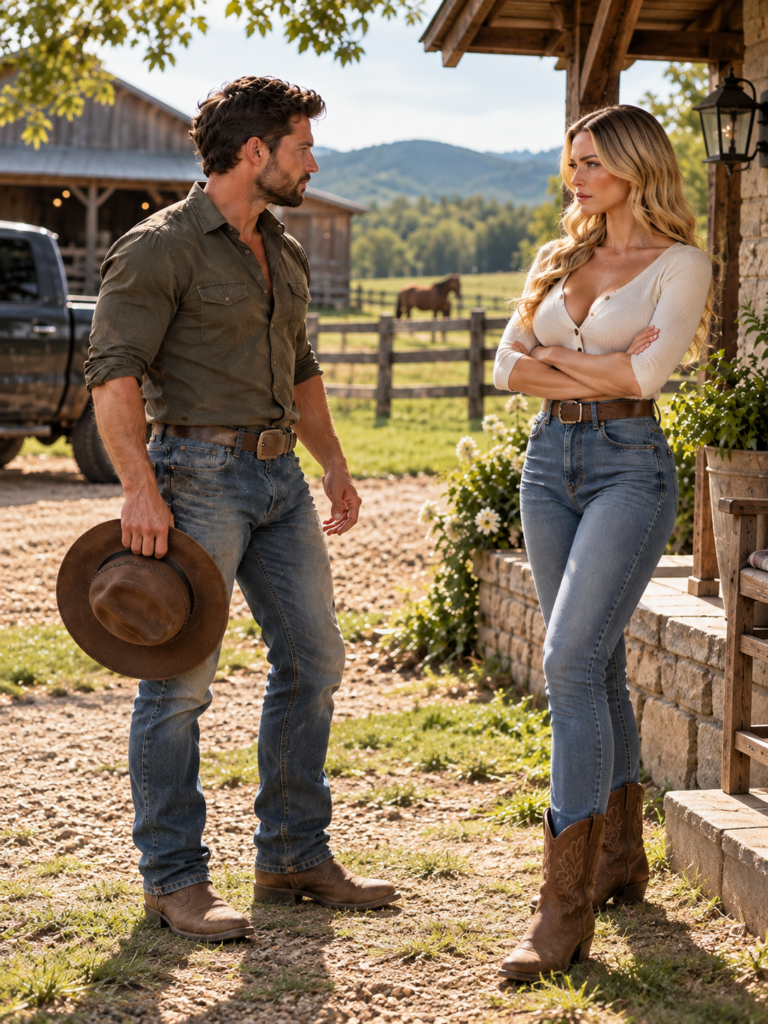
At thirty-three, he still had the shoulders of the boy who had started throwing square bales at twelve. Faded white scars crossed his forearms from barbed wire, sheet metal and years of fixing things that bit back. His olive work shirt was dusty at the seams, his boots nearly finished, his beard a week past respectable.
He climbed the drive toward the house.
He had nearly reached the stone walkway when the oak front door opened.
A woman stepped onto the porch.
Luke stopped.
She was younger than he expected.
Early thirties, perhaps.
Golden-blond hair fell loosely over her shoulders, not arranged in the polished style he associated with people who lived behind gates like these. She wore a cream ribbed Henley tucked into high-waisted jeans and a dark leather belt. No jewelry except a small watch.
Her arms folded across her ribs.
Her expression made it clear that charm would be wasted.
“Can I help you?”
Her voice carried an educated polish beneath the country quiet. Washington, Luke guessed. Richmond, maybe. Somewhere people spoke carefully because words had consequences.
He held his hat against his thigh.
“Afternoon, ma’am. I’m looking for the farm manager.”
Something changed in her face.
Not surprise exactly.
Suspicion sharpening.
“And why would you be looking for him?”
Luke glanced toward the south fields.
“Word at Southern States is High Meadow lost sixty acres of orchard grass on second cutting and two hands yesterday.”
A humorless smile touched her mouth.
“Southern States talks too much.”
Luke waited.
“The two hands weren’t lost,” she continued. “They were fired. They left an automatic water valve open in the south barn and ruined three thousand dollars’ worth of imported feed.”
Her gaze moved from his shirt to his boots to the Dodge at the bottom of the lane.
“I don’t hire drifters, Mr.—”
“Callahan. Luke Callahan.”
“Mr. Callahan. Especially ones driving trucks that look unlikely to reach my mailbox.”
Luke looked back at the Dodge.
One corner of the bumper was tied with wire.
Fair enough.
“The truck got me here.”
Her eyebrows rose slightly.
“And I grew up on a cow-calf operation in Augusta County,” he added. “I’ve run square balers, repaired hydraulic lines and stacked hay since I was twelve.”
The woman said nothing.
Luke looked toward North Mountain.
“Storm clouds will build over that ridge tomorrow afternoon. You’ll get rain by four, give or take an hour. If an inch hits orchard grass while it’s curing on the ground, sixty acres of premium feed becomes compost instead of nine-dollar horse hay.”
Her fingers tapped once against her elbow.
That was the first sign he had given her something she had not already dismissed.
“It’s fifteen hundred bales,” she said. “Field’s three miles behind the ridge. The John Deere in the lower barn has a bad knotter. Dealer says parts are three days out.”
Luke studied the nearest equipment shed.
“If the knotter won’t tie, you lose the cutting.”
“That is generally how balers work.”
There was an edge to the answer.
He looked back at her.
She expected him to bristle.
He didn’t.
“Give me an adjustable wrench, locking pliers and twenty minutes.”
Her arms slowly uncrossed.
“You think you can fix a knotter without even seeing it?”
“I think I can tell you whether I can.”
“And if you can’t?”
“You don’t pay me anything. I leave.”
The woman glanced toward his truck again.
Luke did not follow her gaze this time.
“If I fix it,” he said, “twelve dollars an hour until the last bale’s under roof.”
“Twelve?”
“That’s what I asked.”
Something almost resembling amusement appeared in her eyes.
Then disappeared.
“The tools are in the red machine shop beside the silo.” She stepped aside. “Claire Vance.”
Luke nodded.
“If you make that machine worse, Mr. Callahan, I’ll have the county deputy impound that pickup at my gate before sundown.”
“All right, Miss Vance.”
He touched two fingers to the brim of his hat and walked away.
Claire watched him descend the drive.
He did not argue about her threat.
Did not tell her he knew people.
Did not ask for an advance.
That alone distinguished him from half the men who had appeared at High Meadow since her father died.
For nine months—seven since Marcus Vance’s death and the frantic legal aftermath had truly begun—Claire had dealt with contractors who doubled estimates after shaking her hand, attorneys who spoke to male associates instead of her, neighboring developers who mistook grief for weakness, and workers who discovered mysterious emergencies whenever the job became unpleasant.
She had become suspicious because suspicion was cheaper than being deceived.
Still, something about Luke Callahan bothered her.
Not because she distrusted him.
Because after less than five minutes, she suspected she might not.
At the truck, Luke opened the passenger door.
Toby was awake, rubbing both eyes.
“Daddy?”
“Hey, buddy.”
“Did we find the green farm?”
Luke smiled.
The smile transformed him so completely that Claire, still standing halfway down the drive with a pasture clipboard under one arm, stopped walking.
The exhausted stranger disappeared.
In his place was a father.
“Yeah,” Luke said. “We found it.”
He lifted Toby from the cab and carried him into the shade of an old oak.
From the floorboard he collected a red water bottle, a drawing pad and four short crayons.
“I’ve got some work beside that big red barn. You sit right here where it’s cool and draw me the best picture of that mountain anybody’s ever made. Keep your eyes on the tractor barn.”
Toby considered the assignment with grave importance.
“Can I make the mountain blue?”
“You’re the artist.”
“What color is rain?”
Luke glanced toward North Mountain.
“Today? Purple, maybe.”
Toby nodded.
“Okay.”
Luke waited until the boy was settled cross-legged in the grass.
Only then did he enter the machine shop.
Claire told herself she was walking that direction because the pasture records were stored in the adjoining office.
It was almost true.
The John Deere baler occupied the center bay.
Luke circled it once before kneeling beside the knotter.
He did not immediately grab tools.
Claire noticed that.
He turned the flywheel by hand.
Again.
Then once more, slower.
Four minutes later he reached for a wire brush.
The knotter hook was clogged with rusted residue from old baling twine, and the tension spring on the stripper arm had slipped. He cleaned the hook, soaked the mechanism with penetrating oil, reseated the spring, greased the needle-drive gear and found a replacement pin in a drawer of old hardware.
No guessing.
No swearing.
No dramatic performance for the woman watching from the doorway.
Fourteen minutes after entering the barn, Luke pulled the trip arm and turned the drive.
The steel needle swept forward.
Twine wrapped.
The cutter snapped cleanly.
The knot tightened.
Luke cycled it again.
Perfect.
Claire lowered the clipboard.
Luke wiped his hands on a rag.
“Knotter’s cycling.”
“That’s it?”
“That’s it.”
“The dealer said the assembly needed replacing.”
“Dealers like assemblies.”
She crossed the concrete floor and tested the trip mechanism herself.
It locked with a clean mechanical click.
She looked at him.
“What exactly was wrong?”
“Old twine had rusted onto the hook. Stripper-arm spring was off tension. Needle gear was dry.”
“How did you find that in fourteen minutes?”
He shrugged.
“Machine tells you where it hurts if you turn it slow enough.”
Claire stared at him for one second longer than necessary.
It was not his appearance she noticed then.
It was the complete absence of need to impress her.
Competence sat easily on him.
That was rarer than charm.
“Where do you want the first load?” he asked.
Her voice came out less cold.
“North-bank barn. Elevator’s connected. Eight high along the west wall.”
Luke nodded.
“Diesel?”
“Storage tank behind the shop.”
He started toward the tractor.
“Mr. Callahan.”
He turned.
Claire almost said thank you.
The words felt oddly personal after the way she had greeted him.
Instead she said, “The north field has irrigation ruts near the lower corner. Keep the wagon clear of them.”
Luke’s gaze rested on her.
“I saw them coming in.”
Of course he had.
Then he climbed onto the tractor and went to work.
Claire remained in the barn after the engine noise faded.
Through the open door, Toby sat under the oak tree carefully coloring a mountain blue.
She looked at the repaired baler.
For the first time in weeks, something on High Meadow had been made better instead of broken.
And for reasons she did not yet understand, that frightened her almost as much as it relieved her.
Part 2
By early afternoon, the valley had turned white with heat.
Dry orchard grass gave off a sweet, dusty smell beneath the sun. The baler worked row by row across sixty acres, kicking out tight forty-pound rectangles while Luke moved behind it with the flatbed.
Lift.
Turn.
Stack.
Again.
His rhythm never became careless.
Claire had watched plenty of hired men attack physical work as though violence were the same thing as efficiency. Luke handled the bales differently. He caught them against his hip, checked loose twine, stacked the weight evenly and kept the wagon tires away from the irrigation channels.
He treated the equipment as if he owned it.
Not possessively.
Responsibly.
From the shaded edge of the house porch, Claire held a glass of iced tea that had gone warm.
She had pasture accounts open beside her.
She read the same line four times.
Finally she put the papers down and reached for the binoculars.
Luke was checking a bale for moisture.
Twenty minutes later she looked again.
He was tightening a loose chain on the wagon rather than waiting for it to fail.
Then, precisely half an hour after that, the tractor stopped.
Claire straightened.
Luke climbed down.
Instead of heading toward the water pump, he walked all the way to the oak near the gate.
Toby looked up from his picture.
Even through binoculars, Claire saw the boy’s face brighten.
Luke crouched beside him, touched his hair and held the water bottle while Toby drank.
The interaction lasted less than two minutes.
Luke returned to the field.
Half an hour later he did it again.
And again.
Claire slowly lowered the binoculars.
Her father had been like that.
Marcus Vance had built High Meadow from sixty stubborn acres of cedar scrub and clay. By the time Claire was born, the farm had grown into one of the most valuable agricultural properties in the valley, but Marcus never confused wealth with importance.
He would stop a meeting about six-figure cattle contracts because a mare had gone lame.
He would drive forty miles to return a borrowed post-hole auger himself.
After Claire’s mother died, he had learned to braid a six-year-old girl’s hair badly rather than hand the task to an employee.
He used to say, Don’t judge a man by what he promises when he wants your money. Judge him by how he handles work—and by who he protects when he thinks nobody is watching.
Claire closed her eyes.
“Dad,” she whispered, annoyed at the ache in her throat.
She had spent months defending the farm partly because it was valuable.
Mostly because it still contained him everywhere she looked.
Developers saw thirty million dollars’ worth of land.
Claire saw the fence post where Marcus had carved her height every birthday until she was sixteen.
She saw the creek where he had taught her to sit a horse bareback.
She saw the south pasture where he had once slept in a truck for three nights waiting for a sick calf to stand.
And lately she saw all the ways she might fail him.
Her two best harvest workers had taken money to walk out.
A contractor had inflated an estimate by nearly forty percent.
Two supervisors had quietly encouraged her to accept the developers’ offers.
Everyone had a prediction for how long an unmarried woman with an expensive agricultural property could hold out.
Claire had developed a simple answer.
Longer than they could.
But determination did not bale hay.
Down in the field, Luke lifted another forty pounds.
Claire watched him work.
For once, she allowed herself to wonder what it might feel like not to do everything alone.
The thought made her put down the binoculars at once.
At three, she drove a utility cart to the north field.
Luke saw her coming and kept working.
She stopped near the wagon.
“You’ve been at it five hours.”
“Mm-hm.”
“That wasn’t an observation. It was a suggestion.”
He dropped a bale into position.
“For what?”
“A break.”
“Storm isn’t taking one.”
Claire looked toward the western ridge.
Clouds were indeed beginning to gather.
“You always this agreeable?”
Luke climbed down from the wagon.
“Usually more.”
She nearly smiled.
Nearly.
He drank from a water jug and poured the last little bit over the back of his neck.
Claire noticed his hands then.
The baling twine had cut red grooves across old calluses.
“Your palms are bleeding.”
Luke looked at them as if she had informed him of the weather.
“Not much.”
“I have work gloves in the utility cart.”
“I’ve got hands.”
“That is an astonishingly poor argument.”
That earned her a glance.
Claire walked to the cart, pulled out a pair of heavy gloves and extended them.
Luke looked at the gloves.
Then at her.
There was no flirtation in the moment.
Something more difficult passed between them: the awkwardness of a proud man being offered care by a woman who understood that accepting it might cost him more than blood did.
“They were my father’s,” she said.
Luke’s expression changed.
Claire immediately regretted adding that.
She had not intended to make the offer intimate.
“Then I shouldn’t—”
“He had six pairs.”
Luke considered her for another second.
Then he took them.
“Thank you.”
It was the first time he had thanked her without calling her Miss Vance.
Claire stepped back.
“You can return them when the field is finished.”
“I will.”
The gloves fit.
Of course they did.
Her father had also had large hands.
Claire returned to the house before she could dislike the comparison.
By late afternoon, Toby’s picture contained three blue mountains, twelve purple clouds, a red barn, four horses shaped vaguely like dogs, and one large green rectangle he identified as the tractor.
Claire discovered this because at four thirty she carried a pitcher of lemonade to the oak.
Toby looked up at her.
“You’re the lady.”
Claire stopped.
“I suppose I am.”
“Daddy says this is your farm.”
“It is.”
Toby studied her carefully.
“Do you know the horses?”
“Most of them.”
“All their names?”
“Yes.”
His eyes widened.
Claire sat on the far side of the blanket rather than beside him.
“That one is Mercy,” she said, pointing toward a mahogany mare near the fence. “The gray one is Willow. The little chestnut who keeps biting the fence rail is Bandit.”
Toby giggled.
“Why’s he called Bandit?”
“Because he steals things.”
“What things?”
“Hats. Brushes. Once my father’s wallet.”
“Did he spend the money?”
Claire laughed before she could stop herself.
It had been weeks since the sound came naturally.
“No. He ate part of a twenty-dollar bill, though.”
Toby seemed delighted.
“Daddy says horses are smart.”
“Your daddy’s mostly right.”
“Daddy fixes everything.”
Claire’s smile faded slightly.
Children said things adults would never dare.
“Does he?”
“The sink. My train. Mommy’s bed.”
Claire’s breath caught.
Toby was coloring again and did not notice.
“What was wrong with Mommy’s bed?”
“It made noises in the hospital.”
Claire looked down.
Toby selected a brown crayon.
“Daddy fixed the button so it went up again. But Mommy still died.”
The sentence came without drama.
That made it worse.
Claire stared toward the field.
Luke was a small figure on the wagon, working beneath a sky growing darker.
“I’m sorry, Toby.”
He shrugged in the mysterious, heartbreaking way children sometimes carried grief.
“Daddy says she’s not hurting now.”
Claire folded her hands around the sweating lemonade glass.
“My dad died too.”
Toby looked at her immediately.
“Is he with Mommy?”
Claire had faced probate attorneys, land developers and bankers without losing her composure.
She had no defense against that question.
“I don’t know,” she admitted.
Toby thought about it.
Then he moved one of his crayons toward her.
The blue one.
“You can use this.”
Claire accepted it.
“Thank you.”
When Luke came back for his next check, he found Claire Vance sitting cross-legged in the grass helping Toby add a blue roof to a house that did not exist anywhere in the landscape.
He stopped several yards away.
Claire saw him.
For a moment neither moved.
Something quiet passed across Luke’s face.
Not suspicion.
Not gratitude exactly.
Recognition, perhaps.
Claire stood.
“Toby informed me Bandit should be included in the drawing.”
“He’s the horse who eats money,” Toby explained.
Luke looked from his son to Claire.
“I’ve known a few like that.”
Claire smiled.
This time she did not stop herself.
It changed her too.
Luke had thought her attractive the instant she stepped onto the porch. He had done his best not to notice afterward.
Attraction was an indulgence for men with roofs.
And grief had made him distrust sudden warmth. For two years, every good day with Sarah had come carrying the knowledge that another hospital night might follow.
He had no desire to want anyone.
But standing beneath that oak, watching Claire hold a stubby blue crayon in one hand while trying not to laugh at Toby’s crooked horse, Luke became aware of her in a way he had not allowed before.
Not as the wealthy woman who owned the farm.
As someone who had lost a parent and still carried the grief close enough for a child to touch it.
Claire handed him the gloves.
“You’ll need these back.”
“Keep them until you’re done.”
Luke nodded.
“Thanks.”
Their fingers brushed briefly.
Neither reacted.
That, somehow, made Luke more conscious of the contact.
He curled his hand around the gloves.
“I need to get the last loads in.”
Claire stepped away.
“I know.”
No one said anything else.
They did not need to.
The field was almost empty by sunset.
The western clouds had become a dark wall beyond the Alleghenies.
Luke pushed through the final hours on legs that had started to feel hollow.
Every bale represented something practical.
Groceries.
Gas.
A cheap motel, maybe.
Breakfast for Toby.
He had long ago stopped believing that hard work guaranteed good outcomes.
Sarah had fought hard.
She had died anyway.
Luke had learned that effort was not a bargain made with God.
You worked because the work still needed doing.
That was all.
At six, he backed the last loaded wagon beneath the north-bank barn.
The elevator rattled.
Bale by bale, the final row disappeared under the corrugated roof.
Eight high.
West wall.
Exactly as Claire had instructed.
Luke shut down the tractor.
For several seconds he remained seated.
The field outside was bare.
Sixty acres under cover.
His arms shook when he climbed down.
At the yard pump, he washed green dust and sweat from his face and forearms. Cold spring water felt almost painful against the cuts in his hands.
Then he collected Toby.
The boy had fallen asleep beneath the oak with his wooden train against his chest and the drawing curled beside him.
Luke carried him toward the stone house.
Claire waited at the bottom of the porch steps.
She had changed into clean jeans and a soft navy flannel shirt. In one hand was a metal bottle slick with condensation.
In the other was a thick brown envelope.
Luke’s eyes went to the envelope first.
Not because of greed.
Because he had counted twelve-dollar hours all afternoon.
Claire offered the bottle.
“Drink.”
Luke hesitated.
“Spring water from the south well. Coldest on the mountain.”
He drank deeply.
Claire watched the movement of his throat and immediately looked away.
That irritated her.
She had inherited thirty million dollars’ worth of agricultural property and spent most days explaining financial projections to men twice her age.
She could survive noticing that Luke Callahan was a handsome man.
Probably.
Luke handed the bottle back.
“Barn’s full. Sixty acres cleared. Fifteen hundred twenty bales stacked eight high. Knotter head’s cleaned and greased for the next cutting.”
“You counted them?”
“Machine did.”
Claire nodded toward his hands.
“You also ruined my father’s gloves.”
Luke looked down.
One palm had worn thin.
“I’ll replace them.”
“They were work gloves, Luke.”
The use of his first name landed softly between them.
Claire had not planned it.
Luke noticed.
Neither corrected it.
“I made seven paid hours,” he said after a moment. “At twelve, that’s eighty-four dollars.”
Claire stared at him.
Then at the sleeping child against his shoulder.
Toby’s arm was looped around Luke’s neck. His wooden train rested between them.
“What’s his name?”
“Toby.”
“How old?”
“Five.”
Claire already knew both answers.
She had asked because there was another question behind them.
Luke seemed to understand.
“Where’s his mother?” Claire asked quietly.
His face closed.
Not against Claire.
Against pain.
Luke adjusted Toby higher on his shoulder.
“Sarah died in December. Congestive heart failure. She was sick two years.”
Claire’s gaze dropped.
“I’m sorry.”
Luke gave a small nod.
No rehearsed reassurance.
No it’s okay.
Because it was not.
Claire respected him for that too.
“And where are you staying tonight?”
Luke’s eyes shifted toward the Dodge.
He could have lied.
Claire watched him consider it.
“There’s a clean tarp over the bed,” he said. “Heavy wool blanket too. It’s warm tonight.”
Claire went very still.
“You’re sleeping in the truck.”
“We’ve had worse.”
“With a five-year-old.”
Luke’s voice hardened just slightly.
“He’ll be dry.”
There it was.
Pride.
But not vanity.
The last wall of a man who had already surrendered nearly everything except his right to believe he could still care for his son.
Claire did not pity him.
Pity would have insulted them both.
Instead she looked toward the darkening fields her father had left her.
“My father built High Meadow from nothing,” she said.
Luke waited.
Claire did not know why she told him.
Perhaps because he had spent seven hours proving what he did when nobody promised him anything beyond eighty-four dollars.
Perhaps because Toby had given her a blue crayon.
Perhaps because she was tired of being the only person who knew how afraid she really was.
“When Dad died, developers came before I’d finished dealing with the funeral. Twenty million dollars. Cash purchase. Tear down the barns, subdivide the pastures, put retail buildings near the road.”
Luke looked toward the valley.
Claire continued.
“They thought I’d sell because I was alone. When I wouldn’t, they started working around me. Contractors. Supervisors. Labor. Someone paid those two men to walk away from this harvest. They wanted the operating numbers weak enough that the bank would start asking questions.”
Luke’s expression sharpened.
“That why the valve got left open too?”
“I can’t prove it.”
“But you think it.”
“Yes.”
A low roll of thunder moved beyond the ridge.
Claire looked toward the north-bank barn.
Rain had not reached the valley yet.
When it did, every bale would be dry beneath a roof.
She faced Luke again.
“You didn’t just stack hay today. You protected our winter cash flow. You repaired a machine two mechanics told me needed a replacement assembly. You performed the work of four men without one complaint.”
“I complained about the dealer.”
The answer surprised a laugh from her.
Luke’s mouth almost lifted.
Claire held out the brown envelope.
He looked at it.
“Eighty-four dollars.”
“No.”
“Miss Vance—”
“Luke.”
His gaze rose.
“This is not charity.”
“I didn’t say it was.”
“You were about to.”
He shifted Toby’s weight.
“We agreed on twelve an hour.”
“And you completed emergency contract work that would normally cost me two thousand dollars to rescue before a storm.”
Luke did not take the envelope.
Claire stepped closer.
“Do you know what my father hated more than dishonesty?”
“I’m guessing developers.”
“Cheap people.”
That earned the smallest actual smile.
Claire pressed the envelope against his hand.
“Two thousand dollars.”
Luke’s fingers did not close.
“Claire.”
The first use of her name affected her far more than it should have.
“Take it.”
“I did the work for eighty-four.”
“You saved me considerably more.”
His gaze held hers.
“If I take two thousand, I want to know what you expect back.”
There was no accusation in the question.
Only experience.
Claire understood then that people had probably made generosity expensive for him before.
She answered carefully.
“Nothing.”
Luke remained motionless.
“Then why?”
Claire looked at Toby.
“Because fair pay is not charity.”
Something in Luke’s expression loosened.
Slowly, he accepted the envelope.
“Thank you.”
“You’re welcome.”
Thunder rolled again.
Neither moved.
Then Claire said, “But that’s not the offer.”
Luke frowned.
“What offer?”
She turned toward the eastern hill.
A two-story stone cottage stood among dogwoods and old apple trees. Dark green shutters framed the windows. Beyond it stretched a fenced yard and a small orchard.
Claire pointed.
“That house has three bedrooms, a modern kitchen, a stone fireplace and enough fenced yard for a five-year-old to exhaust himself before breakfast.”
Luke stared.
“My father lived there while he built the main house. It’s been empty five years.”
He looked back at her.
“I can’t afford to rent something like that.”
“You’re not renting it.”
His brow furrowed.
Claire felt something unexpected then.
Fear.
Not fear that Luke would take advantage.
Fear that he would say no.
Part 3
“I need a full-time operations manager,” Claire said.
Luke did not answer.
Night insects had begun their steady chorus along the pasture. Behind them, the first cool gust from the approaching storm moved through the trees.
Claire continued before courage abandoned her.
“Someone who understands livestock and equipment. Someone who notices irrigation ruts before being warned about them. Someone who repairs a baler instead of inventing a four-hundred-dollar problem.”
Luke looked at the cottage again.
“And somebody whose word is worth more than the check I write him.”
His expression changed.
Claire could not tell whether she had offended him.
So she kept going.
“The salary is seventy-five thousand dollars a year. Full health insurance through the farm trust. Ten percent participation in commercial cattle sales starting this fall.”
Luke stared at her as if she had changed languages.
Claire almost smiled, but the moment was too serious.
“My father established a five-million-dollar preservation trust specifically to keep High Meadow operating as a heritage farm. Certain land grants and operating provisions require an experienced farm manager.”
“You don’t know me.”
The words were quiet.
Claire had expected surprise.
Not that.
“I know what I saw today.”
“One day.”
“Yes.”
“That’s not the same as knowing a man.”
“No.”
Claire folded her arms, not defensively this time but because the wind had become cool.
“You could be wrong about me.”
“I could.”
“I could take the job and disappoint you.”
“You could.”
Luke studied her face.
Claire did not rescue him from the uncertainty.
The truth mattered more.
Finally he said, “Then why me?”
She looked past him to the old oak.
“Toby told me you fix everything.”
Luke closed his eyes briefly.
Claire continued.
“My father used to say you don’t judge a man by what he promises when he wants your money. You judge him by his work and by who he protects when he thinks nobody is watching.”
Luke’s gaze returned to her.
“I watched you.”
The words came out more intimate than Claire intended.
She let them remain.
“You checked your son every half hour. You handled my equipment better than men I’ve employed for years. You could have made that baler repair sound complicated and charged me for it. You didn’t. When I offered you more money, your first question was what I expected in return.”
Claire stepped closer.
“So no, Luke. I don’t know everything about you.”
The storm wind lifted a strand of hair across her cheek.
She tucked it behind her ear.
“But I know enough to offer you a job.”
Luke looked down at Toby.
The boy slept unaware that his entire life might be changing while he dreamed.
Luke’s throat worked.
“You said health insurance?”
“Full coverage.”
“For Toby too?”
“Dependents are covered.”
The question nearly broke Claire.
Luke did not ask first about salary.
Or the cottage.
Or profit participation.
Health insurance.
For Toby.
“Yes,” she said softly. “For Toby too.”
Luke looked away.
For seven months he had carried fear so continuously that it had become indistinguishable from breathing.
What if Toby got sick?
What if the truck died?
What if there was no food tomorrow?
What if someone reported them for sleeping in the Dodge?
What if Sarah had trusted the wrong man when she made him promise he would take care of their son?
He had lived from one disaster to the next, telling Toby everything was an adventure because the truth was too heavy for a five-year-old.
Now a woman he had met that morning was offering him a salary larger than any he had ever earned.
A house.
Health insurance.
Work he understood.
Land worth protecting.
He distrusted miracles.
They usually turned out to be loans with interest.
“Why’s the house empty?” he asked.
Claire heard the caution returning.
“My last manager lived closer to town.”
“What happened to him?”
“He resigned three months after Dad died.”
“Why?”
Claire hesitated.
“He thought selling was sensible.”
Luke’s expression told her what he thought of that.
Claire noticed.
“You disagree?”
“Not my land.”
“That wasn’t what I asked.”
Luke looked over the fields.
“Your father spent his life building this.”
“Yes.”
“You want it kept as a farm.”
“Yes.”
“Then selling because somebody waves a large enough check at you isn’t sensible. It’s just profitable.”
Claire’s breath caught.
For months, nearly every professional adviser had explained to her that sentiment had no place in asset management.
Luke Callahan, with three dollars and ten cents in his truck that morning, understood immediately.
“It’s not just land,” she said.
“No.”
Their eyes met.
There it was again.
Not attraction alone.
Something more dangerous.
Being understood.
Luke looked away first.
“I’ve got conditions.”
Claire blinked.
“You have conditions?”
“If I take it.”
“Let’s hear them.”
“I earn the job. You don’t keep me because you feel sorry about Toby.”
Claire’s answer came immediately.
“I don’t feel sorry for Toby.”
Luke’s eyes narrowed.
“I like him,” she added. “Different thing.”
His expression softened.
“Second, if you want me responsible for equipment and livestock, I make the call when something’s unsafe.”
“Within budget.”
“If it’s unsafe, budget can complain afterward.”
Claire almost smiled.
“Anything else?”
Luke thought.
“I won’t be part of anything crooked.”
“Neither will I.”
“You ask me to lie to a bank, inspector, buyer or employee, I walk.”
“Same goes for you.”
“Fair.”
The word settled between them.
Claire extended her hand.
Luke looked at it.
For a second she wondered whether he would refuse simply because accepting would make all of this real.
Then Toby shifted against him.
His wooden train slipped.
Claire caught it before it hit the ground.
Both adults looked at the toy in her hand.
Its blue paint was almost completely worn away.
Claire offered it back.
Luke took it carefully.
His fingers brushed hers.
This time neither pretended not to notice.
Claire’s pulse changed.
Luke’s gaze lingered for half a second.
Grief moved visibly behind his eyes.
Claire recognized what followed.
Guilt.
That surprised her.
And suddenly she understood that whatever might one day exist between them could not be rushed.
His wife had been dead seven months.
Claire would not make herself into an argument he had to win against a woman who was gone.
She stepped back first.
Not rejection.
Space.
Something in Luke’s shoulders eased, as if he understood exactly what she had given him.
Claire held her hand out again, this time unmistakably businesslike.
“Operations manager?”
Luke shifted Toby and clasped her hand.
His palm was rough and warm.
“Operations manager.”
The handshake lasted only as long as it should.
When they released each other, something had changed anyway.
Luke looked toward the cottage.
“How soon would you need me?”
Claire stared at him.
“You’re homeless.”
His mouth twitched.
“That’s not an answer.”
“You start tomorrow.”
“Tomorrow?”
“You already worked today.”
“At twelve an hour.”
“I believe I can afford the discrepancy.”
Luke finally smiled.
It was a tired smile, restrained by disbelief, but real.
Claire felt its effect in a place she refused to investigate closely.
She reached into her pocket.
A brass key ring rested there.
For a moment, she thought of her father carrying the same keys years ago while the cottage was still his home.
She had kept them after he moved into the main house.
She had not known why.
Now she removed them.
“The pantry’s stocked,” she said. “Hot water should still be on. There’s milk, bacon, eggs and bread in the refrigerator. Housekeeper keeps the place aired out.”
Luke looked at the keys but did not take them.
“Claire.”
“Yes?”
“I meant what I said about earning this.”
“I know.”
“You don’t know what kind of employee I’ll be in six months.”
“No.”
“You don’t know whether I’ll make mistakes.”
“You will.”
He raised an eyebrow.
“So will I,” she said.
The admission cost her more than she expected.
Luke noticed.
Of course he did.
Claire had spent months projecting absolute certainty because predators could smell doubt.
With him, for one strange moment, she did not need to pretend.
“I’m going to make mistakes,” she repeated. “Probably expensive ones. I’m trying to manage thirty million dollars’ worth of land, cattle, horses and equipment while half the county waits for me to fail.”
Luke listened without interrupting.
“I don’t need someone who thinks I’m always right.”
The wind shifted again.
“I need someone who tells me the truth before the mistake gets expensive.”
Luke nodded slowly.
“That I can do.”
Claire placed the keys in his palm.
His hand closed around them.
A single tear cut through the dust on Luke’s cheek before he could turn away.
He bowed his head.
His shoulders moved once.
Claire pretended not to notice.
Not because his grief embarrassed her.
Because dignity sometimes meant letting another person decide which tears were witnessed.
She looked toward the valley.
The first distant flash of lightning illuminated North Mountain.
After several seconds, Luke spoke.
His voice was rough.
“I accept.”
Claire looked back at him.
He wiped his cheek with the heel of his hand.
“I’ll take the job.”
Relief warmed her face.
Luke glanced across High Meadow.
“And I promise you something.”
“You don’t owe me a promise tonight.”
“I know.”
He looked toward the barns, the creek and the dark pasture beyond.
“But as long as I’m responsible for this place, nobody damages it without going through me.”
Claire swallowed.
Her father would have liked him.
That thought arrived so clearly it hurt.
“Then we understand each other.”
Luke looked at her.
“Yes.”
For one suspended moment they simply stood there while the storm approached.
Claire could have imagined another version of the scene.
A more reckless woman might have stepped closer.
A lonelier man might have mistaken rescue for love.
Neither did.
Luke still wore his wedding ring on a cord beneath his shirt.
Claire still woke some nights convinced she had heard her father moving through the downstairs hall.
What existed between them was not yet permission.
It was possibility.
And perhaps because neither tried to seize it, it became more real.
Toby stirred.
His eyes opened slowly.
“Daddy?”
Luke’s entire attention shifted.
“Hey, buddy.”
Toby looked around sleepily, then noticed Claire.
“Horse lady.”
Claire folded her arms.
“That’s Miss Horse Lady to you.”
Toby grinned.
Luke laughed.
The sound was low and rusty from lack of use.
Claire liked it too much.
Toby rubbed his face.
“Are we leaving?”
The question changed Luke.
Claire saw the fear behind it.
The boy had learned that leaving was something adults did without warning.
Luke looked toward the stone cottage among the apple trees.
“No.”
Toby blinked.
“No?”
Luke crouched carefully so his son could see the house.
“You remember the adventure?”
“The green farm?”
“Yeah.”
Claire stood a few feet away, suddenly aware she was witnessing something that belonged to father and son.
Luke pointed.
“You see that house?”
Toby nodded.
“That’s where we’re sleeping tonight.”
The boy’s eyes widened.
“In a house?”
Luke’s mouth tightened.
“Yeah, buddy.”
“Tomorrow too?”
Luke looked at Claire.
She nodded once.
He faced his son.
“Tomorrow too.”
Toby considered the information.
Then, because he was five and therefore capable of accepting miracles faster than adults, he asked, “Can I see the horses?”
Luke laughed again.
“Tomorrow.”
“Bandit too?”
“Apparently Bandit eats money, so we’ll keep him away from my paycheck.”
Claire smiled.
Toby held out his arms to Luke.
Luke lifted him again.
Claire stepped aside.
“Go home.”
The word stopped him.
Luke looked at her.
Claire suddenly wondered if she had overstepped.
Then his gaze shifted toward the cottage.
“Home,” he repeated.
The storm wind carried the scent of rain across High Meadow.
Luke walked the winding path with Toby against his shoulder.
Claire remained near the porch.
Halfway up the hill, Luke turned.
She was still there.
Neither waved.
It felt unnecessary.
Luke continued.
The cottage key slid smoothly into the old lock.
The heavy wooden door opened onto polished pine floors and a kitchen washed in the last blue-gold light of evening.
The place smelled faintly of cedar and clean linen.
Toby squirmed down.
“Whoa.”
Luke set the bags inside.
For several minutes the boy explored without speaking, opening doors, peering through windows, discovering the stone fireplace and the fenced yard.
Luke followed more slowly.
A refrigerator hummed in the kitchen.
He opened it.
Milk.
Eggs.
Bacon.
Bread.
Apples.
Real food.
Luke gripped the refrigerator handle.
There had been mornings when he had eaten nothing so Toby could have cereal.
There had been evenings when he had claimed he was not hungry because one can of soup stretched farther between one adult and one child than between two.
He shut the refrigerator carefully.
“Daddy!”
Toby called from upstairs.
Luke found him in the main bedroom.
The boy had climbed onto a soft quilt.
The wooden ceiling arched overhead. White curtains lifted in the mountain breeze.
Toby touched Luke’s face.
“Is this the green farm?”
Luke sat on the edge of the bed.
His son was safe.
There was food downstairs.
Tomorrow he had work.
Next month he would still have work.
If Toby got sick, there would be insurance.
Luke had forgotten what it felt like for tomorrow not to resemble a threat.
He pulled the boy into his arms.
“Yeah.”
His voice broke.
He tried again.
“Yes, buddy.”
Toby leaned against him.
“Is it our house?”
Luke thought of Claire standing beneath the darkening sky.
Of the gloves she had offered without humiliating him.
Of the blue crayon in her hand.
Of the way she had stepped back when she saw something in his face he was not ready to explain.
He thought of Sarah.
Loving Sarah did not become less true because life had continued after her.
He was not ready for anything beyond that truth.
Maybe Claire understood.
That mattered.
Luke kissed Toby’s forehead.
“This is our home now.”
Outside, the first rain began.
It tapped softly against the roof.
Luke walked to the bedroom window.
Across High Meadow, the north-bank barn stood secure beneath the gathering storm, fifteen hundred twenty bales dry beneath corrugated steel.
Farther down the hill, a light still burned in the main house.
For just a moment, a figure appeared on the porch.
Claire.
Even from this distance, Luke knew it was her.
She stood watching the rain sweep over the valley her father had fought to build and she had chosen to keep.
Luke rested one hand against the window frame.
Claire looked toward the cottage.
She could not possibly see him clearly.
Still, after a moment, the porch light went off.
Luke smiled to himself.
No confession.
No impossible promise.
No betrayal of the people they had loved before meeting each other.
Only a man who had arrived asking for twelve dollars an hour.
A woman who had learned that accepting help was not surrender.
A little boy asleep in a safe bed.
And between two houses beneath the summer rain, the beginning of something neither of them was ready to name.
Luke returned to Toby, tucked the quilt around him and placed the worn wooden train beside his pillow.
“Daddy?”
“Yeah?”
“We don’t have to leave tomorrow?”
Luke sat beside him until his eyes closed.
“No, son.”
Rain washed the dust from High Meadow and whispered through the apple trees.
Luke listened to it for a long time.
Then he looked around the quiet room, at his sleeping boy, at the brass keys on the bedside table.
His answer came steady now.
“We’re not leaving.”