
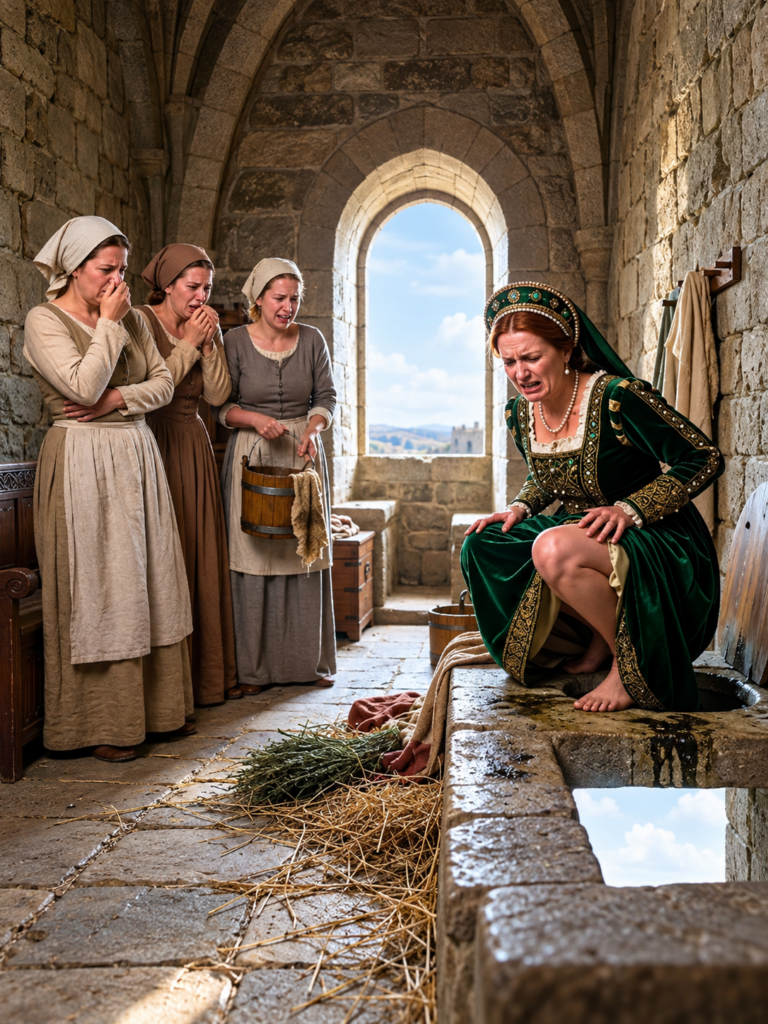
Part 1
The first warning came from the water.
Lady Eleanor de Wychford stood beside the great hearth of Greyfen Castle, watching a servant pour warm water over the hands of her husband’s cousin, when she noticed the smell.
It was faint, almost lost beneath the richer odors of roasted venison, woodsmoke, beeswax, and damp wool. Something sour and earthy, like mud turned over at the bottom of a forgotten ditch.
Sir Rafe Wychford noticed it too.
He drew back his hands.
“Does your well always smell like a graveyard, cousin?”
The servant, a narrow-shouldered woman with weather-reddened hands, lowered the pitcher.
Eleanor looked at her.
“Maud?”
“The water was drawn from the inner cistern, my lady.”
“That was not my question.”
The woman hesitated.
“No, my lady. It has been worse since the rain.”
Sir Rafe wiped his fingers on the linen towel and smiled without warmth.
“A curious thing, Eleanor. Your late husband spent enough silver strengthening these walls to withstand a Welsh army, yet no one appears capable of keeping his drinking water sweet.”
Eleanor let the insult pass.
In the great hall behind them, nearly eighty people waited for supper. Two fires burned beneath the high timbered roof, but the warmth barely reached the benches nearest the doors. The smoke gathered above the company in blue ribbons before escaping through the roof vent.
Dogs nosed through rushes scattered across the floor. Servants hurried between trestle tables carrying trenchers, pitchers, and steaming bowls.
Greyfen was considered one of the finest fortified residences in that part of the English Marches.
Its walls stood forty feet high. Its gatehouse had resisted three raids. Its upper chambers boasted glazed windows, painted ceilings, and wall hangings brought from London at enormous expense.
Yet Eleanor had been cold since Michaelmas.
Even now, wearing a gown lined with squirrel fur, she could feel the winter creeping upward through the flagstones.
“Have the kitchen draw from the outer spring tomorrow,” she told Maud.
“The spring lies below the western wall, my lady.”
“I know where it lies.”
“It takes four men to carry enough water for the kitchen alone. With the frost—”
“Then use six.”
Maud lowered her eyes.
“Yes, my lady.”
Eleanor turned away, irritated by the exchange and more irritated still by the look Sir Rafe gave her.
He had arrived that morning with twelve mounted men, two clerks, and a priest whose loyalty seemed more attached to Rafe’s purse than to God.
He claimed to be visiting for the Christmas season.
Eleanor knew better.
Greyfen had belonged to her husband, Lord Edmund Wychford, until fever took him eighteen months earlier. Their son Hugh, now eleven years old, stood to inherit his father’s lands when he reached his majority.
Eleanor possessed Greyfen itself as part of her marriage settlement. The terms were written, witnessed, and sealed. She had brought considerable property into the marriage, and Edmund had promised her the castle and certain rents for her lifetime.
Sir Rafe, Edmund’s older cousin, had spent most of the previous year attempting to persuade the king’s officials that a widow could not adequately protect so important a stronghold.
The fact that Eleanor had managed the household through two difficult harvests did not impress him.
Nor did the fact that her late husband’s garrison remained loyal.
He wanted the castle.
And now he was standing in her hall, making jokes about its water.
At the high table, Hugh sat between Eleanor and the visiting priest.
He was a solemn boy with his father’s dark eyes and a habit of twisting the cuff of his sleeve whenever strangers frightened him.
“Mother,” he whispered, “why does Uncle Rafe keep looking at the doors?”
“Because he has never learned to admire a room without imagining how to own it.”
Hugh almost smiled.
Then he pressed a hand against his stomach.
Eleanor noticed.
“Have you eaten?”
“A little.”
“You must eat more.”
“The broth tastes strange.”
She took his bowl and raised it to her lips.
The flavor was heavy with onions and pepper. A bitter note lingered beneath the salt.
“Perhaps the cook has been too generous with the herbs.”
Hugh nodded, though he did not reach for the bowl again.
Across the hall, a kitchen boy carrying a basket of bread stumbled.
The basket overturned.
Loaves rolled beneath the benches.
A steward seized the boy by the collar.
“Clumsy little swine!”
The boy, perhaps fourteen, struggled to stand.
Eleanor might not have noticed him at all had he not lifted his face.
He was terribly pale.
Before the steward could strike him, the boy collapsed.
The hall fell silent.
For a moment, the only sound was the crackling of the enormous fire.
Then the servants hurried forward.
“Too much work and too little food,” Sir Rafe remarked.
The boy began to shiver.
Eleanor rose.
“Take him to the infirmary room.”
The steward bowed.
“At once, my lady.”
“And see that he is given broth.”
“Yes, my lady.”
The company resumed its meal.
The incident should have ended there.
But when Eleanor looked toward the servants’ entrance, she saw Maud standing motionless with the empty water pitcher in her hands.
The woman was staring not at the sick boy, but at the stone wall behind the high table.
At the narrow doorway leading toward Eleanor’s private chambers.
At the place where, seven years earlier, Lord Edmund had ordered a new garderobe built for his wife.
And Maud looked afraid.
Greyfen Castle had a hundred ways of making a rich woman comfortable.
It had no easy way of making her warm.
Every morning, servants carried wood up steep stairs to the fireplaces, hauled cold water from the lower court, emptied basins, shook bedding, brushed gowns, polished ironwork, and scrubbed the grease from kitchen stones.
During the summer months, laundry dried in the yard.
In winter, wet sheets hung near fires and filled the corridors with a sour, woolly dampness.
Eleanor’s own chamber contained a handsome bed hung with embroidered curtains. A carpet covered part of the floor. A chest of fine linen stood beneath the window.
But the stone walls drew warmth from the room as a thirsty man drew water from a cup.
That evening, after the feast, her chambermaid tucked a heated stone wrapped in cloth beneath the bedding.
“Shall I bring another, my lady?”
“No. You may go.”
The girl curtsied.
Eleanor sat beside the fire with a roll of household accounts.
Thirty-two quarters of grain remaining in the storehouse.
Seventeen barrels of salted fish.
Six sides of bacon.
Fourteen cartloads of firewood owed by tenants before Candlemas.
Wages for cooks, grooms, stable boys, guards, laundresses, masons, porters, and laborers.
Greyfen required more people to maintain it than the small village below the hill contained in its entirety.
Edmund had once called that a sign of prosperity.
A great lord, he said, was measured by the number of men who answered his call.
Eleanor had never thought to ask what happened when those men grew tired, sick, or old.
A knock sounded at the door.
“Enter.”
Master Piers Fen, the castle steward, stepped inside.
He was a thin man of fifty with a careful beard and fingers permanently stained by ink.
“My lady. Sir Rafe requests a private audience tomorrow morning.”
“On what business?”
“He would not say.”
“Then he may state it at breakfast.”
Piers shifted.
“There is another matter.”
She looked up.
“The kitchen boy taken ill at supper has grown worse. Two scullions are unwell, and a groom has complained of stomach pains.”
Eleanor put down the accounts.
“Bad meat?”
“The cook insists the venison was fresh.”
“Then perhaps the salted fish.”
“Possibly.”
“Remove whatever they ate.”
“Yes, my lady.”
Piers remained standing.
“Is that all?”
“There have been complaints about the inner cistern.”
Eleanor exhaled.
“Everyone appears suddenly fascinated by the water.”
“My lady, the servants say the western garderobe pit has not been properly cleared since autumn.”
“Then have it cleared.”
Piers looked uncomfortable.
“We have had difficulty finding men willing to go down.”
“Pay them.”
“The work is costly.”
“Master Piers, I do not keep an estate of this size to be told that emptying a privy is beyond our means.”
He bowed.
“As you wish.”
After he left, Eleanor returned to the accounts.
A line near the bottom of the page caught her attention.
Repair and clearing of western waste shaft: twelve shillings.
The sum had been entered three months earlier.
She frowned.
Had they not already paid for the work?
She might have asked Piers to return.
Instead, she set the parchment aside.
The fire was dying, her head ached, and the castle seemed filled with small complaints that never ended.
Tomorrow, she thought.
She would settle it tomorrow.
The scream came shortly after midnight.
Eleanor was asleep when someone began pounding on her chamber door.
“My lady! My lady!”
She sat upright.
“What is it?”
“Your son!”
She was out of bed before the girl finished speaking.
Hugh lay curled beneath his blankets in the adjoining chamber.
His face was waxen. His hair clung wetly to his forehead.
A servant held a basin near his mouth.
The boy had been vomiting.
“Mother,” he whispered.
Eleanor knelt beside the bed.
“I am here.”
“It hurts.”
“Where?”
He pressed both hands against his abdomen.
Eleanor touched his face.
His skin burned.
She ordered the priest awakened and sent a rider for a physician in the nearest market town.
The household’s experienced nurse recommended cool cloths and small sips of warmed, clean water.
But when a chambermaid returned with a pitcher, Eleanor caught the same unpleasant smell she had noticed before supper.
She seized the vessel.
“Where did this come from?”
“The cistern, my lady.”
“Did I not order water from the outer spring?”
“Tomorrow, my lady. The men said—”
“Throw it away.”
The girl flinched.
Eleanor stared at the pitcher.
For the first time, an uneasiness colder than the winter air moved through her.
“Bring Maud Bell.”
Maud arrived with her sleeves rolled to the elbows.
She was not dressed for an audience with her mistress.
Her gown was patched, her boots wet, and her apron stained from the day’s work.
A cut crossed one of her knuckles.
Eleanor barely noticed these things.
“My son is ill.”
Maud looked toward Hugh’s chamber.
“I heard, my lady.”
“The servants were complaining about the water. What do you know?”
Maud clasped her hands.
“My husband knew more.”
“Your husband is dead.”
“Yes.”
Three years earlier, William Bell had died after being lowered into a waste pit beneath Greyfen’s western tower. He had been among the men hired to empty the chamber when its contents rose too near the discharge opening.
The work required ropes, baskets, and an iron hook.
It paid better than most labor in the castle.
It was also foul and dangerous.
William had entered the pit after another worker refused.
He had not come out alive.
Eleanor remembered the funeral only vaguely.
She had sent candles and money to the widow.
At the time, she believed she had acted generously.
Now Maud looked at her with an expression Eleanor could not read.
“Before Will died,” the woman said, “he warned Master Piers that the old channel under the western tower had been broken.”
“What channel?”
“The stone watercourse, my lady.”
Eleanor frowned.
“There is no watercourse beneath that tower.”
“There was.”
“Who told you this?”
“My husband helped build the new privy chamber. He had worked with the masons before he took to other labor.”
“The privy has been there seven years.”
“Yes, my lady.”
“Then why was the matter not reported to Lord Edmund?”
“It was.”
Something in Maud’s voice made Eleanor still.
“The lord ordered the work finished.”
“Edmund would never have allowed drinking water to be fouled.”
Maud did not answer.
Eleanor rose.
“Are you accusing my husband?”
“No, my lady.”
“Then speak plainly.”
Maud swallowed.
“Will said the old spring channel ran beneath the tower foundations. The masons were told to close an opening in the wall after a new waste passage was made. He believed the water might be getting into the wrong place.”
“Believed?”
“He could not see what lay behind the stone once they had finished.”
“And you have kept this story to yourself for seven years?”
“I told Master Piers after Will died. More than once.”
“Why not tell me?”
Maud’s face tightened.
“Would you have listened?”
The question hung between them.
Outside, wind rattled the shutters.
From Hugh’s room came another low cry of pain.
Eleanor felt anger rise, but beneath it lay the first sharp edge of shame.
“What proof do you have?”
Maud hesitated.
Then she reached beneath her apron and brought out a narrow bundle wrapped in worn oilcloth.
“My husband kept notes. He could make letters, though he was no clerk. He wrote down the work he did, the wages owed, and things the masons told him.”
She laid it on the table.
“After he died, I thought I ought to burn it. Then I thought perhaps one day someone would ask.”
Eleanor untied the string.
Inside lay a small, battered book, its pages yellowed by smoke and handling.
The earliest entries were simple.
Three days carrying stone.
Two days clearing the west ditch.
Payment short by four pence.
Then came rough drawings of arches, drains, and channels.
In the middle of the book, beneath a crude sketch of Greyfen’s western tower, someone had written:
Old spring passage. Do not close until the mason has seen where the water goes.
Below that was another line.
Closed by order of Master Piers. Lord Edmund’s seal shown.
Eleanor read it twice.
“Is this your husband’s hand?”
“Yes, my lady.”
She turned the page.
There was a list of payments, dates, and names.
At the bottom, one sentence had been pressed so deeply into the parchment that the letters had nearly torn through it.
The clean water passes below the foul shaft. If the stones give way, the castle will drink its own waste.
Eleanor slowly lowered the book.
For a moment, she could hear nothing but the fire.
Then footsteps approached.
Sir Rafe entered without waiting for permission.
He glanced at Maud, then at the open book.
“An unusual hour for household business.”
Eleanor closed it.
“My son is ill.”
“I know. I have spoken to the steward.”
“Then this is hardly the time for your visit.”
“On the contrary. It is precisely the time.”
He held out a folded parchment, tied with green silk.
“My petition concerning young Hugh’s wardship has been accepted for examination. A royal officer will arrive within the week to hear the matter.”
Eleanor stared at him.
“Greyfen is mine by marriage settlement.”
“The castle may be your dower property, Eleanor. But the safety of Edmund’s heir is another matter. The king has an interest in that boy and the lands he will inherit.”
“He is my son.”
“And you are a widow presiding over a garrison that cannot keep its kitchens healthy or its water fit to drink.”
Her fingers tightened around the small book.
“Take care, Rafe.”
He stepped closer.
“I have men, resources, and a dependable spring on my own lands. I can provide what this household needs. Give me the keys and allow me to govern Greyfen while Hugh is a child. I will secure his inheritance and see that he is properly cared for.”
“Your generosity overwhelms me.”
“I am attempting to spare you a public humiliation.”
“By arranging one?”
His face hardened.
“I offer you a choice. Surrender command willingly, or allow the royal officer to hear how Edmund’s household has fallen into disorder.”
Eleanor looked toward her son’s chamber.
Rafe followed her gaze.
“Think of the boy.”
Then he departed, leaving the parchment on her table.
Maud had not moved.
Eleanor opened the dead man’s book again.
“Where is this old channel?”
“Behind the western tower, my lady. Below the garderobe.”
“Can it be reached?”
“Perhaps. Simon Dyer was master mason when it was built. He still lives by the lower gate.”
Eleanor studied the drawing.
Above the channel, William Bell had drawn a small square and marked it with a cross.
“What is this?”
“The old inspection opening.”
“Why does it matter?”
Maud looked at her.
“Because, my lady, that opening was sealed before anyone checked whether the spring water had been kept apart from the waste.”
From the adjoining chamber came the sound of Hugh retching again.
Eleanor stood.
“Wake Simon Dyer. Bring lanterns. And tell Master Piers that no one is to draw another bucket from the inner cistern.”
Maud nodded and hurried away.
Eleanor remained beside the table, looking down at the dead man’s writing.
For eleven years, she had believed Greyfen’s mighty walls were the surest protection she could give her son.
Now she faced a possibility more frightening than any army.
Something inside those walls might be killing him.
And before another week had passed, the man who wanted to take the castle would have every reason to say she was unfit to keep it.
Part 2
Simon Dyer arrived before dawn with a lantern, a hammer, and the expression of a man who had already guessed why he had been summoned.
He was sixty-three, broad through the shoulders despite his years, with a left hand bent by an old injury. He had spent most of his life shaping the stones of Greyfen.
Eleanor received him in the passage outside the western tower.
Maud stood beside her, carrying William Bell’s book.
The air there was noticeably worse than in the great hall.
A cold draft came through the arrow slits. Beneath it lay a heavier smell rising from the little chamber built into the outer wall.
“Tell me what happened when this tower was repaired,” Eleanor said.
Simon looked at the book.
“Will Bell kept that?”
“Yes.”
The mason rubbed his injured hand.
“He was a good worker. Cleverer than some men who called themselves masters.”
“Why was he afraid of this watercourse?”
Simon lowered his lantern.
“Before your husband built his new privy chamber, the western tower had a smaller opening. Its waste fell through a shaft beyond the old spring passage. The masons who built Greyfen knew the water ran beneath the court, and they kept the two apart.”
“Then what changed?”
“The lord wanted a private garderobe beside the upper sleeping chamber. He disliked going down the cold passage at night. The older chamber was narrow, and its seat had grown rotten.”
Eleanor remembered.
Edmund had complained bitterly about the cold.
She had laughed when he proposed a more comfortable arrangement near their bedchamber.
It was one of the last great improvements he had made to Greyfen before illness began to diminish his strength.
Simon continued.
“The new shaft required us to cut through older stone. We found a vaulted passage below the foundation, but the roof had settled. I warned Master Piers that the mortar was giving way.”
“What did he say?”
“That the lord had ordered the chamber completed before winter.”
“And you obeyed?”
Simon looked at her.
“I was paid to build, my lady. Not to rule.”
The answer struck harder than an accusation.
Eleanor held out the ledger.
“Will wrote that the inspection opening was sealed.”
“Aye.”
“Can you open it?”
“I can.”
“Without damaging the tower?”
Simon hesitated.
“That depends on what is behind the stones.”
“Then we shall discover it.”
The inspection opening lay behind a disused storage chamber near the base of the tower.
It had been concealed beneath shelves, broken casks, and an old wooden door.
When Simon cleared the debris away, a patch of newer masonry appeared in the wall.
Eleanor saw immediately that the stone differed from the surrounding work.
The blocks were smaller. The mortar had been roughly applied. One corner had sunk slightly.
Simon touched it with his hammer.
“A poor piece of work,” he muttered.
“Yours?”
“No, my lady.”
He did not volunteer whose it was.
Two laborers began removing the smaller stones.
The first came free after half an hour.
The second broke at the corner.
With the third, a current of foul air escaped through the opening.
One laborer recoiled.
“Christ preserve us.”
Simon raised the lantern but kept his face back.
Beyond the wall ran a narrow vaulted channel, scarcely tall enough for a man to crawl through.
Water trickled along its floor.
It should have been clear.
Instead, the thin stream was gray.
A greasy film caught the lantern light.
Eleanor felt her stomach contract.
Simon stared into the darkness.
“There’s a break farther up,” he said.
“Can you see it?”
“Not from here.”
He called for an iron rod.
Then, kneeling with difficulty, he reached into the opening and pushed the rod toward the western wall.
It scraped against stone.
Suddenly, it passed through an empty space.
Simon stopped.
“There.”
He drew the rod back.
A black, foul-smelling smear clung to its end.
Maud turned her face away.
Simon wiped the iron on a scrap of straw.
“The old passage has broken beneath the waste shaft. When the pit fills, its contents may seep through the damaged stones into the watercourse. The rain has made it worse.”
Eleanor gripped the edge of a barrel.
“That water flows into our cistern?”
“Aye. The outer spring feeds the passage. It collects in the covered reservoir beneath the court.”
She thought of all the pitchers carried upstairs, all the basins filled for washing, the great kitchen kettles, Hugh’s broth.
“How long?”
Simon looked troubled.
“The water may have been affected before now, especially in wet seasons. But I cannot tell you how long this particular breach has been open.”
“Can it be repaired?”
“Yes. First we must stop the flow, empty the foul water, and rebuild the broken section.”
“How long will that take?”
“With good stone and enough hands? Several days, perhaps longer. There may be further damage we cannot yet see.”
Eleanor stared into the opening.
For seven years, a small private comfort had stood above this neglected passage.
And the household had paid for it in ways no one at the high table had understood.
“Begin,” she said.
Simon did not move.
“My lady, before we set a hand to the masonry, we need clean water for the workers and the household.”
“Then we shall bring it from outside.”
“The outer spring is lower than the castle. A hundred people cannot live on what six men carry up those steps.”
“How many do you need?”
“More than six. And animals to haul barrels. The way is narrow, and it freezes after dark.”
Eleanor lifted her chin.
“Tell me what is required. I will find the men.”
By midday, Greyfen had become a place of buckets.
Lines of servants crossed the lower court carrying wooden pails between them.
Two oxen hauled a sled laden with barrels through the gatehouse.
A pair of stable boys led mules up the steep path from the outer spring, slipping in the frozen mud.
The kitchen fires burned continuously as women boiled water and prepared simple food for the sick.
The infirmary room filled.
The first kitchen boy, whose name was Tib, lay beneath a wool blanket beside three other servants.
Two grooms suffered severe stomach pains.
A laundress had become so weak that she could no longer stand.
The physician arrived near dusk, cold and exhausted from his journey. He examined Hugh, ordered rest and carefully prepared drinks, and advised against using the foul water.
He spoke of corrupted humors and dangerous vapors.
Whatever the cause, he agreed that the castle’s water supply must be changed.
Eleanor asked if her son would live.
The physician did not promise.
“His strength is good, my lady. But the flux has taken many stronger people.”
She sent him back to Hugh with a trembling prayer.
Outside, Maud directed the servants carrying water.
Eleanor watched from the doorway.
The woman moved with swift, economical gestures, deciding which barrels should go to the kitchen and which to the sickrooms.
She knew which boy could carry a full pail without spilling it, which groom had an injured shoulder, and which laundress was strong enough to work but would not admit that she had a fever.
She knew every stair, every passage, every part of Greyfen that required water.
Eleanor had lived within those walls for eleven years.
She could not have named half the people who kept them livable.
“Maud.”
The woman approached.
“Yes, my lady?”
“How many servants are ill?”
“Thirteen who cannot work. Others are still standing, but some should not be.”
“And how many are carrying water?”
“Twenty-three. Some can work only a few hours. They must also tend their own families.”
Eleanor looked at the lines of weary faces.
“Bring the wages book to me tonight. I want to know what these people are paid.”
Maud’s expression changed.
“The wages book?”
“Yes.”
“My lady, several men have not received their full wages since the autumn.”
Eleanor stared at her.
“Why?”
“They were told there was no silver until the rents arrived.”
“Master Piers says the wages are current.”
Maud was silent.
Eleanor understood.
“Have him bring every account.”
Piers Fen appeared in Eleanor’s chamber that evening carrying two heavy volumes.
He looked as though he had not slept.
She placed William Bell’s ledger on the table.
“We opened the western channel.”
Piers closed his eyes.
“I know.”
“Then you know why I summoned you.”
He said nothing.
“These household accounts show payment for cleaning and repairing the waste shaft three months ago. The work was never properly done.”
“The men cleared what they could.”
“Simon says the damaged passage has been known for years.”
Piers took a slow breath.
“There was never enough money to do everything.”
Eleanor turned one page.
“Greyfen collects rents from six manors. It holds grain, livestock, timber, and pasture. How can there be no money?”
“Because the castle consumes it, my lady.”
His voice rose for the first time in her hearing.
“The garrison must be paid. The gatehouse roof required rebuilding. The north curtain was damaged in the spring storms. We lost two grain carts to thieves. Tenants ask for relief after poor harvests. Every feast consumes stores. Every guest brings horses, servants, and mouths to feed.”
“Then why are the repairs recorded as completed?”
“Because if I entered every unfinished task, your late husband would demand to know why the work had stopped. Later, Sir Rafe would ask why I had allowed the estate to deteriorate.”
“And so you lied?”
“I kept the castle standing.”
Eleanor shut the book.
“No. Simon kept it standing. The masons kept it standing. The men who emptied the pits, carried the water, and repaired the walls kept it standing. You made marks upon parchment.”
Piers looked as though she had struck him.
She opened another page.
“William Bell’s name appears on a payment list from last winter.”
“He had wages owing.”
“He died three years ago.”
Piers lowered his head.
Eleanor stared at the entries.
The account listed work on the western drainage, signed as paid.
“You recorded wages under a dead man’s name?”
“The money went toward the north curtain. I expected to replace it from the winter rents.”
“Did you tell anyone?”
“I told the constable that we had insufficient funds for both.”
“And he agreed?”
“He said the king’s peace would be little comfort to us if the curtain wall fell upon our heads.”
“Did Sir Rafe know?”
Piers did not answer immediately.
“He saw the books when he visited after Lord Edmund’s death.”
“Did he know about the spring?”
“He knew there were complaints. He asked me for copies of the repair accounts last summer.”
Eleanor felt a new anger gathering.
“Then he came tonight offering to save us from a danger he already knew existed.”
Piers kept his eyes lowered.
“Sir Rafe has long maintained that Greyfen needs a stronger hand.”
“And you furnished him with the proof.”
The steward’s lips trembled.
“I did not wish to ruin you, my lady.”
“Yet you were willing to let the servants drink that water.”
He looked up then.
“I drank it too.”
For a moment, neither spoke.
The answer did not excuse him.
But it reminded Eleanor that incompetence, fear, and habit could do almost as much harm as malice.
She ordered him to remain at Greyfen and account for every diverted payment.
Before he left, Piers spoke again.
“There is something else.”
Eleanor waited.
“After the western channel first began to fail, the masons requested money to open the wall and make a proper survey.”
“When?”
“Last winter.”
“Why was I not told?”
Piers swallowed.
“You were.”
He pointed to an entry.
Beneath it lay a notation in Eleanor’s own household hand.
The work shall stand until better weather. No wall is to be opened while the household resides in the upper chambers.
She stared at the words.
Then she remembered.
The steward had brought a request concerning a damp wall near her private chamber.
She had feared the room would become unusable in winter.
Hugh had been recovering from a chest illness, and the great hall was filled with visiting tenants for the Christmas court.
She had ordered the work postponed.
It had been a small matter among dozens.
She had forgotten it within a week.
But Piers had not brought it back before her, and the neglected channel had remained sealed.
“My lady,” he said quietly, “I should have explained the danger.”
Eleanor could barely speak.
“And I should have asked.”
That night, Eleanor sat beside her son’s bed while the castle struggled around them.
Hugh had grown weaker.
His lips were dry. His face seemed smaller against the pillow.
Every few minutes, he moved restlessly, unable to find comfort.
She held a clean cloth against his forehead.
“Mother?”
“Yes, darling.”
“Is the castle going to fall?”
“No.”
“I heard Uncle Rafe say the water is bad.”
“We have stopped using it.”
“Will everyone get better?”
Eleanor looked toward the door.
She could hear footsteps on the stairs, pitchers being set down, voices calling for more wood.
“I pray they will.”
Hugh watched her.
“Father said these walls could protect us from anything.”
“He was speaking of enemies.”
The boy closed his eyes.
“Water cannot be an enemy.”
“No,” Eleanor whispered. “But people can fail to understand what is dangerous.”
Hugh’s fingers found hers.
“You won’t leave me?”
“Never.”
She remained beside him until he slept.
Then she went to the servants’ infirmary.
It was a room she had rarely entered.
The air was hot, close, and heavy with the odors of sickness, damp bedding, and smoke from a brazier.
Tib, the kitchen boy, lay near the window.
His mother was a widow who worked in Greyfen’s bakehouse. She sat beside him, rubbing his hands.
When Eleanor entered, the woman tried to stand.
“Stay where you are,” Eleanor said.
The widow looked frightened.
“My lady, I am sorry he dropped the bread.”
Eleanor stopped.
For an instant, she could not understand the words.
Then she remembered the basket overturning in the great hall.
“Your son is ill,” Eleanor said.
“I know, my lady. He had been complaining all morning, but the cook needed every pair of hands.”
Eleanor knelt beside the boy.
Tib opened his eyes.
“Did I spoil the feast?”
“No.”
“Master Piers said—”
“He was wrong.”
The boy tried to smile.
Eleanor touched his shoulder.
“Rest now.”
She sat beside his mother for a long time, listening to the sounds of the infirmary.
When she returned to Hugh, the candles were nearly burned down.
Her son was sleeping.
For the first time in her life, Eleanor understood that the distance between the high table and the servants’ benches could be crossed in a single night.
Illness cared nothing for rank.
The next morning, Sir Rafe’s men stopped the water carts at the outer spring.
A messenger came running through the gatehouse.
“My lady, they have blocked the road.”
Eleanor hurried to the battlements.
Below the western wall, the narrow track bent toward a grove of ash trees where the spring emerged from the hillside.
Six mounted men stood across it.
Beside them were two wagons loaded with barrels.
Sir Rafe waited near the gate.
He bowed when Eleanor appeared.
“Good morning, cousin.”
“Remove your men.”
“I have brought water.”
“Then let it pass.”
“Certainly. When we have agreed upon the protection of the castle.”
Eleanor descended to the gatehouse, where he waited with his gloves tucked into his belt.
“You are threatening a sick child.”
“I am offering a sick child what he requires.”
“The spring has served Greyfen since before either of us was born.”
“The land on which it rises belongs to my manor. Your household has enjoyed the use of it by custom. I have no intention of denying water to Hugh, but I will not finance the continued mismanagement of the estate.”
“Those men are drawing water for people who are dying.”
Rafe’s jaw tightened.
“I will send one barrel for the sickrooms. The rest will be brought inside when command of the household is properly settled.”
Eleanor stared at him.
“You would turn water into a bargain?”
“A castle is governed by bargains, Eleanor. You know that.”
He stepped closer.
“The royal officer is nearer than you think. I have sent word of the outbreak and asked him to come directly. Sign an agreement placing Greyfen’s administration in my hands until Hugh is of age. You may retain your chambers and household allowance. Your son will remain here, attended by those he knows.”
“And the servants?”
“They will have work as long as they are useful.”
Eleanor thought of Maud.
Of Simon kneeling in the foul passage.
Of Tib trembling beneath his blanket.
“No,” she said.
Rafe studied her.
“Pride is a poor substitute for water.”
“And cruelty is a poor claim to guardianship.”
She turned back toward the gate.
Behind her, Rafe called:
“By tomorrow, you may have no choice.”
Eleanor did not return to her private chamber.
She went directly to the lower court.
Maud was supervising the last barrels brought inside before the road had been blocked.
“How much clean water remains?”
“Enough for the sick and the kitchens through tomorrow, if we are careful.”
“And after that?”
Maud hesitated.
“There is a village spring beyond the south meadow. It is not large, and the path is difficult, but it lies outside Sir Rafe’s manor.”
“Can we reach it?”
“Through the lower postern. The carts cannot pass, but men can go on foot.”
“Then send them.”
“The postern has not been opened in years. The stair is broken.”
“Simon can inspect it.”
“My lady, the men are exhausted.”
Eleanor looked across the yard.
Laborers stood in the cold with swollen hands. The servants who had carried water since dawn leaned against the walls. One young woman had fallen asleep sitting beside a barrel.
“Then fetch men from the village. Offer wages from my own rents. Bring bread, cheese, and ale from the stores for those who work.”
Maud stared at her.
“Your private stores?”
“Yes.”
“The steward will object.”
“Then he may carry the first bucket.”
For the first time, Maud smiled.
It was a small, tired smile.
But Eleanor felt something within the household begin to change.
By evening, the south postern had been opened.
The narrow stairs beyond were slippery with ice, but villagers joined the castle servants in carrying water.
They formed a line between the spring and the lower court.
Men and women passed the heavy vessels hand to hand.
A blacksmith brought his apprentices. Two tenant farmers left their own work to help. The parish priest sent his servants with additional buckets.
Eleanor watched them from the steps.
She had imagined loyalty as something owed to a lord by law and custom.
Now she saw it given freely by people who had little to spare.
Simon approached, his face blackened by dust.
“We have reached the damaged channel.”
“Can you stop the leak?”
“Temporarily. I can place a barrier upstream of the break and divert what remains of the spring flow away from the contaminated reservoir. But the whole section beneath the privy must be rebuilt.”
“Do it.”
Simon hesitated.
“Before I begin, there is something you should see.”
He led Eleanor into the storage chamber.
The opening had been widened, and a laborer had recovered a small wooden box from a dry recess above the old watercourse.
Inside lay several folded parchments, stiff with age.
Simon lifted the uppermost sheet.
“This is the original mason’s agreement.”
The parchment bore Lord Edmund’s seal.
The new privy shaft had been ordered seven years earlier, shortly after Hugh’s birth.
Below the main contract was a second instruction.
Eleanor read it by lantern light.
The masons had warned that the proposed waste passage would pass dangerously close to Greyfen’s oldest watercourse.
They requested permission to alter the design.
The change would require additional stone, wages, and time.
The request had been refused.
Beneath the refusal stood her husband’s mark.
But there was more.
A later instruction, written the winter after Edmund’s death, ordered that the inspection opening remain closed and the work be postponed.
It carried Eleanor’s own seal.
Her hands went numb.
She remembered authorizing the postponement. She had not understood that the damp wall concealed a broken watercourse.
Yet the order existed.
And her authority had kept the masonry closed.
Simon watched her in silence.
“Did you know what this meant?” she asked.
“I knew the first work was dangerous. I told Master Piers. After your husband died, I requested another inspection. I was told the lady had refused.”
“Why did you not come to me?”
“Because the last time a man insisted that the lord’s new privy was unsafe, he lost the work and went down into a waste pit to earn his bread.”
Eleanor looked at William Bell’s name in the old account.
Then at the wax seal bearing her own device.
The dead mason’s warnings had been ignored.
The steward’s accounts had hidden the cost.
And she had signed away the chance to correct the mistake.
Footsteps echoed in the passage.
A guard entered, breathing hard.
“My lady, Sir Rafe has returned.”
“What does he want now?”
“He is not alone.”
The guard glanced at the parchment in her hands.
“He has brought Sir Thomas Evers, the royal escheator appointed to examine the matter of your son’s wardship.”
Eleanor slowly folded the document.
“Where are they?”
“In the great hall. Sir Rafe has demanded that you appear immediately.”
She looked once more at her own seal.
If she concealed the parchment, Rafe might persuade the officer that she had inherited a dangerous castle and done everything within her power to maintain it.
If she revealed it, she would prove that she herself had refused the work that might have protected her son.
And Sir Rafe would have the evidence he needed.
Simon waited.
“What shall I do with these papers, my lady?”
For a long moment, Eleanor said nothing.
Then she answered.
“Bring them.”
“But my lady—”
“All of them.”
She lifted the lantern.
“If Greyfen is to be taken from me, let it be taken for the truth. I will not purchase its walls with another lie.”
And she walked toward the great hall, carrying the document that could destroy her claim to rule it.
Part 3
The great hall was colder than Eleanor remembered.
The fires had burned low, and the servants were too occupied with the sick to keep them fed. Wind moved through the high chamber, stirring the rushes and making the candles tremble.
Sir Thomas Evers stood beside the high table.
He was a compact, gray-haired man with a stern face and the tired eyes of someone accustomed to hearing disputes in which every party claimed the right and none claimed responsibility.
Sir Rafe stood beside him.
When Eleanor entered, both men turned.
“Lady Eleanor,” Evers said. “I understand there is grave illness within your household.”
“There is.”
“And that the castle’s water supply has been found unwholesome.”
“Yes.”
Rafe folded his arms.
“My cousin has at last admitted the seriousness of the matter.”
Eleanor ignored him.
“I ask that Master Simon Dyer and Maud Bell be permitted to remain. They know more about the condition of Greyfen than anyone else in this room.”
Evers regarded the two servants.
“Very well.”
Rafe’s mouth tightened.
Eleanor placed William Bell’s ledger on the table.
Then she laid the old building agreement beside it.
“The illness has not come from spoiled meat, as we first believed. The covered watercourse beneath the western tower has been damaged. Waste from the garderobe pit has entered the channel that supplies our inner cistern.”
Evers opened the ledger.
“How long has this been known?”
“Some in the household suspected the danger years ago.”
“And you?”
“I learned its full nature last night.”
Rafe stepped forward.
“That is not entirely true.”
Eleanor turned toward him.
“No,” she said. “It is not.”
She unfolded the order bearing her own seal.
“Last winter, a request was presented for repairs to the western wall. I refused to have the masonry opened while the household occupied the upper chambers.”
Evers read the parchment.
“You signed this?”
“I did.”
“Did you know the watercourse might be damaged?”
“I knew the wall was damp. I did not understand that a broken channel lay beneath it. I did not ask enough questions.”
Rafe gave a short, humorless laugh.
“There you have it. The lady herself admits neglect.”
Eleanor looked at him.
“I admit my part. I do not admit that every danger at Greyfen is mine alone.”
She called Piers forward.
The steward came slowly, carrying the household accounts.
Under Evers’s questioning, he explained the diverted repair money, the unfinished work, and the false entries.
He did not attempt to excuse himself.
When Evers discovered that William Bell’s name had been used in accounts long after his death, the royal officer’s face darkened.
“These records may constitute fraud against the estate.”
Piers bowed his head.
“I understand, sir.”
“Who instructed you to prepare copies for Sir Rafe?”
“Sir Rafe requested them.”
“Did those copies mention the drainage concerns?”
“Yes, sir.”
Evers looked toward Rafe.
“You knew the watercourse required attention?”
“I knew there were complaints. I had no authority to repair another person’s property.”
“Yet you found authority to block the spring.”
Rafe stiffened.
“The spring rises on my land.”
“Your claim of ownership does not settle the household’s customary right to draw water. That may be examined separately. Meanwhile, you have placed armed men across a track used for that purpose.”
“I brought wagons of clean water.”
“On condition that Lady Eleanor surrender administration to you.”
Rafe said nothing.
Evers set down the accounts.
“I was appointed to examine a petition concerning the wardship of Lord Edmund’s heir. I was not sent here to deliver his mother’s dower castle to the first man who arrived with a demand for its keys.”
A murmur passed through the hall.
Rafe flushed.
“The boy is in danger.”
“Plainly. The question is who can best secure his welfare, not who stands nearest with a parchment.”
Evers turned to Eleanor.
“Your marriage settlement appears to grant you possession of Greyfen during your lifetime. Your son’s wardship is another matter, reserved for the king’s determination. I shall make my report. Until the matter is decided, I require a proper account of the repairs and provisions for those who are ill.”
Eleanor bowed.
“You shall have them.”
“Do not mistake this for an acquittal, my lady. The condition of the castle is serious.”
“I know.”
“And the false accounts must be investigated.”
“They will be.”
At that moment, a terrible cracking sound echoed through the western passage.
Everyone turned.
A second crack followed.
Then shouting.
Simon ran toward the door.
Eleanor followed him.
The western tower was moving.
Not enough for the eye to see at first, but enough for a mason to hear.
A seam had opened in the mortar beside the old inspection chamber.
Water, thick with silt, seeped through the lower stones.
Simon pressed his ear against the wall.
“The vault is giving way.”
“Will the tower fall?” Eleanor asked.
“Not yet. But if the pit pushes more of that weakened masonry outward, it may take part of the foundation with it.”
“What must be done?”
Simon looked upward.
The private garderobe chamber stood directly above them.
“We must remove the newer work and cut away the broken waste shaft. The old stonework beneath it must be supported before we rebuild the channel.”
“Then begin.”
Simon hesitated.
“My lady, this will destroy the privy your husband built.”
“I understand.”
“The upper chamber may be unusable for months.”
“Then I shall sleep elsewhere.”
“And if we remove the wrong stone—”
“Tell me which stones must remain.”
Simon stared at her.
A sound came from the passage behind them.
Sir Rafe had followed with Evers.
“You cannot mean to pull down part of Greyfen,” Rafe said.
Eleanor turned.
“Would you prefer to let it fall?”
“This is a fortified residence. Its defenses must not be ruined on a mason’s guess.”
Simon straightened.
“It is not a guess, sir.”
Rafe dismissed him with a glance.
“You would destroy a valuable part of the castle to save a few yards of drainage?”
Eleanor studied him.
“You have spoken often of what Greyfen is worth. Tell me, Rafe, what is the price of a child?”
His expression hardened.
“Do not make this sentimental.”
“Then answer as a practical man. What is the value of a mason whose hands can save a tower? What is the cost of replacing a water-bearer who knows every passage? How much should a lord pay to keep his household alive?”
Rafe looked away.
Eleanor turned to the royal officer.
“I accept responsibility for this work. Let your clerk record the expense and the reason for it. I will answer for whatever damage must be done.”
Evers studied the cracked wall.
Then he nodded.
“Have the mason explain the work to my clerk. I shall remain to witness what is done.”
That was all the permission Eleanor needed.
The work began before noon.
Simon ordered timber brought from the carpenters’ stores to brace the weakened masonry.
Two men climbed into the private chamber and began removing its wooden fittings.
Others worked carefully on the stonework below, supported by scaffolding in the narrow passage.
The old waste shaft was dangerous to enter.
Simon forbade anyone to descend into the pit. Instead, they opened the masonry from the side, working from a dry section of the older vault.
Maud supervised the ropes, tools, and buckets.
She insisted that no man work beyond sight or hearing of another.
When one laborer complained that the precautions would slow them, she answered:
“My husband went down into a pit with one rope and a promise. He came back in a shroud. We shall not work that way again.”
No one argued.
Above them, Eleanor watched the room that had once been her favorite convenience come apart stone by stone.
She remembered the day Edmund had shown it to her.
He had been proud.
“No more freezing passages in the middle of the night,” he had said. “My lady shall enjoy the comfort she deserves.”
She had kissed him.
Now she watched the masons remove the stones that had made that comfort possible.
The destruction was loud and ugly.
Dust filled the passage.
Water had to be carried constantly to dampen the work, while other buckets removed muddy refuse.
The air was foul.
Even with their cloaks pulled across their mouths, the laborers were forced to stop frequently.
At midafternoon, a timber support slipped.
The heavy beam struck the floor and knocked Simon against the wall.
He cried out.
Maud reached him first.
A stone had fallen across his leg.
“Do not move!” she shouted.
Two men hurried forward.
Eleanor followed, carrying a lantern.
The passage was narrow. There was hardly room to kneel.
Simon was pale, but conscious.
“The support,” he gasped. “Set the support again before you touch that stone.”
Maud examined the beam.
“It will not hold if we lift it from this side.”
“Bring the spare timbers,” Eleanor ordered.
A laborer hesitated.
“My lady, there is not room to place them.”
Simon reached weakly toward the wall.
“Use the notch beneath the old arch. There.”
The men followed his instructions.
For twenty terrible minutes, they worked in silence broken only by Simon’s directions.
At last, the weight shifted.
The stone was lifted.
Simon was dragged free.
His leg was badly bruised, perhaps broken.
Eleanor knelt beside him.
“Take him to the infirmary.”
Simon gripped her sleeve.
“The channel must be stopped before dark.”
“Someone else can finish it.”
He shook his head.
“Ellis knows the stones. He worked with me when the tower was built.”
Eleanor called for Ellis.
Simon explained the remaining work while lying on a makeshift stretcher.
Even injured, he remained the man whose knowledge stood between the household and disaster.
As he was carried away, Eleanor walked beside him.
“You will be paid for every day you cannot work,” she said.
Simon looked up.
“Will I, my lady?”
The question was not insolent.
It was simply one he had never had reason to ask before.
“Yes,” she answered. “You will.”
By dusk, the dangerous section had been opened.
The new privy chamber was ruined.
A portion of its floor had been removed. The outer shaft stood exposed, its lower masonry cut away under the direction of the masons.
But the old arch had been braced.
The foul passage had been separated from the spring channel, and the dangerous flow diverted away from the reservoir.
It was not a complete repair.
The inner cistern would have to be drained, scrubbed, and kept out of use until the fresh water could be restored safely.
For the present, a temporary timber trough carried water from the outer spring to a collecting barrel below the wall, where the servants filled their buckets.
The household would still depend on men, women, animals, ropes, and the exhausting climb through the gatehouse.
Yet the immediate danger had been contained.
Eleanor stood in the lower court as the final light faded.
Around her, workers sat upon stones, their faces gray with exhaustion.
Several had eaten little since dawn.
She ordered the kitchen stores opened.
Bread, broth, cheese, and ale were distributed among them.
Then she summoned Piers and his assistant.
“Bring the wage chest.”
Piers looked startled.
“My lady, that silver is set aside for the garrison.”
“I know.”
“Without it, we cannot meet their next payment.”
“Then I shall pledge some of the household plate to raise the remainder. The men who have worked today will be paid first, along with those whose wages have been withheld.”
Piers glanced at the tired laborers.
“The captain may object.”
“Ask him whether he would rather guard a castle with living men or bury the people who keep it habitable.”
Piers bowed.
The silver was counted beneath a lantern.
It did not settle every debt.
But it began.
Maud stood at the edge of the gathering.
Eleanor called her forward.
“Your husband’s wages were entered falsely after his death. The work he actually performed was never fully paid.”
Maud’s face grew still.
“I know, my lady.”
“I shall have the accounts corrected. The arrears due to him will be given to you.”
Maud looked down.
“Will was not thinking about money when he tried to warn them.”
“No.”
“He wanted the work done properly.”
“I know that too.”
For a moment, Eleanor did not speak.
Then she said, quietly enough that only Maud could hear:
“I cannot give him back to you.”
Maud’s eyes filled.
“No, my lady.”
“But I can see that his warning is never again treated as the complaint of a man who did not matter.”
The two women stood together in the cold.
Neither reached for the other’s hand.
Their lives were too different for such a gesture to erase what lay between them.
But something had changed.
Eleanor no longer regarded Maud as merely one more servant moving through the castle with a pitcher.
And Maud, for the first time, believed her mistress understood the difference.
Tib died that night.
The physician had warned that the boy was failing, but Eleanor had allowed herself to hope.
He was only fourteen.
He had worked in Greyfen’s kitchen since he was ten.
He had carried wood, scrubbed pots, cleaned bones, fetched water, and turned the spit for hours beside a fire hot enough to blister his skin.
He had never sat at the high table.
He had never slept in a private chamber.
He had once dropped a basket of bread before a hall full of noble guests, and his first thought, even while gravely ill, had been that he might be punished for it.
His mother came to Eleanor shortly before dawn.
She did not cry when she spoke.
“My lady. Tib is gone.”
Eleanor closed her eyes.
She had heard reports of deaths before.
A groom crushed beneath a horse.
A laborer killed by falling timber.
A tenant child carried off by winter sickness.
Such losses had always reached her as words brought by another person.
Now she remembered Tib’s small hand beneath hers.
His worried voice.
Did I spoil the feast?
“No,” she whispered, though the boy could no longer hear her.
She went to the infirmary.
Tib’s mother sat beside the bed.
Eleanor sat beside her.
Neither spoke for a long time.
At last the widow said:
“He wanted to be a cook.”
Eleanor looked at her.
“He did?”
“Aye. He used to watch the master cook make sauces. He said he would learn the spices, and one day he’d prepare a feast so fine that the king himself would ask who made it.”
The woman gave a broken laugh.
“He had never tasted half the things he cooked.”
Eleanor bowed her head.
There was nothing she could say that would make the room less empty.
She paid for Tib’s burial.
She saw that his mother was given time away from the bakehouse, with wages for the days she could not work.
But she did not pretend that these things could repay a life.
That, too, was something she had begun to learn.
Hugh survived.
For three more days, his strength remained uncertain.
He slept fitfully, drank what the physician allowed, and endured long hours of pain.
Eleanor stayed with him whenever she could.
At times, she sat by his bed with her head resting against the cold stone wall, too exhausted to speak.
On the fourth morning, Hugh asked for bread.
It was such a simple request that Eleanor almost wept.
The physician examined him and allowed himself the first cautious expression of relief.
“He is improving, my lady.”
Eleanor kissed her son’s forehead.
The room was still cold.
The fire needed tending.
A servant arrived carrying a fresh pitcher from the lower court.
This time, Eleanor noticed how the woman’s arms shook beneath its weight.
“Set it down,” she said gently.
The servant obeyed.
“Have you eaten?”
The woman looked confused.
“Not yet, my lady.”
“Then go to the kitchen and eat before you carry another.”
The servant stared for a moment.
Then she curtsied and departed.
Hugh watched her go.
“Mother?”
“Yes?”
“Why did she look so surprised?”
Eleanor smoothed his blankets.
“Because I have been a long time learning something I ought to have known.”
Sir Thomas Evers remained at Greyfen for two more days.
He examined the completed emergency work, heard statements from the mason, the servants, the steward, and the parish priest, and reviewed the household accounts.
He also heard evidence of Greyfen’s long-established use of the outer spring.
Before leaving, he met Eleanor in the great hall.
“I shall report that you have begun the necessary repairs and provided for the household,” he said. “I shall also report the false accounts and the original failure of the drainage works.”
“I expect nothing less.”
“Your possession of Greyfen under your marriage settlement remains undisturbed for the present. The question of your son’s wardship must be resolved by the king’s authority.”
“And Sir Rafe?”
Evers glanced toward the window.
“He has been warned not to obstruct the water carriers while the customary rights are examined. His petition will be considered in light of the evidence collected here.”
Eleanor nodded.
It was not victory in the manner of a tournament or battle.
There was no defeated enemy kneeling before her.
No royal proclamation declared her wiser than every man who had doubted her.
There were still legal questions, damaged stones, unpaid debts, and graves in the churchyard.
But Greyfen remained in her keeping.
And for the first time since Edmund’s death, Eleanor felt capable of accepting what that truly meant.
Before Evers departed, she asked him one final question.
“Sir Thomas, do you believe the castle is safe?”
He studied her.
“Safer than it was.”
“That is not quite the answer.”
“No, my lady. But it is the only honest one.”
Winter settled heavily over the Marches.
The repairs continued.
Masons rebuilt the damaged watercourse with carefully fitted stone, and Simon, once his injured leg had healed enough for him to move about with a staff, inspected their work from a wooden chair.
The old privy was not restored in its former position.
A new waste arrangement was planned farther from the spring channel, with easier access for cleaning. The household still relied on buckets, labor, and the practical limitations of the age.
Eleanor ordered inspections recorded openly, with the names of the workers and the actual tasks completed.
Piers remained long enough to surrender his accounts to the appointed examiners. His future service at Greyfen ended under a cloud, and restitution was sought for the wages and money he had diverted.
The servants’ sleeping quarters were reorganized to provide more space.
The kitchen received a larger covered water store.
Those ordered to clear waste pits were given proper assistance and payment, rather than expected to descend alone with inadequate ropes.
None of these changes made Greyfen a modern or effortless place to live.
The fireplaces still smoked.
The great hall remained bitterly cold during winter storms.
Rats continued to trouble the grain stores, and cats patrolled the cellars.
Bathing still required water to be carried, heated, and carried away again.
A noblewoman could enjoy fine linen and fragrant soap, but only because other people labored to provide them.
The difference was that Eleanor had begun to see those people.
Not as decorations of a great household.
Not as nameless hands.
As human beings whose knowledge, strength, and lives mattered.
And Greyfen’s fortunes were no longer to be measured solely by the height of its walls.
In early spring, Hugh walked with his mother through the lower court.
He was thin after his illness, but his color had returned.
Sunlight lay across the stones. Water dripped from the eaves where the last patches of snow were melting.
The sound of hammers came from the western tower.
Hugh stopped beside the newly repaired channel.
“Will it always need looking after?” he asked.
“Yes.”
“Even when I am lord?”
“Especially then.”
He considered this.
“Father told me a great castle was like a giant made of stone. Stronger than any man.”
Eleanor looked toward the tower.
“Your father loved Greyfen.”
“I know.”
“And he wished to make it strong. But there were things he did not understand.”
Hugh watched two workers carrying a beam across the yard.
“Like the water?”
“Like the water.”
“And the servants?”
Eleanor was quiet for a moment.
“Perhaps most of all.”
They continued toward the lower gate.
Maud stood beside a young maid, teaching her how to secure the wooden yoke used for carrying two buckets.
The maid was struggling to balance the weight.
Maud adjusted the strap.
“Keep your shoulders steady. Let the buckets hang. Don’t try to hold them up with your arms.”
She looked up when Eleanor approached.
“Good morning, my lady.”
“Good morning, Maud.”
Hugh glanced at the buckets.
“May I try?”
Maud appeared uncertain.
Eleanor smiled.
“Show him.”
The woman placed the empty yoke across Hugh’s shoulders.
He laughed.
“It isn’t heavy.”
“Not empty, my lord,” Maud replied.
She filled the buckets partway.
Hugh took three steps before the weight swung and pulled him sideways.
Water splashed across his boots.
Maud caught one bucket.
Eleanor caught the other.
Hugh stared at them, startled.
Then he began to laugh again.
Eleanor laughed with him.
For a moment, the lower court rang with a sound Greyfen had not heard in many months.
When Hugh finally set down the yoke, breathing hard, he looked at Maud.
“Do you carry these all day?”
“Often, my lord.”
He examined the red marks the wooden handles had left on her hands.
“Then you must be very strong.”
Maud smiled.
“Strong enough when the work requires it.”
Hugh thought about that.
Then he turned to Eleanor.
“When I am lord, I shall remember.”
She placed a hand upon his shoulder.
“See that you do.”
Above them rose the great walls of Greyfen, pale beneath the spring sky.
They had been built to withstand arrows, ladders, and battering rams. Men had spent fortunes raising them, and generations had taken pride in the power they represented.
Yet those walls had never carried a single bucket of water.
They had never tended a sick child, lifted a fallen mason, baked a loaf, cleaned a chamber, or kept a winter fire alive.
All those things had been done by people whose names rarely appeared in the fine chronicles of noble families.
Eleanor looked toward the western tower.
She thought of William Bell, who had warned of the broken passage.
Of Simon, whose knowledge had saved the foundations.
Of Maud, who had carried the truth for years.
And of Tib, who had died before he could become the cook he dreamed of being.
The dead would not return.
The past could not be remade.
But the living could be treated differently.
As the morning sun warmed the courtyard, Eleanor took one of the smaller water buckets and helped Hugh carry it toward the kitchen.
It was an ordinary task.
One that would have to be repeated again and again, long after the moment itself had been forgotten.
The stones of Greyfen remained cold and formidable behind them.
But within those walls, something more enduring than pride had begun to take shape.
A household learning that the greatest responsibility of those who held power was not merely to preserve the castle.
It was to protect the lives of the people who made it a home.


