
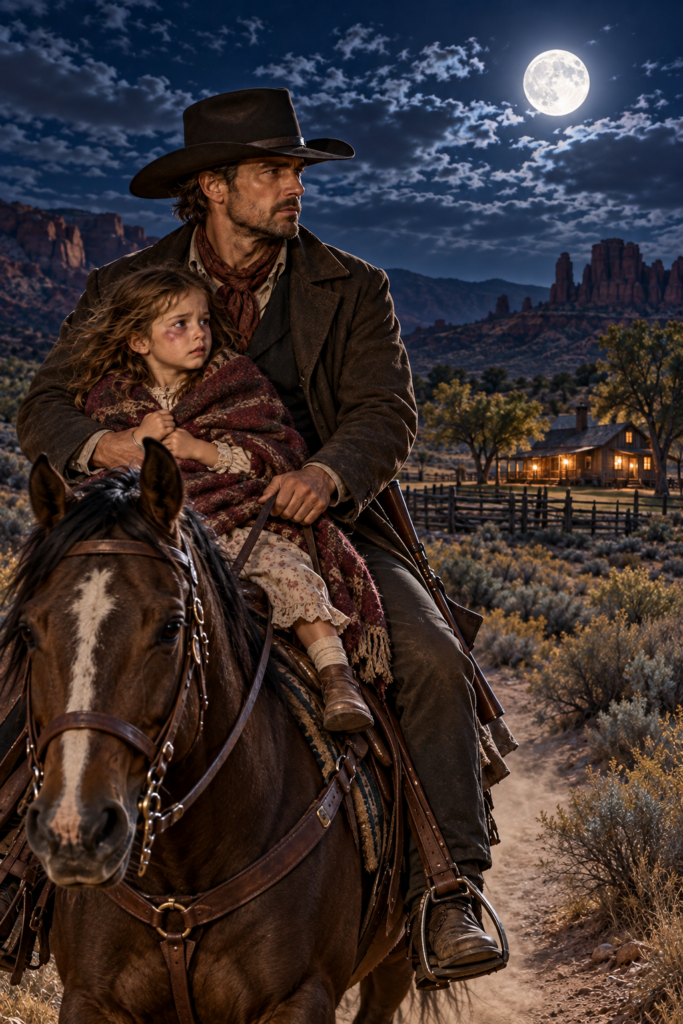
**She Counted to 512 Before She Ran. By Sunrise, the Lonely Rancher Would Learn Why Her Mother Had Chosen Him.**
Eight-year-old Elsie Mae Whitcomb arrived at Caleb Rourke’s ranch before dawn with blood on her feet, dust in her hair, and a number burning behind her eyes.
**Five hundred and twelve.**
That was how high she had counted before she dared to run.
Caleb heard the scraping at his east gate at 4:17 in the morning.
He knew the time because he had not truly slept in fifteen years.
Sleep came to him in shallow stretches, never long enough to dream and never deep enough to forget. Most nights he lay in the narrow iron bed in his ranch house listening to the wind comb the Arizona desert, to coyotes barking somewhere beyond the wash, to the old cottonwood beside his roof scratching its dead fingers against the shingles.
That morning, however, the sound was different.
Scrape.
Pause.
Scrape.
Something was dragging itself along the gate.
Caleb sat up.
The room was blue with moonlight.
His Winchester leaned beside the dresser.
He took it with him.
Outside, the October air was cold enough to bite. The horizon beyond the San Pedro valley was still black, although a thin gray seam had begun to form behind the Dragoon Mountains.
Caleb stepped onto the porch.
Nothing moved.
Then he saw the east gate.
It leaned crookedly from one hinge, as it had for two years because **living alone meant no one ever complained about broken things.**
A small figure knelt against the post.
Caleb lowered the rifle.
He approached slowly.
He had seen tricks before. During the war, desperate men had used wounded civilians as bait. Years later, cattle thieves had learned softer methods. A crying woman. A lame horse. A child beside a road.
But no thief would have wrapped a little girl’s feet in strips torn from a flour sack until the cloth had soaked red.
She wore a faded yellow dress.
One sleeve was torn.
Her right eye was swollen purple.
Her braids had half unraveled.
Yet what disturbed Caleb most was her silence.
She did not cry.
She did not beg.
She simply watched him come.
“Easy,” he said.
Her shoulders tightened.
Caleb stopped three paces away.
“What’s your name?”
“Elsie Mae Whitcomb.”
Her voice was hoarse.
Caleb felt something old shift inside him.
Whitcomb.
He looked toward the south, toward red bluffs invisible in the darkness.
He told himself there were other Whitcombs.
He knew there were not.
“Where are your folks?”
“Mama’s home.”
“And your father?”
She glanced behind her as if the darkness itself might have ears.
“Papa hurt her.”
Caleb’s hand tightened around the rifle.
“How badly?”
“He pushed her into the washstand.”
She swallowed.
“Then against the wall.”
Caleb crouched.
“Was she awake when you left?”
Elsie nodded.
“Could she speak?”
“No.”
“Was she breathing?”
“Yes.”
A pause.
Then the little girl said, with terrible precision, “**One breath every nine seconds.**”
Caleb went still.
Some memories did not fade.
They waited.
Fifteen years vanished.
He was twenty-six again, lying behind a stone wall outside Saint-Mihiel while artillery shook mud from the sky. His younger brother Daniel was twenty-one, pale beneath the blood covering his collar.
One breath.
Nine seconds.
Another breath.
Nine seconds.
Caleb had counted because there was nothing else to do.
Daniel had smiled at him.
“Quit looking at me like that, Cal.”
Then the shelling came again.
Afterward, there had been no Daniel.
Only an officer.
A box.
A silver watch.
And a grave.
Caleb looked at Elsie.
“No child should know how to count breaths like that.”
“Mama taught me.”
“Why?”
“So I’d know when not to scream.”
Something cold moved down Caleb’s spine.
He set the Winchester on the ground.
“Who hurt your feet?”
“Papa.”
“How?”
Elsie looked down.
“He said girls who wander learn better if walking hurts.”
Caleb closed his eyes once.
When he opened them, his voice was quieter.
“How far did you come?”
“Four miles if you use the road.”
“You didn’t?”
“No, sir. I took the dry wash.”
“Why?”
“Papa watches the road.”
Caleb studied her.
“When did you leave?”
Elsie’s fingers curled into the torn fabric of her skirt.
“After I counted to five hundred and twelve.”
“Why that number?”
For the first time, her control cracked.
Her lower lip trembled.
“Mama told me if Papa locked her in the blue room again, I was to hide beneath my bed and count.”
“To five hundred and twelve?”
“She said never stop at five hundred. Papa likes round numbers.”
Caleb frowned.
“What does that mean?”
“He checks things on round numbers.”
“What things?”
“Steps. Fence posts. Nails. Money. Seconds. He says round numbers are God’s way of telling you where to look.”
Caleb had known men with habits like that.
Not superstition.
Control.
A need to force the world into predictable boxes.
“Mama said if I ever had to run, I should wait until five hundred and twelve so Papa would think I was still counting.”
The eastern sky brightened another shade.
Caleb looked at the broken gate, then back at the girl.
“Why here?”
Elsie hesitated.
“Mama said to find the man with the broken east gate.”
Caleb stared at her.
“She knew my gate was broken?”
“She said it had been broken a long time.”
“What else did she say?”
Elsie looked directly at him.
“She said you were **mean enough not to gossip and lonely enough to listen.**”
For fifteen years, Caleb Rourke had believed solitude was armor.
Now an eight-year-old child had crossed four miles of desert barefoot because her mother believed his loneliness made him trustworthy.
Caleb stood.
“Can you ride?”
“I can walk.”
“Not another step.”
He lifted her.
Pain flashed across her face so violently that he nearly put her down.
But she did not make a sound.
That frightened him more.
He carried her toward the house.
“Wait inside. I’ll get my mare.”
Elsie grabbed his shirt.
“No.”
“You can’t go back on those feet.”
“I didn’t say I’d walk.”
“You said—”
“I said I’m not staying.”
Caleb looked at her.
There was fear in her face now.
But beneath it was something harder.
She had left terror behind and would rather ride toward it again than sit safely while her mother faced it alone.
“All right,” he said.
“You come.”
—
Juniper, Caleb’s dun mare, disliked mornings and most people but tolerated him.
He saddled her quickly, wrapped Elsie in his heavy coat, and settled her before him.
As they left the ranch, dawn smeared pale silver over the horizon.
“Tell me where.”
“Follow the wash.”
He did.
“To the cottonwoods?”
Elsie nodded against his chest.
Caleb’s stomach tightened.
“And then the red bluff?”
She twisted around.
“How did you know?”
Caleb did not answer.
The wash curved south.
Sand whispered beneath Juniper’s hooves.
The sun had not yet risen, but the world was becoming visible piece by piece: mesquite, ocotillo, brittle grass, stones white as old bones.
Then two cottonwoods appeared.
Tall.
Twisted.
Caleb pulled the reins.
Beyond them lay a low rise.
And beyond that rise, hidden for the moment, stood a house with blue shutters.
He knew because once he had painted those shutters himself.
The memory came without permission.
A woman standing on a ladder.
Dark hair pinned badly.
Laughter in the heat.
“Blue, Caleb.”
“Green lasts longer.”
“I don’t care.”
“You’ll care in five years.”
“In five years I’ll make you repaint them.”
“Will you?”
She had looked down at him.
“Yes.”
Her name had been Miriam.
Miriam Vale.
Before she became Miriam Whitcomb.
Before she disappeared from Caleb’s life.
Before Daniel died.
Caleb’s fingers stiffened around the reins.
“The house has blue shutters,” Elsie whispered.
Juniper felt him tense.
“Mr. Rourke?”
“Yes?”
“Why do you look scared?”
Caleb swallowed.
“Because I knew somebody who lived there once.”
“My mama?”
He could have lied.
Instead he said nothing.
Elsie understood anyway.
Children who lived in dangerous homes learned the meanings of silence early.
She faced forward.
“You loved her.”
Caleb nearly laughed.
Not because it was funny.
Because an eight-year-old girl had found in ten seconds what he had spent fifteen years burying.
“A long time ago.”
“Does love stop?”
Caleb looked toward the unseen house.
“No.”
“Then why didn’t you come?”
That question rode with them over the rise.
The Whitcomb farm appeared below.
Caleb stopped breathing.
It looked smaller than memory.
The porch sagged.
One chimney leaned.
The blue shutters had faded almost gray.
The orchard Miriam’s father once tended had gone half wild.
But the old barn still stood behind the house.
And inside it burned a lantern.
A bright yellow square in the predawn gloom.
Caleb’s hand moved toward the revolver at his hip.
“Elsie.”
“Yes?”
“How many people live here?”
“Mama. Papa. Me.”
“Workers?”
“Sometimes Mr. Bell comes.”
“Who’s Bell?”
“Papa says he buys cattle.”
“Does he?”
“I don’t know.”
Caleb studied the barn.
The farmhouse windows were dark.
Too dark.
“Stay close.”
He dismounted.
Then came a sound.
Faint.
Broken.
A woman’s cry.
“Mama!”
Elsie slid from the saddle before Caleb could catch her.
She hit the ground, gasped as her wounded feet took her weight, and staggered toward the house.
Caleb grabbed her.
“Slow.”
“Mama!”
The front door stood open.
That was wrong.
Thomas Whitcomb had been many things even when Caleb knew him years ago—charming, smiling, vain, watchful—but never careless.
Caleb entered first.
The smell hit him.
Kerosene.
Sweat.
Iron.
Blood.
Broken plates covered the kitchen.
A chair lay overturned.
A dark stain marked one wall.
Elsie whispered, “That’s where she hit.”
On the floor beneath the table lay a handkerchief.
White linen.
Bloodied.
Caleb picked it up.
An embroidered M marked one corner.
Miriam had embroidered that letter the year Caleb left for Europe.
He had teased her that it looked like a wounded spider.
She had thrown a spool of thread at him.
His throat closed.
“Where is she?”
Elsie limped toward the hall.
“Mama?”
Caleb caught her arm.
A floorboard creaked outside.
He turned.
A man stood beyond the rear door beneath the barn lantern.
Thomas Whitcomb.
Older than Caleb remembered, but instantly recognizable.
He was lean, almost elegant, with silver at his temples and pale eyes set beneath heavy brows.
He wore a clean shirt.
Clean trousers.
Clean boots.
There was blood on one cuff.
Thomas smiled.
“I wondered when you’d come back, Rourke.”
Caleb stepped outside.
“Where’s Miriam?”
Thomas’s smile widened.
“Still your first question.”
“Where is she?”
“You ought to say hello.”
Caleb’s hand lowered near his revolver.
Thomas lifted his own hand.
Something silver dangled from his fingers.
A pocket watch.
Caleb forgot the gun.
Forgot Elsie.
Forgot the cold.
The watch had a dent beside the hinge.
A small scratch crossed the lid.
And along its edge was the tiny crooked engraving Caleb had made himself with a nail when he and Daniel were boys.
D.R.
Daniel Rourke.
Caleb stared.
“That’s impossible.”
Thomas flipped the watch open.
Tick.
Tick.
Tick.
Caleb had buried it.
He had stood beside Daniel’s grave in France six months after the armistice when military clerks finally corrected the grave marker.
He had placed the watch inside the coffin because their father had given it to Daniel before the war.
Caleb remembered the sound of earth hitting wood.
“You stole that.”
Thomas laughed softly.
“From a dead man?”
“Yes.”
“Interesting choice of words.”
Caleb stepped toward him.
“Where did you get it?”
Thomas glanced toward the barn floor.
Then he smiled.
“Your brother didn’t die the way you were told.”
Three knocks came from beneath the barn.
Knock.
Knock.
Knock.
Elsie screamed.
“Mama!”
She ran past Caleb.
Thomas reached for her.
Caleb hit him.
The punch landed flush against Thomas’s jaw.
Thomas fell into the dirt.
Caleb kicked away the revolver hidden beneath his coat and slammed a boot onto his wrist.
“Move and I break it.”
Thomas grinned through blood.
“You always were dramatic.”
Caleb pointed his Winchester at him.
“Elsie, where’s the cellar?”
“No cellar.”
Another three knocks sounded beneath the floor.
Caleb looked around.
The barn was filled with hay, tack, and rusted tools.
A heavy worktable stood in the center.
Elsie limped toward it.
“Mama told me never touch this.”
Caleb pushed the table aside.
Beneath it was a square iron ring set into the planks.
A trapdoor.
He pulled.
Locked.
Thomas laughed from outside.
“You’ll want the key.”
Caleb went back and searched him.
He found three keys.
A pocketknife.
A vial of clear liquid.
And a folded piece of paper covered in numbers.
Caleb tossed the paper aside and returned to the trapdoor.
The second key opened it.
Blackness yawned below.
A ladder descended into earth.
“Miriam?”
A muffled sound answered.
Caleb climbed down.
The underground room smelled of mold, lamp oil, and fear.
A lantern rested on the floor.
Beside it lay Miriam Whitcomb.
For one impossible moment Caleb saw the girl she had been.
Then reality replaced memory.
She was thirty-eight now.
Her dark hair was streaked with gray.
Blood had dried near her temple.
One side of her face was bruised.
Her wrists were tied.
But her eyes—
Her eyes were still Miriam’s.
They opened.
Found him.
And filled with something far more complicated than relief.
“Caleb.”
He dropped beside her.
“Easy.”
“You came.”
“Elsie found me.”
Miriam’s gaze moved toward the ladder.
“Where is she?”
“Safe.”
“No.”
Her fingers gripped his arm.
“You don’t understand.”
“He can’t hurt her now.”
“I’m not talking about Thomas.”
Caleb froze.
Above them, a gunshot exploded.
Elsie screamed.
Caleb climbed the ladder so fast his shoulder struck the hatch.
Thomas was running toward the house.
Elsie stood near the barn wall holding Caleb’s revolver with both hands.
Smoke curled from the barrel.
Thomas clutched his upper arm.
“He tried to grab me,” Elsie said.
Her face was white.
Caleb took the weapon gently.
“You did right.”
Thomas staggered inside the farmhouse.
Caleb could have followed.
Instead, Miriam shouted from below.
“Let him go!”
Caleb looked down.
“What?”
“Get me out.”
He descended, cut her bindings, and carried her up.
When Miriam emerged into the dawn, Elsie threw herself against her.
“Mama!”
Miriam sank to her knees.
She touched her daughter’s swollen eye.
Then her bandaged feet.
Her face changed.
“Thomas did this?”
Elsie nodded.
Miriam hugged her so tightly the girl squeaked.
Then Miriam looked at Caleb.
“We leave now.”
“He’s wounded.”
“Leave him.”
“He has Daniel’s watch.”
That stopped her.
Caleb saw it.
Not surprise.
Recognition.
“You knew.”
Miriam closed her eyes.
“Caleb.”
“You knew he had it.”
“Please.”
“What does Thomas know about Daniel?”
“Everything.”
The first blade of sunlight crossed the red bluff.
Caleb felt suddenly as though the earth beneath him were no more stable than water.
“Tell me.”
Miriam looked at Elsie.
“Not here.”
A floorboard creaked inside the house.
Thomas stepped onto the porch.
Blood soaked his sleeve.
He held a rifle.
Caleb shoved Miriam and Elsie behind the water trough as a shot cracked overhead.
Wood splintered.
Caleb fired back.
Thomas disappeared inside.
“Stay down!”
Caleb ran toward the wagon shed.
Another shot hit the dirt beside his boot.
Thomas had the advantage inside the house.
Caleb had the open yard.
He circled behind the barn.
There was an old irrigation ditch leading toward the kitchen wall.
He remembered because Daniel had fallen into it drunk one summer and spent two weeks claiming he had been attacked by a ditch.
Daniel.
The thought almost stopped Caleb.
He forced himself onward.
He reached the side window.
Inside, Thomas leaned against a wall, loading another cartridge.
Caleb raised the rifle.
“Drop it.”
Thomas turned.
For three seconds neither man moved.
Then Thomas laughed.
“Do you know what your problem has always been?”
“Drop the rifle.”
“You believe memories are evidence.”
“Last warning.”
“You remember Daniel dead.”
Thomas lowered the barrel.
“But **you never saw his body.**”
Caleb’s mouth went dry.
“I saw the coffin.”
“You saw a sealed coffin.”
“I buried his watch.”
“Did you?”
The question hit strangely.
Caleb saw the cemetery again.
Rain.
Mud.
An officer beside him.
A coffin.
His hand holding Daniel’s watch.
Had he placed it inside?
Yes.
Of course.
He remembered—
No.
He remembered intending to.
He remembered touching the coffin lid.
He remembered crying.
Then Thomas spoke.
“You put the watch in an envelope for the graves officer because they wouldn’t reopen the box.”
Caleb’s stomach dropped.
Memory shifted.
Not vanished.
Corrected.
The envelope.
The officer promising it would be placed with Daniel before final burial.
Thomas smiled.
“Memory is a liar, Caleb.”
“Where did you get it?”
“From Daniel.”
The world narrowed.
“Alive?”
Thomas looked past him toward the yard.
“Ask Miriam.”
A shot cracked.
Thomas jerked backward.
His rifle fell.
Caleb spun.
Miriam stood near the barn holding Elsie’s small revolver.
Smoke lifted from the muzzle.
Thomas slid down the wall.
The bullet had struck his chest.
“Miriam!”
She walked forward.
Her expression was empty.
Thomas coughed.
Blood appeared on his lips.
“You should have waited,” he whispered.
“For what?”
Thomas smiled at Caleb.
“For him to remember.”
Then he died.
—
They buried no one that morning.
Caleb insisted on riding for the sheriff.
Miriam refused.
“He has friends.”
“Thomas?”
“Thomas had people who owed him.”
“Miriam, a man is dead.”
“He was dead long before I pulled that trigger.”
Caleb looked at Elsie.
She sat at the kitchen table while Miriam cleaned and bandaged her feet properly.
The child had become silent again.
Too silent.
“Sheriff Lawson will come eventually.”
Miriam tied the bandage.
“Then eventually is soon enough.”
Caleb slammed Daniel’s watch onto the table.
“Explain this.”
Elsie flinched.
Caleb immediately regretted the force.
Miriam noticed.
“Not in front of her.”
“I’m not leaving you alone with a dead body and a frightened child.”
Miriam stared.
“You still think Thomas was the worst thing in this house.”
Caleb felt cold.
“Who was worse?”
Miriam looked at Elsie.
“Go upstairs.”
“No.”
“Elsie.”
“I counted.”
Her small voice shook.
“I walked.”
“Yes.”
“I found him.”
“Yes.”
“So you don’t get to make me little again because Mr. Rourke is here.”
Miriam closed her eyes.
Caleb looked away.
Finally Miriam said, “Sit.”
Elsie sat.
Miriam took a long breath.
“Daniel survived the attack outside Saint-Mihiel.”
Caleb stared at her.
“No.”
“Yes.”
“I was there.”
“You were unconscious.”
“Not until after.”
“You saw him wounded.”
“I saw him buried under rubble.”
“You saw what you were able to see.”
Caleb’s hands began to shake.
“What happened?”
“Daniel was pulled out by a French medical unit. He had a head injury. Severe memory loss.”
“How do you know?”
“He came here.”
The room tilted.
“When?”
“1921.”
Four years after Caleb had been told Daniel was dead.
Caleb pushed back from the table.
“That’s impossible.”
“He arrived at my father’s house one night.”
“This house?”
“Yes.”
“Why didn’t you tell me?”
“I tried.”
“No.”
“I wrote.”
“You never wrote.”
“Three letters.”
“Liar.”
Miriam flinched.
Caleb hated himself for seeing it.
He lowered his voice.
“I never got them.”
“I know.”
“How?”
“Because Thomas took them.”
Caleb stared toward the porch where Thomas’s body lay unseen beyond the doorway.
Miriam continued.
“Daniel remembered almost nothing. Not you. Not your father. Not the ranch. Only fragments. My name was one of them.”
“Why yours?”
Miriam hesitated.
And Caleb suddenly understood.
He laughed once.
A broken sound.
“Oh.”
Elsie watched him.
Caleb looked at Miriam.
“You and Daniel.”
“Before you and I.”
“How long?”
“Three months.”
Caleb stood.
“You told me you barely knew him.”
“I was seventeen.”
“You said—”
“I lied.”
“Why?”
“Because I was ashamed.”
“Of Daniel?”
“Of myself.”
Caleb paced.
Miriam’s father had been strict. Church-strict. Reputation-strict. The kind of man who believed a daughter’s virtue belonged to the entire family.
“You loved him.”
“Yes.”
The word cut surprisingly little.
Maybe because fifteen years had made pain spacious.
Or maybe because worse was coming.
“When he left for war,” Miriam said, “Daniel broke things off. He told me he didn’t want me waiting for a man who might not return.”
“And then you turned to me.”
Her eyes flashed.
“Do not reduce what we had to that.”
Caleb stopped.
“We were real.”
“You married Thomas.”
“Because you disappeared.”
“I went looking for Daniel’s grave.”
“For fourteen months.”
“I wrote you.”
“I never received those letters either.”
Thomas.
Caleb looked toward the porch again.
“How long had he been interfering?”
“Before any of us understood he was doing it.”
The dead man seemed larger now.
Not merely violent.
Architectural.
As though entire portions of their lives had been built inside rooms he designed.
Caleb sat again.
“What happened when Daniel came here?”
Miriam’s hands tightened.
“He was different.”
“How?”
“Quiet. Frightened. He woke screaming. He remembered numbers better than names. Dates. Distances. Patterns.”
Elsie looked up.
Caleb noticed.
“Miriam.”
She stared at the table.
“Daniel would count when afraid.”
Caleb’s pulse slowed.
“Round numbers?”
“No.”
Miriam looked at Elsie.
“Powers of two.”
Caleb felt the hair rise on his arms.
Two.
Four.
Eight.
Sixteen.
Thirty-two.
Sixty-four.
One hundred twenty-eight.
Two hundred fifty-six.
**Five hundred twelve.**
Caleb turned toward Elsie.
Her face had gone pale.
“Mama?”
Miriam reached for her.
Elsie backed away.
“No.”
“Sweetheart—”
“You said Papa liked round numbers.”
“Thomas did.”
“Then why five hundred and twelve?”
Miriam said nothing.
Elsie stood.
“Mama.”
Caleb whispered, “Because Daniel taught you.”
Miriam’s face crumpled.
“Yes.”
Silence swallowed the room.
Caleb heard the watch ticking.
Daniel’s watch.
Tick.
Tick.
Tick.
He looked at Elsie.
At her dark hair.
At the faint cleft in her chin.
Daniel had possessed that same cleft.
Caleb stood so quickly the chair fell.
“No.”
Miriam began crying.
“No.”
“Caleb—”
“How old is she?”
“Eight.”
“Thomas married you twelve years ago.”
“Yes.”
“Then no.”
“I know what you’re thinking.”
“You don’t.”
“I do.”
Caleb looked at Elsie again.
Eight.
Daniel had returned in 1921.
It was now 1932.
The dates did not fit.
Relief came too fast.
Then Miriam said, “Elsie isn’t Daniel’s daughter.”
Caleb almost laughed.
“Then why are you—”
“She’s his granddaughter.”
The ticking watch became deafening.
Elsie stared at her mother.
“What?”
Miriam reached for her again.
Elsie moved behind Caleb.
It was instinctive.
Miriam saw it and broke a little more.
“My daughter,” she whispered, “your father was not Thomas Whitcomb.”
Elsie’s lips parted.
Caleb felt suddenly sick.
“Who?”
Miriam looked at him.
“Daniel’s son.”
—
His name had been Samuel.
Miriam told the story in pieces because some truths resist coming out whole.
When Daniel returned from Europe, he did not come alone.
He brought a baby.
A boy less than a year old.
Caleb listened without blinking.
“Whose child?”
“We never knew the mother’s full name.”
“Daniel didn’t remember?”
“He remembered a village. A woman called Claire. A church with no roof. That’s all.”
Samuel grew up in the Whitcomb house hidden beneath the lie that he was Miriam’s orphaned cousin.
Thomas knew.
Of course Thomas knew.
Thomas always knew the useful secrets.
“He helped hide Samuel’s identity,” Miriam said.
“Why?”
“Because secrets make chains.”
Daniel lived in the barn loft for nearly two years.
He repaired fences.
He carved toys.
He taught Samuel numbers.
And slowly, memory began returning.
First his own name.
Then Caleb’s.
Then the ranch.
Then the war.
“He wanted to find you.”
“Why didn’t he?”
“Thomas convinced him you were dead.”
Caleb stared.
“What?”
“He showed Daniel a newspaper clipping about a Caleb Rourke killed in a mining accident in Colorado.”
“There are dozens of Rourkes.”
“Daniel was fragile.”
Miriam wiped her face.
“He believed it.”
Caleb looked down at the watch.
“And Daniel?”
“He disappeared in 1924.”
“Disappeared?”
“One morning his bed was empty.”
“Thomas killed him.”
“I believed so.”
“Believed?”
Miriam looked toward the barn.
“We never found a body.”
Caleb stood.
The knocks beneath the floor.
The underground room.
“How long has that room been there?”
“Thomas built it years after Daniel vanished.”
“For what?”
“For me, when I disobeyed.”
Elsie’s face tightened.
Miriam continued.
“Samuel grew up. He hated Thomas. By sixteen he was asking questions.”
“And?”
“He found Daniel’s military papers hidden in Thomas’s desk.”
Caleb already knew the ending would be bad.
“Samuel learned the truth.”
“He learned some of it.”
“How old was he?”
“Seventeen.”
“That was three years ago.”
“Yes.”
Miriam looked at Elsie.
“He ran away.”
Elsie whispered, “My papa ran away?”
Miriam shook her head.
“No, darling.”
The word sounded fragile.
“He came back.”
“When?”
“Last year.”
Caleb looked sharply at her.
“Thomas said he never did.”
“Thomas lied.”
“Where is Samuel now?”
Miriam’s face emptied.
“He is dead.”
Elsie made a tiny sound.
Miriam rose.
Elsie retreated.
“No.”
“Sweetheart—”
“No!”
She ran.
Bare feet struck the hall.
Miriam lunged after her.
Caleb caught Miriam’s shoulder.
“Let her.”
“She’s hurt.”
“So is everything she thought was true.”
That stopped Miriam.
Upstairs, a door slammed.
Miriam pressed both hands over her mouth.
Caleb looked toward the ceiling.
“You told her Thomas was her father.”
“He demanded it.”
“Why?”
“Because Samuel married in secret.”
“To whom?”
“A girl from Benson. Ruth Danner.”
“And Elsie?”
“Their child.”
“Where’s Ruth?”
Miriam looked down.
“She died giving birth.”
Caleb rubbed his face.
“So you raised Elsie.”
“Yes.”
“As your daughter.”
“Yes.”
“And Thomas used that to control Samuel.”
“Yes.”
“What happened when Samuel returned?”
Miriam’s eyes shifted toward the barn.
“He came looking for Daniel.”
Caleb froze.
“Why?”
“Because Samuel believed Daniel was alive.”
The room seemed to contract.
“Why would he believe that?”
“He received letters.”
“From Daniel?”
“We thought so.”
“Where are they?”
“Thomas burned them.”
“How convenient.”
“You think I don’t know that?”
Miriam’s voice broke.
“I have spent fifteen years inside that man’s lies.”
Caleb lowered his voice.
“And now he’s dead.”
“No.”
Miriam stared at him.
“Now his lies are all we have left.”
—
They found the first hidden compartment by accident.
Elsie did not come downstairs for nearly an hour.
When she did, she held a wooden horse.
One of its legs was broken.
Caleb recognized the carving immediately.
Daniel used to make the same horse every winter.
Always one front leg raised.
Always a notch under the belly shaped like a V.
“Where did you get that?”
Elsie’s face was swollen from crying.
“My room.”
“Who gave it to you?”
“Papa.”
“Thomas?”
She shook her head.
“Samuel.”
Miriam inhaled sharply.
“He told you his name?”
“Not until the last time.”
Caleb crouched.
“When was that?”
“The night he died.”
Miriam gripped the table.
“Elsie.”
The girl turned.
“You knew?”
“I thought you were asleep.”
“I wasn’t.”
“What did you see?”
Elsie looked at the wooden horse.
“Papa came to my window.”
“Samuel?”
A nod.
“He was bleeding.”
Caleb felt the air change.
“What did he say?”
Elsie closed her eyes.
“He said, ‘If Grandfather comes back, give him the horse.’”
Caleb stopped breathing.
“Grandfather?”
Elsie opened her eyes.
“He said, ‘Not Thomas. The other one.’”
Miriam sat hard.
Caleb took the horse.
The carved V under the belly.
He pressed it.
A panel shifted.
Inside the hollow body was a tiny brass key.
Miriam whispered, “Oh God.”
Caleb stood.
“What does it open?”
No one knew.
They searched the house.
Desk drawers.
Boxes.
Cupboards.
Thomas’s room.
Nothing.
Then Elsie said, “The blue room.”
Miriam went pale.
“No.”
“What’s the blue room?”
Elsie looked at Caleb.
“The room Mama was locked in.”
Miriam whispered, “We don’t go there.”
Caleb studied her.
“Why?”
“Because Thomas kept it locked.”
“He’s dead.”
“That room has been locked longer than Elsie has been alive.”
“Then we’re going in.”
The blue room was at the end of the upstairs hall.
Its door was painted a darker blue than the shutters.
The brass key fit.
Caleb turned it.
The lock clicked.
Dust drifted in the sunlight as the door opened.
The room contained almost nothing.
A narrow bed.
A washbasin.
A wardrobe.
And hundreds of marks carved into the walls.
Numbers.
Caleb stepped inside.
2.
4.
8.
16.
32.
64.
128.
256.
512.
Then again.
2.
4.
8.
16.
The sequences repeated across the plaster.
Elsie whispered, “I count like that.”
Miriam covered her mouth.
“Daniel.”
Caleb touched one set of carvings.
They were old.
Very old.
“He was here.”
Miriam shook her head.
“Thomas said—”
“Thomas lied.”
They searched everything.
The wardrobe stood empty.
The bed frame contained nothing.
Then Elsie crouched beside the baseboard.
“There.”
A tiny brass keyhole.
The horse key fit.
Part of the wall released.
Behind it waited a cavity.
Inside lay three things.
A photograph.
A ledger.
And an envelope.
Caleb picked up the photograph first.
Four young people stood beside the cottonwoods.
Caleb.
Miriam.
Daniel.
Thomas.
All smiling.
All ignorant.
On the back someone had written:
**FOUR BEGIN. ONE ENDS IT.**
Caleb recognized Daniel’s handwriting.
He opened the envelope.
Inside was a single sheet dated April 4, 1924.
Cal,
If you ever read this, Thomas lied to me and probably lied to you too.
I remember now.
Not everything.
Enough.
The officer who told you I died was paid.
Not to fake my death.
To fake yours.
Thomas wanted us separated.
Ask Miriam why.
Do not trust the watch.
—Daniel
Caleb read the final sentence again.
**Do not trust the watch.**
He opened the ledger.
The first pages were financial.
Cattle sales.
Land purchases.
Loans.
Then names appeared.
Sheriff Lawson.
Judge Mercer.
Dr. Vale.
Miriam’s father.
Payments.
Dates.
Amounts.
Caleb’s pulse hammered.
“What was Thomas doing?”
Miriam scanned the pages.
“Buying people.”
“For what?”
Then Caleb saw his own name.
C. ROURKE — $2,000.
He stared.
“I never took money from him.”
Miriam turned the page.
Beneath Caleb’s name was Daniel’s.
D. ROURKE — transfer arranged.
Beside it:
**Subject unsuitable after memory recovery. Relocation required.**
Caleb whispered, “Subject?”
More pages.
More names.
Men believed dead.
Women declared insane.
Children transferred between families.
Properties inherited under suspicious circumstances.
Thomas Whitcomb had not merely been cruel.
He had operated something.
A machine made of corruption.
“What was he involved in?”
Miriam’s face turned gray.
“My father.”
“What about him?”
“He worked for the territorial asylum before Arizona became a state.”
Caleb waited.
“He arranged placements for patients.”
“What kind of placements?”
“Labor.”
Caleb’s jaw tightened.
“People were sold.”
“Not officially.”
Miriam pointed to the ledger.
“These names… they were men with no families. Veterans. Drifters. People nobody would look for.”
“Daniel.”
“Yes.”
Elsie stood in the doorway clutching her sleeves.
“Was Grandpa Daniel one?”
Caleb looked at her.
Grandpa Daniel.
The words landed strangely.
“I don’t know.”
Then the watch chimed.
All three turned.
The silver pocket watch lay on the bed.
It chimed again.
Once.
Twice.
Three times.
Caleb frowned.
“It doesn’t chime.”
Miriam stared.
“It never did.”
Caleb picked it up.
The watch was warm.
He pressed the winding crown.
Nothing.
Then Elsie said, “Twist left.”
Caleb looked at her.
“How do you know?”
“Papa Samuel told me.”
Caleb twisted the crown left.
The back popped open.
Behind the ordinary clockwork was a second compartment.
Inside, folded smaller than a postage stamp, was a strip of paper.
Four words.
**BELL KNOWS WHERE DANIEL IS.**
—
Mr. Bell arrived at noon.
They heard his truck before they saw it.
Caleb took position beside the porch.
Miriam stayed upstairs with Elsie.
The truck rattled into the yard.
An elderly man climbed out.
He was perhaps sixty-five, narrow-shouldered, gray-bearded, wearing a dusty hat.
He saw Thomas’s body.
Stopped.
Then looked at Caleb.
“Well,” he said.
“About damn time.”
Caleb aimed the rifle.
“You’re Bell?”
“Jonas Bell.”
“You know Daniel Rourke?”
Bell looked toward the house.
“Who found the watch?”
“Answer me.”
“I know Daniel.”
“Alive?”
Bell studied Caleb.
“Yes.”
The rifle dipped.
Caleb forced it back up.
“Where?”
Bell sighed.
“That answer costs more than pointing a gun.”
“You want money?”
“I want to know whether Miriam is alive.”
“She is.”
“And the girl?”
“Alive.”
Bell closed his eyes.
“Thank God.”
Caleb grabbed his shirt.
“Where is my brother?”
Bell did not resist.
“Twenty-three miles east.”
Caleb’s grip loosened.
“In the Chiricahuas.”
“Doing what?”
“Hiding.”
“For eight years?”
“Not hiding from Thomas.”
Caleb stared.
“From you.”
The words struck harder than a fist.
“Why?”
Bell looked toward the upstairs window.
“Because Daniel believed **you were Thomas’s partner.**”
Caleb stepped back.
“That’s a lie.”
“I know.”
“Who told him?”
“You did.”
Caleb felt something rupture inside his understanding of the world.
“I never saw Daniel after France.”
Bell reached slowly into his coat.
Caleb raised the rifle.
“Careful.”
Bell produced an envelope.
“Then explain this.”
The letter was in Caleb’s handwriting.
Cal,
You should have stayed dead.
Thomas and I have an arrangement. Miriam made her choice.
Come near us again and Samuel disappears.
Forget your name.
Forget mine.
—Caleb Rourke
Caleb read it twice.
“That isn’t mine.”
“Handwriting is.”
“Forged.”
Bell nodded.
“Daniel eventually guessed that.”
“When?”
“Three months ago.”
Caleb looked sharply at him.
“Why didn’t he come?”
“He sent Samuel.”
The dead young father.
The wooden horse.
The blood at Elsie’s window.
Caleb whispered, “Samuel came to me?”
“No.”
“Then where?”
“To Thomas.”
“Why?”
“To steal the ledger.”
Caleb looked toward the blue room.
“He hid it.”
“Yes.”
“Thomas killed him.”
Bell said nothing.
That was answer enough.
Miriam came outside.
When Bell saw her bruised face, his expression hardened.
“You should’ve shot Thomas years ago.”
“I tried once.”
“Should’ve aimed better.”
Caleb held up Daniel’s letter.
“You knew about this.”
Bell nodded.
“Some.”
“How?”
“I served with Daniel after you were wounded.”
Caleb’s eyes narrowed.
“You were military?”
“Medic.”
“Then why don’t I remember you?”
“You were unconscious when we pulled you out.”
Caleb’s pulse stopped.
“We?”
Bell looked at him steadily.
“You and Daniel were both alive after Saint-Mihiel.”
“No.”
“Yes.”
“I woke in another aid station.”
“Three days later.”
“You’re saying—”
“Daniel was beside you.”
Caleb felt the desert move under his feet.
“He was alive.”
“He was.”
“What happened?”
Bell’s face changed.
“Thomas happened.”
Caleb nearly struck him.
“Thomas was in Arizona.”
“No.”
Miriam whispered, “Caleb…”
Bell removed his hat.
“Thomas Whitcomb was in France.”
Caleb turned.
Miriam’s eyes filled.
“You knew?”
“Not then.”
Bell said, “Lieutenant Thomas Whitcomb. Intelligence liaison. He handled displaced soldiers and unidentified wounded.”
Caleb remembered a face in mud.
An officer bending over him.
Pale eyes.
Caleb had forgotten.
Or thought he had.
Thomas.
“You saw him.”
“For seconds.”
“He altered your records. Daniel’s too.”
“Why?”
Bell looked at Miriam.
Caleb followed his gaze.
Miriam went white.
“Tell him,” Bell said.
She shook her head.
“You tell him.”
“Miriam.”
She stared at Caleb.
“My father promised me to Thomas when I was sixteen.”
Caleb said nothing.
“I refused.”
“Because of Daniel?”
“At first.”
“And later?”
“Because of you.”
Caleb closed his eyes.
Thomas had wanted Miriam.
Daniel loved her.
Caleb loved her.
And Thomas turned an entire war into a weapon against two brothers.
“He killed our lives over jealousy?”
Bell laughed bitterly.
“Thomas never did anything for one reason. Miriam came with land.”
Caleb looked around.
The Whitcomb property stretched from the river toward the foothills.
“What land?”
Bell pointed east.
“Under it.”
Caleb frowned.
“Copper?”
“No.”
“What?”
“Water.”
The answer seemed too small.
Then Bell explained.
A deep aquifer ran beneath the Whitcomb acreage and neighboring ranches.
Rail companies had explored a route years earlier.
Mining interests wanted pumping rights.
Thomas had quietly accumulated claims and neighboring titles.
Caleb’s ranch sat over the western branch.
Daniel, as Caleb’s heir if Caleb died, complicated ownership.
Caleb complicated it more.
Thomas had planned to have both brothers legally dead.
Then acquire Miriam’s property through marriage.
“Why leave me alive?”
“You came home before he could finish.”
Caleb remembered returning to Arizona.
Miriam married.
Daniel dead.
His father dead.
Letters unanswered.
He had ridden north for years.
By the time he came back, Thomas controlled nearly everything.
Bell said, “Your solitude saved you.”
“How?”
“Thomas needed you isolated, not dead. A dead man creates papers. An isolated man creates nothing.”
Caleb looked toward his broken gate.
Lonely enough to listen.
Mean enough not to gossip.
His life had not merely been lonely.
It had been curated.
Encouraged.
Thomas had built invisible fences around him.
Rage rose so violently Caleb tasted blood where his teeth cut his cheek.
“Take me to Daniel.”
Bell nodded.
“We go before dark.”
—
Daniel lived in a ruined mining camp beneath the Chiricahuas.
The journey took four hours.
Miriam insisted on coming.
So did Elsie.
Caleb argued.
Lost.
By late afternoon, clouds gathered above the mountains.
Bell guided them along a narrow canyon road until abandoned stone buildings appeared among junipers.
A man stood outside one.
He had white hair.
A limp.
And Caleb’s face.
Older.
Thinner.
Scarred along the left temple.
But unmistakable.
Daniel Rourke.
Caleb stopped walking.
Fifteen years of grief did not vanish.
It transformed.
That was worse.
Daniel stared.
His mouth opened.
No sound came.
Caleb moved first.
They met halfway.
Neither brother spoke.
They collided in an embrace so violent it looked like a fight.
Daniel made a sound Caleb had not heard since childhood.
A sob swallowed into someone’s shoulder.
Caleb held the back of his brother’s head.
“You bastard.”
Daniel laughed and cried at once.
“You look terrible.”
“You’re alive.”
“So are you.”
“You’re alive.”
“I know.”
Caleb struck his shoulder.
Daniel struck him back.
Then Caleb hugged him again.
Behind them, Elsie began crying.
Daniel looked over Caleb’s shoulder.
Saw her.
Everything in his face changed.
“Samuel’s girl.”
Elsie wiped her cheeks.
“Are you my grandpa?”
Daniel’s knees nearly buckled.
“Yes.”
She stared at him.
Then crossed the distance and hugged him around the waist.
Daniel pressed both hands over his face.
Caleb looked away.
Some reunions were too private even when witnessed.
Miriam stood near Bell.
Daniel eventually looked at her.
“Miriam.”
“Daniel.”
No embrace.
Too many ghosts stood between them.
“Samuel?” Daniel asked.
Miriam’s face answered first.
Daniel closed his eyes.
“No.”
“I’m sorry.”
“No.”
“He came back.”
“No.”
“Thomas killed him.”
Daniel turned away.
Elsie clung tighter.
For several minutes only wind moved through the canyon.
Then Daniel said, “We finish it.”
Caleb frowned.
“Thomas is dead.”
Daniel looked at him.
“You think Thomas was in charge?”
Silence.
Bell swore softly.
Miriam whispered, “Daniel…”
Daniel’s face hardened.
“Thomas was never the architect.”
Caleb felt dread crawl into him.
“Then who?”
Daniel looked toward Elsie.
“No.”
Miriam stepped back.
“Don’t.”
Daniel ignored her.
“Thomas took orders for thirty years.”
“From whom?”
Daniel looked directly at Caleb.
“From the person who sent Elsie to your gate.”
Caleb turned toward Miriam.
She shook her head violently.
“No.”
Elsie whispered, “Mama?”
Daniel said, “Miriam, tell him.”
Caleb’s throat dried.
“Tell me what?”
Miriam looked at Elsie.
Then at Caleb.
“I sent her because I needed Thomas to follow.”
Caleb frowned.
“Follow what?”
“Her.”
Elsie’s face changed.
“You knew I’d run?”
“I taught you where.”
“You told me to find Mr. Rourke.”
“Yes.”
“You knew Papa would hurt you?”
Miriam’s eyes filled.
“I knew he would lose control.”
Caleb felt sick.
“You used your daughter as bait?”
“My granddaughter.”
Elsie recoiled as if struck.
Miriam reached out.
Elsie moved behind Daniel.
Caleb stared at the woman he once loved.
“Why?”
Miriam’s expression collapsed.
“Because it was the only way to bring all of you together.”
“All of who?”
“You. Daniel. Bell.”
“Why?”
Miriam whispered, “Because Thomas would never reveal the watch unless he thought everything was ending.”
Caleb remembered Thomas beneath the barn lantern.
Holding Daniel’s watch openly.
Too openly.
Almost presenting it.
“He wanted me to see it.”
“Yes.”
“Why?”
“Because the watch was never evidence.”
Daniel said, “It was a key.”
Caleb took it from his pocket.
“To what?”
Daniel looked at the silver case.
“The real ledger.”
“We found a ledger.”
“A decoy.”
Bell muttered a curse.
Daniel continued.
“Thomas kept the true records where nobody could reach them without four things.”
“What four?”
“His watch. Samuel’s key. Miriam’s code.”
Caleb looked around.
“And the fourth?”
Daniel met his eyes.
“You.”
Caleb almost laughed.
“What am I, another key?”
“Yes.”
“How?”
“Your memory.”
The canyon went silent.
Caleb remembered Thomas’s final words.
**For him to remember.**
Daniel stepped closer.
“What happened at Saint-Mihiel?”
“I told you.”
“No. You told yourself.”
Caleb’s heartbeat accelerated.
“We were shelled.”
“Before that.”
“Daniel—”
“Before that.”
Fragments surfaced.
Mud.
Night.
A farmhouse.
Thomas.
Bell.
Daniel bleeding.
A lantern.
Someone shouting.
Caleb gripped his head.
“I don’t remember.”
“You do.”
“No.”
Daniel looked almost afraid now.
“Caleb, what number did you count when I stopped breathing?”
“Nine seconds.”
“Not breaths.”
“What?”
“The door.”
Caleb froze.
A door.
Metal.
Painted red.
A bunker beneath the farmhouse.
He saw his own hand tapping.
Not randomly.
Numbers.
2.
4.
8.
16.
32.
64.
128.
256.
512.
His stomach turned.
“No.”
Daniel whispered, “You taught me the sequence.”
“No.”
“Yes.”
“I learned it from you.”
Elsie stared at them.
Daniel continued.
“You used powers of two for field codes.”
“I was infantry.”
“Before the war.”
Caleb shook his head.
“You worked telegraph.”
The memory cracked open.
He had.
For the railroad.
Signal relays.
Binary states.
On.
Off.
Open.
Closed.
Patterns.
Codes.
Thomas had found out.
Used him in France.
Not officially.
Caleb saw papers.
Names.
Transfers.
Men listed dead but still alive.
A hidden trafficking operation moving wounded soldiers into forced labor after the war.
Thomas was part of it.
So was—
Caleb looked at Bell.
Bell’s face was gray.
“You.”
Bell nodded.
“At first.”
Caleb raised his fist.
Daniel caught it.
“Wait.”
Bell said, “I got men out. Daniel first.”
“You helped Thomas.”
“I helped a military intelligence operation I thought was legitimate.”
“You falsified deaths.”
“I followed orders until I understood.”
“Whose orders?”
No one answered.
Caleb turned slowly toward Miriam.
She looked very tired.
“My father,” she said.
Dr. Vale.
Miriam’s father.
The asylum official.
Caleb exhaled.
“He started it?”
“No.”
Another voice spoke from inside the stone building.
A woman’s voice.
Old.
Clear.
“No, Mr. Rourke.”
Everyone turned.
An elderly woman stepped into the doorway.
She was perhaps seventy.
Thin.
Straight-backed.
Dressed in black.
Caleb had never seen her.
Yet Miriam looked terrified.
Elsie whispered, “Who is that?”
The woman smiled.
“Your great-grandmother.”
Miriam’s face drained of color.
“Mother.”
Caleb stared.
“Miriam told me her mother died when she was a child.”
The old woman’s smile sharpened.
“Yes.”
“That was the first useful lie.”
—
Her name was Evelyn Vale.
She had not died.
She had disappeared.
There was a difference, she explained.
They gathered inside the mining building as rain began beating against the roof.
Evelyn sat near a cold stove like a queen receiving petitioners.
No one offered her comfort.
No one seemed foolish enough.
Caleb stood.
“Start talking.”
Evelyn looked amused.
“You always were impatient.”
“You know me?”
“Since before you knew yourself.”
Miriam whispered, “I watched them bury you.”
“A coffin full of stones.”
“Why?”
“To become free.”
“Free from what?”
“Being watched.”
Daniel leaned against the wall.
“You ran the network.”
Evelyn looked at him.
“Eventually.”
Caleb felt disgust.
“You trafficked wounded men.”
“I redirected abandoned men.”
“Into labor camps.”
“Into industries.”
“Slavery.”
Evelyn shrugged.
“Words become moral when spoken by people who benefited from the outcome.”
Caleb stepped forward.
Daniel blocked him.
Evelyn continued.
“Railroads needed labor. Mines needed bodies. Governments needed inconvenient records to disappear. Thomas understood paperwork. My husband understood institutions. Bell understood medicine.”
Bell spat on the floor.
“And you understood monsters.”
Evelyn smiled.
“Exactly.”
Miriam stared at her mother.
“Why are you here?”
“For the same reason all of you are.”
“The ledger?”
“The final record.”
Caleb looked at the watch.
Evelyn nodded.
“Thomas lacked the courage to destroy it.”
“Where is it?”
“In a vault beneath your ranch.”
Caleb went rigid.
“My ranch?”
“Your father built the original station for the railroad. Telegraph junction. Storage basement.”
“I know every inch of that property.”
“No.”
Evelyn’s smile widened.
“You know every inch Thomas allowed you to know.”
Caleb thought of the east gate.
Broken.
Unrepaired.
Why that gate?
Why had Miriam specifically said broken east gate?
He looked at her.
“Miriam.”
She lowered her eyes.
“The gate marks the tunnel line.”
Elsie whispered, “That’s why you knew.”
“Yes.”
Caleb’s head spun.
“So this entire morning—”
“Was planned,” Evelyn said.
He turned on Miriam.
“You planned Thomas attacking you?”
“No.”
“Elsie running?”
“Yes.”
“Me returning to the house?”
“Yes.”
“Thomas showing the watch?”
“I hoped.”
“His death?”
Miriam looked away.
Caleb understood.
“You meant to kill him.”
“Yes.”
“Why involve a child?”
Miriam exploded.
“Because Samuel is dead!”
Her scream filled the room.
“Because Daniel hid for eight years! Because you spent fifteen years rotting alone! Because Bell is old! Because Thomas was about to sell the western claims and disappear! Because every adult in this cursed family has failed and lied and hidden until an eight-year-old girl became the bravest person among us!”
Elsie flinched.
Miriam began crying.
“I hated sending her.”
“Then why?”
“Because Thomas never watched children carefully enough.”
Elsie stared.
“He hurt me.”
Miriam’s face broke completely.
“I know.”
“You knew he might.”
“No.”
“You knew.”
“Elsie—”
“You knew.”
The child walked backward.
Then ran outside into the rain.
Miriam followed.
Daniel caught her.
“Give her space.”
“She’s eight!”
“And you made her older this morning.”
Miriam slapped him.
The sound cracked through the room.
Daniel did not move.
Miriam stared at her own hand.
Then collapsed against the wall.
Outside, rain turned the canyon silver.
Caleb looked at Evelyn.
“What’s in the ledger?”
Evelyn’s amusement vanished.
“The names of everyone.”
“Everyone involved?”
“Everyone purchased.”
Bell whispered, “My God.”
“Thousands,” Evelyn said.
“Across how many years?”
“Thirty-seven.”
Caleb stared.
“And you want it?”
“Yes.”
“To destroy it?”
“No.”
“Then why?”
Evelyn looked toward the rain.
“To find one name.”
“Whose?”
She looked at Caleb.
“Yours.”
He laughed.
“Mine?”
“You were never born Caleb Rourke.”
The room vanished.
Not physically.
But Caleb lost his sense of it.
Daniel whispered, “Evelyn.”
She continued.
“Neither was Daniel.”
Caleb turned toward his brother.
Daniel looked equally stunned.
Evelyn smiled sadly now.
“Your father bought both of you.”
—
Caleb remembered his father as a hard man with huge hands.
Nathan Rourke.
Railroad mechanic.
Rancher.
Widower.
He never spoke of their mother.
Said she died when Caleb was three.
There were no photographs.
No family Bible records before Arizona.
No relatives.
Caleb had never thought to question it.
Why would a boy question the man who taught him to ride?
Evelyn said, “Nathan Rourke worked for the network.”
“No.”
“Yes.”
“He hated Thomas.”
“Later.”
“No.”
“He transported children west.”
Caleb lunged.
Daniel and Bell restrained him.
“You lie.”
Evelyn did not blink.
“He took you from a labor settlement in Pennsylvania in 1898.”
Caleb fought harder.
“Shut up.”
“You were six.”
“Shut up!”
“He took Daniel from a church orphanage in Ohio four years later.”
Daniel stopped moving.
Caleb turned.
Brothers.
Not blood.
The thought should have mattered.
Somehow it did not.
Daniel had bled beside him in France.
Blood had nothing to add.
Evelyn continued.
“Nathan developed a conscience.”
Bell muttered, “Late.”
“Consciences usually are.”
“He abandoned the network. Took you both west. Raised you as sons.”
Caleb slowly stopped fighting.
“Why would the ledger list my original name?”
“Every transfer did.”
“And you don’t know it?”
“The early records were coded.”
“Then how do I unlock them?”
Evelyn looked at the watch.
“Your memory.”
Again.
That word.
Memory.
Caleb suddenly hated it.
“The vault is controlled by an old relay system,” Evelyn said. “A sequence.”
“Powers of two.”
“Yes.”
“And why me?”
“Because Nathan made you memorize the final pattern before he died.”
“My father died of influenza.”
“He died from poison.”
Caleb closed his eyes.
Another lie.
Another room opening behind a wall.
“How much of my life is real?”
Daniel answered.
“Me.”
Caleb looked at him.
Daniel’s eyes were wet.
“Whatever else they changed, you’re my brother.”
Caleb exhaled.
“Yes.”
Outside, Elsie stood in the rain beneath a pine.
Not crying now.
Just watching water run from her fingertips.
Caleb went to her.
He did not tell her to come inside.
He stood beside her.
After a while she said, “Do grown-ups always lie this much?”
“No.”
“That was a lie.”
Caleb almost smiled.
“Fair.”
She looked toward the building.
“Is Mama bad?”
Caleb considered the question carefully.
“She did something terrible.”
“Sending me?”
“Yes.”
“Does that make her bad?”
“I don’t know.”
“You’re old.”
“I’m forty-one.”
“That’s old.”
“Thank you.”
She almost smiled.
Then her face tightened.
“She knew I was scared.”
“Yes.”
“She told me to count anyway.”
Caleb looked at the rain.
“Sometimes people decide the thing they need is so important that they stop seeing what it costs someone else.”
“Thomas did that.”
“Yes.”
“So did Mama.”
“Yes.”
“Did you?”
Caleb thought of fifteen years alone.
Of letters he stopped writing.
Questions he stopped asking.
People he refused to trust.
“Yes.”
“To who?”
“Myself.”
Elsie considered that.
Then asked, “Will you leave after?”
“After what?”
“The ledger.”
Caleb looked toward Daniel.
Miriam.
The impossible family assembled through violence and lies.
“I don’t know.”
Elsie slipped her hand into his.
“Don’t.”
One word.
No drama.
No pleading.
It struck deeper than anything else had.
Caleb squeezed her hand.
“Come on.”
They went inside.
Miriam looked up.
Elsie did not go to her.
But she did not turn away either.
For now, that was all they had.
—
They reached Caleb’s ranch after midnight.
The rain had followed them from the mountains.
Lightning flashed over the valley.
The broken east gate hung open.
Caleb looked at it differently now.
A marker.
The tunnel line.
Evelyn pointed.
“Start there.”
They dug near the gatepost.
Three feet down, Caleb’s shovel struck iron.
A hatch.
His own land.
His own gate.
A secret beneath it.
The hatch opened into a narrow tunnel lined with old railroad timbers.
They descended carrying lanterns.
Elsie remained above with Miriam at first.
Then a rifle shot came from the darkness beyond the house.
Bell shouted.
“Down!”
Glass shattered.
Someone else had arrived.
Evelyn did not look surprised.
Caleb grabbed her.
“Who?”
“Thomas’s insurance.”
“Who?”
“Sheriff Lawson.”
Another shot.
Bell fell.
Blood spread across his shoulder.
Daniel dragged him behind the stone foundation.
Caleb ran toward the porch, fired twice into darkness, and heard a horse scream.
Then a voice boomed.
“Rourke! Bring me the watch!”
Sheriff Lawson.
The lawman Caleb had known for eleven years.
Shared coffee with.
Helped during floods.
Another fence.
Another liar.
Caleb shouted, “Thomas is dead!”
A pause.
Then laughter.
“I know.”
“How?”
“I told him to stall you.”
Caleb’s blood chilled.
The sheriff had known before anyone could have ridden to town.
Thomas had not been insurance.
He had been expendable.
Lawson shouted, “Miriam was supposed to survive. The girl wasn’t.”
Elsie went still.
Miriam’s face changed.
She picked up Thomas’s rifle.
Caleb caught her.
“No.”
“He just said—”
“I heard.”
“I’ll kill him.”
“That’s what he wants.”
Lightning illuminated the yard.
For one instant Caleb saw Lawson near the corral.
He fired.
Lawson vanished again.
Daniel crawled to Caleb.
“There’s another entrance to the tunnel.”
“Where?”
“Barn.”
Caleb understood.
The underground room at Whitcomb’s barn had been modeled after this network.
“Can we reach the house basement?”
“Yes.”
They retreated through the hatch.
Daniel, Miriam, Elsie, Evelyn, wounded Bell, and Caleb descended.
Lawson fired at the opening.
Bullets struck iron.
Caleb slammed the hatch shut.
Darkness.
Lantern light.
The tunnel ran west.
After fifty yards they reached a circular chamber.
Telegraph equipment rusted along one wall.
Wires disappeared into stone.
At the center stood a steel door.
No keyhole.
Only eight levers.
Above them numbers had been stamped:
2
4
8
16
32
64
128
256
Elsie whispered, “Where’s 512?”
Caleb stared.
“The door.”
She looked at him.
“What?”
“If all eight are engaged, the next state is five hundred twelve.”
Daniel smiled despite everything.
“You remember.”
Caleb shook his head.
“No.”
He touched the first lever.
A memory flickered.
Nathan Rourke sitting beside a stove.
Young Caleb arranging coins.
Two.
Four.
Eight.
“Never trust the obvious sequence,” Nathan had said.
“Why?”
“Because if a man is making you remember something, he should make you remember how to survive it too.”
Caleb moved his hand away.
“It’s a trap.”
Evelyn stiffened.
“What?”
“All eight levers open something else.”
“How do you know?”
“My father told me.”
“You remember the pattern?”
“Not yet.”
Above them, dull thuds sounded.
Lawson had found the hatch.
They had minutes.
Caleb looked at the levers.
Nathan’s voice.
Never trust the obvious sequence.
He remembered playing a game.
Coins on a table.
Two.
Four.
Eight.
Then Nathan flipping some face down.
Not addition.
Binary.
Railway relays.
On and off.
Caleb whispered, “512 isn’t the answer.”
Elsie stepped beside him.
“Mama told me to count to 512.”
Everyone looked at her.
She continued.
“But she always made me skip something.”
Miriam frowned.
“I did?”
“When you taught me.”
“What did you skip?”
Elsie recited.
“Two, four, eight, sixteen, thirty-two, sixty-four, one hundred twenty-eight, five hundred twelve.”
Caleb stared.
“You skipped 256.”
Elsie nodded.
Miriam whispered, “I learned the sequence from Daniel.”
Daniel shook his head.
“I never skipped 256.”
Miriam looked at Evelyn.
Her mother smiled.
“I did.”
Caleb’s hand curled.
“Why?”
“Because 256 was the kill switch.”
Silence.
“You knew the combination all along.”
“Part.”
“Why drag us here?”
“Because opening the vault requires the sequence and your hand.”
“My hand?”
“Bloodline lock.”
Caleb laughed bitterly.
“You just said Nathan bought me.”
“Yes.”
“Then there’s no bloodline.”
Evelyn’s smile faded.
“I never said the bloodline was Nathan’s.”
Caleb understood before she spoke.
“No.”
Evelyn’s eyes shone.
“You wanted the truth.”
“No.”
“I’m your mother.”
Nobody moved.
Even the pounding above seemed distant.
Caleb stared at her.
“You’re lying.”
“I gave birth to you in 1892.”
“Miriam is thirty-eight.”
“Yes.”
“You’re her mother.”
“Yes.”
Caleb looked at Miriam.
Then back at Evelyn.
“You’re saying Miriam is my—”
“Half-sister.”
Miriam made a choking sound.
Caleb nearly vomited.
Because once, long ago, before war and lies, he had loved Miriam.
Kissed her.
Planned to marry her.
Evelyn watched the horror spread.
“That,” she said quietly, “is why Thomas separated you.”
Caleb’s mind went blank.
Thomas.
Of all people.
Thomas had known.
“He saved us?”
“No,” Evelyn said. “He exploited it.”
But the distinction barely registered.
Miriam sank against the wall.
“No.”
“You never told me.”
“Your father didn’t know Caleb existed.”
“Who was Caleb’s father?”
Evelyn looked toward the steel door.
“The man who founded the network.”
Caleb whispered, “Name.”
“Silas Whitcomb.”
Miriam stared.
“Thomas’s father?”
“Yes.”
The final shape emerged.
Caleb was Thomas Whitcomb’s half-brother.
Miriam was Caleb’s half-sister through Evelyn.
Daniel was no blood relation.
Samuel was Daniel’s son.
Elsie was Samuel’s daughter.
Every relationship they had believed was false.
Every falsehood concealed another.
Above them, metal screeched.
Lawson was entering the tunnel.
Daniel raised his rifle.
“We can untangle the family tree after not dying.”
Caleb almost laughed.
It was the sanest sentence spoken all day.
He faced the levers.
“Which one?”
Evelyn said, “All except 256.”
“How do I know you’re not lying?”
“You don’t.”
Elsie stepped forward.
“Grandpa Samuel knew.”
Caleb looked at her.
“He told me one thing.”
“What?”
“If I ever found a room with numbers, I should choose the number that was missing.”
Caleb looked at the levers.
256.
The missing number.
“Not skip it,” Elsie said.
“Choose it.”
Evelyn shouted, “No!”
Caleb pulled 256.
A violent metallic crack sounded.
The floor beneath Evelyn opened.
She screamed.
For the first time, the old woman lost control.
A narrow pit appeared beneath her.
She caught the edge.
Miriam grabbed her wrist instinctively.
Evelyn dangled over darkness.
“Pull me up!”
Caleb stared.
The 256 lever was not a kill switch.
It was a trap.
For the person who lied about it.
Samuel had known.
Maybe Daniel had known without remembering.
Maybe Nathan designed it.
Miriam strained.
“Help me!”
Caleb moved.
Not toward Evelyn.
Toward the remaining levers.
He pulled 2.
4.
8.
16.
32.
64.
128.
Left 256 engaged.
The total of the engaged values—
Caleb calculated.
510.
Elsie whispered, “Add the door.”
Caleb looked at the steel door.
Two heavy locking bars shifted.
**512.**
The door opened.
Evelyn screamed from the pit.
“You fool!”
Inside the vault were shelves.
Boxes.
Documents.
Photographs.
Identity records.
Birth certificates.
Military tags.
Thousands of stolen lives.
And on a desk in the center sat one final envelope.
CALEB.
Footsteps thundered down the tunnel.
Lawson.
Daniel took position.
Caleb opened the envelope.
Nathan Rourke’s handwriting.
Son,
If you are reading this, I failed to keep the past buried.
You were Evelyn Vale’s child by Silas Whitcomb.
She sold you into the network herself.
I was ordered to deliver you to a textile camp.
I could not.
I took you.
Years later I took Daniel too.
Not because you shared blood.
Because I had learned that blood is the poorest reason to call someone family.
If Evelyn ever returns, she will tell you the vault proves who you are.
It does not.
It proves what was done to you.
There is one more thing.
The network was never controlled by Evelyn.
She believed it was.
Silas let her believe it.
Thomas believed he inherited it.
He did not.
After Silas died, control passed through coded account ownership.
To you.
Caleb stopped.
No.
He read the next line.
Every property, company, claim, payment account, and holding created by the network was placed under the legal identity Silas intended for his heir.
Your birth name.
**Caleb Silas Whitcomb.**
You own the machine.
Destroy it.
Or become it.
The letter fell from his hand.
Daniel whispered, “Cal?”
Caleb looked around at shelves representing millions of dollars.
Land.
Mines.
Rail contracts.
Banks.
Judges.
Politicians.
He understood Thomas’s obsession.
Thomas was not trying merely to own the Whitcomb land.
He was trying to force Caleb into discovering the vault so ownership could be transferred or coerced.
Evelyn shouted from the pit.
“Pull me up!”
Then Lawson entered the chamber.
He held Elsie by the hair.
No one had seen him circle through the side passage.
His revolver pressed against her head.
Everything stopped.
“Drop them.”
Daniel lowered his rifle.
Miriam made a sound like an animal.
Caleb raised empty hands.
Lawson smiled.
“Good.”
Elsie trembled.
But she did not cry.
Lawson dragged her closer to the vault.
“You found it.”
Caleb said, “Let her go.”
“Once you sign.”
“Sign what?”
Lawson pulled folded papers from his coat.
“Transfer.”
Caleb almost laughed.
“You need my birth name.”
“We have it now.”
Of course.
Lawson had been listening.
“Thomas was stupid,” Lawson said. “Evelyn arrogant. Silas dead. But paperwork?”
He smiled.
“Paperwork outlives everyone.”
Caleb looked at Elsie.
Her eyes met his.
Then shifted.
Down.
His gaze followed.
Her right hand.
Small.
Closed.
Opening.
Closing.
Counting.
One.
Two.
Three.
Caleb understood.
She was doing what frightened children did.
Counting.
But not to calm herself.
To signal.
Her fingers moved:
2.
4.
8.
Then stopped.
Lawson noticed.
“What are you doing?”
Elsie looked up.
“Counting.”
“To what?”
She swallowed.
“Five hundred and twelve.”
Lawson laughed.
“Why?”
Elsie looked at Caleb.
“Because that’s when I run.”
Then she stomped backward on Lawson’s injured instep.
He cursed.
She dropped.
Miriam fired.
The bullet struck Lawson’s gun hand.
Daniel tackled him.
Caleb grabbed Elsie and rolled behind the steel door.
Lawson screamed.
Daniel hit him.
Once.
Twice.
Lawson reached for a knife.
Bell appeared in the tunnel behind him.
Wounded shoulder soaked red.
He fired once.
Lawson fell.
Silence.
Then Evelyn laughed from the pit.
Everyone turned.
Her fingers were slipping.
“You think this ends anything?”
Caleb walked to the edge.
She looked up at him.
“Pull me out.”
He crouched.
“You’re my mother.”
“Yes.”
“You sold me.”
Her face changed.
“I survived.”
“That wasn’t what I asked.”
“The world was different.”
“No.”
“Caleb—”
“You sold a child.”
“I created an empire.”
“You lost a son.”
“I found you.”
“No.”
Caleb looked toward Daniel.
Miriam.
Elsie.
Bell.
“My father found me.”
Evelyn’s face twisted.
“Nathan stole you.”
“He chose me.”
Caleb stood.
Evelyn screamed.
“You need me!”
“No.”
“You don’t understand those records!”
“I’ll learn.”
“The accounts!”
“I’ll close them.”
“The properties!”
“I’ll return them.”
“You’ll destroy everything!”
Caleb looked down.
“Yes.”
Her grip slipped.
Miriam lunged.
Caleb caught her.
“Mother!”
Evelyn fell.
Her scream faded into darkness.
No impact came for a long time.
When it did, it was small.
Final.
Miriam collapsed.
Caleb held her.
Not as a lost lover.
Not as the woman he once intended to marry.
As something stranger.
A sister discovered too late.
A survivor of the same mother.
Elsie stood beside them.
After a moment she put one hand on Miriam’s shoulder.
Miriam covered it with hers.
Not forgiveness.
Not yet.
But contact.
Sometimes beginnings were smaller than people expected.
—
Three months later, the broken east gate was gone.
Caleb replaced it himself.
Elsie complained the new one squeaked.
He told her new things needed time to learn how to sound old.
She said that made no sense.
Daniel agreed with her.
They lived together now.
Not gracefully.
Not simply.
But together.
Daniel took the small room near the barn.
Miriam and Elsie lived in the main house while repairs were made at the Whitcomb property.
Bell recovered and moved to Tucson, where he began sending evidence to federal investigators under three different names because, as he explained, “One government office can lose anything. Three have to compete.”
Sheriff Lawson’s death exposed enough corruption to start inquiries across two states.
The vault did the rest.
Caleb spent weeks reading records.
The network was larger than any of them had imagined.
More than twelve hundred people had been stripped of names, transferred, exploited, or declared dead.
Some were still alive.
Properties had passed through fraudulent inheritances for decades.
Caleb could not undo all of it.
But he could open the books.
So he did.
Rail holdings were sold.
Claims were returned where possible.
Money was placed into trusts for survivors and descendants.
Lawyers arrived daily.
Some threatened.
Some begged.
Some offered fortunes if Caleb would remain silent.
He refused.
One man offered him two hundred thousand dollars to burn a single box.
Caleb burned the offer in the stove.
Elsie watched.
“That was money.”
“It was paper.”
“Money is paper.”
“Not that much of it.”
She rolled her eyes.
Eight-year-olds recovered in strange ways.
Her feet healed before her trust did.
She still counted when nervous.
But now Caleb sometimes counted with her.
2.
4.
8.
16.
32.
64.
128.
256.
512.
One evening in January, she sat with him on the porch.
The desert had turned purple beneath sunset.
Daniel was in the barn arguing with a mule.
Miriam cooked supper inside.
The sounds felt ordinary.
Caleb had forgotten how extraordinary ordinary life could be.
Elsie swung her legs.
“Mr. Rourke?”
“Caleb.”
“Mama says children shouldn’t call grown men by their first names.”
“Your mama has known me too long to expect proper behavior.”
Elsie considered that.
“Uncle Caleb?”
He nearly choked on his coffee.
Technically, somehow, absurdly, it was true.
Miriam was his half-sister.
Elsie was not his blood niece by Samuel’s line, but family had become a word with too many branches to police.
“Sure.”
She smiled.
Then grew serious.
“Did Mama know Grandma Evelyn was alive?”
“No.”
“Did Daniel?”
“No.”
“Did Thomas know?”
“Probably.”
“Did Samuel?”
“Some.”
She nodded.
Then asked, “Who knew everything?”
Caleb stared at the horizon.
“No one.”
Elsie frowned.
“Somebody had to.”
“No.”
This was something Caleb had learned from the vault.
Something worse, perhaps, than discovering a single mastermind.
Nobody had known everything.
Silas knew one piece.
Evelyn another.
Thomas another.
Nathan another.
Bell another.
Miriam another.
Daniel another.
Samuel another.
They had all acted on incomplete truths.
**The great machine of suffering had not survived because one monster controlled it. It survived because hundreds of people knew only enough to protect their own piece of it.**
Elsie leaned against him.
“That’s stupid.”
“Yes.”
“Grown-ups are stupid.”
“Often.”
They watched the sunset.
Then Elsie said, “I’m glad I counted to 512.”
Caleb looked down.
“Why?”
“Because I found you.”
His throat tightened.
“You would’ve found someone.”
“No.”
She shook her head.
“Mama picked you.”
“That isn’t the compliment you think.”
“But I picked you after.”
Caleb looked at her.
“What do you mean?”
“At the mountain.”
“When?”
“When I asked you not to leave.”
He had no answer.
Elsie seemed satisfied by that.
She hopped down.
“Daniel says supper’s burning.”
“Daniel can’t smell supper from the barn.”
“He says he can.”
“He’s lying.”
“Family trait.”
She ran inside laughing.
Caleb remained on the porch.
The sun disappeared.
Stars emerged.
He listened to Miriam scold Daniel through the kitchen window.
Daniel claimed innocence.
Elsie loudly testified against him.
For the first time in fifteen years, Caleb’s house was noisy.
He liked it.
Then he heard a scrape at the east gate.
Caleb froze.
The new gate moved gently in the wind.
Nothing there.
He smiled at himself.
Old fear.
Old habit.
He turned toward the house.
Then something silver glinted beneath the gatepost.
Caleb stopped.
He walked into the yard.
The object lay half buried in dust.
A pocket watch.
Not Daniel’s.
Another.
Caleb picked it up.
On the lid were engraved two letters.
**S.W.**
His stomach tightened.
Silas Whitcomb.
Impossible.
The watch opened.
Inside was no clockwork.
Only a folded piece of paper.
Caleb unfolded it.
One sentence.
**If you opened the vault, Evelyn failed—come alone to the old telegraph station on February 2 if you want to meet the woman who gave birth to Elsie.**
Caleb forgot how to breathe.
Behind him, Elsie laughed inside the house.
Miriam called her name.
Daniel shouted something about biscuits.
Caleb read the line again.
The woman who gave birth to Elsie.
Ruth Danner.
Dead in childbirth.
That was the story.
Another story.
Another grave no one had opened.
He looked at the date.
January 31.
Two days.
At the bottom of the note was a second line in handwriting he recognized.
Samuel’s.
**Caleb, if you are reading this, do not tell Miriam.**
His hand began to shake.
Then he noticed something else.
A tiny mark beside Samuel’s signature.
A carved V.
The same V hidden beneath the wooden horse.
Not a letter.
An arrow.
Pointing to the paper’s edge.
Caleb held it near the porch lamp.
There, written so faintly it appeared only against the light, were eight more words.
**Elsie was never Samuel’s daughter. Ask Daniel why.**
Caleb stared at the house.
At the warm windows.
At the family inside.
Daniel stood visible through the kitchen glass.
Alive.
Home.
His younger brother looked toward the porch.
For a second their eyes met.
Daniel smiled.
Then he saw the watch in Caleb’s hand.
The smile disappeared.
Not slowly.
Instantly.
Daniel went white.
And in that single expression Caleb understood the most terrifying truth of all.
**Daniel knew exactly what the note meant.**
Caleb stepped toward the door.
Inside, Elsie began counting while she set plates on the table.
“Two, four, eight, sixteen…”
Daniel did not move.
Miriam laughed at something the child said.
“…thirty-two, sixty-four…”
Caleb looked down at the watch.
Another compartment had opened by itself.
Inside it was a miniature photograph.
A newborn baby.
On the back:
**ELSIE ROURKE.**
Caleb’s vision blurred.
“…one hundred twenty-eight…”
He turned the photograph over again.
Beneath the first inscription was a date.
Eight years earlier.
And beneath that, four words.
**Father: Caleb Silas Whitcomb.**
The plate in Caleb’s hand shattered on the porch.
Inside, Elsie stopped counting.
Daniel closed his eyes.
Miriam turned toward the sound.
Caleb could hear his own heart.
He had been alone eight years earlier.
Or believed he had.
He remembered a winter fever.
Three missing days.
A doctor sent by Sheriff Lawson.
A woman’s voice.
A needle.
He remembered nothing else.
Not until now.
A flash.
A white room.
Evelyn.
Thomas.
Someone saying, **“The bloodline continues.”**
Caleb staggered.
The network had not needed him merely as an heir.
It had needed an heir after him.
Elsie walked to the doorway.
“Uncle Caleb?”
He looked at the child.
At the chin he had thought belonged to Daniel.
At the gray-green eyes.
His eyes.
A truth more impossible than every truth before it settled over him.
Thomas had not beaten Elsie merely because she disobeyed.
He had been raising the legal heir to the entire hidden empire.
Miriam had not known.
Samuel had discovered it.
That was why he died.
Daniel knew.
That was why he hid.
Evelyn had never wanted Caleb to open the vault simply because of ownership.
She wanted him to claim the girl.
Because under Silas Whitcomb’s old trust documents, **the network could only be dissolved by two consecutive blood heirs acting together.**
Caleb.
And Elsie.
That was why the child had been trained to count.
Why Samuel taught her the horse.
Why Miriam sent her to the broken gate without understanding the full design.
Why every road led to Caleb.
Elsie stepped onto the porch.
“You look scared again.”
Caleb stared at the note.
Then at Daniel.
“You knew.”
Daniel came outside slowly.
“Yes.”
“For how long?”
“Three months.”
“Why didn’t you tell me?”
“Because I found Samuel’s final letter.”
“What did it say?”
Daniel looked at Elsie.
“That once you knew she was yours, everyone left in the network would come for both of you.”
Caleb’s blood chilled.
“The network is gone.”
Daniel shook his head.
“We destroyed the records.”
“No.”
“We exposed the accounts.”
“No.”
“Thomas is dead. Evelyn is dead. Lawson is dead.”
Daniel looked toward the darkness beyond the new gate.
“They were the people trying to destroy it.”
Caleb stopped.
“What?”
Daniel’s voice dropped.
“Silas’s network wasn’t being protected by Thomas.”
He looked toward the road.
“Thomas was stealing from it.”
“The sheriff?”
“Trying to seize it.”
“Evelyn?”
“Trying to expose enough of it to bargain for immunity.”
Caleb felt the night expand around them.
“Then who actually runs it?”
Daniel looked at Elsie.
She had gone strangely still.
Too still.
Caleb noticed her right hand.
Her fingers were moving.
Counting.
Not upward.
Backward.
512.
256.
128.
64.
Caleb whispered, “Elsie?”
The girl looked at him.
And suddenly the fear was gone from her face.
Not faded.
Gone.
Her posture changed.
Only slightly.
But enough.
Daniel stepped backward.
“Caleb.”
Miriam appeared in the doorway.
“What’s happening?”
Elsie reached into the pocket of her dress.
She removed a tiny brass whistle.
Caleb stared at it.
“Where did you get that?”
Elsie smiled.
Not like a child.
Not entirely.
“Mr. Bell gave it to me.”
Daniel swore.
“Bell.”
Elsie raised the whistle.
Caleb caught her wrist.
“Don’t.”
She looked up at him.
For one terrible second he saw an eight-year-old girl.
Then something colder returned.
“You opened the vault.”
“Yes.”
“You signed the dissolution papers.”
“Yes.”
“You returned the property.”
“Yes.”
“You exposed the names.”
“Yes.”
Elsie smiled wider.
“Then you did everything they needed.”
Caleb’s heart stopped.
“Who?”
The desert answered.
Lanterns appeared beyond the east gate.
One.
Then five.
Then twelve.
Riders.
Cars.
Men moving through the darkness.
Daniel reached for his rifle.
Elsie said quietly, “Don’t.”
He froze.
She looked at Caleb.
“Grandpa Samuel said you were the only man stubborn enough to destroy the old network.”
Caleb could barely speak.
“Samuel planned this?”
“He helped.”
“He’s dead.”
“Yes.”
“Bell?”
“Alive.”
“Evelyn?”
“Dead.”
“Thomas?”
“Dead.”
“Why?”
Elsie tilted her head.
“Because they belonged to the old network.”
Caleb understood.
Not fully.
Enough.
The people approaching were not coming to preserve Silas Whitcomb’s machine.
They were coming because Caleb had destroyed it.
And destruction created empty space.
Power hated empty space.
Miriam whispered, “Elsie, sweetheart…”
Elsie looked at her.
“I am your sweetheart.”
Her voice softened.
“I love you.”
Miriam began crying.
“But Samuel told me something before he died.”
“What?”
“That love and truth are not the same thing.”
Elsie turned back to Caleb.
“The old network stole people.”
Caleb said nothing.
“The new one finds them.”
“What new one?”
“People with no names. No papers. No protection.”
Caleb looked at the lanterns.
“You’re rebuilding it.”
“No.”
Her face became fierce.
“We’re replacing it.”
Daniel whispered, “With what?”
Elsie answered like she had rehearsed the words a hundred times.
“Routes out of forced labor camps. Safe houses. Money taken from the old accounts. Judges we expose if they refuse. Railmen who hide people instead of selling them. Doctors who change names when changing a name saves a life.”
Caleb stared.
“A rescue network.”
Elsie nodded.
“Samuel built the first routes.”
“Bell?”
“Runs the southern line.”
Caleb looked at Daniel.
“You knew none of this?”
“Not this.”
Elsie continued.
“Thomas discovered it.”
“That’s why he killed Samuel.”
“Yes.”
“And Evelyn?”
“She thought Samuel wanted the ledger for revenge.”
Caleb almost laughed.
All the old monsters had misunderstood.
They believed everyone sought the same thing they did.
Ownership.
Control.
Money.
Samuel had wanted something else.
To turn the machinery backward.
Caleb looked at the riders arriving at his gate.
“Why me?”
Elsie smiled.
“Because you’re mean enough not to gossip.”
Caleb closed his eyes.
“And lonely enough to listen.”
“Yes.”
He opened them.
“You crossed four miles on bloody feet for this?”
Her face changed.
The child returned.
Tears filled her eyes.
“No.”
Her voice broke.
“I crossed four miles because I thought Mama was dying.”
Caleb’s chest tightened.
“So none of that was staged?”
“Mama planned for me to find you.”
“Yes.”
“Samuel planned for the horse to reach me.”
“Yes.”
“But Thomas hurting you—”
“Was real.”
“The fear.”
“Real.”
“You shooting him.”
“Real.”
“The counting.”
Elsie wiped her face.
“That was mine.”
Caleb knelt before her.
“Then listen to me.”
She did.
“No network owns you.”
“I know.”
“No dead man gets to decide what you become.”
“I know.”
“No ledger. No bloodline. No Whitcomb name.”
“I know.”
“You are eight.”
Elsie’s face crumpled.
“I know.”
Caleb pulled her into his arms.
This time she cried.
Not silently.
Not carefully.
Not every nine seconds.
She cried like a child who finally had permission to be one.
Miriam knelt and wrapped herself around both of them.
Daniel put a hand on Caleb’s shoulder.
Beyond the gate, the riders waited.
Not masters.
Not saviors.
People carrying work left unfinished.
Caleb looked at them over Elsie’s head.
One man dismounted.
Jonas Bell.
His wounded shoulder was strapped.
Caleb laughed through tears.
“You lying son of a bitch.”
Bell tipped his hat.
“Took you long enough.”
“You could’ve told me.”
“You wouldn’t have believed me.”
“I believe increasingly ridiculous things these days.”
Bell smiled.
Then grew serious.
“We need a place.”
“For what?”
“A station.”
Caleb looked at his ranch.
At the house that had been silent fifteen years.
At the barn.
At the desert road.
At the east gate.
A place where no one came.
A place nobody watched.
The perfect place for people who needed to disappear.
Caleb looked at Elsie.
“What do you think?”
She sniffed.
“About what?”
“Should we fix the gate again?”
She stared.
“You just fixed it.”
“I know.”
“Why break it?”
Caleb looked toward the waiting strangers.
“Because some people may need to know they’ve found the right place.”
Elsie thought about this.
Then smiled.
A real child’s smile this time.
“Make it crooked.”
Daniel groaned.
“I helped hang that gate.”
“Then you can help unhang it.”
“I hate this family.”
“No you don’t.”
“No,” Daniel said.
“I really don’t.”
The next morning, just before sunrise, Caleb removed the lower hinge.
The east gate sagged.
Exactly as it had before.
Miriam painted a tiny blue mark on the inside post where only someone searching for it would notice.
Bell rode south before breakfast.
Daniel began clearing the spare room.
And Elsie sat on the porch with a pencil and a schoolbook, loudly refusing to do arithmetic because, according to her, she had “done enough numbers for one lifetime.”
Caleb repaired a fence nearby.
At noon, dust appeared on the northern road.
A wagon approached.
Inside sat a woman with two children.
The driver stopped beside the broken gate.
The woman looked exhausted.
Afraid.
Caleb walked toward her.
She clutched a scrap of paper.
“Are you Caleb Rourke?”
He looked at Elsie.
She had stopped pretending not to listen.
“Yes.”
The woman glanced at the crooked gate.
“Someone told me I’d know your place because you never fix anything.”
Elsie burst out laughing.
Caleb sighed.
“Apparently my reputation is improving.”
The woman did not smile.
Her eyes filled with tears.
“They said you help people disappear.”
Caleb considered the word.
Disappear.
That was what the old network had done.
Erased names.
Erased histories.
Erased lives.
He shook his head.
“No.”
The woman’s hope faded.
Caleb opened the gate.
**“We help people come back.”**
Behind him, Elsie began counting.
Not because she was afraid.
Not because anyone had ordered her.
Not because five hundred and twelve was a code, a lock, a bloodline, a trap, or a promise.
She counted because she was eight years old and had decided to see how high she could go.
“Five hundred and nine.”
She grinned.
“Five hundred and ten.”
Caleb held the broken gate open.
“Five hundred and eleven.”
The woman guided her children through.
Elsie took a breath.
Then shouted the number that had once meant escape.
**“Five hundred and twelve!”**
And for the first time in her life, **nothing terrible happened when she reached it.**


