
Part 1
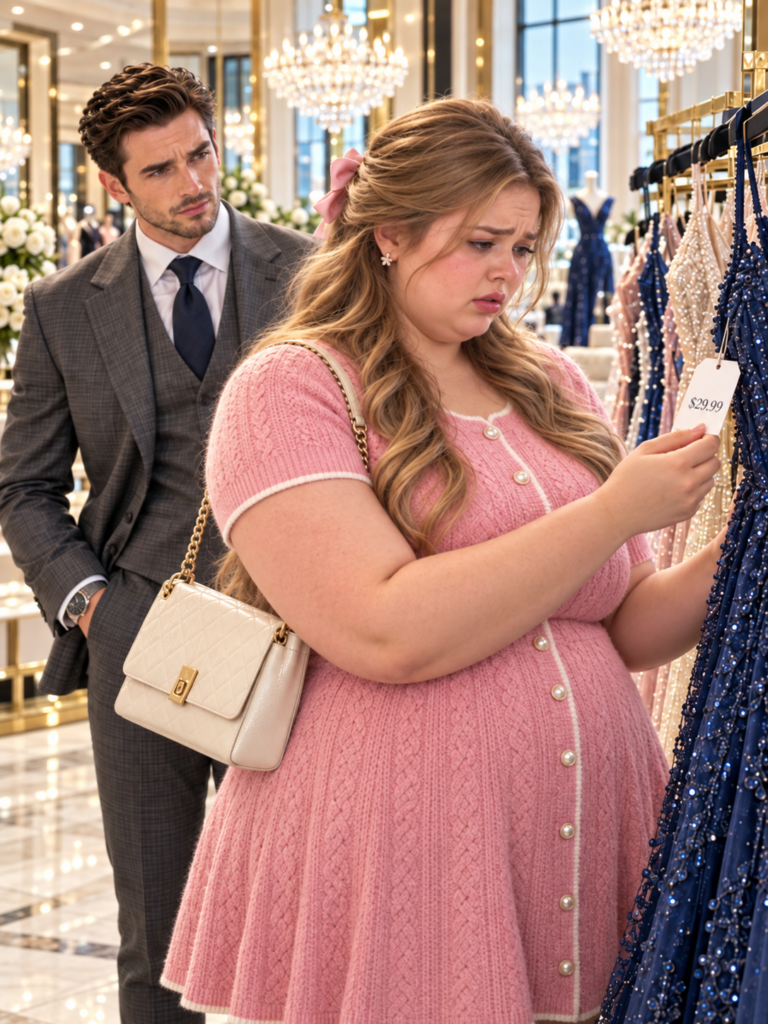
The navy dress cost $29.99.
To most of the women moving through the department store that morning, it was the price of lunch for two, perhaps less than a bottle of perfume displayed three aisles away. To Nora Bennett, standing beneath the soft white lights of the women’s clothing department, it might as well have cost a thousand dollars.
She stood in front of the glass display longer than she meant to.
The dress was simple enough to escape anyone else’s attention: dark navy fabric, a modest neckline, a fitted waist, and tiny pearl-like beads stitched along the sleeves. It was elegant without trying too hard. Professional without being severe.
Exactly the kind of dress Nora might once have designed herself.
Her fingers closed around the fraying strap of her handbag.
Inside her wallet was $31.46.
She had counted it at the kitchen table before sunrise.
Then again on the bus.
And once more in the department store restroom, as though money might somehow multiply if she looked at it often enough.
It had not.
Her father needed groceries. More importantly, he needed his medication that evening. Nora knew almost exactly what both would cost, and every calculation ended the same way.
The dress was impossible.
She stepped closer anyway.
For a few seconds, she imagined herself wearing it to the interview scheduled less than an hour from now. She pictured the boutique manager looking up and seeing someone polished, capable, employable.
Not a woman who cleaned office floors before dawn.
Not a waitress who hurried from table to table during lunch shifts.
Not the neighbor people called when they needed a hem shortened or a zipper repaired for ten dollars.
Just Nora Bennett.
Thirty-one years old.
Standing straight.
Looking like she still belonged to the world she had once wanted.
Her reflection appeared faintly in the glass. Tired brown eyes. Hair pinned neatly but without much care. A cream blouse she had owned for six years. A faded skirt she had altered twice to keep it presentable.
The woman in the reflection looked older than thirty-one.
Nora glanced at the price tag again.
$29.99.
She almost laughed.
The number looked so small.
That was the cruel part.
If the dress had been $300, she could have dismissed it immediately. But $29.99 was close enough to temptation that she could imagine doing something irresponsible.
Thirty dollars.
One moment of confidence.
One chance to walk into that boutique looking like she had not spent the last five years putting everyone else first.
Then her father’s face came to mind.
The left side of his mouth still pulled slightly downward when he was tired. His hand shook when he lifted his coffee cup. Since the stroke, he tried to hide how much he hated depending on her, which only made Nora more determined never to let him feel like a burden.
She released the handbag strap.
“No,” she whispered.
She stepped away from the display.
Several feet behind her, a man in a charcoal-gray suit noticed.
Matthew Whitaker had entered the store twenty minutes earlier to review inventory before a meeting. He owned several clothing stores across New York City and had recently acquired the company operating this location.
His visits usually caused nervous energy wherever he went.
Managers straightened displays that were already straight. Employees smiled too quickly. People who recognized his name found reasons to introduce themselves.
Matthew had grown accustomed to it.
Money had a way of entering rooms before he did.
At forty, he had spent most of his adult life building businesses, restructuring failing stores, acquiring brands, and learning how to read people who wanted something from him.
The woman near the display wanted nothing from him.
She did not even know he was there.
That was partly why he kept watching.
Not her appearance.
Her hesitation.
He had seen customers abandon expensive items before. People looked at prices, frowned, changed their minds.
This was different.
Nora had looked at the dress the way someone looked through a window at a life they used to recognize.
Then she had checked the tag and gone still.
Matthew noticed the brief tightening around her mouth. The way she touched the sleeve but immediately pulled her hand back. The way she finally turned from it with an expression so controlled that it somehow revealed more than tears would have.
She did not complain.
She did not look around for someone to sympathize.
She simply accepted the answer life had given her and walked toward the exit.
Matthew’s gaze followed her.
He might have forgotten the moment.
Then something pale slipped from her handbag and landed near the entrance.
“Miss?”
She did not hear him.
The revolving door carried her onto the sidewalk.
Matthew crossed the polished floor and bent to pick up the small paper envelope.
Two words were written across the front in careful handwriting.
Dad’s medicine.
He stared at them.
Suddenly the $29.99 dress meant something entirely different.
Outside, Nora hurried toward the subway.
She checked the time on her phone and increased her pace.
The interview was at eleven.
She had twenty-seven minutes.
She could still make it.
That was all she allowed herself to think about.
Not the dress.
Not the fact that she had wanted it.
Not the old shame that sometimes rose whenever she remembered the girl she had been at twenty-six.
That girl had owned notebooks filled with sketches.
She had stayed awake after midnight drawing sleeves, collars, coats, evening dresses, work clothes—anything she could imagine. She had saved money from every temporary job she could find because she wanted to enroll in a small design program.
She had believed talent plus work would eventually equal a life.
Then her mother died unexpectedly.
Three months later, her father suffered a stroke.
Dreams did not disappear dramatically after that.
They disappeared one practical decision at a time.
Nora came home.
She cancelled the design course.
She used the money she had saved to help with medical expenses.
Her younger brother Joseph had recently moved across the country for work. He sent what he could, but he barely earned enough to keep himself afloat.
So Nora stayed.
At first, she told herself it would only be for a few months.
Then a year passed.
Then two.
She took early-morning cleaning jobs because they left her afternoons open for appointments with her father. She waited tables because tips helped pay bills. At night, she did alterations for neighbors.
The sketchbooks went into a cardboard box beneath her bed.
Eventually, she stopped opening it.
By the time Nora reached the boutique, she had pushed the department store from her mind.
The boutique was everything she had expected it to be.
Quiet.
Expensive.
Beautiful.
Soft music played beneath gold-toned lighting. Garments hung with enough space between them to make each dress seem important.
Through the glass doors, Nora could already see four women sitting in the reception area.
Her stomach tightened.
One wore a fitted black suit with pointed heels.
Another had a leather portfolio resting across her knees.
All of them looked prepared.
Nora looked down at her faded skirt.
For one dangerous second, she considered leaving.
Nobody had seen her yet.
She could turn around, go home, make lunch for her father, pick up an extra shift at the restaurant, and tell herself the interview probably would not have worked out anyway.
Then she remembered why she had applied.
The salary was better.
The hours were steadier.
Benefits were possible after six months.
Her father deserved security more than she feared embarrassment.
Nora lifted her chin and entered.
“Good morning,” she told the receptionist. “I’m Nora Bennett. I have an eleven o’clock interview.”
The receptionist checked a list.
“Of course. Please have a seat.”
Nora sat beside the other applicants.
Nobody said much.
She clasped her hands over her handbag and waited.
Across the street, inside a black sedan that had paused near the curb, Matthew saw her through the boutique window.
He had followed only because he wanted to return the envelope.
At least that was what he told himself.
His driver had been heading toward his next meeting when Matthew noticed Nora walking quickly from the subway.
“Stop here.”
The driver had glanced back.
“Sir?”
“Just for a minute.”
Then Matthew recognized the boutique.
Whitaker Retail Group had acquired its parent company less than two months earlier.
He checked the envelope again.
Dad’s medicine.
He could have asked an employee to return it.
Instead, he stayed.
Twenty minutes later, Nora’s name was called.
The hiring manager, Caroline Mercer, led her into a small office.
“Please sit.”
“Thank you.”
Caroline scanned Nora’s résumé.
Her expression was professional but difficult to read.
“I see a number of different jobs here.”
“Yes.”
“Cleaning services. Restaurant work. Freelance alterations.”
“Yes.”
“And before that?”
Nora hesitated.
“I was preparing to study fashion design.”
Caroline looked up briefly.
“But you didn’t complete the program?”
“I never started.”
“Why?”
“My mother passed away, and my father had a stroke shortly afterward. I became his primary caregiver.”
“I see.”
Nora waited.
Caroline looked back at the résumé.
The silence stretched.
Nora had attended enough interviews to recognize the moment someone stopped imagining her as an employee and began searching for a polite way to end the conversation.
“I’ve had consistent work throughout that period,” Nora added. “Some of it overlapped. I’ve also done sewing and garment alterations for several years.”
Caroline nodded.
“But not in a formal retail environment.”
“No. Not recently.”
“Do you have management experience?”
“Not by title.”
Another pause.
Nora could almost hear every answer being placed into the wrong column.
Caroline closed the folder.
“Thank you for coming in, Ms. Bennett. We have several candidates to consider, but we’ll be in touch.”
It was not cruel.
That somehow made it worse.
Nora smiled.
“Thank you for your time.”
Three minutes later, she was outside.
The glass door closed behind her.
She took several steps before allowing her shoulders to drop.
Another door closed.
She should have been used to it.
Instead, disappointment settled heavily in her chest.
She reached into her handbag for the medicine envelope.
Her hand found nothing.
Nora stopped.
She searched again.
Receipts.
A comb.
Wallet.
Keys.
No envelope.
Her pulse jumped.
“No. No, no.”
She moved to the side of the sidewalk and emptied half the contents into her hands.
Nothing.
She remembered having it at the department store.
She must have dropped it.
Inside the car across the street, Matthew watched her expression change.
He opened the door.
His driver turned.
“Mr. Whitaker, your meeting—”
“Move it twenty minutes.”
Matthew stepped onto the sidewalk.
Nora was still searching her bag when his shadow crossed the pavement beside her.
“Ms. Bennett?”
She looked up sharply.
For a second, she could not place him.
Then Matthew held out the envelope.
“I think this belongs to you.”
Her eyes widened.
She took it with both hands.
“Oh my God.”
Relief passed across her face so quickly and honestly that Matthew felt something shift inside him.
“Where did you find it?”
“Near the entrance of the department store.”
Nora pressed the envelope against her chest.
“I didn’t even realize I dropped it. Thank you.”
“You’re welcome.”
She looked at him more closely now.
“You were in the store.”
“I was.”
Embarrassment colored her cheeks.
Nora immediately wondered whether he had seen her staring at the dress.
Matthew did not mention it.
Instead, his gaze flicked toward the boutique behind her.
“Interview?”
She gave a small, resigned smile.
“Apparently a very short one.”
He heard the disappointment beneath the joke.
“What position?”
“Sales associate.”
Matthew glanced at the résumé folder still visible inside her handbag.
“You sew?”
Nora’s expression changed.
“Yes.”
“How long?”
“Most of my life, technically. Professionally? Off and on for years.”
“Design, too?”
She studied him now, confused by the questions.
“I used to.”
Used to.
The phrase stayed with him.
Before Matthew could ask anything else, Nora checked the time.
“I’m sorry. I need to go. My father is waiting, and I have another shift this afternoon.”
She tucked the envelope securely into an inside pocket.
“Thank you again. Really.”
“Nora.”
She paused.
“You shouldn’t give up on that interview yet.”
Her brow furrowed.
“What makes you say that?”
Matthew looked toward the boutique.
“Because sometimes people interview for the wrong job.”
She stared at him.
Then a bus approached the corner.
Nora stepped back.
“I appreciate the optimism.”
She gave him a polite smile and hurried away.
Matthew remained on the sidewalk.
He watched until she disappeared into the crowd.
Then he turned toward the boutique.
The softness left his expression.
He walked inside.
Part 2
The atmosphere changed within seconds of Matthew Whitaker entering the boutique.
The receptionist recognized him first.
Her spine straightened.
Then Caroline emerged from her office, saw him, and stopped mid-step.
“Mr. Whitaker.”
“Ms. Mercer.”
She hurried forward.
“We weren’t expecting you today.”
“I know.”
Matthew glanced toward the chairs where the remaining applicants waited.
“I won’t take long.”
Caroline smiled nervously.
“Of course. Would you like to see the sales figures? We’ve been implementing the recommendations from the transition team.”
“Later.”
He looked toward her office.
“I’d like to see the résumé of the woman who just left.”
Caroline hesitated.
“Nora Bennett?”
“Yes.”
They went inside.
Caroline handed him the folder.
Matthew read more carefully than she had.
The résumé was not impressive by conventional standards.
That was exactly the problem.
Office cleaner.
Server.
Private alterations.
Temporary garment repair.
Caregiving had created gaps and irregular hours.
But beneath those entries were details that told a different story.
Pattern adjustment.
Hand finishing.
Garment reconstruction.
Hemming.
Fitting.
Repair work.
Fabric knowledge.
Customer-specific alterations.
Matthew pointed to the section.
“Did you ask her about any of this?”
Caroline shifted in her chair.
“The position is primarily customer-facing retail.”
“That wasn’t my question.”
“No.”
“Why not?”
“She doesn’t have recent luxury retail experience.”
Matthew leaned back.
“What does hemming a neighbor’s dress have to do with whether someone can sell our inventory?”
Caroline looked confused.
“Exactly,” he said.
He closed the résumé.
Three weeks earlier, one of Whitaker Retail Group’s internal reports had identified a serious weakness across several stores: alteration services were slow, inconsistent, and expensive. Complaints had increased. Customers buying mid-range clothing increasingly went elsewhere because basic tailoring took too long.
Matthew had approved a proposal to rebuild the service.
They needed people who understood sewing.
People who could work with customers.
People who knew what ordinary women actually worried about when clothes did not fit properly.
The company had been interviewing candidates with fashion-school credentials.
Some were excellent.
Others could discuss design theory beautifully but had barely touched a real alteration requested by a working customer on a limited budget.
Nora’s résumé had been sitting in front of Caroline.
Nobody had looked past the job title she had applied for.
“Get her back,” Matthew said.
Caroline blinked.
“For another sales interview?”
“No.”
He reopened the résumé and tapped the sewing experience.
“For the alterations program.”
“She hasn’t worked for a major fashion company.”
“Neither had half the people who built the companies we now call major.”
Caroline nodded slowly.
“What would you like me to tell her?”
“The truth. We reviewed her background and believe she may be more qualified for another position.”
“And if she asks why?”
Matthew stood.
“Then tell her somebody finally read the entire résumé.”
He left before Caroline could respond.
That evening, Nora sat across from her father at their small kitchen table.
Daniel Bennett ate slowly.
Since the stroke, some tasks required concentration. Nora had learned not to rush him and never to reach for something he was trying to do himself unless he asked.
“How was the interview?” he said.
Nora stirred soup she was no longer hungry for.
“Short.”
“That bad?”
“They had better-qualified people.”
Daniel set down his spoon.
“For what?”
“Sales.”
He stared at her.
“You’ve been waiting tables for years.”
“Luxury sales.”
“You deal with people every day.”
“It’s different.”
“You sew their clothes, too.”
Nora smiled faintly.
“Dad.”
“What?”
“You’re biased.”
“I’m your father. It’s allowed.”
The stroke had taken some speed from his speech but not the dry humor.
Nora looked down.
“I almost bought a dress today.”
His eyebrows rose.
“A dress?”
“I didn’t.”
“That wasn’t the question.”
She laughed despite herself.
“It was navy. Pretty. I thought maybe I’d look more professional.”
“How much?”
“Thirty dollars.”
Daniel’s face changed.
“You should have bought it.”
“No.”
“Nora.”
“I needed your medicine.”
“My medicine is not more important than everything you want.”
“Yes, it is.”
“No.”
The firmness in his voice startled her.
He looked at her with an expression she had seen many times since his stroke—a mixture of gratitude and guilt.
“You keep making my life the reason yours has to get smaller.”
Nora swallowed.
“That’s not what I’m doing.”
“It is sometimes.”
“Dad—”
“I remember those notebooks.”
Her fingers stilled.
“I remember you drawing at the kitchen table. Your mother used to complain because you left pencils everywhere.”
Nora smiled painfully.
“She complained about everything I left everywhere.”
“She kept every sketch you gave her.”
Nora looked away.
“I made choices.”
“You made sacrifices.”
“I don’t regret taking care of you.”
“I know.”
Daniel reached across the table with his stronger hand.
“That’s what worries me.”
Before Nora could answer, her phone rang.
Unknown number.
She almost ignored it.
Then something made her answer.
“Hello?”
“Ms. Bennett? This is Caroline Mercer from the boutique you visited today.”
Nora straightened.
“Yes.”
“We’ve reviewed your résumé again, and we’d like to ask you to return tomorrow.”
Nora looked at her father.
“For the sales position?”
“Actually, no. We’re considering you for a different role.”
Nora frowned.
“What kind of role?”
“Our parent company is developing a new alterations and design-support program. Your sewing background may be relevant.”
For several seconds, Nora said nothing.
Caroline continued.
“We’d like to evaluate your practical skills. There’s no need to prepare anything formal.”
Nora almost laughed from shock.
“You want me to sew?”
“Yes.”
“When?”
“Ten tomorrow morning, if you’re available.”
Nora looked at the stack of bills beside the refrigerator.
“I’m available.”
The next morning, she arrived fifteen minutes early.
This time, Caroline did not take her to the small office.
She led Nora through the back of the boutique, down a hallway, and into a room Nora had not known existed.
She stopped at the doorway.
Sewing machines lined one wall.
Bolts of fabric stood in racks.
Dress forms occupied the center of the room.
A long table was scattered with unfinished pieces, chalk, measuring tape, pins, scissors, thread, and paper patterns.
Something inside Nora went very quiet.
The smell of fabric and steam.
The little metallic sound of a machine pedal shifting.
The smooth wooden handles of the scissors.
She had forgotten how deeply familiar it all felt.
Caroline noticed her expression.
“Are you all right?”
“Yes.”
Nora stepped inside.
“I just haven’t been in a proper workroom in a long time.”
Two members of the company’s operations team waited near the table.
One introduced herself as Tessa Hall, regional merchandising director. The other, Mark Liu, oversaw garment services.
Mark held up a jacket.
“The sleeve is pulling incorrectly at the shoulder. We want you to tell us why.”
Nora took the jacket.
She studied it.
Ran her fingers along the seam.
Turned it inside out.
“The sleeve head was reset too high.”
Mark’s eyebrows lifted.
Nora continued.
“And someone tried to compensate by taking in the underarm seam, which made the pulling worse.”
“How would you fix it?”
“I’d remove the sleeve, rebalance it, ease it properly into the armhole, then check the lining.”
Mark gestured toward the machine.
“Show us.”
Nora sat down.
Her hands trembled when she threaded the needle.
Then muscle memory took over.
The fear disappeared.
She stopped thinking about whether her blouse looked cheap.
Stopped wondering who had recommended her.
Stopped hearing the years that had passed.
There was only fabric.
Structure.
Balance.
A problem with a solution.
She removed the stitches carefully, preserving the cloth. Adjusted the sleeve. Pinned it. Checked the drape.
Mark watched.
Tessa asked questions.
Nora answered without trying to impress them.
Why use that stitch?
Because the fabric would pucker under a tighter setting.
Why not shorten from here?
Because it would distort the line.
How would you explain the alteration to a customer?
Nora looked up.
“I’d show her what I’m changing before I do it.”
“Why?”
“So she knows what she’s paying for.”
Tessa exchanged a glance with Mark.
The next piece was a plain dress deliberately constructed with an awkward waistline.
Nora examined it.
“You want it corrected?”
“We want you to improve it.”
That was different.
Her heart beat faster.
Nora pinned the waist.
Adjusted the side seams.
Then she stopped.
“What?”
She looked at the unused fabric nearby.
“If this were for a real customer, I’d ask what she wanted before deciding what ‘improve’ means.”
Mark smiled for the first time.
“Assume she wants something more flattering but still conservative.”
Nora nodded.
She changed the waistline, softened the silhouette, and used a narrow strip of matching fabric to create detail at the neckline.
Forty minutes later, the plain garment looked intentional.
Elegant.
Not expensive.
Not dramatic.
Simply better.
Nora stepped away.
She had forgotten the observers.
Tessa walked around the dress form.
“You designed that neckline?”
“Adjusted it.”
“Without a pattern?”
“I could draft one if you need it replicated.”
Mark folded his arms.
“Where did you learn this?”
“My mother taught me basic sewing. Then I taught myself. Later I took some community classes and did private alterations. I was planning to study design before…”
She stopped.
“Before life changed,” Tessa said.
Nora met her eyes.
“Yes.”
The evaluation continued for nearly three hours.
At one point, Nora repaired a torn hem in less than eight minutes.
At another, she spotted a grain-line issue in a skirt no one had mentioned.
By noon, the nervous applicant who had arrived carrying a worn handbag was gone.
In her place was a woman who knew exactly what she was doing.
Matthew observed part of the session from behind the glass panel in the hall.
Nora never saw him.
He had told the team not to mention him.
He wanted their judgment independent of his interest.
Mark eventually joined Matthew outside.
“She’s good.”
“How good?”
“She lacks formal corporate production experience.”
Matthew waited.
Mark smiled.
“But she sees clothing the way experienced tailors do. She thinks about the person wearing it, not just the garment.”
“Can she learn the rest?”
“Absolutely.”
“Then offer her the job.”
Mark studied him.
“You know her?”
“I returned something she dropped.”
“That’s all?”
Matthew looked through the glass.
Nora was explaining to Tessa why an inexpensive dress should sometimes receive more careful alteration than an expensive one.
“No,” Matthew said. “I saw somebody almost get overlooked.”
By late afternoon, Nora sat across from Caroline again.
This time, the conversation lasted longer.
The salary was higher than the sales position.
The hours were stable.
Training was included.
There were benefits.
And the company wanted her input as it built a service designed for customers who needed reliable, affordable alterations.
Nora read the offer twice.
“You’re serious?”
Caroline smiled.
“Very.”
“I came here yesterday to sell clothes.”
“And today we discovered you’re more useful fixing and improving them.”
Nora looked at the number printed beside annual salary.
Her throat tightened.
This would cover medication.
Groceries.
Rent.
Maybe even savings.
Maybe—
She stopped herself.
One thing at a time.
“When do I start?”
Monday.
She walked out of the boutique holding the offer letter against her chest.
For the first time in years, she did not calculate how much money remained in her wallet.
She called her father before reaching the corner.
He answered on the fourth ring.
“Well?”
Nora started crying before she managed to speak.
“I got it.”
There was silence.
Then Daniel exhaled.
“The sales job?”
“No.”
She laughed through tears.
“Something better.”
Part 3
During Nora’s first week, she learned that the new job would require more than sewing.
The company was rebuilding its alterations department almost from the ground up. She worked beside experienced staff, trained on inventory systems, learned scheduling procedures, studied vendor requirements, and sat through meetings where executives used phrases she had never heard while discussing problems she understood immediately.
Customers did not care about “service optimization.”
They cared that a dress fit before a wedding.
That a jacket sleeve did not look crooked at a job interview.
That they could afford the repair.
Nora began speaking more often in meetings.
At first, carefully.
Then with confidence.
“If the alteration costs almost as much as the garment,” she told the team during one discussion, “most customers won’t do it.”
Mark nodded.
“That’s a margin problem.”
“It’s also a customer problem.”
Nora slid a worksheet across the table.
“If we standardize basic adjustments and keep pricing clear, we’ll get more volume.”
Someone asked, “Would people actually bring cheaper garments in for tailoring?”
“I would.”
The room quieted.
Nora did not retreat.
“People with limited money care about fit, too. Sometimes more. If someone can only afford two work dresses, both matter.”
Matthew, sitting at the far end of the table, watched her.
She had been formally introduced to him on her third day.
This time she understood who he was.
Matthew Whitaker.
Owner.
Investor.
The man whose company controlled the boutique.
The realization had left her speechless for nearly five seconds.
“You,” she had said.
Matthew had smiled.
“Me.”
“You knew.”
“About the job opening?”
“About everything.”
“Not everything.”
Nora had looked at him suspiciously.
“You told them to interview me.”
“I told them to look at your résumé again.”
“That’s not the same as earning the job.”
“No.”
He had nodded toward the workroom.
“You did that part.”
Nora had carried those words with her.
You did that part.
They mattered more than the offer itself.
Because what she feared most was not accepting help.
It was discovering that the opportunity existed only because somebody felt sorry for her.
Matthew never allowed that interpretation to survive.
He challenged her ideas.
Rejected one of her proposals because the cost estimates were incomplete.
Asked her to revise another presentation twice.
When she was right, he said so.
When she was unprepared, he expected better.
Respect, Nora realized, could be more generous than pity.
At the end of her first week, a package appeared on her worktable.
No company label.
No return address.
Her name was written across a small card.
Nora opened the box.
Then she stopped breathing.
Dark navy fabric rested beneath white tissue paper.
The dress.
The same dress she had stared at in the department store.
Tiny pearls along the sleeves.
Modest neckline.
Fitted waist.
$29.99.
Her coworkers had gone to lunch.
Nora stood alone beside the box, one hand covering her mouth.
A folded note rested on top.
She opened it.
The message was brief.
Not charity. A reminder.
You deserved to feel confident before anyone offered you a job.
You deserve to feel beautiful now that you are beginning one.
Nora read it again.
Then a voice came from the doorway.
“I wasn’t sure about the size.”
She turned.
Matthew stood there.
Nora looked from him to the dress.
“You bought this.”
“Yes.”
“When?”
“The day you left it behind.”
She stared at him.
“Why?”
Matthew walked into the room.
“Because I watched you decide not to.”
“That doesn’t explain anything.”
“No.”
He leaned against the edge of the worktable.
“I saw you looking at it. Then you walked away. When I found the envelope, I understood why.”
Nora glanced down.
“Dad’s medicine.”
“Yes.”
Heat touched her face.
“You read it.”
“The outside.”
She nodded.
For some reason, she believed him.
Matthew looked at the dress.
“I almost had someone take it to you that day.”
“Why didn’t you?”
“Because I thought about how it might feel.”
Nora raised an eyebrow.
“A strange rich man buying me clothes?”
His mouth curved.
“Something like that.”
Despite herself, she laughed.
Matthew’s expression softened.
“I didn’t want to turn one difficult moment in your life into a performance about my generosity.”
The answer surprised her.
“So you waited?”
“I waited until the dress could mean something other than rescue.”
Nora looked at it again.
“And what does it mean now?”
“That depends on you.”
She touched one of the tiny pearl beads.
Matthew continued.
“To me, it means you were qualified before anyone here noticed.”
Nora’s throat tightened.
“You barely knew me.”
“No.”
“You still don’t know me very well.”
“That’s true.”
“Then why were you so certain?”
“I wasn’t certain you’d succeed.”
The answer made her look up.
Matthew’s gaze was steady.
“I was certain you deserved to be evaluated for what you could actually do.”
That distinction settled something inside her.
Nora had been thanked before.
Praised for sacrifice.
Called strong because she survived circumstances she would never have chosen.
But this was different.
Somebody had looked at the part of her she had stopped using and said: Show me.
She folded the note carefully.
“Thank you.”
“For the dress?”
“For noticing.”
Matthew glanced toward the workroom around them.
“You made the rest difficult to ignore.”
Months passed.
The alterations program began producing results.
Customer complaints decreased.
Turnaround times improved.
Stores that had considered eliminating in-house tailoring began expanding it instead.
Nora became one of the most trusted people in the program.
She was not the highest-ranking.
She did not have the most prestigious education.
But when discussions drifted too far into abstract numbers, someone eventually asked, “What does Nora think?”
She continued sewing.
That mattered to her.
She did not want success to move her so far from the work that she forgot why it mattered.
One evening, after the store closed, she stayed late repairing a sample dress.
Matthew found her leaning over the worktable with a pencil tucked behind one ear.
“What is that?”
Nora covered the paper beside her.
“Nothing.”
“That usually means something.”
“It’s a sketch.”
“For the alteration?”
“No.”
Matthew reached for the page.
Nora hesitated.
Then handed it over.
It showed a work dress with clean lines, practical sleeves, deep pockets, and a waist designed to be adjusted easily across multiple sizes.
Matthew studied it.
“You designed this?”
“It’s just an idea.”
“How many?”
“How many what?”
“Ideas.”
Nora glanced toward her bag.
Matthew followed her gaze.
“Nora.”
She sighed.
Then pulled out a notebook.
Not one of the old notebooks from beneath her bed.
A new one.
She had bought it with her first paycheck.
Inside were sketches.
Dozens of them.
Simple dresses.
Affordable fabrics.
Practical details.
Garments designed for women who worked in offices, restaurants, schools, clinics, shops—women who needed to look polished but could not spend several hundred dollars every time they needed something new.
Matthew turned the pages slowly.
“You’ve been doing this at home?”
“Mostly.”
“Why didn’t you show anyone?”
“I’m not part of the design team.”
“That’s an organizational chart, not a law of physics.”
Nora smiled.
“They’re not luxury pieces.”
“I can see that.”
“They’re supposed to be affordable.”
“I can also see that.”
“I mean actually affordable.”
Matthew looked up.
“How affordable?”
Nora told him.
His eyebrows rose.
“That’s tight.”
“It’s possible.”
“With what fabric?”
She named three options.
“What about manufacturing?”
“I’ve been working on that.”
“Margins?”
“I have estimates.”
Matthew closed the notebook.
Nora immediately reached for it.
He held it away.
“Come with me tomorrow.”
“Where?”
“Merchandising.”
Her eyes narrowed.
“Are you taking my notebook?”
“I’m borrowing evidence.”
“Matthew.”
“I’ll bring it back.”
The next morning, Nora presented the concept.
She expected polite rejection.
Instead, the discussion lasted two hours.
The finance team challenged the pricing.
Production challenged the materials.
Merchandising questioned whether inexpensive dresses would dilute the brand.
Nora answered what she could.
When she did not know something, she admitted it.
When she disagreed, she did not soften merely because the person across from her held a larger title.
“These customers already exist,” she said. “We’re just pretending they don’t because they aren’t buying what we currently sell.”
The room went quiet.
Matthew did not rescue her.
He let her continue.
“A woman shouldn’t need a special occasion to justify owning one dress that makes her feel good. And affordable shouldn’t mean disposable.”
Afterward, Matthew caught up with her in the hallway.
“You frightened finance.”
“They frightened me first.”
He laughed.
The company approved a small test collection.
Nora was placed on the project team.
She insisted on two conditions.
Reasonable prices.
Reliable construction.
The first collection was modest.
A handful of dresses.
Navy, black, soft green, burgundy.
Simple silhouettes.
Good seams.
Useful pockets.
Fabric that could survive ordinary washing.
Pieces that looked appropriate in an office but did not require an office salary to buy.
Matthew supported the project, but he refused to let Nora underprice it irresponsibly.
“Affordable is not the same as unsustainable,” he told her during one meeting.
“If we raise it too much, we defeat the point.”
“If the company loses money on every dress, there won’t be a second collection.”
She hated that he was right.
So they compromised.
The collection launched.
Within days, it sold out.
Nora stood inside the stockroom staring at the inventory screen.
“Is that correct?”
Mark looked over her shoulder.
“Sold out.”
“All of it?”
“All of it.”
“That can’t be right.”
He refreshed the system.
The same number appeared.
Zero available.
Nora sat down.
She thought of the department store.
The navy dress.
Thirty-one dollars and forty-six cents in her wallet.
She thought of all the times she had wanted something small and beautiful and told herself wanting it was selfish.
Now women she would never meet were buying dresses she had helped create.
Matthew found her ten minutes later.
“You saw the numbers.”
She nodded.
He smiled.
“Congratulations.”
Nora shook her head, still stunned.
“I thought maybe we’d sell half.”
“You underestimated yourself.”
“No. I underestimated how many women understood.”
That distinction mattered to her.
Success did not make Nora forget the years before it.
It made those years impossible to forget.
She knew what thirty dollars could mean.
Groceries.
Medicine.
Bus fare.
A utility bill.
She knew talent could exist in kitchens, basement apartments, second jobs, and spare rooms without anyone important ever seeing it.
So when the collection began producing meaningful profit, Nora proposed something else.
A company fund.
Small.
Practical.
Not charity for its own sake.
Opportunity.
Sewing machines for women who could already sew but lacked equipment.
Short training programs.
Paid internships.
Skill-development grants.
Matthew read the proposal in his office.
“You built this quickly.”
“I’ve been thinking about it for years.”
“Years?”
“Every time somebody told me I needed experience for a job that would have given me experience.”
Matthew leaned back.
“How much are you asking for?”
She named a figure.
He nodded.
“Approved.”
Nora blinked.
“That’s it?”
“That’s it.”
“You’re not going to negotiate?”
“Do you want less money?”
“No.”
“Then we should probably stop.”
The fund began quietly.
One recipient was a single mother who had been doing alterations on a borrowed machine.
Another was a twenty-year-old employee who wanted pattern-making training.
A third received a paid internship she otherwise could not have afforded because she needed income while learning.
Nora read every application she could.
Not because she believed she could save everyone.
She had learned better than that.
People did not need saving nearly as often as they needed access.
A chance.
A door opened at the right moment.
Years later, Nora returned to the department store where everything had started.
The layout had changed.
Displays were brighter.
Brands had moved.
Employees she did not recognize crossed the polished floor.
But Nora knew exactly where she had stood.
Beside her, Daniel Bennett walked carefully with a cane.
His recovery had been slow but meaningful.
He still tired easily.
His left leg remained weaker.
But he had insisted on coming.
“I can walk,” he told Nora when she offered her arm.
“I know.”
“Then stop hovering.”
“I’m not hovering.”
“You’ve been hovering since breakfast.”
Matthew, walking behind them, hid a smile.
Daniel noticed.
“Don’t encourage her.”
“I wouldn’t dare.”
They reached the central display.
A dress stood inside a glass case.
Navy blue.
Pearl detailing.
Not the original $29.99 dress.
This one belonged to Nora’s latest collection.
The company had created the display to tell the story of how the affordable line began.
Nora stared at it.
For a moment, the department store disappeared.
She saw herself at thirty-one.
Worn handbag.
Faded skirt.
Thirty-one dollars and forty-six cents.
An interview she was certain she needed.
A father waiting for medication.
A dream packed into a box beneath her bed.
She had believed dreams belonged to people with spare money.
Spare time.
Parents who did not get sick.
Lives that did not suddenly require everything from them.
She understood differently now.
Some dreams ended.
That was true.
Others changed.
And some waited.
Not magically.
Not painlessly.
They waited in hands that still remembered how to sew.
In notebooks hidden beneath practical responsibilities.
In skills that survived even when confidence did not.
Daniel stood beside her.
“Your mother would have cried.”
Nora smiled.
“She cried at commercials.”
“She would have cried more than usual.”
Nora looked at him.
His eyes were wet.
“You’re crying.”
“I’m old. We leak.”
She laughed and slipped her arm through his.
Across the display, Matthew watched them.
Years earlier, he had believed money gave him the greatest ability to alter someone’s future.
He could fund a company.
Create a department.
Approve a salary.
Buy a dress.
All of those things mattered.
But Nora had taught him the limitation of that belief.
Money could open doors.
It could not create the talent walking through them.
It could not manufacture dignity.
It could not substitute for determination.
The most important thing Matthew had done that morning had not been buying the navy dress.
It had been paying attention.
Seeing the envelope.
Reading the résumé.
Refusing to let the first judgment become the final one.
Nora turned toward him.
“You’re being unusually quiet.”
“I was thinking.”
“Dangerous.”
“So I’ve been told.”
She looked back at the display.
“Do you remember exactly where the old dress was?”
Matthew pointed several feet away.
“There.”
Nora followed his gesture.
“You remember?”
“I remember.”
She walked to the spot.
Daniel remained by the display while Matthew followed her.
Nora looked down at the polished floor.
“This is where I decided I couldn’t afford it.”
Matthew stood beside her.
“Yes.”
“I thought that dress was the thing standing between me and a better life.”
“You were wrong.”
“Completely.”
She smiled.
“The interview was terrible.”
“It was.”
Nora turned toward him.
“You could be kinder.”
“I bought you the dress.”
“Years ago. You don’t get permanent credit.”
Matthew laughed.
She looked around the store again.
“I used to think that day changed because you noticed me.”
Matthew’s expression grew thoughtful.
“Didn’t it?”
“Partly.”
She glanced toward the navy dress behind glass.
“But I think what really changed was that someone gave me a place where I could notice myself again.”
Matthew said nothing.
Nora touched the edge of the worn leather handbag she still carried occasionally, though she could easily afford another.
She had kept it for the same reason she kept the handwritten note that arrived with the first navy dress.
Not because she wanted to remember being poor.
Because she wanted to remember what being overlooked felt like.
There was a difference.
Daniel called from behind them.
“Nora.”
She turned.
A young woman had stopped near the display.
She wore a grocery-store uniform beneath an inexpensive coat and was studying the navy dress.
Nora watched her glance at the price.
Then at the sign explaining the collection.
The woman reached out and touched the sleeve of another copy hanging on the nearby rack.
For one brief second, Nora saw herself.
Not because she knew the woman’s circumstances.
She didn’t.
That mattered.
She would not invent someone else’s pain simply because she recognized the posture.
The young woman checked the tag again.
Then smiled.
She lifted the dress from the rack and carried it toward the fitting rooms.
Nora felt her eyes burn.
Matthew noticed.
“You all right?”
“Yes.”
She watched the woman disappear around the corner.
“I’m better than all right.”
Daniel came to stand beside her.
Nora slipped one arm through his.
Matthew remained on her other side.
Behind them, the navy dress stood beneath the department-store lights.
Once, it had represented everything Nora thought she could no longer have.
Confidence.
Beauty.
Possibility.
A version of herself she believed responsibility had erased.
Now she understood that none of those things had ever lived inside a dress.
The dress had only reflected them back to her.
Her ability had survived five years of sacrifice.
Her imagination had survived exhaustion.
Her future had survived delay.
Even when she stopped recognizing those things, they had remained.
Waiting.
And years earlier, on one ordinary morning, a man standing several feet behind her had noticed one small choice.
A woman looked at something she wanted.
She thought of someone she loved.
And she walked away.
Matthew could have forgotten her.
Nora could have lost the envelope.
Caroline could have filed away the résumé.
The second interview could have ended differently.
Life rarely changed because of a single perfect miracle.
It changed through choices stacked quietly on top of one another.
Matthew chose to pick up the envelope.
He chose to read Nora’s résumé again instead of assuming he understood her.
The company chose to test her ability.
Nora chose to return.
She chose to sit at the sewing machine despite years away from the work.
She chose to speak in meetings before she felt important enough to speak.
She chose to draw again.
She chose to turn her own second chance into opportunities for people whose names she had not yet learned.
That was the part of the story she valued most.
Not the dress.
Not the salary.
Not even the collection.
The chance had not changed who Nora Bennett was.
It had revealed who she had remained all along.
She looked once more at the navy dress beneath the glass.
Then she smiled and walked forward with her father beside her.

