
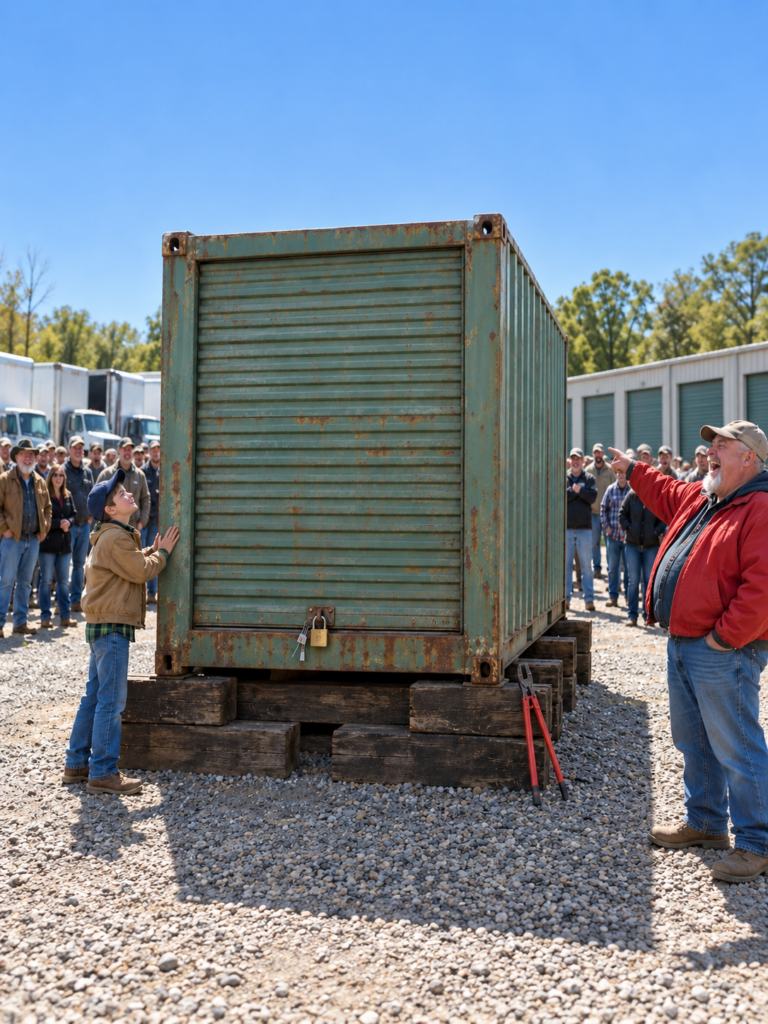
everyone laughed when a farm boy spent his last $40 on a locked storage crate—until his grandfather recognized the name written on the rusted door
Part 1
By the time the auctioneer dropped the opening bid from two hundred dollars to fifty, almost everyone in the gravel yard had stopped looking at the old green storage crate.
Everyone except thirteen-year-old Caleb Dunn.
The crate sat alone near the back fence of Crowley Moving and Storage, balanced on four blackened railroad ties that had sunk several inches into the Tennessee clay. It was sixteen feet long, built from steel thick enough to have survived generations of summer heat, freezing rain, and thunderstorms rolling east out of the Cumberland Plateau.
Most of its paint had faded into the dull green of pond water.
Orange rust ran beneath the roof seams.
The roll-up door was secured by an old brass padlock.
Two gray lead seals had been threaded through the latch with twisted wire.
Nothing about it looked valuable.
That was why Earl Maddox was laughing.
“Fifty dollars for that?” he shouted from the front of the crowd. “You’d have to pay me fifty to haul it away.”
Several men laughed.
Earl owned Maddox Used Furniture and Salvage on Highway 27, a long sheet-metal building where everything from refrigerators to porch swings sat beneath hand-painted signs promising bargains.
He attended nearly every estate sale, equipment auction, and abandoned-storage sale within three counties.
He was fifty-seven, loud, heavy through the shoulders, and famous for wearing a red windbreaker no matter how warm the day became.
If Earl decided something was junk, half the crowd usually agreed.
The auctioneer, Lester Pike, rolled his eyes.
“Thank you for your expert opinion, Earl.”
“That one’s free.”
More laughter.
Caleb stayed beside his grandfather at the back of the group.
In his right pocket were forty-three dollars.
Three tens.
Two fives.
Three ones.
Money he had earned all summer mowing yards, cleaning gutters, stacking firewood, and helping Mr. Jenkins down the road clear brush from a fence line.
He had been saving for a used mountain bike another boy at school wanted to sell for seventy-five.
Caleb’s mother had offered to pay the difference.
Caleb refused.
His father had left when Caleb was seven.
For six years, Caleb had watched his mother count bills at the kitchen table after working ten-hour shifts at a nursing home laundry.
If Caleb wanted a bicycle, he intended to earn it himself.
He had not come to the auction planning to spend a dollar.
He had come because his grandfather asked him to.
Walter Dunn was seventy-eight.
He had the long arms and narrow waist of a man who had spent his life lifting chains, throwing tarps, tightening binders, and climbing in and out of trucks.
His hair had gone white years ago, but he still cut it with electric clippers every second Sunday.
He wore brown work boots, gray suspenders, and an old denim shirt buttoned to the throat even though the September afternoon was warm.
Walter had worked for Crowley Moving and Storage for forty-one years.
He had driven their crane truck back when portable steel storage containers were not common and people stared when one appeared in a driveway.
He moved military families.
Factory workers.
Widows leaving big houses for small apartments.
College professors changing universities.
Farmers whose barns had burned.
Newly married couples.
Recently divorced couples.
Families headed south.
Families headed west.
Families going home.
Crowley Moving and Storage had been part of Walter’s life longer than his own marriage.
Now the company was closing.
The last Crowley brother had turned eighty and moved to Florida.
The trucks had been sold that morning.
Then the forklifts.
Then office desks, dollies, straps, chains, pallets, tool cabinets, and one rust-colored safe that three men argued over for fifteen minutes.
The final items were nine storage crates whose owners had stopped paying.
The rules were simple.
Nobody opened them before buying.
You bid on the locked crate and whatever waited inside.
Some held furniture.
One contained a riding lawn mower that made its buyer grin like Christmas morning.
Another contained nothing but moldy mattresses and boxes of romance novels.
Then Lester reached the old green crate.
“Last one, folks.”
He slapped its side.
The steel answered with a deep hollow sound.
“Been on this yard longer than anybody remembers.”
“I remember,” Walter murmured.
Caleb glanced up.
His grandfather was staring at the door.
Not at the lock.
At the yellowed inventory card stapled beneath a cloudy sheet of plastic beside it.
Earl Maddox got there first.
He wiped the plastic with his sleeve.
“Well, look at this.”
He read loudly.
“Fourteen pieces. Hand carved. Must remain upright. Keep dry.”
He squinted at the signature.
“Arthur Vale. October 1971.”
Walter’s face changed.
It was not dramatic.
He simply stopped blinking.
Caleb noticed because he had spent most of his life watching his grandfather closely.
Grandpa did not show surprise the way other people did.
He went quiet.
Very quiet.
Caleb tugged his sleeve.
“Grandpa?”
Walter did not answer.
Earl slapped the card.
“Fourteen carved pieces. There you go, Lester. Somebody’s old dining chairs.”
“Could be antique furniture.”
“Could be fourteen carved toilet seats.”
People laughed.
Lester started at two hundred.
Nobody bid.
He dropped to one fifty.
Then one hundred.
Nothing.
At seventy-five, a man near the forklift raised his hand halfway, reconsidered, and lowered it.
“Fifty?”
Silence.
Walter was still staring at the name.
Arthur Vale.
Caleb knew that name.
He had heard it in stories.
Not often.
Usually in winter when the electricity went out and Walter lit the kerosene lantern.
Or on slow evenings when rain tapped the farmhouse roof and television reception disappeared.
Arthur Vale had once operated the carousel at Silver Lake Park.
That park had closed more than fifty years earlier.
Caleb had never seen it.
His mother had never seen it.
But Walter remembered.
When Walter was a boy, families drove from four counties to Silver Lake.
There had been a wooden roller coaster.
A dance hall over the water.
A row of little cottages families rented for a week.
A miniature train.
A ferris wheel.
And a carousel under a round pavilion covered in hundreds of white bulbs.
Walter always remembered the horses.
“They weren’t toys,” he once told Caleb.
“They looked alive.”
Each horse had been carved by hand.
Some had glass eyes.
Some had flowers carved into their saddles.
One black horse wore a golden eagle across its chest.
Walter said the carousel music could be heard half a mile across the lake on summer evenings.
Caleb whispered, “Grandpa.”
Walter looked down.
“Arthur Vale.”
“I see it.”
“The carousel man?”
Walter swallowed.
“Yes.”
Lester called, “Forty dollars.”
Caleb’s hand rose.
He did not remember deciding.
It simply happened.
The yard became quiet.
Lester shaded his eyes.
“What’ve I got back there?”
Caleb felt heat rush into his face.
“Forty.”
Lester smiled.
“Well. Forty dollars from the young gentleman.”
Earl Maddox turned around.
When he saw Caleb, he burst out laughing.
“You’re kidding.”
Caleb’s hand stayed raised.
“Forty-five?” Lester called.
No one moved.
Earl pointed.
“The kid’s spending his lunch money.”
A few people chuckled.
Caleb lowered his eyes.
Walter placed one hand on his shoulder.
It was heavy and steady.
“Forty, going once.”
Caleb could hear his heartbeat.
“Going twice.”
He thought about the bicycle.
He thought about his mother asking why he had spent almost everything he saved on a rusted steel box.
He thought about the name.
Arthur Vale.
Lester looked toward Walter.
Walter gave the smallest nod.
“Sold.”
The wooden gavel cracked against the folding table.
People clapped.
Some laughed.
Caleb walked forward and paid.
He smoothed each bill before handing it to the clerk.
Earl watched the whole thing.
“Boy,” he called, “you better hope there’s a bicycle in there.”
That drew another round of laughter.
Caleb folded the receipt and put it carefully in his wallet.
Then he walked to the storage crate.
He placed both hands against the cold door.
The steel smelled faintly of rust and hot dust.
Earl appeared beside him carrying long-handled bolt cutters.
“Moment of truth.”
Caleb looked at them.
“No, sir.”
Earl blinked.
“What?”
“I’m not opening it.”
The smile returned.
“Scared?”
“No, sir.”
“You just bought the thing.”
“Yes, sir.”
“Well then cut the lock.”
“No.”
Earl looked toward the crowd as though Caleb had delivered the day’s best joke.
“He paid forty dollars for a mystery box and now he’s afraid to look inside.”
Caleb felt every eye on him.
His hands shook.
Still, he kept them against the door.
“I’ll open it later.”
“When?”
“When I’m ready.”
Earl laughed.
“Son, whatever’s in there has been dead since Nixon was president.”
Walter walked over.
“Put the cutters away, Earl.”
Earl turned.
“Walter, you going along with this?”
“The boy bought it.”
“He’ll lose the whole forty dollars.”
“That’s his forty dollars to lose.”
Earl leaned closer to Caleb.
“You got forty-eight hours to move this thing off company property.”
“We’ll move it,” Walter said.
“With what?”
“Truck.”
“You don’t own a crane truck anymore.”
Walter looked at Earl.
“I have friends.”
That ended the conversation.
Most people drifted away.
Caleb stayed beside the crate until the auction yard emptied.
Finally Walter said, “Come on.”
They climbed into his old Chevrolet pickup.
Neither spoke until they were halfway home.
Then Caleb asked, “Do you think it’s the carousel?”
Walter kept both hands on the steering wheel.
“I think Arthur Vale locked something in that container fifty-five years ago.”
“That’s not what I asked.”
“No.”
Walter glanced at him.
“It isn’t.”
Caleb waited.
Walter sighed.
“Yes.”
Caleb’s stomach tightened.
“What happened to the horses?”
“Nobody knows.”
“You said they disappeared.”
“They did.”
“What if they’re in there?”
Walter drove another hundred yards before answering.
“Then you spent forty dollars on something this county has been missing for half a century.”
“And if they’re not?”
Walter smiled faintly.
“Then you spent forty dollars learning why auctions make fools out of sensible people.”
When they reached the farmhouse, Caleb’s mother was already home.
Sarah Dunn stood in the kitchen wearing faded blue scrubs, her hair tied back and exhaustion written into the lines around her eyes.
She was forty-one.
She had worked since sixteen.
Grocery store.
Chicken-processing plant.
Hotel laundry.
Then the nursing home.
After Caleb’s father left, she moved back into Walter’s old farmhouse because pride did not pay rent.
Three generations had lived there ever since.
Sarah listened while Caleb explained the auction.
When he reached the forty dollars, she closed her eyes.
“My forty-dollar question,” she said, “is why.”
Caleb pulled out the receipt.
Then he showed her a photograph he had taken of the inventory card.
Arthur Vale.
Sarah looked at Walter.
He sat at the kitchen table.
“Tell him,” Walter said.
Sarah stared at him.
“Tell him what?”
“Why the name matters.”
Walter leaned back.
For several seconds, the kitchen held only the hum of the refrigerator.
Then the old man began talking about Silver Lake.
Not the short version Caleb had heard before.
The real story.
Walter had been eighteen when the park closed.
The land had been sold to developers after two bad summers and a fire damaged the dance hall.
The roller coaster came down first.
Then the train.
The carousel was supposed to be sold intact.
But negotiations failed.
Its machinery was dismantled.
The platform was scrapped.
Then the carved animals disappeared.
“One October night,” Walter said, “Mr. Crowley sent me and another driver out with that exact green container.”
Caleb leaned forward.
“To Silver Lake?”
Walter nodded.
“Arthur Vale was waiting beside the carousel building.”
“What did you move?”
“He wouldn’t let us inside.”
Sarah frowned.
“You never told me this.”
“Never seemed important.”
“Apparently it became forty dollars important.”
Walter continued.
“We dropped the container behind the pavilion. Vale and three other men spent half the night carrying things into it. Everything wrapped in furniture blankets. Tall shapes. Some took three men.”
Caleb barely breathed.
“And then?”
“Vale shut the door himself. Put on the brass padlock and those lead seals. Told Mr. Crowley to keep it dry.”
“For fifty-five years?”
“Vale paid the rent every year.”
“How?”
“Cash mostly. Sometimes checks.”
“Why didn’t anybody open it?”
“Because the rent stayed paid.”
Walter looked toward the dark kitchen window.
“Arthur died last winter. No wife. No children. No close relatives anybody could find. Payments stopped. Eventually the unit went into the lien sale.”
Caleb felt a chill move across his shoulders.
Sarah looked at him.
“So you think there are fourteen carousel horses in that container?”
Caleb shook his head.
“Not all horses.”
“What?”
“The card just said pieces.”
Walter smiled.
“Good boy.”
Caleb got up.
“Where are you going?”
“To the computer.”
He spent nearly two hours searching.
He found old photographs of Silver Lake Park.
Postcards.
Newspaper clippings.
A grainy picture of the carousel under lights.
He enlarged it.
There were horses.
A lion.
A chariot.
A deer.
He counted what he could see.
Then he searched restoration articles.
By ten o’clock, he came back to the kitchen.
“We can’t open it.”
Sarah stared.
“You spent forty dollars on something you refuse to open?”
“If those are original painted figures, opening the door outside could hurt them.”
Walter raised his eyebrows.
Caleb placed printed pages on the table.
“They’ve been sealed at stable temperature for decades. Sudden humidity changes can make old paint crack. Sunlight can damage surfaces. If Mr. Vale packed them correctly, whoever opens it needs to know what they’re doing.”
Sarah read the papers.
“Since when do you know anything about conservation?”
“Since twenty minutes ago.”
Walter laughed.
Caleb looked at his mother.
“I want an expert.”
“An expert costs money.”
“Then I’ll find one who doesn’t.”
“And until then?”
Caleb folded the old photograph.
“We keep it closed.”
The next morning, Walter called two old friends.
By noon they had a rollback truck, a winch, chains, and four men who remembered Crowley Storage.
Moving the container took five hours.
Earl Maddox arrived halfway through.
Of course he did.
He parked across the road with his window down.
“Still afraid to open it?”
Caleb ignored him.
Earl called louder.
“I’ll give you ten bucks for the steel when you’re done playing treasure hunter.”
Walter turned.
“Earl.”
“What?”
“Go home.”
Something in Walter’s voice worked.
Earl left.
By evening, the green container sat inside Walter’s machine shed.
The doors closed behind it.
The brass padlock remained untouched.
The lead seals remained unbroken.
Caleb stood beneath the fluorescent lights looking at the thing he now owned.
Forty dollars.
A summer of work.
Maybe junk.
Maybe history.
Behind him, Walter said quietly, “Now comes the hard part.”
“What?”
“Waiting.”
Part 2
News traveled faster than mail in Hawthorne County.
By Monday morning, everyone seemed to know that Walter Dunn’s grandson had spent his bicycle money on an abandoned storage container and refused to open it.
By Tuesday, Earl Maddox had improved the story.
At the diner, Caleb had apparently screamed when someone approached with bolt cutters.
At the feed store, the container was full of dead raccoons.
By Wednesday, a boy at school drew a picture of Caleb sitting on a mountain of garbage and taped it to his locker.
STORAGE KING was written underneath.
Caleb pulled it down.
He folded the paper.
Put it in his backpack.
And said nothing.
That was what Walter had taught him.
“You don’t have to attend every argument you’re invited to.”
Still, thirteen was thirteen.
Being mocked hurt.
At lunch, he sat alone for the first time that year.
The previous week, friends had argued over football and traded snacks.
Now two boys kept asking whether Caleb planned to move into his “forty-dollar mansion.”
He pretended not to care.
When the final bell rang, he walked to the county library instead of getting on the bus.
The library occupied an old brick courthouse annex behind Main Street.
Mrs. Elaine Porter had been the librarian since Caleb’s mother was in school.
She was seventy-four, thin as a fence rail, with white curls and reading glasses that hung from a beaded chain.
She knew everything about everyone and considered privacy a challenge rather than a rule.
“You’re the storage boy.”
Caleb stopped.
“So you heard too.”
“Everybody heard.”
She studied his face.
“I didn’t say I believed what everybody heard.”
Caleb relaxed slightly.
“I need information about Silver Lake Park.”
Elaine took off her glasses.
“That’s more interesting.”
For two hours, they searched archive boxes.
The park had opened in 1914.
Local businessmen built it after the railroad expanded weekend passenger service.
Families traveled from Nashville, Knoxville, and southern Kentucky.
The carousel arrived in 1916.
It had been manufactured in Philadelphia by a carving firm called Albrecht & Sons.
Elaine found photographs.
Caleb spread them across a long oak table.
The horses were magnificent.
One wore roses along its saddle.
Another had a carved dragon.
The lead horse reared with a golden eagle across its chest.
There was a lion with glass eyes.
Two chariots.
A deer.
Caleb counted.
Fourteen surviving figures appeared in the clearest photograph.
Exactly fourteen.
His hands began shaking.
“Mrs. Porter.”
“I see.”
“The card.”
“I remember.”
She sat down.
“My mother rode that carousel.”
“Really?”
“Every summer.”
Elaine touched the photograph of the eagle horse.
“She called this one General.”
Caleb stared.
“Do you know anybody who can tell if they’re real?”
Elaine considered.
“There’s a state museum conservator in Nashville. Margaret Sloan. She spoke here three years ago about preserving painted furniture.”
“Can we call her?”
“We can try.”
Elaine dialed.
Caleb waited.
After several transfers, Margaret Sloan answered.
Elaine explained.
Then handed the phone to Caleb.
A woman’s calm voice came through.
“You bought the unit?”
“Yes, ma’am.”
“How old are you?”
“Thirteen.”
Silence.
Then, “Have you opened it?”
“No.”
“Has anyone?”
“No.”
“Are the original seals intact?”
“Yes.”
“Where is the container now?”
“In my grandfather’s machine shed.”
“Dry?”
“Yes.”
“Temperature controlled?”
“No, ma’am, but the building is shaded.”
“Good enough for now.”
Caleb waited.
Margaret’s voice became more serious.
“Do not open it.”
He smiled.
“My mother is going to be happy somebody agrees with me.”
“If the figures are inside, fifty years of stable darkness may have preserved the surfaces. Sudden sunlight and moisture are exactly what I would avoid.”
“Can you come?”
Another pause.
“Send me photographs of the container, seals, card, and all the archival material you found.”
Caleb did that evening.
Two days later, Margaret called back.
She would come Saturday.
She would bring an appraiser named Jonathan Rees who specialized in historic amusement art.
She would charge nothing for the initial inspection if Caleb allowed the county historical society to document the opening.
Caleb agreed instantly.
Then he asked Elaine Porter to help with invitations.
“Invitations?”
“Yes, ma’am.”
“To whom?”
“People who laughed.”
Elaine studied him.
“That sounds dangerously close to revenge.”
Caleb looked at the floor.
“Maybe a little.”
She smiled.
“At least you’re honest.”
Caleb wrote six cards.
One went to the auctioneer.
One to Walter’s friend who hauled the container.
One to his science teacher.
One to his mother’s supervisor, who had heard so much about the storage crate that she asked for photographs.
One to Elaine.
And the final card went to Earl Maddox.
Caleb rewrote it twice.
Mr. Maddox,
You are invited to be present when the storage container purchased at the Crowley auction is professionally opened and examined this Saturday at 10:00 a.m. at my grandfather’s machine shed.
A museum conservator and certified appraiser will be present.
I hope you can attend.
Sincerely,
Caleb Dunn
Walter drove him to Maddox Salvage.
Earl stood behind the counter arguing with a man over the price of a used refrigerator.
Caleb waited.
Finally Earl looked up.
“Well, if it isn’t the storage king.”
Caleb handed him the envelope.
Earl read it aloud.
“A museum conservator.”
He grinned.
“You got the Smithsonian coming too?”
“No, sir.”
“National Geographic?”
“No, sir.”
Two customers laughed.
Earl looked again at the invitation.
Something shifted in his expression.
Barely.
But Caleb saw it.
Earl had spent his life buying old things.
Maybe the phrase professional appraisal meant more to him than he wanted anyone to know.
“I’ll come.”
“Thank you.”
Caleb turned away.
“Hey.”
He looked back.
Earl leaned against the counter.
“Save yourself the trouble. I’ll give you two hundred for the whole thing right now.”
Caleb stared.
“You said it was junk.”
“Steel’s worth money.”
“Two hundred dollars?”
“I’m feeling charitable.”
Caleb remembered Walter’s rule.
You don’t have to attend every argument.
“No thank you.”
He walked out.
Walter waited in the pickup.
“What’d he say?”
“Offered two hundred.”
Walter’s eyebrows lifted.
“Interesting.”
“Why?”
“Because yesterday it was worth ten.”
That Thursday evening, Earl came to the farmhouse.
He drove slowly up the gravel lane and stopped beside the porch.
Walter was shelling beans at the kitchen table.
Caleb was doing math homework.
Sarah had just left for the nursing home.
Earl knocked.
Walter opened the door.
“I want to talk business.”
“Then come tomorrow when it’s daylight.”
“This won’t take long.”
Walter stepped onto the porch and closed the door behind him.
Caleb moved quietly to the screen window.
Earl lowered his voice.
“Five hundred.”
“For what?”
“The container.”
“Belongs to Caleb.”
“You’re his guardian.”
“No. His mother is.”
“You know what I mean.”
Walter folded his arms.
“Why do you want it?”
“I buy abandoned storage.”
“So do thirty other people.”
Earl looked toward the machine shed.
“Maybe I was hard on the kid.”
“That keeping you awake?”
Earl ignored the question.
“Five hundred cash. That’s good money for a thirteen-year-old.”
Walter opened the door.
“Caleb.”
He stepped outside.
“Mr. Maddox wants to give you five hundred dollars for your container.”
Caleb’s heart hammered.
Five hundred dollars was more money than he had ever owned.
He could buy the bicycle.
A better bicycle.
He could give his mother money.
He could—
Then he looked toward the machine shed.
The old green container sat behind closed doors.
Arthur Vale had protected it for fifty-five years.
Caleb wanted to know why.
“No thank you.”
Earl stared.
“Think about it.”
“I did.”
“You don’t even know what’s inside.”
“Neither do you.”
For once Earl had no quick answer.
He drove away.
Walter waited until the taillights disappeared.
Then he looked at Caleb.
“You wanted the money.”
“Yes.”
“Why’d you say no?”
“I want the truth more.”
Walter nodded once.
“Good answer.”
That night, Caleb asked the question he had been avoiding.
“Grandpa, why didn’t Arthur Vale sell the horses?”
Walter stared into his coffee.
“Maybe they weren’t his to sell.”
“Then why hide them?”
“Maybe hiding and saving can look the same from the outside.”
Caleb thought about that.
Walter continued.
“Silver Lake shut down ugly. People lost money. Creditors came after everything. There were arguments about ownership. I heard the carousel company had a debt attached to it. Vale might’ve thought if he left the horses there, they’d get auctioned individually for decorations.”
“Why didn’t he bring them back later?”
“I don’t know.”
Walter rubbed his hands.
“Maybe he kept waiting for the right time.”
“And then he got old.”
“Yes.”
Caleb looked around the kitchen.
Walter was old.
Elaine Porter was old.
Arthur Vale had been old.
Most of the stories Caleb knew came from people who had once expected plenty of time.
That realization unsettled him.
“Grandpa?”
“Hm?”
“Did you ever want something and wait too long?”
Walter looked through the window toward the dark yard.
“Yes.”
“What?”
The answer took a while.
“To tell your grandmother I was sorry.”
Caleb knew his grandmother had died nine years earlier.
“What for?”
“Doesn’t matter anymore.”
“It mattered to you.”
Walter smiled sadly.
“You’re too smart tonight.”
The conversation ended there.
But Caleb remembered it.
Saturday came cold and bright.
Frost silvered the pasture.
Walter opened the machine shed at eight.
They swept the concrete floor.
Borrowed folding chairs from Bethel Baptist Church.
Sarah made cinnamon rolls before sleeping after her night shift.
Elaine arrived carrying archive folders.
By nine-thirty, neighbors were pulling into the driveway.
Caleb became nervous.
He had wanted witnesses.
Now there were almost thirty.
At 9:52, a white museum van arrived.
Margaret Sloan stepped out.
She was sixty-two, with short gray hair, khaki pants, and a black equipment case.
Jonathan Rees followed.
Tall.
Glasses.
Tweed jacket.
Clipboard.
He shook Caleb’s hand as though Caleb were an adult client.
“Mr. Dunn.”
Caleb glanced at Walter.
Nobody had ever called him Mr. Dunn.
“Sir.”
Jonathan smiled.
“I hear you made an unusual purchase.”
“Yes, sir.”
Earl Maddox arrived at 10:07.
Red jacket.
Coffee cup.
Big grin.
“Didn’t start without me, did you?”
Nobody answered.
Margaret began by examining the exterior.
She photographed every seal.
Measured humidity.
Checked the roof seams.
Studied the inventory card.
Then she addressed the room.
“These wire seals appear original and intact. There is no visible evidence this container has been opened since it was packed.”
She turned toward Caleb.
“Mr. Dunn, it belongs to you.”
His throat went dry.
“Would you like to break the seal?”
He looked at Walter.
Walter said, “Your call.”
Caleb nodded.
Margaret’s assistant clipped the wires.
Then the brass padlock.
The snap echoed through the building.
Caleb flinched.
Margaret opened the latch.
“Slowly.”
Caleb and Walter took the handle together.
They lifted.
The steel door resisted.
Then moved.
Six inches.
A foot.
Two feet.
Cold, dry air drifted out carrying a smell unlike anything Caleb expected.
Cedar.
Old wool.
Machine oil.
Varnish.
No rot.
No mold.
No animals.
They lifted higher.
Inside stood two rows of tall objects wrapped in faded moving blankets.
Exactly fourteen.
Nobody laughed.
Part 3
For several seconds, Caleb did not move.
He had spent an entire week imagining what the door might reveal.
Broken furniture.
Boxes.
Garbage.
Nothing.
He had even imagined carousel horses.
But imagination had not prepared him for the silence.
Thirty people stood behind him.
Nobody spoke.
Even Earl Maddox lowered his coffee.
Margaret Sloan stepped forward.
“Before anyone touches anything, I need photographs.”
Flashlights illuminated the interior.
The container had been packed with extraordinary care.
Wooden braces ran across the floor.
Each wrapped object stood on its own custom support.
Cedar blocks had been placed between them.
Canvas covered everything.
A handwritten tag hung from the nearest bundle.
No. 7 – Rose Mare – outside row.
Margaret read it twice.
Jonathan Rees stopped writing.
Elaine Porter covered her mouth.
Caleb looked at Walter.
His grandfather’s eyes had filled with tears.
“It’s them,” Walter whispered.
Margaret asked Caleb to come closer.
“You may pull back the outer canvas.”
His hands trembled.
He took one corner.
The canvas was heavier than he expected.
He pulled.
Dust rose.
The fabric slid down.
One of the moving blankets underneath had sagged over the decades.
A carved wooden ear appeared first.
Then part of a mane.
Gold leaf caught the shed lights.
Someone gasped.
Margaret put on white cotton gloves.
She untied the cords securing the blanket.
Together with her assistant, she folded it away.
The horse beneath had been painted deep chestnut.
Roses curled across its saddle.
Tiny glass jewels decorated the bridle.
Its mane had been carved into long flowing ridges tipped with gold.
The paint showed age.
Fine cracks.
Some fading.
But the figure was astonishingly intact.
Caleb had seen carousel horses at fairs.
Fiberglass.
Bright paint.
Smiling faces.
This was different.
This looked like sculpture.
A hundred-year-old animal frozen in movement.
Elaine opened her archive folder.
She found a photograph.
The same horse appeared in a picture dated 1948.
“There,” she whispered.
Margaret compared details.
“The floral pattern.”
Jonathan pointed toward a small chip near the left foreleg visible in both.
“Same figure.”
They unwrapped the next piece.
A black stallion with a silver mane.
Then a small palomino jumper.
Then the lion.
Then a deer with carved leaves around its saddle.
Two chariots emerged from the back.
Finally Walter helped remove the blanket from the tallest figure.
The eagle horse.
It reared nearly six feet high.
A carved eagle spread its wings across the armored breastplate.
Gold remained around the feathers.
The glass eyes reflected the fluorescent lights.
Walter stepped backward.
His face seemed to lose fifty years.
“I rode that horse.”
Caleb turned.
Walter laughed through tears.
“I was eight.”
He reached toward it, then stopped before touching.
“My mother gave me a nickel and told me not to lose it. I rode this exact horse three times that afternoon.”
Elaine held up an old photograph.
It showed the eagle horse beneath the carousel pavilion.
Same carved mane.
Same breastplate.
Same raised forelegs.
Nobody needed an expert to understand anymore.
Still, Margaret worked for nearly two hours.
She examined paint layers through magnification.
Recorded carver’s marks beneath the figures.
Compared construction.
Reviewed Arthur Vale’s handwritten tags.
She found old maintenance notes packed inside a metal box.
Oil schedules.
Repair records.
Photographs.
Receipts.
A folder labeled SILVER LAKE – DISMANTLING.
Jonathan Rees grew more serious with each document.
Earl Maddox stayed near the back wall.
He no longer joked.
Eventually Margaret removed her gloves.
She stood beside Caleb and faced the room.
“These are authentic Silver Lake Park carousel figures.”
A murmur moved through the crowd.
“They were carved around 1915 or 1916 by Albrecht & Sons of Philadelphia, one of the respected American carousel carving firms of that period.”
She rested one hand lightly near the chestnut horse without touching it.
“What makes this collection especially important is that it remains together, with excellent documentation and significant original surface decoration.”
Caleb looked toward the horses.
“How good is the condition?”
Margaret smiled.
“Much better than it had any right to be.”
People laughed softly.
Not cruelly this time.
She continued.
“Mr. Vale packed them exceptionally well. He protected them from light. Kept them upright. Used breathable natural materials. The sealed container prevented dramatic environmental changes.”
Then she looked directly at Caleb.
“You also made the right decision.”
“About what?”
“Not opening it at the auction.”
Earl shifted.
Margaret continued.
“If that door had been raised in full afternoon sun after decades of stable darkness, followed by humid outdoor air and dozens of people touching the surfaces, we could be having a very different conversation.”
Caleb felt Sarah’s hand settle on his shoulder.
“The paint could have been damaged?”
“Possibly. At minimum, it would have been reckless.”
Margaret smiled.
“You protected them before you even knew for certain they were here.”
Caleb looked toward Earl.
He did not mean to.
Everybody else did too.
Earl stared into his coffee.
Jonathan cleared his throat.
“I suppose everyone is waiting for the vulgar question.”
Someone laughed.
“What are they worth?”
Jonathan opened his folder.
“A formal market valuation will require research. Provenance matters. Condition matters. Whether sold individually or together matters.”
Earl finally spoke.
“So nobody knows.”
Jonathan glanced at him.
“I know enough.”
The room quieted.
“As a matched group, with documentation and the lead eagle horse, I would place a conservative insurance value in the range of four hundred seventy-five to five hundred twenty-five thousand dollars.”
Caleb thought he misheard.
Sarah gripped his shoulder harder.
Walter sat down abruptly in the nearest folding chair.
Jonathan continued.
“At auction, under competitive conditions, it could be more.”
Someone whispered, “Half a million dollars.”
Caleb looked at his grandfather.
Walter laughed once.
Not loudly.
Just a breath of disbelief.
The whole machine shed turned toward Earl Maddox.
He had mocked the forty-dollar bid.
Offered ten dollars for scrap.
Then two hundred.
Then five hundred.
Now fourteen carved figures stood between him and Caleb, worth enough to buy several houses in Hawthorne County.
Earl opened his mouth.
Closed it.
Finally he said, “I knew that name sounded familiar.”
Lester Pike, the auctioneer, removed his hat.
“No, you didn’t.”
A few people chuckled.
Earl’s face reddened.
“I almost bid.”
Walter looked at him.
“You had every chance.”
This time the laughter belonged to everyone else.
It was not as loud as Earl’s had been at the auction.
But perhaps that made it worse.
Earl set his coffee on a workbench.
He walked out.
Caleb watched through the open shed door as the red jacket disappeared into the truck.
For one second, satisfaction felt wonderful.
Then strangely empty.
He had expected victory to feel larger.
Instead he looked back at the horses and thought about Arthur Vale.
A man who spent half a century paying to keep them safe.
Why?
After the crowd left, Margaret and Jonathan helped reseal the building.
The figures would remain where they were until controlled transport could be arranged.
That evening, Caleb, Sarah, and Walter sat around the kitchen table.
Nobody knew what to say.
Sarah finally laughed.
“My son owns half a million dollars in wooden horses.”
“Not all horses.”
“Caleb.”
“Sorry.”
Walter held a copy of Arthur Vale’s documents.
“Something bothers me.”
“What?” Sarah asked.
“Why didn’t he sell them?”
“Maybe he loved them.”
“Love doesn’t explain fifty-five years of storage fees.”
Caleb leaned forward.
“There was a folder marked dismantling.”
Walter nodded.
“Margaret took copies. Originals are locked in the safe.”
“What was inside?”
“Contracts. Letters.”
“Can we read them?”
“We should.”
The next day, they did.
Arthur Vale had not owned the carousel.
Silver Lake Recreation Company did.
When the park closed, creditors seized most equipment.
The carousel mechanism and pavilion were sold.
The carved figures were supposed to be sold at a bankruptcy auction.
But a handwritten agreement complicated the story.
A group of local families had raised money in 1916 to purchase the carousel animals as a gift to the community.
The operating company controlled them.
But Arthur believed the figures technically belonged to a nonprofit recreation association that had become inactive decades earlier.
He had removed them before the bankruptcy auction because he feared they would be dispersed before ownership could be resolved.
Then lawsuits began.
Records disappeared.
The company dissolved.
The association officers died.
Years passed.
Arthur kept paying storage.
A letter from 1994 explained everything.
If these figures are ever found after I am gone, I hope whoever holds lawful title understands that I never meant to steal them.
I meant to keep them together until Silver Lake had children again.
Caleb read the sentence three times.
Sarah leaned back.
“So they might not belong to us.”
Walter nodded.
“Maybe.”
Caleb felt his stomach sink.
“But I bought the container.”
“You did.”
“The auction was legal.”
“Probably.”
“Then—”
Walter raised a hand.
“You asked me once whether hiding and saving could look the same.”
Caleb remembered.
“Yeah.”
“This is the other side of that question.”
“What do we do?”
“We find out what’s right.”
Caleb looked toward the window.
For one week, everyone had laughed because he paid forty dollars for junk.
Now that the junk was worth half a million dollars, keeping it suddenly seemed more complicated.
“What if doing right means giving them away?”
Walter looked at him.
“Then that’s what doing right means.”
Caleb hated that answer.
Which was exactly why he knew it mattered.
Part 4
By October, the story had spread far beyond Hawthorne County.
A Nashville television station called.
Then a Knoxville newspaper.
Then a collector from Ohio.
Then an auction house in New York.
Caleb’s photograph appeared online beside the headline:
TENNESSEE BOY’S $40 STORAGE GAMBLE MAY BE WORTH HALF A MILLION.
He hated the word gamble.
He had not guessed.
He had remembered.
That distinction mattered to him.
Offers arrived anyway.
Thirty thousand dollars for the eagle horse.
Forty-five thousand for the lion.
A private collector offered four hundred thousand for everything before lawyers examined ownership.
Sarah nearly dropped the letter.
“That could pay off the mortgage.”
Walter looked at her.
“So could selling the farm.”
“I’m not saying we should do it.”
“You’re thinking it.”
“Of course I’m thinking it.”
Sarah stood.
“I work sixty hours some weeks. The roof leaks over the laundry room. My car has two hundred thousand miles. Caleb needs braces.”
“I know.”
“Then don’t look at me like money doesn’t matter.”
Walter’s face softened.
“I’m not.”
Sarah sat again.
Her eyes filled.
“I’m tired, Dad.”
Walter reached across the table.
“I know.”
Caleb sat silently.
Adults often told children money was not everything.
That was easier to say when the electricity bill was paid.
Caleb knew exactly what four hundred thousand dollars could change.
His mother could stop working nights.
Walter could repair the farmhouse.
They could replace the furnace.
He could go to college without Sarah counting pennies.
The figures could solve problems.
Real ones.
And yet Arthur Vale’s letter sat on the table.
I meant to keep them together until Silver Lake had children again.
Three weeks of legal research followed.
A local attorney donated his time.
Then the county historical society brought in another lawyer familiar with dissolved nonprofit organizations.
The old Silver Lake Recreation Association no longer existed.
Its charter had lapsed in 1982.
No surviving directors remained.
Under state law, the abandoned storage sale had lawfully transferred the contents to Caleb.
No competing titleholder could be found.
Legally, the figures were his.
That should have simplified everything.
It did not.
Caleb visited Silver Lake with Walter on the first cold Saturday of November.
The old amusement park was gone.
Most of the shoreline had returned to woods.
A subdivision covered part of the original property.
But the northern section remained county land around a public boat ramp and picnic area.
Walter parked near the water.
They walked slowly.
His knees had worsened that fall.
Caleb noticed he rested more often.
“You okay?”
“I’m seventy-eight.”
“That doesn’t answer me.”
“It answers most questions.”
They found the old carousel site by comparing photographs.
Nothing remained except a broken concrete circle beneath leaves.
Walter stood in the middle.
“This was it.”
Caleb tried to imagine music.
Children.
Lights.
The smell of popcorn.
Instead there were crows.
Wind.
Water against the shore.
Walter pointed.
“Ticket booth was there.”
He turned.
“Dance hall over that way.”
Caleb sat on the concrete.
“What would Grandma do?”
Walter smiled.
“About what?”
“The horses.”
“She would tell us to keep one.”
“Really?”
“Your grandmother liked pretty things.”
Caleb laughed.
“What about the rest?”
“She’d ask whether we needed half a million dollars.”
“Do we?”
Walter sat carefully beside him.
“Everybody needs money.”
“That’s not what I asked.”
“You’re getting too good at that.”
They watched the lake.
Finally Walter said, “Your grandmother grew up poor. Worse than your mother. She never romanticized poverty.”
Caleb waited.
“She’d say paying your bills is honorable. Taking care of your family is honorable. But she’d also ask whether owning something gives you permission to forget what it means.”
Caleb looked toward the water.
“What do they mean?”
“That’s for you to decide.”
School became easier after the newspaper story.
The same boys who mocked Caleb wanted to know when he was buying a new truck.
One asked whether he could borrow money.
Caleb discovered admiration could feel almost as uncomfortable as ridicule.
Elaine Porter noticed.
“You look miserable for someone who may be rich.”
“I’m not rich.”
“Good.”
“Why good?”
“Money before algebra would ruin anybody.”
She handed him another archive folder.
Inside was a photograph taken in 1968.
Walter appeared in the background.
Nineteen years old.
Thin.
Dark-haired.
Standing beside the carousel.
Caleb brought it home.
Walter stared for a long time.
“That was your grandmother’s first summer working at the park.”
“She worked there?”
“Cotton candy stand.”
“You never told me.”
“I forget what I’ve told you.”
Caleb sat across from him.
“Is that where you met?”
Walter nodded.
“She hated me.”
“Why?”
“I was annoying.”
“You still are.”
Walter laughed.
Then his eyes drifted toward the photograph.
“We danced in the pavilion after closing.”
Caleb smiled.
“Grandpa.”
“What?”
“That sounds romantic.”
“Don’t spread it around.”
Caleb placed the picture beside Arthur Vale’s letter.
Suddenly Silver Lake was not just history.
His grandparents had met there.
Elaine’s mother had ridden the carousel.
Half the county’s oldest residents carried some memory attached to the park.
Maybe Arthur Vale understood something nobody else did.
Objects were sometimes valuable because they were rare.
Other times they were valuable because people had lived around them.
Christmas approached.
Caleb still had no bicycle.
Walter offered to buy one.
Caleb refused.
“You saved my forty dollars.”
“That wasn’t charity.”
“Still no.”
Sarah finally bought him new tires for Walter’s old bicycle instead.
Caleb spent winter helping clean and document the carousel figures.
Margaret Sloan returned several times.
Under controlled lighting, she showed him how experts examined paint without damaging it.
He learned about gesso layers, gold leaf, carving knives, wood grain, conservation wax, and stable humidity.
He became especially interested in the eagle horse.
Beneath the saddle, someone had carved the initials A.V.
Arthur Vale.
But Margaret believed those initials had been added later.
“He didn’t carve the horse,” she explained.
“Then why put his initials there?”
“Maybe he repaired it.”
Walter remembered.
“General broke a rear leg.”
“When?”
“Must have been late fifties.”
Margaret examined the joint.
The repair was nearly invisible.
“He did good work.”
Caleb imagined Arthur late at night beneath the carousel lights repairing the horse children loved.
The man seemed less like someone hiding property and more like a caretaker who never knew when to stop caring.
In January, Earl Maddox returned.
Caleb was in the machine shed with Walter.
Earl stood at the doorway without the red jacket.
He wore a brown work coat.
For several seconds nobody spoke.
Then Earl said, “Can I come in?”
Walter looked at Caleb.
Caleb nodded.
Earl stepped inside.
The figures now stood behind temporary barriers.
He stared at the eagle horse.
“Beautiful.”
Caleb said nothing.
Earl shoved his hands into his coat pockets.
“I came to apologize.”
Walter raised an eyebrow.
“To him,” Earl clarified.
Caleb waited.
Earl looked uncomfortable.
“I made fun of you.”
“Yes, sir.”
“More than once.”
“Yes, sir.”
“Whole town heard it.”
“Yes, sir.”
Earl sighed.
“You planning to make me work for this?”
Caleb nearly smiled.
“No, sir.”
“I was wrong.”
Caleb looked at him.
Earl continued.
“I’ve been buying stuff at auctions thirty years. You start thinking you know what everything’s worth just by looking.”
He glanced toward the horses.
“Sometimes you get arrogant.”
Walter said quietly, “Sometimes?”
Earl shot him a look.
Then smiled reluctantly.
“Most times.”
Caleb relaxed.
Earl reached into his pocket.
“I brought something.”
He handed Caleb an envelope.
Inside was the folded paper someone had taped to Caleb’s locker.
STORAGE KING.
Caleb stared.
“Where’d you get this?”
“My nephew.”
The boy who started it.
Earl looked ashamed.
“I told him to apologize too.”
Caleb folded the paper again.
“You didn’t have to bring this.”
“I wanted you to know I knew.”
“Knew what?”
“What my mouth started.”
That mattered more than Caleb expected.
He looked toward the eagle horse.
“We’re trying to decide what to do with them.”
“Sell.”
Walter laughed.
Earl shrugged.
“I apologized for being rude. Didn’t say I got stupid.”
Caleb smiled.
“What would you do?”
“Sell enough to help your family.”
“And the rest?”
Earl looked toward the figures.
“Put them somewhere kids can see them.”
Caleb stared.
Earl shrugged again.
“Maybe I’m getting sentimental.”
When he left, Walter said, “People surprise you.”
“Good and bad?”
“Usually both.”
By March, Caleb had a plan.
It was not perfect.
It made his mother cry.
It made Walter argue.
It made accountants confused.
But eventually everyone agreed.
Four figures would be sold.
Not the eagle horse.
Not the lion.
Not either chariot.
Caleb selected four horses whose sale would still leave a representative group together.
A museum consortium offered one hundred seventy-eight thousand dollars.
After taxes, legal expenses, conservation costs, and fees, the money would pay off Sarah’s mortgage, replace the farmhouse roof, buy her a reliable used car, establish an education fund for Caleb, and create a maintenance account for the remaining figures.
Sarah sat at the kitchen table after signing the paperwork.
“You’re sure?”
“Yes.”
“This is your money.”
“You’re my mother.”
“That doesn’t make it mine.”
“It paid for Grandpa’s roof too.”
Walter looked offended.
“My roof was fine.”
Rain dripped into a bucket beside the pantry.
Sarah stared at him.
Walter sighed.
“Mostly fine.”
The remaining ten figures would not be sold.
Caleb offered them to Hawthorne County on a ninety-nine-year renewable loan.
One condition.
They had to become a carousel again.
Not static museum pieces.
Not decorations in a hotel lobby.
Children had to ride them.
The county commissioners laughed at first.
Restoring a historic carousel required money they did not have.
Then the newspaper published the proposal.
Donations started.
Five dollars.
Twenty dollars.
A retired contractor pledged labor.
A local bank pledged fifty thousand.
The historical society launched a campaign.
A regional foundation became interested.
Former residents mailed checks from Florida, Texas, Michigan, and California.
Letters arrived with memories.
My parents met at Silver Lake.
My father proposed beside that carousel.
I rode the lion every birthday until I was twelve.
My sister loved the white horse with roses.
Please bring them home.
The project stopped belonging to Caleb.
That was exactly what he wanted.
Part 5
It took three years.
Caleb grew from thirteen to sixteen while the carousel returned.
The county approved land near the old northern shore.
Architects used historic photographs to design a round pavilion inspired by the original.
A carousel restoration company in Ohio built a new rotating platform, mechanism, and center structure.
The ten original figures would alternate with newly carved companions so the historic animals were not ridden continuously.
Margaret Sloan supervised conservation.
Caleb spent two summers helping her.
He learned to clean old surfaces one square inch at a time.
He learned patience.
Real patience.
The kind that made waiting one week to open a storage container seem easy.
Walter came whenever his health allowed.
He sat in a folding chair watching.
Sometimes he offered advice nobody needed.
Sometimes he fell asleep.
At eighty-one, his body had begun losing arguments his mind still expected to win.
His hands shook more.
Walking tired him.
One winter pneumonia put him in the hospital for eleven days.
Caleb stayed beside him nearly every evening after school.
Walter hated hospitals.
“This gown opens in the back.”
“That’s standard.”
“Why?”
“So you don’t escape.”
Walter looked at him.
“That nurse humor?”
“Grandma would’ve laughed.”
Walter smiled.
“Yes.”
He stared out the hospital window.
“You think I’ll make it to opening day?”
Caleb’s throat tightened.
“Yes.”
“You answered too fast.”
“You’re going.”
“You don’t control that.”
“Neither do you.”
Walter smiled.
“Fair.”
He did make it.
Opening day arrived on the second Saturday of June.
Clear sky.
Seventy-eight degrees.
A breeze off Silver Lake.
More than two thousand people came.
Cars lined both sides of the county road.
Families carried lawn chairs.
Food trucks parked near the picnic field.
A high-school band played beneath oak trees.
The new carousel pavilion stood near the water, white and red, with hundreds of warm bulbs around its roof.
At its entrance hung a bronze plaque.
THE SILVER LAKE CAROUSEL
Original figures carved circa 1916.
Protected for fifty-five years by Arthur Vale.
Rediscovered in 2026 by Caleb Dunn, age thirteen, who purchased their sealed storage container for $40 and chose to bring them home.
Caleb stood reading the words.
He had read them before.
Still, seeing his name in bronze felt strange.
Sarah came beside him.
“You okay?”
“Yeah.”
“You’re lying.”
“A little.”
She smiled.
Walter arrived in a wheelchair.
He hated the wheelchair.
But the walk from the parking lot was too far.
Earl Maddox pushed him.
“Slow down,” Walter complained.
“I’m barely moving.”
“You drive like this too.”
“Keep talking and I’ll park you by the trash cans.”
Caleb laughed.
Earl had become part of the project.
Nobody would have predicted it.
He donated lumber.
Then tools.
Then an old display case.
Then, without advertising it, ten thousand dollars.
When the newspaper found out, he told the reporter it was “tax planning.”
Nobody believed him.
At noon, the county commissioner gave a speech.
Then Elaine Porter spoke.
She was seventy-seven now.
Still thin.
Still carrying pencils in her cardigan.
She read Arthur Vale’s final letter aloud.
I meant to keep them together until Silver Lake had children again.
The crowd became silent.
Caleb looked toward Walter.
His grandfather cried openly.
Nobody teased him.
Then Margaret Sloan removed the ribbon.
The pavilion doors opened.
Music began.
Not recorded pop music.
A restored band organ played an old waltz.
The carousel started turning.
Slowly.
The eagle horse rose in front.
Gold catching sunlight.
Glass eyes shining.
The lion followed.
Then the rose mare.
The chariots.
Newly carved animals filled the spaces left by the four figures sold.
Children pressed against the rail.
Caleb’s chest tightened.
For three years, the figures had been objects.
Valuable objects.
Fragile objects.
Historic objects.
Now they became what Arthur Vale had saved them to be.
A carousel.
The first ride had been reserved.
Caleb climbed onto the eagle horse.
He was taller now.
His feet nearly reached the platform.
Walter rolled his wheelchair beside the lion.
“No.”
Caleb looked down.
“What?”
Walter gripped the armrests.
“I’m not riding a carousel in this chair.”
“Grandpa—”
“I rode that lion standing up in 1953.”
“You were eight.”
“Details.”
Earl and Caleb helped him stand.
Margaret protested.
Sarah protested louder.
Walter ignored both.
A special stationary mount had been prepared near the lion.
With three people supporting him, Walter eased into the saddle.
He looked ridiculous.
He looked eighty-one.
He looked delighted.
People applauded.
“Stop that,” Walter shouted.
They applauded louder.
Sarah climbed into one chariot.
Elaine sat beside her.
Margaret rode the rose mare.
Earl stood near the back.
Caleb called, “Mr. Maddox.”
Earl shook his head.
“Somebody has to maintain dignity.”
“You wore a red windbreaker to every auction for thirty years.”
The crowd laughed.
Earl pointed.
“That mouth came from Walter.”
Eventually he climbed onto a newly carved black horse.
The operator rang the bell.
The carousel moved.
Once.
Twice.
Faster.
The band organ played.
Children waiting outside waved.
Caleb held the brass pole and watched the lake turn past him.
Trees.
Water.
Pavilion.
Faces.
Walter passed on the lion.
For one instant, Caleb saw his grandfather not as an old man.
He saw the boy Walter had been.
Eight years old.
Nickel in his pocket.
Mother waiting beyond the rail.
Summer evening ahead.
Then Walter turned and shouted.
“You were right!”
Caleb laughed.
“About what?”
“Forty dollars!”
The carousel carried him away before Caleb could answer.
After the ride, Walter was exhausted.
They moved him to a chair in the shade.
Caleb brought lemonade.
Walter took one sip.
“Too sweet.”
“You complain about everything.”
“Keeps me alive.”
They watched children climb aboard.
A small girl chose the eagle horse.
Her mother lifted her into the saddle.
The girl touched the carved mane carefully.
Then smiled when the carousel began.
Walter watched.
“Arthur would’ve liked this.”
Caleb nodded.
“Do you think he knew?”
“Knew what?”
“That somebody would find them?”
Walter considered.
“No.”
“Then why keep paying?”
“Because sometimes you take care of something without knowing whether you’ll ever see the result.”
Caleb looked at him.
“That sounds unfair.”
“It often is.”
“Then why do it?”
Walter smiled.
“That’s called planting trees you won’t sit under.”
Caleb remembered hearing that phrase somewhere.
Now he understood it.
Arthur Vale had protected carved animals for children not yet born.
Walter had worked forty years and saved enough to keep a farmhouse in the family.
Sarah worked night shifts so Caleb could grow up without knowing exactly how close bills sometimes came.
Elaine protected dusty photographs nobody looked at until one boy needed them.
Margaret spent thousands of hours preserving paint most people would never notice.
Not everything important paid the person who did the work.
Some things mattered because they reached forward.
Late that afternoon, after the speeches and rides and photographs, Caleb walked alone to the lake.
He carried something in his pocket.
Three folded one-dollar bills and two twenties.
The original forty-three dollars he had possessed at the auction were gone, of course.
But Sarah had given him replacement bills on his sixteenth birthday.
“For the story,” she said.
Caleb sat near the water.
Three years earlier, he wanted a used bicycle.
Now his college account held more money than he knew how to think about.
His mother’s mortgage was gone.
The farmhouse had a new roof.
Walter had a walk-in shower installed because Sarah finally won that argument.
Four original carousel horses belonged to museums where people could see them.
Ten had returned to Silver Lake.
And the whole thing began because sixty people looked at a rusted green box and saw inconvenience.
Caleb had not been braver than everyone.
He had not been smarter.
He had simply recognized one name.
Then listened.
Then waited.
That last part mattered most.
The following year Walter died in April.
Quietly.
At home.
Caleb found him asleep in his favorite chair beside the living room window.
The television was on.
A baseball game played softly.
Walter’s coffee had gone cold.
He was eighty-two.
The funeral filled Bethel Baptist Church.
Truck drivers came.
Farmers.
Former Crowley employees.
Carousel volunteers.
Elaine.
Margaret.
Earl.
After the service, Caleb found Earl standing alone beside the grave.
The red windbreaker looked brighter than ever beneath the gray sky.
“You okay?” Caleb asked.
Earl wiped his nose.
“Allergies.”
“It’s raining.”
“Rain allergies.”
Caleb smiled.
Earl looked at the casket.
“He was a good man.”
“Yes.”
“He sure enjoyed reminding me about that forty dollars.”
“Yes.”
“Every single time.”
“Yes.”
They laughed quietly.
Then Earl placed something beside Walter’s headstone.
A small pair of bolt cutters.
Caleb stared.
“What are those?”
“Joke between us.”
Walter would have loved it.
That summer, Caleb worked at the carousel.
Not because he needed money.
Because he wanted to.
He sold tickets.
Swept floors.
Oiled machinery.
Helped small children climb into saddles.
Every day people asked about the eagle horse.
Sometimes they asked whether the story on the plaque was true.
“You really paid forty dollars?”
“Yes.”
“Everybody really laughed?”
“Pretty much.”
“You knew what was inside?”
“No.”
That answer surprised them.
“But you thought you did.”
“I hoped.”
“What if you’d been wrong?”
Caleb always gave the answer Walter once gave him.
“Then I would’ve spent forty dollars learning something.”
Years passed.
Caleb went to college.
He studied historic preservation and mechanical engineering.
Sarah eventually left the nursing home laundry and took a daytime job at the county school system.
Elaine retired from the library twice and returned twice.
Earl stopped attending auctions every weekend but never stopped wearing red.
The Silver Lake Carousel became part of Hawthorne County again.
Children who had never heard of Arthur Vale rode the lion.
Teenagers took photographs beside the eagle horse.
Grandparents stood outside pointing.
“I rode that one when I was your age.”
The carousel did what good old things sometimes did.
It tied generations together without asking permission.
Twenty years after the auction, Caleb returned to Silver Lake with his own daughter.
She was seven.
Walter would have adored her.
Her name was Ruth, after Caleb’s grandmother.
She stood before the carousel choosing.
“The deer.”
“You sure?”
“Yes.”
“Not the eagle?”
“Too scary.”
Caleb laughed.
They boarded.
Ruth climbed onto the deer.
Caleb took the horse beside her.
The operator rang the bell.
Music started.
As they turned, Caleb saw the plaque near the ticket booth.
His thirteen-year-old self lived there forever.
A boy with forty dollars.
A rusted storage container.
A crowd laughing.
He thought about how badly he had wanted those people to regret laughing.
At thirteen, that had felt important.
At thirty-three, it barely mattered.
Earl’s embarrassment did not matter.
The newspaper headline did not matter.
Even the appraisal mattered less than he once believed.
What mattered was Ruth laughing beside him while a hundred-year-old carousel turned near the lake.
What mattered was Walter’s story continuing through a child who never met him.
What mattered was Arthur Vale’s promise surviving long enough for someone else to finish it.
The carousel passed the shore.
Caleb could almost see Walter sitting there.
Gray suspenders.
White crew cut.
Complaining about the lemonade.
He knew memory could play tricks.
Still, he smiled.
Ruth called across the music.
“Dad!”
“What?”
“Look at me!”
“I’m looking!”
“No, really look!”
So he did.
He watched his daughter rise and fall on a wooden deer carved more than a century before she was born.
Her hair lifted in the summer wind.
Her laughter mixed with the band organ.
And Caleb understood the final lesson of the green storage container.
People were always deciding what things were worth.
Auctioneers did it.
Collectors did it.
Appraisers did it.
Banks did it.
Sometimes they were even right.
The carousel figures had been worth nearly half a million dollars.
But that number was only a price.
Arthur Vale had understood their value differently.
Walter had too.
Eventually Caleb did.
Value was an old man remembering his mother buying him a ride.
It was a widow keeping photographs because someday somebody might ask.
It was a tired mother letting her son risk his bicycle money because his grandfather saw something familiar in a handwritten name.
It was a boy refusing to cut a lock because patience mattered more than proving strangers wrong.
It was children riding beneath a roof of lights beside the same lake where their great-grandparents once danced.
When the carousel slowed, Ruth leaned toward him.
“Again?”
Caleb looked toward the eagle horse.
Its gold leaf glowed beneath the afternoon light.
He smiled.
“Again.”
They stayed until sunset.
And near closing time, when the last families were leaving and the lake had turned copper beneath the evening sky, Caleb stood beside the brass plaque.
He ran his fingers across Walter Dunn’s name, which the county had added after his death.
Then he read Arthur Vale’s sentence carved underneath.
Keep them together until Silver Lake has children again.
Children were still there.
They were laughing beneath the pavilion lights.
The old carousel turned once more.
And the thing everyone had laughed at for being worthless had finally become what it had always been waiting to become.
Home.

