
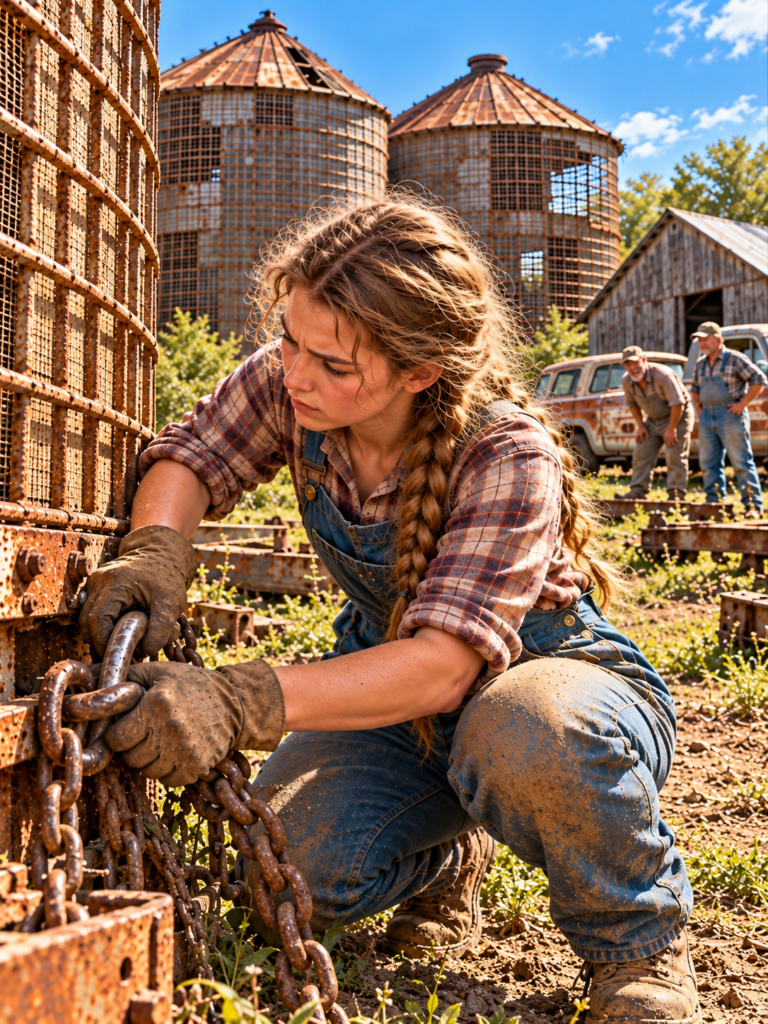
at seventeen, she hauled home three corn cribs everyone called useless—two years later, grain buyers drove to her family’s farm asking for her
Part 1
In October of 1980, when Denise Kner was seventeen years old, she spent three Saturdays taking apart a structure nearly every farmer in central Illinois was trying to get rid of.
It was a round wire corn crib.
Rusty bolts.
Curved steel panels.
A roof faded almost white from weather.
Nothing about it looked valuable.
That afternoon Denise stood halfway up a stepladder in Harve Deets’s farmyard with a socket wrench in one hand and a coffee can hanging from the ladder to catch the bolts.
She had already removed eleven panels.
Harve stood beside his pickup with her grandfather Otto Kner, watching.
“Denise,” Harve called, “this makes three.”
She kept working.
“I can count.”
“Three corn cribs.”
“Yes.”
“Empty corn cribs.”
“I noticed.”
Harve laughed.
He was not a cruel man.
That almost made the laughter worse.
Cruelty you could fight.
Good-natured dismissal was harder because everyone expected you to smile along.
“What in Sam Hill are you planning to do with three of these things?”
Denise put another bolt into the coffee can.
“I don’t know yet.”
Harve turned toward Otto.
“She doesn’t know.”
“I heard her.”
“She hauled home three obsolete corn cribs and doesn’t know why.”
Otto folded his arms.
“She’ll figure it out.”
“And if she doesn’t?”
“Then she’ll own three corn cribs.”
Harve shook his head.
“Teenagers.”
Denise went back to work.
What none of them could know that afternoon was that within two years men from a grain-processing company would drive into the Kner yard, walk straight toward those same old structures, and ask seventeen-year-old Denise’s family how reliably they could keep corn separate.
But on that October afternoon, all anyone saw was a high-school girl saving junk.
The Kner farm lay four miles outside the town of Milbrook.
Five hundred acres, some owned, some rented.
Black Illinois soil.
Corn.
Soybeans.
A white farmhouse with a porch facing west.
Two machine sheds.
A red barn no one had painted in years.
A gravel yard.
Three generations of Kners arguing over weather, seed, machinery, and whether the coffee at the grain elevator had gotten worse.
Denise’s father, Walt, ran most of the operation.
Her grandfather Otto still farmed a smaller piece up the road and behaved as though retirement were a rumor started by lazy people.
Denise’s older brother Gary was twenty-one and already working full-time with Walt.
Everybody assumed Gary would someday run the farm.
No one had ever formally announced it.
Farm families often made their largest decisions without sentences.
Gary rode in the tractor with Walt.
Gary went to machinery auctions.
Gary talked to seed dealers.
Gary knew which field would go into corn before Christmas.
Denise did chores.
She drove wagons when needed.
She helped her mother Ruth with meals during planting and harvest.
She could back a hay wagon through a narrow gate better than half the boys at school, but that did not mean anyone introduced her as the future of the farm.
She was the daughter.
Gary was the son.
Nobody hated her.
Nobody tried to push her out.
It was simply the shape of things.
And at seventeen, Denise had not yet decided whether she resented it.
What she knew was that she liked things other people ignored.
Old machinery manuals.
Settlement sheets from the grain elevator.
Seed tags.
Receipts.
Handwritten field records.
The little numbers people threw away after looking at the check.
Her mother once found Denise at the kitchen table comparing moisture deductions on four loads of corn.
Ruth stared at her.
“Are you having fun?”
Denise looked up.
“Yes.”
Her mother shook her head.
“I gave birth to a strange child.”
Denise smiled.
That habit would eventually matter.
The corn cribs came first.
For decades, farmers in that part of Illinois harvested corn on the ear.
Mechanical pickers pulled whole ears from stalks.
Wagons carried them home.
The ears went into round wire cribs where wind passed through the mesh and dried the corn naturally.
Later the kernels were shelled from the cob.
By 1980, that system was disappearing.
Combines could shell corn directly in the field.
Steel grain bins with fans and dryers could handle far more grain with far less labor.
A farm could harvest faster.
Move more acres.
Expand.
Old wire cribs became obstacles.
They occupied yard space.
They rusted.
They reminded farmers of a slower system nobody wanted to return to.
When neighbors removed them, they rarely bothered selling them.
If somebody hauled one away for free, that was considered a good deal.
The Kners had two.
Walt had already stopped using both.
One afternoon he jokingly told Denise, “If you like that old thing so much, you can have it before I take the torch to it.”
He expected her to laugh.
The following Saturday Denise began removing bolts.
Walt came around the shed.
“What are you doing?”
“You said I could have it.”
“I wasn’t serious.”
“You want it?”
“No.”
“Then I want it.”
“For what?”
She looked up from the wrench.
“I don’t know yet.”
That answer would become famous in the Kner family.
She reassembled the crib behind the machine shed.
Then Ray Sinsky down the county road heard about it.
“You want another?”
Denise did.
Then Harve offered his.
By winter she had three.
Moving them was miserable work.
Bolts fought her.
Wire cut her gloves.
One panel slipped from the trailer and landed in a ditch.
She spent forty minutes dragging it out.
Gary helped twice, then Walt told him there was enough real work to do without spending every Saturday on Denise’s “museum.”
Denise heard.
She pretended not to.
Mostly she worked alone.
Otto helped level the ground.
Not because he believed in the project.
Because he believed if you were going to do something foolish, you should at least do it square.
“Two inches high on this side,” he said.
Denise adjusted the base.
“Now?”
“Still high.”
“How much?”
“One.”
“You couldn’t have said one before?”
“Then you’d have learned nothing.”
She glared.
Otto grinned.
By January the three cribs stood side by side.
Empty.
That was the problem.
They looked impressive only if a person admired useless things.
Spring came.
Planters rolled.
The Kners put in their regular crop.
Denise’s cribs remained empty.
At school, Harve’s grandson asked whether she had started her “corn-crib collection.”
She told him she planned to open a museum and charge him double.
He laughed.
She laughed too.
Then July came.
The hay rake broke.
Not partially.
Completely.
Walt crawled underneath it, came back out covered in grease, and said a word Ruth did not allow at the supper table.
Replacement cost more than he had planned to spend that summer.
The farm was not broke.
But farms did not have to be broke for one unexpected purchase to hurt.
Expenses arrived in clusters.
Fuel.
Repairs.
Seed.
Fertilizer.
Land rent.
Taxes.
Every dollar already had a job before it entered the checking account.
That evening Ruth said quietly, “Sometimes I think about those hours Denise put into those cribs.”
Nobody answered.
Denise sat at the table.
Her mother continued.
“Not blaming anybody.”
Walt cut his meat.
“I know.”
“Just saying sixty hours is sixty hours.”
Gary drank his milk.
Denise felt heat rise into her face.
Walt finally looked at her.
“Your cribs didn’t break the rake.”
“I know.”
“If you’re waiting for me to say they did, I’m not.”
“I know.”
Ruth said, “Nobody is attacking you.”
That sentence always made Denise feel attacked.
She finished supper quickly.
Outside, darkness had settled over the yard.
She walked past the machine shed.
Three circular shadows stood against the sky.
For the first time, Denise hated them.
Harve had been right.
They were junk.
She had spent weekends hauling them.
Fuel.
Bolts.
Bandages.
Hours.
For what?
Because she did not like watching something useful be destroyed.
But usefulness had to have a use.
Otherwise it was sentiment.
And sentiment did not buy hay rakes.
Denise leaned against one of the wire panels.
She thought about dismantling them again.
Selling the steel.
Admitting everyone else had understood something she had not.
Then she heard Otto’s truck.
His headlights came up the lane.
He parked near her.
“What are you doing standing in the dark?”
“Thinking.”
“Dangerous.”
She did not smile.
Otto got out.
He stood beside her.
After a minute Denise said, “They’re stupid.”
“The cribs?”
“Yes.”
“Could be.”
“You’re supposed to disagree.”
“Why?”
“Because you’re my grandfather.”
“I’ve got plenty of relatives. Doesn’t mean I have to lie to them.”
Denise kicked at gravel.
“I don’t have any use for them.”
“Not yet.”
“Maybe never.”
“Maybe.”
She looked at him.
“How do you know when keeping something is smart and when you’re just afraid to admit you were wrong?”
Otto took his time.
“Usually don’t.”
“That’s helpful.”
“Most important decisions look obvious ten years later.”
He touched the wire.
“When you’re standing inside them, mostly they look like work.”
Then he went home.
Denise did not tear the cribs down.
Not because Otto convinced her they were valuable.
He hadn’t.
He had simply given her permission not to know yet.
That fall, while helping Walt deliver corn, Denise returned to another habit nobody cared much about.
She studied settlement sheets.
Every load delivered to the elevator produced one.
Gross weight.
Moisture.
Test weight.
Deductions.
Price.
Net payment.
Most farmers looked at the bottom.
Denise looked at everything.
She kept a spiral notebook in the truck.
One line per load.
Field.
Date.
Moisture.
Test weight.
Price.
Deduction.
Net.
Gary found it in the glove box.
“What is this?”
“My notes.”
“For what?”
“So I can compare.”
“Compare what?”
“Loads.”
Gary flipped pages.
“Why?”
Denise stared at him.
“You don’t ever wonder why two loads from the same field bring different money?”
“Moisture.”
“Sometimes.”
Gary put the notebook down.
“You’re weird.”
“Mom says that.”
But patterns emerged.
A point of moisture mattered.
Test weight mattered.
How long corn sat before drying mattered.
Sometimes the difference looked tiny.
Three cents.
Five cents.
Seven cents.
Until Denise multiplied it across a thousand bushels.
Then across fifty thousand.
Tiny decisions became machinery payments.
She began understanding the farm differently.
Walt saw fields.
Gary saw equipment.
Otto saw weather.
Denise began seeing pathways.
A crop did not become money merely because it grew.
It had to be harvested.
Handled.
Stored.
Graded.
Sold.
Every step either preserved value or leaked it.
The following autumn, Walt planned to attend a county extension meeting but a hydraulic pump failed on the combine.
“Denise.”
She looked up from homework.
“You busy?”
“Yes.”
“Good. Go to this.”
He tossed a folded notice onto the table.
“I don’t want to drive thirty miles to hear somebody tell me fertilizer costs money.”
“Why me?”
“You like meetings.”
“I do not.”
“You like paper.”
“That isn’t the same thing.”
“Bring back the handouts.”
So Denise went.
Thirty farmers sat in a meeting room drinking free coffee.
The first presentation covered herbicide timing.
The second discussed grain drying.
Then a nervous representative named Roy Sanderson stood up.
He worked for Prairie Starch Works in Danville.
He talked about specialty corn contracts.
Most farmers barely looked interested.
Denise listened.
Roy described waxy corn.
Different starch characteristics.
Different end users.
Different buyer requirements.
Then he said one sentence that caused Denise to stop doodling.
“We aren’t necessarily looking for the biggest farm in this room. We’re looking for the farm that can guarantee that what we buy never touched anything else.”
Denise wrote the sentence word for word.
Roy continued.
Identity preservation.
Isolation in the field.
Separate handling.
Separate storage.
Clean transportation.
Contamination could destroy the specialty premium.
The grain would still be corn.
Just ordinary corn.
And ordinary corn earned ordinary money.
Denise wrote:
HAS TO NEVER TOUCH OTHER CORN.
Then underneath:
HOW?
For almost two months, she could not answer.
Everything on the Kner farm touched regular corn.
Planter.
Combine.
Wagons.
Augers.
Bins.
Trucks.
Dryer.
The entire system was designed to mix bushels efficiently.
Separation was the opposite of efficiency.
One cold December afternoon Denise walked behind the machine shed.
Snow lay in patches.
The three wire cribs stood empty.
She stopped.
One minute passed.
Then another.
Something shifted in her mind.
The cribs had no connection to the modern grain system.
No augers led to them.
No regular shelled corn used them.
No one needed them.
They were isolated because they were obsolete.
Denise walked closer.
The very reason everyone considered them useless might make them useful.
That night she opened her notebook.
WAXY CORN.
Below it she wrote:
Separate field.
Separate harvest.
Separate wagon.
Cribs?
Then she circled the word.
She still had a problem.
The cribs were built for ear corn.
The Kners harvested shelled corn.
Denise drove to Otto’s farm the next afternoon.
Behind his shed, under a leaning roof, sat an old two-row corn picker.
“You still have that?”
Otto followed her gaze.
“Apparently.”
“Run?”
“Last time I used it.”
“When was that?”
“Before you learned long division.”
Denise walked around the machine.
“What if we got it running?”
“For what?”
She explained.
Otto listened.
When she finished, he scratched his cheek.
“Special corn.”
“Yes.”
“Picked on the ear.”
“Yes.”
“Stored in those ridiculous cribs.”
“Yes.”
“Shelled separately.”
“Yes.”
“Then hauled straight to the buyer.”
“Yes.”
Otto looked at her for a long time.
“You got a contract?”
“Not yet.”
“Then right now you’ve got a story.”
“I know.”
“You got numbers?”
“Working on them.”
“Good.”
He pointed toward the picker.
“If you can make the arithmetic make sense to your father, I’ll help you get that old bastard running.”
That was the first moment anybody had called Denise’s idea something other than foolish.
Not good.
Not brilliant.
Not promising.
Just worth doing the math on.
For Denise, that was enough.
Part 2
Denise spent January building a plan nobody had asked her to build.
She called Roy Sanderson.
The first time, his secretary put her on hold twice.
When Roy finally answered, he assumed she was calling for Walt.
“No, sir. I’m calling.”
“You’re Walt Kner’s daughter?”
“Yes.”
“How old are you?”
“Seventeen.”
A pause.
“All right.”
Denise hated that pause.
She heard it constantly.
All right meant this is unusual.
She opened her notebook.
“I have questions about the waxy contract.”
Roy became serious immediately.
That changed everything.
He explained acreage minimums.
Approved seed.
Isolation requirements.
Moisture limits.
How purity was tested.
Record keeping.
Delivery windows.
The premium.
Denise wrote until her hand cramped.
“Can ear corn be stored naturally before shelling?”
Roy paused.
“That’s an old method.”
“I know.”
“Do you have cribs?”
“Yes.”
“How many?”
“Three.”
Another pause.
“What are you thinking?”
She told him.
This time his silence sounded different.
Not dismissal.
Calculation.
“It could work.”
Denise sat straighter.
“Could?”
“You’d have to show segregation throughout the chain.”
“We can.”
“Planter cleanout.”
“Yes.”
“Field identification.”
“Yes.”
“Picker?”
“Dedicated.”
“Sheller?”
“Separate rental.”
“Truck?”
“Washed.”
“Storage?”
“Dedicated.”
Roy said, “Your biggest risk is contamination in the field.”
“I’ll follow the isolation requirement.”
“And weather.”
“That’s farming.”
Roy laughed.
“Fair enough.”
Afterward Denise sat at the kitchen table staring at his business card.
She had expected him to say no.
Instead he had treated her question as a real one.
Now she had to convince Walt.
She waited until February.
The right evening mattered.
Farm families knew this instinctively.
Do not bring a new idea to a man whose tractor will not start.
Do not discuss spending while cattle are loose.
Do not introduce risk when taxes are due.
Denise waited for a quiet Tuesday after supper.
Walt sat drinking coffee.
Ruth was balancing household books.
Gary had gone to town.
Denise placed her notebook on the table.
“Dad.”
Walt looked at the notebook.
“That usually means trouble.”
“I want fifteen acres.”
“For what?”
She explained.
Not emotionally.
Numbers first.
Specialty premium.
Low acreage.
Existing equipment.
Minimal capital.
Old picker.
Dedicated crib.
Separate wagon.
Separate shelling.
Worst-case outcome: if purity failed, grain could still sell as commodity corn.
Walt listened without interrupting.
When she finished, he asked, “Why fifteen?”
“Small enough that failure doesn’t hurt us.”
“Big enough?”
“Should produce enough to test the whole system.”
“You’ve talked to the company?”
“Yes.”
Walt raised an eyebrow.
“Without asking me.”
“I asked about a contract. I didn’t sign your land away.”
Ruth hid a smile.
Walt opened the notebook.
He read.
“You calculated picker time?”
“Estimate.”
“Drying?”
“Natural.”
“Sheller rental?”
“Here.”
“Extra hauling?”
“Here.”
“Premium?”
“Range. Depends on contract.”
He kept reading.
Finally he looked up.
“What do you want from me?”
“Fifteen acres.”
“And if it fails?”
“We sell regular.”
“No.”
Denise frowned.
“No?”
“If it fails, what do you learn?”
The question surprised her.
She thought.
“Whether contamination happened in planting, field isolation, harvest, storage, shelling, or transport.”
“How?”
“Records.”
Walt nodded.
“Then that’s your job.”
“You mean yes?”
“I mean fifteen acres.”
Denise smiled.
“On conditions.”
Of course.
“You handle the paperwork.”
“Fine.”
“You talk to Sanderson.”
“Fine.”
“You keep records.”
“Already planned.”
“You don’t interfere with regular harvest.”
“I won’t.”
“If the buyer rejects the crop, you don’t blame equipment, weather, Gary, me, your grandfather, or Jesus Christ.”
Ruth looked up.
“Walt.”
“Sorry.”
Denise nodded.
“Deal.”
Walt extended his hand across the table.
That mattered to Denise.
He did not pat her on the head.
Did not call it a school project.
Did not say let’s see what happens, sweetheart.
He shook her hand the way he would Gary’s.
“Fifteen acres.”
“Fifteen.”
The specialty seed arrived in bags marked separately.
Denise read every tag.
She cleaned the planter more thoroughly than Gary thought necessary.
He watched her with an air hose.
“You planning surgery?”
“Go away.”
“You know one kernel isn’t going to destroy civilization.”
“One regular seed in the wrong place can become more than one kernel at harvest.”
“Your life seems exhausting.”
“It is.”
Gary walked off.
But ten minutes later he returned carrying a smaller brush.
“You missed behind the plate.”
Denise looked at him.
He shrugged.
“Don’t make it emotional.”
They planted fifteen acres.
The field was sufficiently isolated under the contract requirements.
Denise drove stakes at each corner.
SPECIALTY — DO NOT HARVEST.
Gary added another sign underneath:
DENISE’S WEIRD CORN.
She removed it.
He put it back.
She eventually stopped fighting him.
The growing season was ordinary.
That made Denise almost more nervous.
There was no drought to blame.
No storm.
No dramatic disaster.
If the system failed, it would fail because they made a mistake.
She inspected the field constantly.
Walt finally said, “Watching doesn’t make corn grow faster.”
“It could catch a problem.”
“Could also make you unbearable.”
July turned dry.
Leaves rolled slightly in afternoon heat.
Then August rains came.
The crop recovered.
By September ears filled well.
The first real problem arrived at harvest.
Otto’s old picker had not run in years.
The first afternoon they tried to start it, one chain snapped.
Then a bearing complained.
Then a belt slipped.
Gary laughed from beneath the machine.
“Your revolutionary grain business is going great.”
Denise threw a glove at him.
Otto stood nearby smoking a cigar Ruth hated.
“That machine picked more corn than you’ve seen in your life.”
Gary looked out.
“Not today.”
Otto pointed the cigar.
“Respect your elders.”
“Machine or you?”
“Both.”
They worked two days getting the picker dependable.
When it finally moved through the waxy field, Denise rode beside Otto for the first round.
The machine was slow.
Painfully slow compared with the combine.
Two rows at a time.
Whole ears rattled into the wagon.
Denise picked one up.
Yellow kernels.
Nothing visually dramatic.
No gold.
No obvious premium.
Just corn.
That was the odd thing about specialty grain.
The value existed partly because someone could prove what it was.
Without records and separation, these kernels were indistinguishable from everything around them.
The first wagon went straight to Harve’s old crib.
Harve happened to stop by.
He watched the ears tumble inside.
“Well.”
Denise leaned against the wagon.
“Well what?”
“Guess you found something to put in it.”
“One of them.”
“What are the other two for?”
She smiled.
“I don’t know yet.”
Harve laughed.
This time she laughed with him.
Harvest took most of two afternoons.
Gary drove the picker the second day.
He complained.
“This thing is prehistoric.”
“It works.”
“So did horses.”
“Want one?”
“No.”
They kept the waxy corn completely separate.
The rest of the farm’s crop moved through the combine, dryer, bins, and augers as usual.
Denise’s fifteen acres followed its own awkward route.
That was exactly the point.
Weeks later, after the ear corn had dried sufficiently, they rented a portable sheller.
The truck was swept.
Washed.
Inspected.
Denise checked it twice.
Gary checked it once.
Walt looked inside.
“Clean.”
Denise looked again.
Walt groaned.
“Denise.”
“Clean.”
The portable sheller rattled to life.
Whole ears entered one side.
Shelled kernels poured into the truck.
Cobs piled separately.
It took hours.
When the truck was finally loaded, Denise climbed into the passenger seat.
Walt drove.
Gary leaned through the window.
“If they reject it, don’t cry.”
“If they accept it, I’m charging you consulting fees.”
“You didn’t consult me.”
“You’re welcome.”
The drive to Danville seemed twice as long as it was.
Prairie Starch Works was larger than Denise expected.
More trucks.
More bins.
More concrete.
Operations that made the Kner farm look tiny.
They waited in line.
Denise held her notebook on her lap.
Walt glanced over.
“You’ll rub a hole in that cover.”
“I’m fine.”
“Sure.”
“What if they reject it?”
“Then we haul it to an elevator.”
“We lose the premium.”
“Yes.”
“All that work.”
“Yes.”
Denise stared through the windshield.
Walt said, “You understand testing something means it might fail.”
“I know.”
“You know it like a sentence.”
She looked at him.
“Today you learn it like a feeling.”
The truck moved forward.
At the scale house, a technician took a probe sample.
Denise watched the grain disappear into the lab.
Roy Sanderson came over.
“Morning.”
“Morning.”
He saw her expression.
“Nervous?”
“No.”
Walt laughed.
Roy smiled.
“Lab will take a few minutes.”
The minutes were terrible.
Then the technician returned.
He handed Roy a card.
Roy read it.
Looked at Denise.
“Moisture is good.”
She waited.
“Purity passes.”
Denise exhaled.
Roy handed her the card.
“Congratulations.”
That was all.
No music.
No applause.
No one at the plant cared that a seventeen-year-old had hauled home obsolete corn cribs.
Another truck pulled forward behind them.
Work continued.
Yet Denise looked at the scale ticket as though it were a diploma.
The premium was twenty-four cents per bushel on that load.
Not fortune.
After extra handling and sheller rental, the additional profit from fifteen acres amounted to hundreds rather than thousands.
At supper, Gary said, “So you spent a year earning what, maybe enough for half a used lawn mower?”
Ruth gave him a look.
Denise surprised everyone by agreeing.
“Pretty much.”
Gary stopped chewing.
“What?”
“The money wasn’t the point.”
He stared.
“You’ve been talking about premiums for six months.”
“The premium proves somebody will pay it.”
Walt slowly nodded.
Denise continued.
“We proved we can grow and handle it without building a new bin.”
Otto pointed his fork at her.
“There.”
Everyone looked.
“That’s the thing.”
He leaned back.
“First crop wasn’t the harvest.”
Gary frowned.
“What does that mean?”
Otto grinned.
“The girl harvested proof.”
Part 3
Roy Sanderson called three weeks later.
Not Denise.
Walt.
Denise knew something had happened because her father came into the kitchen still wearing his coat.
“Prairie Starch wants sixty acres next year.”
Gary looked up immediately.
“Sixty?”
Ruth stopped chopping vegetables.
Denise’s stomach tightened.
“What’d you say?”
“That I’d talk to the family.”
Gary smiled.
“We do it.”
Walt looked at him.
“That’s your analysis?”
“First year passed.”
“Fifteen acres passed.”
“So scale.”
“Four times.”
“That’s the point.”
Walt removed his coat.
“No, the point is whether we can handle four times.”
Denise remained quiet.
This surprised Gary.
“Well?”
She looked at him.
“What?”
“This is your thing.”
“I’m thinking.”
The conversation lasted three days.
Gary wanted sixty.
He saw opportunity.
If Prairie Starch needed acres and the Kners had proven themselves, why move slowly?
Buy a used sheller.
Find another picker.
Take advantage while the buyer wanted supply.
Walt disagreed.
Commodity corn remained the farm’s foundation.
Sixty acres of slow ear-corn harvest could interfere with the rest of the operation.
A wet October could turn extra labor into a serious bottleneck.
One specialty contract should not control the entire harvest schedule.
Ruth listened more than she spoke.
Otto sided with nobody.
“You’re useless,” Gary told him.
“Experience teaches a man to let other people make their own mistakes.”
At supper on the second night, the argument became sharp.
Gary put his fork down.
“We spend our whole lives complaining margins are thin, then somebody offers us a better market and suddenly we’re scared.”
Walt answered, “Caution isn’t fear.”
“Sometimes it is.”
“You’ve run exactly zero farms through a debt crisis.”
“And you’ve signed exactly zero specialty contracts before Denise found this one.”
Silence.
Ruth said, “Eat.”
Nobody moved.
Denise disliked conflict.
Not because she was weak.
Because she heard things beneath sentences.
Gary was not merely arguing for sixty acres.
He was proving he could make decisions.
Walt was not merely arguing against it.
He was protecting thirty years of work.
And somewhere between them sat Denise’s experiment, becoming large enough to affect everybody.
That frightened her.
She went outside after supper.
Three cribs stood in darkness.
Gary followed.
“Mad?”
“No.”
“You got quiet.”
“You two were doing enough talking.”
He leaned against the crib.
“What do you think?”
“Don’t know yet.”
He laughed.
“Your favorite answer.”
“It’s better than pretending.”
Gary looked toward the house.
“Dad’s too cautious.”
“Maybe.”
“You agree.”
“I said maybe.”
“He still thinks farms work like when Grandpa was young.”
“And you think every opportunity has to be attacked before somebody steals it.”
Gary looked at her.
“You don’t?”
“No.”
“Why?”
“Because I kept records.”
He groaned.
“Of course.”
Denise spent the next evening with her notebook.
Hours required for fifteen acres.
Picker speed.
Shelling capacity.
Drying time.
Labor.
Regular harvest demands.
Then she multiplied.
Thirty acres.
Forty.
Fifty.
Sixty.
Best-case weather.
Normal.
Tight window.
The result became obvious.
Sixty could work if almost everything went right.
That meant sixty did not work.
Forty was uncomfortable but manageable.
The following night Denise placed her figures on the kitchen table.
Gary started to speak.
She raised a hand.
“Wait.”
He actually did.
She walked them through it.
At sixty acres, the old picker became the limiting factor.
Harvest days increased too much.
Shelling became tighter.
Storage capacity approached the useful limit of the cribs.
If weather delayed picking while regular corn was ready, they risked sacrificing commodity harvest timing for specialty corn.
At forty, they maintained margin.
Gary read the numbers.
“You’re assuming the picker breaks.”
“I’m assuming old equipment sometimes breaks.”
“It ran fine.”
“After we replaced a chain, bearing, and belt.”
Otto chuckled.
Walt read the calculation twice.
Then again.
“Check this line.”
Denise checked.
“Right.”
“And this?”
“Right.”
Gary leaned back.
“You two already decided.”
“No,” Denise said.
She turned the notebook toward him.
“The numbers decided what I’m comfortable defending.”
That sentence ended it.
Forty acres.
Prairie Starch accepted the reduced commitment.
Roy even sounded pleased.
“Most people ask us for more acreage than they can actually segregate.”
“We’re trying not to.”
“That’s why I called again.”
The second year was harder.
Forty acres felt real.
The planter cleanout took longer.
Record keeping mattered more.
The waxy field occupied land the family otherwise would have put into ordinary production.
Gary helped without jokes now.
Not because he had become gentle.
Because he considered the project serious enough to criticize properly.
“Your log is missing the planter cleanout start time.”
“Does start time matter?”
“You’re the paperwork person.”
Denise stared.
Gary smiled.
“Thought so.”
She wrote it.
Harvest tested everyone.
The picker moved slowly.
A cold rain stopped them for almost two days.
Regular corn stood ready elsewhere.
Walt grew tense.
Denise saw him at the kitchen window at five one morning studying weather.
For the first time she understood the burden of an idea after other people’s money became attached.
Fifteen acres had been an experiment.
Forty acres belonged to the family.
If Denise made a bad recommendation, Walt and Gary carried it physically.
Ruth carried it in the checking account.
Otto carried it because his machinery was involved.
Denise could no longer think of herself as a girl with a clever plan.
She had become accountable.
That frightened her more than being laughed at.
One evening after twelve hours of harvest, Denise found Walt in the machine shed.
“Dad.”
“Yeah?”
“Maybe Gary was right.”
“About?”
“Buying a second picker.”
Walt looked up.
“This year?”
“No. I mean maybe we should’ve done sixty and invested.”
“Why?”
“We’re working everyone too hard.”
“That’s an argument for less acreage, not more.”
She rubbed her face.
“I don’t know.”
Walt set down the wrench.
“First year you were afraid because nobody believed you.”
She nodded.
“Second year you’re afraid because people do.”
Denise looked at him.
“That worse?”
“Yes.”
He smiled.
“Good.”
“How is that good?”
“Means you’re learning what responsibility feels like.”
“It’s terrible.”
“Correct.”
The forty acres passed specification.
Again.
The premium difference moved into four figures.
Still not enough to transform the farm.
Enough to matter.
Enough to buy a used sheller.
When Walt wrote the check, he handed the paperwork to Denise.
“Your department.”
She stared.
“What?”
“Keep it.”
“For the farm records?”
“For yours.”
“Why mine?”
Walt looked toward the three cribs.
“Because you built the reason we need it.”
That winter Denise graduated high school.
Most classmates left for college, factory work, marriage, military service, or jobs in larger towns.
Denise enrolled in agriculture and business courses at a community college within driving distance.
She continued working on the farm.
One afternoon Harve Deets stopped beside her at the elevator.
“Did I hear you’re planting forty acres of that odd corn?”
“Already did.”
“And they paid extra?”
“Yes.”
Harve nodded toward the Kner road.
“My old crib involved?”
“First one we filled.”
He scratched his chin.
“Probably should’ve charged you.”
Denise smiled.
“Too late.”
Harve laughed.
“Guess so.”
He did not apologize for laughing years earlier.
Denise did not need him to.
Then spring came.
A dark sedan and two company pickups turned into the Kner driveway.
Denise was helping Gary grease a planter.
She wiped her hands.
Roy Sanderson got out.
Two men followed.
One wore work boots but clean trousers.
The other carried a clipboard.
Walt came from the shop.
Roy shook his hand.
“Walt.”
“Roy.”
Roy turned.
“Denise here?”
Walt glanced toward his daughter.
“She is.”
The purchasing manager shook Denise’s hand.
“We’ve been looking forward to meeting you.”
Gary’s eyebrows rose.
Denise tried not to look seventeen again.
They inspected everything.
The fields.
The old picker.
The sheller.
The truck cleaning procedure.
Records.
Then the three corn cribs.
Harve’s crib.
Ray’s crib.
The Kners’ original crib.
The quality-control man ran his hand across the wire.
“How do you designate which lot goes where?”
Denise explained.
Tags.
Maps.
Dates.
Physical separation.
Cleaning.
No shared auger system.
He asked questions for nearly an hour.
Not one question was addressed automatically to Walt.
If it concerned the system, he asked Denise.
They moved into the kitchen.
Ruth served coffee.
Denise opened her notebooks.
Years of settlement sheets.
Field records.
Moisture.
Loads.
Delivery results.
The quality-control representative turned pages.
“You kept all this before the specialty contract?”
“Yes.”
“Why?”
“I wanted to know why prices changed.”
He looked at the purchasing manager.
Then back at Denise.
“A lot of suppliers twice your size don’t keep records this clean.”
Her face warmed.
Walt sat silently.
Gary leaned against the counter.
The purchasing manager closed the notebook.
“We’re interested in discussing a multi-year relationship.”
Nobody spoke for a second.
Then Roy smiled.
“And eventually other specialty grains.”
“What kind?” Denise asked.
“Food-grade white corn. High-oil contracts sometimes. Depends on customer demand.”
The man gestured toward the yard.
“You’ve already solved the part that makes us nervous.”
“Which part?”
“Whether you’ll follow a system when nobody is standing here watching.”
After they left, the family remained in the kitchen.
Ruth looked out the window.
“Well.”
Gary nodded.
“Well.”
Walt drank coffee.
Denise waited.
Finally Gary said, “You realize those guys drove two hours to inspect your junk.”
Denise smiled.
“Our junk.”
Gary laughed.
“Absolutely not. I’m not claiming responsibility now that it’s working.”
Walt looked at Denise.
“Good job.”
Two words.
That was all.
Her father was not a speech-making man.
Yet Denise carried those two words longer than anything the buyers said.
Part 4
Success did not make the next years easy.
It made decisions larger.
That was different.
By the third contract year, the Kners approached one hundred acres of specialty production.
The premium added meaningful income.
Not enough to turn them wealthy.
Enough to strengthen the farm.
Enough to make machinery repairs less frightening.
Enough to pay bills on time in years when commodity prices disappointed.
Enough that Walt stopped calling specialty corn Denise’s project.
He began calling it “our contract ground.”
Denise noticed.
She never corrected him.
Gary became her strongest critic and best ally.
He understood machinery better.
She understood marketing better.
Their arguments improved.
That might have been the most valuable change.
One winter afternoon Gary came into the kitchen holding a brochure.
“Dedicated steel bin.”
Denise looked.
“How much?”
He told her.
She nearly choked on coffee.
“No.”
“You didn’t even read it.”
“I heard the number.”
“We’re outgrowing the cribs.”
“I know.”
“Picker too.”
“I know.”
“So?”
“So we don’t spend that until acreage supports it.”
“It does.”
“Maybe.”
Gary groaned.
“You’re turning into Dad.”
“No. Dad would say no without a spreadsheet.”
Walt called from the living room, “I can hear you.”
Gary lowered his voice.
“He’s ancient but apparently still has ears.”
“Still hear you,” Walt said.
They ran projections.
Specialty acreage.
Three-year buyer commitment.
Capital cost.
Interest.
Labor saved.
Reduced contamination risk.
Storage efficiency.
Eventually Denise looked at Gary.
“It works.”
He grinned.
“Say it louder.”
“It works.”
“To Dad.”
“You tell him.”
“This was your rule. Don’t spend until demand is proven.”
She hated that he was right.
The new dedicated bin went up the following summer.
Bright galvanized steel.
Separate auger.
Separate handling route.
Modern.
Efficient.
Expensive.
Denise watched construction beside the old wire cribs.
Otto stood with her.
“Looks better.”
“It should. It cost more than my life is worth.”
He laughed.
“You know the funny part?”
“What?”
“If you’d asked your father to build this before the first fifteen acres, he’d have thrown you out of the kitchen.”
“I know.”
“Now he’s complaining the builders are two days late.”
Denise smiled.
“Evidence.”
“What?”
“You spend after evidence.”
Otto nodded.
“Sounds like something somebody old and wise taught you.”
“No. I figured it out.”
“Ungrateful child.”
The new bin changed the operation.
The old picker eventually retired.
Combines could be cleaned and scheduled properly as specialty acreage justified more efficient procedures.
The sheller system changed.
The improvised chain became professional infrastructure.
The three old cribs had done their job.
One came down.
Denise watched Gary dismantle it.
Something tightened in her chest.
“You okay?”
“Fine.”
“You’re staring at wire.”
“That was Ray Sinsky’s.”
“Yes.”
“First year we used it for overflow.”
“Yes.”
Gary loosened another bolt.
“You know it’s rusting out.”
“I know.”
“We’ve got no use for it.”
“I know.”
He paused.
“Want me to stop?”
Denise considered.
Then shook her head.
“No.”
She understood now that keeping everything forever was not preservation.
Sometimes an old tool succeeded precisely because it allowed you to reach the moment you no longer needed it.
The second crib came down two years later.
They kept one.
No one asked Denise why.
By then everyone understood some things did not need to earn their square footage anymore.
The early 1980s brought difficult years for many Midwestern farms.
Money became tighter.
Borrowing became painful.
Land values no longer felt like a promise that could only move upward.
Neighbors who had expanded aggressively discovered that acres could become liabilities when debt followed them.
The Kners felt pressure too.
A rented parcel disappeared when the landlord needed more money.
Input costs climbed.
One year commodity corn disappointed badly enough that Ruth returned from the mailbox with a settlement check and simply placed it on the kitchen table without speaking.
Denise’s specialty contracts did not make the Kners immune.
But they created another lane.
Not every bushel lived under the same pricing rules.
That mattered.
One evening Walt and Denise drove past a neighboring farm auction.
Tractors lined the road.
People stood beside machinery.
Denise looked away.
“Could that happen to us?”
Walt kept driving.
“Could.”
She waited for reassurance.
None came.
“That’s all?”
“What do you want me to say?”
“That we’re safe.”
“No farm is safe.”
“That sounds cheerful.”
“Safety isn’t the job.”
“What is?”
“Surviving the bad years without destroying the good ones.”
Denise looked out the window.
“How?”
“Choices.”
That word stayed with her.
The corn cribs had given them a choice before they could afford modern infrastructure.
The specialty contract gave them another buyer.
The records gave them information.
Slow scaling gave them room to fail without losing everything.
Denise began to understand that resilience was not the same thing as strength.
A strong system could still break if it had only one direction to move.
A resilient farm had options.
Then came the wet year.
It began normally.
Spring planting went well.
Summer moisture was adequate.
September turned damp.
Then October became miserable.
Fog.
Rain.
Clouds.
The specialty corn refused to dry as Denise wanted.
Delivery windows approached.
Regular harvest pressed from behind.
She checked moisture constantly.
Gary walked into the shop one evening.
“What’s it at?”
“Too high.”
“How high?”
She told him.
He whistled.
“Wait?”
“We can.”
“Risk weather.”
“Yes.”
“Go now?”
“Penalty.”
“Yes.”
Walt joined them.
Nobody made jokes.
This was the kind of decision where every option cost something.
Denise spread numbers on the workbench.
If they waited and weather worsened, regular harvest could be delayed.
If they moved early, drying costs and moisture deductions cut the specialty premium.
Gary said, “Take it.”
Walt said, “I’d wait forty-eight hours.”
Both looked at Denise.
Years earlier that would have thrilled her.
Now she wished someone else would decide.
“Why me?”
Gary stared.
“Because you manage the contract.”
“I know, but—”
Walt interrupted.
“No.”
She looked at him.
“You wanted a seat at this table.”
“Yes.”
“This is the table.”
Denise hated him a little for that.
She went outside.
Walked past the modern bin.
Past the one remaining wire crib.
Rain tapped on its old roof.
She remembered being seventeen, when success meant proving men wrong.
Life had become more complicated.
Nobody here wanted her to fail.
That did not make the answer easier.
She thought about the settlement sheets.
Premium.
Drying.
Risk.
Harvest time.
She returned to the shop.
“We start tomorrow.”
Walt nodded once.
Gary asked, “You sure?”
“No.”
He smiled faintly.
“Good enough.”
They harvested.
Moisture penalties reduced the margin.
Days were long.
The contract still passed.
Profit was thinner.
Nothing dramatic happened.
That season became one of Denise’s most important.
Because until then, specialty grain had felt like a success story.
The wet year reminded her it was only a strategy.
Strategies had limits.
Markets changed.
Weather ignored contracts.
Premiums could disappear.
Buyers could alter requirements.
A farm survived by adapting without believing its own mythology.
At the end of the season Denise updated her records.
Gary came in.
“How bad?”
“Not bad.”
“Good?”
“Not particularly.”
He sat.
“Would regular corn have done better?”
“On some acres, maybe.”
He leaned back.
“So maybe this wasn’t worth it.”
Denise shook her head.
“That isn’t how you evaluate it.”
“Why?”
“One year?”
She turned the notebook.
“Look at five.”
Gary studied the figures.
The specialty system remained clearly profitable across multiple seasons.
One difficult year had not invalidated the strategy.
Neither had several good years made it invincible.
Gary nodded.
“You really do enjoy this.”
“Yes.”
“Still weird.”
By her mid-twenties, Denise handled most grain marketing for the Kner operation.
Gary managed much of field production and machinery.
Walt still made final decisions less often each year.
That transition happened quietly.
One day Denise realized buyers called her before calling her father.
The discovery made her sad.
Not because she wanted Walt’s authority.
Because every responsibility she gained marked time passing.
Otto slowed.
His hands shook slightly.
He stopped climbing ladders.
Then stopped driving tractors after Ruth caught him taking too long to turn into the yard.
He complained for six months.
One autumn afternoon Denise found him sitting near the remaining wire crib.
“You okay?”
“Fine.”
“You’re sitting.”
“Observation worthy of your notebooks.”
She sat beside him.
The modern bins rose behind them.
Fans hummed.
Trucks moved.
The farm looked different from 1980.
Otto nodded toward the crib.
“Remember Harve laughing?”
“Yes.”
“I laughed too.”
“You didn’t.”
“Inside.”
Denise smiled.
“I knew.”
“You looked ridiculous.”
“Thank you.”
“A little girl taking apart corn cribs nobody wanted.”
“I was seventeen.”
“Little.”
She leaned against the post.
Otto continued.
“You know what I liked?”
“What?”
“You didn’t know why.”
“That seems like the worst part.”
“No.”
He shook his head.
“If you’d known, you’d have been lucky.”
She frowned.
“You saw something worth keeping before you knew what it’d be worth for.”
He looked at her.
“That’s different.”
Denise grew quiet.
Otto touched the rusty wire.
“Most people only know how to value something after a buyer tells them the price.”
She looked toward the new steel bins.
“And sometimes buyers are right.”
“Sure.”
“They pay the bills.”
“Sure.”
“Then what are you saying?”
Otto smiled.
“I’m saying don’t let price be the first person you ask.”
He died the following winter.
Not suddenly.
Not painfully.
He simply became weaker.
Then one February morning he did not wake.
The funeral filled the little church.
Farmers came in clean shirts.
Harve.
Ray Sinsky.
Men Otto had argued with for fifty years.
After the burial Denise returned home alone before everyone else.
Snow lay around the crib.
She put her hand against cold wire.
For the first time, the old structure felt less like a piece of farm history and more like something her grandfather had touched.
She finally understood why older people kept objects nobody else saw a use for.
Sometimes usefulness ended.
Meaning did not.
Part 5
By the time Denise was in her thirties, a child in the Kner family could walk through the farmyard without understanding why one rusted wire corn crib stood beside modern steel bins.
Everything around it had changed.
Dedicated storage.
Improved handling equipment.
Larger combines.
Better records.
Long-term contracts.
Specialty corn had become an ordinary part of the operation.
Not every acre.
Not every year.
But enough that buyers knew the Kner name.
Denise eventually married a man named Paul Mercer who ran a small electrical business in town and had no desire to become a farmer.
This pleased her.
“I already have enough farmers telling me things,” she told him.
They had two children.
Gary married too.
His children grew up next door.
The yard became noisy again.
Bicycles.
Dogs.
Baseballs where baseballs did not belong.
One summer afternoon Denise found her nephew Luke climbing the old crib.
“Get down.”
“Why?”
“Because tetanus exists.”
He climbed down.
“Why don’t you tear this thing down?”
Denise looked up.
The wire was rusted.
The roof had been repaired twice.
Around it stood equipment worth more than the entire Kner farm had been worth when Denise was seventeen.
“What do you think it’s for?” she asked.
Luke shrugged.
“Nothing.”
“Correct.”
“So why keep it?”
Denise looked toward the newest segregated steel bin.
Bright sunlight reflected off its side.
She could have given him the whole story.
She could have told him about Harve’s yard.
The socket wrench.
The coffee can of bolts.
The nights she wondered whether she had wasted her time.
The extension meeting.
Roy Sanderson’s sentence.
The fifteen acres.
The old picker.
The first truck to Danville.
The purity test.
The twenty-four-cent premium.
The forty-acre compromise.
The buyers arriving.
Otto sitting beside the wire years later.
Instead she said, “That one paid for the first new one.”
Luke looked from the old crib to the steel bin.
“That?”
“Basically.”
“How?”
“Long story.”
He considered asking.
Then a cousin yelled from the barn and Luke ran away.
Denise smiled.
Some stories could wait until people were old enough to care.
Harve Deets lived long enough to watch the Kner specialty operation grow.
One morning Denise encountered him outside the diner.
He walked with a cane now.
“You still got my crib?”
“One.”
“That mine?”
“Yes.”
“Thought so.”
He smiled.
“I’ve told people for years I donated the first piece of infrastructure to your business.”
Denise laughed.
“You spent the first afternoon making fun of me.”
“That part’s less important.”
“To your version.”
“History improves with editing.”
He became serious.
“You know, I really did think it was foolish.”
“I know.”
“Wasn’t trying to make you feel small.”
“I know that too.”
Harve looked toward the road.
“Sometimes older people laugh when younger people do something we don’t understand.”
Denise waited.
“Easier than admitting we don’t understand it.”
She had never expected an apology.
This was better.
“You weren’t wrong based on what you knew.”
Harve looked at her.
“That generous?”
“No. Accurate.”
He nodded.
“I’ll take it.”
That conversation stayed with Denise because by then she had become old enough to catch herself doing the same thing.
A younger farmer came to her with an idea about direct marketing.
Her first instinct was to explain why it would not work.
She stopped.
Asked for numbers instead.
Another wanted to experiment with a food-grade contract too small for Denise to consider worthwhile.
She almost dismissed him.
Then remembered fifteen acres.
“What’s the downside?” she asked.
The young man explained.
“What does failure cost?”
He answered.
“What do you learn if it doesn’t work?”
He hesitated.
Denise smiled.
“Go figure that part out first.”
The Kner farm changed slowly.
Walt officially retired, though much like Otto he continued appearing in places retirement should have prevented him from being.
One morning Denise found him checking corn after he had promised Ruth he would stay home.
“Mom know?”
“No.”
“I can make money with that information.”
“You’re forty-two years old.”
“Blackmail has no age limit.”
He laughed.
Then looked over the field.
“You ever think about what would’ve happened if I told you no?”
“To the waxy corn?”
“Yes.”
“All the time.”
“What do you think?”
Denise considered.
“I would’ve been furious.”
“Obviously.”
“Probably tried something else.”
Walt nodded.
“You know I nearly did.”
“Nearly did what?”
“Said no.”
She looked at him.
“Why?”
“You were seventeen.”
“That’s not an argument.”
“It was to me.”
He kicked the dirt.
“Fifteen acres doesn’t sound like much now. Back then, letting your kid decide what happened on fifteen acres felt different.”
“You read the numbers.”
“Yes.”
“You trusted the numbers.”
“No.”
Denise frowned.
Walt looked at her.
“I trusted that you had done the work.”
Her eyes stung unexpectedly.
He continued.
“Big difference.”
Denise stared across the field.
For years she had remembered the handshake across the kitchen table as the moment her father took her seriously.
She had never asked what it cost him to do it.
To let a child make a decision on land he had spent decades protecting.
Walt put his hands in his pockets.
“Gary always looked like a farmer.”
Denise laughed.
“What does that mean?”
“You know exactly what it means.”
She did.
“He liked machinery. Wanted to be outside. People assumed he’d stay.”
“And me?”
“You looked like somebody who might leave.”
“Did that bother you?”
“A little.”
“Why?”
“Because you noticed things around here nobody else did.”
Denise swallowed.
“You never said that.”
“I’m saying it now.”
Walt walked back toward the truck.
“Don’t get sentimental. Your mother will think I’m dying.”
He lived another fifteen years.
By then Denise and Gary jointly managed the farm.
The division between them was so natural nobody needed titles.
Gary production.
Denise contracts, storage planning, marketing, and financial analysis.
Decisions crossed between both.
They fought.
Often.
They also trusted each other in a way they could not have achieved if one had spent life merely working for the other.
The old story that farms automatically passed from father to oldest son had not exactly broken.
It had expanded.
There was room for both.
That mattered to Denise more than the premiums.
More than buyers.
More than proving Harve wrong.
She had found a place on her family’s land that did not require becoming her brother.
Years later Prairie Starch Works changed ownership.
Then changed again.
Contracts evolved.
Waxy corn premiums rose and fell.
Other specialty grains entered the rotation.
Some worked.
Some did not.
One food-grade experiment Denise tried on thirty acres failed its quality specification and sold as ordinary grain.
She lost money.
Gary found her in the office staring at the settlement.
“Bad?”
“Yes.”
“How bad?”
She told him.
He winced.
“Want me to say I told you so?”
“You didn’t tell me so.”
“I can start now.”
She threw a pencil at him.
He laughed.
Then asked, “What did we learn?”
Denise stared.
“That is my line.”
“I’ve been listening for thirty years.”
They reviewed the failure.
Wrong hybrid for their conditions.
Handling had been adequate.
Buyer expectations were clear.
The production risk had been underestimated.
They did not repeat it.
That became another part of Denise’s philosophy.
Preserving old things was not the lesson.
Neither was doing the opposite of everyone else.
Sometimes everybody else threw something away because it truly was obsolete.
Sometimes a new idea was simply bad.
Curiosity required discipline.
Test small.
Measure.
Understand the buyer.
Understand the handling chain.
Know what failure costs.
Only then spend serious capital.
People occasionally invited Denise to speak at farmer meetings.
She hated public speaking almost as much as Roy Sanderson apparently had.
At one meeting a young farmer asked, “How do you spot the next opportunity?”
Denise answered, “Usually I don’t.”
The room laughed.
She continued.
“I spot questions.”
Silence.
“If I knew an opportunity was profitable before testing it, there wouldn’t be much risk.”
She held up one of her old spiral notebooks.
“You ask why the numbers are different.”
She turned a page.
“Why did this field bring a lower test weight?”
Another.
“Why did this buyer pay more?”
Another.
“Why can they pay a premium?”
Another.
“What do they need from me that the commodity market doesn’t?”
She looked at the farmers.
“Most of the time the answer leads nowhere.”
A man in front asked, “And when it doesn’t?”
“Then you test it small enough that being wrong won’t kill you.”
That sentence got written down.
Denise noticed.
She smiled.
The strangest full-circle moment came after a meeting when a seventeen-year-old girl approached her.
Her name was Emma.
Her family raised cattle and corn on a small operation south of town.
Emma held a folder against her chest.
“My dad says you’re the person to ask.”
“That sounds dangerous.”
“I want to sell beef directly.”
“All right.”
“He says it’s too complicated.”
“It is complicated.”
Emma’s face fell.
Denise continued.
“That doesn’t mean no.”
The girl opened the folder.
Processors.
Freezer costs.
Packaging.
Farmers markets.
Insurance.
Margins.
Denise spent forty minutes listening.
Not advising.
Listening.
At the end she asked, “What’s the smallest version you can test?”
Emma thought.
“Two animals.”
“What happens if nobody buys?”
“We still have beef.”
“Can your family absorb that?”
“Yes.”
“Then you’ve got a test.”
Emma hesitated.
“My dad thinks I’m wasting time.”
Denise smiled.
“My dad thought I was hauling junk.”
“What happened?”
Denise pointed through the meeting hall window.
Far beyond town, invisible from there, one rusted corn crib still stood behind the Kner machine shed.
“It depends who you ask.”
By the time Denise reached her late fifties, almost nobody remembered the farm before specialty grain.
The modern system looked inevitable.
That bothered her.
Young employees saw the dedicated bins and assumed the Kners had built them because they had always intended to serve specialized markets.
They had not.
The infrastructure came after proof.
The proof came after an experiment.
The experiment came after a question.
And the question found an answer because three obsolete corn cribs happened to be standing empty behind a machine shed.
One autumn afternoon Denise gathered several younger family members.
Gary came too.
So did Walt, now moving slowly with a cane.
They stood beside the final crib.
Its condition had deteriorated.
A windstorm had damaged part of the roof.
Gary said, “We need to decide.”
Everyone knew what he meant.
Repairing it would cost money.
Not much.
Enough.
Walt touched the wire.
“Take it down.”
Denise looked at him.
“You sure?”
“It’s metal.”
She smiled.
“That’s funny coming from you.”
“Why?”
“Grandpa would’ve kept it.”
“Your grandfather kept bent nails.”
“That is true.”
Gary said, “We can save a panel.”
Denise walked around the crib.
For decades she had told the story through this object.
Now she asked herself whether she was preserving memory or avoiding loss.
Otto was gone.
Harve was gone.
Ruth was gone.
Walt was old.
The original picker had been sold years earlier.
Even the first specialty buyer no longer existed under the same name.
Time did what time always did.
It converted working life into story.
Denise placed her hand on the wire.
Then she looked at the modern bins.
“No.”
Gary waited.
“Repair it?”
“No.”
“Then?”
“Leave it for now.”
Gary sighed.
“Excellent business reasoning.”
“I don’t know yet.”
Walt laughed so hard he began coughing.
Denise laughed too.
There it was.
The answer that had started everything.
I don’t know yet.
People sometimes treated uncertainty as weakness.
At seventeen Denise had been embarrassed by it.
At fifty-eight she understood better.
“I don’t know yet” could mean ignorance.
It could also mean honesty.
It could mean leave enough room for information to arrive.
Do not destroy the thing simply because its usefulness is not obvious today.
Do not invest your entire farm simply because a new idea looks exciting today.
Wait.
Measure.
Watch.
Learn.
Then decide.
The crib remained.
A year later, one of Denise’s grandnieces brought her elementary-school class to the farm.
Children climbed down from a bus.
They toured the bins.
Saw grain samples.
Watched a truck scale demonstration.
Then one boy pointed toward the old crib.
“What’s that?”
The teacher looked at Denise.
She smiled.
“That is how this farm learned not to put all its corn in the same place.”
The boy frowned.
“That doesn’t make sense.”
“No.”
She walked toward the crib.
“Come on.”
The children followed.
Denise told them about 1980.
Not all of it.
Enough.
A girl on a stepladder.
Rusty bolts.
Two men laughing.
An old grandfather saying she would either figure it out or she wouldn’t.
A strange meeting.
A kind of corn that had to stay separate.
A slow picker.
A truck to Danville.
A test.
A premium.
Buyers arriving.
New bins.
When Denise finished, the boy asked, “So were you really smart?”
The adults laughed.
Denise thought.
“No.”
The boy looked disappointed.
“I was curious.”
“That’s smart.”
“Sometimes.”
She crouched beside him.
“But curiosity only helps if you do the work afterward.”
The children moved on.
Walt had died the previous spring.
After the funeral Denise had walked to the crib alone.
Just as she had after Otto.
But grief had changed with age.
When Otto died, she felt robbed.
When Walt died at eighty-seven, she felt something gentler beneath the sadness.
Completion.
He had lived long enough to see what his daughter became.
Long enough to know that fifteen acres had not endangered the farm.
Long enough to see Gary and Denise standing together where he and Otto once stood.
Long enough to tell her he had been proud.
He said it only once.
Hospital room.
Late evening.
Machines humming.
Denise sat beside him.
Walt’s voice had become weak.
“You still got that crib?”
“Yes.”
“Ridiculous thing.”
“Yep.”
He smiled.
“Good.”
Then, after a silence:
“You were right.”
Denise shook her head.
“About one thing.”
“Still counts.”
“No.”
She took his hand.
“We were careful enough to find out.”
Walt looked at her.
“That sounds like you.”
Those were among the last clear words he said.
Two years after his death, Denise stood outside at sunset.
Harvest was nearly complete.
Combines moved across distant fields.
The new bins caught orange light.
Fans ran.
A semi waited near the scale.
Behind all of it stood one obsolete wire corn crib.
Too small.
Too slow.
Rusting.
Completely unnecessary.
Denise watched a young employee walk past without looking at it.
That made her smile.
Objects did not need everyone to understand them.
The crib had already done what it was going to do.
It had not created waxy corn.
It had not made Denise intelligent.
It had not saved a dying farm in one miraculous season.
Nothing in real farming worked that neatly.
What it had provided was something quieter.
A separate place.
A low-cost way to try something new without forcing that experiment through the same system as everything else.
And because that experiment could remain separate, failure would have been survivable.
Success could be measured.
Evidence could come before expensive commitment.
From that evidence came forty acres.
Then larger contracts.
Then dedicated equipment.
Then modern bins.
Then decades of choices.
Denise understood now that people often misunderstood progress.
They imagined progress meant throwing away old methods and replacing them with new ones.
Sometimes it did.
But sometimes progress happened when an old tool was temporarily useful in building the road toward something better.
The picker had been obsolete.
Until it wasn’t.
The cribs had been obsolete.
Until they weren’t.
Then they became obsolete again.
That did not make the middle years less important.
A bridge could become unnecessary after you crossed it.
It still mattered that it had been there.
Gary approached from the machine shed.
“Coming in?”
“In a minute.”
He followed her gaze.
“The crib again?”
“Yes.”
“You’re getting sentimental.”
“Age.”
“Terrible disease.”
She smiled.
Gary stood beside her.
“Remember when I called it your weird junk?”
“Yes.”
“I helped rebuild it.”
“Twice.”
“Once.”
“Twice.”
“Second time barely counted.”
“It counted.”
They watched the sun settle.
Gary said, “You know what Dad would’ve done if you hadn’t brought those things home?”
“What?”
“Eventually scrap his.”
“Probably.”
“And we’d have farmed regular corn.”
“Probably.”
“Would’ve been okay.”
Denise nodded.
That mattered.
The alternative life did not need to be tragic for this one to matter.
The Kners might have survived without specialty corn.
Gary would still have farmed.
Walt would still have worked.
Denise might have found another career.
There was no need to exaggerate.
The beauty was precisely that an ordinary choice had widened their future.
Gary put his hands in his jacket.
“Funny.”
“What?”
“You didn’t save the farm.”
“No.”
“You changed what kind of farm it could become.”
Denise looked at him.
“That sounded suspiciously intelligent.”
“Don’t tell anyone.”
He walked toward the house.
Denise remained a moment longer.
Wind moved through the old wire.
A faint metallic hum.
She remembered Harve leaning against his pickup.
What are you doing with three empty corn cribs?
She remembered herself at seventeen.
I don’t know yet.
At the time it had sounded like an admission.
Now it sounded almost like a philosophy.
There would always be pressure to decide immediately what something was worth.
A structure.
A field.
An idea.
A person.
Young Denise had lived in a world where everyone already knew what Gary was for.
He was the farm son.
Her place had been less obvious.
Maybe that was why she recognized value in structures nobody else knew what to do with.
The cribs and Denise had something in common.
Neither fit the direction everybody assumed the farm was going.
Both needed time before their use became visible.
She did not resent that anymore.
The farm had eventually made room for her because she had made a place for herself inside it.
Not by becoming Gary.
Not by driving the largest tractor.
Not by inheriting authority automatically.
She learned the part everyone else ignored.
Numbers.
Buyers.
Specifications.
Storage.
Margins.
Records.
The invisible distance between growing a crop and getting paid properly for it.
She became necessary on her own terms.
That was the inheritance she valued most.
Not land.
Not bins.
Not premiums.
A place earned without taking someone else’s away.
The yard lights came on automatically.
Denise turned toward the house.
Before walking in, she touched one rusted wire panel.
“Not bad,” she said.
If Harve had still been alive, he would have laughed at her talking to a corn crib.
Otto would have understood.
Inside, dinner waited.
Another harvest season would end.
Another set of settlement sheets would go into the records.
Another year of numbers would become history.
The old crib stood outside beside the new steel.
It did not look impressive.
It never had.
That was almost the point.
The most valuable thing Denise hauled home at seventeen had never really been three round wire structures.
It was the ability to try one thing differently without betting everything else on being right.
And that single advantage had turned a teenage girl’s strange collection of unwanted farm junk into something every farmer understands sooner or later.
Choice.
Choice about what to grow.
Choice about whom to sell it to.
Choice about when to invest.
Choice about which traditions to keep and which to leave behind.
Choice enough to survive a bad year.
Choice enough to recognize a good opportunity.
Choice enough that when buyers finally drove into the Kner yard, they did not come because the farm was the biggest.
They came because somebody there had spent years paying attention.
And when those men stepped out of their cars and asked who could explain exactly how the grain stayed separate from field to delivery, Walt Kner did something Denise remembered for the rest of her life.
He did not begin answering.
He simply turned toward his daughter and said:
“Denise?
They’re here to see you.”

