
Part 1
The screen door slammed hard enough to stir a little cloud of August dust from the porch.
I looked up from the rotten section of railing in front of me, wiped my forehead with the back of my work glove, and squinted toward the house.
Three hours in the afternoon heat had soaked my T-shirt through the shoulders. The sun sat low enough to throw long shadows across the yard, but it still felt as if somebody had laid a hot blanket over the entire town.
I should have been home.
Instead, I was kneeling on the porch of a house that had once felt almost as familiar as my own.
My name is Ryan. I own a small carpentry business, which sounds more impressive than it is. Most weeks, it means repairing decks, replacing rotten trim, fixing cabinets, patching roofs, and explaining to homeowners why water always finds the one place nobody bothered to seal.
I like the work.
Wood makes sense to me.
If something bows, there is a reason. If a joint fails, you can usually find where the pressure went wrong. If a board rots, you cut away what can’t be saved and reinforce what can.
People are harder.
Marriages especially.
The house belonged to Julia, my former mother-in-law.
Her daughter Sarah and I had been divorced long enough that most people in town no longer lowered their voices when they mentioned it. Sarah had moved three states away, started over in Denver, and apparently built the kind of new life that looked good in pictures.
I stayed.
And because years ago I had told Julia I would keep an eye on the place if she ever needed anything, I kept doing exactly that.
A promise didn’t stop being a promise because the paperwork changed.
The screen door opened again.
Julia stepped onto the porch carrying a glass pitcher of iced tea.
“You didn’t have to come out in this heat,” she said.
She wore faded jeans and a plain white cotton shirt, sleeves pushed casually to her elbows. Her dark hair was tied back. Nothing about her looked arranged for company.
That made it easier.
“The rail was giving out,” I said. “Another week and somebody would’ve leaned on it and gone straight into the hydrangeas.”
She looked at the new section I had fitted between the posts.
“Would that somebody have been me?”
“Probably.”
Her mouth curved.
“That’s reassuring.”
She poured a glass and handed it to me.
The cold went straight through my glove when I wrapped my hand around it.
“You have your own life to worry about now,” she said.
I drank half the tea before answering.
“Fixing a porch rail isn’t a life crisis.”
“That wasn’t what I meant.”
I knew.
So did she.
Neither of us said more.
The cicadas buzzed in the oak trees. Somewhere down the block a lawn mower coughed and restarted. The old house settled behind us with one of those small wooden creaks I remembered from Sunday dinners and crowded holidays.
There had been a time when I could walk through that front door without knocking.
A time when Julia kept the brand of coffee I liked because, as she used to tell Sarah, I became useless before the second cup.
Now Sarah was gone.
And Julia lived in the big house alone.
I finished the railing, packed my tools, and carried everything to my truck.
My lower back complained when I straightened.
I was reaching for the driver’s door when Julia called from the porch.
“Ryan?”
I turned.
She leaned against the post I had just repaired.
“The kitchen sink is leaking again.”
Ten minutes later I was flat on my back under her sink, flashlight between my teeth, staring at a rusted copper fitting.
“Hand me the smaller wrench.”
A moment later the tool appeared in my palm.
“How’s work?” Julia asked.
“Busy.”
“That’s not what I asked.”
I pulled the flashlight from my mouth.
“It’s steady. Roof work right now. Decks. Couple custom cabinets.”
“You’re working Sundays again, aren’t you?”
I twisted the fitting.
“That sounded suspiciously judgmental.”
“It was.”
I laughed despite myself.
“You always worked too hard,” she said.
The sentence landed differently than it should have.
Not because of what she said.
Because of how easily she remembered.
That was the dangerous thing about people who had once been family. They knew details strangers never earned. They knew which knee bothered you in cold weather, what you drank in your coffee, how you went quiet when you were angry instead of raising your voice.
Divorce could end a marriage.
It couldn’t erase witnesses.
I tightened the fitting, checked the line, then slid out from beneath the cabinet.
“All done.”
Julia stood closer than I expected.
She held a clean towel.
“Leave the cabinet doors open tonight,” I said. “The wood needs to dry.”
“Thank you.”
“There’s a shockingly high invoice coming.”
“I’ll prepare myself.”
I reached for the rag in my back pocket.
Before I found it, she lifted the towel.
“There’s grease.”
“Where?”
“Hold still.”
She wiped my cheek.
It should have been ordinary.
Her fingers were separated from my skin by cotton. The gesture lasted perhaps two seconds.
But after the grease was gone, her hand remained near my jaw for one beat longer than necessary.
I looked at her.
She looked back.
Neither of us moved.
The refrigerator hummed.
The clock above the doorway ticked.
And something I had no right to name moved quietly into the space between us.
Then the telephone rang.
Julia stepped away.
“I should get that.”
“Yeah.”
I grabbed my toolbox faster than necessary.
By the time she returned, I was standing beside the front door.
“Everything okay?”
“Wrong number.”
I nodded.
“Call me if the leak comes back.”
“I will.”
I stepped onto the porch.
Cooler evening air touched my face, and embarrassment followed immediately.
I was lonely.
That was all.
A lonely divorced man had mistaken ordinary kindness for something else.
I reached the bottom step.
“Ryan.”
I stopped again.
Julia stood framed in the doorway.
“I’m making a roast Tuesday.”
I waited.
“It’s too much food for one person,” she added. “You should come.”
There were easy ways to refuse.
I knew all of them.
Instead I said, “What time?”
Tuesday came gray and wet.
I worked most of the day replacing floorboards in an old Victorian and spent the drive to Julia’s house telling myself dinner meant nothing.
It was gratitude.
Friendship.
Two people who had both eaten enough meals alone.
That explanation would have been more convincing if I hadn’t gone home first to shower and change into a clean blue button-down.
Julia opened the door before I knocked twice.
She wore a dark green sweater, and her hair was pulled loosely back.
“You’re exactly on time.”
“I take roast seriously.”
“That may be the most dependable thing about you.”
“Comforting.”
She took my wet jacket.
The house smelled like rosemary, beef, and bread.
A table meant for two had been set in the kitchen.
Not the dining room where family dinners used to happen.
The kitchen.
Smaller.
Warmer.
We ate and talked about harmless things.
Lumber prices.
A local hardware store changing ownership.
A book Julia was reading about the town’s history.
She told me about a nineteenth-century hotel that had burned down twice.
“Seems like the universe was sending them a message,” I said.
“The third version lasted sixty years.”
“So stubbornness won.”
“Persistence.”
“Same thing with better marketing.”
She laughed.
It surprised me how much I liked making her laugh.
Halfway through dinner, the power went out.
Total darkness swallowed the kitchen.
Julia gave a startled breath.
“Well,” she said. “That’s inconvenient.”
“Wind probably dropped a branch.”
I turned on my phone flashlight.
“I have candles in the pantry.”
I followed her.
The pantry was narrow. She reached toward the top shelf, rose onto her toes, and lost her balance slightly.
My hand went to the middle of her back.
Instinct.
Nothing more.
Except she stopped.
Not stumbled.
Stopped.
My palm remained against the soft fabric of her sweater.
She could have moved.
So could I.
Neither of us did.
The rain tapped harder against the windows.
I lowered my hand slowly.
Julia retrieved the candle box and turned.
We stood close enough that stepping away would have required a decision.
Her eyes lifted to mine.
“I’ve got them,” she whispered.
“Good.”
Three seconds.
Maybe less.
Long enough for me to understand that the kitchen incident had not been entirely in my imagination.
Then the lights returned.
The refrigerator kicked on.
The radio blared back to life.
Julia flinched and moved past me.
“Guess we don’t need these.”
“Guess not.”
We finished dinner with careful conversation.
At the door, she handed me my jacket.
“Thanks for coming.”
“Thanks for feeding me.”
Our eyes met once.
Then I walked to my truck in the rain knowing something had changed.
For four days, I did my best to change it back.
I buried myself in work.
I took the longer road home so I wouldn’t pass Julia’s street. I accepted jobs I could have scheduled the following week. At night, I watched whatever game happened to be on television until I fell asleep.
I told myself the pantry had been an accident.
I told myself memory made people careless.
I told myself Julia had been my mother-in-law for years, and that fact alone should have been enough to shut down anything else.
Friday morning, I stopped at Miller’s Hardware.
I was halfway down the stain aisle when I saw her.
Julia stood studying a display of wood finishes with a small can in her hand.
For one ridiculous second, I considered retreating before she noticed me.
Then she looked up.
“Ryan.”
The smile came first.
That was what got me.
Not surprise.
Not awkwardness.
Pleasure.
“I thought you were working at the Miller property all week,” she said.
“Finished framing yesterday.”
“I’m impressed.”
“Don’t be. I complained continuously.”
She lifted the stain can.
“I’m refinishing Dad’s bench.”
I knew the one.
Heavy oak. Curved arms. Built by her father and kept on the back porch for decades.
“You’re doing it yourself?”
“That sounded insulting.”
“It was professional concern.”
She laughed softly.
“I rented a sander.”
“What kind?”
When she told me, I winced.
“What?”
“That machine is for flooring.”
“The man at the rental counter said it would work.”
“The man at the rental counter hates furniture.”
She pointed toward the stain display.
“Then at least save me from choosing the wrong color.”
I stepped beside her.
“Walnut.”
“Why?”
“It’ll bring out the grain instead of covering it.”
She moved closer to study the can I indicated.
Her sleeve brushed my forearm.
The reaction was immediate.
Not dramatic.
Just awareness.
A sharp understanding of exactly where she stood.
I glanced down.
She was already looking at me.
“Hey, Ryan!”
Tom Reynolds appeared at the end of the aisle carrying a bag of grass seed.
Julia and I moved apart.
Tom greeted us both, talked about his yard, complained about the heat, and then, with the innocent destructiveness of a man who had no idea what he was walking through, said, “You talk to Sarah lately? My wife saw pictures online. Looks like she’s doing great in Denver.”
Sarah.
Julia’s daughter.
My ex-wife.
The name restored every boundary at once.
I stared at the stain cans.
“No,” I said. “I don’t keep up much.”
“Whole new life, huh?” Tom said. “Crazy how fast things change.”
“Yeah.”
I picked up my basket.
“I need to get back.”
I didn’t look at Julia.
That was cowardly.
I knew it even as I walked away.
But shame had arrived too quickly.
The pantry, the kitchen, the dinner, the way I had looked at her five seconds earlier—it all seemed indecent beneath the weight of Sarah’s name.
I left the store convinced distance was the only sensible choice.
Then Julia called me four days later.
“I’m in trouble,” she said.
I sat straighter in my truck.
“What happened?”
“The bench.”
Relief came first.
Then guilt for feeling it.
In the background I heard the harsh whine of machinery.
“Turn that thing off.”
“It keeps digging into the wood.”
“Julia.”
“It belonged to my father, Ryan. I think I’m ruining it.”
That ended the argument I had been having with myself all week.
“Unplug it.”
Silence.
Then, “Okay.”
“I’ll be there in twenty minutes.”
Part 2
Julia was sitting on the back steps when I arrived.
Sawdust covered her shirt and clung to her hair.
She looked exhausted.
She also looked furious with herself.
“I made a mess.”
I ran my fingertips over the oak bench.
There were gouges, but nothing fatal.
“You didn’t ruin it.”
“I definitely wounded it.”
“That I’ll give you.”
She folded her arms.
“I should’ve listened.”
“No, you should’ve been given the right tool.”
I carried my orbital sander onto the porch.
“Difference matters.”
She watched me set out progressively finer sheets of sandpaper.
“You always defend people from their own mistakes?”
“Only when they’re useful enough to hand me coffee.”
“I see the foundation of our relationship is extortion.”
The word relationship landed between us.
Julia looked away first.
I plugged in the sander.
For two hours, the machine spared us from conversation.
I worked carefully through the damaged areas. Julia sat nearby reading, occasionally bringing water or sweeping sawdust away from the porch door.
There was something unexpectedly intimate about her simply remaining there.
She didn’t hover.
She didn’t ask if I was almost finished.
She let me work.
Every so often, I glanced over and found her absorbed in her book, one ankle crossed over the other.
Peaceful.
Present.
I realized I liked being watched by someone who understood that concentration wasn’t rejection.
That realization bothered me more than attraction did.
Attraction could be dismissed.
Compatibility was harder.
I shut off the sander.
The sudden quiet seemed enormous.
Julia put down her book and approached the bench.
She ran her palm over the bare oak.
“It feels new.”
“Not new.”
“No?”
“Better than new.”
She looked at me.
“Because?”
“Because now you can see what survived.”
Her expression changed.
I regretted the sentence immediately.
Too close to something neither of us had agreed to discuss.
Julia looked back at the wood.
“My father built this when I was twelve.”
“I remember you telling me.”
“He believed things should last.”
“Good philosophy for furniture.”
“For furniture,” she repeated.
I began wiping dust from the bench.
She traced one of the old joints with her fingertip.
“Sometimes people hold on to things because they’ve always been there,” she said. “Not because they still fit.”
I stopped wiping.
There it was.
Not a confession.
Not even close.
Something more dangerous.
Permission to understand.
I could have answered honestly.
Instead, I kept my eyes on the wood.
“Sometimes you have to strip off the old layers before you know what’s underneath.”
Silence.
Then Julia smiled.
Small.
Knowing.
“I’m making iced coffee.”
She headed inside.
“Let the dust settle.”
The phrase followed me into the kitchen.
While I washed my hands, the sky changed.
One minute the afternoon was hot and hazy.
The next, the light outside turned green-gray.
Wind struck the windows.
Julia came beside me.
“That was fast.”
“Summer squall.”
A branch scraped across the roof.
“I need to get the tools in the truck.”
Lightning flashed.
Thunder exploded at almost the same instant.
The rain arrived as a wall.
Within seconds, water sheeted across the yard.
“Ryan, don’t.”
“I’m not leaving. I’m moving the equipment.”
Another gust bent the oak trees.
Then came a crack from the front yard so deep I felt it through the floor.
I ran to the living room.
A massive limb from the old oak had fallen across the driveway.
Branches buried themselves into the asphalt.
My truck sat on the wrong side of an impossible barrier.
Julia joined me at the window.
“Well,” I said.
“Your timing remains excellent.”
I looked at her.
She was trying not to smile.
“Glad you find this funny.”
“I’m trapped with a carpenter during a storm. There are worse emergency scenarios.”
Something about the way she said it made me look away.
“We should check the basement.”
The next forty-five minutes gave us practical things to do.
We checked window seals.
Put towels beneath doors.
Went downstairs with flashlights to make sure the sump pump was keeping up.
I checked the hot-water heater while Julia moved boxes away from one wall where moisture sometimes collected.
It should have felt domestic.
That word frightened me.
But there we were, working around each other with the easy rhythm of people who already knew how the other person moved.
“Flashlight.”
She passed it without asking why.
“Towel.”
Already in her hand.
At one point we both reached for the same extension cord.
Our fingers touched.
Neither of us reacted.
That mattered too.
The earlier moments had been charged because touch felt forbidden.
This one felt natural.
I wasn’t sure which scared me more.
Back upstairs, Julia started coffee.
Not iced anymore.
Hot.
She added milk to mine before carrying it over.
“You remembered.”
“You drank coffee in this kitchen for six years.”
There was no accusation in it.
Only fact.
We sat.
Rain hammered against the windows.
The world outside had disappeared.
Julia wrapped both hands around her mug.
“My father spent three weeks choosing the wood for that bench.”
I waited.
“He rejected everything with knots. Everything with imperfections. He wanted it to last forever.”
“He knew what he was doing.”
“He did.”
She looked toward the back porch.
“He believed if you built something correctly and maintained it properly, nothing should ever have to change.”
Her voice had shifted.
I stayed quiet.
“He applied that philosophy to the house too,” she continued. “And the family.”
I understood then that the bench had never really been about furniture.
“I gave up a place at an art program in Chicago when I was young.”
That was new.
“You never told me that.”
“I didn’t tell many people.”
“Why didn’t you go?”
“This house.”
She smiled without humor.
“My father was getting older. My mother was sick. Somebody needed to stay. Then life moved on, and there was always another reason.”
She stared into her coffee.
“I married a man who loved the idea of stability more than he loved the woman providing it.”
I had known Julia’s marriage hadn’t been happy.
I had not known she knew exactly why.
“I kept everything functioning,” she said. “Birthdays. Meals. School events. Repairs. Family holidays. I became very good at making sure nobody noticed what I wanted.”
The rain softened for a moment before strengthening again.
“You made yourself useful enough that nobody had to ask whether you were happy.”
Julia looked at me.
The accuracy of it seemed to hurt.
“How do you know that?”
I looked at my hands.
“Because I do the same thing.”
“You?”
“I fix things.”
“That’s your job.”
“It’s more than my job.”
I leaned back.
“If someone calls and says a roof is leaking, I know what to do. If a deck is sagging, I know where to start. Somebody gives me a broken physical thing and I become the most useful person in the room.”
“And when the thing isn’t physical?”
“I work longer.”
She smiled sadly.
I continued before I could reconsider.
“When Sarah and I started falling apart, I thought the answer was to make everything easier. Take extra jobs. Pay bills early. Fix the house. Don’t argue. Don’t make demands.”
Julia’s gaze stayed on me.
“I thought if I became reliable enough, nothing could fail.”
“But it did.”
“Yeah.”
I took a sip of coffee.
“And after the divorce, I stayed in town, stayed in the same apartment, kept the same routine. Told myself I liked things simple.”
“You don’t?”
“I like things safe.”
For the first time since Sarah left, I said the next part aloud.
“I think failing at something new scares me more than being unhappy at something familiar.”
Julia’s expression softened.
For several minutes, we spoke without the protective layer we usually kept between us.
Not about attraction.
That would have been easier.
We talked about regret.
Her abandoned art program.
My marriage.
The strange humiliation of realizing you had built your identity around being needed.
The fear of becoming selfish if you finally wanted something for yourself.
Then I ruined it.
“You shouldn’t have sacrificed your whole life to keep Sarah’s world perfect,” I said.
Julia froze.
I heard my own words too late.
“You hollowed yourself out for her, and she moved to Denver anyway.”
The second Sarah’s name entered the room, I wanted to take it back.
Julia lowered her eyes.
“I’m sorry,” I said. “That was out of line.”
She didn’t answer.
“Julia.”
I started pulling my hand away from the center of the table.
She reached across and covered it with hers.
I stopped.
“I didn’t stay only for her, Ryan.”
Her thumb moved once across my knuckles.
A quiet gesture.
Nothing theatrical.
But I understood what it cost her.
The boundary between us was no longer something only I was imagining.
She knew it was there.
She was touching it deliberately.
Outside, thunder rolled farther away.
Inside, the clock ticked in the hallway.
Julia’s hand remained over mine.
I turned my palm upward.
Our fingers settled together.
Neither of us said what it meant.
We didn’t need to yet.
The storm had removed the roads, the errands, the excuses.
But it had not removed choice.
I could still have pulled away.
So could she.
We stayed.
Julia looked at our joined hands.
Then at me.
There was fear in her expression now.
Not fear of me.
Fear of consequence.
“I spent half my life doing what made sense to everybody else,” she said.
I didn’t interrupt.
“I don’t know how to tell the difference anymore between something being wrong and something simply being difficult.”
The confession tightened something in my chest.
“What are you asking?”
“I don’t know.”
“That makes two of us.”
A faint smile.
Then it disappeared.
“There are things we can’t pretend don’t matter.”
“Sarah.”
“Yes.”
“The town.”
“Yes.”
“Our history.”
“Yes.”
I nodded.
“Those things matter.”
Julia’s shoulders sank slightly.
Then I added, “That doesn’t automatically mean they get to decide everything.”
She looked at me again.
The storm outside continued weakening.
No kiss followed.
No declaration.
That would have made the moment smaller.
Instead, we sat together with our hands joined, acknowledging for the first time that there was something between us worth being afraid of.
Eventually, Julia withdrew her hand to refill our mugs.
This time the absence of her touch felt noticeable.
Attachment, I realized, could form in embarrassingly small spaces.
A cup placed beside you without asking.
Someone knowing how much milk you took.
A quiet room that felt less empty simply because one particular person was in it.
That was what frightened me on the drive home the following morning, after the county crew had cleared enough of the fallen branch for me to get my truck out.
I had spent weeks arguing with attraction.
Attraction was no longer the problem.
I was beginning to miss her before I had even left.
Part 3
The days after the storm did not become dramatic.
That was almost worse.
Julia and I did not suddenly start behaving like reckless teenagers.
We finished the bench.
That was all.
At least, that was what anyone watching from the road would have seen.
I returned the next afternoon with stain, brushes, gloves, and enough drop cloths to protect the porch.
Julia had already swept the wood clean.
“You’re early,” she said.
“You’re surprised?”
“No. I wanted to see if you’d admit it.”
We worked side by side.
I showed her how to follow the grain, how to keep the edge wet so the finish wouldn’t overlap unevenly.
She learned quickly.
“You’re annoyingly good at that,” I said.
“Maybe I should’ve gone to art school.”
The joke carried a bruise beneath it.
I looked at her.
“You still paint?”
Her brush stopped.
“Not in years.”
“That wasn’t what I asked.”
She recognized her own words from the porch weeks earlier and gave me a look.
“Occasionally.”
“What?”
“Watercolor mostly.”
“Can I see?”
“No.”
“Why?”
“Because I said no.”
I lifted both hands.
“Fair.”
She watched me for a second.
“You’re not going to keep asking?”
“You said no.”
Something in her expression shifted.
It was small, but I noticed.
Respect could be built from grand gestures, I supposed.
Or from somebody believing the first answer you gave them.
The bench darkened beneath the walnut stain.
Old scratches remained faintly visible below the finish.
I liked that.
So did Julia.
“It doesn’t look new,” she said.
“No.”
“It looks like itself again.”
“Exactly.”
We cleaned the brushes as evening settled over the yard.
Before leaving, I stood beside my truck while Julia remained on the porch.
“Ryan?”
“Yeah?”
“Thank you.”
“For the bench?”
“For not making me explain everything.”
I knew what she meant.
The storm.
Her hand over mine.
The unfinished conversation.
“Whenever you want to explain it, you can.”
“And if I don’t?”
“Then I’ll still show up when you rent the wrong sander.”
She smiled.
That became our rhythm.
Not dating.
Neither of us called it that.
I repaired a loose cabinet hinge and stayed for coffee.
Julia brought lunch to a job site because she happened to be “passing through,” though the house I was working on was fifteen minutes in the wrong direction.
I accused her of lying.
She accused me of being ungrateful.
I ate both sandwiches.
One evening I arrived to find a watercolor drying on her kitchen counter.
She tried to cover it with a newspaper.
“Absolutely not,” I said.
“You were not invited to inspect that.”
“You put it in the middle of the kitchen.”
“In my kitchen.”
“Excellent point.”
I started to turn away.
“Ryan.”
I looked back.
Julia slowly removed the newspaper.
The painting showed the back porch after rain.
The restored bench sat beneath the oak tree.
The colors were loose and soft, but the light on the wet boards looked almost real.
I stared longer than I meant to.
“Well?”
“You’re good.”
She rolled her eyes.
“I’m serious.”
“You don’t have to say that.”
“I know.”
She studied my face, perhaps searching for politeness.
“What do you like about it?”
“The empty chair.”
Her eyebrows lifted.
There were two chairs in the painting.
One occupied by a coffee mug.
The other empty.
“Why?”
“Because it looks like somebody’s expected.”
Julia looked at the painting.
Then at me.
She didn’t cover it again.
Those were the moments that changed us.
Not the dramatic ones.
Not touches in dark pantries or storms trapping us inside.
A painting shown after decades of hiding it.
A lunch carried across town.
A refusal respected.
The slow accumulation of evidence that we were becoming important to each other.
Which was why fear eventually arrived.
It happened on an ordinary Thursday.
I was loading lumber when I saw Sarah’s name on my phone.
I stared at it.
My ex-wife and I rarely spoke.
There was no hostility left between us, but no friendship either.
Just history.
I answered.
“Hey.”
“Ryan.”
Her voice sounded almost exactly the same.
For ten minutes we talked about practical things—a box of paperwork she thought might still be in my storage unit, an insurance document with both our names on an old copy.
Then she said, “Mom mentioned you’ve been helping around the house.”
My grip tightened on the phone.
“Some repairs.”
“She said you refinished Grandpa’s bench.”
“Yeah.”
“That was nice of you.”
Nothing in her tone suggested suspicion.
That made it harder.
“Ryan?”
“Yeah?”
“Thanks for checking on her.”
The sentence stayed with me after the call ended.
Thanks for checking on her.
I drove to Julia’s house that evening and almost didn’t go inside.
She opened the door.
“What happened?”
Of course she knew.
“I talked to Sarah.”
Julia’s face changed.
“Is she okay?”
“She’s fine.”
We stood in the doorway.
“She thanked me for looking after you.”
Julia slowly folded her arms.
“And?”
“And I felt like a liar.”
“You didn’t lie.”
“I didn’t tell the truth either.”
“What truth?”
I looked past her into the house.
“That I think about you when I wake up.”
She became very still.
“That I find reasons to drive down your street.”
I forced myself to continue.
“That the best part of my week has somehow become sitting in your kitchen while you complain that I’m putting too much sugar in coffee I don’t even put sugar in.”
“You don’t.”
“I know. Your complaint makes no sense.”
A startled laugh escaped her.
It disappeared quickly.
“Ryan…”
“I’m not saying this because I expect anything.”
“That’s not true.”
I met her eyes.
“No. It isn’t.”
There.
Finally.
An honest sentence.
“I want something,” I said. “I just don’t know what we’re allowed to want without hurting people.”
Julia looked down.
“That’s what scares me too.”
I stepped onto the porch rather than farther into the house.
The distance mattered.
“I won’t make you choose anything tonight.”
Her eyes lifted.
“And I won’t pretend this isn’t happening anymore.”
She nodded.
I left.
It was the hardest responsible thing I had done in years.
Three days passed.
Then Julia called and asked if I could come over.
Her voice sounded different.
Not frightened exactly.
Resolved.
When I arrived, two mugs sat on the kitchen table.
Rain had begun outside—not a storm this time, only a steady autumn shower.
Julia was standing by the window.
I took the chair across from hers.
She sat slowly.
For several seconds, neither of us spoke.
Then she placed her hand on the table, palm down.
“I’ve spent my whole life waiting until I was certain other people wouldn’t be disappointed.”
I said nothing.
“I waited before leaving home. I waited before admitting my marriage was lonely. I waited before telling Sarah I wanted something different after her father and I separated.”
Her fingers curled slightly.
“And now I’m waiting again.”
“For what?”
“Permission.”
“From who?”
“That’s the problem.”
She gave a faint, unsteady smile.
“I don’t know anymore.”
I remembered the storm.
The sentence about right and difficult.
“You don’t owe me a decision.”
“I know.”
“You don’t owe me a relationship because I fixed your porch.”
“That’s fortunate. Your rates would be outrageous.”
I almost smiled.
Then I saw that her eyes had filled.
“Julia?”
“There’s something else.”
Every instinct in me sharpened.
“What?”
Her hand moved across the table.
I placed mine beneath it.
She took a breath.
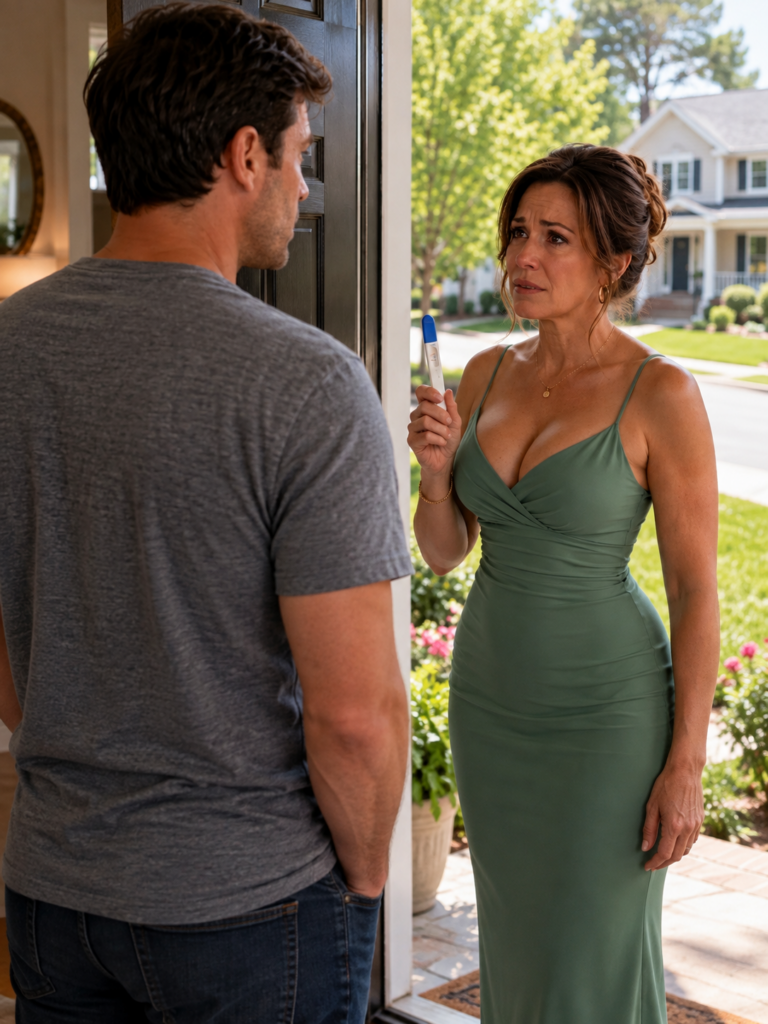
“I’m pregnant.”
For a second, the words meant nothing.
I heard them.
I understood each one individually.
Together, they refused to make sense.
The clock in the hallway ticked.
Rain touched the kitchen window.
I looked at Julia.
She did not look away.
The source of my shock was larger than surprise. It was the sudden awareness that there were parts of Julia’s life I still did not know, choices and truths that existed beyond the narrow frame through which I had been seeing her.
The revelation altered every assumption I had carried into that kitchen.
My first response came out rough.
“Are you telling me the truth?”
Julia nodded.
“Yes.”
I waited for the rest.
For the explanation that would make the impossible arrangement of facts settle into something I understood.
What followed changed the shape of the future I had been imagining.
There was no shouting.
No slammed chair.
No accusation.
Only the two of us sitting at the same wooden table where, during the storm, we had first stopped pretending our lives were simple.
I looked down at our hands.
Then I turned mine over and closed my fingers around hers.
Whatever complications stood outside that kitchen—Sarah, the town, the past, the consequences, the unanswered pieces of a future neither of us could completely predict—they were real.
But so was Julia.
So was the hand holding mine.
So was the fact that running had become the easiest choice, and for the first time in years I no longer wanted the easy choice.
Julia searched my face.
“You’re not leaving.”
It wasn’t quite a question.
“No.”
“You should think.”
“I am thinking.”
“Ryan.”
“I’m not saying none of this scares me.”
Her eyes lowered.
“It scares me too.”
“Good.”
She looked up, startled.
“Good?”
“It means we understand the size of it.”
I brushed my thumb once across her hand.
“What I’m not going to do is disappear just because the future got complicated.”
A tear slipped down her cheek.
Julia wiped it away impatiently.
“I hate crying.”
“You’re terrible at it.”
She laughed despite herself.
That sound broke whatever remained of the distance between us.
Not physically.
I still sat across the table.
But something inside me settled.
For months after my divorce, I had thought peace meant the absence of demands.
No arguments.
No expectations.
No one depending on me.
I had mistaken emptiness for safety.
This was different.
This room contained fear, consequence, uncertainty, history.
And somehow it felt more peaceful than my quiet apartment ever had.
Outside, the rain slowly weakened.
A thin strip of evening light appeared behind the clouds.
Julia lifted her coffee mug with one hand while keeping the other inside mine.
Neither of us made promises we couldn’t yet understand.
We simply stayed.
Forty-two days later, I walked onto the back porch carrying two mugs of coffee.
October had sharpened the air.
A thin layer of frost covered the grass, catching pale morning light.
The broken oak limb had been cleared weeks earlier, cut into manageable lengths and stacked near the edge of the property to dry for winter.
The restored bench sat beneath the porch window.
Deep walnut.
Smooth beneath years of scratches that neither of us had tried to erase.
Julia was already there.
She sat wrapped in a gray wool blanket with her feet tucked beneath her.
When she saw me, she shifted over without asking.
I sat beside her.
No careful distance.
No chair between us.
I handed her a mug.
She leaned against my shoulder.
That simple movement still surprised me sometimes.
Not because it felt strange.
Because it didn’t.
I put an arm around her and pulled the blanket higher against the cold.
She rested one hand on my knee.
For a while, we watched two blue jays hop along the fence.
The old house stood behind us.
It no longer seemed like a museum preserving somebody else’s decisions.
Julia had moved a few pieces of furniture.
She had turned the unused upstairs bedroom into a place to paint.
A box from an art supply store sat unopened beside the kitchen door because she insisted she needed better light before deciding where anything belonged.
I had stopped offering to install shelves until she actually asked.
That was growth.
The screen door banged shut behind us when the wind caught it.
Red leaves scattered across the porch.
Julia watched them tumble into the yard.
“Your repair is holding,” she said.
“The porch rail?”
“The bench.”
“That too.”
She shook her head.
“No.”
I looked down at her.
She was studying the house.
For a moment, I saw the woman I had known when I was married to her daughter—the composed mother who kept dinner warm, remembered everybody’s birthdays, and could host twelve people without appearing tired.
Then I saw the woman I knew now.
The painter.
The stubborn amateur furniture restorer.
The woman who drank coffee on cold mornings with both hands wrapped around the mug.
The woman who had finally stopped treating her own wants like inconveniences.
She leaned more heavily against me.
“It’s finally going to hold,” she said.
I knew she wasn’t talking about the bench.
Maybe she wasn’t talking about the house either.
I looked across the frost-covered yard at the stacked pieces of the fallen oak.
Something could break and still become useful.
Something could survive without returning to its original form.
A repaired thing did not have to pretend it had never been damaged.
I tightened my arm around her shoulders.
For most of my life, I had believed stability came from keeping everything exactly where it belonged.
The right people in the right roles.
The right promises made once and kept forever.
The right walls standing even after the people inside them had changed.
Julia had believed something similar.
Maybe that was why it took us so long to understand what was happening between us.
We had both confused permanence with love.
But sitting there beside her on the bench her father had built, I finally understood the difference.
Things lasted because people chose to keep caring for them.
Not because they never changed.
Julia lifted her head.
“What are you thinking about?”
I looked at the porch rail I had repaired that first afternoon.
“Wood.”
She stared at me.
“That is the least romantic answer you could possibly have given.”
“You asked.”
“I regret it.”
I smiled.
She settled against me again.
The morning remained quiet.
No declarations.
No grand promises.
Just frost, coffee, old wood, and the warmth of her beside me.
It was enough.
More than enough.
And every time I thought about her words afterward—It’s finally going to hold—I understood them a little differently.
I think I always will.


