
Part 1
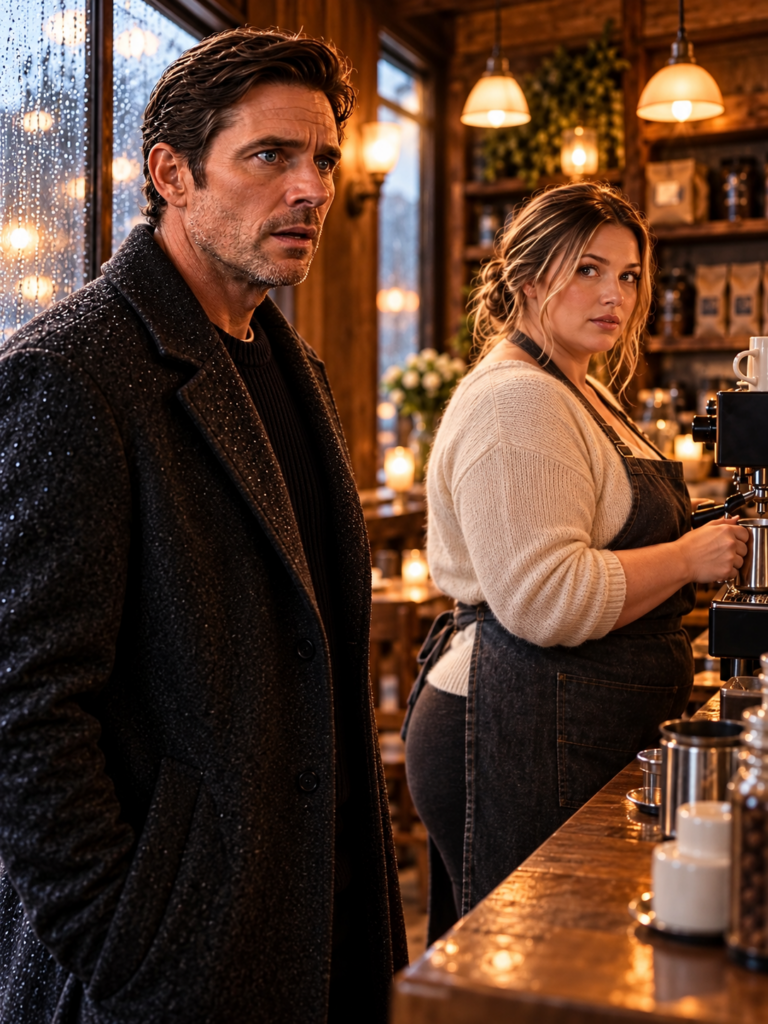
The coffee cup slipped from Hugh Marsden’s hand the instant he heard her voice.
“Here you go, Mr. Lund. Careful, it’s hot.”
An ordinary sentence.
Four words of warning to an old man waiting for waffles.
But the last syllable fell in that familiar way, softened as though the woman speaking always kept one final breath to herself.
The cup struck the hardwood floor of the Fog Bell Cafe and shattered.
Coffee splashed Hugh’s shoes and the leg of trousers that had cost more than his first pickup truck. Every head in the cafe turned. A young barista hurried around the counter with a towel.
Hugh did nothing.
At forty-two, he had become very good at not showing surprise. He ran a software company with three hundred employees. He had faced investors determined to dismantle his projections, competitors trying to bury him, journalists looking for weakness in every pause.
He knew how to keep his expression still.
But twelve years had not taught him how to hear Phoebe Colfax’s voice without becoming thirty again.
She came through the kitchen doorway carrying a plate of waffles.
Older, of course.
The dark brown hair he remembered fell into a neat knot at her neck now, threaded at the temples with a few silver strands. Fine lines rested beside her eyes. A charcoal apron covered a plain sweater, and tiredness sat in her posture with the familiarity of something that had been allowed to stay for years.
Then the elderly man at the window said something.
Phoebe tilted her head to the left as she listened.
Hugh forgot how to breathe.
Always to the left.
She heard the broken cup and turned.
For perhaps half a second, Phoebe stopped.
The plate in her hands remained suspended between one step and the next.
Then she finished crossing the room.
She set the waffles before Mr. Lund. Said something Hugh couldn’t hear. Walked back behind the counter.
She did not look at him again.
Instead, she picked up a glass and polished it.
Then another.
Both were already clean.
The barista crouched beside Hugh. “Sir? Are you okay?”
“Yes.”
He sounded unlike himself.
“I’m sorry.”
He reached automatically for his wallet.
Behind the black credit cards, he glimpsed a folded rectangle of yellowed paper.
His fingers stopped.
Twelve years.
Three wallets.
One unused bus ticket.
He pulled out a twenty instead and placed it on the counter.
“You don’t need to do that,” Phoebe said.
She still wasn’t looking at him.
“Cups break.”
Those were the first words she had spoken directly to Hugh Marsden in twelve years.
Cups break.
There were dozens of things he could have answered.
I’m sorry.
How are you?
I heard about Flora.
I should have come back.
Phoebe.
Instead he stood there with nothing.
Finally, he ordered another Americano.
Phoebe made it herself.
Hugh watched her weigh the grounds, level them, tamp them down. Her movements were efficient and practiced, every action fitted neatly into the next.
She did not look at him once.
It was such deliberate avoidance that Hugh understood looking at him would have been easier.
Then his gaze moved to the highest shelf behind her.
Between jars of beans stood a cobalt blue ceramic mug.
A small piece was missing from its handle.
It was not stacked with the cafe cups.
It stood alone.
Clean.
Kept.
Hugh stared at it until something inside him seemed to fold inward.
Phoebe placed his coffee on the counter with the handle turned toward him. Their fingers never came close to touching.
“To go,” she said.
He had ordered it that way.
Yet Hugh carried the cup to a table by the window and sat down.
For forty minutes, the man who could make decisions affecting hundreds of livelihoods watched Phoebe wipe tables, refill sugar jars and move through the warm little room while rain whispered against the windows.
He could not make himself say her name.
He had come to Eureka because his father was dead.
Eight months earlier, Truitt had called to tell him.
Hugh had sent money for the funeral expenses. Money for repairs to the old house on Hemlock Street. Money for property taxes and legal fees.
Money was the language Hugh had used with his family for twelve years whenever he did not know how to use anything else.
Truitt finally ended that arrangement.
“The house isn’t going to clean itself,” his older brother had said. “I need you here for two weeks.”
Their father’s house had been sold. Both brothers needed to sign the final papers, and the attic was filled with decades of things nobody could classify over the telephone.
So Hugh had left San Francisco before dawn.
The farther north he drove, the taller the redwoods became.
By the time he crossed into Humboldt County, rain had begun. Not a storm. Just the patient winter rain of the Northern California coast, falling steadily enough to make the world seem older.
Fog swallowed the streets of Eureka.
Hugh had intended to drive directly to Hemlock Street.
He stopped only because he needed coffee.
That was how twelve years of discipline ended.
Not with a deliberate return to Phoebe Colfax.
With an Americano.
When Hugh finally left the cafe, the brass fog bell mounted over the door sounded once behind him.
Deep.
Round.
Almost solemn.
He drove to Hemlock Street.
Truitt stood in the living room surrounded by boxes, holding a roll of packing tape. He was forty-five now, broad-shouldered, with the rough hands of a man who had spent two decades building boats.
He looked at Hugh’s stained trousers.
Then at Hugh’s face.
“You saw her.”
Hugh set his keys on the table.
“You knew she worked there.”
Truitt sealed a box.
“You never said anything.”
“You never asked.”
Hugh looked at him.
“Not once,” Truitt continued. “Twelve years. You asked about Dad’s knee. The roof. Taxes. The harbor. You asked me whether Wilson’s hardware store was still open. You never asked me about Phoebe.”
He stacked the box.
“I figured that was on purpose.”
Hugh sat on the third stair from the bottom. It still creaked beneath his weight exactly as it had when he was a teenager.
“Tell me.”
Truitt waited.
“Everything.”
So he did.
And as his brother spoke, Hugh remembered the first time he had seen Phoebe.
He had been thirty then, working days in the warehouse of a seafood company and nights on a computer he had built himself.
He owned an aging pickup, the computer, and an idea for supply-chain software that almost everyone in Eureka considered impractical.
His father’s preferred word had been idiot.
Phoebe never used it.
She was twenty-five, working mornings at Eugenia Colfax’s bakery and afternoons at a grocery-store register. The Colfaxes were not destitute, but every dollar had a purpose before it arrived.
Phoebe’s father had gone to sea when she was ten and simply never returned.
After that there had been Eugenia, Phoebe, and Flora, Phoebe’s younger sister, eight years behind her and born with enough nerve for all three women.
Hugh met Phoebe at a harbor flea market.
They reached into the same box for the same cobalt blue mug.
Its glaze was the color of the bay before bad weather. A chip was missing from the handle.
The seller wanted a dollar.
Hugh bargained him down to fifty cents, then looked at the young woman still holding the other side.
“Twenty-five cents each?”
Phoebe raised an eyebrow.
“I get Tuesday, Thursday, Saturday. You get Monday, Wednesday, Friday.”
“And Sunday?”
“Mug’s day off.”
She laughed.
Hugh fell in love with the sound before he understood what was happening.
They fell in love slowly after that because they had very little money with which to do anything faster.
Fries on the pier.
Long walks.
Overdone waffles Eugenia couldn’t sell.
Phoebe sitting curled in Hugh’s only chair while he explained software architecture until he realized she had stopped understanding him twenty minutes earlier.
“I understand enough,” she would say.
“What part?”
“The part where your eyebrows do that when you think you’ve solved something.”
Flora followed them everywhere.
At seventeen, she had braces, two ponytails and a business model built around extortion.
She photographed Hugh and Phoebe secretly along the pier, then demanded one dollar either for the photograph or for her silence.
Hugh always paid.
Once he handed her five dollars.
“Advance payment.”
Flora pocketed it and solemnly shook his hand.
“Pleasure doing long-term business with you.”
For years afterward, Hugh could remember that sentence and smile.
Then two letters arrived nine days apart.
One was for Hugh.
A San Francisco company wanted his software and wanted him with it.
The salary was not extraordinary, but there was equity and possibility and one strict requirement: he needed to be in San Francisco within three weeks.
The second letter was Eugenia Colfax’s biopsy result.
Advanced pancreatic cancer.
Months.
Not years.
Hugh had already asked Phoebe to marry him. There was no ring yet. Only an understanding spoken quietly one night on the pier.
His plan seemed obvious.
They would move together.
He would take the job. Phoebe would find bakery work. They would earn more money and bring Eugenia to San Francisco for treatment.
He bought two Greyhound tickets.
Seats 14A and 14B.
Seven o’clock Saturday morning.
But Phoebe knew her mother.
Eugenia refused to leave Eureka.
“I was born in the fog of this town,” she told her daughters. “I’ll lie down in the fog of this town.”
And Flora was seventeen with a year of school remaining.
Phoebe could not leave a dying mother and a younger sister behind.
On Friday night, she told Hugh she was staying.
Their argument was quiet.
That made it worse.
Hugh told her this opportunity would never come again. That staying in Eureka would not cure Eugenia. That money mattered now more than ever.
Phoebe told him some things could not be solved by earning more.
He was frightened.
Frightened of losing her.
Frightened of losing his chance.
Frightened that if he chose one, the other would disappear forever.
Fear made him cruel.
“You’re not staying because of your mother.”
Phoebe became very still.
“You’re staying because you’re scared,” Hugh said. “You’re scared to leave Eureka. You’re scared to try living anything bigger than that bakery, and you’re using your mother as an excuse.”
A foghorn sounded somewhere across the bay.
Phoebe put on her coat.
At the door she looked back at him.
No tears.
“Go.”
He said nothing.
“Take the seven o’clock bus.”
Her hand closed around the doorknob.
“And don’t ever come back.”
The next morning Hugh sat in seat 14A.
He watched the station entrance until the doors closed.
Seat 14B remained empty.
He kept the unused ticket.
For twelve years.
Now, sitting on the creaking stair in his father’s house, Hugh listened while Truitt told him what had happened after the bus disappeared into the fog.
Eugenia died six months later.
The bakery was sold to cover medical bills.
Phoebe worked wherever she could and helped Flora through high school.
Flora began nursing school but never finished.
She fell in love with a guitarist passing through with a touring band.
She had a son.
Levi.
The father vanished before Levi learned the word dad.
Then four years ago, on a Tuesday morning, Flora dropped Levi at school.
A logging truck lost its brakes on Broadway.
Truitt stopped speaking.
Hugh rose from the stair.
He walked through the front door and stood on the porch.
Fog drifted past the houses.
Flora.
In his mind she remained seventeen, braces flashing as she counted dollar bills on the pier.
Now Hugh had to force another fact into the memory.
Flora had been dead four years.
She had left behind a son.
Phoebe was raising him.
“She never married,” Truitt said from the doorway.
Hugh did not turn.
“Since apparently you weren’t going to ask.”
Truitt folded his arms.
“And unless you’ve got a secret wife in San Francisco, neither did you.”
“No.”
“Pair of idiots.”
Hugh almost laughed.
Almost.
Then Truitt’s voice changed.
“Hugh.”
He waited until Hugh looked at him.
“You’re here to finish this house. Once we sign it over, you’ll go back to San Francisco.”
Hugh said nothing.
“Don’t open a door you’re not willing to walk through.”
Truitt nodded toward town.
“People aren’t cafes. You don’t get to come in because you’re cold, warm yourself for two weeks, then leave.”
It was good advice.
Hugh understood that.
The next morning at 7:15, he opened the door of the Fog Bell Cafe.
The brass bell rang once.
Phoebe looked up.
Something crossed her face and vanished.
“Americano,” she said. “To go?”
Hugh removed his coat.
“Here.”
She looked at him.
“I’ll have it here.”
Part 2
Hugh returned the next morning.
Then the morning after that.
He did not apologize again because he had not properly apologized the first time, and he sensed that producing twelve years of regret beside the pastry case would only force Phoebe to manage his feelings while she was trying to work.
So he occupied the corner table.
He opened his laptop.
He drank his coffee.
He spoke when she spoke.
He did not demand that she remember them kindly.
For the first few days, they discussed only safe things.
Rain.
Road construction.
Fish prices.
Whether the Giants had any chance that season.
Phoebe remained courteous in the exact manner she was courteous to everyone else.
Yet Hugh began noticing the life she had built.
Mr. Lund came in each morning just before eight.
One day he stopped in front of the menu and stared at it with sudden confusion.
His hand tightened around his damp hat.
Phoebe did not ask what he wanted.
“Earl Grey,” she said gently. “More milk on the side. And I saved you an edge waffle.”
The old man relaxed.
Later Hugh learned Mr. Lund’s wife had died the year before. For forty years she had ordered for them both.
Phoebe remembered for him now.
That stayed with Hugh.
He had spent twelve years becoming someone people described as successful.
Phoebe, who worked long shifts in a cafe and went home to raise her dead sister’s child, possessed a kind of wealth he had never learned how to measure.
On Thursday afternoon, Levi walked in.
Nine years old.
Yellow raincoat too large for him.
Brown hair wet against his forehead.
He greeted the barista, dropped his backpack beside a small table and began taking out schoolbooks.
“Coat first,” Phoebe said.
Levi sighed with theatrical suffering.
“It’s barely wet.”
“You’re dripping on your fractions.”
“Maybe they deserve it.”
Phoebe pointed toward the back room.
Levi obeyed.
Hugh knew immediately who he was.
Not because Levi resembled Flora exactly.
He didn’t.
But the hazel-brown eyes were Colfax eyes, and when Levi returned and noticed Hugh watching him, the boy narrowed those eyes and tilted his head slightly left.
Hugh nearly smiled.
Levi did not.
Instead he studied Hugh with uncomfortable seriousness.
Hugh saw him again the next day.
And the next.
Every time, Levi stared.
Finally Hugh smiled first.
Levi only stared harder.
On Saturday, Phoebe left briefly to deliver baked goods to a church.
Levi waited until the door closed behind her.
Then he crossed the cafe carrying a photograph.
He placed it beside Hugh’s laptop.
Hugh stopped typing.
The print was faded and curled at the corners.
A wooden pier.
Late-afternoon light.
Phoebe sat on a mooring post laughing.
A younger Hugh stood beside her, one hand raised too late to block the camera.
At the edge of the frame was half a teenage face, braces visible, tongue stuck out.
Flora.
“My mom took that.”
Hugh touched the edge of the photograph.
Levi watched him.
“There are thirteen pictures of you in her box. I counted.”
Hugh could not answer.
“She wrote stuff on the backs.”
Levi turned the picture over.
In handwriting Hugh recognized immediately were five words.
Hugh owes me a dollar.
Levi looked up.
“Are you Hugh?”
Hugh’s throat tightened.
“The Hugh who owes my mom a dollar?”
For a moment he was thirty again, reaching into an almost empty wallet while Flora waited with one hand extended.
Hugh opened the wallet he carried now.
He took out a dollar bill, smoothed it flat and pushed it toward Levi.
“I’m Hugh.”
His voice broke.
“And I’m twelve years late paying her.”
Levi considered the money.
“You probably owe interest.”
“I was afraid of that.”
“How much?”
“You’re the businessman.”
Levi pulled over scrap paper.
By the time the brass bell rang again, they were attempting compound interest at an annual rate that would have horrified any legitimate financial regulator.
Phoebe walked in carrying an empty bakery box.
She saw Levi sitting across from Hugh.
The photograph.
The dollar.
Her face changed.
“Levi.”
The boy looked up.
“When did you take your mother’s photo box out of the house?”
Levi’s shoulders rose toward his ears.
“I was careful.”
“That wasn’t my question.”
Hugh stood.
“It’s my fault.”
Phoebe picked up the photograph.
For several seconds she looked at it.
Something passed over her face so quietly Hugh felt almost ashamed to witness it.
Then she placed the photograph facedown.
“Levi. Go change out of that wet coat.”
“I already—”
“Now.”
The boy disappeared.
Phoebe looked at Hugh.
“We’re closing early today.”
He understood.
He left.
But he returned the next morning.
Not to insist.
Simply to remain.
That became the beginning of something neither of them named.
Hugh spent his days helping Truitt empty the house.
In the mornings and sometimes evenings, he came to the Fog Bell.
He learned that Dulcie Renfrew, the seventy-one-year-old owner, ran inventory through memory and scraps of paper pinned behind the counter.
Dulcie’s late husband had been a sailor.
The brass bell above the door had belonged to his ship.
Hugh also noticed spoiled milk.
Duplicate deliveries.
Paper cups ordered too late.
Phoebe staying after closing with a calculator.
One Tuesday evening, Levi was half asleep over a comic book while Phoebe worked through receipts.
Hugh turned his laptop toward her.
“I made something.”
Phoebe’s expression immediately cooled.
“Hugh—”
“It’s not money.”
“I don’t need—”
“It isn’t for you.”
She stopped.
“It’s for Dulcie.”
On the screen was a simple inventory system.
Nothing resembling the sophisticated software Hugh’s company sold. Three clear columns. Suppliers. Order dates. Quantities. Automatic reminders.
He pointed to a figure.
“You’re losing about three hundred eighty dollars a month through spoiled stock and duplicate ordering.”
Phoebe stared at him.
“I’ve seen you stay late every night fixing numbers that shouldn’t be wrong in the first place.”
She looked back at the spreadsheet.
“I don’t want your charity.”
“I know.”
That answer made her glance up.
Hugh leaned back.
“Call it rent for the table. Coworking space in San Francisco costs a fortune.”
Phoebe studied him for a long time.
Then she pointed at the screen.
“This is wrong.”
Hugh looked.
“Flower delivery is Friday.”
He corrected it.
Not flowers.
Not a speech.
Not forgiveness.
That was how they began again.
Two people leaning over a spreadsheet after closing.
After that, the cafe developed a rhythm around them.
Phoebe made two final coffees before cleaning the machine.
Levi did homework nearby.
Hugh updated suppliers and taught Dulcie enough of the system that she stopped threatening to throw his laptop into Humboldt Bay.
Conversation arrived in small pieces.
Phoebe learned Hugh still disliked raisins.
Hugh discovered Phoebe had become incapable of drinking coffee while it was hot because someone always needed her before she reached the cup.
He began sliding her mug back toward the machine when it cooled.
She began making his Americano without asking.
Neither mentioned the blue mug on the highest shelf.
Levi started calling him Uncle Hugh as a joke.
The first time, Phoebe’s eyes lifted sharply.
Hugh glanced at her, prepared to correct the boy.
Phoebe returned to wiping the counter.
She did not object.
Hugh had something else to give Levi.
Stories.
He was one of the last people alive who remembered Flora before adulthood, before motherhood, before tragedy converted her into photographs and secondhand recollections.
So he told Levi about the dollar photography business.
The caramel that once stuck in Flora’s braces so badly she could not open her mouth.
“How’d she talk?”
“She insulted me entirely with her eyes.”
Levi laughed.
“Was she good at it?”
“Terrifying.”
He told him about the handshake.
Pleasure doing long-term business with you.
Levi demanded Hugh imitate Flora’s serious expression.
Hugh did.
Levi laughed so hard he nearly fell from his chair.
Behind the counter, Phoebe turned away.
Hugh stopped.
Her hands remained on the towel.
Her shoulders rose once.
Then settled.
He understood.
Sometimes grief did not object to happiness.
Sometimes it was happiness that found the tenderest place.
One evening Levi leaned toward Hugh confidentially.
“I hid my spelling test under the back seat.”
“What grade?”
Levi whispered it.
Hugh opened his wallet and placed a dollar on the table.
Levi stared.
“Payment for silence. Your mother established market rates.”
“That was twelve years ago.”
“Inflation?”
“Definitely.”
Behind them Phoebe laughed.
Not politely.
Not carefully.
The real sound.
Hugh looked over.
Phoebe caught him looking.
Her smile disappeared, but not immediately.
For one second they were back at the flea market with twenty-five cents each and a ridiculous custody arrangement for a chipped mug.
That night, after Hugh left, Phoebe reached to the highest shelf.
She took down the cobalt cup.
She ran a clean towel around the rim.
Then she put it back.
Not yet.
Three weeks after Hugh arrived in Eureka, Truitt called.
“The buyers want the house early. Papers are ready Wednesday.”
Hugh stood alone in the nearly empty living room.
“Wednesday?”
“You sign, I sign, we give them the keys.”
Five days.
Hugh looked around the house.
For weeks he had been thinking in mornings.
Tomorrow’s coffee.
Tomorrow’s conversation.
Tomorrow’s chance to hear Levi complain about spelling.
Now time returned in a form he recognized.
A deadline.
That night, Hugh reached the Fog Bell late.
Levi was sleeping at a neighbor’s house.
Dulcie had gone home.
Phoebe was cleaning the counter.
Hugh should have left the past alone until he knew how to speak about it carefully.
Instead the approaching Wednesday made him clumsy.
“Phoebe.”
She stopped wiping.
“There’s something I never told you.”
The caution in her face should have warned him.
“About your mother’s funeral.”
Phoebe became completely still.
Hugh forced himself to continue.
“I heard ten days late.”
Her hand remained around the cloth.
“Someone from Eureka mentioned it. I drove through the night.”
Phoebe looked at him.
“I came to your house.”
Nothing moved except the rain on the windows.
“The night after the funeral,” Hugh said. “There were cars outside. The lights were on.”
Phoebe’s fingers tightened.
“I saw you through the front window. You were wearing black. Flora was beside you.”
The glass washer stopped.
The silence left behind seemed enormous.
“I stood outside for forty minutes.”
Phoebe whispered, “Outside?”
“I didn’t know what right I had to come in.”
Her expression changed.
Hugh kept speaking because he had spent twelve years believing the explanation would matter.
“The last thing I had said to you was that you were using your dying mother as an excuse. Then she died while I was in San Francisco building the life I told you mattered so much.”
His voice roughened.
“I thought walking through that door would make the night worse. I thought staying outside was the last decent thing I could do for you.”
Phoebe set the cloth down.
Carefully.
“You stood outside my house.”
Hugh finally heard what he had missed in his own story.
“Yes.”
“The night after my mother’s funeral.”
“Yes.”
She stared at him.
“Do you know what I did that night?”
Hugh said nothing.
“I sat in that living room while neighbors told me how sorry they were. People brought casseroles. Flowers. They told me she was in a better place.”
Phoebe swallowed.
“And every ten minutes, I looked at the front door.”
Hugh went cold.
“Flora asked me who I was waiting for.”
Phoebe’s eyes shone.
“I told her nobody.”
Her voice trembled.
“I was waiting for you, Hugh.”
He could not move.
“The whole town knew she died. I kept thinking somebody would tell you.”
Phoebe wiped angrily at one cheek.
“And I made myself a promise. I said if Hugh comes—if he only stands in the doorway—then the thing he said that night doesn’t matter anymore.”
Hugh stared at her.
“I gave you that door.”
“Phoebe—”
“I gave you the entire night.”
She took a breath that seemed to hurt.
“And you were there.”
Hugh closed his eyes.
“You were sixteen feet away.”
When he looked again, tears were running down her face.
“Twelve years,” she said. “We didn’t lose twelve years because you took that bus.”
Her voice broke.
“We lost them in sixteen feet.”
Hugh looked toward the cafe door.
He could see it now.
The wet sidewalk.
The Colfax house.
His thirty-year-old self standing in the dark telling himself that cowardice was kindness.
Phoebe shook her head.
“You can almost forgive someone for never coming back. But someone who comes back and still doesn’t knock?”
She looked directly at him.
“What was I supposed to think that meant?”
Hugh could not answer.
“That I was worth driving three hundred miles for, but not worth sixteen feet?”
“Phoebe.”
“Go home.”
She turned away.
“Hugh, please.”
He obeyed.
At the door he stopped.
Then he opened his wallet.
Behind the credit cards was the folded ticket.
He removed it.
Placed it on the counter.
Phoebe did not turn.
“I never got a refund.”
Her shoulders stiffened.
“Seat 14B. Seven o’clock bus.”
Slowly, Phoebe looked back.
“It’s been in my wallet for twelve years,” Hugh said. “Three wallets.”
He almost smiled, but there was nothing funny left.
“I’ve never unfolded it. I couldn’t look at the date.”
Phoebe stared at the paper.
“You’re right,” Hugh said.
He had finally reached the sentence no explanation could replace.
“I was a coward.”
Her face crumpled slightly.
“I stood sixteen feet from the person I loved most in the world and convinced myself leaving was kindness.”
He pushed the ticket gently toward her.
“But before I go, I need you to know something.”
Phoebe looked at him.
“For twelve years, there hasn’t been a single morning when I opened my wallet and didn’t see you.”
Hugh left.
The fog bell sounded once behind him.
Phoebe stood alone beneath the cafe’s warm lights.
After a long time, she unfolded the ticket.
Greyhound Lines.
Eureka to San Francisco.
Seat 14B.
The date she remembered better than almost any other.
Near one corner was a faded round stain.
For twelve years, Phoebe could have called it rain.
That night, for the first time, she allowed herself another possibility.
Part 3
Hugh did not return the next morning.
Or the morning after that.
He finished emptying the house with Truitt.
Boxes went to charity shops.
Tools went to Truitt.
Their father’s old invoices went into recycling.
Hugh found photographs of himself and his brother as boys, both of them squinting against sunlight, their father’s hand resting on their shoulders.
He kept three.
Everything else had to become someone else’s problem or someone else’s possession.
On Tuesday evening, the house stood almost empty.
Hugh and Truitt sat on the open tailgate of Truitt’s truck.
Fog moved between the houses.
Neither brother had spoken much all afternoon.
Then Truitt said, “Dad got offered a job on a ship once.”
Hugh looked at him.
“When?”
“Twenty-five.”
Hugh had never heard the story.
“Ocean-going vessel. Good money. Chance to see half the world.”
“What happened?”
“He got accepted.”
Truitt rubbed his hands together.
“Never went.”
“Why?”
“Scared.”
Hugh looked at the empty house.
“When Dad was dying, there was one afternoon when he got completely clear. You remember how rare that was near the end.”
Hugh nodded.
“He didn’t talk about Mom. Didn’t talk about the house. Didn’t talk about me.”
Truitt paused.
“He talked about that ship.”
Hugh turned toward him.
“He remembered the ship’s number.”
Fog thickened beneath the streetlamps.
“Fifty years later,” Truitt said. “He remembered the number.”
He looked at Hugh.
“I don’t know what you and Phoebe are supposed to be. That part’s none of my business.”
Hugh gave him a look.
Truitt shrugged.
“Mostly none of my business.”
Then his face became serious.
“But fifty years from now, what do you want to know by heart?”
Hugh said nothing.
“Seat 14B?”
Truitt stood.
“Or something else?”
Across town, Phoebe carried Hugh’s ticket in her apron pocket.
She told herself she had put it there only because leaving it at home felt unsafe and throwing it away felt impossible.
Dulcie watched her make the same customer’s drink twice.
“You planning to caffeinate him to death?”
Phoebe stared at the extra coffee.
Dulcie sighed.
“Sit down.”
“I have work.”
“You’re currently making work.”
Phoebe sat.
Dulcie poured tea.
For a while, the older woman said nothing.
Then she pointed toward the brass bell above the door.
“That was my husband’s.”
“I know.”
“Fog bell.”
Phoebe wrapped both hands around the tea.
“You know what those do?”
“Make noise?”
Dulcie gave her a patient look.
“A fog bell doesn’t make the fog go away.”
Phoebe’s thumb pressed against the ticket inside her apron.
“Nobody gets to make fog disappear. Bell just tells the other ship, I’m here.”
Dulcie drank her tea.
“Twelve years, you two managed not to run into each other. One patch of ocean each.”
Phoebe looked toward the windows.
“Perfectly safe,” Dulcie said.
Then, more quietly, “Safe and blind.”
That evening Phoebe went home and waited until Levi was asleep.
Then she opened Flora’s photograph box.
Thirteen photographs.
Hugh leaning against a pier rail.
Hugh carrying paper-wrapped fries.
Phoebe laughing at something beyond the frame.
Hugh reaching for the camera while Flora ran.
She found the picture Levi had shown him.
Hugh owes me a dollar.
Phoebe smiled through tears.
Then she found another.
The photograph was badly blurred. Two figures sat close together on a mooring post, their backs to the camera. Sunlight had smeared itself across the film.
Phoebe turned it over.
Flora’s seventeen-year-old handwriting covered the back.
When I grow up, I want someone to look at me the way Hugh looks at Phoebe.
Beneath it:
If those two ever break up, I’m tearing up every picture.
Phoebe sat at the kitchen table.
Flora had never torn them up.
She had kept all thirteen.
For Levi.
For herself.
Perhaps for no reason she had understood at seventeen.
Phoebe touched the handwriting.
She cried then.
Not simply for Hugh.
Not only for Eugenia.
She cried for Flora, who would never grow older than the age she had reached.
For the twenty-five-year-old version of herself who had stood in Hugh’s apartment and said words she meant desperately for one night.
Don’t ever come back.
She had never imagined he might spend twelve years honoring them.
And she cried for those sixteen feet.
Because anger was easier when she believed Hugh had stayed in San Francisco.
Knowing he had stood outside changed the shape of everything.
It did not erase the hurt.
It made it sadder.
Two people had wanted the same door opened.
Neither had moved.
Wednesday morning, Hugh and Truitt signed the final papers at nine.
At ten, Hugh loaded his luggage into the car.
He stood for a moment beside the empty house on Hemlock Street.
Then he drove toward Highway 101.
The route did not actually require passing through Old Town.
The detour took six minutes.
Hugh took it anyway.
One coffee.
A goodbye.
That was all.
He rehearsed three sentences while parking.
Take care of yourself.
Tell Levi I’ll send those pictures when I find them.
I’m glad I saw you.
All respectable.
All useless.
Hugh opened the cafe door.
The fog bell rang.
Mr. Lund sat beside the window with Earl Grey.
Steam clouded the glass.
Levi sat at the counter swinging his legs, apparently late for school and unconcerned by it.
Phoebe stood behind the espresso machine.
She looked up.
Her eyes moved to Hugh’s coat.
Then the car keys in his hand.
She understood.
“Americano?”
Hugh nodded.
“To go?”
Every prepared sentence disappeared.
“To go.”
Phoebe did not move toward the paper cups.
Instead she turned.
Rose onto her toes.
Reached for the highest shelf.
Hugh stopped breathing.
She took down the cobalt blue mug.
The chipped one.
Their fifty-cent mug.
She rinsed it beneath hot water.
Once.
Twice.
Dried the outside carefully.
Then she made his Americano and poured it into the blue ceramic cup.
She placed it on the counter.
Turned the chipped handle toward him.
“Not to go.”
Hugh stared at her.
Phoebe’s fingers remained against the mug.
“For here.”
The glaze was still the deep cobalt color of Humboldt Bay before a storm.
The chip had not changed.
Hugh touched the handle.
His thumb settled naturally into the missing place.
Twelve years disappeared and remained all at once.
“What day is it?” he asked.
Phoebe’s eyes filled.
“Wednesday.”
Hugh almost laughed.
“Your day.”
The corner of her mouth lifted.
“My day.”
She reached into her apron pocket.
“But I’ll let you borrow it.”
She took out the bus ticket and placed it beside the mug.
Hugh looked at it unfolded for the first time in twelve years.
Seat 14B.
Phoebe smoothed the old paper.
“I’m not giving this back so you can carry it another twelve years.”
Hugh looked at her.
“And I’m not tearing it up.”
Her voice wavered.
“We’ve already torn up enough things.”
She took a slow breath.
“Twelve years ago, I told you never to come back.”
Hugh waited.
“You are apparently the only man on earth who has ever obeyed me perfectly.”
A small laugh escaped her and became something dangerously close to a sob.
Hugh’s eyes burned.
“Look where that got us,” she whispered.
She wiped her cheek.
“So I’m taking it back.”
His hand tightened around the mug.
Phoebe met his eyes.
“Listen carefully this time.”
“I am.”
“Come back.”
Hugh did not move.
Phoebe swallowed.
“Just keep coming back.”
The cafe seemed to narrow around those words.
“Saturday. Tuesday. Whatever days you can.”
Her mouth trembled.
“San Francisco is five hours away. I know that.”
Hugh nodded.
She glanced toward Levi.
“And you owe that kid a hundred twenty-nine dollars.”
Levi immediately looked up.
“One hundred twenty-nine dollars and change.”
Phoebe corrected herself solemnly.
“And change.”
Hugh smiled.
“You can pay him in stories about his mother.”
Phoebe’s voice softened.
“By my calculations, that should take a few years.”
“A few?”
Hugh lifted the blue mug.
The old chip fitted beneath his thumb like no time had passed at all.
“I think it’ll take longer.”
Phoebe looked at him.
“Compound interest.”
Levi spun around on his stool.
“I’m raising the price of secrets to two dollars.”
Neither adult answered.
“Just letting you know,” he said. “Not negotiable.”
Phoebe laughed.
Hugh laughed with her.
There was no proposal that morning.
No dramatic kiss beside the espresso machine.
No promise that the lost twelve years could somehow be returned.
They could not.
Eugenia was still gone.
Flora would never hear Hugh tell her son about the caramel in her braces.
Hugh’s father would never know whether his younger son finally learned from the regrets of an old man who could remember a ship’s number half a century later.
Some things were gone.
Love at forty-two did not require pretending otherwise.
Hugh still drove back to San Francisco that afternoon.
He had a company there.
Three hundred people depended on decisions he made.
Phoebe had Levi, the cafe, Dulcie and a life in Eureka that was not waiting to be abandoned simply because Hugh had returned.
So they did not destroy one life to prove the importance of another.
They built a bridge between them.
Hugh learned which Friday meetings could become video calls.
Phoebe learned not to assume a delayed arrival meant he had changed his mind.
Levi developed increasingly creative interest calculations.
Some weekends Hugh drove north.
Sometimes Phoebe and Levi came south.
Some Fridays traffic added two hours.
Some Sundays saying goodbye was harder than either expected.
Once, after Hugh arrived exhausted near closing, Phoebe set the chipped blue mug in front of him without speaking.
He wrapped both hands around it.
“You know it isn’t your day.”
“It’s Saturday.”
“My days were Monday, Wednesday and Friday.”
“You kept it for twelve years. Possession changes the terms.”
“That is not legally binding.”
“Take me to court.”
He smiled.
Phoebe leaned one hip against the counter.
For a moment neither spoke.
Those quiet moments became the most important ones.
Not because nothing remained to say.
Because silence no longer meant leaving.
Months later, Hugh finally asked the question that had been living between them since his return.
“Why did you keep the mug?”
Phoebe looked at it.
She took enough time that Hugh thought she might not answer.
“Because throwing it away felt like admitting I had never loved you.”
Hugh said nothing.
“And using it felt like admitting I still did.”
Her gaze lifted.
“So I put it where I could see it.”
Hugh touched the chip.
“Twelve years.”
“Twelve years.”
“I’m sorry.”
“I know.”
It was not absolution.
It was something more useful.
Truth without punishment.
They learned that forgiveness was not a single generous act. It was a series of smaller decisions.
To answer the phone.
To explain instead of assume.
To knock.
To open.
To come back after the difficult conversation instead of allowing shame to turn distance permanent.
The following Saturday morning, fog from Humboldt Bay covered Old Town.
A car with San Francisco plates pulled in front of the Fog Bell Cafe.
Inside, Dulcie was arguing with the new inventory tablet.
Mr. Lund sat at his usual table.
Levi was attempting to convince someone that his mother’s old blackmail business constituted a legitimate family enterprise.
Phoebe heard the door open.
The brass fog bell rang once.
Deep.
Warm.
Resonant.
A bell could not clear fog.
It could not undo weather.
It could not restore years or erase bad words or shorten the distance already traveled.
It could only tell another person where you were.
I’m here.
Phoebe did not look toward the door immediately.
She simply reached to the shelf for the chipped blue mug.
And Hugh, standing beneath the bell with rain on his shoulders, knew the most important distance he would ever travel had never been the two hundred eighty miles between San Francisco and Eureka.
It had been sixteen feet.
This time, he crossed every one of them.

