
Part 1
At seventy-six, Harlon Wescott had grown accustomed to loss arriving quietly.
His wife, Lenora, had been gone seven years. The first year without her had been full of obvious absences—the empty side of the bed, the untouched chair beside the window, the silence at dinner. Later, grief became more subtle. It lived in the second coffee cup he still sometimes reached for without thinking. In the coat that remained at the far end of the closet. In the jokes he formed in his head before remembering that the person who would have laughed hardest was no longer there.
Then, three months before the October storm, Harlon lost something he had never expected to lose.
Trust.
For forty-one years, he had run a small repair shop outside a quiet Washington town, fixing machinery other people had already given up on. Farmers brought him generators that refused to turn over. Loggers hauled in battered engines and hydraulic pumps. Neighbors appeared with lawn equipment, chainsaws, water pumps, and the occasional piece of machinery so old that no manual existed for it anymore.
Harlon rarely hurried.
He listened.
He inspected.
He asked what the machine had been doing before it stopped.
Lenora used to say patience was his real talent.
“You don’t give up on broken things, Harlon.”
He had believed that about machines.
He had believed it about people, too.
That was why he had hired Corbin Shaw fourteen years earlier.
Corbin had been young then, with overdue bills, a newborn daughter, and more determination than experience. Harlon taught him how to diagnose an engine instead of replacing parts at random. He loaned him tools. Let him take extra hours. Invited him to Christmas dinner when Corbin’s own family situation fell apart.
Over time, Harlon stopped thinking of him as an employee.
Then he stopped thinking of him merely as a partner.
At Lenora’s funeral, Corbin had stood beside him after most of the mourners had gone home. He had put a hand on Harlon’s shoulder.
“You’re family to me.”
Harlon had believed him.
Years later, while reviewing accounts that should have been routine, Harlon found withdrawals he did not recognize.
Then came documents carrying his signature.
Except he had never signed them.
Then the retirement accounts.
Accounts that should have contained decades of careful saving.
Most of the money was gone.
The lawyers called it fraud. Family members called it devastating. Friends called Corbin things Harlon did not repeat.
But none of those words explained what betrayal actually did.
The missing money was measurable.
The rest of the damage wasn’t.
Afterward, people began speaking differently around Harlon.
Friends suggested selling the shop.
Relatives told him not to spend his remaining years fighting.
One Sunday, when Harlon reached for the check at a restaurant, his nephew gently slid it away.
“I’ve got it, Uncle Harlon.”
There had been kindness in his voice.
That was what hurt.
Before Corbin, nobody had wondered aloud whether Harlon could manage his own affairs. Nobody watched him quite so closely. Nobody treated a forgotten name or misplaced tool as evidence of decline.
Soon Harlon began doing it to himself.
He double-checked decisions he would once have made without hesitation. He reread numbers. He hesitated before signing things.
Maybe Corbin had fooled him because he was getting old.
Maybe his family’s concern was justified.
Maybe the man Lenora had trusted to keep things running had finally become the broken thing in the room.
Then, one cold evening in October, Harlon found an old map.
It had been folded into the back of a drawer beneath several travel brochures Lenora had saved. On it, an old frontier wagon route disappeared into miles of Pacific Northwest forest.
Years earlier, he and Lenora had talked about hiking part of it.
They never did.
Harlon sat at the kitchen table, looking at the faded route beneath the yellow light.
There was nothing remarkable marked along it. No cabins. No historical stations. No shelters.
Just an old corridor through the mountains where wagons had once traveled west.
Three mornings later, before sunrise, Harlon packed food, rain gear, fire starters, a flashlight, his compass, the old map, and the folding knife Lenora had given him years before.
He stood for a moment in the kitchen.
Her coffee mug was still on the shelf.
He touched the knife in his pocket.
Then he switched off the light.
He was not trying to become young again.
He did not need to climb some impossible mountain or prove that seventy-six was the new forty-six.
He only needed to spend one day somewhere nobody knew about Corbin Shaw.
Somewhere nobody watched him carefully.
Somewhere every decision belonged to him.
By noon, the forest had swallowed almost every sound except his footsteps.
The trail climbed gently through old-growth timber. Massive firs crowded the slopes, their trunks darkened by moisture. In places, Harlon could still make out shallow wagon ruts beneath the moss.
He noticed things many hikers would have missed.
A bent square nail half buried in the dirt.
An old scar in a tree.
A depression where wheels had once followed the same line year after year.
He stopped several times simply to study them.
Those traces comforted him.
Other people had come through here carrying troubles of their own. Families, wagons, tools, children, livestock, hopes. Whatever they had feared or lost, the forest had outlived all of it.
Sometime after three, the light changed.
Harlon stopped walking.
The sky above the treetops had turned the color of dirty steel.
The forecast had mentioned cold weather and possible rain, but nothing serious.
Still, forecasts did not matter as much as the evidence directly overhead.
He tightened his jacket.
Ten minutes later, the rain began.
Twenty minutes after that, the trail started disappearing.
Wind moved through the upper branches with a growing roar. Rain struck the canopy, gathered, then fell in heavy bursts. Pine needles and fallen leaves turned slick beneath his boots.
Harlon checked his compass.
Then the map.
Then the compass again.
Ahead, the old route divided around a mass of fallen timber.
Neither branch looked right.
He stood there longer than he should have.
Once, he would have examined the ground and trusted what he saw.
Now another voice entered the decision.
Maybe you missed something.
Maybe your memory isn’t what it used to be.
Maybe everybody else can see it except you.
Harlon hated that Corbin had left that voice behind.
“No,” he said aloud.
Rain rattled through the branches.
He chose the lower branch and marked a tree before continuing.
Half an hour later, he knew he had chosen wrong.
The wagon ruts were gone.
So were recognizable trail markers.
There were only trees.
Turning back should have been simple, but the storm was erasing his path almost as quickly as he made it. Water filled depressions. Wind shifted directions. Dead branches fell hard enough to make him flinch.
He checked his watch.
Less than two hours of usable daylight remained.
That was when irritation became fear.
Harlon had food.
He had fire starters.
He had spent much of his life outdoors.
But experience did not make a person invincible.
At seventy-six, being cold and wet overnight was not a discomfort.
It could be fatal.
He decided to climb, hoping higher ground might offer a recognizable landmark.
The slope became steeper.
His breathing deepened.
Then his right boot slid across a buried root.
Harlon went down hard.
His knee struck the ground.
Pain shot through his leg so sharply that for several seconds he did not move.
Rain ran from his hair and down his face.
What frightened him was not the pain.
It was the possibility that when he tried to stand, his leg would refuse.
He stayed there, one palm pressed into the mud.
Finally, he grabbed a tree trunk and pulled himself upright.
His knee trembled.
But it held.
“Not finished yet,” he muttered.
He was not sure whether he meant the hike, the storm, Corbin Shaw, or himself.
Thunder rolled beyond the ridge.
Close.
Harlon moved.
The rain thickened until the trees ahead became gray shapes. Daylight seemed to drain from the forest by the minute.
He stopped looking for the trail.
Now he looked for shelter.
A rock overhang.
A hollow.
Anything that could keep the rain off him long enough to make it through the night.
Then lightning flashed.
For less than a second, the woods turned white.
Harlon saw a straight line.
He stopped.
Nature made curves, breaks, chaotic shapes.
That had been an angle.
He pushed through wet brush.
Another flash.
Wood.
Something large.
He moved closer.
Then he saw the wheels.
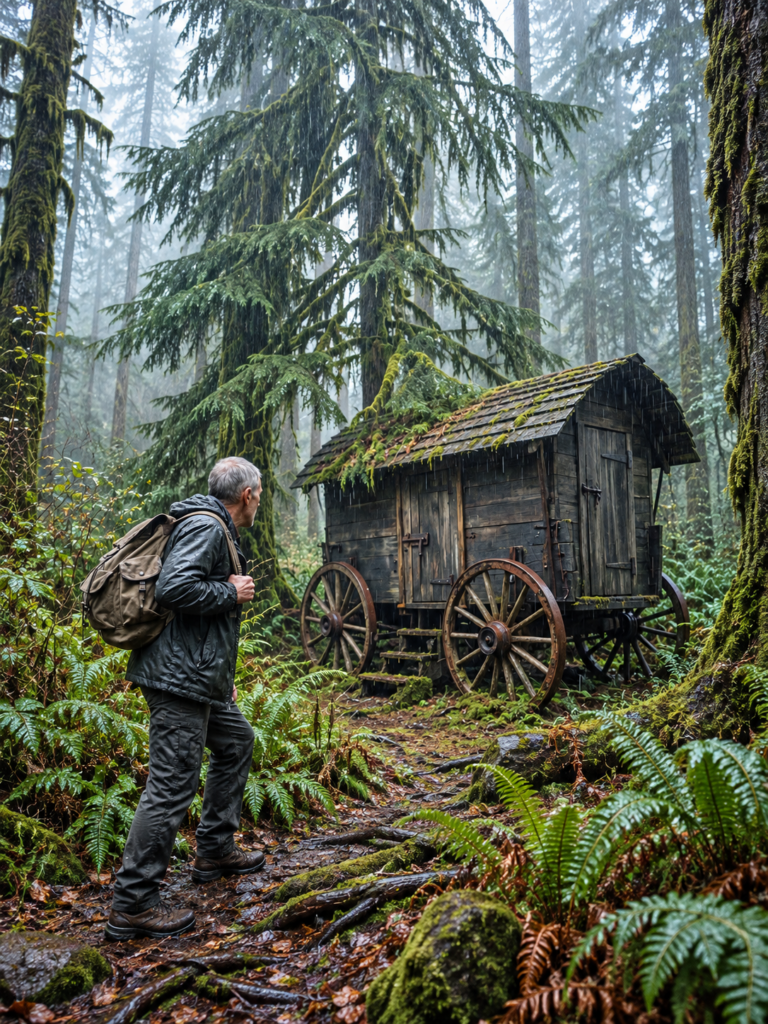
Two enormous wooden wagon wheels rose from the forest floor, half buried beneath roots and moss. Iron rims, red with age, vanished into the earth.
Above them stood the remains of a long wagon frame—but someone had enclosed it with timber walls. A roof stretched above it. Reinforcement beams disappeared beneath layers of moss.
Harlon stared.
It was a wagon.
Or it had been once.
Someone had turned it into a house.
He pulled out his map with stiff fingers.
Nothing.
No structure.
No historical marker.
No shelter.
According to the map, this place did not exist.
A branch snapped somewhere behind him with a crack like a rifle shot.
Harlon put the map away.
Whatever the building was, he needed it.
The door was still closed.
That surprised him almost as much as the structure itself.
The iron latch had rusted dark, but it remained in place.
Harlon put his hand on it.
For one strange moment he hesitated.
For months, it had seemed as though doors were quietly closing all around him—the business he might have to sell, the money he might never recover, the future people had started discussing as if he were no longer qualified to decide it.
Now, lost in a storm, he stood in front of a door that had been closed for more than a century.
He lifted the latch.
The door opened.
Inside, the air was dry.
Harlon stopped on the threshold.
That should not have been possible.
A neglected wooden structure in a Washington forest should have smelled of rot, wet leaves, animals, and collapse.
This one smelled old.
But not ruined.
He stepped inside and shut the door.
The storm became a distant pounding overhead.
He switched on his flashlight.
A narrow bench ran along one wall with drawers fitted beneath it. A small table folded flat against the opposite side. Hooks had been driven into the timber at careful intervals. At the far end stood a sleeping platform.
Nothing was decorative.
Nothing was accidental.
Then his light reached the stove.
It stood near the center of the wagon house, compact and black with age, with an iron flue rising toward the roof.
Harlon forgot the storm for a moment.
Machines had always made more sense to him than people.
He crouched beside the stove.
The installation was remarkably careful. The wood around it had been shielded from heat. The floor had been reinforced. The pipe had been positioned with obvious attention to airflow.
“Someone knew what he was doing,” Harlon whispered.
Thunder shook the walls.
His hands had begun trembling.
He needed heat.
Harlon opened the stove.
Ancient ash lay inside, gray and completely dry.
He arranged emergency tinder, struck a flame, and watched it catch.
For several seconds, everything worked.
Then smoke rolled into the room.
Harlon coughed.
More smoke followed.
“Damn it.”
He opened the door to clear the air.
Freezing rain blew across the floor.
He extinguished the fire.
For the first time since finding the wagon, genuine panic moved through him.
Without heat, he might survive.
Probably.
Harlon no longer liked the word probably.
He stared at the stove.
A machine was a machine.
If it had worked once, there was a reason it was not working now.
He lifted the flashlight.
Beside the flue were faint marks in the timber.
He leaned closer.
Words.
Carved by hand.
He wiped soot away with his sleeve.
Instructions.
A strong west wind reduced the draft.
Open the lower floor intake before lighting.
And beneath that:
Wait for the pull. Don’t force her.
Harlon stared at the message.
Someone had faced this exact problem.
Perhaps a century earlier, a stranger had stood where Harlon stood now with smoke filling the room and had taken the trouble to leave instructions for whoever might come after him.
Harlon found the intake low against the wall.
He opened it.
Adjusted the stove.
Then waited.
Nothing happened at first.
Then he felt faint cold air moving across his hand.
Draft.
He lit the tinder again.
The flame rose.
Smoke climbed toward the flue, hesitated, then disappeared.
Harlon remained crouched there, watching.
Minutes later, warmth began spreading through the wagon.
He sat on the bench and held his hands toward the stove.
His eyes burned.
Perhaps from the smoke.
Perhaps not.
Corbin had used his knowledge of Harlon’s life to steal from him.
A stranger long dead had used his knowledge to help someone he could never meet.
Harlon looked again at the wall.
There were other markings.
Measurements.
Dates.
And a symbol—a small circle crossed by two short lines.
He found it again near the stove.
Again beside a measurement.
Again near the bench.
Seven times.
He ran his thumb over the final carving.
A gust slammed against the wagon.
Something scraped across the roof.
Then Harlon heard another sound.
Not above him.
Below him.
Knock.
He turned.
The wind struck again.
Knock.
The sound came from beneath the bench.
Harlon lowered the flashlight.
One floorboard moved slightly when the structure flexed.
He knelt and pressed it.
Loose.
His hand went automatically to Lenora’s folding knife.
He took it out.
Opened the blade.
For a moment, he could almost imagine Lenora beside him, studying the board with that practical expression she used whenever he pretended not to be curious.
He slid the knife toward the edge.
Then stopped.
There, nearly hidden beneath a century of grime, someone had carved a name.
Gideon Vale.
Harlon traced the letters with one finger.
He did not pry the board up.
Not yet.
The name made the floorboard feel less like abandoned property and more like a boundary.
He folded Lenora’s knife and put it away.
Then he searched the wagon more carefully.
Beneath the sleeping platform, one narrow drawer resisted before sliding open.
Inside lay a bundle wrapped in brittle cloth and tied with darkened cord.
Harlon carried it to the table.
The first surviving page was dated October 1, 1891.
At the bottom appeared the same name.
Gideon Vale.
Harlon sat down beside the stove and began to read.
At first, the journal was practical.
Miles traveled.
Food remaining.
Weather.
Repairs to a failing wagon wheel.
References to Gideon’s wife, Estelle, and their children, Abram and Nell.
Then the entries changed.
Gideon wrote of a man he had trusted.
A partner.
A friend.
Money had been entrusted to him so Gideon could purchase land farther west.
The man disappeared.
So did almost everything Gideon had saved.
Harlon stopped reading.
The rain continued beyond the walls.
More than a century earlier, another man had sat in this wilderness and learned the same ugly lesson.
Trust could cost more than money.
Harlon saw Corbin at Lenora’s funeral.
You’re family to me.
He forced himself to continue.
Gideon’s next entries contained surprisingly little anger.
Winter was approaching.
Estelle had developed a persistent cough.
The children were exhausted.
One wheel was failing badly.
The family no longer had enough money to travel safely.
So Gideon stopped.
Not surrendered.
Stopped.
He turned the wagon into a house.
He cut timber.
Sealed gaps.
Built storage.
Reinforced the roof.
Modified the stove.
Harlon glanced toward the carved instructions beside the flue.
Gideon had written those words.
Words that had saved Harlon from a freezing night.
Then he reached an entry that made him sit back.
Gideon wrote that a man could spend whatever strength remained cursing what had been taken from him—or count what remained and begin from there.
Harlon read the thought twice.
For three months, he had measured his life almost entirely by subtraction.
Money gone.
Lenora gone.
Trust gone.
Years gone.
Confidence gone.
But Gideon, facing winter with a sick wife and two children, had asked a different question.
What remains?
Harlon looked around.
The answer was everywhere.
A stove.
Tools.
Timber.
Knowledge.
Hands capable of working.
A roof built from what remained after betrayal.
He turned another page.
The later entries became shorter.
Estelle’s cough worsened.
Food grew scarce.
A traveling party was expected when the weather cleared. Gideon planned to send Abram and Nell with them.
The children could travel.
Estelle could not.
Gideon would remain.
The entry stopped.
Several pages were missing.
In the margin beside the break was the same symbol Harlon had found throughout the wagon.
The crossed circle.
Beside it, Gideon had written four words.
For what cannot travel.
Harlon slowly raised his eyes.
Across the wagon, beneath the bench, the loose floorboard waited.
Part 2
The storm had weakened.
Rain still struck the roof, but the violence was fading, leaving the wagon house to creak softly around Harlon.
For what cannot travel.
He looked at the words again.
Gideon had not hidden something casually.
Whatever lay beneath the floor had been connected to the family’s separation.
Harlon took Lenora’s knife from his pocket.
This time he opened it.
The floorboard lifted more easily than he expected.
Beneath it was a narrow compartment built between the reinforced floor and the wagon frame.
His flashlight found oilcloth.
Harlon reached down and carefully lifted the bundle.
It was heavier than it looked.
He placed it on the table.
Inside the oilcloth sat an old leather case, cracked but intact.
Harlon opened it.
Silver coins.
Dozens of them.
Beside the coins lay a woman’s brooch, a gold wedding band, folded documents, and a cloth pouch that made a muted metallic sound when he moved it.
Harlon sat very still.
Three months earlier, he might have looked at those things and seen artifacts.
Tonight, he saw money first.
That realization embarrassed him.
He picked up one coin.
It was cool against his fingers.
He had no idea what it was worth.
Perhaps little.
Perhaps a great deal.
No one knew he was there.
No one knew the wagon house existed.
The storm had erased much of his trail.
He could place the case in his pack.
Put the board back.
Walk away.
A bitter thought came easily.
After what happened, maybe you’re owed something.
His hand closed around the coin.
Then he noticed Lenora’s knife on the table.
He remembered something she used to ask whenever anger threatened to turn a bad moment into a worse decision.
Who do you want to be when this is over?
Harlon opened his hand.
The coin went back into the case.
Corbin had taken money because he believed trust was an opportunity.
If Harlon took what was beneath this floor merely because nobody could stop him, then Corbin’s betrayal would have changed more than Harlon’s bank account.
It would have changed the kind of man he was.
He examined the documents instead.
There were old land papers and letters of credit.
Then he unfolded several drawings.
Harlon leaned closer.
They were plans.
Working plans for the wagon house.
Measurements ran along the walls. Arrows showed airflow around the stove. Notes described reinforcement, drainage, storage, insulation, and weight distribution.
Harlon looked around the room.
The floor intake.
The protected flue.
The angle of the roof.
The reinforced frame.
All of it was there.
Gideon had not merely hidden from winter inside an old wagon.
He had engineered a shelter.
At the bottom of one drawing was a smaller note.
If the plans survived him, Gideon hoped they might someday be useful to someone else.
Harlon sat back.
Useful.
That word landed harder than he expected.
For months, people had spoken to Harlon as though usefulness were something that slowly expired with age.
Gideon had written instructions for strangers he would never meet.
A stove warning.
A building plan.
Knowledge passed forward.
Harlon returned to the journal.
Near the back he found another sheet.
The handwriting had become less steady.
Estelle was weaker.
The northbound travelers were expected after the weather cleared.
Abram and Nell would go with them.
The children could carry only what they needed.
The coins, jewelry, documents, and plans would remain hidden beneath the floor.
Gideon intended to retrieve them once Estelle was strong enough to travel.
Then came the lines Harlon read more slowly than the rest.
If Gideon failed to return, whoever found the compartment should understand that the objects beneath the floor belonged first to the story of how the family had endured.
Their value was not a reason to scatter them.
Harlon looked toward the open compartment.
For more than a hundred years, the valuables had remained together.
People had crossed these mountains.
Roads had been built.
Towns had grown.
Generations had passed.
Yet Gideon’s small collection remained where he had placed it.
Waiting.
Harlon thought again about Corbin.
For months he had told himself he had been a fool to trust him.
But Gideon’s journal suggested another possibility.
Trust had not been the failure.
Betrayal had been.
Those were not the same thing.
If Harlon rewrote his whole life so that every kindness became stupidity and every act of trust became weakness, then Corbin would continue stealing from him long after the money was gone.
Harlon returned the silver coins to the case.
Then the brooch.
Then the wedding band.
He wrapped everything exactly as he had found it and placed the bundle back beneath the floor.
The journal and plans remained on the table.
Those were different.
They carried information that could lead others back to the site.
He would take them only long enough to find people who could preserve what was here.
Morning came gradually.
Gray light filled the small window.
Harlon had slept only in short stretches beside the stove.
When he opened the door, the forest looked altered.
Branches covered the clearing.
Rainwater cut new channels through the soil.
Less than thirty feet from the wagon house, a dead fir had fallen during the night, its trunk split open where it struck the ground.
Harlon stared at it.
Then at the wagon.
The structure had survived another storm.
So had he.
His knee had stiffened badly overnight.
The first steps hurt enough to stop him.
He waited.
Adjusted the pack.
Tried again.
“Slow is still moving.”
He wrapped Gideon’s journal and drawings in waterproof material and secured them carefully.
Before replacing the loose floorboard, he rested his hand on it.
“I’ll come back with people who know what they’re doing.”
There was nobody to hear him.
He said it anyway.
The walk out took almost five hours.
The storm had erased familiar landmarks. Fallen timber forced detours. Mud pulled at his boots.
Twice, his knee required him to sit and rest.
But the difficulty felt different now.
For months, every mistake had seemed like evidence against him.
A forgotten appointment meant decline.
A wrong decision meant Corbin had recognized weakness before Harlon did.
Pain meant his useful years were ending.
Now a wrong turn was a wrong turn.
A sore knee was a sore knee.
Neither was a verdict on the man experiencing it.
By early afternoon, he found wagon ruts beneath the trees.
Later he reached the maintained trail.
When his truck finally appeared between the trunks, Harlon stopped.
He leaned against a tree and breathed.
Then he laughed.
It was not loud.
But it sounded familiar.
At the nearest gas station, Harlon changed into dry clothes as best he could and bought coffee strong enough to make his eyes water.
He should have gone home.
Instead, he drove to the county historical society.
The organization occupied an old brick building near the courthouse.
Inside, a woman with silver-streaked hair looked up from the front desk.
Her name was Miriam Lockach.
She studied Harlon’s muddy boots, scratched hands, and exhausted face.
“Can I help you?”
Harlon placed the wrapped journal on the counter.
“I think I found something you should see.”
At first, Miriam listened with the careful politeness of someone accustomed to people bringing in old bottles, family legends, rusted tools, and objects supposedly carried by famous pioneers.
Then Harlon unfolded Gideon’s drawing.
Her expression changed.
“Where did you get this?”
“In the forest.”
“What forest?”
Harlon told her.
Miriam pulled on gloves.
She studied the paper for several seconds, then called toward the back of the building.
Another staff member appeared.
Then another.
Within twenty minutes, three people had gathered around the table.
Questions came quickly.
How intact was the wagon?
Were the wheels original?
Was there writing on the interior walls?
Did the stove remain in place?
Had Harlon moved anything?
Was the structure sitting directly on the ground?
Was there evidence of later repairs?
Harlon answered carefully.
Then Miriam asked about the loose floorboard.
“You said there was a compartment?”
“Yes.”
“What was inside?”
“Coins. Jewelry. Documents.”
One of the men looked up sharply.
“You brought them with you?”
“No.”
“You left them there?”
“Yes.”
The room became still.
“Why?”
Harlon looked at the journal.
For a moment he thought about the retirement account.
The shop mortgage.
Legal fees.
Every practical thing those coins might have helped.
Then he answered.
“Because they weren’t mine.”
Miriam studied him.
Harlon continued.
“Gideon wrote that the things under that floor belonged together. I figured the least I could do was believe him.”
Miriam looked down at the journal.
“We need to document the site before somebody else finds it.”
“I can take you.”
She hesitated.
“Mr. Wescott, you just spent the night lost in a storm. You’re injured. We can organize a team.”
“I know.”
“You don’t have to go back.”
Harlon almost smiled.
For months, people had been telling him what he did not have to do.
As though removing responsibility were always a kindness.
Sometimes being needed was not a burden.
Sometimes it was the thing that kept a person standing.
“I know I don’t have to,” he said. “I want to.”
Miriam held his gaze.
Then she nodded.
“All right.”
That was all.
No softened voice.
No argument about his age.
No reassuring smile.
She simply believed him.
Two days later, Harlon returned to the forest with Miriam, a preservation specialist, and a structural engineer.
The weather was clear and cold.
They followed the old trail, then the route Harlon had reconstructed from memory and landmarks.
His knee still complained.
Nobody tried to take his pack.
Nobody suggested turning around.
When the wagon house finally appeared between the trees, the others stopped.
The engineer stared.
“My God.”
He walked around the structure once.
Then a second time.
He placed a hand against the timber.
“This has no business being this sound.”
Inside, Harlon showed them the stove.
The ventilation opening.
The carved instructions.
The repeated symbol.
Gideon’s name.
Miriam photographed everything before anyone touched it.
Then Harlon lifted the loose board.
The oilcloth bundle remained exactly where he had returned it.
The preservation specialist crouched beside the opening.
Nobody spoke for several seconds.
Harlon watched their faces.
For months, he had been forced to revisit what Corbin had taken from him.
Now, surrounded by people studying a structure he had recognized as worth saving, Harlon understood something else.
Corbin had taken money.
He had damaged trust.
But he had not taken Harlon’s judgment.
He had not taken his patience.
He had not taken the years of experience that allowed him to look at an old stove and understand why it mattered.
The useful part of him had never disappeared.
He had only stopped looking for it.
Part 3
The wagon house did not remain a secret for long.
Over the following weeks, historians, preservation specialists, and county officials made controlled trips into the forest.
Nothing was hurried.
Every object was photographed before being moved.
Every carving was recorded.
Every board, fitting, wheel, reinforcement, and modification was examined.
The silver coins were cataloged.
So were Estelle’s brooch, the wedding band, the old land papers, the letters of credit, Gideon’s drawings, and the journal that had survived more than a century in darkness.
The greatest surprise, however, was the wagon house itself.
One afternoon, after another inspection, the structural engineer stood outside with Harlon and Miriam.
“Much of it is still sound,” he said.
Harlon repeated the word quietly.
“Sound.”
He liked it.
Sound did not mean untouched.
It did not mean perfect.
The wagon had scars. Moisture had damaged parts of the exterior. Some wood would require stabilization. Metal had corroded. Time had left marks everywhere.
But damage had not become destruction.
Sound meant the years had done their work without getting the final word.
Researchers began looking for records of Gideon Vale and his family.
The search took time.
Names shifted in old records. Handwriting created problems. Documents were incomplete.
Eventually, Miriam called Harlon.
“We found Abram and Nell.”
Harlon drove to the historical society that afternoon.
Miriam had copies of the records spread across a table.
Abram and Nell had reached a settlement farther west with a traveling party during the winter of 1891.
Both survived.
Nell eventually became a schoolteacher.
Abram worked as a carpenter and raised three children.
Harlon smiled when he heard that.
“A carpenter.”
Miriam nodded.
“Looks that way.”
“What about Gideon and Estelle?”
Her expression changed.
“No record of them reaching the settlement.”
“Anywhere else?”
“Nothing we’ve found.”
Harlon looked at the papers.
The children had survived because their parents had sent them forward.
Gideon and Estelle had never joined them.
Whatever happened after the last journal entry had disappeared into the mountains.
For more than a century, their story had ended with missing pages.
Now, at least, the family could be connected again.
The wagon house had become the missing bridge.
Months later, the county approved a preservation project.
The decision raised another problem.
Leaving the structure in the forest meant accepting that weather would eventually destroy it.
Moving it carried risks of its own.
The team spent weeks planning.
Reinforcement was installed around the frame.
Weak sections were stabilized.
A transport platform was designed.
Nothing about the process was dramatic in the way television documentaries made preservation look dramatic.
Mostly it involved measurements.
Waiting.
Checking.
Arguing over inches.
Rechecking.
Harlon loved every minute of it.
On the morning the wagon house was finally moved, he stood beside Miriam near the old trail.
The structure emerged slowly through the trees.
For the first time in more than a hundred years, the old wagon was moving again.
Miriam folded her arms.
“What do you think Gideon would say?”
Harlon watched the transport crew.
“I think he’d ask if we secured the stove properly.”
Miriam laughed.
Harlon did too.
Months later, the restored wagon house became the centerpiece of a small exhibit at the county museum.
Harlon had only one strong opinion about the restoration.
“Don’t make it look new.”
Nobody argued.
The worn boards remained worn.
Scratches stayed visible.
The iron stove remained blackened from use.
The repaired sections were stabilized rather than disguised.
Beside the flue, clear protective material covered Gideon’s carved instructions.
Wait for the pull. Don’t force her.
Harlon stood in front of those words for a long time during the final installation.
Without them, the stove might not have worked.
Without the stove, the night in the wagon could have ended very differently.
Gideon had never known Harlon Wescott.
He could never have imagined electric lights, paved highways, modern engines, retirement accounts, or a seventy-six-year-old mechanic wandering off course with a synthetic rain jacket and a flashlight.
But he had known that another human being might someday face the same problem.
So he left an answer.
Near the entrance, another display told the story of Gideon, Estelle, Abram, and Nell.
They were not famous pioneers.
They did not become wealthy landowners.
There were no monuments carrying their names.
They were ordinary people who lost nearly everything and made practical decisions with what remained.
Opening day arrived on a cool morning.
Harlon came early.
He did not ask for special recognition.
Visitors moved through the exhibit throughout the day.
Children stared at the enormous wheels.
Older visitors spent more time reading the journal excerpts.
People leaned toward Gideon’s drawings, surprised by the sophistication of the modifications.
Harlon stayed mostly near the back.
He did not need strangers to know he had discovered the wagon.
Then he heard a boy reading aloud beside one of the displays.
The quotation was Gideon’s idea about what to do after something important had been taken.
The boy stumbled over a word.
His grandfather helped him.
Then the boy looked up.
“What does it mean?”
The older man studied the display.
“It means you can spend your whole life being angry about what you lost, or you can look at what you still have and do something with it.”
The boy considered that.
“That’s a good thing?”
The grandfather smiled.
“That’s a very good thing to remember.”
Harlon looked away.
His eyes had filled before he could stop them.
For a moment he wanted Lenora beside him so badly that the old ache returned with surprising force.
He could picture her standing in the exhibit, studying Gideon’s repairs.
She would have noticed the practical things first.
The roof angle.
The reinforced floor.
The ventilation.
Then she would have looked at Harlon with that familiar expression.
You don’t give up on broken things.
No.
Not when something worth saving remained.
The legal case against Corbin continued.
Harlon recovered some of his money.
Not all of it.
For months, he had imagined recovery as the only possible ending.
If the money came back, perhaps he had won.
If it did not, perhaps Corbin had.
The wagon house changed that equation.
Harlon still wanted accountability.
He still wanted every dollar that could legally be recovered.
He did not forgive Corbin simply because he had found an old journal in the woods.
Betrayal did not become harmless because a lesson eventually grew around it.
But Harlon stopped allowing the missing money to measure the rest of his life.
He kept the repair shop.
Then he changed it.
Two mornings each week, he began teaching basic repair skills to young people in the community.
Nothing formal.
Nothing elaborate.
A few workbenches.
Old engines.
Damaged carburetors.
Generators that could be taken apart without costing anyone much if something went wrong.
At first, four teenagers came.
Then six.
Harlon taught them the way he had always worked.
Listen before disassembling.
Inspect before replacing.
Understand the failure before deciding the machine is useless.
One morning, a boy tried to start an old generator.
Nothing happened.
He pulled again.
Still nothing.
“This thing’s dead.”
Harlon handed him a wrench.
“How do you know?”
“It won’t start.”
“That tells you the symptom.”
The boy stared at him.
“What’s the difference?”
“A symptom tells you something isn’t working. Diagnosis tells you why.”
The boy sighed.
Harlon smiled.
“Welcome to repair work.”
He made them slow down.
Fuel.
Air.
Spark.
Compression.
One system at a time.
The students sometimes became impatient.
Harlon recognized that impatience. He had once seen it in Corbin, too, before Corbin became skilled enough that Harlon trusted him with almost anything.
That memory still hurt.
Harlon did not try to pretend otherwise.
Some losses remained painful even after a person learned to live around them.
One afternoon, a teenager held up a rusted carburetor.
“This thing’s finished, Mr. Wescott.”
Harlon looked at the corrosion.
Then at the boy.
“Maybe.”
The teenager grinned.
“You always say that.”
“Because sometimes things are finished.”
Harlon reached for a wrench.
“But let’s make sure before we bury it.”
Above his workbench hung a photograph of Gideon’s wagon house.
The picture showed it before restoration, still half swallowed by the forest, moss along the roof and enormous wheels sinking into the earth.
Visitors to the shop sometimes asked about it.
Harlon usually kept the answer short.
“Found it on a bad night.”
People assumed he meant the weather.
He let them.
One evening, after the students had gone home, Harlon sat outside the shop with a cup of coffee.
The sun was dropping behind the hills.
Inside, tools hung in their familiar places.
Lenora’s folding knife rested beside his cup.
He picked it up.
The handle was worn smooth from years of use.
Seven years without her had not made him miss her less.
It had only changed the shape of the missing.
Corbin’s betrayal still hurt too.
Harlon understood now that healing was not the same thing as pretending an injury had never happened.
Some losses stayed.
Some scars stayed.
The wagon house had survived because Gideon had not wasted time insisting that nothing was wrong.
He had known exactly what had happened.
The money was gone.
Winter was coming.
His wife was sick.
His children needed safety.
He faced each fact.
Then he took inventory.
Timber.
Tools.
A wagon.
A stove.
Knowledge.
Time.
Whatever remained became the starting point.
Harlon had entered the forest believing he needed to prove that he was not finished.
But perhaps proving it had never been necessary.
Gideon had not made speeches about resilience.
He had built walls.
Adjusted a flue.
Cut wood.
Sent his children toward safety.
Left instructions.
Harlon looked through the open shop door.
He still had his hands.
His judgment.
His patience.
A business.
People who wanted to learn.
Family members who worried because they loved him, even when their worry sometimes landed badly.
Memories of Lenora that nobody could take.
A future that might be shorter than the past but still belonged to him.
Corbin had stolen money.
He had misused trust freely given.
Time had taken Lenora.
Age would take other things eventually.
None of that was negotiable.
But those losses did not get to decide what Harlon did next.
That decision remained his.
The realization was quieter than triumph.
More useful, too.
Several weeks later, Miriam visited the shop.
She stood beneath the photograph of the wagon house.
“The museum wants to do an anniversary program next year.”
Harlon made a face.
“You want me to give a speech.”
“We want you to talk about finding it.”
“That sounds suspiciously like a speech.”
“Five minutes.”
“Three.”
“Four.”
Harlon pretended to consider.
“Do I have to wear a tie?”
“No.”
“Four minutes.”
Miriam smiled.
“Deal.”
She turned toward the workbenches.
A half-disassembled engine occupied one.
Several labeled parts sat on towels nearby.
“You really did change this place.”
“Not that much.”
“You’re teaching.”
“Two mornings.”
“I heard.”
Harlon glanced at the photograph.
“Figured Gideon had the right idea.”
“Which one?”
“If you know something useful, leaving it behind for somebody else isn’t the worst way to spend your time.”
Miriam looked at him for a moment.
Then she nodded.
“No. It isn’t.”
After she left, Harlon remained by the bench.
Outside, the evening air had begun to cool.
He thought about the night of the storm.
The disappearing trail.
The fall.
The terror he had felt while kneeling in the mud, afraid his body might refuse to stand.
He remembered the lightning exposing the wagon wheels.
The impossible dry interior.
The smoke pouring from the stove.
The carved instructions.
The loose board knocking beneath him.
Gideon’s name.
The coins shining under his flashlight.
He had entered that wagon believing he had found shelter.
In a practical sense, he had.
But the shelter had done more than keep him alive.
It had interrupted a story Harlon had begun telling himself.
A story in which Corbin’s betrayal proved Harlon had become foolish.
A story in which age meant irrelevance.
A story in which losing money, strength, people, and years eventually left a person with nothing but memories.
Gideon’s life offered no promise that everything lost would return.
It offered almost the opposite.
Gideon never recovered the money his partner stole.
He never completed the journey with his family.
He and Estelle apparently never saw Abram and Nell again.
There was nothing fair about that.
And yet his actions mattered.
His children survived.
His wagon survived.
His knowledge survived.
His words survived.
More than a century later, an old mechanic lost in a storm had lived because Gideon Vale once took the time to carve stove instructions into a wall.
Harlon could think of few stronger arguments against calling a damaged life useless.
He reached for Lenora’s knife.
For years, the knife had reminded him mostly of what he had lost.
Now it reminded him of a question.
Who do you want to be when this is over?
Harlon smiled.
Maybe nothing was ever completely over.
One trouble became another season.
One loss became a scar.
One repair led to the next broken machine.
One generation left instructions for another.
The following morning, the first student arrived before Harlon unlocked the front door.
The boy had a small engine in the bed of his father’s pickup.
“You said I could bring this.”
Harlon looked at it.
“I said you could bring it if you were willing to do the work.”
“I am.”
“We’ll see.”
The boy helped him unload it.
Another student arrived.
Then another.
Soon the shop filled with voices, tools, questions, and the familiar smell of oil and metal.
Harlon stood at his workbench while one teenager struggled with a stubborn bolt.
“Don’t force it,” Harlon said.
The teenager stopped.
“What?”
Harlon glanced toward the photograph of Gideon’s wagon.
A smile crossed his face.
“Nothing. Just something a good mechanic figured out a long time ago.”
He showed the boy how to change the angle of the wrench.
The bolt moved.
Outside, morning light reached through the open shop door.
Harlon had no illusions.
He was still seventy-six.
His knee still hurt on cold mornings.
His retirement savings were still smaller than they should have been.
Lenora was still gone.
Corbin had still betrayed him.
None of those facts had changed.
But damaged did not mean finished.
An old wagon could lose the road it was built to travel and become a house.
A man could lose the future he thought he had saved for and still discover work worth doing.
A story could suffer an ending in one place and continue somewhere nobody expected.
Harlon had gone into the forest asking whether the useful part of him still existed.
The answer had been waiting beneath moss, behind a closed door, beside an old iron stove.
He did not need to become the man he had been twenty years earlier.
He did not need to recover every dollar.
He did not need to prove himself to people who worried about his age.
He only needed to look carefully at what remained.
His hands.
His judgment.
His kindness.
His experience.
His ability to help.
His ability to choose.
Then begin there.
Harlon picked up another wrench and placed it in the student’s hand.
“Try again.”
The boy did.
This time, the part came free.
Harlon nodded.
“There you go.”
And the work continued.


