
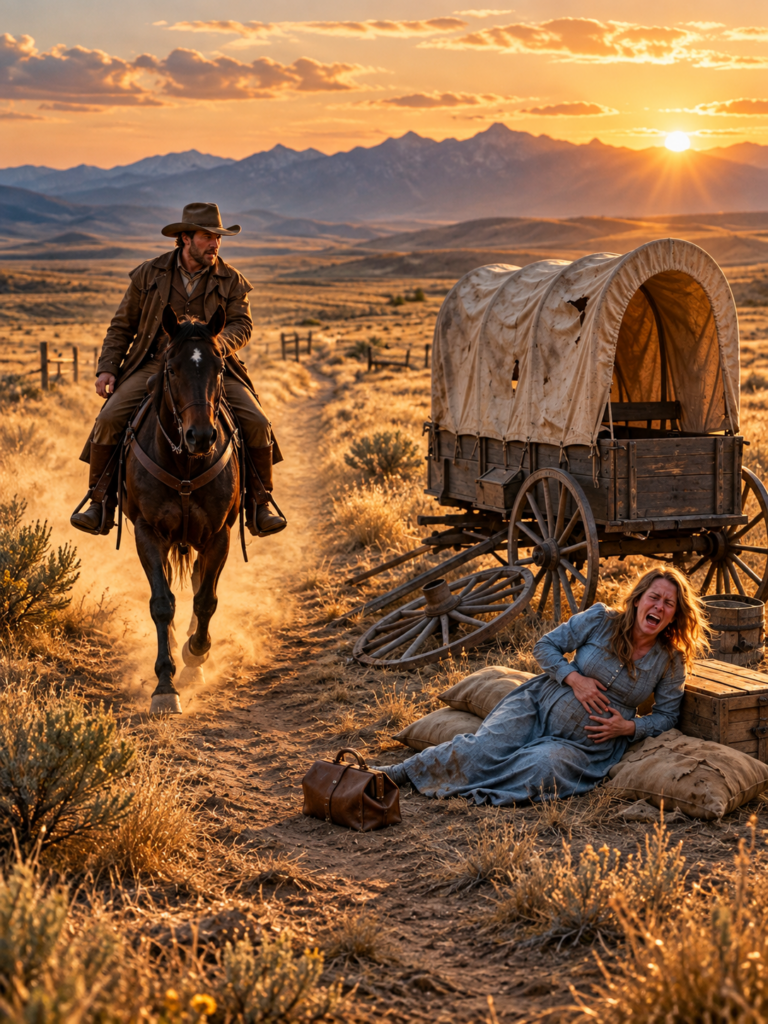
His hands had buried a wife and an unborn child nineteen years ago.
Since then, Josiah Beckett had used those hands for everything except tenderness.
They split firewood.
Set traps.
Skinned elk.
Repaired roofs.
Dragged fallen timber through waist-deep snow.
They had become hard enough to survive Montana winters and steady enough to hold a rifle against a charging mountain lion.
But Josiah had never again trusted them with anything fragile.
Then, on the worst night of January 1873, a woman screamed inside a broken wagon half buried in snow.
And for the first time in nineteen years, Josiah Beckett’s hands began to tremble.
Winter in the Montana Territory did not negotiate.
It arrived with its own laws.
The mountains closed the roads. Snow erased trails. Rivers hardened into white scars across the land, and distances that seemed manageable in July became deadly in January.
People living in the Bitterroot Valley learned not to challenge winter.
They prepared.
They waited.
They survived.
Josiah Beckett had been surviving longer than most.
At forty-five, he looked as though the mountains themselves had made him.
He was tall, broad through the shoulders, and built from years of labor that required no audience and offered no applause. His beard was dark with threads of gray, his hair fell past his collar, and wind had carved deep lines into his face.
Most men who met him remembered his size.
Those who looked longer remembered his eyes.
Warm brown.
Too gentle for the rest of him.
Josiah lived alone in a log cabin high above the valley.
He had built it himself twenty-two years earlier when he still believed it would become a home.
There was a stone fireplace, a root cellar, a smokehouse, a small barn, two horses and a stubborn mule named Amos.
Everything a man needed.
Except someone waiting when he came inside.
That had not always been true.
Once there had been Catherine.
She had come west from Oregon with brown hair, quick laughter, and an unreasonable affection for mountain storms.
She made curtains from flour sacks because she hated bare windows.
She planted flowers beside the porch even though Josiah told her the deer would eat them.
They did.
She planted more.
At night she would sit beside the fire and read aloud while Josiah carved wood or repaired tools.
Her voice had filled the cabin so completely that after her death the silence seemed unnatural.
Catherine died during the winter of 1854.
She had been pregnant with their first child.
The nearest doctor was days away.
The passes had already closed.
When the labor went wrong, Josiah had been the only person there.
He boiled water.
He gathered blankets.
He prayed.
He held her hand.
He begged.
None of it was enough.
Near midnight, Catherine stopped breathing.
The baby never cried.
Josiah sat beside them until morning while the wind battered the cabin walls.
He remembered staring at his hands afterward.
Large hands.
Strong hands.
Useless hands.
The ground was too frozen to dig.
He kept Catherine and the child wrapped carefully in the coldest part of the barn until spring.
When the earth finally softened, Josiah buried them together on the ridge overlooking the valley.
He built a ring of creek stones around the grave.
Then he went back to the cabin and closed something inside himself.
Nineteen years passed.
He never remarried.
Rarely visited town.
Spoke when necessary.
Worked constantly.
People called him independent.
Josiah knew the truth.
He was hiding.
Guilt lived with him more faithfully than any person ever could.
It sat in Catherine’s empty chair.
Walked beside him on trap lines.
Lay down with him each night.
It whispered the same thing whenever the cabin became too quiet.
You should have saved them.
The storm came on a Tuesday.
Josiah had seen signs of it that morning.
The horses were restless.
The wind had changed.
Clouds gathered beyond the mountains in a dark wall that old trappers learned not to ignore.
He had gone down to check his lower trap line anyway.
By afternoon, the world disappeared.
Snow came sideways.
Wind screamed through the trees.
Josiah mounted his horse, Buck, and turned toward home.
Visibility dropped until even the trail became difficult to distinguish.
Buck knew the route better than Josiah in weather like this, so he loosened the reins and trusted the animal.
They were less than a mile from the cabin when Buck suddenly slowed.
Josiah leaned forward.
“What is it?”
The horse snorted.
Ahead, something dark emerged through the blowing snow.
A wagon.
It stood crooked beside the road.
One wheel had shattered.
The canvas covering was ripped open and snapping violently in the wind.
No horses.
No driver.
Josiah studied it.
Abandoned wagons were not unusual on frontier roads.
People cut horses loose during storms rather than let animals freeze while harnessed.
Whoever had been traveling might have left hours earlier seeking shelter.
Josiah looked toward the ridge.
Home was perhaps fifteen minutes away.
The temperature was dropping.
Every instinct developed through decades of wilderness living told him one thing.
Keep moving.
Then he heard it.
A sound from inside the wagon.
Low.
Strained.
Human.
Josiah froze.
Another sound came.
His stomach tightened before his mind understood why.
He had heard that sound once before.
Nineteen years ago.
Inside his own cabin.
He dismounted.
For several seconds he simply stood there, holding the reins.
“No,” he whispered.
The wind swallowed the word.
Another cry came from the wagon.
Josiah closed his eyes.
He could ride away.
He could tell himself he had imagined it.
Could return with help.
Except there was no help.
Not tonight.
Not within fifty miles.
He tied Buck to the broken wagon and pulled back the torn canvas.
A woman lay inside.
Young.
Perhaps twenty-five.
Dark hair clung to her face.
Her dress was soaked with melted snow and sweat.
One hand gripped the wagon rail while the other pressed against her stomach.
She turned toward him.
Josiah saw immediately what was happening.
She was in labor.
Alone.
In a broken wagon.
During a blizzard.
Her eyes met his.
“Please.”
That single word nearly sent him running.
Not because he did not want to help.
Because suddenly the wagon was gone.
The mountains were gone.
Nineteen years disappeared.
Josiah was back inside his cabin watching Catherine suffer while he desperately tried to understand what to do.
He looked down at his hands.
They were trembling.
The woman cried out again.
“Please.”
Josiah climbed into the wagon.
The space was cramped.
Boxes had overturned during the accident. Blankets and clothing were scattered across the floor.
Josiah removed his coat and placed it around the woman.
“I’m here.”
His own voice sounded unfamiliar.
She reached for him.
Her fingers closed around his hand.
Hard.
Josiah nearly pulled away from the shock of the contact.
Instead he tightened his grip.
“What’s your name?”
She struggled to answer.
“Eliza.”
Another wave of pain took her.
She squeezed his hand until his knuckles hurt.
“Eliza what?”
“Grant.”
“I’m Josiah.”
Her eyes squeezed shut.
“Josiah.”
Something about the way she repeated his name made him stay.
Not that he had planned to leave.
But until that moment, some part of him had still been standing at the edge of the wagon, prepared to escape into the storm.
Now there was nowhere else he could go.
He remembered Catherine asking him to talk.
Keep talking, she had said.
Anything.
Just let me hear you.
So Josiah began speaking.
He told Eliza about the Bitterroot Mountains.
About summer.
About the creek running below his cabin.
About how snow on the ridge looked pink before sunrise.
About Buck.
About his mule Amos, who once kicked a bear and then spent three days terrified of a chicken.
Eliza almost laughed.
Then another contraction struck.
She screamed.
Josiah kept talking.
Hours passed.
The storm rocked the wagon violently enough that Josiah sometimes thought it might tip.
Snow blew through the torn canvas.
He blocked the opening with sacks and blankets.
Eliza shook from cold and exhaustion.
Josiah gave her what water he had.
More than once, fear returned.
What if something went wrong?
What if history repeated itself?
What if his hands failed again?
Each time the thought came, Eliza’s grip pulled him back.
Then, sometime deep in the night, everything changed.
A new sound filled the wagon.
Small.
Sharp.
Furious.
A baby crying.
Josiah stopped breathing.
For a moment, he could not move.
He had imagined this sound for nineteen years.
The sound that never came.
The sound that should have followed Catherine’s final struggle.
And now it was here.
A child.
Alive.
Crying against the storm.
Josiah looked down.
The baby was tiny.
Red-faced.
Angry.
Perfect.
He lifted her carefully.
His hands shook harder now.
These same hands had felled trees.
Dragged elk.
Broken ice.
Buried the dead.
Now they held something that weighed almost nothing.
Josiah wrapped the child in the cleanest cloth he could find.
Then he placed her against Eliza’s chest.
Eliza looked down.
Her expression collapsed.
Tears slid into her hair.
“My baby.”
Josiah turned away because something had tightened painfully behind his ribs.
“Thank you,” Eliza whispered.
He shook his head.
“You did the work.”
“You stayed.”
Josiah looked at her.
She was exhausted beyond measure.
“You need sleep.”
Eliza glanced toward the torn canvas.
“What if the storm gets worse?”
“Then it gets worse.”
“What if something happens?”
“I’ll be here.”
Her eyes held his.
“Promise me.”
The word struck somewhere deeper than he expected.
Josiah looked at the child breathing against her mother.
At Eliza’s hand still wrapped loosely around his.
At the storm beyond the wagon.
“I promise.”
Eliza slept.
Josiah did not.
He sat against the wagon wall, rifle across his knees, listening to the baby breathe.
Every few minutes he checked them both.
He knew almost nothing about newborn children.
That did not stop him.
He adjusted blankets.
Blocked drafts.
Kept watch.
When the fire lantern dimmed, he conserved what little oil remained.
Before dawn, the storm weakened.
Stars appeared.
By sunrise, the sky was clear.
The world outside had transformed into endless white.
Josiah stepped down from the wagon.
The cold hurt his lungs.
He looked toward his ridge.
He could see the cabin.
Getting Eliza there would not be easy.
But there was no alternative.
He returned to the wagon.
“We’re going home.”
Eliza blinked awake.
“Home?”
“My cabin.”
“I can walk.”
“No.”
“I can.”
“You gave birth six hours ago.”
“I still have legs.”
Josiah stared at her.
Eliza stared back.
“You are stubborn,” he said.
“I’ve been told.”
Josiah bent and lifted her before she could continue arguing.
Eliza gasped.
“Put me down.”
“No.”
“Mr. Beckett—”
“Save your strength.”
She eventually stopped protesting.
Josiah carried her through the snow.
Then returned for the baby.
He tucked the child inside his coat against his chest.
The tiny warmth against him felt almost unbearable.
He had carried many things up that ridge.
Meat.
Firewood.
Tools.
Injured animals.
Never anything he was afraid to breathe around.
When he reached the cabin, he opened the door with one hand.
Warmth from the banked fire drifted out.
For the first time in nearly two decades, Josiah Beckett entered his home carrying a child.
Eliza remained weak for several days.
Josiah cared for her with intense concentration.
He heated water.
Prepared broth.
Washed cloth.
Kept the fire constant.
Checked the baby obsessively.
Eliza found it amusing.
“You know she’s breathing.”
“I know.”
“You checked thirty seconds ago.”
“I know.”
“And she was breathing then.”
Josiah frowned.
“Children can change.”
“She’s sleeping.”
“How do you know?”
“Because I’m her mother.”
Josiah considered this.
Then checked anyway.
Eliza smiled.
On the third evening, she finally told him how she had reached that road.
Her husband, Marcus Grant, had worked as a surveyor for a railroad company.
He died from fever six months earlier.
Eliza had been pregnant and alone.
Her aunt owned a small homestead south of Bitterroot Valley and had invited Eliza to stay.
So she sold what little she owned and traveled west.
The storm caught her before she reached the valley.
One wagon wheel broke.
The horses panicked.
The driver went after them.
He never returned.
“I thought I was going to die there,” Eliza said.
Josiah stared into the fire.
“You didn’t.”
“Because you came.”
“I almost didn’t.”
She looked at him.
Josiah rarely admitted weakness.
But something about Eliza made lies feel pointless.
“I nearly rode past.”
“Why didn’t you?”
He remained silent for a long time.
Finally he said, “Because I heard you.”
“That’s all?”
“No.”
He looked at his hands.
“The last time I heard a woman make that sound, she was my wife.”
Eliza’s face changed.
Josiah told her about Catherine.
Not everything.
He could not.
But enough.
The winter.
The labor.
The child.
The silence afterward.
When he finished, the cabin was quiet.
“I’ve spent nineteen years thinking my hands weren’t enough,” he said.
Eliza looked at him.
“They were enough for me.”
Josiah swallowed.
“And they were enough for Rose.”
“Rose?”
Eliza smiled toward the sleeping baby.
“I decided today.”
Josiah looked at the child.
“Rose.”
“Do you like it?”
He nodded.
“My Catherine tried growing roses here once.”
“Did they survive?”
“No.”
Eliza laughed softly.
“That wasn’t encouraging.”
“She planted more.”
“Did those survive?”
“No.”
“Josiah.”
“She never stopped trying.”
Eliza’s smile changed.
“So Rose it is.”
The mountain passes remained closed.
Days became weeks.
No one could travel safely.
The three of them were trapped together.
Josiah expected to resent the disruption.
Instead, the cabin slowly changed.
There were blankets hanging near the fire.
Tiny cloths drying by the stove.
Eliza humming while she worked.
Rose crying at impossible hours.
Josiah began waking before the baby did.
He learned each sound she made.
The hungry cry.
The uncomfortable cry.
The offended cry.
The mysterious cry that apparently meant nothing except that Rose had discovered she possessed lungs.
The first time Josiah managed to calm her, he looked so shocked that Eliza laughed until tears filled her eyes.
“What?”
“You look as though you just negotiated peace between nations.”
“This is harder.”
Rose eventually fell asleep against his chest.
Josiah stood motionless.
“You can sit down,” Eliza whispered.
“She’ll wake.”
“She won’t.”
“How do you know?”
“Mother.”
Josiah sat carefully.
Rose continued sleeping.
He looked down at her.
“She trusts me.”
“Yes.”
“She shouldn’t.”
Eliza stopped smiling.
“Why not?”
Josiah did not answer.
Eliza understood anyway.
“Josiah.”
He looked up.
“You are not that night.”
His jaw tightened.
“You don’t know what happened.”
“I know grief makes people turn memory into punishment.”
Josiah stared at her.
Eliza continued gently.
“You loved Catherine.”
“Yes.”
“You tried to save her.”
“Yes.”
“You failed to perform a miracle.”
His eyes darkened.
“That is not the same thing as failing her.”
Josiah looked away.
No one had ever said that to him.
He did not know how to accept it.
But that night, the old voice of guilt inside him was quieter.
Only slightly.
It was enough.
One evening Eliza woke and discovered Josiah missing from his chair.
A faint scraping sound came from the other side of the cabin.
She found him sitting near the workbench, carving cedar.
“What are you doing?”
“Nothing.”
“That is clearly something.”
Josiah shifted his enormous body in an unsuccessful attempt to block her view.
Eliza stared.
Wood pieces rested around his boots.
A curved frame sat on the bench.
“Is that a cradle?”
“No.”
She raised an eyebrow.
Josiah sighed.
“Yes.”
“For Rose?”
“The baby needs somewhere proper to sleep.”
Eliza touched the smooth cedar.
“You’ve been doing this at night.”
“I had wood.”
“You shaped all of this by hand.”
“I have hands.”
“That is becoming obvious.”
Josiah looked embarrassed.
It was possibly the first time Eliza had seen a man his size appear shy.
She ran her fingers along the curved wood.
“It’s beautiful.”
“It’s practical.”
“Of course.”
“The bottom rocks.”
“How terribly practical.”
“Eliza.”
She laughed.
For the first time, Josiah laughed with her.
It came unexpectedly.
Rusty.
Deep.
The sound seemed to surprise him.
Eliza stopped.
“What?”
“Nothing.”
“You’re looking at me.”
“I’ve never heard you laugh before.”
Josiah’s smile vanished slightly.
He looked toward Catherine’s empty chair.
“Been a while.”
Eliza touched his arm.
“Then perhaps you should practice.”
Spring came slowly.
Snow withdrew from the valley in patches.
Water began running beneath the ice.
Birdsong returned.
Trails reappeared.
Then one morning Josiah rode down the ridge and discovered the southern road passable.
When he returned, Eliza was hanging cloth outside.
“The pass is open.”
Her hands stopped.
“I thought it might be.”
“Your aunt’s homestead is three days south.”
“Yes.”
Josiah waited.
Eliza continued hanging cloth.
He felt foolish standing there.
“You could leave now.”
She turned.
“Do you want me to?”
The question caught him unprepared.
“This was never meant to be permanent.”
“That isn’t what I asked.”
Josiah looked toward the mountains.
He had spent nineteen years controlling one thing above all others.
Expectation.
If he expected nothing, nothing could be taken.
So he said, “Your family will be waiting.”
Eliza’s expression became unreadable.
“Yes.”
She went inside.
Josiah stood alone in the yard.
That afternoon, he repaired a fence that did not need repairing.
The next day, Eliza did not leave.
Nor the day after.
A week passed.
Josiah said nothing.
Finally, one evening in April, they sat on the porch.
Rose slept inside the cabin.
The sky over the valley burned copper and purple.
“The passes are open,” Josiah said again.
“I know.”
“Your aunt—”
“I know.”
Silence.
Then Eliza said, “I could stay.”
Josiah turned slowly.
“Why?”
The question was so sincere that she smiled.
“You truly don’t know?”
“No.”
“Rose took her first breath in your hands.”
Josiah looked away.
“You carved her a cradle while pretending it was merely practical.”
“It was.”
“It has flowers carved into the sides.”
“The wood required decoration.”
She laughed.
Then her voice softened.
“You promised not to leave me that night.”
Josiah looked at her again.
“And you didn’t.”
“I said I wouldn’t.”
“That matters.”
“Eliza—”
“You held my hand through the longest night of my life.”
She reached for him.
“The man who held it then is the man I want holding it through all the nights after.”
Josiah could not breathe properly.
He had imagined many dangers over the years.
Avalanches.
Bears.
Illness.
Fire.
Never hope.
Hope frightened him more.
“I failed once.”
Eliza’s thumb moved across his rough knuckles.
“I was not enough for Catherine.”
“You loved her.”
“That didn’t save her.”
“No.”
Eliza did not give him an easy lie.
That mattered.
“You cannot change that night,” she said. “And I would never ask you to stop loving her.”
Josiah looked toward the ridge where Catherine lay buried.
Eliza followed his gaze.
“But love is not a room with only one chair, Josiah.”
His eyes returned to hers.
“You were enough for me.”
She squeezed his hand.
“You were enough for Rose.”
Then she smiled faintly.
“That is all I am asking you to be.”
Josiah looked through the doorway.
The cedar cradle was visible beside the fire.
Rose slept beneath the quilt Eliza had stitched from scraps.
His cabin no longer seemed enormous.
It seemed full.
For nineteen years Josiah had believed Catherine’s death meant that the best part of his life had ended.
Maybe grief had convinced him of something that love had never asked.
Maybe remembering Catherine did not require remaining alone.
He tightened his fingers around Eliza’s.
“Then I’ll stay too.”
Eliza smiled.
“You own the cabin.”
“That isn’t what I meant.”
“I know.”
They married in June.
Josiah insisted on one thing.
The ceremony would take place on the ridge.
Beside Catherine’s grave.
Some people in town found that strange.
Eliza did not.
She brought wildflowers.
She placed some beside Catherine’s stone before taking Josiah’s hand.
“You don’t have to do that,” he whispered.
“I know.”
“Then why?”
“Because she loved you first.”
Josiah closed his eyes briefly.
“And because,” Eliza continued, “Rose and I would not have this version of you if Catherine had never loved the first one.”
That nearly broke him.
They exchanged vows beneath the Montana sky.
Rose slept through most of them.
Then screamed during the final prayer.
Everyone laughed.
Even Josiah.
Especially Josiah.
Years passed.
Rose grew strong.
Loud.
Fearless.
She called Josiah “Papa” before she properly learned any other word.
Eliza teased him for months.
Josiah pretended not to care.
But one evening she found him alone in the barn wiping his eyes.
Rose grew up believing Josiah had always been her father.
In every way that mattered, he had.
He taught her to ride.
To fish.
To read storms.
To recognize animal tracks.
To never approach Amos from behind.
She ignored that lesson once.
Only once.
The old mule chased her halfway around the barn.
Josiah laughed so hard he had to sit down.
The cedar cradle remained in the cabin even after Rose outgrew it.
Josiah could never bring himself to put it away.
Travelers sometimes stopped at the Beckett place.
They noticed two things.
The cradle near the wall.
And the graves on the ridge.
Catherine and the child Josiah never met.
Beside them grew a garden.
Eliza planted wildflowers there every spring.
Years later, Rose helped.
Nothing erased what came before.
That was never the point.
Life simply grew beside it.
Like flowers beside stones.
Like laughter inside a cabin once filled with silence.
Like a child sleeping in a cradle built by a man who had once believed his hands could only fail the people he loved.
On Rose’s eighteenth birthday, a winter storm moved across the valley.
Nothing unusual.
Rose was helping Eliza prepare supper when Josiah stepped onto the porch.
Snow began falling.
He watched it quietly.
For a moment, he remembered another storm.
A broken wagon.
A frightened woman.
A newborn’s cry.
Eliza joined him.
“You’re thinking about that night.”
Josiah smiled.
“You always know.”
“I’ve had eighteen years of practice.”
She slipped her hand into his.
Same hand.
Same grip.
Much warmer night.
“Do you ever wonder what would have happened if you had ridden past?”
Josiah looked through the window.
Rose was laughing about something inside.
Her voice filled the cabin.
He thought about the lonely man who had approached that wagon believing his life was already finished.
“Yes.”
“What do you think?”
Josiah remained silent for several seconds.
Then he said, “I think I would have survived.”
Eliza looked at him.
“But?”
“I would never have lived.”
She rested her head against his shoulder.
Snow covered the ridge.
Beyond them stood Catherine’s grave.
Behind them Rose laughed.
Past and present.
Loss and love.
Neither cancelling the other.
Josiah squeezed Eliza’s hand.
That night in 1873, a woman alone in a broken wagon had whispered one desperate word.
Please.
A man who had spent nineteen years running from the memory of failure had answered with two.
I promise.
He had believed the promise meant only that he would remain until morning.
He had been wrong.
He kept it through Rose’s childhood.
Through spring planting and winter storms.
Through arguments and illnesses and birthdays.
Through every ordinary evening beside the fire.
He kept it when Eliza’s hair began turning silver.
He kept it when his own hands grew slower and the scars across his knuckles faded beneath age.
Because some promises are larger than the moment in which they are spoken.
Some families begin with blood.
Others begin with vows.
And one family on a ridge above the Bitterroot Valley began during a blizzard—
with a broken wagon,
a newborn child,
a frightened widow,
and the trembling hands of a mountain man who finally discovered they had never failed because they were weak.
They had failed once because some losses cannot be stopped.
But when life placed something precious in them again,
they knew exactly what to do.
They held on.


