
Part 1
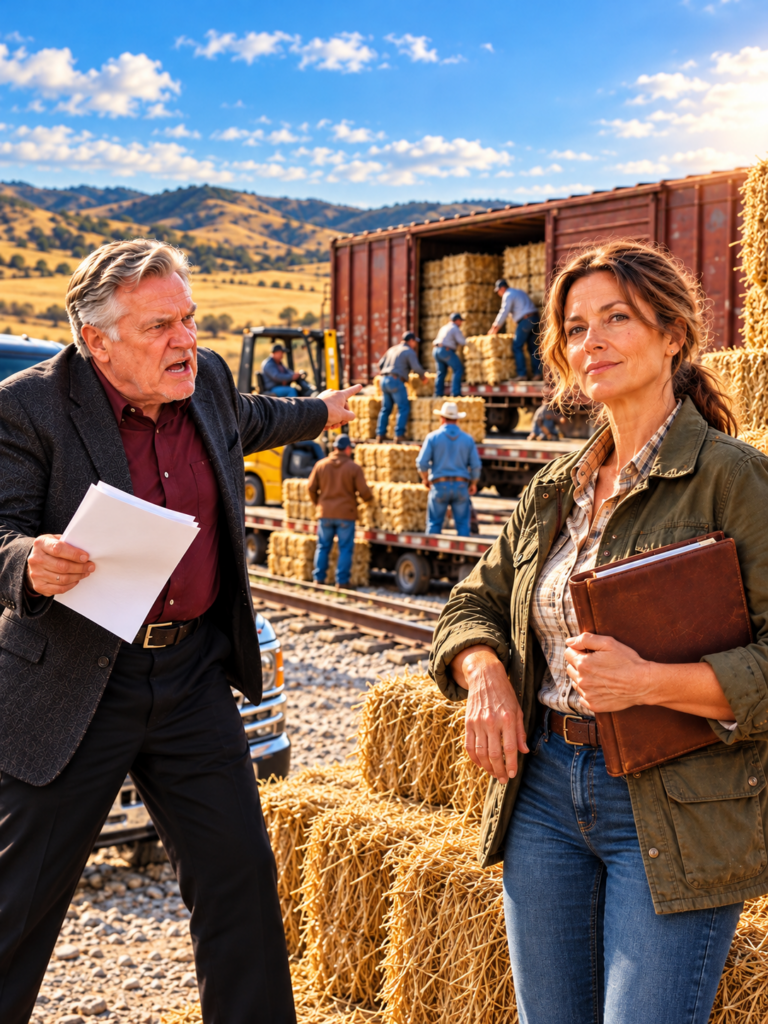
Wendell Pruitt had learned that a man didn’t have to raise his voice to take another man’s land.
Sometimes all he had to do was close an account.
He had done it three times in Harlan County. Three ranching families had found themselves squeezed between rising feed costs, overdue bills, and the terrible arithmetic of keeping hungry cattle alive through a Nebraska winter. Each had eventually sold something valuable for less than it was worth. Wendell had been there when they reached that point, checkbook ready, speaking gently about difficult times and practical decisions.
He never called it pressure.
He called it business.
And on a gray October morning, sitting behind his desk at the largest hay operation in the county, he decided that Hazel Brannigan would be next.
The telephone rang in Hazel’s kitchen shortly after she came in from checking the cattle.
She was fifty-eight years old, with work-roughened hands and the kind of tiredness that came from having too many responsibilities and nobody to share them with. Her boots had left a little trail of dry mud across the floor. A mug of coffee sat beside the telephone, already going cold.
She recognized Wendell’s voice immediately.
“Morning, Hazel.”
“Morning.”
He took his time getting to the point.
There was a problem with her standing hay order, he explained. The delivery would not be coming. Her payment had been refunded, and her account was closed.
For a moment, Hazel thought she had misunderstood.
“Closed?”
“That’s right.”
“I’ve never missed a payment.”
“I’m not saying you have.”
“Then why am I not getting my hay?”
Wendell gave her an answer that sounded like an answer without explaining anything. His operation was making adjustments. Certain accounts could no longer be serviced. Those decisions were final.
Then his voice softened.
“Now, Hazel, you know my offer on your place still stands. Same price we discussed. Might be worth giving it serious thought before winter gets here.”
She looked through the kitchen window toward the pasture.
Thirty-one cattle were scattered beyond the fence, their dark and white-marked bodies moving slowly through grass that had already surrendered to autumn.
She knew what Wendell was telling her.
Sell him the ranch, or face the winter without the feed she needed to keep it.
“I’ll think about it,” she said.
“That’s all I’m asking.”
When the call ended, she stood beside the kitchen counter for several seconds.
There were things a person could say to a man like Wendell Pruitt. She could have accused him of trying to steal her property. She could have reminded him that her husband had worked that ground for more than thirty years. She could have asked how he slept knowing what he was doing.
None of those words would put a single bale of hay in her barn.
So she pulled on her coat, went outside, and climbed into her pickup.
She opened the glove compartment.
Beneath an insurance envelope and a stack of old receipts lay a folded county tax-sale list.
She had carried it around for three weeks.
One parcel had been circled in pencil.
Hazel smoothed the paper across the steering wheel and studied the figures again.
Three point two acres.
Unimproved land.
Delinquent taxes: $1,200.
Most people in Harlan County would have laughed at the idea of buying such a place. It had soil so salty that weeds struggled to survive. No productive pasture, no water well, no buildings worth keeping.
Hazel wasn’t interested in growing anything there.
What interested her was something most people driving past the property had stopped seeing years ago.
A strip of railroad track.
And at that moment, with her feed account closed and Wendell waiting for her to surrender, that nearly forgotten piece of ground was the only alternative she could see.
Whether it would save her ranch was another matter entirely.
Harlan Bend, Nebraska, sat near the edge of the Sandhills, where the land spread out beneath an enormous sky and the wind could travel for miles without finding much to slow it.
It was the sort of town where people identified a pickup by the sound of its engine and knew who had stopped at the feed store before the driver stepped out.
Hazel had lived there for thirty-four years.
For most of those years, her life had been built around a forty-acre home place, a leased pasture nearby, and a husband named Tom Brannigan.
They hadn’t been wealthy.
Their operation was a modest cow-calf business, with a herd of mixed Angus and Hereford cattle and equipment that stayed in use long after other ranchers might have traded it in.
Tom had never believed a working machine needed to be replaced merely because it looked old. He maintained what they owned, repaired what broke, and measured a good year by whether the bills were paid and the herd had come through healthy.
Hazel had worked beside him.
She knew the cattle individually, knew which fence posts loosened in spring, which stretches of pasture dried out first, and which animals needed watching when the weather turned.
The two of them had developed the quiet understanding of people who spent decades doing difficult work together.
A glance across a barn could mean that a gate needed closing. A hand lifted from a tractor seat could tell the other person to wait. There were days when they hardly spoke until supper, not because they had nothing to say, but because the work itself had become a language.
Then, two years earlier, Tom had died.
It happened on a February morning, during feeding.
He was sixty-one.
Hazel found him beside the hay ring.
The cattle stood nearby, waiting.
She could remember the shape of his body against the frozen ground and the way the cold air seemed to strip every familiar sound from the pasture.
What she remembered just as clearly was that the cattle still needed feeding.
So she fed them.
People occasionally asked about that morning afterward. What had happened, how she had managed, whether there had been any warning.
Hazel would tell them she had fed the cattle first.
She never said much beyond that.
After the funeral, grief had arrived with paperwork.
There was an equipment loan to settle. The leased pasture went back to its owner. Without it, she couldn’t maintain the herd at its previous size.
She sold cattle to cover the loan and kept thirty-one head.
It was a smaller herd than the one she and Tom had managed together, but those animals represented what remained of thirty years of careful breeding, early mornings, droughts, calving seasons, and hard decisions.
She refused to think of them merely as livestock she could liquidate whenever someone else found it convenient.
The ranch was her home.
And the cattle were still her responsibility.
She had become careful with money in a way she never needed to be while Tom was alive.
Feed came first. Veterinary bills came next. Whatever remained went into a savings account she had opened under her own name.
By that October, the balance stood at $5,100.
It wasn’t enough to make her feel secure.
It was enough to give her a little breathing room if a truck broke down or a calf needed treatment or winter turned out worse than expected.
She had learned not to spend it casually.
Wendell Pruitt understood that.
He knew almost everyone’s finances, or at least enough to recognize when a household had reached the point where one bad season could change everything.
His family controlled nearly nine hundred irrigated acres devoted to hay production. He also owned the only feed store within forty miles.
That made him more than a supplier.
For many small ranchers, he was the easiest and most dependable route between a standing herd and the feed that herd needed.
His trucks were familiar on county roads. His invoices came regularly. His employees knew which gates to use and where customers wanted their bales stacked.
As long as Wendell wanted to do business with a rancher, the arrangement worked.
The trouble began when he wanted something else.
His family’s property bordered Hazel’s land on two sides.
And on her forty acres was the only dependable stock pond for six miles.
Wendell had wanted that pond, and the ground around it, for years.
He had begun making offers after Tom died.
The first had been wrapped in sympathy. He understood how difficult it must be for a widow to maintain an operation alone. He said he could take the burden off her hands.
Hazel declined.
The next offer was lower.
He explained that the market had changed.
She declined again.
By the time two years had passed, he had learned to make the same proposal with the patient expression of a man waiting for someone else to become reasonable.
His last offer came just before he cut off her hay.
And when she refused it, the following morning brought instructions through his dispatcher that her standing deliveries were canceled. The telephone call from Wendell merely confirmed what he had already set in motion.
He had removed the one service she couldn’t easily replace.
That afternoon, Hazel walked into her barn and counted the hay.
She counted twice.
Eight days.
Thirty-one head of cattle.
November was approaching, and the forecast already showed a serious cold front.
Eight days meant eight days under ordinary feeding conditions. Bad weather could change consumption. Wet hay could spoil. A delayed delivery could leave her with animals needing food and nothing to put in front of them.
She didn’t need Wendell to explain what happened to a rancher who ran out of winter feed.
She had lived long enough to know.
Hazel spent much of the next day on the telephone.
She called producers whose numbers she had kept for years. She called ranchers she had bought from before. She asked about spare bales, partial loads, delivery schedules, and whether anybody could get a truck out to Harlan Bend quickly.
Some had hay but couldn’t spare a load.
Others had commitments already.
A few could sell to her, but by the time freight was added, the price was so high that buying enough for the winter would eat through much of her savings.
She wrote every offer down.
Then she began noticing something.
The problem wasn’t only that hay was scarce near Harlan Bend.
It was that getting hay there was unusually expensive for anyone too small to buy in bulk.
During one call, a neighbor mentioned that Wendell had quietly doubled his delivery fees after the neighbor arranged a load from an independent hauler out of Kearney.
Another rancher told her a hay delivery had arrived a full week late, without explanation, shortly after she asked Wendell for a better price.
Neither person spoke as though they expected anything to be done about it.
They described the trouble in the same weary voices people used for broken water pumps or an early frost.
These things happened. You paid the bill. You kept going.
Hazel listened.
She understood why they were reluctant to challenge him.
Harlan Bend was small enough that public disagreements rarely remained between the people directly involved.
A rancher who complained about Wendell might still need his delivery truck next month. A family that bought from someone else might find the next order more expensive or slower to arrive.
Nobody needed to be threatened openly.
The uncertainty did enough damage by itself.
Hazel finished her calls, looked at the prices she’d written in a notebook, and began doing the arithmetic.
The figures told her something important.
There was affordable hay available farther north.
The extraordinary cost came from moving small loads over long distances.
Each rancher was paying for freight separately, one truck at a time, at rates that made sense for the hauler but punished the buyer.
What would happen, she wondered, if several ranchers bought hay together?
What if they didn’t move it by truck the entire distance?
She remembered seeing railcars loaded with agricultural freight years earlier.
The old Platte Valley and Western line had once served the grain elevator in Harlan Bend. The elevator had closed decades ago, and the town’s old siding had fallen into disuse.
Most of the land around it had eventually been sold.
Most of it.
Hazel unfolded the tax-sale list again.
She studied the circled parcel.
Then she drove out to see it.
The ground was worse than she remembered.
White alkali crust covered the surface in uneven patches. The abandoned fence leaned at tired angles, with wire sagging toward the dirt. There wasn’t a well, a usable pasture, or any obvious reason someone would invest money in the place.
A good farmer would have taken one look at the soil and kept driving.
Hazel parked her pickup and walked toward the far boundary.
There, beyond the salt-stained earth, lay a long, straight rise of old gravel ballast.
She could still make out the remains of a wooden loading platform.
Rusted rails ran beside it.
The siding had been left to weather and weeds for years, but the rail line beyond it was still in service.
She stood there long enough for the wind to work its way through her coat.
If the old connection was still recognized by the railroad, if freight cars could be brought onto the spur, and if hay could be purchased in sufficient quantity, there might be a way around the system Wendell controlled.
Those were three large ifs.
Hazel didn’t mistake them for an answer.
She got back into her pickup and drove home to find a telephone number.
The freight agent at the short-line railroad was named Sheila Dunning.
Hazel introduced herself, explained where she lived, and described the abandoned siding.
There was a pause while Sheila checked records.
Hazel could hear office sounds faintly through the receiver and the movement of papers at the other end.
“That siding hasn’t handled much of anything in a long time,” Sheila said.
“I can see that.”
“Are you asking whether the track is still connected?”
“I’m asking whether a railcar could be delivered there if somebody owned the property and fixed the unloading area.”
Sheila didn’t promise anything.
She said she would have to look into the legal status and the operating requirements.
Hazel left her number.
When Sheila called back, she had found something.
The siding was dormant, but its connection was still legally intact.
It hadn’t been formally removed from the railroad’s system.
That did not mean Hazel could start unloading freight the next morning. She would need to establish ownership, satisfy the applicable requirements, and rebuild the platform so deliveries could be handled safely.
But the railroad was willing to consider spotting full hay cars there.
Hazel wrote down every condition.
“Full cars?” she asked.
“That’s how we’d handle it.”
“And the siding can be used if the work is done?”
“Provided everything checks out.”
Hazel thanked her and sat with the telephone in her hand.
For the first time since Wendell had called, she had something more substantial than another refusal to sell.
She had a possible route.
The next question was whether the numbers worked.
A North Dakota producer had surplus hay he had been trying to move south for two seasons. Hazel reached him and asked for pricing by the railcar.
When she saw the figures, she checked them again.
Then a third time.
Even after freight and unloading costs, a pooled rail shipment could cost less per bale than the small retail truckloads ranchers in Harlan County had been buying.
There was nothing magical about it.
Rail transport allowed a much larger load to move together. The cost could be spread across many bales and, if she found enough buyers, across several households.
But there were expenses she couldn’t ignore.
A loading platform needed repairs. Equipment had to be arranged. The freight schedule had to be confirmed. The county had to permit the use she was proposing.
And buying a piece of land at a tax sale meant nothing if the necessary paperwork wasn’t in order.
Hazel called the county and confirmed the zoning. She checked the requirements with the railroad. She put the critical answers in writing.
Only then did she make her purchase.
By Friday, the 3.2-acre parcel belonged to her.
The tax-sale price was $1,200.
Filing and closing costs added another $340.
Hazel watched that money leave her savings account with the unpleasant awareness that a mistake would be entirely hers.
She bought pressure-treated lumber and arranged a rented loader for a weekend. She found a used platform scale at an auction in Grand Island.
The work was unglamorous.
The old platform had to be made usable. The scale needed a place where loads could be checked. The ground needed to accommodate people arriving with pickups and trailers.
She worked with the urgency of someone whose cattle were still eating from a dwindling stack of hay.
By the time the immediate work was finished, her savings had fallen to about $3,100.
She now owned a patch of infertile land, a repaired loading platform, and access to a rail spur that most people in Harlan Bend had forgotten.
She did not yet own enough hay to make the venture worthwhile.
And the railroad wasn’t interested in delivering a few bales at a time.
It wanted full cars.
That meant Hazel needed other ranchers.
The first household she visited listened politely and declined to commit.
The second asked several questions about freight charges.
The third wanted to know what would happen if the train didn’t arrive.
Hazel didn’t pretend she had experience operating a freight distribution business.
She had none.
She had spent her working life raising cattle with Tom.
But she understood invoices, feed requirements, and the difference between a number that looked inexpensive and a number that actually was inexpensive after every charge had been included.
She explained the arrangement as simply as she could.
Each household would commit to a quantity of hay and pay its share in advance. The order would be pooled into a full rail shipment. Freight would be divided fairly, and buyers would collect their hay at the siding.
Hazel would coordinate the shipment and charge a modest handling fee, listed separately so everyone could see exactly where their money went.
There would be no hidden delivery charge.
No penalty for buying from another supplier.
No expectation that anyone would sell livestock or land to keep an account open.
The neighbors listened.
Some seemed interested.
Others looked doubtful.
Hazel understood their hesitation. She was asking people to advance money for hay that hadn’t arrived, through a business that had no history, at a loading point with no roof and barely enough equipment to operate.
Wendell Pruitt might charge too much, but his trucks usually showed up.
Hazel was offering them a repaired wooden platform on a salt flat.
Still, six households finally agreed to participate in the first shipment.
Six.
She studied the orders that evening, checking the quantities and the freight calculations until she was satisfied.
It wasn’t a comfortable beginning.
But it was enough to try.
She confirmed the first railcar.
And then, having committed other people’s money as well as her own, she discovered just how different a workable idea could be from a working operation.
The train arrived a full day late.
By then, the November wind was cutting across the empty lot hard enough to make conversation difficult.
Hazel had arranged the unloading, and the participating ranchers were waiting with equipment and trailers.
Then the forklift arrived.
The operator took one look at the platform ramp.
They tried to position the machine.
The approach was wrong.
Hazel had built the ramp using specifications she had found online. The grade turned out to be six inches too steep for the forklift the railroad had sent.
For several moments, everyone stood there looking at the same problem.
Hay had finally arrived.
The people who had paid for it were standing nearby.
And the equipment couldn’t use the ramp.
Hazel felt the blood rise into her face.
There was no time to argue with a diagram or wish she had measured differently.
She asked what they could unload safely with the tractors and people available.
The answer was slower than anyone wanted to hear.
They would have to handle the load bale by bale.
So they did.
The men and women who had come expecting a straightforward pickup found themselves moving hay in the cold, working in shifts as daylight faded. A tractor helped where it could. Hands did the rest.
Gloves became stiff with dirt and chaff.
Wind pushed loose hay across the gravel.
People climbed down from trailers, bent their backs, lifted, carried, counted, and stacked.
Hazel worked alongside them, keeping track of each household’s order between trips across the platform.
She bought coffee.
She replaced a torn tarp and a damaged strap.
The little expenses kept accumulating.
By the time the last bales were separated and counted, nearly all of her handling fee had disappeared.
She had earned almost nothing.
But the hay was there.
The first shipment had been delivered.
An older rancher named Earl Tibbetts stood beside his row of bales, studying them.
He walked its length once.
Then again.
Hazel watched from several yards away.
Earl took a folded receipt from his coat pocket. It was an invoice from his previous hay order with Wendell.
He opened it carefully against the wind and compared the amount with the figures Hazel had given him.
She waited.
Earl had seen enough winters to know when a bargain wasn’t really a bargain. He would count the cost of his fuel, his time, and the labor they had spent unloading.
He studied the papers for a long while.
Then he folded the old invoice.
“Still cheaper,” he said.
Hazel looked at him.
“Even after today?”
Earl nodded.
“Even after today.”
It wasn’t a dramatic endorsement.
He didn’t shake her hand or tell everybody that she had saved the county.
He loaded his trailer and drove home.
But Hazel understood what that short exchange meant.
The first railcar had been late.
The ramp had been wrong.
The work had been miserable.
And the final cost had still been lower.
For the first time, she had proof that the alternative she had imagined on the back of a county tax-sale list could actually work.
That evening, she drove home through the dark with aching hands and hay dust clinging to her coat.
She checked the cattle before going inside.
Then she opened her ledger at the kitchen table.
The numbers showed almost no profit.
What they didn’t show was the change that had begun in Harlan Bend.
Word was about to spread.
And Wendell Pruitt was about to discover that closing one widow’s account had created a problem considerably larger than her forty acres.
Part 2
The first sign that things were changing appeared on a local ranching forum.
Someone posted a simple breakdown of Hazel Brannigan’s first rail shipment.
There were no accusations against Wendell Pruitt, no speech about fairness, and no grand announcement that the people of Harlan County had found a new way to buy feed.
Just the numbers.
The purchase price of the hay.
The shared rail freight.
Hazel’s handling fee.
The final cost per bale.
Beside those figures were the ordinary prices ranchers had been paying for delivered hay in the county.
Anybody who understood a feed bill could see the difference.
By the next morning, Hazel was getting telephone calls.
Some callers asked whether the figures were correct.
Others wanted to know when another car would arrive.
A few asked whether they could place an order even though they hadn’t participated in the first shipment.
Hazel answered each question carefully.
She wasn’t ready to promise more than she could deliver.
The first railcar had taught her that an apparently simple transaction could go wrong in half a dozen ordinary ways before lunch.
She needed a better ramp.
She needed to understand the unloading schedule.
She needed clearer pickup arrangements and enough room to keep one household’s hay from being mixed with another’s.
Most of all, she needed to be certain that everybody who trusted her with money got exactly what they had paid for.
But the questions kept coming.
By the end of the week, she was beginning to understand that her little operation mattered to people beyond the six households who had taken the first chance on her.
Then Wendell called.
It was Tuesday morning.
Hazel had just come in from feeding the cattle when the telephone rang.
“Morning, Hazel.”
She knew his voice before he said another word.
“Morning, Wendell.”
“I hear you’ve been keeping busy.”
She said she had.
He sounded relaxed, almost amused.
He had heard about the railroad deliveries, he explained. A clever idea, certainly. He could appreciate somebody trying something different.
Then he shifted to what he really wanted.
He was prepared to restore her feed account.
Not merely reopen it, but offer regular deliveries again at competitive prices.
There would be no more unexplained cancellations. No trouble with schedules. No need for Hazel to stand around in freezing wind unloading railcars with a handful of neighbors.
All she had to do was stop organizing the shipments.
She could keep the salt-flat property if she liked.
He didn’t care what she did with it.
He simply didn’t want her running a competing feed supply through the old siding.
Hazel rested one hand on the kitchen counter.
“And if I don’t?”
Wendell didn’t threaten her.
He didn’t need to.
“Just seems like an awful lot of trouble you’re taking on,” he said. “Especially when you’ve already got your own place to look after.”
Hazel looked toward the barn.
He wasn’t entirely wrong.
That was what made the offer dangerous.
She was exhausted.
Every morning began before daylight with the cattle. By the time the regular chores were finished, her day had only moved into its second half.
There were freight schedules to check, orders to total, invoices to compare, and telephone calls to return. She was trying to learn a business she had never intended to operate, using the same hours she once spent with Tom repairing equipment or planning the next season.
The ranch wasn’t getting any easier to manage while she did it.
And the neighbors who depended on the shipments weren’t her family.
They hadn’t promised to help if the railroad failed or the numbers stopped working.
They were customers.
She had made a commitment to them, but she also had to admit that she was tired of being responsible for everybody’s worries as well as her own.
For a brief moment, Wendell’s proposal seemed almost generous.
She imagined making one telephone call when she needed hay and having it delivered to her barn, the way things had worked before.
No freight calculations.
No arguments about pickup times.
No money tied up in rail shipments.
Only her cattle, her house, and the forty acres she was trying so hard to keep.
“Think it over,” Wendell told her. “There’s no sense making life harder than it needs to be.”
Hazel said she would consider it.
After the call, she sat at the kitchen table longer than she meant to.
She opened her ledger, but for once the figures didn’t hold her attention.
The possibility of returning to her old life had unsettled her more than she wanted to admit.
That afternoon, Earl Tibbetts drove out to the siding.
He arrived without an appointment, parked near the platform, and got out slowly, looking around at the patched lumber and the gravel that had been pressed down by tires during the first delivery.
Hazel was checking the unloading area.
“Come to see whether it’s still standing?” she asked.
Earl glanced at the platform.
“Looks like it.”
He walked a little farther, then stopped.
“I brought you something.”
From his jacket pocket, he removed several folded invoices.
They were from Wendell’s feed business.
Earl opened them on the hood of his pickup and pointed to the delivery charges.
Hazel looked at the dates.
The fee had increased several weeks earlier, right around the time her standing order had been canceled.
It wasn’t an enormous amount on any one invoice.
A rancher buying hay for the winter would notice it, but might swallow the difference rather than pick a fight with the only nearby supplier.
That was how Wendell operated.
A higher freight fee here.
A delayed delivery there.
A slightly lower offer on a piece of land whose owner was already worried about the next season.
Small pressures, applied patiently, until a person began to believe there was no other choice.
Earl tapped the paper.
“I didn’t think much of it when it came.”
Hazel studied the numbers.
“Did he give you a reason?”
“Not one I could understand.”
She looked toward the tracks.
Earl refolded the invoices, but didn’t put them away immediately.
“Thought you ought to see.”
That was all.
He hadn’t come to organize a protest. He didn’t tell Hazel what she should do.
He had brought evidence of something she had already suspected: the pressure Wendell placed on his customers wasn’t limited to her ranch.
Hazel thought about the telephone call that morning.
Wendell wasn’t offering to restore her account because he had reconsidered whether she deserved to buy hay.
He was offering because six households had found a way to purchase feed without him, and other ranchers were beginning to ask the same questions.
If she stopped, nothing would prevent the old arrangement from returning.
Perhaps her own deliveries would continue for a while.
Perhaps they wouldn’t.
Either way, she would be back where she had started: depending on the goodwill of a man who wanted her land.
Hazel folded her arms against the cold.
“I appreciate you bringing these.”
Earl nodded.
He drove away a few minutes later.
Hazel remained beside the platform until his pickup disappeared down the road.
Then she went home and called Wendell.
She told him she would not be closing the siding.
He listened without interrupting.
“Well,” he said at last, “that’s your decision.”
“Yes,” Hazel replied. “It is.”
She hung up.
And began preparing the second rail order.
The second shipment was larger.
More households had expressed interest, and Hazel was determined to make the process smoother than the first.
She had corrected what she could around the platform, studied the unloading requirements more carefully, and begun organizing pickups into assigned periods.
That last decision caused trouble almost immediately.
Some neighbors wanted to arrive whenever it suited them.
Others wanted Hazel to keep their hay on the property until they had time to collect it.
But the salt flat had no proper storage building. The tarps and available covering weren’t sufficient for large quantities of hay sitting exposed to Nebraska weather.
Hazel couldn’t allow the loading area to fill with uncollected bales while another shipment was being handled.
So she established strict pickup windows.
People grumbled.
She listened, explained the reasons, and kept the rule.
A few ranchers asked whether they could pay after the hay arrived.
Hazel understood why.
Money was tight. Some would rather wait until they saw the product before handing over cash.
But she couldn’t finance their orders.
Her remaining savings weren’t enough to cover even one large unpaid commitment, and the North Dakota producer needed payment according to the agreed terms.
If Hazel began advancing money for people, she might be unable to pay the freight or settle the next invoice.
One customer failing to pay could destroy the entire arrangement.
So she required payment in advance.
She wasn’t pleased about every difficult conversation, but she was learning that kindness and a reliable business couldn’t always mean agreeing with people.
Then Wendell began contacting households directly.
He offered temporary price reductions, hoping to persuade them to return to his deliveries.
Two households withdrew from Hazel’s second order.
The effect was immediate.
The freight cost now had to be divided among fewer buyers.
Everybody remaining would pay more per bale unless something changed.
Hazel spread the numbers across her kitchen table and recalculated them.
She checked the total twice, then prepared an updated breakdown for the participating households.
She didn’t hide the higher cost or pretend the withdrawals made no difference.
Instead, she reduced her own handling fee to absorb part of the increase.
It left her with an even thinner margin.
But she knew that once people began questioning whether her figures were fair, the entire operation would be at risk.
Most of the remaining buyers stayed.
The second car was scheduled to arrive on day twenty-eight of the operation.
Several families were counting closely on that delivery.
They had stretched their remaining feed, trying to make what they had last until the railcar arrived.
Hazel understood the danger in that.
She knew how thin a feed supply could become before it turned into a genuine emergency.
Still, the shipment was confirmed.
The producer had supplied the hay.
The railroad had accepted the movement.
The dates were on paper.
For the first time, Hazel felt that the operation might begin settling into a routine.
Then, on day twenty-five, the storm arrived.
The blizzard came out of the northwest harder and faster than the forecast had suggested.
By nightfall, the wind was driving snow across the open country at sixty miles an hour.
The yard vanished beneath moving white.
Fence lines disappeared behind drifts.
Snow found every opening around the barn doors and gathered against the buildings.
Within a single night, two feet had fallen across the county, with drifting that made some stretches far deeper.
Hazel was out before daylight tending the cattle.
The cold pressed through her gloves as she worked. Snow packed around her boots, and the wind made it difficult to keep her face turned in any one direction.
She got the animals fed.
Then she went inside and checked for news of the rail line.
The state had closed the highway.
The railroad had shut down operations because of the weather.
Her hay car was stranded on a siding sixty miles away.
Hazel called the freight office.
The crews were working, but the line could remain closed for as long as ten days.
Ten days.
She wrote the number down.
Then looked at it.
Some of her customers had planned their feed supplies around delivery on day twenty-eight.
They didn’t have ten extra days.
She asked whether there was another way to move the shipment.
The freight agent explained that the railcar could be unloaded at the railhead, where the hay was stranded. From there, a trucking company might be able to haul it the remaining sixty miles using the road that was still passable.
Hazel asked what that would cost.
When she heard the estimate, she closed her eyes.
The expense was far beyond the money she had available.
Her savings had already gone into the property, the platform, and the equipment needed to make the operation work.
The remaining balance wasn’t enough to pay for emergency trucking.
She set down the telephone and looked at her ledger.
Every household in the second order had paid for hay that existed, but couldn’t reach them on schedule.
Their money was committed to the producer.
The railroad couldn’t move the freight.
And Hazel didn’t have the cash to arrange a substitute.
By evening, messages were arriving.
People wanted to know where the hay was.
Had the train moved?
Was there a new delivery date?
Would their orders be safe?
Some callers were calm.
Others sounded frightened.
A few tried hard not to sound angry.
Hazel told them what she knew and promised nothing she couldn’t verify.
When night came, she sat at her kitchen table with the ledger open and the telephone nearby.
She thought about the first railcar, how foolish she had felt when the forklift couldn’t use the ramp.
That mistake had been embarrassing and expensive, but it had been something hard work could repair.
This was different.
A blizzard couldn’t be negotiated with.
A railroad couldn’t open a blocked line because one woman had customers waiting.
And the cattle on seven family ranches wouldn’t stop eating simply because their hay was trapped sixty miles away.
Hazel understood that her decision had consequences for people who had trusted her.
She had been so concerned with making hay affordable that she had not set aside enough money for a transportation failure.
That was her responsibility.
There was no comfortable way to explain it.
Early the next morning, a pickup appeared through the snow near Hazel’s gate.
Wendell Pruitt climbed out.
He hadn’t called ahead.
His coat was buttoned against the cold, and his manner was as businesslike as ever.
Hazel met him outside with her ledger in one hand.
“Quite a storm,” he said.
She said nothing.
He looked toward the barn and then back at her.
He’d heard there was trouble with the railroad.
Hazel told him the line was closed.
“Unfortunate timing.”
“Yes.”
He shifted his feet on the packed snow.
Then he returned to the same subject he had been raising for two years.
His offer for her forty acres was still open.
Only now, he explained, the price would have to be lower.
Conditions had changed. Markets were uncertain. She had taken on expenses with that railroad property.
He spoke as if these were regrettable facts that had nothing to do with him.
Hazel watched his face.
Wendell continued.
If the hay shipment failed, the ranchers who had been buying from her would eventually need another supplier.
He could provide feed, of course.
But deliveries in this weather were costly.
Prices would reflect that.
He didn’t say he would punish them.
He didn’t need to.
Hazel understood perfectly.
The other ranchers would return to him because their animals needed to eat, and he would charge what the circumstances allowed.
Wendell glanced at the ledger in her hand.
“Wouldn’t want you carrying all this trouble alone, Hazel.”
She wanted to tell him what she thought of his concern.
Instead, she looked past him toward the cattle sheltering near the barn.
She could sell him the ranch.
The sale might give her enough money to settle immediate obligations, close the siding operation, and stop trying to hold together a business that had become much larger than she expected.
It would also give Wendell the stock pond he had wanted from the beginning.
He had waited two years for this moment.
Now the weather had done something his canceled deliveries hadn’t managed.
It had put Hazel in a position where every available choice hurt.
“I need to get back to my chores,” she said.
Wendell waited.
She did not accept or reject the offer that morning.
Finally, he climbed into his pickup and drove away.
Hazel remained at the gate until the truck disappeared into the white distance.
Then she returned to the house.
The ledger was still in her hand.
She set it beside the telephone and began making calls.
First she called the railroad.
She needed to know exactly where the stranded car could be unloaded and what arrangements would have to be made.
Then she spoke with the North Dakota producer.
She confirmed the shipment’s status and what could be done with the hay if she arranged another carrier.
After that, she called a trucker named Dutch Alvarez.
Dutch operated a small fleet of heavy-duty trucks from a yard thirty miles east of Harlan Bend.
His rigs were equipped for harsh winter work, and he had drivers accustomed to difficult roads.
Hazel described the situation.
He listened, asked about the route and the load, and told her he had two trucks available.
They could make the trip using the road that remained open.
There would be complications, but the work could be done.
Hazel asked for his rate.
She wrote it down.
Then asked him to repeat it.
The price was fair for the conditions, but it was still more than she could pay.
Dutch couldn’t haul a railcar’s worth of hay through a blizzard for nothing.
Fuel, drivers, equipment, chains, and the risks of the road all had to be covered.
Hazel thanked him and said she would call back.
She sat quietly after hanging up.
The plan existed.
The problem was paying for it.
She could bring the hay home, provided she found a way to cover the difference.
A few weeks earlier, she would have treated this as another calculation to solve alone.
Now she realized that was part of how she had gotten into trouble.
Seven households were depending on her.
They deserved to know the truth.
That afternoon, Hazel called each one.
She asked them to meet at her barn that evening.
She said there was a serious problem with the shipment and she wanted to explain it to everyone directly.
She didn’t tell them the matter was handled.
Because it wasn’t.
By the time the neighbors began arriving, the wind had eased enough for people to travel, though snow still lay heavily across the yard.
Pickup headlights swept across the barn.
Boots crunched over packed snow.
Seven families were represented, some by one person, others by couples who stood together with their hands tucked into coat pockets.
Hazel had cleared a place near the back of her truck.
On the tailgate she arranged three things.
The railroad’s delivery confirmation.
Dutch Alvarez’s trucking estimate.
And a paper showing what remained in her bank account.
She waited until everyone had gathered.
Then she told them what had happened.
The railcar was stranded sixty miles away.
The railroad might be closed for ten days.
The hay had been purchased, but moving it to Harlan Bend by truck would cost more than she had available.
Nobody interrupted at first.
Hazel pointed to the figures.
“I didn’t leave enough money in reserve for something like this.”
She looked around at the faces in front of her.
“That was my mistake.”
The silence afterward was worse than she had expected.
She had been afraid someone would shout.
Instead, people stared at the papers.
A younger man near the back crossed his arms and looked down.
Marisol Vega, one of the women who had committed to the second order, spoke first.
“I already told my husband the hay was taken care of.”
Hazel nodded.
“I know.”
“We planned around it.”
“I know that, too.”
Marisol looked toward the barn door, where snow had gathered along the threshold.
For a moment, nobody had anything to say.
Then someone asked whether the money could be refunded immediately.
Hazel looked directly at the person who had asked.
“No. Not immediately.”
She explained that the payment had already gone to the producer and the hay was on the railcar.
If anyone wanted to withdraw, she would work with the parties involved to recover whatever portion could be returned.
But she would not pretend that she had cash available to write refund checks that evening.
There was another uneasy silence.
Hazel let it stand.
The people in front of her had every right to be upset.
She had asked them to trust a business that had no established history, and now their feed was stranded in the middle of a winter storm.
She couldn’t make them feel better with assurances she had no means of keeping.
So she showed them the only solution she had found.
Dutch could move the hay from the railhead.
His two trucks would make the necessary runs and bring the loads toward Harlan Bend within roughly forty-eight hours, assuming road conditions allowed.
Some households could also send their own trailers directly to the railhead, if they were able to make the trip safely.
Every load collected there would reduce the amount Dutch needed to haul.
That would lower the overall cost.
Hazel went through the numbers carefully.
Then she made one thing clear.
“I won’t be taking a handling fee on this order.”
A man near the back looked up.
“None?”
“None.”
She had failed to prepare for the disruption, she told them. She would not charge them for the work of correcting it.
The remaining problem was the gap between the emergency trucking costs and the money available.
Someone asked how she intended to cover that.
Hazel looked at the papers.
“I’m working on that.”
It wasn’t the answer they wanted.
It was the only truthful one she had.
She asked who might be able to collect directly from the railhead.
A few people began discussing trailers, road conditions, and whether they could make the trip.
Others wanted to know how soon Dutch could get started.
The meeting gradually changed from a roomful of frightened customers into a group of ranchers trying to solve a practical problem.
Not everyone was satisfied.
Hazel didn’t expect them to be.
Some left without thanking her.
But by the time the last truck pulled away, she had enough information to narrow the emergency hauling costs.
Now she knew the amount she had to find.
She closed the barn door and stood for a moment in the cold.
There was one asset she hadn’t included in any of her calculations.
It sat in the machine shed behind the barn.
A 1974 Farmall tractor.
Tom had spent six winters restoring it.
He had taken it apart and rebuilt it piece by piece, returning worn components to working order until the old machine ran with the steady precision of something nearly new.
It was more than a tractor to Hazel.
She knew the sounds it made when the engine started. She remembered Tom coming in from the shed with grease on his hands, pleased because a repair he had been studying for days had finally worked.
The Farmall was one of the few things from their life together that remained almost exactly as he had left it.
She had never considered selling it.
Even after his death, when the equipment loan came due and she had to reduce the herd, she had kept that machine.
Now she stood in the doorway of the shed and looked at it.
The emergency trucking bill was still in her coat pocket.
The tractor was worth money.
Real money.
Enough, perhaps, to close the gap.
Hazel walked closer and rested her hand against the old metal.
She could lose her ranch to Wendell Pruitt.
She could let seven families go short of feed and try to untangle the financial damage afterward.
Or she could sell the last machine Tom had rebuilt with his own hands.
For a long time, she said nothing.
Then she went back to the house.
She found the telephone number of a collector in Lincoln.
And made the call.
Part 3
The collector arrived from Lincoln the following morning.
By then, the storm had begun to loosen its grip on Harlan County, though the fields were still buried beneath snow and the roads demanded careful driving.
Hazel heard the vehicle pull into the yard while she was finishing her morning chores.
She met the man outside the machine shed.
He had come to look at the 1974 Farmall.
She opened the doors and stepped aside.
The collector walked slowly around the tractor, studying the restoration work. He examined the engine, checked the condition of the metal, and looked over the details Tom had spent years getting right.
He made one complete circuit.
Then another.
Hazel stood nearby with her hands in her coat pockets.
When the man asked whether the tractor ran, she told him it did.
“Like a watch,” she said.
He could see that somebody had cared for it.
That was what made the transaction so difficult.
Tom hadn’t restored the Farmall because he expected to make money from it. He had worked on it through six winters because he loved the process of bringing a machine back to life.
Sometimes Hazel had gone out to the shed late in the evening to tell him supper was ready, only to find him bent over an engine part, studying some stubborn little problem.
He would explain what wasn’t working, even when she already understood enough to know what he meant.
Then he’d say he was nearly finished.
He seldom was.
Those evenings had seemed ordinary while they were happening.
After his death, they had become precious.
The collector finished his inspection and made an offer.
Hazel knew what the machine was worth.
She also knew what Dutch Alvarez needed to be paid.
She accepted.
The man wrote her a check.
They completed the arrangement, and soon the tractor was being taken away.
Hazel stood at the shed entrance while it left the property.
She did not ask the collector to promise he would take good care of it.
She didn’t tell him what Tom had meant to her.
He was buying a restored tractor, and he had paid a fair price.
That was enough.
When the vehicle finally disappeared down the road, she remained in the doorway.
The space where the Farmall had stood looked strangely large.
She could see marks on the floor where its tires had rested and bits of dust disturbed by the work of moving it.
For a moment, she wanted to close the doors and pretend the shed was still full.
Instead, she took the check inside.
She sat at her kitchen table and performed the arithmetic one more time.
The numbers worked.
With the money from the Farmall, she could cover the shortfall in emergency transportation.
The hay could be delivered.
Every household could receive its order.
Hazel put the pencil down.
She had sold one of the last things Tom had made his own through years of patient labor.
That loss wasn’t going to disappear because she had made the right business decision.
But neither was she going to hand their ranch to Wendell Pruitt.
She had spent two years refusing to sell the ground where she and Tom had built their life.
And she had not asked seven families to trust her simply so she could abandon them when keeping her promise became expensive.
She picked up the telephone.
This time, when she called Dutch Alvarez, she told him to bring the trucks.
By day thirty, Hazel’s carefully planned rail operation had become something she could hardly have imagined when she first bought the salt flat.
There was no neat line of customers collecting hay from a railcar on a calm afternoon.
There were heavy trucks moving through snowdrifts, chains rattling against packed roads.
There were ranchers driving their own trailers to the railhead, loading their shares directly and carefully making their way home.
There were freight confirmations, revised pickup arrangements, and enough telephone calls to leave Hazel tired of hearing the sound of her own voice.
Dutch’s trucks made four trips through the difficult conditions.
Every load mattered.
Hay that ordinarily would have come down the railroad in one organized delivery was now being transferred, hauled, unloaded, and divided through a series of movements that required constant attention.
Hazel tracked them all.
She knew which families had collected directly from the railhead.
She knew whose hay was still on Dutch’s trucks.
She knew which quantities were scheduled to arrive at the siding.
She marked each delivery in her ledger.
The final partial loads reached the salt flat on a bitter afternoon.
Trucks entered the gate one after another.
Drivers positioned their vehicles.
Hay came off the loads and was checked against the remaining orders.
Hazel stood near the entrance with her coat collar turned up and the ledger open in her hands.
Her fingers ached in the cold.
She had barely slept properly since the storm.
But she refused to let exhaustion turn the final accounting into another mistake.
Each household’s quantity had to be correct.
She checked the counts before anyone left.
A rancher loaded his trailer, thanked her briefly, and drove away.
Another collected his hay with little conversation.
Some people were visibly relieved.
Others were still irritated by the disruption.
Hazel accepted both reactions.
She had not promised them a pleasant adventure.
She had promised them feed.
By late afternoon, only the last order remained.
She checked the amount, compared it with the ledger, and marked the final line.
Every family had received exactly what it had paid for.
Hazel closed the book.
The storm had cost her nearly all the earnings she might otherwise have made on the shipment.
It had cost her the Farmall.
It had forced her to stand before her neighbors and acknowledge that her planning had been inadequate.
There was no way to call the experience an easy victory.
But the cattle had hay.
The customers had their orders.
And her forty acres still belonged to her.
She looked across the salt-flat property.
The platform was scuffed and dirty. Tire tracks crossed the gravel. Stray pieces of hay had collected against the fence.
Nothing about the place looked impressive.
Yet it was still operating.
And Wendell Pruitt had not managed to close it.
Two days later, Wendell returned.
This time, he drove to the siding.
Hazel saw his pickup approaching and noticed that he wasn’t pulling a trailer.
He parked near the repaired platform, got out, and looked around.
The winter sun was weak, but the sky was clear.
Hazel was working with some paperwork when he approached.
“Afternoon,” he said.
“Afternoon, Wendell.”
He glanced at the tracks.
“Looks like you got your hay in.”
“We did.”
He nodded slowly.
Then he told her why he had come.
He had a proposal.
Instead of competing with her little distribution operation, he was prepared to supply it directly.
His business could furnish hay at competitive prices, on a regular schedule, without the complications that came from arranging shipments all the way from North Dakota.
It would be practical, he explained.
For Hazel.
For the customers.
For everyone.
Hazel listened without interrupting.
Wendell spoke with the confidence of a man who had spent years making deals in a county where few people had enough leverage to refuse him.
There was a time when Hazel might have been tempted by the offer.
A dependable local supplier could simplify her operation.
It could reduce shipping distances and make scheduling easier.
And she hadn’t established the siding because she wanted to fight with Wendell for the rest of her life.
She had established it because she needed another choice.
When he finished speaking, she nodded.
“I’m willing to consider any supplier who can meet our requirements.”
Wendell seemed encouraged.
“Well, I think we can work something out.”
“Then I’ll need your price schedule in writing.”
He nodded.
“And the delivery terms. Not just the price of the hay. I want the freight charges, the conditions, and what happens if a delivery can’t be made.”
His expression became a little more guarded.
But he said that was reasonable.
Hazel continued.
“There’s one more thing.”
Wendell waited.
“I need a written policy that says nobody buying hay through this operation will be pressured to sell their land or their livestock as a condition of getting feed.”
For the first time since he arrived, Wendell had no immediate answer.
Hazel watched him.
She wasn’t shouting.
She wasn’t threatening to tell the whole county what he had done.
She was simply describing the terms under which she was prepared to do business.
The price had to be clear.
The deliveries had to be dependable.
And a rancher’s property could not become part of the negotiation over whether the animals would eat.
Wendell looked away toward the platform.
The railroad tracks lay beyond it, following their long course across the Nebraska countryside.
He had once controlled the only convenient supply route for many ranchers in Harlan County.
He had relied on that advantage.
But the old siding had changed the calculation.
Hazel no longer needed his permission to buy hay.
Neither did the families willing to participate in her shipments.
Wendell said nothing about the final condition.
After a moment, he returned to his pickup.
Hazel didn’t follow him.
She watched him drive through the gate and leave.
There had been no argument.
No public humiliation.
No dramatic confession of wrongdoing.
Just a proposal that couldn’t survive one plainly stated requirement.
Hazel turned back to her paperwork.
She had freight bills to review.
The following months were not especially easy.
The operation continued to demand more work than Hazel had expected.
Freight schedules still changed.
Customers occasionally arrived late.
Bad weather remained a fact of Nebraska life.
There were days when running the siding seemed almost as demanding as caring for her own cattle.
But Hazel had learned from the blizzard.
She began limiting the number of households she accepted for each railcar, making certain that the volume could be handled with the equipment and space available.
She established a minimum reserve fund.
No shipment would be confirmed until enough money had been set aside to deal with a serious interruption.
She would never again build the entire operation around the assumption that a delivery would arrive exactly when expected.
And she contacted a second northern hay producer.
That decision mattered to her.
The North Dakota supplier had been reliable, but she had come to understand that dependence itself could become dangerous, even when the person you depended on was honest.
If one producer ran short, she wanted another available.
If one route became impractical, she wanted time to consider alternatives.
She wasn’t trying to become the largest feed business in the county.
She wanted ranchers to have choices.
The work never made her rich.
Most days, it didn’t even make her comfortable.
She still rose before dawn and walked out to feed her own cattle.
She still worried over expenses.
She still counted the herd and checked the fences and watched the weather with the attention of someone who knew how quickly conditions could change.
There was one fewer tractor on the property.
Some mornings, when she passed the machine shed, the empty space still hurt.
She could remember Tom working there, the sound of a tool striking metal, the smell of grease, the pride he took in bringing an old machine back to dependable working condition.
She didn’t try to convince herself that selling the Farmall had been a small sacrifice.
It hadn’t.
But she had made a decision she could live with.
The tractor had gone to a collector.
The land remained hers.
And the people who had trusted her had received their hay.
That was the difference.
One afternoon, a man stopped beside the fence at the siding while Hazel was checking the property.
The ground looked much as it had when she first purchased it.
Salt crust still marked the soil.
The platform stood beside the old railroad tracks.
The lot was useful, but nobody would have mistaken it for good farmland.
The man leaned against the fence and looked across the white flat.
“You ever going to plant something out here?”
Hazel glanced at him.
He gestured toward the ground.
“Grass, maybe. Make it look like something.”
She looked across the property.
She remembered the first time she had walked over that same patch of dirt, studying the abandoned platform and the rails that everybody else had forgotten.
She remembered sitting in her pickup with the tax-sale list spread across the steering wheel.
The balance in her savings account had been $5,100.
Her cattle had eight days of hay.
Wendell Pruitt had believed those two facts would be enough to make her give up the ranch.
She remembered the first delayed railcar and the ramp that wouldn’t accommodate the forklift.
She remembered Earl Tibbetts unfolding his receipt in the wind.
She remembered the blizzard, the meeting at her barn, Marisol Vega’s worried face, and the look of that empty machine shed after Tom’s tractor had been hauled away.
She looked at the man beside the fence.
“I didn’t buy this ground to grow anything.”
He waited.
Hazel rested a hand against the gate.
“I bought it so there’d be someplace nobody could shut the gate in my face.”
The man looked again at the repaired platform.
Perhaps he understood.
Perhaps he only saw three acres of land that would never make a decent pasture.
Hazel didn’t mind either way.
She had learned that something could be valuable without looking valuable.
A stock pond could be worth more than the acres surrounding it.
A reliable supplier could be worth more than a lower advertised price.
And a piece of useless-looking land could be worth far more than $1,200 if it gave people an alternative when the powerful decided to close their doors.
Wendell had tried to make Hazel’s future depend on his willingness to sell her feed.
She hadn’t defeated him by acquiring more land than he owned, producing more hay than he could grow, or becoming wealthier than he was.
She had discovered where her dependence came from.
Then she had built a way around it.
It was a modest solution.
A few acres of salt flat.
A repaired loading platform.
An old rail spur.
A ledger filled with orders from people who needed dependable feed at a price they could afford.
And it had taken far more from her than the money listed on the county tax-sale notice.
It had taken months of labor, evenings of worry, and the willingness to admit her mistakes in front of people whose trust mattered.
It had taken the Farmall that Tom had restored through six long winters.
There was no getting that tractor back.
No happy ending could undo the sight of it leaving the machine shed.
But Hazel could stand at her own gate and know that when the situation became desperate, she had not solved it by passing the cost of her mistake onto somebody with fewer choices.
She had taken responsibility.
She had found a way to deliver what she promised.
And she had kept the place she and Tom had spent their lives building.
As the afternoon light faded over Harlan Bend, Hazel closed her ledger and looked toward the railroad tracks.
The next shipment would come in due course.
There would be more schedules to check and more work waiting tomorrow.
At home, thirty-one cattle would need feeding.
Her chores hadn’t disappeared.
The responsibilities hadn’t become lighter.
But her neighbors now had somewhere else to buy hay.
And Wendell Pruitt could no longer decide, with a single telephone call, whether Hazel Brannigan had a future on her own land.
She turned toward her pickup and started home.
The gate behind her was still hers to open.
And that was enough.


