
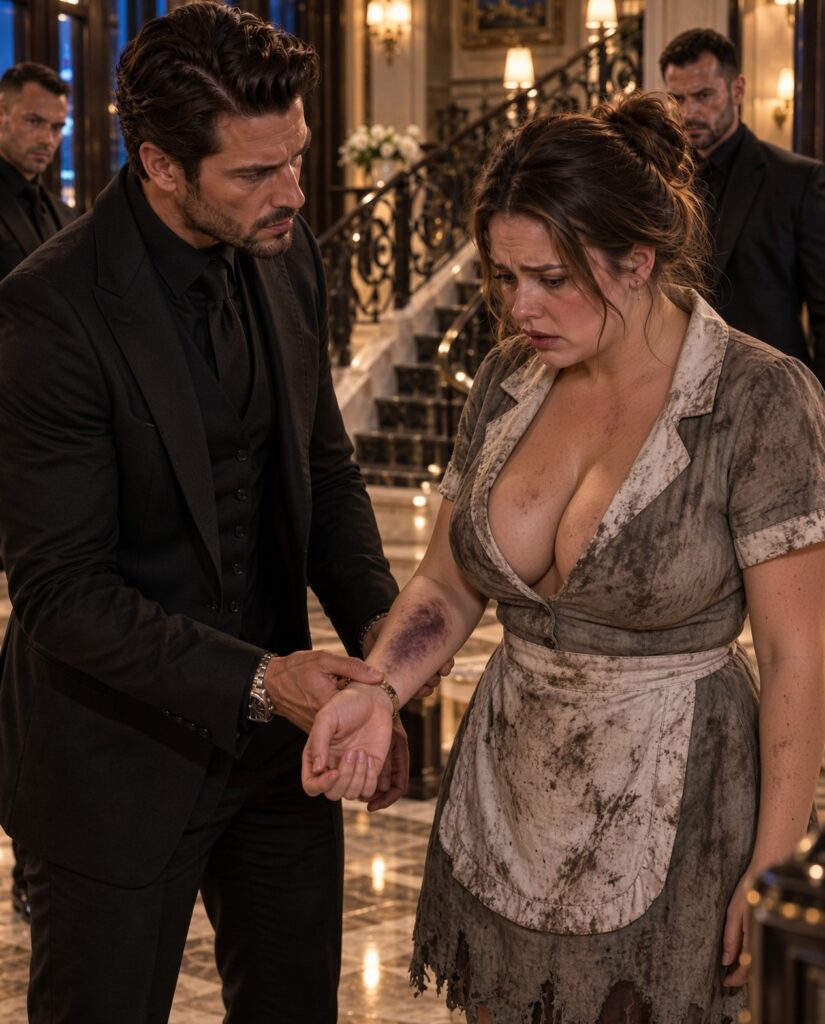
The Mafia Boss Saw Finger-Shaped Bruises on His Housekeeper’s Wrist—Then She Named the Men Who Hurt Her, and He Realized His Father’s Oldest Friend Had Been Secretly Rebuilding the Criminal Empire He Thought He Destroyed
A silver tray shattered across Lorenzo Moretti’s marble floor, and when his housekeeper’s sleeve slipped back, he saw four purple fingerprints wrapped around her wrist.
Emma begged him not to retaliate—because the men who hurt her worked for him, knew where she lived, and had already threatened neighborhood shopkeepers in his family’s name.
By sunrise, Lorenzo discovered the bruises were not evidence of three rogue guards at all—they were the first visible crack in a secret extortion network controlled by the man his dead father had trusted more than anyone alive.

PART 1 — THE BRUISES ON MY HOUSEKEEPER’S WRIST EXPOSED THE FIRST CRACK INSIDE MY OWN HOUSE
The silver tray hit the marble floor at 7:13 on a Thursday morning.
The sound cracked through Lorenzo Moretti’s study like a gunshot. Coffee splashed across white Carrara stone, porcelain broke, and Emma Collins stood beside the desk with her right arm pressed against her ribs.
For two years, she had moved through the Beacon Hill estate with the quiet efficiency of someone who knew wealthy men preferred not to notice the people who cleaned up after them. She opened curtains before sunrise, polished silver after midnight dinners, remembered which doors stayed locked and which flowers made Lorenzo’s mother sneeze.
She had never dropped anything.
Lorenzo lowered the document in his hand. “What happened?”
“Nothing.”
His gaze sharpened.
Emma crouched too fast. She gathered the broken cup with her left hand while her right disappeared inside the sleeve of an oversized gray cardigan.
“Emma.”
She froze.
It was the first time in nearly two years he had used her first name.
Lorenzo Moretti was thirty-eight, black-haired, broad-shouldered, and dressed in a charcoal suit without a tie. Boston newspapers called him a businessman. Federal prosecutors used less flattering descriptions behind closed doors.
“What happened to your wrist?”
“I burned myself cooking.”
“You don’t cook.”
Emma looked up. “How would you know?”
He did not answer.
“Show me.”
“No.”
The word was soft.
It stopped him.
“You hired me to clean your house,” Emma said. “You don’t own my body because I work here.”
Lorenzo leaned back slightly.
Everyone feared him. Politicians disguised it. Rivals weaponized it. Emma Collins simply looked tired.
She bent again. Her sleeve caught beneath her palm.
Pain crossed her face.
Lorenzo caught her forearm instinctively.
Emma gasped and went completely still.
“Let go.”
He did.
Immediately.
“Did someone hurt you?”
“No.”
“Emma.”
Her fingers trembled.
He reached for the edge of her cardigan instead of her skin. “May I?”
After a moment, she nodded.
He raised the sleeve.
A crude white bandage circled her wrist. Dark bruises extended above it, four unmistakable finger marks staining the inside of her forearm.
Lorenzo stopped breathing.
“Who?”
“Don’t.”
“Who touched you?”
Emma glanced toward the open study door.
Someone inside his world.
Lorenzo shut the door, then stepped away from it when her face tightened.
“Tell me.”
She swallowed. “Last night I went out for cold medicine. Behind Mr. Russo’s bakery, three men were demanding an envelope.”
Lorenzo’s expression changed.
“I recognized them. Your security people. Daniel Krell was one.”
“What did you hear?”
“They said Mr. Russo’s payment would double next month. One of them reminded him what happens to businesses that forget who protects the neighborhood.”
The room became unnaturally quiet.
“Krell followed me almost four blocks,” Emma continued. “He asked what I heard.”
“And?”
“I told him enough.”
Lorenzo stared.
“I told him Mr. Russo was paying because they were threatening him, and I said he should be ashamed.”
“You confronted three armed men?”
“I was angry.”
“You were alone.”
“I noticed that afterward.”
His mouth almost moved.
Then she said, “Krell grabbed my wrist and told me accidents happen to people who mistake courage for importance.”
Lorenzo became perfectly still.
“He let me go,” she added quickly.
“Because he chose to?”
Emma hesitated. “A car turned the corner.”
Lorenzo reached for his phone.
“No.”
His eyes lifted.
“I need this job. Those men know where I live. If they disappear tonight, I don’t want to know why. But I also don’t want anyone dying because of me.”
For several seconds neither moved.
Then Lorenzo lowered the phone.
“What do you want me to do?”
Emma blinked.
No one asked Lorenzo Moretti that question.
“I want Mr. Russo left alone. The other stores too. And I want those men away from me.”
“Anything else?”
“Yes.”
“I want to go back to being invisible.”
Lorenzo looked at the bruises on her wrist, then at her face.
“That part may be difficult.”
PART 2 — LORENZO THOUGHT THREE GUARDS HAD GONE ROGUE; THEN THE MONEY LED TO THE MAN WHO HAD HELPED RAISE HIM AFTER HIS FATHER DIED
By eight thirty, Emma was sitting inside a private orthopedic clinic overlooking the Charles River.
She had agreed only after Lorenzo promised the doctor would bill the estate’s ordinary employee-injury policy rather than hand her some mysterious envelope of cash.
The distinction mattered to her.
Apparently, Lorenzo had already noticed that.
He waited outside the examination room.
Not Daniel Krell’s replacement.
Not an assistant.
Lorenzo himself.
When Emma emerged wearing a proper wrist brace, she found him standing beside a window reading messages on his phone.
He looked up.
“Fracture?”
“No.”
“Ligament damage?”
“Mild strain.”
“Pain medication?”
“Over-the-counter.”
He nodded once.
“Good.”
Emma stared.
“What?”
“You sound like a checklist.”
“I like information.”
“I noticed.”
He drove her home personally.
A black SUV followed three cars behind.
Emma noticed it by the second turn.
“You said no bodyguards.”
“I said I heard what you wanted.”
“That sounds dangerously different.”
“I adjusted.”
She almost smiled.
Lorenzo saw it and looked back at the road too quickly.
Her apartment occupied the second floor above a laundromat in the North End.
The building smelled of detergent, old radiators, and garlic from the restaurant downstairs.
Lorenzo parked at the curb.
Emma reached for the door.
“You’re not working tomorrow.”
Her hand stopped.
“I can’t afford unpaid leave.”
“You’re being paid.”
“I don’t want charity.”
“It isn’t charity.”
“What is it?”
“Administrative leave while I investigate violence committed by employees.”
That answer was irritatingly reasonable.
She opened the door.
“Lorenzo.”
His eyes shifted toward her.
“If those men disappear tonight, I don’t want to spend the rest of my life wondering whether somebody died because I opened my mouth.”
His jaw tightened.
“They won’t die because of you.”
“That is carefully phrased.”
“Yes.”
At least he did not insult her by lying.
Lorenzo waited until her apartment light came on.
Then he drove back to the estate.
At 5:06 the next morning, seven security officers had their access credentials suspended.
At 5:22, company-issued weapons were secured.
At six, outside employment counsel began interviews.
At seven, a forensic accountant started examining discretionary cash accounts associated with the estate-security division.
No one disappeared.
No one was beaten.
Emma would not learn that until later.
Lorenzo discovered something far worse.
Daniel Krell had not invented the neighborhood collections.
Eighteen family-owned businesses had been paying unauthorized “security assessments.”
A bakery.
Two groceries.
A dry cleaner.
Three restaurants.
A small pharmacy.
A florist.
A mechanic who had once repaired Lorenzo’s mother’s car.
The payments ranged from eight hundred to four thousand dollars a month.
Most were in cash.
Some moved through sham “consulting” invoices.
The final accounts belonged to companies controlled by Victor Salerno.
Lorenzo read the report twice.
Then a third time.
Victor had been his father’s chief lieutenant.
When Lorenzo’s father died, Victor had stood beside the coffin with one hand on eighteen-year-old Lorenzo’s shoulder.
He had taught him how to read a balance sheet.
How to spot a lie.
How to survive a room full of men waiting for weakness.
And apparently, how to hide theft from the person who trusted him most.
Victor sat across from Lorenzo that afternoon in a windowless conference room beneath a Moretti logistics warehouse in Chelsea.
Not restrained.
Not threatened.
Two lawyers sat outside.
Marco DeLuca, Lorenzo’s general counsel, remained inside.
Victor glanced at the printed transaction summary.
Then laughed.
“You’re destroying discipline over a maid.”
Lorenzo said nothing.
“Krell scared her.”
Victor leaned back.
“That’s all.”
“He bruised her wrist.”
“Then fire him.”
“I did.”
Victor smiled.
“Problem solved.”
Lorenzo slid another report across the table.
“Eighteen businesses.”
The smile faded.
“Unauthorized assessments.”
“Refund reserves.”
“Shell vendors.”
“Money into accounts you control.”
Victor did not touch the pages.
“You want to lecture me about unauthorized revenue?”
“I want an explanation.”
“From me?”
His laugh was uglier now.
“I taught you this business.”
Lorenzo’s face went cold.
“My father ran this neighborhood like farmland.”
“Fear was harvested.”
“Money followed.”
“When I took control, I ended that.”
Victor leaned forward.
“You thought you ended it.”
There it was.
Not denial.
Contempt.
Victor believed Lorenzo’s changes were weakness.
No trafficking.
No narcotics around schools.
No predatory loans to family businesses.
No protection collections.
Lorenzo had spent fifteen years dragging the Moretti organization toward legitimate freight, property, construction, and hospitality revenue.
Victor had quietly rebuilt the old system inside the cracks.
“You think mercy makes you strong?”
Victor asked.
“No.”
Lorenzo folded his hands.
“I think knowing which traditions deserve to die makes me intelligent.”
Victor smiled.
“You sound like your mother.”
“That is meant as an insult?”
“It’s meant as a warning.”
Then Victor made the mistake.
He said:
“You’re distracted.”
“By what?”
“A woman who scrubs your floors.”
Lorenzo’s stare sharpened.
Victor noticed.
And smiled wider.
It was less than a second.
But Marco noticed too.
When Victor left the room under formal suspension, Marco shut the door.
“He was looking for that.”
Lorenzo remained seated.
“What?”
“Reaction.”
Marco took off his glasses.
“He knows Emma matters to you.”
“She is an employee Victor’s men assaulted.”
“That isn’t what I said.”
Lorenzo’s eyes hardened.
“Do not turn this into something ridiculous.”
Marco stared.
“You’ve known me twenty years.”
“Yes.”
“Then you know I rarely volunteer to irritate you.”
“Apparently today is special.”
Marco put his glasses back on.
“Whatever Emma is to you, Victor noticed before you did.”
That sentence followed Lorenzo home.
Emma returned to work three days later.
The estate felt different.
Not safer.
Quieter.
Faces had changed.
Krell was gone.
So were six others.
No one explained why.
Emma did not ask.
For nearly a week, she and Lorenzo barely spoke beyond the ordinary language of the house.
Coffee.
Laundry.
Guests.
Schedules.
Then small things began happening outside.
Mr. Russo found an envelope beneath his bakery register containing every dollar his business had paid in unauthorized protection fees.
So did the florist.
The pharmacy.
The Vietnamese grocery three blocks from Emma’s apartment.
No Moretti name appeared anywhere.
The payments came through a restitution account administered by outside counsel.
Emma understood anyway.
The following week, a long-broken streetlight near her bus stop was repaired.
She assumed Lorenzo had arranged it.
He had not.
The city had simply finally processed the request.
Emma felt almost disappointed.
Then angry with herself for being disappointed.
That was the problem with powerful men.
Once they entered your life, coincidence began looking like their handwriting.
She found Lorenzo in the library one evening.
His jacket hung over a chair.
White shirt sleeves rolled to his forearms.
Rain touched the tall windows.
A stack of financial reports covered the table.
“You returned the money.”
He did not look up.
“You’ll need to be more specific.”
“To the businesses.”
Silence.
“You did.”
“Yes.”
“Why?”
“Because it should never have been taken.”
No performance.
No fishing for gratitude.
Emma crossed her arms.
“Most men with your reputation would have used it as a public-relations opportunity.”
“Most men with my reputation are exhausting.”
She laughed.
Lorenzo looked up.
The sound seemed to catch him unprepared.
“Thank you.”
she said.
“I don’t need that.”
“I know.”
She turned toward the door.
“Emma.”
She looked back.
His eyes dropped toward her brace.
“How is the wrist?”
“Better.”
A pause.
Then:
“Good.”
His hand shifted slightly at his side.
As though he had considered touching her and decided not to.
Emma noticed.
That was worse.
Victor waited twenty-six days before making his next move.
Emma left a pharmacy on Hanover Street at 7:18 p.m.
Cold rain glazed the pavement.
She had just slipped a bottle of cough syrup into her canvas tote when an engine screamed.
A sedan jumped the curb.
For one impossible second, headlights filled everything.
Someone grabbed Emma from behind.
Hard.
Pulled her backward.
The sedan missed her by inches.
She slammed into a broad chest.
A gun appeared beside her face.
Three shots cracked through the rain.
The sedan’s rear window shattered.
It accelerated away.
Emma turned.
“Lorenzo?”
He wore no coat.
Rain soaked his white dress shirt.
His left arm remained locked around her waist.
“How are you here?”
“Down.”
Another gunshot struck the pharmacy window.
Lorenzo pulled her behind a concrete planter.
Glass exploded across the sidewalk.
Within seconds, black SUVs flooded the intersection.
Men moved into defensive positions.
But Lorenzo’s attention stayed on Emma.
“Are you hit?”
“No.”
“Emma.”
“No.”
His hands moved to her shoulders.
Neck.
Ribs.
Checking.
Then reached her face.
Stopped.
Even now.
Waiting.
“I’m okay.”
she whispered.
For one second, Lorenzo closed his eyes.
Police arrived quickly because the Moretti driver had called 911 as soon as the sedan mounted the curb.
That surprised Emma.
She had expected the entire incident to vanish into Lorenzo’s private machinery.
Instead, shell casings were marked.
Store cameras were seized under evidence procedures.
Witness names were taken.
A detective separated Emma from Lorenzo for her statement.
Lorenzo did not interfere.
The sedan was found abandoned in Charlestown.
Stolen plates.
Wiped interior.
But one city traffic camera had captured a second vehicle following it.
Registered to a security contractor previously used by Moretti Holdings.
The authorization code associated with the rental came from Victor Salerno’s office.
Not proof Victor ordered the attack.
Enough to deepen the question.
Then detectives reached Emma’s apartment.
Two bullets had entered through her bedroom window twenty minutes after the pharmacy incident.
That changed everything.
She could not go home.
Lorenzo did not order her to the estate.
He asked.
“Your options are a hotel under police coordination, my guest wing with independent security, or wherever else you choose if law enforcement approves the location.”
Emma stared at him.
“You prepared options?”
“Marco did.”
“Of course he did.”
“What do you want?”
There it was again.
Not this is what happens now.
What do you want?
“The estate.”
she said reluctantly.
“Only because the police already know it.”
“Understood.”
“Separate room.”
“Yes.”
“No guard directly outside my door.”
“Stairwell?”
“Fine.”
“No tracking my phone.”
Lorenzo hesitated.
Emma’s eyes narrowed.
“Lorenzo.”
“You may disable location sharing yourself.”
“Good.”
“Security app stays installed.”
“Only emergency alerts.”
“Agreed.”
Negotiating safety with a crime boss was becoming disturbingly normal.
That night, Emma stood in a guest suite overlooking the garden.
The room was larger than her apartment.
That irritated her.
Lorenzo remained near the doorway.
“You’re using me to get to Victor.”
His expression hardened.
“No.”
“He attacked me because of you.”
“Yes.”
The honesty stopped her.
“No excuses?”
“Would excuses change anything?”
“No.”
“Then no.”
“And you’re keeping me here because I’m useful.”
“No.”
“Then why?”
Lorenzo looked at her.
For once, control deserted his face.
“When that car came toward you today, I forgot everything else.”
Emma’s breathing changed.
“I forgot who was watching.”
“The shooter.”
“Victor.”
“The investigation.”
He stepped closer, then stopped before entering her space.
“That is not useful to me.”
“Then what am I?”
His hand lifted.
Stopped beside her cheek.
“That,” Lorenzo said quietly, “is the problem.”
Emma’s eyes dropped to his mouth.
His expression tightened.
For one dangerous second, she thought he would kiss her.
Instead, he lowered his hand.
“Lock the door.”
Then walked out.
Emma stood alone, furious with him.
More furious with herself.
Because she had wanted him to stay.
Forced proximity stripped away mythology.
Lorenzo slept four hours a night.
Drank coffee black.
Read newspapers on paper because he believed algorithms showed people only what they already wanted to believe.
He called his mother every Sunday.
Hated opera despite owning a box at the Boston Opera House.
Remembered the names of employees’ children.
Knew which groundskeeper had diabetes and which driver’s wife was studying nursing.
Emma found those details difficult to reconcile with the man whose reputation could clear a restaurant.
Lorenzo learned things too.
Emma drank cinnamon tea when anxious.
She hated lilies because they reminded her of funerals.
She had once studied business administration before dropping out to care for her mother during cancer treatment.
She still kept the textbooks.
She wanted someday to run a household-management and staffing agency where domestic workers had written contracts and safety protections.
She had never said that aloud before.
Lorenzo listened.
Did not offer money.
That mattered.
One evening, Emma had dinner with Marco.
Strictly friendly.
He was married, nearly fifty, and possessed the exhausted humor of a man who had spent two decades preventing Lorenzo from ruining his own legal position.
When Emma returned, Lorenzo was waiting in the kitchen.
“You’re awake.”
“So are you.”
She removed her coat.
“Marco made me laugh.”
“I know.”
She stopped.
“Was that jealousy?”
“No.”
“Lorenzo.”
He looked at her.
“Yes.”
The admission silenced her.
“I don’t like it.”
he said.
“What?”
“That I care.”
Something softened inside her.
“You could try behaving like a normal man.”
“I have no training.”
She laughed.
Lorenzo stared at her like the sound hurt.
Emma noticed.
“You really don’t hear much laughter in this house.”
“Not before you.”
The room changed.
Lorenzo stepped closer.
His fingers rose.
Paused.
“May I?”
Emma nodded.
He brushed one strand of hair away from her cheek.
Nothing else.
The restraint was almost unbearable.
Then an alarm sounded.
Every light in the estate turned red.
Marco burst through the kitchen door.
“We found Victor’s room.”
Lorenzo’s hand dropped.
“What room?”
Marco’s face was grim.
“You need to see it.”
The hidden surveillance room sat behind the wine cellar.
The entrance had been disguised as old brickwork.
Plans showed the cavity had existed for nearly fifteen years.
Victor knew.
Lorenzo did not.
Inside were monitors, archived drives, listening equipment, old camera controllers and folders of photographs.
Lorenzo stared at the screens.
His father had apparently created parts of the surveillance system years earlier.
Victor had expanded it.
Secretly.
Office corridors.
Guest rooms.
Exterior gates.
Staff entrances.
Clare—no, Emma—moved toward one monitor.
Then froze.
Her apartment building filled the screen.
Her bus stop.
The grocery store.
The pharmacy.
Photographs covered an entire folder.
Emma entering the Moretti estate.
Leaving.
Speaking with Lorenzo after the clinic.
Getting into his SUV.
Hundreds of images.
Months.
“You knew?”
she whispered.
Lorenzo turned pale.
“No.”
“Tell me the truth.”
“I swear to you.”
For the first time, he looked frightened of her answer rather than of any armed enemy.
Marco opened another folder.
Security reports.
Behavior notes.
Lorenzo’s movements whenever Emma was present.
How long he spoke to her.
Whether he changed routes after she finished work.
Whether he sent staff home.
How quickly he responded to her injury.
“She wasn’t the primary target.”
Marco said quietly.
Lorenzo understood.
“I was.”
Victor had not watched Emma because she mattered to Victor.
He watched her because she mattered to Lorenzo.
Long before Lorenzo admitted it to himself.
A ceiling speaker crackled.
Victor’s voice filled the room.
“Finally.”
Lorenzo turned.
“You should have let Krell frighten the maid.”
Emma saw Lorenzo’s hand move beneath his jacket.
She caught his wrist.
“Don’t.”
His eyes snapped toward her.
Victor laughed through the speaker.
“She still thinks she can save you from becoming what you are.”
Lorenzo did not answer.
Then every light died.
Somewhere above them, gunfire erupted.
The marble floor trembled.
A security alarm screamed.
Victor had not merely watched the estate.
He had prepared to enter it.
END OF PART 2
Emergency lights flickered red across Lorenzo’s face as armed men moved through a service tunnel his own father had built years earlier.
Emma tightened her hand around his wrist.
Lorenzo looked toward the staircase, then at the woman Victor had spent months studying because he believed love would make the most dangerous man in Boston predictable.
And Emma realized the next decision would answer the question she had been asking from the beginning:
Would Lorenzo protect her—
or would fear make him take away her choices again?
PART 3 — VICTOR THOUGHT EMMA MADE LORENZO WEAK; WHAT HE NEVER UNDERSTOOD WAS THAT SHE HAD TAUGHT HIM THE DIFFERENCE BETWEEN POWER AND CONTROL
“Safe room.”
Lorenzo’s voice cut through the alarm.
Emma immediately shook her head.
“Where?”
“East wing.”
“How?”
“Service stairs.”
“Who is inside?”
“My mother is away.”
“Staff?”
“Evacuating through the south exit.”
“Police?”
“Already called.”
Emma stared.
“You called them?”
“Marco did the moment we found the surveillance room.”
That mattered.
No private war.
Not completely.
Lorenzo led her through the dark wine cellar.
Emergency lights painted the walls blood red.
Two loyal security officers moved ahead.
No one fired blindly.
Orders remained short.
“Identify before engagement.”
“Do not pursue outside the perimeter.”
“Preserve the surveillance room.”
Emma heard those words.
Preserve.
Evidence.
Victor’s crimes would not vanish into shattered marble.
The first explosion came from the main foyer.
Not military explosives.
A breaching charge on an exterior service door.
Still loud enough to shake dust from the ceiling.
Emma flinched.
Lorenzo looked back.
“You okay?”
“No.”
“Good answer.”
Despite terror, she almost laughed.
They reached the east corridor.
The reinforced safe-room door stood open.
Emma stopped.
“Come inside.”
“I can’t.”
“You mean you won’t.”
“Victor has men moving toward the central hall.”
“You have security.”
“Some of them may still be his.”
That silenced her.
Lorenzo turned toward the officers.
“You two stay with Emma.”
“No.”
His eyes hardened.
“Emma.”
“You keep using my name like it is an order.”
Even now.
Even terrified.
She challenged him.
Something almost like pride moved across his face.
“I am not going to fight.”
she said.
“I am not going to follow you.”
“But I’m also not locking myself in a room without knowing the second exit.”
Lorenzo pointed immediately.
“Rear stair.”
“Manual release.”
“Leads to the enclosed courtyard.”
“Thank you.”
Another burst of gunfire sounded far away.
He looked toward it.
Emma grabbed his shirt.
“Stop treating yourself like you are disposable.”
His gaze returned.
“If Victor reaches the ballroom—”
“Then what?”
“He may reach Marco and the evidence team.”
“So you personally have to solve it?”
“Yes.”
“No.”
Lorenzo stared.
“My people are being attacked.”
“And rushing into gunfire does not become leadership because your last name is Moretti.”
His jaw tightened.
“You expect me to hide?”
“I expect you to think.”
That sentence struck harder than shouting.
Lorenzo drew a breath.
Then used his radio.
“Dante.”
Static.
“Boss.”
“Do not chase the shooters.”
“Hold east and south corridors.”
“Police entry through north gate.”
“Victor alive if possible.”
A pause.
“Understood.”
Emma watched.
He had changed the plan.
Because she asked him to think.
Not because she ordered him.
Because the question had become part of how he made decisions.
Lorenzo turned back.
“I still need to reach Marco.”
“Then I’m staying in the safe room.”
“Thank you.”
Emma touched his chest.
His heart hammered beneath her palm.
She had never imagined Lorenzo Moretti frightened.
Now she understood.
Fear in powerful men rarely looks like panic.
It looks like urgency.
Like certainty.
Like orders given too quickly.
“Lorenzo.”
“Yes?”
“If you do something stupid, I will be furious.”
“Useful motivation.”
“And…”
She stopped.
Terrible timing.
His eyes searched hers.
“And?”
“I love you.”
The words came out almost angrily.
Lorenzo stared.
Then gave one short, broken laugh.
“That is spectacularly inconvenient.”
Emma’s eyes filled.
“Go.”
He touched her face.
This time with permission already in the way she leaned toward him.
Then kissed her.
Not violently.
Not like a claim.
Like a question neither had time to answer properly.
Emma kissed him back.
Gunfire sounded again.
They separated.
“Lock the door.”
This time, she did.
Lorenzo did not confront Victor alone in some theatrical duel.
Reality was messier.
By the time he reached the central ballroom, Boston police tactical officers had entered from the north side.
Two attackers surrendered.
One had been wounded.
Another fled toward the lower service tunnel and was arrested outside.
Victor remained inside.
Armed.
Desperate.
The ballroom had once hosted politicians, fundraisers and Moretti family weddings.
Now glass glittered across its marble floor.
Victor stood beneath the chandelier with a pistol in one hand.
Marco sat behind an overturned table, blood running from a cut along his temple.
Alive.
Lorenzo entered from the side corridor.
Victor smiled.
“You always were sentimental.”
Lorenzo stopped behind a stone column.
“You built cameras inside my home.”
“I protected it.”
“You extorted people under my name.”
“I preserved the organization.”
“You tried to murder an employee.”
Victor laughed.
“A maid.”
Lorenzo’s face changed.
“No.”
Victor’s smile thinned.
“That is your problem.”
“You look at her and forget what the rest of us built.”
“No.”
Lorenzo stepped partly into view.
“She made me remember there are people underneath everything men like us build.”
Victor lifted the gun.
“She made you weak.”
“No.”
Lorenzo’s voice became almost quiet.
“She made me choose.”
Victor fired.
The bullet tore through Lorenzo’s upper shoulder.
He staggered behind the column.
Marco shouted.
Police moved from the west entrance.
Victor fired again.
Then a voice came from the upper balcony.
“Victor.”
Every face turned.
Emma stood beside the old control console.
Lorenzo’s expression became furious.
“Emma, get down!”
She held up her phone.
The safe room’s internal panel had connected to the surveillance archive.
Emma had found Victor’s live audio channel still active.
She did not leave because she wanted to become an action heroine.
She left only after officers reached the east corridor and escorted her toward the police command position.
From there, Detective Caroline Shaw had asked whether Emma could identify Victor’s voice on the recovered system.
She could.
The phone in Emma’s hand was not some amateur secret recording.
It displayed a live evidence capture being made by investigators from Victor’s own surveillance network.
“You wanted everyone watched.”
Emma said.
Her voice shook.
“Now investigators have your voice describing exactly why.”
Victor looked toward the officers entering behind her.
Understanding reached him too late.
He raised his weapon toward the balcony.
Lorenzo moved from cover.
“Victor!”
Victor turned.
That half second was enough.
Police fired.
Victor fell.
His weapon skidded across the marble.
Alive.
Barely.
Lorenzo dropped to one knee.
Blood spread across his white shirt.
Emma forgot every rule she had spent months teaching him.
She ran.
“Lorenzo.”
He looked up.
“I told you to stay—”
“Finish that sentence and I’ll let the ambulance leave without you.”
His mouth moved.
Maybe a smile.
Then his eyes closed.
Lorenzo woke in Massachusetts General the following afternoon.
His shoulder felt as though someone had replaced the joint with fire.
Marco sat near the window.
“You look terrible.”
Lorenzo swallowed.
“Emma?”
Marco nodded toward the other side of the room.
She was asleep in a chair.
Hair messy.
Old sweater.
One hand resting on the mattress near his.
Not touching him.
Waiting.
Marco stood.
“I’ll give you privacy.”
“Victor?”
“Alive.”
“Custody?”
“Yes.”
“Evidence?”
“Secured.”
“Emma?”
Marco looked at him.
“I already answered that.”
“Answer again.”
“She is fine.”
Marco paused.
“She also called you an idiot in front of three surgeons.”
Lorenzo closed his eyes.
“Good.”
Emma woke ten minutes later.
She saw his eyes open.
Her face crumpled with relief before anger replaced it.
“You got shot.”
“I noticed.”
“You idiot.”
“Yes.”
“You confessed your feelings, kissed me, and immediately went toward a gunman.”
“Technically, he came toward—”
“Stop.”
Lorenzo stopped.
Emma’s mouth trembled.
He reached toward her.
Then remembered himself.
His hand stopped on the sheet.
Emma looked at it.
“You can touch me.”
His eyes lifted.
“Are you sure?”
“Yes.”
Lorenzo threaded his fingers through hers.
Slowly.
Carefully.
Emma squeezed.
“I love you too.”
He said nothing.
His eyes closed again.
For several seconds, the man Boston feared simply held her hand like it was the one thing keeping him anchored to the world.
Victor survived surgery.
That complicated everything.
Good.
Dead men make convenient endings.
Living defendants create records.
Victor was charged in connection with extortion, conspiracy, attempted murder, unlawful surveillance, financial crimes and the armed attack on the Moretti estate.
Daniel Krell cooperated.
So did two suspended security employees.
Once one man talked, others discovered principles quickly.
The financial investigation revealed more than unauthorized neighborhood collections.
Victor had siphoned money from Moretti construction and security subsidiaries for nearly eight years.
Fake vendors.
Inflated invoices.
Emergency cash accounts.
Several payments connected to political intermediaries.
Lorenzo’s own companies were subjected to audits.
Some regulators asked uncomfortable questions about why he had failed to detect it earlier.
He did not blame Victor for everything.
That mattered.
“I built an organization where one man controlled too many systems.”
Lorenzo told the independent board review.
“That was my failure.”
Marco stared at him afterward.
“You realize admitting fault voluntarily may cause an apocalypse.”
“Write it down.”
“I already did.”
Lorenzo returned every dollar investigators could identify as unauthorized neighborhood collections.
Not cash envelopes in the dark.
A restitution program managed through outside counsel and an independent accounting firm.
Businesses documented payments where possible.
Where exact amounts could not be proved, claims were reviewed.
Some were denied.
Most were paid.
It took months.
Not one cinematic afternoon.
Mr. Russo received his refund on a Tuesday.
Emma happened to be buying bread when he opened the letter.
The old baker looked at the check.
Then at her.
“You did this.”
“No.”
She shook her head.
“I told the truth.”
“Someone else finally did something with it.”
Mr. Russo’s eyes filled.
“That is sometimes the same thing.”
Emma carried those words home.
Victor eventually pleaded guilty to several financial and conspiracy counts but went to trial on the most serious violent charges.
The surveillance archive damaged him badly.
So did phone records.
Payments.
Krell’s testimony.
Weapons procurement.
Deleted access logs recovered from backup servers.
The prosecution did not need Emma to say Victor was evil.
Documents had fewer adjectives and more credibility.
Emma testified for one afternoon.
Victor’s attorney asked whether her romantic relationship with Lorenzo gave her a reason to exaggerate.
Emma looked at the jury.
“My relationship with Lorenzo is the reason I have spent two years insisting that loving someone does not make their bad decisions disappear.”
The attorney changed subjects.
Victor was convicted of attempted murder, conspiracy, illegal surveillance, extortion-related offenses and several financial crimes.
Not every count.
One witness’s testimony about an older assault failed corroboration.
The jury acquitted him there.
Lorenzo appreciated the specificity.
Justice that says everything too easily often becomes another kind of myth.
Victor received decades in prison.
Daniel Krell received a substantially shorter sentence after cooperation.
The other men faced charges appropriate to what prosecutors could prove.
No one vanished.
No basement executions.
No quiet graves.
Emma had asked Lorenzo not to become worse than the men who hurt her.
For once, a promise survived anger.
Six months after the ballroom attack, Emma entered Lorenzo’s study carrying one envelope.
No tray.
No coffee.
Lorenzo looked up.
The scar beneath his shoulder ached in winter now.
“What is that?”
“My resignation.”
His face became unreadable.
Emma placed the letter on his desk.
“You’re leaving.”
“I’m resigning.”
“Difference?”
“A large one.”
She sat opposite him.
“I do not want to spend the rest of my life wondering whether I fell in love with you because I worked in your house, needed your protection, and eventually got used to living inside your gravity.”
Pain crossed his face.
He did not interrupt.
“I love you.”
Emma continued.
“But you are still my employer.”
“You control the house.”
“Cars.”
“Security.”
“My paycheck.”
“My schedule whenever something goes wrong.”
She took a breath.
“I need to know what we are when none of those things connect us.”
Lorenzo stared at the resignation letter.
For years, men had threatened to leave him as leverage.
They expected negotiation.
Money.
Pressure.
Fear.
Emma simply waited.
“Effective when?”
“Two weeks.”
“I can pay you through—”
“No.”
He stopped.
Good.
“You’re not going to fight me?”
she asked.
“No.”
“Why?”
Lorenzo leaned back.
“You told me in this room that I did not own your body because you worked here.”
Emma’s expression softened.
“I remember.”
“So do I.”
He opened a drawer.
Emma narrowed her eyes immediately.
“If that’s a ring, close it.”
For perhaps the first time in his adult life, Lorenzo Moretti looked genuinely uncertain.
Emma laughed.
“Is it?”
Slowly, he closed the drawer.
“Yes.”
“Terrible timing.”
“I am discovering that.”
She walked around the desk.
“I just resigned.”
“I understand.”
“I want my own apartment again.”
“Yes.”
“I want to build the business I told you about.”
“Yes.”
“I want to know what dating you feels like when I can tell you to go home and you actually have to go.”
Lorenzo’s mouth moved.
“How long?”
Emma stared.
“Are you negotiating a trial period?”
“I negotiate when nervous.”
“You get nervous?”
“Only around you.”
She kissed him.
Lorenzo forgot whatever answer he had prepared.
Emma moved into a one-bedroom apartment in Charlestown.
No Moretti property.
No hidden subsidy.
She used savings and a small-business loan to launch Collins Household Staffing & Standards.
The name barely fit on the office door.
She refused to shorten it.
The company placed housekeepers, nannies, caretakers and estate staff under written employment agreements.
Overtime.
Privacy.
Harassment reporting.
Emergency contacts.
No confiscating passports.
No cameras inside sleeping quarters.
No retaliation for raising safety concerns.
Her first client was a cardiologist in Back Bay.
Second, a retired professor.
Third, Lorenzo’s mother.
Emma refused until Mrs. Moretti signed the same employer agreement as everyone else.
Lorenzo’s mother laughed for five full minutes.
Then signed every page.
Lorenzo offered no money.
Because Emma told him not to.
That restraint probably cost him more than the ballroom bullet.
They dated.
Actually dated.
Restaurants.
Museums.
A disastrous Red Sox game in cold rain.
Emma discovered Lorenzo hated baseball but enjoyed complaining about it.
He discovered she sang badly in cars.
Neither used these facts strategically.
Progress.
When Lorenzo wanted to send security after a threat against one of his warehouses, he asked whether Emma wanted coverage too.
Sometimes she said yes.
Sometimes no.
When she said no, no black SUV appeared secretly three blocks behind her.
She checked.
Often.
Trust is rebuilt through boring moments when the feared consequence simply does not arrive.
One evening, a year after her resignation, Lorenzo came to Emma’s office.
She was closing.
“Dinner?”
“No.”
He nodded.
“All right.”
She stared.
“What?”
“You’re leaving?”
“You said no.”
“Yes.”
“That means no.”
Emma smiled slowly.
“Good.”
“Was this a test?”
“Possibly.”
“You are exhausting.”
“So I’ve heard.”
Three weeks later, she asked him to dinner.
His expression brightened so quickly she almost laughed.
Choice changes the emotional temperature of everything.
The Moretti organization changed too.
Not into a charity.
Lorenzo remained a man with history, influence, and connections Emma preferred not to know in detail.
But the legitimate side expanded.
Independent compliance.
Professional security leadership.
Dual approvals.
Whistleblower protection.
No neighborhood collections.
No cash discipline system controlled by one longtime lieutenant.
Men who hated the reforms left.
Good.
Lorenzo discovered something unexpected.
Legitimate businesses made more money when employees did not steal and federal agents were not constantly threatening to seize assets.
Emma called this “civilization.”
He called it “administrative harassment.”
Marco called both of them unbearable.
Two years after Victor’s conviction, Lorenzo took Emma to Russo’s bakery on a snowy December afternoon.
Mr. Russo stood behind the counter pretending not to watch.
Children played beneath new municipal streetlights outside.
Not Lorenzo’s.
Emma had checked.
Lorenzo held two coffees.
“Seven minutes late.”
Emma said.
“Traffic.”
“You own parking garages.”
“That does not alter traffic flow.”
“Sounds like a management failure.”
He handed her a cup.
Cinnamon tea.
Not coffee.
She looked at him.
“You remembered.”
“I remember useful information.”
“That line again.”
“It worked once.”
His eyes dropped toward her wrist.
The bruises were gone.
Only a faint pale line remained where the cheap bandage had rubbed her skin.
That injury had pulled them into each other’s lives.
Emma no longer romanticized it.
She hated what happened.
She simply refused to hate everything that came after.
Lorenzo reached into his coat.
Emma immediately said:
“We discussed this.”
“We discussed a ring eleven months ago.”
“And I said not yet.”
“Yes.”
He took out a velvet box.
“But I have demonstrated extraordinary patience.”
“You complained about patience weekly.”
“That is not the same as failing to practice it.”
Emma laughed.
He did not kneel.
She was glad.
Public spectacle had never belonged to them.
Snow collected in his black hair.
Lorenzo held the closed box between them.
“Emma Collins.”
“Yes?”
“I spent most of my life believing love was another form of leverage.”
Her expression changed.
“My father taught me power kept people loyal.”
“Victor taught me fear kept people useful.”
“You taught me both men were wrong.”
Emma’s eyes filled.
“You were the first person in my house who was unimpressed enough by my power to tell me it frightened you.”
“I was mostly irritated.”
“I know.”
A smile touched his mouth.
“You were also the first person who made me afraid of using it badly.”
He opened the box.
A simple diamond caught the gray winter light.
“I cannot promise I will become harmless.”
Emma shook her head.
“I don’t want harmless.”
“I can promise I will never again mistake loving you for owning your choices.”
That was the sentence.
Not protection.
Not obsession.
Choice.
Emma looked at the man Boston still whispered about.
Then at his open hand.
The same hand that had once stopped inches from her face because she had not given permission.
“Yes.”
Lorenzo went completely still.
She laughed through tears.
“Yes, Lorenzo.”
He exhaled like someone had finally removed a weight from his chest.
Then she held out her hand.
He slid the ring onto her finger.
Behind the bakery window, Mr. Russo immediately looked away.
Emma smiled.
“He’s watching.”
Lorenzo glanced over.
“I can have the windows replaced.”
She stared at him.
“That was almost normal humor.”
“Do not tell Marco.”
They married the following spring.
Small ceremony.
No captains.
No politicians.
No photographers.
Marco served as witness.
Mrs. Moretti cried.
Mr. Russo supplied pastries.
Emma kept Collins professionally.
Lorenzo did not ask otherwise.
Marriage did not cure either of them.
Lorenzo still reacted too quickly when afraid.
Emma still assumed concern meant control before waiting for the next sentence.
They argued.
Went to therapy.
Made rules.
Broke smaller ones.
Apologized.
Tried again.
Healthy love turned out to be less cinematic than crisis and far more difficult to fake.
Collins Household Staffing & Standards grew across New England.
Emma created a legal-aid fund for domestic workers facing harassment, wage theft, stalking, or retaliation.
No worker was told gratitude was part of compensation.
No employer’s social status changed the contract.
Once, Emma rejected the household of a billionaire after his assistant asked whether staff could sign away the right to report “private disputes.”
“No.”
Emma said.
The assistant offered double the placement fee.
“No.”
Lorenzo heard about it and looked delighted.
“You enjoy saying that word.”
“I learned from experience.”
Years passed.
The Moretti name became less associated with fear and more with shipping terminals, hotels, and property development.
Not entirely.
History does not evaporate because somebody falls in love.
But Lorenzo stopped needing every room to become silent when he entered.
That was progress too.
At fifty-eight, Victor died in federal prison after a stroke.
Marco called Lorenzo.
Emma watched her husband sit at the kitchen table afterward.
No celebration.
No grief exactly.
Something between.
“What do you feel?”
she asked.
Lorenzo thought.
“I don’t know.”
“Good answer.”
He looked at her.
“You’ve been saying that for twenty years.”
“You finally started giving better answers.”
They drove to the North End that evening.
Mr. Russo’s bakery had passed to his daughter.
The old man had died peacefully two winters earlier.
A framed photograph near the register showed him flour-covered and laughing.
Emma stood beneath it for a moment.
That bakery was where everything began.
Not romance.
The truth.
Lorenzo came beside her.
“If you had not spoken up that night…”
“Someone else might have eventually.”
“Maybe.”
“Victor might have stayed hidden for years.”
“Maybe.”
“Krell could have hurt you worse.”
Emma turned.
“Do not turn survival into fate.”
He stopped.
She continued.
“I was frightened.”
“I made a decision.”
“It happened to matter.”
“That doesn’t mean people who freeze when they’re scared are weaker.”
Lorenzo nodded.
Another lesson.
Still learning.
Later, they walked through snow toward the harbor.
Emma slipped her hand inside Lorenzo’s.
He looked down.
“Voluntary?”
“Do not ruin it.”
“I need confirmation.”
“Lorenzo.”
He smiled.
The first morning of their story began with broken porcelain and four bruises Emma tried desperately to hide.
People who heard pieces of the story later often said Lorenzo saved her.
Emma always corrected them.
He protected her sometimes.
Badly at first.
Better later.
But saving was different.
Emma saved herself when she said no in his study.
When she made him release her arm.
When she told him nobody should die because she spoke.
When she refused to let protection become ownership.
When she resigned.
When she built a company with her own money.
When she returned to Lorenzo only after she had somewhere else to go.
That was why staying meant something.
Lorenzo understood eventually.
The most powerful thing Emma ever gave him was not obedience.
Not gratitude.
Not forgiveness.
It was trust.
And trust was valuable precisely because no one could order it into existence.
They reached the corner.
Snow moved softly through yellow streetlight.
Lorenzo stopped.
“What?”
Emma asked.
“Nothing.”
“You’re looking at my wrist.”
He had been.
The skin was clear now.
No bruises.
No fingerprints.
No evidence that Daniel Krell had once believed a quiet household employee could be frightened into silence.
“I still remember.”
Lorenzo said.
“So do I.”
“You were terrified of what I would do.”
“Yes.”
“Were you right to be?”
Emma considered.
“At the time?”
“Yes.”
The answer hurt him.
Good.
Truth sometimes should.
“And now?”
he asked.
Emma looked at the man beside her.
Older.
Scar at the shoulder.
Silver beginning near his temples.
Still dangerous to some people.
Still capable of mistakes.
Still asking.
“No.”
she said.
“Not now.”
Lorenzo breathed out.
Emma squeezed his hand.
“That is the difference.”
“What?”
“You used to think protecting me meant making sure nothing could reach me.”
“And now?”
She smiled.
“Now you know it means making sure I can still reach the door.”
They continued walking.
No armed men followed closely.
No black sedan waited at every corner.
No hidden cameras watched Emma’s bedroom.
No powerful man decided where she would sleep because he believed fear gave him permission.
Home waited several blocks away.
A home they had chosen together.
For years, Lorenzo Moretti had believed strength was the ability to remove threats.
Victor believed strength was the ability to create fear.
Krell believed strength was putting fingerprints on a woman’s wrist because he knew she needed her paycheck.
Emma had lived beneath all three definitions.
She rejected them all.
The strongest thing Lorenzo ever did was much quieter.
He stopped.
He listened.
He accepted that love did not automatically make his judgment superior to hers.
And when Emma eventually chose to stand beside him, he finally understood why that mattered.
A woman who is trapped beside you can stay forever and still never truly be yours.
A woman who is free to leave—and stays anyway—is giving you something power can never take.
Snow collected on Emma’s coat.
Lorenzo brushed it from her shoulder.
His hand paused before touching her face.
Even after all those years.
A question hidden inside an ordinary movement.
Emma leaned forward.
Permission.
His palm settled against her cheek.
Warm.
Familiar.
Safe.
The bruises had disappeared decades ago.
But the lesson remained.
Protection was not choosing for someone.
Love was not controlling every danger around them.
Power was not proving that nobody could tell you no.
Sometimes the hardest form of strength was simply hearing the word—
and moving aside.
Emma smiled.
Lorenzo kissed her beneath the falling snow.
And somewhere behind them, inside a bakery that no longer paid anyone for the privilege of being left alone, the lights stayed on late.
Not because the Moretti name demanded it.
Because people were working.
Laughing.
Living.
Unafraid.
That was the empire Emma wanted.
And eventually, it became the only one Lorenzo cared to keep.


