
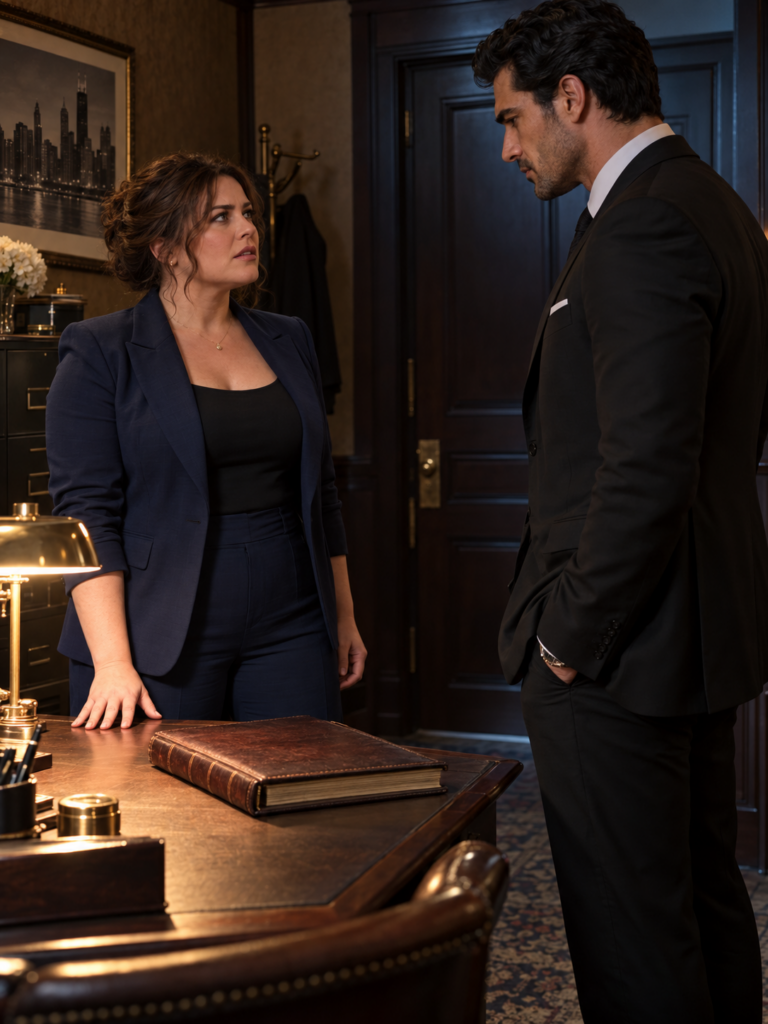
Her heel struck the back hallway tile before Gabriel answered.
“I know.”
Penelope stopped.
Not because he called her back.
Because he didn’t.
She turned halfway.
Gabriel remained inside her office.
No order.
No threat.
No promise that she would eventually surrender.
Just the contract sitting beneath the desk lamp.
Penelope hated that this version of him was more dangerous to her defenses than the man who had locked the door.
“Christopher,” she said. “Where is he?”
“At a private apartment in River North with two of my men outside.”
Her anger returned instantly.
“Outside or inside?”
“Outside.”
“Is the door locked?”
“No.”
“Does he know he can leave?”
“Yes.”
“Take me to him.”
Gabriel reached for his phone.
“Now.”
His eyes lifted.
“I heard you.”
Twenty minutes later, Penelope walked into the apartment before Gabriel.
Christopher sat on a gray sofa with his face buried in both hands.
He looked smaller than she remembered.
Older too.
“Penny.”
She crossed the room and slapped the ledger onto the coffee table.
“Three hundred thousand dollars?”
Christopher’s face collapsed.
“I was going to fix it.”
“With what?”
“I had a system.”
Penelope laughed bitterly.
“People with systems don’t end up signing debt markers.”
Christopher looked toward Gabriel.
Penelope stepped directly into his line of sight.
“No. You look at me.”
Her brother flinched.
“I’m sorry.”
“You always are.”
That hurt them both.
Penelope sat opposite him.
“Gabriel says the debt is forgiven.”
Christopher’s eyes widened.
“I know.”
“You know?”
“He told me before he left for the restaurant.”
Penelope slowly turned.
Gabriel stood near the doorway.
“You pardoned him before Richard ever walked in tonight?”
“Yes.”
“And before you made your proposal?”
“Yes.”
Some of the suspicion in her chest changed shape.
Not disappeared.
Changed.
Christopher rubbed his palms together.
“He offered rehab too.”
Penelope looked back at her brother.
“Are you going?”
His silence told her everything.
“Christopher.”
“I can handle it.”
“No, you cannot.”
His expression hardened.
“You don’t get to run my life.”
Penelope almost smiled at the cruel symmetry.
“No. I don’t.”
She pushed the treatment information toward him.
“But I do get to decide whether I keep financing your disasters. I’m done.”
His face paled.
“You mean that?”
“Yes.”
He looked toward Gabriel again as though the more powerful man might reverse her decision.
Gabriel said nothing.
Good.
Penelope stood.
“If you choose treatment, I’ll answer the phone. I’ll visit. I’ll help you rebuild when you’re doing the work.”
“And if I don’t?”
“I love you anyway.”
Her eyes burned.
“But I stop saving you.”
Christopher stared at her.
For the first time in years, Penelope allowed his consequences to remain his.
Outside, rain streaked the apartment windows.
She walked into the hallway.
Gabriel followed only after she was several steps ahead.
“Was the marriage proposal tied to him when you first conceived it?” she asked.
“Yes.”
“At any point were you planning to make his survival conditional on me?”
Gabriel took longer this time.
“Yes.”
Pain tightened her throat.
“When?”
“Yesterday.”
“And what changed?”
“You did.”
“That sounds flattering. Try again.”
His eyes darkened.
“I saw Richard reduce you to the insecurity he created, and then I watched myself prepare to exploit a different wound.”
Penelope absorbed that.
“I despised him for humiliating you while planning to corner you more effectively.”
The admission cost him something.
She could see it.
“That doesn’t absolve you.”
“No.”
“Christopher being safe does not make the original plan acceptable.”
“No.”
“And if I consider your contract, it will not be because you rescued him.”
Gabriel nodded.
“Then why would you consider it?”
Penelope looked through the apartment’s glass lobby doors at the rain-slick Chicago street.
Because the proposal was outrageous.
Because Gabriel Romano frightened her.
Because six months of his silent attention had frightened her for reasons she had refused to name.
Because the contract might place her inside a world where information itself was power.
And because part of her wanted to discover whether the man who had almost used coercion could actually learn restraint.
She turned back.
“I would consider it because your organization needs someone who understands hospitality logistics better than whichever idiot ordered twelve cases of French champagne to my club last month without accounting for dock restrictions.”
Gabriel blinked.
“That was Matteo.”
“Then Matteo is the idiot.”
For the first time, Gabriel laughed.
A real laugh.
It startled both of them.
Penelope raised the contract.
“I want separate bedrooms guaranteed. My job stays mine. No surveillance without my knowledge. No touching without permission. No threats against anyone I love to influence me.”
“Agreed.”
“I’m not finished.”
His mouth closed.
“Good.”
“And I want access to any business decision you expect me to publicly defend.”
Gabriel’s expression sharpened.
“That may be impossible.”
“Then find a different wife.”
Silence.
The elevator doors opened behind her.
Penelope stepped inside.
Gabriel remained in the hallway.
“Twenty-four hours,” she said. “Then I give you my answer.”
The doors began closing.
At the final inch, Gabriel said, “Penelope.”
She met his eyes.
“What?”
“I already know which answer I want.”
The elevator sealed shut before she could tell him wanting was still not enough.
The elevator descended, and Penelope read Gabriel’s contract twice before reaching the lobby.
By breakfast, three attorneys had marked it red.
By noon, Penelope had marked it redder.
When she returned to Gabriel’s downtown office that evening, Matteo himself opened the conference-room door.
The older underboss had silver at his temples and the expression of a man accustomed to bad news.
Penelope handed him a forty-two-page revision.
“For Mr. Romano.”
Matteo weighed the document in his hand.
“This was twelve pages yesterday.”
“He wants a competent wife.”
Something almost resembling approval crossed Matteo’s face.
“Apparently.”
Gabriel entered five minutes later.
He sat opposite Penelope.
No locked doors.
Two attorneys were present, one for each side.
Penelope noticed.
Another adjustment.
Gabriel opened her revisions.
“Section four,” he said.
“Keep reading.”
His eyes moved.
“Independent residence option.”
“Yes.”
“You intend to live elsewhere?”
“I intend to have the right.”
He continued.
“Separate professional identity.”
“Yes.”
“Protection detail by consent unless there is a documented immediate threat.”
“Yes.”
“That phrase is doing a great deal of work.”
“So will your lawyers.”
He turned another page.
“No unilateral control over transportation, employment, finances, medical decisions, communications, or family contact.”
Gabriel looked at her.
“Richard truly did a number on you.”
Penelope’s expression cooled.
Gabriel immediately set the pages down.
“That was careless.”
“Yes.”
“I’m sorry.”
Her attorney glanced between them.
Penelope picked up her coffee.
“Continue.”
Gabriel did.
Twenty minutes later he reached the final clause.
“Either party may terminate the public-marriage arrangement after six months without financial penalty.”
“One year was your requirement, not mine.”
“My council expects stability.”
“Your council can survive disappointment.”
Gabriel’s attorney coughed into his hand.
Matteo stared very carefully at the wall.
Gabriel leaned back.
“You realize nobody speaks about my council that way.”
“Then your marriage is already providing new experiences.”
His mouth threatened a smile.
Then Penelope became serious.
“If this happens, I will stand beside you publicly. I will learn what I need to learn. I will not embarrass you deliberately.”
Gabriel listened.
“But you will not use my brother, my body, my career, or my fear to keep me there.”
“No.”
“And if your organization creates danger around me, I get information.”
“Relevant information.”
“All information relevant to my safety.”
He considered.
“Agreed.”
Penelope looked at her attorney.
The woman nodded.
Penelope signed.
Gabriel watched her pen move.
Something about his silence made the moment heavier than any declaration.
When he signed beneath her, Penelope felt the ground shift.
Not because she had been taken.
Because she had entered knowingly.
The wedding took place the next evening in a private chapel near downtown Chicago.
Not because Penelope wanted a fairy tale.
Because speed mattered to Gabriel’s council, and because postponing the decision would not make it less strange.
Rosa, an Italian seamstress Gabriel’s staff recommended, arrived that morning with enough silk to outfit a small opera.
Penelope stood in a guest suite at the Winnetka estate while Rosa examined her with ruthless professional concentration.
Penelope braced for the familiar pause.
The slight tightening around the eyes.
The problem of her body presented as though her body had committed an administrative error.
Instead Rosa circled once.
“Excellent.”
Penelope blinked.
“What?”
“You have shoulders for structure and a waist worth defining. Stop hiding both.”
Two assistants began pinning ivory mikado.
For the first time in years, Penelope watched clothes adapt to her rather than treating herself as something that had failed clothing.
When she saw the finished gown, emotion caught unexpectedly in her throat.
Not thin.
Not transformed.
Herself.
Visible.
At the chapel, Gabriel waited in a black suit.
Only a small group attended.
Matteo.
Two family captains.
Penelope’s attorney.
Rosa, somehow.
Christopher did not come.
He had entered treatment that morning.
That mattered more.
When Penelope reached Gabriel, his composure slipped for half a second.
She saw it.
So did Matteo.
Gabriel recovered.
“You look—”
“Careful.”
His eyes warmed.
“Like yourself.”
Penelope’s throat tightened.
“That was acceptable.”
Their vows were simple.
The legal words mattered more than theatrical ones.
At the kiss, Gabriel waited.
Penelope understood the question.
She nodded.
His mouth touched hers gently.
No claim.
No conquest.
Still, something electric moved through her.
That night, Penelope entered the master suite because Gabriel had asked whether she wanted a drink before retiring.
Her room waited across the hall.
He poured sparkling water.
She laughed.
“You keep a bar that could finance a college education, and you offer me water?”
“You dislike drinking when you’re anxious.”
She stared.
“How do you know that?”
“You order club soda whenever a difficult customer is in the room.”
“Watching me again.”
“Yes.”
“At least you admit it.”
He handed her the glass.
Penelope’s fingers brushed his.
Heat moved through her arm.
Gabriel noticed.
He did nothing.
Strangely, his restraint made the room feel more intimate.
“You’re trembling,” he said.
“I married a syndicate boss today.”
“Fair.”
Penelope looked toward the adjoining hall.
“I was afraid you would think the contract entitled you to more.”
His expression hardened—not at her, but at the idea.
“It doesn’t.”
“You almost used Christopher to force the marriage.”
“Yes.”
“You don’t get credit for stopping before the worst version of yourself won.”
“I know.”
She studied him.
“Why do you answer that so easily?”
“Because arguing would make it less true.”
Penelope set down her glass.
“Good night, Gabriel.”
He walked to the door and opened it.
“Good night, wife.”
She gave him a warning look.
He corrected himself.
“Penelope.”
Three weeks changed everything.
Not dramatically.
Incrementally.
Penelope learned Vanguard Holdings from the legitimate side first.
Imports.
Warehousing.
Food-service contracts.
Event logistics.
She discovered within forty-eight hours that one distribution route supplying three downtown properties was wasting nearly eleven percent of its refrigerated capacity.
By the end of the week, she had redesigned the schedule.
Matteo stared at the projected savings.
“You did this from restaurant inventory experience?”
“I managed a supper club where one missing crate of oysters could start a diplomatic incident.”
Matteo laughed.
After that, he started bringing her real problems.
Gabriel noticed.
Instead of being threatened, he began asking her opinion.
That affected her more than gifts would have.
At dinners, they talked.
At first about work.
Then books.
Chicago.
His mother, who had died when he was young.
Richard.
Not often.
But enough.
Penelope learned Gabriel had spent most of his life confusing control with preparedness.
Gabriel learned Penelope’s self-deprecating jokes usually appeared just before she expected rejection.
Once, while dressing for dinner, she emerged in a deep green gown and muttered, “At least the chair won’t lose me.”
Gabriel’s face went still.
Penelope regretted the joke instantly.
He did not tell her she was beautiful.
He asked, “Was that your thought or Richard’s?”
The question followed her for days.
Their physical distance narrowed too.
A hand offered, never taken without invitation.
A dance at a charity dinner.
Her palm against his shoulder.
His attention on her face instead of scanning the room.
The first time Penelope kissed him without ceremony, it happened in the kitchen after midnight while arguing over whether he had any right to call deep-dish pizza an embarrassment to Chicago.
She kissed him to shut him up.
He remained perfectly still until she kissed him again.
Afterward, Gabriel said, “For the record, your argument remains weak.”
Penelope laughed into his chest.
Peace lasted four more days.
Then the Vanguard Charity Gala arrived.
The Field Museum glittered beneath white lights.
Penelope wore emerald green.
Not because Gabriel chose it.
Because she liked how it looked against her skin.
Halfway through the evening, Matteo approached them.
His face had lost color.
“Cavanaugh.”
Gabriel stiffened.
“Where?”
“Inside.”
Declan Cavanaugh entered the VIP hall moments later with four men.
He wore a smile Penelope recognized immediately.
Richard had worn that kind of smile.
Men wore it when they believed humiliation was a form of control.
Declan stopped ten feet away.
“Gabriel. Congratulations.”
His gaze moved to Penelope.
“So the rumors were true.”
Gabriel shifted.
Penelope touched his wrist before he could move in front of her.
Stay beside me.
Not ahead.
His eyes flicked to hers.
He understood.
Declan removed a flash drive from his pocket.
“I heard you forgave Christopher Hayes.”
Penelope’s stomach dropped.
Declan smiled wider.
“Unfortunately, Christopher had other debts.”
Gabriel’s expression changed.
Before Romano protection found him, Declan explained, Christopher had sold details about Vanguard’s primary Lake Michigan warehouse.
Guard rotations.
Vehicle windows.
Storage maps.
“My men are emptying it right now.”
Matteo whispered a curse.
Declan looked directly at Penelope.
“Your wife’s brother just cost you millions.”
Around them, conversations died.
Gabriel’s captains stared.
Not at Declan.
At Penelope.
She felt the old instinct arrive.
Become smaller.
Disappear.
Let Gabriel handle it.
Then Penelope remembered a spreadsheet she had reorganized eight days earlier.
High-value shipping routes.
Lake Michigan warehouse.
Cicero overflow facility.
And a discrepancy that had annoyed her enough to change the entire week’s allocation.
Penelope turned to Matteo.
“When I changed Thursday’s routing, where did the insured high-value inventory go?”
His eyes widened.
“Cicero.”
Declan’s smile faltered.
Penelope continued.
“What remains at Lake Michigan?”
“Empty containers. Maintenance equipment.”
“And the ventilation project?”
Matteo understood.
“Scheduled tonight.”
Penelope looked back at Declan.
“You sent armed men into an almost empty warehouse that has already been isolated for hazardous-material remediation.”
Declan’s face changed.
Penelope lifted her phone.
“I suggest you call them.”
His confidence cracked.
Gabriel still had not moved.
He was staring at her.
Not rescuing.
Watching.
Trusting.
Declan reached for his own phone.
Penelope’s voice stopped him.
“One more thing.”
He looked up.
“My brother betrayed us.”
Saying it hurt.
“But his betrayal does not make me responsible for his choices.”
She glanced toward Gabriel.
“And it does not make my husband responsible for saving me from them.”
Then she faced Declan again.
“So if you came here expecting shame to separate us, you misunderstood the marriage.”
For the first time that night, Gabriel smiled.
Declan’s smile disappeared completely.
The gala hall remained silent around them.
Penelope could hear glasses settling onto tables.
A distant string quartet continued playing because apparently no one had told the musicians that half the city’s criminal hierarchy had just stopped breathing.
Declan looked from her to Gabriel.
“You’re letting her speak for you now?”
Gabriel’s answer came calmly.
“No.”
Penelope felt his hand open beside hers.
Not taking.
Offering.
“She is speaking for herself.”
She placed her hand in his.
The distinction landed harder than any threat.
Declan glanced at his phone.
The screen lit with incoming calls.
Once.
Twice.
Three times.
His face changed.
Matteo leaned toward Gabriel.
“Chicago police units are moving toward the warehouse. Fire department too.”
Penelope looked at Matteo.
“You called them?”
“No.”
She understood.
The hazardous-material contractor had automatic security alerts.
Declan’s men had broken into a monitored commercial site while armed.
Real consequences were already arriving.
No sealed room.
No execution order.
No private war required.
Declan looked suddenly less like a rival king and more like a man realizing his plan had failed in several directions at once.
Gabriel stepped forward only then.
“You entered my event uninvited,” he said. “You threatened my business and tried to use my wife’s family against her.”
His voice remained quiet.
“You should leave before legitimate law enforcement arrives here asking why your people are being arrested across town.”
Declan’s jaw clenched.
“This isn’t finished.”
Penelope answered before Gabriel could.
“It should be.”
Declan stared at her.
“You think being married to him makes you untouchable?”
“No.”
Penelope’s grip on Gabriel’s hand remained steady.
“I think learning from my brother’s mistakes makes me harder to manipulate.”
That was different.
Declan left.
His men followed.
The doors closed behind them.
Only then did the room breathe again.
Low murmurs spread among Gabriel’s captains.
Penelope saw something unfamiliar in their faces.
Not approval because she belonged to Gabriel.
Respect because she had changed the outcome.
Matteo approached.
“Donna.”
Penelope raised an eyebrow.
He smiled.
“You saved us several million dollars last week without knowing it.”
“I fixed an inefficient route.”
“Same result.”
“No.”
She shook her head.
“That difference matters.”
Matteo studied her.
Then nodded.
“Yes.”
Gabriel remained quiet until they reached a private gallery beyond the gala hall.
The moment the doors closed, his restraint fractured.
“Christopher sold our security schedules.”
Penelope turned toward him.
“I know.”
“You knew he was capable of lying.”
“I knew he was capable of gambling. I did not know this.”
Gabriel paced once.
“He put you in the middle of—”
“Stop.”
He looked at her.
Penelope’s heart was pounding.
Not from Declan.
From the sentence she knew Gabriel was about to finish.
He endangered you.
I will handle him.
The old language.
The old solution.
“Christopher betrayed you,” she said. “He betrayed me too.”
Gabriel’s jaw tightened.
“If he returns to Chicago—”
“You will tell me.”
“He stole operational intelligence from my organization.”
“I understand.”
“There are consequences.”
“Yes.”
Gabriel looked almost angry that she agreed.
Penelope stepped closer.
“But I need to know what those consequences are before you impose them.”
Silence.
She continued.
“I entered this marriage after you promised information relevant to my safety. Christopher is relevant.”
“He may never return.”
“That isn’t the point.”
“No.”
Gabriel rubbed a hand across his face.
The movement was startlingly human.
“What do you want me to say?”
“The truth.”
His hand dropped.
“If Christopher returns while Cavanaugh can reach him, he becomes a security risk.”
“What would the old Gabriel have done?”
His eyes went cold.
“Killed him.”
The word struck hard.
Penelope inhaled slowly.
“And the man standing here?”
Gabriel looked at her.
“Would call you before making any decision that affects your family.”
“That’s not enough.”
His expression hardened.
Penelope held her ground.
“My consent does not make killing someone acceptable.”
“Penelope—”
“No.”
The gallery seemed to shrink.
“You told me your world had rules. Fine. I am telling you marriage has rules too.”
He stared at her.
“You cannot ask me to become your partner while keeping a private category of decisions where your answer is always violence.”
Gabriel’s face became unreadable.
“That world existed before you.”
“I know.”
“I cannot dismantle it because you dislike it.”
“I did not ask you to.”
“Then what are you asking?”
Penelope took a breath.
“For you to understand that I will not become the excuse you use to be cruel.”
The words landed.
Gabriel looked away.
For several seconds the only sound came from gala music beyond the wall.
When he spoke again, his voice had changed.
“My father used to say restraint was what weak men called hesitation.”
Penelope waited.
“I believed him for a long time.”
“And now?”
Gabriel looked at her.
“Now I am beginning to understand that restraint is only meaningful when you actually have the power not to use it.”
Penelope’s throat tightened.
“Good.”
“But Christopher still needs consequences.”
“Yes.”
“If he returns, he cannot have access to Vanguard or our family.”
“Agreed.”
“He will cooperate with the authorities if criminal charges arise from tonight.”
Penelope swallowed.
That hurt.
But it was fair.
“Agreed.”
“I will not have him killed.”
Her eyes closed briefly.
When they opened, Gabriel had moved no closer.
He was waiting.
“Thank you.”
His expression darkened.
“Do not thank me for reaching a standard I should already have understood.”
That was the moment Penelope realized how deeply she had fallen in love with him.
Not when he called her beautiful.
Not when he gave her his name.
Not when he watched her cross a ballroom as though every other person had disappeared.
Now.
When he refused praise for basic decency because she had taught him the difference.
They returned to the gala together.
An hour later, Matteo received confirmation that the men at the warehouse had been arrested.
No one had died.
No cargo was lost.
The scandal remained containable.
By midnight, Penelope was exhausted.
Gabriel drove with her to Winnetka.
No convoy in the car itself.
No business calls.
Just the two of them in the quiet rear compartment while Chicago lights slid across the windows.
Penelope rested her head against the leather seat.
“Christopher is going to hate me.”
Gabriel turned.
“For what?”
“For not fixing this.”
“You moved his debt away from death.”
“You did that.”
“Yes.”
“I convinced him to enter treatment.”
“He chose to enter.”
Penelope looked at him.
“Why are you being irritatingly precise?”
“Because you taught me to be.”
She almost smiled.
Then her eyes filled.
“I spent years thinking love meant preventing people from suffering consequences.”
Gabriel said nothing.
“My mother protected Christopher. Then I did. Paid bills. Covered debts. Lied to employers. Found apartments.”
Her voice broke.
“I thought if I stopped, something terrible would happen and it would be my fault.”
Gabriel reached for her hand.
He stopped before touching it.
Penelope turned her palm upward.
He took it.
“You did not create his choices,” Gabriel said.
“I know that intellectually.”
“And emotionally?”
“I’m working on it.”
His thumb moved gently over her knuckles.
“So am I.”
At the estate, Penelope walked upstairs.
Gabriel expected her to turn toward her room.
She did not.
She entered his.
He remained near the doorway.
“You’re tired.”
“Yes.”
“Then sleep.”
Penelope smiled faintly.
“You have spent months proving you can wait, Gabriel.”
His gaze sharpened.
“I noticed.”
She stepped closer.
“And I have spent months discovering that wanting you does not make me weak.”
“No.”
“This marriage began because you almost made the worst decision of your life.”
“Yes.”
“It continued because I made my own.”
His eyes darkened.
“Yes.”
Penelope placed her hands against his chest.
“What happens now is also my decision.”
Understanding transformed his face.
He touched her waist only after she leaned toward him.
Their kiss began slowly.
No debt.
No bargain.
No obligation.
When it deepened, Penelope felt the difference immediately.
Desire without fear.
Choice without leverage.
She pulled back just enough to whisper, “Don’t make me regret teaching you patience.”
Gabriel’s mouth curved.
“Never.”
The next morning brought consequences.
Not romantic ones.
Real ones.
Christopher called from treatment.
Penelope answered on the balcony outside Gabriel’s study.
“I heard what happened,” Christopher said.
“So did I.”
“Declan told people I gave him the warehouse information.”
“Did you?”
Silence.
Penelope closed her eyes.
“Yes.”
The admission hurt worse than she expected.
“Why?”
“I owed him too.”
“How much?”
“Not money.”
Penelope frowned.
“What does that mean?”
Christopher breathed shakily.
“After I stole from Romano’s game, I panicked. Declan’s people approached me. They said if I gave them something useful, they would protect me from Gabriel.”
Penelope looked through the glass doors.
Gabriel stood across the study but did not approach.
He could hear enough to know the subject.
He stayed away anyway.
“What exactly did you give them?”
“Old warehouse information I found on a Vanguard contractor portal.”
“Did you know they planned a raid?”
“No. I swear.”
Penelope believed only part of that.
For once, she did not need certainty immediately.
“Christopher, there may be charges.”
“I know.”
“You need a lawyer.”
“I know.”
“I will help you find one.”
His breath caught.
“But I will not lie for you.”
Silence.
“I know.”
“And I won’t ask Gabriel to erase this.”
Another silence.
Longer.
“Are you choosing him over me?”
The old guilt arrived instantly.
Penelope recognized it.
This time she did not obey it.
“No.”
She steadied her voice.
“I’m choosing not to destroy myself protecting you from yourself.”
Christopher began crying.
Penelope cried too.
They stayed on the phone.
No magical repair.
No sudden promise that addiction, fear, and betrayal would vanish.
Just truth.
When the call ended, Penelope remained outside for several minutes.
Gabriel eventually opened the balcony door.
“May I come out?”
She nodded.
He stood beside her.
Not touching.
“He admitted it.”
“I heard enough.”
“He may be charged.”
“Yes.”
“I’m not asking you to stop that.”
Gabriel studied her.
“I know.”
She wiped her cheek.
“I hate this.”
“I know that too.”
Penelope laughed weakly.
“You say that a lot.”
“I know.”
She elbowed him.
That finally made him smile.
Six months later, the contract reached its earliest termination date.
Penelope placed the original agreement on Gabriel’s study desk.
He looked at it.
Then at her.
“The six-month clause.”
“Yes.”
His face became carefully blank.
“If you want to leave, your attorney already has the release documents.”
Penelope stared.
“You prepared them?”
“The day after the wedding.”
That surprised her.
“Why?”
“Because a promise that you could leave meant very little if I controlled the mechanism.”
The answer settled somewhere deep inside her.
Penelope sat opposite him.
During those six months, Vanguard’s legitimate hospitality and logistics operations had changed dramatically.
Penelope had not become a ceremonial wife.
She had built an operations strategy group with independent authority.
She had reduced waste across four properties.
Reorganized event-security communication so that managers received threat information earlier.
Created staff evacuation procedures that did not depend on private muscle.
And infuriated Matteo at least twice a week.
Christopher remained in treatment.
He had retained counsel.
He was cooperating in the investigation.
Penelope loved him.
She no longer protected him from every consequence.
Richard had attempted to contact her twice.
She had blocked him once.
The second time, Gabriel asked whether she wanted intervention.
Penelope had said no.
Gabriel had replied, “All right.”
Richard eventually disappeared from their lives through the least dramatic mechanism imaginable.
Irrelevance.
Gabriel tapped the contract.
“What do you want?”
Penelope pretended to think.
“A better coffee machine in the west kitchen.”
“Approved.”
“Matteo banned from scheduling breakfast meetings before eight.”
“Denied.”
“Then this marriage has no future.”
His eyes narrowed.
She smiled.
Gabriel understood.
Something vulnerable entered his face.
“Penelope.”
She pushed the contract toward him.
“I’m terminating it.”
He became perfectly still.
Then she placed a second document on top.
His gaze dropped.
A new agreement.
One page.
No public-marriage obligations.
No fixed term.
No financial arrangements beyond the prenuptial agreement already protecting both of them.
At the bottom, Penelope had handwritten a sentence.
Marriage continues only while both people freely choose it.
Gabriel read it twice.
“You had lawyers draft one sentence?”
“I had lawyers argue over that sentence for three days.”
His laugh broke unexpectedly.
Penelope stood.
“So.”
He rose too.
“You are ending the arrangement.”
“Yes.”
“And staying married.”
“If you want to.”
Gabriel walked around the desk.
Then stopped several feet away.
The old Gabriel would have crossed the remaining distance and assumed the answer.
This Gabriel asked.
“May I?”
Penelope smiled.
“Yes.”
He reached her.
His hands settled around her waist.
Not hiding her.
Not reshaping her.
Not holding tightly enough to prevent departure.
Just holding.
“You once told me men like me don’t marry women like you,” he said.
Penelope winced.
“I was having a terrible night.”
“You were also wrong.”
“Careful.”
His smile deepened.
“What would you say now?”
Penelope looked at the man who had first frightened her by believing power gave him permission.
The man who had nearly turned her brother’s danger into leverage.
The man she would never pretend had started nobly.
But also the man who had unlocked the door when she demanded it.
Changed the contract when she challenged it.
Stopped using surveillance when she refused it.
Allowed her knowledge to outrank his instincts.
Accepted consequences he disliked.
And learned, piece by piece, that protection without choice was simply another kind of cage.
She touched the front of his shirt.
“I’d say a don can marry whoever he wants.”
Gabriel’s eyebrows rose.
“But,” she continued, “the woman still gets to decide whether she marries him.”
His expression softened.
“And?”
Penelope pulled him closer.
“She did.”
He kissed her.
Later that evening, they attended dinner at the Obsidian Room.
Penelope had not returned as its manager.
She remained a silent investor after purchasing a minority stake from the retiring owner with her own money.
When she entered, staff greeted her first.
Not because Gabriel stood beside her.
Because she had earned that affection years earlier.
Their table was booth four.
Penelope stopped beside it.
“Of course.”
Gabriel pulled out her chair.
“You always liked this booth?”
“I liked the view.”
“Of the room?”
His gaze settled on her.
“No.”
Penelope laughed and sat.
Around them, Chicago continued being Chicago—ambitious, glittering, dangerous, indifferent.
She did not feel smaller inside it anymore.
Gabriel sat opposite her rather than surrounding her.
Her phone vibrated.
A message from Christopher.
Six months sober.
Penelope smiled.
She typed back three words.
Proud of you.
Nothing about saving him.
Nothing about fixing him.
His life remained his.
Across the table, Gabriel watched her expression.
“Good news?”
“Yes.”
He did not ask to see the phone.
Another small thing.
Another enormous one.
Penelope set it down.
A waiter approached with champagne.
She took one glass.
Gabriel lifted the other.
“To what?”
She considered.
Not beauty.
Not survival.
Not becoming somebody’s queen.
Those were too simple.
“To people learning the difference between being chosen and being owned.”
Gabriel held her gaze.
“To being chosen.”
Their glasses touched.
Six months earlier, a locked office door had sounded like a threat.
Tonight, when the Obsidian Room’s front doors closed against the cold Chicago night, Penelope knew she could open them whenever she wanted.
She simply had no desire to leave.


