
Part 1
The night my friend set me up with Emma Collins, I learned something simple about people.
Some of them didn’t want romance.
They wanted an audience.
My name is Adam Reed. I was thirty-four, single, and apparently had been single long enough for everyone around me to consider it a situation requiring intervention.
My sister sent me profiles with comments like, She likes hiking. You like being outside sometimes.
My coworkers treated my dating life like a stalled construction project.
My friends were worse.
They kept telling me I needed to “get back out there,” as if romance were a public duty I had neglected and the community was beginning to suffer.
The truth was less dramatic.
A year earlier, I had ended a long relationship with a woman I had once imagined marrying. There was no betrayal. No screaming. No affair. Nothing clean enough to hate.
We had simply reached the point where the future she wanted and the future I wanted stopped looking like the same place.
For months, we had both pretended love could repair that.
Eventually, we stopped pretending.
Afterward, I discovered that peace could feel strange when you had spent years negotiating your life around another person. I cooked what I wanted. I stayed late at work when I needed to. I spent Sunday mornings with coffee and books and nobody asking why I hadn’t made plans.
I wasn’t lonely.
That seemed to offend people.
Then Mark invited me to dinner.
“Small group,” he said over the phone. “Nothing weird.”
I should have declined immediately.
Nothing good had ever followed the phrase nothing weird.
The restaurant was downtown, all exposed brick, low amber lighting, and a menu that used four adjectives to describe potatoes.
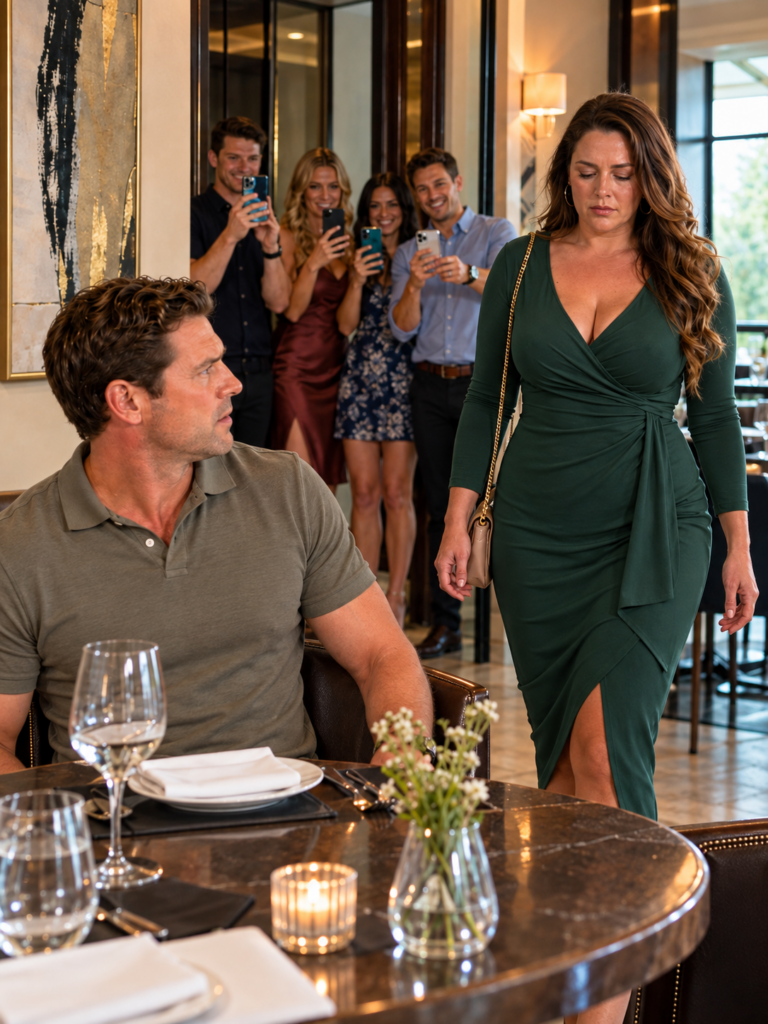
When I arrived, Mark was already seated with his wife, Jenna, two other couples, and one woman I had never seen before.
There was one empty chair.
Beside her.
I understood before anyone spoke.
Not because she did anything.
Because everyone else did.
The quick glances.
The suppressed smiles.
Jenna suddenly becoming deeply interested in the condensation on her water glass.
Brad, one of Mark’s friends from college, leaning back in his chair with the relaxed posture of a man who thought entertainment had just arrived.
The woman beside the empty seat noticed it too.
Her name, I learned a moment later, was Emma Collins.
She looked to be in her early thirties. Warm brown eyes. Shoulder-length dark hair. A navy dress without anything flashy about it.
She was plus-size.
That fact was obvious.
It was also not the first thing I noticed.
What I noticed first was how still she had gone.
Not timid.
Not embarrassed.
Still.
Like she had entered the room, understood the joke before anyone explained it, and decided nobody there would get the satisfaction of watching her react.
Mark stood too quickly.
“Adam. There he is.”
I looked at him.
“Here I am.”
“This is Emma.”
He gestured toward her with the false casualness of someone trying very hard to appear casual.
“Emma, Adam.”
She gave me a polite smile.
“Hi.”
“Hi.”
Then Mark said it.
“We thought you two might, you know, hit it off.”
The table went quiet.
Not completely. The restaurant was still alive around us—glasses touching, silverware against plates, a waiter laughing near the bar.
But our table stopped.
There it was.
The moment everyone had been waiting for.
I didn’t know exactly what Mark had told Emma. I didn’t know what he had told the others. I didn’t know whether he genuinely believed this was matchmaking or whether someone had decided the difference between Emma’s body and whatever they assumed my “type” was would make for an amusing evening.
What I knew was that Emma knew too.
Her expression stayed composed.
But something in her eyes had closed.
I pulled out the chair beside her.
“Good,” I said as I sat down. “I was hoping there’d be at least one person here I hadn’t already heard tell the same three stories.”
Emma looked at me.
Really looked.
One corner of her mouth twitched.
Mark blinked.
“Wow. Starting aggressive.”
“You invited me to a surprise dinner with witnesses.”
I picked up the menu.
“Aggressive feels appropriate.”
A few people laughed.
The laughter sounded different now.
Nervous.
Emma lifted her water.
“For the record, I was also told this was a normal dinner.”
I turned toward her.
“So we were both lied to.”
“Apparently.”
“Strong foundation.”
That did it.
Her smile appeared fully for the first time.
Small.
Sharp.
Genuine.
It changed her whole face.
And somewhere in that moment, the evening stopped being something happening to me and became something I was curious about.
For the next twenty minutes, everyone tried to act normal.
They failed.
Conversation kept drifting toward Emma and me, then rushing away whenever it became too obvious.
Someone asked about work.
Someone else asked where Emma lived.
Jenna asked me a question and then barely listened to the answer because she kept checking Emma’s face.
Emma handled all of it with more grace than the table deserved.
She was a high school art teacher.
She told a story about accidentally ordering seventy pounds of clay instead of seven because, in her words, the supplier’s website had been “designed by a raccoon with Wi-Fi.”
I laughed.
Not because I was trying to make her comfortable.
Because it was funny.
“What did you do with seventy pounds of clay?” I asked.
“Pretended it was intentional.”
“Did anyone believe you?”
“My freshmen did. Teenagers are very willing to assume adults know what they’re doing as long as you say things confidently.”
“That explains most corporate management.”
She laughed softly.
I discovered she loved old bookstores.
Hated cilantro.
Had a theory that every bad first date could be identified by how a man treated the waiter within the first ten minutes.
“That seems harsh.”
“It’s generous,” she said. “I used to give them twenty.”
I laughed again.
Across the table, Mark glanced at us.
His expression caught my attention.
Confusion, maybe.
Or disappointment.
That annoyed me more than I expected.
Emma seemed to notice it too, but she didn’t look over.
She kept asking me about work.
I managed operations for a regional bookstore chain, which usually earned polite nods from people who had no idea what that meant.
Emma’s eyes changed immediately.
“You work with bookstores?”
“I manage logistics, staffing problems, inventory headaches, vendor relationships, and occasionally the consequences of someone moving a display without telling anyone.”
“So you control books.”
“That sounds more impressive than it is.”
“Do you get staff recommendations?”
“I have access to all of them.”
She leaned slightly closer.
“That is dangerously close to seductive.”
I stared at her.
“Books?”
“Books, logistics, and insider recommendations. Powerful combination.”
The laugh surprised me out of my own chest.
It was the first moment all night when I forgot anyone else was there.
Then Brad opened his mouth.
He had been waiting.
I knew that later.
At the time, I only knew his tone before the sentence finished.
“So, Adam.”
I looked over.
He was grinning.
“Be honest. Is Emma your usual type?”
The table stopped breathing.
Emma’s face barely changed.
But her hand tightened around her fork.
There are moments when the meaning of a question sits beneath the words so clearly that pretending not to understand becomes its own kind of participation.
Brad was not asking about compatibility.
He wasn’t asking whether I usually dated teachers, brunettes, women who liked bookstores, or women who could make me laugh before appetizers arrived.
He wanted me to look at Emma’s body.
He wanted her to know I was looking.
And he wanted the table to watch.
I set down my glass.
“No.”
Silence.
Beside me, Emma looked toward her plate.
The answer hung there long enough to become dangerous.
Then I continued.
“She’s smarter, warmer, and funnier than most women I’ve been lucky enough to sit beside.”
Emma lifted her eyes.
I turned toward her enough to make sure she knew I wasn’t performing the sentence for everyone else.
“So if you’re asking whether I usually get set up with someone this interesting, the answer is no.”
Brad’s smile disappeared.
Mark’s wife looked into her drink.
I faced Brad again.
“And if you were asking something else…”
I let the sentence settle.
“Don’t.”
Nobody spoke.
I didn’t feel heroic.
Mostly I felt angry.
Not the loud kind.
The cold kind that came when adults behaved badly and expected everyone else to help disguise it as humor.
Beside me, Emma’s expression had changed.
Not softened exactly.
Opened.
“Well,” she said at last.
I glanced toward her.
“That was unexpected.”
“Good unexpected?”
I picked up my menu again.
“Or should-we-escape-through-the-kitchen unexpected?”
Her mouth curved.
“Ask me again after dessert.”
For the first time since walking in, I stopped caring what anyone else thought.
Dessert became the safest deadline I’d ever been given.
After Brad’s question, the table developed a sudden enthusiasm for behaving itself.
No one apologized.
That would have required admitting what had happened.
Instead, they moved on.
People like Brad loved sharp moments until those moments demanded accountability.
Emma didn’t help them pretend.
She didn’t storm out.
She didn’t collapse.
She didn’t reward them with visible injury.
She simply turned toward me and resumed the conversation.
“So,” she said, smoothing her napkin over her lap, “what do you do when you’re not rescuing blind dates from social experiments?”
“I thought we agreed I controlled books.”
“I’m trying to understand the full range of your responsibilities.”
I smiled.
“Mostly solving problems before customers realize there was a problem.”
“Competence.”
“Occasionally.”
“That’s another point in your favor.”
We talked about books.
Then teaching.
Then the kinds of questions that didn’t feel important until the answer told you something real.
She asked which book I secretly judged people for pretending to like.
I refused to answer on the grounds that it might damage my professional reputation.
She accused me of cowardice.
I asked whether people bought books because of who they were or because of who they wished they were.
“Both,” she said. “But I think the second kind is more hopeful.”
I thought about that.
“So buying the cookbook means I genuinely intend to cook?”
“No. It means some optimistic version of you does.”
“That person has disappointed me before.”
Emma smiled.
When she talked about her students, she became animated in a way I hadn’t seen yet.
There was a boy who only drew dragons but gave each one extremely specific emotional problems.
A senior who had painted her grandmother from memory and made an entire classroom go quiet.
A freshman who hid tiny cartoon frogs in every assignment.
“You let him?”
“I pretend I don’t see them.”
“Why?”
“Because fifteen is hard.”
The answer came without sentimentality.
That stayed with me.
Not because it was profound.
Because it was kind.
By the time dessert menus arrived, half the table had ceased to exist for me.
Apparently, Mark noticed.
“Wow,” he said with a strained smile. “You two are really hitting it off.”
Emma turned toward him.
“Was that not the plan?”
Mark hesitated.
“No. I mean, yeah. Of course.”
“You seem surprised,” I said.
He looked at me.
I held his gaze.
No anger.
No performance.
Just enough silence to make him sit with the question.
He looked away first.
Emma noticed.
The waiter came over.
She ordered chocolate cake.
Then she added, “Two forks.”
I looked at her.
“Bold assumption.”
She gave me a perfectly serious expression.
“You defended my honor. You’ve earned shared cake privileges.”
“Is that the system?”
“It is now.”
When the cake arrived, she gave me the first bite from my side of the plate without comment.
Something about that tiny act felt more intimate than it had any right to.
Not romantic.
Not yet.
Just an agreement.
A little private territory formed in the middle of a table where everyone had expected us to become a spectacle.
And every time I caught someone watching us, Emma seemed less embarrassed by it.
Eventually, she seemed amused.
Still, underneath her humor, I could feel something carefully held.
It appeared after dinner.
Coats came out.
Phones appeared.
Everyone suddenly became consumed by the complex mathematics of splitting the bill.
Emma slipped her purse over her shoulder.
“I’m going to get some air.”
She left.
I waited two minutes.
Partly because I didn’t want it to look like I was following her.
Mostly because I needed those two minutes not to turn toward Mark and start a conversation I wasn’t ready to have calmly.
Outside, Emma stood beneath the restaurant awning.
Rain hadn’t started yet, but the air smelled like it might.
Her arms were loosely folded.
City lights reflected in the pavement.
She looked composed.
Too composed.
I stopped beside her.
“You okay?”
She smiled without facing me.
“That question has become very popular tonight.”
“That’s not an answer.”
“No.”
For several seconds, she watched traffic move past the intersection.
Then she said quietly, “I’m okay.”
Another pause.
“I’m also tired of being okay in rooms where people expect me not to be.”
There was history in the sentence.
Enough of it that I didn’t rush to fill the silence afterward.
Eventually, she glanced at me.
“You handled Brad well.”
“He made it easy.”
“No.”
Her voice softened.
“He made it familiar.”
That landed differently.
Emma looked down at the sidewalk.
“I knew what this was about five minutes after I sat down. Maybe sooner. Jenna kept over-smiling. Brad looked like he was waiting for something.”
She let out a breath.
“I almost left.”
“Why didn’t you?”
She looked at me.
“Because you walked in.”
Something tightened beneath my ribs.
Not romance.
Not yet.
Trust.
A little of it.
Given before I had earned much.
“I thought if you looked disappointed, I’d excuse myself, go home, and delete three phone numbers before midnight.”
“And if I didn’t?”
“Then maybe dinner would be interesting.”
I smiled faintly.
“Was it?”
She held my eyes.
“It became interesting.”
The restaurant door opened behind us.
Mark stepped outside.
His hands were in his jacket pockets.
His expression belonged to a man who knew an apology was expected and had hoped circumstances might somehow perform it for him.
“Hey.”
Emma and I looked over.
“Adam, can I talk to you for a second?”
Emma shifted.
“I can give you two space.”
“No,” I said.
She looked at me.
Then Mark.
“You can stay.”
Mark’s face got worse.
Good.
He had wanted witnesses earlier.
He could have one now.
Part 2
Mark rubbed the back of his neck.
“Look, I didn’t mean for anything to get awkward.”
Emma gave a short laugh.
“That is an incredible sentence.”
He looked at her, then at me.
“I just thought you two might be good for each other.”
“That part could be true,” I said.
His eyes lifted.
“The problem is that you invited us like people and watched us like entertainment.”
His face changed.
Not dramatically.
Just enough.
“Brad was out of line.”
“Yes.”
I waited.
“And everyone who sat there waiting to see what I’d do was right there with him.”
He looked down.
There were a dozen things he could have said.
That I had misunderstood.
That Brad was always like that.
That nobody meant anything by it.
Instead, for once, he said nothing.
Emma stepped forward slightly.
“For what it’s worth, I don’t need anyone punished.”
Mark looked at her.
“I just need fewer people confusing cruelty with honesty.”
That did more than anything I could have said.
Mark’s shoulders lowered.
“I’m sorry.”
Emma nodded once.
“Accepted.”
A beat.
“Not erased.”
I looked at her.
The words were quiet.
No threat in them.
No revenge.
Just a boundary.
She was willing to let an apology matter without pretending it changed the past.
Mark went back inside soon after.
The door closed.
For a moment, Emma and I stood beneath the awning without speaking.
Then she said, “You know, I had a speech prepared.”
“For him?”
“For all of them.”
“How long?”
“Very good. Sharp. Devastating.”
“That doesn’t answer the question.”
“Possibly too long.”
I smiled.
“What happened to it?”
“You ruined it.”
“I apologize.”
“No, you don’t.”
“No,” I admitted. “I really don’t.”
Rain began softly.
Not enough to run from.
Emma looked toward the street, then back at me.
“So.”
“So?”
“You asked earlier.”
I remembered.
“Good unexpected or kitchen escape unexpected?”
She waited.
I tucked my hands into my jacket pockets.
“Good unexpected.”
Her smile appeared slowly.
Warmer than before.
“Good.”
Then she said, “Because I was hoping you’d ask me out without an audience.”
The sentence caught me somewhere unprepared.
Through the restaurant window, I could see Mark and the others still inside.
Watching us badly.
I stopped caring.
“Then I’m asking.”
Emma lifted an eyebrow.
“That fast?”
“No committee.”
“No one pretending this was their idea?”
“Nope.”
“No witnesses?”
I glanced through the window.
“Technically, we’re failing at that one.”
She laughed.
I looked back at her.
“Emma Collins, would you like to go out with me on purpose?”
The humor in her expression softened.
“On purpose is important.”
“I thought so.”
“Yes.”
The answer warmed me faster than it should have.
Then she added, “But not tonight.”
I blinked.
She noticed.
“Tonight is contaminated.”
I laughed once.
“That’s fair.”
Her smile faded into something more thoughtful.
“I don’t want our first actual date to be built on me being publicly underestimated and you being decent in front of witnesses.”
I stayed quiet.
She continued.
“I want to know what this feels like when nobody is watching.”
That was probably the moment I began to respect her in a way that went beyond humor and composure.
She wasn’t dazzled because I had said one good thing in a bad room.
She didn’t mistake decency for intimacy.
She wanted to see whether whatever had happened between us could survive daylight.
“Coffee Saturday?”
“Bookstore first.”
The answer came instantly.
I stared at her.
“What?”
“You manage bookstores. I teach art.”
She folded her arms.
“If you take me somewhere boring, I’ll lose respect for you.”
“That’s pressure.”
“That’s standards.”
I smiled.
“Bookstore Saturday. Then coffee.”
“Good.”
A car pulled to the curb.
Emma glanced at it.
“That’s mine.”
I didn’t want her to leave.
The realization embarrassed me slightly.
We had known each other for one strange dinner.
I knew she hated cilantro, loved bookstores, taught teenagers, and weaponized precision.
That should not have been enough for reluctance.
Apparently, it was.
Before stepping toward the car, she turned.
“Adam.”
“Yeah?”
“Thank you for what you said in there.”
“You don’t have to thank me for not being cruel.”
“No.”
She studied me.
“But I can thank you for being precise.”
Then she left.
I stood beneath the awning with rain gathering on my shoulders and the uncomfortable sense that Mark had accidentally accomplished one useful thing in his life.
Saturday took too long to arrive.
On Friday, Mark texted me three times.
I really didn’t mean it that way.
Then:
Brad was being Brad.
Then:
You’re mad, aren’t you?
I ignored the first two.
I answered the third.
I’m disappointed. That’s worse.
He didn’t respond.
Emma met me at the downtown bookstore at eleven.
She wore jeans, a rust-colored sweater, and a denim jacket with a streak of dried paint on one sleeve.
No performance.
No careful dinner-table armor.
Just comfortable.
I liked that immediately.
Before I could say hello properly, she pointed at me.
“Before we begin, I need you to understand something.”
“That sounds serious.”
“I judge people by which section they drift toward first.”
“High stakes.”
“Extremely.”
“Shouldn’t I be judging you? This is technically my territory.”
“You’re biased.”
“And you’re not?”
“No.”
The answer was delivered with enough confidence to make argument useless.
We spent two hours inside.
Emma moved through a bookstore the way some people moved through a city they loved—fast when something interested her, slowly when she wanted to remember.
She pulled books from shelves and told me which covers lied.
I showed her the staff recommendation wall.
One card recommended a mystery novel with so much enthusiasm that Emma stopped.
“This employee should be given more authority.”
“She’s eighty.”
“Even better.”
“She doesn’t work here.”
Emma looked at me.
“What?”
“Customer. Comes in every Tuesday. Recommends books to strangers. She’s responsible for half the mystery sales this quarter.”
“That woman owns this store.”
“Functionally, yes.”
Emma made me choose a poetry collection.
I made her choose a cookbook.
“I don’t cook.”
“That’s why.”
“This is retaliation.”
“This is optimism.”
She narrowed her eyes.
“You remembered.”
“People buy books for who they want to become.”
Her expression changed almost imperceptibly.
The joke softened.
“You remembered.”
“I said I did.”
Something passed between us then.
Small.
No dramatic pause.
No touch.
Just the knowledge that a sentence she had said in a noisy restaurant had stayed with me.
She placed the cookbook beneath her arm.
“Fine.”
Neither of us bought the books we had entered planning to buy.
Afterward, we walked to a small café around the corner.
Mismatched chairs.
Scratched wooden tables.
A window seat that seemed designed for people who intended to stay longer than necessary.
Halfway through coffee, Emma stirred her drink and said, “Can I ask something awkward?”
“Given how we met, normal seems unrealistic.”
She smiled.
Then the smile faded.
“Did you feel like you had to defend me?”
I could have answered immediately.
Part of me wanted to.
I didn’t.
I considered the question because she deserved an answer better than instinct.
“No.”
Emma waited.
“I felt like Brad tried to make you the punchline of a joke I didn’t agree to hear.”
She held my gaze.
“And if I had handled it myself?”
“I would have enjoyed watching him suffer.”
Her laugh came quickly.
Bright enough that a woman at the next table glanced over.
Emma lowered her eyes toward her cup.
“I’m used to people making assumptions before I’ve opened my mouth.”
Her thumb moved along the rim.
“Men especially.”
I said nothing.
“So when you looked at me like I was simply the person sitting beside you…”
She looked up.
“That mattered.”
“You were.”
“Exactly.”
The answer seemed to settle something.
Not fix it.
Just settle it.
Our date should have ended after coffee.
It didn’t.
We walked past an art supply store.
Emma stopped mid-sentence.
“No.”
I looked at the window.
“No what?”
“You’re not escaping this.”
“I wasn’t aware I was trying.”
“Come on.”
Inside, she bought brushes and made me guess what each one was used for.
I failed magnificently.
“That one’s for watercolor.”
“No.”
“Oil?”
“No.”
“Walls?”
“Adam.”
“What? It has bristles.”
She laughed.
“You are confidently terrible at this.”
“I work in books.”
“Noted.”
By late afternoon, we were outside her apartment building.
Emma held the bookstore bag against her hip.
Neither of us had a legitimate reason to keep standing there.
Neither of us moved.
“So,” she said.
“So?”
“Good unexpected?”
I thought about the restaurant.
The bookstore.
Coffee.
The way she had laughed in the art store after I suggested a fan brush might be used for painting radiators.
“Better.”
Her expression softened.
Then her phone buzzed.
She glanced at the screen.
Something changed.
Not hurt.
Exhaustion.
“What?”
She turned the phone slightly.
A message from Jenna.
I heard you and Adam are actually going out. That’s cute. Guess the setup worked after all.
Emma stared at it.
Then locked the screen.
“I really don’t want them thinking they get credit for this.”
“They don’t.”
She looked at me.
“No?”
“No.”
I nodded toward the phone.
“They created a bad room.”
Then I looked at her.
“You created everything worth staying for.”
Her eyes changed.
No joke came.
No deflection.
For the first time all day, Emma seemed to have no immediate answer.
Then she put the phone in her pocket.
“Come upstairs for tea, Adam.”
My pulse shifted.
She noticed.
Her mouth curved slightly.
“Tea.”
“I didn’t say anything.”
“You didn’t need to.”
I followed her upstairs.
Her apartment made immediate sense once you knew her.
Student artwork framed on one wall.
Sketchbooks stacked on the coffee table.
Plants in every window in varying conditions of survival.
A blue ceramic bowl full of wrapped candies beside the door.
Three blankets folded on the couch.
Emma kicked off her shoes.
“I should warn you.”
“About?”
“My tea collection suggests I’m more emotionally stable than I am.”
“I’ll try not to be misled.”
“Good.”
She made chamomile for herself and ginger tea for me.
We sat on the couch.
For a while, we talked about nothing important.
Bad apartment plumbing.
Bookstore smell.
Whether adults should legally be permitted more than one decorative blanket.
“You have three on this couch alone.”
“They serve different functions.”
“They are blankets.”
“That is a limited worldview.”
I smiled into my mug.
The quiet afterward wasn’t awkward.
That surprised me.
First dates often seemed to demand constant motion.
Questions.
Stories.
Proof that something was happening.
With Emma, silence felt like part of the conversation.
Eventually, she looked down at her tea.
“The thing about being made into a joke…”
I waited.
“People always expect you to appreciate it when someone else stops the joke.”
I understood.
“You don’t want to be grateful for basic decency.”
Her eyes lifted.
“Yes.”
“You shouldn’t have to be.”
The room seemed to become smaller.
Not physically.
Emotionally.
Emma leaned back.
“I liked what you did.”
She turned the mug slowly in her hands.
“I did. But I think I liked even more that afterward you didn’t treat me like I was fragile.”
“You threatened to judge my bookstore performance.”
“You needed pressure.”
“I performed well.”
“You did.”
Again, the silence.
Softer this time.
Emma set down her mug.
“Adam?”
“Yeah?”
“I’m not asking for a speech.”
I put mine down too.
“I’m not asking for reassurance.”
Her voice was steady.
“I just want the truth.”
I waited.
“Did today change how you saw me?”
“Yes.”
Something flickered across her face.
I continued before fear could finish the sentence for her.
“It made me see you more clearly.”
She didn’t move.
“I already thought you were beautiful.”
I said it simply.
No performance.
No pause asking her to reward me for saying it.
“But today I saw the way you hold your ground.”
Her eyes stayed on mine.
“The way you let people apologize without pretending what happened didn’t matter.”
I leaned forward slightly.
“The way you’re kind to teenagers without making a performance out of being kind.”
Something brightened in her eyes.
“The way you can spend twenty minutes explaining brushes to a man who clearly has no future in visual art.”
That made her smile.
“And the way you don’t seem interested in being rescued.”
Her smile faded into something deeper.
“So yes.”
My voice lowered.
“Today changed how I saw you.”
I let the next sentence come without trying to make it impressive.
“It made me want to know you properly.”
Emma blinked once.
Then whispered, “That was dangerously precise.”
“I was told precision matters.”
“It does.”
She kissed me.
Not suddenly.
Not hesitantly either.
She leaned toward me, gave me every opportunity to move away, and then closed the distance because she wanted to.
That mattered.
The kiss was warm.
Brief at first.
Then not quite as brief.
When we separated, Emma laughed softly and touched her forehead to mine.
“What?”
“I was trying not to kiss you until the second date.”
“How’d that go?”
“Poorly.”
“I’m honored.”
“You should be.”
The second date happened three days later.
No audience.
No setup.
No table full of people watching for a reaction.
Just us.
Exactly the way she had asked.
Part 3
The restaurant was Italian.
Small.
Warm.
The waiter brought extra bread without being asked, which earned immediate approval from Emma.
Halfway through dinner, she drew tiny cartoon frogs on the paper napkin.
I looked at them.
“The freshman?”
“You remembered him too.”
“You make remembering things sound surprising.”
“Sometimes it is.”
One frog held a paintbrush.
Another appeared to be judging me.
“That one looks hostile.”
“That one represents artistic criticism.”
“Of what?”
She looked at my shirt.
“Several choices.”
I laughed.
Then she told me about a student who had finally submitted a painting after months of insisting he “wasn’t an art person.”
“What changed?”
“I stopped arguing with him.”
I looked at her.
“He expected me to keep convincing him he had talent. So I told him he didn’t have to be an artist.”
“And?”
“He got offended.”
I smiled.
“That seems risky.”
“It was.”
“What did you say after that?”
“That he could keep telling himself what he wasn’t, or he could make something.”
“And he did?”
“He did.”
There was pride in her voice.
Quiet pride.
The kind that wasn’t about herself.
After dinner, we walked for almost an hour.
At some point, Emma took my hand.
She did it mid-sentence.
No announcement.
No question.
Her fingers simply slipped into mine while she was explaining why one of the city’s new murals was technically impressive and emotionally empty.
I nearly missed half the argument.
Not because hand-holding was extraordinary.
Because she had chosen it.
Emma had spent the night we met being turned into someone other people thought they could evaluate.
Every step since then had been hers.
Stay at dinner.
Come outside.
Accept Mark’s apology without erasing what he did.
Say yes to a date.
Say no to having it that night.
Invite me upstairs.
Kiss me.
Take my hand.
There was something deeply attractive about a woman who made her own choices and expected everyone else to live with them.
Mark apologized properly a week later.
He came to my office without warning.
I was reviewing inventory numbers when he appeared in the doorway.
“You busy?”
“Yes.”
He stood there.
I sighed.
“Come in.”
Mark sat opposite my desk.
For once, he didn’t joke.
“I thought I was being funny.”
I waited.
“I wasn’t.”
“No.”
“I’m sorry.”
I studied him.
He looked uncomfortable.
Good.
Some discomfort was useful.
“Tell her.”
“I will.”
He did.
Emma mentioned it later that night while we were cooking dinner at her apartment.
Or, more accurately, while I cooked and she supervised with aggressive opinions.
“Mark apologized.”
I glanced at her.
“How’d it go?”
“I accepted.”
“Not erased?”
She looked at me.
A smile slowly appeared.
“You really do remember everything.”
“Occupational hazard.”
She stole a piece of bell pepper from the cutting board.
“Accepted. Not erased.”
Then she leaned against the counter.
“But he didn’t make excuses this time.”
“That’s something.”
“It is.”
And that was it.
She didn’t spend the evening dissecting Mark.
She didn’t need him to suffer.
She simply noticed the difference between a useful apology and a convenient one.
That became one of the first things I loved about her.
I didn’t tell her that yet.
The word love had entered my thoughts before it entered my mouth.
That felt right.
Three months after we met, Emma invited me to the spring art show at her school.
The gymnasium had been transformed with folding panels, string lights, paper signs, and several hundred pieces of student work.
Emma belonged there.
I had seen her at restaurants.
Bookstores.
At home in socks, arguing with a plant she insisted was “being dramatic.”
None of those versions prepared me for this one.
Students pulled her from one display to another.
“Miss Collins, look.”
“Miss Collins, come see mine.”
“Miss Collins, he put my drawing in the wrong section.”
She moved through it all with patience I would not have survived for twenty minutes.
She remembered details.
Asked questions.
Knew which student needed praise and which one needed honesty.
I watched a boy show her an abstract painting with the seriousness of someone presenting evidence in court.
Emma studied it.
“What changed?”
He pointed toward one corner.
“I redid this.”
“I see that.”
“Is it better?”
She tilted her head.
“Do you think it’s more honest?”
He considered that.
“Yeah.”
“Then it’s better.”
The boy nodded as if she had confirmed something larger than paint.
Later, a shy girl wearing purple glasses approached us.
She looked at me, then at Emma.
“Miss Collins?”
“Yeah?”
“Is he your boyfriend?”
Emma turned.
I looked at her.
The girl looked between us.
There were several possible answers.
I chose the one that felt true.
“I’m trying very hard to earn the title.”
Emma’s smile spread so quickly the girl giggled.
“You’re doing okay,” Emma said.
“Okay?”
The student escaped before I could protest.
Emma touched my sleeve.
“Don’t get needy at the art show.”
“I was given a performance review in public.”
“You’ll recover.”
But later, while we were walking to my car, her hand found mine.
“You’ve earned the title,” she said quietly.
I looked at her.
“Officially?”
“Don’t make me revoke it.”
I didn’t.
Months passed.
The relationship didn’t become dramatic.
That was one of the things I loved most about it.
Emma stayed over at my apartment and complained that I owned exactly one usable blanket.
I stayed at hers and discovered she set three alarms but woke on the first.
She left books face-down despite working in education.
I objected on professional grounds.
She ignored me on personal grounds.
I learned which weeks of the school year exhausted her most.
She learned that inventory audits made me quiet, not angry.
When one of my stores had a plumbing emergency and I spent twelve hours dealing with ruined stock, she arrived at nine that night with takeout and no expectation that I entertain her.
When she had parent conferences, I knew not to ask “How did it go?” until she had eaten something.
We developed rituals without deciding to.
Saturday bookstores.
Tea after bad days.
A running argument about decorative blankets.
Every time she hid a tiny frog somewhere in my apartment, I pretended not to notice.
Every time she discovered I had noticed, she acted disappointed.
It wasn’t dramatic.
It was attachment becoming routine.
A year after our first dinner, we moved in together.
Not because we had a crisis.
Not because a lease expired at exactly the right cinematic moment.
Because Sunday mornings had started feeling strange when we woke in different places.
She brought too many blankets.
I brought too many books.
We compromised by purchasing more shelves and pretending that addressed either problem.
Living together showed me versions of Emma I hadn’t known.
The woman who stood calmly at a cruel dinner table could also become furious when the dishwasher was loaded “incorrectly.”
The woman who guided teenagers through insecurity could spend twenty minutes refusing to call the landlord because she hated making maintenance requests.
She learned things about me too.
That I became too practical when I was worried.
That I sometimes tried to solve feelings like scheduling problems.
That when I said, “I’m fine,” what I often meant was, “I don’t know what to call this yet.”
None of those discoveries frightened us away.
That, more than the easy parts, gave the relationship weight.
I had once believed compatibility meant wanting the same future.
Emma taught me it also meant knowing how another person moved through ordinary difficulty.
Two years after that, I bought a ring.
I kept it hidden for almost three weeks because I wanted the moment to be right.
Not impressive.
Right.
A crowd would have been wrong.
The beginning of us had belonged to too many witnesses.
I wanted the next beginning to belong only to us.
So I took her to the bookstore.
The downtown branch.
The one where we had our first real date.
She had no idea.
At least, I thought she had no idea.
We wandered through the store exactly as we had years earlier.
Emma drifted toward art.
I followed.
She pulled a book from the shelf.
“This cover is lying.”
“You’ve said that before.”
“It remains true.”
She read the back.
Put it away.
Picked up another.
I watched her for a few seconds.
The paint-stained denim jacket from our first date was long gone, but I could still see that woman.
The one who had looked at me across a bad room and decided to stay long enough to see what I would do.
The one who refused to confuse one decent act with proof of character.
The one who had made me earn every step after.
“Emma.”
She turned.
I had the ring in my hand.
For once, Emma Collins had nothing to say.
Her eyes dropped to it.
Then lifted to me.
I had imagined the speech.
Rewritten it.
Rejected every version.
In the end, I used the only sentence that felt true enough.
“I don’t want to be the man who defended you one night.”
Her eyes filled.
I continued.
“I want to be the man who chooses you every ordinary day after it.”
Her hand covered her mouth.
For one terrible second, I forgot how proposals worked.
Then she laughed through tears.
“Yes.”
I exhaled.
“Yes?”
“Yes, Adam.”
She held out her hand.
“Before you forget what happens next.”
I put the ring on her finger.
Then she pulled me up and kissed me between art history and watercolor technique.
When we separated, she looked around the shelves.
“You manipulated me with location.”
“I prefer emotionally strategic planning.”
“You work in operations.”
“Exactly.”
“That makes it worse.”
“You still said yes.”
“I did.”
She looked at the ring again.
Then back at me.
“And for the record?”
“Yeah?”
“You earned the title.”
Years later, when people asked how we met, Emma never told the story the way Mark originally did.
She never said our friends introduced us.
She never said it was a successful setup.
She smiled and said, “A group of people set us up badly.”
And I always added the same thing.
“Luckily, they underestimated both of us.”
Because that was the truth.
The important part of that first night was not that I defended Emma.
She never needed me to rescue her.
The important part was that we both saw something clearly.
I saw a woman who had every reason to walk away from a cruel room and chose instead to remain herself inside it.
She saw a man and refused to mistake one decent moment for proof that he deserved her trust.
Everything that mattered happened afterward.
The bookstore.
The coffee.
The questions nobody else heard.
The tea.
The kiss she chose.
Her hand finding mine on an ordinary sidewalk.
Meals.
Workdays.
Bad moods.
Art shows.
Shelves.
Too many blankets.
The thousand small moments where attraction became respect, respect became trust, and trust became a life.
The room that first brought us together had expected a reaction.
What it got instead was the beginning of something nobody there had earned the right to take credit for.
And Emma was right from the start.
On purpose mattered.


