
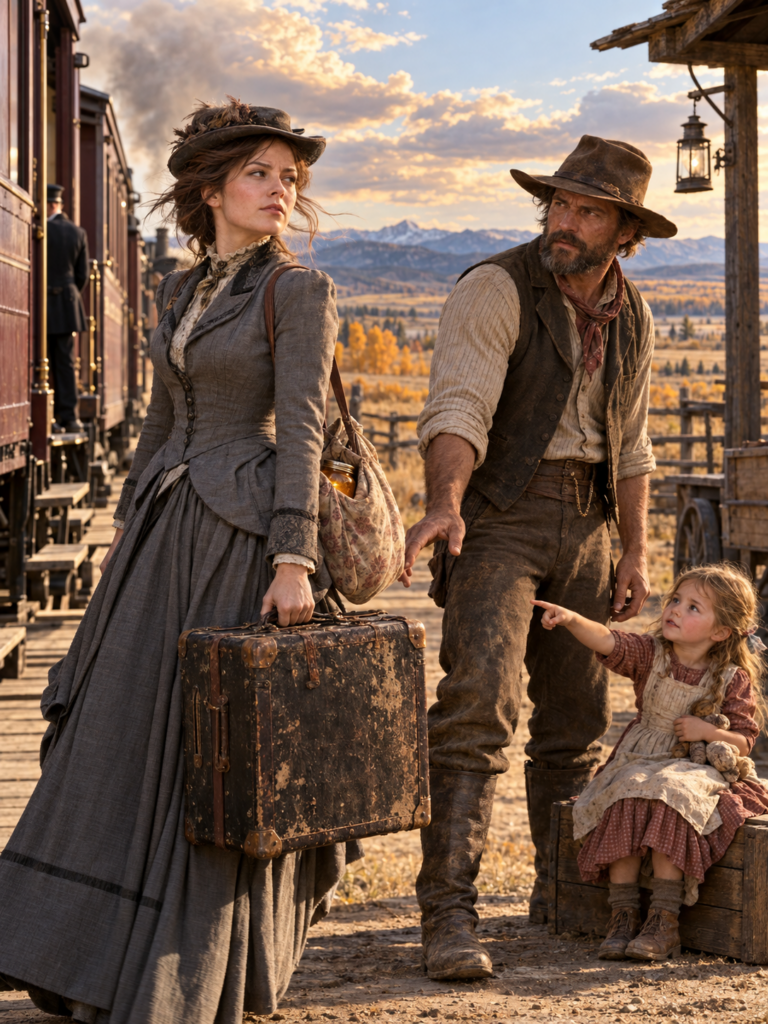
Gideon set down his spoon.
“The creek.”
Ruth waited.
“Alderton owns range on three sides of mine. He has wanted the water rights for two years.”
“And you refused?”
“Three offers.”
“Because without the creek—”
“This land becomes harder to hold cattle on.”
Ruth glanced toward the dark window.
“So he cannot buy what he wants.”
“No.”
“He’ll try another method.”
Gideon studied her.
“You sound certain.”
“I spent six years teaching in a school controlled by men who believed money made refusal temporary.”
The stove snapped softly.
Ruth continued.
“They don’t push where you are strongest. They look for uncertainty.”
“What uncertainty?”
She hesitated.
Then decided plain speech was more useful than delicacy.
“Me.”
Gideon’s brow tightened.
“Alderton did not know whether I was your wife, your relative, or hired help. He asked.”
“And?”
“I told him the truth.”
“Housekeeper.”
“Yes.”
He leaned back.
Ruth held his gaze.
“A wife has standing in a household that a hired woman does not. If he intends to pressure the land through your domestic circumstances, he will use whatever ambiguity he finds.”
Silence stretched between them.
Then Gideon asked quietly, “What do you want your place here to be?”
Ruth had not expected that.
She looked at the oak chair beneath her.
At the hem she had repaired on Mercy’s winter dress hanging near the stove.
At the honey jar, now half empty, catching amber lamplight on the shelf.
“I want useful work,” she said.
“That wasn’t my question.”
“No.”
She looked at him again.
“But it is the only answer I have.”
Gideon nodded.
“Fair.”
A week later Alderton returned.
This time he brought a lawyer.
Gideon met them in the yard while Ruth stood on the porch with Mercy beside her.
The lawyer produced a recently prepared survey claiming part of the Hale creek bank fell inside Alderton’s range.
Gideon read it once.
Then again.
“This survey is three weeks old.”
“A reassessment,” the lawyer said.
“My original claim was surveyed in 1879.”
“Surveys may be revised.”
“They may also be contested.”
Alderton stepped forward.
“Hale, you can barely work the place alone. I’m offering fair money. Take it and make your life easier.”
Gideon folded the document.
“I’ll contest Monday.”
Alderton’s pleasant expression finally hardened.
“You have a child. Winter coming. One hired woman. Pride is expensive.”
Gideon went very still.
Then he looked once toward the porch.
At Mercy.
At Ruth.
“I’m not alone.”
The words were quiet.
That made them stronger.
Alderton followed his gaze.
Ruth did not look away.
The men left.
Gideon climbed the porch steps.
Snow clung to his boots.
“Thank you.”
Ruth frowned.
“For what?”
“Standing there.”
“I stood on a porch.”
“You stood where you meant to.”
Mercy tugged Ruth’s hand.
“Come inside. Your chair is warmer.”
Ruth let the child pull her through the doorway.
That evening, she sat in the oak chair with her sewing untouched in her lap.
She had come west because the Columbus school closed.
Because her savings were thinning.
Because the agency notice had appeared when staying in Ohio no longer made practical sense.
She had told herself she wanted wages.
A roof.
Work.
Honesty.
All true.
But not complete anymore.
The chair mattered.
Mercy’s trust mattered.
The way Gideon had said her name for the first time mattered.
And when he had told Alderton he was not alone, he had looked at her.
The realization unsettled Ruth more than prairie darkness ever had.
The door opened.
Gideon entered from the woodpile and stamped snow from his boots.
“The original survey will hold,” he said. “I’ve two witnesses and the filing.”
“Good.”
He removed his gloves.
Then stopped.
His hands were not quite steady.
“Ruth.”
She set the sewing aside.
“Yes?”
“I need to ask you something.”
She waited.
“It is not because of Alderton.”
His voice roughened.
“His trouble only made me stop postponing it.”
Ruth stood.
Gideon took one step toward her.
“I want you to stay after spring.”
He swallowed.
“Not for wages.”
Ruth remained beside the oak chair.
Gideon did not move closer.
“Then what are you asking?” she said.
He looked toward the loft where Mercy slept.
Then back at Ruth.
“To stay as my wife.”
The word settled between them.
Not frightening.
Not comforting.
Simply enormous.
Gideon continued before she could answer.
“Mercy decided what she wanted on the station platform. I took longer.”
Ruth almost smiled.
Almost.
“You should.”
“I know.”
“And if Alderton had never come?”
“I would still be standing here eventually.”
“Eventually is convenient.”
His mouth tightened.
“That sounded better before I said it.”
“Yes.”
A silence.
Ruth looked at the chair.
The worktable she had leveled.
The wall she had packed against winter wind.
The house had changed around her by inches rather than declarations.
And so had she.
But she had spent too much of her life being practical to mistake longing for certainty.
“I need you to understand something.”
“All right.”
“I am not Clara.”
Gideon’s face shifted.
“I never asked you to be.”
“Perhaps not aloud.”
She crossed her arms.
“You watched me cooking the first morning as though the kitchen had remembered something you had forgotten. You watched me sewing Mercy’s clothes. Sometimes I can see exactly who is missing when you look at me.”
Pain crossed his face.
Ruth did not regret saying it.
Truth was not cruelty merely because it hurt.
Gideon leaned one hand against the table.
“Clara was my wife.”
“I know.”
“She was Mercy’s mother.”
“I know that too.”
“And I loved her.”
Ruth nodded.
“I would think less of you if you hadn’t.”
That surprised him.
She continued.
“But I will not become a shape fitted into the place she left.”
“No.”
“I need work that belongs to me, decisions I have a voice in, and a room I can close when I want solitude.”
“You have that.”
“I need more than permission to occupy a room.”
He listened.
“If I stay permanently, I will not be hired help who becomes convenient enough to marry.”
Gideon looked at her for a long time.
Then he pulled out his chair and sat.
Not because the discussion was finished.
Because he was making himself less physically imposing.
“Tell me what partnership means to you.”
Ruth had taught schoolrooms full of children.
She had argued budgets with church trustees.
She had crossed half a continent alone.
Yet that question was harder than any of those things.
“It means I am asked.”
“About what?”
“Household money. Mercy’s needs. Winter stores. Anything that changes the work I am expected to do.”
Gideon nodded.
“Anything else?”
“If I earn money through sewing or teaching, it remains mine unless I choose otherwise.”
“Yes.”
“And if I decide this does not suit me—”
“I take you back to Harlow Creek.”
“Without punishment.”
His eyes hardened—not at her, but at the idea.
“Ruth, I will not bargain shelter against affection.”
She released a breath she had not realized she was holding.
Gideon continued.
“If you remain as my employee through spring, the agreement stays exactly as written.”
“And if I say no to marriage?”
“You still stay under that agreement if you want.”
Ruth looked at him differently.
That answer mattered more than the proposal.
“Then I am not ready to answer tonight.”
Pain crossed his face again.
He contained it.
“All right.”
Ruth waited for persuasion.
None came.
Gideon rose.
“I’ll bank the stove.”
That was all.
The next morning he behaved exactly as he had the day before.
He did not withdraw kindness as punishment.
Did not become cold.
Did not make Mercy carry the tension between them.
By breakfast, Ruth understood something important.
Gideon meant what he had said.
Her refusal—or delay—did not make her less safe in his house.
That realization changed more than a dramatic declaration could have.
Monday, Gideon rode to Harlow Creek to file his contest against Alderton’s survey.
Ruth remained with Mercy.
They spent the morning cutting worn blanket cloth into strips for another braided cushion.
Mercy worked beside her.
After a while the child asked, “Are you marrying Papa?”
Ruth nearly stabbed her finger with the needle.
“Did he tell you that?”
“No.”
“Then why ask?”
“He looks at you.”
Ruth set down the needle.
“Your father looks at many things.”
“Not like that.”
Children were intolerable witnesses.
Ruth resumed sewing.
“Nothing has been decided.”
Mercy frowned.
“I decided at the train.”
“You are four.”
“I’m almost five.”
“That strengthens your legal position considerably.”
Mercy considered this.
Then she said, “Mama didn’t like honey.”
Ruth’s hands stopped.
Mercy’s face had become thoughtful.
“She liked jam.”
Ruth waited.
“I remember some.”
“You do?”
“A little.”
Mercy traced the blanket strip with one finger.
“Papa gets sad if I ask too much.”
Ruth’s chest tightened.
“Your father does not get sad because you ask.”
“He gets quiet.”
“That is not the same thing.”
Mercy looked uncertain.
Ruth put the sewing aside.
“You are allowed to remember your mother.”
“Even if you stay?”
Ruth understood then.
The question beneath every other question.
She crouched beside Mercy’s chair.
“If I stay, your mother is still your mother.”
Mercy’s eyes filled.
“And if I like you?”
“That does not take anything from her.”
The child stared at Ruth.
Then leaned forward abruptly and wrapped both arms around her neck.
Ruth froze.
Only for a heartbeat.
Then she held Mercy back.
Gideon returned near dusk with the contest properly filed and news that two older neighbors remembered the original 1879 survey.
“The hearing should be straightforward,” he said.
Ruth gave him supper.
She did not mention Mercy’s question immediately.
After the child slept, she told him.
Gideon lowered his head.
“She remembers more than I thought.”
“Children remember differently.”
He nodded.
“I avoided speaking about Clara because I thought it would make Mercy hurt.”
“It may have taught her that hurting means she should not speak.”
Gideon accepted that quietly.
“You think I did wrong.”
“I think you were grieving.”
“That is a kinder answer.”
“It is also the true one.”
The next evening Gideon told Mercy a story about her mother.
Nothing tragic.
Nothing about death.
He told her how Clara once chased a calf halfway across the south pasture while wearing one shoe because the other had come off in the mud.
Mercy laughed until she hiccupped.
Ruth listened from the stove.
When the story ended, Gideon looked at her.
Something passed between them.
Not romance exactly.
Trust.
A week later the county matter was heard.
Alderton arrived with his lawyer and recent survey.
Gideon produced his original filing and witnesses.
The commissioner examined both.
The old markers had not moved.
The earlier record was clear.
Alderton’s claim failed.
There was no spectacle.
No threats.
No violence.
Just paperwork defeating pressure.
Outside, Alderton stopped Gideon.
“You got fortunate.”
Gideon glanced at Ruth.
“No. I kept records.”
Alderton left.
Mercy lifted both arms.
“Did Papa win?”
Ruth picked her up.
“The creek is still where it was yesterday.”
“That sounds like winning.”
“It does today.”
On the ride home, wind moved cleanly across the grass.
Ruth sat in the wagon beside Gideon.
Mercy slept between them.
Neither spoke for several miles.
Finally Gideon said, “I meant what I asked.”
“I know.”
“I also meant that you may refuse.”
“I know that too.”
He looked ahead.
Ruth watched his rough hands on the reins.
Hands that built a chair because she asked.
Hands that had not reached for her without permission.
Hands that had held onto land not from vanity but because it fed his daughter.
The homestead came into view.
Smoke rising.
Creek catching pale afternoon light.
A house that six weeks earlier had seemed stark and temporary.
Now Ruth could identify which kitchen window would be brightest before dawn.
Which floorboard complained near the stove.
Where Mercy stored her treasures.
Where Gideon hung his coat.
She had not planned to know these things.
That evening, after Mercy slept, Ruth sat in her chair.
Gideon repaired tack at the table.
She said, “I have an answer.”
His hands stopped.
Ruth stood.
“So do not interrupt before I finish.”
“I won’t.”
“I came because my school closed. Because my savings were shrinking. Because practical choices were running out.”
Gideon listened.
“I told myself I wanted work.”
“You did.”
“I still want work.”
“I know.”
“I want the garden plot south of the house in spring.”
“Done.”
“Do not agree before hearing how large.”
A faint smile appeared.
“Continue.”
“I want to keep my own savings.”
“Yes.”
“I want Mercy to grow up able to speak Clara’s name without worrying it hurts us.”
Gideon’s smile disappeared.
“Yes.”
“And I want the right to tell you when your worktable is crooked.”
“That seems excessive.”
“Then the answer is no.”
His eyes widened.
Ruth let him suffer one second.
Then she smiled.
“I will stay.”
Gideon rose slowly.
“As my wife?”
Ruth met his gaze.
“As Ruth Calloway, who intends to become your wife.”
Relief transformed him.
He started toward her.
Then stopped.
Ruth noticed.
“You may take my hand.”
So he did.
Nothing more.
His rough fingers closed around hers with a steadiness she trusted more than any speech.
Up in the loft, a board creaked.
A small face appeared over the edge.
Mercy looked down at them.
“I told you.”
Neither adult could find an argument.
Mercy climbed down the loft ladder before either adult could stop her.
She wore the flannel undershirt Ruth had sewn and carried the nearly empty honey jar against her chest.
“I told you at the train,” she repeated.
Gideon released Ruth’s hand only when Ruth chose to let go.
“You were very confident.”
“I prayed.”
“So I remember.”
Mercy climbed onto her chair.
Then she looked at Ruth.
“Are you staying forever?”
Ruth did not answer lightly.
Children deserved fewer careless promises than adults often gave them.
“I intend to stay.”
Mercy narrowed her eyes.
“That isn’t forever.”
“No.”
Gideon glanced at Ruth but did not interfere.
Ruth crouched.
“Forever is too large for anybody to promise honestly. But I am choosing this home. I am choosing your father. And I am choosing to be here with you.”
Mercy considered the distinction.
Then held up the honey jar.
“Can we have biscuits?”
Ruth laughed.
“Yes.”
That was how the first morning of their new arrangement began.
Not with romance.
With biscuits.
Gideon worked outside while Ruth and Mercy mixed flour and lard. Later Ruth joined him near the creek to examine the south-facing ground she wanted for a garden.
“This section,” she said.
Gideon looked at the stretch she indicated.
“That’s larger than I expected.”
“I warned you.”
“How many people are you feeding?”
“You, apparently.”
He almost smiled.
Ruth knelt and crumbled soil between her fingers.
“Beans. Onions. Squash if the ground warms enough. Maybe turnips.”
Gideon crouched beside her.
“You know gardening.”
“I know farm work.”
“You spent six years in a city schoolroom.”
“And twenty-five years before that being useful elsewhere.”
He glanced at her.
“You are thirty-one.”
“Yes.”
“So your arithmetic—”
“Do not test a former schoolteacher before breakfast.”
He laughed.
She liked the sound.
The following weeks changed the Hale place by accumulation.
Ruth did not transform it into something delicate.
She did not hang unnecessary lace over practical windows or make Gideon’s home look like an eastern parlor.
She repaired what needed repair.
Organized food stores.
Started a list of winter expenses.
Set aside her own small wages rather than allowing them to vanish into household needs.
Gideon showed her exactly what the homestead earned and cost.
It was not a prosperous operation.
Two hundred acres sounded larger on paper than it felt when cattle needed feed, fencing needed posts, and winter consumed wood faster than a man could split it.
Ruth appreciated seeing the truth.
“One bad season would hurt.”
“Yes.”
“Two?”
“Badly.”
“You considered selling to Alderton?”
“Once.”
“What stopped you?”
Gideon looked toward Mercy, who was dragging a stick through the dirt and announcing herself surveyor of an invisible kingdom.
“That.”
Ruth understood.
The land was not merely property.
It was the one stable thing Gideon believed he could preserve for his daughter after failing to preserve her mother.
That belief had made him stubborn.
It had also made him afraid.
One evening Ruth found him sitting alone beside the creek.
She approached only until he heard her.
“You want company?”
He shifted on the log.
“If you do.”
She sat.
For a while they watched water move beneath thin new ice near the bank.
Then Gideon said, “Clara liked this spot.”
Ruth waited.
“She said the cottonwoods sounded like rain even when the sky was clear.”
“That sounds pleasant.”
“It annoyed me.”
Ruth turned.
He smiled faintly.
“I kept telling her it sounded like leaves.”
“And she married you anyway?”
“Poor judgment.”
Ruth looked toward the trees.
“Tell me more.”
So he did.
Not everything.
Enough.
Clara had been quicker to laugh than Gideon.
Better with calves.
Terrible with figures.
She had hated thunderstorms but would never admit it.
After she died, Gideon had stopped telling stories because every memory felt like reopening something.
Ruth listened without jealousy.
Later she told him about Ohio.
About seven children around one table.
About a mother who could stretch stew farther than arithmetic permitted.
About a father who believed work cured nearly every moral defect.
About the Columbus school where Ruth taught daughters of shopkeepers, laborers, widows, and occasionally men wealthy enough to believe payment purchased obedience.
“Did you love teaching?” Gideon asked.
“Yes.”
“Would you return to it?”
Ruth looked toward the darkening prairie.
“I don’t know.”
Gideon nodded.
That answer mattered because he did not say, You won’t need to now.
He left the future open.
Several days later he rode into Harlow Creek for supplies.
When he returned, he brought Mercy’s new winter boots, Ruth’s requested flannel, lamp oil, coffee, and a small stack of slates.
Ruth looked at them.
“What are these?”
“Thought you might teach Mercy letters before spring.”
Ruth touched one slate.
“You bought school supplies?”
“They were inexpensive.”
“That is not the point.”
Gideon removed his hat.
“You said you loved teaching.”
Ruth looked at him.
He seemed suddenly uncertain.
“If I presumed—”
“No.”
Her voice softened.
“You remembered.”
“Yes.”
“That is different.”
Mercy learned her letters at the kitchen table.
Soon a neighbor heard.
Then another.
By late winter two children from a nearby claim began coming twice each week when weather allowed.
Gideon built a longer bench.
Ruth objected.
“We agreed you needed another chair, not an entire school.”
“You appear to be multiplying students.”
“They followed me.”
“Like cattle?”
“Do not compare my pupils to your livestock.”
Mercy whispered, “Some of them are louder.”
By spring, teaching had become a small paid undertaking.
Ruth kept the coins she earned.
Gideon never asked for them.
That fact settled something in her.
When she bought seed with part of the money, it was because she chose to contribute.
Not because shelter had created debt.
The wedding question returned naturally.
Not from pressure.
Not from Alderton.
Not from Mercy.
Ruth raised it herself one evening while Gideon repaired the latch on the barn.
“When?”
He looked up.
“When what?”
“You proposed marriage.”
“I recall.”
“You have not mentioned a date.”
His hammer paused.
“I thought perhaps you wanted time.”
“I did.”
“And?”
“I have had some.”
He set down the hammer.
“What do you want?”
“A small service.”
“Good.”
“Mercy present.”
“Obviously.”
“Nothing foolishly expensive.”
“Agreed.”
“And I keep Calloway in my teaching records if I choose.”
Gideon blinked.
“Why would I object?”
Ruth studied him.
“You don’t?”
“It is your name.”
She smiled.
“You remain unexpectedly sensible.”
“Do not spread that around.”
They chose a spring date.
Before the wedding, Ruth insisted on one more conversation.
They sat at the kitchen table after Mercy slept.
The oak chair Gideon had built for Ruth stood opposite his.
Two places now.
Not one chair and one crate.
Ruth folded her hands.
“If we marry, I do not want you assuming I become Mercy’s mother by ceremony.”
Gideon nodded.
“She decides what she calls you.”
“Yes.”
“And Clara remains her mother.”
“Yes.”
“What else?”
“If I teach, I teach.”
“Yes.”
“If the garden fails, you do not pretend it was because I am from Ohio.”
He stared.
“I had not planned to.”
“I am establishing protections.”
“Against weather or insult?”
“Both.”
He smiled.
Then became serious.
“And you?”
“What about me?”
“If we are partners, you don’t get to decide alone that some hardship is yours to carry because you are accustomed to being capable.”
Ruth sat back.
“That is annoyingly perceptive.”
“It is still true.”
She thought of her school closing.
How she had told almost no one how frightened she had been.
How she boarded the westbound train because staying seemed worse than leaving.
How often she had treated competence as proof she needed nothing.
“All right,” she said.
“All right what?”
“I will try.”
Gideon accepted that.
He did not ask for a promise she could not honestly make.
Spring arrived slowly.
The snow retreated from the creek.
Grass returned first in stubborn green patches.
Ruth planted her south-facing garden.
Mercy helped.
Help was perhaps too generous a word.
She planted three seeds in some holes, none in others, and announced worms as personal discoveries.
Gideon repaired the outer fence.
Alderton’s challenge did not return.
The original survey stood.
There was no further conspiracy.
No revenge.
He simply lost.
Sometimes that was how disputes ended.
Not dramatically.
Just unsuccessfully.
Alderton remained a neighbor.
Gideon remained careful.
The creek continued through Hale land exactly where it always had.
The wedding was held in Harlow Creek.
Ruth wore the same gray dress she had arrived in, altered slightly and cleaned until the fabric looked almost new.
Mercy carried wildflowers and the empty honey jar with one yellow blossom inside it because she insisted the jar had brought good luck.
Ruth told her luck had very little to do with honey.
Mercy disagreed.
The minister kept the service short.
When he asked Ruth her choice, she answered clearly.
When he asked Gideon, he did the same.
Gideon did not look at Mercy when he said yes.
He looked at Ruth.
That mattered.
Afterward, Mercy took Ruth’s hand.
“What do I call you now?”
Ruth crouched.
“Whatever feels true.”
Mercy thought.
Then said, “Ruth.”
“All right.”
A month later, while Ruth was checking beans in the garden, Mercy ran outside holding a slate.
“Mama Ruth!”
Ruth froze.
Mercy froze too.
Neither moved.
Then Ruth slowly stood.
“You called me something.”
Mercy’s eyes filled with uncertainty.
“Was it wrong?”
Ruth crossed the garden and knelt.
“No.”
She swallowed.
“Not if you meant it.”
Mercy threw her arms around her.
Ruth held her.
From the barn, Gideon saw.
He did not interrupt.
That evening Ruth told him.
“I heard.”
“You did?”
“Yes.”
“And you stayed away?”
“It seemed like it belonged to you two.”
Ruth looked at him.
There were times he still surprised her.
Years did not arrive all at once after that.
They came through winters and springs.
Through repaired fence posts.
Through calves born before dawn.
Through jars cooling on shelves.
Through school lessons at the kitchen table.
The little class grew enough that eventually neighboring families discussed putting up a simple schoolhouse closer to the claims.
Ruth helped organize it.
She did not surrender teaching to become a wife.
Marriage enlarged her life rather than narrowing it.
Gideon learned that consultation took more time than command.
He also learned it produced fewer foolish decisions.
Ruth learned that accepting help did not reduce competence.
Mercy learned reading quickly and arithmetic reluctantly.
The oak chair remained beside the table.
Years later it bore scratches on the legs and a dark mark where a coal once fell too near it.
No one replaced it.
It had become Ruth’s in the way objects become a person’s through use rather than ceremony.
The honey jar remained too.
Mercy kept buttons in it after the honey was gone.
Then pencil stubs.
Then small flowers pressed too tightly together.
On certain autumn evenings, sunlight struck the glass and made the jar glow amber again.
“The sun inside,” Gideon would say.
Mercy eventually became embarrassed that she had ever said such a childish thing.
Ruth never let him tease her too harshly.
One October afternoon, several years after Ruth’s arrival, a westbound train stopped at Harlow Creek while the family happened to be in town.
Steam covered the platform.
Passengers descended.
Ruth stood still.
Gideon noticed.
“What?”
“Nothing.”
He waited.
She looked across the platform.
“I was remembering.”
Her first arrival had carried no certainty.
Only one trunk.
A dwindling purse.
A substituted agency assignment.
An eleven-mile wagon ride toward a widower she did not know.
She had not come searching for love.
That truth remained important.
Had Gideon demanded romance because he had provided shelter, she would have left.
Had he treated her labor as obligation rather than work, she would have left.
Had he expected her to erase Clara, she would have left.
Had marriage required abandoning her teaching or savings, she would have refused.
Instead a chair had appeared beside a table.
A room had remained hers until she chose differently.
A grieving child had been allowed to remember.
A man who feared loss had learned to ask rather than hold too tightly.
Ruth had learned to answer freely.
Mercy—no longer small enough to sit on Gideon’s boot—came racing across the platform with some urgent discovery about a horse tied near the freight shed.
Ruth watched her.
“She was so certain,” she said.
“About you?”
“On the first day.”
Gideon smiled.
“She was unbearable.”
“She remains so.”
Mercy shouted for them.
Gideon started toward her, then stopped.
He looked at Ruth.
“You ever wonder what happened to Dorothea Marsh?”
“Occasionally.”
“Regret the agency’s mistake?”
Ruth considered the station.
The wind.
The enormous Montana sky she had once stared at because she could not comprehend so much open distance.
Then she looked at Gideon.
“No.”
He held out his hand.
She took it.
Not because she needed help crossing the platform.
Because she wanted to.
They walked toward Mercy together.
Later that evening, back at the homestead, Ruth sat in the oak chair while Gideon read aloud from an old newspaper.
He had taken up the habit after she once told him she missed hearing words shared simply for company.
His reading was not elegant.
He skipped occasionally.
Mispronounced names.
Stopped to complain about editorials.
Ruth corrected him whenever necessary.
Mercy worked at the table.
Outside, darkness settled across the prairie.
Ruth still did not especially like it.
“The dark and I remain in disagreement,” she said.
Gideon looked over the newspaper.
“You’ve been arguing for years.”
“I am persistent.”
“So is dark.”
The lamp burned between them.
The stove held.
Beyond the walls, the creek moved through the land Alderton had once tried to take.
Inside, Ruth’s chair stood where Gideon had built it.
Her school papers rested on the shelf.
Mercy’s boots waited by the door.
Clara’s memory had not been erased.
Neither had Ruth’s former life.
Nothing good had required pretending the losses never happened.
Gideon had once believed survival meant holding tightly enough that nothing else could be taken.
Ruth had once believed safety meant remaining useful enough that she would never need anyone.
They had both been wrong.
The life they built asked something more difficult.
To need without owning.
To help without controlling.
To remember without living backward.
To stay while remaining free.
And long after everyone in Harlow Creek forgot that the agency had once sent Gideon Hale the wrong woman, the Hale household kept the evidence of that mistake everywhere.
In a crooked table Ruth had leveled.
In the sturdy chair Gideon built because she asked.
In a honey jar full of buttons.
In a garden that returned every spring.
In a daughter who had been the first of them to understand.
Ruth had stepped from the train as the wrong woman.
She stayed because no one required her to become the woman they had expected.
And that was exactly why she became the right one.

