
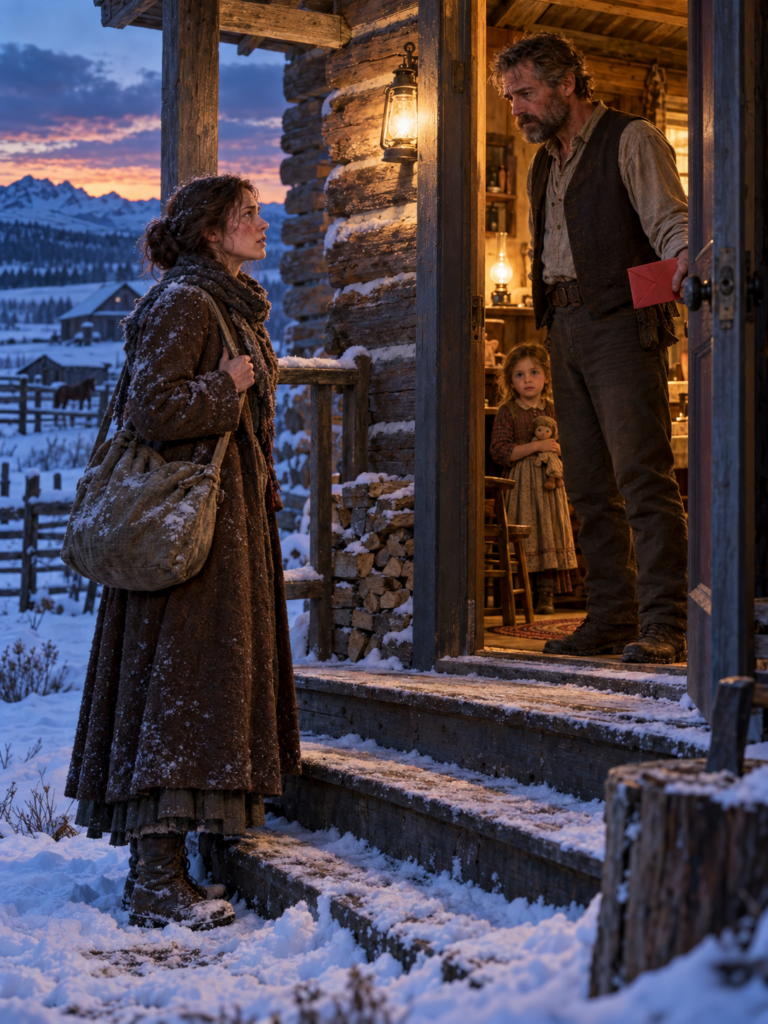
Her hand remained on Abel’s sleeve until Ferris and his two men disappeared beyond the north bend.
Only then did Clara release him.
“Survey papers,” she repeated.
Abel’s anger had not cooled.
“What about them?”
“Do you have the original record?”
“In a tin box.”
“Recorded where?”
“I don’t know whether they were ever entered locally. The federal survey was done years ago.”
Clara bent, picked up the chicken bucket, and started toward the house.
“Then standing in the yard glaring after Denton Ferris won’t save one foot of pasture.”
Abel followed.
“You know something about land claims?”
“My father knew less than he thought he did.”
That answer carried enough weight to quiet him.
Inside, Ruth sat at the table arranging her stones in a row. Clara placed the bucket near the back door, washed her hands, and turned.
“My father worked forty acres he believed were his. Cleared them. Planted them. Fenced them.”
She took a cloth from the peg and dried her fingers.
“Another man made certain his papers were in order first.”
Abel’s jaw shifted.
“What happened?”
“We lost the forty.”
Nothing dramatic in her voice.
That made it worse.
“Did your father fight?”
“For years.”
“And?”
“He learned that being right and being recorded are not always the same thing.”
She nodded toward the bedroom.
“Get the papers.”
Abel did.
The tin containing the land records was not the same tin beneath his bed holding Margaret’s forty-one returned letters. He set the documents on the table, and Clara pulled the lamp closer.
Ruth leaned over importantly.
“Is our house moving?”
“No,” Abel said.
Clara looked at him.
“Not if your father rides to Harlo Creek tomorrow.”
Abel spread out the survey sheets.
“You’re telling me what to do again.”
“I am.”
“And if I choose not to?”
“Then that is your choice.”
She met his eyes steadily.
“But don’t confuse refusing advice with independence.”
Abel stared at her.
Then a laugh escaped him—brief, unwilling, genuine.
Clara’s mouth almost changed at one corner.
Almost.
The next morning Abel rode to Harlo Creek before daylight.
The county clerk examined the old survey, registered the record, stamped it, and told him plainly that if the original survey markers remained, Ferris had little ground to stand on.
Abel rode home through punishing cold feeling as though the north field had been returned to him even though it had never physically gone anywhere.
When he entered the house, Clara sat on the floor braiding Ruth’s hair.
“We’re all right,” he said. “The clerk recorded it.”
Clara’s shoulders eased.
Ruth grinned.
Abel noticed both.
Eight days later, he went to the stage depot for harness hardware.
While the agent searched the storeroom, Abel idly read a handwritten list of unclaimed baggage and ticket adjustments.
One entry caught his eye.
Voss, C.
His attention sharpened.
The notation said Clara had surrendered the unused value of her stage ticket so a stranded family—husband, wife, two children—could continue their journey.
Abel read it twice.
Then again.
He called the agent back.
“This woman. Clara Voss.”
The man remembered.
“She gave up the rest of her fare?”
“Every bit.”
“Why?”
The agent shrugged.
“Family didn’t have enough. She said she could walk.”
“In December?”
“That’s what I asked.”
Abel stood perfectly still.
Clara had not merely lost transportation.
She had chosen to surrender it.
Then walked through winter until she saw Abel’s lamp.
That night he came home after dark.
Clara sat beneath the lamp mending one of Ruth’s dresses.
She looked up.
Abel removed his coat.
“I was at the depot.”
Her needle stopped.
Barely.
He saw it.
“The list,” she said.
Not a question.
“The family whose fare you paid.”
Clara resumed folding the cloth over her finger.
“It was their fare after I gave it to them.”
“You walked because of them.”
“I walked because I had two sound legs.”
“You could have frozen.”
“So could their children if they’d been stranded longer.”
Abel pulled out the chair opposite her.
“You never told me.”
“It wasn’t part of our arrangement.”
“No.”
His gaze shifted toward Ruth asleep beneath the quilts.
Then to the red wooden bird above the window.
Then back to Clara.
“No, I suppose it wasn’t.”
He reached into his coat and placed something on the table between them.
One of the returned letters.
Clara looked at the sealed envelope but did not touch it.
Abel rested his hand beside it.
“There’s something you ought to know about why I kept expecting another woman to come up that road.”
Clara laid Ruth’s half-mended dress across her lap.
“You don’t owe me an explanation.”
“I think I do.”
Abel turned the unopened envelope once beneath his fingers.
“Her name was Margaret Hollis.”
Clara waited.
“A neighbor knew her. Widow in Cheyenne. Grown children. She thought Margaret and I might suit each other.”
“Suit?”
“For practical reasons.”
The words sounded worse aloud than they had in his head months earlier.
“I had land. Ruth needed more care than I could give while keeping the place going. Margaret wanted a new start. We wrote.”
Clara glanced at the envelope.
“For nearly a year?”
“Eleven months.”
“And you intended to marry her?”
“If she came and if we both agreed after meeting.”
Clara’s eyes lifted to his.
That distinction mattered to her. He could see it.
“She never came,” he continued. “All the letters came back. Forty-one of them.”
“Forty-one?”
“I had more to say on paper than I usually do in person.”
That brought the faintest warmth to Clara’s expression.
Abel looked down.
“The last came back the morning you arrived.”
Understanding moved across her face.
“So when you opened the door—”
“I thought the road was empty for good.”
“And instead you got a housekeeper demanding access to your sick child.”
“You did not demand access.”
“I came near enough.”
“You asked.”
Clara looked back toward Ruth’s cot.
Abel noticed the difference in her face whenever her attention settled on the child.
Not possession.
Not performance.
Something older and more careful.
He pushed the returned letter farther away.
“You walked eleven miles because you gave your fare to strangers.”
“Yes.”
“Why?”
“Because there were two children.”
“That’s not the whole answer.”
“It’s enough.”
“For you.”
Her gaze sharpened.
“Be careful, Abel.”
He fell silent.
Clara set the dress aside.
“I work here. I care for Ruth because I agreed to. You have treated me fairly. I’m grateful for that.”
He started to speak.
She raised one hand.
“But you finding out something about me does not make the rest of me yours to uncover.”
The words landed without anger.
That made them impossible to dismiss.
Abel nodded once.
“You’re right.”
Clara studied him, perhaps expecting an argument.
None came.
After a moment she picked up the dress again.
Abel remained seated.
“I still want to ask one thing.”
“You may ask.”
“Are you planning to leave in spring?”
Her needle stopped for longer this time.
“I haven’t decided.”
The answer hurt more than he expected.
He took care not to show it as accusation.
“You have somewhere you’re going?”
“I had somewhere.”
“Had?”
Clara looked toward the red bird.
Then she resumed stitching.
“That is another question.”
Abel understood.
He rose.
“Fair enough.”
He took the letter and returned it to the tin beneath his bed.
But the question stayed with him.
Not because Clara owed him an answer.
Because by then he wanted one.
The remaining days of January forced everyone into work too immediate for speculation.
Cold tightened the creek beneath thick ice. Abel broke water for the animals before sunrise. Clara carried feed when needed and managed Ruth indoors when the wind made outside work foolish.
They did not divide labor according to what either thought a man or woman should do.
They divided it according to what needed doing and who could do it.
One afternoon Abel came into the barn and found Clara examining the gray mare’s hoof.
“You’ll freeze your hands.”
“I’m wearing gloves.”
“Those are mending gloves.”
“They are currently horse gloves.”
He crouched opposite her.
The mare shifted.
Clara steadied the animal with a hand along her leg.
“Stone bruise,” Clara said. “I think.”
Abel inspected the hoof.
“I think you’re right.”
“That sounded painful.”
“What?”
“Admitting it.”
He looked up.
Clara smiled fully for the first time.
It changed her face so completely that Abel forgot, for one dangerous second, why he was crouching in straw.
He returned his attention to the hoof.
“Don’t get used to it.”
“I wouldn’t dare.”
Those moments became more frequent.
Not declarations.
Not touches stolen under convenient circumstances.
Small recognitions.
She preferred coffee strong enough that Abel privately thought it could strip paint.
He disliked onions unless cooked nearly to nothing.
Ruth wanted cornmeal mush on Mondays and Wednesdays, oat porridge on other weekdays, and biscuits on Sundays.
Clara accepted this decree as though negotiating with a territorial governor.
Abel watched from the stove.
“What happens Saturday?”
Ruth frowned.
She had not considered Saturday.
Clara folded her hands.
“A serious defect in the arrangement.”
Ruth whispered something into Clara’s ear.
Clara nodded gravely.
“Saturday is cook’s choice.”
Ruth agreed.
A treaty had been formed.
Later Abel found an old wooden box in the lean-to. Clara sanded the splinters away and gave it to Ruth for her rock collection.
The child arranged every stone with fierce care.
That night Abel found Clara alone by the stove.
“You’re good with her.”
Clara’s expression went still.
“I try to be.”
“You don’t have to look afraid when I say that.”
“I’m not afraid.”
“You looked something.”
She fed a small piece of wood into the fire.
“Children make room for people before grown people decide what anything means.”
Abel leaned against the table.
“Ruth called you Mama.”
“I know.”
“I saw you hear it.”
Clara’s hand rested on the stove latch.
“I won’t ask her to call me that.”
“I know.”
“And I won’t answer to it unless—”
She stopped.
“Unless what?”
“Unless my place here changes.”
Abel felt his pulse once, hard.
“What would change it?”
Clara looked directly at him.
“Not gratitude.”
He understood immediately.
“Not because you took me in. Not because I help with Ruth. Not because I can keep a house or doctor a cough or spot trouble with a horse. And not because another woman failed to come.”
Abel straightened.
“I would never ask you to become a replacement for Margaret.”
“I know.”
“Or Eleanor.”
At that name Clara’s expression softened.
He had rarely spoken his dead wife’s name aloud since Clara’s arrival.
“She was Ruth’s mother,” he said. “That won’t change.”
“No.”
“And if anything ever changed between you and me, it would have to be because you wanted it.”
Clara looked down at the stove.
“That is the only way I would remain.”
It was the clearest boundary she had given him.
Abel carried it carefully.
February softened the worst cold but brought mud, half-frozen troughs, and long gray days.
Ferris’s challenge remained pending, though the recorded federal survey stood strongly in Abel’s favor.
One afternoon Abel took the tin box from under his bed.
He carried the forty-one letters to the stove.
He did not burn them because he hated Margaret Hollis.
He had no knowledge of what had happened to her and no right to invent a betrayal larger than the facts.
He burned them because they had become correspondence with a future that no longer existed.
One envelope at a time, the wax softened, blackened, and vanished.
When Clara came in from outside, she stopped beside the stove.
She noticed the ash.
Then Abel.
She did not ask.
She merely nodded.
He realized then that she understood silence better than he did.
Not silence used to hide.
Silence given when another person was entitled to keep something private.
By March, the fields began to thaw.
Abel turned the south ground while Clara brought coffee out midmorning. She stood beside him while he drank, both looking over soil that would soon need seed.
“You still thinking of spring?” he asked.
Clara did not pretend to misunderstand.
“Yes.”
“Leaving?”
“Deciding.”
He handed the cup back.
“What would make you stay?”
She considered him.
“That sounds dangerously close to asking what price would buy me.”
He winced.
“You’re right.”
“But I know what you meant.”
He waited.
Clara looked toward the house where Ruth’s red mittens flashed near the porch as she searched the melting yard for newly exposed rocks.
“I need to know whether I’m building something here or merely helping you hold together what belonged to someone else.”
Abel took that in slowly.
“Eleanor?”
“Her. Margaret. The life you planned before I arrived.”
Clara’s voice remained level.
“I have no objection to a man remembering his wife. I would distrust you if you could erase her that easily. But I won’t live inside a place reserved for another woman.”
Abel looked at the house.
For the first time he tried to see it through Clara’s eyes.
Eleanor’s household arrangements remained almost untouched. Clara’s room was separate because she had required it, but otherwise everything still carried the shape of what had existed before.
Even the second peg beside the back door had never been added. Clara still hung her coat on the nail inside her room.
“You’re right,” he said.
She gave him a sidelong glance.
“Again?”
“Don’t become vain.”
Over the next weeks, he did not attempt grand gestures.
He simply began making room.
A shelf in the kitchen for Clara’s belongings.
A better latch for her door, installed after asking.
A hook by the entrance placed where she wanted it rather than where he assumed.
He brought her into discussions over spring planting because she understood gardens better than he did.
When he proposed a south-wall kitchen plot, she changed the dimensions and explained why.
He listened.
She noticed.
In early April, one evening after Ruth had gone to bed, Clara stood by the window while Abel repaired a harness strap.
The last blue light lay over Flat Willow Creek.
Without looking up, Abel said, “I think Eleanor would have liked you.”
Clara remained still.
Then she asked, “Tell me something about her.”
So he did.
Not how she died.
How she lived.
How she sang while churning butter, old family songs in words Abel had never learned.
“The words didn’t matter,” he said. “The sound was enough.”
Clara’s eyes stayed on the fading creek.
“My husband read aloud.”
Abel’s hands stopped.
She had never mentioned a husband.
“Whatever he had,” Clara continued. “Newspaper. Almanac. Notices from town. Sometimes things no one needed read aloud at all.”
Abel waited.
“Fever,” she said. “Three winters ago.”
He set down the harness.
“I’m sorry.”
“So am I.”
She turned from the window.
“But here we are.”
Abel rose.
The room seemed very quiet.
“Clara.”
She faced him.
He did not cross the space between them.
“I don’t want a replacement for Eleanor.”
“I know.”
“I don’t want a substitute for Margaret Hollis.”
Clara said nothing.
“I don’t want a housekeeper I can call wife because it makes the work easier.”
His voice roughened.
“I want you to stay because this house is different when you’re in it. Ruth is different. I am different. And because when I imagine spring now, every plan I make has you standing somewhere in it.”
Clara’s eyes shone, but her chin remained steady.
Abel continued.
“If you leave, I will help you reach wherever you decide to go.”
She breathed in slowly.
“And if I stay?”
“Then I want you here as my equal in everything we build from this point forward.”
A long silence passed.
Then Clara crossed half the distance between them.
Not all.
“Ask me again,” she said, “when you know whether you mean a wife or a partner.”
Abel looked at her.
“I mean both.”
Her expression broke with something like relief and fear together.
Before she could answer, a hard knock struck the front door.
Ruth woke with a cry.
Abel turned.
Clara moved toward the child.
Another knock came.
Abel opened the door to find Denton Ferris on the porch holding a folded county notice.
Ferris’s smile was gone.
“The commissioner hears the boundary matter next week,” he said. “You’ll be there, Marsh.”
Abel took the notice.
Ferris glanced past him toward Clara.
“And if she’s been advising you, bring her too.”
Clara rose from beside Ruth’s cot.
“I intend to come whether he wants me there or not.”
Ferris looked past Abel and found Clara already standing.
For a moment, surprise showed plainly on his face.
Then the familiar smile returned.
“This concerns land.”
“So I gathered.”
“Land belonging to Marsh.”
Clara crossed the room but stopped well behind Abel, close enough to be heard and far enough that no one could mistake whose choice it was to enter the conversation.
“It concerns a survey record I told him to file before you did.”
Ferris’s smile thinned.
Abel did not look back at her.
He did not need to.
Ferris folded his gloves together.
“Commissioner decides facts, not housekeepers.”
“Then facts should do well enough.”
Ferris turned his attention to Abel.
“Next Thursday.”
“I’ll be there.”
Ferris left.
Abel closed the door.
Ruth, awake now beneath her quilts, asked, “Is our house moving again?”
Clara answered before Abel could.
“No.”
Ruth considered that.
“Good.”
She rolled over.
Within minutes she was asleep again.
Abel looked at Clara.
“You don’t have to come.”
“I know.”
“You said you intended to.”
“I do.”
He nodded.
That was the end of it.
Not because he wanted her absent.
Because the decision belonged to her.
Over the following week they prepared without turning the dispute into something larger than it was.
Abel gathered the federal survey papers, the clerk’s registration, tax receipts, and his notes on the old markers.
Clara helped arrange them chronologically.
She did not claim expertise she did not possess.
She knew only what hard experience had taught her: paper forgotten in a box protected no one.
The hearing in Harlo Creek was held in a plain county room that smelled of coal smoke, wet wool, and ink.
Ferris brought his lawyer.
Abel brought his records.
Clara sat beside Mrs. Pickett near the back, with Ruth occupying herself by turning a smooth gray stone in her palm.
The commissioner listened.
Ferris’s lawyer argued that the old line had been incorrectly interpreted.
Then the clerk produced the registered survey.
The original federal markers still stood.
No evidence showed they had been moved.
The commissioner asked several questions, reviewed the papers again, and dismissed Ferris’s complaint.
That was all.
No gunfight.
No dramatic threat.
No righteous speech.
Just a ruling based on the record Clara had insisted Abel secure before Ferris moved first.
Outside, Ferris descended the courthouse steps ahead of them.
He stopped.
Looked at Clara.
Then Abel.
“You got lucky.”
Abel might once have answered sharply.
Instead he said, “No. I listened.”
Ferris’s eyes shifted toward Clara.
Whatever reply occurred to him, he kept it.
He walked away.
Ruth tugged Clara’s sleeve.
“Did we win?”
Clara crouched to her height.
“The line stayed where it belonged.”
“Is that winning?”
“Today it is.”
Ruth appeared satisfied.
On the ride home, Abel let Ruth sit before him while Clara rode the gray mare, whose hoof had long since healed.
The land looked unimpressive beneath the early spring sky.
Brown grass.
Softening ground.
Fence posts leaning here and there.
Flat Willow Creek carrying meltwater between muddy banks.
Yet Abel saw it differently.
Not because the commissioner had confirmed possession.
Because for the first time he was thinking of the place beyond survival.
He was thinking of Clara’s garden.
Ruth’s rock box.
A second shelf.
Another winter, perhaps, with three people preparing for it together.
At home, Clara went directly to the kitchen.
Abel followed.
“We still have unfinished business.”
She glanced at him.
“The north fence?”
“No.”
Her hands slowed.
He leaned against the table but did not come closer.
“You told me to ask again when I knew whether I meant wife or partner.”
Clara turned fully toward him.
“I remember.”
“I meant what I said.”
“So did I.”
Abel took a breath.
“Then before I ask anything else, I want to know where you were going when you gave away that stage fare.”
Clara’s expression closed slightly.
Abel raised a hand.
“You do not owe me the answer. But if I’m asking you to build a future with me, I want to understand whether staying here costs you another future you still want.”
That changed something.
She moved to the chair and sat.
Abel remained standing until she nodded toward the opposite chair.
Then he sat too.
“My husband’s name was Thomas,” Clara said.
Abel waited.
“He died three winters ago.”
“The fever.”
“Yes.”
Clara folded her hands.
“We had no children.”
Her gaze drifted briefly toward Ruth’s cot.
“Afterward, I could not keep the place we had. There wasn’t enough money, and I had no wish to spend what little I possessed fighting for a house that had become unbearable to enter.”
She spoke without self-pity.
“I went to work for the Shribers. They were decent people. Mr. Shriber became ill, and after he died, his daughter took Mrs. Shriber east.”
“So you lost the position.”
“Yes.”
“And the stage?”
“I bought passage as far as I could afford toward Miles City.”
“What was there?”
“Possibility.”
Abel smiled faintly.
“That specific?”
“That specific.”
“I thought perhaps relatives.”
“No.”
“A position?”
“I had heard there might be work.”
“That was all?”
“That was enough.”
She looked toward the window.
“At the depot I saw the Hendrix family counting their money. Quietly, because people are often most ashamed when the fault is not theirs.”
Abel remembered the agent’s account.
“They could pay for two.”
“They had four people.”
“So you surrendered your remaining fare.”
“Yes.”
“And walked.”
“Yes.”
“Eleven miles through snow.”
Clara looked mildly irritated.
“You seem determined to make the distance grow each time you mention it.”
“It remains eleven.”
“Then let us preserve accuracy.”
Abel laughed.
This time she did too.
When it faded, Clara’s face became serious again.
“I did not give them the fare because I am unusually good, Abel.”
“I didn’t say you were.”
“You were thinking it.”
“I was thinking eleven miles.”
She shook her head.
“I gave it because I knew what it was to have the road ahead of you depend on money you did not have. I knew I could walk. Their children could not reasonably be asked to.”
“And after that?”
“I walked south.”
“Toward what?”
“Whatever came.”
Her eyes met his.
“Then I saw your lamp.”
There it was.
The complete simplicity of it.
She had not been sent.
She had not known about Margaret.
She had not come seeking marriage.
She had not crossed Montana pursuing some secret claim or family.
A tired widow without employment had seen light in a winter house and asked for work.
Abel sat with that truth.
Then he said, “And now?”
Clara’s fingers tightened.
“Now is harder.”
“Why?”
“Because leaving a place you do not belong is simple.”
Her voice lowered.
“Leaving a place where you might belong is not.”
Abel did not interrupt.
She looked toward Ruth’s collection beneath the red wooden bird.
“When Ruth called me Mama, I wanted to answer.”
The admission seemed to cost her.
“I hated myself a little for wanting it.”
“Why?”
“Because Eleanor existed.”
“So did Thomas.”
Clara’s gaze snapped back to him.
Abel continued.
“If you can sit in this house and speak Thomas’s name, I can speak Eleanor’s.”
Her eyes filled.
He did not move toward her.
Not yet.
“No one has to disappear for someone else to stay,” he said.
Clara looked down.
Abel waited until she raised her face again.
Then he asked.
“Would you stay?”
She breathed carefully.
“As what?”
There could be no easier answer.
Abel gave her the true one.
“As Clara Voss, first.”
Her mouth trembled.
“As my partner in this place, if you want it. As someone with a say over the work, the house, the garden, the money we earn, and the decisions that shape the life here.”
He paused.
“And if, after you’ve had time to decide without wages or shelter hanging over you, you want marriage—then as my wife.”
Clara’s eyes searched his face.
“If I say no to marriage?”
“Your wages remain yours until you decide whether you’re staying in some other fashion or leaving. I’ll take you to town myself if that’s your choice.”
“If I say I need time?”
“You take it.”
“If I say yes?”
His voice quieted.
“Then I spend the rest of my life remembering it was an answer you were free to refuse.”
Clara looked at him for a long moment.
Then she stood.
Abel rose as well.
She crossed the remaining distance herself.
Not enough for an embrace.
Enough to place her hand in his.
“I will stay through planting,” she said.
Abel’s heart sank and lifted in the same instant.
Clara saw it.
“And through harvest.”
His fingers closed carefully around hers.
“And after that?”
She tilted her head.
“You asked me to take time.”
“I regret my wisdom already.”
Her laugh came softly.
Then she stepped closer.
“I’m staying, Abel.”
He did not move.
“Permanent?”
“Yes.”
“For Ruth?”
“For Ruth.”
His thumb shifted once against her knuckles.
“For the land?”
“For some of it.”
“For—”
“For you,” Clara said.
That stopped him.
“For me.”
She nodded.
“Do not make me say it twice merely because you enjoy hearing it.”
“I might.”
“Then I’ll leave.”
He smiled.
“You just said permanent.”
“I reserve the right to revise unreasonable arrangements.”
Abel lifted her hand.
He hesitated.
Clara noticed.
“You may kiss me.”
So he did.
Once.
Gently.
Nothing in the house changed.
No thunder.
No sweeping miracle.
The stove clicked as iron cooled.
Ruth turned in her sleep.
Outside, meltwater ran beneath the last shelves of creek ice.
But when Abel stepped back, the room no longer felt like a place waiting for someone.
It felt occupied by the people actually inside it.
The next morning Ruth found Abel and Clara standing near the stove with their shoulders nearly touching.
She studied them.
“Are we all staying now?”
Abel looked at Clara.
Clara answered.
“Yes.”
Ruth climbed onto her chair.
“Good.”
She put her chin in both hands.
“I didn’t want to move my rocks.”
Clara laughed so suddenly she had to turn away.
Spring advanced.
Abel repaired the north fence after the ground softened enough to set posts. Clara helped mark which old ones had rotted through but left the heavier digging to Abel when the earth resisted.
She planted her kitchen garden along the south wall.
Turnips.
Onions.
Two rows of beans.
Ruth dropped seeds into the prepared holes, sometimes three where Clara requested one.
Clara corrected her without ruining the solemnity of the task.
Abel watched from the fence line.
He remembered the first evening Clara arrived.
Soaked boots.
Straight back.
Canvas bag.
“If you don’t need anyone, I’ll move along.”
He had needed help.
That was true.
But need alone was not what kept her.
That mattered to him.
By late April Clara no longer accepted wages.
Not because Abel declared her family.
Because she sat at the kitchen table, reviewed the household accounts with him, and said, “If I am staying as your partner, three dollars a month makes no sense.”
“What do you propose?”
“A share of decisions before you spend money on anything foolish.”
“That sounds expensive.”
“It will save you considerably.”
They agreed that household and garden money would be discussed together.
The land legally remained Abel’s, a fact neither pretended otherwise, but the life being built upon it would not be governed by his preferences alone.
When Clara wanted a larger garden, they measured it.
When Abel wanted to purchase another milk cow, Clara asked what they would feed through winter.
When Ruth demanded a goat, both adults rejected the proposal.
Ruth accused them of tyranny.
May arrived green.
One afternoon, Mrs. Pickett visited and found Clara kneeling in the garden while Ruth presented worms as gifts.
The older woman watched for a while.
“So,” she said eventually. “I hear you’re staying.”
Clara looked up.
“That seems to be the rumor.”
Mrs. Pickett glanced toward Abel repairing tack on the porch.
“About time that man found some sense.”
Abel called without looking up, “I can hear you.”
“That’s why I said it loudly.”
Clara lowered her head to hide a smile.
After Mrs. Pickett left, Abel joined her near the garden.
“She started the Margaret correspondence.”
“I know.”
“She means well.”
“That can be dangerous.”
“It can.”
He knelt beside her.
“Do you mind people talking?”
“They talked when I was widowed. They talked when I worked for wages. They talked when I traveled alone.”
She pressed soil around a young bean plant.
“People get tired eventually.”
“And if they don’t?”
“I will outlive their interest.”
Abel touched the dirt beside her hand.
“Would you marry me?”
Clara sat back.
He immediately added, “That was poorly timed.”
“Among beans?”
“I could try again somewhere grander.”
“No.”
His face changed.
Clara smiled.
“No, don’t try somewhere grander.”
She removed her gardening glove.
“You asked before whether I would stay. I said yes.”
“I remember.”
“I have stayed long enough to know the difference between shelter and home.”
Abel remained very still.
“And?”
“And I will marry you.”
He exhaled.
“But,” she continued.
“There’s always a but.”
“You will not tell Ruth until we tell her together.”
“Agreed.”
“And you will not call this house yours when you mean ours.”
He nodded.
“Agreed.”
“And the kitchen shelf you built for me is too narrow.”
Abel stared.
Clara’s eyes brightened.
“Agreed.”
They told Ruth that evening.
She listened gravely.
“Will there be cake?”
Clara said, “Probably.”
“Then yes.”
Abel frowned.
“I wasn’t aware your permission was required.”
“It is.”
The wedding took place in Harlo Creek on the second Saturday in June.
Nothing about it attempted to erase the lives Abel and Clara had lived before meeting.
Eleanor’s memory was neither hidden nor displayed as a test.
Thomas’s name was not treated as a threat.
They came to the church as two adults who had already buried people they loved and understood that beginning again did not require pretending the earlier love had meant less.
Mrs. Pickett cried from the second pew.
The stage agent stood near the back.
Several neighboring families attended.
Ruth wore her best dress and two neat braids. In her hands she carried a small bunch of wild clover she had collected herself.
When the minister finished, Abel looked at Clara.
Not at Ruth.
Not at the neighbors.
At Clara.
A question remained in his expression even then.
She answered it by taking his hand.
Afterward, Abel bent and lifted Ruth.
The child turned immediately toward Clara.
“You stayed.”
Clara’s face softened.
“I stayed.”
Ruth leaned into her shoulder and closed her eyes.
For Abel, that was the moment that mattered more than the ceremony.
Not because Clara became Ruth’s mother by declaration.
Because she had been allowed to choose a place in their lives slowly enough that the word could become true without replacing anyone.
That autumn, Abel added a broader kitchen shelf.
Clara inspected it.
“Better.”
He added another hook beside the door.
“Too high,” she said.
“It is exactly shoulder height.”
“Your shoulder.”
He moved it.
Ruth watched.
“Clara wins a lot.”
Abel glanced at his wife.
“So I’ve noticed.”
The red wooden bird found a permanent place above the window.
One evening Ruth asked Clara again who it had been made for.
This time Clara answered.
“For Thomas.”
Ruth considered the bird.
“Did he like red?”
“He did.”
“Can it stay here?”
Clara looked at Abel.
“Yes,” she said. “It can stay.”
That winter, the bird hung above a household that no longer feared old names.
Eleanor’s songs were sometimes remembered.
Thomas’s habit of reading aloud became a story Ruth requested more than once.
The forty-one letters to Margaret were ash.
Abel never learned exactly why she had disappeared.
With time, he stopped needing to.
There was no villain required.
Only one road that had not opened and another that had.
Years later, Abel would still remember Clara first as a figure coming through December dusk with snow on her coat and determination in every step.
Clara would remember the lamplight.
Not Abel’s face.
Not the house.
The light.
A proof that someone was there.
A place where she could knock and still remain free to leave.
And Ruth remembered something different.
She remembered that before Clara came, her rocks had lived wherever she happened to set them.
Afterward, they had a box.
A small thing.
But children sometimes understand permanence through objects adults overlook.
The farm never became easy.
No frontier promise could honestly offer that.
There were poor harvests and hard winters. Fences failed. Animals sickened. Money tightened.
But work no longer belonged entirely to Abel’s shoulders.
Clara did not become valuable because she cooked, mended, planted, or understood horses.
Those skills mattered.
So did Abel’s labor.
But the marriage endured because neither confused usefulness with love.
They listened.
Argued.
Adjusted.
Asked.
And when one of them said no, the other learned that love did not become smaller by respecting it.
Some mornings Abel still woke before Clara and stood by the window looking south along the road.
Once, years into their marriage, Clara came beside him.
“Expecting somebody?”
“No.”
“Then why stare?”
He considered.
“Used to be I looked down that road and measured everything missing.”
Clara slipped her hand into his.
“And now?”
Behind them, Ruth—older now but still unwilling to discard any stone she considered important—was arguing with herself over breakfast.
Abel looked at the second coat hanging by the door.
The widened shelf.
The garden beyond the window.
The red bird catching the first edge of morning light.
Then he looked at Clara.
“Now I look because I remember the night it wasn’t empty.”
Clara leaned lightly against his shoulder.
Outside, Flat Willow Creek continued under the pale Montana sky.
The north fence stood where the survey had always said it belonged.
The road stretched south, open to anyone who needed to travel it.
And the door remained a door—not a trap, not a debt, not a promise made for someone else.
Clara had once crossed that threshold asking only for honest work.
She had been free to leave.
That was precisely why her staying meant everything.


