
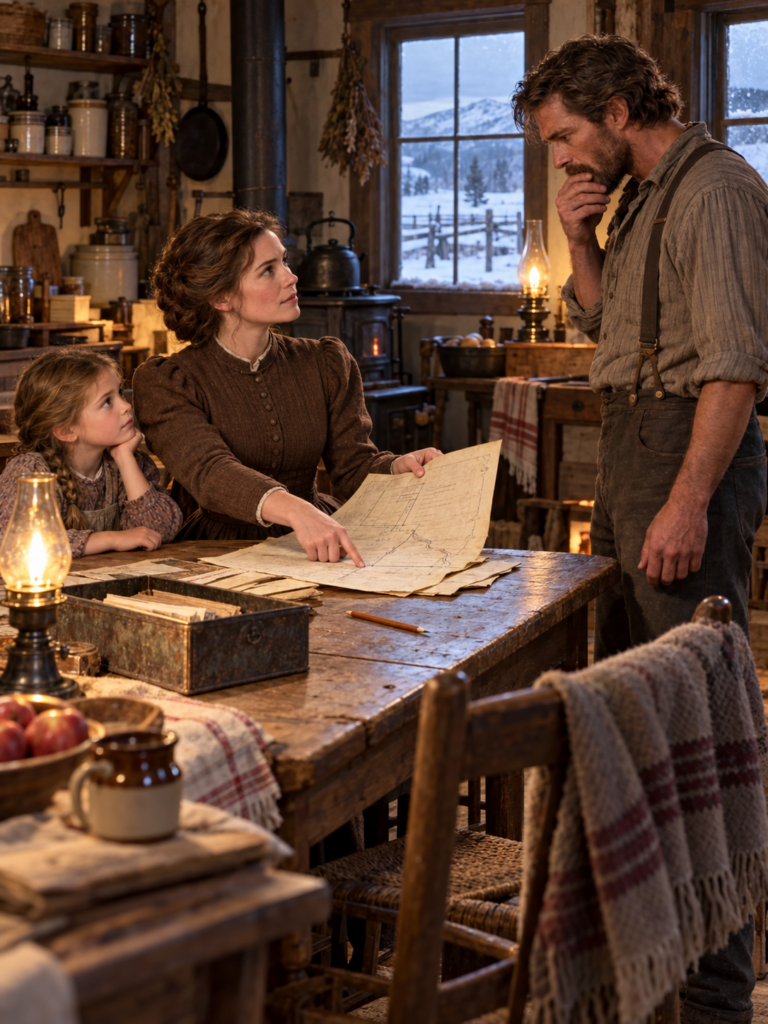
Abigail stopped with the letter still in her other hand.
Clara’s fingers held fast.
Abel shifted beside the table, but he did not tell his daughter to let go. He seemed to understand that whatever Clara meant, it belonged to her before it belonged to him.
“I am here,” Abigail said gently.
“Tonight.”
“Yes.”
Clara frowned.
Children disliked answers narrower than their questions.
“I mean here.”
Abigail looked toward Abel.
The room seemed suddenly smaller.
She could have promised what the child wanted. It would have been easy, and cruel in ways Clara was too young to recognize.
“My agreement with your father lasts through winter.”
Clara’s face fell.
Abel’s jaw tightened.
Abigail crouched—not to make herself childish, but so Clara would not have to look upward to hear something difficult.
“And while I am here, I will not disappear without telling you.”
Clara studied her.
“Promise?”
“Yes.”
Abigail offered her hand properly.
Clara shook it with grave solemnity.
“Promise.”
Only then did she release her.
Abel looked toward the stove.
“Bed.”
Clara obeyed reluctantly, dragging her doll by one arm.
At the doorway she turned.
“You’ll still be here at breakfast?”
“I will.”
Satisfied with the immediate future, she vanished upstairs.
Abigail placed Fitch’s letter beside Abel’s hat.
“You should send that before the weather turns.”
“I will.”
He remained standing.
So did she.
The silence between them no longer felt simple.
Finally Abel said, “You didn’t tell her what she wanted to hear.”
“I told her what I could promise.”
“She’s taken to you.”
“I’ve taken to her.”
The honesty made something flicker across his face.
Abigail continued before he could mistake affection for agreement.
“But Clara liking me does not decide what happens after the contract.”
“I know.”
“Do you?”
His eyes met hers.
She had never challenged him for sport. That was why he heard her now.
“Yes.”
The answer was quiet.
Certain.
Abigail nodded.
Then she went upstairs.
The reply to Fitch left with Abel before sunrise.
For nine days nothing came back.
Those nine days changed the house more than a confrontation might have.
Abel said little about the matter, yet Abigail saw him checking the creek channel whenever he returned from the lower field. She saw him study the ledger at night, calculating how long the farm could endure trouble with the bank.
She refused to let the waiting make the household helpless.
The garden beds were covered against deeper frost. Clara learned five new words. Abigail inventoried flour and lamp oil. Abel repaired the loose latch on the north bedroom door after noticing it failed to catch.
He did not mention doing it.
Abigail noticed anyway.
On the tenth afternoon, Abel returned from town carrying no new letter.
“Nothing?” Abigail asked.
“Nothing.”
He removed his gloves.
“Fitch was at the bank.”
Her hand stilled over the dough she was kneading.
“Did he speak to you?”
“He saw me.”
“And?”
“Walked the other direction.”
Abigail resumed kneading.
“That sounds encouraging.”
Abel almost smiled.
“Is that what educated people call it?”
“It is what cautious people call it.”
That evening he opened the tin box again.
Not because he needed the deed.
He placed it before Abigail.
“There are other papers in here.”
She looked at him.
“Do you want them explained?”
“I want to understand them.”
It was different.
She knew he meant it.
So they worked together after Clara slept.
Mortgage terms. Receipts. Seed accounts. A tax notice. Nothing mysterious. Nothing dramatic.
But each page moved something invisible between them.
Abel was letting her see not only what he owned, but where he might fail.
Abigail knew the significance of that better than any declaration.
Near ten o’clock she closed the ledger.
“You are carrying more debt than I first understood.”
“I know.”
“You can manage it if winter expenses stay ordinary.”
“If they don’t?”
“Then you make choices before someone else makes them for you.”
His face hardened.
“You think the bank might?”
“I think anyone who owes money should understand what choices remain theirs.”
Abel leaned back.
“And yours?”
She did not pretend not to understand.
“My choices remain mine as well.”
The words sat between them.
“If the farm fails,” he said, “your wages still get paid before mine.”
“That is not what I meant.”
“I know.”
He looked toward the staircase.
Then back at her.
“If spring comes and you want another position, I will take you anywhere the road allows. Silver Creek. Boise, if necessary. I won’t use Clara to hold you here.”
Abigail stared at him.
That promise cost him.
She could hear it.
And because it cost him, she believed it.
“Thank you.”
Outside, the first hard snow began tapping against the window.
Abigail rose to check the draft beneath the sill.
Abel crossed toward the door to bring in another armful of wood.
Before either reached what they intended, a small figure appeared halfway down the stairs.
Clara clutched the banister.
“Papa?”
He turned.
“What is it?”
She looked at Abigail, then at him.
“If Miss Morse leaves in spring, can I go with her?”
Abel stopped with one hand on the door latch.
Abigail went still beside the window.
Clara descended one more step.
Not crying.
That made it worse.
“I don’t want to lose another mother.”
Abel’s hand fell from the latch.
The wind pressed snow against the door from outside, but no one moved to fetch the wood.
Clara stood halfway down the staircase with her rag doll tucked beneath one arm.
Abigail reached her first.
“Come sit with us.”
Clara descended.
Abigail did not gather her into an embrace without asking. She simply held out a hand.
Clara took it.
At the table, Abel pulled out the repaired chair.
His daughter climbed into it.
For several moments he could not speak.
Eleanor’s death was rarely named in the house. Not because Clara had forgotten, and not because Abel had. The grief had become something like the mountains beyond the farm—always present, whether anyone looked toward them or not.
Abigail sat opposite Clara.
“I cannot become your mother because you are afraid I might leave.”
Clara looked down.
Abel’s face tightened, but he did not interrupt.
Abigail continued.
“And I will not promise forever tonight because forever is too large a promise to make only because someone is frightened.”
Clara’s lower lip trembled.
“But I like you.”
“I like you too.”
“Then why would you go?”
Because a woman needed more than affection to build a life.
Because Abigail had once believed ability would protect her from being treated as inconvenient, only to learn that a school board could smile while taking away eight years of work.
Because she would not trade dependence on one institution for dependence on one household.
Those thoughts were too large for Clara.
So Abigail gave her the truth a child could carry.
“Sometimes grown people must decide where they can live honestly.”
Clara considered this.
“Are you honest here?”
The question struck with remarkable accuracy.
Abigail glanced at Abel.
“Yes.”
Clara turned to her father.
“Is she?”
Abel swallowed.
“Yes.”
“Then she should stay.”
Abigail nearly smiled.
“If all decisions were that simple, you would make an excellent judge.”
“What’s a judge?”
“Someone who decides arguments.”
“I could.”
“You certainly could.”
Clara’s shoulders eased.
Abel finally rose.
“I’ll bring the wood.”
The moment he was outside, Clara whispered, “Papa likes you.”
Abigail stared toward the door.
“You are going to bed.”
“He does.”
“Clara.”
“He fixes things after you touch them.”
Abigail had no answer ready for that.
Clara smiled for perhaps the first time with mischief rather than happiness and ran upstairs.
When Abel returned carrying wood, Abigail was still standing beside the stove.
“What happened?”
“Your daughter has developed opinions.”
“She had those before you came.”
“I’m beginning to suspect that.”
He stacked the wood.
Then, without looking at her, said, “She asked something I should have answered better.”
“You answered honestly.”
“I didn’t answer at all.”
“Sometimes not lying is the first part.”
His gaze rose.
Abigail saw fatigue there.
And fear.
Not fear that she would leave him.
Fear that Clara would lose again.
That distinction mattered.
“My position in Millfield ended because the school board decided an unmarried woman past a certain age was unsuitable as an example to children.”
Abel became very still.
It was the first time she had spoken plainly about why she had come west.
“They dismissed you for that?”
“They called it a reorganization.”
“What did you call it?”
“A dismissal.”
His mouth tightened.
“They fools?”
“Some were.”
“You taught eight years.”
“Yes.”
“And they thought marriage made a woman wiser?”
“I believe they thought marriage made her easier to classify.”
That almost smile appeared.
Briefly.
Then vanished.
“My cousin in Boise took me in. She was kind. But kindness can become another sort of debt when you have no work and no intention of becoming someone’s permanent guest.”
“So you answered the agency.”
“I did.”
“Did Pitts warn you about me?”
“He said you were a widowed farmer with a young daughter and limited means.”
“That sounds generous.”
“He also wrote that the household might not provide sufficient intellectual engagement.”
Abel stared at her.
Abigail’s composure broke.
She laughed.
A real laugh.
He shook his head.
“What did you tell him?”
“That I had never required intellectual engagement from a stove.”
The almost smile finally became an actual one.
It transformed him.
Not into a different man.
Into the man exhaustion had hidden.
Abigail stopped laughing.
For one charged second neither looked away.
Then the kettle hissed.
She turned first.
December came fully.
The farm disappeared under snow that remained shallow enough for work but deep enough to make every trip slower.
Abigail established lessons for Clara after breakfast.
Not because the contract required them.
Because Clara wanted them.
Abel began lingering in the kitchen before morning chores, pretending to examine tack or weather through the window while Clara sounded out increasingly difficult passages.
One morning Clara stumbled over “perseverance.”
Abel supplied it from the doorway.
Both females looked at him.
He shrugged.
“I can read.”
Abigail raised an eyebrow.
“I never suggested otherwise.”
“You looked surprised.”
“I was surprised you were listening.”
“I live here.”
Clara giggled.
Abel escaped to the barn.
That afternoon he returned with scrap lumber.
Abigail found him measuring the kitchen wall.
“What are you doing?”
“Nothing yet.”
“That is a suspicious answer from a man holding a rule.”
“You’ll see.”
“I dislike mysteries involving alterations to rooms I work in.”
He looked at her.
“Then I’ll tell you before I alter it.”
She appreciated the answer more than he knew.
The lumber remained stacked until spring.
For now there were more immediate matters.
Clara’s coat seam split again.
Abel found Abigail repairing it by the window.
“I meant to do that.”
“I know.”
She reinforced both ends and held it out.
He took it.
For a moment his expression seemed almost pained.
“What?”
“That coat came apart the week I wrote the agency.”
Abigail waited.
“I remember holding it up outside and seeing daylight through the seam.”
His thumb traced her neat stitches.
“I thought I was failing at everything Eleanor had done.”
Abigail did not tell him he had not failed.
He had failed at some things.
So did everyone forced to perform two lives’ worth of labor alone.
“You kept Clara warm enough to reach this winter,” she said.
His eyes met hers.
“That counts.”
He looked back at the coat.
“So does this.”
The simplicity of the acknowledgment settled warmly inside her.
The next morning Clara burst outside in the repaired coat, and Abigail watched father and daughter cross the white field.
She found herself imagining another winter.
The thought frightened her more than departure had.
That night the question of the agency report finally arose.
Abel stood beside the kitchen table while Abigail poured coffee.
“They’ll ask whether the arrangement is satisfactory.”
“They will.”
“Is it?”
She looked at him.
“To me?”
“Yes.”
“It is.”
He turned his cup between both hands.
“Pitts warned me you were too educated.”
“I know.”
“He made it sound as if that would be trouble.”
“Has it been?”
“Yes.”
Abigail’s eyebrows lifted.
Abel continued before she could misread him.
“I used to think trouble meant something breaking.”
His gaze moved across the room.
The properly hung curtains.
The repaired chair.
Clara’s slate.
The tin box containing papers he now understood.
“Turns out sometimes trouble is finding out how poorly you were doing something and being expected to improve.”
Abigail’s mouth curved.
“That is a dangerous definition.”
“I expect you taught children the same way.”
“Often.”
He set down the cup.
“I’d like you to stay after the contract ends.”
There it was.
Not romance.
Not yet.
But no longer merely employment.
Abigail folded her hands.
“Under what arrangement?”
His answer came slowly.
“I don’t know.”
“Then we should not pretend we do.”
“No.”
He looked toward the staircase.
“I know I want Clara to keep what she has.”
Abigail’s expression cooled a fraction.
“If you are asking me to remain only because Clara wants me here, you should hire another governess.”
His face changed.
“That isn’t what I mean.”
“Then say what you mean.”
He rose and walked once to the window.
Snow blurred the yard beyond the glass.
When he turned, he looked less like the owner of the farm than a man standing without tools before a job he could not avoid.
“I want you here.”
Abigail waited.
He had more to say.
He knew she would not rescue him from saying it.
“You make this house better. Not because you cook better than I do, though you do. Not because you teach Clara. Not because you helped with Fitch.”
He stopped.
“What, then?”
“Because when you’re here, I don’t feel like I’m guarding what’s left.”
The words landed quietly.
Abigail’s breath caught.
Abel looked down.
“After Eleanor died, everything became something I could lose. Clara. The farm. Her things. Even the chair, probably.”
That drew the smallest smile from her.
“I kept fixing things because fixing them meant they hadn’t gone yet.”
He looked at Abigail again.
“You came here and started building instead.”
Neither moved.
Finally she said, “You loved your wife.”
“Yes.”
“And loving me, if that is what you are trying to ask about, cannot require making her smaller.”
“It doesn’t.”
The answer came without hesitation.
“I thought it might.”
“It doesn’t.”
Abigail believed him.
Still, belief was not yet a decision.
“What would staying mean to you?”
Abel’s hands opened once at his sides.
“I don’t know how to ask this without making it sound like I need a housekeeper.”
“Then don’t ask for a housekeeper.”
His jaw tightened.
“Or a mother for Clara.”
“Then don’t ask for one.”
The silence stretched.
Abigail could hear the clock.
Finally Abel drew a breath.
“Would you consider becoming my wife?”
She did not answer.
His face remained steady, but color rose slightly beneath the weathered skin.
“That was poorly done.”
“No.”
She looked at him carefully.
“It was incomplete.”
He waited.
“If I married you, I would not become an employee with a different title.”
“No.”
“I would keep handling my own wage until the marriage. Afterward I expect to know the household accounts entirely.”
“Yes.”
“I expect decisions affecting this house to be discussed with me.”
“Yes.”
“And Clara’s schooling continues.”
“Yes.”
She studied him.
“You are agreeing very quickly.”
“I’ve had three years of making decisions alone. I am not attached to the experience.”
That earned him a smile.
Abigail looked at the lamp.
Then at the stairs where Clara slept.
Then at the man who had offered to take her to Boise if she chose to leave, even knowing what departure would cost his daughter.
That mattered more than any proposal.
“Ask me again.”
Abel’s eyes sharpened.
“Plainly.”
He stepped closer, but not close enough to crowd her.
“Abigail Morse, will you marry me?”
She let the question exist between them.
A home was not a rescue.
A husband was not employment.
A child’s need could not make the choice for her.
She thought of Millfield.
Of Boise.
Of the October station bench.
Of a farmhouse where her thoughts were not an inconvenience.
“Yes,” she said.
Abel exhaled.
Then Abigail lifted one finger.
“We discuss the terms in the morning.”
His mouth curved.
“Of course we do.”
A floorboard creaked overhead.
Both looked toward the stairs.
Clara stood there in her nightgown, very obviously pretending she had not heard anything.
Abigail folded her arms.
“How long have you been awake?”
Clara descended with dignity.
“Not long.”
Abel coughed into his fist.
Clara looked from him to Abigail.
“Are you staying forever?”
Abigail glanced at Abel.
This time the answer did not belong to fear.
It belonged to choice.
“Yes,” she said.
Clara’s entire face brightened.
“Good. Because I already told Mrs. Hendricks at the post office you were going to be my mother.”
Abel lowered his hand from his mouth.
Abigail stared at Clara.
“You told Mrs. Hendricks what?”
Clara climbed onto the bench as though called to testify.
“That you were going to be my mother.”
“And what did Mrs. Hendricks say?”
“She said I ought not tell people things I didn’t know.”
Clara folded her hands.
“But I did know.”
Abel turned toward the stove.
His shoulders moved once.
Abigail realized he was laughing silently.
“You find this amusing?”
He turned back, composed except for the treacherous crease beside one eye.
“A little.”
Clara looked pleased with herself.
Abigail tried sternness and failed.
“You may tell Mrs. Hendricks you were correct.”
“I will.”
“After breakfast.”
“Yes, ma’am.”
“And you will not add details of private conversations.”
Clara considered this limitation.
“What counts as private?”
Abel sat down.
“We’ll need another lesson.”
The next morning began, as promised, with terms.
Abel made coffee before Abigail came downstairs.
It was poor coffee.
She drank it anyway.
He had laid the ledger on the table beside a blank sheet of paper.
That nearly made her love him before either of them had yet spoken the word.
Not because he had surrendered authority.
Because he understood she was not asking him to.
She was asking to share responsibility.
Abigail sat.
Abel handed her the pencil.
“No.”
He frowned.
She pushed it back toward the middle of the table.
“We both need one.”
Something like recognition passed through his expression.
He fetched another.
They talked for two hours.
The house would remain the farm Clara inherited in due course, but Abigail would have a secure home within it as Abel’s wife, not merely at his pleasure. Household expenses would be transparent. Abigail would continue managing the pantry and garden because she was better at both, but not because those tasks belonged to her by nature. Abel would keep responsibility for livestock and field work, though Abigail could learn any part she wished.
Clara’s schooling would continue at home through winter and with whatever local schooling became practical later.
“If I ever teach again,” Abigail said, “I want that choice open.”
Abel nodded.
“You should have it.”
“I may want books.”
“I suspected.”
“More than three.”
“I feared that.”
She smiled.
“There is something else.”
He waited.
“I don’t want Eleanor erased.”
His expression changed.
“I wouldn’t ask that.”
“I know. But Clara should be able to speak of her mother without wondering if it wounds me.”
Abel looked toward the stairs.
“That may wound me.”
“Yes.”
“But she should be able.”
“Yes.”
He lowered his gaze to the ledger.
“I packed Eleanor’s things away because every object felt like accusation.”
Abigail said nothing.
He continued.
“I thought if I touched them, I was admitting she was never coming back. If I didn’t touch them, I could pretend I had not abandoned her memory.”
“That sounds exhausting.”
“It was.”
He gave a humorless smile.
“I was angry at her for dying.”
Abigail’s face softened.
“Then ashamed for being angry.”
“Yes.”
“You need not ask me to absolve you.”
“I know.”
That was one of the things she had come to trust about him.
He did not demand that affection make his grief simpler.
Clara came downstairs soon afterward, hair uncombed, and interrupted the discussion by asking whether marriage meant Abigail would sleep in Papa’s room.
Abel nearly dropped his pencil.
Abigail replied that it meant Clara needed to wash her face before breakfast.
Clara accepted the redirection reluctantly.
The wedding could not be immediate.
Snow made travel uncertain, and Abel wanted a preacher rather than a hurried declaration before whoever happened to be available in town.
Abigail agreed.
More importantly, the waiting allowed their decision to prove itself in ordinary days.
They did not become suddenly romantic merely because marriage had been proposed.
Abel still forgot to wipe mud from his boots.
Abigail still rearranged supplies and then had to tell him where she put them.
They disagreed about how much lamp oil could reasonably be used for evening reading.
Abigail won that argument by showing him the accounts.
Abel responded by purchasing a second lamp wick anyway.
He claimed this was unrelated.
She did not believe him.
Clara watched both with deep satisfaction.
At Christmas, there were no extravagant gifts.
Abel carved Clara a small wooden horse.
Abigail made her a cloth book satchel from sturdy remnants.
Clara gave Abigail a page covered in carefully copied words.
HOME.
BOOK.
WINTER.
PAPA.
ABIGAIL.
At the bottom, in larger letters:
STAY.
Abigail read it twice.
Then she looked across the table.
Abel knew from her face that this was not a moment for speech.
So he did not spoil it.
In January, another letter came from Silver Creek.
This one was not from Fitch.
It came from the bank manager.
Abel opened it at the table.
Abigail watched the familiar flattening of his hands, but this time he passed the paper to her immediately.
The bank acknowledged the filed water claim and stated that no further question concerning the eastern channel affected Abel’s mortgage.
Abigail read the paragraph again.
“That settles it.”
Abel nodded.
“Fitch?”
“Not mentioned.”
“Probably wise of them.”
He folded the letter and placed it in the tin box behind the deed.
Then he stopped.
“No.”
Abigail looked up.
He removed both documents.
“What?”
“I’m tired of keeping every important thing where nobody sees it.”
He carried the papers to the cabinet and placed them in the household ledger.
Abigail understood.
The deed no longer represented a threat he feared privately.
It had become information they both knew how to defend.
By February, sunlight lingered longer on the snow.
The preacher reached the farm on a Saturday.
There were no rings.
The catalogue order had not arrived.
Abel apologized once.
Abigail told him if he apologized again, she might reconsider merely to cure him of the habit.
He believed her enough to stop.
They stood in the front room.
Abigail wore her best brown dress.
Abel wore a dark coat that Clara had inspected twice for lint.
Clara stood between them.
The preacher looked at the child.
“You understand you are not required to stand in the middle?”
“Yes.”
“Would you like to move?”
“No.”
Abel cleared his throat.
The preacher wisely continued.
The vows were plain.
So were the answers.
When Abel said yes, he looked directly at Abigail.
Not at Clara.
Not at the room.
Her.
When Abigail answered, she did the same.
No rescue.
No debt.
No woman grateful merely to have somewhere to go.
No man filling an empty place beside him.
Two adults who had watched each other work, fail, choose, repair, and speak truth.
After the preacher finished, Clara took both their hands and joined them herself.
“There.”
Abel looked down.
“There what?”
“Now it looks right.”
Abigail’s eyes stung.
She squeezed Clara’s fingers.
The preacher accepted coffee before beginning the trip back.
He complimented the cornbread.
Abel informed him Abigail had repaired the household’s long history of burnt bottoms.
Abigail reminded Abel that one successful winter did not justify rewriting history.
By evening the farmhouse belonged to the same people it had that morning.
And yet it did not feel the same.
Marriage did not make Abigail more entitled to respect than she had been the day before.
It did not transform Abel into a wiser man.
It did not erase Eleanor.
It did not heal every fear Clara carried.
What it did was make public a choice already being lived privately.
That night, before Clara went upstairs, she paused beside Abigail.
“Can I call you Mama?”
Abigail’s heart clenched.
She glanced at Abel.
His face was unreadable.
The answer was hers.
“You may call me Abigail as long as you like.”
Clara frowned.
“That wasn’t what I asked.”
“No.”
Abigail touched the girl’s hair.
“If one day you want to call me Mama because that is what I have become to you, you may. But you never have to stop having a mother named Eleanor.”
Clara’s eyes filled.
“She died.”
“I know.”
“I remember her voice a little.”
Abel turned away.
Abigail continued softly.
“Then keep it.”
Clara wrapped both arms around her.
This time Abigail held her without hesitation.
Over the child’s head, she saw Abel press his thumb once against his eyes.
Spring came slowly.
Snow retreated from the southern edges of the fields first.
The creek rose but stayed within its banks.
Abigail uncovered the garden beds she had prepared before winter and found the dark soil ready beneath the straw.
Clara followed with a basket of seed packets.
Abel came behind carrying a spade.
“You said the garden belongs to the house,” he reminded Abigail.
“It does.”
He offered her the spade.
“Then you decide what goes where.”
She took it.
“Beans along the back. Herbs close to the kitchen.”
“Anything else?”
“Yes.”
She pointed toward a strip beside the porch.
“Flowers.”
Abel looked skeptical.
“They don’t feed anybody.”
“They feed me.”
He considered that.
“Then flowers.”
It was the kind of answer she had learned to expect from him.
Not agreement without thought.
Respect after thought.
A few days later she found lumber stacked against the kitchen wall.
The lumber from December.
Abel entered carrying a plane.
“You never told me what that was for.”
“I am now.”
He measured the wall above the table.
“A shelf.”
“We already have shelves.”
“Not enough.”
“For what?”
“Books.”
Abigail said nothing.
Abel kept his eyes on the board.
“There are three in the house now besides the Bible and ledger. Clara will outgrow the reader. You will want others.”
“You dislike unnecessary spending.”
“I do.”
“And books cost money.”
“They do.”
“So?”
“So I can dislike a thing and still understand it is worth doing.”
Abigail leaned against the doorway.
He had become better with words.
Not eloquent.
Better.
“Where will we put it?”
He showed her the line he had marked.
“High enough that Clara cannot reach everything now. Low enough she can soon.”
Abigail stepped beside him.
“Move it two inches left.”
“Why?”
“The lamp throws better light there.”
He moved the mark.
They built the shelf together.
Abel planed.
Abigail sanded.
Clara handed them nails in quantities neither requested.
When it was finished, it was not perfect.
One board bore a knot near the middle.
Abigail loved the knot.
The three books went up first.
McGuffey’s reader.
The old primer.
A worn volume Abigail had brought in her trunk.
Then Abel added the household ledger.
Abigail looked at him.
“That is not a book.”
“It has writing.”
“By that standard, grocery lists are literature.”
“I’ve read some of yours. They have plot.”
She laughed.
Clara demanded to know what plot meant.
Abigail gave her a lesson.
Summer followed.
The farm did not suddenly become prosperous.
Debt still existed.
Weather still mattered.
One injured horse cost them more than expected.
A stretch of fence along the creek needed replacing.
The pantry required discipline.
But the difference was that trouble no longer arrived to one person standing alone.
Abigail kept the accounts beside Abel.
She wrote correspondence when precision mattered.
He taught her how to judge which fence posts had rotted beneath the soil before they visibly failed.
She taught him that asking Clara what she thought did not weaken paternal authority.
He taught Abigail to harness the smaller mare.
She learned badly at first.
He did not laugh when she tangled a strap.
She laughed at herself.
That gave him permission.
Clara learned multiplication.
Abel claimed this was sorcery.
Abigail made him sit through the lesson.
He learned too.
In late summer, Mrs. Hendricks came out from Silver Creek carrying a parcel.
Clara met her in the yard.
“I told you,” she announced before the woman reached the porch.
Mrs. Hendricks looked puzzled.
“Told me what?”
“That Abigail was staying.”
Abigail stood in the doorway.
“Clara.”
“What? I did.”
Mrs. Hendricks laughed.
“So you did.”
She handed over the parcel.
The rings had finally arrived months after anyone needed them to prove anything.
That evening Abel opened the little box at the table.
The bands were simple.
Abigail lifted one.
“We seem to have managed without them.”
“We did.”
“Do you still want one?”
He answered without offense.
“Do you?”
She considered.
“Yes.”
He slid the band onto her finger.
Not as a claim.
As a sign.
Then she put his on.
Clara applauded.
Years did not pass in a blur after that.
They accumulated in objects.
A second shelf.
Then a third.
A larger garden.
A better coat for Clara, with Abigail teaching her to reinforce the seams herself.
The tin document box remained in the cabinet, but it no longer held every fear.
Eleanor’s box came down one autumn afternoon because Clara asked whether she could see her mother’s blue shawl.
Abel carried it to the table.
His hands shook.
Abigail sat beside him without opening it for him.
He lifted the lid himself.
Clara touched the shawl.
“Did Mama wear this?”
“At church,” Abel said.
“And once to a dance before you were born.”
“You danced?”
“Poorly.”
Abigail looked interested.
“I would like evidence.”
“You’ll get none.”
Clara laughed.
So did Abigail.
Abel touched the shawl.
He cried quietly.
No one tried to stop him.
Afterward Clara kept one ribbon.
The rest went back into the box, but not to the highest shelf.
It remained where she could ask for it again.
By the time Clara could reach the original book shelf easily, there were too many volumes to fit.
Some came secondhand from Silver Creek.
Some Abigail ordered carefully when money allowed.
One winter she began teaching two neighboring children at the kitchen table.
Then four.
Abel asked whether she wanted to charge their families.
Abigail thought about Millfield.
About the board that had decided her life should be narrower.
“Yes,” she said.
“Not much. But yes.”
He nodded.
“What do you need?”
“Another bench.”
He built one.
The first morning it was used, Abigail stood in the kitchen before the children arrived and ran her hand over the smooth wood.
Abel watched from the doorway.
“You all right?”
“Yes.”
She looked around.
Books.
Slates.
Clara’s coat hanging by the door.
The repaired chair.
The table where a deed had once been translated from threatening language into plain truth.
“This was never in the contract.”
“No.”
Abel crossed the room.
He stopped close enough for warmth, not possession.
“No contract I could have offered would have been big enough.”
She looked at him.
“You have improved with words.”
“Don’t spread it around.”
She smiled.
Outside, children’s voices approached through the cold.
Years earlier Abigail had arrived at this farm because she required employment.
Abel had accepted her because his daughter needed care.
Both facts remained true.
Neither was the whole truth.
The whole truth was built afterward.
In the garden rows Abel let Abigail choose.
In the books he made room for before he understood all she would teach.
In the papers they read together.
In the mother Clara remembered and the mother she later chose to name.
In a man learning that protecting a household did not mean controlling it.
In a woman learning that belonging somewhere did not require becoming smaller.
One October evening, years after Abigail first waited at the station, she found Abel outside holding Clara’s old winter coat.
The child had long since outgrown it.
Abigail stood beside him.
“Where did you find that?”
“Bottom of the chest.”
He turned the coat.
Her old repair still held.
Abel pressed his thumb against the seam.
“The week before you came, this tore open.”
“You told me.”
“I remember thinking I was the sort of man who let his child go cold.”
Abigail looked at the farm.
Smoke from the chimney.
Light in the kitchen window.
Books visible beyond the glass.
The garden turned dark for winter.
“You were the sort of man who asked for help.”
“Took me long enough.”
“But you did.”
He handed her the coat.
She traced the stitches she had made so many years earlier.
“What should we do with it?”
Abel glanced toward the house.
“Clara might want it.”
“Then we ask her.”
He nodded.
They went inside together.
That was the difference.
Once, every broken thing had seemed to Abel like proof that he had failed.
Now a broken thing was only a thing requiring attention.
Sometimes Abigail repaired it.
Sometimes Abel did.
Sometimes Clara, nearly grown, showed them both a better way.
The old coat remained folded in the chest.
The shelf Abel built remained on the kitchen wall, though more shelves surrounded it now.
The creek still ran along the eastern edge of the farm under rights Abigail had once defended with a sharpened pencil.
And when the wind came down from the Idaho hills, persistent as ever, it still found the farmhouse.
But not the same house.
Not anymore.
Inside were books, accounts, mending, remembered grief, arguments, shared decisions, warm food, and people free enough to stay.
The agency had warned Abel Granger that Abigail Morse might be too educated for his household.
They had misunderstood both the woman and the household.
She had never needed to know less in order to belong there.
He had needed to become the kind of man who understood that everything she knew, everything she chose, and everything she still hoped to become did not threaten his place beside her.
It made their life larger.
And Abigail had not remained because a lonely child needed her, because a widower rescued her from uncertainty, or because the frontier gave her nowhere else to go.
She stayed because she was offered the one thing she had nearly stopped expecting.
A place where her usefulness did not cancel her freedom.
A place where love did not ask her to become smaller.
A place she could leave.
And therefore, with open eyes, a place she chose as home.

