Part 1
“Mom, you need to turn around.”
I kept my voice level, although my heart was pounding hard enough to make my ribs ache.
For a few seconds, all I heard was road noise through the phone.
Then my mother laughed.
Not because anything was funny.
It was the laugh she had used my entire life whenever I said something she had already decided not to take seriously.
“Claire, please,” she said. “We’re forty minutes away.”
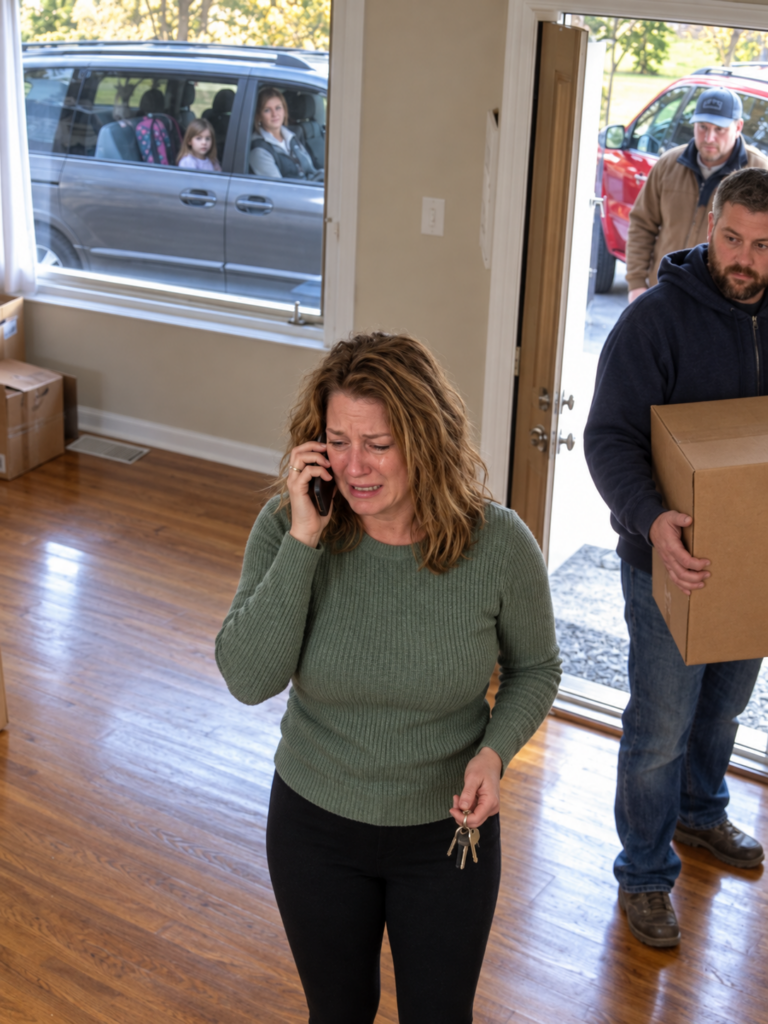
I stood in the center of the living room and looked around.
The room had never seemed so large.
There was no sofa against the far wall anymore. No Christmas tree in front of the bay window. No coffee table scarred by years of mugs, toy cars, wineglasses, and my brother Daniel putting his boots where I had repeatedly asked him not to.
Even the rug was gone.
All that remained were pale rectangles where furniture had protected the hardwood from sunlight.
My husband, Ben, carried the last cardboard box down the hallway.
He glanced at me.
I mouthed, They’re coming.
His expression changed immediately.
My mother was still talking.
“Your brother has the kids with him. Vanessa brought those breakfast pastries you like. I told everybody we should arrive before lunch so you wouldn’t have to cook right away.”
The sentence was so absurd I nearly laughed.
So I wouldn’t have to cook right away.
As though delaying my unpaid shift by three hours were some generous Christmas gift.
“Mom, I told you three weeks ago that we were not hosting Christmas.”
“You said you were tired.”
“I said no.”
“You were upset.”
“I was clear.”
“Claire.”
There it was.
My name spoken with that small downward turn at the end, the verbal equivalent of a hand pressing me back into a chair.
Behave.
Stop embarrassing us.
Be reasonable.
Which, in my family, had always meant: make yourself uncomfortable so nobody else has to be.
Ben set down the box he was carrying.
He came closer.
“Put it on speaker,” he whispered.
I shook my head.
Not yet.
My mother sighed.
“Your sister has already taken four days off work.”
“That was her decision.”
“Daniel rented an SUV because there wasn’t enough room for all the luggage.”
“That was also his decision.”
“And your aunt Mary is bringing Grandma’s serving dishes.”
I closed my eyes.
For twelve Christmases, my house had been the place everyone came because it was “central.”
That was the official reason.
The real reason was simpler.
I let them.
When Ben and I bought the house outside Columbus, Ohio, I had been thirty-one and foolishly thrilled to have a dining room big enough for an actual table.
I grew up in a cramped ranch house where holiday dinners required folding chairs, TV trays, and somebody eating on the stairs.
Our new place had four bedrooms.
Two and a half bathrooms.
A wide kitchen with a double oven.
The first Christmas after we moved in, I invited everyone.
I meant it as a celebration.
My mother cried when she saw the lights along the porch railing.
Daniel opened a bottle of champagne.
My younger sister, Paige, hugged me and said, “You finally have the family house.”
At the time, the words warmed me.
I didn’t understand that she had just named my future job.
The second Christmas, nobody waited to be invited.
They simply asked what time they should arrive.
The third year, Daniel and his wife came two nights early.
By the fifth, my mother had started referring to the upstairs guest room as “her room.”
By the seventh, Paige kept a phone charger in one of my nightstands.
By the ninth, Daniel’s children knew which pantry shelves held snacks.
By the twelfth, people no longer asked whether Christmas would be at my house.
They asked what I was cooking.
The tradition expanded quietly.
Breakfast became brunch.
Brunch became dinner.
Dinner became three-day stays.
Then four.
Someone always needed to arrive early because of traffic.
Someone always needed to stay late because the children were tired.
My mother began showing up with grocery suggestions instead of groceries.
“You know what would be wonderful?” she would say, placing her purse on the kitchen island. “Those little sausage rolls you made last year.”
Or:
“Daniel loves your scalloped potatoes.”
Or:
“Your grandmother always made two desserts.”
Every suggestion somehow became work for me.
And because I had spent most of my life wanting my mother to call me capable instead of difficult, I did it.
I cooked.
I cleaned.
I bought extra sheets.
I bought air mattresses.
I washed towels at midnight.
I made grocery lists so detailed they looked like inventory sheets for a restaurant.
I wrapped gifts after everyone went to sleep because my days disappeared into serving food, finding batteries, reheating coffee, separating arguing children, and answering questions nobody asked the men.
Where are the extra napkins?
Do you have Tylenol?
Which towels can we use?
Is there more milk?
Where should I put this dirty pan?
Can the kids eat in the den?
What time are we having dinner?
Did you remember whipped cream?
Ben helped.
He always helped.
That was part of what made my family’s behavior harder to excuse.
They watched him load dishwashers.
They watched him strip beds.
They watched him haul trash bags outside in freezing weather.
Nobody seemed embarrassed.
They merely praised us.
“You two are such wonderful hosts.”
Wonderful hosts.
A phrase that gradually sounded like a prison sentence.
The previous Christmas finally broke something in me.
Sixteen people stayed at the house at some point during the holiday week.
Five children.
Eleven adults.
Daniel’s youngest got sick on the upstairs carpet after eating too many chocolate-covered pretzels.
His wife, Vanessa, stood in the bathroom doorway while I knelt with stain remover and paper towels.
“Oh, Claire, you’re better at that stuff,” she said.
Then she walked away.
Paige borrowed my new wool coat without asking and returned it with a coffee stain near the cuff.
When I confronted her, she looked at the spot and shrugged.
“It’ll come out.”
“Then clean it.”
Her eyebrows rose.
“Wow.”
That single word.
Wow.
As though asking a thirty-four-year-old woman to clean a coat she had stained was evidence of some terrible character flaw.
Daniel spent most of Christmas Eve watching football with our cousins while Ben and I cooked.
At one point, I walked into the living room carrying two trash bags and asked whether someone could take them to the bins.
Daniel looked directly at me.
“After this drive.”
He was playing a football video game.
Not watching football.
Playing it.
Twenty minutes later, the bags were still there.
So I took them outside myself.
It was snowing.
I remember standing beside the garage in house slippers while cold water soaked through the fabric around my toes.
Through the windows, I could see everyone laughing.
The Christmas tree glowed.
Music played.
My mother was sitting in my chair drinking wine.
Nobody noticed I was outside.
That should have been the moment.
But it wasn’t.
The moment came the next morning.
Ben’s parents were supposed to visit for dessert.
His father had been recovering from surgery, so they weren’t staying long.
I had made a pecan cake because it was his favorite.
I even taped a note to the container.
PLEASE SAVE FOR TOM AND JUDY.
At eleven that morning, I opened the refrigerator.
The container was empty.
Not missing.
Empty.
Someone had put the empty container back.
I stared at it.
Vanessa walked into the kitchen behind me.
“Oh,” she said. “The kids got into that.”
I turned.
“The cake for Ben’s parents?”
She opened the cabinet and reached for a mug.
“They were hungry.”
“There are muffins. Cereal. Fruit. Cookies. Leftovers.”
She shrugged.
“They wanted cake.”
“My note was on it.”
“I saw the note.”
Something in the way she said it made the room go silent in my head.
Not apologetic.
Not embarrassed.
Almost annoyed that I was making her discuss it.
“You saw the note?”
“Yes, Claire.”
“And you let them eat it?”
She sighed.
“They’re children. It’s Christmas.”
I can still remember the refrigerator humming behind me.
The smell of coffee.
The sticky patch of maple syrup beneath my sock.
The red Christmas towel hanging crooked from the oven.
Everything looked normal.
That was the strange part.
You expect the moment you finally understand your place in someone else’s life to arrive with thunder.
Mine arrived beside an empty cake container.
Vanessa walked away.
I stayed there.
Then my mother entered.
“What’s wrong now?”
Now.
As if I had been creating problems all morning.
I held up the container.
“Ben’s dad’s cake is gone.”
She barely looked at it.
“Oh, honey. Make another.”
I stared at her.
“Make another?”
“You’re already baking.”
Ben’s father never got his cake.
I didn’t make another one.
Instead, I went upstairs, locked our bedroom door, sat on the edge of the bed, and cried so quietly nobody heard me.
Ben found me ten minutes later.
He didn’t tell me to calm down.
He didn’t tell me it was only cake.
He sat beside me.
After a while, he said, “We don’t have to do this anymore.”
I wiped my face.
“You know what they’ll say.”
“Yes.”
“My mother will tell everyone I’m selfish.”
“Probably.”
“Paige will make it public.”
“Probably.”
“Daniel will say I’m dramatic.”
Ben reached for my hand.
“Probably.”
I looked at him.
“You’re not helping.”
“I’m not trying to convince you they’ll behave well.”
His thumb moved across my knuckles.
“I’m telling you their bad behavior doesn’t have to decide what we do.”
That stayed with me.
All year.
By October, my mother had begun mentioning Christmas.
I ignored the hints.
In November, she started a family group chat called CHRISTMAS AT CLAIRE’S.
I changed the name to CHRISTMAS PLANS.
Paige changed it back within five minutes.
That should have told me everything.
Finally, on December 1, I sent the message.
Ben sat beside me at the kitchen table while I typed.
This year Ben and I will not be hosting overnight guests or Christmas dinner. We need a quieter holiday. I’m happy to meet everyone at a restaurant or attend something at someone else’s home.
I reread it six times.
Ben said, “Send it.”
So I did.
My mother replied first.
Claire, don’t be ridiculous.
Daniel followed.
Already promised the kids.
Paige sent a laughing emoji.
Then:
Mom has already been planning the menu.
I typed:
I’m serious. We are not hosting.
My mother called immediately.
I let it ring.
Then the messages became less polite.
Daniel:
Where exactly do you expect everybody to go?
Paige:
You have the biggest house.
Mom:
Families make sacrifices.
I stared at that one longest.
Families make sacrifices.
Somehow, there was never any confusion about which family member she meant.
Then Paige did exactly what Ben had predicted.
She posted online.
She didn’t use my name.
She didn’t need to.
“Nothing sadder than watching somebody get a little comfortable in life and suddenly decide family is an inconvenience.”
Within an hour, two aunts and three cousins had commented.
People who had never bought a turkey.
People who had never changed sheets.
People who had never stayed awake until one in the morning scrubbing roasting pans.
My aunt Mary wrote:
Your mother would never turn away family at Christmas.
I almost replied.
Instead, Ben said, “Take screenshots.”
So I did.
Not because I had some elaborate plan.
Because I needed proof for myself.
Proof that I had not imagined the pressure.
Proof that “no” had been treated like the beginning of a negotiation.
The next morning, I made coffee and stood at the kitchen window.
The backyard was brown and frozen.
Ben came in wearing sweatpants and carrying his laptop.
He set it down.
“Can I ask you something?”
“Sure.”
“Do you still love this house?”
I looked around.
The kitchen had once been my favorite room.
Now, when I saw the island, I pictured platters.
When I saw the double oven, I felt tired.
When I passed the guest rooms, I thought about laundry.
“I don’t know,” I admitted.
Ben nodded.
“We’ve talked about downsizing for two years.”
We had.
Quietly.
Our mortgage was manageable, but the house was larger than we needed.
We didn’t have children.
Ben worked remotely.
I had recently accepted a position with an accounting firm that allowed me to work from home three days a week.
We had even visited smaller neighborhoods the previous spring.
Then life got busy.
“Are you suggesting we move because of Christmas?”
“No.”
He closed the laptop.
“I’m suggesting maybe Christmas finally made us admit we’ve been keeping a house we don’t want because your family wants it.”
I sat very still.
That sentence landed differently.
Not:
Sell the house to punish them.
Not:
Run away.
Just:
Why are we preserving a life that serves everyone except us?
Two days later, I called a realtor.
Her name was Marisol Greene.
She arrived carrying a leather folder and wearing red-framed glasses.
She walked through every room twice.
When she finished, she stood near the fireplace and said, “If you’re serious about moving quickly, I think we can price it aggressively and still do very well.”
“How quickly?”
She smiled slightly.
“In this neighborhood? If the inspection is clean, faster than your relatives are going to believe.”
I laughed.
I couldn’t help it.
Marisol didn’t know why.
We listed the house that Friday.
By Sunday evening, we had four offers.
The strongest came from a divorced school principal named Ellen Parker, who wanted to close before Christmas because she was moving closer to her daughter.
No inspection drama.
No financing contingency.
Flexible possession.
I stared at the offer for nearly twenty minutes.
Ben stood behind my chair.
“You don’t have to do it.”
I looked toward the dining room.
The long oak table sat beneath the chandelier.
My mother had once called that room “the reason we can’t possibly hold Christmas anywhere else.”
I signed.
We didn’t tell my family.
Not because I wanted some theatrical surprise.
Because I had learned something.
Information was another thing they believed belonged to them.
If I mentioned selling, they would call.
They would argue.
They would recruit relatives.
They would explain why my property should remain available for their convenience.
For once, I wanted to make an adult decision without submitting it for family approval.
So Ben and I packed.
Quietly.
We rented a townhouse twenty-five minutes away.
Two bedrooms.
One small dining area.
No basement full of folding chairs.
No guest wing.
No double oven.
The first night we carried boxes inside, I stood in the tiny kitchen and smiled.
Ben caught me.
“What?”
“There’s nowhere to put sixteen people.”
He looked around.
“That cabinet might hold Daniel.”
I laughed so hard I had to sit down.
Meanwhile, the family group chat continued.
Paige asked whether I still had enough air mattresses.
Daniel asked if I could buy the cinnamon coffee his wife liked.
My mother texted separately:
I know you’re upset, but I refuse to let you spoil Christmas over a misunderstanding.
I replied once.
There is no misunderstanding. We are not hosting.
She answered:
We’ll talk when we get there.
That was when I knew they intended to come anyway.
I showed Ben.
He stared at the message.
Then he said, “Good thing you won’t live there.”
Closing was scheduled for December 21.
That morning, the house was empty.
Ellen was due at eleven to collect the keys after the final walkthrough.
Ben loaded the last box into our car.
I stood in the living room remembering every Christmas that room had swallowed.
At 9:42, my mother called.
I nearly ignored it.
Something made me answer.
“Hello?”
Her voice was cheerful.
Too cheerful.
“We’re on the road.”
My stomach tightened.
“Who is we?”
“Oh, everybody.”
“Mom.”
“Daniel has the children. Paige is behind us. Mary and Uncle Steve are meeting us there.”
I looked at the empty walls.
“You’re coming to my house?”
“Of course.”
“I told you not to.”
“Claire, honestly, we are not doing this over the phone.”
“You need to turn around.”
“Don’t make this difficult.”
Then, through the window, I saw a blue sedan slowing near the driveway.
Ellen.
She parked and stepped out wearing a green winter coat.
A folder was tucked beneath her arm.
My mother kept talking.
“We’ve got food in coolers, presents in both cars, and your grandmother is already asking where she’ll sleep.”
I looked at Ellen.
Then at the key in my hand.
And for the first time in my life, disappointing my mother did not feel like failure.
It felt like telling the truth.
“You can’t stay here,” I said.
My mother’s voice sharpened.
“Why not?”
I watched Ellen walk toward the front steps.
“Because in about five minutes, it won’t be my house.”
Silence.
Then my mother said, very quietly:
“What did you just say?”
Part 2
“I sold it.”
My mother did not respond.
For one strange second, I thought the call had dropped.
Then I heard Daniel in the background.
“What happened?”
My mother whispered something.
He must have taken the phone because his voice suddenly filled my ear.
“You sold the house?”
“Yes.”
“When?”
“Closing was this morning.”
“Without telling anybody?”
I almost smiled.
“Who exactly was I required to tell?”
“Your family.”
“Why?”
“Because—”
He stopped.
That was the problem with entitlement when somebody finally asks it to explain itself.
It often has no vocabulary beyond because.
“Because we have Christmas plans,” he said finally.
“I don’t.”
“You knew everybody was coming.”
“I knew everybody intended to ignore me.”
“That is not the same thing.”
“It’s exactly the same thing.”
Outside, Ellen hesitated near the walkway.
I held up one finger to indicate I needed a moment.
She nodded and returned to her car.
Daniel lowered his voice.
“What is wrong with you?”
That hurt.
I wish I could say it didn’t.
Boundaries do not magically remove the part of you that still wants your brother to understand.
“I asked everyone to make different plans.”
“And instead of working this out like a normal person, you sold your house?”
“Ben and I had already discussed moving.”
“Convenient.”
“Very.”
“You did this to embarrass Mom.”
“No.”
“You knew what would happen.”
“I knew she might come after I told her not to. Those are different things.”
He swore under his breath.
Then I heard my mother again.
“Give me the phone.”
A scuffle.
Then:
“Claire.”
She sounded as if she were holding back tears.
I closed my eyes.
For years, my mother’s tears had functioned like an emergency alarm.
Everything stopped.
Whatever I felt became secondary.
I fixed things.
Not because she consciously planned every tear.
That almost made it worse.
The pattern had become so natural none of us noticed it anymore.
“Where are we supposed to have Christmas?” she asked.
There it was.
Not:
Where will you live?
Not:
Are you okay?
Not:
Why didn’t you feel safe telling us?
Where are we supposed to have Christmas?
I looked around the empty room.
The answer formed before I could soften it.
“Somewhere else.”
She inhaled sharply.
“After everything this family has done for you.”
The old hook.
I knew it immediately.
Our parents had helped me with tuition during my first year of college.
My father had co-signed my first car loan.
My mother had stayed with me for three days after gallbladder surgery.
Every act of kindness from the previous twenty years could be brought into evidence whenever I resisted a current demand.
“You mean the things families do because they love each other?”
“Don’t twist my words.”
“I’m not.”
“We supported you.”
“And I have supported this family every Christmas for twelve years.”
“No one forced you.”
The words struck harder than anything else she had said.
No one forced you.
I sat down on the windowsill.
She was right.
And wrong.
Nobody had physically forced me.
They had simply punished every attempt to stop.
Called me selfish.
Mocked my exhaustion.
Ignored my no.
Posted about me publicly.
Turned cooperation into the admission price for belonging.
“No,” I said. “You didn’t force me.”
Her breathing softened, as if she thought I had surrendered.
Then I continued.
“I trained all of you to expect it because I kept saying yes when I wanted to say no.”
Silence again.
“That part is mine.”
Ben looked at me from the doorway.
I could see pride in his face, but also sadness.
Because he knew what it cost me to say it.
“But I’m done training you,” I said.
My mother’s voice went cold.
“Fine.”
Then she hung up.
I thought that was the end of it.
It wasn’t.
At 10:37, Paige texted:
You are unbelievable.
At 10:39:
Mom is crying.
At 10:41:
Grandma has nowhere to go.
That one almost worked.
Our grandmother, Ruth, was eighty-three.
She hated hotels.
She had arthritis.
For one terrible minute, guilt rushed through me so fast I felt dizzy.
Then I remembered something.
“Ben.”
He came over.
“What?”
“Grandma lives twenty minutes from Mom.”
His expression hardened.
“Yes.”
“And Mom has a guest room.”
“Yes.”
I called Grandma directly.
She answered after four rings.
“Claire?”
“Grandma, are you in the car with Mom?”
“No, sweetheart. I’m at home.”
I sat up straighter.
“What?”
“Your mother said she’d pick me up after lunch.”
My throat tightened.
“Did she tell you I sold the house?”
“She said something happened.”
Of course she did.
Something happened.
Like weather.
Like illness.
Like a tree falling across the road.
Not:
Claire told us no and we ignored her.
“Grandma, I need you to know I’m not hosting Christmas.”
“Oh.”
“I told everybody weeks ago.”
A pause.
Then:
“Well, I wondered why your mother kept saying you’d come around.”
My eyes closed.
There it was.
Confirmation from someone who had no reason to protect my feelings.
“Are you okay staying home today?”
“Of course.”
“I’m sorry if this ruined your plans.”
“Claire.”
Her voice changed.
Firm.
My grandmother had been a school secretary for thirty-six years. She could make one syllable sound like an administrative ruling.
“You are not responsible for grown adults making plans after being told not to.”
Tears burned unexpectedly behind my eyes.
I looked away from Ben.
Grandma continued.
“And your mother has four bedrooms.”
I laughed through the tears.
“Yes, she does.”
“She turned one into a sewing room.”
“I know.”
“Fabric can sleep in the basement.”
That made me laugh harder.
Grandma sighed.
“Your mother gets ideas about how things ought to be. Sometimes the rest of you mistake that for law.”
I thought about that sentence for weeks afterward.
Before we hung up, Grandma said, “Tell me your new address when you’re ready.”
Not:
Where is it?
Tell me.
When you’re ready.
The difference almost broke my heart.
Ellen knocked gently a few minutes later.
I apologized for making her wait.
“No problem,” she said.
Then she looked past me into the empty living room.
“Hard morning?”
“You could say that.”
She smiled with the cautious kindness of someone who knew better than to ask.
I handed her the keys.
She turned them over in her palm.
“I haven’t owned a place by myself in twenty-seven years.”
Something about the way she said it shifted my perspective.
To my family, the house was Christmas headquarters.
To me, it had become a burden.
To Ellen, it was freedom.
“I hope it’s good to you,” I said.
She looked around.
“I think it will be.”
Ben put his hand against the middle of my back.
We walked outside.
I expected some dramatic feeling when I left.
Regret.
Triumph.
Grief.
Instead, I felt tired.
Then two vehicles turned onto the street.
A gray SUV.
A black minivan.
My stomach dropped.
“No,” Ben said quietly.
The SUV slowed.
I recognized Daniel behind the wheel.
My mother sat beside him.
Paige was in the second vehicle.
They had come anyway.
Even after the phone call.
Even after learning the house belonged to someone else.
Daniel pulled to the curb.
Doors opened.
Children climbed out wearing winter coats and carrying pillows.
Vanessa emerged holding a bakery box.
My mother stepped onto the pavement and stared at Ben and me.
Then at Ellen.
Then at the SOLD sign near the yard.
For once, nobody knew what to say.
My mother walked toward us first.
Her face was pale.
“You really did it.”
“Yes.”
Her gaze moved toward the house.
The front door stood partly open behind Ellen.
“You let a stranger buy our family home.”
Our family home.
I felt something settle inside me.
“Mom, you never lived here.”
“That isn’t what I mean.”
“I know.”
Daniel came closer.
“What do you expect us to do?”
Ben answered before I could.
“Go home.”
Daniel stared at him.
“This is family business.”
Ben’s jaw tightened.
“It became my business every time I spent Christmas scrubbing your mess out of my house.”
Vanessa folded her arms.
“Oh, come on.”
Ben turned toward her.
“No. You come on. One year your son threw up on our carpet and you told my wife she was better at cleaning it.”
Vanessa’s cheeks flushed.
“He was sick.”
“Nobody blamed him.”
Daniel said, “We are not standing in the street arguing about vomit.”
“No,” Ben replied. “We’re standing in the street because nobody listened when Claire said you couldn’t stay here.”
Paige walked up holding her phone.
Of course she was holding her phone.
She glanced at me.
“You knew this would happen.”
“I hoped you’d believe me before it did.”
Her mouth twisted.
“Mom spent weeks planning.”
“I spent twelve years hosting.”
“You loved hosting.”
That sentence stopped me.
I looked directly at her.
“At first.”
Paige seemed startled.
Maybe because none of them had ever considered that affection could expire under misuse.
“I did love it,” I continued. “I loved choosing menus. I loved decorating. I loved everybody being together.”
My mother’s face softened slightly.
Then I said, “And you took that thing I loved and turned it into work I wasn’t allowed to stop doing.”
Nobody answered.
Paige lowered the phone a little.
Daniel glanced toward the children.
They had grown quiet.
I immediately regretted having the argument in front of them.
“Kids,” I said gently, “none of this is your fault.”
My nephew Owen, ten years old, looked at me.
“Are we not having Christmas?”
The question hurt because he sounded frightened.
I crouched slightly so I wasn’t towering over him.
“You are absolutely having Christmas. It’s just not happening here.”
“Where?”
Before I could answer, my mother said bitterly, “Apparently nobody knows.”
I stood.
That was the moment I realized something I should have seen years earlier.
Chaos was useful to her.
If everyone remained confused long enough, I would step in.
I always did.
Make a reservation.
Find a hotel.
Offer the new townhouse.
Cook something.
Save the day.
I took a breath.
“Mom has a house.”
My mother’s eyes widened.
Paige looked toward her.
Daniel frowned.
Mom actually took a step back.
“My house isn’t prepared.”
The absurdity was almost beautiful.
“You have four bedrooms,” I said.
“One is my sewing room.”
“Grandma says fabric can sleep in the basement.”
Ben covered a laugh with a cough.
My mother did not find it amusing.
“I don’t have enough food.”
Vanessa lifted the bakery box in her hands.
“We have some.”
Paige looked inside her vehicle.
“I brought two trays.”
Daniel said, “We’ve got the ham in the cooler.”
One by one, their excuses collapsed under the weight of their own preparation.
They had food.
Cars.
Homes.
Money.
Adults capable of washing dishes.
The only thing missing was me doing all the work.
My mother realized it too.
I could see it in her face.
That was why she became angry.
“You planned this.”
“No.”
“You wanted to teach us some kind of lesson.”
“No.”
“Then why are you smiling?”
I hadn’t realized I was.
I touched my mouth.
Because for the first time, I could see the machinery.
And once you see a machine clearly, it becomes harder to believe it is destiny.
“I’m smiling because you’re all going to be fine.”
Paige scoffed.
“You don’t know that.”
“Yes, I do.”
I gestured toward them.
“There are eight adults standing here. Between all of you, somebody can roast a ham.”
Ellen had remained near the porch through all of this.
Finally, she stepped forward.
“I don’t mean to interrupt.”
Everyone turned.
She gave my mother an apologetic smile.
“But I do need to bring my furniture in soon.”
My mother looked at her as though Ellen had personally orchestrated the betrayal.
Then she looked at me.
“You are really leaving us like this?”
The word us carried decades inside it.
I remembered being sixteen and skipping a school trip because Mom said she needed help preparing for my aunt’s anniversary dinner.
I remembered being twenty-four and canceling a weekend with friends because Daniel needed help moving.
I remembered driving Paige to an airport ninety minutes away after she missed her train.
I remembered believing love was measured by how inconvenient you were willing to make your own life.
“Yes,” I said quietly.
“I’m leaving.”
She started crying.
Not dramatically.
That made it harder.
Her face crumpled.
She looked suddenly older than sixty-seven.
For a moment, I almost moved toward her.
Then Paige did.
My sister put an arm around her shoulders.
Daniel took the cooler from the back of the SUV.
Vanessa called the children closer.
Nobody collapsed.
Nobody died.
Nobody was abandoned.
They simply began taking care of one another because I had stopped doing it first.
Ben opened the passenger door for me.
I got inside.
As we drove away, I looked back once.
My family stood in front of a house that no longer belonged to me.
My mother was speaking.
Daniel was listening.
Paige was typing something into her phone.
And Ellen stood on her own porch holding her own keys.
That should have been the end of the conflict.
Instead, it became the beginning of the truth.
Two days later, Paige called.
I nearly let it ring.
Then I answered.
She did not say hello.
“Did you know Mom told everybody you were having some kind of breakdown?”
My grip tightened around the phone.
“What?”
“She said that was why you sold.”
I sat down at our small dining table.
Ben was assembling a bookshelf across the room.
“What exactly did she say?”
“That you’d been overwhelmed at work. That you were making impulsive decisions. That she was worried about you.”
I closed my eyes.
Of course.
If my decision could be turned into instability, nobody had to examine why I made it.
“Do you believe her?”
Paige was quiet.
“I did.”
Past tense.
Something in her voice made me wait.
Finally, she said, “Until Christmas.”
Apparently, my mother had hosted after all.
Everyone drove to her house.
The first problem was sleeping arrangements.
Grandma got the guest room.
Daniel’s family took the basement.
Paige slept on the pullout sofa.
Aunt Mary and Uncle Steve stayed at a nearby motel.
Then came dinner.
My mother had always presented herself as the person who taught me how to host.
In reality, she had not hosted more than six people for a holiday since my father died.
She forgot how much work disappeared behind closed doors.
The ham needed glazing.
The potatoes had to be peeled.
The children wanted snacks.
Someone spilled juice.
The dishwasher filled.
The trash overflowed.
The downstairs toilet clogged.
By four o’clock, she was furious.
“She snapped at Daniel because he was watching television,” Paige said.
I pressed my lips together.
“And?”
“He told her he was just relaxing.”
I closed my eyes.
The universe occasionally lacked subtlety.
Paige continued.
“Then she told Vanessa to get the kids out of the kitchen. Vanessa said Mom was being controlling.”
“What happened after dinner?”
A pause.
“Mom asked everyone to help clean.”
“And?”
Another pause.
“Not everyone did.”
“Who?”
“Claire.”
“Who?”
She exhaled.
“Me.”
At least she admitted it.
“I was tired,” she said.
“So was I.”
“I know.”
Those three words came quietly.
I stared through the window.
Snow had begun falling beyond the townhouse parking lot.
“You know now,” I said.
“Yes.”
Part 3
The family story began unraveling after Christmas.
Not in one dramatic confession.
In pieces.
That was more believable.
People rarely abandon a comfortable lie all at once.
They loosen their grip when reality makes holding it inconvenient.
Paige was first.
She came to the townhouse on December 29 carrying a grocery-store pie and no overnight bag.
That detail mattered more than she knew.
Ben let her in.
She stood just inside the doorway and looked around.
“This is it?”
I smiled.
“This is it.”
The townhouse was half the size of the old place.
We had one guest room, which Ben used as an office.
The dining table seated four.
Six if everybody liked each other.
Paige walked through the living room.
“It’s cute.”
“Thank you.”
“You seem happy.”
“I am.”
She sat at the table.
For a minute, neither of us spoke.
Then she said, “I deleted the post.”
“I saw.”
“I shouldn’t have written it.”
“No.”
She winced.
I didn’t rescue her from that either.
“I thought you were punishing us.”
“I wasn’t.”
“I know.”
She picked at the edge of the pie box.
“Mom made it sound like you just snapped.”
“I know.”
“She also said you never told her clearly that you weren’t hosting.”
I pulled out my phone.
Not triumphantly.
Almost sadly.
I opened the screenshots.
December 1.
My message.
Her reply.
My second message.
Her phone call.
Then December 14.
There is no misunderstanding. We are not hosting.
Mom:
We’ll talk when we get there.
Paige read everything.
Her cheeks went pale.
“She told Aunt Mary you changed your mind.”
“I didn’t.”
“She told Daniel you said you just didn’t want to cook.”
“I said nobody was staying at the house.”
Paige handed back the phone.
For the first time, I watched my younger sister confront the possibility that our mother was not merely controlling.
She had rewritten events.
Maybe not maliciously.
Maybe she had repeated the version she needed to believe.
But the result was the same.
Everyone arrived believing I was unreasonable because Mom had removed the parts where I had been clear.
Paige stared at the pie.
“I’m sorry.”
I nodded.
“I appreciate that.”
She looked up.
“Are we okay?”
“Not immediately.”
Her face fell.
I continued before guilt could make me lie.
“But I want us to be.”
That was new for both of us.
In our family, apologies had always functioned like erasers.
Someone said sorry.
The injured person had to announce forgiveness.
Everybody moved on before anything changed.
I didn’t want that anymore.
Paige came back twice in January.
Both times she called first.
Both times she left before dinner unless invited to stay.
Those tiny acts felt almost ceremonial.
Daniel took longer.
He did not speak to me for six weeks.
Then Grandma fell in her kitchen.
Nothing terrible.
A bruised hip.
A cut on her elbow.
But because I was closest, the hospital called me first.
I drove her to urgent care.
Daniel arrived an hour later.
We sat on opposite sides of a small waiting room while Grandma got X-rays.
For fifteen minutes, we said nothing.
Finally, Daniel looked at me.
“You could’ve told me sooner.”
“The nurse called you immediately after I got here.”
“I mean about the house.”
I stared at him.
“Would you have supported it?”
He looked away.
“That’s not the point.”
“It’s exactly the point.”
He rubbed his hands together.
The waiting room television played a home renovation show with the sound turned off.
“I thought you were trying to hurt Mom.”
“I was trying to stop hurting myself.”
He looked at me then.
There are sentences people cannot argue with because doing so would reveal too much.
Daniel leaned back.
“Christmas at Mom’s was a disaster.”
“So I heard.”
“She cried in the laundry room.”
That softened me despite everything.
“What happened?”
“Everybody wanted clean towels.”
I almost laughed.
Daniel did.
A small, embarrassed sound.
“She said she had been washing things for three hours and nobody noticed.”
We looked at each other.
Then he said, “I noticed the irony.”
“Did you help her?”
His mouth tightened.
“Eventually.”
“Eventually.”
“I know.”
Grandma appeared fifteen minutes later using a cane she claimed was unnecessary.
The doctor said she was fine.
Before we left, she looked between Daniel and me.
“You two speaking again?”
Daniel said, “Sort of.”
Grandma adjusted her coat.
“Good. Your mother has enough people angry with her.”
I frowned.
“What happened?”
Grandma looked surprised.
“You don’t know?”
Apparently, my mother had told the family that selling the house had been Ben’s idea.
She had suggested he was isolating me.
That accusation crossed a line even Paige had not tolerated.
My sister had confronted her.
Daniel had defended Ben.
Aunt Mary asked to see the messages.
Then Grandma told everyone she had spoken to me before Christmas and knew I had clearly refused to host.
The story collapsed.
Not spectacularly.
Just completely.
For years, Mom had controlled family disagreements by getting to people first.
Not necessarily with outright lies.
With framing.
Claire is sensitive.
Daniel means well.
Paige is going through a phase.
Your father is under pressure.
Once everybody accepted her interpretation, the person actually involved had to fight uphill simply to describe what happened.
This time, I had screenshots.
And Grandma had a memory.
My mother stopped answering calls for several days.
I did not chase her.
That may have been the most important boundary I set.
February became March.
The silence continued.
Then one rainy Sunday afternoon, my doorbell rang.
Ben looked through the peephole.
His eyebrows rose.
“It’s your mom.”
My stomach tightened.
“Does she have luggage?”
He looked again.
“No.”
“Then open it.”
She stood there wearing a navy raincoat.
Her hair was damp around the temples.
In both hands she held a glass baking dish covered with foil.
“I made lasagna.”
For a second, none of us moved.
Then she said, “I called first.”
I checked my phone.
Three missed calls.
It had been charging upstairs.
“You did.”
“I didn’t want you to think I was just showing up.”
The sentence carried so much history it almost made me smile.
I stepped aside.
“Come in.”
She entered cautiously.
Mom had never entered my old house cautiously.
She had walked in calling my name.
Opened cabinets.
Rearranged serving spoons.
Adjusted thermostats.
Now she stood in the small entryway as though aware that another person’s home had borders.
Ben took the lasagna.
“Thank you.”
She looked at him.
“Ben.”
“Linda.”
His use of her first name startled her.
Then she nodded.
“Could I talk to Claire?”
He glanced at me.
I nodded.
He took his coat and left to buy coffee we did not need.
Mom sat at the table.
For several seconds, she stared at her hands.
Then she said, “I was wrong.”
No explanation.
No but.
I waited.
She continued.
“I kept telling myself you were making the holiday harder than it needed to be.”
Her fingers twisted together.
“Then I hosted.”
I almost smiled.
She noticed.
“You can enjoy that.”
“I’m trying not to.”
“You should.”
That surprised me.
Mom looked toward the kitchen.
“I was furious by noon.”
“I heard.”
“Who told you?”
“Everyone.”
She gave a tired laugh.
“Of course.”
Then her expression changed.
“I kept waiting for people to notice things.”
“What things?”
“The trash.”
I said nothing.
“The dishes.”
Still nothing.
“The children pulling everything out.”
Her eyes met mine.
“The bathrooms.”
I folded my hands on the table.
“No one notices until you stop doing it.”
She swallowed.
“I know.”
The room felt very quiet.
“I heard myself say something to Daniel.”
“What?”
“‘Could somebody please just help without making me ask?’”
A strange ache moved through my chest.
She looked down.
“And I remembered you saying almost exactly that two Christmases ago.”
I remembered too.
My mother had answered:
People aren’t mind readers, Claire.
Her eyes filled.
“I told you to stop complaining.”
“Yes.”
“I thought because you were good at it, it wasn’t hard for you.”
That sentence mattered.
Not because it excused anything.
Because it revealed something true about families.
Competence often becomes invisible labor.
The person who remembers birthdays gets assigned birthdays.
The person who can calm everyone becomes responsible for peace.
The person who cooks becomes the cook.
The person who never complains becomes the one nobody thinks to protect.
“I was good at it because I practiced for twelve years,” I said.
She nodded.
“I know.”
“No, Mom. I need you to understand something.”
She straightened.
“I didn’t sell the house because I wanted revenge.”
“I know that now.”
“I sold it because I realized I was maintaining a whole life around everybody else’s expectations.”
She pressed her lips together.
“I’m sorry.”
I believed she meant it.
That did not immediately heal me.
Those are different things.
“I’m sorry I ignored you,” she continued. “And I’m sorry I told people you were unstable.”
My eyes narrowed slightly.
She noticed.
“That was terrible.”
“Yes.”
“I was embarrassed.”
“So you made me the problem.”
“Yes.”
The honesty took some air out of my anger.
Not all.
Enough.
She wiped beneath one eye.
“I thought if everyone believed you were overwhelmed, then I didn’t have to admit you had chosen not to take care of us.”
I said nothing.
She breathed out.
“That sounds awful when I say it.”
“It was awful when you did it too.”
She nodded.
“I know.”
We sat there for a while.
Then she said, “Can you forgive me?”
Once, I would have said yes immediately.
To stop the crying.
To restore peace.
To prove I was kind.
Instead, I told her the truth.
“I think I can. But forgiveness isn’t the same as going back.”
“I understand.”
“Christmas will never work the old way again.”
“I understand.”
“No one stays here.”
She looked around the townhouse and almost smiled.
“I don’t think anyone could.”
“Good.”
She laughed softly.
Then I gave her the rules.
Not because I wanted to control everyone.
Because healthy families have expectations too.
They simply apply them to everyone.
If we celebrated together, hosting rotated.
Everyone brought food.
Everyone helped clean.
Overnight guests required invitations.
Nobody announced plans for another person’s home.
And no family argument went on social media.
Mom listened.
Then she said, “That last one should probably have been a rule twenty years ago.”
“Agreed.”
Our first test came the following Thanksgiving.
Paige hosted.
She had a two-bedroom condo.
So nobody stayed overnight.
Imagine that.
People drove home.
Daniel brought mashed potatoes.
Vanessa brought two pies and spent twenty minutes helping Paige wash serving dishes.
Mom arrived with green beans.
I brought rolls and a sweet potato casserole.
Grandma brought nothing because Grandma was eighty-four and had earned the right.
At one point after dinner, I walked into the kitchen.
Paige was rinsing plates.
Daniel was loading the dishwasher.
Mom was wiping the counter.
I stopped in the doorway.
Paige looked up.
“What?”
“Nothing.”
“Why are you staring?”
I smiled.
“I’ve just never seen this many members of our family voluntarily touching cleaning supplies.”
Daniel held up a sponge.
“Take a picture. It may never happen again.”
We laughed.
It was ordinary.
That was what made it beautiful.
Not perfect.
Not some dramatic reunion where everyone became wiser overnight.
Daniel still got defensive.
Paige still occasionally posted before thinking.
Mom still made suggestions that sounded suspiciously like instructions.
I still had to say no sometimes.
The difference was that no longer automatically meant war.
Christmas came a month later.
This time, Mom hosted.
She invited people formally.
Actual invitations.
She capped dinner at ten adults and four children.
Aunt Mary booked a hotel without complaint.
Daniel and Vanessa went home after dessert.
Paige stayed late to help clean.
Ben and I arrived at noon.
Mom opened the door holding a dish towel.
For half a second, I saw uncertainty cross her face.
Maybe she was remembering the previous Christmas.
Maybe I was too.
Then she smiled.
“You came.”
“You invited us.”
Behind her, the house smelled like cinnamon and roasted turkey.
A Christmas movie played quietly in the living room.
The dining table was set.
Not perfectly.
One fork was missing.
Two wineglasses didn’t match.
A child had already knocked one napkin onto the floor.
Nothing terrible happened.
Mom took my coat.
Then, before I could walk toward the kitchen out of old habit, she said, “You don’t have to do anything yet.”
I smiled.
“I know.”
That might have been the greatest change of all.
Later, when dinner ended, everybody carried something to the kitchen.
Without being assigned.
Without praise.
Without calling it helping Mom, as though household work naturally belonged to one woman and everyone else deserved medals for touching a plate.
Just people cleaning up after themselves.
I stood beside Grandma near the doorway.
She nudged me.
“Look at that.”
“I know.”
“Miracles still happen.”
I laughed.
Across the room, Mom caught my eye.
She walked over carrying the pie server.
For one strange second, I remembered Ellen receiving the key to my old house.
The tiny metallic sound when it landed in her hand.
At the time, I thought that was the sound of something ending.
Maybe it was.
But endings make space.
Mom stopped in front of me.
“Coffee?”
“Please.”
She poured two cups.
Then, almost casually, she asked, “Is there anything you need?”
The question was so simple I almost missed its significance.
Anything you need.
Not:
Can you fix this?
Not:
Could you make that?
Not:
Everyone is counting on you.
I looked around at my family.
Daniel drying dishes.
Paige wrapping leftovers.
Vanessa collecting the children’s coats.
Ben talking with Grandma.
Nobody waiting for me to rescue the evening.
“No,” I said.
“I’m good.”
And I meant it.
Selling the house had not fixed my family.
A house cannot do that.
Distance cannot do it.
A dramatic gesture cannot do it.
What changed us was what came afterward.
The uncomfortable conversations.
The apologies that did not demand immediate forgiveness.
The proof that contradicted convenient stories.
The small moments when people had to decide whether they preferred the old arrangement or the people they claimed to love.
Some changed more than others.
Some days were still difficult.
But no one ever again called my home “the family house.”
That phrase belonged to another life.
When Ben and I drove back to our townhouse that Christmas night, snow had begun falling softly over the parking lot.
He carried our leftovers inside.
I turned on the small lamp beside the window.
Our living room glowed warm and quiet.
There were no air mattresses in the hallway.
No mountains of towels.
No sixteen-person breakfast waiting for me in the morning.
Just our little tree, two mugs in the sink, and the soft hum of the furnace.
For years, I had believed a good daughter was the person who always made room.
More chairs.
More plates.
More beds.
More forgiveness.
More of herself.
I know better now.
Love needs generosity.
But generosity without limits eventually stops feeling like love.
It becomes access.
My family did not lose me when I sold that house.
They finally had to meet me somewhere outside it.
And once I stopped measuring my worth by how many people I could carry, I discovered something I should have learned years earlier.
Home was never the big dining room.
It was never the guest beds.
It was never the double oven, the long driveway, or the address everyone assumed belonged to them every December.
Home was the place where I could open the door because I wanted to.
And close it without being ashamed.