
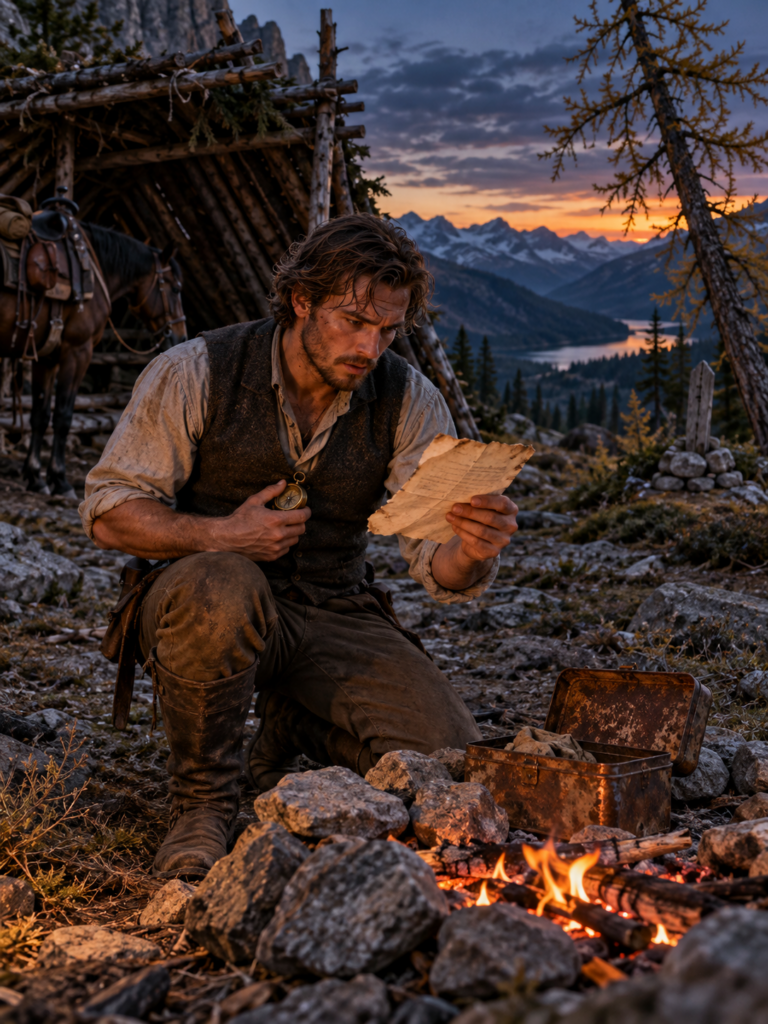
Arthur carried the burning branch beyond the fire ring, one slow step at a time.
The shape beneath the leaning larch resolved into stones.
Not an animal.
A grave.
The mound had settled so low that only the deliberate ring of river rock distinguished it from the grass.
At its head stood a split cedar slab.
Arthur crouched and held the flame near it.
Weather had softened the carving almost flat.
But the first letter was still there.
T.
Below it came the remains of a surname.
OSLER.
Merritt Kell had told the truth about at least one thing.
Arthur lowered the branch.
The relief he felt was immediately followed by something heavier.
A confession could be invented.
A pouch of money could be stolen.
But a boy’s grave beneath an eighty-year-old tree was evidence of time itself.
Arthur set one fallen stone back onto the mound.
Then he returned to the fire.
He counted the money.
One hundred eighty-four dollars.
Exactly what Merritt’s letter claimed.
Arthur sat with the coins spread on a flat stone.
He had been robbed of one hundred sixty-two dollars that afternoon.
Now he possessed twenty-two dollars more than he had lost.
The arithmetic should have felt like fortune.
It did not.
Because the money had belonged to a horse thief who claimed he had saved it honestly while committing crimes around it.
Arthur knew ledgers.
His father had let suppliers cheat their wheelwright shop until Arthur learned figures well enough to catch one dishonest invoice.
Numbers could be correct while the story around them was rotten.
He tied the pouch again.
Then he folded Merritt’s letter and placed it inside his vest beside the compass.
He would not spend a coin until somebody with authority had seen both.
That decision cost him immediately.
His stomach cramped.
He had not eaten since morning.
With one hundred eighty-four dollars beside him, Arthur still chose to sleep hungry.
The difference mattered.
Merritt Kell had written that he wanted to become honest after seven seasons of theft.
Arthur had no intention of letting desperation make the first decision on his behalf.
He dragged the least-rotted sections of wool blanket from the bunk.
The pieces smelled of dust and old mice but held enough warmth to keep his shaking under control.
He lay near the fire.
Sutter filled his mind.
His saddle.
Olan’s knife.
The tobacco tin with his wages.
Every practical thing he had earned.
Then Arthur thought about Thomas Osler.
A boy of nineteen.
Dead with strangers.
Parents waiting for a son who never returned.
For the first time that night, Arthur’s own losses became smaller without becoming less real.
At gray light he returned to the grave.
He examined the cedar marker carefully.
A date remained beneath Thomas’s name.
Arthur memorized it.
Then he walked the little park.
Water ran nearby.
Grass held beneath the granite shoulder.
The rock blocked the worst northern wind.
There was timber enough to repair the shelter.
The hidden park was not worthless ground.
It was useful ground that had been useful for the wrong purpose.
Arthur stood beside the old picket line.
His eyes caught something on one iron ring.
A fresh abrasion.
Bright metal.
He touched it.
Someone had rubbed rust from the ring recently.
Arthur looked at the ground.
There—in the protected dirt beneath the granite—was a print too sharp to be eighty years old.
A shod horse.
Then another.
Arthur’s pulse changed.
The thieves from Pine Crossing had not ridden into this clearing last night.
Their trail had continued below.
But somebody had been here recently.
Somebody who knew the old camp existed.
Arthur crouched and studied the sign.
One horse.
Rider dismounted.
The track approached the shelter.
Left again.
Not today.
Perhaps several days earlier.
Arthur looked at Merritt’s biscuit tin.
Had that visitor seen it?
Apparently not.
Or had he left it intentionally?
Arthur no longer knew which possibility was worse.
He closed the shelter as well as he could.
He put the pouch inside his shirt.
Merritt’s confession went in his vest.
Then he drew Olan’s compass.
The nearest freight town, according to what he remembered from the road crews, lay southeast.
Kettlebend.
Two days if a man had a horse.
Longer on foot.
Arthur looked once toward the trail where his robbers had disappeared.
Following them was no longer the only question.
A dead boy had waited eighty years for someone to carry his name home.
Arthur turned the compass until the needle steadied.
Then he stepped out of the abandoned horse-thief camp and started toward Kettlebend with the confession against his heart.
Arthur kept southeast until the hidden park vanished behind timber.
He did not take the thieves’ trail.
He moved by creek bottoms, game paths, and the brass compass in his hand.
The choice felt wrong for the first mile.
Sutter was somewhere behind him.
So was the knife Olan had carried for decades.
So was every dollar Arthur himself had earned.
Walking away felt too much like surrender.
But Arthur kept moving.
Because Merritt Kell’s letter had shown him where one kind of thinking ended.
A man could spend years telling himself he would become honest after one more bad season.
One more theft.
One more necessity.
Arthur would not begin by deciding that his own need excused whatever came next.
The first day he ate nothing.
The second morning he found rose hips and chewed them slowly.
By afternoon his legs felt hollow.
He followed a creek, drank often, and conserved strength.
Late that day a grouse burst from brush at his feet.
Arthur threw the only stone already in his hand.
Luck did what hunger could not.
The bird dropped.
Without matches he had no easy fire, but Olan had taught him other ways.
Arthur ate that evening because he was willing to work for flame.
On the third day he reached Kettlebend.
The town amounted to a feed store, several houses, a land office, a blacksmith shed, two saloons, and a sheriff’s room built behind the store.
Arthur walked directly to the sheriff.
He did not stop first for food.
That decision impressed Sheriff Howerin more than Arthur realized.
Howerin was fifty-two, broad through the shoulders and stiff through the knees. He had worked stock theft before age made long pursuit harder.
Arthur gave him the robbery plainly.
Three men.
Older leader.
Gloved hand.
Short-barreled rifle carried by the second.
Third man handling Sutter.
Arthur described his bay’s marking and the slight outward turn of the near hind hoof.
Then he placed Merritt Kell’s letter on the desk.
Howerin read it once.
Then again.
“You found this last night?”
“Yes.”
“And the money?”
Arthur removed the pouch.
Howerin looked at him.
“You carried that two and a half days and came here before buying food?”
“Yes.”
“Why?”
“Wasn’t sure it was mine.”
Something in Howerin’s expression changed.
Not friendship.
Assessment.
He opened an old brand register.
Merritt had named several brands in the confession.
Howerin worked through the record slowly.
One matched a horse reported lost from Snake country.
Then another.
Then a third.
Different years.
Same general period.
Howerin leaned back.
“Well.”
Arthur knew that word.
Men used it when evidence had removed the need for opinion.
“Merritt Kell was real?” Arthur asked.
“Looks that way.”
“Thomas Osler?”
“That’ll take longer.”
Arthur told him about the grave.
Then about the fresh horse sign at the hidden camp.
Howerin’s gaze sharpened.
“How fresh?”
“Days. Not weeks.”
“Your three men?”
“No.”
“You certain?”
“No.”
Howerin nodded once.
“Good answer.”
Arthur understood.
Certainty was another thing a man could spend too cheaply.
Howerin wrote down the location.
“Do not go chasing those robbers.”
Arthur stiffened.
“That an order?”
“No. Advice.”
“Then I’ll hear it.”
Howerin almost smiled.
“They have horses. You don’t. They have rifles. You don’t. I can put word south and west faster than you can limp after them.”
Arthur disliked every word.
He also knew every word was true.
“What do I do?”
“Eat.”
That problem was solved by Mrs. Ivers.
She owned the feed store attached to Howerin’s office and had been widowed long enough that nobody in Kettlebend attempted to explain her own business to her.
Arthur tried to pay for beans and cornbread.
She refused.
“A man walking out of that country in shirtsleeves eats free the first night.”
“I have money.”
“So do I.”
Arthur had no reply to that.
Mrs. Ivers looked him over.
“You always argue with food?”
“Only when it’s charity.”
“Then call it information.”
“What information?”
She pointed to his empty bowl.
“That you were hungry.”
Arthur ate the second helping without argument.
The next morning he returned to Howerin.
The sheriff had not changed his position.
The robber report would go out.
If Sutter appeared in any legitimate string, word would return.
Arthur could not control the rest.
So he turned to what he could control.
He bought a canvas coat lined with blanket cloth.
A wool blanket.
Matches.
Coffee.
A skillet.
A hatchet.
Flour.
Beans.
Bacon.
A whetstone.
And a used Green River knife.
When the storekeeper handed it across, Arthur tested the balance.
Not Olan’s.
Not close.
But sound.
He paid only after Mrs. Ivers made him write down every purchase against Merritt’s one hundred eighty-four dollars.
“You keep books?” she asked.
“Yes.”
“Good. Dead men’s money deserves better books than live men usually give it.”
Arthur looked at her.
She had put into one sentence exactly what had troubled him.
He recorded every cent.
Then he walked two doors down to the land office.
The hidden park had never been claimed.
The clerk, Deems, produced the maps and made Arthur show him twice where the granite shoulder sat in relation to Pine Crossing.
“You sure there’s water?”
“I drank it.”
“Grass?”
“Yes.”
“Timber?”
“Yes.”
“Road?”
“No.”
Deems snorted.
“That explains why nobody filed.”
Arthur thought of the horse-thief shelter tucked where no honest traveler would have reason to search.
“What’s the fee?”
“Fourteen dollars.”
Arthur paid it.
His name went onto a preemption claim.
For the first time in his life, the possibility of ground belonging to him existed on paper.
He felt almost nothing at first.
Then he remembered the tobacco tin the robbers had taken.
One hundred sixty-two dollars saved because he had dreamed of this exact step.
They had stolen his savings.
They had not stolen the decision those savings represented.
Arthur folded the claim receipt into his vest.
The compass lay behind it.
The same pocket now held direction and proof.
Before leaving Kettlebend, Arthur wrote to the Osler family.
He kept the letter short.
He did not soften the facts.
He had found the grave of Thomas Osler.
The marker carried Thomas’s name and a date.
A written confession found at the camp described his death from fever and stated that he had been buried decently.
Arthur included directions.
He did not include speculation.
Mrs. Ivers watched him fold the page.
“You know them?”
“No.”
“Then why do this?”
Arthur thought of the grave.
“Because somebody didn’t.”
Mrs. Ivers took the letter and put it into the outgoing sack herself.
When Arthur returned to the hidden park, he no longer entered as a stranded man looking for shelter.
He entered as someone responsible for what happened next.
He repaired the roof first.
The old shakes came away in silver curls.
He split replacements from windfall lodgepole and weighted them with stone.
He rebuilt the bunk.
Hung a slab door.
Cut drainage around the shelter.
Restored the picket line.
Then he dismantled the ancient blackened fire ring.
For one moment he hesitated.
Those stones had surrounded the flame on the night he found Merritt’s confession.
But they had also surrounded fires made by men holding stolen horses.
Arthur carried the stones one by one to Thomas Osler’s grave.
He built them into a low wall around the mound.
The old camp changed with that act.
Its center was no longer the place thieves had warmed themselves.
Its center became the boy they had failed to send home.
News traveled.
Slowly at first.
Then strangely fast.
A stockman named Orr Bailey arrived from Snake country leading a stout gray gelding.
He had known Thomas Osler’s father.
“Horse is yours.”
Arthur shook his head.
“I can pay.”
“No.”
“I have money.”
“Didn’t say you didn’t.”
Orr wrapped the lead rope around Arthur’s hand.
“Old account.”
Arthur almost argued.
Then he remembered Mrs. Ivers.
He said thank you.
A carpenter named Witt Senker came from Kettlebend with boards.
A woman named Mrs. Pruitt rode up with her fourteen-year-old son, two hens, and a jar of pickled beets. Her late husband had lost horses at Pine Crossing years earlier.
She stood beside Thomas’s grave for several minutes before speaking to Arthur.
“My husband always said those trails swallowed things.”
Arthur looked toward the crossing.
“Sometimes they kept them.”
Mrs. Pruitt nodded.
“And sometimes somebody finds them.”
The camp’s history was coming out.
Not because Arthur had hunted spectacle.
Because Merritt Kell had written the truth and left it where chance could eventually put it into another man’s hands.
Howerin worked the newer robbery.
Arthur forced himself not to ride south.
That restraint cost him every day.
He imagined Sutter under a stranger.
Imagined Olan’s knife sold.
Imagined his wages divided among thieves.
He could have let anger become occupation.
Instead he worked.
Winter came early.
Snow closed the high eastern trail.
Arthur repaired tack for passing riders in exchange for supplies.
He kept records.
He used Merritt’s remaining money carefully.
Then, in the fourth month, a rider came from Kettlebend.
“Howerin got one.”
Arthur stood so quickly his chair fell backward.
“The older man?”
“Yes.”
“Where?”
“Willowbar.”
Arthur’s first question came out before pride could rearrange it.
“My horse?”
The rider smiled.
“Bay gelding. Near hind throws outward.”
Arthur closed his eyes.
“Sutter.”
“Howerin says the county needs him a while. Evidence.”
Arthur nodded.
“When?”
“Soon as they’re done.”
It was not complete justice.
Two robbers were still missing.
Olan’s knife had not been recovered.
Most of Arthur’s money was gone.
But Sutter was alive.
Arthur walked outside.
Snow lay blue in the shadow of the granite.
He rested both hands on the new picket line.
Five months earlier those iron rings had represented stolen horses.
Soon his own horse would stand there lawfully.
The meaning of the place had reversed.
Then Arthur noticed something carved into the new doorframe.
Three letters.
T.O.
He had not put them there.
He turned.
Mrs. Pruitt’s son Ike stood near the woodpile with his hands buried in his coat pockets.
“You do that?”
The boy reddened.
“Thought somebody ought to have his name up where people sleep.”
Arthur looked at Thomas’s grave.
Then back at the letters.
“Leave it.”
Ike nodded.
A few weeks later, hoofbeats came up the trail through snow.
Arthur stepped outside.
Sheriff Howerin rode first.
Behind him came a lead rope.
At the end of it walked Sutter.
The bay was thinner.
His winter coat had grown rough.
But he was sound.
Arthur crossed the yard.
Sutter saw him.
The horse pulled once against the rope.
Howerin let go.
Sutter came forward and pushed his head against Arthur’s chest.
Arthur buried both hands in the bay’s mane.
For the first time since Pine Crossing, he let himself feel everything that had been taken.
And everything that had returned.
Howerin waited.
Then he said, “There’s something else.”
Arthur looked up.
The sheriff held a leather belt across his saddle horn.
A familiar bone handle projected from the sheath.
Arthur walked toward Howerin slowly.
He recognized the knife before his fingers touched it.
Forty years of use had darkened the bone handle almost brown.
A small notch near the guard had been there since before Arthur was born.
Olan’s knife.
Arthur took the belt.
“Where?”
“Older man had it.”
Arthur ran his thumb over the handle.
“Money?”
“Some. Not yours anymore in any way I can prove.”
Arthur nodded.
He had expected that.
“The other two?”
“Gone south.”
“You think you’ll find them?”
Howerin considered before answering.
“Maybe.”
Arthur appreciated the answer more than a promise.
Howerin dismounted stiffly.
They drank coffee inside the shelter.
The sheriff looked at the rebuilt roof, the new door, the bunk, the ledger on Arthur’s shelf.
Then his gaze settled on Merritt Kell’s biscuit tin.
“You kept it.”
“Yes.”
“Good.”
Arthur poured more coffee.
“What happens to the man you caught?”
“Court.”
“He admit it?”
“To your robbery? Enough.”
Arthur stared into his cup.
For months he had imagined this moment as something sharper.
A confrontation.
An apology.
An explanation from the man whose gloved hand had rested calmly on Arthur’s thigh while everything he owned was taken.
Instead the robber sat in a jail somewhere.
Arthur sat here.
The difference was larger than revenge.
Howerin seemed to read something in his expression.
“You want to see him?”
Arthur thought.
“No.”
“You sure?”
“Yes.”
He surprised himself with how certain it felt.
The robber had taken four minutes of Arthur’s life.
Arthur would not give him a fifth voluntarily.
Howerin nodded.
“Probably wiser.”
Arthur looked toward the door.
“Sutter’s home.”
“Looks that way.”
“My knife’s home.”
“Yes.”
“What about Merritt?”
Howerin leaned back.
“What about him?”
“You found more?”
The sheriff reached into his coat.
He removed several copied sheets.
“Old territorial brand records. Complaints. One death notice from Willowbar.”
Arthur read.
A man called Ansel Doe had indeed been shot near Willowbar during the period Merritt described.
Another man named Peter or Petri something disappeared from the record afterward.
Several stolen animals matched dates in Merritt’s confession.
Not every claim could be verified.
But enough could.
Merritt Kell had not written a campfire fantasy.
He had been who he said he was.
Arthur touched the biscuit tin.
“Did he make it down?”
Howerin shook his head.
“No record of him surrendering.”
“So he died before?”
“Maybe.”
Arthur almost asked how.
Then stopped.
Maybe was enough.
Merritt’s last known act had been to write the truth, leave his honest savings, and try to ride out to answer for what he had done.
Arthur could not turn uncertainty into redemption.
Nor could he turn it into damnation.
Some stories ended without witnesses.
Howerin finished his coffee.
At the door he paused.
“You planning to stay up here permanent?”
“That’s the claim.”
“You get much traffic?”
“More than I expected.”
“Trouble?”
“Not yet.”
The sheriff glanced toward Pine Crossing.
“These upper trails could use somebody who notices things.”
Arthur smiled faintly.
“That a job offer?”
“Not today.”
Howerin rode away.
Arthur watched until snow swallowed him.
Then he brought Sutter to the picket line.
The bay stood beneath the same old iron rings once used for stolen stock.
Arthur fastened the rope.
He stepped back.
Sutter lowered his head and began pulling grass from beneath the snow.
For the first time, the camp held a horse whose presence needed no excuse.
That winter changed Arthur’s relationship with the place.
At first he had thought of it as Merritt Kell’s camp.
Then as his own claim.
Eventually it became something else.
A stopping place.
Riders caught late on the crossing learned there was coffee beneath the granite shoulder.
Freighters learned there was a bunk if weather closed the trail.
Arthur asked few questions.
He had once been left on foot with nothing but a vest and compass.
He understood what shelter meant when a man had no bargaining power.
But he was not careless.
Olan had taught him attention.
Howerin had reinforced it.
Arthur watched brands.
Listened to explanations.
Noticed when the story a rider told did not fit the horse beneath him.
Once, a young man arrived leading two animals and claimed both belonged to his employer.
Arthur noticed one saddle carried a freshly cut latigo and the horse flinched when the young man reached for its bridle.
Arthur did not accuse him.
He simply asked him to wait while another rider carried a note to Kettlebend.
The horse proved legitimate.
The young man was furious.
Arthur apologized.
The next time a suspicious string appeared, it was not legitimate.
A stolen mare went home because Arthur had been willing to risk embarrassment before risking silence.
At the end of the first full year, Howerin returned.
He placed a nickel star on Arthur’s table.
“No pay.”
Arthur looked at it.
“Fine beginning to a job offer.”
“Authority to hold somebody at the crossing until word gets down.”
Arthur turned the badge over.
A number had been stamped into the back.
“I’m twenty-two.”
“So?”
Arthur almost laughed.
People had spent half his life telling him what age disqualified him from.
Howerin evidently had missed the lesson.
“You sure?”
“No.”
Arthur raised an eyebrow.
Howerin shrugged.
“Certainty’s expensive.”
That decided it.
Arthur accepted.
He did not pin the badge outside his coat.
He carried it in his left vest pocket.
Behind Olan’s compass.
The arrangement pleased him.
Direction first.
Authority second.
By the following summer Arthur had six horses of his own grazing beneath the granite shoulder.
He registered a brand.
A plain block K with a bar beneath it.
Howerin examined the drawing.
“Kell?”
Arthur nodded.
“You naming the place for a horse thief?”
“For a man who finally wrote down what he’d done.”
Howerin considered.
“Fair distinction.”
People began calling the hidden meadow Kell’s Park.
Arthur did not correct them.
The name did not erase the crime.
That mattered.
He had learned that turning a bad place into a good one did not require pretending the past had been clean.
The biscuit tin stayed on the shelf.
Inside it lay Merritt’s confession.
Then another letter arrived.
It came from Barrow Fork.
Arthur recognized the surname immediately.
Osler.
He sat by the fire before opening it.
Thomas’s surviving family had passed through several generations.
The writer was Thomas’s niece, daughter of a younger brother who had died years earlier.
Family stories had said Thomas went west and vanished.
Some believed he had been murdered.
Others believed he abandoned them deliberately.
Nobody knew.
Arthur read the letter twice.
They thanked him for giving them a grave.
Not an innocent story.
Not a better story.
The truth.
Thomas had ridden with criminals.
He had also been nineteen.
He had died of fever far from home.
Someone had buried him.
Those facts could coexist.
Arthur folded the letter and placed it inside Merritt’s tin.
On the anniversary of the date cut into Thomas’s cedar marker, Mrs. Pruitt rode up.
Orr Bailey came when weather permitted.
Sometimes a member of the Osler family sent a letter.
Arthur read each one aloud beside the grave, then put it in the tin.
The old horse-thief camp became a place where truth accumulated instead of disappearing.
Arthur thought often about that.
He also thought about his brother Lyall.
No letter ever came from him.
Arthur knew enough people traveling toward Barrow Fork that he could have sent one.
He did not.
For a long time he told himself there was no point.
Then, during his third autumn at Kell’s Park, he admitted the less comfortable truth.
He was afraid.
Not of Lyall.
Of wanting something back.
Their father had died.
The shop was sold.
The money gone.
Their family had dissolved into the same silence in which Arthur had grown up.
Sending a letter would mean accepting that he still cared whether his brother answered.
Arthur sat one evening with Olan’s compass on his knee.
Behind it lay Howerin’s badge.
Two objects in one pocket.
One inherited.
One earned.
Neither guaranteed anything.
A compass did not walk the trail for a man.
A badge did not make him just.
A letter did not make a brother answer.
Tools only gave a person something honest to act with.
Arthur went inside.
He took paper from his ledger drawer.
He wrote:
Lyall,
I have ground of my own now.
He stopped.
The sentence felt boastful.
He crossed out ground of my own.
He tried again.
I am living above Pine Crossing in a place called Kell’s Park.
I have Sutter still.
He stopped again.
Then he wrote the plain version.
I thought you should know I am alive.
Arthur looked at that sentence a long time.
He added directions.
Nothing else.
He sent it with a passing freight wagon.
Months passed.
No answer came.
Arthur discovered he could live with that.
The act of writing had belonged to him.
Lyall’s silence belonged to Lyall.
That distinction freed something old.
Arthur did not suddenly forgive his father.
He did not turn his brother into a misunderstood victim.
He simply stopped carrying both men as explanations for every choice he made.
Kell’s Park demanded too much present-tense work for that.
There were roofs to repair.
Horses to doctor.
Travelers to shelter.
Snow to shovel.
Accounts to keep.
And sometimes crimes to stop.
One autumn evening, three riders appeared at Pine Crossing after dark.
Arthur watched from above.
They moved one horse without a rider.
The loose animal wore a brand Arthur recognized from Howerin’s book.
The men did not take the freight road.
They turned toward timber.
Toward Kell’s Park.
Arthur stood beside Sutter with one hand inside his vest.
Compass.
Badge.
He did not reach for the knife first.
That mattered.
When the riders entered the park, Arthur had already placed a lantern where it illuminated the new door and left the rest of the clearing in darkness.
“Evening,” he called.
The first man stopped.
“Need water.”
“There’s water.”
The second rider glanced at the picket line.
Arthur recognized the behavior.
Not a man looking for a place to tie his horse.
A man inventorying horses that might be worth taking.
Arthur’s pulse remained steady.
Olan had taught him to sit still.
Time had taught him the value of making another man reveal himself.
The third rider asked, “You alone?”
Arthur leaned against the doorframe.
“Why?”
No answer.
The lead man dismounted.
His gaze went to Arthur’s belt.
The Green River knife hung there.
Then to his vest.
“Just asking.”
Arthur heard hoofbeats far below.
Good.
Earlier that afternoon he had seen sign near the crossing and sent a traveler to Kettlebend.
He had not known whether the riders would come up.
He had known enough not to wait alone without telling anyone.
The lead man stepped closer.
“We’ll take coffee.”
Arthur did not move.
“You’ll wait outside.”
The man smiled.
“Is that how you treat travelers?”
“Travelers, no.”
The smile vanished.
Arthur drew the badge from behind the compass.
No threat.
No flourish.
Just proof.
“Horse behind you carries a registered Bar-S brand. Owner is north of Kettlebend.”
The second rider’s hand moved.
Arthur saw it.
So did the first.
“Don’t,” Arthur said.
The word was quiet.
Hoofbeats grew louder below.
The leader calculated distance.
Options.
Arthur let him.
Then the man raised both hands away from his coat.
Howerin arrived minutes later with two riders.
No gunfight followed.
No heroic charge.
Only three men realizing the trail had closed.
Afterward Howerin stood beside Arthur at the old picket line.
“Could’ve gone poorly.”
“Yes.”
“Could’ve stayed inside.”
“They might have left.”
“Could’ve let them.”
Arthur looked at him.
Howerin sighed.
“Right.”
Arthur smiled.
The sheriff pointed toward the approaching dawn.
“You notice what you did?”
“What?”
“You didn’t chase them.”
Arthur understood.
At twenty-one he had stepped into the timber after three mounted robbers with nothing but a compass.
He still believed that decision had saved his life.
But he no longer confused pursuing danger with solving it.
He had learned to use help.
To send word.
To wait.
To let authority mean responsibility instead of pride.
That morning Arthur moved the three recovered horses to the picket line.
Old iron rings.
New hemp.
Lawful custody.
The transformation of Kell’s Park was complete enough that Arthur finally understood something Merritt never had.
A man did not become honest merely by deciding he was finished with crime.
He became honest through what he did afterward.
What he returned.
What he admitted.
Whom he faced.
What consequences he accepted.
Merritt had tried.
Maybe he died trying.
Arthur would not grant him a cleaner ending than the evidence allowed.
But neither would he deny the importance of the letter.
Merritt’s confession had returned Thomas Osler’s name to his family.
It had exposed old thefts.
It had put lawful land beneath Arthur.
And it had preserved enough truth for another man to choose differently.
That was not redemption.
It was consequence.
Sometimes consequence could still grow something useful.
In the third autumn after the robbery, Arthur sat on the flat stone beside the fire ring.
The reconstructed shelter stood behind him.
Sutter grazed near the door.
Six horses carrying Arthur’s registered brand stood along the picket line.
Thomas Osler’s grave lay beneath the leaning larch inside its low wall of old blackened firestones.
Arthur poured coffee.
The evening settled.
He took Olan’s compass from his pocket.
The brass case was scratched.
The needle still swung and found north.
He set Howerin’s badge behind it on his knee.
Arthur thought of Pine Crossing.
The gloved hand.
His saddle disappearing into timber.
The helplessness of standing in wagon ruts with everything stripped away.
For years he had assumed the important part of that afternoon was what the thieves took.
Now he knew better.
The important part was what remained.
Boots that fit.
A vest.
Attention.
Training.
A compass.
And the ability to choose what kind of man would walk away from a bad crossing.
Down by Thomas’s grave, the black stones held the last sunlight.
Arthur stood.
Before gathering the horses, he went inside and opened the biscuit tin.
Merritt’s confession lay beneath the letters from the Osler family.
Arthur added another sheet.
Not a confession.
An accounting.
He had maintained one since the first morning in Kettlebend.
Merritt’s original money: one hundred eighty-four dollars.
Land filing: fourteen.
Clothing.
Tools.
Food.
Repairs.
Remaining amounts.
Income later earned from stock work.
Every figure.
Arthur had long since repaid the original sum into a separate account in his ledger, though no law required it.
He had done it because the money had given him a start, and he wanted to know exactly where the gift ended and his own work began.
The number now exceeded one hundred eighty-four.
Arthur had decided what to do with it.
He would keep a reserve at Kell’s Park.
Not for himself.
For the next traveler who came through Pine Crossing stripped of what he needed.
Food.
Blanket.
Horse feed.
Maybe a coat.
Enough help to keep desperation from making the first decision.
No debt attached.
No claim on the person afterward.
He wrote that clearly.
Mrs. Ivers would have approved.
Arthur smiled at the thought.
He closed the tin.
Then someone called from the trail.
“Park open?”
Arthur stepped outside.
A young rider sat on a tired horse beneath the granite shoulder.
The boy—young man, really—looked cold and embarrassed.
“Lost my bedroll in the river.”
Arthur glanced at the clouds.
Snow before morning.
“Come in.”
“I can pay.”
Arthur almost laughed.
“I didn’t ask.”
The traveler hesitated.
Arthur understood that hesitation too.
Help could feel dangerous when a person had learned that every gift carried a hook.
Arthur opened the door wider.
“Coffee’s on. Bunk’s dry. Decide the rest after you’re warm.”
The rider dismounted.
Arthur took the horse.
That night, while another man slept safely in the shelter that had once hidden stolen stock, Arthur stood outside beneath the stars.
He could hear Sutter shifting in the dark.
He put one hand into his vest.
Compass first.
Badge behind it.
Olan had told him to trust the needle before his feet when country turned strange.
For years Arthur thought the lesson concerned direction.
Now he understood it had been larger.
Every man needed something truer than fear to steer by.
Sometimes it was a compass.
Sometimes a ledger.
Sometimes a promise.
Sometimes the name on a forgotten grave.
Arthur walked to the leaning larch.
He rested one hand against the cedar marker.
Thomas Osler had made bad choices.
Merritt Kell had made worse ones.
Arthur’s father had wasted what he earned.
Lyall had followed him toward the bottle.
The three men at Pine Crossing had seen another man’s life as four minutes of profit.
Arthur could not change any of them.
He could decide what their actions became inside his own story.
Not destiny.
Not excuse.
Information.
He returned to the fire.
Years later, travelers would still turn from Pine Crossing onto the narrow trail and find Kell’s Park beneath the granite shoulder.
They would find water.
Grass.
Coffee.
A place to sleep.
Some would notice the old iron rings grown into the pines.
Some would ask about the grave.
Arthur would tell them.
Not the polished version.
The true one.
Horse thieves used this place.
A nineteen-year-old boy died here.
A man named Merritt Kell helped commit crimes and eventually wrote them down.
Eighty years later, another young man was robbed at the same crossing and found the letter because he stepped into the timber.
“And then?” people sometimes asked.
Arthur usually looked around before answering.
At the repaired shelter.
At the lawful horses.
At Thomas’s grave.
At Sutter growing gray around the muzzle.
“At some point,” he would say, “somebody has to decide what a place is for next.”
That was all.
On certain evenings he took Olan’s compass from his pocket and laid it on the flat stone beside the fire.
The needle trembled.
Turned.
Settled.
Arthur Holt had been twenty-one when armed men took his horse, his bedroll, his knife, and the one hundred sixty-two dollars he had saved toward land.
They left him standing at Pine Crossing with almost nothing.
He followed their sign only far enough to enter country he had never meant to find.
There, beneath a granite shoulder, an eighty-year-old horse-thief camp held a confession, one hundred eighty-four dollars, and the location of a missing boy’s grave.
Arthur carried the confession to the law.
He carried the dead boy’s name back to his family.
He filed honestly on the ground.
He recovered Sutter.
He recovered Olan’s knife.
He built a lawful horse string where stolen animals had once been hidden.
He carried a deputy’s badge in the same pocket as the compass that had gotten him there.
And he turned a camp created to conceal wrongdoing into a refuge where travelers could come without being robbed, questioned unnecessarily, or made indebted for needing help.
The men at Pine Crossing had taken nearly everything Arthur owned.
What they could not take was the part of him Olan Merchant had spent years building.
The patience to read sign.
The discipline to distrust desperation.
The ability to tell fact from anger.
The willingness to ask for law when revenge would have been easier.
The sense to accept help without surrendering himself to it.
And the stubborn belief that losing the road beneath your feet did not mean you had lost every road ahead.
Arthur looked toward the crossing as night settled.
Then he turned back to the fire.
Behind him, the shelter door hung straight.
Inside, the biscuit tin rested on its shelf.
At the edge of the clearing, Thomas Osler’s grave lay quiet beneath the leaning larch.
Sutter waited among Arthur’s own horses.
And in Arthur’s vest, the old brass compass still pointed true.
The trail had not returned him to the life stolen from him at Pine Crossing.
It had done something stranger.
It had carried him toward a life he could finally call his own.


