Part 1
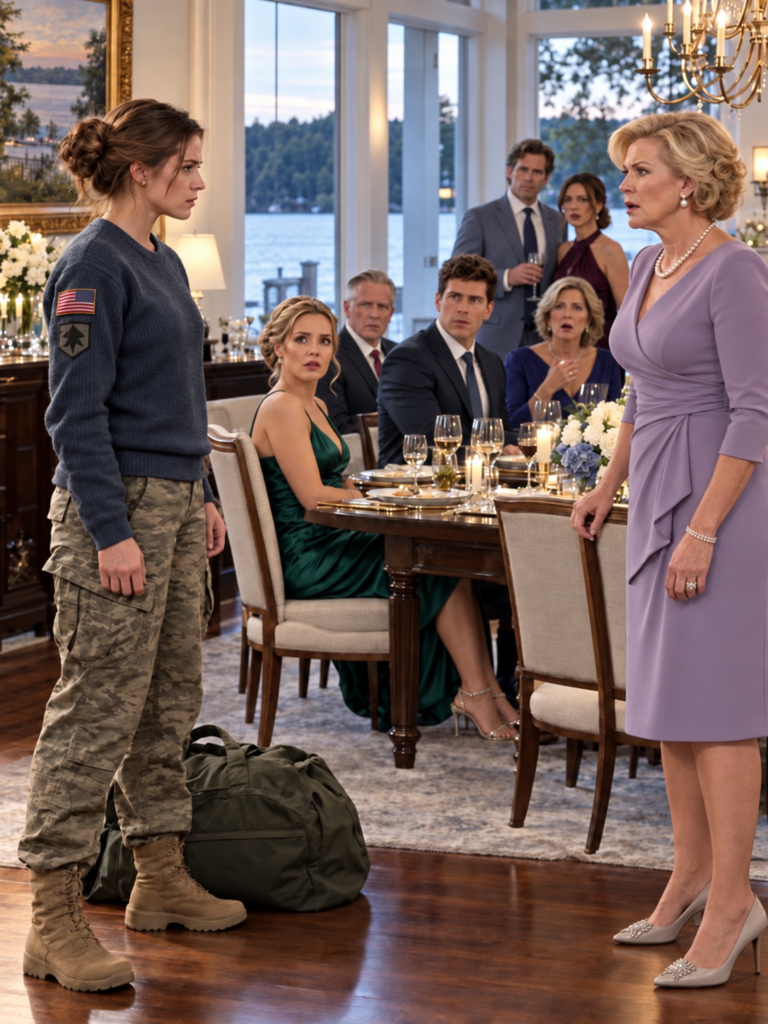
The laughter died before I reached the table.
Not gradually.
One second there were wineglasses touching crystal, forks scraping porcelain, and the low comfortable murmur of people who believed they were among their own kind.
The next, there was only the soft hum of the ventilation system and rain tapping the tall windows overlooking Lake Mercer.
My stepmother, Vivian Caldwell, had a peculiar ability to make cruelty sound like etiquette.
She was standing beside the fireplace in a cream silk blouse, one hand resting on the back of my stepsister’s chair, smiling at a retired bank president and his wife.
The smile disappeared when she saw me.
“Rachel.”
She said my name as though a caterer had accidentally wheeled in the wrong dessert.
My stepsister, Brooke, slowly lowered her glass.
Beside her sat her husband, Grant Holloway, whose confidence had always seemed to depend on being the wealthiest man in whatever room he entered.
Unfortunately for Grant, wealth had become an increasingly theoretical condition in his life.
I knew that already.
They didn’t know I knew.
“I thought your flight was tomorrow,” Vivian said.
“It was.”
I put my duffel bag beside the staircase.
“I caught an earlier connection.”
Nobody mentioned what I had overheard.
That was almost worse than an apology.
Vivian had married my father, Martin Caldwell, when I was six years old. My mother had died two years earlier. Brooke was seven months younger than I was, though Vivian behaved as if we belonged to different species.
She never beat me.
Never screamed that she hated me.
That would have been easier to name.
Instead, she specialized in distinctions.
Brooke got ballet lessons because she had “natural grace.” I got piano lessons only after my father insisted.
Brooke’s first car was a new Audi. Mine was my father’s twelve-year-old Ford pickup, which I loved so much that Vivian seemed disappointed by my gratitude.
When Brooke failed algebra, Vivian blamed the teacher.
When I came home with a B in calculus, Vivian asked whether I was becoming distracted.
At holidays, Brooke’s presents came wrapped in ivory paper with satin ribbon.
Mine came in store bags.
Small things.
That was Vivian’s genius.
Nothing dramatic enough to explain to another person without sounding petty.
Yet a childhood can be shaped by a thousand tiny messages about who belongs at the center of the photograph and who is expected to stand near the edge.
My father saw more than he admitted.
That was one of the complicated truths I had spent years trying to forgive.
Martin loved me fiercely.
He also hated conflict.
He spent half his life believing those two qualities could coexist without consequence.
After college I joined the Army Corps of Engineers, partly because I wanted to build things and partly because distance felt cleaner than resentment.
By thirty-seven, I had spent enough time around bridges, roads, flooded bases, and damaged infrastructure to learn something simple.
A structure does not care whether you meant well.
If a support beam fails, the building falls.
Intentions do not hold roofs up.
Neither do families.
Vivian recovered first.
“Well,” she said brightly, “since you’re here, please sit down.”
I glanced at the chair farthest from her.
“That one?”
A couple of guests looked at their plates.
Brooke’s mouth tightened.
“You don’t have to make everything uncomfortable.”
“I’ve been in the room thirty seconds.”
Grant leaned back.
“Rachel, come on. Your mother didn’t mean anything.”
Vivian corrected him immediately.
“Stepmother.”
There it was.
Even then.
Even cornered.
She needed the distinction.
I looked at Grant.
“She seemed fairly precise.”
The retired bank president suddenly became fascinated by his napkin.
Vivian’s cheeks colored.
“We were discussing estate planning. You know how conversations wander.”
“Apparently mine wandered in from the hallway.”
Brooke sighed.
This was her favorite performance: exhausted tolerance toward the difficult sister.
“Can we please not do this tonight?”
I looked at her.
“Do what?”
“Turn one careless comment into another campaign about how excluded you’ve always been.”
I almost admired her.
Brooke could convert an insult committed against someone else into an inconvenience suffered by herself in under fifteen seconds.
Grant reached for his wine.
“Everyone’s tired. Rachel’s just back. Maybe we should leave it.”
That was when I looked at him properly.
His watch was gone.
Grant loved watches.
For the last decade he had rotated among three pieces expensive enough to cover the mortgage on the first house I had bought.
Tonight his wrist was bare.
His wedding ring was there.
The watch wasn’t.
Then I noticed Brooke’s earrings.
Costume jewelry.
Convincing costume jewelry, but I had watched my father buy her the diamond pair she normally wore to formal dinners.
I glanced through the windows toward the circular drive.
Grant’s black Range Rover was missing.
There was a leased Cadillac near the garage instead.
Interesting.
I sat down.
Dinner resumed with the enthusiasm of people returning to a movie after the fire alarm.
For the next twenty minutes Vivian spoke too much.
That was another tell.
She described a foundation luncheon, an upcoming charity auction, Brooke’s plans to renovate the east guesthouse, and Grant’s “exciting expansion” into mixed-use development.
Grant barely touched his food.
Every time his phone vibrated, he turned it face down.
At dessert, Vivian placed her napkin beside her plate.
“Rachel, since you’re home earlier than expected, perhaps tomorrow morning we can discuss the paperwork.”
“What paperwork?”
Brooke answered too quickly.
“Just some business documents.”
My father had died eleven months earlier.
He had owned Caldwell Civil Works, a regional engineering and construction company that had started with three employees and ended up building municipal projects across Virginia and Maryland.
When he died, I received a minority interest in the operating company.
Brooke received one too.
Vivian received cash accounts, investments, and lifetime use of the lake property.
At least, that was what everyone believed.
My father’s estate documents were complicated enough that I had let attorneys handle most of them from overseas.
I had not needed the money.
That fact bothered Vivian more than poverty ever could have.
People who use money for control become uneasy around someone who can walk away from it.
“What business documents?” I asked again.
Grant finally looked up.
“A bridge facility.”
I almost smiled at the wording.
People use gentle nouns when they want to hide dangerous verbs.
“What does the bridge connect?”
He stared at me.
“The company is restructuring.”
“Which company?”
“Holloway Development.”
That explained the missing watch.
Grant had spent twelve years turning inherited commercial land into luxury developments named after trees he had bulldozed.
Sycamore Place.
Oak Crossing.
The Preserve.
His genius, according to Grant, was leverage.
His favorite phrase was using other people’s money intelligently.
The problem with leverage is that it magnifies both intelligence and stupidity.
Vivian cut in.
“It is temporary, Rachel.”
“Then you don’t need me.”
Brooke put down her fork.
“We haven’t even explained it.”
“You’ve explained enough for dinner.”
Vivian’s expression hardened.
“We’ll talk tomorrow.”
“Fine.”
I stood.
She hated when I refused to fight on schedule.
“Good night.”
I picked up my duffel bag and walked upstairs to the guest bedroom.
Not my bedroom.
That had been converted into a dressing room for visiting donors six months after I left for college.
I slept badly.
At 5:52 the next morning, I went downstairs barefoot and made coffee in the kitchen.
My father’s mug still hung from the hook beside the stove.
Blue ceramic.
Hairline crack near the handle.
I didn’t use it.
Some things hurt less when left where they were.
Outside, fog covered the lake.
The property had nearly a thousand feet of shoreline, an old boathouse, two guest cottages, and a stone main house built in the 1930s.
My father bought it when I was twelve.
Vivian redesigned almost everything within a year.
But she could never redesign the lake.
That belonged to mornings with Dad.
Cold air.
Bad coffee from a thermos.
Fishing lines disappearing into silver water.
At 6:20, Brooke entered wearing cashmere pajamas.
She stopped when she saw me.
“You’re up.”
“Remarkable, isn’t it?”
She opened the refrigerator.
“You don’t have to be sarcastic all the time.”
“I don’t.”
“You do around us.”
I watched her search past three bottles of champagne for almond milk.
“Maybe that’s environmental.”
She slammed the refrigerator door.
“See?”
Before I could answer, Vivian entered.
She was already dressed.
Pearl earrings.
Pressed trousers.
Hair perfect.
My father used to tease her that she prepared for breakfast like photographers might rappel through the windows.
She carried a leather folder.
Grant followed thirty seconds later.
He looked as though he had not slept.
Vivian placed the folder on the island.
“Let’s behave like adults.”
I took my coffee to the stool opposite her.
“That usually means somebody’s about to ask me for money.”
Grant gave a short laugh.
Nobody else did.
Brooke pushed the folder toward me.
“It’s not money. It’s a guarantee.”
“That is money with delayed consequences.”
Grant rubbed his jaw.
“Would you just read it?”
I opened the folder.
The first page identified Piedmont National Bank.
The second identified Holloway Development Holdings.
The facility amount was $3.6 million.
Not catastrophic by Grant’s old standards.
But the collateral schedule was interesting.
Three development parcels.
Two receivables accounts.
A personal guarantee from Grant.
A guarantee from Brooke.
Then a proposed pledge of my shares in Caldwell Civil Works.
I kept reading.
Vivian began talking.
I ignored her.
On page nineteen, I found the provision they hoped I wouldn’t understand.
My shares would not merely support the loan.
In a default, they could be transferred into a special collateral vehicle controlled by the lender.
Grant’s development assets, meanwhile, were protected behind two layers of subordinate claims.
I read it twice.
Then I opened the appendix.
Late payments.
Renegotiated notes.
A covenant breach.
Another.
Projected liquidity shortfall.
I looked up.
“How much does Holloway Development owe outside this facility?”
Grant’s face changed.
“A company our size always carries debt.”
“How much?”
“That isn’t relevant.”
“It is if you’re asking me to secure it.”
Brooke folded her arms.
“You’re not securing all his debt.”
“No. I’m merely volunteering my father’s company as the first thing eaten when his debt catches fire.”
Vivian’s voice sharpened.
“Enough.”
I turned another page.
The number was buried in a disclosure schedule.
Just over $3.1 million in short-term obligations.
Another $900,000 in disputed contractor claims.
Grant was not expanding.
He was trying to make it through the quarter.
I closed the folder.
“No.”
Nobody spoke.
Vivian blinked.
“What do you mean, no?”
“The word hasn’t changed much.”
Brooke stared at me.
“Dad left you those shares.”
“Yes.”
“Because you were part of this family.”
I looked at her.
“Last night you said nobody included me in family decisions.”
“That was different.”
“How?”
She opened her mouth.
Nothing came out.
Grant leaned forward.
“Rachel, we’re not asking you to lose anything. The refinancing will close, we stabilize the projects, and the lien gets released.”
“If everything goes well.”
“It will.”
“Then pledge your own remaining equity first.”
His jaw tightened.
Vivian placed both hands on the counter.
“Your father would have helped.”
That hurt.
Not because I believed it.
Because she knew it might still work.
“He isn’t here to ask.”
“No,” she said. “He isn’t. And the rest of us have been left to manage what he built while you’ve spent years staying conveniently far away.”
I felt something inside me become very quiet.
Brooke looked down.
Grant stopped moving.
Vivian continued.
“We supported you when you had nowhere else to go.”
I stared at her.
“I was six.”
“We gave you a home.”
“Dad gave me a home.”
Her face hardened.
“There. That attitude. You have always treated everything I did as if it didn’t count.”
I thought about school lunches she packed only when my father reminded her.
Birthdays scheduled around Brooke’s activities.
The Christmas she gave Brooke a gold bracelet and me a luggage set because, as she put it, I was always leaving anyway.
I could have listed every memory.
I didn’t.
“I’m not signing.”
Brooke shoved back her stool.
“You’re unbelievable.”
“No. I’m predictable. I don’t sign contracts designed to protect the person asking me to take the risk.”
Vivian’s voice dropped.
“If you refuse, there will be consequences.”
I looked at her.
“What kind?”
Her eyes flicked toward Brooke.
That tiny glance told me this part had been rehearsed.
“We are formalizing the family trust structure next week. The Heritage Foundation dinner will include the announcement. If you insist on treating us like strangers, perhaps we should stop pretending otherwise.”
There it was.
The threat underneath the request.
Sign, or be removed.
I finished my coffee.
“Do whatever you think is appropriate.”
Vivian looked almost disappointed.
Then I remembered something my father had said from his hospital bed six weeks before he died.
He had been tired that afternoon, his voice thin from medication.
Before I left for my final deployment, he handed me a sealed envelope.
I had placed it in my field bag and forgotten about it.
The words written across the front came back to me now.
Open only if Vivian asks you to risk your money for Brooke.
I stood so quickly that Brooke flinched.
“What?” she asked.
“Nothing.”
I went upstairs.
The envelope was still in the inside pocket of my duffel.
My father’s handwriting crossed the front.
My hands shook before I even opened it.
Inside was one sheet of paper.
Rachel,
If you’re reading this, then I was right to worry.
Do not sign anything.
Call Samuel Price.
Trust him before you trust what anyone in this house tells you about my estate.
I’m sorry I waited too long to make certain things clear.
Dad.
A telephone number was written beneath his name.
Behind me, someone knocked on the open door.
Vivian stood in the hallway.
Her eyes went directly to the paper.
“What is that?”
I folded it once.
“Something Dad left me.”
Her face lost color.
Only for a second.
Then she smiled.
“Your father left many things unfinished.”
I slipped the letter into my pocket.
“Maybe.”
She studied me.
“What are you going to do?”
I picked up my keys.
“For once?”
I walked past her.
“Exactly what he told me.”
Part 2
Samuel Price practiced law above a pharmacy in Warrenton.
That was the first surprise.
The second was that he already knew I was coming.
He opened his office door before I knocked.
“Rachel Caldwell.”
He was seventy, maybe older, with silver hair, suspenders, and the suspicious expression of a man who had survived five decades of clients lying to him.
“You look like Martin when you’re angry.”
“I thought I looked like my mother.”
“You do.”
He stepped aside.
“But Martin looked exactly like that whenever Vivian had an idea.”
The office smelled like paper and old coffee.
No glass conference room.
No marble reception desk.
No framed magazine covers.
Just file cabinets, law books, and photographs of Samuel with people I didn’t recognize.
He handed me coffee.
It was terrible.
I liked him immediately.
Samuel read my father’s letter, though I suspected he knew every word.
“When did she ask?” he said.
“This morning.”
“For how much?”
“Three point six million.”
He closed his eyes.
“That took longer than Martin predicted.”
“You knew?”
“I knew Grant Holloway was overextended.”
“How?”
“Your father paid me to know.”
Samuel stood and walked to a locked cabinet.
He returned carrying three binders.
The first contained internal reports from my father’s company.
The second contained property records.
The third had my name on it.
I stared at the label.
“What is this?”
“Your father correcting something he should have corrected years earlier.”
He opened the binder.
For the next forty minutes, I discovered that the estate I thought I understood barely existed.
My father had not given Vivian ownership of the lake property.
He had given her a conditional right of residence through a trust.
Three years earlier, after learning that Vivian had quietly attempted to borrow against one of his commercial properties to help Brooke and Grant, he amended the trust.
Then, fourteen months before his death, he transferred the underlying ownership of Lake Mercer House into a separate irrevocable property trust.
The sole beneficiary was me.
I stared at the page.
Samuel waited.
I read it again.
Then again.
“This means…”
“You own the beneficial interest in the entire property.”
“The house?”
“And the guest cottages, shoreline, boathouse, wooded parcel, and access road.”
I sat back.
The room seemed to move without actually moving.
“How much?”
“Last appraisal was just under sixteen million. Current value may be higher.”
I laughed once.
Not because it was funny.
Because my body needed somewhere to put the shock.
“Vivian knows?”
“She knows she has a residence right.”
“Does she know about me?”
“No.”
“Why?”
Samuel’s expression softened.
“Your father hoped he’d live long enough to tell her himself.”
That silenced me.
Samuel pulled another file from the binder.
“Unfortunately, the property is only half the problem.”
He showed me bank records.
Over eighteen months, Vivian and Brooke had rented the two guest cottages for weddings, executive retreats, and private weekends.
The trust prohibited commercial rentals without trustee approval.
They had deposited the money into a personal account controlled by Brooke.
“How much?”
“About one hundred and eighteen thousand dollars that we can document.”
I ran my thumb along the page.
“Did Dad know?”
“Near the end.”
“And he did nothing?”
Samuel looked at me carefully.
“He was dying.”
“That isn’t an answer.”
“No.”
He took off his glasses.
“It isn’t.”
I looked toward the rain-dark window.
Samuel continued quietly.
“Martin spent too much of his life trying to solve people administratively.”
That sounded exactly like my father.
“He loved you,” Samuel said.
“I know.”
“He also failed to confront Vivian when confronting her might have protected you.”
I swallowed.
“I know that too.”
Both truths sat between us.
Neither cancelled the other.
Samuel slid the final document toward me.
It was a preliminary financing memorandum from Grant’s lender.
The collateral package included the Lake Mercer estate.
I stared at it.
“He can’t pledge this.”
“No.”
“Vivian can’t pledge it.”
“No.”
“Does the bank know?”
“Not yet.”
I looked at Samuel.
“Grant listed it anyway?”
“He described Vivian as controlling owner.”
My anger finally found a clean shape.
Not revenge.
Not humiliation.
Evidence.
“What happens now?”
“That depends on what you want.”
I thought about the dining room.
Charity child.
Not family.
I thought about the folder on the kitchen island.
They had not merely insulted me.
They had tried to expose my father’s company shares to Grant’s failing business while Grant was simultaneously claiming my property as his collateral.
“What are my options?”
Samuel smiled faintly.
That was the first time I saw why Dad trusted him.
“Now you’re asking the useful question.”
We did not rush.
That mattered.
For two days, we checked documents.
Samuel ordered certified title records.
I had an independent commercial attorney review the guarantee agreement.
An accountant traced the guesthouse deposits.
A title company confirmed the trust’s ownership position.
By Friday afternoon, there was no ambiguity left.
Grant’s financing memorandum was false.
Vivian had no authority to pledge the estate.
Brooke had received unauthorized rental income.
And my proposed guarantee would have placed my legitimate asset at risk to rescue a company whose owners had concealed material liabilities from me.
I stayed in a small hotel rather than return home.
Friday night, I spread the documents across the bed and called my father’s former chief financial officer, Ellen Park.
Ellen had worked with him for twenty-three years.
When I told her what was happening, she was silent for a long time.
Then she said, “Your dad knew Grant was in trouble.”
“How long?”
“Maybe two years.”
“Why didn’t he tell me?”
“He thought he could stop it before it reached you.”
Of course he did.
That was Martin Caldwell’s fatal habit.
Repair the bridge before anyone notices the crack.
“Ellen?”
“Yes?”
“Did he ever talk about Vivian and me?”
Another pause.
“All the time.”
I closed my eyes.
“What did he say?”
“He said his biggest regret was teaching you to endure what he should have stopped.”
I did not cry immediately.
I thanked her.
We ended the call.
Then I sat on the carpet beside the hotel bed and cried like I hadn’t cried at my father’s funeral.
At funerals, grief had tasks.
Stand here.
Thank people.
Choose flowers.
Sign papers.
This was different.
This was grief without a job.
I cried for my father.
For the little girl who learned not to complain because complaints created more work.
For the teenager who watched Brooke receive affection casually while she earned approval through perfect grades and perfect behavior.
For the adult who mistook independence for proof that none of it had mattered.
Around midnight, I unfolded Dad’s letter again.
I’m sorry I waited too long.
That sentence hurt more than the property records.
I finally understood what Samuel meant.
Dad had not left me a house as compensation.
He had left me protection because he knew he had not protected me soon enough.
The next morning, Vivian called.
I answered.
“Where are you?”
“Out.”
“The Heritage dinner is tonight.”
“I remember.”
“You are not welcome.”
“I also remember.”
A small silence.
“Brooke tells me you’ve spoken to a lawyer.”
“Brooke has an active imagination.”
“Rachel.”
Her voice changed.
Less social.
More frightened.
“Whatever Martin told you, he wasn’t himself near the end.”
That was useful.
People reveal what scares them when they try to discredit it before you mention it.
“I haven’t told you what Dad said.”
She went quiet.
Then she recovered.
“This behavior is exactly why I wanted the family arrangements clarified.”
“What arrangements?”
“Our relationship.”
“You needed a lawyer to clarify that?”
“I have had documents prepared.”
I almost laughed.
“Documents?”
“If you continue refusing to support this family, I am formally removing you from all Caldwell family financial obligations and future discretionary distributions.”
She meant to frighten me.
Instead, she had just offered to separate me from liabilities Samuel had warned might exist elsewhere.
“Send them.”
“What?”
“Send the documents.”
Her voice hardened.
“You think this is a game.”
“No, Vivian. I think it’s paperwork.”
She hung up.
Two hours later, a courier arrived at my hotel.
The document was unnecessarily dramatic.
It declared that Vivian, Brooke, and associated family entities would no longer recognize financial obligations to me beyond rights already established by Martin’s estate.
It also stated that I would bear no responsibility for liabilities incurred by Vivian, Brooke, Grant, or their controlled companies unless separately agreed in writing.
I read that paragraph three times.
Then I called Samuel.
“She signed it?”
“And notarized it.”
Samuel laughed.
Not loudly.
The deeply satisfied laugh of a lawyer who has just been given an unexpected Christmas present.
“What?”
“Nothing.”
“Samuel.”
“She has spent thirty years paying attorneys to make her sound powerful. Today one of them accidentally made her useful.”
The Heritage dinner began at seven.
By six forty-five, expensive cars were lining the estate’s circular drive.
The event was supposed to announce a new philanthropic partnership between Grant’s development company and the Caldwell Family Foundation.
More importantly, Grant intended to introduce two private investors who were considering emergency capital.
The lakehouse was part of the presentation.
I knew because Samuel had obtained the investor packet.
There it was on page seven.
Lake Mercer Estate: family-controlled unencumbered real property.
Grant had attached photographs.
My home had become a bullet point in his rescue plan.
At seven fifteen, Samuel and I arrived.
I wore a dark blue suit.
No uniform.
No medals.
No theater.
I did not want anyone confusing my profession with my authority.
The documents were enough.
A young valet approached.
“Invitation, ma’am?”
“I live here.”
He looked uncertain.
Samuel handed him a card.
“She’s also the property beneficiary.”
The valet immediately decided this was above his pay grade.
Smart young man.
Inside, the house glowed with candlelight.
A string quartet played near the terrace.
Nearly a hundred guests filled the main rooms.
At the far end, Vivian stood beneath a framed portrait of my father.
For one strange second, that offended me more than anything else.
She was using his face as scenery.
Brooke saw me first.
She crossed the room so quickly that two guests stepped aside.
“What are you doing here?”
“Walking.”
“You were told not to come.”
“I remember.”
“This is humiliating.”
“Nothing has happened yet.”
Her face changed.
“What does that mean?”
Before I could answer, Grant appeared.
He looked worse than he had at dinner.
“Rachel.”
He gave Samuel a quick glance.
Then his attention returned to me.
“We need to speak privately.”
“I agree.”
Relief flickered across his face.
I pointed toward the library.
“Let’s go.”
Vivian joined us before we reached it.
The four of us entered.
Samuel closed the door.
Vivian did not sit.
“What is this?”
Samuel placed a certified property report on the desk.
Grant saw the heading.
His face went still.
Vivian did not understand yet.
Brooke leaned over the document.
“Rachel, what did you do?”
“I verified the ownership of the property.”
Vivian laughed.
Actually laughed.
“I’ve lived here for twenty-six years.”
“That wasn’t the question.”
Samuel opened the trust certificate.
Vivian read the first page.
Then the second.
Her expression changed so gradually I almost missed the moment arrogance became fear.
“No.”
Samuel remained calm.
“Yes.”
“This is wrong.”
“It is recorded.”
“Martin would never transfer this property without telling me.”
Samuel’s eyes met hers.
“He did.”
Brooke grabbed the papers.
Her eyes moved down the page.
Then she looked at me.
“You own this?”
“Technically the trust does.”
“You know what I mean.”
“Yes.”
Grant did not ask any questions.
That frightened me more than his anger would have.
He already knew enough about title documents to understand exactly what this meant for his investor presentation.
“Who else knows?” he asked.
Samuel answered.
“The county recorder. The trustee. The title company. Rachel’s counsel. And, as of four this afternoon, Piedmont National Bank’s compliance office.”
Grant’s face drained.
Brooke whispered his name.
He ignored her.
“What did you send them?”
“The ownership record.”
“Why?”
Samuel looked almost puzzled.
“Because your financing materials identify this property as collateral controlled by your household.”
Grant stepped toward him.
“That memorandum was preliminary.”
“Then correcting it should be painless.”
Grant looked at me.
“You had no right.”
I stared at him.
“It is my property.”
“I mean no right to interfere with my financing.”
“You used my property in your financing.”
Vivian slapped one hand against the desk.
“Enough! This can be fixed.”
Samuel turned toward her.
“Possibly.”
The confidence returned to her face for half a second.
Then he continued.
“There is also the issue of the guest cottages.”
Brooke stopped breathing.
I watched her.
That was the moment I knew the audit was accurate.
Samuel placed a transaction schedule beside the trust documents.
Dates.
Rental contracts.
Deposits.
Names.
Amounts.
Brooke’s face became white.
Vivian turned toward her.
“What is that?”
Brooke looked at Grant.
Not her mother.
Grant.
And suddenly I understood something we had gotten wrong.
Samuel saw it too.
“Brooke,” I said, “did Vivian know about the rentals?”
She said nothing.
“Brooke.”
Grant interrupted.
“This isn’t relevant.”
Samuel’s eyes narrowed.
That was the first crack in our assumptions.
We had believed Vivian and Brooke arranged the rentals together.
But the accounts told a different story.
The deposits went to Brooke’s personal company.
Grant had access.
Vivian did not.
Brooke whispered, “Mom knew we sometimes let friends use them.”
“That isn’t what I asked.”
Vivian stared at her daughter.
“You charged people?”
Brooke’s eyes filled with tears.
Grant stepped between them.
“We needed liquidity.”
Vivian slowly turned toward him.
“You told me your company was stable.”
“It is.”
Samuel actually sighed.
Grant snapped.
“Don’t.”
Samuel folded his hands.
“Mr. Holloway, stable companies rarely attempt to collateralize sixteen-million-dollar properties they do not own.”
The quartet outside stopped playing.
Applause rose from the ballroom.
Someone was beginning the program.
Vivian stared toward the door.
For a moment I could see two worlds fighting inside her.
Truth in the library.
Appearance in the ballroom.
Appearance won.
She straightened.
“We are not doing this now.”
She opened the door.
Samuel spoke behind her.
“Your investors are about to hear a presentation containing a material misstatement.”
She froze.
Grant looked at him.
“What are you saying?”
“I am saying that if you allow them to rely on information you now know is false, your problem becomes considerably worse.”
Nobody moved.
From the ballroom, an emcee introduced Vivian.
Applause came again.
Vivian’s name floated through her own house.
She looked at me.
“What do you want?”
That was the question she should have asked days earlier.
Maybe years earlier.
“I want my name and my property removed from Grant’s financing.”
“Done.”
Grant spun toward her.
“Vivian—”
“Done.”
I continued.
“I want Brooke to repay every dollar earned from unauthorized rentals, subject to the audit.”
Brooke began crying.
“Rachel.”
I looked at her.
“You rented property you knew you didn’t own.”
“I was trying to help my husband.”
“And you asked me to risk my father’s company shares for the same reason.”
“You have everything!”
The sentence exploded out of her.
Not greed.
Not calculation.
Pain.
“You have the career. Dad respected you. His employees worship you. Even when you weren’t here, everything was still about what Rachel would think, whether Rachel would approve, whether Rachel had called.”
I stared at her.
For the first time, I heard something beneath the entitlement.
Jealousy.
Old, childish, exhausted jealousy.
“You had Mom,” I said.
Her face folded.
“And you had Dad.”
The room became quiet.
There it was.
The wound neither of us had named.
Two girls had grown up in one house, each convinced the other had received the parent she wanted.
The difference was that Brooke had turned her wound into permission.
Permission to take.
Permission to exclude.
Permission to call me privileged for surviving differently.
Grant grabbed the financing packet from the desk.
“We’re leaving.”
Samuel stopped him with one sentence.
“The bank froze review of the facility at five seventeen.”
Grant stared at him.
That was the strongest blow of the night.
Not mine.
Not emotional.
A banker’s email.
“No,” Grant said.
Samuel looked at his watch.
“Yes.”
Grant rushed into the ballroom.
We followed.
He tried to reach the two investors before the presentation began.
Too late.
One of them was already looking at his phone.
The other turned toward Grant.
“Can we speak outside?”
Vivian climbed onto the small stage because she still believed the evening could be saved.
“Ladies and gentlemen—”
Her voice trembled.
Only slightly.
Most people would not have noticed.
I did.
I had spent my childhood noticing.
Then Grant shouted from the rear of the room.
“Brooke!”
Every head turned.
An investor had handed him a document.
Grant read it.
His shoulders dropped.
Piedmont National Bank had suspended the transaction pending review of collateral representations.
The ballroom fell quiet.
Vivian stood beneath my father’s portrait with a microphone in her hand.
Brooke was crying beside the library doors.
Samuel stood next to me carrying a plain brown folder.
And for one dangerous second, every old instinct inside me returned.
Explain.
Smooth it over.
Protect everyone from embarrassment.
Be useful.
Then I understood something that changed the rest of my life.
Silence was not always kindness.
Sometimes silence was how a lie kept its job.
Part 3
I did not take the microphone.
That surprised Vivian.
It probably surprised me too.
For years, I had imagined that if I ever finally stood up to her, I would have the perfect speech.
I would list every insult.
Every Christmas.
Every photograph.
Every moment she had reminded me I was an accessory to my father’s real family.
But standing there in a room filled with strangers, I realized I did not need strangers to certify my childhood.
I needed facts to protect my future.
So I walked to the two investors.
“My name is Rachel Caldwell.”
The older man nodded.
“We’ve met once.”
“I believe you’re reviewing an investment in Holloway Development.”
Grant appeared beside us.
“Rachel, stop.”
I ignored him.
“The lake property described in your materials is not owned or controlled by Grant, Brooke, or Vivian.”
The younger investor looked toward Samuel.
“Do you have documentation?”
Samuel handed him the trust certificate.
That was all.
No projector.
No giant screen.
No dramatic announcement.
Three sheets of paper.
The investor read them.
Then he looked at Grant.
“You represented the estate as family-controlled collateral.”
“It is family controlled.”
The investor pointed at me.
“By her.”
Grant’s face reddened.
“This is a technical trust arrangement.”
Samuel spoke.
“It is an irrevocable ownership arrangement.”
The second investor closed his folder.
“We’re not proceeding tonight.”
Grant stepped closer.
“Let’s not overreact.”
The man gave him a long look.
“If this is an innocent mistake, you’ll resolve it in diligence.”
Then he walked away.
That was how Grant’s empire began to collapse.
Quietly.
Not with handcuffs.
Not with screaming.
With due diligence.
People began leaving early.
Nobody announced why.
They simply remembered morning meetings, babysitters, long drives, headaches.
That is how social circles protect themselves.
They do not rush toward a damaged ship.
They remember another appointment.
Within twenty minutes, half the ballroom had emptied.
Vivian remained near the stage.
She had not moved.
When the last investor left, she finally looked at me.
“You wanted this.”
I thought about the question.
“No.”
She gave a bitter laugh.
“Please.”
“I wanted you to stop asking me to finance Grant.”
“You knew what would happen if you came here.”
“I knew what might happen if they discovered the truth.”
“You could have warned us privately.”
“I did.”
“When?”
“When I said no.”
She stared at me.
“That wasn’t a warning.”
“It was a boundary.”
Brooke sat at one of the dining tables, crying into both hands.
Grant had disappeared.
Later we learned he had driven directly to his office.
Vivian looked suddenly older.
Not defeated.
Just stripped of momentum.
“Your father would hate this.”
That sentence finally made me angry.
I walked toward her.
“No.”
My voice was quiet enough that she had to listen.
“Dad would hate that we reached this point. That’s different.”
She looked away.
“He trusted me.”
“He loved you.”
“You say that as if those aren’t the same.”
“They aren’t.”
Her eyes filled.
I had never seen Vivian cry without controlling how her face looked.
It unsettled me.
“He left the house to you.”
“Yes.”
“After everything I did here.”
“Yes.”
“I made this place what it is.”
I looked around.
The flowers.
The chandeliers.
The polished floors.
The silver.
She was right in one sense.
Vivian had made the house beautiful.
She had simply never learned that beauty was not ownership.
“Dad left you the right to live here,” I said.
“For life.”
“Subject to the trust conditions.”
Her expression changed.
“What conditions?”
Samuel joined us.
He opened the trust.
The residence right terminated if Vivian attempted unauthorized sale, encumbrance, or transfer of trust property.
Her signature appeared on Grant’s preliminary collateral authorization.
Not enough to complete a mortgage.
More than enough to trigger review.
Vivian sat down.
Actually sat.
As though her knees had stopped negotiating.
“No.”
Samuel’s voice was gentler now.
“It will be up to the trustee and, if challenged, the court.”
She stared at the floor.
Brooke looked up.
“Where is Mom supposed to live?”
The irony was so sharp I could almost taste it.
For a moment, the old version of me wanted to answer cruelly.
Ask your real family.
Not my problem.
Charity project.
Every line was available.
I used none of them.
“We’ll let the lawyers handle it.”
Brooke laughed through tears.
“Of course. More lawyers.”
“You seemed comfortable with paperwork when it was my signature at the bottom.”
She looked away.
Three weeks followed.
They were not satisfying.
That surprised me.
The truth, once exposed, created work.
Piedmont National Bank ordered an internal review.
Grant’s investors withdrew.
Two subcontractors filed liens.
A private lender accelerated a note after learning that Grant’s asset schedule contained disputed property.
None of that meant he went to prison.
Real life is usually less theatrical.
It meant lawyers.
Auditors.
Restructuring specialists.
Calls that went unanswered.
Accounts frozen pending verification.
Projects sold at bad times.
Reputations becoming questions.
The guesthouse rentals became a civil matter.
Brooke agreed to repay the trust rather than litigate.
Samuel negotiated a schedule.
Vivian’s residence right was more complicated.
Her attorneys argued that she had relied on Grant’s representations and had never intended to encumber the property improperly.
The trustee ultimately reached a settlement.
Vivian would relinquish her lifetime residence right in exchange for twelve months in one of my father’s smaller townhouses and a fixed relocation payment drawn from funds already allocated to her under the estate.
She was not left homeless.
I insisted on that.
Samuel asked me why.
“Because I don’t want revenge deciding who I become.”
He nodded.
“That sounds like Martin.”
“No.”
He raised an eyebrow.
“It sounds like me.”
He smiled.
“Fair enough.”
Grant’s collapse separated Brooke from him faster than any moral awakening might have.
Six weeks after the dinner, she came to the lakehouse alone.
I almost didn’t let her in.
But she stood outside in the rain without an umbrella, and some childhood habits are hard to kill.
I opened the door.
She looked terrible.
No makeup.
Hair tied back.
Eyes swollen.
“Can we talk?”
We sat in the breakfast room.
The house was half packed.
Vivian had already moved most of her things.
Brooke wrapped both hands around a mug.
“Grant lied to me.”
I waited.
“He told me the company had a cash-flow issue. Temporary. He said one successful refinancing would fix it.”
“Did you believe him?”
“At first.”
“And later?”
She looked down.
“No.”
That mattered.
“When did you know?”
“Before we asked you to sign.”
The answer hurt more than I expected.
She began crying.
“I didn’t know how bad it was.”
“But you knew enough.”
“Yes.”
We sat in silence.
Outside, a pair of geese moved across the lawn toward the water.
Finally Brooke said, “I hated you.”
“I know.”
“No. I mean when we were kids.”
I looked at her.
She wiped her eyes.
“Dad loved you differently.”
“He loved you too.”
“He liked me. He worried about me. He rescued me. But he respected you.”
I leaned back.
“Brooke, I spent half my childhood thinking he chose you and Vivian every time he refused to defend me.”
She stared at me.
“I never knew that.”
“We weren’t exactly encouraged to compare notes.”
A sad laugh escaped her.
“That might have solved a lot.”
“Maybe.”
She looked toward the lake.
“Mom always said you thought you were better than us.”
“I thought you were better than me.”
Her face crumpled again.
That was the cruelest inheritance Vivian gave us.
Not money.
Competition.
Two children measuring affection as if one person’s share automatically reduced the other’s.
Brooke and I did not reconcile that afternoon.
People like neat endings because uncertainty makes them uncomfortable.
But forgiveness is not a switch.
She apologized.
Specifically.
For the rentals.
For the loan.
For the dinner.
For years of joining Vivian’s jokes because being aligned with the powerful parent felt safer than defending me.
I accepted the apology.
I did not restore trust.
Those are different things.
Grant moved out of their house two months later.
Their marriage entered mediation.
I never celebrated that.
He had lied to Brooke, but she had also helped him lie to me.
Both truths mattered.
Vivian moved into the townhouse in Richmond.
On her final morning at Lake Mercer, she stood in the foyer while movers carried the last boxes outside.
The house looked enormous without her furniture.
She wore jeans.
I had never seen her in jeans.
For once there were no guests, no charity committee, no photographer, no audience.
Just us.
She touched the banister.
“I chose this wood.”
“I remember.”
“Your father wanted oak.”
“He usually did.”
She smiled faintly.
“He had terrible taste.”
I almost smiled back.
Then she looked at me.
“Do you hate me?”
I thought about lying.
“No.”
That surprised her.
“I was cruel to you.”
“Yes.”
“I suppose you want an apology.”
“I wanted one when I was twelve.”
She closed her eyes.
That was the sharpest thing I said to her.
I regretted it immediately.
Not because it was untrue.
Because I had said it to wound.
Vivian nodded.
“You’re right.”
She sat on the bottom stair.
“I was jealous of a child.”
I did not expect that.
She looked down at her hands.
“Martin had already lost your mother. You were the last part of that marriage still living in the house. Every time he looked at you, there was a history I could never enter.”
I said nothing.
“It embarrassed me,” she continued. “Feeling threatened by a little girl embarrassed me. So I told myself I was teaching you independence.”
My throat tightened.
“You were six when I met you. Serious little thing. Always watching everyone.”
“Children watch when they don’t know the rules.”
She winced.
“I know that now.”
I waited.
She looked toward the front windows.
“Brooke was easy for me to love because she reflected me. You didn’t.”
“That wasn’t my job.”
“No.”
Her voice cracked.
“It wasn’t.”
For the first time, I saw Vivian not as a villain or mother or rival.
Just a flawed woman who had spent decades protecting herself from an insecurity she refused to name until the cost became impossible to ignore.
Understanding her did not excuse her.
But it reduced her power over me.
That surprised me most.
She stood.
“Your father loved you very much.”
“I know.”
“He loved me too.”
“I know that.”
She nodded.
Then she walked outside.
No dramatic farewell.
No final attack.
The car door closed.
The vehicle disappeared beyond the trees.
I shut the front door.
The lock clicked.
The house became quiet.
At first, I hated the quiet.
For almost a month, I kept waking before dawn convinced I had heard voices downstairs.
Once I walked through the entire kitchen because I thought someone was slamming cabinets.
It was the ice maker.
Another night I heard footsteps and stood beside my bed listening until I realized rain was hitting the copper gutter.
That was when I began understanding that peace could feel frightening when your body was trained for tension.
I had spent years calling myself calm.
What I actually was, sometimes, was prepared.
Prepared for criticism.
Prepared for exclusion.
Prepared to prove that I deserved the space I occupied.
There is a difference between being peaceful and being excellent at surviving conflict.
By spring, I knew what I wanted to do with the property.
Not sell it.
Not turn it into a trophy.
My father’s company had worked with veteran employment programs for years.
I used part of the trust income to renovate the two guest cottages legally this time.
We created a six-week residential transition program for veterans moving from active service into civilian engineering, construction, logistics, and skilled trades.
Nothing grand.
Eight residents at a time.
Career counseling.
Quiet rooms.
A workshop.
Good coffee.
Access to the lake.
Samuel handled the nonprofit structure and complained theatrically about becoming “the attorney for every noble idea in Virginia.”
He loved every minute.
Brooke came once during the renovation.
She stood inside the larger cottage while electricians replaced the panel.
“You’re really doing it.”
“Yes.”
“Dad would like this.”
I looked at her.
“I think so.”
She had started therapy.
She and Grant were divorcing.
She was selling the house they could no longer afford.
We still did not speak every week.
But when we did, neither of us pretended.
That felt like progress.
Vivian sent me a letter near the anniversary of Dad’s death.
Not an email.
A letter.
Her handwriting was immaculate.
She did not ask to return.
She did not ask for money.
She wrote that she had spent much of her life confusing being admired with being secure.
Then she apologized.
Not for “anything that hurt me.”
Not for “mistakes on both sides.”
She named things.
The unequal birthdays.
The jokes.
My bedroom becoming a dressing room.
The word charity.
The financial pressure.
Her failure to treat me like a child who deserved belonging without earning it.
I read the letter twice.
Then I put it in the cedar box where I kept Dad’s note.
I did not answer for three months.
When I did, I wrote four sentences.
I thanked her for being specific.
I told her I hoped she was building a peaceful life.
I said I was not ready for closeness.
And I wished her well.
That was enough.
The first group arrived at the lakehouse in October.
Six men and two women.
Duffel bags.
Work boots.
Tired faces.
Polite distance.
I recognized all of it.
One former medic slept thirteen hours the first night and apologized at breakfast.
“For what?” I asked.
“Sleeping through everything.”
“Nothing happened.”
She looked almost confused.
That stayed with me.
Nothing happened.
For some people, that is what safety feels like at first.
An absence.
No crisis.
No accusation.
No demand.
One Saturday, I found two residents repairing loose boards on the dock.
“You know we have contractors for that,” I said.
A former Marine named Luis shrugged.
“Couldn’t sleep.”
The other man handed him a drill.
“Figured we’d make ourselves useful.”
I knew that instinct.
I had built an entire identity around it.
“You don’t have to earn breakfast,” I said.
Luis laughed.
“Good. Because I’m eating either way.”
I sat beside them.
The lake was still.
My father used to say that strong foundations rarely attract attention.
People notice buildings.
They don’t notice what keeps them standing.
For years I had mistaken that lesson.
I thought it meant I should become the foundation.
Quiet.
Reliable.
Load-bearing.
Never inconvenient.
Now I understood something else.
A strong foundation is not the part everyone piles weight onto until it cracks.
It is the part protected deliberately because everything else depends on its integrity.
That applied to money.
To property.
To relationships.
To dignity.
Especially dignity.
The strangest part of everything that happened was that owning the lakehouse never felt like the victory.
Neither did Grant’s collapse.
Neither did watching investors leave the ballroom.
Those moments were consequences.
The victory happened much earlier.
It happened in the kitchen when a $3.6 million contract sat in front of me and people who had spent years teaching me to doubt my place told me that love required my signature.
For once, I did not explain for twenty minutes.
I did not negotiate.
I did not prove that I was good.
I just said no.
This morning, I woke before sunrise.
Fog lay low over the lake.
Lights were beginning to come on in the guest cottages as people made coffee and prepared for another day of classes, interviews, and ordinary rebuilding.
I carried my father’s blue mug onto the porch.
I use it now.
The crack near the handle has been repaired.
You can still see where it broke.
I like that.
Some repairs should remain visible.
They remind you that surviving damage and pretending damage never happened are not the same thing.
The lake was silent.
For once, the silence did not feel like punishment.
It felt like home.