
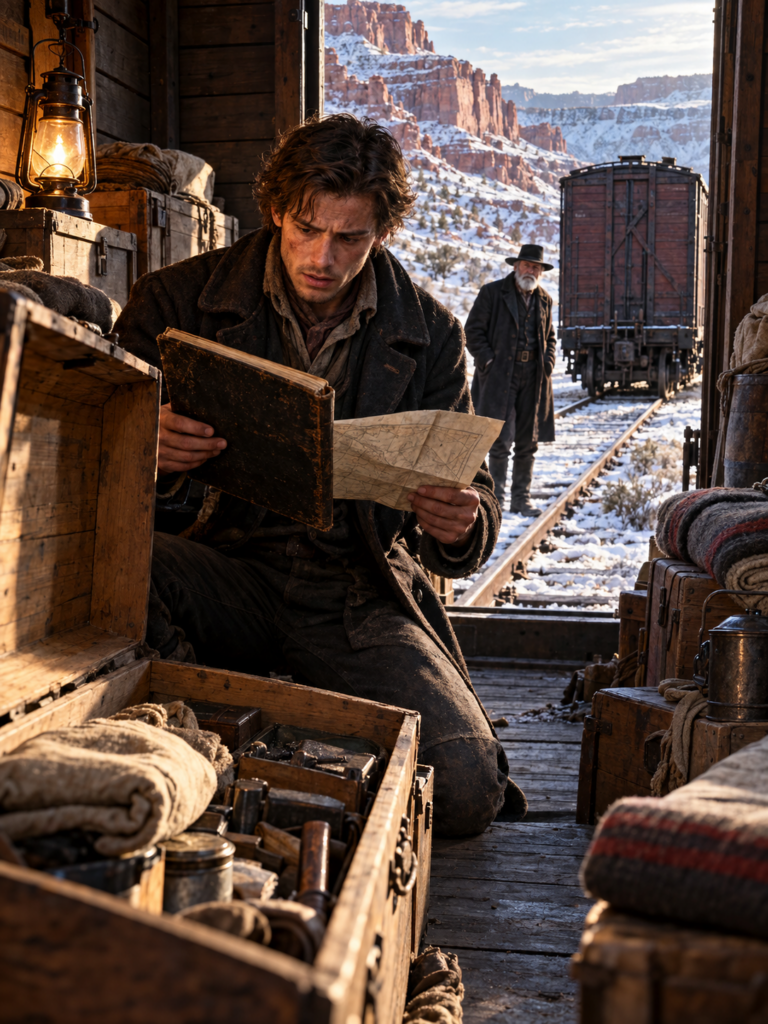
Peter ran low over the loose ballast, the lantern striking his leg as he crossed toward the wrecked wagon.
The woman saw him coming.
“My boy,” she said before he reached her. “Please.”
Peter dropped beside the mare first.
Breathing.
Alive.
Frightened more than badly hurt.
He cut her loose from the twisted traces with his pocketknife, then climbed onto the wagon.
The boy was perhaps eight.
Blood from a small cut above his eye had dried along one cheek.
His right wrist was swollen and angled wrong.
Peter’s stomach tightened.
He had seen that shape before.
Years earlier, his father had set a calf’s broken leg on a January night while Peter held the animal steady.
“Don’t fight what’s already broken,” his father had told him. “Keep it from becoming worse.”
Peter eased the boy’s sleeve back without forcing the wrist.
“What’s your name?”
“Eli.”
“All right, Eli. I’m Peter.”
The boy’s face had gone white.
Peter took off his scarf and made a sling that kept the injured arm against the child’s body without trying to straighten it.
Then he looked at the mother.
“Town’s about a mile.”
“I can walk.”
“I’ll carry him.”
She nodded.
No argument.
Peter lifted the boy carefully against his shoulder.
The mother took his free arm for balance.
They started toward Red Butte.
Peter did not look back at car twelve.
Men from the yard saw them near the coal chute.
One shouted.
Another ran.
Hollis Ren came out without his coat.
When he saw the child, he forgot every question he might have had about the unfinished inventory.
He took Eli from Peter’s arms and carried him toward the doctor’s house.
Peter stayed beside the mother.
By the time they reached the main street, people were already gathering.
Dr. Amos Pell met them outside his gate.
He took one look at the wrist and brought Eli inside.
Peter waited on the plank walk with his hat in his hands.
He suddenly realized how cold he was.
Not from the weather.
From the knowledge sitting two miles behind him in an open freight car.
Thirty years of names.
Supplies.
A secret system built beneath the official railroad.
Someone had trusted it.
Someone had protected it.
And somebody else had decided this morning that it should be uncovered.
The doctor came outside.
“The boy will mend.”
The mother covered her mouth.
Peter released a breath.
Amos studied him.
“You carried him correctly.”
“My father showed me.”
“A railroad man?”
Peter nodded.
The doctor’s eyes shifted toward the distant siding.
“You came from number four?”
“Yes.”
Amos was silent for one beat too long.
Peter noticed.
“You know what’s out there.”
The doctor looked at him.
“I know some of it.”
Peter’s grip tightened around his hat.
Amos lowered his voice.
“For eleven winters, when families have been cut off, supplies have appeared. Medicine sometimes. Food. Blankets. Nobody sent invoices afterward.”
Peter said nothing.
“I signed receipts.”
That changed the shape of the secret again.
The ledger was not merely an old man’s private charity.
Other people knew.
Other people participated.
“How many?”
“I never asked.”
“Why?”
Amos looked toward his house, where Eli’s mother now sat beside the door.
“Because when somebody brings flour to a widow in February, I care more that it reaches her than whether the company ledger approves.”
Footsteps approached.
Hollis Ren stopped in front of them.
His coat was finally on.
His pencil was missing.
“You left twelve sealed,” he said.
Peter nodded.
“Why?”
Peter considered lying.
He did not.
“Because eleven explained enough to make me stop.”
Hollis’s face went still.
“You opened the chest.”
“Yes.”
“The ledger?”
“Yes.”
Amos looked between them.
Peter continued.
“There’s a map. Receipts. Thirty years.”
Hollis lowered his head.
Then he said, “Audi is my uncle.”
Peter had suspected a connection.
He had not expected that one.
“He rode this line before I was born,” Hollis said. “What he built started small. A sack of flour here. Coal there. Then men joined him.”
“The railroad knows?”
“Pieces of it.”
“Does the railroad know about those cars?”
Hollis looked toward the tracks.
“Not all of them.”
Peter thought of the work order in his pocket.
“Then who sent me?”
Hollis met his eyes.
“That is what worries me.”
Across the street, Dell Ror stood among the gathered railroad men.
He was not smiling anymore.
Peter suddenly understood the danger was not inside the twelfth car.
The danger was that somebody wanted thirty winters of quiet relief dragged into daylight without telling the people who had spent their lives protecting it.
Hollis said, “Where are the cutters?”
“Against twelve.”
“And the seal?”
“Unbroken.”
Hollis exhaled.
Then another voice came from behind him.
“Good.”
Audi Vaughn stood at the edge of the crowd with the same worn canvas coat he had worn that morning.
The old man walked forward slowly.
His eyes settled on Peter.
“You counted?”
“Eleven.”
Audi nodded.
“That’s the count I meant.”
Peter reached into his coat and removed his tally book.
“I need to know what twelve holds.”
Audi’s expression did not change.
“You need to know why it was sealed.”
“That too.”
“And if I tell you?”
Peter looked toward the siding.
“Then I decide whether I finish the order.”
Hollis started to speak.
Audi lifted one hand.
The yard master stopped.
The old railman studied Peter for a long time.
Then he said, “Bring the cutters.”
Peter understood the choice being offered.
Not obedience.
Responsibility.
He put his hat on.
“I’m going back.”
Audi turned with him.
“And this time,” the old man said, “you won’t open anything alone.”
Peter walked back toward siding four with Audi Vaughn on one side and Hollis Ren on the other.
Nobody hurried.
The red-rock ridges had turned copper beneath the lowering afternoon sun.
Behind them, Red Butte resumed moving in cautious pieces.
A wagon was being sent for the injured mare.
Dr. Pell remained with Eli.
Dell Ror and several railroad men returned toward the yard.
But Peter could feel eyes following the three of them.
At the coal chute, Hollis spoke first.
“Before we reach twelve, you should know something.”
Peter kept walking.
“This morning’s work order did not originate with me.”
“You signed it.”
“I did.”
“Why?”
“Because it came through the division office with my authorization code already on it.”
Peter stopped.
Hollis did too.
“You’re saying someone used your name?”
“I’m saying somebody knew enough about this yard to make an order look routine.”
Audi continued several steps before noticing they had stopped.
He turned.
Peter looked at him.
“Did you know?”
Audi’s face remained unreadable.
“I knew someone had been asking about old supply discrepancies.”
“What kind?”
“Things that vanished on paper and arrived where they were needed.”
Peter thought of the receipts.
“So theft.”
Hollis bristled.
Audi did not.
“Call it what company accountants would call it.”
“What do you call it?”
“Winter.”
The answer irritated Peter more than he expected.
Not because it was clever.
Because it avoided the question.
“You took railroad property.”
“Sometimes.”
“Without permission.”
“Sometimes.”
“And sometimes?”
“Sometimes men donated their own wages. Sometimes merchants gave stock. Sometimes the company quietly wrote off damaged freight and looked the other way. Sometimes a section boss knew exactly what left his shed.”
Peter resumed walking.
“That isn’t one system.”
“No,” Audi said. “It’s thirty years of men doing what was necessary before there was a system.”
They reached the first freight car.
Peter’s chalk marks ran along the row.
One through eleven.
He looked at them differently now.
“What were these cars doing here?”
Hollis answered.
“Being reorganized.”
Audi gave him a sharp look.
Hollis ignored it.
“We’ve used hidden caches along the northern line for years. Most aren’t large. A shed compartment. A marked crate. Sometimes a locked box in a section house.”
“The map showed ten.”
“Ten permanent ones.”
Peter looked toward car twelve.
“And this?”
Audi spoke.
“A transfer.”
“Of everything?”
“Enough that someone noticed.”
They passed car seven.
The carved mark remained hidden inside.
Peter remembered the initials.
“OVW.”
Audi glanced at him.
“What does the W mean?”
“Nothing.”
Peter frowned.
Audi almost smiled.
“My knife slipped when I first cut the mark thirty years ago. Men copied it badly afterward. Some called it OVW. Some OVR. Eventually the mistake became part of the sign.”
For the first time, Peter saw the old man not as something legendary but simply old.
A man who had made a mark badly and watched it outlive the mistake.
At eleven, Peter stopped.
The chalk cross was pale beside the door.
“You wanted me to find this one.”
“Yes.”
“Why not tell me?”
Audi looked at the open country around them.
“Because I did not know if you were the man your father said you might become.”
Peter turned sharply.
“You knew my father?”
“Longer than you’ve known the railroad.”
The wind seemed to disappear.
Peter’s father had rarely spoken about his years on the northern line.
Just names.
Storms.
Work.
Men who were useful.
A few who were not.
“You shared camps?”
Audi nodded.
“Your father helped carry supplies into Willow Creek the winter the bridge went out.”
Peter remembered being young and waking once to find his father gone for eight days.
“He never told me.”
“He wasn’t doing it to have a story.”
Peter looked away.
That sounded exactly like his father.
Audi continued.
“When word came that he died, Hollis told me you were coming north.”
Peter looked at Hollis.
The yard master nodded.
“The job was real,” Hollis said. “No charity.”
“I know.”
“But Audi asked me to watch you.”
Peter’s anger came fast.
“You tested me.”
Audi did not deny it.
“That was wrong.”
The simple admission checked Peter more effectively than an excuse.
Audi looked toward the eleventh car.
“I should have told you what I knew. I was afraid someone had compromised the caches. I wanted to see whether you would inventory what you found or start taking things apart.”
“So you sent me blind.”
“I allowed you to go blind.”
Peter’s jaw tightened.
“There’s a difference?”
“No.”
Silence stretched between them.
Audi said, “You can walk back now.”
Peter looked at him.
“No penalty. No debt. No expectation. Hollis can assign another man.”
Hollis nodded reluctantly.
Peter understood what Audi was doing.
Returning the decision to him.
Too late to erase the manipulation.
Not too late to stop repeating it.
Peter looked toward twelve.
“What’s in there?”
Audi’s face changed slightly.
“The reason the caches started.”
Peter waited.
The old man walked on.
Peter followed.
The final car stood where he had left it.
His father’s cutters leaned against the wheel.
The company seal remained whole.
Audi stopped several feet away.
“In the winter of seventy-one, a train stalled north of Bitter Fork.”
Peter knew the winter by reputation.
Men still spoke of it.
“Passenger train?”
“Mixed. Freight, passengers, mail. Snow held them six days.”
Hollis said nothing.
Audi continued.
“Company dispatch believed another engine would reach them. It didn’t.”
Peter looked at the seal.
“What happened?”
“People in nearby camps began carrying food by hand.”
“Railroad men?”
“Railroad men. Miners. Two ranch families. A preacher I disliked. Everybody.”
Despite himself, Peter glanced at Audi.
The old man’s mouth twitched.
“Good man. Terrible company.”
Then the humor vanished.
“Three passengers died before enough food reached the train. One was a woman traveling with two children.”
Peter felt the direction of the story before Audi said it.
“My sister.”
Hollis lowered his eyes.
Peter looked between them.
“Hollis’s mother.”
Audi nodded.
“She lived?”
“She did. So did the children. Barely.”
“What’s that have to do with the car?”
Audi rested his hand against the sealed door.
“Afterward I started keeping things where official schedules couldn’t fail them.”
“And twelve?”
“The original records.”
Peter stared.
“Names?”
“Names. Contributions. Letters. Promises. Every man and woman who helped build what came afterward.”
“Why move them?”
“Someone at division started asking why inventory disappears from certain stations every winter.”
Hollis said, “We thought if we consolidated the historical records and moved the current supplies, we could regularize the whole thing before somebody treated thirty years of relief as a criminal scheme.”
Peter understood.
“You wanted the company to approve it.”
“We wanted it to survive.”
“And now somebody ordered all twelve opened.”
“Yes.”
Peter picked up the cutters.
His father’s grip marks were worn into the handles.
Audi watched him.
“Once that seal is cut, the company record says the car was inspected.”
“And if I don’t cut it?”
“The work order remains incomplete.”
“I could lose my position.”
Hollis said, “Possibly.”
Peter looked at him.
“You said no penalty.”
“If you walk away because Audi manipulated you, I’ll defend that.”
“But refusing a direct work order?”
Hollis did not pretend.
“I can’t promise how division responds.”
Peter looked at Audi.
“Why keep records at all?”
“Because memory lies.”
The answer was immediate.
Peter thought of his father.
The foreclosure man.
The old inspector he remembered from childhood.
Words said.
Words omitted.
Audi continued.
“If you do good quietly long enough, somebody eventually says it never happened. If you do wrong quietly long enough, somebody says that never happened either. Records make both lies harder.”
Peter placed the cutters against the seal.
Then stopped.
“What if opening this destroys the system?”
Audi’s eyes rested on him.
“Then keeping it closed forever destroys it another way.”
There it was.
No safe choice.
Hide the records, and the caches might die with Audi.
Expose them carelessly, and the company could punish everyone who had sustained them.
Peter removed the cutters without breaking the seal.
“I’m not opening it yet.”
Hollis stared at him.
Audi did not.
Peter pointed toward town.
“We need witnesses.”
“For what?”
“For whatever is inside.”
Audi’s expression sharpened with approval.
Peter continued.
“Dr. Pell signed receipts. You and Hollis know the system. If there are thirty years of records in there, one probationary brakeman should not be the only man who sees them.”
Hollis nodded slowly.
“And division?”
Peter looked down the line.
“If somebody forged your authority to force this open, I want that order beside the records when we do it.”
That was the first moment both older men stopped treating him as someone being tested.
Audi removed his glove and held out his hand.
Not to congratulate him.
To ask for the cutters.
Peter did not give them over.
“I’ll carry them.”
Audi’s eyes warmed slightly.
“Your father would’ve said the same.”
Peter lifted the lantern.
“Then let’s get the people who need to be here.”
They turned back toward Red Butte.
Behind them, car twelve remained sealed.
For the first time that day, Peter did not feel it was waiting for him.
It was waiting for all of them.
They returned before sunset with Dr. Amos Pell, Dell Ror, the station bookkeeper, and two section men whose names appeared in the eleventh-car ledger.
Peter had insisted on the bookkeeper.
That surprised Hollis.
“Why him?”
“Because if the argument is about company property, somebody should know what the company actually recorded.”
The bookkeeper was a narrow man named Ezra Cole who seemed offended by cold weather personally.
He carried three ledgers under one arm and complained all the way to siding four.
At the final car, Peter set down the lantern.
Nobody spoke.
He handed Hollis the suspicious work order.
Hollis handed it to Ezra.
The bookkeeper studied the authorization code.
Then his face tightened.
“This is yours.”
“That’s what I said.”
“No. I mean the code is yours. But the sequence isn’t.”
Hollis stepped closer.
Ezra pointed.
“Orders out of Red Butte are numbered from the yard book. This number belongs to a coal manifest from six weeks ago.”
Peter felt the day’s mystery narrow.
“Somebody copied an old authorization.”
Ezra nodded.
“Looks like it.”
Audi asked, “Can you prove that?”
Ezra lifted one of his ledgers.
“I can show the original.”
That changed everything.
The demand to open twelve had never been legitimate.
Peter could have stopped there.
Part of him wanted to.
But Audi had been right about one thing.
Keeping the past sealed forever was another way of losing it.
Peter looked at the old man.
“You still want it opened?”
Audi nodded.
“Now I do.”
Peter fitted his father’s cutters around the lead.
The seal broke with a soft click.
He caught it in his palm.
The twelfth.
He did not put it in the tin can.
He handed it to Ezra.
“Record that.”
Ezra did.
Peter pulled the door.
It resisted at first.
Dell stepped forward instinctively.
Peter shook his head.
“I have it.”
He leaned harder.
The runner moved.
Cold darkness opened.
Audi lifted one lantern.
Peter lifted the other.
Inside were no mysterious weapons.
No stolen payroll.
No bodies.
Shelves had been built along both walls.
On them sat wooden document boxes.
Hundreds of envelopes.
Old account books.
Bundles of correspondence tied in cotton tape.
At the far end stood several plain trunks.
Peter climbed in.
Audi followed more slowly.
Hollis remained at the door.
The first box contained receipts older than those in car eleven.
The second held letters.
Requests from camps.
Thank-you notes.
Statements from merchants who donated damaged stock.
Notes from railroad men who gave portions of wages anonymously.
Peter opened one envelope.
Audi stopped him.
“Read the name first.”
Peter did.
Thomas Carter.
Everything inside him went still.
His father.
He looked at Audi.
The old man said nothing.
Peter unfolded the letter.
The handwriting was unmistakable.
He knew it from labels on tool drawers.
From notes left beside firewood.
From the one birthday card Peter had kept folded in his duffel.
His father had written about Willow Creek.
A bridge out.
Families stranded.
A section crew short of food.
He had offered two weeks of wages toward supplies and requested that no record be sent home because his wife worried enough when he was away.
Peter read the letter twice.
His mother had been alive then.
He had been a child.
His father had come home from that trip exhausted, with a split knuckle and a cough.
Peter remembered asking what happened.
“Work,” his father had said.
Nothing more.
Peter lowered himself onto a crate.
The silence around him was enormous.
All day he had been opening other men’s secrets.
Now one had opened his father back to him.
Audi sat beside him.
“I told you he helped.”
“You didn’t tell me this.”
“You deserved to find his own words.”
Peter looked down at the paper.
Anger rose unexpectedly.
“He could have told me.”
“Yes.”
“Why didn’t he?”
“I can’t answer for him.”
Peter looked at Audi sharply.
The old man did not retreat.
“Your father was a good man. Good men can still leave things unsaid that their sons deserved to hear.”
That answer hurt because it was fair.
Peter had spent three months turning his father into something simple.
A dead man who had worked hard.
A victim of sickness.
A man whose claim had been taken after his death.
But his father had existed beyond Peter’s grief.
He had chosen things.
Hidden things.
Helped people Peter would never meet.
Peter folded the letter carefully.
“Did he know you were keeping these?”
“Yes.”
“Did he ask you to?”
“Yes.”
Another truth.
Another decision made without Peter.
He stood.
“I want a copy.”
“You should have the original.”
Peter shook his head.
“No.”
Audi waited.
“If these records matter because memory lies, then they stay with the record.”
A faint smile touched Audi’s face.
Peter added, “I’ll make a copy.”
“Fair.”
Behind them, Ezra was already opening account books.
Dr. Pell found his own signature.
Dell Ror stood at the door without entering.
Peter noticed.
“You coming in?”
Dell removed his cap.
“Not unless somebody asks.”
It was a small thing.
But after mocking Peter that morning, the man had learned something about entering spaces that were not automatically his.
Peter nodded toward the floor.
“I’m asking.”
Dell climbed in.
They worked until dark.
The story that emerged was less romantic than legend and more valuable because of it.
There had been no single mastermind.
Audi had started the caches after the Bitter Fork disaster.
But the network survived because dozens of people sustained it.
Rail workers.
Merchants.
Doctors.
Station agents.
Widows who later contributed when they could.
Cooks who added flour.
Ranchers who sent blankets.
Section crews who diverted scrap timber for emergency fuel.
Some supplies had technically belonged to the railroad.
Many had not.
Sometimes paperwork had been altered.
Sometimes supervisors had deliberately marked usable damaged goods as waste so they could be distributed.
There were rules broken.
There were also lives probably saved.
The truth resisted becoming clean.
Peter respected it for that.
Near midnight, Ezra found the most important record.
A letter from the northern division superintendent dated eleven years earlier.
He read it twice.
Then handed it to Hollis.
The superintendent acknowledged the existence of emergency caches.
He did not formally authorize them.
He also explicitly instructed local managers not to dismantle them until the company developed a replacement relief system.
No replacement had ever been created.
Hollis laughed once without humor.
“So the company knew enough to benefit from them and not enough to accept responsibility.”
Audi said, “Companies are talented that way.”
Ezra kept searching.
By dawn they had enough evidence to protect most of the people involved.
Not perfectly.
But enough.
The false work order remained unexplained.
Yet Peter understood something important.
Whoever forged it had expected an inexperienced brakeman to obey mechanically.
Break seals.
List contents.
Turn everything over.
No witnesses.
No context.
No questions.
The scheme had failed because Peter stopped.
Not from bravery.
Because an injured child forced his attention away from the job long enough for him to think about what the job actually meant.
The next morning Hollis telegraphed the division office.
He did not conceal the caches.
He did not surrender them either.
His message stated that unauthorized orders had been issued using his code and that historical emergency-relief materials had been discovered under disputed company custody.
He requested an investigator and instructed that no freight be moved until the authorization fraud was addressed.
Audi read the telegram.
“You made it official.”
Hollis nodded.
“You angry?”
“Terrified.”
Peter looked at him.
Audi grunted.
“Good. Means you understand paperwork.”
Three days later, a division representative arrived.
The forged order was eventually traced not to some grand conspiracy but to a mid-level freight auditor who had noticed recurring inventory discrepancies and believed exposing them dramatically would advance his position.
He had expected theft.
He had expected scandal.
Instead he found thirty years of relief records, an old superintendent’s written acknowledgment, and half the communities along the northern line prepared to testify about what the caches had done.
He lost his position.
The relief system survived.
But it changed.
That mattered most to Peter.
Audi did not remain its secret ruler.
Hollis did not inherit control simply because he was family.
The railroad formally designated emergency stores at isolated sidings.
Local doctors and section bosses received documented authority to release supplies during storms.
Inventories were recorded openly enough to prevent theft but flexibly enough that a stranded family did not need permission from an office two hundred miles away before receiving flour.
Audi resisted some of it.
Peter challenged him.
“You wanted the thing to survive.”
“I wanted it to stay useful.”
“Then it can’t depend on everybody pretending you’ll live forever.”
Audi glared.
Peter waited.
Finally the old man said, “Your father argued like that.”
“I’ll take that as praise.”
“It wasn’t.”
Peter smiled anyway.
He received his brakeman’s badge three months later.
Not as a reward for siding four.
Because he passed the requirements.
That distinction mattered to him.
Dell Ror shook his hand afterward.
No joke.
No green boy.
Just, “You earned it.”
Peter remained at Red Butte.
He learned switching.
Signals.
Winter coupling.
Emergency braking.
He learned which ridges caught snow first and which sidings drifted shut.
And under Audi’s supervision, he learned the emergency stores.
Not their secrets.
Their responsibilities.
The first winter after the system became official, a storm isolated a work camp north of Willow Creek.
Peter rode with two section men and delivered flour, coffee, blankets, and medicine.
At the camp, a young laborer tried to thank him.
Peter said, “Sign here.”
The man laughed.
Peter held out the receipt book.
“I’m serious.”
The laborer signed.
On the ride back, Audi asked why Peter cared so much about the paperwork.
Peter thought about the twelfth car.
“Memory lies.”
Audi glanced at him.
Then nodded.
Years later, the sealed-car story became exaggerated around Red Butte.
People said Peter found a fortune.
Others claimed guns.
Some said stolen company money.
One version had dead men inside the twelfth car.
Peter corrected those stories whenever he heard them.
“There were records,” he would say.
“Supplies.”
“Names.”
Usually people looked disappointed.
They wanted something sensational.
Peter had learned that reality was sometimes quieter and heavier.
Thirty years of people making sure strangers survived winter did not need a body in a box to matter.
Neither did his father.
Peter eventually copied Thomas Carter’s letter.
He kept the copy folded inside the same oilcloth that held his father’s tools.
The original stayed in the railway archive created from the twelfth car’s records.
That decision surprised Hollis.
“You don’t want it?”
“I do.”
“Then why leave it?”
Peter looked through the archive-room window toward the line.
“Because he wrote it into something larger than me.”
Hollis understood.
Audi lived several more winters.
Age bent him but did not soften his opinions.
When he finally stopped riding the line, the handoff was not ceremonial.
He simply appeared one morning at Peter’s quarters with an old brass key.
Peter looked at it.
“What’s this?”
“North cache store.”
“I already have access.”
“This opens the old lock.”
“Why would I need the old lock?”
“You won’t.”
Peter frowned.
Audi pushed it into his hand.
“Then keep it for what it means.”
Peter turned the key over.
A small square with a crooked cross had been scratched into the bow.
And beside it, the badly copied letters.
OVW.
Peter laughed.
“You really did slip with that knife.”
Audi looked offended.
“Cold hand.”
“Thirty years of men copied a mistake because your hand was cold?”
“Tradition has started from stupider things.”
Peter kept the key.
Not as authority.
As warning.
Systems became symbols easily.
Symbols became stories.
Stories became certainty.
The important thing was always the people underneath them.
Years after Audi was gone, Peter sometimes walked to siding four at dusk.
The original twelve cars had long since been moved.
Freight changed.
Tracks were repaired.
Red Butte grew.
But he could still place where the eleventh and twelfth cars had stood.
He remembered arriving there as a twenty-year-old who thought his task was simple.
Cut every seal.
Inventory every car.
Return before noon.
He had believed work meant completing instructions.
By evening he understood something harder.
Sometimes work meant knowing when not to finish the order exactly as written.
Sometimes loyalty meant exposing a secret enough to save it.
Sometimes inheritance was not land.
Peter had lost land.
For months he had believed that meant his father left him almost nothing.
He knew better now.
His father left tools.
Skills.
A reputation with men Peter had never met.
A way of handling frightened animals.
A habit of reading before acting.
A letter inside a sealed freight car describing wages quietly given to strangers.
None of it could be foreclosed.
None of it needed a deed.
One winter evening, Peter stood outside the emergency store while snow began falling over Red Butte.
Inside were flour sacks, canvas, coffee, blankets, lamp oil, medicine, and tools.
All inventoried now.
All authorized.
Nothing hidden.
A young brakeman newly assigned to the line came up behind him.
“Mr. Carter?”
Peter turned.
The boy—though legally a man—held a clipboard.
“They told me you could show me how the winter store works.”
Peter looked at him.
He remembered the switch shack.
Dell’s laughter.
Audi’s warning.
The cutters in his hand.
The twelve sealed cars.
He could have tested the young man with riddles.
He could have made him prove something.
Instead Peter unlocked the door.
“I’ll show you.”
The brakeman followed him inside.
Peter explained what every shelf held.
What could be released without delay.
What required a receipt.
Who could authorize medicine.
What to do when telegraph lines failed.
What not to wait for when somebody was freezing.
The young man listened carefully.
At the end he noticed the old brass key hanging from a nail.
“What’s that open?”
“Nothing anymore.”
“Why keep it?”
Peter removed it.
The crooked square and cross still showed in the metal.
He thought of Audi.
Of Hollis.
Of Dr. Pell.
Of Dell standing outside the car until invited.
Of his father’s letter.
Of the child with the broken wrist whose accident had interrupted an order and changed the whole day.
Then Peter put the key back.
“It reminds me that people can build something useful for the wrong reasons, break rules for the right reasons, hide good work too long, or expose it too carelessly.”
The young brakeman looked puzzled.
Peter smiled.
“You’ll understand eventually.”
Outside, a freight whistle sounded down the line.
Peter extinguished the lamp.
They stepped into the snow together.
The northern rails disappeared into darkness beyond the yard.
Once, Peter had thought he came to Red Butte because he needed wages.
Then he thought he had been sent to siding four to cut seals.
Both things were true.
Neither was the whole truth.
He had arrived carrying his father’s tools and believing inheritance was what remained after a man died.
The northern line taught him differently.
Inheritance was also what a man chose to continue.
Not property.
Not secrecy.
Not obedience.
Care.
Peter locked the store and slipped the key into his pocket.
Then he walked toward the night train, where someone was waiting for him to do the next piece of work correctly.


