Harlon lifted the lantern above the narrow trail as Evelyn stepped carefully over a fallen branch.
Snowflakes drifted through the trees.
The ground was already hard with frost, and the darkness had swallowed most of the familiar landmarks.
“You came out here alone?” he asked.
“Yes.”
“Following mule tracks?”
“Yes.”
“That took nerve.”
“It took desperation.”
He glanced at her.
“At least you’re truthful.”
Evelyn gave a faint smile.
“I’ve discovered lies cost more time than I can afford.”
They walked quietly until the trees began to thin.
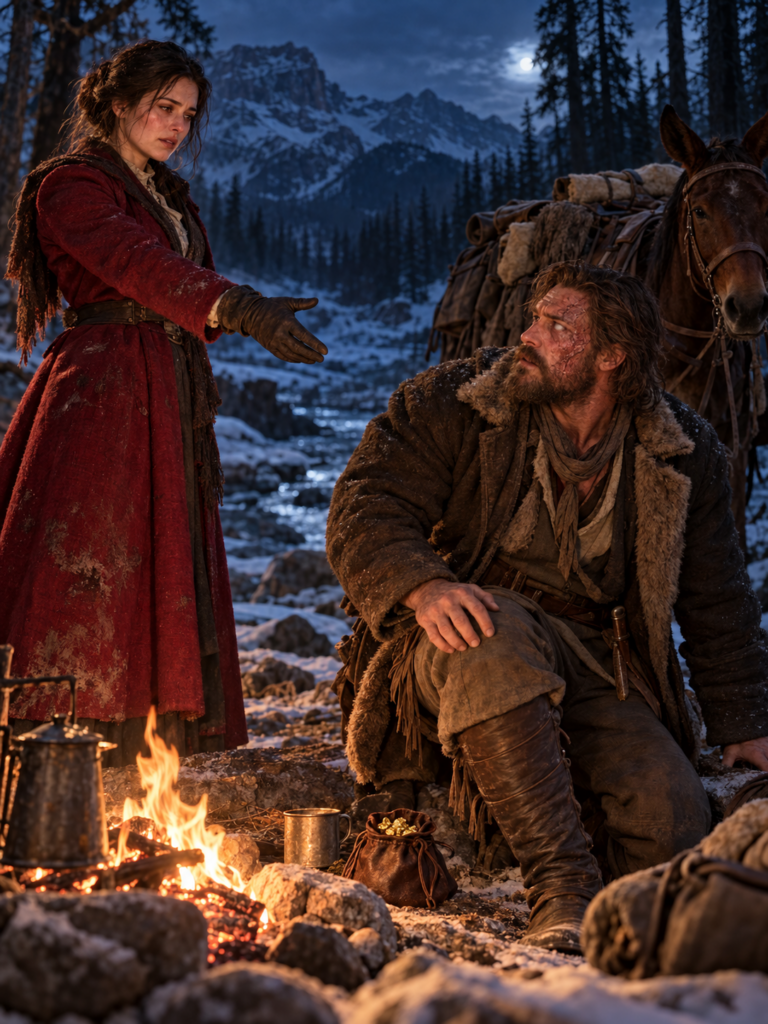
Her crimson coat brushed against the low branches. She kept one hand near her pocket, where the gold remained hidden.
Harlon noticed that she glanced over her shoulder twice.
“Expecting somebody?”
“Judson’s men have watched my house.”
“Followed you here?”
“I don’t believe so.”
“Then perhaps you ought to remain cautious.”
She stopped.
“Mr. Fletcher, I know why people are afraid of you.”
Harlon’s expression closed.
“Reckon you do.”
“But I don’t know whether you deserve it.”
He turned toward her.
“Most people don’t wait to find out.”
“Then they’re careless.”
Something about the quiet certainty of her answer unsettled him.
She wasn’t pretending his scars didn’t exist.
She wasn’t studying them out of pity.
She was judging what he said and did.
That was unfamiliar enough to make him uncomfortable.
When they reached the road, Evelyn stopped beside a tall pine.
“I can find my way now.”
Harlon held up the lantern.
“Keep to the wagon ruts.”
“I will.”
She hesitated.
“What happens if you change your mind tomorrow?”
“Then I’ll tell you before we sign anything.”
“And if I change mine?”
“You’re free to do the same.”
Evelyn studied his face.
“Thank you.”
He nodded once.
Then she turned toward town.
Harlon watched until the crimson coat disappeared beyond the bend.
Only then did he start back to camp.
***
Morning came bitterly cold.
Harlon packed his mule before sunrise and walked into Bitter Creek beneath a sky heavy with snow.
People stared as he passed.
A miner stopped speaking.
A woman moved away from the boardwalk.
He lowered his hat.
Then he saw Evelyn waiting outside the courthouse.
She wore the same crimson coat.
Her hair was neatly pinned.
Her face was pale from a sleepless night.
“You came,” she said.
“Gave my word.”
She looked toward the courthouse door.
“I brought our written terms.”
Harlon took the folded paper.
She had listed the promised payment, separate sleeping arrangements, the management of her property, and the intended duration of their initial agreement.
He read it carefully.
“There’s one thing missing.”
“What?”
“Neither of us can use this arrangement to force the other to remain.”
Evelyn looked at him.
“You mean either of us may leave?”
“Whatever the marriage laws require afterward, yes. I won’t hold you against your will, and you won’t hold me by threatening what I’m owed.”
She took the paper back.
“Then we’ll add it.”
Inside, Judge Caldwell looked up from his ledger and recoiled at the sight of Harlon.
“Miss Cross, is this some kind of joke?”
“No,” Evelyn answered. “We’ve come to marry.”
The magistrate looked from her refined features to Harlon’s ruined face.
“Do you know who this man is?”
“Yes.”
“Are you being threatened?”
“No. I asked him.”
Caldwell appeared almost offended by her certainty.
He examined their papers, took the required fee, and finally prepared the marriage record.
Harlon stood beside Evelyn.
He could feel the judge’s gaze lingering on his scars.
When Caldwell asked for his full name, he answered reluctantly.
“Harlon Fletcher.”
The pen felt awkward in his broad fingers.
He signed in uneven letters.
Evelyn signed next, her handwriting neat and practiced.
They exchanged brief vows.
No affection was declared.
No promises were made beyond those they understood.
When the magistrate pronounced them husband and wife, Evelyn drew one deep breath.
The first condition of her plan was complete.
But Harlon noticed how firmly she held the folded property papers.
This was only the beginning of her struggle.
Outside, she turned toward him.
“My wagon is at the livery.”
“I’ll follow on the mule.”
She shook her head.
“I’d rather you rode beside me.”
“Why?”
“Because Judson’s men have been watching the road. I want them to see that we’re married.”
Harlon studied her.
“Then I’ll ride beside you.”
They gathered her horses and wagon, loaded his supplies, and started out of Bitter Creek.
The town watched them leave.
At first neither spoke.
Then snow began falling across the foothills.
Evelyn’s gloved fingers tightened around the reins.
Harlon noticed her shivering.
“Would you like another blanket?”
She nodded.
He drew a heavy hide covering from the wagon bed and settled it over her lap.
“Thank you,” she whispered.
The horses continued along the rutted road.
After a long silence, Evelyn spoke.
“My father made mistakes. But he built that home with his own hands.”
Harlon listened.
“I won’t surrender it because Judson thinks a woman cannot defend what belongs to her.”
“Nor should you.”
She looked toward the white hills ahead.
“Then help me reach it.”
He nodded.
And as the snow thickened around the wagon, Evelyn gathered the reins and urged the tired horses toward the valley that held everything she was fighting to save.
The horses leaned into their harness as Evelyn guided the wagon toward the last ridge above her valley.
Snow was collecting along the canvas covering.
The road had grown slick, and the team was beginning to tire.
Harlon leaned forward.
“Ease them a little.”
“If we stop, we’ll lose the light.”
“If we push too hard, we’ll lose the team.”
She studied the road ahead.
Then she loosened the reins enough to let the horses find a steadier pace.
It was a small decision.
But Harlon noticed that she accepted practical advice without surrendering control.
They reached the property as evening settled over the basin.
The house stood among tall cottonwoods, with a broad river beyond the lower pasture and a barn sheltered against the hillside.
It was a substantial place.
Well-built walls.
A pitched roof.
A stone chimney.
Yet the yard carried signs of recent neglect.
A gate hung crooked.
Wind had scattered straw beside the barn.
And through the cabin window, Harlon could see the broken remains of a rocking chair lying beside the hearth.
“Judson’s men?” he asked.
Evelyn followed his gaze.
“Yes.”
He said nothing.
The sight was explanation enough.
They brought the wagon to the barn.
Harlon helped unhitch the exhausted horses, rubbed them down, checked their hooves, and gave them water and feed.
Evelyn gathered the supplies they needed immediately and carried them inside.
When he entered, she was lighting a lamp.
The room smelled of cold ashes, dry apples, and the faint sweetness of herbs hanging above the stove.
“There’s a bed in the loft,” she said. “And another room at the back.”
“I’ll use the loft.”
She looked at him.
“Are you certain? The ladder’s steep.”
“Better than sleeping on your floor all winter.”
Her mouth curved slightly.
“You told me you didn’t sleep in beds.”
“Been known to change my mind.”
It was their first shared joke.
Small as it was, it eased the tension between them.
***
The snow continued for three days.
Harlon spent the daylight hours making certain the holding could withstand harder weather.
He repaired the barn latch, secured the loose gate, checked the wood supply, and inspected the roof where wind had lifted several shingles.
Evelyn kept the house warm and made notes concerning the supplies in the cellar.
She had more than enough food for herself.
Two adults and several animals required different planning.
She asked Harlon how much grain the horses would need if the snow persisted.
He gave her his estimate.
She calculated what remained.
They made a list for the next possible trip to Bitter Creek.
Neither pretended the arrangement was romantic.
But each began recognizing the other’s competence.
One morning, Evelyn found Harlon standing before her father’s broken rocking chair.
He was examining the damaged joints.
“Can it be repaired?” she asked.
“Most of it.”
She looked down.
“Father used to sit there after supper.”
“Would you want it fixed?”
“Yes.”
“Then I’ll see what I can do.”
He moved the broken pieces onto a workbench.
He did not make a speech about restoring her memories.
He simply began the careful work of saving what could be saved.
***
On the fourth morning, a dog barking near the barn announced visitors.
Harlon was tending a horse when three riders crossed the lower pasture.
Evelyn stepped onto the porch.
She carried her father’s shotgun, lowered toward the floorboards.
The lead rider was one of Judson’s hired men.
His name was Cole.
He had been present when the rocking chair was destroyed.
“Morning, Miss Cross.”
“State your business.”
“Judson sent us to inquire whether you’re ready to leave.”
“I’m not leaving.”
“The deadline’s upon you.”
“I’ve fulfilled the requirement I’m being told applies.”
The man laughed.
“By marrying whom?”
“My husband.”
He looked around the yard.
“Don’t see him.”
Harlon stepped from the barn.
He did not draw a weapon.
He walked toward the porch at an unhurried pace.
“I’m her husband.”
The rider stared at him.
Recognition spread across his face.
“Harlon Fletcher?”
“That’s right.”
The two men behind him shifted uneasily in their saddles.
Their leader dismounted.
“You expect us to believe this?”
“You may ask the magistrate,” Evelyn said. “The marriage is recorded.”
The man stepped toward the porch.
Harlon stopped beside Evelyn.
“She’s told you why you aren’t welcome.”
The rider looked up at him.
“Judson owns the best lawyers in Bitter Creek.”
“Then he can send one to speak properly.”
The man’s expression hardened.
“Move.”
Harlon did not.
For a tense moment, neither spoke.
The rider’s companions remained near their horses.
Evelyn lifted her voice.
“You have no permission to enter this house. If Judson believes he has a legal claim, he can bring it before the proper authority.”
The hired man looked from her to Harlon.
He had expected an isolated woman.
Instead, he found someone willing to answer him clearly and a man who showed no eagerness to begin a fight.
At last, he stepped backward.
“Judson won’t like this.”
“Then he may take his complaint to the office that recorded the marriage,” Evelyn replied.
The three men mounted and rode away.
Harlon watched until they reached the distant tree line.
Then he turned to Evelyn.
“You handled that well.”
Her fingers still trembled around the shotgun.
“I was frightened.”
“Didn’t prevent you from speaking.”
She looked at him.
“Thank you for standing beside me.”
“It’s what we agreed.”
“Yes,” she said.
But something in her expression suggested she was beginning to understand that a promise could become more meaningful through the way it was kept.
***
Winter settled hard over the valley.
The river froze along its banks.
Snow gathered against the fences.
Cold weather made Harlon’s damaged knee ache, sometimes severely.
At first he tried to conceal it.
He had spent years relying on nobody.
But Evelyn noticed his uneven steps and the way he lowered himself carefully into a chair after working outdoors.
One evening, she found him struggling to mend a leather strap beside the fire.
“You’ve been limping all day.”
“Old injury.”
“May I look at it?”
He hesitated.
“Won’t be pleasant.”
“I asked whether I may look.”
Harlon studied her.
Then he nodded.
He removed his boot and rolled up his trouser leg.
The knee bore old scarring from the bear attack.
It was swollen from the day’s exertion.
Evelyn examined it without flinching.
“My father used a salve for aching joints,” she said. “I cannot promise it’ll help, but I’ve some left.”
Harlon looked at her.
“You needn’t trouble yourself.”
“I know.”
She fetched the jar and returned.
“Would you like me to put some on?”
He gave a small nod.
Her hands touched his injured knee carefully.
The contact startled him more than the cold had.
For years, people had looked at him with disgust or fear.
Touch had become something he no longer expected.
Evelyn noticed his hands tightening around the chair arms.
“Does it hurt?”
“No.”
“Shall I stop?”
He swallowed.
“Not unless you want to.”
She continued gently, careful not to press too hard.
Afterward, she wrapped the jar and set it beside him.
“You’ll still need to rest that leg.”
He managed a faint smile.
“I’ve heard.”
She sat on the rug near the hearth.
For a while, neither spoke.
Then Evelyn said something he had not expected.
“My father was not always kind.”
Harlon looked toward her.
“When he drank, his temper changed. Once, when I was sixteen, I dropped an iron skillet. He struck me so hard I lost consciousness.”
Harlon went still.
Evelyn kept her eyes on the fire.
“I learned to watch a man’s hands. To listen for anger before he spoke. To make myself small whenever I could.”
She looked up at him.
“When Judson sent men to my house, I knew what frightened people could be made to surrender.”
Harlon said quietly, “You shouldn’t have had to live that way.”
“Neither should you.”
He looked away.
“You don’t know everything about me.”
“I know what you choose to show me.”
She reached toward his hand, then stopped.
“May I?”
He nodded.
Her fingers rested over his scarred knuckles.
“You’re not frightening because of your face, Harlon.”
He stared at her.
“Most people disagree.”
“Then they haven’t taken the time to know you.”
He looked down at their joined hands.
For the first time in years, he allowed himself to believe that the woman beside him might be offering more than gratitude.
***
Their companionship changed after that evening.
Evelyn no longer treated him merely as a hired protector.
She asked his opinion on decisions concerning the holding.
He learned which responsibilities she wanted to keep for herself.
They repaired fences together when weather permitted.
He showed her how to inspect the horse tack.
She taught him to keep the household accounts in a clearer order.
The repaired rocking chair returned to the hearth.
Sometimes she sat in it while he read from his battered Bible.
Other evenings, he simply listened as she described what her father had hoped to accomplish on the land.
Neither spoke of ending the marriage.
But both knew the original agreement had been made under pressure.
It could not become a true partnership without a different kind of choice.
***
Spring arrived with mud, thawing riverbanks, and the hard work of repairing what winter had damaged.
Harlon worked long hours strengthening the fences and restoring the roof.
Evelyn managed the supplies and helped where she could.
One afternoon in April, she found him splitting wood beside the shed.
He had removed his heavy coat.
The scars across his chest were visible beneath the damp fabric of his undershirt.
When he noticed her looking, he reached instinctively for his flannel shirt.
“Don’t hide on my account,” she said.
He paused.
She handed him a cup of water.
“You’ve worked enough for today.”
“Still some rounds to split.”
“They’ll be here tomorrow.”
He drank.
Then she said, “Our original arrangement is finished.”
Harlon lowered the cup.
The words seemed to take the warmth from the afternoon.
“The deadline passed months ago,” she continued. “The marriage was recorded. Judson hasn’t sent anyone since winter. I’ve kept my land.”
Harlon looked toward the cabin.
“So you no longer need me.”
“That isn’t what I said.”
“But it’s true you don’t need a man standing guard.”
“Not in the way I did before.”
He returned the cup.
“Then I’ll pack my things.”
Evelyn stared at him.
“Harlon—”
“Agreement was clear. I don’t mean to stay where I’m not wanted.”
She opened her mouth, then closed it.
She had meant to ask whether he wished to remain as her husband in more than name.
He had heard only dismissal.
Before she could untangle the misunderstanding, he picked up his shirt and walked toward the barn.
Evelyn stood in the yard watching him go.
She had once feared a man might refuse to leave when she asked.
Now she feared that the one man she wanted to stay would depart without ever discovering why.
And at dawn the following morning, as Harlon was tightening the cinch on his mule, the sound of an approaching wagon and several horses rolled through the fog toward the house.
Harlon released the mule’s cinch and moved toward the barn doors.
Through the morning fog, he could make out a polished buggy accompanied by four mounted men.
One rider was the man who had threatened Evelyn during winter.
The man who stepped from the buggy was Judson himself.
Harlon recognized him from the trading settlements: expensive coat, carefully polished boots, and the manner of someone accustomed to having other men clear his path.
A second passenger followed him.
Sheriff Hoy.
Harlon remained beside the barn long enough to understand the situation.
Then he walked toward the house.
Evelyn had already opened the front door.
She stood on the porch, her dark hair pinned neatly and her shoulders squared.
Her father’s shotgun rested within reach, though she had not raised it.
“Judson,” she said.
“Mrs. Fletcher,” he replied with a thin smile. “Or shall we say Miss Cross?”
“State your business.”
“I’ve come concerning the validity of your marriage.”
Evelyn’s expression hardened.
“My marriage was recorded.”
“So I’ve learned.”
Judson removed a folded document from his coat.
“I’ve also learned that your husband was a mountain trapper living alone until you suddenly married him just before your property deadline.”
“That is no secret.”
“No. But it suggests a convenient arrangement.”
Harlon reached the porch.
He stopped beside Evelyn.
Judson looked at him.
Recognition turned into open disgust.
“So this is the husband.”
“Harlon Fletcher,” Harlon answered.
Judson’s gaze traveled across the scars on his face.
“And you expect anyone to believe this woman married you for reasons other than protecting her land?”
Evelyn stepped forward.
“Mr. Judson, you are not entitled to question whom I choose to marry.”
“I am entitled to challenge a claim when I believe a false arrangement has prevented lawful transfer.”
Sheriff Hoy cleared his throat.
“Mr. Judson has filed a complaint. I’ve come to inform you of it and inquire whether there is anything you wish to say.”
Evelyn looked at the sheriff.
“Do you have authority to take possession of this property today?”
“No, ma’am.”
“An order to remove me?”
“No.”
“An order to arrest my husband?”
“No.”
“Then your presence does not alter my right to remain in my home.”
The sheriff shifted uncomfortably.
“That appears correct.”
Judson’s smile faded.
***
Harlon had expected to face another threat.
Instead, he watched Evelyn ask precise questions and require precise answers.
She had become much more confident since the night she had found his camp.
Judson turned to Harlon.
“Perhaps you’d care to settle this privately.”
“Say what you came to say.”
Judson removed a heavy envelope.
“Five thousand dollars.”
Harlon stared at it.
“That’s a great deal of money.”
“It is. More than a man like you can earn trapping in many seasons.”
Judson stepped closer.
“You acknowledge that the marriage was entered into solely to protect the claim. You agree to withdraw from the arrangement and cooperate with whatever proceedings follow. Then the money is yours.”
Evelyn’s face went pale.
Harlon looked at the envelope.
Five thousand dollars.
Enough to build a better cabin.
Enough to purchase equipment that would make his work easier.
Enough to protect him from the uncertainty of aging alone in the high timber.
He thought of the lonely winters.
The pain in his knee.
The years of being looked at as though he were less than human.
Then he thought of Evelyn.
The first night she had spoken to him.
The careful way she had kept their boundaries clear.
The evenings beside the hearth.
The touch of her hand over his injured knee.
And the sight of her standing before Judson without yielding.
He looked directly at the rancher.
“You’re asking me to give false testimony.”
Judson frowned.
“I’m offering you a business opportunity.”
“I won’t take it.”
“You haven’t even examined the money.”
“Don’t need to.”
Judson’s voice sharpened.
“Look at yourself, Fletcher. Do you imagine she wants you as a husband?”
Harlon felt the words strike the old wound beneath his scars.
But he did not lower his head.
“What she wants is hers to say.”
Evelyn turned toward him.
For a moment, she looked as though she might cry.
Judson thrust the envelope forward.
“Take it.”
Harlon refused.
“Put it away.”
***
Sheriff Hoy stepped between them.
“That’s enough.”
Judson rounded on him.
“Sheriff, I expect this matter investigated.”
“You may pursue your complaint through the proper office,” Hoy answered. “But I haven’t seen grounds to remove Mrs. Fletcher or her husband from this property.”
Judson pointed toward Harlon.
“It’s obvious why she married him!”
“That may be your opinion,” the sheriff replied. “But opinion isn’t an order of dispossession.”
Evelyn spoke.
“Mr. Hoy, will you also record that Mr. Judson has twice sent men to pressure me concerning this land?”
Hoy looked at her.
“You have witnesses?”
“My husband witnessed the second visit. The first resulted in damage to my house.”
Harlon nodded.
“I saw the damage. I also witnessed the later visit.”
The sheriff took out his notebook.
Judson’s expression darkened.
“This is absurd.”
“Then you’ve nothing to fear from an accurate record,” Evelyn replied.
For once, Judson had no immediate answer.
Hoy closed the notebook.
“Mr. Judson, we’re leaving. Any further challenge belongs before the appropriate authority.”
Judson looked from Evelyn to Harlon.
He had expected to divide them with money and contempt.
Instead, the two had answered him without surrendering control of themselves or their property.
He turned sharply.
“Very well.”
The men mounted.
The buggy wheels sank into the thawing mud as they departed.
Harlon watched until the last rider disappeared beyond the lower pasture.
Then he turned back toward the house.
***
Evelyn was still standing on the porch.
Her hand rested against the doorframe.
The shotgun remained unused.
Harlon took off his hat.
“I reckon that settles today’s trouble.”
“It does.”
“The sheriff heard what needed saying.”
“Yes.”
He looked toward the barn.
“My mule’s nearly ready.”
Evelyn stared at him.
For several seconds, she did not seem to understand.
Then her expression changed.
“You’re still leaving?”
Harlon kept his gaze lowered.
“The work I came to do is done.”
“Is that all you believe this has been?”
He looked up.
“What else am I supposed to believe?”
Evelyn stepped down from the porch.
Mud clung to the hem of her blue dress.
She scarcely noticed.
“Harlon Fletcher, will you please stop speaking as though you have no feelings about any of this?”
He stood very still.
She came closer.
“You said yesterday that you would leave because you weren’t wanted.”
“Didn’t mean to trouble you.”
“But you did.”
His expression tightened.
“I’m sorry.”
“I don’t want an apology. I want you to listen.”
He nodded.
Evelyn drew a breath.
“When I came to your camp in November, I was frightened. I needed somebody who could help me protect my home.”
“I know.”
“And I offered you money because I believed that was the only arrangement a stranger would accept.”
“You were clear about it.”
“Yes. But what I wanted then is not everything I want now.”
Harlon looked away.
“Don’t say something kindly meant that you’ll regret.”
Evelyn stepped around to face him.
“I’m not doing that.”
“You don’t need a man like me.”
“I have never needed a man simply because he was large enough to frighten people.”
The words startled him.
“You needed protection.”
“I needed someone who would stand beside me without trying to take control of my life.”
She looked toward the house.
“You repaired the barn. You helped me through winter. You restored my father’s chair.”
“Those things needed doing.”
“You listened when I spoke about my father. You let me help when your knee was hurting. You told me the truth about your life.”
Harlon swallowed.
“Evelyn—”
“And when Judson offered you a fortune, you refused because he wanted you to lie.”
She stopped close enough that he could see tears brightening her eyes.
“Those things matter to me.”
***
For years, Harlon had believed his scars settled every question about his worth.
He had accepted other people’s disgust as though it were fact.
Now Evelyn stood before him, telling him she had seen more than his appearance.
He did not know how to answer.
At last, he said quietly, “I thought you only wanted me because I was frightening.”
“In November, I thought your reputation might keep Judson away.”
“That hasn’t changed.”
“No. But my understanding of you has.”
Harlon looked toward the mist lifting from the river.
“The bear tore my face when I was thirty-one,” he said. “Before that, people weren’t afraid to look at me. Afterward, I couldn’t walk down a street without seeing somebody turn away.”
Evelyn listened.
“I began staying in the mountains because it was easier than pretending the stares didn’t hurt.”
“You should never have had to pretend.”
He shook his head.
“I got used to being alone.”
“Were you happy?”
He thought of the high cabin.
The winter wind.
The nights when pain kept him awake and nobody knew.
“No,” he admitted. “Not particularly.”
“Then why go back?”
“Because I don’t know whether I can be the husband you deserve.”
Evelyn drew closer.
“Nor do I know how to be the wife you deserve.”
A faint, uncertain smile touched his face.
“That makes two of us.”
“Yes.”
She looked toward the house.
“But I’ve learned we can work together. We can disagree. We can speak plainly. We can make a home without either of us ruling the other.”
Harlon’s eyes returned to her face.
“And the agreement?”
“Fulfilled.”
“And the payment?”
“Yours, according to the terms.”
“I didn’t come here looking for love.”
“Neither did I.”
She smiled through her tears.
“Perhaps that is why it took us so long to recognize it.”
***
The mule shifted in the barn.
Harlon glanced toward the sound.
His belongings were packed.
His rifle secured.
The road to the mountains was open again.
He could leave.
For the first time in his life, he understood that staying might require more courage.
Evelyn reached toward his scarred cheek.
Then stopped.
“May I?”
He nodded.
Her fingers rested gently against his face.
He closed his eyes.
She did not try to hide or avoid the scars.
They were part of the man standing before her.
Not the whole of him.
“I want to ask you something,” she whispered.
He opened his eyes.
“When we married, I asked you to stand beside me for the sake of the property.”
“I remember.”
“Now I’m asking whether you’ll stay because we want to share a life.”
Harlon’s breath caught.
“You’re certain?”
“I am.”
“Not because you need another guard?”
“No.”
“Not because you feel you owe me?”
“No.”
He stared at her.
“Then why?”
“Because I love the man who kept his promises even when nobody was watching.”
The words seemed to reach somewhere he had hidden from himself for years.
He lowered his head.
“I’ve loved you longer than I meant to,” he said.
Evelyn smiled.
“Then perhaps you should have told me.”
“Didn’t think it was mine to ask.”
“It wasn’t yours to demand. But you could have asked.”
He gave a quiet laugh.
“Still learning.”
“So am I.”
She offered her hand.
This time, when he took it, there was no payment attached.
No bargain.
No threat.
He was free to refuse.
So was she.
Harlon looked at her.
“I’d like to stay.”
Evelyn’s smile widened.
“Then stay.”
***
They walked back toward the house together.
Harlon left the mule in its stall and carried his belongings inside.
He did not move directly into Evelyn’s bedroom.
That was not a decision to be made simply because they had confessed their feelings.
Instead, they sat at the oak table and talked.
They discussed the land.
The household.
The money he had earned under their original agreement.
His trapping business.
The work that would be required through spring and summer.
Evelyn wanted to maintain clear control over the claim she had inherited.
Harlon respected that.
He wanted to continue working in the mountains during the seasons when trapping and trading made sense.
Evelyn understood.
They agreed that major decisions concerning their shared home would be made together.
They would maintain records of earnings and expenses.
Neither would use money, affection, or legal status to silence the other.
And when their marriage became a fully shared life, it would be because both wished it so.
It was a practical conversation.
It was also, to Harlon’s surprise, one of the most romantic evenings he had ever known.
Because he had never imagined that a beautiful woman might look at him and ask not what he could provide, but what he wanted his life to become.
***
The following weeks brought more work.
Spring water ran high along the lower pasture.
Fence rails damaged by winter needed replacing.
The barn roof required attention.
Evelyn kept the property accounts and organized the planting.
Harlon helped repair the outer fences and built stronger supports where winter storms had weakened the wood.
They worked at different tasks.
Then came together at supper to discuss what had been accomplished.
Occasionally, Evelyn challenged one of his plans.
He sometimes disagreed with hers.
But they learned that neither needed to win every argument to be respected.
The repaired rocking chair became their favorite place beside the hearth.
Sometimes Evelyn sat there reading while Harlon rested his aching knee.
Other evenings, he read aloud from the Bible he had carried for years.
They spoke more freely about their childhoods.
Evelyn no longer excused her father’s violence as something winter had made unavoidable.
She acknowledged that he had hurt her, even though she had loved him.
Harlon stopped describing himself as a monster.
He learned to speak about the bear attack without reducing his whole life to it.
None of those changes happened overnight.
But each was another rail set firmly into a fence that had once seemed beyond repair.
***
By the following autumn, the Cross holding looked different.
The fences were sound.
The barn doors closed properly.
The roof was secure.
The garden had supplied vegetables for the cellar.
Harlon’s trapping income helped purchase necessities, while Evelyn’s careful management allowed them to plan ahead.
They arranged their finances so both had access to what they needed and a voice in how the household was run.
The place belonged to Evelyn through the claim her father had left.
But the home they were building belonged to the life they had freely chosen together.
Judson’s attempted challenge had not taken the land from her.
The marriage remained recorded.
And the strength of their relationship no longer depended upon whether powerful men in Bitter Creek believed the pairing looked suitable.
Sometimes, when they visited town, people still stared at Harlon’s scars.
But Evelyn did not pull him away or behave as though he needed to be hidden.
She walked beside him naturally.
And Harlon began discovering that he could endure strangers’ opinions without allowing those opinions to determine where he belonged.
***
One cold evening, almost a year after Evelyn had first appeared at his campfire, snow began falling over the basin.
Harlon stood on the porch watching the flakes settle on the fence posts.
He wore the same old felt hat he had worn that night.
The scars on his face remained.
His knee still troubled him when the weather turned.
Love had not made those injuries disappear.
But their meaning had changed.
He was no longer ashamed to have Evelyn see the parts of himself that had suffered.
Behind him, the door opened.
She stepped onto the porch wearing her crimson coat.
He turned.
For a moment, the sight brought him back to the forest outside Bitter Creek.
A woman in red.
A small campfire.
A marriage proposal that had seemed impossible.
Evelyn noticed his expression.
“What are you thinking?”
“About the first time I saw you.”
“In Gideon’s window?”
He shook his head.
“At my camp. You stood beside the fire and asked me to marry you.”
She smiled.
“You looked as though you’d rather face another grizzly.”
“Wasn’t far from the truth.”
She laughed.
“And now?”
Harlon considered the house behind them.
The repaired chair.
The warm hearth.
The shelves filled with provisions.
The two places set at the table.
The woman standing beside him.
“Now,” he said, “I reckon I should’ve offered you a cup of coffee before telling you to go back to town.”
Evelyn slipped her hand into his.
“You did eventually make me coffee.”
“After we were married.”
“A little late for proper courtship.”
He looked down at her.
“We could begin again.”
She raised an eyebrow.
“How?”
Harlon removed his hat.
“Mrs. Fletcher, would you care to share supper with me this evening?”
She pretended to consider.
“Will there be coffee?”
“Yes.”
“And a warm fire?”
“Yes.”
“And will you sit beside me instead of keeping watch by the door?”
He smiled.
“Gladly.”
“Then I accept.”
She stepped closer and kissed him.
There was no desperate urgency in it.
No debt being paid.
No bargain being completed.
Only affection freely given and returned.
When they separated, Harlon rested his forehead gently against hers.
“I once thought nobody could want a face like mine.”
Evelyn looked into his eyes.
“I didn’t marry a face, Harlon.”
He drew a slow breath.
“Then what did you marry?”
“A man who was willing to be kind when he had every reason to distrust the world.”
The words remained with him as they went inside.
***
Later that evening, Evelyn hung the crimson coat beside the door.
Harlon banked the fire.
They sat at the table with their supper and discussed the work they hoped to finish before the next heavy snow.
There would be hard winters ahead.
There would be days when his knee ached and days when memories of Evelyn’s father troubled her.
There would be disagreements, uncertain seasons, and the ordinary demands of making a livelihood on a frontier holding.
But neither mistook those difficulties for reasons to withdraw from the life they had chosen.
Harlon had learned that strength did not mean being feared.
Sometimes it meant admitting loneliness.
Sometimes it meant putting down a weapon.
Sometimes it meant accepting a woman’s help without believing her pity was the price.
And Evelyn had learned that keeping her land was only part of what she needed.
She also deserved a household where her decisions mattered, her work was respected, and love did not require surrender.
Outside, snow settled softly on the fields.
Inside, the great stone hearth warmed the room.
The crimson coat hung beside Harlon’s worn hide jacket.
Two garments that had once belonged to strangers traveling separate roads.
Now they hung together, ready for another morning.
Harlon reached across the table.
Evelyn took his hand.
And the man who had spent four years believing he was too scarred to be loved finally understood that she had not come into his life to make him someone else.
She had come seeking protection for her land.
He had come seeking a warm place to survive the winter.
What they built afterward was something neither had dared to ask for.
A marriage no longer held together by desperation.
A home governed by mutual respect.
And a love that began the moment two wounded strangers discovered they could choose each other without giving up themselves.