
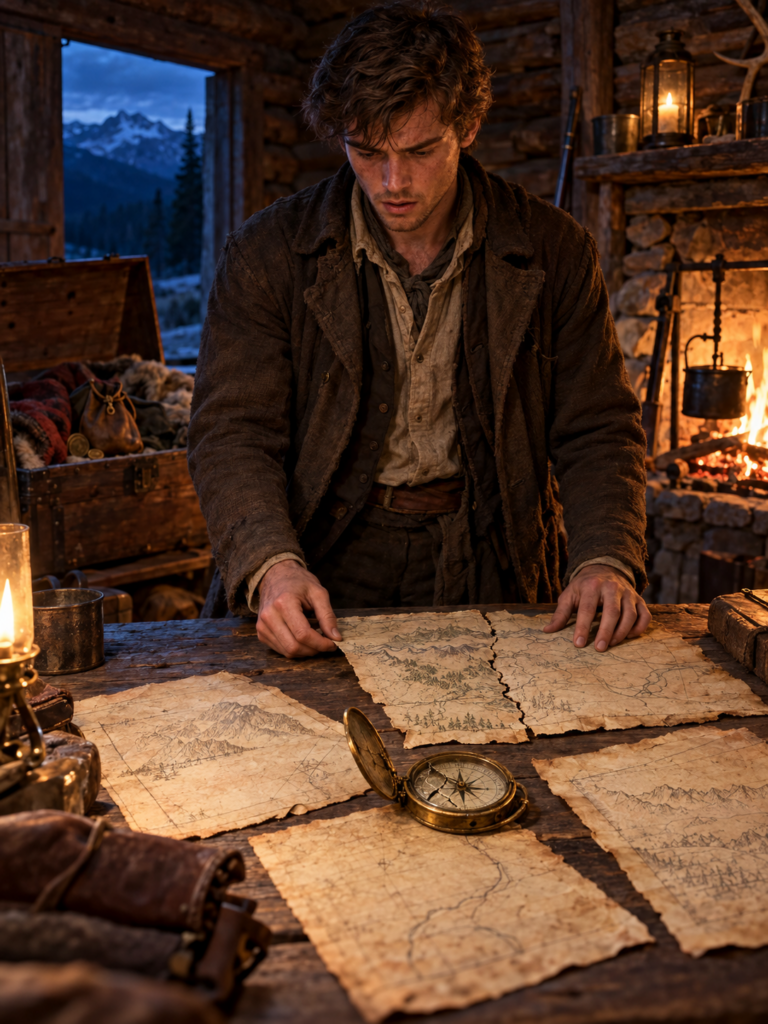
The compass needle swung once, trembled, and settled.
Joseph sighted across it.
A shoulder of stone rose precisely where Whitcomb’s field description said it should.
He moved twenty paces higher, checked again, then searched the darkening ridge until he found the shape of an ancient pine against the sky.
Not proof.
But confirmation enough to make sleep difficult.
He returned to the cabin, banked the fire, and placed the oilcloth bundle inside his shirt.
He kept it there through the night.
At dawn he folded his mother’s gray blanket in thirds, then halves, tucking the selvage inward exactly as she had taught him before memory had reduced her voice to something softer than words.
Then he began working.
That decision would later matter more to Joseph than the gold.
He did not rush down to Flint Hollow.
He did not wave the claims in Wyatt’s face.
He did not ride to his father’s house and demand an apology.
He repaired the cabin.
The first morning, he cut clay from the creek bank and mixed it with dried moss to replace missing chinking.
The second, he worked on the north wall.
The third, he removed the young pine that had begun pushing one corner off its stone.
Each evening he read Whitcomb’s descriptions and compared them with the land.
The more he checked, the less the papers looked like chance.
On the fourth day he found the remnant of a witness mark on an old tree.
Time had swollen the bark around it, but the position matched.
Joseph placed his palm against the scar.
Halbert had once taught him that an old survey rarely shouted.
It waited.
By the seventh morning Joseph had repaired enough of the roof that rain would not destroy what remained inside.
Only then did he leave.
He wrapped the documents in oilcloth, tied them with the leather thong, and placed them against his ribs.
The hundred dollars went into his coat.
His own eleven remained separate.
He wanted to remember which money had brought him here.
Two days later, after sleeping once beside the trail and walking the final miles with mud dried to his boots, Joseph entered the county recorder’s office in Kessler.
Bertram Hoy was sixty-one, narrow-shouldered, gray-haired, and not easily impressed.
He examined Joseph before examining the papers.
“You selling something?”
“No.”
“Buying?”
“Maybe.”
That earned the smallest lift of an eyebrow.
Joseph placed the first claim on the counter.
Bertram’s expression did not change.
The second made him reach for spectacles.
The third made him lock the office door.
When Joseph laid down the fourth, Bertram said, “Where did you get these?”
“Ansel Whitcomb’s cabin. West draw.”
Bertram looked sharply at him.
“You know that name?”
“Only from his letter.”
Joseph placed it beside the claims.
Bertram read.
Then he removed a heavy plat book from a shelf beneath the north window.
For nearly an hour he compared seals, descriptions, clerk marks, dates, and survey references.
Joseph did not interrupt.
At last Bertram opened a drawer and took out a hand lens.
He inspected one seal.
Then another.
His face changed.
Not dramatically.
But enough.
“What?”
Bertram sat back.
“The seals appear genuine.”
Joseph felt the room narrow around those words.
“Appear?”
“I can establish the impressions. I can establish the original filing references. After that, you need witnesses where witnesses still exist, and you need to walk the boundaries.”
Joseph nodded.
Bertram studied him.
“You understand what these sections cover?”
“I think I do.”
“You understand one of them overlaps ground currently treated as Howerin property?”
“Yes.”
“And the Carter lease?”
Joseph met his eyes.
“Yes.”
Bertram closed the plat book carefully.
“Son, if these survive proof, you didn’t find yourself a cabin.”
Joseph waited.
Bertram turned the book around and placed one finger on the old lines.
“You found a substantial piece of Flint Hollow.”
Joseph looked at the boundary.
For the first time since leaving his father’s table, anger tempted him toward something easy.
He could picture Wyatt discovering that the land beneath his inheritance was Joseph’s.
He could picture Odessa’s silence.
He could picture Merritt understanding what he had discarded.
Joseph folded Whitcomb’s letter once.
Then he asked the question that mattered.
“What do I have to do to prove it honestly?”
Bertram looked at him for several seconds.
Then he drew a fresh sheet of paper toward himself, dipped his pen, and began writing the first formal step that could turn Joseph Carter’s worthless half-map into a lawful claim on the valley that had thrown him away.
Bertram’s pen scratched steadily across the page.
Joseph remained standing until the recorder pointed toward a chair.
“Sit. This won’t be finished by supper.”
Joseph sat.
Bertram explained what the papers did not automatically give him.
Whitcomb’s filings might be prior, but priority had to be established from the county’s surviving books. Survey marks had to be located where possible. Witness testimony mattered. Boundaries had to correspond with what Whitcomb had described.
And because decades had passed, every inconsistency would matter.
Joseph listened without arguing.
That seemed to surprise Bertram.
“You’ve done survey work?”
“Helped a surveyor.”
“Who?”
“Halbert Rann.”
Bertram’s pen stopped.
“You were Rann’s boy?”
Joseph almost corrected him.
He had never been anyone’s boy in the sense Bertram meant.
Halbert had not adopted him. Had not paid his keep. Had not given him land or family standing.
He had done something Joseph now understood might have mattered more.
He had taught him.
“I learned from him.”
Bertram leaned back.
“Well.”
That single word changed the room.
“He was difficult,” Bertram said.
“He was.”
“Mean about sloppy measurements.”
“Yes.”
“Made a county commissioner walk half a mile back because the man moved a chain pin.”
Joseph nearly smiled.
“That sounds like him.”
Bertram tapped Whitcomb’s papers.
“If Halbert gave you the map that led here, I’d pay attention.”
That afternoon, Joseph rented a narrow upstairs room at Naomi Ashfield’s boarding house.
Naomi was fifty-eight, widowed, practical, and apparently uninterested in interrogating young men who arrived muddy and tired.
She served beans, salt pork, and cornbread for eleven cents.
Joseph ate slowly.
For the first time since leaving home, someone put food in front of him without making him feel that the plate itself established a debt.
On the second evening Naomi asked his name.
“Joseph Carter.”
She studied him.
“Flint Hollow Carter?”
“Yes, ma’am.”
She nodded, as though one piece of an equation had settled into place.
Nothing more.
On the third evening she put down a second helping before he asked.
Joseph looked at it.
“You’ll charge me?”
“Of course.”
He nodded.
“Good.”
That made her laugh.
The sound startled him.
A strange thing began happening in Kessler.
People treated Joseph as if his answers mattered.
The blacksmith, Ethel Grange, made him a new axe head modeled after the broken one from Whitcomb’s cabin.
Joseph reached for his money.
Ethel waved him off when it came to a set of door hinges.
“My father bought a wagon wheel from Ansel Whitcomb,” he said. “Lasted thirty years.”
“You knew him?”
“Barely. But my father trusted his work.”
Another thread.
Not proof of ownership.
Proof that Whitcomb had existed as the letter claimed.
Joseph carried that to Bertram.
The recorder wrote it down.
Then an older settler named Martin Kilbourne appeared.
Seventy years had bent his shoulders but left his memory stubbornly intact.
“I carried chain for Whitcomb,” he said.
Joseph looked at Bertram.
Bertram was already reaching for paper.
Martin described the north bench.
The creek.
A witness tree.
A summer so dry that one afternoon the chain crew had dug for water beneath cottonwoods rather than walk back down the ridge.
Joseph had seen those same cottonwoods.
He asked Martin which side of the creek they had worked.
Martin answered without hesitation.
Joseph felt the claims move another fraction closer to reality.
They began walking corners.
Not once.
Repeatedly.
Joseph carried Halbert’s drafting roll and cracked compass.
He measured chains himself, then measured again when something felt wrong.
Where old witness trees survived, they found signs.
Where trees had fallen, landforms matched.
A rock shoulder.
A creek junction.
A notch in the ridge.
Every confirmed bearing strengthened Whitcomb’s work.
Word spread.
Joseph discovered that news in a county traveled faster than horses whenever land was involved.
Pruitt Howerin arrived at Bertram’s office on a Thursday.
Joseph happened to be across the street leaving Naomi’s boarding house when he saw the lawyer dismount.
Pruitt entered the recorder’s office and remained there almost an hour.
Joseph did not follow.
That was harder than it sounded.
The Howerins bordered the Carter lease.
Pruitt had written Merritt’s transfer.
Suspicion whispered that those facts must connect.
Halbert’s voice answered from memory.
Read what is there.
Joseph went to the blacksmith instead.
That evening Bertram told him Pruitt had examined the filings.
“What did he say?”
“Nothing worth recording.”
“Did he challenge them?”
“No.”
“Then there’s nothing to answer.”
Bertram’s mouth twitched.
“You really were Rann’s student.”
The following Monday a rider came from the Howerin Holdings.
Joseph was outside Kessler marking measurements in a notebook when the man approached.
“I have an offer.”
Joseph closed the book.
The rider named three hundred dollars.
For Joseph’s interest in all four claims.
Three hundred dollars.
Less than two weeks earlier Joseph had walked out of Flint Hollow with eleven.
Three hundred could buy equipment.
Livestock.
A start somewhere else.
It could remove every uncertain step ahead.
The rider watched him carefully.
Joseph noticed something in that attention.
Not menace.
Expectation.
They expected him to be poor enough to make the decision simple.
He was poor.
That did not make him foolish.
“No.”
The rider shifted.
“You hear the amount?”
“I did.”
“There may be legal complications.”
“There may.”
“Howerin Holdings would assume them.”
“For three hundred dollars.”
“Yes.”
Joseph opened his notebook again.
“No.”
The rider stared at him.
Joseph pointed toward a water trough.
“Your horse can drink before you ride back.”
That was the end of the conversation.
But not the pressure.
Over the next six weeks Joseph spent Whitcomb’s money slowly.
Filing charges.
Food.
Iron pins.
Tools.
Supplies for the cabin.
He kept exact accounts.
He also kept his own eleven dollars apart as long as he could, almost superstitiously.
One evening Naomi found him at the kitchen table adding figures.
“You look offended by arithmetic.”
“I’m offended by how often it’s right.”
She poured coffee into his cup.
“You’ll survive.”
“I intend to.”
He looked toward the dark window.
There was something he had postponed.
The Carter house.
The claim boundary was no longer doubtful.
Bertram’s records and the field measurements had confirmed it.
The ground Merritt had signed to Wyatt as part of the lease fell inside Whitcomb’s earlier claim.
Joseph’s claim.
He could ride home.
He could confront them.
He could demand rent in person.
The thought gave him no satisfaction.
He had imagined vindication during lonely hours on the survey line.
In the imagination, Merritt always understood.
Wyatt always looked ashamed.
Odessa always lost her certainty.
Reality offered no promise of any of those things.
Naomi sat across from him.
“You planning a fight?”
Joseph looked up.
“Do I look like it?”
“You look like a man deciding whether he wants one.”
He considered that.
“My father’s house is inside one of the claims.”
Naomi did not react immediately.
“And?”
“He gave it to my brother.”
“But could not give him the land under it.”
“No.”
“You want the house?”
Joseph thought of his mother there.
Then he thought more carefully.
No.
What he wanted was to stop being the boy in the loft waiting for the family below to decide how much space he deserved.
“I want the claim settled.”
Naomi nodded.
“Then settle the claim.”
It sounded obvious.
It felt revolutionary.
Joseph took out a sheet of paper.
He wrote to Merritt Carter.
Not to Wyatt.
Not Odessa.
His father.
He stated the facts without accusation.
The Whitcomb filings predated the Howerin interests. The proof had been accepted through the county process. The Carter lease lay inside the claimed ground.
Then Joseph made his decision.
They could stay.
They could graze the same ground.
They could keep the house.
The rent would remain what they had been paying Howerin Holdings.
Payment would be made through the recorder’s office in Kessler.
No humiliation.
No personal collection.
No eviction.
No revenge.
Joseph read the letter twice.
Naomi, working dough at the other end of the table, said nothing.
He sealed the paper with candle wax.
Eleven days passed.
On the twelfth, a freight driver brought a folded reply.
Joseph recognized Wyatt’s blunt handwriting before opening it.
One word waited inside.
Agreed.
He read it twice.
There was no message from Merritt.
No apology.
No question.
No request that Joseph come home.
Joseph folded the paper.
For one moment, disappointment went through him so cleanly that it felt almost like physical pain.
Naomi watched from the stove.
“Bad?”
“No.”
He placed the reply beside his plate.
“It’s enough.”
And he meant it.
Not because the wound had vanished.
Because for the first time he understood that his future could not depend on Merritt Carter eventually becoming the father Joseph had needed.
By the first hard frost, the filings stood.
Joseph Carter’s name appeared in records that had once contained nothing belonging to him.
His ownership did not come from beating Wyatt.
It did not come from ruining Howerin Holdings.
It came from an abandoned man’s lawful work, an old surveyor’s patient teaching, and Joseph’s willingness to walk every miserable mile required to prove what the paper said.
He returned to Whitcomb’s cabin at the end of each week.
There was still work.
The old structure leaked less now, but the floor had rotted.
Joseph split fir and laid new puncheons over the old sleepers.
He rebuilt the bunk.
Naomi sewed a straw tick after he brought her ticking cloth from Kessler.
He paid her.
She complained that he had overpaid.
He told her she could return the difference.
She told him not to become irritating merely because he owned land.
He installed the black iron hinges Ethel Grange had given him.
Then he cut a small second window into the east wall.
On the morning after he finished it, sunrise entered the cabin for the first time in perhaps half a century.
Joseph stood in the beam with sawdust on his sleeves.
The light struck the old table.
The empty saucer.
Whitcomb’s letter.
The cracked compass.
He took the compass down from his pocket and hung it on a peg above the door.
Halbert’s tool roll went onto the shelf.
His mother’s blanket lay folded at the foot of the new bunk.
The room no longer looked abandoned.
That frightened him in a way poverty had not.
A man with nothing could leave without losing anything.
Joseph now possessed land, a roof, obligations, records, people who expected to see him again.
Belonging, he was beginning to understand, could be more frightening than exile.
A knock struck the repaired door.
Joseph froze.
Nobody had ever come to the cabin uninvited.
He reached for the latch and opened it.
Martin Kilbourne stood outside, breathing hard from the climb, snow caught along the shoulders of his coat.
The old man held a folded survey sheet.
“I remembered something,” he said.
Joseph moved aside.
Martin entered, crossed directly to the table, and opened the paper.
His finger landed beyond the four claims Joseph had already proved.
“Whitcomb wasn’t working alone the summer we walked the north bench.”
Joseph stared at him.
Martin tapped a faint line continuing east.
“And if my memory is right, what you’ve proved so far isn’t the whole story of why Halbert Rann gave you only half that map.”
Joseph bent over the survey sheet.
For several seconds he said nothing.
A month earlier, those words would have sent him straight outside with the compass.
Now he had learned something more difficult than following a line.
He had learned when not to run after one.
“What do you remember?” he asked.
Martin lowered himself onto the stool.
“Not enough to swear yet.”
“Then don’t.”
The older man looked almost offended.
Joseph pulled another chair closer.
“Tell me what you actually remember.”
Martin studied him, then nodded.
“Fair.”
He remembered Whitcomb and Halbert Rann working the same country during different periods. Not partners, exactly. Surveyors crossed one another’s work constantly in those years, checking lines, carrying information, correcting mistakes made by men working from poor instruments or worse instructions.
Martin believed there had been another sheet.
An eastern continuation.
But belief was not evidence.
Joseph listened.
That distinction had become the foundation of everything he possessed.
“Did you see it?”
“A map?”
“Yes.”
Martin rubbed one thumb across his knuckle.
“I saw Halbert with a sheet that matched the western country. Might’ve been continuation work. Might’ve been something else.”
“Did Whitcomb own it?”
“Couldn’t tell you.”
“Did it describe more claims?”
“Couldn’t tell you that either.”
Joseph sat back.
Martin smiled faintly.
“You don’t like my answers.”
“I like them better than invented ones.”
That earned a dry chuckle.
“Halbert taught you too well.”
Joseph looked at the half-map on the table.
For months he had regarded the missing half as an absence that ought to be solved.
Suddenly he saw another possibility.
Maybe Halbert had never given him the map to make him rich.
Maybe the value of the western half was precisely that it led to what Joseph had needed to find—and nothing more.
The cabin.
Whitcomb’s letter.
The legitimate claims.
A beginning.
Joseph folded Martin’s sheet.
“Will you make a statement about what you know for certain?”
“I will.”
“Then we’ll take that to Bertram. The rest can remain a question.”
Martin gave him a long look.
“You’re twenty-two?”
“Yes.”
“That’s irritating.”
Joseph almost laughed.
They rode into Kessler together the following morning.
Bertram recorded Martin’s supplemental testimony but agreed that it established no additional ownership.
No dramatic fifth claim appeared.
No hidden empire.
No mysterious second fortune.
Only a trace of old surveying history and another reason to understand that Halbert had known more of Whitcomb’s work than Joseph had realized.
That answer might once have disappointed him.
Instead it relieved him.
The four claims were enough.
More than enough.
Winter settled over the valley.
The first heavy snow covered the west draw and erased the trail beneath a clean white surface.
Joseph learned to read the cabin by sound.
A healthy roof took weather differently from a failing one.
The chimney drew best after he warmed the stone gradually.
Wind found one seam near the north corner until he opened it and packed fresh clay deep into the gap.
He worked because there was satisfaction in making a structure dependable.
But he also began spending more time in Kessler.
Not because the town dazzled him.
It did not.
Kessler had one muddy main street, two feed stores, a recorder’s office, a smithy, a church, a stable, and a boarding house whose kitchen smelled permanently of coffee and wood smoke.
But people there knew him without first placing him beneath Wyatt.
That difference was difficult to explain to anyone who had never spent a lifetime being measured against someone else.
Bertram began asking Joseph to help interpret old survey descriptions.
Not officially at first.
A farmer came in with a boundary dispute involving a creek that had shifted.
Bertram frowned at an old plat.
Joseph, waiting nearby, noticed that the original survey referenced a rock outcrop rather than the water line.
He pointed it out.
The argument ended before it became expensive.
Another week a widow brought a deed whose western boundary depended on a witness cottonwood that had been struck by lightning years earlier.
Joseph rode out, found the stump, then located the companion marker described thirty-two chains south.
Bertram paid him for the day.
Joseph tried to refuse.
The recorder pushed the coins back across the desk.
“You performed work.”
“I was helping.”
“Those two things are not opposites.”
Joseph took the money.
That sentence stayed with him.
At home, work had been the price of occupying space.
In Kessler, useful work could also be something freely valued.
He began taking occasional surveying jobs.
Nothing grand.
Fence lines.
Access roads.
Creek boundaries.
Old plats.
He carried Halbert’s compass until he could afford to have its cracked glass replaced.
When the repairman offered to put in a new crystal, Joseph hesitated.
Then he declined.
The crack did not interfere with the needle.
And some damage, he had learned, did not need to be erased before something could remain useful.
In Flint Hollow, Wyatt paid the first quarter’s rent.
Joseph did not go to watch.
Bertram received it.
Three days later, when Joseph stopped by the recorder’s office, a small envelope sat on the desk.
“Carter payment,” Bertram said.
Joseph opened the ledger, entered the amount, and closed it.
That was all.
“Your brother didn’t say anything,” Bertram added.
“I didn’t ask him to.”
The second payment came the same way.
Merritt never wrote.
By spring, Joseph heard through a freight driver that his father had grown weaker.
He stood outside Naomi’s boarding house with the news sitting inside him like a stone.
Naomi was hanging washed cloths on a line.
“You going down?”
“I don’t know.”
She clipped another cloth.
“That usually means yes.”
“He told me there was nothing in the house that belonged to me.”
Naomi faced him.
“Was he right?”
Joseph almost said no.
The land was his now.
Legally, he could have made the answer no.
But that was not what she meant.
He thought of his mother’s ring.
Her blanket.
Halbert’s compass.
Whitcomb’s letter.
None of the objects that had carried him forward had come from Merritt’s generosity.
“Yes,” Joseph finally said. “He was right about the house.”
Naomi waited.
“He was wrong about what that meant.”
She nodded once.
Joseph rode to Flint Hollow the next morning.
The valley appeared smaller than he remembered.
Perhaps all places did after a person had been forced beyond them.
He passed the last fence line—the same one he had crossed months before with eleven dollars in his coat—and followed the familiar road toward the plank house.
Wyatt stood near the corral.
He saw Joseph coming and went still.
Joseph dismounted.
Neither brother spoke for several seconds.
Wyatt looked older.
Not dramatically.
Just tired.
“The rent’s paid,” he said.
“I know.”
“You here about the lease?”
“No.”
Wyatt glanced toward the house.
“He’s bad.”
Joseph tied his horse.
“I heard.”
Odessa was in the kitchen.
She stopped when Joseph entered.
Once, her silence had been a weapon.
Now it was merely silence.
He removed his hat.
“Odessa.”
“Joseph.”
That was all.
Merritt lay in the room beside the stove.
The same stove.
The same chair nearby.
The same wall Joseph had stared at over countless meals while learning not to speak unless someone required an answer.
His father had become startlingly thin.
When he opened his eyes, he recognized Joseph.
“You came.”
Joseph pulled the chair closer.
“Yes.”
Merritt breathed shallowly.
“Wyatt says the ground’s yours.”
“The county says so.”
A ghost of irritation touched the old man’s face.
“You always did like papers.”
Joseph almost answered sharply.
Instead he considered the statement.
“No,” he said. “I like knowing what they mean.”
Merritt’s eyes shifted toward him.
For the first time, Joseph saw not authority there but uncertainty.
“I didn’t know.”
“About Whitcomb?”
“About the claims.”
“I know.”
“You think Howerin knew?”
Joseph shook his head.
“I don’t have evidence of that.”
Merritt frowned as though the answer disappointed him.
Maybe he wanted Joseph to provide a villain.
Someone whose wrongdoing could make the family’s choices easier to forgive.
Joseph would not do it.
Pruitt Howerin’s relationship to the holdings had made Joseph suspicious. The offer to purchase the claims had made him cautious.
But suspicion was not proof of fraud.
The records had survived.
No one had attempted to destroy them.
Pruitt had left the county the following spring, but Joseph knew of no evidence that transformed his departure into guilt.
Halbert had taught him better than to make certainty from resentment.
Merritt coughed.
Joseph poured water and held the cup while his father drank.
When Merritt settled again, he said, “Could’ve thrown them out.”
“Wyatt and Odessa?”
“All of them.”
“Yes.”
“Why didn’t you?”
Joseph stared at the worn boards beneath his boots.
He had asked himself that many times.
Because revenge would have felt good for a day.
Because possession had given him power, and he had discovered almost immediately that possessing power did not tell a man what kind of man to become.
Because Whitcomb’s letter had not said, Punish whoever came after me.
It had said to be kind to what he built.
The valley contained more than ground.
It contained lives.
“I wanted what was mine,” Joseph said. “I didn’t need everything they had.”
Merritt closed his eyes.
“You sound like your mother.”
Joseph’s breath caught.
It was the first time in years Merritt had spoken of her directly.
“What do you remember about her blanket?” Joseph asked.
Merritt opened his eyes again.
“The gray one?”
“Yes.”
“She kept redoing one edge.” His voice had gone faint. “Said she’d woven the selvage too loose.”
Joseph looked down at his hands.
“She taught me to fold it inward.”
“I remember.”
No apology came.
Joseph had once imagined an apology with such precision that he thought he knew what words it ought to contain.
I was wrong.
You deserved better.
You were my son too.
Merritt said none of them.
Instead, after a long silence, he whispered, “I thought Wyatt needed the place.”
“And I didn’t?”
Merritt looked at him.
There it was.
The question Joseph had carried out of the house months earlier.
Merritt could not escape it by coughing.
Could not answer it with property papers.
Finally he said, “I thought you’d manage.”
Joseph sat perfectly still.
The cruelty of the answer was that it contained a kind of respect so poorly expressed it had become neglect.
“You knew I could survive,” Joseph said.
“Yes.”
“So you gave everything to the people you thought couldn’t.”
Merritt’s face tightened.
Joseph felt anger rise.
But beneath it came clarity.
Being capable had become the reason his father asked more of him and gave him less.
Joseph could understand that without accepting it.
“That wasn’t fair.”
“No.”
The word barely carried.
Joseph looked at him.
Merritt swallowed.
“No,” he repeated.
It was not a complete apology.
But it was true.
Joseph accepted the truth and refused to enlarge it into something prettier.
He stayed until evening.
When he left, Wyatt followed him onto the porch.
The brothers stood looking across pasture that legally belonged to Joseph and emotionally belonged to neither of them in any simple way.
“You going to raise the rent?” Wyatt asked.
“No.”
“Why?”
“Because the rate is fair.”
Wyatt looked toward him.
“That all?”
“That’s enough.”
Joseph put on his gloves.
Wyatt shifted his weight.
“I should’ve said something that night.”
Joseph stopped.
“The night Odessa told you to leave.”
“Yes.”
“You didn’t.”
“I know.”
Joseph waited.
Wyatt seemed to expect absolution.
Joseph discovered he had none ready.
“Maybe someday that changes what we are,” he said. “It doesn’t change what happened.”
Wyatt nodded.
Joseph mounted.
He rode away without looking back.
This time the choice felt different.
Months earlier he had refused to look back because doing so might have weakened him.
Now he did not look back because he knew where he was going.
Merritt died before summer.
Joseph attended the burial.
He stood beside Wyatt and Odessa.
No reconciliation transformed the family into something it had never been.
Grief did not erase old choices.
Ownership did not repair childhood.
But neither did anger own Joseph anymore.
When the service ended, he returned to the west draw.
By then the cabin had changed.
The roof was tight.
The floor solid.
A proper bunk stood against the north wall.
Morning light entered through the east window.
Halbert’s drafting tools lay clean and oiled.
Whitcomb’s letter remained wrapped in its oilcloth.
Joseph had spent nearly all of the hundred dollars.
Two gold coins remained.
He could have used them.
Instead he kept them in the deerskin pouch.
Not because he thought the coins lucky.
Because they reminded him that Whitcomb had saved money for a future he never received, and still chose to give that future forward rather than bury it with himself.
One evening late the following autumn, Joseph returned from splitting cedar and made coffee.
The fire settled into a steady draw.
Wind moved through the pines outside.
He sat at Whitcomb’s table.
The room smelled of smoke, wood shavings, wool, and coffee.
He opened the oilcloth and read the letter again.
He knew every line.
A wife who had never lived to see the land.
A son who had never been born.
Four claims honestly made.
A request that whoever found them possess enough will to prove them.
Joseph folded the letter carefully.
Above the door hung Halbert’s cracked compass.
At the foot of the bunk lay his mother’s gray blanket, nearly silver at the corners.
He stood and touched the wool.
Then he reached into the inside pocket of his coat and removed his mother’s wedding ring.
For years he had carried it because she had asked that it be kept for him.
He had once thought keeping something meant never letting it leave his pocket.
Now he understood differently.
He placed the ring on the shelf.
Beside it he put the deerskin pouch containing Whitcomb’s final two gold coins.
Two small inheritances.
Neither was legally an inheritance at all.
One had come from a mother who died before she could see what her son became.
The other from a stranger who died without the child for whom he had meant to build.
Joseph stood between them.
Down in Flint Hollow, Wyatt continued grazing cattle on the lease and paying rent every quarter.
Odessa once crossed the street after seeing Joseph in Kessler.
He let her.
He had no interest in forcing recognition from someone who had spent years withholding it.
Pruitt Howerin eventually left the county.
Joseph never learned whether the lawyer had known anything about Whitcomb’s prior filings before Bertram reopened the records.
Without evidence, Joseph refused to rewrite uncertainty as guilt.
The Howerin offer remained what it had been: an attempt to buy an unexpectedly valuable claim from a young man they thought might sell cheaply.
He had declined.
Nothing more was needed.
Martin Kilbourne continued coming into Kessler on Wednesdays.
Ethel Grange continued pretending pieces of iron had accidentally been left near the smithy door whenever Joseph needed them.
Naomi continued charging him for supper and occasionally putting more food on his plate than the price justified.
Bertram began sending people to Joseph when old boundaries required a patient eye.
And slowly, without ceremony, the boy who had inherited every unwanted chore became a man whose judgment people sought.
He did not become wealthy overnight.
He did not build a mansion.
He did not ride into Flint Hollow simply to display what everyone else had failed to see.
He improved the land.
He repaired water crossings.
He marked boundaries properly.
He leased pasture at fair rates.
He kept records.
When disagreements arose, he walked the ground before deciding who was right.
The valley prospered because someone finally treated its lines as responsibilities rather than weapons.
Years later, younger men sometimes asked him about the half-map.
By then the paper had grown too fragile for frequent handling.
Joseph kept it protected with Whitcomb’s letter.
They expected a dramatic lesson.
Something about hidden treasure.
Luck.
Destiny.
Joseph never gave them one.
He told them the truth.
The map had been worth nothing to anyone unwilling to walk it.
The claims had been worth nothing without proof.
Whitcomb’s letter had been worth nothing without a person willing to honor it honestly.
Halbert’s teaching had seemed useless until the day Joseph needed every part of it.
Even the rejection that pushed him from Flint Hollow had not secretly been a gift.
Joseph refused to romanticize cruelty.
Being cast out had hurt.
His father had failed him.
Wyatt had stayed silent.
Odessa had made clear how little place Joseph occupied in the household.
Those things remained true.
What changed was not the past.
What changed was what Joseph built after it.
One winter evening, long after the first desperate October journey, he stepped outside Whitcomb’s cabin.
Snow had begun falling over the draw.
The east window glowed behind him.
His own horse stood sheltered beneath a lean-to that had not existed when he first came.
A new axe rested beside the woodpile.
Inside, the compass hung above the door.
The wedding ring and two gold coins remained on the shelf.
And his mother’s blanket waited folded at the foot of the bunk.
Joseph looked east.
Beyond two ridges lay Flint Hollow.
From here he could not see the plank house.
That surprised him.
For years it had seemed like the center of every question.
Who belonged.
Who inherited.
Who mattered.
Who was chosen.
Now the house was simply one building among many on land whose history had begun long before Merritt Carter and would continue long after Joseph.
He went back inside.
The fire had burned low.
Joseph added one piece of cedar.
Flame moved across the fresh wood and brightened the room.
He took Whitcomb’s letter from the oilcloth one last time that winter and read the final lines.
Then he folded it along the old creases.
Carefully.
Not because the paper was valuable in itself.
Because someone had trusted an unknown future person to do something decent with what remained.
Joseph returned the letter to its wrapping.
He crossed to the bunk.
His hand rested on the gray blanket.
He remembered leaving his father’s property with eleven dollars and no room to sleep in.
He remembered the cold first night beyond the last fence.
He remembered waking before dawn, folding the same blanket, opening Halbert’s cracked compass, and deciding that a line drawn by a dead surveyor was worth following one more ridge.
He had thought then that he was searching for land.
He knew better now.
Land had been what waited at the end of the map.
What he had actually found was the right to decide what kind of man he would become once nobody else was deciding his place for him.
Joseph lifted the blanket.
He folded it in thirds.
Then in halves.
He tucked the selvage inward so the old edge would not fray.
And in the cabin a forgotten man had once built for a family he never got to keep, Joseph Carter banked the fire, set tomorrow’s survey notes beside the door, and went to sleep beneath a roof he had repaired with his own hands, on ground he had proved honestly, owing his future to no one’s permission.


