Part 1
“Three dollars?”
Silas Croft’s laughter rolled across the crowded auction yard.
“You mean to tell me that little girl just spent her last three dollars on a dead man’s cabin?”
The men gathered outside the saloon laughed with him. A few shook their heads. Others stared at the young woman standing alone near the auction wagon, her faded blue dress coated with road dust and her boots worn nearly through at the heels.
Rose Harding was nineteen years old.
She had buried both her parents, lost the farm where she had been born, and walked fifty miles beside a freight wagon to reach Redemption Gulch, Wyoming Territory.
The three silver dollars in her hand were all the money she had left in the world.
And she had just spent every cent.
The auctioneer brought his wooden hammer down.
“Sold! Forty acres and the old Blackwood lodge to Miss Rose Harding!”
Another wave of laughter followed.
Croft stepped toward her, his silver watch chain swinging across his expensive brown vest.
“Tell me something, sweetheart. Did you buy the cabin because you believe in ghosts, or because you’re too foolish to know what rotten timber looks like?”
Rose looked at the deed the county clerk had handed her.
She could barely read the words through the trembling in her fingers.
“I bought it,” she answered quietly, “because I need somewhere to live.”
Something in her answer briefly silenced the crowd.
Then Croft snorted.
“Well, you picked the wrong mountain.”
He leaned closer.
“Old Blackwood disappeared up there years ago. Nobody knows where his bones are buried. That roof collapsed, the road washed out, and winter comes early. You won’t last until Thanksgiving.”
Rose folded the deed.
“Then I suppose I’d better get started.”
She walked away before anyone could see her eyes filling with tears.
The laughter followed her all the way down the dusty street.
But there was something those men did not know.
The dead trapper had left behind far more than a ruined cabin.
And before the first winter storm ended, the very people who mocked Rose Harding would learn why some things were worth more than all the ranchland Silas Croft owned.
Three months earlier, Rose had still believed she would grow old on her family’s little farm outside Laramie.
It was not a prosperous place.
The farmhouse leaned slightly east. The barn needed new shingles. Their six acres of workable soil produced just enough potatoes, beans, corn, and hay to keep the family fed.
But the kitchen was warm.
Her mother kept a blue pottery pitcher on the windowsill, filled with wildflowers whenever the season allowed.
Her father always whistled while sharpening his tools.
And every evening, after the animals were fed, they sat together beneath the cottonwood tree behind the house.
Her father, Samuel Harding, had a favorite saying.
“Good land isn’t always pretty land, Rosie. Find water, find shelter from the wind, and give the earth honest work. That’s how you build a life.”
Rose had heard those words so often she sometimes repeated them before he finished.
Then fever came.
It took her father in April.
Her mother, already weakened from caring for him, followed in July.
The morning after the funeral, Rose found herself sitting alone at the kitchen table with two empty chairs across from her.
The blue pitcher held dead flowers.
A bowl of oatmeal sat untouched.
She listened for her father’s familiar boots on the porch before remembering there would never be another morning when he came through that door.
She cried until she was too exhausted to cry anymore.
Ten days later, a banker arrived.
His name was Mr. Whitcomb, and he had known her father for fifteen years.
That made what he said no easier.
“The note is overdue, Rose.”
She stared at him.
“Papa was making payments.”
“He was. But there’s still the principal, accumulated interest, and last winter’s extension.”
“He said the wheat harvest would cover it.”
Whitcomb lowered his eyes.
“There wasn’t a wheat harvest.”
The drought had ruined almost everything.
Rose had spent the summer carrying water to dying plants, hoping the rain would come.
It never did.
She offered to work off the debt. She offered the livestock, the wagon, even her mother’s wedding ring.
Whitcomb listened without interrupting.
Then he told her the foreclosure would proceed.
Thirty days later, she watched strangers enter the farmhouse and carry out her parents’ furniture.
A woman bought her mother’s rocking chair.
A ranch hand purchased her father’s tool chest.
The old kitchen table went to a merchant who complained about scratches in the wood.
Rose stood in the yard holding the blue pitcher, watching an entire lifetime being divided into purchases.
When the last wagon left, she walked through the empty rooms.
The sound of her footsteps echoed where family voices once had.
In her mother’s bedroom, she found something the buyers had overlooked.
A small tear in the lining of an old traveling dress revealed a leather pouch stitched into the hem.
Inside were three silver dollars.
Wrapped around the coins was a folded scrap of paper.
Her mother’s handwriting was faint but unmistakable.
For Rosie. If the world ever leaves you without a door to open, keep looking for one. There is always another beginning.
Rose pressed the note against her lips.
The next morning, she left the farm carrying a blanket, a change of clothes, her father’s pocketknife, and the three dollars.
She did not look back until she reached the bend in the road.
By then the house had disappeared behind the cottonwoods.
Redemption Gulch lay two days west by freight wagon.
It was a rough settlement surrounded by dry grasslands and distant mountains, with one main street, a feed store, a saloon, a blacksmith, and a collection of buildings that seemed permanently coated in dust.
Rose arrived hungry and exhausted.
She had earned her passage by mending torn wagon canvas and helping the driver unload barrels.
He offered her a piece of hard bread before leaving.
“Try the hotel kitchen,” he said. “Sometimes they need help.”
The hotel did not.
Neither did the laundry.
A woman at the boardinghouse told her every bed was taken.
By noon, Rose had begun to understand how quickly a person could become invisible when they had neither money nor family.
Then she noticed a paper nailed beside the sheriff’s office.
COUNTY PROPERTY AUCTION.
Most of the listings described grazing land and abandoned claims.
The last item was different.
Blackwood parcel. Approximately forty acres. Mountain structure. Access impaired. Delinquent taxes. Sold as is.
Rose read it three times.
She remembered stories about an old trapper named Silas Blackwood who had lived alone in the Rattlesnake Mountains.
Some said he had gone mad.
Others claimed wolves had killed him.
A few insisted his cabin was haunted.
What everyone agreed on was that no one had seen the man in years.
Rose studied the distant peaks.
The land was nearly worthless to ranchers because it had no easy road, no broad pasture, and no convenient route for hauling timber.
But there might be a roof.
There might be water.
And there might be somewhere she could sleep without being chased away.
She touched her mother’s three dollars.
For the first time since losing the farm, she felt the smallest possibility of hope.
That hope carried her to the auction yard.
And now, after everyone else had gone, she stood outside the county clerk’s office holding a deed to forty acres she had never seen.
The clerk, Mr. Bell, looked at her with concern.
“You understand what you’ve bought?”
“Yes, sir.”
“There’s no wagon road beyond Miller Creek. Last five miles are practically wilderness.”
“I can walk.”
“There may not be much standing.”
“I understand.”
He hesitated.
“Miss Harding, why didn’t you keep your money and buy food?”
Rose looked down at the document.
“Because three dollars of food would be gone in a week.”
She raised her eyes.
“But if that cabin has even one good wall, perhaps I can build something that lasts.”
Mr. Bell said nothing for several seconds.
Then he reached beneath his desk and brought out an old hand-drawn map.
“This belonged to the original surveyor. It might help you find the trail.”
He pushed it toward her.
“No charge.”
Rose thanked him.
Outside, she nearly collided with an elderly woman wearing a weathered buckskin coat.
The woman had long gray-streaked hair, dark eyes, and a face marked by decades of mountain weather.
She had watched the auction from the opposite side of the street.
“You bought Blackwood’s place,” the woman said.
Rose nodded.
“Do you know it?”
“I knew the man.”
Rose looked up quickly.
“Was he truly as strange as people say?”
The old woman considered the question.
“People call a man strange when they cannot understand why he wants something different from what they want.”
She glanced toward the mountains.
“Blackwood respected that land. He took what he needed and left the rest.”
“Did he die there?”
“I don’t know.”
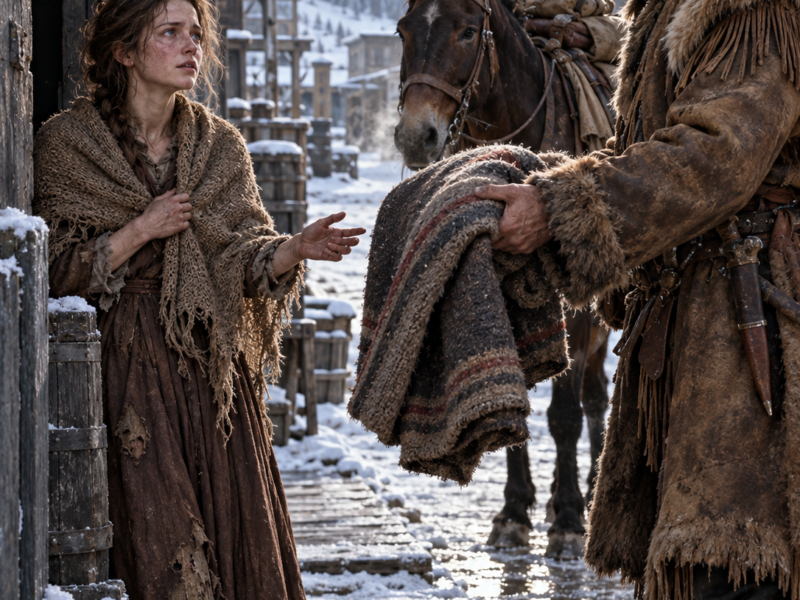
The woman took Rose’s hand briefly.
“Be careful on the north trail. The creek stones are slippery, and the ridge turns cold after sunset.”
Then she walked away.
Rose watched her disappear behind the general store.
She did not know the woman’s name.
But those few words were the first kindness anyone in Redemption Gulch had offered her.
They would not be the last.
Part 2
The livery stable smelled of hay, leather, and warm animals.
Rose approached the owner, a stooped man with thick gray eyebrows.
“Are you Mr. Jed Morris?”
“Depends who’s asking.”
“My name is Rose Harding. I bought the Blackwood property.”
Jed stopped repairing a harness.
“Well, now.”
He looked her over.
“You’re the girl Croft was making a fool of himself over.”
Rose’s face reddened.
“I suppose so.”
“What do you need?”
“A pack animal. Just for the trip. I can work to pay for it.”
Jed rubbed his jaw.
“Got an old mule named Jasper. Strong enough, but one eye doesn’t see too well. Ten dollars.”
Rose’s shoulders dropped.
“I haven’t got ten dollars.”
“How much have you got?”
“Nothing.”
Jed studied her worn boots and the little bundle she carried.
“You spent it all on that mountain?”
“Yes, sir.”
“And you’re going anyway?”
Rose nodded.
“I’ve nowhere else.”
Jed turned and walked toward the rear stall.
For a moment, Rose thought he was dismissing her.
Instead he opened a wooden gate.
A large brown mule lifted his graying muzzle and regarded her with one cloudy eye.
“This is Jasper.”
The mule snorted.
“He bites when he’s offended. Kicks when he’s frightened. And he’s smarter than some men I know.”
Rose cautiously held out her hand.
Jasper sniffed it.
Then he lowered his head against her palm.
Jed gave a faint smile.
“Would you look at that.”
He fetched an old pack saddle.
“Take him.”
Rose blinked.
“Sir?”
“You heard me. Take him up there. Get yourself settled, then pay me when you can.”
“I don’t know when that will be.”
“Neither do I.”
He carried a small sack from the storeroom.
“Here’s oats for the mule. I’ve also got some flour, salt pork, and a little coffee that’s too old to sell.”
Rose struggled to speak.
“You don’t even know me.”
Jed tightened the strap on Jasper’s saddle.
“No. But I know what it looks like when somebody’s reached the end of the road.”
He paused.
“And I know the difference between being beaten and being finished.”
Rose wiped her cheeks with the back of her sleeve.
“I’ll pay you back.”
“Then live long enough to do it.”
Silas Croft appeared just as they were preparing to leave.
He stood in the stable doorway with two ranch hands behind him.
“Well, Jed. Giving away animals now?”
Jed did not look up.
“Conducting business.”
Croft laughed.
“With a girl who can’t afford a pair of boots?”
Rose continued tying her bundle.
Croft approached her.
“You know, I could take that deed off your hands. Give you five dollars for it.”
Rose stopped.
Five dollars.
Nearly twice what she had paid.
Enough for food.
Perhaps a bed for several nights.
Her stomach clenched at the thought.
But she remembered the way Croft had laughed when she said she needed a home.
“No, thank you.”
His smile hardened.
“Ten dollars.”
Jed glanced up.
“Silas, leave the girl be.”
Croft ignored him.
“Twenty dollars. Cash.”
Rose tightened the last knot.
“I’m not selling.”
Croft’s expression changed.
For the first time, he appeared genuinely offended.
“Do you have any idea who you’re talking to?”
“Yes, sir.”
“Then you ought to know I own more land in this county than any other man.”
Rose gathered Jasper’s lead rope.
“That must be a comfort to you.”
Jed coughed to conceal a laugh.
Croft stepped closer.
“Listen carefully. That mountain will kill you. When you’re hungry enough, you’ll come crawling down here, and I’ll pay you one dollar for the deed.”
Rose looked straight at him.
“Then I hope you won’t be disappointed when I don’t.”
She led Jasper past him into the sunlight.
Behind her, Croft muttered something ugly.
Rose kept walking.
She had faced her first opportunity to surrender.
And she had refused it.
She left Redemption Gulch before sunrise the following morning.
The world was still blue with darkness.
Frost silvered the grass, and the distant mountains stood against the sky like enormous sleeping animals.
Jasper followed without complaint.
For the first few miles, the trail crossed open prairie, where dry grass brushed Rose’s knees and the wind blew unhindered from the northwest.
By midmorning, they reached the first stands of pine.
The air changed.
It smelled of damp earth, cold stone, and resin.
Rose stopped beside a stream to drink.
The water was so cold it made her teeth ache.
She shared a little grain with Jasper, then consulted the surveyor’s map.
The old pencil markings were faded.
Two creeks crossed near the base of a wooded ridge.
Beyond them, a narrow trail climbed toward a place labeled Blackwood Valley.
Rose remembered her father’s advice about traveling rough country.
“Never chase daylight, Rosie. Know where you’re sleeping before the sun goes down.”
But she could not know.
Not yet.
The road ended in the early afternoon.
A spring flood had washed away part of the old wagon track.
Beyond that point, the trail became a narrow path climbing between granite boulders and dense pine roots.
Rose’s boots slipped repeatedly.
At one creek crossing, Jasper refused to step onto the wet stones.
She pulled his lead.
He planted his hooves.
“Come on, old boy.”
He snorted.
Rose looked more carefully.
The middle stone was loose.
She tested it with her boot.
It shifted dangerously.
She backed away and led Jasper upstream to a shallower crossing.
“You knew better than I did,” she whispered.
The mule flicked an ear.
By late afternoon, Rose’s legs trembled with exhaustion.
Her shoulders burned.
Every breath seemed thinner than the last.
The trail climbed endlessly.
Twice she sat on rocks and considered turning back.
But back to what?
A dusty street where she owned nothing?
A boardinghouse she could not afford?
A rancher who wanted her to fail?
She stood each time and continued.
As evening approached, clouds swallowed the sun.
The temperature fell sharply.
Rose pulled her thin shawl tighter and searched desperately for the clearing described on the map.
She found it just before darkness.
A narrow opening between two stands of pine revealed a stone ledge overlooking the valley.
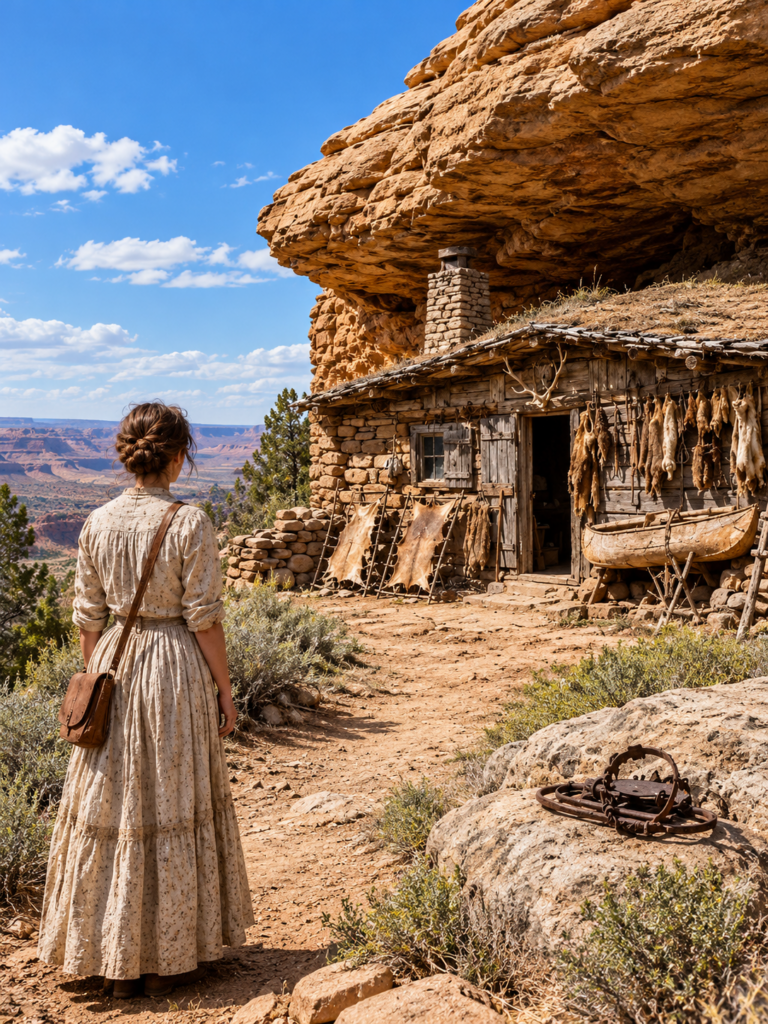
And there, beneath the towering mountains, stood Blackwood’s cabin.
Rose stopped walking.
Her heart sank.
The roof sagged badly.
One corner of the porch had collapsed.
The front door hung crooked from its hinges.
Moss covered the chimney.
Weeds grew through the steps.
The window was black and empty.
It looked abandoned beyond saving.
For several minutes, Rose could do nothing but stare.
Then she sat beside a tree and covered her face.
“Oh, Mama.”
Her voice broke.
“What have I done?”
She had spent everything on a ruin.
The bitter words of Silas Croft returned to her.
That mountain will kill you.
She cried quietly while Jasper grazed nearby.
Eventually the mule wandered over and pushed his rough nose against her shoulder.
Rose gave a weak laugh.
“You don’t think much of my purchase either, do you?”
Jasper nudged her again.
She looked toward the cabin.
The door was crooked.
But the walls were still standing.
There was a chimney.
And somewhere behind the building she could hear running water.
She remembered her father’s voice.
Find water. Find shelter. The rest is work.
Rose rose slowly.
“All right, Papa.”
She wiped her face.
“Let’s see what we’ve got.”
The cabin contained one room.
A stone hearth occupied the northern wall.
A narrow bed frame stood beneath the window.
There was a rough wooden table, one chair, and a set of shelves along the far wall.
Dust covered almost everything.
Yet something about the room puzzled Rose.
The table had been carefully positioned away from the leaking roof.
Tools hung in orderly rows.
A broom stood beside the door.
Near the hearth sat a small iron kettle.
The place did not look as though someone had fled it in fear.
It looked as though someone had intended to return.
Still, the roof worried her.
She could see a patch of evening sky between the rafters.
Rather than sleep beneath unstable timbers, she made camp just outside the door.
She tethered Jasper beneath the pines and wrapped herself in her blanket.
Dinner consisted of a little salt pork and hard bread.
She ate slowly, forcing herself not to think about how little food remained.
As darkness settled, unfamiliar sounds surrounded her.
An owl called from the trees.
Something rustled in the undergrowth.
Far down the valley, a coyote howled.
Rose drew her knees toward her chest.
She had never spent a night so far from another human being.
Every sound made her afraid.
Every quiet moment made her lonelier.
She took her mother’s note from her pocket.
There is always another beginning.
“I’m trying,” she whispered.
Above her, the stars appeared by the thousands.
She wondered whether her parents had seen these same constellations during their last summer together.
Then she closed her eyes.
Sleep came in broken pieces.
At dawn, Rose began examining the property.
The cabin’s walls were built from enormous pine logs, carefully fitted at the corners.
They were weathered but remarkably solid.
The roof was the worst problem.
Several rafters needed reinforcement, and a broad section of shingles had fallen inward.
Behind the cabin stood the remains of a firewood shed.
Its roof had collapsed.
Beneath it, however, Rose discovered something extraordinary.
Stacks of split wood, sorted by length and thickness, rested above the damp ground on flat stones.
The wood was dry.
Nearby, a spring bubbled between moss-covered rocks.
Someone had built a narrow stone-lined channel to carry the water away from the cabin’s foundation.
Rose knelt beside it.
The channel still worked.
She splashed water over her face and smiled despite herself.
“Water and firewood.”
She glanced toward the cabin.
“That’s a beginning.”
Then she saw the axe.
It was embedded in a chopping stump beside the shed.
Its head was wrapped in dark leather.
Rose pulled it free and removed the covering.
The steel beneath was clean.
Someone had coated it with protective oil.
She ran her thumb carefully along the edge.
Sharp.
Perfectly maintained.
Not the weapon of a dead man abandoned to the wilderness.
The working tool of a careful craftsman.
Rose examined the handle.
Near the base, two initials had been carved into the wood.
S. B.
Silas Blackwood.
She held the axe in both hands.
“Who were you?” she whispered.
The wind passed softly through the pines.
No answer came.
But the question stayed with her.
Because the more she examined the cabin, the more obvious it became that Silas Blackwood had not simply walked away and forgotten his home.
He had prepared it for something.
And Rose intended to discover what.
Part 3
The first week nearly broke her.
Rose rose before sunrise and worked until darkness made further labor impossible.
She cleared debris from the cabin, removed rotten shingles, and sorted Blackwood’s surviving tools.
Her palms blistered.
Her shoulders ached so badly that she sometimes struggled to lift her arms.
She ate sparingly and slept hard.
Still, every morning she stood before the cabin, studied the work ahead, and reminded herself that a roof could be repaired one board at a time.
She began with the smaller leaks.
Using Blackwood’s axe, she split wooden shakes from a fallen cedar.
The first dozen were crooked.
Several snapped.
She cursed once, then laughed at herself.
Her father would have raised an eyebrow at that language.
By the third day, she had learned to strike more carefully, letting the grain guide the blade.
She found nails in a wooden box beneath the workbench.
Some were bent, but she straightened them against a flat stone.
The roof required new support timbers.
For those, she needed Jasper.
She cut two slender pine trunks and trimmed away their branches.
Then she built a rough sled from discarded boards.
Using a rope and the mule’s steady strength, she dragged one timber toward the cabin.
The first attempt failed.
The rope slipped.
The timber rolled sideways.
Rose fell heavily to her knees.
For several seconds, she sat in the dirt shaking with anger.
“Nothing,” she muttered, “can ever be simple.”
Jasper stood patiently.
Rose looked at him.
Then at the timber.
She realized she had been pulling it from the wrong angle.
Her father had taught her to use leverage when setting fence posts.
She fetched a shorter log, wedged it beneath the timber, and shifted the weight.
The next attempt worked.
By dusk, the first support was in place.
Rose stood beneath it with tears running down her cheeks.
Not tears of despair.
Something different.
She had solved a problem.
She had changed the shape of her future with her own hands.
The work continued through September.
Rose repaired the worst section of the roof and tested the chimney before lighting a proper fire.
She cleared the old flue with a rope, brush, and weighted stone, removing years of soot and debris.
The first fire smoked badly.
She extinguished it, found another blockage, and tried again.
On the second attempt, smoke rose cleanly through the chimney.
Rose stood watching it drift into the bright afternoon sky.
A house with a working hearth felt different from an abandoned building.
It felt almost alive.
That evening she brought her blanket inside.
She placed it on the old bed frame after checking the supports and tightening the rawhide lashings.
For the first time since leaving her parents’ farm, she slept beneath a roof she could call her own.
The cabin gradually revealed more of Blackwood’s habits.
In a corner cupboard, Rose found tin containers sealed with wax.
One held salt.
Another contained dried beans.
A third held flour that had remained protected from dampness.
She inspected everything carefully, discarding anything spoiled or doubtful.
On shelves near the window lay bundles of dried plants tied with string.
Small wooden labels identified them.
Mint.
Yarrow.
Willow bark.
A large chest contained trapping equipment, snowshoes, spare leather, heavy blankets, and several carefully folded animal hides.
There were chisels, awls, sharpening stones, needles, and a handsome hand saw.
Every tool had been cleaned.
Every cutting edge protected.
Nothing appeared to have been thrown aside carelessly.
Rose began speaking aloud to the absent trapper.
“You kept everything in its place, didn’t you, Mr. Blackwood?”
Sometimes she imagined him as a stern old man with a white beard, watching disapprovingly while she made mistakes.
When she broke the handle of a small wooden mallet, she muttered, “I know. I know. You would’ve done it better.”
Then she shaped a replacement.
She started learning the cabin’s systems as if someone had left behind a practical education.
A wooden rack near the stove could dry wet clothing.
The pantry was positioned against the coolest wall.
The cabin’s floor sloped slightly toward the entrance, allowing water to run out during cleaning.
Outside, flat stones marked a footpath to the spring.
The arrangements were modest, but thoughtful.
They showed the work of a man who had paid attention to small things for many years.
Rose understood that kind of attention.
Her father had repaired farm machinery long after wealthier neighbors would have discarded it.
Her mother had saved buttons, mended stockings, and turned worn dresses into kitchen cloths.
The Blackwood cabin felt increasingly familiar.
Not because it resembled her childhood home.
Because it had been built with the same respect for work.
Her greatest worry was winter.
The mountain air had already turned cold at night.
Some mornings, thin frost covered the grass.
She needed more firewood, better protection for Jasper, and enough provisions to survive months when the trail might be impassable.
Using scraps of lumber from the ruined shed, she constructed a small lean-to beside the cabin.
She gave Jasper a dry bed of pine needles and reinforced the walls against wind.
Then she began gathering food.
She found wild raspberries and a few patches of late-season edible greens.
At the creek, she fashioned a crude fishing line using cord from Blackwood’s supplies and caught two trout.
She cooked one that evening and preserved the other with salt.
She discovered a small patch of potatoes growing wild near an old garden bed.
They were undersized but edible.
Rose knelt in the soil, carefully loosening each plant.
Somewhere beneath the weeds, Silas Blackwood had once grown his own food.
She examined the garden area.
The soil was dark and rich.
There were signs of old compost and stone borders.
The place had been neglected, but not ruined.
For the first time, she imagined spring.
Rows of beans.
A patch of squash.
Wildflowers near the porch.
The thought was so hopeful that it frightened her.
She had been disappointed too often to trust happiness easily.
One afternoon, while carrying firewood inside, Rose noticed something peculiar near the stone hearth.
A low log along the rear wall had shifted.
She crouched to examine it.
At first she assumed the wood had loosened because of temperature changes.
But its edges were unusually smooth.
There were no visible nails.
She pressed against one end.
It moved slightly.
Rose pulled her hand back.
For a long moment, she stared.
Every other part of Blackwood’s construction had been fitted tightly.
Why would he leave one log loose?
She tested it again.
The log moved inward, only a fraction.
There was something behind it.
Her heart began beating faster.
She fetched a small pry bar.
But before she could investigate further, Jasper brayed outside.
Rose set the tool down.
A dark cloud bank had appeared above the western ridge.
The air smelled of coming snow.
She hurried to secure the mule’s shelter and bring in more firewood.
By the time she returned to the cabin, the temperature had dropped sharply.
She decided the hidden compartment could wait.
Survival came first.
That night, Rose dreamed of her mother.
They were sitting at the old kitchen table.
Sunlight fell across the familiar blue pitcher.
Her mother was sewing a small leather pouch into the lining of a dress.
“Why are you hiding it?” Rose asked.
Her mother smiled sadly.
“Because someday you may need something I cannot give you myself.”
Rose woke with tears on her face.
For a while, she sat staring at the hearth.
Then she took the three-dollar deed from beneath her pillow.
She unfolded it carefully.
Her name stood clearly on the paper.
Rose Harding.
Owner.
It seemed an impossibly important word.
Her parents had left her no money.
The bank had taken their farm.
Yet somehow, through a series of desperate choices and unexpected kindnesses, she had a home again.
It was a broken little cabin on a mountain nobody wanted.
But it was hers.
She thought of the hidden log.
And she began to wonder whether the cabin held more than the tools she had already found.
Part 4
Two weeks after arriving, Rose finally opened the concealed compartment.
The afternoon was clear and cold.
She had finished repairing the chimney stones and wanted to understand the strange movement in the wall.
Kneeling beside the hearth, she slipped the pry bar into a narrow seam.
She applied gentle pressure.
The wood creaked.
Then the entire section swung inward.
Rose gasped.
It was not a loose log.
It was a cleverly disguised little door.
Behind it lay a hollow space protected from the damp.
Inside stood a small metal box.
Rose carefully lifted it out and carried it to the table.
It was surprisingly heavy.
Her first thought was gold.
Perhaps Blackwood had been a prospector as well as a trapper.
Perhaps he had hidden silver or valuable papers.
But when she opened the lid, she found three objects.
A leather-bound journal.
An oilcloth pouch.
And a smooth gray river stone.
Rose picked up the pouch.
Inside were dozens of folded paper packets.
Each bore a handwritten label.
Carrots.
Beans.
Squash.
Mountain corn.
Wildflower seeds.
Rose stared at them.
Seeds.
Not money.
Not treasure.
Something meant to grow.
She set them carefully on the table and opened the journal.
On its first page, written in strong, deliberate handwriting, were the words:
To the one who comes after me.
Rose’s throat tightened.
She turned the page.
If you are reading this, you have found my home. I hope you are someone who needs it.
She stopped.
The fire snapped softly in the hearth.
She continued.
My name is Silas Blackwood. By the time these words are found, people in the valley may believe I died here. That is not precisely the truth.
Rose leaned closer.
I came to these mountains thirty years ago after losing my wife, Elizabeth, and our little daughter, Anna, to cholera back east.
The next lines were blurred in places.
Perhaps water had once touched the page.
Perhaps tears.
I arrived with more anger than hope. I hated the world for continuing without them.
Rose rested her hand on the paper.
She understood that feeling.
Blackwood described building the first walls of the cabin in a bitter autumn.
He had nearly frozen the first winter.
He had learned to store food, read weather patterns, and respect the mountain’s dangers.
He had repaired the shelter again and again until it became a home.
The work did not cure my grief, he wrote. But it gave my hands something to do while my heart learned to endure.
Rose read those words twice.
She thought of her parents.
Of the roof she had repaired.
Of the long days when physical exhaustion had been easier to bear than memory.
The old trapper had known the same loneliness.
The journal continued.
I am old now. My bones ache in winter, and I have no family left to inherit what I have built.
Rose turned another page.
Men like Silas Croft would see only the timber, the stone, and the right to sell what grows here. They would strip this place bare and call it profit.
She glanced toward the window.
Croft’s laughter seemed suddenly close.
I cannot prevent every wrong. But I can leave something useful behind for the person who comes seeking shelter rather than wealth.
The entry explained that Blackwood had arranged his affairs before leaving the mountain, paying several years of taxes in advance and preparing the cabin for whoever might next take possession.
Rose frowned.
The county had auctioned the property for delinquent taxes.
She turned back through the pages.
There were dates, but the final entries did not clearly explain when Blackwood had departed or what had happened to the tax payments.
A later page mentioned papers held in town and an instruction to speak with the county clerk if ownership ever became disputed.
Rose felt a flicker of unease.
Perhaps the county’s records had been mistaken.
Perhaps the property had become delinquent after the prepaid period ended.
She could not know.
The last portion of the journal was different.
It contained practical instructions.
Where to find clean drinking water.
How to identify dangerous weather.
Which slopes were most likely to produce spring vegetables.
Which trees made dependable firewood.
How to repair the cabin’s chimney.
Where trout gathered during late summer.
There was even a drawing of the little garden beside the spring.
Rose spread the journal open.
The old man had left behind the knowledge of an entire lifetime.
And hidden among the pages was an instruction that caught her attention.
The house must never become a monument to the dead. It was built for the living.
She sat quietly for a long time.
Then she looked at the seed packets.
Blackwood had not preserved them for himself.
He had prepared them for someone who would come later.
Someone who might need a new beginning.
Over the following weeks, Rose followed the journal closely.
She identified a sheltered storage space beneath the cabin floor where root vegetables could be kept cool.
She improved the mule’s shelter.
She repaired the final gaps in the roof and reinforced the door.
She stacked firewood beneath an overhang, protecting it from snow.
She dug a narrow drainage ditch uphill from the cabin.
She carried stones until her hands shook and her back burned.
At night she read a few pages of the journal beside the hearth.
Sometimes she spoke aloud.
“You were a stubborn old fellow, weren’t you?”
The silence no longer frightened her quite so much.
Yet one concern remained.
The notes about taxes troubled her.
Rose had bought the land legally at a county auction, but she possessed little understanding of property law.
She decided that once the weather improved, she would return to town and ask Mr. Bell to examine the records.
She also intended to repay Jed for Jasper.
Until then, she had work to do.
The first blizzard arrived earlier than anyone expected.
It began late one afternoon.
The sky turned a bruised purple.
Wind swept through the treetops.
Rose had been splitting firewood when Jasper suddenly lifted his head and brayed.
She looked west.
A wall of cloud was moving across the ridge.
Blackwood’s journal had warned about such clouds.
When the peaks disappeared beneath a low, fast-moving bank, a storm might arrive before dark.
Rose hurried.
She carried the remaining firewood inside, checked Jasper’s shelter, and secured the cabin shutters.
Then the snow began.
Within minutes, the distant trees vanished.
The wind roared against the newly repaired roof.
Snow drove through the clearing in hard white sheets.
Rose stood beside the hearth, listening to the timbers creak.
She had repaired the roof herself.
She knew every weak place.
If it failed, she could freeze before morning.
She fed another log into the fire.
“Hold,” she whispered.
The wind struck again.
“Please hold.”
Hour after hour, the cabin endured.
The chimney drew steadily.
The walls remained warm.
Rose sat wrapped in one of Blackwood’s heavy blankets, watching flames dance across the stone.
And for the first time, she felt the difference between merely surviving and being prepared.
She had worked for this warmth.
She had carried every log.
She had repaired every leak.
The security around her was something she had built.
Then, through the wind, she heard a sound.
A faint cry.
Rose sat upright.
At first she thought it was an animal.
Then it came again.
“Help!”
A human voice.
She moved to the door and listened.
“Somebody!”
The cry sounded desperate and weak.
Rose grabbed a lantern.
Outside, the snow was nearly waist-deep in places.
The wind almost knocked her backward when she opened the door.
She hesitated.
Going out could be fatal.
The trail was difficult even in good weather.
A person might become disoriented only a few yards from the cabin.
But someone was out there.
Rose remembered Blackwood’s words.
Built for the living.
She tied a long rope to a secure timber beside the entrance, took the other end with her, and stepped into the storm.
“Hello!” she shouted.
A faint answer came from the direction of the trail.
She pushed through the snow, shielding the lantern.
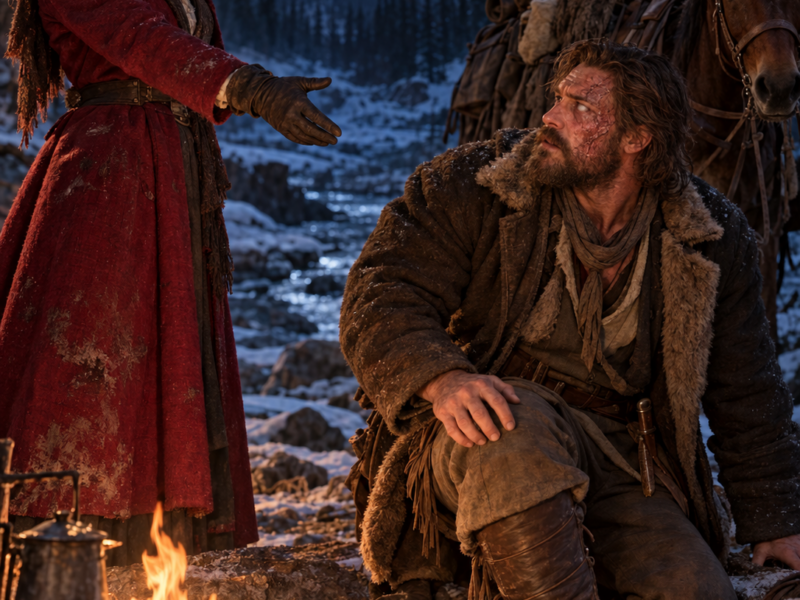
After several exhausting minutes, she found three figures crouched behind a boulder.
A man.
A woman.
And a young boy.
The woman’s lips were blue.
The child barely responded.
The man struggled to stand.
“My name’s Daniel Evans,” he gasped. “That’s my wife Sarah. Our son Thomas. Our horse went lame. We were trying to reach town.”
Rose took Sarah’s arm.
“My cabin is close.”
Daniel looked toward the darkness.
“How close?”
“Close enough if we keep moving.”
She pulled the woman to her feet.
“Take your son. Follow the lantern. Don’t let go of each other.”
They began the terrible journey back.
Twice Sarah stumbled.
Thomas cried weakly.
Daniel could barely carry him.
Rose kept talking.
“Just a little farther.”
“Keep your eyes on the light.”
“You’re doing well.”
But when Rose reached the end of her rope, she realized the cabin was still hidden by blowing snow.
Her stomach dropped.
She had not measured the distance correctly.
The wind had shifted.
She could no longer see the door.
For a moment, panic seized her.
Then she remembered Jasper.
The mule had been restless since the storm began.
Rose listened.
Through the gale came a faint bray.
She turned toward the sound.
“There,” she whispered.
She helped the family follow the rope back to the cabin.
When they finally crossed the threshold, Sarah collapsed near the hearth.
Rose shut the door against the storm and knelt beside her.
“You’re safe now.”
The words sounded strange coming from her mouth.
She had spent so long needing someone else to say them.
Rose removed their wet outer clothing, wrapped them in dry blankets, and warmed them gradually beside the fire.
She heated water and made bean soup.
Thomas, who was seven, sat close to his mother with both hands around a tin cup.
“Is this your house?” he asked.
Rose nodded.
“Mine and Jasper’s.”
“Who’s Jasper?”
“My mule.”
Thomas considered that.
“Does he sleep inside?”
“Not unless he learns to wipe his feet.”
For the first time all evening, the boy smiled.
Daniel Evans watched Rose carefully.
“You saved us.”
Rose stirred the soup.
“I heard you calling.”
“We might not have lasted another hour.”
She did not answer immediately.
She looked around the cabin, at Blackwood’s tools, his blankets, his food stores, and the fire burning steadily in the hearth.
“I don’t think I saved you alone,” she said.
Daniel frowned.
Rose touched the old journal lying on the table.
“A man I never met helped me make this place ready.”
The storm raged for three days.
During that time, four strangers shared the small cabin.
Rose gave the Evans family food, shelter, and warmth.
Sarah helped cook.
Daniel repaired a loose shutter once he recovered.
Thomas spent hours watching Jasper through the window.
At night, they talked.
Daniel was a traveling preacher heading toward a congregation in the next valley.
He and Sarah had sold most of their belongings to make the journey.
They had misjudged the weather and nearly paid for the mistake with their lives.
One evening, Daniel asked about Blackwood.
Rose showed him the journal.
He read several pages in silence.
Then he closed the book carefully.
“Miss Harding, I believe that man understood something most folks spend their whole lives trying to learn.”
“What?”
“That what we own matters far less than what we leave behind for someone else.”
Rose glanced toward the hearth.
The old trapper had left enough to save four lives.
And she had nearly sold the place back to Croft for twenty dollars.
The thought made her shiver.
When the blizzard finally passed, sunlight flooded the valley.
Snow lay thick across the clearing.
The sky was so blue it seemed almost unreal.
Daniel stood on the porch with his family.
He shook Rose’s hand.
“I wish there were some way to repay you.”
Rose smiled.
“Get your family down the mountain safely. That’s enough.”
Sarah embraced her.
“You’ll come visit us someday?”
“I hope so.”
Thomas hugged Jasper’s neck before leaving.
The mule tolerated the affection with visible resignation.
Rose watched them depart, their figures growing smaller along the snowy trail.
The cabin felt quiet afterward.
But it was not the same lonely silence she had known on her first night.
Something had changed.
The home that had sheltered her had now sheltered others.
Blackwood’s gift had begun to travel beyond the mountain.
Still, Rose did not know what consequences the family’s visit would bring.
Nor did she know that Silas Croft was about to hear a story that would make him reconsider the property he had mocked.
Part 5
By the time spring approached, everyone in Redemption Gulch had heard about Rose Harding.
Daniel Evans had told the story first.
He told it at the feed store, at the church, and to anyone who asked how his family had survived the blizzard.
He described the young woman who had ventured into dangerous weather with a lantern and a rope.
He described the warm cabin, the carefully stored provisions, and the old trapper’s remarkable preparations.
He spoke of Rose’s courage without exaggeration.
That was enough.
People remembered the auction.
They remembered laughing when the orphan girl spent her last three dollars.
Now those memories made some of them uncomfortable.
A woman who had mocked Rose outside the saloon began asking whether someone should send supplies to the mountain.
The blacksmith offered spare nails.
A merchant set aside a bag of flour.
And Jed Morris, the livery owner, told anyone who would listen that he had known all along the girl had grit.
“Didn’t know she’d turn out to be a mountain legend,” he admitted, “but I knew she wasn’t foolish.”
Silas Croft heard the story while drinking coffee in the hotel dining room.
He dismissed it immediately.
“Preachers embellish everything,” he grumbled.
But a few days later, one of his ranch hands returned from hunting near the mountain.
“I saw smoke coming from the Blackwood chimney, boss.”
Croft lowered his newspaper.
“So?”
“Roof looked sound. Place was fixed up.”
Croft stared at him.
“You sure?”
“Yes, sir.”
Croft put down his coffee.
For the first time, the mountain property troubled him.
Not because Rose had made it valuable.
Because she had proved him wrong.
Dr. Miller came up the trail two weeks later.
He was an elderly physician who had practiced in the county for almost thirty years.
When he arrived, Rose was splitting firewood.
The doctor dismounted and removed his hat.
“Miss Harding?”
Rose set down the axe.
“Yes, sir.”
“I’ve come to make sure the mountain hasn’t swallowed you.”
She laughed.
“Not yet.”
He inspected the cabin with obvious surprise.
The roof was sound.
The chimney was clear.
Firewood stood in neat stacks.
Jasper grazed nearby in the pale spring sunlight.
Inside, the doctor found clean shelves, preserved food, and a warm stove.
He accepted a cup of coffee.
“Remarkable,” he said.
Rose looked around.
“Most of it was here when I arrived. I just had to learn how to use it.”
Dr. Miller noticed the journal.
She told him about Blackwood.
Then she mentioned the old man’s notes concerning taxes.
The doctor’s expression grew serious.
“You ought to have Mr. Bell examine those records.”
“I intend to.”
“Good. Land disputes can get ugly when someone believes there’s money involved.”
He reached into his bag and brought out a package.
“The Evans family asked me to deliver this.”
Inside was a length of warm wool cloth, several sewing needles, and a handwritten letter.
Sarah thanked Rose for saving their lives.
Thomas had drawn a picture of Jasper standing beside the cabin.
Rose laughed through tears at the picture.
The mule had been given enormous ears.
There was also a brief message from Jed.
Your debt is paid. Consider Jasper a gift from the town.
Rose folded the note carefully.
“He didn’t need to do that.”
“Perhaps,” Dr. Miller said, “he wanted to.”
The doctor finished his coffee and stood.
“One more thing. People in town know what happened up here. They’re beginning to understand what they misjudged.”
Rose glanced toward the window.
“I didn’t buy this place to prove anything.”
“I know.”
He put on his hat.
“That’s probably why you did.”
Several days later, Silas Croft rode into the clearing.
Rose saw him from the garden.
She was clearing away dead weeds and preparing the soil for planting.
The rancher stopped his horse near the edge of the trees.
For a while, he said nothing.
His gaze moved from the roof to the chimney, from the firewood to the mule’s shelter.
Finally, he dismounted.
“Miss Harding.”
“Mr. Croft.”
He approached the porch.
“Looks like you managed to make something of it.”
Rose brushed dirt from her hands.
“I’ve done my best.”
Croft examined the new shingles.
“You repaired all this yourself?”
“Jasper helped with the heavy timbers.”
He looked toward the mule.
Jasper ignored him.
Croft cleared his throat.
“I’ve been thinking about that property.”
Rose waited.
“I’ll offer you two hundred dollars.”
She stared at him.
Two hundred dollars was more money than she had seen in years.
Croft continued.
“Cash. No trouble with deeds or taxes. You can go somewhere easier to live.”
Rose looked around the clearing.
At the repaired porch.
At the cabin walls.
At the garden.
At the spring flowing cold and clear.
Then she shook her head.
“No, thank you.”
Croft frowned.
“You’ve no idea what two hundred dollars could do for you.”
“Yes,” she said softly. “I do.”
“Then why refuse?”
“Because you want the trees.”
Croft’s expression stiffened.
“And I want the home.”
For several seconds, he seemed ready to argue.
Instead he turned his gaze toward the valley.
“Blackwood was always peculiar,” he muttered.
Rose stepped closer.
“Did you know him?”
Croft hesitated.
“Some.”
“Was he a bad man?”
“No.”
The answer came reluctantly.
“He was just stubborn. Had opportunities to sell. Wouldn’t take them.”
Rose waited.
Croft looked at the cabin again.
“He said people didn’t need to own every beautiful thing they saw.”
He gave a humorless laugh.
“I thought he was a fool.”
Rose said nothing.
The rancher mounted his horse.
“I won’t trouble you again.”
He rode away.
Rose watched until the trees hid him.
She felt no triumph.
Only relief.
When the trail became passable, Rose traveled down to Redemption Gulch with Jasper.
She carried the journal, the county deed, and the old survey map.
Mr. Bell welcomed her into the clerk’s office.
“I’ve been expecting you.”
He had heard the Evans family’s account and already reviewed the Blackwood records.
Rose placed the journal on his desk.
“I found something that may concern the property’s taxes.”
Mr. Bell opened his ledger.
He turned several pages.
Then he removed an older file from a cabinet.
“Silas Blackwood paid five years in advance,” he confirmed.
“What happened after that?”
“The prepaid period eventually expired. Notices were sent to his last address, but no one collected them. The taxes became delinquent afterward.”
Rose studied the entries.
“So the sale was legal?”
“Yes. The county’s interest was properly advertised, and no competing claim was filed.”
She released a breath she had not realized she was holding.
Mr. Bell turned another page.
“There’s something else.”
He produced a sealed document from the file.
“Blackwood left a statement with the county years before he disappeared. It wasn’t a will, exactly. More a declaration concerning the property.”
Rose leaned forward.
Mr. Bell carefully unfolded the page.
The writing matched the journal.
Blackwood had explained that he had no surviving family and intended for the land and its improvements to benefit someone willing to occupy and preserve the homestead.
He acknowledged that ordinary law would govern ownership after his death or departure.
But he asked that any future owner respect the cabin’s purpose as a refuge.
Mr. Bell finished reading.
“He couldn’t legally control every future owner with this statement,” he explained. “But it tells us what he wanted.”
Rose looked down at her deed.
“And the county sold it to me.”
“Yes.”
“For three dollars.”
“Yes, ma’am.”
Her eyes filled.
The cabin had not merely passed into her hands by accident.
Blackwood had deliberately prepared it for someone like her.
A person who had nowhere else to go.
A person willing to climb the mountain.
Someone who saw shelter where others saw worthless timber.
Rose covered her mouth.
For months, she had believed the world had taken everything from her.
Now she understood that a stranger, years earlier, had chosen to leave something behind for whoever might one day need it most.
Mr. Bell looked at her kindly.
“Miss Harding, I think Silas Blackwood would be pleased.”
Rose wiped her eyes.
“I hope so.”
Before leaving town, Rose stopped at the livery stable.
Jed looked up from a harness.
“Well, there’s our mountain woman.”
Rose smiled.
“I came to thank you.”
“You’ve done that already.”
“Not properly.”
She reached into her bag and brought out a small bundle of dried herbs, a beautifully repaired leather strap, and a carved wooden handle she had made for his old stable brush.
Jed examined the workmanship.
“Well, I’ll be.”
“I know it isn’t ten dollars.”
He shook his head.
“Miss Harding, I believe you’ve misunderstood the arrangement.”
Rose looked puzzled.
“I told you to pay me when you could.”
“Yes, sir.”
“Well, you paid me the first time I heard you had survived that storm.”
He placed the strap on his workbench.
“Everything after that is just a bonus.”
Rose laughed.
Then, unexpectedly, she hugged him.
Jed stood stiffly for an instant before patting her shoulder.
“You take care up there.”
“I will.”
“And don’t let Jasper get too fat.”
From outside, the mule brayed.
Jed grinned.
“See? He heard me.”
Spring arrived slowly in the mountains.
First came the sound of melting snow.
Then patches of brown earth appeared beneath the pines.
The creek rose with cold, rushing water.
Birdsong returned to the clearing.
Rose worked the garden with a shovel she had repaired during winter.
Following Blackwood’s instructions, she planted beans, carrots, squash, and mountain corn.
Along the edges, she scattered wildflower seeds.
She built a simple fence to protect the young plants from animals.
She repaired the porch and placed a wooden bench beside the door.
One afternoon, while sorting Blackwood’s remaining possessions, she found a small carved wooden horse wrapped in cloth.
Its surface had been worn smooth by careful handling.
On the underside were two small letters.
A. B.
Anna Blackwood.
Rose sat for a long time with the toy resting in her palm.
She imagined the old trapper carrying it west after burying his wife and daughter.
Perhaps he had kept it beside his bed.
Perhaps he had held it during lonely winter nights.
The little horse reminded her of the loss that had brought him to the mountain.
She did not put it back in the chest.
Instead she placed it on the mantel near her mother’s note.
Two small keepsakes.
Two families separated by years and miles.
Both remembered in the same home.
In late May, Daniel and Sarah Evans returned with Thomas.
They brought a basket of bread, preserves, and fresh eggs.
Thomas raced toward Jasper.
The mule tolerated his affection with the same long-suffering expression as before.
Sarah helped Rose prepare supper.
Daniel repaired a section of the garden fence.
That evening, they sat outside beneath a sky turning gold.
The valley spread below them, green and quiet.
Daniel studied the cabin.
“Have you ever thought of giving the place a name?”
Rose looked surprised.
“Blackwood’s lodge already has one.”
“That was his name. Perhaps it could have another.”
Rose considered this.
She thought about the old trapper’s journal.
Her mother’s note.
Jed’s generosity.
The Evans family arriving nearly frozen.
The fire that had kept them alive.
She looked toward the door.
“What about Second Chance Lodge?”
Sarah smiled.
“I think that’s beautiful.”
Daniel nodded.
“Seems fitting.”
Thomas raised his head from Jasper’s neck.
“Does that mean people can come here when they’re lost?”
Rose looked at the boy.
The question touched something deep inside her.
She thought of herself arriving on the mountain with trembling legs, three dollars gone, and no certainty she would survive.
Then she thought of the words in Blackwood’s journal.
The house must never become a monument to the dead. It was built for the living.
“Yes, Thomas,” she said.
“I think that’s exactly what it means.”
Over the next year, Rose’s little cabin became a familiar landmark to travelers crossing the high valley.
She did not turn it into a hotel.
There was no business sign advertising rooms.
No rich investor came to transform it into a grand estate.
It remained a small log cabin with a stone chimney, a vegetable garden, and an aging mule who believed every visitor had come to bring him treats.
But the porch was repaired.
The door was strong.
The pantry stayed stocked as well as Rose could manage.
And beside the trail stood a simple wooden marker.
Second Chance Lodge.
Water. Shelter. Help if needed.
Rose carved the words herself.
Some travelers stopped only to drink from the spring.
Others needed directions.
Occasionally, someone arrived exhausted or frightened, carrying burdens Rose recognized all too well.
She offered what she could.
A place beside the fire.
A bowl of soup.
A dry blanket.
Sometimes, when the need was plain and words seemed unnecessary, she simply opened the door.
One evening the following autumn, a young mother appeared with two children and a battered suitcase.
Her wagon had broken an axle several miles down the trail.
She had been walking since afternoon.
The younger child was crying.
The older one clutched the woman’s skirt.
Rose met them at the clearing.
“Are you the lady who lets people stay?” the mother asked nervously.
Rose looked at the children.
Their faces were cold.
Their shoes were muddy.
The woman’s exhaustion was unmistakable.
Rose remembered another girl who had once stood alone in an unfamiliar place, afraid to ask for help.
She opened the cabin door.
“Come inside,” she said. “There’s a fire going.”
The woman hesitated.
“I don’t have money.”
Rose smiled gently.
“Neither did I when I came here.”
She stepped aside.
“And someone made sure I had a chance anyway.”
That night, after her guests had fallen asleep, Rose sat alone on the porch.
The mountains rose dark against a sky crowded with stars.
Jasper stood beside her, his great head resting lightly against her shoulder.
The old mule’s muzzle had grown grayer.
His movements were slower.
But he was still strong enough to carry supplies and stubborn enough to argue whenever Rose tried to shorten his supper.
She stroked his neck.
“Do you remember our first night here?”
Jasper flicked an ear.
“I thought we’d made the worst mistake of our lives.”
She laughed softly.
“I suppose you knew better.”
She reached into her pocket and took out the smooth gray river stone from Blackwood’s hidden box.
She carried it everywhere now.
Its surface had been polished by years of handling.
She wondered how often the old trapper had held it while remembering his wife and daughter.
Perhaps he had found it on the day he built the first wall.
Perhaps Anna had once given it to him.
She would never know.
And that was all right.
Not every question needed an answer.
Some things mattered because they endured.
Rose looked through the cabin window.
The hearth glowed warmly.
The young mother and her children slept beneath blankets Blackwood had preserved.
Her mother’s note rested safely beside the carved wooden horse.
Two generations of grief had become part of the same story.
But grief was no longer the only thing that lived inside those walls.
There was laughter now.
There was work.
There was food growing in the garden.
There were travelers who knew where to find help.
There was a life Rose had never imagined when she first arrived.
She remembered Silas Croft laughing at the auction.
She remembered the cruel certainty in his voice.
You bought yourself a pile of rotten logs.
She had believed him for one terrible evening.
And yet the old trapper had seen something in that lonely mountain property that wealthier men had never understood.
He had seen the possibility of beginning again.
Rose closed her fingers around the river stone.
“Thank you, Mr. Blackwood,” she whispered.
The wind moved softly through the pines.
For a moment, she imagined the old man standing beside his cabin, satisfied that the tools were being used, the garden was growing, and the fire had not gone out.
Then Jasper nudged her shoulder.
Rose smiled.
“All right, old boy. We’d better get some sleep.”
She rose from the bench and turned toward the door.
Before going inside, she looked once more across the valley.
Somewhere beyond those mountains stood the farm where she had buried her parents and lost her childhood.
She would always miss them.
She would always remember the kitchen table, the cottonwood tree, and the sound of her father’s whistle.
But those memories no longer belonged only to sorrow.
They had helped teach her how to survive.
Her mother had left her three silver dollars.
Her father had taught her to find good ground.
Jed had trusted her with an aging mule.
And Silas Blackwood had left a home prepared for a stranger he would never meet.
Rose finally understood what the old trapper had given her.
It was not a fortune hidden inside a wall.
It was not the timber, the tools, the seeds, or even the land itself.
It was the chance to stop running from everything she had lost and begin building something worth leaving behind.
She stepped inside, closed the door against the cold, and added another log to the fire.
Outside, the wooden sign stood firm beside the mountain trail.
Second Chance Lodge.
And high above Redemption Gulch, in the cabin everyone had once called worthless, the light remained burning for whoever might need it next.