Garrick pushed the ledger away until nothing lay between them.
“Tell me what you know,” he said.
Elena looked at the cleared desk.
“Victor operates lending businesses in Pueblo. He collects debts and manages property for men who prefer somebody else to do their unpleasant work.”
“Did you owe him money?”
“No. I worked for him.”
“What happened?”
“He began treating my employment as something he could never be required to release.”
She touched her collar unconsciously.
“When I decided to leave, he refused to accept it.”
Garrick watched her closely.
Elena had expected him to demand every detail, to measure her usefulness against the danger she might bring, perhaps to regret opening his gate.
Instead, he asked, “What does he want now?”
“To take me back.”
“By force?”
“He has men willing to use it.”
Outside, wind pressed against the office window.
“How many?”
“Six or more. Sometimes ten. It depends on what he thinks he’ll need.”
Garrick rested his hands on the desk.
“Have you seen him?”
“Not Kaine himself. One of his riders. Twice.”
“And you’re certain?”
“Yes.”
She looked down.
“I should have told you when I arrived.”
“You didn’t know whether you could trust me.”
“I knew you were offering work. I didn’t know anything else.”
“That’s fair.”
The plainness of his answer caught her off guard.
Garrick stood, crossed to the window, and looked toward the dark ranchyard.
“Holt will need to know. We can keep watch without putting the hands into a needless quarrel.”
Elena rose.
“I don’t want anyone injured because I came here.”
“Neither do I.”
“Then perhaps I should go.”
He turned.
“Is that what you want?”
She did not answer immediately.
In three weeks, she had brought order to the pantry, good meals to the bunkhouses, and laughter to a dining room that had stood unused for years.
She had slept through whole nights without waking frightened.
She had begun to imagine saving enough wages to start a business of her own.
Leaving would mean giving up the first steady ground she had found in months.
“No,” she said.
Garrick nodded.
“Then we won’t mistake somebody else’s threat for your decision.”
Her eyes filled, though she refused to let the tears fall.
“What if he demands to speak to me?”
“Then you decide whether to answer. I’ll make certain you have the chance to refuse.”
Elena studied him.
She knew strong men who believed strength gave them the right to command.
Garrick was offering something unfamiliar: help without a bargain attached.
“You don’t know everything about me,” she said.
“No.”
“Some of it may be ugly.”
“Something ugly was done to you. That doesn’t make it yours.”
She looked away.
For a long moment neither spoke.
Then Garrick returned to his desk.
“There’s another matter.”
“What?”
“The room upstairs. Is the lock sound?”
“It holds.”
“Good. I’ll have Holt arrange for the road to be watched. Tell me if anybody troubles you.”
She nodded.
At the door she hesitated.
“Mr. Dalton?”
“Yes?”
“Why are you doing this?”
He considered the question.
“Because you asked me for honest work, and you’ve given it. Because no man gets to come onto this property and carry off a woman who refuses to go.”
He paused.
“And because I don’t like seeing people frightened out of the lives they’re trying to build.”
Elena went upstairs with his words following her.
For several days the rider did not appear.
The ranch settled into its ordinary tasks.
Garrick repaired drainage beside the barn.
Holt shifted men between pastures.
Elena continued her cooking, checking the pantry before winter and teaching Callum to handle hot pans safely.
She also began setting the big dining room table each evening.
At first the cowboys entered awkwardly.
They were accustomed to carrying food back to the bunkhouse.
Now twelve places waited beneath a lit lamp.
Garrick stopped in the doorway the first evening.
Margaret had once insisted that the men occasionally eat together.
He had nearly forgotten what the room sounded like when its chairs were filled.
Elena did not ask him to speak about his wife.
She simply pulled out a chair.
“Your supper’s getting cold.”
He sat.
And the room slowly learned to hold laughter again.
But the calm did not last.
One Sunday morning, Holt came to the office with news.
Three riders were watching the eastern ridge.
Garrick immediately called for Elena.
When she arrived, he told her plainly what Holt had seen.
Her expression tightened.
“He’s preparing to come closer.”
“How can you tell?”
“Victor doesn’t send men to watch forever. He wants whoever he’s pursuing to know they’re surrounded.”
Garrick stood.
“Then we’d better understand exactly what we’re facing.”
He led her toward the window.
Elena looked out across the ranchyard.
The gates she had entered seeking shelter were still open.
The men were still working.
But somewhere beyond the hills, Victor Kaine was preparing to test whether this place could truly protect her freedom.
She turned from the window and took her leather notebook from her apron.
“If we’re going to protect the ranch,” she said, opening it to a clean page, “I intend to help decide how.”
Elena laid the open notebook on Garrick’s desk.
He looked at the blank page.
“What do you have in mind?”
“First, I want to know where everyone works during the day. Then I want to examine the approaches to the house.”
Garrick considered her.
“You know the buildings well enough?”
“Better than the men watching from the ridges.”
He could not dispute that.
Over the following days, Elena worked with Holt to identify vulnerable entrances and areas that could be observed from the house.
She carried the information to Garrick rather than acting without his knowledge.
He listened carefully.
When she pointed out the neglected cellar latch, he arranged for Burl, the ranch hand responsible for maintaining tools and firearms, to repair it.
There was no grand speech about courage.
No suggestion that danger made any one of them heroic.
They were people with work to do, attempting to prevent another man’s violence from reaching their household.
Garrick also made something clear to the ranch hands.
A dangerous man might arrive demanding that Elena be surrendered to him.
No one would be required to remain in a dispute they had not chosen.
Any hand wishing to leave could take his wages.
Nobody did.
Callum stood near the barn door, twisting his hat.
“Miss Hart isn’t going away, is she?”
“That’s for Miss Hart to decide,” Garrick answered. “And she has said she wants to stay.”
The boy nodded.
Elena heard about that conversation later.
It meant more than any declaration of possession could have meant.
She was becoming important to the people of Silver Crest, yet her decisions remained her own.
In the kitchen, she continued working.
She cooked steadily, sometimes too steadily, using activity to hold her anxiety at a distance.
One afternoon Holt stopped beside the range.
“You’re making enough potatoes for a cattle drive.”
“They won’t keep much longer.”
He looked at the enormous kettle.
“Maybe not, but neither will the rest of us if we eat them all at once.”
She laughed despite herself.
Holt took another helping.
Elena appreciated that he never demanded an explanation for her fear.
Another day, Garrick discovered her struggling behind a flour barrel in the storeroom.
“There is a stool,” he observed.
“I have seen it.”
“Would it help?”
“At this point it would mostly injure my pride.”
He suppressed a smile.
She emerged, dusty and annoyed, and accepted the coffee he handed her.
For several minutes, the rain tapping against the roof seemed more important than the danger waiting beyond the ridges.
Then Garrick looked around the storeroom.
“Margaret used to arrange all this.”
Elena paused.
He rarely spoke his wife’s name.
“She knew where everything belonged,” he continued. “After she died, I kept the ranch running. The house was another matter.”
Elena sat on the stool.
“You built it together?”
“Most of it. She planned the kitchen.”
“Then she had good judgment.”
He glanced at the range through the open doorway.
“She did.”
They remained quiet.
Elena knew she could not erase the woman who had once occupied this household.
Nor did she want to.
She had come to Silver Crest looking for employment, not another person’s place in a man’s heart.
But she was beginning to care about Garrick.
Not because he owned land.
Not because he was wealthy.
Because he noticed when his men were tired, carried heavy things without making a display of it, and listened when she knew something he did not.
And because he seemed to recognize that her future mattered as much as his.
The following Monday, three riders appeared on the ridge.
On Thursday, only two remained.
Elena studied their changing positions.
“They’re nearly finished watching,” she told Garrick.
He looked toward the hills.
“You think they’ll come soon?”
“Yes.”
That evening, Burl reinforced the cellar door.
Holt reviewed the approaches with the hands.
Elena checked the kitchen supplies and made certain the household had water and food enough to remain indoors if necessary.
Then she baked an apple pie.
Callum hovered near the window until she finally called him inside.
“You’re wearing a path through my yard,” she said.
“I wasn’t waiting for anything.”
“Then you won’t mind helping carry the dishes.”
He grinned and obeyed.
Garrick saw the pie cooling on the sill.
“Seems a strange day for baking.”
“Callum likes apples. Everyone’s frightened. A warm meal won’t fix that, but there’s no harm in giving them one.”
Garrick watched her for a moment.
“You’ve done more for this house than you know.”
Elena looked down at the pastry crumbs.
“I know what I’ve done in the kitchen.”
“That’s not all I meant.”
Their eyes met.
She felt the dangerous sweetness of wanting to believe him.
Before either could say more, Holt entered to report that the watchers had disappeared from the ridge.
The following morning, just before daylight, the first warning came from the northwest pasture.
Riders were approaching.
Eight men came up the main road, with more movement near the eastern side of the property.
Garrick reached the front hall with his rifle.
Elena stood in the kitchen doorway.
She held the household shotgun, as she had already told him she could.
“Stay where you can be safe,” he said.
“I intend to stay where I can see what’s happening.”
He studied her.
Then he nodded.
“Don’t take needless risks.”
“Neither should you.”
Outside, Victor Kaine rode into view.
He was a straight-backed man on a black horse, dressed more finely than most of his companions.
He stopped beyond the porch.
“Garrick Dalton!”
Garrick answered from the house.
“What business brings you here?”
“I’ve come for Elena Hart.”
“She isn’t your property.”
Kaine’s mouth tightened.
“She’s under an obligation to me.”
“Then pursue it by lawful means. You don’t get to take her.”
The men on horseback shifted uneasily.
Kaine glanced toward the windows.
“I don’t believe you understand who I am.”
Garrick remained steady.
“I understand that you’ve come armed to remove a woman who doesn’t wish to go.”
Kaine’s expression sharpened.
Then the first shot struck the parlor window.
Glass shattered.
The ranch hands returned fire from their positions.
For several terrible minutes, the yard became a place of shouting, frightened horses, splintered wood, and gun smoke.
Elena remained in the kitchen.
When a rider attempted to move toward the eastern side of the house, she fired at the cover he was using, forcing him to withdraw.
She was frightened.
She did not pretend otherwise.
But she would not surrender merely because Victor Kaine expected terror to make her obedient.
Garrick continued demanding that the intruders leave.
Holt and the other hands prevented the riders from approaching the buildings.
Kaine had expected a frightened woman and an unprepared rancher.
He found a household that had been warned and had chosen to stand together.
Eventually he ordered his men away.
“This isn’t finished!” he called.
Garrick did not chase him.
He watched until the last rider passed beyond the gate.
Then he lowered his rifle.
The ranch was damaged.
A parlor window had been shattered.
Part of the eastern fence was down.
Bullets had struck the barn.
But no one at Silver Crest had been seriously injured.
Holt examined the buildings.
Burl began securing the damaged window.
Elena walked into the yard after the riders departed.
Her hands were still trembling.
Garrick found her beside the broken fence.
“Are you hurt?”
“No.”
He looked at her closely.
“Are you certain?”
“Yes.”
She stared at the torn rails.
“Victor will come again.”
“Then we cannot leave matters here.”
She looked toward the empty road.
“I’ve spent too long waiting for him to decide when my life can begin.”
Garrick said nothing.
Elena turned toward him.
“I want to stop running.”
The decision changed everything.
Garrick could defend his ranch against one attack.
He could not guarantee that Kaine would never return.
And Elena understood that hiding behind Silver Crest’s gates would not remove the power the man claimed over her.
They needed something stronger than another confrontation.
They needed testimony, witnesses, and a legal case.
Garrick agreed to help her contact the authorities.
But he did not offer to speak in her place.
“This is your account,” he told her. “I can stand beside you, but you must decide what you’re ready to say.”
Elena considered the challenge.
Then she nodded.
“I’ll tell them.”
The following weeks brought an investigation that reached beyond Silver Crest.
A marshal named Cain, who had been examining complaints connected to Victor Kaine’s lending operations, gathered statements from people in several communities.
Elena supplied the details of her employment, the pressure Kaine had placed upon her, and the circumstances of her departure.
She described the men who had followed her and the armed confrontation at the ranch.
Garrick, Holt, and the other hands gave accounts of the attack.
The broken window and damaged fence offered physical evidence that could not be dismissed as a private misunderstanding.
Investigators also obtained testimony concerning Kaine’s treatment of other people.
Elena discovered she had not been the only person who feared him.
That knowledge did not diminish what had happened to her.
But it made the decision to testify feel larger than her own escape.
When the first formal charges were prepared, she signed her statement.
Her hand trembled.
The words remained clear.
Kaine’s influence began to weaken as his men and business associates became less willing to risk themselves on his behalf.
Two of the riders involved in the attack were arrested.
Others left the area.
Victor himself was eventually brought before the authorities.
The danger had not vanished.
But for the first time, Elena could see a process unfolding that did not depend upon what Victor wanted.
Winter settled over Silver Crest.
Snow covered the pastures.
The horses grew shaggy in their coats.
The cattle were managed carefully through the cold months.
Inside, life continued.
Elena reorganized the storeroom for winter supplies.
Garrick helped her bring heavy provisions from the wagon.
Together they decided which rooms would be kept heated and how the household meals could be arranged without wasting fuel.
The dining room remained open.
The parlor window was repaired.
Callum received new winter boots, chosen by Elena after she noticed the holes in his old pair.
And slowly, an intimacy grew between Elena and Garrick.
It did not arrive with a declaration.
It appeared when he brought her coffee before she asked.
When she remembered which days he would return late from the range.
When he spoke about Margaret without guilt or embarrassment.
When Elena realized she no longer checked the road every time a horse passed.
One evening, after the men had gone to bed, Garrick sat with her at the kitchen table.
The fire had burned low.
Outside, snow pressed against the dark windows.
He reached across the table, then stopped before touching her hand.
Elena looked at him.
She turned her palm upward.
He took it.
Neither spoke for a long while.
Finally, Garrick said, “I’ve grown used to having you here.”
She smiled faintly.
“That’s a dangerous habit.”
“I know.”
“Especially when I may want a place of my own someday.”
He nodded.
“I’d help you find it.”
She looked at him.
“Even if it wasn’t here?”
“Even then.”
Elena tightened her fingers around his.
For years she had known men who treated another person’s independence as an insult.
Here was a man offering to help her build a life that might take her away from him.
She leaned closer.
Their first kiss was gentle, brief, and freely given.
When they parted, Garrick did not attempt to turn it into a promise.
Elena rested her forehead against his for a moment.
Then she smiled.
“We still have accounts to finish.”
“I suspected you’d say that.”
He remained beside her while she opened the ledger.
In early December, the marshal’s letter arrived.
Victor Kaine had been formally charged.
A trial was expected in spring.
The case rested on documentary evidence and witness testimony, including Elena’s statement.
The outcome was not guaranteed.
She read the letter twice.
Garrick waited.
Finally she looked up.
“It may still be a long road.”
“Yes.”
“I’m frightened.”
“I know.”
She set the paper down.
“But I intend to see it through.”
He took her hand.
“Then I’ll go with you.”
Not to answer for her.
Not to make the decision.
Simply to stand beside her while she reclaimed what Victor Kaine had tried to take.
As winter deepened, Elena began thinking about another future.
Mil Haven had no proper bakery.
The nearest dependable supplier was many miles away.
She had saved her wages.
She knew how to calculate the cost of flour, fuel, labor, and deliveries.
She had the skills to run a business.
And she wanted something that would remain hers no matter what happened between her and Garrick.
One snowy afternoon she drew a plan in her notebook.
A rented storefront.
A baking oven.
Bread for the town.
Pastries when supplies allowed.
Regular deliveries to nearby settlements.
She studied the figures for a long time.
Then she placed the notebook beside the trial notice.
One paper represented the danger she was determined to face.
The other represented the life she was determined to build.
In April, when the roads began to thaw, she traveled with Garrick and Holt to the county seat at Harlow.
Victor Kaine’s trial was beginning.
Elena entered the courthouse carrying her statement.
The man she had spent months escaping was waiting inside.
And this time, she would not be the one who ran.
Elena stepped through the courthouse doorway and immediately recognized Victor Kaine.
He sat beside his attorney, dressed neatly, with his hands resting upon the table as though he had come to discuss an ordinary business matter.
The sight brought back memories she had tried to leave behind in Pueblo.
His office.
The hours she had spent working for him.
The gradual realization that he regarded her employment as permission to govern every part of her life.
The threats when she tried to leave.
The bruise she had carried to Silver Crest.
She stopped walking.
Garrick, a pace behind her, noticed.
He did not touch her or tell her not to be afraid.
He waited until she moved again.
Then they took their seats.
Holt remained nearby.
The proceedings lasted several days.
The prosecutor called witnesses who described Kaine’s lending operations, threats, and efforts to force compliance from people who resisted him.
Evidence from the Silver Crest attack was presented.
Men who had ridden with Kaine testified about their involvement.
The damage to the ranch was documented.
The court also heard about the complaints that had preceded Elena’s escape.
When her turn came, Elena stood and approached the witness chair.
Kaine watched her.
She refused to look away.
The first questions concerned her employment.
She answered carefully.
Then came the questions about her departure.
She explained that she had chosen to leave and that Kaine had refused to accept her decision.
She described the threats that followed.
The journeys she made through mountain country.
The money she spent to keep moving.
The day she reached Silver Crest with her cooking pot and a bruise along her jaw.
The prosecutor asked why she had not reported everything immediately.
Elena took a breath.
“Because I believed he had more influence than I did,” she answered. “I didn’t think anyone would stop him.”
Her voice remained steady.
The courtroom was silent.
She explained how the riders had appeared near the ranch.
How she eventually warned Garrick.
How Kaine came with armed men.
And how the attack began when he was refused.
When the defense attorney questioned her, he tried to suggest that she had misunderstood Kaine’s intentions.
He pressed her about whether she had willingly worked for the man.
She answered that she had.
Then she made the distinction clear.
Agreeing to work did not mean agreeing to surrender her freedom.
The attorney questioned her about why she had fled rather than remain in Pueblo.
“Because I was afraid,” she said.
“And yet you claim you were capable of refusing him?”
“Being afraid doesn’t mean I consented.”
The prosecutor had no need to improve upon that answer.
Elena sat for a moment afterward, gathering herself before she left the witness chair.
In the gallery, Garrick watched quietly.
He knew how much that testimony had cost her.
He also knew it was the first time she had told the story in a room where Victor Kaine could not simply command everyone to be silent.
When the day’s proceedings ended, Elena walked outside.
The spring air was cool.
Mud lined the street.
Garrick joined her beneath the courthouse awning.
“You did well,” he said.
“I told the truth.”
“That’s what I meant.”
She looked toward the hills beyond town.
“I kept thinking he’d interrupt me.”
“But he couldn’t.”
“No.”
She stood quietly for a moment.
Then she turned back toward the courthouse.
“I think that was what I needed to understand.”
The verdict came on the third morning.
Victor Kaine was found guilty on four of the five counts, including extortion and unlawful coercion.
The jury did not find the remaining charge proved to the required standard.
The judge sentenced him to seven years’ imprisonment.
There would likely be an appeal.
The marshal explained that the legal process might continue and that no sentence could promise the end of every threat.
But Kaine’s organization had suffered a decisive collapse.
Several of his men had received lesser sentences.
Others had scattered.
His ability to command people through fear and money had been sharply reduced.
Elena listened carefully.
She did not feel the sudden, perfect relief she had once imagined.
She felt tired.
She felt uncertain.
And beneath those feelings, she felt something quieter.
Possibility.
For years, her decisions had revolved around avoiding Victor Kaine.
Now she could begin making decisions that had nothing to do with him.
When she thanked the marshal, he reminded her that her testimony had been important to the case.
She accepted that.
Not with pride exactly.
With the recognition that she had done something difficult and necessary.
On the road back to Silver Crest, Holt drove the wagon while Garrick and Elena sat together.
Spring had begun to brighten the valley.
The cottonwoods showed their first leaves.
Water ran freely along the road.
An hour from the ranch, Elena spoke.
“I want to open a bakery.”
Garrick turned toward her.
“In Mil Haven?”
“Yes.”
He waited.
“The town doesn’t have one. The nearest reliable baker is forty miles away. There are smaller camps in the valley that could use regular bread deliveries.”
She took out her notebook.
“I’ve been working on the costs since winter.”
Garrick looked at the pages.
Elena explained the storefront she had noticed on the main street.
It had once held a dry-goods business.
The building needed repairs, but the rent was within reach.
She could begin with bread, biscuits, and a limited selection of pastries.
There was demand from ranch families, travelers, and work camps.
With careful management, she believed it could grow.
“I’ve saved most of my wages,” she said. “I don’t need you to pay for it.”
“I wasn’t about to assume you did.”
She looked at him.
He smiled.
“I wanted to hear the plan.”
She continued.
He asked practical questions about flour suppliers, delivery arrangements, and how she would divide her time between the bakery and Silver Crest.
He offered to help examine the building.
She accepted that offer.
But she insisted upon one condition.
“The business will be mine.”
“Of course.”
“I want you to understand that clearly.”
“I do.”
She studied him.
Months earlier, she had stood outside his gate with no safe place to sleep.
Now she was discussing a business she intended to own.
He was listening as though her plans mattered every bit as much as his cattle.
Elena closed the notebook.
“There’s something else we ought to settle.”
Garrick looked toward her.
“I’ve been thinking about that, too.”
He paused.
“I’d like us to consider making our arrangement permanent.”
She raised an eyebrow.
“That sounds remarkably like a cattle contract.”
Holt continued driving without turning his head.
Garrick looked embarrassed.
“Wasn’t how I intended it.”
“Then try again.”
He considered his words.
“I want to share my life with you, Elena. Not because I need a cook or because I think you need someone to protect you.”
She waited.
“Because the days are better when you’re here. Because I trust your judgment. Because I admire the way you choose your own course even when the way ahead is hard.”
His voice grew quieter.
“And because I love you.”
Elena felt tears rise.
Not from fear this time.
Garrick continued.
“I loved Margaret, and I always will remember what we built. But losing her taught me something I misunderstood for too long.”
“What?”
“Keeping a house closed doesn’t preserve the life that was once inside it.”
He glanced at the mountains.
“You helped me see that.”
Elena touched his hand.
“I don’t want to replace her.”
“You never have.”
She smiled through her tears.
“And I don’t intend to stop working.”
“I wouldn’t ask you to.”
“Or to give up the bakery.”
“I hope it succeeds.”
She looked at him steadily.
“Then ask me properly.”
Garrick took her hand.
“Elena Hart, will you marry me?”
“Yes.”
Holt stared ahead at the road with magnificent determination not to acknowledge anything happening behind him.
Elena laughed.
Garrick leaned toward her.
They kissed while the wagon continued along the mountain road.
No one had rescued the other into obligation.
Both had faced loss.
Both had changed.
And both were choosing a future that left room for the work and hopes of the other.
Their wedding took place in June.
There was no great public ceremony.
Elena preferred something simple, and Garrick agreed.
A judge from Mil Haven came to Silver Crest and married them in the dining room.
Elena wore a blue dress she had made herself.
Garrick wore his best coat.
Holt stood with the ranch hands.
Callum had brushed Garrick’s coat the evening before and looked almost as nervous as the groom.
The dining room had been arranged for the occasion.
The walnut table, once abandoned beneath dust, shone warmly.
Fresh flowers stood near the windows.
Elena had prepared the wedding meal with the same care she gave every important supper.
There was roasted beef, potatoes, fresh bread, vegetables, and pies enough for everyone.
After the ceremony, Callum rose to speak.
He held his hat with both hands.
“I’m not much for talking,” he began.
Several ranch hands exchanged amused looks.
“But when I came here, I didn’t have a proper home.”
He glanced at Elena.
“Not one where anybody expected me to stay.”
Elena felt Garrick’s hand close around hers.
Callum swallowed.
“This is the first place I remember feeling like I belonged.”
He sat down quickly.
Holt raised his glass.
Nobody felt the need to add anything.
The words had been enough.
September brought another beginning.
Elena opened her bakery in Mil Haven.
It occupied the repaired storefront she had described to Garrick on the journey home from the trial.
She hired a seventeen-year-old apprentice named Petra, a capable young woman with a natural gift for pastry work.
Elena paid her a fair wage and taught her carefully.
She remembered the indignity of being offered lesser work after years of managing a kitchen.
She would not repeat it with someone who had come to learn.
The bakery began modestly.
Fresh bread appeared before dawn.
Biscuits and rolls followed.
Pies were available when fruit and supplies allowed.
The first weeks demanded long hours.
Some batches sold quickly.
Others did not.
Elena kept detailed accounts, adjusted quantities, and learned what the town wanted.
She did not expect the business to succeed merely because she wished it.
She knew that dependable work built trust.
Before long, travelers began arranging their journeys through Mil Haven so they could stop for her bread.
Ranch families sent orders.
Freight workers purchased provisions for the road.
Elena organized deliveries to smaller settlements when it became practical.
Garrick helped repair shelves and counters, sometimes accompanied by Reese and Burl.
But he never represented the bakery as his accomplishment.
He knew who had planned it.
Who understood the customers.
Who calculated the costs.
And who woke before dawn to make the first dough.
When people asked about the business, he directed them to Elena.
“She’s the one who knows,” he would say.
At Silver Crest, the household continued changing.
Holt, to everyone’s surprise, began exchanging letters with a widow from another ranch.
The correspondence started over a fence dispute and gradually became something more personal.
Elena found the situation delightful.
Garrick found it dangerous to comment upon.
“I value my foreman,” he told her one evening. “I’d rather not have him look at me the way he looks at a horse that has done something foolish.”
Elena laughed.
Holt continued writing his letters.
Callum, meanwhile, had begun asking about relatives he barely remembered.
Elena helped him compose letters to an uncle in Missouri.
She did not promise that every letter would receive an answer.
She simply helped him write and made certain the envelopes were properly addressed.
Eventually a reply came.
Then another.
The following year, Callum’s uncle traveled to Silver Crest.
His name was Robert.
He worked with horses and had the same quiet manner that Callum displayed when he was uncertain of himself.
They spent two weeks together.
When Robert departed, Callum remained by the gate long after the dust settled.
Later, he came into the kitchen while Elena was baking.
“He says he’ll come back next summer.”
“That’s good.”
“He says I look like my mother.”
Elena kept working the dough.
“Do you remember her?”
“A little. I was six.”
He sat quietly.
Elena did not fill the silence with questions.
Some memories needed time.
She knew that better than most.
Life at Silver Crest had settled into a rhythm that would once have seemed impossible.
The ranch remained successful.
The men were fed well.
The parlor was used.
The dining room filled every evening.
And Elena divided her time between her bakery and the home she shared with Garrick.
Their marriage was not without disagreements.
She believed in making plans early.
He sometimes preferred waiting until a problem stood directly before him.
She wanted the storeroom arranged according to a system.
He had opinions about where things belonged.
They sometimes argued over working hours, deliveries, and how many tasks either of them could reasonably manage.
But they learned to ask questions instead of giving orders.
They learned to apologize without treating an apology as humiliation.
And they learned that sharing a home did not require thinking alike about everything.
On the first anniversary of Elena’s arrival, Garrick found her standing beside the kitchen window.
The mountains were turning gold beneath the late October sun.
She held a cup of coffee.
“What are you looking at?” he asked.
“The gate.”
He followed her gaze.
The iron gate stood at the end of the long approach road.
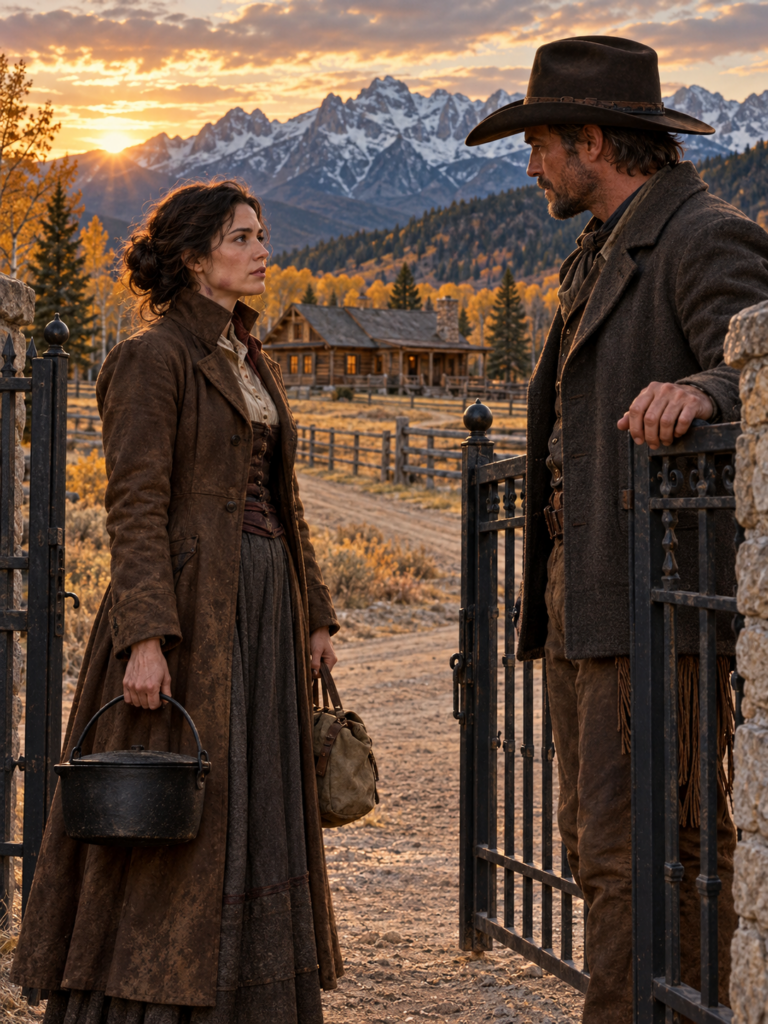
It was the same gate she had entered carrying a cast-iron pot and all the possessions she had managed to save.
Garrick stood beside her.
“I nearly didn’t open it.”
“I know.”
“You looked as though you’d turn around and leave if I asked another question.”
“I might have.”
He smiled faintly.
She looked at him.
“I was frightened that day.”
“I could tell.”
“I was also angry.”
“That was fairly plain.”
She laughed.
Then she grew thoughtful.
“I believed the only safety I could ever have would come from staying beyond the reach of men like Victor.”
Garrick waited.
“But staying here taught me something different.”
“What?”
“That I could build a life worth protecting without surrendering the right to choose how I lived it.”
He took her hand.
“And you’ve done that.”
She looked toward the bustling kitchen.
Her old iron pot sat on a shelf near the range.
It had traveled with her across Colorado.
It had once seemed like the only useful thing she could be certain was hers.
She still used it.
Not because she lacked better equipment.
Because it reminded her of the woman who had refused to surrender herself, even when she had little else left.
“I want to keep that pot forever,” she said.
Garrick glanced at it.
“Even though we’ve enough pots to feed a small army?”
“Especially then.”
He smiled.
“Then it stays.”
Outside, Callum crossed the yard carrying a basket of apples.
Holt was returning from the north pasture.
Two hands were repairing a section of fence.
The sounds of ordinary ranch life drifted through the open window.
Elena set down her coffee.
“There’s supper to finish.”
“I’ll help.”
She gave Garrick a doubtful look.
“You’re improving, but I still wouldn’t trust you with the biscuits.”
“Then give me something I can’t spoil.”
“Set the table.”
He did.
Twelve plates.
Twelve cups.
Fresh bread waiting near the range.
A room once left empty because its owner could not bear the memories it held now welcomed people every evening.
Elena carried her old iron pot to the stove and lifted the lid.
A rich fragrance spread through the kitchen.
Garrick looked up from the table.
“Smells good.”
“It ought to. I’ve been cooking it all afternoon.”
He came to stand beside her.
For a moment they looked at each other in the warm light.
She remembered the rancher who had stood twenty feet away from her at the gate, uncertain whether he should trust the stranger carrying a pot.
He remembered the tired woman who had refused to beg.
Neither could have imagined the road ahead.
The danger.
The long winter.
The courthouse.
The bakery.
The wedding.
The quiet work of learning how to love without controlling.
Garrick reached for her hand.
Elena gave it freely.
Then Callum called from the dining room.
“Mrs. Dalton, are we eating soon?”
“In a moment!”
Garrick smiled.
Elena squeezed his hand and returned to the stove.
Beyond the windows, the San Juan Mountains rose blue and immense against the evening sky.
The gate remained open for travelers who came in good faith.
The house was warm.
The table was ready.
And the woman who had arrived asking for work had built a home, a business, and a future in which her life belonged to her.
This time, she was not running from anything.
She was exactly where she had chosen to be.