Part 1
The pistol was pointed directly at Celia Monroe’s chest, and the man holding it was someone she had once made cinnamon rolls for.
That was the part her mind couldn’t quite accept.
Not the weapon. Not the empty hotel kitchen after midnight. Not even the painful pressure of his fingers around her upper arm.
It was the familiar, kindly face of Victor Lanning.
A man who had complimented her baking, asked after her grandmother’s recipes, and sat beside Roman Blackwell at countless lunches.
Now he wanted her notebook.
“Where have you hidden it, Celia?” he asked.
His voice was almost affectionate.
She could hear the refrigeration units humming behind her. On the counter, a tray of lemon tarts waited beneath the fluorescent lights. She had spent the evening worrying about whether their delicate crusts would survive the hotel reception.
Now she was wondering whether she would survive the kitchen.
Victor tightened his grip.
“Don’t make this unnecessarily difficult.”
Celia swallowed.
Her heart was pounding, but she kept her eyes on his face.
“No.”
The service door opened.
A man in a black overcoat stepped inside, silver threading through his dark hair.
Roman Blackwell.
Fifty-nine years old. Head of the most feared criminal family in Nashville. A man whose quietest decisions could change another man’s life forever.
He looked at the gun.
Then at Celia.
For one devastating second, his expression revealed something nobody in Tennessee had ever expected to see.
Fear.
“Victor,” he said, his voice dangerously controlled. “Let her go.”
Eight months earlier, none of them could have imagined arriving at this moment.
Especially not Celia.
Because in February, the only dangerous thing in her life had seemed to be an elderly hotel guest who refused to eat his pear tart.
At 4:15 every morning, Celia’s alarm sounded in her apartment above a laundromat in East Nashville.
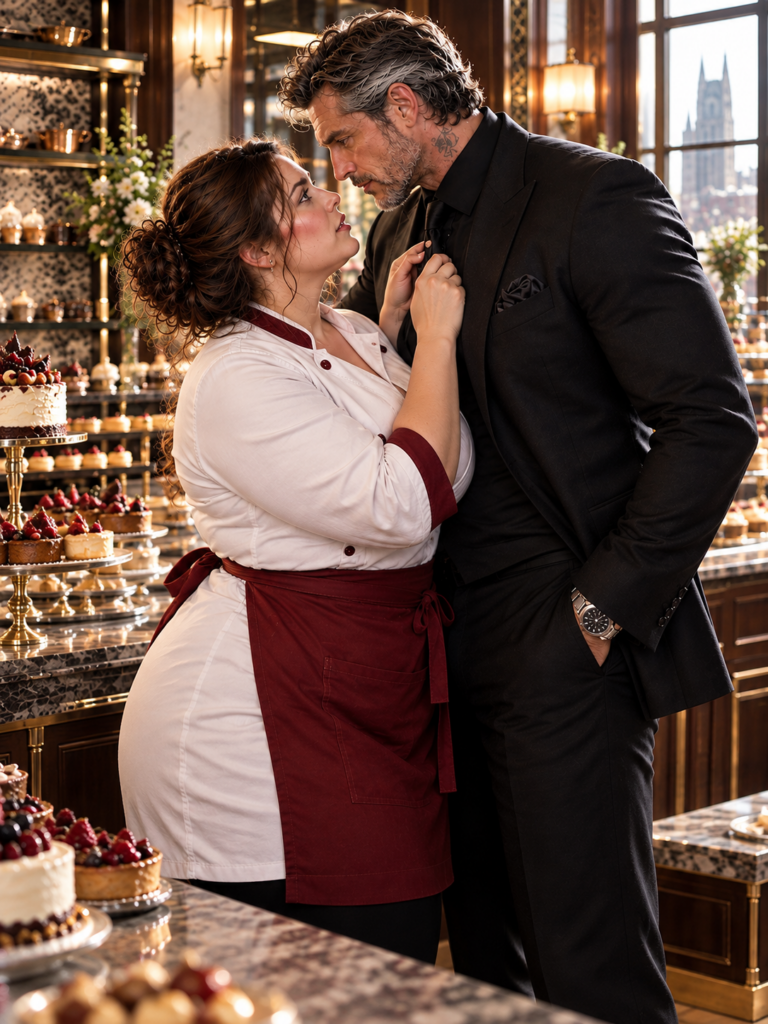
She was thirty, with dark curls that rarely stayed pinned beneath her kitchen hat, generous curves, strong arms, and a face people often mistook for an invitation to underestimate her.
She had learned to let them make that mistake.
Growing up, her grandmother Josephine Monroe had taught her two essential skills: how to tell when butter was properly softened without touching a thermometer, and how to recognize someone who expected you to surrender your dignity.
Josephine, affectionately known throughout the neighborhood as Nana Joe, had operated a little bakery on Gallatin Pike.
Six stools. A hand-painted sign. A counter that always smelled of cinnamon.
Celia had lived there emotionally long before she understood what a home was.
Her mother had abandoned her when she was seven. Nana Joe had taken her in, taught her to bake, and never once suggested that being left behind made her less worthy of love.
But four years earlier, illness had taken Nana Joe.
The medical expenses had swallowed the bakery’s savings, its equity, and eventually the building.
Celia still remembered standing outside as strangers carried away the stools.
She had saved one thing.
A worn recipe box held closed with a rubber band.
She kept it above her bed.
The remaining medical debt was still $61,000, and every month she sent another $400 toward it.
She could have thought of those payments as punishment.
Instead, she considered them promises.
At the Briarwood Hotel, where she worked as head pastry chef, Celia could temporarily forget those promises beneath bowls of chocolate, trays of pastry, and the constant urgency of preparing desserts for people who rarely knew her name.
The Briarwood was a historic Nashville landmark near the river, with marble floors, glittering chandeliers, and guests who spent more on a bottle of champagne than she spent on groceries in a month.
Celia loved its kitchen.
She loved her team.
She especially loved Dara Okafor, her closest friend, whose laughter could reach the pastry station from the lobby.
What she didn’t love was Dennis Whitlock.
The hotel’s food and beverage director had perfected the art of making cruelty sound like professional advice.
He had publicly joked about the size of Celia’s chef coat when she first started.
Later, he had claimed credit in a regional magazine for her lemon-lavender tart, a recipe inspired by Nana Joe.
When Celia challenged him, Dennis reminded her that management represented the accomplishments of the team.
It was an elegant way of telling her that her work belonged to him.
Celia had endured it.
Not because she lacked courage.
Because she needed her paycheck, and because she was tired of rebuilding everything she loved from ruins.
She had already rebuilt herself once after Brent.
Her former fiancé had been charming, educated, and exceptionally skilled at delivering insults disguised as concern.
At a family wedding, he had told her he loved her but would love her more if she changed her body.
She had left without an argument.
That night, she baked three hundred cookies.
By sunrise, she knew two things.
She would never marry Brent.
And she would never again let someone convince her that she needed to become smaller to deserve affection.
She was less certain whether anyone would ever love her exactly as she was.
Across Nashville, Roman Blackwell faced a different kind of loneliness.
He lived in an enormous house with twelve rooms and almost no laughter.
His family had built its fortune along the Cumberland River, beginning with his grandfather’s hauling business and expanding through trucking, construction, shipping, nightclubs, and political influence.
Roman had inherited both the legitimate businesses and the dangerous network surrounding them.
Police investigations had repeatedly failed to put him behind bars.
People called him a businessman in public.
In private, they called him a mafia boss.
Roman rarely corrected anyone.
He didn’t need to.
His wife, Eleanor, had died of cancer eleven years earlier.
Since her death, his house had remained orderly, expensive, and unbearably quiet.
He had no children.
He had Teddy Pruitt, his loyal bodyguard of fourteen years, and Victor Lanning, his oldest advisor, a silver-haired man whose friendship reached back to Roman’s childhood.
Victor had been beside him at Eleanor’s funeral.
He knew the family history, the business arrangements, and the things Roman would never say aloud.
Beyond those relationships, Roman trusted almost no one.
He was surrounded by people who feared him, needed him, or wanted something from him.
And he had developed one private indulgence.
Occasionally, he escaped to quiet restaurants where he could eat without a roomful of people watching his every movement.
That habit brought him to the Briarwood Hotel one gray Tuesday afternoon.
He had arranged a business meeting with a riverfront developer named Harlan Beaumont in the hotel’s Magnolia Room.
Beaumont left shortly after two, looking noticeably less confident than when he had arrived.
Roman remained at table six.
Teddy stood nearby, carefully positioned to watch the entrance and back stair.
Downstairs, Celia was trying to finish the afternoon pastry orders when Dennis appeared.
“Table six needs a pear tart,” he announced. “Take it up yourself.”
Celia glanced at the ticket.
“Since when am I a server?”
“Since I asked you to be.”
He gave her a quick inspection.
“And please don’t make a production of it.”
She imagined telling him precisely what he could do with his instructions.
Instead, she arranged a delicate pear tart on a white plate, added brown-butter caramel, and finished it with a crisp almond decoration.
Then she carried it upstairs.
The guest was handsome in a severe, almost intimidating way.
Dark charcoal suit. Broad shoulders. Silver hair at his temples.
He looked like a man who considered smiling an unnecessary expenditure.
“Pear tart,” Celia said, placing the plate before him.
“Thank you.”
His attention returned immediately to the papers beside his coffee.
Celia went downstairs.
Forty minutes later, Dara mentioned that table six had barely touched his dessert.
Celia stared at her.
“He hasn’t eaten it?”
“Not really.”
“Then why did he order it?”
Dara shrugged.
“Rich people.”
Celia removed her apron, marched back upstairs, and stopped beside Roman’s table.
“Is there something wrong with the tart?”
Roman looked up.
“No.”
“Then perhaps you’d like to explain why you’ve been conducting a staring contest with it for nearly an hour.”
Teddy lowered his menu.
Roman studied her.
“Are you always this direct?”
“Only when somebody insults my pastry.”
“I haven’t insulted anything.”
“Leaving it untouched is a fairly convincing statement.”
For a moment, Roman appeared genuinely uncertain how to answer.
Then he picked up his fork.
He took a small bite.
His expression changed so subtly that someone less observant might have missed it.
Celia didn’t.
“Well?”
“It’s excellent.”
“That wasn’t terribly painful, was it?”
Roman looked down at the tart.
“My wife used to make something similar.”
The words seemed to surprise him.
Celia softened.
“Does she still bake?”
“No.”
He paused.
“She died.”
Celia felt the shift in the air between them.
She could have apologized excessively. Asked questions. Offered the kind of sympathy people gave because they couldn’t tolerate silence.
Instead, she nodded.
“She must have had good taste.”
Roman looked at her.
“In pastries?”
“In husbands, I was hoping. But I haven’t decided yet.”
Teddy made a suspicious noise behind his menu.
Roman’s mouth moved slightly.
Not quite a smile.
But close.
As Celia turned to leave, she noticed the almond decoration still resting untouched on the plate.
“Don’t like almonds?”
“I’m allergic to tree nuts.”
She stopped.
“How allergic?”
“They affect my breathing.”
Her face changed.
“You should have told me.”
“It seemed unnecessary.”
“Unnecessary?”
She lifted the almond decoration away from him.
“Sir, your throat closing is considerably more important than whether my plate looks pretty.”
Roman stared at her.
She shook her head.
“Next time, speak up.”
Then she disappeared downstairs.
Roman watched the empty doorway for several seconds.
Finally, he turned toward Teddy.
“Find out who made that dessert.”
Teddy’s expression brightened.
“Interested in the chef, boss?”
“Interested in the recipe.”
“Of course.”
“And Teddy?”
“Yes, sir?”
“Nobody needs to know I asked.”
By Thursday, Roman had returned.
By the following week, table six was becoming a routine.
His reservations appeared under the name Roman Black.
Celia considered it an unremarkable name for a remarkably difficult man.
He ordered his coffee black, demanded it extremely hot, and complained when it burned his tongue.
She explained that hot things were often hot.
He informed her that sarcasm was an unattractive professional quality.
She told him he was welcome to register a complaint.
He never did.
Instead, he returned every Tuesday and Thursday.
Over time, Celia noticed something else.
He held the dessert menu farther from his face than necessary.
One afternoon, she placed a pair of inexpensive purple reading glasses beside his coffee.
Roman examined them.
“What are these?”
“Your dignity’s last chance.”
“I can read perfectly well.”
“Then stop holding the menu halfway across Tennessee.”
Teddy turned toward the wall.
Roman put the glasses on with obvious reluctance.
They were a little too small.
And spectacularly purple.
Celia pressed her lips together.
Roman lowered the menu.
“Don’t.”
“I haven’t said anything.”
“You’re thinking it.”
“Very loudly.”
Behind him, Teddy coughed until Roman ordered him to stop.
The nickname came shortly afterward.
Roman was criticizing the hotel’s sugar bowls when Celia interrupted.
“Good grief, old man. It’s sugar, not an international crisis.”
Roman looked up.
“Old man?”
“Would you prefer grandfather?”
“I’m fifty-nine.”
“Then you are precisely old enough to stop arguing with kitchen equipment.”
She expected annoyance.
Instead, he looked almost entertained.
A few weeks later, Celia was working late on a three-tier birthday cake, carefully shaping tiny sugar roses when she noticed Roman standing at the kitchen entrance.
He had apparently come to retrieve an umbrella.
Except the weather was dry.
And he had never brought one.
Celia watched him watching her.
“Something you need?”
Roman’s eyes moved from her face to the cake.
“Beautiful work.”
“Careful. Compliments might damage your reputation.”
She caught the unexpected smile that appeared across his face.
A complete smile.
For the first time, the stern lines around his mouth seemed to belong to a different man.
Celia grinned.
“Look at that. The old man has teeth.”
He immediately recovered his composure.
“I came for my umbrella.”
“Naturally.”
He left without it.
Celia laughed until she had to put down her piping bag.
Outside, Teddy stared at Roman’s faintly reddened face.
For fourteen years, he had watched dangerous men tremble before his employer.
He had never watched his employer blush over a pastry chef.
In April, the Briarwood hosted its annual luncheon for the Nashville Builders Association.
Forty guests. Three courses. A complicated dessert service.
And one critical dietary restriction.
A guest at table one required a completely nut-free dessert.
Celia prepared a lemon posset in a glass and marked it with a green pick.
She personally checked the plate count and instructions.
When the dessert trays began leaving the kitchen, she checked again.
Something was wrong.
The lemon posset remained on the counter.
But a green pick was missing.
Celia counted the desserts on the departing tray.
And saw it.
A pistachio-crusted tart.
Marked with green.
Her stomach dropped.
She ran.
The Magnolia Room was filled with expensive suits and polite conversation when Celia pushed through the doors.
At the head table, Roman Blackwell was raising a fork.
The pistachio tart sat directly in front of him.
“STOP!”
Her shout cut through the room.
She reached him and struck the fork from his hand.
It hit the table, bounced, and fell onto the carpet.
Forty guests stared.
Teddy moved instantly, one hand disappearing inside his jacket.
Celia scarcely noticed.
“Don’t eat that,” she said breathlessly. “It’s got pistachios. Your dessert is still downstairs. Someone switched the marking.”
Roman looked from the tart to her face.
“You remembered.”
“Of course I remembered.”
“That was two months ago.”
“And you’re still allergic, aren’t you?”
The room remained motionless.
Then Teddy went looking for the waiter who had delivered the plate.
Kyle was intercepted near the loading dock.
Terrified, he admitted that a stranger had given him five hundred dollars and instructed him to switch the green marker.
He had been told it was a harmless prank.
Mrs. Margaret Ashby, the hotel’s formidable owner, immediately took control of the luncheon.
She thanked Celia for identifying a serious service error and promised the guests replacement desserts.
Dennis attempted to blame the pastry department.
Margaret turned toward him.
“Your own event order contained the correct instructions, Dennis. I suggest you remember that before assigning responsibility.”
Afterward, Roman found Celia in the service corridor.
Her hands were still shaking.
“How did you know it was my plate?”
“You told me about your allergy.”
He regarded her quietly.
“And you kept that in mind?”
“Roman, I remember which customers prefer extra caramel. I certainly remember which ones could die from eating nuts.”
He said nothing.
Something about his silence made her uncomfortable.
So she returned to the kitchen and brought him his lemon posset in a small paper bag.
A handwritten note was attached.
For the old man. Don’t rush.
When Teddy later offered her an envelope of money, she refused it.
“I didn’t save him for a reward.”
Teddy hesitated.
“Then is there anything I can do?”
Celia considered him.
“Do you like cinnamon rolls?”
The enormous man’s eyes widened.
“Very much, ma’am.”
She made him twelve.
For several weeks, life almost returned to normal.
Then Dara found Celia after a Friday shift in May, holding her phone with both hands.
“Celia. You need to see this.”
On the screen was a local news report about another racketeering case that had collapsed.
A man in a charcoal suit emerged from the courthouse, accompanied by an enormous bodyguard.
The caption identified him.
Roman Blackwell.
Head of the Blackwell family.
One of Tennessee’s most notorious organized-crime figures.
Celia watched the footage twice.
Then she took off her apron.
Dara reached for her.
“Where are you going?”
“To ask an old man a question.”
And for the first time since they had met, Celia wasn’t smiling.
Part 2
Roman Blackwell was standing on the front steps of his Nashville mansion when Celia arrived.
The driveway was long, the gates imposing, and the building itself looked like it belonged to a family that had never needed to count money.
Celia barely noticed.
“Roman.”
He turned.
One look at her face told him everything.
“Who told you?”
She held up Dara’s phone.
“You’ve been on television.”
Roman’s expression became guarded.
“Celia—”
“Are you the head of the Blackwell family?”
“Yes.”
“Is that why Teddy watches every doorway?”
“Yes.”
“And those meetings at the hotel?”
“Business.”
“What kind?”
He hesitated.
She laughed without humor.
“That answers enough.”
Roman descended one step.
“I never intended to hurt you.”
“That’s what people say when they get caught hiding something.”
He accepted the accusation.
Celia crossed her arms.
“Why pretend to be somebody else?”
Roman looked toward the iron gates.
The sun was settling behind the trees, casting long shadows across the driveway.
“Because I wanted to spend an hour somewhere without being Roman Blackwell.”
He paused.
“One hour where the woman bringing my coffee wasn’t calculating what I could do for her. Where somebody could laugh at my glasses without worrying about consequences.”
Celia felt her anger collide with an unexpected understanding.
He had wanted to be seen without his power.
She had spent her life wanting to be seen beyond her appearance.
The resemblance troubled her.
“You should have trusted me with the truth.”
“I know.”
“You might have lost me.”
“I know that too.”
For a long moment, neither spoke.
Then Celia raised three fingers.
“If you want me in your life, there are conditions.”
Roman straightened instinctively.
“Tell me.”
“No more lies. I won’t spend my time wondering which version of you is real.”
He nodded.
“Second, nobody gets hurt in my kitchen. Not a waiter, not a customer, not somebody you dislike.”
“Agreed.”
“Third, if your doctor tells you to avoid sugar, you listen.”
Roman blinked.
“That last condition seems unrelated.”
“It’s very related. And you can stop hiding lemon tarts in your briefcase.”
Roman looked genuinely startled.
“How did you find out about that?”
From behind a nearby hedge came the unmistakable sound of Teddy attempting to make himself scarce.
Celia pointed.
“Your security leaks.”
For the first time that evening, Roman smiled.
It didn’t erase the deception.
But it gave them somewhere to begin.
Roman’s first attempt at sending Celia a text message arrived early Saturday morning.
Good morning. Roman.
A second message followed.
This is Roman.
Then:
Blackwell.
Celia nearly spilled her coffee laughing.
She replied with a doughnut emoji.
After an unusually long delay, Roman responded.
What is the meaning of the round pastry?
Before she could answer, another message arrived.
Are you making fun of me?
Celia typed:
It means I was thinking about you, old man.
She stared at those words longer than she wanted to admit.
Then she put the phone facedown.
The realization was becoming impossible to ignore.
She was falling in love with him.
And although Roman would have preferred facing another police investigation to discussing his feelings, he was experiencing the same terrifying change.
In June, a chocolate supplier named Gavin stopped by the Briarwood.
He was handsome, talkative, and very enthusiastic about Celia’s work.
He lingered beside her counter, asking questions about chocolate and whether she ever accepted dinner invitations from vendors.
Celia laughed at one of his jokes.
Across the Magnolia Room, Roman slowly set down his coffee.
He removed his purple glasses.
And stared.
Gavin glanced toward him.
Whatever he saw in Roman’s expression ended the conversation immediately.
He announced that he had another appointment and left.
Celia marched over holding a spatula.
“What did you do?”
Roman looked up.
“Nothing.”
“You frightened the chocolate salesman.”
“I observed him.”
“You stared at him like he had stolen government secrets.”
“He was standing rather close.”
“It’s a pastry counter, Roman. People stand near it.”
“He was leaning.”
“That is often what counters are used for.”
Roman folded his napkin.
“I didn’t care for him.”
Celia’s eyes widened.
Then she burst out laughing.
“Oh, this is wonderful.”
“What is?”
“You’re jealous.”
“Don’t be ridiculous.”
“Of a man who sells couverture chocolate.”
“I was evaluating his intentions.”
Celia leaned toward him.
“Old man, you were jealous.”
Roman held her gaze.
Then, with visible reluctance, he admitted, “I disliked the way he looked at you.”
Her laughter softened.
“You’re allowed to dislike him. You aren’t allowed to frighten away everyone who speaks to me.”
Roman considered that.
“Fair.”
“Good.”
She straightened his coffee cup.
“And for the record, I wasn’t interested in Gavin.”
Roman looked at her with such unguarded relief that she nearly kissed him then and there.
Nearly.
The first time Celia witnessed Roman’s grief without the protection of his usual composure was on a July evening.
Teddy had accidentally mentioned that Roman visited a cemetery on the nineteenth of every month.
Celia took the bus to the hillside cemetery north of the city.
She found Roman seated near a simple gray marker bearing Eleanor Marie Blackwell’s name.
He had removed his hat and rested it against his knee.
Celia sat beside him.
For several minutes, they listened to the cicadas.
“She liked baking,” Roman finally said.
Celia waited.
“She wasn’t particularly good at it.”
A faint smile crossed his face.
“But she could make a pear tart.”
He explained how Eleanor had carefully omitted almonds because of his allergy, even while teasing him for making dessert preparation so inconvenient.
Celia watched his hands tighten around the hat.
“I think I kept the house exactly as she left it because changing anything felt like losing her again.”
“Does it help?”
“Not anymore.”
He stared at the gravestone.
“I used to think silence was peaceful. Now I come home, and sometimes I can hardly bear the sound of my own footsteps.”
Celia reached for his hand.
His fingers closed around hers.
“My grandmother died four years ago,” she said. “I still have her recipes. Sometimes I talk to that old box when I don’t know what else to do.”
Roman turned toward her.
“Does it answer?”
“Only when I’ve forgotten to add enough salt.”
He gave a small, broken laugh.
Then she rested her head against his shoulder.
For the first time, Roman understood that allowing someone to comfort him did not diminish his strength.
It required a different kind.
Two days later, however, he made a mistake.
He arrived at the Briarwood carrying a letter from his lawyer.
The letter outlined a plan for settling Celia’s remaining medical debt.
All $61,000.
Immediately.
Celia read it twice.
Then she looked up.
“No.”
Roman frowned.
“It’s entirely manageable.”
“For you.”
“Celia—”
“No.”
He set his hands against the back of a chair.
“Why must you make everything so difficult?”
Her expression tightened.
“Because you think money makes difficult things disappear.”
“I think money can make this particular burden disappear.”
“And then what?”
“Then you would be free of it.”
Celia shook her head.
“You don’t understand.”
She held out the letter.
“Those bills came from caring for my grandmother. I’ve been paying them because she gave me everything when nobody else would. Every payment is something I chose.”
Roman listened.
“I know you’re trying to help. But I don’t want to become someone whose life you manage.”
His eyes lowered to the paper.
“What do you want, then?”
Her voice softened.
“For you to respect the difference between helping me and taking over.”
Roman took back the letter.
He folded it neatly.
“Then I won’t pay it.”
Celia studied him.
“Even if it bothers you?”
“Especially then.”
It was one of the hardest promises he had ever made.
And one of the most important.
Later that July, Dennis Whitlock gathered the pastry staff for a meeting.
He displayed the magazine featuring his supposed signature lemon-lavender tart and congratulated himself on its popularity.
Celia stood beside Dara, listening as her own creation was praised under someone else’s name.
Then Dennis glanced at her.
He made a comment about the kitchen staff needing greater discipline around employee meals.
A few uncomfortable laughs followed.
Celia felt heat rise in her face.
She could have destroyed him with words.
Instead, she carefully removed her apron and walked out.
Roman was waiting in his car.
Teddy had already told him enough to make his temper dangerous.
When Celia climbed into the back seat, Roman turned toward her.
“Who did it?”
She closed her eyes.
“Please don’t.”
“Celia.”
“If you make him apologize because he’s afraid of you, he won’t respect me. He’ll just be afraid of you.”
Roman stared ahead.
“I can correct the situation.”
“I know. That’s the problem.”
Her voice trembled.
“I need one victory in my life that belongs entirely to me.”
Roman took a slow breath.
Then he placed his hand over hers.
“What would help?”
“Drive.”
“Where?”
“Anywhere.”
They spent the next hour circling the river roads.
Celia leaned against his shoulder.
Roman said almost nothing.
For a man accustomed to settling problems with orders, learning to remain still beside another person’s pain was unfamiliar territory.
But he was learning.
And Celia, without knowing it, was about to find the one thing his money and influence had failed to uncover.
The identity of the man betraying him.
Celia had always kept meticulous records.
Her spiral notebook contained pastry deliveries, supplier invoices, staff orders, and event schedules.
Nana Joe had taught her that a bakery could lose money through a hundred small mistakes before anyone noticed the missing dollars.
One rainy evening in August, Celia was checking the previous months’ invoices when an unusual pattern emerged.
On days when Roman held meetings at the Briarwood, an additional supplier delivery appeared.
The company was Delmar.
Its driver, Luis Herrera, arrived in a white van with a dented bumper.
He usually remained at the loading dock for nearly an hour.
Yet Celia could recall him carrying only a single crate inside.
She checked the event schedules.
On those same days, the adjoining Camellia Room was reserved by Lanning and Pierce Development.
Four guests.
Private lunch.
No food orders.
Not once in six months.
Celia frowned.
Hotel guests sometimes canceled meals.
They did not repeatedly book private dining rooms without eating.
Especially not on the exact dates Roman met with business associates.
She went through the notebook again.
The pattern held.
Rather than confront Roman with an unproven suspicion, she began watching.
For a week, she recorded delivery times and checked reservation sheets.
Then, one Tuesday, she found Luis sitting alone at the back of his van.
He was crying.
Celia sat beside him and offered a lemon bar.
He tried to pretend he was fine.
She didn’t believe him.
After a long silence, he spoke about his nine-year-old daughter, Marisol.
She had a serious heart defect.
The operation she needed would cost eighty thousand dollars, and he had been told insurance would not cover it.
His hands shook as he explained.
A man had approached him with an offer.
Money in exchange for information.
Which rooms an important guest used.
When meetings were scheduled.
Who attended.
He had been assured that no one would be harmed.
Celia thought of the pistachio tart.
The green marker.
The frightened waiter with five hundred dollars.
“Did this man have silver hair?” she asked.
Luis looked at her.
“Yes.”
“Do you know his name?”
“No.”
“Anything distinctive?”
Luis hesitated.
“He wore a gold ring. On his little finger. It had some kind of family crest.”
Celia felt cold.
She knew that ring.
She had seen it on the hand of a pleasant elderly man who liked pecan sticky buns.
Victor Lanning.
She called Roman.
“I need you at the hotel.”
“What’s wrong?”
“I’ve found something.”
“Are you safe?”
“Yes. But bring Teddy.”
They met in the pastry office.
Luis sat near the desk, barely touching his lemon bar.
Teddy guarded the doorway.
Celia spread her notebook open and showed Roman the dates.
Delmar deliveries.
Private reservations.
Meeting schedules.
The pattern was impossible to dismiss.
Roman examined the pages without interrupting.
When he reached the name Lanning and Pierce Development, he stopped.
He turned toward Luis.
“Describe the ring again.”
Luis obeyed.
Roman’s face lost its color.
“My father gave Victor that ring when I was born.”
Nobody moved.
Roman looked at the documents.
“I approved that company’s registration eight years ago.”
Celia placed her hand on his arm.
He seemed barely aware of it.
Victor wasn’t merely an employee.
He had been present throughout Roman’s life.
He had advised his father, taught Roman practical lessons when he was young, and supported him through Eleanor’s death.
For decades, Roman had believed that bond was beyond question.
Now a pastry chef’s notebook suggested otherwise.
Roman finally turned toward Luis.
“Your daughter.”
Luis looked up in terror.
“Sir, please—”
“She needs surgery?”
“Yes.”
“Then she’ll receive it.”
Luis blinked.
Roman spoke with deliberate calm.
“I’ll arrange the hospital expenses. You’re not buying forgiveness, and I’m not purchasing your silence. A child needs medical care. That’s all.”
Luis covered his face and cried.
Celia watched Roman.
He could not accept every kindness she offered him.
But he could choose to offer kindness without demanding anything in return.
And that mattered.
Once Luis was escorted somewhere safe, Roman explained the larger danger.
Dominic Varga, an ambitious criminal figure in Memphis, wanted control of the Nashville River Terminals.
He had been searching for a way into Roman’s operations for two years.
Victor possessed the access Varga lacked.
And Victor had spent decades wanting more influence than Roman had given him.
The Camellia Room had served as a listening post.
The deliveries carried information outward.
The incident with the allergy might have been a warning, or an attempt to determine how vulnerable Roman really was.
Now Celia had exposed the connection.
And that placed her in danger.
Roman turned toward her.
“You’re leaving Nashville.”
Celia stared at him.
“No.”
“Teddy has a sister in Asheville. There’s a farmhouse. Nobody will find you.”
“I’m staying.”
His voice hardened.
“This isn’t a discussion.”
Celia rose from her chair.
“That’s exactly why I’m saying no.”
“Celia, Victor knows you’ve been looking into the deliveries.”
“And you want me to abandon my life?”
“I want you alive.”
Her eyes filled, but she held his gaze.
“My mother left me. Brent decided I wasn’t enough. Dennis tries to make me disappear every day. I’m not running away from my own life because another man thinks he has the right to decide where I belong.”
Roman looked stricken.
“That’s not what I’m doing.”
“Then stop trying to protect me by taking away my choices.”
His hands opened slowly.
“What are you asking?”
“Let me stand with you.”
He looked at her for a long time.
Then he nodded.
“With me,” he repeated.
“Yes.”
He took her hand.
And for the first time in his life, Roman Blackwell entered a dangerous situation knowing that he could not simply command the person he loved.
Over three nights, they prepared a plan in Celia’s small apartment.
A map of Nashville’s riverfront lay across her bed.
Teddy occupied the couch.
Roman drank terrible amounts of coffee while Celia organized evidence.
The plan depended on Victor believing that Roman remained unaware of his betrayal.
Roman would continue their usual contact.
He would also let it slip that he intended to meet a representative connected to Dominic Varga at the Briarwood on Friday night.
Teddy’s men would be positioned to intercept the visitors and provide witnesses.
Celia’s notebook would establish the chain of deliveries and reservations.
She agreed to remain away from the confrontation.
Then Friday arrived.
At five minutes before four, Margaret Ashby called the pastry kitchen.
The hotel’s centennial reception had unexpectedly been moved forward.
Three hundred guests would arrive that evening.
The enormous six-tier anniversary cake Celia had spent weeks building was required at seven-thirty.
Celia stared at the cake.
A miniature Briarwood made from sugar, buttercream, marzipan windows, and a delicate chandelier.
She couldn’t leave her staff to handle it alone.
She sent Roman a message.
I have to stay for the cake. I’ll remain in the kitchen. Teddy’s people are here.
His reply came several minutes later.
Be careful. I’ll get there when I can.
That evening, Roman hosted Victor for dinner in his mansion.
They ate veal at the long dining table while Victor reminisced about Roman’s father.
Roman watched the familiar gold ring move around Victor’s wineglass.
He wondered how many years the man had been preparing to betray him.
At 10:10, Victor received a call and excused himself.
Ninety seconds later, Roman went looking for him.
The hallway was empty.
The front door stood slightly open.
And Victor’s car was already disappearing down the driveway.
At the Briarwood, the centennial reception ended.
The cake had been admired, photographed, and served.
Margaret Ashby had kissed Celia on both cheeks and told her Nana Joe would have been proud.
Dara went home around ten-thirty.
At eleven-fifteen, Celia was alone in the kitchen cleaning her station when the service door opened.
Victor Lanning stepped inside.
“Good evening, my dear.”
His silver hair was immaculate.
His smile was familiar.
And on his little finger, the gold ring caught the kitchen lights.
“Roman asked me to look in on you,” he said.
Celia felt her pulse accelerate.
“Roman would have contacted me himself.”
Victor sighed.
“You’re a clever girl.”
He walked toward her.
“Then I suppose there’s no reason to pretend.”
His hand closed around her arm.
“I need your notebook.”
And when she refused, he drew a gun.
Part 3
Celia understood immediately that Victor hadn’t come to negotiate.
He had entered the hotel through corridors where Teddy’s men had seen him a hundred times before.
For years, Victor Lanning had walked through Roman Blackwell’s security without challenge.
Tonight, that familiarity had become his greatest weapon.
“Give me the notebook,” Victor said.
Celia stood beside the pastry counter, aware of the pistol and the small distance separating them.
She had left a tray of lemon tarts behind her.
One had a cracked edge.
A ridiculous detail to notice.
Yet her mind clung to it while she tried to control her breathing.
“Why?” she asked.
Victor’s expression hardened.
“You already know why.”
“I know you were watching Roman.”
His grip tightened.
“I know you were helping Dominic Varga.”
“Then you understand this is considerably bigger than you.”
Celia looked at his ring.
She remembered the day he had eaten one of her sticky buns and told her it reminded him of his mother’s kitchen in Chattanooga.
He had looked happy.
She had made him a box to take home.
“Was any of it real?” she asked.
Victor hesitated.
“What?”
“Your friendship with Roman. All those meals. The way you stood beside him when his wife died.”
His eyes darkened.
“Don’t speak to me about Eleanor.”
“Then tell me why you’re doing this.”
For several seconds, he said nothing.
Then his composure fractured.
“Because I gave that family my entire life.”
Celia watched him.
“Thirty years,” he continued. “Thirty years of cleaning up disasters, protecting contracts, making arrangements nobody else had the stomach to make.”
His voice rose.
“I stood beside Roman while the city worshipped and feared him. I helped carry the weight of that empire, and I was always the man beside the throne.”
He looked toward the kitchen door as though Roman might somehow be listening.
“At my own wife’s funeral, he barely noticed my grief.”
Celia swallowed.
Victor laughed bitterly.
“And then you arrived. A pastry chef. A woman with flour on her clothes and a talent for making him laugh.”
The pistol trembled slightly.
“I watched him change for you in months after spending decades convincing myself he was incapable of change.”
“That’s not my fault.”
“No.”
His voice softened.
“It isn’t.”
He looked exhausted.
“Varga offered me half the river. Not a salary. Not another favor. A position of my own.”
Celia understood then.
The money mattered.
But the humiliation mattered more.
Victor had spent so many years measuring his worth against Roman’s power that he could no longer recognize the friendship he was destroying.
He raised the pistol.
“Where is the notebook?”
Celia’s heartbeat pounded in her ears.
She knew exactly where it was.
In the pocket of her chef’s coat.
She did not look down.
“I’m not giving it to you.”
His face became unbearably sad.
“I’m sorry, Celia.”
The service door opened.
“Victor.”
Roman stood in the doorway, his black overcoat still buttoned.
Teddy loomed behind him.
Roman’s eyes went straight to Celia’s arm.
Then to the pistol.
“Release her.”
Victor turned.
The gun moved with him.
“Roe.”
The old nickname sounded obscene in the circumstances.
Roman stepped forward.
“Whatever you want from me, you can discuss with me. She’s done nothing to you.”
Victor gave a strained laugh.
“She’s done everything. She found what your security couldn’t. She convinced you to trust somebody outside our world.”
“She didn’t make you betray me.”
Victor’s mouth twisted.
“You still don’t understand.”
Roman kept his hands visible.
“Then explain it after you’ve put that gun down.”
For one second, Victor’s attention shifted completely toward him.
And in that second, he forgot what Celia was capable of.
She had spent fifteen years carrying heavy flour sacks, lifting stockpots, and working through physical exhaustion.
She was shorter than Victor.
But she was strong.
And she was close.
She drove her weight against his gun arm, forcing it upward.
The pistol fired.
A tremendous crack shattered the kitchen.
Plaster burst from the ceiling.
A light fixture broke.
Celia stumbled as Victor lost his balance.
Then Teddy hit him.
The bodyguard drove Victor backward against a steel counter, pinning him before he could raise the weapon again.
The pistol slid across the floor.
Roman didn’t look at it.
He crossed the kitchen straight toward Celia.
“Celia.”
His voice barely resembled his own.
He caught her shoulders.
“Look at me.”
She turned toward him.
There was plaster in her hair.
Her hands were shaking.
“Are you hurt?”
“I don’t think so.”
“Did he shoot you?”
“No. The ceiling.”
Roman touched her face, searching for injuries.
“Tell me you’re all right.”
She placed her hands over his.
“I’m all right.”
He closed his eyes.
For one terrible moment, he simply held her.
Celia felt the tremor moving through him.
This man had survived armed enemies, federal investigations, and decades of violence without openly surrendering control.
But now his hands shook because he had nearly lost her.
She reached into her coat pocket.
“Roman.”
He opened his eyes.
She produced the spiral notebook.
“I didn’t let him have it.”
A sound escaped him somewhere between a laugh and a sob.
“Celia Monroe.”
“What?”
“You’re going to shorten my life.”
She gave him a shaky smile.
“Your dessert habits will manage that long before I do.”
He pulled her against him.
Behind them, Teddy secured Victor and brought him to his feet.
The older man looked suddenly diminished.
His coat was torn.
His silver hair hung out of place.
Blood marked his lower lip.
Roman finally turned.
For several moments, the two men regarded one another.
An entire lifetime seemed to stretch between them.
“I trusted you,” Roman said.
Victor looked away.
“You trusted me to remain useful.”
“You could have asked me for anything.”
Victor’s eyes filled.
“Anything you decided I deserved.”
Roman’s expression tightened.
“I would have shared more with you.”
“A place beside you, perhaps.”
Victor looked directly at him.
“But never your place.”
Celia watched Roman absorb the answer.
There was no satisfying victory in it.
The man who had comforted him through Eleanor’s final illness had stood in a hotel kitchen and threatened the woman he loved.
No amount of anger could restore what had been destroyed.
Roman approached Victor.
He placed a hand on his shoulder.
“You’re leaving Tennessee tonight.”
Victor said nothing.
“You take whatever is in your pockets. You do not return to Nashville. You do not approach Celia. You do not contact anyone connected to her.”
Victor met his eyes.
“And if I refuse?”
Roman’s voice lowered.
“You already know what that would mean.”
For a moment, Victor seemed about to argue.
Then he looked at Celia.
“I’m sorry,” he murmured.
She didn’t answer.
An apology could not erase the pistol, the gunshot, or the betrayal.
Teddy escorted him away.
Outside, three men associated with Dominic Varga had arrived near the loading dock expecting a meeting.
Teddy’s security team was waiting.
Their attempted entry ended before they could reach the hotel.
Celia later chose not to ask what arrangements Roman made afterward.
She had lived through enough danger to know she wanted no further part in it.
At two in the morning, Celia sat in the back seat of Roman’s car.
A blanket covered her shoulders.
Someone had placed warm tea in her hands.
Roman sat beside her, keeping a careful distance.
She understood why.
He was afraid that touching her would remind her of everything that had happened.
For a long while, they watched the deserted streets through the windows.
Finally, Roman spoke.
“I brought this danger into your life.”
Celia looked at him.
“Don’t.”
“I should have—”
“Roman.”
He stopped.
“I knew there was danger. I decided to stay. That decision belonged to me.”
His eyes searched her face.
“I nearly lost you.”
“But you didn’t.”
“That’s not enough.”
“It has to be enough for tonight.”
She leaned against his shoulder.
Slowly, his arm settled around her.
“You’re the bravest woman I know,” he said.
“And the most troublesome?”
“Without competition.”
Celia smiled against his coat.
“Good.”
He kissed the top of her head.
She fell asleep before they reached her apartment.
For the first time in years, Roman did not return home feeling only the weight of what he had lost.
He was still frightened.
Still grieving the friendship that had been destroyed.
But in his arms was someone who had chosen to stay beside him.
Not because she feared him.
Because she loved him.
Over the next several days, Nashville returned to its familiar routines.
At the Briarwood, maintenance workers repaired the damaged kitchen ceiling and replaced the broken fixture.
The hotel described the incident publicly as a minor electrical problem.
Dominic Varga lost his foothold in Nashville and withdrew to Memphis.
Without Victor’s access, his ambitions concerning the Nashville River Terminals collapsed.
Luis Herrera’s daughter, Marisol, underwent her heart operation.
Roman had kept his promise.
Luis waited at the hospital through the long procedure, terrified that the money had arrived too late to help her.
Teddy remained with him.
When the doctors finally reported that the operation had succeeded, Luis cried so hard that Teddy had to steady him.
Marisol woke up asking for ice cream.
When Celia heard, she laughed and cried at once.
It was the best news she had received in weeks.
But the consequences of her notebook had not finished unfolding.
The following Friday, Margaret Ashby asked Celia to visit her office.
The hotel owner was seated behind an enormous desk.
An envelope lay in front of her.
“Close the door, dear.”
Celia obeyed.
Margaret gestured toward the chair.
“We need to discuss Dennis Whitlock.”
Celia braced herself.
“Has he complained about me?”
Margaret raised an eyebrow.
“He is in no position to complain about anybody.”
She explained that investigators had examined the hotel’s event schedules, financial records, and the evidence connected to the notebook.
Dennis had been selling confidential hotel information to outsiders for more than a year.
His gambling debts had made him vulnerable.
The suspicious schedules were not merely the result of Victor’s manipulation.
Dennis had been providing information for money.
He had been dismissed.
Police had been waiting when he left.
Celia sat very still.
For two years, Dennis had taken credit for her work, mocked her appearance, and undermined her confidence.
Now his own choices had ended his career at the Briarwood.
And Roman had not needed to threaten him.
The evidence had been enough.
Margaret opened the envelope.
“There’s another matter.”
She removed a letter from the regional magazine.
The editor had agreed to publish a correction identifying Celia as the creator of the lemon-lavender tart.
Celia stared at the page.
Her name.
Attached to her work.
After all the humiliation, the simplicity of it almost broke her heart.
Margaret allowed her a moment.
Then she continued.
“I want you to become the Briarwood’s executive pastry chef.”
Celia blinked.
“What?”
“Effective immediately.”
Margaret named a salary.
Celia stared at her.
“That’s considerably more than I earn now.”
“It should be.”
“But—”
“Celia, I’ve watched you lead this kitchen. You protected a guest during an emergency. Your work has helped build this hotel’s reputation. I don’t intend to lose you because someone else failed to recognize your value.”
Celia’s eyes filled.
Margaret smiled.
“Now, there is one more thing.”
She produced a separate set of documents.
“Mr. Blackwell mentioned a building on Gallatin Pike.”
Celia’s breath caught.
“Joe’s Bakery?”
“He told me you might like the opportunity to reopen it.”
Celia stiffened.
“Did he offer to buy it?”
“No.”
Margaret looked faintly amused.
“He seems to understand that would be an unwise suggestion.”
She slid the papers across the desk.
“I’m offering you a business loan. Proper documents. Fair interest. A reasonable repayment schedule.”
Celia looked down at the proposal.
“This is your money.”
“It’s a commercial arrangement.”
“And the bakery would be mine?”
“Entirely.”
Celia thought of Nana Joe standing behind the counter.
Of the six stools.
Of the hand-painted sign being removed from the building.
Of every $400 payment she had made since the funeral.
For the first time, the dream of reopening Joe’s Bakery was no longer an impossible memory.
It was a decision waiting for her signature.
Margaret handed her a pen.
Celia held it with trembling fingers.
Then she signed.
October brought clear skies and a gentle breeze to Gallatin Pike.
On a bright Saturday morning, the neighborhood gathered outside the restored bakery.
The brickwork had been cleaned.
The windows gleamed.
Inside, the familiar scent of fresh cinnamon rolls drifted through the open door.
The counter was ready.
The kitchen ovens were warm.
Celia had spent weeks preparing the recipes, hiring help, and arranging the displays.
She still held her new position at the Briarwood, and with a stronger team behind her, she had been able to create room for the bakery in her life.
Dara stood near the entrance, emotional beyond all reason.
Teddy, dressed in an immaculate dark suit, had volunteered to oversee the cinnamon-roll samples.
He was taking the responsibility seriously.
Possibly because he had already eaten several.
Celia stood outside in her white chef’s coat.
Her curls were loose around her shoulders.
She kept glancing toward the road.
“Where is he?”
Dara checked her watch.
“He’s not late yet.”
“He said ten.”
“And it’s nine fifty-eight.”
“He could have called.”
Dara gave her a look.
“Have you forgotten how he texts?”
Celia smiled despite her nerves.
She glanced up at the empty space above the bakery door.
The new sign hadn’t arrived.
It was the one detail she hadn’t been able to finish.
At precisely ten o’clock, a long black car pulled alongside the curb.
Roman stepped out.
He wore a charcoal suit, his hair neatly combed, his expression unreadable.
But behind his car came a truck.
Two workers climbed down and carefully opened the rear.
Celia frowned.
“Roman?”
He approached her.
“I found something.”
The workers lifted a long wooden board from the truck.
Its edges were worn.
The red painted lettering was faded.
Celia stared.
Her hand rose slowly to her mouth.
JOE’S BAKERY.
The original sign.
The one that had hung above her grandmother’s shop for decades.
The sign Celia had watched strangers carry away four years earlier.
The workers positioned it above the bakery entrance and secured it carefully.
Celia couldn’t move.
“Where did you get that?”
Roman came to stand beside her.
“It ended up in a salvage yard in Murfreesboro.”
She looked up at him.
“How did you know?”
“I asked someone to look for it.”
His voice softened.
“It took a while.”
Celia traced the familiar red letters with her eyes.
Every chip in the paint belonged to a memory.
She could almost hear Nana Joe calling her from the kitchen.
Almost smell the first tray of rolls coming from the oven when she was little.
Roman watched her carefully.
“I didn’t pay your debts, Celia.”
She looked at him through gathering tears.
“I know.”
“I didn’t purchase your bakery.”
“I know.”
“I found the sign. I paid the owner what he asked for it. That’s all.”
His expression was almost uncertain.
“I hoped it would be something you wanted.”
Celia crossed the space between them.
She threw her arms around his neck.
And cried.
Roman held her without speaking.
People along the sidewalk fell quiet.
A few neighbors recognized the sign immediately.
Some had known Nana Joe.
Others remembered Celia doing her homework on a stool behind the counter.
Now the old name had returned.
And with it, a piece of the neighborhood everyone had thought was gone forever.
“Thank you,” Celia whispered.
Roman held her closer.
She lifted her face.
“That is the most beautiful thing anyone has ever given me.”
He brushed a tear from her cheek.
“You built all of this yourself.”
“Not entirely.”
“Yes, you did.”
His eyes moved toward the bakery.
“I just brought back something that belonged here.”
Celia looked at him for a long moment.
Then she noticed the crowd watching them.
“Oh, goodness.”
“What?”
“Everyone’s staring.”
Roman glanced toward the gathered neighbors.
“That does seem to be the case.”
“What are we supposed to do?”
For once, he looked just as uncertain as she felt.
Then he took her hand.
And turned toward the crowd.
“May I have everyone’s attention?”
The sidewalk grew quiet.
Dara stopped wiping her eyes.
Teddy straightened.
Roman Blackwell, who could control rooms full of dangerous businessmen without raising his voice, now looked distinctly uncomfortable speaking before a collection of bakers, neighbors, and curious customers.
He cleared his throat.
“I’m not especially practiced at speeches of this sort.”
Celia gave his hand an encouraging squeeze.
Roman continued.
“Most of my life, people have responded to me because of my position. Sometimes because of money. More often because they are afraid.”
Nobody interrupted.
He looked at Celia.
“This woman never seemed particularly impressed by any of those things.”
A few people laughed.
“She told me my coffee was too hot. Criticized my reading habits. And managed to make me wear purple glasses.”
Teddy coughed.
Roman gave him a warning glance.
More laughter followed.
Then his expression softened.
“Celia Monroe is one of the most capable people I’ve ever known. She notices what others overlook. She protects the people she cares about. And she refuses to let anyone else decide what she’s worth.”
Celia’s eyes filled again.
Roman turned fully toward her.
“I have spent years believing that being feared was the same as being respected.”
He paused.
“You showed me they are different.”
The breeze stirred her curls.
He lifted her hand.
“And I want to ask you something.”
Celia stared at him.
“You’re asking?”
“Yes.”
The crowd held its breath.
Roman’s voice became quieter.
“I want to know whether you will keep choosing me. Not because of what I own. Not because of my name. And certainly not because you think you owe me anything.”
His thumb moved over her knuckles.
“But because you want me in your life.”
Celia’s lips trembled.
He lowered his voice so only she could hear.
“I’ve spent years thinking love was something I’d already had my share of. Then you walked into a hotel dining room carrying a pear tart, and I discovered how wrong a man can be.”
Celia laughed through her tears.
“Roman.”
His eyes searched hers.
“Yes?”
“Kiss me, you stubborn old man.”
He did.
Right there on Gallatin Pike, beneath the returned bakery sign, with the smell of cinnamon in the air and the whole neighborhood cheering.
Roman placed one hand at her waist and the other against her curls.
Celia held him close, unconcerned with who was watching.
For once, she wasn’t trying to make herself smaller.
She wasn’t hiding her happiness.
She wasn’t wondering whether she deserved it.
When they finally parted, Teddy had dropped an entire tray of cinnamon-roll samples.
He didn’t appear particularly concerned.
Dara was crying openly.
And Roman Blackwell was smiling.
Not the restrained expression Celia had once fought to coax out of him.
A real, unguarded smile.
The kind that belonged to a man who finally believed happiness might stay.
A week later, on a quiet Thursday evening, Celia visited Roman’s private office at the top of the Blackwell building.
The windows overlooked the Cumberland River.
Evening sunlight fell across a long wooden desk.
Roman sat behind it reviewing business documents.
A pair of purple reading glasses rested on his nose.
Celia paused in the doorway.
“Well, look at you.”
Roman glanced up.
“Shouldn’t you be at the bakery?”
“I have excellent people working there.”
“And the hotel?”
“Excellent people there too.”
He set down his pen.
“Then to what do I owe this surprise?”
Celia approached his desk carrying a white pastry box tied with string.
“I brought you a present.”
Roman eyed the box.
“That usually means you’re about to lecture me about something.”
“Only if you deserve it.”
She placed it in front of him.
He carefully untied the string.
Inside were twelve small golden pastries, their flaky surfaces lightly dusted with sugar.
A card rested against the lid.
Roman picked it up.
Sugar-free.
Beneath those words, in smaller handwriting:
Mostly.
He looked at her.
“Celia.”
“Don’t start.”
“My doctor—”
“Your doctor would probably prefer you not eat twelve pastries in one sitting.”
“I had no intention of eating twelve.”
“That’s why I’m taking half back to Teddy.”
Roman sighed.
“Of course you are.”
She laughed.
He selected a pastry and took a bite.
The butter-rich layers broke delicately.
He chewed.
And a familiar softness appeared around his eyes.
Celia leaned against the desk.
“Good?”
“Very.”
“You say that about everything I make.”
“Because everything you make is good.”
She folded her arms.
“Flattery, Mr. Blackwell.”
“Accuracy, Miss Monroe.”
He reached for another pastry.
Celia tapped the box.
“Easy, old man.”
Roman looked at her over the purple glasses.
She smiled.
“Too much sugar isn’t good for you. And I intend to keep you around for a very long time.”
Something in her voice changed.
She hadn’t planned to say what came next.
It simply arrived.
“After all, you’re mine.”
Roman stopped.
The half-eaten pastry remained in his hand.
For several seconds, he didn’t move.
Then he carefully put it down.
“What was that?”
Celia raised an eyebrow.
“What was what?”
His voice deepened.
“Celia.”
She fought a smile.
“Yes?”
“Say that again.”
The request was quiet, almost rough.
A different woman might have been intimidated by the way Roman Blackwell looked at her.
Celia had never been particularly good at being intimidated.
She leaned closer.
“Which part?”
He reached for her hand.
“You know exactly which part.”
She slid onto the edge of his desk, close enough to see the silver in his hair and the faint lines around his eyes.
Then she smiled.
Slowly.
Deliberately.
With all the affection she no longer had any reason to hide.
“I said you’re mine, old man.”
Roman went perfectly still.
And then he smiled.
It began at the corners of his mouth.
Spread across his face.
Reached his eyes.
And transformed him in a way that no amount of money, power, or reputation ever had.
“That’s what I thought I heard,” he murmured.
Celia laughed.
“Then why make me repeat it?”
He lifted her hand and pressed his lips gently to her fingers.
“Because I wanted to hear it again.”
She looked at him.
For a moment, the teasing faded.
Roman lowered the glasses onto the desk.
“All my life, I’ve known how to make people agree with me,” he said. “I’ve known how to buy loyalty, demand obedience, and recognize fear.”
He paused.
“But I never knew what it would feel like to have someone choose me simply because they wanted to.”
Celia’s eyes softened.
“Well.”
She laced her fingers through his.
“You’d better get used to it.”
He laughed quietly.
She leaned forward until their foreheads touched.
Outside the windows, the river reflected the deepening gold of sunset.
Inside, the feared head of the Blackwell family sat with a pastry box between himself and the woman who had changed his life.
He had not rescued her from being ordinary.
She had never been ordinary.
She had been capable, stubborn, compassionate, and courageous long before he entered the Briarwood.
And she had not transformed him into an innocent man.
His past still existed.
His power still carried shadows.
His choices still had consequences.
But together, they had discovered something neither could command or purchase.
Trust.
The freedom to make their own decisions.
And a love built not on fear or obligation, but on being fully seen.
Outside the office, Teddy occupied a chair considerably too small for his broad frame.
He was eating one of the pastries Celia had left him.
When he heard Roman laugh again, the bodyguard smiled to himself.
Then, because he was a sentimental man beneath all that muscle, he wiped his eyes with the back of his hand.
Across Nashville, Joe’s Bakery glowed beneath its restored red sign.
Inside, on a shelf above the register, sat Nana Joe’s recipe box, still fastened with its old rubber band.
Celia no longer kept it hidden above her bed.
She wanted everyone to see it.
She wanted the world to know where she had come from.
And whom she had loved.
Nana Joe had once told her that a woman who smelled like cinnamon could be far more formidable than anyone expected.
She had been right.
Her granddaughter had stood up to cruel employers, protected a dangerous man from a deadly mistake, uncovered a devastating betrayal, and rebuilt the bakery that had once been the center of her childhood.
But perhaps her greatest achievement was quieter than all of those things.
Celia Monroe had learned that she did not have to surrender her independence to accept love.
She could own her work.
Her future.
Her choices.
And her heart.
As for Roman Blackwell, the most feared man in Nashville, he had finally found someone who could look directly at him, call him an old man, and make him feel not powerful, but loved.
And he wouldn’t have traded that feeling for every business, building, or river terminal in Tennessee.
Because when Celia smiled and told him he was hers, he no longer heard a challenge to his authority.
He heard the promise he had been waiting eleven lonely years to believe.
He was chosen.
And so was she.