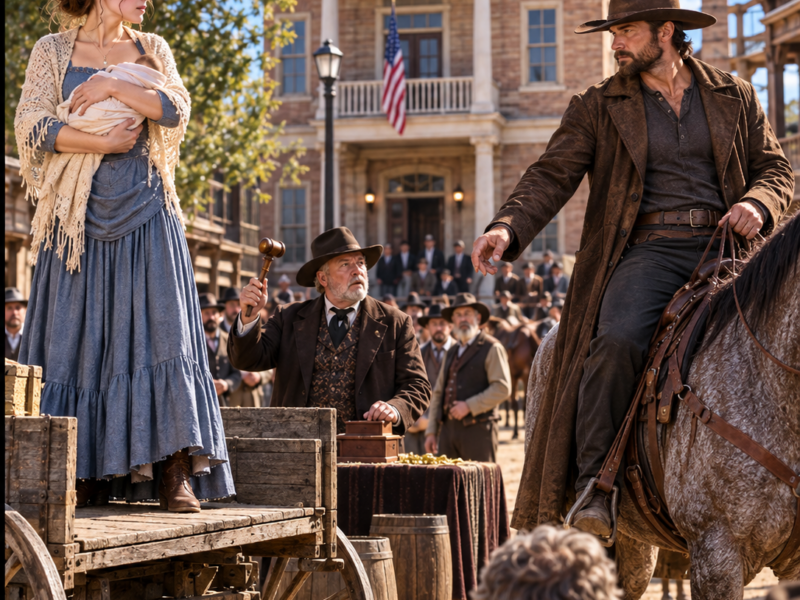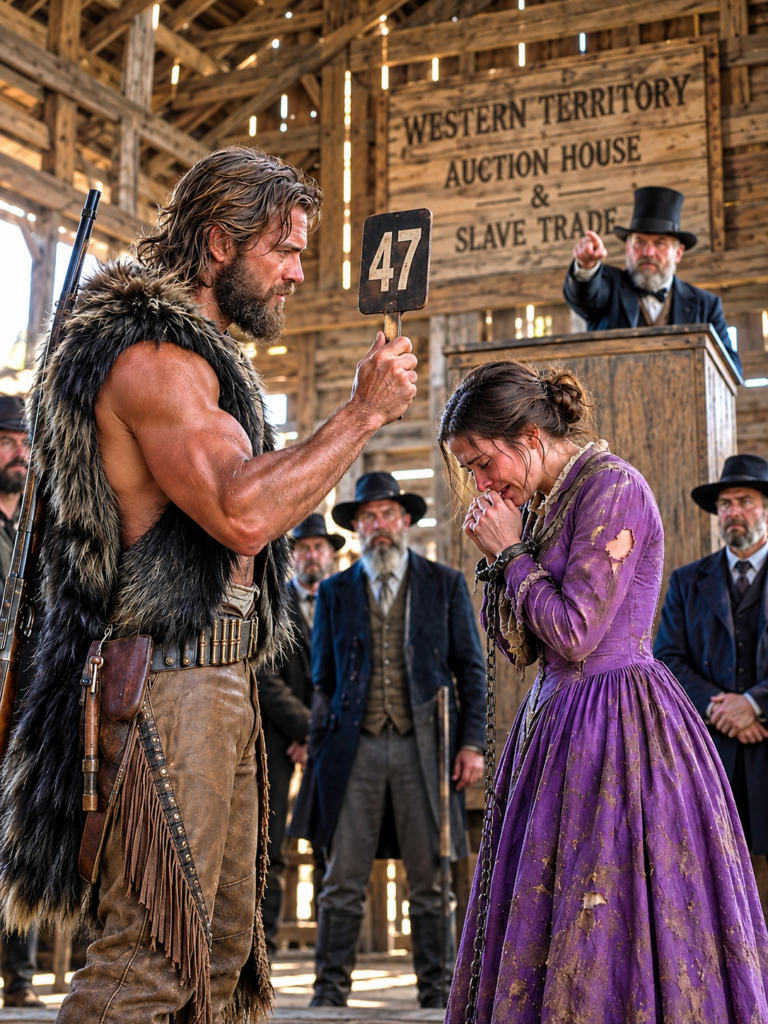
The gavel cracked like a gunshot over the dusty town square. Clara stood on the pine board stage, head bowed, listening to the suffocating silence. The local drunks sneered. The respectable women looked away.
“Fifty cents,” a voice mocked from the back, “for a girl who can’t even lift a plow.”
A heavy sob tore from her dry throat. Nobody wanted her.
Then a shadow fell over the crowd. A man stepped out of the timberline, dropping a heavy leather sack onto the assayer’s scale.
The July sun beat down on Ridge Creek like a blacksmith’s hammer. Heat radiated from the hard-packed dirt of the thoroughfare, shimmering in waves that distorted the facades of the saloons and boarding houses.
Clara Dawson stood on a makeshift wooden platform in front of the assayer’s office. The pine boards beneath her worn leather boots were splintered and rough. She kept her eyes fixed on the grain of the wood, counting the knots. One, two, three. If she focused on the wood, she didn’t have to look at the faces.
Her father had been in the ground for exactly three days. He left her nothing but a rusted Colt, a shack with a caved-in roof, and a ledger full of debts owed to Jebidiah Cross.
Cross was a man who owned the bank, the general store, and most of the town council. He didn’t forgive debts. When a man died owing him money, Cross took his assets. When there were no assets, he took the labor of the next of kin.
It was an old, ugly frontier law dressed up in legal paper and enforced by men with badges and shotguns.
Clara’s contract, five years of indentured domestic labor to cover a $500 debt, was up for public auction.
A drop of sweat rolled down her spine beneath the heavy, frayed wool of her mourning dress. The dress was too big. It had belonged to her mother, dead these ten years. Clara felt swallowed by it. She gripped the folds of the skirt, her knuckles white, trying to stop the violent trembling in her hands.
The crowd began to gather around noon. Miners came down from the hills, their faces coated in gray dust, their eyes sharp and hungry. Ranch hands leaned against the hitching posts, rolling cigarettes and murmuring to one another.
A few townsfolk, the baker, the telegraph operator, stood near the back, watching with a mixture of pity and morbid curiosity.
Nobody intervened. Morality in Ridge Creek was a luxury reserved for those who had gold in the bank.
Clara had exactly twelve cents to her name.
Jebidiah Cross stepped onto the platform. He smelled of stale cigars and bay rum. He wore a tailored broadcloth suit that looked absurd in the rugged mining camp. A heavy gold watch chain draped across his protruding stomach.
He didn’t look at Clara. He treated her like a mule brought to the block.
“Gather around, boys!” Cross boomed, his voice carrying over the rattle of freight wagons passing at the edge of town. “We have a simple matter of commerce today. The late Elias Dawson departed this world owing the Ridge Creek Mercantile $540. The law dictates that his daughter, Miss Clara Dawson, assumes the obligation.”
A low murmur rippled through the crowd. Men shifted on their boots.
Clara swallowed hard. Her throat felt like sandpaper.
“I hold here a contract,” Cross continued, waving a piece of heavy parchment. “Five years of labor. Cooking, cleaning, mending, washing. Whoever holds the highest bid buys the contract. The girl works for you until the term is up.”
It was a death sentence.
Five years serving one of the brutal, unwashed men in this camp meant she would likely not survive to see the end of it. The frontier broke strong men. It ground women like her into dust.
“We’ll start the bidding at $50,” Cross announced, striking his gavel against a wooden barrel. “$50 for five years of able-bodied help.”
Silence.
The men in the crowd looked at each other. $50 was a month’s wages in the mines.
Clara wasn’t robust. She was pale, thin from months of rationing flour and beans while her father drank their meager savings. Her collarbones jutted out against the rough wool of her dress.
“$50,” Cross repeated, his tone sharpening. “Come now, she’s quiet and she knows how to bake.”
A man near the front, a prospector with a tangled gray beard and a missing ear, spat a stream of tobacco juice into the dust.
“She looks like a stiff breeze would snap her in half. Jebidiah, I ain’t paying $50 for a girl who’ll die of mountain fever before the first snow.”
Laughter erupted. Cruel, jagged laughter that scraped against Clara’s ribs. She squeezed her eyes shut.
“$10!” a drunken voice yelled from the porch of the Golden Nugget Saloon. “And she’s got to wash my long johns.”
More laughter.
Cross frowned, his face flushing red. This was a spectacle, and he was losing control of it.
“The starting bid is $50, gentlemen. I will not entertain jokes.”
But the joke had already taken hold. The town was turning on Cross, using the girl as a way to mock the town boss.
“$5!” someone else shouted.
“I’ll give you two bits and a half-empty bottle of rye.”
Clara’s chest tightened. The air left her lungs.
The sheer, overwhelming weight of her uselessness pressed down on her shoulders. Her father had gambled her away. And now, even in her absolute degradation, she wasn’t worth the price of a decent saddle.
She was nothing. A piece of unwanted refuse left behind in a hard land.
The dam broke.
A sob, sharp and jagged, tore from her throat. She slapped a hand over her mouth, desperately trying to hold it back, but another followed. Tears, hot and shameful, spilled over her lashes, cutting clean tracks through the dust on her cheeks.
“Nobody wants me,” she whispered, the words slipping out into the mocking din. “Nobody.”
She sank to her knees right there on the rough pine boards, wrapping her arms around herself, burying her face in the dusty wool of her dress.
The laughter in the crowd began to falter, replaced by an uneasy, shuffling silence. The reality of breaking a human being on a public stage suddenly soured the joke.
Cross looked down at her in disgust. He raised his gavel to call off the farce and simply take her to his own kitchens.
Then the crowd parted.
They didn’t just part. They recoiled.
Men who had spent years braving caverns and grizzly bears stepped back, shuffling out of the way to clear a path.
Clara heard the sudden hush, the abrupt cessation of shuffling boots and nervous coughs, and raised her head just enough to see through the blur of her tears.
A man was walking down the center of the thoroughfare.
He was massive, built like the granite peaks that loomed behind the town. He wore high leather boots, worn buckskin trousers, and a heavy coat made of dark cured hides that smelled faintly of wood smoke and pine resin.
A wide-brimmed felt hat obscured the upper half of his face, but a thick, dark beard framed a strong, rigid jaw.
A Winchester rifle rested casually over his right shoulder.
He didn’t swagger. He moved with a heavy, deliberate silence, like a predator navigating a familiar forest.
Cole Halloway.
Clara had only heard the name whispered in town.
He was a mountain man, a trapper and timber baron who lived high up in the jagged crags of the Bitterroots. He only came down to Ridge Creek twice a year to trade furs, buy salt, and ship timber downriver.
He owned miles of the mountain. He spoke to no one, drank with no one, and tolerated no fools.
Cole stopped at the base of the platform. He didn’t look at the crowd. He didn’t look at Cross.
He looked at Clara.
His eyes beneath the brim of his hat were the color of slate before a storm. They were cold, assessing, but devoid of the leering mockery she had seen in the faces of the miners.
He looked at her, huddled on the boards, at her trembling shoulders, at the tear tracks cutting through the dirt on her face.
He reached inside his heavy hide coat.
Cross tensed, instinctively taking a half step back, his hand twitching toward the derringer in his vest pocket.
Cole didn’t draw a weapon.
He pulled out a heavy leather pouch cinched with a rawhide string. He tossed it onto the assayer’s table that sat at the edge of the stage.
The pouch hit the wooden planks with a dull, heavy thud that rattled the brass scale.
“$540,” Cole said.
His voice was a low, gravelly rumble. It sounded like boulders grinding together at the bottom of a riverbed.
Cross stared at the pouch. He blinked, completely thrown off balance. He looked from the bag of gold to the giant standing below him.
“Mr. Halloway, we… The bidding was an auction. I haven’t counted it.”
Cole interrupted. He didn’t raise his voice. He didn’t have to.
Cross scurried to the table, his hands shaking slightly as he untied the rawhide string. He poured a small portion onto the brass tray of the scale.
Raw gold nuggets and heavy dust caught the harsh afternoon light.
It was pure. It was heavy.
Cross didn’t even need to weigh all of it to know it was easily double the debt.
“The debt is settled,” Cross announced, his voice tight, eager to get the gold into his safe before the mountain man changed his mind.
He brought the gavel down on the barrel.
“Sold to Cole Halloway.”
Clara remained frozen on her knees. The world was spinning.
She had been bought by the beast of the Bitterroots, a man who lived miles away from civilization, completely isolated.
Panic seized her throat.
Cole climbed the three wooden steps onto the platform. The boards groaned under his immense weight.
He stopped a few feet from her and lowered the Winchester, leaning it against his leg.
He reached out a massive, calloused hand. His knuckles were scarred, the skin tanned to the color of saddle leather.
Clara stared at the hand, terrified. She shrank back, pulling her knees tighter to her chest.
Cole didn’t force her. He dropped his hand, letting it rest on his hip.
“Get up,” he said quietly, meant only for her ears.
“What are you going to do with me?” Clara whispered, her voice cracking.
“Right now, I’m going to get you out of the sun,” he replied. “Where are your things?”
“Things?” she echoed, dazed.
“Clothes. Belongings.”
“I have a bag in the alley behind the livery.”
Cole nodded once.
He turned his back on her, a deliberate show of non-aggression, and looked out over the crowd.
The townsfolk were still staring, utterly silent.
“Show’s over,” he stated.
It wasn’t a suggestion.
Slowly, awkwardly, Clara forced herself to her feet. Her legs were shaky, her head light. She stumbled slightly.
Cole turned back, and his large hand shot out, catching her firmly by the elbow to steady her.
His grip was strong, unyielding, but surprisingly gentle. He didn’t hold her a second longer than necessary.
“Walk with me,” he said.
He led her off the stage, stepping down into the dust. The crowd parted again, giving them a wide berth.
Clara kept her head down, her face burning, acutely aware of the massive man walking beside her.
He guided her toward the livery stable.
Behind the barn, resting against a water trough, was a battered carpetbag. It held a spare apron, two pairs of mended stockings, a hairbrush, and her mother’s silver comb.
It was the sum total of her existence.
Cole didn’t laugh at the pathetic sight of it. He simply bent down, picked up the bag in one hand as if it weighed nothing, and carried it toward the hitching post where two massive draft-cross horses were tied.
One was loaded with supplies: flour, salt, coffee. The other had an empty saddle.
“Can you ride?” he asked.
Clara nodded slowly. “Yes.”
He checked the girth on the saddle, then stepped back.
“Mount up.”
She hesitated, looking up at the towering peaks in the distance.
The mountain was a dark, jagged shadow against the sky. It was wild, dangerous, and completely unknown.
But as she glanced over her shoulder at the dusty street of Ridge Creek, at the men already returning to the saloons, she knew there was nothing left for her here but death.
Clara put her boot in the stirrup and pulled herself up into the saddle.
Cole swung onto his own horse with surprising agility for a man his size.
He didn’t say another word. He just turned his horse toward the north trail, clicked his tongue, and started toward the timberline.
Clara picked up her reins and followed him into the deep, quiet shadows of the pines.
The trail began as a wide wagon rut, choked with alkaline dust, winding its way through the yellow, sunbaked foothills.
Within an hour, it narrowed into a rocky path that forced the horses into a single-file line.
The scrub brush and sage eventually gave way to dense stands of lodgepole pine, and the oppressive heat of the valley floor began to lose its sharp edge.
Clara rode in silence behind Cole. She kept her eyes fixed on the broad, sturdy back of his hide coat, watching the rhythmic sway of his shoulders as his horse navigated the increasingly steep incline.
She had never been this high up.
Ridge Creek was built in a basin hemmed in by these peaks, and the townsfolk rarely ventured beyond the lower logging camps.
The mountains were considered harsh, unforgiving territory, completely devoid of law or comfort.
Two hours passed, then three.
The air grew noticeably thinner, carrying a sharp, biting chill that easily pierced the worn wool of Clara’s mourning dress.
She shivered, her fingers stiffening around the leather reins. Her thighs burned from the unaccustomed strain of riding, and a dull, throbbing ache settled into the base of her spine.
She didn’t complain. She didn’t make a sound.
Years of living with Elias Dawson had taught her that suffering in silence was the only way to avoid making a bad situation worse.
Cole didn’t speak, but he wasn’t oblivious.
Every so often, he would pause his horse on a switchback, ostensibly to check the load on his packhorse, but Clara noticed his slate-gray eyes lingering on her pale face.
He was assessing her endurance.
Around late afternoon, the sun dipped behind a massive granite ridge, plunging the trail into deep blue shadow.
Cole pulled back on his reins, bringing his horse to a halt beside a fast-moving, clear creek that cut across the path.
He dismounted smoothly, his boots crunching against the loose gravel.
“Get down,” he instructed, his voice low over the rush of the water. “Rest the animals.”
Clara tried to swing her leg over the saddle, but her muscles had cramped into hard knots.
She misjudged her balance, her boots slipping from the stirrup, and she pitched forward.
She braced for the hard impact of the rocky ground.
It never came.
Two massive hands caught her by the waist, halting her fall midair. The grip was shockingly strong, holding her suspended for a brief second before lowering her gently to her feet.
Cole smelled of horses, pine needles, and clean sweat.
“Legs give out on the steep grades if you ain’t used to it,” he said, stepping back immediately.
He didn’t offer any further pity.
He unhooked a tin cup from his saddlebag, dipped it into the freezing creek, and handed it to her.
Clara took it with shaking hands.
The water was icy and tasted of minerals and pure snowmelt. It was the best thing she had ever swallowed.
She drank it down greedily, the cold liquid soothing her dry, aching throat.
When she finished, she held the cup out to him.
“Keep it,” he said, turning his back to loosen the cinch on his horse. “Drink more. Altitude sickness creeps up on flatlanders.”
They stayed by the creek for fifteen minutes.
Clara sat on a mossy boulder, rubbing feeling back into her calves, while Cole silently checked the horses’ hooves.
The sheer quiet of the forest was deafening.
There were no shouts from the saloons, no clatter of stamp mills, no drunken arguments bleeding through thin walls.
There was only the wind moving through the upper branches of the pines and the steady rush of the water.
When they resumed the ride, the trail turned brutal.
They climbed a near-vertical ridge, the horses scrambling for footing on loose shale.
Clara clung to the saddle horn, her heart hammering against her ribs, terrifyingly aware of the sheer drop-off to her right.
A fall here meant a broken neck, if she was lucky.
Cole rode ahead with complete, unbothered confidence, navigating the treacherous path through memory and instinct.
Twilight was bleeding the color from the sky when they finally broke through the treeline onto a wide alpine plateau.
Clara gasped.
Nestled against the sheer face of a towering granite cliff sat a cabin.
Calling it a cabin felt inadequate.
It was a fortress of thick, peeled logs notched perfectly at the corners. A massive stone chimney dominated one end, built from river rock and mortar.
A wide covered porch ran the length of the front, stacked high with perfectly split cords of firewood.
Behind the main house stood a sturdy barn and a large smokehouse.
It wasn’t the dilapidated, leaky shack she had expected of a mountain trapper.
It was permanent. It was unyielding. It was built to withstand a siege of winter snows.
Cole rode up to the hitching rail and dismounted. He tied his horse, then walked back to help her down.
This time, Clara managed to slide from the saddle on her own, though her legs nearly buckled when her boots hit the dirt.
“Take your bag,” Cole said, unstrapping the supplies from the packhorse. “Go inside. Door’s unlocked.”
Clara grabbed her battered carpetbag.
She walked up the heavy wooden steps, her boots loud on the porch boards.
She gripped the wrought-iron latch and pushed.
The heavy oak door swung open on oiled hinges.
She stepped into the dark interior, instantly hit by the residual warmth of the place.
It smelled of wood ash, cured leather, and something savory, like dried herbs.
As she stood in the center of the room, clutching her bag to her chest, she realized how entirely cut off she was.
There was no town to run back to. There was no neighbor to hear a scream.
She belonged entirely to the giant unsaddling horses in the yard.
The crushing weight of her new reality settled over her, heavy and cold.
Cole walked through the door ten minutes later, carrying a heavy sack of flour on one shoulder and a crate of supplies in his other arm.
He didn’t look at Clara, who was still standing exactly where she had been when she first entered, frozen in the center of the main room, her knuckles white around the handles of her carpetbag.
He kicked the door shut behind him with the heel of his boot, sealing out the biting evening wind.
He crossed the room in three long strides, dropping the supplies onto a heavy, scarred oak table.
Then he walked to the massive stone fireplace.
He didn’t fumble with flint and steel.
He pulled a Lucifer match from his pocket, struck it against the stone, and touched it to the dry tinder waiting beneath a stack of split logs.
Within seconds, a bright, crackling fire illuminated the room.
Clara finally looked around.
The cabin was immaculately clean. The floors were swept bare wood. Iron skillets and copper pots hung in precise order above a large black cast-iron cookstove.
A double bed with a heavy wool quilt sat in the far corner, neatly made.
Rifles, traps, and snowshoes hung on the walls.
It lacked a woman’s touch. There were no curtains, no woven rugs, no decorative knickknacks, but it was orderly, functional, and deeply masculine.
Cole stood up from the fire and dusted off his heavy canvas trousers.
He finally turned his attention to her.
She looked like a ghost haunting his floorboards.
“You can set the bag down,” he said quietly.
Clara flinched slightly at the sound of his voice, but she obeyed, letting the carpetbag drop to the floor.
It hit with a pathetic thud.
She wiped her damp, dusty palms on the rough wool of her skirt.
“I can start supper,” she offered, her voice a thin, shaky rasp. “If you show me how the stove draws and where the water bucket is, I can wash your clothes tomorrow. I’m a good worker. I won’t cause trouble.”
She was rambling, driven by a desperate, panicked need to prove her worth.
If she wasn’t useful, he would have no reason to feed her. If she wasn’t useful, she was vulnerable.
Cole’s brow furrowed. The harsh lines around his eyes deepened, making him look older than she had originally thought.
He crossed his arms over his massive chest.
“Stop!”
Clara snapped her mouth shut, her breath catching in her throat.
She stepped back instinctively, bracing herself for a reprimand or a blow.
Cole saw the flinch. A muscle in his jaw twitched.
He let his arms drop slowly to his sides.
“You don’t need to earn your keep tonight. You’ve been riding for five hours. You’re exhausted.”
“The contract,” Clara stammered, her heart hammering. “Jebidiah Cross said—”
“I don’t give a damn what Cross said,” Cole interrupted, his voice dropping into a dangerous, gravelly register. “That piece of paper is in my saddlebag. It stays there. I didn’t drag you up this mountain to be a slave.”
Clara stared at him, her mind struggling to process the words.
“Then why did you buy me?”
Cole looked away, staring into the flickering flames of the fireplace for a long moment.
When he looked back at her, his expression was entirely unreadable.
“Because I was standing in town watching a pack of wolves corner a stray dog, and I don’t stomach bullies.”
He turned and walked to the kitchen area.
He pumped water from a hand pump installed directly over a soapstone sink, a luxury Clara had never seen outside the mayor’s house in Ridge Creek.
He filled a cast-iron kettle and set it on the stove, striking another match to light the burner.
“Sit down,” he ordered, nodding toward one of the heavy wooden chairs at the table.
Clara didn’t move.
“I can help.”
Cole paused, holding a sharp hunting knife and a block of cured bacon.
He looked at her, his slate eyes boring into hers.
“You’ve spent your whole life fetching and caring for men who took it for granted, haven’t you?”
Clara felt a hot flush of shame creep up her neck.
Her father had treated her like a scullery maid until the day his liver finally gave out.
“Sit,” Cole repeated, softer this time. “Let me cook in my own kitchen.”
Hesitantly, Clara pulled out a heavy chair and sat down. She kept her hands folded tightly in her lap, watching him work.
He moved with a surprising quiet grace for a man of his immense size.
He sliced the bacon into thick slabs, throwing them into a hot skillet. He cracked three eggs into the popping fat, cut thick wedges of hard-crust bread, and scooped coffee grounds into the boiling kettle.
Ten minutes later, he set a tin plate in front of her.
It was piled high with hot food.
He set a tin cup of steaming black coffee beside it. Then he took his own plate and sat down opposite her.
Clara stared at the food.
The smell of the salty meat and rich egg yolks made her stomach clench painfully.
She hadn’t eaten anything but a piece of stale hardtack since her father’s funeral, but she didn’t pick up her fork.
She looked across the table at the giant sitting across from her.
“Eat,” Cole said between bites.
“What happens tomorrow?” she asked, her voice tight. “When I’m rested, what do you expect of me then?”
Cole set his fork down.
He leaned back in his chair, the wood creaking under his weight.
“I expect you to heal up. You’re entirely too skinny. When you get some meat on your bones and stop jumping at your own shadow, we’ll figure out what comes next. If you want to help keep the place clean, fine. If you want to sit on the porch and stare at the pines, that’s fine, too.”
Clara swallowed hard, fighting the sudden, sharp sting of tears behind her eyes.
It was a trick. It had to be.
Men weren’t kind without a price. They didn’t spend $500 in gold out of the goodness of their hearts.
“I don’t understand,” she whispered.
“You don’t have to,” Cole replied, picking his fork back up. “Just eat the damn eggs before they get cold.”
Clara picked up her fork.
Her hand trembled as she brought the first bite to her mouth.
It tasted like salvation, and it terrified her more than the auction block ever had.
The first rays of dawn pierced the small square window of the cabin, casting long and dusty shafts of light across the plank floor.
Clara awoke with a start.
For a fraction of a second, her mind placed her back in the leaky, drafty shack in Ridge Creek, waiting for the heavy, drunken footsteps of her father.
Then the smell of wood smoke and cured leather registered.
She sat up, clutching the heavy wool quilt to her chest.
She was in the large double bed. Cole was nowhere to be seen.
A neatly folded wool blanket lay on the hearth rug, marking where the massive mountain man had slept on the hard floor.
The fire had been banked, a fresh log laid over the glowing embers to keep the chill at bay.
The coffee pot sat on the edge of the stove, radiating a faint heat.
Panic, cold and sharp, spiked in Clara’s chest.
She had slept past dawn.
In Elias Dawson’s house, sleeping past the sunrise meant a backhand across the face and a day without rations.
In the employ of a man like Jebidiah Cross, it would have meant the whip.
She threw off the covers, her bare feet hitting the cold floorboards.
She scrambled into her boots and pulled her worn mourning dress over her head, her fingers fumbling clumsily with the buttons.
She had to make herself useful. She had to prove she wasn’t a burden.
She rushed to the kitchen area.
The cast-iron sink held two unwashed tin plates and a skillet coated in bacon grease.
Clara grabbed them.
She found a block of harsh lye soap and a stiff-bristled brush under the counter. She pumped water furiously, ignoring the freezing temperature of the snowmelt, and began to scrub.
When the dishes were clean, she didn’t stop.
She found a broom made of bundled twigs and swept the entire cabin, driving every speck of dust out the heavy oak door.
She beat the hearth rug against the porch rail until her shoulders ached, but it wasn’t enough.
The cabin was already too clean.
She needed a larger task, something to visually demonstrate her labor.
In the corner near the door, she found a canvas laundry bag holding three of Cole’s heavy cotton work shirts, stiff with dirt and sweat.
Clara seized it.
She hauled a heavy wooden wash bucket out to the porch, filled it from the hand pump, and dragged it down the steps to the yard.
The morning air was frigid, biting through the thin fabric of her sleeves.
Clara knelt in the dirt beside the bucket.
She submerged the heavy shirts, lathering the lye soap directly onto the stained fabric, and began to scrub them against the wooden ridges of a washboard.
The water was brutal. It stripped the heat from her hands instantly, turning her fingers stiff and clumsy.
The coarse lye soap ate at her skin, leaching the moisture away.
Within ten minutes, her knuckles were raw, split, and stinging furiously.
She ignored the pain.
She threw her weight into the work, her breath pluming in the cold air, scrubbing until her arms trembled.
“What are you doing?”
The voice was a low rumble, startling her so badly she dropped the wet shirt back into the bucket with a loud splash.
She spun around, wiping her wet, stinging hands on her apron.
Cole stood at the edge of the timberline.
He held a massive double-bladed axe over one shoulder, breathing steadily, unaffected by the cold.
He stared down at her, kneeling in the dirt, his slate-gray eyes taking in the heavy wash bucket, her shivering frame, and the red, raw state of her hands.
“Washing!” Clara stammered, her heart hammering against her ribs.
She scrambled to her feet, instinctively shrinking back.
“Your shirts. They were dirty. I didn’t mean to overstep. I just… I needed to work.”
Cole walked toward her.
He didn’t drop the axe until he reached the porch, setting it against the rail with a heavy thud.
He stepped up to the wash bucket and looked down at the freezing, soapy water.
“I wash my own gear,” he stated.
His tone wasn’t angry, but it was flat, uncompromising.
“But I have to earn my keep,” Clara pleaded, her voice rising in a desperate, thin pitch. “I can’t just sit in your house and eat your food. You paid $500 for me. I know how this works. I know what happens to people who don’t pull their weight.”
Cole closed the distance between them in a single step.
Clara squeezed her eyes shut, turning her head away, her shoulders hiking up to her ears.
Silence stretched out.
A long, heavy pause that was only broken by the wind rustling the tops of the pines.
“Open your eyes.”
The command was quiet.
Clara opened her eyes slowly.
Cole wasn’t raising a hand to her. He wasn’t even looking at her face.
He was looking at her hands, still clutched tightly in front of her apron.
Slowly, telegraphing his movement so she wouldn’t flinch, he reached out and took her wrists.
His hands were impossibly large, his calluses rough against her skin, but his grip was startlingly light.
He lifted her hands, turning them over to inspect the raw, cracked knuckles and the angry red skin stripped by the lye.
“You’re tearing yourself apart to pay a debt I already canceled,” Cole said, his voice dropping to a harsh whisper. “I told you last night. You are not a mule. You are not a slave.”
“I don’t know how to be anything else,” she admitted, the words slipping out before she could stop them.
Cole looked up from her bruised hands, meeting her gaze.
The cynicism in his eyes seemed to fracture just for a moment, revealing a profound, weary understanding.
“Then you’re going to have to learn,” he said.
He released her wrists and reached down, hoisting the heavy, waterlogged wash bucket with one hand.
He dumped it unceremoniously into the dirt.
“Go inside. Sit by the fire. I have a tin of bear grease in the cupboard. Put it on your hands.”
Clara stood frozen.
“But the shirts—”
“I’ll finish them,” Cole interrupted, turning away. “Go.”
She retreated up the porch steps, wrapping her arms around herself.
When she reached the door, she looked back.
Cole was kneeling by the pump, his massive hands working the heavy fabric of his shirts.
He wasn’t looking at her.
He was just doing the work, shouldering the burden, leaving her completely unmanned in a world where she suddenly had no price tag.
Three weeks passed.
The high-altitude summer began to surrender to the impending autumn.
The mornings grew sharper, the frost lingering longer on the porch rails, and the aspen leaves clinging to the lower ridges started to bleed into vibrant shades of gold.
Clara changed.
It wasn’t a sudden, miraculous transformation, but a slow, cautious thaw.
The hollows in her cheeks began to fill out, fueled by a steady diet of venison, dried apples, and heavy biscuits.
The dark, bruised circles under her eyes faded.
She still kept her head down when Cole entered a room, and she still moved with a quiet, ghostlike caution.
But the violent, involuntary flinching had stopped.
They established a silent rhythm.
Cole spent his days outside, felling timber, checking traplines miles up the ridge, or repairing the heavy tack for the draft horses.
Clara took over the cabin.
She didn’t do it out of frantic, terrified obligation anymore.
She did it because the quiet routine gave her something to anchor her mind.
She baked bread, mended the tear in his heavy canvas coat, and kept the hearth fire burning.
They rarely spoke.
Words were scarce on the mountains, and Cole hoarded his like winter provisions.
But the silence between them was no longer suffocating.
It was becoming comfortable.
Until the afternoon the sky fell.
It started around noon.
The barometric pressure plummeted so fast Clara felt it in her teeth.
The bright blue sky bruised over, turning a dark, ominous purple.
The wind died completely, leaving the mountain in an eerie, breathless stillness.
Cole came out of the timberline early, pushing the draft horses hard, his jaw set tight.
“Get the shutters closed,” he ordered as he rode into the yard. “Storm’s coming over the peak. A big one.”
Clara dropped her sweeping broom and hurried to the windows, pulling the heavy wooden shutters closed and dropping the iron latches into place.
The cabin plunged into dim shadow, illuminated only by the fire in the hearth.
Cole walked in a few minutes later, securing the heavy oak door behind him and throwing the deadbolt.
Ten minutes later, the storm hit.
It wasn’t like the rainstorms in the valley.
This was a physical assault.
The wind struck the cabin with the force of a freight train, rattling the thick log walls and howling down the stone chimney.
Then came the thunder.
It didn’t roll.
It cracked like artillery fire directly overhead, a deafening, percussive blast that shook the floorboards beneath Clara’s boots.
She cried out, dropping the tin cup she was holding.
It clattered across the floor.
She backed into the corner near the stove, pressing her shoulders against the warm logs.
Her hands clamped over her ears.
Thunder in Ridge Creek meant her father couldn’t go to the saloon.
It meant he drank his rye at the kitchen table, growing meaner and more volatile with every strike of lightning.
The noise was a trigger, dragging her violently back into the past.
Another crack of thunder shook the room, followed by the furious drumming of hail against the roof.
Clara slid down the wall, pulling her knees to her chest, her breathing turning shallow and erratic.
Cole was sitting at the heavy oak table, a lantern pulled close, carefully oiling the mechanism of his Winchester.
He paused, the rag still in his hand, and looked across the dim room at her.
He watched her hyperventilate, his slate eyes narrowed, analyzing the situation with the same calm precision he used to track a wounded elk.
He didn’t rush over to her. He didn’t offer empty platitudes.
He set the rifle down, picked up the lantern, and walked to the stove.
He pulled one of the heavy wooden chairs out and placed it a few feet from her corner.
He sat down, holding the lantern so the warm yellow light pushed back the shadows pressing in on her.
“My father,” Cole said.
His voice was a low, steady rumble, completely unbothered by the chaos raging outside.
The sudden, unexpected words pierced through Clara’s panic.
She lowered her hands slightly, looking up at him.
“My father was a preacher back in Missouri,” Cole continued, leaning his forearms on his knees, staring into the flame of the lantern. “He had a voice that could rattle the stained glass. Spoke a lot about hellfire, about damnation. Used a leather belt to make sure his lessons stuck.”
Clara stared at him, stunned.
Cole had never spoken more than three sentences to her at a time, let alone offered a glimpse into his history.
The thunder crashed again, but this time Clara’s focus remained anchored on the giant sitting in front of her.
“I left when I was fourteen,” Cole said, his voice entirely devoid of self-pity.
It was just a statement of fact.
“Worked my way west on freight wagons. Ended up in the mining camps. Saw men kill each other over fifty cents of gold dust. Saw men drink away their families.”
He looked away from the lantern, turning his gaze to meet hers.
“Men down there build towns just to have a place to tear each other apart. They wrap it up in laws and commerce. But it’s just rot.”
“Is that why you live up here?” Clara asked, her voice trembling, though no longer entirely from the storm. “Because you hate them?”
Cole considered the question.
He picked up his oil rag and began wiping his hands.
“I don’t hate them. I just don’t have any use for them. Up here, the rules are simple. The mountain is hard, but it’s honest. It doesn’t lie to you. It doesn’t pretend to be civilized while it breaks your back.”
He looked at her, and for the first time, the severe lines of his face softened into something resembling compassion.
“You spent your whole life paying for the rot of other men, Clara. Your father, Cross. You let them tell you what you were worth.”
He stood up, towering over her in the dim light.
“The storm is just noise. It can’t touch you in here, and neither can they.”
He turned and walked back to the table, picking up his rifle and resuming his work as if he hadn’t just laid his soul bare.
Clara stayed in the corner, listening to the wind howl against the logs.
But the panic was gone.
Cole was right.
The mountain was harsh, but it was honest.
And for the first time in her life, she felt absolutely, undeniably safe.
October arrived with biting clarity.
The first snow fell over the Bitterroots, a heavy powder burying the lower brush and coating the pines.
The mountain transformed into a stark landscape of blinding white.
Inside the cabin, heat from the stone hearth pushed back the frost creeping up the windowpanes.
Clara stood at the heavy oak table, hands buried in flour and yeast.
She drove the heels of her palms into the dough, pressing with rhythmic force.
Her hands were no longer frail.
They were calloused, strong, and capable.
She had put on weight. The hollows of her cheeks had filled in, and her eyes held a quiet, focused calm.
Cole had been gone since before dawn, taking the draft horses to haul a felled cedar out of a distant ravine.
For the first time in months, Clara was entirely alone on the mountain.
She wasn’t afraid.
The silence now felt like a shield.
Then the horses whinnied from the corral.
It wasn’t the low greeting nicker they gave Cole.
It was sharp and anxious.
Clara wiped her flour-dusted hands on her apron and walked to the small window facing the yard.
Two men rode into the clearing.
They were valley men.
Their horses were blowing hard, lathered in freezing sweat.
Clara recognized the rider on the left immediately.
It was the prospector from the auction, the one with the missing ear.
The man beside him was younger, heavily armed, with the pinched look of a hired gun.
Jebidiah Cross hadn’t forgotten the pouch of pure gold Cole had tossed onto the scale.
Clara stepped back from the window, her heart executing a sudden, violent kick against her ribs.
The old instinct, the terrified, beaten girl from the valley, screamed at her to hide under the heavy bed frame and pray they left.
The men dismounted.
“Halloway!” the older man shouted, his voice a harsh intrusion on the quiet air. “We know you’re up here.”
Clara looked around the cabin.
She looked at the iron skillet. She looked at the perfectly stacked cords of wood. She looked at the hearth rug where Cole slept, giving her the only safe bed she had ever known.
This wasn’t a cage.
This was her home.
She walked to the wall near the door.
The Winchester rested on two wooden pegs.
It was heavy, oiled, and fully loaded.
Cole had shown her how to lever a round into the chamber three weeks ago.
She took the rifle down.
Heavy boots hit the wooden planks of the porch.
“Door’s probably locked,” the younger man muttered.
“Kick it!”
Clara didn’t wait.
She threw the heavy iron deadbolt back and pulled the oak door open.
The two men froze, caught entirely off guard.
Clara stepped directly into the center of the doorway.
She didn’t shrink back into the shadows.
She raised the Winchester, tucking the heavy stock firmly against her shoulder, and leveled the iron sights squarely at the center of the younger man’s chest.
She cocked the lever.
The metallic clack-clack was the loudest sound on the mountain.
“Get off this porch,” Clara said.
Her voice didn’t tremble. It was low, steady, and hard.
The older prospector stared at her, his jaw slack.
“Well, I’ll be damned. The Dawson girl. Put the gun down, little bird. We ain’t here for you. We just want a word with the giant about some unpaid town taxes.”
“He isn’t here,” Clara replied, her finger resting lightly against the trigger. “And you aren’t collecting taxes. Get back on your horses.”
The younger man sneered, recovering his nerve.
He dropped his hand toward the heavy revolver strapped to his thigh.
“You ain’t going to shoot that thing, sweetheart. The kick would snap your collarbone. Step aside.”
He took a step forward.
Clara didn’t hesitate.
She shifted the barrel a fraction of an inch to the right and pulled the trigger.
The rifle roared, kicking back hard into her shoulder with a concussive blast.
The bullet splintered the wooden porch post a mere three inches from the younger man’s ear, showering his face with sharp, flying cedar shards.
He yelled, falling backward into the snow.
The horses panicked, pulling fiercely at their reins.
Clara smoothly levered another round into the chamber, the empty brass casing clinking against the floorboards.
She aimed the smoking barrel at the older man.
“The next one goes through your knee,” she stated, the smell of burnt powder stinging her nose. “Ride.”
The prospector backed down the stairs, hands raised, leaving his companion to scramble desperately through the snow.
They mounted their horses and spurred them hard, fleeing back down the trail toward the valley.
Clara stood in the doorway, the heavy rifle still leveled at the treeline.
Slowly, the adrenaline began to recede, leaving her arms trembling.
She lowered the Winchester.
A shadow moved at the edge of the clearing.
Cole stepped out from the dense cover of the pines.
He had his heavy Colt revolver drawn, his face carved from granite.
He had heard the shot.
He walked into the yard, stopping at the base of the porch.
He looked at the fresh tracks in the snow, then at the shattered porch post.
He looked up at Clara standing in the doorway with the smoking rifle.
He holstered his weapon.
He didn’t ask if she was hurt.
He saw the empty brass casing on the floor. He saw the fierce, unyielding light in her eyes.
Cole walked up the steps, his massive frame blocking out the glare of the snow.
He gently took the rifle from her hands, setting it aside.
“They won’t come back,” Clara said, her voice shaking slightly now that it was over.
Cole looked down at her.
The harsh, cynical armor he wore against the world fractured completely, replaced by a profound, silent respect.
He brushed a stray lock of hair away from her face.
“No,” he agreed, his voice a low, gravelly rumble. “They won’t.”
He didn’t pull her into a desperate embrace.
He simply placed his hand on the back of her neck, a solid, grounding weight, and guided her back inside out of the cold.
The door shut heavy and firm behind them, sealing the mountain, leaving only the warmth of the fire and a life they had carved out of the wilderness together.
The frontier breaks the weak and hardens the strong. But sometimes it takes the quietest among us to show true iron.
Clara didn’t just survive the mountain.
She claimed it.
Her journey from a broken girl on an auction block to a fierce protector of her own home proves that worth isn’t dictated by the cruelty of others.