
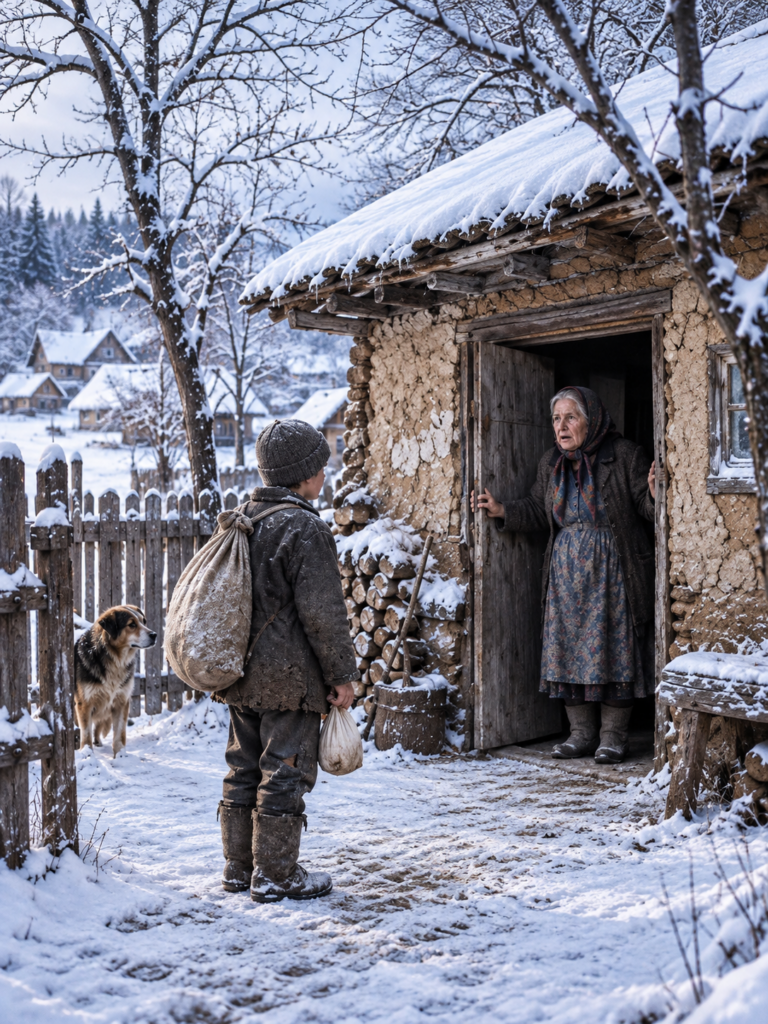
Part 1
The last thing Noah Mercer heard before the front door slammed was his uncle telling him he wasn’t worth the trouble anymore.
“Get off my property, Noah. I’m done feeding you.”
The boy stood at the bottom of the porch steps with a faded blue backpack hanging from one shoulder. He was eleven years old, his father had been dead for nine months, and he had just been ordered to leave the only family he had left.
Inside the house, his aunt was clearing the dinner dishes. He could hear plates knocking against the sink. The television was still playing in the living room.
Nobody came outside.
Noah looked at the door one more time.
“Uncle Rick?”
There was no answer.
He swallowed hard.
“Where am I supposed to go?”
A curtain moved in the front window. For a second, he saw his aunt’s face behind the glass.
Then the curtain fell back into place.
That was when Noah understood.
They weren’t trying to scare him. They weren’t teaching him a lesson. They really wanted him gone.
He turned toward the gravel driveway and started walking.
The house sat outside a small town in the Missouri Ozarks, where narrow country roads ran between cattle pastures, wooded hills, and scattered farmhouses. On most days, Noah liked the quiet. He liked the smell of freshly cut hay and the way the hills turned deep blue as the sun went down.
But that afternoon, every empty field seemed to remind him how far he was from anyone who might help.
The backpack wasn’t heavy. It contained two T-shirts, a pair of jeans, socks, a toothbrush, and a photograph of his father standing beside an old fishing boat.
Those were the things Noah had managed to collect before Rick lost patience and told him to hurry up.
He had forgotten his jacket.
He thought about going back for it, but the idea of knocking on that door again made his stomach tighten.
So he kept walking.
Nine months earlier, Noah had still believed that bad things happened one at a time.
Then his father died, and the world he understood began coming apart.
His dad, Daniel Mercer, had been the kind of man who could fix a leaking faucet with parts from a coffee can and make a Saturday afternoon feel special with nothing more than a fishing pole and a bag of peanut butter sandwiches.
They hadn’t had much money. Their little rented house needed repairs, and Daniel’s pickup always seemed to have something wrong with it. But Noah had never worried about whether there would be food in the kitchen or whether his father would be glad to see him when he came home from school.
Every morning, Daniel left a note beside Noah’s cereal bowl.
Have a good day, buddy.
Sometimes he added a terrible joke. Sometimes he drew a crooked smiley face.
Noah kept a few of those notes tucked into the back of a school notebook.
When Daniel died, Noah moved in with his father’s older brother, Rick, and Rick’s wife, Paula.
At first, they told him he would be all right.
Rick carried his bags into the spare room. Paula bought him a toothbrush and told him where to put his shoes. For a few weeks, everyone tried to act as though the arrangement might work.
But things changed.
Rick worked irregular hours doing construction and roofing jobs. Some weeks there was plenty of work. Other weeks there wasn’t. Bills collected on the kitchen counter, the truck needed repairs, and Rick seemed to become angry at anything that cost money.
Noah learned to recognize the look on his uncle’s face when he opened an envelope.
He learned not to ask for anything on those evenings.
He stopped mentioning school field trips. When his sneakers developed holes near the toes, he folded his feet inside them so the damage was less noticeable.
He ate whatever Paula put in front of him, even when he was still hungry afterward.
And he helped around the house.
He carried trash bags to the cans beside the garage. He swept the back porch. He fed the chickens and pulled weeds from the vegetable garden. On Saturdays, he cleaned the muddy work boots Rick left by the door.
He thought if he became useful enough, they might want to keep him.
But Rick always seemed to find something Noah had done wrong.
One evening, a glass slipped from Noah’s hand while he was drying dishes.
It struck the kitchen floor and shattered.
Noah immediately dropped to his knees.
“I’m sorry. I’ll clean it up.”
Rick looked up from the table.
“That’s the problem with you, kid. Everything you touch costs me money.”
Noah stared at the broken glass.
He had heard worse things at school from boys trying to be mean. But coming from someone who was supposed to take care of him, those words settled somewhere deeper.
After that, he became careful about everything.
He closed doors without making noise. He walked lightly across the hallway. He tried to finish chores before anyone noticed they needed doing.
And whenever Rick complained about having another mouth to feed, Noah pretended he hadn’t heard.
The morning he was thrown out began like any other.
Rick had come home irritated after a job was canceled. Paula was standing at the kitchen counter, adding numbers on the back of an envelope.
Noah was outside gathering eggs.
When he came in, he heard Rick saying they couldn’t keep doing this.
Paula answered something too quietly for him to understand.
Then Rick looked directly at him.
“There he is. Another problem I didn’t ask for.”
Noah stopped beside the kitchen door.
“I got the eggs,” he said.
Rick pushed his chair away from the table.
“Good for you.”
Noah put the basket down.
“Do you want me to clean the chicken coop?”
“I want you to stop acting like doing a couple chores makes up for everything.”
Noah felt his face turn hot.
“I can do more.”
Rick stood up.
“You keep saying that.”
“I will. I promise.”
“Promises don’t pay bills.”
Paula stayed beside the counter, staring at the envelope in her hands.
Noah looked toward her.
“Aunt Paula?”
She didn’t raise her head.
Rick pointed toward the hallway.
“Go get your stuff.”
Noah thought he had misunderstood.
“What?”
“You heard me. Get your things. You’re not staying here anymore.”
For several seconds, Noah could only stare.
Then he tried to explain that he could eat less, work harder, stay out of their way. His words came out too quickly. He could hear how frightened he sounded, and that made him even more frightened.
Rick cut him off.
“I’ve had enough.”
And that was the end of the conversation.
Now, walking under the late-August sun, Noah kept replaying it.
He wondered which part had finally made his uncle decide to send him away.
The broken glass?
The grocery bill?
The fact that he wasn’t Rick’s own child?
He had tried so hard not to be a problem. Yet somehow, simply being there had become one.
By late afternoon, his legs were aching.
The gravel road stretched ahead between trees and open pasture. Every passing vehicle made him step into the grass, hoping no one would recognize him.
He didn’t want anyone asking why he was out there.
He didn’t know what to say.
Once, a red pickup slowed near him.
The driver glanced in his direction, then continued down the road.
Noah watched the taillights disappear.
He wondered whether he should have waved for help.
But Rick’s voice immediately came back to him.
Stop being somebody else’s problem.
So Noah said nothing.
His stomach hurt. He hadn’t eaten since breakfast, and he had only a little water left in the plastic bottle tucked inside his backpack.
He took one small sip and screwed the cap back on.
The sun was beginning to drop behind the hills when he reached a bend in the road where an old split-rail fence stood beside a line of oak trees.
Beyond the fence was a small farmhouse.
It had once been painted white, although the paint had weathered to a soft gray in places. A narrow front porch stretched across the house, and an American flag hung from a wooden post near the steps.
Behind it stood a red shed with a patched metal roof.
A few chickens scratched beneath a cedar tree. There was a vegetable garden behind a wire fence, a stack of firewood near the porch, and an old green pickup parked beside the shed.
Nothing about the place suggested wealth.
But there were flowers growing in coffee cans along the porch railing.
And a light was on in the kitchen.
Noah stopped.
He watched a chicken hop onto an overturned bucket. Somewhere behind the house, a screen door creaked.
He knew he couldn’t spend the night on the road. He had heard coyotes calling through the woods before, and he was already shivering despite the warmth of the evening.
Still, approaching a stranger’s house felt almost as frightening as turning around and going back.
He stood at the fence for a long time.
Then he opened the gate.
It scraped against the ground as he pushed it inward.
Noah walked slowly up the gravel path, gripping the strap of his backpack.
Before he reached the porch, the front door opened.
An elderly woman stepped outside.
She was small and slightly stooped, with silver hair gathered into a loose bun. She wore faded jeans, a blue cotton blouse, and an apron decorated with tiny yellow flowers.
In one hand, she held a dish towel.
She looked at Noah without speaking.
Noah stopped near the first porch step.
The woman noticed his dusty shoes, his sunburned face, and the backpack hanging from his shoulder.
“Evening, sweetheart,” she said. “You lost?”
Noah opened his mouth.
Nothing came out.
The woman waited.
He tried again.
“I’m sorry to bother you.”
“You aren’t bothering me.”
Noah looked down at the gravel.
He had been planning to ask for water. Or directions to town. Something small enough that she wouldn’t mind helping.
But when he raised his head and saw her looking at him with concern instead of irritation, the question he had been holding inside finally escaped.
“Ma’am?”
“Yes?”
His voice trembled.
“Would you take care of me?”
The woman’s expression changed.
She lowered the dish towel.
Noah immediately regretted what he had said.
It was too much to ask a stranger. Much too much.
“I don’t mean forever,” he added quickly. “I can work. I know how to feed chickens, and I can clean things. I don’t eat very much.”
He swallowed.
“I just don’t have anywhere to go tonight.”
The woman didn’t answer immediately.
Noah’s eyes began filling with tears.
He wiped them with the back of his hand, embarrassed.
“I’m sorry,” he whispered. “I shouldn’t have come here.”
He stepped backward.
Then the woman spoke.
“Hold on a minute, honey.”
Noah froze.
She came down the porch steps, moving carefully but with surprising steadiness.
“What’s your name?”
“Noah.”
“Well, Noah, I’m Ruth Walker.”
He nodded.
“Hello, ma’am.”
Ruth looked at his face again.
“When did you last eat?”
He tried to remember.
“Breakfast, I guess.”
“Breakfast?”
“Yes, ma’am.”
Ruth glanced toward the road, then back at him.
“Where are your folks?”
The question made his chest ache.
“My dad died.”
Her expression softened.
“I’m sorry, sweetheart.”
Noah stared at his shoes.
“My uncle said I couldn’t stay at his house anymore.”
Ruth was quiet for a moment.
Then she reached out, not touching him yet.
“Did he tell you to leave today?”
Noah nodded.
“And you’ve been walking ever since?”
“Yes, ma’am.”
She took a slow breath.
“All right,” she said. “First thing we’re going to do is get you something to eat. After that, we’ll figure out what comes next.”
Noah looked up.
“You mean I can come inside?”
“Of course you can.”
He still hesitated.
Ruth noticed.
“You don’t have to earn a glass of water at my house, Noah.”
Something about that sentence made his throat tighten.
She held the screen door open, and he stepped into the kitchen.
The room smelled of chicken stew, warm cornbread, and brewed coffee.
A round wooden table stood beneath the window. There were four mismatched chairs, a faded red-and-white checkered tablecloth, and a glass jar filled with wildflowers.
A ceiling fan turned slowly overhead.
Near the stove hung an old calendar with handwritten reminders in the squares. A pair of work gloves rested beside a basket of tomatoes.
Everything looked used, ordinary, and cared for.
It reminded Noah of how home had felt before his father died.
Ruth set a glass of cold water on the table.
“Sit down, honey.”
Noah obeyed.
He drank half the water without stopping.
Ruth didn’t comment. She turned to the stove, lifted the lid from a pot, and spooned chicken stew into a deep bowl.
She cut a square of cornbread and placed it beside the stew.
“Careful,” she said as she set the plate before him. “It’s still hot.”
Noah stared at the food.
“Is this really for me?”
Ruth pulled out the chair opposite him.
“Unless somebody else walked into my kitchen while I wasn’t looking.”
He almost smiled.
“Thank you, ma’am.”
He picked up his spoon.
At first, he ate slowly, afraid of seeming greedy. But after a few bites, hunger overcame his embarrassment.
He began eating faster.
Ruth watched quietly.
When his spoon scraped the bottom of the bowl, she asked whether he wanted more.
Noah looked up, startled.
“Can I?”
“That’s why I asked.”
She gave him another small serving.
He ate that too.
For the first time all day, his stomach stopped hurting.
Afterward, he folded his hands in his lap and stared at the empty plate.
“I’m sorry I ate so much.”
Ruth looked at him across the table.
“Why in the world would you apologize for being hungry?”
Noah didn’t know how to answer.
He had become so accustomed to apologizing that sometimes he did it before he knew what he’d done wrong.
Ruth rose and carried the dishes to the sink.
“Would you like some lemonade?”
“No, thank you. The water was good.”
She nodded, then sat down again.
“Now, tell me a little about yourself.”
Noah told her his name was Noah Mercer. He was eleven, he was supposed to be starting sixth grade soon, and he had lived with his father until the previous winter.
He told her Daniel had died and that he’d moved into his uncle’s house afterward.
When Ruth asked what had happened that afternoon, Noah became quiet.
He picked at a loose thread on his backpack.
“My uncle said he couldn’t afford me anymore.”
Ruth kept her voice gentle.
“Did he hurt you?”
Noah shook his head.
“Not like hitting me.”
He thought about it.
“He yells a lot.”
Ruth nodded slowly.
“He said I was costing him too much money,” Noah continued. “I tried to help. I really did.”
“I believe you.”
“I cleaned things and fed the chickens. I tried not to ask for anything.”
His voice cracked.
“But I guess it wasn’t enough.”
Ruth looked at the boy sitting across from her.
His clothes were dusty. His face was tired. But what troubled her most was the way he kept trying to prove that he deserved a chair at her kitchen table.
She had lived long enough to recognize a child who had learned to make himself small.
“Listen to me, Noah,” she said.
He raised his eyes.
“You’re eleven years old. Keeping you fed and safe is an adult’s responsibility. It isn’t something you’re supposed to pay for by working yourself to death.”
Noah stared at her.
He had never heard anyone explain it that way.
“But if I don’t help—”
“Helping is fine. Everybody helps around here. But nobody has to earn the right to be treated decently.”
He looked down.
Ruth let the words settle.
Outside, the crickets had begun singing.
The light beyond the kitchen window was fading.
Ruth glanced at the clock.
“I’m going to make a phone call,” she said. “You can sit right here. Nobody’s sending you back out onto that road tonight.”
Noah’s shoulders tensed.
“Are you calling my uncle?”
“Not without talking this through properly. I’m going to call someone who knows how to help children in your situation.”
“Am I in trouble?”
Ruth moved her chair closer.
“No, honey. You’re not in trouble.”
She paused.
“You understand that I can’t just pretend you don’t have a family or that nobody needs to know where you are. But we can make sure you’re safe while the grown-ups sort things out.”
Noah considered that.
“Will they make me go back?”
“I can’t promise you what every person will decide,” she said carefully. “But I can promise you I’ll tell them what you’ve told me. And I’ll make sure they hear you.”
That wasn’t the absolute guarantee Noah desperately wanted.
Somehow, it was more reassuring.
Ruth didn’t sound like someone making promises merely to stop him from crying.
She sounded like someone who meant what she said.
She called the county sheriff’s office and explained that an abandoned child had come to her home. The dispatcher helped her contact the on-call child welfare worker, and a deputy came by to check on Noah.
The deputy, a broad-shouldered man with a calm voice, sat at the kitchen table rather than standing over the boy.
He asked Noah simple questions.
His name. His age. Where he’d been living.
Noah answered in a whisper.
Ruth remained nearby.
When Noah became frightened and glanced at the door, she gave him a small nod.
The deputy explained that someone from the county would follow up and make arrangements to keep him safe.
Because Noah had nowhere safe to return that night, Ruth agreed to remain with him while the authorities coordinated temporary care.
After the calls were finished, Noah looked exhausted.
Ruth led him down a short hallway to a spare bedroom.
The room contained a narrow bed, a wooden dresser, and a quilt with squares of blue, yellow, and white fabric.
There was a lamp on the nightstand and a small window overlooking the garden.
Ruth switched on the lamp.
“You can sleep here tonight.”
Noah stood in the doorway.
He looked from the bed to Ruth.
“Are you sure?”
“I’m sure.”
He touched the quilt.
“It’s really nice.”
“Made that one a long time ago.”
“My dad had a blanket kinda like it,” Noah said. “He always kept it on the couch.”
Ruth didn’t rush to fill the quiet that followed.
Then she said, “You can put your backpack beside the dresser. Bathroom’s across the hall. I’ll leave the light on if you need anything.”
Noah set his bag down carefully.
Ruth started toward the door.
“Mrs. Walker?”
She turned.
“Yes, sweetheart?”
He hesitated.
“You won’t be mad if I don’t know how to do something?”
Ruth felt her heart tighten.
“Noah, the only thing I expect you to do tonight is get some sleep.”
He nodded.
Then, unexpectedly, he whispered, “I don’t want to be a burden.”
Ruth walked back to the bed and sat beside him.
“You know something?”
He looked at her.
“I’ve been living alone in this old house for a good while now. I have more quiet than I know what to do with, a chicken that thinks she owns the porch, and a garden that grows more tomatoes than one woman can eat.”
A tiny smile appeared on Noah’s face.
“What’s the chicken’s name?”
“Dolly. And she’s every bit as bossy as she sounds.”
Noah gave a small laugh.
It was the first time Ruth had heard it.
She smiled too.
“Getting you a plate of supper isn’t a burden, honey.”
Noah pressed his lips together.
“Okay.”
Ruth stood.
“Good night, Noah.”
“Good night, Mrs. Walker.”
After she left, Noah sat on the bed for a long time.
He took his father’s photograph from the backpack and held it in both hands.
Daniel was standing beside the fishing boat, squinting into the sunshine with one hand resting on Noah’s shoulder. It had been taken the summer before he died.
Noah traced the edge of the picture with his thumb.
“I don’t know what I’m doing, Dad,” he whispered.
His eyes filled.
“I tried to be good.”
He stayed that way until the tears began falling onto the photograph.
Finally, he wiped it carefully with his shirt and placed it on the nightstand.
He crawled under the quilt.
The mattress was soft, the room was clean, and for once he wasn’t waiting for an angry voice to call his name.
Down the hall, he heard Ruth moving quietly through the kitchen. A cabinet opened. Water ran into the sink. Floorboards creaked.
Ordinary sounds.
Safe sounds.
And eventually, exhaustion pulled him into sleep.
Ruth remained awake long after the house became quiet.
She sat at her kitchen table with a cup of tea cooling between her hands.
A few years earlier, her husband had died, leaving her alone on the small farm where they had spent most of their married life.
She had learned to manage.
She tended the garden, cared for the chickens, paid her bills, and sometimes drove into town for groceries or coffee with an old friend.
But an empty house has a way of making even small noises seem loud.
Tonight, there was a little boy sleeping down the hall.
A boy who had asked a stranger whether she would take care of him.
Ruth thought about the way he’d apologized for eating.
The way he’d offered to work before he knew whether she would let him through the door.
And the way he’d asked whether she would be angry if he made a mistake.
She looked toward the hallway.
Then she reached for the telephone again.
There would be forms, questions, home checks, and decisions that weren’t entirely hers to make. She understood that.
But she also knew something else.
Whatever happened next, Noah needed at least one adult who would stand beside him instead of treating him like something to be passed along.
Ruth switched off the kitchen light.
“Lord,” she whispered into the darkness, “help me do right by that child.”
Outside, the gravel road lay empty beneath the stars.
For the first time since his father’s death, Noah Mercer was sleeping in a house where someone was glad he had arrived.
And neither he nor Ruth yet understood how much that would come to mean.
Part 2
The next morning, Noah woke to the smell of bacon.
For several seconds, he didn’t recognize the room.
The quilt was pulled up around his chest. A pale strip of sunlight crossed the wooden floor, and somewhere outside, a rooster was making enough noise to wake the entire county.
Noah sat up quickly.
Then he remembered.
The gravel road. The farmhouse. Mrs. Walker.
He looked toward the doorway.
Nobody was shouting. Nobody was pounding on the wall and telling him he’d slept too late.
He listened for another moment before getting out of bed.
When he reached the kitchen, Ruth was standing at the stove with a spatula in one hand.
“Well, look who’s awake.”
Noah stopped near the doorway.
“Morning, Mrs. Walker.”
“Morning, sweetheart. Sleep all right?”
“Yes, ma’am.”
“Good. Wash your hands. Breakfast is almost ready.”
He obeyed and returned to find a plate waiting at the table.
Scrambled eggs, two strips of bacon, buttered toast, and a few slices of tomato from the garden.
Noah stood beside the chair.
Ruth looked over.
“Something wrong?”
“Do you want me to do anything first?”
“Like what?”
“Feed the chickens? Sweep the porch?”
Ruth set the spatula down.
“Not before breakfast.”
“But I can.”
“I know you can. Sit down and eat.”
He pulled out the chair.
Even then, he waited until Ruth sat before touching his food.
She noticed but said nothing.
It was becoming clear that Noah had learned to treat every kindness as though it might be withdrawn without warning.
Ruth understood that one breakfast wouldn’t change that.
Neither would a week of breakfasts.
What he needed was something much harder to provide: consistency.
Later that morning, a child welfare worker named Elena Alvarez arrived at the farmhouse.
She was a practical woman with dark hair tied back from her face, a canvas bag filled with paperwork, and a manner that was direct without being harsh.
She spoke with Noah privately at the kitchen table while Ruth worked outside within sight of the window.
Elena asked him about his father, his uncle, his school, and the day he had been told to leave.
Noah answered most of her questions.
Some made him uncomfortable.
When she asked whether he wanted to return to his uncle’s house, he stared at his hands.
“Do I have to?”
Elena leaned forward.
“I need to understand what would feel safe for you. Can you tell me why you don’t want to go back?”
Noah was quiet.
Then he said, “I don’t think they want me.”
Elena waited.
“He said he was tired of paying for everything. I tried to help, but I couldn’t do enough.”
She made a note.
“Did anyone tell you where you were supposed to go?”
“No.”
“Did they arrange for another adult to take care of you?”
Noah shook his head.
“Did they know you were leaving alone?”
“Yes, ma’am.”
Elena stopped writing.
She looked at him for a moment before asking the next question.
Outside, Ruth was gathering vegetables from the garden.
Through the window, Noah could see her carefully lift a ripe tomato from the vine and place it in her basket.
He found himself hoping that when Elena finished asking questions, Ruth would still be there.
The county began reviewing Noah’s situation that week. Rick and Paula were contacted, and the officials responsible for Noah’s safety considered where he could stay while the case was assessed.
Elena also spoke with Ruth about her willingness and ability to care for him.
Ruth didn’t pretend that her farmhouse was perfect.
The roof needed repairs. The old pickup complained whenever she started it. Her retirement income was modest, and she had never considered herself wealthy.
But the home was clean, the pantry was stocked, and the spare bedroom was ready.
She was willing to complete the necessary checks and cooperate with the county.
Most importantly, she wanted Noah to be safe.
After the initial assessment and emergency arrangements were made, Noah was allowed to remain temporarily with her while the appropriate approvals continued.
Ruth explained the situation to him that evening.
“It means we still have some things to work out,” she said.
Noah’s face tightened.
“So I might have to leave?”
“Some decisions will be up to the county and the court. I won’t lie to you about that.”
He looked at the table.
“But the people helping us know what happened,” she continued. “And they know you’re safe here. We’re going to take it one step at a time.”
He nodded.
Ruth watched him for a moment.
“And while you’re here, I’d like you to stop acting like you’re visiting somebody who might ask you to leave any minute.”
He gave her a puzzled look.
“What do you mean?”
“I mean you can leave your shoes by the door. Put your clothes in the dresser. Get a glass of water without asking permission.”
Noah looked toward the hallway.
“Even at night?”
“Especially at night.”
He thought about that.
Then, slowly, he smiled.
Over the next several weeks, the farmhouse began settling into a new routine.
Ruth woke early, just as she always had. She brewed coffee, checked the weather on the local radio station, and let Dolly and the other chickens out into their fenced yard.
Noah usually appeared not long afterward.
At first, he tried to complete every chore before Ruth noticed.
One morning, she found him dragging a heavy feed bag toward the shed.
“Noah Mercer, what do you think you’re doing?”
He nearly dropped it.
“I’m feeding the chickens.”
“That bag weighs almost as much as you do.”
“I can carry it.”
“That’s not the point.”
Ruth walked over and took one end of the bag.
“We do heavy things together around here. Understand?”
Noah looked surprised.
“Together?”
“Unless you’ve figured out how to grow another pair of arms.”
He laughed.
They carried the feed bag into the shed between them.
Little moments like that began changing him.
Not quickly.
There were still mornings when a loud noise made him jump. There were still evenings when he finished supper and immediately asked what he needed to do to pay for it.
Sometimes, he studied Ruth’s face before speaking, trying to anticipate whether she was about to become angry.
But Ruth remained steady.
When he spilled a jar of chicken feed, she handed him a broom.
When he broke the handle of an old garden tool, she showed him how to repair it.
When he accidentally tracked mud across the kitchen floor, she pointed toward the mop and said, “Well, good thing nobody’s making us eat off the floor.”
Noah had expected punishment.
Instead, he was given the chance to fix a mistake and move on.
That difference mattered more than Ruth realized.
One afternoon, he was helping her collect eggs when Dolly rushed past him, flapping wildly.
Noah stumbled backward and nearly dropped the basket.
“Dolly!” he shouted.
The chicken disappeared beneath the porch.
Ruth burst out laughing.
Noah stared at her.
“What?”
“She does that to everybody. Don’t take it personally.”
“She scared me!”
“She thinks she’s in charge.”
“She acts like Uncle Rick.”
Ruth stopped laughing.
Noah froze.
He hadn’t meant to say it.
His face changed immediately.
“I’m sorry.”
Ruth placed an egg in the basket.
“For what?”
“I shouldn’t have said that.”
“You’re allowed to say what you think.”
He studied her.
“Really?”
“Really.”
Noah looked toward the porch, where Dolly was now pecking at a beetle.
Then he smiled a little.
“She’s still nicer than him.”
Ruth tried not to laugh again.
She failed.
And this time, Noah laughed with her.
When the school year began, Elena helped coordinate Noah’s enrollment and transportation while the county continued overseeing his placement.
On his first morning, Ruth made pancakes.
Noah came into the kitchen wearing clean jeans and a blue T-shirt. His hair was still damp from the shower, and his backpack had been washed and mended.
Ruth looked him over.
“Well, don’t you look ready for sixth grade.”
Noah shifted his weight.
“I guess.”
“Nervous?”
“A little.”
“That’s all right. Most people are.”
He looked down at his shoes.
“What if the kids ask why I’m living here?”
Ruth set a plate on the table.
“You don’t owe anybody your whole story, Noah.”
“But they’ll ask.”
“Probably. People ask questions.”
“What should I say?”
She considered it.
“You could say you’re staying with a family friend for a while. That’s true enough.”
He nodded.
“And if somebody keeps bothering you, you tell a teacher.”
Noah sat down.
He ate half a pancake before asking, “Can I still call you if something happens?”
Ruth looked at him.
“Of course.”
“Even if it’s during the day?”
“Especially if something happens during the day.”
He looked relieved.
The school bus stopped at the end of the lane just after seven-thirty.
Ruth walked down with him.
Noah climbed aboard, then turned back.
She stood beside the mailbox, one hand raised.
“Have a good day, sweetheart.”
Noah raised his hand too.
As the bus pulled away, he moved to the window to keep her in sight.
She didn’t turn around until the bus disappeared beyond the bend.
Noah carried that picture with him all day.
Someone had made breakfast for him.
Someone had walked him to the bus.
Someone would be waiting when he came home.
Those were ordinary things to many of the children sitting around him.
To Noah, they felt extraordinary.
As September passed, he started finding a place for himself in the farmhouse.
His clothes no longer stayed packed in his backpack. His sneakers sat beside Ruth’s gardening boots near the back door. His school papers began appearing on the refrigerator beneath little magnets shaped like strawberries.
One afternoon, he brought home a spelling test with a large red A at the top.
Ruth examined it carefully.
“Well, would you look at that.”
Noah tried to appear casual.
“It wasn’t that hard.”
“Maybe not for you.”
She opened the refrigerator and pinned the paper beside the calendar.
Noah stared.
“You’re putting it up there?”
“Where else would I put something I’m proud of?”
He didn’t answer.
Later that night, he returned to the kitchen alone.
The light above the stove was still on.
He stood looking at his spelling test for a long time.
His father had always put his drawings on the refrigerator.
Since Daniel died, nobody had displayed anything Noah brought home from school.
He reached up and touched one corner of the paper.
Then he went to bed with a feeling he couldn’t quite name.
On Saturdays, he helped Ruth outside.
She taught him how to tell when tomatoes were ready, which hens were likely to hide eggs, and how to stack firewood so air could circulate through it.
Noah told her about his father.
At first, he mentioned small things.
Daniel had liked country music. He always burned the first pancake. He knew how to tell where fish were hiding along the creek.
Then the memories grew longer.
One afternoon, while they were shelling beans on the porch, Noah said, “Dad used to take me fishing on Saturdays.”
Ruth dropped another handful of beans into the bowl.
“Sounds nice.”
“He said you didn’t need to catch anything for it to be a good day.”
“Smart man.”
Noah smiled.
“He wasn’t very good at sitting still, though. He’d always get up and move because he thought the fish were somewhere else.”
Ruth chuckled.
Noah looked toward the trees.
“I miss him.”
Ruth set her bowl aside.
“I know you do.”
He rubbed the seam of his jeans.
“Sometimes I get mad at him.”
Ruth waited.
“Not because he wanted to die,” Noah said quickly. “I know he didn’t. I just get mad that he isn’t here.”
“You can be angry about losing somebody.”
“Even if you love them?”
“Especially then, sometimes.”
Noah leaned forward, resting his elbows on his knees.
“I think if Dad was still here, none of this would’ve happened.”
Ruth looked out across the yard.
“He sounds like he took good care of you.”
“He did.”
“You can miss that without feeling guilty.”
Noah wiped his face.
Ruth didn’t tell him to be strong. She didn’t tell him that everything happened for a reason.
She simply sat beside him until he was ready to pick up the beans again.
By the end of September, Ruth had become more than the elderly woman who had given Noah a meal and a bed.
She was the person he looked for when he came home from school.
The person who reminded him to take a jacket when the mornings turned chilly.
The person who knew he disliked overcooked carrots and always wanted extra cornbread with stew.
For Ruth, the changes were just as real.
She found herself buying a second kind of cereal at the grocery store. She remembered which days Noah needed gym clothes and began keeping peanut butter crackers in the kitchen for when he came home hungry.
Sometimes she caught herself smiling at the sound of his footsteps in the hallway.
The house didn’t feel empty anymore.
But Noah still carried a question that he hadn’t found the courage to ask.
One evening, they were sitting on the porch after supper.
The air smelled of dry leaves and freshly cut grass. In the distance, a dog barked near the neighboring farm.
Ruth was mending a tear in one of her gardening gloves. Noah sat on the steps, turning a small pebble between his fingers.
“Mrs. Walker?”
“Yes, honey?”
“Can I ask you something?”
“You certainly can.”
He hesitated.
“Why’d you let me stay here?”
Ruth looked up from her sewing.
“Well, you needed help.”
“But you didn’t know me.”
“No, I didn’t.”
“You didn’t know if I was a good kid or a bad kid.”
Ruth set the glove aside.
“Noah, I knew you were a hungry little boy standing in my yard with nowhere to go. That was enough to tell me you needed help.”
He stared at the pebble.
“My uncle said I was too much trouble.”
Ruth’s face softened.
“I remember.”
“What if he was right?”
She leaned forward.
“Look at me, sweetheart.”
Noah turned.
“Your uncle being unwilling to care for you doesn’t make you a burden. It means he failed to give you the care you needed.”
Noah’s eyes began shining.
“I tried so hard.”
“I know.”
“I thought if I did enough, he’d like having me there.”
Ruth moved down one step to sit beside him.
“You shouldn’t have to work for somebody to love you, Noah.”
A tear slipped down his cheek.
He wiped it away quickly.
“I’m sorry.”
“Nothing to apologize for.”
He looked at her again.
“Do you ever wish I hadn’t come?”
Ruth answered without hesitation.
“No.”
“Not even when I mess things up?”
“Not even then.”
He stared at her for a long moment.
Then he leaned against her shoulder.
Ruth wrapped an arm around him.
They sat together as the sun disappeared behind the hills.
After a while, Noah spoke again.
“Can I call you Grandma Ruth?”
She looked down at him.
The question caught her by surprise.
For a moment, she couldn’t speak.
Then she smiled.
“I’d like that very much.”
Noah leaned a little closer.
“Okay, Grandma Ruth.”
Ruth held him gently.
They remained on the porch until the evening air turned cold enough to send them inside.
For the first time in months, Noah went to sleep without wondering whether he deserved to stay.
But the next morning, the past came looking for him.
It was Saturday.
Ruth was in the kitchen preparing biscuit dough when Noah went outside to check the chicken coop.
He was carrying a small bucket of feed toward the shed when he heard an engine approaching along the gravel road.
He barely noticed at first.
Cars occasionally passed the farmhouse on their way to the highway.
Then the engine slowed.
Tires crunched over loose stones.
Noah turned.
A dusty black pickup came to a stop outside Ruth’s front gate.
He knew that truck.
He knew the dent above the rear wheel, the cracked passenger-side mirror, and the missing letter on the tailgate.
His stomach tightened.
The driver’s door opened.
Rick Mercer stepped out.
Noah froze beside the chicken coop.
For a moment, he was eleven years old again in his uncle’s driveway, holding a backpack and begging for another chance.
Rick shut the truck door and looked across the yard.
Then he saw Noah.
“There you are.”
Noah couldn’t move.
Rick walked toward the gate.
Ruth heard the truck and came out onto the porch, wiping flour from her hands.
“Can I help you?” she called.
Rick stopped.
“You the woman who’s been keeping my nephew?”
Ruth studied him.
“And you are?”
“Rick Mercer. I’m his uncle.”
Ruth came slowly down the porch steps.
“I see.”
Rick glanced at Noah.
“He’s been here the whole time?”
“He’s been safe here,” Ruth answered.
Rick folded his arms.
“Well, I came to pick him up.”
The bucket slipped slightly in Noah’s hands.
He caught it before it fell.
Rick pointed toward the truck.
“Come on, Noah. Get your things.”
Noah stared at him.
He had spent weeks trying to believe he was safe.
Now, in a single moment, it felt as though everything he had begun building might be taken away.
And the man who had ordered him out of his home was standing at the gate, expecting him to come back.
Part 3
Rick Mercer opened the gate without waiting to be invited.
Noah took a step backward.
The movement was small, but Ruth saw it.
She also saw the way the boy’s fingers tightened around the bucket handle, how his shoulders lifted, and how quickly the color drained from his face.
She moved toward him.
“Just a minute, Mr. Mercer.”
Rick stopped near the path.
“What?”
“You don’t get to walk into my yard and order that child around.”
Rick looked irritated.
“Lady, he’s my nephew.”
“I understand that.”
“He belongs with family.”
Ruth studied the man standing before her.
He wore work boots, dusty jeans, and a faded construction-company T-shirt. His face looked tired, and there were deep lines around his eyes.
He didn’t appear to be a monster.
He looked like an ordinary man who had allowed his frustration to become an excuse for cruelty.
Ruth had met men like him before.
Being tired didn’t excuse what he’d done.
“Mr. Mercer,” she said, “your nephew walked almost all afternoon because you sent him away without arranging for anyone to care for him.”
Rick glanced toward Noah.
“That’s not exactly how it happened.”
Noah lowered his eyes.
Ruth noticed.
“Then how did it happen?”
Rick exhaled sharply.
“Things got out of hand. We were having a bad day.”
“A bad day?”
“You don’t know what we’ve been dealing with.”
Ruth stood quietly.
Rick continued.
“I’m trying to keep a roof over everybody’s head. Work’s been slow. Bills don’t stop coming. And then I’ve got another kid to look after.”
Noah flinched at the words another kid.
Rick pointed in his direction.
“He’s got no idea what it takes to run a household.”
Ruth’s expression hardened.
“He’s eleven.”
“I know how old he is.”
“Then you ought to know he isn’t responsible for your bills.”
Rick looked away.
For a moment, neither adult spoke.
Then Rick said, “Look, I don’t need a lecture. The county’s been calling us, and now people around town are asking questions. I’m trying to straighten this out.”
Ruth understood.
He was not standing there because he had spent sleepless nights missing Noah.
He was standing there because other people knew what had happened.
Rick glanced toward the house.
“Paula says we ought to bring him back and get things settled.”
Noah could hardly believe what he was hearing.
For weeks, he had wondered whether Rick and Paula missed him.
Sometimes, late at night, he had imagined his uncle arriving at the farmhouse to apologize.
He had pictured Rick saying he’d made a mistake, that he wanted Noah home, that the house felt empty without him.
But Rick hadn’t asked whether Noah was happy.
He hadn’t asked how school was going.
He hadn’t even asked whether he was all right.
He just wanted him in the truck.
Ruth looked toward Noah.
“Sweetheart, why don’t you come over here?”
Noah hesitated.
Rick immediately raised his voice.
“Noah, I told you to get your things.”
The boy stopped.
His old instincts took over.
When Rick spoke that way, you listened. You moved quickly. You didn’t argue.
Noah took one uncertain step toward the gate.
Then he looked at Ruth.
She hadn’t moved.
She wasn’t shouting.
She was waiting for him.
Ruth held out her hand.
“Come stand beside me, honey.”
Noah crossed the yard and stopped next to her.
Ruth rested a hand on his shoulder.
Rick let out an impatient breath.
“This is ridiculous. He’s a kid. He doesn’t get to make all the decisions.”
“No,” Ruth answered. “He doesn’t make all the legal decisions. That’s why the county is involved.”
She held his gaze.
“And that means you don’t get to take him away just because you drove over here.”
Rick frowned.
“What are you talking about?”
“There are temporary care arrangements in place. If you want to change them, you can speak with Ms. Alvarez and the people handling Noah’s case. They’re the ones responsible for deciding what’s safe.”
Rick’s expression darkened.
“I’m his family.”
Ruth nodded.
“Being family should mean something, Mr. Mercer.”
“Exactly.”
“It should mean that when a child is hungry, you feed him. When he’s frightened, you make him feel safe. When he makes a mistake, you teach him instead of telling him he’s worthless.”
Rick stared at her.
Ruth continued, still speaking calmly.
“It should mean that you don’t send him walking down a county road with everything he owns in a backpack.”
Noah looked up.
He had never heard an adult describe what had happened so plainly.
Rick shifted his weight.
“You don’t know everything that went on in our house.”
“That’s true,” Ruth replied. “But I know what happened after he was told to leave.”
Rick looked toward Noah again.
“Come on, kid. This has gone far enough.”
Noah’s heart pounded.
He could feel the familiar pressure to obey.
For months, he had believed he needed to do whatever Rick demanded, because otherwise he would lose his place in the family.
And for months before that, he had been afraid of saying the wrong thing.
He looked across the yard.
The porch swing moved gently in the breeze. Dolly scratched beneath the cedar tree. Through the kitchen window, Noah could see his school spelling test still hanging on the refrigerator.
Those were small things.
But they belonged to a life in which he wasn’t afraid every minute.
Rick took another step.
“Noah. Let’s go.”
The boy looked at his uncle.
His mouth was dry.
“I don’t want to.”
Rick stopped.
“What did you say?”
Noah swallowed.
“I don’t want to go back.”
Rick stared at him.
“What kind of nonsense has she been putting in your head?”
Ruth started to speak, but Noah surprised them both.
“She didn’t.”
His voice was quiet, but clear.
Rick turned toward him.
“What?”
“Grandma Ruth didn’t tell me to say anything.”
The word Grandma seemed to irritate Rick even more.
“Grandma? She’s not your grandmother.”
Noah glanced at Ruth.
Then he looked back at his uncle.
“I know she’s not related to me.”
Rick spread his hands.
“Then what are we doing here?”
Noah’s legs were trembling.
He wanted to stop talking.
But he remembered the afternoon on the porch when Ruth had told him he didn’t need to earn somebody’s love.
And he remembered something else.
His father had always listened when Noah had something important to say.
Daniel might not have agreed with every word, but he’d listened.
For the first time in a long time, Noah decided that his own voice was worth hearing.
“You told me you didn’t want me,” he said.
Rick’s face changed.
“Now, listen—”
“You said I cost too much money.”
“Things were complicated.”
“You told me to leave.”
Rick looked away.
Noah’s voice began shaking.
“I didn’t have anywhere to go. I walked all day, and I was scared. I thought I was gonna have to sleep outside.”
Ruth’s hand tightened gently on his shoulder.
Noah drew another breath.
“And when I came here, she gave me dinner.”
Rick said nothing.
“She didn’t even know me, but she let me eat. She let me sleep in a real bed. She helped me get back to school.”
His eyes filled.
“She doesn’t yell when I break something. She doesn’t get mad when I’m hungry.”
Rick shifted uncomfortably.
Noah wiped his cheek.
“I tried really hard to make you want me there.”
The words landed harder than any accusation.
Rick looked at him.
For the first time since arriving, he seemed to see the boy standing in front of him rather than the responsibility he wanted to move from one house to another.
Noah continued.
“But Grandma Ruth doesn’t make me try.”
He paused.
“She just wants me here.”
Rick opened his mouth, then closed it.
Noah’s next words came out barely above a whisper.
“I want to stay with her.”
Ruth felt tears gathering in her eyes.
She blinked them away.
This wasn’t the moment for her to speak for Noah.
He had finally found the courage to speak for himself.
Rick stared at the ground.
“You think everything’s going to be perfect here?” he asked.
Noah shook his head.
“No, sir.”
“Life isn’t easy.”
“I know.”
Rick looked at Ruth, then back at Noah.
“You’ll have to work, you know. Nobody gets a free ride.”
Noah thought about the mornings feeding chickens with Ruth, the vegetable garden, and the firewood they’d stacked together.
“I know how to work.”
“Then what’s the difference?”
Noah answered without thinking.
“Grandma Ruth says I can still stay when I make mistakes.”
Rick went quiet.
Even the chickens seemed less noisy for a moment.
Ruth looked down at Noah.
He was crying now, although he was trying to hide it.
She reached for his hand.
Rick stood near the gate, looking older than he had when he arrived.
Finally, he shook his head.
“I don’t understand this.”
Ruth answered softly.
“You don’t have to understand everything today. But you do have to respect the arrangements that are in place.”
Rick rubbed his forehead.
“Fine. I’ll talk to the county.”
“That would be the right thing to do.”
He looked at Noah once more.
There was something unsettled in his expression, but he didn’t apologize.
Maybe he wasn’t capable of it yet.
Maybe admitting what he’d done would require him to face more than he was willing to face.
He turned and walked back toward the truck.
Noah stood very still.
Rick opened the driver’s door, then hesitated.
“Take care of yourself, kid.”
Noah didn’t answer.
The door slammed.
The engine started.
A few moments later, the pickup disappeared around the bend, leaving a cloud of pale dust drifting over the gravel road.
Noah watched until the last trace of it was gone.
Then he looked up at Ruth.
“Grandma?”
“Yes, sweetheart?”
“Did I do something wrong?”
Ruth turned toward him.
“No.”
“I told him no.”
“I heard you.”
“Was that disrespectful?”
Ruth crouched carefully so she could look into his face.
“Noah, you told him the truth about how you feel. You didn’t threaten him or call him names. You told him you were afraid to go back. That’s something the adults responsible for your safety need to hear.”
He considered her words.
“Are you mad?”
“Not at you.”
Noah’s chin trembled.
“Can I still stay here?”
Ruth pulled him gently into her arms.
“For now, we follow the arrangements the county made. And I’m going to keep doing everything I can to make sure you have a safe, loving home.”
Noah held on to her.
Ruth felt his small shoulders shaking.
All the courage he’d gathered during the confrontation seemed to disappear at once.
He cried against her shoulder, long and hard, with the kind of exhaustion that comes after being frightened for too long.
Ruth didn’t tell him to stop.
She didn’t remind him to be brave.
She simply held him.
Eventually, Noah whispered, “I thought he was going to make me leave.”
“I know, honey.”
“I didn’t want to go.”
“I heard you.”
He pulled back slightly.
“You really heard me?”
Ruth brushed a tear from his cheek.
“Every word.”
That afternoon, Ruth contacted Elena and explained what had happened.
Elena listened carefully, spoke with Noah, and arranged the appropriate follow-up with Rick and the other people involved in the case.
Nothing was decided merely because Rick had driven away.
There were interviews, reviews, background checks, and more conversations about Noah’s long-term care. Rick and Paula had to answer difficult questions about why they’d sent a child away without arranging a safe place for him.
The process took time.
Some days, Noah became anxious when he heard the telephone ring.
Other days, he asked Ruth whether another adult would arrive at the gate and tell him to pack his belongings.
She answered his questions as clearly as she could.
She never promised that paperwork was simple or that everyone would agree immediately.
But she kept showing up.
She took him to meetings, listened when he worried, and stayed in contact with the professionals working on his case.
Little by little, the uncertainty became easier to bear.
The county approved Ruth as Noah’s longer-term caregiver while his legal situation was resolved, and eventually a judge approved arrangements that allowed her to become his legal guardian.
Rick and Paula did not resume caring for him.
There was no dramatic courtroom victory, no sudden fortune waiting to be discovered, and no public humiliation of the family that had failed him.
Just a difficult process that finally gave Noah something he had needed for a long time.
A dependable place to belong.
When Ruth told him the guardianship had been approved, he was sitting at the kitchen table doing his math homework.
She sat across from him.
“Noah, I’ve got some good news.”
He put down his pencil.
“What?”
“You know all those meetings we’ve been going to?”
He nodded cautiously.
“Well, the arrangements are official now. I’m your guardian.”
Noah stared at her.
“Like, for real?”
“For real.”
He looked toward the hallway.
“So I don’t have to keep my clothes packed?”
Ruth smiled.
“No, honey.”
“And I’m not just visiting?”
“No.”
He pressed his lips together.
“Does that mean I get to stay here?”
Ruth reached across the table and took his hand.
“Yes, Noah. This is your home.”
For a moment, he simply looked at her.
Then he got out of his chair, walked around the table, and wrapped both arms around her.
Ruth held him close.
They stayed that way for a long time.
By December, the Ozark hills had turned brown and gray, and cold winds rattled the farmhouse windows at night.
Noah learned how to bring in firewood without leaving a trail of bark across the floor. He helped Ruth cover the garden beds before the first hard freeze and made sure the chickens had fresh water on icy mornings.
He was still the same boy who had arrived with a blue backpack.
But he stood a little straighter now.
He spoke up when he didn’t understand something.
At school, he made friends. At home, he left his books on the coffee table and occasionally forgot to put his shoes away.
Once, he accidentally knocked over a mug of hot chocolate while doing homework.
The chocolate spread across the table and dripped onto the floor.
Noah jumped up.
“I’m sorry!”
Ruth came in from the kitchen.
She looked at the mess.
“Well, that’s unfortunate.”
Noah froze.
Then Ruth handed him a towel.
“Let’s clean it up before Dolly somehow gets in here and starts demanding chocolate.”
Noah laughed.
He helped wipe the table.
And when it was clean, he sat back down without wondering whether he might be told to leave.
That was one of the changes Ruth cherished most.
He was learning that mistakes could simply be mistakes.
On Christmas morning, Noah woke before sunrise.
He hurried down the hallway in his pajamas and found Ruth in the kitchen making cinnamon rolls.
A small Christmas tree stood near the living-room window. Ruth had decorated it with old glass ornaments, handmade stars, and strings of warm white lights.
There were a few wrapped presents beneath it.
Noah stopped.
“Are those for me?”
Ruth looked over her shoulder.
“Some of them.”
He stared.
“Really?”
“You’d better come see.”
Noah knelt beside the tree.
One package contained a new winter coat. Another held a set of colored pencils and a sketchbook. The last was a small fishing tackle box, the kind his father used to carry.
Noah lifted it carefully.
Ruth sat beside him.
“I remembered what you said about going fishing with your dad.”
Noah opened the box.
Inside were hooks, bobbers, sinkers, and a little handwritten note.
For the fishing trips still ahead.
He read the note twice.
Then he looked at Ruth.
“Grandma?”
“Yes?”
“Dad would’ve liked you.”
Ruth’s eyes filled.
“I think I would’ve liked him too.”
Noah hugged the tackle box to his chest.
“Maybe in the spring, we could go fishing.”
“I think that sounds wonderful.”
He smiled.
“We don’t even have to catch anything.”
Ruth laughed softly.
“No?”
“Nope. Dad said it could still be a good day.”
She rested her hand on his shoulder.
“Then your dad knew what he was talking about.”
In the weeks that followed, Noah began talking about his father with less fear of becoming overwhelmed.
He still missed him.
There were days when the grief returned sharply, particularly when he heard a song Daniel used to play or saw a truck that looked like his father’s.
But he no longer felt that loving Ruth meant forgetting Daniel.
She helped him put the photograph from his backpack into a simple wooden frame.
They placed it on a shelf in the living room.
Beside it, Ruth set a picture taken at the school’s fall family night.
It showed Noah standing next to her, both of them smiling awkwardly toward the camera.
Two photographs.
Two different parts of his life.
Neither one erased the other.
One cold evening, Noah sat with Ruth on the porch swing beneath a blanket.
The sky was clear, and stars shone above the dark outlines of the hills.
Noah had been quiet for a while.
Then he asked, “Grandma, can I tell you something?”
“Always.”
He looked toward the road.
“When Uncle Rick made me leave, I thought it was because something was wrong with me.”
Ruth listened.
“I thought if I was smarter, or stronger, or didn’t need so much food, maybe he’d want me.”
He rubbed his hands together beneath the blanket.
“But I don’t think that anymore.”
Ruth looked at him.
“What do you think now?”
Noah considered the question.
“I think he just didn’t know how to take care of me.”
Ruth nodded.
“Maybe so.”
“And that wasn’t something I could fix.”
“No, sweetheart. It wasn’t.”
He leaned against her.
“I wish he’d been different.”
“I understand.”
“But I’m glad I found your house.”
Ruth put an arm around him.
“So am I.”
He looked at the farmhouse window, glowing warmly behind them.
“Do you remember what I asked you when I first came here?”
Ruth smiled.
“I’ll never forget it.”
Noah lowered his voice, imitating his frightened younger self.
“Would you take care of me?”
She nodded.
“That’s the one.”
He looked up.
“I was so scared you’d say no.”
Ruth held him a little closer.
“I know.”
He thought about that for a moment.
Then he said, “I’m glad you didn’t.”
Ruth kissed the top of his head.
“Me too, Noah.”
A cold breeze moved through the trees. Somewhere across the pasture, an owl called.
Noah pulled the blanket higher around his shoulders.
“Grandma?”
“Yes?”
“Can we go inside? I’m freezing.”
Ruth laughed.
“Now that’s the smartest thing you’ve said all evening.”
They rose from the swing and went into the house.
Noah closed the front door behind them.
There was nothing extraordinary about the sound.
Just a wooden door clicking shut on a winter evening.
But for Noah, it meant something entirely different from the door that had slammed behind him months earlier.
This time, he was on the inside.
This time, someone was making hot chocolate in the kitchen.
And this time, when morning came, he knew he would still be welcome.
Ruth went to the stove while Noah hung up their coats.
“Extra marshmallows?” she called.
“You already know!”
She smiled to herself.
A few minutes later, they sat at the kitchen table together, their mugs warming their hands.
Noah told her about a science project he wanted to make for school. Ruth asked questions, teased him about the mess he would probably leave behind, and promised they could find some supplies in the shed.
Their conversation was ordinary.
That was what made it beautiful.
Noah didn’t need a miracle hidden beneath the floorboards, an inheritance worth millions, or a dramatic act of revenge to make up for what he’d suffered.
What he needed was someone who noticed when he was hungry.
Someone who listened when he was frightened.
Someone who understood that a child could make a mess, have a bad day, cry over a memory, or need a little extra reassurance without becoming less worthy of love.
Rick had thought getting rid of Noah would solve a problem.
Instead, the boy had found a woman who saw him not as an expense or an obligation, but as a child deserving of care.
Ruth hadn’t expected anything in return when she opened her door that August evening.
Yet Noah had brought laughter back to her kitchen, muddy shoes to her hallway, school papers to her refrigerator, and a reason to look forward to the sound of the bus returning every afternoon.
They had both been lonely in different ways.
Neither had known how much they needed the other.
Years later, Noah would remember the gravel road. He would remember the weight of the backpack, the hunger in his stomach, and the terror of asking a stranger for help.
But he would remember something else even more clearly.
An elderly woman standing in the doorway of a weathered farmhouse, wearing a flowered apron, asking whether he had eaten.
And a warm kitchen where nobody expected him to prove he deserved dinner.
Before going to bed that night, Noah paused beside the living-room shelf and looked at his father’s photograph.
“Good night, Dad,” he whispered.
Then he turned toward the kitchen.
“Good night, Grandma!”
“Good night, sweetheart,” Ruth called back. “Love you.”
Noah smiled.
“Love you too.”
He walked down the hallway, switched on the little lamp beside his bed, and climbed beneath the blue-and-yellow quilt.
His backpack sat empty in the closet.
His clothes were in the dresser.
His schoolbooks were on the desk.
And the door to his bedroom stood open, because there was nobody in that house he needed to hide from.
For the first time since losing his father, Noah didn’t fall asleep hoping someone would come and take him home.
He was already there.


