Part 1
The first time Walter Bennett saw the old Whitcomb farm, he stood beside his rusted pickup truck for nearly twenty minutes without moving.
Two hundred and forty acres stretched before him beneath a gray October sky. Most of the fields had disappeared beneath shoulder-high weeds. Young cedar trees had taken root where corn once grew. The barn leaned toward the east like a tired old man, and a section of the farmhouse roof had collapsed, leaving black rafters exposed to the weather.
At seventy years old, Walter knew exactly what he was looking at.
Trouble.
A great deal of trouble.
But he also saw something the other men at the county auction had apparently missed.
A place where he might still have a reason to get out of bed.
Three days earlier, he’d raised his hand and bought the property for $86,000, nearly everything he’d managed to keep after selling the cattle ranch he and his late wife had spent forty-two years building.
The auctioneer had barely finished announcing the winning bid when someone behind Walter chuckled.
“Old Bennett’s finally lost his mind.”
Walter recognized the voice. Hank Mercer, a cattleman from the neighboring county, had known him for thirty years.
“That farm hasn’t produced a decent crop in twenty years,” Hank said. “You’re buying yourself a graveyard with a property tax bill.”
A few men laughed.
Walter folded his auction papers, slipped them into the inside pocket of his worn brown jacket, and walked out without answering.
He’d buried his wife, Margaret, two winters earlier.
After that, he’d discovered that the worst things people could say about him rarely hurt as much as the silence waiting inside an empty house.
Now, standing before the farmhouse, he remembered something Margaret used to tell him whenever a sick calf refused to stand or a drought threatened their livelihood.
“Just because something’s struggling, Walt, doesn’t mean it’s finished.”
He looked across the abandoned fields.
“Well, Maggie,” he murmured, “I reckon we’ll find out.”
The wind moved through the dead grass.
Somewhere near the barn, a loose piece of sheet metal rattled.
Walter climbed back into his truck and drove toward the house.
The driveway was little more than two muddy tracks. Blackberry vines scraped against the doors. When he finally reached the porch, he discovered that three of the wooden steps had rotted through.
He climbed carefully over them.
Inside, the farmhouse smelled of damp plaster, mice, and old timber.
Dust covered the kitchen counters. Broken glass glittered beneath one window. A dead bird lay in the cold fireplace.
Walter walked from room to room, making an inventory in his head.
Roof repair.
Electrical inspection.
Water pump.
Septic system.
Windows.
Floorboards.
Everything needed attention.
In the kitchen, he found an old wooden table standing beneath a ceiling stained brown from years of leaks. One of its legs had been repaired with a strip of scrap metal.
He pulled out a chair.
It groaned beneath him.
For a moment, he pictured Margaret sitting across from him, reading through the household bills with her glasses halfway down her nose.
She would have looked around this place, raised one eyebrow, and asked him whether he’d remembered to have his head examined.
The thought made him smile.
Then, as quickly as it came, the smile disappeared.
He reached into his jacket and removed a small photograph.
Margaret stood beside him in front of their old ranch house, her silver hair blowing across her face. They had been married thirty-nine years when the picture was taken.
He placed it carefully on the table.
“Not much to look at yet,” he told her.
His voice sounded strange in the empty room.
“But it’s ours.”
That evening, Walter slept in his pickup.
The farmhouse was too damp, the wiring too uncertain, and the old chimney hadn’t been inspected.
He spread a wool blanket across the truck seat, ate a cold ham sandwich, and watched the moon rise over the neglected fields.
His knees ached.
His savings were nearly gone.
And for the first time since the auction, the size of what he’d undertaken began to settle heavily in his chest.
He had no wife to share the work.
No hired hands.
No large bank account to absorb mistakes.
His daughter, Rebecca, lived three states away in Colorado. His son, Daniel, had moved to Phoenix years earlier and rarely came home.
Both had urged him to sell the old ranch and move into a retirement community.
Neither knew he’d bought another farm.
Walter leaned his head against the cold window.
“One acre at a time,” he whispered.
It was the only plan he had.
And the following morning, he began.
He started with the driveway, cutting brush so a delivery truck could reach the house. Then he cleared a path to the well and hired a licensed electrician to inspect the service before turning on the power.
He spent his mornings cutting vegetation and his afternoons repairing what he safely could.
Some evenings, he was so exhausted that removing his boots felt like lifting stones.
On the eighth day, he found an old iron horseshoe buried beneath leaves beside the barn.
He held it in his palm, brushing away the dirt.
It had been forged by hand.
A reminder that someone else had once worked this same ground.
Someone had built fences, planted crops, raised children, and watched the changing seasons.
Walter hung the horseshoe on a nail beside the kitchen door.
“For luck,” he told Margaret’s photograph.
But luck seemed in short supply.
The first soil tests came back discouraging.
Decades of poor management had depleted the fields of essential nutrients. Erosion had stripped topsoil from several slopes. Parts of the property would require years of careful rebuilding before they could support reliable crops.
The agricultural extension agent, a younger man named Peter Collins, studied the reports across Walter’s kitchen table.
“You can restore it,” Peter said cautiously. “But I don’t want to give you false expectations. This isn’t something you fix in one growing season.”
Walter looked at the maps.
“How long?”
“Depends on what you’re trying to grow. Some areas might respond in a couple of seasons. Others could take a lot longer.”
Walter nodded.
He wasn’t surprised.
But hearing the truth spoken aloud made the future seem suddenly much shorter.
Peter hesitated before continuing.
“Mr. Bennett, can I ask you something?”
“Sure.”
“Why this place?”
Walter looked toward the window.
Beyond the glass, weeds bent beneath the wind.
“Because it needed somebody,” he said.
Peter waited.
Walter rubbed his thumb across the rim of his coffee mug.
“And I reckon I did, too.”
Three weeks later, the first hard storm arrived.
Rain hammered the farmhouse through the night. Wind tore loose the temporary covering Walter had secured over the damaged roof.
By morning, water had soaked the upstairs flooring and dripped through the kitchen ceiling.
Walter climbed the stairs slowly, carrying buckets and plastic sheeting.
His left knee nearly gave out halfway up.
He caught the railing and stood motionless until the pain eased.
For the first time, he was frightened by how little strength he had left.
He managed to contain the worst leaks from inside, then called a roofing crew when the roads cleared.
The emergency repair consumed almost half his remaining cash.
That evening, he sat at the kitchen table with the receipts spread before him.
The numbers were brutal.
Property taxes.
Insurance.
Equipment repairs.
Fuel.
Seeds.
Soil amendments.
Roofing bills.
He crossed out the amount he’d originally intended to spend on restoring the barn.
Then he crossed out the money allocated for a replacement truck.
Finally, he sat back.
The room had grown dark.
He hadn’t noticed.
Walter reached for Margaret’s photograph.
“I think I made a mistake,” he whispered.
And for the first time since buying the farm, he began to wonder whether the men who had laughed at him were right.
Part 2
By December, Walter’s hands were so cracked that blood sometimes stained the cuffs of his work gloves.
The first snow came early.
It settled across the fields, disguising the weeds and broken fences beneath a clean white blanket.
From the kitchen window, the farm almost looked peaceful.
But Walter knew better.
The barn roof needed reinforcing. The well pump had developed an intermittent fault. A section of the driveway washed out whenever rain followed a thaw.
Every repair seemed to reveal two more problems.
He had grown accustomed to working alone, but loneliness had a way of finding him after sunset.
At his old ranch, Margaret had filled the evenings with small, familiar sounds.
The clatter of dishes.
The radio playing old country songs.
Her footsteps crossing the kitchen floor.
Sometimes she’d sit beside him and read while he studied cattle prices.
They rarely needed to speak.
Now he found himself turning toward an empty chair whenever the house creaked.
One evening, his daughter called.
“Dad, are you home?”
Walter glanced around the partially repaired kitchen.
“More or less.”
“What does that mean?”
“Just keeping busy.”
Rebecca sighed.
“Daniel says you haven’t returned his calls.”
“I talked to him last month.”
“That was six weeks ago.”
Walter rubbed his forehead.
“Been working.”
“Working on what?”
He hesitated.
“Bought a little place.”
There was silence.
“What kind of place?”
“A farm.”
“Dad.”
He closed his eyes.
“Rebecca—”
“Please tell me you’re joking.”
“No, ma’am.”
“You’re seventy years old!”
“I’ve noticed.”
“This isn’t funny.”
Walter listened as she explained everything he’d already considered.
His age.
His knees.
His finances.
The danger of living alone.
The possibility of falling and having no one nearby to help him.
Then her voice softened.
“Dad, you don’t have to keep proving you can do everything yourself.”
Walter looked toward Margaret’s photograph.
“I’m not trying to prove anything.”
“Then why are you doing this?”
He struggled to find an answer she would understand.
Because a life without work felt like sitting in a waiting room.
Because retirement had sounded peaceful until he was the one waking up to it.
Because selling the ranch had felt like burying Margaret all over again.
Instead, he said, “I still know how to grow things.”
Rebecca began crying quietly.
“I just don’t want to lose you, too.”
That hurt worse than her anger.
Walter promised to install an emergency alert system, check in regularly, and hire professionals for dangerous repairs.
He meant every word.
But when she asked him to sell the farm, he refused.
After the call, he sat beside the woodstove for a long time.
He understood his daughter’s fear.
He also understood that fear could become a cage if he allowed it to make every decision.
The following morning, he drove to town for supplies.
At Miller’s Feed and Hardware, the owner, Earl Miller, glanced at the list Walter handed him.
“Cover crop seed, soil amendments, fence staples, replacement fittings.” Earl looked up. “You fixing to bring the whole Whitcomb place back from the dead?”
“That’s the general idea.”
Earl shook his head.
“You’re a stubborn old mule.”
“Heard that before.”
“Your wife used to say it.”
Walter looked up sharply.
Earl had known Margaret for years.
For a moment, neither man spoke.
Then Earl reached beneath the counter and produced a battered metal toolbox.
“Belonged to my brother,” he said. “Good tools. He passed last spring. Been sitting in my storeroom.”
Walter opened it.
Inside were wrenches, pliers, a hand drill, and several other carefully maintained tools.
“I can’t afford all this.”
“Didn’t ask you to.”
“Earl—”
“Take the box, Walt.”
Walter ran his hand across its worn handle.
“Thank you.”
Earl shrugged.
“Bring it back when you’re done.”
Both men knew that wasn’t really the arrangement.
That night, Walter placed the toolbox beside the kitchen table.
For the first time in weeks, the farmhouse felt a little less empty.
But the hardest setback came in January.
A fierce winter storm rolled across the county, bringing freezing rain and violent wind.
Walter had paid to stabilize the damaged roof, but the barn remained vulnerable.
At approximately four in the morning, a tremendous crash woke him.
He struggled into his boots and coat and hurried outside.
Part of the barn’s eastern wall had collapsed.
Old boards lay scattered across the frozen ground.
The sight stopped him cold.
The barn had been built before his grandfather was born.
He had hoped to save it.
Now the remaining structure would have to be assessed before he dared go near it.
Walter stood in the snow, breathing hard.
He felt no anger.
Only exhaustion.
He thought about calling Rebecca.
He thought about telling her she had been right.
He even imagined putting the farm back on the market.
Then he looked toward the fields.
Under the snow, the ground was still there.
Damaged, neglected, depleted.
But still there.
“All right,” he said quietly. “We’ll do something different.”
In February, he revised his plans.
Instead of trying to restore all 240 acres, he concentrated on the eastern field, where the soil tests had been slightly more encouraging.
He contacted Peter Collins again and worked out a modest program of cover crops, carefully targeted amendments, and erosion control.
He hired a contractor to stabilize the unsafe barn structure rather than trying to rebuild it immediately.
Every decision became smaller and more deliberate.
Every dollar had to justify itself.
By early March, he could finally see patches of bare earth through the melting snow.
And something unexpected happened.
The first green shoots appeared.
They were only small areas of cover crop established before the worst of winter.
Nothing impressive.
Nothing a neighboring farmer would stop his truck to admire.
But Walter stood beside them for a long time.
He knelt awkwardly, touching a blade of green between two fingers.
“Well, would you look at that.”
He smiled.
Then laughed.
Not loudly.
Just enough for the sound to surprise him.
For months, nearly everything he’d touched had broken, leaked, collapsed, or cost more than expected.
Now something was growing.
That afternoon, he walked the eastern field with Peter.
“This section’s your best chance,” Peter said, pointing toward a slight rise. “But take it slowly. We still don’t know what decades of neglect have left beneath the surface.”
Walter nodded.
He’d already arranged to use a small tractor and an old plow suitable for the initial work.
His equipment wasn’t pretty, but it was serviceable.
“I’ll start here after the ground dries a little more.”
Peter looked toward the distant tree line.
“Ever wonder what this place looked like before the Whitcombs owned it?”
Walter glanced at him.
“Sometimes.”
“County records say people were farming around here before the Civil War. Hard to imagine it now.”
Walter studied the land.
The slope of the field.
The old tree line.
The shallow depression running toward a creek.
He wondered how many boots had crossed that same ground.
How many families had depended on it.
How many dreams had ended beneath it.
He had no idea that the answer to some of those questions was resting less than two feet below where he stood.
And that one ordinary morning in April, a steel plow blade would bring everything to the surface.
Part 3
The morning Walter struck the buried stone began with bright sunshine and the smell of damp earth.
It was the kind of spring morning he and Margaret used to love.
Cool enough for a jacket.
Warm enough to promise better weather.
Walter ate two scrambled eggs, drank his coffee from a chipped blue mug, and stepped onto the porch just after seven.
His old tractor waited beside the equipment shed.
He checked the fluids, inspected the tires, and walked around the plow before climbing aboard.
He knew better than to trust old machinery without examining it.
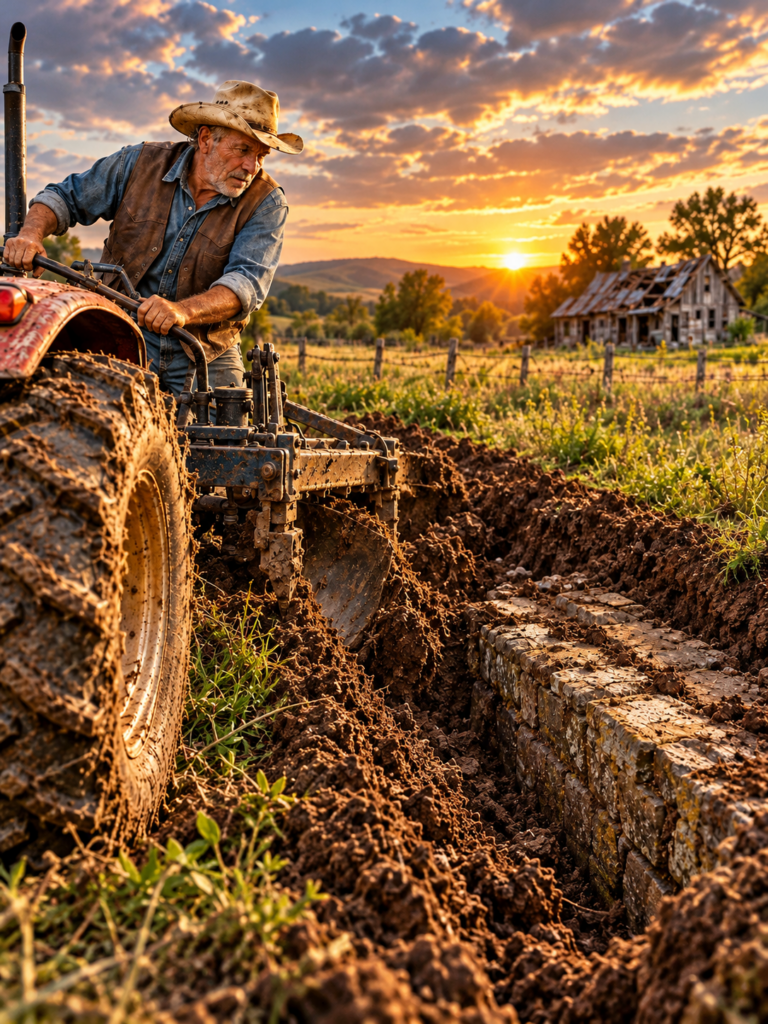
By eight, he was working the eastern field.
The first passes were slow.
Roots tugged at the implement. Small rocks surfaced. The neglected soil turned unevenly after years without cultivation.
But the tractor held steady.
Walter eased along the field, watching the ground break open behind him.
There was something deeply comforting about the familiar pattern.
A straight line.
A careful turn.
Another straight line.
Work that rewarded patience.
Around ten-thirty, the tractor lurched violently.
A metallic crack rang through the morning air.
Walter immediately disengaged the implement, stopped, and shut off the engine.
For a moment, he sat perfectly still.
Then he looked backward.
The plow had stopped against something buried in the soil.
“Lord have mercy.”
He climbed down carefully.
At first, he assumed he’d struck a large rock.
He’d encountered plenty of them.
But as he knelt beside the shallow trench and brushed away loose dirt, he noticed something unusual.
The exposed surface was dark gray and remarkably flat.
He scraped away more soil with his glove.
A straight edge appeared.
Then another.
Walter frowned.
Rocks didn’t usually meet at such deliberate angles.
He retrieved a small hand shovel from the truck and widened the opening.
The stone continued beneath the ground.
He uncovered a second piece beside it, fitted closely against the first.
Then a third.
He sat back on his heels.
“Well, I’ll be.”
He’d spent most of his life working fields.
He knew the difference between natural rock and something a human hand had placed.
This was no ordinary obstruction.
He traced the edge of the stone with his fingers.
The masonry looked old.
Far older than the farmhouse.
Walter looked across the empty field.
“Who put you here?”
There was no answer.
Only a meadowlark calling from the fence line.
For the next hour, he worked slowly, using the small shovel and a hand trowel.
More stone appeared.
It seemed to form part of a larger rectangular structure.
By noon, he had exposed enough to know he couldn’t safely continue without help.
Whatever lay beneath the field might be fragile.
He didn’t want to damage it.
He marked the area with stakes and bright survey tape, covered the exposed section to protect it from rain, and returned to the farmhouse.
Over lunch, he studied the county property records he’d collected before the auction.
The Whitcomb family had owned the farm for decades, but the property’s earliest ownership history was much older.
Some nineteenth-century deeds used descriptions that no longer matched modern roads or boundaries.
Walter stared at an old reference to a homestead near an eastern creek.
His heart began to beat faster.
The following morning, he called Russell Hayes.
Russell was sixty-four, a retired equipment operator who occasionally took small excavation jobs.
The two men had known each other since Walter’s cattle-ranching days.
“Russ,” Walter said, “I found something.”
“Money?”
“Stone.”
“Then you found what most farmers find.”
“Not this kind.”
Russell chuckled.
“What kind is it?”
“The kind somebody put there on purpose.”
There was a pause.
Then Russell asked, “How much stone?”
“Enough that I don’t know what I’m looking at.”
Russell arrived two days later in a dusty white truck.
He climbed out, shook Walter’s hand, and followed him toward the marked spot.
At first, Russell said little.
He knelt, examined the exposed masonry, and brushed dirt from one corner.
Then he stood.
“That’s definitely built.”
Walter nodded.
“Thought so.”
“Could be an old foundation.”
“From what?”
Russell looked across the field.
“That’s the interesting part.”
They spent the morning clearing loose topsoil by hand around the exposed area, avoiding the compacted layers next to the stones.
By afternoon, a longer section of wall had emerged.
Russell measured it.
Nearly twenty feet.
And still continuing beneath the ground.
“Walt,” he said, “whatever stood here wasn’t a little fence post.”
Walter looked at the stonework.
“How old do you reckon?”
Russell shook his head.
“Older than I know how to judge.”
That evening, the two men sat on the porch drinking coffee.
Russell stared toward the eastern field.
“You ought to call somebody from the historical society.”
Walter looked down at his hands.
“Probably.”
“Don’t go digging around blindly. You could damage something important.”
Walter nodded.
He understood.
But he also felt something he hadn’t experienced in years.
The excitement of a mystery.
Not a complicated bank statement.
Not an urgent repair.
Not another reminder of his limitations.
A genuine mystery.
Something the land had been keeping to itself.
That night, he dreamed of the farm as it might have looked a century and a half earlier.
A small cabin.
A team of horses.
Smoke rising from a stone chimney.
Children running across freshly plowed earth.
He woke before sunrise, unusually rested.
And when he entered the kitchen, he touched Margaret’s photograph.
“You wouldn’t believe what I found, Maggie.”
He called the county historical society shortly after nine.
The woman who answered listened carefully.
Then she asked him to describe the stonework again.
By the end of the conversation, she’d promised to contact a regional historian.
Two days later, Dr. Louise Farweather drove up Walter’s rutted driveway.
She was in her late fifties, with gray-streaked brown hair, practical boots, and a canvas bag full of notebooks and measuring tools.
After introducing herself, she followed Walter and Russell across the field.
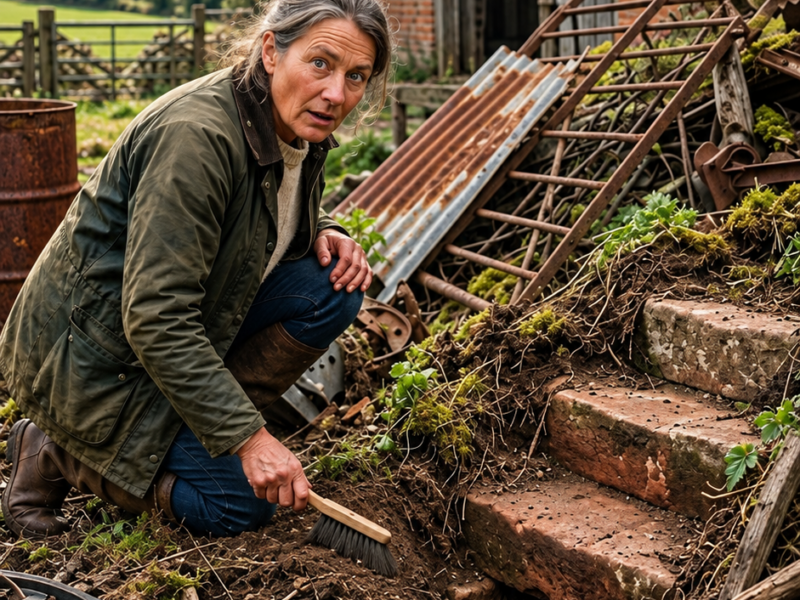
She knelt beside the exposed stones.
For a long while, she said nothing.
Then she brushed away a small patch of soil and studied the way two stones met.
“Mr. Bennett,” she said quietly, “how much of this have you disturbed?”
“Only enough to see what it was.”
“Good.”
Walter swallowed.
“Is something wrong?”
She looked up.
“No.”
There was an unmistakable excitement in her voice.
“Quite the opposite.”
She stood, studying the dimensions of the exposed foundation.
“I can’t give you a definite date without further examination. But this construction is consistent with early settlement-era buildings in this region.”
Walter glanced at Russell.
“How early?”
“Possibly the middle of the nineteenth century.”
Walter felt an unexpected chill.
He looked at the ordinary brown earth beneath his boots.
The same earth he’d cursed when the soil tests came back poor.
The same land everyone had told him was worthless.
Dr. Farweather slowly turned toward him.
“If this is what I suspect,” she said, “you may have found a homestead that disappeared from county records more than a century ago.”
Walter stared at her.
And suddenly, the whole farm seemed different.
Part 4
Dr. Farweather returned the following week with two archaeologists, a graduate student, and a carefully prepared excavation plan.
Walter had expected excitement.
He had not expected paperwork.
There were site maps, permissions, measurements, protective coverings, equipment restrictions, and discussions about preserving the integrity of the soil layers.
At first, Walter found it frustrating.
He had crops to plant.
Bills to pay.
A house still requiring repairs.
He couldn’t afford to have the entire eastern field turned into a research project.
Dr. Farweather understood.
They sat at his kitchen table over coffee while she explained exactly what the team wanted to do.
“We’re not asking to take over your farm, Mr. Bennett.”
“Feels a little like it.”
She smiled.
“I imagine it does.”
Walter folded his arms.
“How much land are we talking about?”
She spread out a preliminary map.
“A limited area around the foundation. We can establish boundaries and keep the rest of your operation accessible.”
He studied the drawing.
“And if you find something valuable?”
“Then we document it properly and determine the legal requirements for protecting and managing it. Ownership and disposition can depend on what is found and the applicable law.”
Walter nodded slowly.
“I don’t want people hauling pieces of this place away just because they think somebody might pay money for them.”
“Neither do I.”
That answer mattered to him.
He looked at her carefully.
“All right, Doctor. Let’s do it right.”
The work began the following Monday.
The excavation team removed soil in controlled layers, recording each discovery.
Walter watched whenever he could, though he continued working other sections of the property.
He had learned that an interesting discovery did not stop the electric company from sending bills.
By the end of the first week, the foundation’s outline was clearer.
It had belonged to a substantial cabin, likely built by settlers who had cleared the land when much of the surrounding county was still forest.
Small fragments of pottery appeared.
A corroded iron hinge.
Pieces of handmade brick.
But the most important discovery came beneath the structure’s southern end.
One of the graduate students noticed a carefully arranged line of stones beneath what appeared to have been the original floor.
The stones enclosed a small opening.
Further examination revealed the outline of a covered cellar.
When Dr. Farweather informed Walter, he nearly dropped the feed sack he was carrying.
“A cellar?”
“That’s what it appears to be.”
“Still there?”
“Part of it, certainly. We don’t yet know how intact.”
Walter followed her toward the site.
The excavation team had uncovered what looked like the top of a narrow stone-lined passage.
The opening was packed with sediment.
The stones around it were unusually well preserved.
Dr. Farweather stood beside the excavation.
“If the chamber remained sealed after the house was destroyed, there could be material inside that hasn’t been disturbed in a very long time.”
Walter studied the opening.
For reasons he couldn’t explain, he imagined a woman kneeling there in a long skirt, storing jars of vegetables before winter.
He imagined children waiting at a kitchen table while bread baked in an iron stove.
The thought struck him with surprising force.
“Somebody lived here,” he said.
Dr. Farweather nodded.
“Yes.”
“Not just owned the land. Lived here.”
“That’s exactly why these places matter.”
The cellar required careful stabilization before the team could fully examine its contents.
During that period, Walter found himself visiting the excavation every evening.
Sometimes he simply stood outside the protective boundary and looked at the stones.
He began wondering what kind of lives had unfolded there.
Had the family been happy?
Had the winters been hard?
Had someone buried a child beneath a tree?
Had a husband stood on that same rise after losing his wife, wondering how he could face another spring?
The questions stayed with him.
And then the team began uncovering artifacts.
First came ceramic storage containers.
Then hand-forged tools.
A broken lantern fitting.
A small collection of household objects.
A few personal possessions.
Each item was photographed and recorded before being removed for conservation.
One afternoon, Dr. Farweather invited Walter to examine a small object resting in a padded tray.
It was an oval brass locket, darkened with age.
Its hinge was damaged.
But a delicate floral pattern remained visible on the front.
Walter stared at it.
“Some woman’s?”
“Possibly,” she said. “We won’t know much more until it’s conserved.”
He leaned closer.
Margaret had owned a small gold locket.
Inside were photographs of their children when they were young.
She’d worn it on Sundays and anniversaries.
Walter remembered fastening the clasp behind her neck because her fingers had begun troubling her in later years.
He stepped away from the tray.
Dr. Farweather noticed.
“Are you all right?”
He nodded.
“Just remembering something.”
She didn’t press him.
That evening, he drove into town and bought flowers.
Not expensive ones.
Just a small bunch of yellow daisies, Margaret’s favorite.
He placed them beside her photograph on the kitchen table.
Then he sat down and cried.
It was the first time he’d allowed himself to cry openly since moving to the farm.
He had spent months working until exhaustion silenced his memories.
Now a stranger’s old locket had brought them all back.
“I miss you,” he whispered.
The words came out broken.
“I miss you so much.”
Outside, a steady rain began tapping against the windows.
Walter sat there until long after dark.
The next morning, he returned to work.
But something inside him had shifted.
The farm no longer felt like a place where he was trying to escape grief.
It felt like a place where grief could exist alongside a life still worth living.
Several weeks later, the historical society identified a likely connection between the buried structure and a pioneer family named the Ashfords.
Thomas and Eleanor Ashford had arrived in the region in the 1850s.
According to surviving records, they raised four children and established one of the county’s earliest documented agricultural homesteads.
Their cabin had apparently been destroyed by fire in the late nineteenth century.
Subsequent land transfers had gradually erased its precise location from common knowledge.
For generations, the site had remained buried.
Walter listened as Dr. Farweather explained the records.
“Did they survive the fire?”
“The documents aren’t entirely clear yet. We know at least some family members were living elsewhere afterward.”
Walter looked down at the site map.
“So there’s still a lot you don’t know.”
“A tremendous amount.”
He smiled faintly.
“Guess a man’s never too old to learn that.”
Within weeks, a regional newspaper published a story about the discovery.
The headline called it a forgotten pioneer homestead.
The accompanying photograph showed Walter standing beside the excavation, hat in hand, looking uncomfortable.
He hadn’t expected the attention.
And he certainly hadn’t expected Hank Mercer to appear at his driveway three days later.
Hank stepped out of his pickup, removed his sunglasses, and looked toward the old farmhouse.
“Place is looking better.”
Walter leaned against the porch railing.
“Coming along.”
Hank shifted his weight.
“Saw the newspaper.”
“Figured you might.”
“Quite a find.”
Walter nodded.
Hank glanced away.
“Listen, Walt. What I said at the auction—”
“You weren’t the only one.”
“Still.”
Walter waited.
Hank took off his hat.
“I shouldn’t have laughed.”
For a moment, the wind was the only sound between them.
Then Walter stepped aside.
“Coffee’s on.”
Hank looked surprised.
“You sure?”
“Unless you came here to complain about the price.”
The older rancher laughed.
And for the first time since the auction, the two men sat together without the weight of that afternoon hanging between them.
But the excavation had attracted more than curiosity.
It had attracted money.
And when the first serious private offer arrived, Walter realized that the hardest decision of his new life might not involve farming at all.
It might involve deciding what a piece of forgotten history was worth.
Part 5
The first collector offered Walter $25,000 for the right to acquire selected objects from the excavation, subject to legal approval.
The second expressed interest in negotiating a larger arrangement.
Then a private heritage developer contacted him about the possibility of acquiring the excavation site and surrounding acreage.
Walter listened politely.
He asked questions.
He took notes.
But each conversation left him more uneasy.
The objects being discussed had once belonged to people who had worked the same land he now struggled to restore.
He couldn’t look at the hand-forged tools without imagining the calloused hands that had held them.
He couldn’t think about the little brass locket without remembering Margaret.
And he couldn’t shake the feeling that selling everything piece by piece would erase the story just as completely as the old fire had done.
One afternoon, a representative from a state historical preservation organization arrived at the farmhouse.
Her name was Caroline Price.
She brought documents, maps, and a proposal.
Unlike the private buyers, the organization wanted to establish a protected historical site, support continued archaeological research, and develop educational materials about early settlement in the county.
The proposed agreement also included compensation to Walter and provisions that would allow him to continue farming the rest of his land.
He listened carefully.
Then he asked the question that mattered most.
“What happens to the things they find?”
Caroline folded her hands.
“They would be conserved, documented, and managed under an agreed preservation arrangement. Our goal is to keep the collection’s history intact.”
Walter glanced at the window.
Beyond it, the eastern field glowed beneath the late-afternoon sun.
“And the people who lived there?”
Caroline looked puzzled.
“The Ashfords,” Walter said. “Will folks know their names?”
“Yes.”
“Not just the man who found the place?”
She smiled.
“Especially not just the man who found it.”
Walter sat back.
For the first time, the offer felt right.
Still, he didn’t sign immediately.
Margaret had always insisted that important agreements deserved careful reading.
So Walter asked a local attorney to review the documents.
He discussed access boundaries, maintenance responsibilities, compensation, insurance, continued farming rights, and the treatment of future discoveries.
He negotiated several changes.
The preservation area would remain limited to the historically significant portion of the property.
Research access would be scheduled.
The remainder of the land would stay available for agriculture.
And an interpretive marker would describe the Ashford family’s life rather than celebrate Walter’s accidental discovery.
Once those terms were settled, he signed.
The compensation wasn’t enough to make him wealthy.
It was enough to help him repair his house, improve his soil, and preserve the financial breathing room he’d nearly lost.
Walter walked out of the meeting carrying his copy of the agreement.
For a long moment, he sat in his truck without starting the engine.
Then he looked at Margaret’s photograph tucked above the dashboard.
“Think we did all right, Maggie.”
He smiled.
“Didn’t sell the whole farm to do it, either.”
Spring arrived again.
The historical site was stabilized and documented.
A modest sign was installed near the protected foundation.
Walter attended the small dedication ceremony wearing his cleanest work shirt and the same brown jacket he’d worn to the auction.
Dr. Farweather spoke about the Ashford family.
She explained how the objects had provided a rare glimpse of early agricultural life in the county.
She described the importance of ordinary things.
Tools.
Cooking vessels.
Storage jars.
Personal keepsakes.
Things that seldom appeared in grand historical accounts but revealed how families actually lived.
Walter stood at the back of the gathering, holding his hat.
He was grateful she’d understood.
Afterward, a young girl approached him.
She couldn’t have been more than ten.
Her mother stood a few steps behind her.
“Mr. Bennett?”
Walter bent slightly.
“Yes, ma’am?”
“Did you really find that whole house with your tractor?”
He smiled.
“Not the whole house. Just enough stone to know something was there.”
She looked toward the excavation.
“Were you scared?”
He considered the question.
“A little.”
“Why?”
“Because I didn’t know what I’d found.”
The girl thought about that.
“Did you know you were going to be famous?”
Walter laughed.
“Honey, I was mostly worried I’d broken my plow.”
She giggled.
Then she asked something that caught him completely off guard.
“Do you think there are more stories under the ground?”
Walter looked across his fields.
He could see fresh growth where weeds had once stood.
The rebuilt fencing followed the land in neat lines.
Beyond the creek, the old trees swayed gently.
“Yes,” he said.
“I think there’s more history in the ground than we’ll ever know.”
The child smiled and ran back to her mother.
Walter stood there a moment longer.
He wished Margaret could have seen it.
Not the attention.
Not the newspaper articles.
He wished she could have seen the little girl’s face.
The wonder.
The excitement.
The certainty that old things still mattered.
Over the following months, Walter returned to the work that had brought him to the farm in the first place.
He planted a modest crop on the better sections of land.
He expanded his cover cropping program.
He repaired drainage channels and strengthened fence lines.
He didn’t attempt to turn all 240 acres into productive farmland at once.
He’d learned that stubbornness was useful only when it walked beside common sense.
His first harvest was small.
The second was better.
And by the following autumn, several of the eastern fields had begun showing real improvement.
Not miracles.
Not sudden abundance.
Just steady progress.
One afternoon, Rebecca arrived from Colorado.
Walter saw her rental car coming up the driveway and stepped off the porch to meet her.
She got out slowly, looking around.
The farmhouse had a sound roof.
The porch had new steps.
The yard had been cleared.
Beyond the house, fenced fields stretched toward the distant trees.
Rebecca stared.
“Dad.”
Walter smiled.
“Different from what you pictured?”
She looked at him.
Then at the land.
Then back at him.
“I thought you were living in a falling-down shack.”
“Was, for a while.”
“Dad!”
He laughed.
She hurried toward him and wrapped her arms around his shoulders.
He held her tightly.
For a moment, he was reminded of the little girl who used to run across the old ranch yard whenever he returned from checking cattle.
Her hair had turned darker.
There were small lines around her eyes now.
But she was still his daughter.
“I’m glad you’re here,” he whispered.
She pulled back.
“I’m still worried about you.”
“I know.”
“You still need help.”
“I know that, too.”
She studied his face.
“Then why do you look so happy?”
Walter turned toward the fields.
He considered how to explain the answer.
The long winter.
The loneliness.
The storm damage.
The fear of losing the last of his money.
The unexpected discovery.
The old family’s forgotten belongings.
The people who had come to help him preserve them.
The way he’d begun waking up each morning with something to look forward to.
Finally, he said, “Because I think I found my way home again.”
Rebecca looked toward the farm.
Her eyes filled with tears.
Then she slipped her arm through his.
“Show me around.”
He did.
He showed her the repaired kitchen, the garden beside the porch, and the small equipment shed he’d built after deciding the old barn wasn’t worth the immediate expense of full reconstruction.
He showed her the fields where the soil was slowly recovering.
And finally, he took her to the historical site.
They stood beside the interpretive marker.
Rebecca read the Ashford family’s story in silence.
Then she looked toward the protected foundation.
“You found all this?”
Walter nodded.
“By accident.”
She smiled.
“Some accident.”
He looked down at his boots.
“Funny thing is, I almost gave up before I got here.”
Rebecca turned toward him.
“What stopped you?”
Walter thought about the question.
He remembered the cold evening he’d sat alone at the kitchen table, staring at bills he couldn’t afford.
He remembered Margaret’s voice.
And he remembered the first small patch of green returning to the field.
“Didn’t want to quit on something just because it was taking longer than I’d hoped.”
Rebecca took his hand.
They remained there until the shadows began stretching across the grass.
That winter, Daniel visited too.
For the first time in years, Walter had both his children under the same roof.
They cooked together.
Argued mildly over a card game.
Laughed about old family stories.
And one evening, Rebecca found Walter sitting alone at the kitchen table.
Margaret’s photograph stood beside his coffee mug.
“Thinking about Mom?”
He nodded.
“Always.”
Rebecca sat across from him.
“She would’ve loved this place.”
Walter smiled sadly.
“She would’ve hated the roof.”
Rebecca laughed through her tears.
“She would’ve made you fix it before you did anything else.”
“That’s the truth.”
They sat quietly.
Then Rebecca reached across the table and squeezed his hand.
“I understand now, Dad.”
Walter looked at her.
“Understand what?”
“Why you couldn’t just stop living when Mom died.”
His eyes filled.
He turned toward the window before she could see.
Outside, snow had begun falling across the fields.
But this time, the farmhouse was warm.
The roof was sound.
The stove burned steadily.
And the silence no longer felt like something waiting to swallow him.
Years earlier, Walter had believed his greatest accomplishment was the ranch he and Margaret had built together.
Later, when he sold it, he thought the meaningful part of his life had ended.
He’d been wrong.
At seventy, he’d purchased a farm everyone else dismissed.
He’d spent months fighting poor soil, dangerous storms, failing equipment, and his own aging body.
His plow had struck a stone foundation buried for generations.
And in discovering the forgotten remains of another family’s home, he’d somehow begun rebuilding his own.
The Ashfords received their place in the county’s history.
The land received a chance to recover.
And Walter Bennett, who had once believed he was simply growing old alone, discovered that he still had something valuable to give.
Not because he had become wealthy.
Not because strangers knew his name.
But because his patience had preserved something worth remembering.
On a warm evening the following spring, Walter sat on the porch with a cup of coffee.
A red-tailed hawk circled above the eastern field.
The rows of new growth shone green beneath the setting sun.
Walter looked at the small framed photograph resting on the table beside him.
Margaret smiled back.
“Well, sweetheart,” he said softly, “we made something of it.”
The breeze passed through the trees.
He watched the sun sink lower.
Then he stood, set down his cup, and reached for his hat.
There was still a fence to check before dark.
And tomorrow, God willing, there would be another field waiting.
Because sometimes the land everyone calls worthless is carrying a story nobody has bothered to hear.
And sometimes a man who believes his best years are behind him discovers that the next chapter of his life is waiting just beneath the surface.
Cho đến nay, cuộc hội thoại này có hữu ích với bạn không?