
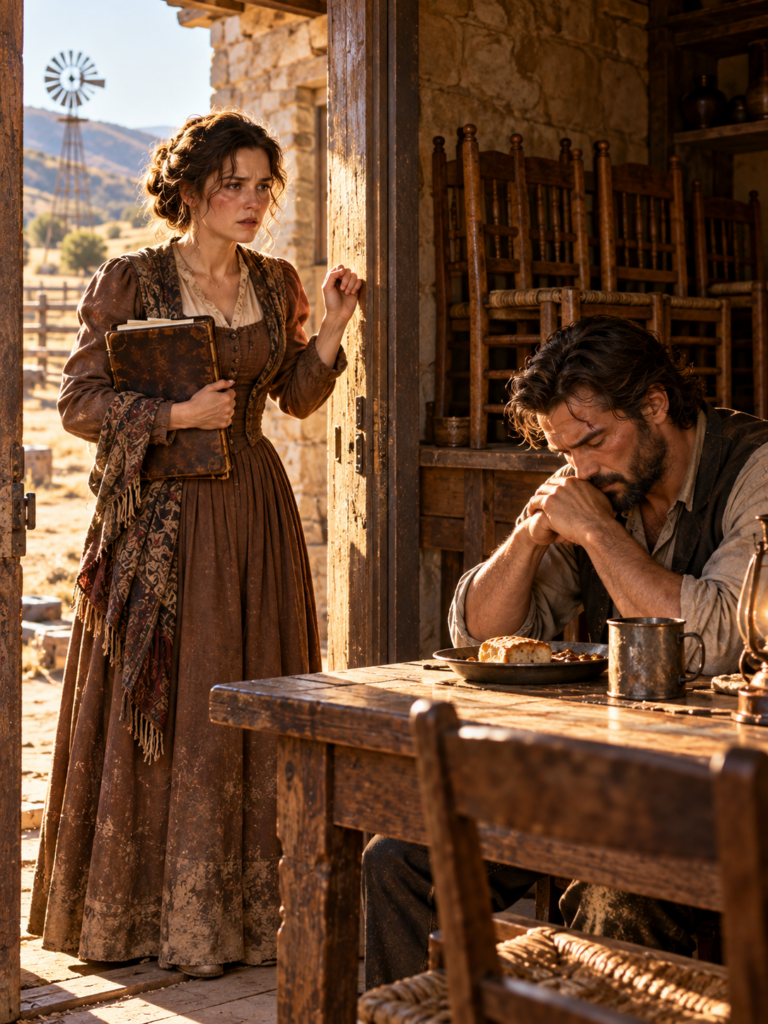
Her pencil stopped above the first entry when the mare shifted beneath her.
Judith steadied the ledger with one hand and traced the purchases with the other.
Feed in regular amounts. Meal. Oats. More feed.
The dates stretched back into March.
Each delivery had been collected without complaint, generally before the mill was busy.
She had assumed the rancher’s own animals were consuming it all.
Perhaps they were.
She closed the book.
A man’s purchases were his own affair. His unpaid balance was hers.
That distinction had kept her in business after her father’s death.
By late afternoon she reached Branic Mill.
The great stone building stood beside a creek bed filled with dust and scattered limestone.
Its enormous wheel was motionless.
On the loading dock, twelve-year-old Davey Brangan sprang to his feet.
“Did he pay?”
“No.”
Davey’s shoulders dropped.
“But he’s coming Monday to build us another way of turning the stones.”
The boy blinked.
“With what? His bare hands?”
“Horses.”
Davey looked toward the silent wheel.
“Can horses turn a mill?”
“We’re going to find out.”
“Can I help?”
“Yes, provided you remember that you’re working, not pestering.”
“How many questions am I allowed?”
“Six each day.”
“That’s hardly enough.”
“Then make them good ones.”
Davey grinned.
Judith watched him hurry toward the office, and the familiar ache in her chest eased a little.
He had come to the mill four years earlier, after fever took his mother. No one had arranged a formal place for him. He had simply remained, helping where he could and finding a place near Judith’s table whenever she remembered to use it.
The mill was his refuge as much as hers.
Losing it would uproot them both.
That evening, Judith stood at her office desk eating cold cornbread while checking the accounts.
Thirty-one customers owed her a combined $412.
Most were honest farmers.
Most had nothing to spare.
She could demand every penny and still not turn their empty pockets into money.
By lamplight, she calculated what a horse-driven mill might earn.
Even at a third of the old grinding capacity, it would bring customers back.
Perhaps she could keep the bank satisfied until autumn.
Perhaps.
Then she remembered Ezra’s prayer.
She looked at the untouched chair beside her desk.
For fourteen months, she had eaten standing up.
She had told herself it saved time.
The truth was harder to name.
Her father had once sat at the kitchen table after a day’s milling, asking whether she had remembered to sharpen the dressing tools, whether the stones were running sweetly, whether the customers had settled their accounts.
Since his death, sitting there had become unbearable.
Standing at the desk gave her something to do while she ate.
There was always another figure to check.
Another responsibility to carry.
Another reason not to notice the empty place.
On Monday morning, the sixteenth, Ezra arrived with a wagonload of timber and two enormous draft horses.
He inspected the ground beside the mill before unloading.
Judith met him at the doorway.
“I found my father’s gear patterns,” she said. “Davey is taking them to the foundry.”
“Good.”
“The castings will cost eleven dollars.”
Ezra nodded.
“I’ll make every piece of timber count.”
She pointed toward a patch of dry earth by the wall.
“That ground is level.”
“It is. But your garden used to be there.”
Judith looked at the bare patch.
“That garden died.”
“Doesn’t mean the ground has to be spoiled.”
He measured farther away and drove his first stake.
For some reason, that small decision unsettled her.
He had noticed something she had nearly stopped seeing.
A place where things might grow again.
By noon, the long beam lay beside the new pivot.
Davey hovered near the horses, using up his six questions before the meal.
Ezra answered each one patiently.
Then he lifted the heavy timber while Judith directed its placement.
For the first time in nine weeks, the mill yard rang with the sound of purposeful work.
Judith returned to the office to fetch her father’s measuring rule.
As she crossed the threshold, she looked down at the ledger lying open on her desk.
Ezra’s debt remained unpaid.
Her September deadline remained unchanged.
But outside, the man who had prayed for someone to share his table was working to save hers.
She picked up the measuring rule, shut the ledger, and stepped back into the sunlight.
Judith carried the measuring rule into the yard, where Ezra was crouched beside the timber pivot.
“Thirty-nine feet from this point to the outside of the circle,” she said.
Ezra checked her mark.
“That’ll do.”
“You’re certain?”
“I’d rather be certain before two horses start walking around it.”
He straightened and passed the rule back.
Their fingers touched briefly.
Judith withdrew her hand first.
Neither remarked upon it.
The next several days changed the sound of Branic Mill.
Instead of the empty creaking of dry machinery, there came the strike of hammers, the rasp of saws, and the steady voices of three people who had begun to expect one another’s company.
Ezra worked with an economy Judith admired.
He examined every length of timber before cutting it. He saved sound pieces from discarded boards. He fitted the sweep and gearing so the horses could walk a broad circle beyond the mill wall.
He was careful with iron, patient with wood, and unusually gentle with his team.
The larger horse, Duke, had a thoughtful, almost suspicious expression.
Sally, the mare, seemed content to follow whatever task her driver set before her.
“Which one’s smarter?” Davey asked.
“Duke,” Ezra replied.
“Which one’s better?”
“Sally.”
“How can the smarter one not be better?”
“Because thinking and doing aren’t always the same thing.”
Davey considered that.
“Which one are you?”
Ezra looked toward Judith.
“I expect Miss Renick has an opinion.”
“I expect,” Judith answered, “that Davey has asked his seventh question.”
Ezra smiled.
It was a small smile, half-hidden beneath his beard.
But Judith saw it.
And after that, she found herself noticing when he was amused, even when he said nothing.
At noon, she honored the agreement she had made.
Beans, cornbread, and a little salt pork appeared on the kitchen table.
Ezra ate there.
Davey usually ate on the dock.
Judith continued taking her portion to the office.
On Tuesday, Ezra appeared at her open office door.
“Miss Renick?”
“Yes?”
“Is there some reason you don’t eat in the kitchen?”
She kept writing.
“There’s work here.”
“There’s work everywhere.”
“The accounts won’t settle themselves.”
“No, ma’am.”
He did not leave immediately.
She raised her eyes.
“Was there something else?”
“Only that it’s a good table.”
She looked past him toward the kitchen.
“It was my father’s.”
Ezra nodded.
“I thought it might be.”
After a moment he said, “Those beans were mighty good.”
“Thank you.”
Then he went back to his meal.
He had not pressed her.
He had not suggested he understood her grief.
And that consideration followed her long after his boots stopped sounding in the hall.
On Wednesday, Judith dressed the millstones.
It was skilled, exhausting work, and one of the last crafts her father had taught her.
The great runnerstone had to be raised with the lifting tackle and turned so she could examine its grinding face.
With a mill bill, she recut the worn furrows, working from the wrist rather than the shoulder, just as her father had instructed her when she was fourteen.
Stone dust settled across her hair, sleeves, and apron.
Her hands ached.
But the clean channels beneath her tools gave her something almost like hope.
When she descended the stairs hours later, Ezra was waiting with a dipper of water.
“Davey said you were resting.”
“Davey knows better.”
“That’s what I suspected.”
She accepted the dipper.
The water was wonderfully cool.
“Where did you get this?”
“From my place.”
“You’ve been carrying water nine miles?”
“Had room on the wagon.”
She drank again.
“You needn’t do that for us.”
“I know.”
“Then why?”
“Because the spring gives more than I need.”
He said it without ceremony.
Judith handed the dipper back.
“Thank you, Ezra.”
It was the first time she had used his given name.
His fingers tightened slightly around the handle.
“You’re welcome, Judith.”
The next morning, the nineteenth of August, the horses began their first slow circuit.
Ezra guided them carefully into their collars.
The long sweep shifted.
Iron teeth engaged.
A shaft inside the mill began to turn.
For one terrible moment, the old machinery resisted.
Judith stood near the meal spout, listening.
“Easy!” she called.
Ezra could not hear her clearly above the grinding gears.
But he saw her raised hand.
He slowed the team.
The resistance eased.
The runnerstone settled into motion.
A faint powder began to fall from the spout.
Judith caught it in her palm.
Warm cornmeal.
Fine enough.
Evenly ground.
She rubbed it between thumb and forefinger, tested it again, and looked toward the open doorway.
“It’s working!”
Davey whooped so loudly that birds scattered from the mill roof.
Old Mr. Zeller, waiting with his corn, removed his hat.
“Your father would have liked to see that,” he told her.
Judith could not answer.
Her eyes had filled.
All morning the horses walked, rested, drank, and walked again.
The output was modest compared with the old waterwheel.
But by noon, nine bushels had been ground.
Nine bushels after nine weeks of silence.
Davey brought the bench from the loading dock into the kitchen.
He set three plates on the table.
When Judith entered carrying the cornbread, she stopped.
“What’s this?”
“Dinner.”
“I can see that.”
“Three places.”
“Davey.”
“We’ve ground nine bushels today. Seems like we could all sit down long enough to eat.”
Judith looked toward Ezra.
He stood near the doorway, freshly washed, his hat in his hands.
He offered no argument on the boy’s behalf.
He simply waited.
She could refuse.
That was what made the moment difficult.
Finally she set down the cornbread.
“Very well.”
Davey scrambled onto the bench.
Ezra took the chair opposite hers.
For a moment, nobody knew what to say.
Judith folded her hands.
“Would you say grace, Ezra?”
He looked surprised.
Then he bowed his head.
“Lord, thank you for this food and those whose work brought it here. Amen.”
He did not speak of loneliness.
He did not need to.
Judith picked up her fork and discovered that supper tasted different when she was not eating over a ledger.
The following morning, she rode east to collect several small accounts.
At the Pedabone farm, Tilda Pedabone met her at the gate.
The woman owed $3.50.
Her face tightened when Judith mentioned it.
“We haven’t got the full amount.”
“I’m here to collect what you can reasonably pay.”
Tilda glanced toward the pasture.
“The cattle barely made it through May.”
Judith knew the drought had been hard.
She had not realized how close this farm had come to losing its animals.
“We sold the calf,” Tilda explained. “Then the cows grew too weak to stand. If Colton hadn’t kept bringing feed, we’d have lost the lot.”
Judith went still.
“Ezra Colton?”
“Who else?”
“He’s been bringing feed here?”
“Since March.”
Tilda folded her arms.
“And to Hester Dunlap. And the old Swedish fellow with the mule. He doesn’t like anybody mentioning it.”
Judith felt the weight of her ledger against her hip.
Feed in regular quantities.
Every Tuesday.
Collected before sunrise.
The entries suddenly made sense.
“He’s been purchasing it on credit,” Judith murmured.
Tilda nodded.
“He wasn’t going to let the animals starve because their owners were short of money.”
Judith remembered standing in Ezra’s kitchen and demanding to know why he had failed to settle his account.
She remembered his steady expression.
He had let her believe he was careless.
He had not mentioned the families he was helping.
Not once.
Tilda watched Judith carefully.
“Amos wanted to refuse the feed. His pride wouldn’t permit it. Ezra told him they could argue about pride after the cows were standing.”
Judith gave a small, unwilling laugh.
That sounded exactly like the man she was beginning to know.
Amos approached from the field carrying his hat.
He produced what cash they could spare.
Judith counted $2.20, wrote a receipt, and agreed to leave the remainder outstanding.
The visit did not solve her own accounts.
By evening, her whole collection round had brought in only $14.35.
But something had changed.
She understood now that the largest unpaid account in her book represented more than one man’s failure to pay.
Its cost had been spread among people who otherwise might have lost their livelihood.
She also understood why Ezra had not explained.
He would not make his neighbors’ troubles the price of defending his good name.
That evening, they ate together again.
Davey described the new mill mechanism in exhausting detail.
Ezra listened.
Judith watched his hands around his cup.
He was not a man who talked much about what he had done.
But he had been taking care of people long before she had thought to look.
She wondered if anyone had been looking after him.
On Saturday, when the mill was closed, Judith baked a cobbler from the last of her dried peaches.
She wrapped it carefully beside a loaf of cornbread and carried the basket nine miles to Ezra’s ranch.
He was working in the far pasture.
She left it beside his door with a note.
A hired man’s wages include dinner. I thought supper ought to be considered now and then as well. It is only custom.
J.R.
That evening Ezra found the basket.
He carried it into the kitchen and set out a plate.
Then, after a long hesitation, he took one of the unused chairs from the wall and placed it beside his own.
He ate alone.
But he did not put the second chair away.
On Monday, August twenty-third, Judith received a letter asking her to come to Toiver Crossing Bank.
Ellis Garity, the banker, looked older than usual behind his walnut desk.
He did not pretend the news was good.
“The institution that provides my bank’s funds has demanded repayment of its loans. Under the terms of your father’s note, I can require payment earlier than September thirtieth.”
Judith stared at him.
“How much earlier?”
“September first.”
“That’s nine days.”
“I know.”
“You know I cannot produce three hundred and forty dollars in nine days.”
Ellis removed his spectacles.
“I can make one concession. Bring me sixty percent of the note and proof that your mill is operating, and I’ll personally carry the remaining balance through October.”
Judith calculated quickly.
Two hundred and four dollars.
She had $133.35.
She needed another $70.65.
The new horse-driven mill could earn money.
But not that much in nine days.
She returned home and spent the evening doing sums that refused to change.
No matter how carefully she rearranged the figures, the answer remained the same.
She could work every available hour.
Ezra could keep the horses turning.
Davey could bring in every customer within reach.
It would not be enough.
Late that night, she set down her pencil.
Her mind returned to Ezra’s overflowing trough.
Water.
Clear spring water running into the dirt.
An entire summer without rain, yet his trough never emptied.
A thought rose so suddenly that she stood.
The next morning, she waited beside the horse sweep before Ezra arrived.
He stepped down from the wagon at six.
“Morning, Judith.”
“Where does your spring water come from?”
He paused.
“The hillside above the house.”
“How much does it produce?”
“More than my stock uses.”
“Even in a drought?”
“Always has. It ran through the dry summer of ’74.”
Judith moved closer.
“Could that water reach Branic Creek?”
Ezra looked at her for several seconds.
Then something in his expression changed.
“My father once started a ditch down the draw,” he said slowly. “He intended to carry the spring overflow toward your father’s millrace.”
Judith caught her breath.
“What happened?”
“The work stopped before they made an agreement. The ditch filled with silt. It’s been neglected twenty years.”
“How long?”
“Near a mile and a half.”
“Would it carry enough water?”
“Your father tested the spring himself. Thought it could turn the wheel, though not at the creek’s old full capacity.”
Judith pressed her fingers against her skirt.
“How long would it take to clear?”
“One man? Better part of a month, likely.”
“And twenty?”
Ezra looked toward the horses.
“With tools and enough willing hands? Several days.”
Judith stepped closer.
“You’ve been feeding your neighbors for five months.”
His head lifted sharply.
She met his gaze.
“I visited the Pedabones.”
For a moment he said nothing.
“They told you.”
“Yes.”
“I didn’t want that business made public.”
“I haven’t made it public. But perhaps the people you’ve helped ought to be allowed to help you.”
“I’m not asking repayment for feed.”
“Then ask them to help save the mill.”
He shook his head slightly.
“Judith, those families have troubles of their own.”
“So do we.”
He looked at her.
She had said we.
Neither missed it.
Judith continued.
“The Pedabones have tools. Hester Dunlap knows how to work. Mr. Zeller may be old, but he can still organize men. And Pastor Wills has never been afraid of dirty hands.”
Ezra studied the bare ground.
“I’ve never been much for asking.”
“I’ve noticed.”
“What if they refuse?”
“Then we’ll know.”
She moved toward him.
“But you gave those people something they couldn’t purchase. You gave them a way to keep going.”
“That doesn’t entitle me to their labor.”
“No. It doesn’t.”
Her voice softened.
“But it gives them a reason to care whether this mill survives. And it gives them the freedom to say yes.”
Ezra looked across the yard at the long timber sweep he had built.
It was working.
It had saved the mill from complete silence.
But it could not save Judith from the bank’s sudden demand.
He took off his hat.
For a long moment he turned it in his hands.
Then he looked up.
“All right,” he said. “I’ll ask.”
The next morning he rode to Amos Pedabone’s farm.
He dismounted at the gate and waited while Amos crossed the yard.
“I’ve come about a ditch,” Ezra began.
Amos listened.
Ezra explained the spring, the old channel, the bank’s deadline, and the labor needed to make the water reach the mill.
Then he spoke the words that felt harder than any day’s ranch work.
“I need help, Amos. I cannot do this alone.”
Amos studied him.
Then he turned toward the barn.
A moment later he came back carrying a mattock.
“Well,” he said, “it’s about time you asked.”
By the following morning, eleven people had gathered along the old Colton Ditch.
Judith stood beside Ezra, looking down its dry, overgrown length.
There were roots to pull, stones to shift, and years of packed silt to remove.
Beyond it waited the dry millrace.
Beyond that, the bank’s deadline.
And when Ezra asked whether they should begin, Judith took up a shovel.
“At the upstream end,” she said. “We need to keep the fall of the channel true.”
Ezra nodded toward the waiting neighbors.
Then he stepped beside her and drove his spade into the hard earth.
The spade struck packed dirt with a dull, stubborn sound.
Ezra leaned his weight against the handle and lifted the first heavy clod from the long-neglected ditch.
Judith dug beside him.
Across the narrow channel, Amos Pedabone set his mattock into the earth.
Soon the hillside echoed with the sound of iron biting soil.
It was Wednesday, August twenty-fifth.
There were seven days before Judith’s payment had to reach the bank.
Every hour mattered.
The old ditch had once been carefully laid along the contours of the land, carrying spring overflow from the Colton property toward Branic Creek.
Time had nearly erased it.
Roots had grown across the channel.
Loose stone had fallen from its banks.
At several places, silt had filled the bed so completely that only a shallow depression showed where water had once been meant to travel.
Ezra remembered portions of the route from his father’s descriptions.
Judith had the miller’s eye for elevation and fall.
Together they marked the lowest workable line and organized the volunteers.
No one needed a speech about the importance of the undertaking.
The silent wheel could be seen from the lower fields.
Most of those gathered had grain waiting to be ground.
All of them knew what losing the mill would mean.
Amos and Ezra worked the hardest ground.
Hester Dunlap, wearing sturdy boots that had belonged to her husband, cleared roots alongside two other neighbors.
Pastor Orin Wills arrived with his sleeves already rolled.
“I expect,” he announced, taking up a shovel, “that the Almighty won’t object if I perform a little earthly labor today.”
That drew a laugh.
Even Ezra smiled.
Tilda Pedabone brought biscuits, beans, and water for the workers.
Old Mr. Zeller took charge of keeping the excavated dirt from sliding back into the ditch.
He was too old for a full day of heavy digging, but he could still recognize poor workmanship from fifty paces.
“Don’t throw that stone there,” he called. “You’ll be putting it back by supper.”
Davey carried water, helped collect tools, and ran messages between sections of the work.
For once, he had fewer questions than usual.
He was learning that a great deal could be understood simply by watching.
Judith divided her hours between the mill and the ditch.
The horse-driven sweep still had customers to serve.
Duke and Sally needed their rests, feed, and water.
The grain accounts still required careful weighing.
She could not abandon the business she was trying to save.
But each morning she walked the ditch before starting the mill.
Each evening she returned to examine the day’s progress.
And every evening Ezra was there, boots crusted with dirt, sleeves damp from labor, discussing tomorrow’s work with the neighbors.
Something unexpected had happened to him.
He was no longer a man standing apart from everyone.
He had become a man people called by name.
Amos asked his opinion about the channel banks.
Hester teased him about his habit of carrying more tools than he needed.
Pastor Wills invited him to sit with the workers at dinner.
And Ezra, who had once eaten his meals at a table with six stacked chairs, began eating on the grass among people who were pleased to have him there.
Judith noticed that he laughed more often.
Not loudly.
Never for attention.
But the sound came more easily.
One afternoon, as they carried a basket of tools toward the wagon, she said, “You seem different.”
Ezra glanced at her.
“Different how?”
“You don’t look as though you’re preparing to apologize for being in a crowd.”
He considered that.
“Hadn’t thought of it.”
“You used to keep to yourself.”
“Still do, more than most.”
“Not quite so much.”
He looked toward Amos, who was arguing amiably with Mr. Zeller about a section of the ditch.
“No,” Ezra admitted. “Not quite.”
They walked a few steps in silence.
Then Ezra said, “After my father was gone, it seemed easier to keep the ranch work moving and let the rest of life take care of itself.”
Judith nodded.
She understood that kind of thinking.
“Turns out,” he continued, “the rest of life doesn’t always look after itself.”
She glanced at him.
“No,” she said. “It doesn’t.”
He stopped beside the wagon.
“Can I ask you something?”
“Of course.”
“When you eat at your desk, is it because you prefer it?”
Judith’s hand tightened around the basket handle.
For a moment, she almost told him it was none of his concern.
Instead she looked toward the distant mill.
“My father and I ate at the kitchen table every evening,” she said. “We would talk about the work. Sometimes we argued about it.”
Ezra listened.
“When he died, I tried sitting there alone. It felt as though the room had grown twice its old size.”
She swallowed.
“So I began eating at the desk. There was always work in front of me. I could finish a meal without noticing how quiet things had become.”
Ezra took the basket from her when she offered it.
“I expect that made for some long evenings.”
“It did.”
He did not tell her to stop.
He did not say she ought to find company.
He simply walked beside her toward the waiting horses.
That restraint was becoming one of the things she valued most about him.
He left her thoughts and choices in her keeping.
And because he did, she found herself wanting to share more of them.
By Saturday evening, the twenty-eighth, the ditch was clear.
For four days, the workers had hauled silt and stones, cut away roots, shaped the channel, and repaired the sections where the banks had fallen inward.
It was rough work.
There would be leaks to mend once water began flowing.
But the course was open from the spring down toward the dry creek and millrace.
The spring gate at the upper end remained closed.
Ezra inspected the channel one last time.
Then he announced they would open it after Sunday worship.
The neighbors accepted that.
They were tired enough to be grateful for a day’s change of pace.
On Sunday, the church at Toiver Crossing was fuller than it had been for months.
Hands that had been carrying shovels were folded over worn Bibles.
Boots still bore traces of pale hillside dirt.
Pastor Wills looked across the congregation with an expression that suggested he had changed his intended sermon.
He opened to the Psalms.
“God setteth the solitary in families,” he read.
Then he looked up.
“Now, folks, I have been thinking all week about what that means.”
Judith sat in the third pew.
Ezra sat beside her.
It was not something they had arranged beforehand.
He had simply paused at the end of her pew, and she had moved to make room.
Pastor Wills spoke about neighbors.
About gifts that arrived without being requested.
About the pride that sometimes made accepting help harder than offering it.
“There’s nothing wrong with a person who works hard and stands on his own feet,” he said. “But the Lord didn’t put us all on this earth to stand apart from one another.”
Judith kept her eyes forward.
Beside her, Ezra shifted slightly.
His shoulder was close enough that she could feel its warmth.
Neither moved away.
After the service, Hester Dunlap marched up to him.
“Ezra Colton, you’re coming to my place Thursday evening for supper.”
He blinked.
“Mrs. Dunlap, there’s no need—”
“Didn’t ask whether you needed to. I asked you to come.”
Tilda Pedabone laughed.
“You’d best agree. She’ll follow you home if you don’t.”
Ezra removed his hat.
“Yes, ma’am. Thank you.”
Judith turned her face away to hide her smile.
Later, as they walked toward their wagons, Ezra said, “I expect I’ll be eating out more often than I used to.”
“That would be a change.”
“A considerable one.”
“Would you mind?”
He considered the question.
“I don’t reckon I would.”
They traveled to the Colton place that afternoon with two neighbors to open the spring gate.
The water started down the first section of the ditch with a modest rush.
It filled shallow places, darkened the dry earth, and found its way around newly exposed stones.
They followed the advance carefully, repairing leaks and checking where the ground absorbed more water than expected.
The old channel had not carried water for twenty years.
It needed tending.
By dusk, the flow had reached farther down the draw.
By Monday evening, the thirtieth, it was approaching the final stretch toward Branic Mill.
Judith spent the day checking the mill’s sluice and wheel pit.
She made certain the new arrival of water would not catch the old machinery unprepared.
The horse sweep had given the stones work again.
Now she hoped to bring back the greater power her father’s mill had been built to use.
At ten that night, she stood beside the wheel pit holding a lantern.
Ezra was next to her.
The hillside beyond the mill lay dark.
The air was still.
Davey had been sent to bed, although neither of them truly believed he was asleep.
For several minutes there was nothing to hear.
Then Judith raised her head.
“Ezra.”
“I hear it.”
At first, it was barely a sound.
A thin movement in the old millrace.
Water touching dry earth.
A little farther up, someone had turned the final flow into the channel.
The trickle grew stronger.
Moonlight caught a narrow line of silver.
Judith stepped nearer the stone edge.
The water ran past her.
It gathered at the sluice.
Then it spilled into the first bucket of the enormous wheel.
The old structure groaned.
Wood shifted against iron.
Another bucket filled.
The wheel trembled.
For one dreadful second Judith feared it might seize.
Then the heavy rim moved.
Slowly at first.
Then another few inches.
Then a full, deliberate turn.
Judith laughed.
The sound rose from somewhere so deep within her that she hardly recognized it.
“It’s turning!”
Ezra pulled off his hat.
“I can see that.”
She laughed again.
Tears ran down her face, leaving pale tracks through the dust on her cheeks.
For nine weeks she had lived with the fear that the wheel would never move again.
For fourteen months she had been trying to hold her father’s world together alone.
And now the water was running.
Not because rain had finally arrived.
Not because a banker had taken pity on her.
But because a rancher had offered his labor, a dozen neighbors had come together, and she had found a way to use what everyone had overlooked.
The wheel kept turning.
Judith looked at Ezra.
“There’s something I should tell you.”
His expression grew attentive.
“Go ahead.”
She set the lantern safely on the stone ledge.
“When I came to your house on August twelfth, your door was open.”
“I remember.”
“You were eating supper.”
He waited.
“I heard you say grace.”
A faint change came over his face.
She gathered her courage.
“I heard the last part, too.”
The water rushed below them.
Ezra looked at his hat.
Judith continued before she could lose her nerve.
“I heard you tell the Lord you were tired of eating alone.”
For a long moment he said nothing.
Then he breathed out slowly.
“I thought somebody might have been on the porch awhile. That board creaked after you’d been standing there.”
“I’m sorry. I should have told you.”
“Why didn’t you?”
She considered the question.
“Because you weren’t speaking to me. It seemed wrong to take something you hadn’t meant to give.”
Ezra looked toward the moving wheel.
“I wasn’t speaking to anyone except the Lord.”
“I know.”
He turned back to her.
“But I suppose He doesn’t always arrange for a person to be the only one listening.”
Judith gave a small, unsteady smile.
“Are you angry?”
“No.”
“Embarrassed?”
“A little.”
She looked down.
“I wish I hadn’t heard it without your knowing.”
Ezra stepped closer, though he left room between them.
“Judith, I’m not ashamed of what I said.”
She lifted her eyes.
“I’d been saying some version of it a good long while,” he admitted. “That evening I finally used the plain words.”
She heard the weariness beneath his admission.
Then she thought of the kitchen table at her own mill.
“I’ve been eating alone, too.”
He nodded.
“I know.”
“No. I mean really alone. I’ve been standing at my desk with the ledger open because I couldn’t bear to sit at my father’s table and see his chair empty.”
Ezra did not interrupt.
“I told myself I was being sensible. That I was saving time. But I wasn’t. I was avoiding the thing I couldn’t change.”
Water splashed against the stone below them.
Judith brushed moisture from her cheek.
“The first time Davey set three plates out, I almost sent him back to the dock. I didn’t want anyone to see how much I needed that ordinary little thing.”
“A meal?”
“Company.”
Ezra’s expression softened.
“I know something about that.”
They stood facing each other beside the wheel.
Then Ezra set his hat on the ledge.
He placed one hand beside Judith’s, palm resting against the stone.
He did not reach for her.
He did not assume that tenderness gave him permission.
Judith looked at his hand.
Then she turned hers and laid it gently over his.
His fingers closed around hers.
For several moments, they watched the wheel turn together.
At last Judith said, “I’m still frightened.”
“About the bank?”
“Yes.”
He waited.
“And about how much this mill matters to me. If I lose it, I lose the place where nearly every good memory of my father lives.”
“You’ve done everything you could.”
“I still need another seventy dollars.”
“The wheel’s running now.”
“Tomorrow may help.”
“It will.”
She glanced at him.
“You sound certain.”
“No. I sound hopeful. There’s a difference.”
She smiled.
He squeezed her hand once.
“Whatever happens tomorrow, you’ve got people who’ll stand with you.”
She looked toward the darkened millhouse.
Davey was indeed visible at the loft window.
The boy hastily ducked when he realized she had seen him.
Judith laughed softly.
“Yes,” she said. “I believe I do.”
The next morning, August thirty-first, wagons began arriving before sunrise.
Old Mr. Zeller came first with corn he had been waiting nine weeks to grind.
The Pedabones followed.
Then the Dunlap family.
Then more wagons from the surrounding farms, each carrying grain that had been stored while the mill stood silent.
Before the sun cleared the hills, the line stretched from the loading dock toward the county road.
The spring-fed wheel was turning steadily.
Judith had inspected the stones and set the feed.
Ezra helped manage the grain sacks and kept the work moving.
Davey stood beside a slate, recording weights and amounts with tremendous seriousness.
Every hour he announced the totals.
Every time the slate filled, he wiped it and began another column.
The day was hot.
The work was demanding.
Meal dust covered Judith’s sleeves and gathered in the folds of her dress.
Ezra’s shirt darkened with sweat as he shifted the grain.
But nobody complained.
The mill had become a place of activity again.
Farmers who had waited weeks for grinding stood beneath the loading dock awning, trading news while their grain was processed.
Tilda Pedabone brought food.
Mr. Zeller offered advice no one had requested.
Davey declared himself the busiest person in the county.
By six that evening, the last of the day’s grain had been accounted for.
Judith went into the office and counted the cash.
She counted it once.
Then again.
Ezra stood in the doorway.
Davey leaned against the desk.
“How much?” the boy demanded.
Judith swallowed.
“Seventy-eight dollars and sixty-five cents.”
Davey’s eyes widened.
“That’s more than you needed today, isn’t it?”
She took up her pencil.
The collection round had raised her strongbox total to $133.35.
She added the day’s earnings.
The answer appeared on the paper.
$212.
She stared at it.
Davey climbed onto the stool to see.
“Two hundred and twelve dollars,” he repeated.
“Yes.”
“How much does the bank want?”
“Sixty percent of three hundred and forty.”
Davey scribbled the calculation on his slate.
“Two hundred and four dollars.”
Judith nodded.
“We have eight dollars more than the minimum.”
The boy whooped.
Ezra closed his eyes briefly.
Judith lowered herself into the office chair.
For the first time since the letter had arrived, she was able to draw a full breath.
The next morning, September first, she walked into Toiver Crossing Bank carrying the money.
Ellis Garity counted it carefully.
Bill by bill.
Coin by coin.
When he finished, he looked across his desk.
“Two hundred and twelve dollars.”
Judith sat very straight.
“Yes, sir.”
“Your mill is operating?”
“It ran all day yesterday. The wheel is turning on water from the Colton spring.”
Ellis studied her.
“I heard the machinery from the road.”
“Then you know it wasn’t merely a promise.”
“No. I know.”
He took up his pen.
For a moment Judith listened only to the scratch of its point against the paper.
Then he signed the extension.
“One hundred and twenty-eight dollars remains. You have until October thirty-first.”
Judith looked at the document.
The mill was not free of debt.
There was more work ahead.
But the immediate danger had passed.
“Thank you, Mr. Garity.”
He shook his head.
“Keep the stones running, Judith. That’s thanks enough.”
Outside, Ezra was waiting beside the wagon.
Duke and Sally stood in the shade, resting quietly.
He looked at Judith as she descended the bank steps.
She held up the signed paper.
For one instant his expression was almost boyish.
“Well?”
“October thirty-first.”
He broke into a smile.
“Then we’ve got ourselves some time.”
Judith walked toward him.
“We do.”
He offered his hand to help her onto the wagon.
She took it.
Before climbing up, she paused.
“Ezra, I want to settle something about your account.”
His smile faded.
“Of course.”
“You’re still owed credit for the days you’ve worked. I’ll continue keeping them properly.”
“I never doubted you would.”
“And the water you’re providing has value. We should put our agreement about its use in writing, so neither property is left depending upon a misunderstanding.”
He considered that.
“That sounds wise.”
“I mean to keep my father’s mill in my own name.”
“I’d expect nothing else.”
She looked at him carefully.
“And I wouldn’t want you to think that because you’ve helped save it, you must keep carrying the work alone.”
Ezra shook his head.
“I don’t want to own your mill, Judith.”
“What do you want?”
He took a moment before answering.
“I’d like to keep helping while it’s useful. I’d like to see the water keep turning that wheel.”
He glanced toward her face.
“And I’d like to share a meal with you now and then, whether or not there’s work to discuss.”
The directness of the offer warmed her more than a grand declaration would have.
She smiled.
“I think I’d like that.”
They returned to Branic Mill together.
There was work waiting, as there always would be.
But the work no longer seemed to stand between Judith and the rest of life.
Over the following days, the spring-fed wheel continued operating.
The flow was less powerful than Branic Creek in a wet season, but it was dependable.
The horse sweep remained available as a useful alternative.
Judith kept the accounts carefully.
Ezra continued working down the balance he owed her.
Together they discussed maintenance of the ditch and the best way to keep its banks sound.
Their conversations became less guarded.
Occasionally, they disagreed.
Judith could be exacting about the mill machinery.
Ezra had definite opinions about timber and repairs.
Neither always yielded.
But each listened to the other.
And the respect between them grew stronger because it did not require one person to surrender a lifetime of knowledge.
One afternoon, Judith found Davey standing beside the kitchen table holding three clean plates.
He glanced at her with exaggerated innocence.
“Is dinner going to be at the desk?”
She looked toward the office, where the ledger lay open.
Then back at the boy.
“No.”
Davey grinned.
“Didn’t think so.”
She took one of the plates from him.
“Set the bench properly. And wash your hands.”
“Yes, ma’am.”
That Sunday, September fifth, Judith and Davey traveled nine miles to the Colton ranch.
Ezra had invited them to dinner after church.
He had made the invitation openly, standing outside the church door with his hat in his hands.
It had been simple.
“Miss Renick, would you and Davey come eat at my place on Sunday? There’s plenty of room.”
Judith had accepted.
Now, as their wagon climbed the familiar approach to the ranch, she saw something that made her heart give an unexpected turn.
The trough still stood at the corner of the yard.
Clear spring water filled it.
The overflow no longer disappeared uselessly into the flat below the house.
It had a course.
It was finding its way to the mill.
Judith remembered her first visit.
She had ridden there angry, frightened, and determined to collect every cent.
She had seen water spilling onto the earth and thought Ezra careless.
Now she understood how much good that spring could do.
And she understood that she had been mistaken about the man who lived beside it.
Ezra came out to meet them.
He helped Davey secure the wagon, then escorted them toward the house.
Judith climbed the same porch steps where she had once stood listening to a prayer not meant for her.
This time she knocked without hesitation.
Ezra smiled.
“Come in, Judith.”
She entered.
The long kitchen table stood beneath the window.
But the chairs were no longer stacked against the wall.
They were gathered around it.
Hester Dunlap was already there.
Tilda and Amos Pedabone had arrived with a covered dish.
Old Mr. Zeller had brought a pie.
Pastor Wills stood near the window talking about the state of the roads.
Davey took his place on the bench, immediately asking whether there would be seconds.
The kitchen filled with conversation.
Plates were passed.
Someone laughed.
Someone moved a chair to make more room.
Judith looked around the room in quiet wonder.
She remembered the solitary plate.
The six chairs standing upside down against the wall.
The voice asking heaven for company.
Now the table was full.
Ezra took his place at its head.
He looked at the people gathered before him.
For a moment, he seemed overcome by the simple fact of their presence.
Then he bowed his head.
Everyone followed.
“Lord,” he began, “thank you for this food, and for every hand that helped provide it.”
Judith folded her hands in her lap.
“Thank you for the spring water, for the work we were able to do together, and for the neighbors who wouldn’t let one another give up.”
His voice grew quieter.
“And Lord, thank you that I’m not eating alone tonight.”
“Amen,” the table answered.
Judith opened her eyes.
Across the table, Tilda was smiling.
Davey had already reached for the cornbread.
Pastor Wills was asking Mr. Zeller to pass the beans.
It was an ordinary Sunday meal.
That was what made it beautiful.
Nobody had become wealthy.
The drought had not magically ended.
Judith still owed the bank $128.
Ezra still had cattle to tend and an account to settle.
The ditch would require maintenance.
The mill would continue demanding long days and careful work.
Nothing about their lives had suddenly become easy.
But something had changed that money alone could never have repaired.
Ezra no longer believed that bearing every burden silently was the only honorable way to live.
Judith no longer believed that responsibility required her to shut everyone out.
Davey no longer had to wonder whether the adults around him would remember to sit down together.
And the neighbors who had once accepted help in private now understood the dignity of giving help openly.
Judith looked at Ezra.
He met her eyes.
There was no hurried promise between them.
No demand for marriage.
No assumption that kindness had created a debt of affection.
There was simply a growing tenderness, freely offered and carefully received.
For now, it was enough.
After the meal, Judith helped gather the dishes while the others talked.
Ezra joined her at the kitchen table.
“You don’t have to do that,” he said.
“Neither do you.”
He smiled.
“Fair enough.”
They worked side by side.
When the plates were cleared, Judith noticed that every chair remained standing.
She touched the back of the one beside her.
“You used to keep these against the wall.”
“Didn’t seem much use having them out.”
“And now?”
Ezra looked around the kitchen.
“Seems I was wrong.”
She glanced toward the open window.
The afternoon sun lay warm across the table.
Far beyond the hills, her mill was waiting beside the newly flowing water.
She would return to it tomorrow.
There would be grain to weigh, stones to tend, and figures to enter in the ledger.
She wanted that life.
She wanted her father’s work to continue beneath her own capable hands.
But now she knew she could want other things as well.
A shared meal.
A friend who understood the cost of loneliness.
Perhaps, given time, a deeper affection neither of them needed to hurry.
Ezra held her gaze.
“Would you come again next Sunday?”
Judith smiled.
“If you like.”
“I would.”
“Then I will.”
She hesitated.
“And one evening this week, you might come to the mill for supper. Not as part of your wages.”
His expression changed.
“As what?”
“As my guest.”
Ezra’s answering smile was gentle.
“I’d be glad to.”
Outside, Davey shouted for help with the wagon.
Ezra reached for his hat.
Judith took up her gloves.
Together they went out onto the porch.
The old board creaked beneath her boots.
It was the very board that had betrayed her presence on that first afternoon.
Judith looked down at it and laughed softly.
Ezra glanced at her.
“Something amusing?”
“Only that I nearly rode away without knocking the first time I came here.”
“I’m glad you didn’t.”
“So am I.”
They descended the steps together.
And when Judith returned to Branic Mill that evening, she did not take her supper to the office.
She sat at the kitchen table with Davey.
She left the ledger closed until the plates had been cleared.
The next morning, the great wheel would turn again.
There would be work.
There would be responsibilities.
There would be another day’s struggle to keep the mill alive.
But that evening, in a quiet kitchen beside the running water, Judith finally understood something her father had never needed to put into words.
A home was not made by walls, land, or accounts kept in perfect order.
It was made by the people who freely chose to return to one another.
Nine miles away, Ezra Colton’s seven chairs stood ready around his table.
And at Branic Mill, Judith left a chair waiting for the next time he came.
Neither table needed to be lonely again.

