
Part 1
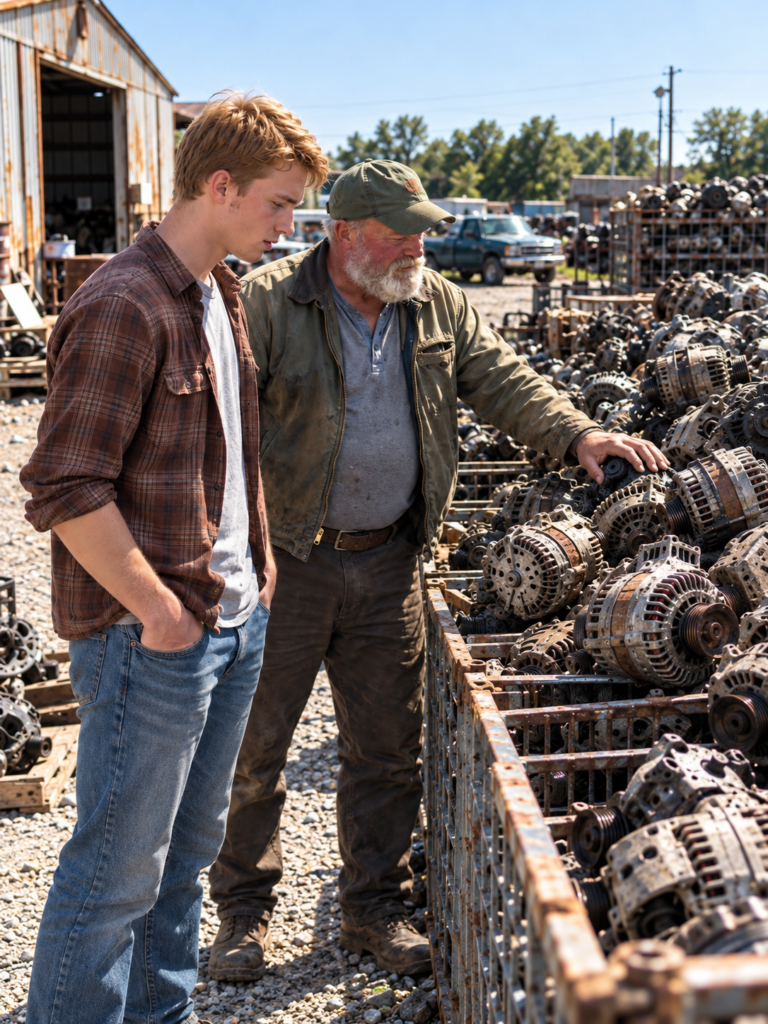
The first thing Ray Dawson did when Ethan Miller handed him eighty dollars was laugh.
It wasn’t a polite chuckle, either. It was the kind of laugh a man gives when he’s certain somebody has just made a mistake and is too young to understand it.
Ray stood behind his salvage shop with four twenty-dollar bills in one hand, looking from the money to the enormous collection of battered alternators scattered across the storage yard.
“You sure you know what you’re buying, son?”
Seventeen-year-old Ethan glanced at the pile.
There were eight hundred alternators in all, removed from old tractors, trucks, automobiles, and agricultural equipment over years of repairs. Some were nearly complete. Others were missing terminals, pulleys, mounting brackets, or pieces of their housings. Rust covered the exposed steel. Oil had dried into black crust around bolts and seams. Dirt filled ventilation openings that hadn’t been cleaned in years.
Most people saw a mountain of heavy, greasy metal.
Ethan saw something else.
“I think I know enough,” he answered.
A mechanic working nearby stopped what he was doing.
Carl had been around engines and repair shops long enough to know what a pile of discarded electrical equipment usually meant. He looked at Ethan, then at the alternators, and shook his head.
“Kid, I wouldn’t haul those things home if Ray paid me.”
Ray laughed harder.
Ethan didn’t argue.
He knew what they were looking at. He wasn’t blind to the cracked castings, frozen bearings, and broken connectors. He understood that some of the units were beyond repair, and others would take more work than they were worth.
But he also knew an alternator wasn’t a single piece of metal.
Inside those dirty housings were copper windings, aluminum components, regulators, rectifiers, shafts, and hardware. Some pulleys could be reused. Some mounting brackets fit machines whose replacement parts were difficult to find. A complete alternator that no longer charged might still contain several perfectly serviceable components.
And somewhere among those eight hundred discarded units, Ethan believed, there had to be a few that were worth saving.
Carl folded his arms.
“You’re buying eight hundred problems.”
Ethan looked at the pile again.
“Maybe,” he said. “Or eight hundred chances.”
Carl laughed.
He had no reason to believe the boy.
Not yet.
Ethan had grown up in a small Midwestern farming community where equipment wasn’t replaced simply because it had become old. Farmers kept tractors running long after manufacturers stopped producing certain parts. Trucks accumulated miles and dents. Machinery passed from one generation to another, repaired whenever possible because buying new equipment wasn’t always an option.
His father worked as a maintenance mechanic at a modest agricultural equipment shop outside town.
For Ethan, the smell of machine oil and warm steel had always been familiar. He had spent years watching his father solve problems that other people found frustrating.
A tractor that wouldn’t start.
A charging system that worked one afternoon and failed the next morning.
An engine making a noise that disappeared the moment somebody tried to identify it.
His father approached those problems with a patience Ethan admired.
He didn’t begin by declaring something useless.
He began by figuring out what had failed.
When Ethan turned fourteen, his father gave him an old red toolbox.
The paint had worn away along the corners. One drawer needed an extra pull before it would open, and a collection of mismatched wrenches and sockets occupied the compartments inside.
It was not an expensive gift.
But Ethan remembered standing there with the box open, examining every tool as though he’d been handed something extraordinary.
His father had watched him for a moment before offering a piece of advice.
“There’s one thing I want you to remember.”
Ethan looked up.
“What’s that?”
“Don’t decide something’s worthless until you understand what’s wrong with it.”
At fourteen, Ethan thought his father was talking about machines.
By seventeen, he had begun to understand that the lesson extended much further.
He started small.
Local repair shops sometimes had damaged electrical components sitting in boxes, waiting to be thrown away. Ethan bought a few of those pieces when he could afford them.
At first, he didn’t know exactly what he was doing.
He knew enough to identify obvious damage, clean dirty connections, and separate parts that looked promising from those that were clearly beyond repair. Beyond that, he learned by asking questions, studying repair information, and making mistakes.
Some afternoons ended with nothing useful on his workbench.
Other days brought small victories.
A component that looked ruined turned out to need only cleaning.
A housing somebody had discarded could be reused.
A part from one broken unit could help repair another.
He sold what he could to local mechanics or through online listings.
Sometimes he earned twenty dollars.
Sometimes fifty.
Then he bought a box of old starter motors that somebody else had been preparing to discard. After examining, cleaning, and sorting the contents, he managed to make almost two hundred dollars.
It wasn’t enough to change his family’s life.
But the experience changed the way Ethan thought about discarded machinery.
A part didn’t have value simply because it looked good.
And something didn’t become worthless merely because it looked terrible.
Its value depended on its condition, what could be recovered from it, and whether somebody somewhere needed it.
The difficult part was learning the difference.
That lesson was still fresh in his mind on the Saturday morning he borrowed his father’s aging pickup and drove to Miller’s Auto and Farm Salvage.
Ray Dawson had operated the business for nearly thirty years.
The place was a familiar sight to people who repaired agricultural equipment in the surrounding area. Old machinery and salvaged components occupied the property behind the repair building, where years of accumulated metal had settled into uneven rows and piles.
Ethan had come looking for parts.
He wasn’t planning to make a major purchase.
Then he noticed the alternators.
They occupied a substantial section of the outdoor storage area. Some sat in plastic crates. Others were stacked against one another. Several had been left exposed to weather long enough for their surfaces to develop a dull orange coating.
Ethan stopped walking.
He recognized some common designs immediately.
Others were unfamiliar.
He crouched beside one of the crates and examined a unit with a damaged connector.
The pulley turned.
Not smoothly, but it turned.
He picked up another and examined the mounting ears. One was broken. The other remained intact.
A third alternator had an old identification tag attached to its housing.
The lettering was difficult to read, but the tag was still there.
Ethan began to wonder how many of the units contained usable parts.
Ray noticed him standing beside the pile.
“Looking for something?”
Ethan straightened.
“Those alternators.”
Ray glanced over his shoulder.
“What about them?”
“How much do you want?”
“Depends which ones you’re after.”
Ethan hesitated briefly.
“All of them.”
Ray looked at him.
“All of them?”
“Yes, sir.”
The older man scratched his beard and studied the pile as though seeing it for the first time in months.
“You realize most of those have been sitting back here forever.”
“I figured.”
“Some are broken. Some aren’t even worth putting on a test bench.”
“I know.”
Ray shifted his weight.
“Then why would you want every one of them?”
Ethan looked down at the nearest crate.
“Because I won’t know what’s useful until I go through them.”
Ray gave him a long, skeptical look.
Then he shrugged.
“Eighty bucks. Take the whole mess.”
Ethan reached for his wallet.
“Deal.”
Ray blinked.
“You’re serious?”
“Yes, sir.”
That was when Carl overheard the conversation and joined them, offering his opinion about the wisdom of purchasing eight hundred broken alternators.
Neither mechanic could understand why a teenager would willingly take on so much work.
Ethan understood their reaction.
He had only eighty dollars invested, but he knew that the purchase would demand something far more expensive than money.
Time.
Every unit would have to be handled, inspected, and sorted. Some would need cleaning. Others would require disassembly and testing. There would be components he couldn’t identify and failures he wouldn’t know how to fix.
He wasn’t expecting eight hundred working alternators.
He wasn’t even expecting half of them to be salvageable.
He just believed the pile held more value than anyone had bothered to investigate.
For nearly two hours, he loaded the heavy, grimy units into his father’s pickup.
By the time he finished, grease had worked into the lines of his palms, and his arms ached from lifting cast housings and steel shafts.
Ray watched from near the shop.
“Hope you know what you’re doing.”
Ethan wiped his hands on a rag.
“So do I.”
He climbed into the truck and headed home.
When he pulled into the driveway, his mother came outside.
She noticed the load immediately.
For several seconds, she said nothing.
Then she approached the truck bed and looked more closely.
“Ethan.”
“Yeah?”
“What did you buy?”
“Alternators.”
“I can see that. How many?”
He looked toward the house.
“Eight hundred.”
His mother turned slowly toward him.
“Eight hundred?”
“Yes, ma’am.”
“Why?”
“They were cheap.”
“How cheap?”
“Eighty dollars for everything.”
She stared at him.
“Ethan, please tell me you’re kidding.”
He tried not to smile.
“I’m not.”
His mother looked into the truck again.
Oil-stained casings, rusty pulleys, and broken brackets filled her view.
Then she shook her head, laughing despite herself.
“Your father is going to love this.”
A few minutes later, his father appeared.
He walked toward the pickup without saying much, looked at the load, and selected an alternator near the edge.
He rotated it in his hands, examined the pulley, and peered through the cooling openings.
Then he looked at Ethan.
“How much?”
“Eighty dollars.”
“For everything?”
“Yes.”
His father turned the alternator over again.
“Ten cents apiece.”
“That’s right.”
For a moment, Ethan waited for the lecture he was certain might be coming.
Instead, his father set the unit down.
“At ten cents each, you won’t have to save many to get your money back.”
Ethan felt his shoulders relax.
It wasn’t a promise that the venture would succeed.
His father knew better than to make one.
But he had looked at the same pile everybody else had dismissed and recognized that there was at least a possibility worth investigating.
That evening, Ethan stood in the garage studying the growing mountain of machinery.
Eighty dollars was a meaningful amount of money to him. He had earned it by working with discarded parts, spending afternoons cleaning components that other people had abandoned.
He didn’t want to lose it.
More than that, he didn’t want to discover that Carl had been right.
The next morning, he arranged three sorting tables in the garage.
One was for complete alternators that might be repairable.
One was for damaged units that needed closer inspection.
The third was for loose components and parts.
He cleared space along the shelves and set aside containers for hardware, pulleys, regulators, and other pieces worth keeping.
His first task was simple.
Find out what he actually owned.
He began with the alternators nearest the garage door.
Each one received a careful inspection.
He checked housings for cracks and broken mounting points. He turned pulleys by hand. He examined shafts and bearings, looked for damaged connectors, and separated units that seemed promising from those with obvious problems.
The work moved slowly.
An alternator that looked reasonably complete sometimes turned out to have a cracked mounting ear.
Another with a badly rusted exterior might contain surprisingly clean components.
There was no reliable way to judge everything from appearance alone.
By lunchtime, the garage looked less organized than when he’d started.
Dirty rags lay beside the tables. Removed components occupied several containers. A small pile of unusable pieces had begun to grow.
Ethan stood at the workbench examining another stubborn pulley when his friend Noah arrived.
Noah stopped just inside the garage.
He took in the tables, shelves, and staggering quantity of dirty metal.
Then he looked at Ethan.
“You’ve been doing this all morning?”
“Pretty much.”
Noah walked toward the nearest table.
“How many good ones have you found?”
“Seven.”
“Seven?”
“Seven that look worth testing.”
Noah stared at the remaining pile.
“Out of eight hundred?”
“So far.”
He let out a laugh.
“Ethan, you’re going to spend your entire summer doing this.”
Ethan gave the pulley another turn.
“Maybe.”
Noah picked up an alternator and felt its weight.
“People are going to make fun of you.”
Ethan glanced at him.
“They already are.”
Noah grinned.
“Fair enough.”
After his friend left, Ethan returned to the workbench.
The pile hadn’t become smaller by much.
And seven promising units didn’t prove anything.
He still didn’t know whether he could repair them, whether anybody needed their particular designs, or whether the money he’d spent would ever come back.
But seven was not zero.
He set the pulley aside, reached for another alternator, and continued working.
Part 2
The first week taught Ethan something his original excitement had overlooked.
Finding value in discarded machinery was not the same thing as turning that value into money.
In the beginning, he had imagined that sorting eight hundred alternators would be straightforward.
Inspect one. Decide whether it could be repaired. Put it in the correct place. Move to the next.
Reality was messier.
Some units looked good until he removed a cover and discovered corrosion inside. Others turned freely but contained electrical damage. A few had housings worth saving even though nearly everything inside needed replacement.
Every alternator demanded its own decision.
And sometimes that decision required more knowledge than Ethan possessed.
He learned to stop guessing.
If he couldn’t identify a unit, he set it aside until he found the necessary information. If he wasn’t sure whether a component worked, he didn’t call it good. If something needed testing, he labeled it accordingly.
His father’s advice returned to him repeatedly.
Understand what is wrong before deciding what something is worth.
The work settled into a routine.
Ethan cleaned exterior housings so identification numbers and mounting patterns became easier to recognize. He removed corrosion where practical. He checked shafts for unwanted movement and listened for bearing noise. He examined electrical connections and separated damaged hardware from components that could be reused.
He saved copper-bearing parts that might have salvage value and sorted aluminum components rather than treating everything as mixed scrap.
The differences between units began to make sense.
Some alternators shared similar housings but used different pulleys.
Others looked nearly identical until he compared the mounting brackets.
A component that fit one older tractor might be useless on a newer model.
The more he learned, the more careful he became.
At the end of the first week, Ethan had identified forty-three alternators worth testing.
He stood in the garage looking at them.
Forty-three.
It was progress, but it also meant the great majority of the pile remained untouched or unresolved.
His hands were rough from cleaning metal. His work clothes carried the smell of old oil, and the garage floor seemed to collect fresh dirt no matter how often he swept.
His father noticed the rows of units on the table one evening.
“How’s it going?”
“Slower than I thought.”
“That’s usually how repairs go.”
Ethan wiped his hands.
“Some of these are worse than they looked.”
His father examined a damaged housing.
“Most things look better before you take them apart.”
Ethan smiled faintly.
“I’ve noticed.”
His father set it down.
“Keep the good ones separate. And don’t assume the cleanest ones are the best.”
Ethan glanced at his shelves.
He was beginning to understand exactly what that meant.
After two weeks, the number of promising alternators had risen to seventy-nine.
Not seventy-nine guaranteed working units.
Seventy-nine that seemed worth additional testing or repair.
It was enough to keep him going.
The rest of the collection was slowly being divided into categories. Some units had valuable components. Some could be sold as rebuilding cores. Others were destined for ordinary scrap.
What Ethan needed now was a customer.
Sorting parts gave him knowledge.
Selling them would prove whether that knowledge had any practical value.
The opportunity arrived through his father’s connections at the agricultural equipment shop.
A local tractor mechanic named Mike was working on an older farm tractor and needed an alternator.
A new replacement would cost more than two hundred dollars.
For someone trying to keep aging equipment working without spending more than necessary, that was a frustrating amount of money.
Mike heard Ethan might have a suitable unit.
When he arrived at the Miller garage, Ethan was working near the shelves.
“Your dad tells me you’ve got a whole collection of alternators.”
Ethan looked up.
“More than I expected.”
Mike glanced around.
“He wasn’t exaggerating.”
“What are you trying to find?”
Mike described the tractor and the alternator he needed.
Ethan listened carefully.
He had learned that making a sale began with identifying the correct application, not simply finding something that looked close enough.
He moved along the shelves until he found a unit with a compatible mounting arrangement.
He took it down and placed it on the workbench.
“This one looks like a match.”
Mike examined it.
“Does it work?”
Ethan hesitated.
“I haven’t tested it yet.”
Mike raised an eyebrow.
“You’re selling me an alternator you haven’t tested?”
“No,” Ethan answered. “I’m showing you one I think I can make work.”
Mike looked at him for another moment.
Then he smiled.
“Fair enough.”
That distinction mattered to Ethan.
He could have told Mike what he wanted to hear. He could have pointed out that the unit looked complete or promised that it would probably charge.
But Mike wasn’t paying for a promise.
He needed a part he could depend on.
Ethan prepared the alternator for testing.
He checked its connections and mounting, inspected the condition of the pulley, and made sure there were no obvious mechanical problems.
Then he ran the test.
He watched the voltage rise.
The charging output behaved as expected.
He listened closely to the bearing and watched the pulley turn smoothly.
Nothing suggested the kind of immediate failure that would make the unit unsuitable.
Mike stood beside him.
“Well?”
Ethan checked the reading once more.
“It charges.”
Mike examined the alternator again.
“How much?”
Ethan had considered the question while working.
The replacement would cost more than two hundred dollars. His own unit had come from a pile that cost ten cents apiece, but making it usable had required inspection, cleaning, testing, and knowledge.
“Seventy-five dollars.”
Mike considered the price.
“If it works, I’ll give you seventy-five.”
They shook hands.
Ethan completed the sale.
He had recovered almost the entire original purchase price of the eight hundred alternators with one transaction.
That evening, seventy-five dollars lay on his workbench beside the old toolbox.
He looked at the money for a long time.
It wasn’t pure profit. There were supplies, equipment, and hours of labor to account for.
Still, there was something remarkable about it.
An alternator that had been sitting among discarded machinery behind Ray Dawson’s shop was now useful to a customer again.
And the customer had paid seventy-five dollars for it.
Ethan thought about Carl’s warning.
Eight hundred problems.
Maybe some of them were.
But one had just paid for almost the entire pile.
The sale gave Ethan confidence without eliminating the work ahead.
He continued sorting, inspecting, and repairing.
He became more attentive to part numbers and application details. He began recognizing that some older alternators were valuable not because their designs were extraordinary, but because replacements had become difficult to find.
New machines could use newer components.
Older machines weren’t always so accommodating.
A farmer might have a perfectly serviceable tractor that needed only one part to return to work.
If that part was no longer commonly available, an otherwise unimpressive used alternator could suddenly become important.
About a month after Ethan bought the pile, the telephone rang.
An older mechanic named Walter was calling.
Walter operated a small repair shop specializing in older agricultural equipment. He had spent years working with machines that many larger shops no longer wanted to handle.
Word had reached him that Ethan was collecting alternator cores.
“I hear you’ve been buying old units,” Walter said.
“Yes, sir.”
“Anything that can be rebuilt?”
“I think I’ve got some.”
“How many?”
“Quite a few. Depends what you’re looking for.”
Walter explained that he needed twelve alternators for equipment he was working on.
Ethan listened with growing interest.
Twelve.
Until then, most of his efforts had revolved around individual components and the occasional single-unit sale.
A mechanic needing twelve alternators represented an entirely different kind of opportunity.
Walter arranged to visit the garage.
When he arrived, he spent a moment studying the shelves.
Ethan had organized the most promising units by condition and design. Complete alternators sat apart from loose components. Items awaiting further inspection were kept separate from those that had already been checked.
Walter looked around.
“You’ve been busy.”
Ethan smiled.
“Still got a lot to go.”
Walter picked up one alternator, inspected its connections, and set it down.
He examined another, turning it over to compare the mounting points.
They worked through the shelves together.
Walter knew older agricultural equipment intimately. He recognized designs Ethan had only recently begun studying.
Every so often, he asked a question that forced Ethan to look more carefully.
“Have you checked the bearings on this one?”
“Not yet.”
“Then don’t count it as ready.”
Ethan nodded.
Walter moved on.
Eventually, he stopped in front of a dusty alternator with a faded identification tag.
He lifted it from the shelf.
“Now this one’s interesting.”
Ethan leaned closer.
“What about it?”
Walter brushed some dirt from the housing.
“I’ve been looking for this style for months.”
“Really?”
“Sure have.”
Walter explained that it belonged to an older tractor application.
The machine itself wasn’t particularly valuable in the restoration market, and its owners generally weren’t interested in spending large sums of money bringing it back to showroom condition.
But those tractors still needed working parts.
And the correct replacement wasn’t always easy to locate.
Ethan looked again at the alternator.
He had inspected it for obvious damage and recognized that it might be useful.
Walter saw something more specific.
He knew who needed it.
That difference stayed with Ethan.
Owning a part was only the beginning.
Knowing what it fit and who needed it could be just as important as knowing how to repair it.
Walter selected four alternators that day.
Not twelve.
Four.
He examined each carefully, asking about its condition and what Ethan had already done.
When they finished, Walter counted out four hundred and twenty dollars.
Ethan looked at the money.
“Four hundred and twenty?”
Walter nodded.
“That’s what we agreed.”
Ethan accepted the bills.
It was more money than he’d ever expected to receive from four pieces of equipment that had once been considered scrap.
Walter noticed the expression on his face.
“Don’t get too excited.”
Ethan looked up.
“Why not?”
“Because the others still have to prove themselves.”
Ethan slowly nodded.
Walter was right.
The money mattered, but the lesson mattered more.
Cleaning an alternator didn’t make it functional.
A freshly painted housing couldn’t compensate for faulty electrical components.
And a mechanic who sold unreliable parts would eventually lose the trust of the people buying them.
Walter needed usable equipment, not a convincing appearance.
Ethan understood that every sale carried a responsibility.
He couldn’t build a real business on luck alone.
After Walter left, Ethan counted the money once more, then put it away.
He looked around the garage.
The remaining alternators no longer seemed like a single enormous pile.
They represented hundreds of individual decisions.
Which units were worth repairing?
Which ones should be sold as cores?
Which components might help somebody who couldn’t find a replacement?
Which pieces were genuinely worthless?
He had started learning the answers.
But one afternoon, a customer arrived who made those questions feel different.
His name was Harold.
Harold was an older farmer who owned a tractor that had belonged to his father.
The machine had been sitting unused for years.
He wanted to get it running again because he intended to work a small piece of land his father had left behind.
When Harold came to the Miller garage, he carried an old alternator.
He placed it carefully on Ethan’s workbench.
“This came off my tractor.”
Ethan examined the housing.
The unit showed its age.
“What’s it doing?”
“Not charging. Hasn’t for a long time.”
Ethan turned the alternator over.
“You want me to see if I can rebuild it?”
Harold nodded.
“If you can.”
Ethan examined the mounting points and electrical connections.
“I can try. Can’t promise anything until I get inside.”
“That’s all I’m asking.”
Harold rested a hand on the edge of the bench.
“My father used that tractor for almost forty years.”
Ethan looked up.
The older man’s eyes remained on the alternator.
“He passed away a few years back.”
“I’m sorry.”
Harold nodded quietly.
“That tractor’s been sitting ever since.”
He paused.
“I know it’s old. I’m not trying to make it worth a lot of money.”
Ethan said nothing.
“I just want to get it running again.”
The garage seemed quieter after that.
Ethan understood what Harold was asking him to repair.
But he was beginning to understand why.
For Harold, the alternator wasn’t simply a replaceable electrical component.
It belonged to a machine that had been part of his father’s life for almost four decades.
Getting the tractor moving again would mean more than putting another piece of farm equipment back into service.
Ethan didn’t ask for payment up front.
He told Harold he would do what he could.
For the next two evenings, he worked on the old alternator.
He opened the housing and examined the components carefully. He cleaned away accumulated dirt and corrosion, replaced worn pieces where needed, checked connections, and prepared the unit for testing.
He wanted it to work.
Not because it represented an especially valuable sale, but because he’d seen Harold’s expression when he spoke about his father.
The first test failed.
Ethan stood staring at the result.
The alternator wasn’t charging properly.
He checked the connections again, reviewed what he’d done, and tried to understand where the problem remained.
He could have stopped there.
He could have told Harold the unit was too old, too troublesome, or not worth the time.
Instead, he returned to the wiring.
He traced the connections and examined the electrical components until he found the problem he’d missed.
He corrected it.
Then he set the alternator up for another test.
He started the machine.
The pulley spun.
Ethan watched the gauge.
At first, he said nothing.
Then the needle rose.
The alternator was charging.
He watched it for another moment to be sure.
Only then did he allow himself to smile.
A few days later, Harold brought the old tractor to the shop.
Ethan stood nearby as the machine was prepared to run.
The tractor bore the marks of years of service. Its appearance wasn’t what mattered. What mattered was whether it could work again.
The engine turned over.
Then it caught.
A low mechanical rumble filled the air.
The tractor shook gently as the engine settled into its rough, familiar rhythm. A little smoke drifted from the exhaust.
Harold remained in the seat, listening.
Then the old machine began moving.
After years of sitting still, his father’s tractor was running again.
Ethan watched it roll forward.
Harold eventually brought it to a stop and climbed down.
He stood beside the tractor for a moment, looking at the machine as though it had become something more than metal and paint.
Then he turned to Ethan and extended his hand.
Ethan shook it.
Harold looked back at the tractor.
“Dad would’ve liked this.”
His voice was quiet.
Ethan didn’t try to find a clever response.
There wasn’t one.
He simply smiled.
For weeks, he’d been measuring his work in dollars, components, and successful tests.
That afternoon, standing beside Harold and the running tractor, he realized there were other ways to measure it.
Some machines carried a family’s history.
Some repairs restored a connection that couldn’t be replaced by buying something new.
And sometimes the most important part of the job was understanding what a customer was really trying to save.
Part 3
Three months after Ethan had handed Ray Dawson eighty dollars, the garage no longer resembled the disorderly storage area it had become on the day he brought the alternators home.
Shelves held separated components.
Boxes contained bolts, brackets, and other reusable hardware.
Alternators awaiting work occupied different spaces from units that had already been tested.
The garage still smelled of old metal, cleaning supplies, and grease, but the disorder had gradually given way to a system Ethan understood.
His hands moved more confidently now.
He recognized common housing designs without needing to study every detail. He knew which kinds of corrosion demanded closer attention. He could distinguish many ordinary mechanical problems from electrical failures that required additional testing.
Most importantly, he had become comfortable admitting when he didn’t know something.
That had been one of the hardest lessons.
When he first bought the pile, Ethan had been eager to discover hidden value in almost everything.
Experience had made him more selective.
Some alternators were beyond practical repair.
Some were worth more as individual components than as complete units.
Others looked promising but had little demand among the mechanics he knew.
He had learned that enthusiasm could begin a project, but it couldn’t replace evidence.
By the third month, Ethan was working through one of the last groups of alternators awaiting detailed inspection.
Several damaged units had been stacked together, and the one at the bottom looked particularly miserable.
Its housing was coated in grime.
The pulley had developed a rough layer of rust.
The identification label was so faded and dirty that he could barely distinguish it from the metal beneath.
Ethan lifted the alternator onto the workbench.
He examined the housing, then turned the pulley.
It didn’t feel good.
He checked the exterior for damage.
At first glance, nothing about the unit justified much optimism.
He almost placed it with the scrap.
Then he noticed the mounting bracket.
He stopped.
Something about the arrangement looked familiar.
He turned the alternator over and studied the spacing and shape of its mounting points.
He’d seen something similar before.
Or perhaps he’d read about it.
He wasn’t certain.
Ethan carried the unit closer to the light and began cleaning the identification tag.
He worked carefully, removing the dirt that had accumulated over the lettering.
Gradually, part of a number became visible.
He cleaned a little more.
Then another character appeared.
Ethan leaned forward.
The tag wasn’t completely readable, but enough information remained to begin identifying the unit.
He wrote down what he could make out and turned to his collection of older repair manuals.
For some time, he searched through reference information, comparing designs and part numbers.
The first possibilities didn’t fit.
He checked another section.
Then another.
Finally, he found a matching application.
He stopped turning pages.
The alternator belonged to a discontinued agricultural equipment application.
It wasn’t an ordinary replacement he could easily order from a modern parts supplier.
The mounting arrangement and original design were specific enough that a suitable unit might be difficult to locate.
Ethan studied the information again.
Now he understood why the bracket had caught his attention.
He remembered hearing that a local restoration shop was searching for a particular alternator of that type.
He returned to the workbench and looked at the neglected unit.
Minutes earlier, he’d nearly discarded it.
Now he wondered whether it was exactly what the shop had been trying to find.
He reached for the telephone.
When the owner answered, Ethan introduced himself and explained why he was calling.
“I heard you were looking for an older alternator.”
“We’ve been looking for one for almost a year,” the owner replied.
Ethan glanced at the part number in front of him.
“I might have it.”
There was a pause.
“Does it work?”
“Not sure yet.”
“Can you test it?”
“Yes, sir.”
“Then let me know what you find.”
Ethan hung up and returned to the bench.
He wasn’t ready to celebrate.
A rare alternator that couldn’t be repaired might still be useful as a core, but its value depended on the condition of the parts the restoration shop actually needed.
He began examining it more carefully.
The bearings were rough.
The regulator needed attention.
Those were problems, certainly.
But as he continued inspecting the alternator, he found something encouraging.
The main housing remained usable.
So did important internal components.
The exterior had made the unit look worse than its underlying condition justified.
That didn’t mean rebuilding it would be effortless.
Ethan still needed to do the work properly, replace what was necessary, and verify that the restored unit could perform its intended job.
But now he had a reason to invest the effort.
He cleaned the housing, addressed the worn components, and carried out the repairs required to make the alternator functional.
Then he tested it.
He paid close attention to the results.
By this point, Ethan knew what could happen when somebody rushed through a repair and trusted appearances rather than measurements.
He had no intention of selling a questionable alternator simply because it was rare.
Once the rebuilding work and testing were complete, he contacted the restoration shop again.
The owner was interested.
The shop needed the correct unit for an agricultural restoration project, and Ethan had managed to recover a serviceable example from a pile of discarded machinery.
They agreed on a price.
Three hundred and fifty dollars.
Ethan accepted.
After the conversation ended, he remained beside the workbench for a moment.
He thought about the alternator as it had looked when he first pulled it from the pile.
Dirty housing.
Rusty pulley.
Almost unreadable identification tag.
He had nearly thrown it away.
Instead, the unit had become a three-hundred-and-fifty-dollar sale.
And because he’d bought all eight hundred alternators for eighty dollars, the original purchase cost allocated to that particular unit was roughly ten cents.
The difference between those amounts was astonishing.
But Ethan knew it hadn’t appeared by magic.
The alternator hadn’t turned valuable merely because he’d bought it cheaply.
It had taken research to identify it.
Mechanical knowledge to assess its condition.
Labor and replacement components to rebuild it.
Testing to verify its performance.
And a customer with a specific need.
Without those things, the alternator might have remained just another dirty object on a shelf.
Ethan thought again about his father’s old advice.
Don’t decide something is worthless until you understand what’s wrong with it.
He had spent months learning what that meant in practice.
And the lesson was becoming more complicated.
Understanding what was wrong with an item was only part of the process.
He also needed to understand what was right with it.
What remained usable.
What could be restored.
What somebody needed.
And whether the work required to recover that value made sense.
The three-hundred-and-fifty-dollar sale was not the only success in the original collection.
As the months passed, Ethan continued working through the remaining alternators.
Some became functional units after cleaning, repairs, and testing.
Others were sold as rebuilding cores to mechanics who wanted to do the work themselves.
A portion of the collection yielded useful pulleys, housings, mounting brackets, regulators, and other components.
Items that had no practical repair value were stripped of anything worth recovering before the remaining metal was sold as scrap.
Not everything paid off.
There were units Ethan spent time inspecting only to discover they were beyond saving.
Sometimes a component looked useful until testing showed otherwise.
There were parts he kept longer than necessary because he thought somebody might eventually need them.
And there were afternoons when he realized he had invested more time in an item than its selling price could justify.
Those experiences were important, too.
They forced him to think about the cost of his own labor.
When he first started, he had measured the economics of the project almost entirely by comparing his eighty-dollar purchase price with whatever money came in.
That was far too simple.
Cleaning supplies cost money.
Replacement parts cost money.
Shipping cost money.
Tools and testing equipment cost money.
And even when he performed the work himself, his time had value.
He began seeing the difference between revenue and profit more clearly.
A seventy-five-dollar sale didn’t mean seventy-five dollars of profit.
Neither did a four-hundred-and-twenty-dollar payment from Walter mean that every dollar was money he could keep.
He had to consider what he’d spent getting those parts ready.
Gradually, Ethan improved his records.
He paid attention to which types of alternators sold, what customers were asking for, and how much work different repairs required.
He learned to recognize applications that had steady demand and obscure parts that might sit on a shelf for months before somebody needed them.
He also learned that a high selling price didn’t automatically make a repair worthwhile.
An alternator worth two hundred dollars after rebuilding could be a poor investment if it required nearly that much in replacement parts and labor.
Another unit worth far less might be an excellent opportunity if it needed only modest work and testing.
The same principle applied to the entire business.
A pile of discarded machinery could contain opportunities, but only somebody willing to sort through the problems carefully would know which opportunities were real.
Six months after the original purchase, Ethan had finally processed all eight hundred alternators.
Every one had been examined and assigned a practical destination.
Some had been rebuilt and sold as working units.
Others had gone to customers as repairable cores.
Reusable components had been separated and sold.
Whatever could not reasonably be reused or repaired had been handled as scrap.
The mountain of dirty metal that once filled his father’s pickup was gone.
In its place was a small, organized operation with a clearer purpose.
Ethan looked over his records.
The total sales associated with the project had reached eight thousand nine hundred and forty dollars.
$8,940.
He read the number again.
Six months earlier, he’d handed over eighty dollars while two experienced mechanics laughed at his decision.
Now the collection had generated nearly nine thousand dollars in sales.
The figure amazed him.
But he didn’t mistake it for his take-home earnings.
After accounting for replacement components, supplies, shipping, equipment, and other expenses, the profit was considerably smaller.
Still, several thousand dollars remained.
For a seventeen-year-old who had begun with nothing more than a little repair knowledge, an old toolbox, and an unusual willingness to handle discarded machinery, it was a remarkable outcome.
Yet the money wasn’t the only thing that had changed.
When he first bought the alternators, Ethan was a teenager experimenting with the possibility of making something useful from damaged parts.
Now mechanics knew they could ask him about older alternator designs.
He had experience with identification numbers, mounting arrangements, and common mechanical failures.
He knew which questions to ask before promising a customer a replacement.
And he understood the importance of giving an honest answer when he couldn’t guarantee that a component worked.
That reputation had developed slowly.
It came from Mike receiving an alternator that had been properly checked.
From Walter finding suitable cores and receiving accurate information about their condition.
From the restoration shop locating a discontinued part it had been searching for.
And from Harold being able to operate his father’s old tractor again.
Each customer had needed something different.
Ethan had learned that the real business wasn’t simply selling metal.
It was solving a problem.
One afternoon, Carl appeared at the garage.
Ethan recognized him immediately.
He was the same mechanic who had stood beside Ray Dawson months earlier and declared that Ethan was buying eight hundred problems.
Carl walked inside and looked around.
The garage was a different place now.
Organized shelves lined the work area.
Boxes were labeled according to their contents.
Alternators that had passed testing were separated from cores and units awaiting repair.
Loose components occupied their own storage spaces.
A small shipping table stood near the door.
Carl took it all in without speaking.
Then he smiled.
“So.”
Ethan looked up from the workbench.
“So what?”
Carl gestured toward the shelves.
“Still junk?”
Ethan leaned back slightly.
“You tell me.”
Carl walked over to a shelf and picked up an alternator.
He examined its housing and pulley, turning it over with the practiced movements of somebody who had handled machinery for years.
Then he looked at the labels and the organized components nearby.
He set the alternator down.
“All right.”
Ethan waited.
Carl gave a reluctant grin.
“I’ll admit it.”
“Admit what?”
“You were right to buy them.”
Ethan smiled.
“That’s what I thought.”
“Now don’t let it go to your head.”
Ethan laughed.
“Too late.”
Carl laughed with him.
There was no bitterness in the exchange.
Carl hadn’t been trying to ruin Ethan’s plans when he’d made fun of the purchase. He had simply looked at a pile of damaged equipment and reached a conclusion based on what he knew.
Most people would have reached the same conclusion.
Eight hundred old alternators represented an enormous amount of tedious work, and many of them were genuinely beyond repair.
Carl hadn’t been wrong about that.
He had simply overlooked what could happen when somebody was willing to examine the useful pieces one by one.
The older mechanic looked around the garage again.
“You know something?”
“What’s that?”
“Those alternators aren’t really your business.”
Ethan frowned.
“What do you mean?”
Carl pointed toward the shelves.
“Your business is knowing what people need before they know where to find it.”
Ethan was quiet for a moment.
He thought about Walter searching for a discontinued alternator.
He thought about the restoration shop spending nearly a year looking for a particular unit.
He thought about Mike trying to avoid the cost of an expensive new replacement.
And he thought about Harold, who hadn’t cared whether his father’s tractor was worth a great deal of money.
He had only wanted the machine running again.
Carl was right.
The alternators had been the beginning, but they weren’t the whole business.
The real value was knowing how to recognize useful components, determine whether they worked, repair them when necessary, and connect them with somebody who needed them.
“Yeah,” Ethan said at last. “I guess it is.”
Carl nodded.
“Keep doing that, and you’ll stay busy.”
After Carl left, Ethan continued working.
He didn’t regard the project as proof that every pile of scrap metal was secretly valuable.
If anything, six months of sorting old machinery had taught him the opposite.
There was plenty of scrap that was exactly what it appeared to be.
Broken castings.
Destroyed components.
Seized assemblies that weren’t worth repairing.
Parts for which there was little practical demand.
Ethan had handled enough of those to understand that buying unwanted equipment blindly was not a reliable way to make money.
The eighty-dollar purchase had worked because the price was unusually low, the collection contained useful units and components, and he had been willing to put in the labor required to separate the valuable material from the worthless.
He also had access to something that money alone couldn’t buy.
His father’s experience.
His own growing mechanical knowledge.
And connections to local people who understood agricultural equipment.
Without those advantages, the project might have ended very differently.
Ethan never forgot that.
After finishing the original eight hundred alternators, he became more selective about what he purchased.
He inspected collections before committing his money.
He asked questions about the equipment the parts had come from.
He studied identification numbers and compared mounting arrangements.
He kept better records.
He paid attention to which types of machinery were still being repaired in his area and which replacement components were becoming difficult to find.
Sometimes he walked away from a deal.
That was part of what he’d learned, too.
The goal wasn’t to collect the largest amount of metal for the smallest amount of money.
It was to recognize genuine opportunities.
A mechanic with an older tractor didn’t need a garage full of random alternators.
He needed the right alternator.
A restoration shop didn’t need five hundred common units when it was searching for one discontinued design.
And a farmer like Harold didn’t need somebody to tell him that his father’s tractor wasn’t worth repairing.
He needed someone willing to determine whether it could be made to work.
As Ethan continued building his small operation, people around town began to recognize him.
He was still young.
He still had plenty to learn.
There were mechanical problems he couldn’t solve and parts he couldn’t identify without additional research.
But people started asking about the teenager who worked with old alternators.
The one who checked part numbers carefully.
The one who knew where to look for obsolete components.
The one who might have a replacement when the ordinary suppliers didn’t.
His reputation didn’t develop because he’d made a spectacular purchase.
It developed because he kept doing the unglamorous work afterward.
He cleaned.
He inspected.
He tested.
He researched.
He repaired.
And when he couldn’t make a part work, he learned to say so.
There were still times when Ethan thought back to that Saturday morning at Miller’s Auto and Farm Salvage.
He remembered Ray Dawson holding the eighty dollars and laughing.
He remembered Carl shaking his head.
He remembered the sight of eight hundred dirty alternators waiting behind the shop.
Back then, he’d been certain there was some value in the pile.
But he hadn’t known how difficult it would be to recover that value, how much he would learn, or how many different people would eventually benefit from the work.
He hadn’t known that one alternator would nearly repay his entire purchase price.
He hadn’t known that Walter would come looking for twelve units and buy four for four hundred and twenty dollars.
He hadn’t known that a nearly discarded component would turn out to be the discontinued alternator a restoration shop had spent almost a year searching for.
And he certainly hadn’t known that an older farmer would one day stand beside a running tractor, thinking of his father.
That particular memory remained with Ethan.
He could still picture Harold looking at the old machine after the engine had come back to life.
The quiet expression on his face.
The handshake.
The simple words about what his father would have thought.
There was no way to put a precise dollar figure on a moment like that.
And Ethan no longer believed that every successful repair could be measured by its selling price.
Sometimes the value was in keeping a useful machine out of the scrap yard.
Sometimes it was helping a mechanic finish a job.
Sometimes it was giving an old piece of equipment another working season.
And sometimes it was helping somebody recover a small part of their family’s history.
The old red toolbox his father had given him at fourteen remained in the garage.
Its paint was still chipped.
The drawer still required a little extra effort.
The tools inside were still a mismatched collection, though Ethan now understood how to use them far better than he had when he’d first received the box.
His father hadn’t given him expensive equipment.
He’d given him a starting point.
And a way of thinking.
Never decide something is worthless before you understand what is wrong with it.
At seventeen, Ethan had taken that advice further than either of them might have expected.
The original alternator collection was gone, but the work it had started continued.
He still had customers to help, parts to identify, and repairs to complete.
There would be more mistakes.
More difficult jobs.
More units that weren’t worth saving.
He knew that now.
But he also knew that a careful inspection could reveal possibilities other people had overlooked.
He had learned to trust evidence rather than appearances.
To listen before making promises.
To take the time to understand a problem before deciding what should be done about it.
And to remember that a machine someone had discarded might still be exactly what another person needed.
Whenever somebody asked Ethan where the idea for his business had come from, he didn’t begin by talking about the money.
He didn’t start with the nearly nine thousand dollars in sales or the rare alternator that brought three hundred and fifty dollars.
Instead, he thought about Ray Dawson’s salvage yard.
The rusty pulleys.
The broken brackets.
The grease and dirt.
The laughter.
And the seventeen-year-old boy who had stood beside eight hundred discarded alternators with eighty dollars in his pocket.
He would point down the road toward the old salvage yard and smile.
“Everybody else saw eight hundred pieces of scrap.”
Then he’d pause, remembering how much work those pieces had demanded and how much they had taught him.
“I saw eight hundred chances.”

