
Part 1
The John Deere salesman looked at the two rusted tractors, then at the twenty-six-year-old farmer who had just bought them, and laughed loud enough for half the auction crowd to hear.
“Son, you just threw your money away.”
Scott Peterson didn’t answer.
He stood beside a faded red Farmall with grease on his hands, mud on his boots, and an auction receipt folded inside his jacket. The March wind blew across the Illinois countryside, carrying the smell of wet earth and old machinery.
Behind him sat two tractors that most farmers wouldn’t have taken home for free.
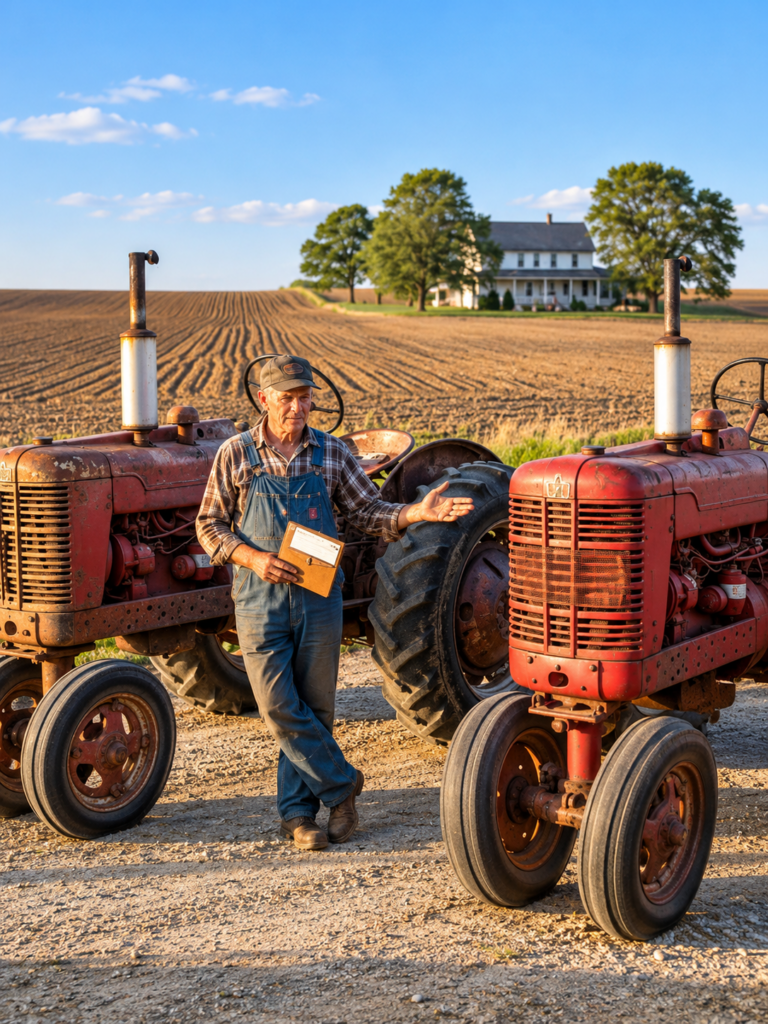
One was a 1952 Farmall Super M. The other was a 1956 Farmall 400. Both had rust crawling across their hoods, cracked seats, worn tires, and engines that looked as though they had survived several wars.
The man laughing at them was Gary Mitchell, sales manager at one of the largest John Deere dealerships in the county.
Gary wore a clean green jacket, polished boots, and the confident expression of a man who had never wondered whether he could afford supper.
“You know how old those things are?” Gary asked.
Scott looked at the tractors.
“Old enough to know how to work.”
A few farmers chuckled.
Gary didn’t.
“There’s a difference between working and making money, young man. Those machines are going to cost you more in repairs than they’re worth.”
Scott slipped the auction receipt into his pocket.
“We’ll see.”
Gary stepped closer.
“I’m trying to help you. You want to be a real farmer someday, you need real equipment. Modern equipment. Something that won’t leave you stranded halfway through planting.”
Scott looked past him toward a row of shiny green tractors parked near the auction grounds.
He knew what those machines cost.
He also knew what the monthly payments would look like.
“My tractors are paid for,” Scott said.
Gary smiled.
“And what exactly do you own besides two piles of scrap metal?”
Scott looked toward the western horizon, where dark clouds hung over the distant fields.
“Not much yet.”
He paused.
“But I’m working on that.”
Gary shook his head.
“You’ll never build a serious farm with junk like that.”
Ten years later, Scott Peterson would walk through the doors of Gary Mitchell’s dealership carrying a folded piece of paper.
And when Gary discovered what was written on it, he would finally understand why that young farmer had refused to buy a new tractor.
But in March of 1973, nobody knew how the story would end.
Least of all Scott.
The auction had started shortly after nine that morning.
It was being held at the farm of an elderly man named Richard “Old Man Rick” Wallace, who had spent nearly fifty years working the same stretch of Illinois farmland.
Rick’s wife had died several years earlier.
They had never had children.
His health was failing, and the time had finally come to leave the farm.
Everything was being sold.
Furniture.
Wagons.
Tools.
A rusted grain auger.
Boxes of bolts collected over decades.
And the two Farmalls that had carried Rick through some of the hardest years of his life.
Scott had arrived before sunrise.
He drove an aging Chevrolet pickup with a heater that barely worked and a driver’s door that had to be lifted slightly before it would close.
Inside his coat pocket was a small notebook.
On the first page, written in careful pencil, were two numbers.
$12,000.
And underneath it:
$50,000.
The first was everything he had saved.
The second was the price he hoped to pay for his own farm.
For eight years, Scott had worked for his uncle Walter Peterson.
He had started at eighteen, shortly after burying his father.
His father, Daniel Peterson, had never owned land.
Daniel had been a hired farmhand for most of his life, working other men’s fields, repairing other men’s fences, and watching crops grow on ground that would never belong to him.
He had been a good worker.
A quiet man.
The kind who repaired broken handles rather than buying new tools.
But when he died, he left his son little more than a worn pocketknife, an old toolbox, and a piece of advice Scott had never forgotten.
“Don’t spend your life making payments on things that don’t make your life better.”
Scott had been too young to understand it fully when his father first said those words.
By twenty-six, he understood.
Every month, he had watched farmers drive new tractors past his uncle’s property.
Some were fine men with successful farms.
Others were exhausted men who worked every available hour just to stay ahead of payments.
Scott had seen families arguing over bills at kitchen tables.
He had seen equipment repossessed.
He had seen neighbors sell good farmland because they had borrowed against it one too many times.
He didn’t believe that all borrowing was foolish.
He knew that buying land itself would require taking on a debt.
But he had made himself one promise.
If he had to borrow money to buy the ground, he would not borrow another dollar merely to look successful while farming it.
For eight years he had lived like a man twice his age.
He repaired his clothes.
He packed lunches instead of eating at the diner.
He drove the same pickup.
When other young men bought motorcycles and took weekend trips, Scott worked extra hours fixing combines and balers.
Sometimes, after a fourteen-hour day in the fields, he would spend another four hours in his uncle’s machine shed rebuilding a carburetor for a neighbor.
Every dollar went into the bank.
And every month, Scott drove past a neglected 160-acre farm eight miles outside town.
It had sandy soil, troublesome low ground, a crooked barn, and a farmhouse badly in need of repairs.
Most farmers considered it undesirable.
Scott considered it possible.
The property belonged to a widow named Evelyn Barlow.
Her husband had died, her children had settled elsewhere, and she no longer wanted to maintain the place.
Two years earlier, she had asked $70,000.
Nobody bought it.
Then she lowered the price to $60,000.
Still nothing.
Finally, the listing dropped to $55,000.
Scott had visited her three weeks before the auction.
Mrs. Barlow had opened the door wearing a faded blue cardigan.
“You’re Walter Peterson’s nephew?”
“Yes, ma’am.”
“You don’t look old enough to buy a farm.”
“Probably aren’t many people who think I am.”
She had smiled and invited him into the kitchen.
They sat beneath a ticking wall clock while Scott explained his plan.
He offered $50,000.
Ten thousand down.
The remaining forty thousand financed directly through her over twenty years, with interest.
He had figured the payment at roughly $334 a month.
Mrs. Barlow studied him for a long time.
“You understand what happens if you can’t make those payments?”
“Yes, ma’am.”
“You lose the place.”
“I understand.”
“And what makes you think you can manage a hundred and sixty acres by yourself?”
Scott didn’t tell her about grand ambitions.
He didn’t promise enormous profits.
He simply placed his worn notebook on the table.
Inside were figures showing seed costs, fuel, expected yields, machinery expenses, and several different possibilities for poor harvests.
Mrs. Barlow turned the pages.
“You’ve thought about this.”
“Every day for two years.”
She closed the notebook.
“My husband always said a man who knows what something costs is halfway to knowing what it’s worth.”
Scott waited.
Then she extended her hand.
“All right, Mr. Peterson. Let’s see whether you can make this old place yours.”
That agreement was the reason Scott had come to Rick Wallace’s auction.
He needed tractors.
Not pretty ones.
Not impressive ones.
Just machines that could pull a cultivator, move a wagon, mow a field, and keep working long enough for him to get his first crop into the ground.
The auctioneer reached the tractors shortly before noon.
He started with the Super M.
“Good old Farmall, folks! Who’ll give me two thousand dollars?”
Nobody moved.
The auctioneer tried fifteen hundred.
Then a thousand.
Still nothing.
A man near Scott muttered, “I’d have to be paid to haul that thing home.”
Someone laughed.
Finally, Scott raised his hand.
“Five hundred.”
The auctioneer squinted.
“You serious, young fella?”
“Yes, sir.”
He waited.
Nobody countered.
The hammer fell.
The Super M was his.
When the Farmall 400 came up, Scott bought it for six hundred dollars.
Eleven hundred dollars for two running tractors.
Eleven hundred dollars that, to Scott, represented the difference between owning machinery and owing money on it.
Gary Mitchell didn’t see it that way.
And he wasn’t content to simply offer his opinion.
After warning Scott that the tractors were junk, Gary followed him toward his pickup.
“Listen,” Gary said. “I’ve got a good used Deere at the dealership. Three years old. Good tires, strong hydraulics. I could get you into it with a reasonable down payment.”
“And the rest?”
“We finance.”
“For how long?”
“Depends on what works for you.”
Scott turned around.
“That’s the part that worries me.”
Gary folded his arms.
“You can’t build a farm without investing.”
“I am investing.”
“In what?”
Scott pointed toward the road leading west.
“Land.”
Gary gave a short laugh.
“You can’t farm land without decent equipment.”
Scott looked at his two red tractors.
“Then I guess I’d better take care of what I’ve got.”
Gary’s expression hardened.
“In five years, both those things will be sitting dead behind your barn.”
“Maybe.”
“And you’ll wish you’d listened.”
“Maybe.”
Scott opened his pickup door.
“But if I buy your tractor, Gary, I’ll owe you whether my crops grow or not.”
For a moment, Gary didn’t reply.
Then he said, “Come see me when you’re ready to farm like a businessman.”
Scott climbed into his truck.
As he drove away, he could still see Gary standing beside the row of green tractors.
The man’s words followed him all the way home.
You’ll never build a serious farm with junk like that.
Scott said nothing to anyone that evening.
He parked behind his uncle’s machine shed, walked over to the Super M, and rested one hand on its faded hood.
The metal was cold.
There was rust beneath his fingers.
He thought of his father.
He thought of the years spent watching crops grow on land belonging to someone else.
Then he whispered into the empty shed.
“We’ve got a lot of work to do.”
Part 2
Scott moved onto the Barlow property in April 1973.
The farmhouse had four rooms downstairs, two small bedrooms upstairs, and a front porch that leaned noticeably to the left.
The roof leaked above the kitchen.
The windows rattled when the wind came out of the north.
The barn’s western wall bowed outward, and several boards near the hayloft had gone soft from years of rain.
There was no proper machine shed.
No grain bins.
No reliable fencing around the low pasture.
And one stretch of farmland near the creek flooded almost every spring.
His uncle Walter drove out the morning Scott moved in.
He walked around the property without saying much.
Then he stopped beside the two Farmalls.
“Tell me you didn’t pay real money for these.”
“Eleven hundred dollars.”
“For both?”
“Yes.”
Walter rubbed his jaw.
“Well, at least you only made one mistake twice.”
Scott smiled.
His uncle didn’t.
“Scott, I know you want your own place. Lord knows you’ve earned a chance. But this farm needs work, and those tractors are older than some of the men driving them.”
“They run.”
“So does a sick horse until it drops.”
Scott knew his uncle wasn’t trying to hurt him.
Walter had watched his brother Daniel work himself to exhaustion.
He had watched Scott grow up without a father.
And for eight years, he had treated his nephew like a son.
“What happens if you lose the crop?” Walter asked.
“I work somewhere else until I can make the payment.”
“What if the tractors break?”
“I fix them.”
“And what if you can’t?”
Scott looked toward the farmhouse.
“Then I figure out another way.”
Walter sighed.
“You sound exactly like your father.”
For the first time that morning, Scott’s smile disappeared.
“I hope so.”
His uncle looked away.
Then he reached into his truck and pulled out a battered steel toolbox.
It had belonged to Daniel.
Walter had kept it in his shop since the funeral.
“Your dad would have wanted you to have this.”
Scott took it carefully.
Inside were wrenches worn smooth by years of use, several screwdrivers with cracked handles, and a folded shop rag that still carried a faint smell of oil.
For a moment, neither man spoke.
Finally, Walter cleared his throat.
“You can use my shop to work on those tractors. And I’ve got a planter you can borrow.”
“I can’t afford to rent it.”
“I didn’t say rent.”
“Uncle Walter—”
“You’ve worked for me eight years. You think I haven’t noticed how many nights you stayed late?”
Scott stared down at the toolbox.
“I’ll pay you back.”
Walter shook his head.
“You can help me after harvest. That’s enough.”
The next six weeks nearly convinced Scott that Gary Mitchell had been right.
The Super M needed a new clutch.
The Farmall 400 had leaking hydraulic seals and an oil leak that left black stains everywhere it sat.
Scott spent his mornings preparing the house, his afternoons repairing the tractors, and his evenings studying equipment manuals beneath a hanging shop light.
He cleaned years of grime from engine housings.
He replaced cracked hoses.
He repaired a broken wiring connection with parts salvaged from an abandoned cultivator.
The clutch repair fought him for two days.
On the second evening, he lost his grip on a heavy component and smashed two fingers against the frame.
He sat on an overturned bucket, holding his hand against his chest.
His knuckles throbbed.
Oil ran down his forearm.
For one miserable minute, he wanted to throw the wrench across the building.
Instead, he thought of Gary’s laughter.
He waited for the pain to ease.
Then he stood up and tried again.
By the end of April, he had spent roughly three hundred dollars on repair parts.
That left frighteningly little cash after the land down payment and tractor purchases.
He had bags of seed acquired through earlier work arrangements, some seed and supplies from his uncle, and equipment he could use in exchange for labor.
He still needed fuel.
He still needed food.
He still needed to make his land payment.
One night, he spread everything across the kitchen table.
Receipts.
Seed records.
A pencil.
A jar containing a few dollars in change.
He studied the numbers until the lantern flame began to die.
There was no room for carelessness.
Not one unnecessary purchase.
Not one preventable repair.
Not one missed opportunity to earn a little extra money.
He closed the notebook and looked around the dark kitchen.
A single plate sat beside the stove.
His father’s toolbox rested beneath the window.
There were no curtains, no pictures on the walls, and no furniture beyond what Mrs. Barlow had left behind.
Scott had never felt so alone.
But when he stepped onto the porch, he could see the dark outline of his own fields.
And for the moment, that was enough.
Planting began in May.
Scott intended to put eighty acres into corn and another eighty into soybeans.
His uncle helped with the borrowed planter during the first few days, then returned to his own fields.
After that, Scott worked alone.
The Super M pulled the cultivator through soil that had not been worked properly in years.
The 400 handled mowing, hauling, and whatever other jobs were required.
Neither tractor was fast.
Neither was comfortable.
The seats were hard, the engines loud, and by late afternoon, Scott’s shirt would be soaked with sweat and dust.
Across the road, a neighboring farmer named Harold Bennett operated a newer tractor that seemed to glide effortlessly through his fields.
Harold could cover in two days what took Scott nearly a week.
One afternoon, Harold stopped beside the fence.
“Peterson!”
Scott shut down the Super M.
“You planning to finish that field before Christmas?”
Harold grinned.
Scott wiped his face with his sleeve.
“Depends. You planning to help?”
Harold laughed.
“I’m serious. You ever think about trading that old thing in?”
“Every time somebody asks me.”
“Then why don’t you?”
Scott leaned against the tractor.
“Because it doesn’t come with a payment book.”
Harold shook his head.
“You’re something else.”
He drove away.
Scott started the engine again.
And kept working.
By June, the corn was coming up.
By July, the soybeans had formed neat green rows across the rolling ground.
Every morning, Scott walked his fields before starting the tractors.
He checked the leaves for signs of trouble.
He studied the creek.
He inspected the low spots after rain.
He looked for weeds, pests, and anything that might threaten the first crop.
He had planted more than corn and soybeans.
He had planted his savings, his reputation, and the future he had imagined since he was eighteen.
If the crop failed, there would be no rich father to rescue him.
No family inheritance.
No bank account waiting behind the first one.
Just a young man and two old tractors.
That summer, Scott lived with almost nothing.
He kept the electricity disconnected for the first three months because he couldn’t justify the expense.
He cooked simple meals on a woodstove.
He washed his clothes in a metal tub.
He ate beans, potatoes, bread, and whatever vegetables he could grow beside the house.
When he needed meat, he sometimes accepted a few pounds from a neighbor in exchange for repairing equipment.
His pickup remained parked most days because gasoline cost money.
At night, he sat on the porch listening to crickets and watching lightning bugs float above the grass.
Sometimes, the loneliness hurt worse than the labor.
His mother had died when he was young, and his father had followed years later.
His uncle had a family of his own.
Most evenings, there was nobody waiting for Scott inside that farmhouse.
No voice asking how his day had gone.
No supper already prepared.
No one to notice when he came home limping or exhausted.
There were nights when he lay awake wondering whether he had mistaken stubbornness for courage.
One evening, after working until nearly dark, he found a folded note tucked beneath his front door.
It was from Mrs. Barlow.
I drove past the place today. The fields look better than they have in years. My husband would have liked seeing that.
Scott read it twice.
Then he placed it inside his father’s toolbox.
It was the first time anyone had told him he was doing something right.
October brought the harvest.
The corn wasn’t extraordinary.
Ninety bushels per acre.
The soybeans averaged twenty-eight.
But to Scott, watching the first wagons fill felt almost unreal.
He had made it through a growing season.
The tractors had survived.
And the land had produced.
After harvest costs, seed, fuel, repairs, and other operating expenses, his records showed approximately eight thousand dollars available from the year’s farming operation.
It was more money than he had expected to have left.
He could have bought a better truck.
He could have fixed the farmhouse roof.
He could have purchased furniture, connected every convenience, and spent one glorious winter living like somebody who had finally succeeded.
Instead, he went to the kitchen table.
He counted out enough money to cover roughly a year’s worth of land installments.
About four thousand dollars.
The remaining money went into a reserve for the next crop and the emergencies he knew would come.
When he finished writing the figures, he rested his hands on the table.
He had survived his first year.
Not comfortably.
Not easily.
But he had survived.
Gary Mitchell heard about the harvest at the grain elevator.
Two weeks later, a green-and-white dealership pickup rolled into Scott’s yard.
Gary stepped out wearing his familiar John Deere jacket.
Scott was inside the barn changing oil in the Super M.
“Well, I’ll be,” Gary said. “Those old things are still running.”
Scott didn’t turn around.
“Morning, Gary.”
“Heard you got a crop off.”
“Sure did.”
“Not bad for your first year.”
“Thank you.”
Gary walked around the tractor.
“You know, you could probably double your productivity with better equipment.”
Scott tightened the drain plug.
“Maybe.”
“I’ve got a machine you’d like. Strong engine. Better hydraulics. You’d save a lot of time.”
Scott wiped his hands.
“How much?”
Gary named a figure.
Scott asked about the financing.
Gary explained the down payment and monthly installments.
When he finished, Scott shook his head.
“No, thank you.”
Gary frowned.
“You’re making a mistake.”
“Wouldn’t be my first.”
“Scott, look around.”
Gary gestured toward the crooked barn, the weathered house, and the aging machinery.
“You’re twenty-six years old. You don’t have to live like this.”
Scott followed his gaze.
He saw the leaking roof.
The sagging porch.
The rust on the tractor hood.
He knew exactly what the place looked like.
But he also knew what his notebook said.
“I’ve got my land payments covered,” Scott replied. “And I don’t owe anybody for a tractor.”
“You still owe forty thousand on the farm.”
“I know.”
“Then why not invest in the equipment that’ll help you pay it off?”
Scott folded the shop rag.
“Because I’ve only got so many dollars. Every dollar going toward a tractor payment is one that can’t go toward the land.”
Gary gave a frustrated sigh.
“You’re handicapping yourself.”
Scott looked directly at him.
“Gary, I’m not trying to own the fanciest tractor in the county.”
“Then what are you trying to do?”
“Own this place before I’m forty.”
Gary stared at him.
“That’s not realistic.”
“Maybe not.”
“You can’t pay off a twenty-year land contract in ten years farming like this.”
Scott glanced toward his fields.
“I’d sure like to find out.”
Gary shook his head.
“You’ll learn.”
Scott picked up his wrench.
“I expect I will.”
The lesson came sooner than Scott expected.
In July 1974, the rain stopped.
At first, nobody worried.
Dry spells were part of farming.
But one week became two.
Then three.
The creek shrank.
The soil cracked.
Corn leaves curled beneath the afternoon sun.
Scott walked his fields every morning, searching the western sky for clouds.
Sometimes dark thunderheads appeared in the distance.
He would stand outside the farmhouse watching them approach.
Then the wind would shift.
And the rain would fall somewhere else.
By August, the corn had suffered badly.
The soybeans weren’t much better.
Scott knew long before harvest that the numbers would be ugly.
One afternoon, he stopped the Super M at the edge of the driest field.
The engine ticked as it cooled.
He climbed down and broke open an ear of corn.
The kernels were poorly filled.
He stood holding it in his hand.
For the first time since buying the farm, he felt something close to panic.
Not because he might lose money.
Because he might lose everything.
That evening, he drove to his uncle’s farm.
Walter was repairing a wagon in the machine shed.
“You look terrible,” his uncle said.
“Crops are bad.”
“So are mine.”
“I don’t know if I’ll make enough.”
Walter set down his wrench.
“You need help?”
Scott stared at the floor.
It would have been easy to say yes.
Walter would have found a way.
He might have offered money.
He might have covered a payment.
But Scott knew his uncle was struggling too.
“I need work this winter,” Scott said instead.
Walter studied him.
“Grain elevator’s hiring seasonal help.”
“I’ll go tomorrow.”
“You sure?”
Scott nodded.
“I don’t need somebody to carry me. I just need a chance to earn what’s missing.”
Walter placed a hand on his shoulder.
“You’ve already proved you know how to work, son.”
Scott swallowed.
“I need to prove I know how to stay.”
The second harvest was painful.
Corn averaged sixty bushels per acre.
Soybeans fell to eighteen.
After expenses, Scott had approximately four thousand dollars left.
Almost all of it would be needed for his land installments.
Nothing meaningful remained for improvement.
No cushion for the winter.
No reward for another year of aching hands and sleepless nights.
He made the payment.
Then he went looking for work.
By November, Scott was spending long days at the grain elevator, unloading trucks and cleaning dusty equipment.
He returned home after dark.
Sometimes he ate supper standing beside the kitchen counter because he was too tired to sit down.
Other nights, he went straight to the machine shed and worked on the tractors until midnight.
One bitter December evening, the temperature dropped below freezing.
Scott came home to find that a pipe inside the farmhouse had frozen.
He spent hours thawing it and repairing a split section.
By the time he finished, his hands were trembling from the cold.
There was barely any wood left beside the stove.
He sat on the kitchen floor, leaning against the wall.
For a long time, he didn’t move.
Then he opened his father’s toolbox.
Inside, beneath the worn wrenches, was Mrs. Barlow’s note.
The fields look better than they have in years.
Scott held it beneath the lamplight.
He wondered what she would think if she could see him now.
A grown man sitting on a cold kitchen floor, exhausted and frightened, with a stack of bills beside him.
He thought of Gary Mitchell.
You can’t build a serious farm with junk like that.
For one terrible moment, Scott wondered whether Gary was right.
Then he looked at the folded land contract on the table.
The next payment was covered.
The tractors still ran.
And spring was coming.
He put the note away.
Stood up.
And brought another armload of wood into the house.
Part 3
The spring of 1975 arrived with a rainstorm that lasted three days.
Water poured off the roof, filled the ditches, and turned the farmyard into a brown sea of mud.
Scott stood beneath the barn overhang watching it fall.
The year before, he had prayed for rain until there was nothing left to do but watch his corn die.
Now it seemed the sky was trying to make up for every missed drop.
He laughed quietly.
“Guess you can’t ever make a farmer happy.”
Behind him, the Super M sat with its hood raised.
He had spent the winter replacing worn parts, adjusting the ignition, and checking everything that might fail during planting.
The Farmall 400 was parked beside it.
Neither machine looked any prettier than the day he bought them.
But Scott knew every sound they made.
He knew the little hesitation before the Super M settled into a steady idle.
He knew the 400’s hydraulic system sometimes needed an extra moment to respond on cold mornings.
He knew which bolts tended to loosen and which hoses deserved a second look.
Other farmers trusted their dealerships.
Scott trusted his toolbox.
And after surviving two difficult years, he had learned something important.
A machine didn’t have to be new to be dependable.
It had to be understood.
By late May, the fields were planted.
The rain came when it was needed.
The corn grew tall.
The soybeans filled out beautifully.
And for the first time since moving onto the farm, Scott began to feel that he wasn’t simply defending himself against disaster.
He was building something.
One Saturday morning, Mrs. Barlow drove up the lane.
Scott was kneeling beside the Super M, adjusting a linkage, when her car stopped.
He stood and wiped his hands.
“Morning, ma’am.”
“Good morning, Scott.”
She looked around the yard.
The porch had been straightened.
Several broken barn boards had been replaced.
A vegetable garden grew beside the house.
The fields beyond the driveway were green and orderly.
“My goodness,” she said. “You’ve been busy.”
“Still plenty left.”
“There always is on a farm.”
She walked toward the porch.
“Mind if I sit a minute?”
Scott hurried ahead and wiped the dust from a chair.
She settled into it slowly.
For a while, they watched the breeze move through the corn.
“My husband used to sit right here,” she said.
Scott glanced at her.
“He’d come in from the fields and complain about everything that needed fixing. Then he’d sit here for half an hour just looking at what he’d planted.”
She smiled faintly.
“I never understood why he liked looking at fields he’d already spent all day working in.”
Scott looked toward the horizon.
“I think I understand.”
Mrs. Barlow studied him.
“You remind me of him.”
Scott didn’t know what to say.
“He wasn’t much for showing off either. Used things until there was nothing left to repair.”
She nodded toward the tractors.
“Though I don’t think even he would have bought those.”
Scott laughed.
“Most people wouldn’t.”
“Are they treating you well?”
“So far.”
“And the payments?”
Scott hesitated.
“I’m making them.”
“That’s not what I asked.”
He looked down.
“Last year was hard.”
“I know. Half the county had trouble with the drought.”
“I’ll keep up.”
Mrs. Barlow reached into her purse and took out a small envelope.
Scott immediately stiffened.
“If that’s money—”
“It isn’t.”
She handed it to him.
Inside was an old photograph.
It showed the farmhouse decades earlier, with fresh paint, a straight barn, and a young couple standing beside a wagon.
Mrs. Barlow’s husband was smiling proudly.
“Thought you might want to see what this place used to look like.”
Scott studied the picture.
The house seemed almost unfamiliar.
“I’d like to get it looking that way again.”
She patted his arm.
“You will. Just don’t forget to live a little while you’re doing it.”
After she drove away, Scott carried the photograph inside.
He placed it on the kitchen mantel.
For the first time, the empty farmhouse felt connected to something larger than his own struggle.
It had sheltered people before him.
It had witnessed births, deaths, arguments, Christmas mornings, and ordinary suppers around a crowded table.
It had been loved.
Scott intended to make sure it would be loved again.
The third harvest was better.
Much better.
After expenses, Scott had approximately nine thousand dollars left.
He applied five thousand dollars toward the land contract and kept four thousand for the next season’s operations and unexpected expenses.
But there was something else he wanted.
At a farm auction in November, he found an old grain drill.
It had been sitting outside for years.
The paint was almost gone.
Several parts were seized.
The tires were badly worn.
Scott studied it for nearly an hour.
He checked the frame.
He examined the seed-metering mechanisms.
He turned the drive wheel by hand.
When the auctioneer reached it, Scott bid four hundred dollars.
Nobody else wanted it.
Once again, the hammer fell.
Once again, Scott brought home machinery that looked ready for the scrap pile.
His uncle stopped by the next morning.
“Please tell me that thing was free.”
“Four hundred.”
Walter stared at it.
“Scott.”
“I know.”
“Does it even work?”
“Not yet.”
Walter shook his head.
“You’ve got a special talent for buying other men’s problems.”
Scott grinned.
“Only the ones I think I can fix.”
For the next week, he took the drill apart.
He cleaned the seed tubes.
He freed rusted components.
He replaced damaged bearings.
He straightened bent metal and repaired the drive system.
By the end of the week, the old machine was ready for the field.
Scott stood beside it with a satisfaction he hadn’t felt in months.
He no longer needed to depend on someone else’s schedule whenever he wanted to plant with a drill.
It wasn’t simply another piece of equipment.
It was one more part of his future that belonged to him.
In 1976, Scott made his first major change to the farming operation.
He added winter wheat to his rotation, planning eighty acres of wheat, forty of corn, and forty of soybeans.
It wasn’t the highest-profit arrangement every year.
But it spread his risk.
It also spread his work.
And that mattered when one man was trying to farm 160 acres with equipment most people had already retired.
Walter visited one afternoon while Scott was studying the fields.
“Wheat now?”
“Thought I’d give it a try.”
“You ever get tired of making things harder?”
Scott smiled.
“I’m hoping it makes some things easier.”
His uncle looked across the land.
“You’ve come a long way in three years.”
“Still owe a lot of money.”
“You’ve paid down more than most folks expected.”
Scott looked toward the barn.
“Not enough.”
Walter was quiet a moment.
Then he said, “Your dad would be proud of you.”
Scott turned away.
He pretended to examine a fence post.
Walter didn’t push.
They were men who had learned to speak about grief in short sentences.
Sometimes that was all either could manage.
The wheat turned golden that summer.
When Scott walked through it, the heads brushed against his palms.
He had never grown much wheat on his own before, and he found himself watching the crop with a mixture of pride and anxiety.
The old machinery worked.
The harvest came in.
And by the end of the year, Scott’s farm had produced approximately eleven thousand dollars after operating expenses.
He could hardly believe it.
For the first time, he felt that his plans might be more than a desperate young man’s stubborn dream.
Then he attended another auction.
And found a combine.
It was a 1960 International Harvester 101.
Thirteen harvest seasons had passed since the machine was new.
Its paint had faded.
The cab was weathered.
Several guards and shields needed attention.
But the engine ran, and the main components were sound enough to justify the work Scott knew would be required.
He examined it for most of the morning.
Then he bid.
Two thousand eight hundred dollars.
Sold.
Scott stood beside the combine, studying his purchase, when a familiar voice came from behind him.
“Well, there he is.”
Scott turned.
Gary Mitchell was approaching with two men from the dealership.
Gary stared at the old International combine.
“Tell me you didn’t buy that.”
Scott smiled.
“Afraid I did.”
Gary laughed.
“Unbelievable.”
One of the salesmen chuckled.
Gary walked around the machine, shaking his head.
“You’ve been doing this for four years now, Scott. When are you finally going to buy something decent?”
Scott leaned against the combine.
“It’s decent enough for me.”
“That thing belongs in a museum.”
“Then I guess I’ll be harvesting with a museum.”
Gary’s smile disappeared.
“Why are you so determined to do everything the hard way?”
Scott thought for a moment.
“Because the easy way usually comes with a bill.”
Gary spread his hands.
“You think successful farmers don’t borrow money?”
“Some do.”
“And they make good money.”
“Some do.”
“Then what’s your problem?”
Scott looked straight at him.
“I don’t have a problem with a farmer using financing when it makes sense. I have a problem with somebody telling me I have to borrow money just to prove I’m a real farmer.”
Several people nearby had begun listening.
Gary folded his arms.
“You’re living like a poor man to prove a point.”
Scott shook his head.
“I’m living carefully because I want to own something.”
Gary gestured toward the combine.
“You call this success?”
Scott looked at the old machine.
He thought about the farmhouse.
The cornfields.
The wheat.
The payment receipts filed neatly in his desk.
Then he nodded.
“Every year, I own a little more of my farm.”
He paused.
“That’s success to me.”
Gary’s face reddened.
“You can’t keep this up forever.”
Scott picked up his auction papers.
“I don’t need forever, Gary.”
He smiled slightly.
“Just long enough.”
The fifth year almost destroyed everything.
In January 1977, Scott heard a sound he would remember for the rest of his life.
He was moving equipment near the barn when the Super M made a sharp metallic knock.
Then another.
The engine lost power.
Scott immediately pulled the throttle back.
But before he could shut it down, something inside the engine gave way.
There was a violent crack.
Then silence.
Scott sat frozen in the seat.
He knew enough about engines to understand what had happened.
A connecting rod had failed.
The Super M needed far more than a tune-up.
He climbed down and opened the hood.
The damage was ugly.
By the time he finished inspecting it, he knew he was facing a complete engine rebuild.
For several minutes, he stood beside the tractor in the freezing wind.
The machine had helped him through four years.
And now it was dead.
He remembered Gary’s prediction.
In five years, those tractors will be dead.
Scott almost laughed.
Gary had come remarkably close.
The repair took nearly two months.
Scott worked in his uncle’s shop, surrounded by metal parts arranged carefully across workbenches.
He removed the damaged engine components.
He checked the crankshaft.
He cleaned and measured everything he could.
When a part was beyond saving, he bought a replacement.
When something could be repaired safely, he repaired it.
His hands cracked from cold and solvent.
His back ached.
More than once, he fell asleep sitting on a wooden stool.
Walter sometimes came into the shop late at night and found him still working.
“Go home, Scott.”
“Almost finished.”
“You said that yesterday.”
“Closer today.”
His uncle stood beside the workbench.
“Why don’t you just sell it for parts?”
Scott stared at the engine block.
“Because I know I can fix it.”
“You can find another tractor.”
“Not one I know this well.”
Walter looked at him for a long time.
“You know, there’s a difference between being determined and being unable to let go.”
Scott didn’t answer immediately.
He knew his uncle had a point.
There were times when hanging on to something broken could cost more than replacing it.
So he had done the calculations.
He had studied the repair costs.
He had considered the market value of other used tractors.
And the numbers still favored rebuilding the Super M.
“Six hundred dollars in parts,” Scott finally said. “A replacement I could trust would cost me more. And I know what’s inside this engine now.”
Walter nodded slowly.
“All right.”
He picked up a wrench.
“Then let’s get the thing running.”
It happened on a cold afternoon in March.
Scott turned the key.
The engine cranked.
Coughed.
Stopped.
He adjusted the controls and tried again.
This time, the Super M fired.
A thick puff of exhaust drifted into the cold air.
The engine stumbled, then settled into a steady rumble.
Scott stood motionless.
Walter stepped out from behind the tractor.
“Well,” he said quietly.
Scott listened to the engine.
Then he laughed.
It wasn’t a big laugh.
It was the shaky, exhausted laugh of a man who had spent two months wondering whether he was wasting his time.
He reached out and placed his palm on the warm hood.
“Welcome back, old girl.”
Walter shook his head.
“Your father used to talk to tractors like that.”
Scott smiled.
“Maybe they listen.”
The rest of 1977 demanded everything he had.
Late planting threatened part of his schedule.
Rain delayed fieldwork.
A fence collapsed near the creek.
The combine required repairs just as he was preparing for harvest.
There were days when Scott felt he was carrying the entire farm on his back.
Yet somehow, the old machines kept working.
By the end of the year, he had netted approximately eight thousand dollars.
Not a record.
But enough to meet the land payments and continue making progress.
On New Year’s Eve, Scott sat alone at his kitchen table.
A small fire burned in the stove.
Outside, snow collected along the fence.
He opened his notebook and examined five years of figures.
There had been good harvests.
Bad harvests.
Repair bills.
Long winters.
Work at the grain elevator.
Nights when he had seriously considered quitting.
But something remarkable had happened.
The farm was still his.
The mortgage balance was lower.
The machinery was still paid for.
And he had survived half a decade without financing a single piece of equipment.
Scott picked up his father’s old pocketknife.
He turned it over in his hand.
Then he looked at the photograph of the Barlow farmhouse on the mantel.
“Five years, Dad,” he whispered.
His voice shook.
“We’ve made it five years.”
He sat quietly for a while.
Then he opened the notebook to a fresh page.
At the top, he wrote:
1978 — keep going.
Part 4
By the sixth year, people in the county had stopped calling Scott Peterson crazy.
They had found another word.
Stubborn.
“That Peterson boy is stubborn as a mule,” men said over coffee at the diner.
“Still running those old Farmalls.”
“Still working that sandy ground.”
“Still hasn’t bought himself a decent tractor.”
But underneath the teasing, something had changed.
Respect.
Not from everyone.
And not loudly.
But people had begun to notice that Scott kept doing what he said he would do.
His equipment was old, but his fields were clean.
His barn was still weathered, but its roof no longer leaked.
His farmhouse had new porch supports, repaired windows, and a kitchen floor that didn’t sag beneath the stove.
Most importantly, his payment record remained current.
Farmers understood that better than anyone.
A man could talk about success all day.
Making the payments after a bad harvest was another matter entirely.
One spring morning in 1978, Scott was repairing a section of fence when a pickup stopped on the road.
It was Harold Bennett.
The neighbor who had once joked that Scott might not finish cultivating before Christmas.
Harold climbed out looking unusually tired.
“Morning, Scott.”
“Morning.”
Harold glanced toward the barn.
“You still have that old grain drill?”
“Sure do.”
“Working?”
“Last I checked.”
Harold rubbed the back of his neck.
“My drill’s down. Dealer says it’ll be a week before they can get the part.”
Scott waited.
Harold looked toward his fields.
“I’m already behind.”
Scott set down his fencing pliers.
“You need to borrow mine?”
Harold gave an embarrassed smile.
“Was hoping you’d say that.”
Scott nodded.
“Come by after supper. I’ll show you how to set it.”
Harold hesitated.
“After all the things I said about your equipment?”
Scott shrugged.
“Doesn’t plant any worse because you made fun of it.”
Harold laughed.
Then his face grew serious.
“I appreciate it.”
Scott picked up his pliers again.
“Neighbors help neighbors.”
That evening, Harold drove into the Peterson yard.
Scott showed him the drill, explaining which adjustments required care.
Harold listened closely.
Before leaving, he looked over the collection of worn red machinery.
“You know, when you first bought these things, I figured you’d be gone in two years.”
Scott smiled.
“You weren’t the only one.”
Harold shook his head.
“Guess I was wrong.”
Scott looked toward the darkening fields.
“We’ll see. I’m not done yet.”
That summer, Gary Mitchell drove past Scott’s farm on his way to visit a customer.
He slowed beside the driveway.
The fields were green.
The barn roof had been repaired.
A small machine shelter, built from salvaged lumber, stood beside the old building.
The two Farmalls were parked beneath it.
Gary stared for a moment.
Then he drove on.
Scott never knew he had been there.
The seventh year brought the kind of weather every farmer dreams about.
Spring rain arrived on time.
The ground dried enough for planting.
Summer stayed warm without becoming punishing.
The corn grew tall and even.
The wheat came in strong.
The soybeans filled their rows.
Scott still worked hard.
Nothing about owning old equipment made farming easy.
But for once, the season seemed willing to cooperate.
One evening, Walter drove over and found his nephew sitting on the porch.
Scott had removed his boots and was drinking a glass of cold water.
His uncle sat beside him.
They watched the corn move in the breeze.
“Looks like a good year,” Walter said.
“Don’t want to jinx it.”
Walter smiled.
“You’ve been saying that since May.”
Scott leaned back.
“Been wrong about the weather enough times to be careful.”
His uncle studied the house.
“You ever think about getting married?”
Scott nearly choked on his water.
“Where’d that come from?”
“You’re thirty-two years old.”
“Thirty-two isn’t dead.”
“No, but it isn’t twenty-two either.”
Scott looked out across the field.
“Wouldn’t be much of a life for somebody else.”
Walter frowned.
“What do you mean?”
“Working all day. No money for anything fancy. Old house. Old truck. Old tractors.”
His uncle was quiet.
Then he said, “You think a good woman would care more about a new truck than a man who keeps his word?”
Scott didn’t answer.
He had dated a little over the years.
But every relationship had eventually run into the same problem.
The farm came first.
It wasn’t that Scott didn’t want companionship.
He did.
Especially on cold winter nights when the house seemed too quiet.
But he couldn’t imagine asking someone to share the uncertainty he had chosen.
Walter sighed.
“Just don’t spend your whole life saving for a future you never let yourself enjoy.”
Scott stared at his hands.
It was something Mrs. Barlow had told him too.
He wondered whether everybody was beginning to see something he had overlooked.
The 1979 harvest was excellent.
When Scott finished the accounts, the farm had produced approximately fifteen thousand dollars after operating expenses.
He read the figure three times.
Then he drove into town.
At the office handling his land contract, he made a substantial additional payment.
Enough to cover roughly two years of scheduled installments, with extra money applied toward principal.
When the new balance was calculated, the remaining debt stood at approximately twenty-four thousand dollars.
Scott sat staring at the statement.
Forty thousand had once seemed like a mountain.
Now the mountain had been cut nearly in half.
The woman behind the desk smiled.
“Everything all right, Mr. Peterson?”
Scott swallowed.
“Yes, ma’am.”
He looked at the number again.
“Everything’s just fine.”
That evening, he drove to his uncle’s house.
Walter answered the door.
Scott handed him the statement.
His uncle examined it.
Then looked up.
“Twenty-four thousand?”
Scott nodded.
Walter let out a low whistle.
“Well, I’ll be.”
They sat at the kitchen table, looking at the paper.
After a while, Walter said, “Your father worked his whole life wanting a place of his own.”
Scott looked down.
“I know.”
“He’d have given anything to sit here and see this.”
Scott’s eyes filled before he could stop them.
For years, he had carried his father’s memory like a weight.
A reminder of unfinished dreams.
Of too many years spent working land that belonged to other people.
But now, sitting in his uncle’s kitchen with the mortgage statement between them, Scott felt something different.
He wasn’t trying to undo his father’s life.
He was trying to build on it.
Walter reached across the table and squeezed his shoulder.
“You’re doing good, son.”
Scott nodded.
For a moment, he couldn’t speak.
The eighth year brought new challenges.
Fuel costs had climbed.
Machinery parts were more expensive.
A wet spring delayed planting in several fields.
And the Farmall 400 developed a hydraulic problem that took longer than expected to diagnose.
Scott spent three evenings working on it.
On the fourth evening, Harold Bennett walked into the shed carrying a thermos.
“Figured you might need coffee.”
Scott slid out from beneath the tractor.
“Wouldn’t hurt.”
Harold poured two cups.
They stood beside the machine.
“What’s wrong with her?”
“Pressure isn’t holding.”
“Think you can fix it?”
Scott took a drink.
“Think so.”
Harold looked toward his truck.
“I’ve got my tractor free tomorrow. You need a hand getting caught up?”
Scott started to refuse.
Then he stopped.
The old Scott would have insisted on doing everything alone.
He would have worked through the night.
He would have refused help even when accepting it was the practical choice.
But seven years on the farm had taught him something.
Independence didn’t mean refusing every hand extended toward you.
It meant being responsible for your choices.
And sometimes the responsible choice was to let a neighbor help.
“I could use a few hours,” Scott admitted.
Harold smiled.
“Good. I’ll be here at seven.”
The 1980 harvest was another strong one.
After expenses, Scott had approximately thirteen thousand dollars available.
He paid down the land contract aggressively.
The balance dropped to roughly sixteen thousand dollars.
For the first time, the amount remaining no longer frightened him.
He could imagine paying it.
He could imagine the day the property belonged to him without another name attached to the title.
He could imagine walking out onto his porch and knowing that no monthly land payment waited in the mailbox.
But with that hope came a new fear.
What if he failed now?
What if something happened when he was so close?
A terrible harvest.
A major illness.
A fire.
An equipment failure he couldn’t repair.
Scott knew farming well enough to understand that disaster didn’t care how hard a man had worked.
It could arrive at any time.
And it had no obligation to be fair.
In the winter of 1980, Scott went into town for a replacement bearing.
He parked outside the hardware store and was walking toward the entrance when he noticed a familiar tractor on a transport trailer across the street.
It belonged to a farmer named Frank Dobbins.
Frank had recently financed a newer machine through Mitchell’s dealership.
Scott knew him casually.
They had spoken at auctions and at the grain elevator.
Frank was a good farmer.
A hardworking man with a wife and three children.
But grain prices and expenses had not treated him kindly.
As Scott watched, two men secured the tractor to the trailer.
Frank stood nearby, his hands buried deep in his coat pockets.
Scott crossed the street.
“Frank?”
Frank turned.
His face tightened.
“Morning, Scott.”
Scott looked at the tractor.
He didn’t need to ask what was happening.
Frank followed his gaze.
“Got behind.”
Scott nodded.
“Sorry.”
Frank kicked a small patch of snow.
“Thought I could make the payments. Thought the new machine would help me get ahead.”
He laughed bitterly.
“Guess I figured wrong.”
Scott didn’t say anything.
He remembered Gary Mitchell promising that modern machinery paid for itself.
Sometimes it did.
Sometimes it didn’t.
The trouble was that the payment still came due either way.
Frank looked embarrassed.
“Don’t suppose you’ve ever had to worry about something like this.”
Scott shook his head.
“I’ve worried about losing my place every year since I bought it.”
Frank looked at him.
“But you haven’t.”
“Not yet.”
They stood in silence.
Then Scott asked, “You got something to plant with this spring?”
Frank looked down.
“I’ll find a way.”
Scott thought about his own spring schedule.
His equipment was older and slower.
There was no spare capacity to waste.
But he also remembered his uncle lending him a planter when he had nothing.
“I’ve got a tractor you can use for some of your lighter work,” Scott said. “Won’t be fast, but it’ll do the job.”
Frank stared at him.
“You serious?”
“As long as you bring it back in one piece.”
Frank’s eyes reddened.
He looked away quickly.
“Scott, I don’t know what to say.”
Scott placed a hand on his shoulder.
“Just get your crop planted.”
That evening, Scott drove home thinking about the men he had seen struggling over the years.
He felt no satisfaction in being proven right about the risks of debt.
He didn’t want Frank to fail.
He didn’t want Gary’s customers to lose their farms.
He wanted every hardworking family in the county to have a fair chance.
And he understood something now that he hadn’t fully grasped at twenty-six.
The purpose of avoiding unnecessary payments wasn’t to win an argument.
It was to give himself room to survive when life went wrong.
In 1981, grain prices improved.
The harvest was strong.
The old combine worked through the fields with its familiar clatter, sending grain into wagons Scott had repaired again and again.
The Super M was nearly thirty years old.
The Farmall 400 had passed twenty-five.
Both were still working.
By late autumn, Scott’s records showed approximately eighteen thousand dollars after operating expenses.
He put a large portion toward the land.
When the new balance came back, only about seven thousand dollars remained.
Scott stared at the statement in his kitchen.
Seven thousand.
He had started with forty thousand dollars of land debt.
He had survived drought, machinery failures, crushing loneliness, and years of living without comforts most people considered ordinary necessities.
Now the end was close enough to see.
He could have paid the remaining amount faster by emptying his reserves.
But he knew better.
The next crop still required seed and fuel.
Taxes still came due.
Machines still broke.
He would not gamble the farm’s operating money simply to satisfy his pride.
So he folded the statement and put it inside the desk.
One more good harvest.
That was what he needed.
Just one more.
In December, Gary Mitchell came to the farm.
Scott was surprised to see the dealership pickup pull into the yard.
Gary climbed out, his face lined more deeply than Scott remembered.
The years had changed him.
There was gray in his hair now.
His shoulders looked heavier.
He walked toward the Super M, which stood beneath the machine shelter.
“Still got this thing?”
Scott smiled.
“Sure do.”
Gary shook his head.
“I don’t understand you.”
“Most people don’t.”
Gary ran his hand along the tractor’s faded hood.
“Do you know how much time you’ve wasted keeping these things running?”
Scott thought of the countless evenings spent with a wrench in his hands.
“Quite a bit.”
“Time you could have spent farming more acres.”
“Probably.”
“Money you could have made.”
“Maybe.”
Gary turned toward him.
“Then why?”
Scott looked past him toward the fields.
“Because I wanted something different.”
Gary gave a tired sigh.
“You’ve always said that.”
“And I’ve always meant it.”
Gary looked toward the farmhouse.
It was still modest.
Still painted an ordinary pale color.
Still without anything expensive parked outside.
“You could have had a bigger operation by now.”
Scott nodded.
“Maybe I could.”
“Doesn’t that bother you?”
Scott thought for a moment.
Then he said, “Gary, you’ve spent years asking why I won’t buy a new tractor.”
“Because you’re stubborn.”
“Maybe. But let me ask you something.”
Gary waited.
“How many acres does a man have to farm before it’s enough?”
Gary frowned.
“That’s not the point.”
“How much equipment does he have to own?”
“Scott—”
“How much money does he have to borrow before somebody calls him successful?”
Gary looked away.
Scott’s voice stayed calm.
“I’ve got a house. I’ve got land. I’ve got machines that work. I can pay my bills. I sleep at night knowing what I owe.”
He paused.
“That’s what I’ve been working for.”
Gary studied him.
For once, he seemed to have no immediate answer.
Finally, he said, “You still owe money on that land.”
Scott nodded.
“Yes, I do.”
Gary adjusted his jacket.
“Well, when you’ve paid it off, come tell me.”
Scott looked at him.
Then he smiled.
“I believe I will.”
Gary laughed once, almost dismissively.
“Fair enough.”
He climbed into his pickup and drove away.
Scott watched the truck disappear down the county road.
Then he went into the house.
He opened the desk drawer.
Took out the statement.
And looked again at the remaining balance.
Seven thousand dollars.
Gary had no idea how close Scott already was.
Part 5
The spring of 1982 arrived slowly.
Cold rain soaked the Illinois fields.
The creek ran high.
The roads turned soft.
And Scott Peterson, now thirty-five years old, prepared for what he privately hoped would be the last growing season of his life under a land payment.
He didn’t tell anyone.
Not his uncle.
Not Harold.
Not Mrs. Barlow.
And certainly not Gary Mitchell.
He didn’t want to speak the dream aloud and tempt fate.
Instead, he did what he had done for nine years.
He checked the tractors.
Repaired equipment.
Counted his seed.
Studied the weather.
And went to work.
The Super M started on a chilly morning in April with a familiar rumble.
Scott sat in the worn seat, one hand on the steering wheel.
For a moment, he remembered the day he had first seen the tractor at Rick Wallace’s auction.
The rust.
The laughter.
Gary’s warning.
Those tractors are junk.
Scott looked down at the old red hood.
There was more rust now.
More scratches.
More patches of paint worn away by years of labor.
But beneath the hood, the rebuilt engine ran smoothly.
Scott smiled.
“One more year,” he whispered.
Then he drove toward the field.
The season began well enough.
Planting was completed without serious trouble.
May brought sunshine.
June brought good growth.
But in July, heavy storms struck the county.
Rain fell for three days.
The creek rose and flooded part of the low ground.
Scott walked out after the worst of the storm and found a stretch of soybeans standing in muddy water.
His boots sank with every step.
He knelt and touched the leaves.
The crop was struggling.
He looked toward the sky.
Ten years.
Ten years of sacrifice.
And now, when he needed one final harvest, the weather seemed determined to test him again.
He returned to the barn and found Harold waiting beside his pickup.
“Creek got you?”
“Some.”
“How bad?”
“Won’t know until the water drops.”
Harold looked out toward the fields.
“Mine’s got some damage too.”
Scott nodded.
They stood quietly.
Then Harold said, “You know, there was a time I’d have told you to get yourself a bigger tractor and work more ground.”
Scott smiled faintly.
“Seems like yesterday.”
Harold looked at him.
“But I think maybe I was missing something.”
Scott turned.
“What?”
Harold gestured toward the farm.
“You’ve spent ten years making this place better. Most fellows would have given up after the drought. Or that engine going bad. Or the years when prices were miserable.”
Scott looked at the barn.
“I thought about it.”
“I know.”
Harold rested his hand on the pickup door.
“But you didn’t.”
Scott didn’t answer.
He was afraid that if he tried, his voice might betray him.
The summer passed.
The flooded ground slowly recovered, though some of the soybean crop was lost.
The corn looked stronger.
The wheat had already provided welcome income.
And as autumn approached, Scott began calculating what he might have left after expenses.
The figures were promising.
Not guaranteed.
But promising.
In September, the old combine developed a serious mechanical problem.
Scott was preparing to bring in the remaining crops when he heard an unfamiliar grinding noise.
He stopped immediately.
After inspecting the machine, he discovered damage that would require parts and several days of work.
He stood beside the combine with his hands on his hips.
The sky to the west was dark.
More rain was forecast.
He needed to harvest while the weather allowed it.
And his own machine wasn’t ready.
For several minutes, he felt the old anger rising.
Why now?
Why, after everything, did something have to break at the worst possible moment?
He thought about the money still owed.
The years already spent.
The possibility that another bad harvest could push the final payment farther away.
He sat on the combine’s step and covered his face with his hands.
Then a pickup engine sounded in the yard.
It was Harold.
Behind him came Frank Dobbins.
Frank climbed out first.
“Heard you had trouble.”
Scott stood.
“Combine’s down.”
Harold nodded.
“We figured.”
Scott frowned.
“What are you two doing here?”
Frank pointed toward the road.
“Got my machine coming over in the morning.”
Scott stared.
“Frank, you’ve got your own crop.”
“Most of mine’s done.”
Harold added, “And I can bring a wagon.”
Scott shook his head.
“I can’t pay you fellows what it’d cost to hire this done.”
Frank looked at him.
“Did you charge me when I needed a tractor?”
Scott fell silent.
Frank stepped closer.
“Two years ago, I thought I was going to lose everything. You helped me get a crop in when nobody else could.”
He looked around the yard.
“Time somebody helped you.”
Harold smiled.
“And you’ve lent me that old drill enough times that I probably owe you half my harvest.”
Scott looked from one man to the other.
For years, he had believed he needed to carry every burden alone.
Now, standing beside the broken combine, he realized how much had changed.
His hard work had earned him something he couldn’t have purchased at a dealership.
Trust.
Friendship.
The respect of men who knew what it meant to struggle.
He extended his hand.
“Thank you.”
Frank shook it firmly.
“See you at seven.”
The next morning, three farmers went to work.
The fields were damp but manageable.
Frank ran the combine.
Harold hauled grain.
Scott moved wagons, checked equipment, and worked alongside them from early morning until dark.
They ate sandwiches on the tailgate of Harold’s truck.
They drank coffee from thermoses.
They joked about machinery, weather, and the strange things farmers did to save a dollar.
At one point, Frank looked toward the old Super M.
“Gary Mitchell still trying to sell you a new tractor?”
Scott laughed.
“Every chance he gets.”
Harold grinned.
“He’s going to have to retire before Scott buys one.”
Scott looked at the Farmall.
“Don’t know about that.”
The two men turned toward him.
Scott shrugged.
“Could be the tractor outlasts Gary.”
All three laughed.
And for a moment, standing in the autumn sunlight with grain dust on their clothes, Scott felt something he hadn’t felt in a very long time.
Peace.
Not because every problem had disappeared.
But because he finally understood he was no longer facing them alone.
When the last grain was sold and the final operating expenses were counted, Scott sat down at the kitchen table.
It was a cold evening in late 1982.
A fire burned in the woodstove.
Outside, the two Farmalls stood beneath the shelter.
The old combine, now repaired, waited in the barn.
Scott spread the receipts across the table.
He entered the numbers carefully.
Then checked them.
And checked them again.
The season had earned enough.
Enough to cover expenses.
Enough to protect the coming year’s operating needs.
And enough to clear the remaining land debt.
Scott put down his pencil.
For ten years, he had imagined this moment.
He had pictured himself shouting.
Laughing.
Driving into town to celebrate.
But now that the numbers were finally in front of him, he found that he could barely move.
He sat looking at the notebook.
Forty thousand dollars.
That had been the original balance.
A figure so large it had once frightened him to think about it.
And now, after ten harvest seasons, the amount needed to settle the remaining obligation was sitting in his account.
He reached for his father’s pocketknife.
He held it in his hands.
Then he began to cry.
Quietly.
Without embarrassment.
For the young man who had lived through winters without enough heat.
For the boy who had buried his father and promised himself he would someday own a farm.
For every night spent alone at the kitchen table wondering whether he had made the biggest mistake of his life.
For the drought.
For the broken engines.
For the people who had laughed.
For the people who had helped.
And for the two worn-out red tractors sitting in the shed.
He wiped his eyes.
Then he looked toward the window.
“We did it, Dad.”
His voice was barely audible.
“We really did it.”
In March 1983, almost exactly ten years after purchasing the two Farmalls, Scott Peterson completed the final payoff on his 160-acre farm.
The office handling the land contract prepared the necessary papers.
The remaining balance was settled.
Mrs. Barlow’s interest under the contract was released through the proper documents.
And Scott received confirmation that the property was his, free and clear.
No land installment due next month.
No equipment loan.
No dealer financing.
No bank holding a lien against his tractors.
Scott sat in the office staring at the papers.
The woman across the desk smiled.
“Congratulations, Mr. Peterson.”
Scott looked up.
“Thank you.”
“You’ve paid this off much sooner than the original schedule.”
“Yes, ma’am.”
“Ten years on a twenty-year arrangement. That’s quite something.”
Scott looked at his hands.
They were rough and heavily calloused.
There were scars across his knuckles.
His fingernails still carried traces of grease that no amount of scrubbing ever seemed to remove.
He thought about the young man who had signed the contract in Mrs. Barlow’s kitchen.
That young man had been scared.
He had pretended otherwise.
But he had been terrified.
Scott carefully folded the documents.
“Could I ask you something?”
“Of course.”
“Would you mind saying it one more time?”
The woman looked puzzled.
“Saying what?”
Scott smiled.
“That it’s paid off.”
Her expression softened.
She leaned forward.
“Mr. Peterson, you own your farm outright.”
Scott closed his eyes for a moment.
Then he nodded.
“That’s what I wanted to hear.”
He drove to Mrs. Barlow’s house first.
She was older now, moving more slowly, but she recognized his pickup immediately.
When she opened the door, Scott stood on the porch holding the documents.
“Mrs. Barlow?”
“Yes, Scott?”
He swallowed.
“I wanted to tell you in person.”
She looked at the papers.
Then at his face.
“Oh, my goodness.”
He smiled.
“It’s paid off.”
Mrs. Barlow covered her mouth.
For a moment, she couldn’t speak.
Then she reached for him.
Scott stepped forward, and the elderly woman wrapped her arms around him.
“My husband would have been so proud,” she whispered.
Scott felt his throat tighten.
“He gave me a chance.”
She stepped back.
“No, Scott. We gave you an opportunity.”
She placed her hand against his cheek.
“You’re the one who turned it into a home.”
Scott looked away, blinking hard.
Then Mrs. Barlow laughed through her tears.
“Well, don’t just stand there. Come inside. I’m making coffee, and you’re going to tell me everything.”
They sat at the same kitchen table where Scott had first offered to buy the land.
She asked about the harvest.
About Walter.
About the tractors.
When he told her both Farmalls were still running, she shook her head in disbelief.
“Ten years?”
“Ten years.”
“My husband used to say a good piece of machinery could last a lifetime if somebody was willing to take care of it.”
Scott smiled.
“Sounds like we would have gotten along.”
Mrs. Barlow looked at him for a long moment.
“I think you would have.”
That afternoon, Scott drove to his uncle’s farm.
Walter was in the machine shed, sorting bolts into coffee cans.
Scott walked in and placed the paid-in-full papers on the workbench.
His uncle glanced at them.
Then looked closer.
He picked them up.
Read them.
And slowly sat down.
“Scott?”
Scott nodded.
“It’s done.”
Walter stared at him.
“All of it?”
“All of it.”
His uncle looked at the papers again.
Then he removed his cap.
For a long time, he sat without speaking.
Finally, he whispered, “Your dad should be here.”
Scott felt the tears return.
“I know.”
Walter stood.
He stepped forward and pulled his nephew into a hard embrace.
The two men held each other in the dusty machine shed where Scott had spent so many nights rebuilding machinery.
The same shed where he had repaired the old Farmalls.
The same shed where his uncle had warned him that he might lose everything.
When Walter finally stepped back, he wiped his eyes with the back of his hand.
“Your father wanted this his whole life.”
Scott nodded.
“I know.”
Walter looked toward the open doors.
“Then I reckon part of him finally got it.”
There was one more person Scott wanted to see.
The following morning, he climbed into his old Chevrolet pickup and drove into town.
He passed the grain elevator where he had worked through the winter after the drought.
He passed the hardware store where he had purchased parts one at a time.
He passed the diner where farmers had spent years discussing whether he would survive.
Then he pulled into the parking lot of Mitchell’s John Deere dealership.
Rows of shining green tractors stood outside.
A large sign advertised financing options.
Inside, the showroom smelled of new rubber, fresh paint, and polished machinery.
Salesmen moved between desks.
Customers studied brochures.
A receptionist looked up as Scott entered.
“Can I help you?”
“I’m looking for Gary Mitchell.”
She pointed toward an office.
“Right over there.”
Scott walked across the showroom.
His boots made soft sounds against the polished floor.
Gary was sitting behind his desk, studying paperwork.
Scott stopped in the doorway.
“Morning, Gary.”
Gary looked up.
For a moment, he seemed surprised.
Then he smiled.
“Well, Scott Peterson.”
He set down his pen.
“Finally decided to buy yourself a real tractor?”
Scott smiled back.
“No.”
Gary laughed.
“Still stubborn, I see.”
“Guess so.”
Gary leaned back in his chair.
“What brings you in?”
Scott reached into his jacket.
He removed a folded document.
Then placed it on Gary’s desk.
“Remember what you told me ten years ago?”
Gary frowned.
“I’ve told you plenty of things.”
“At Rick Wallace’s auction.”
Gary looked toward the paper.
Scott continued.
“You told me those two Farmalls were junk.”
Gary gave a small laugh.
“That’s right.”
“You told me they’d be dead in five years.”
Gary shrugged.
“I was trying to save you some trouble.”
“And you told me I’d never build a serious farm without modern equipment.”
Gary leaned back.
“Well, Scott, I still believe good equipment is an investment.”
Scott nodded.
“Sometimes it is.”
Then he pushed the paper across the desk.
“But I came to tell you something.”
Gary unfolded it.
His eyes moved down the page.
The smile slowly disappeared from his face.
He read the document again.
Then looked up.
“What’s this?”
Scott stood quietly.
“Proof that my farm’s paid off.”
Gary stared at him.
“Your farm?”
“All one hundred and sixty acres.”
Gary glanced back at the paper.
“You paid off the land?”
“Yes.”
“The whole thing?”
“Every dollar.”
Gary looked stunned.
“But you just bought it ten years ago.”
Scott nodded.
“Ten years this month.”
Gary leaned forward.
“With those old Farmalls?”
Scott smiled.
“With those old Farmalls.”
For several seconds, Gary said nothing.
Outside his office, two salesmen were discussing a new tractor.
A telephone rang.
Someone laughed near the front counter.
But inside that small office, the silence seemed enormous.
Finally, Gary asked, “How?”
Scott took a chair.
He had imagined this conversation a hundred times.
Sometimes, during the hardest years, he had pictured himself walking into the dealership and humiliating Gary in front of everyone.
He had imagined reminding him of every cruel remark.
Every laugh.
Every prediction of failure.
But now that the moment had arrived, Scott felt no desire to hurt him.
He simply wanted the man to understand.
“I worked,” Scott said.
Gary frowned.
“Everybody works.”
“I know.”
Scott leaned forward.
“But I kept my costs down. Fixed what I could. Bought used equipment when I needed something. Paid cash for it. Put as much as I could toward the land without leaving the farm short of operating money.”
Gary looked at the paper.
Scott continued.
“I had bad years. A drought nearly wiped me out. I worked at the grain elevator to make payments. Lost an engine in the Super M. Spent two months rebuilding it.”
Gary listened without interrupting.
“There were plenty of times I thought I’d fail.”
Scott glanced toward the showroom.
“And there were plenty of times I wondered whether you were right.”
Gary looked up.
“But you kept going.”
Scott nodded.
“I kept going.”
Gary sat back.
After a while, he said, “You know, with newer equipment, you might have earned more.”
Scott smiled.
“Maybe.”
“You could have farmed more acres.”
“Maybe.”
“You could have built a larger operation.”
Scott looked directly at him.
“Maybe I could have.”
He paused.
“But I might also have spent ten years making equipment payments instead of paying down my land.”
Gary was quiet.
Scott gestured toward the paper.
“I didn’t need the biggest farm in the county. I wanted a place nobody could take away because I missed a tractor payment.”
Gary lowered his eyes.
For the first time, Scott saw something in the man’s face that he hadn’t expected.
Not anger.
Not embarrassment alone.
Regret.
Gary rubbed his forehead.
“I underestimated you.”
Scott shook his head.
“I think you underestimated what I was trying to do.”
Gary looked toward the tractors outside.
He had spent his career selling machines to farmers.
Some had become enormously successful with those machines.
Others had struggled under the payments.
Gary knew both kinds.
Perhaps better than anyone.
“I suppose I did,” he said quietly.
Then he looked back at Scott.
“Are you ever going to buy a new tractor?”
Scott smiled.
“Not while the old ones keep doing the job.”
Gary gave a short laugh.
“You really mean that.”
“I really do.”
Scott stood and extended his hand.
Gary looked at it.
Then he rose and shook it.
“Congratulations, Scott.”
“Thank you.”
“You earned it.”
Scott nodded.
“Yes, sir.”
Then he turned and walked toward the showroom.
At the doorway, Gary called after him.
“Scott?”
Scott stopped.
“One thing.”
“Yes?”
Gary looked at the folded paper in his hand.
“What did those two tractors cost you again?”
Scott smiled.
“Eleven hundred dollars for the pair.”
Gary shook his head slowly.
“Eleven hundred dollars.”
Scott nodded.
Then he said, “Best money I ever spent.”
And walked out.
The afternoon sun was warm when Scott returned home.
He parked beside the barn.
For a moment, he remained sitting in the truck, looking across the fields.
The farmhouse still wasn’t impressive.
It had no grand porch.
No expensive furniture.
No beautifully landscaped entrance.
The paint needed attention.
The barn would require more repairs.
The fence along the creek needed replacing again.
And two aging red tractors waited beneath a shelter built from salvaged lumber.
But every acre belonged to him.
Every piece of equipment was paid for.
And for the first time since he was eighteen, Scott Peterson no longer had to wonder whether his dream would disappear beneath a stack of monthly payments.
He stepped out of the truck.
Walked toward the Super M.
And rested his hand on its hood.
“You weren’t much to look at,” he said softly.
The tractor stood silent.
Scott smiled.
“Guess neither was I.”
He looked toward the fields.
Ten years earlier, he had come to this farm with almost nothing.
Now he had something no salesman could put on a payment plan.
Security.
Dignity.
A home.
And the knowledge that he had kept his promise to himself.
Scott didn’t suddenly become a rich man.
He didn’t tear down the farmhouse and build a mansion.
He didn’t replace his equipment with an expensive fleet of tractors.
He remained the same careful farmer who checked prices, repaired what he owned, and thought long and hard before spending money.
But life became easier.
The money that once went toward land installments could now be saved, reinvested, or used to improve the property.
He replaced the farmhouse roof properly.
He strengthened the barn.
He improved drainage in the low fields.
He bought better implements when the need justified them.
Always used.
Always paid for.
And slowly, the farm grew.
In 1992, he bought eighty adjoining acres.
He paid cash.
In 1998, he added another 120 acres.
Again, no financing.
By then, Scott Peterson owned 360 acres.
Free and clear.
The Super M continued working until 2001, when Scott finally retired it after nearly half a century of service since its manufacture.
He parked it in the shed.
Not because it had failed him completely.
But because it had earned its rest.
The 1956 Farmall 400 remained part of the operation for decades, carefully maintained and brought out for lighter jobs.
Visitors often laughed when they first saw it.
Then someone would tell them what the old tractor had helped accomplish.
And the laughter would stop.
When Scott retired in 2015, at the age of sixty-eight, his nephew took over the farm.
The young man had grown up hearing stories about the two old Farmalls.
He knew about the drought.
The frozen winters.
The broken engine.
The grain elevator.
And the John Deere salesman who had once told his uncle that he would never succeed.
One afternoon, Scott walked his nephew through the machinery shed.
They stopped beside the Farmall 400.
The red paint was faded.
The tires showed their age.
The steering wheel had been polished smooth by thousands of hours of use.
His nephew rested a hand on the hood.
“Uncle Scott?”
“Yes?”
“Why didn’t you ever buy a brand-new tractor?”
Scott smiled.
He had been asked that question more times than he could count.
“Didn’t need one.”
“But you could afford one eventually.”
“Sure could.”
“Then why not?”
Scott looked around the shed.
At the tools.
The wagons.
The old machines.
The equipment he had rebuilt with his own hands.
Then he looked toward the open doors, where 360 acres of farmland stretched beneath the afternoon sky.
“Because I wasn’t trying to own tractors,” he said.
His nephew frowned.
“But you do own tractors.”
Scott nodded.
“That’s right.”
He pointed toward the fields.
“I was trying to own that.”
The young man followed his gaze.
Scott continued.
“A tractor’s a tool. A good one can help you make a living. Sometimes borrowing money for one makes sense. But you have to know what you’re paying for, and you have to make sure it serves your farm instead of making your whole farm serve the payments.”
His nephew listened carefully.
Scott placed a hand on the old Farmall.
“Don’t ever let somebody convince you that what you already own is worthless just because they want to sell you something newer.”
The young man nodded.
Scott smiled.
“And don’t confuse looking successful with being secure.”
Years later, people still told the story of the young farmer who bought two rusted tractors at an auction and refused to give up.
Some told it as a story about money.
Others told it as a story about stubbornness.
A few treated it like a victory over the John Deere dealership.
But Scott never saw it that way.
He had nothing against green tractors.
Nothing against farmers who borrowed wisely.
Nothing against people who chose different ways of building their operations.
What mattered was that he had made a choice.
And when the choice became difficult, he stayed with it because the numbers still made sense and the goal still mattered.
When asked whether he had ever doubted himself, Scott would laugh.
“Every day.”
People were often surprised by that answer.
They expected a man who had succeeded to speak as though he had always known he would.
But Scott remembered too much to pretend.
He remembered the first winter without electricity.
The drought that ruined his second crop.
The grain dust at the elevator.
The frozen pipe.
The engine parts spread across his uncle’s workbench.
The nights when he stared at his bills and wondered whether he had made a terrible mistake.
“I didn’t know it was going to work,” he would say. “I just knew what I was trying to build.”
And when someone asked what had kept him going, he would look toward the old tractor shed.
“Part of it was pride,” he admitted. “I sure didn’t want Gary Mitchell to be right.”
Then his expression would soften.
“But mostly, I wanted a place I could call mine.”
He would pause.
“A place where I could grow old without worrying that somebody else’s name was still on the payments.”
One autumn evening, long after Scott had retired, he sat on the farmhouse porch watching his nephew work a distant field.
The sun was sinking behind the trees.
The air smelled of dry leaves and harvested corn.
The old house had changed over the years.
It was warmer now.
Better maintained.
More comfortable.
But the wooden porch still faced west, just as it had when he first moved in.
Scott held a cup of coffee between his hands.
Beside him lay his father’s pocketknife.
Its blade had been sharpened so many times that it was noticeably narrower than when Daniel Peterson had first carried it.
Scott picked it up.
Turned it over.
And smiled.
He thought of the morning in 1973 when Gary Mitchell had laughed at him.
He remembered the auction crowd.
The faded red tractors.
The eleven hundred dollars he had risked.
And the terrible fear that had followed him home.
If he could speak to that frightened twenty-six-year-old now, Scott knew exactly what he would say.
He wouldn’t promise him that every year would be good.
Because it wouldn’t.
He wouldn’t promise him that his machines would never break.
Because they would.
He wouldn’t tell him that hard work alone guaranteed success.
Because farming had taught him too much about weather, markets, luck, and circumstances beyond a man’s control.
He would tell him something simpler.
Keep your expenses honest.
Take care of what you own.
Accept help when you need it.
Help somebody else when you can.
And don’t let another man’s opinion become the measure of your life.
Scott looked toward the shed.
The old Farmall 400 rested inside.
Seventy years of age were approaching for that machine, yet it remained a treasured part of the place.
He thought about how many thousands of hours its engine had run.
How many seasons its tires had rolled across those fields.
How many repairs had kept it useful.
A machine that had been dismissed as junk had helped change the course of a man’s life.
Not because it was magical.
Not because it never failed.
But because its owner understood both its limitations and its value.
Scott took a slow drink of coffee.
In the distance, a tractor moved steadily across the field.
His nephew was working the ground now.
Another generation.
Another pair of hands.
Another future taking shape in the soil.
Scott looked up at the evening sky.
“Dad,” he whispered, “we finally got our farm.”
The wind stirred the dry leaves around the porch.
Somewhere beyond the barn, a screen door creaked.
And for a moment, Scott imagined his father standing beside him, wearing his old work coat and looking across the fields with that quiet smile Scott remembered from childhood.
No words were necessary.
The land spoke for itself.
Three hundred and sixty acres.
A home that had sheltered generations.
Machinery bought carefully, maintained faithfully, and paid for completely.
And a life built one difficult season at a time.
In 1973, a salesman had told Scott Peterson that two old Farmalls would never make him successful.
Ten years later, Scott had returned to that dealership with proof that his land was paid off.
But the greatest victory had never happened inside Gary Mitchell’s showroom.
It happened every morning afterward.
Every time Scott walked outside and looked across the fields.
Every time the sun rose over ground that belonged to him.
Every time he remembered how close he had come to quitting—and how grateful he was that he hadn’t.
Because the real reward wasn’t proving a salesman wrong.
It was knowing that the young man who had once owned almost nothing had finally built something lasting.
Something honest.
Something worth passing down.
And no matter how many years went by, whenever Scott looked at those two old red tractors, he remembered the lesson they had taught him.
A thing doesn’t have to be new to have value.
A man doesn’t have to look rich to have succeeded.
And sometimes, the most important thing you can own is the freedom to live without owing your future to somebody else.
The dealer had called those tractors junk.
Scott Peterson had called them a beginning.
And ten years later, on 160 acres of fully paid farmland, the whole county finally understood the difference.


