
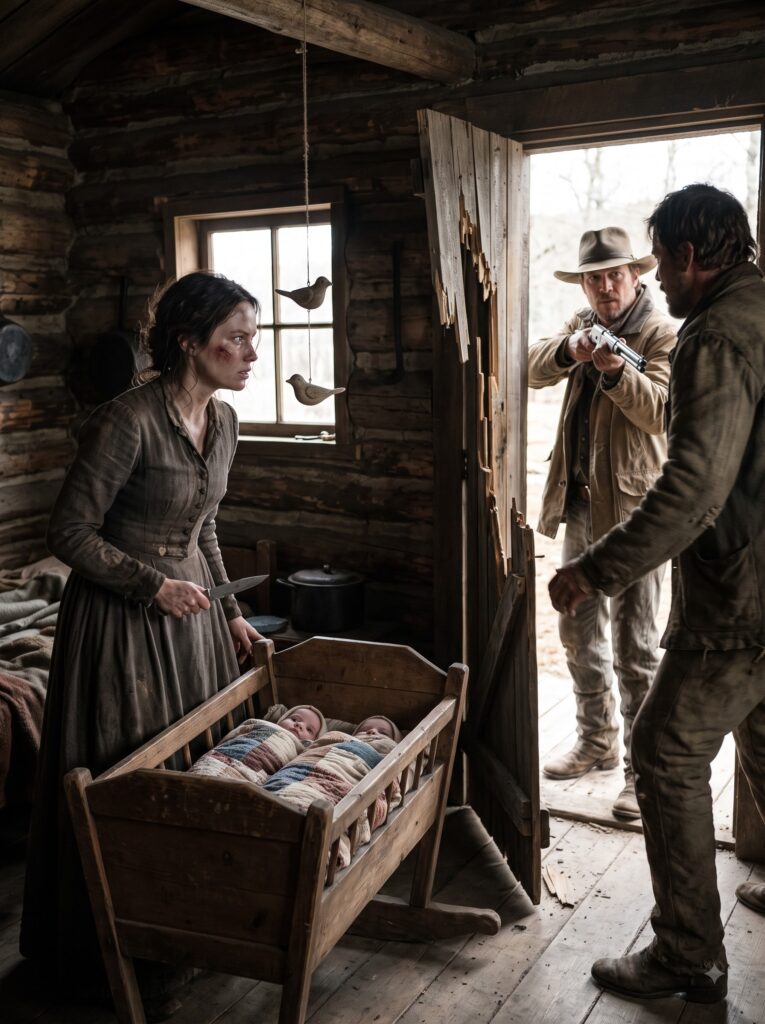
Mara’s fingertips caught the edge of the blanket just as pain tore across her injured back.
She gasped and nearly fell sideways.
Caleb turned from the hearth.
“May I help?”
She nodded, breathing hard.
He steadied her against the pillows and brought the two infants within reach, watching their faces closely.
“Both breathing,” he told her.
Mara touched their cheeks, then held the nearer baby against her chest.
The child searched weakly for milk.
Mara’s expression changed.
“They haven’t eaten.”
“I’ve tried what I could,” Caleb admitted. “I don’t know how to feed babies this small properly.”
She looked down at the girls.
“They need me.”
“Yes,” Caleb answered. “But you need help as well.”
He fetched water and stayed close while she tried to nurse them. She was exhausted and painfully weak. The girls struggled, and Mara’s fear grew with every unsuccessful attempt.
“Please,” she whispered, “don’t let them die.”
Caleb looked toward the shuttered window.
The storm still blocked the trail.
“I’ll do everything I can. When it’s safe to travel, I’ll get proper help.”
She searched his face as though expecting a condition to follow.
None came.
Later, when both babies had settled, Mara noticed the rifle beside Caleb’s chair.
“Are you expecting someone?”
He followed her glance.
“I was hunting wolves when I found you.”
Her hands tightened around the blankets.
“There were wolves?”
“Near enough.”
Mara closed her eyes.
For a moment she saw the porch again.
The lantern swinging above the steps.
The men who had held her arms.
The whip.
And Silas watching while she pleaded for her daughters.
Caleb saw her trembling.
“You needn’t tell me now.”
She shook her head.
“He’ll come.”
“Who?”
She opened her mouth.
But the name would not come.
Instead she whispered, “He said they weren’t fit to bear his name.”
Caleb looked toward the sleeping infants.
“Because they’re girls?”
Mara began crying.
Not loudly.
Not dramatically.
Just a quiet, exhausted grief that seemed to have waited until someone finally listened.
Caleb brought a chair near the hearth, keeping enough distance that she would not feel cornered.
“They’re children,” he said. “There’s nothing wrong with them.”
Mara looked at him.
“You don’t understand. He wanted a boy. He wanted someone to inherit everything.”
“And he blamed you?”
She nodded.
Caleb’s jaw tightened.
He had heard enough to understand that the violence was no accident.
But he did not press for details.
Instead he asked what she needed most.
“My girls safe.”
“Then we’ll start there.”
He moved the cradle nearer her cot so she could reach the babies without straining her injured back.
Then he placed clean water beside her.
Mara watched every movement.
She had spent so long living under another man’s commands that kindness without demands felt unfamiliar.
“Why are you doing this?” she asked.
Caleb paused.
“Because you needed help.”
“You don’t know me.”
“Didn’t need to.”
She looked at his scarred hands.
“And what happens when I’m well enough to leave?”
“That’s yours to decide.”
The words unsettled her more than a promise of permanent shelter would have.
In Silas Drake’s house, she had possessed fine clothing, servants, and enough food.
She had possessed almost no choices.
Here, in a rough cabin with a stranger, someone was telling her she could decide where to go.
Caleb rose to check the fire.
“There’s a settlement down the valley,” he said. “When the trail opens, we can find out what help is available. You needn’t remain here because I carried you in.”
Mara looked down at her daughters.
For the first time, she considered the possibility that surviving the storm might not mean returning to the life that had nearly killed her.
Then the wind struck the cabin hard enough to rattle the shutters.
One infant woke crying.
Mara reached to lift her, but the movement brought a sharp cry of pain.
Caleb turned.
“Shall I bring her?”
“Yes.”
He placed the baby gently in her arms.
Mara settled the child against her breast, but her eyes stayed fixed on the door.
“He has men,” she whispered.
Caleb did not pretend the danger was small.
“Then when you’re strong enough, we’ll decide what to do about them.”
She drew her daughters closer.
After a long silence, she made her first deliberate demand.
“If someone comes asking for us, don’t give him my name before you’ve spoken to me.”
Caleb nodded.
“You have my word.”
Mara looked toward the wooden door, its latch trembling beneath another gust.
She was still afraid.
But she had asked for something.
And the man beside the fire had listened.
The latch trembled again.
Caleb crossed the cabin, checked that the door was secure, and looked through the narrow gap beside the shutter.
Only snow moved outside.
He returned to the hearth.
“No one there.”
Mara nodded, but her arms remained wrapped around her daughters.
Caleb did not ask her to trust him.
He knew trust could not be demanded from someone who had been hurt as badly as she had.
Instead he drew his chair close enough that she could call for him without raising her voice.
“You sleep when you can,” he said. “I’ll keep the fire going.”
She watched him settle into the chair.
“And if I wake?”
“I’ll be here.”
That first week passed in pieces.
There were moments when Mara recognized the ceiling beams above her cot and knew she was safe inside Caleb’s cabin.
Then there were moments when fever, pain, and exhaustion blurred everything.
Sometimes she woke believing she was still in Silas Drake’s house.
She would reach desperately for her daughters.
Caleb learned not to touch her suddenly.
He spoke before approaching.
He asked before helping her sit up.
And whenever possible, he placed what she needed within reach so she could manage it herself.
The twins remained fragile.
Their feeding was the greatest worry.
Whenever Mara was awake and able, Caleb helped position them near her, allowing her to nurse and care for them. She worried that her illness and weakness had left her unable to give them enough.
Their survival was uncertain through those first days.
When the storm finally eased enough for travel, Caleb considered taking them toward the settlement, but Mara was still far too weak for a rough journey through deep snow, and the infants could scarcely endure the cold.
He watched the weather and waited for a safer opening, knowing that delay carried risks of its own.
By the seventh day, Mara could remain awake long enough to study the room.
It was plain but orderly.
A narrow table stood beside the hearth. Several shelves held dried provisions and simple cooking utensils.
Caleb’s coat hung near the door.
There was no sign of a woman’s belongings.
No second place set at the table.
No unnecessary decoration.
The place seemed designed for one man who expected no visitors.
One afternoon she found Caleb sitting near the window with a small block of pine in his hand.
His knife moved carefully over the wood.
“What are you making?” she asked.
He looked up, surprised to hear her speaking so strongly.
“A bird.”
“Why?”
He considered.
“Always liked watching them. They know when to leave and how to find their way back.”
Mara watched the small wooden wings take shape.
“Not every bird has somewhere safe to return.”
Caleb set the knife down.
“No,” he said. “I suppose not.”
She turned toward the twins.
The conversation ended there, but neither forgot it.
As the days passed, Mara’s fever subsided.
Her wounds remained painful. She could not bend easily, and standing brought dizziness.
But her strength slowly returned.
One morning she asked Caleb to help her reach the chair beside the hearth.
“You sure?”
“I want to sit somewhere other than that cot.”
He moved the chair closer.
She stood slowly, leaning on its back.
Pain tightened her face.
For several breaths she remained upright.
Then she lowered herself into the chair.
Caleb waited until she was settled.
“Better?”
Mara looked around the room.
“Yes.”
A simple chair beside a warm fire should not have felt like a victory.
But after days of helplessness, it did.
The twins grew more alert.
Their cries strengthened, and they began waking more regularly to feed.
Caleb made a low wooden cradle with a secure resting place beside Mara’s cot, keeping the bedding arranged so that neither infant could become trapped beneath heavy blankets.
When Mara saw the finished work, she ran her fingers along the smooth edge.
“You made this?”
“Wasn’t doing much else after the barn chores.”
She smiled faintly.
“You’ve been doing plenty.”
He shrugged.
“Woodwork’s easier than guessing what babies want.”
That made her laugh.
The sound stopped him.
For the first time, he saw something in Mara’s expression that did not belong to fear or pain.
He found himself wanting to see it again.
But he kept that wish to himself.
One evening, when the twins were asleep, Mara asked him about the ranch.
“Do you work it alone?”
“Mostly.”
“Always?”
“Long enough.”
He explained that he kept a small cattle holding in the valley, tended his animals, repaired the buildings, and went into the settlement when supplies required it.
He had become accustomed to the quiet.
After years of working distant country, he found it easier to manage fences and stock than conversation.
“Don’t you get lonely?” Mara asked.
Caleb studied the fire.
“Hadn’t given it much thought.”
“That wasn’t my question.”
He glanced at her.
A reluctant smile moved across his face.
“Sometimes.”
Mara nodded.
She understood loneliness.
But hers had existed inside a large house full of people.
That night she began telling him about Silas.
Not everything.
Only the beginning.
“He owns land near the settlement,” she said. “A great deal more than most people.”
Caleb listened.
“He wanted children because he wanted an heir.”
“Most men like having children.”
“He wanted a son.”
Her hands tightened around the cloth she was mending.
“When I learned I was carrying two babies, he spoke about having two boys. Said his name would be secure.”
She fell silent.
Caleb waited.
“When they were born, he wouldn’t look at them.”
The fire snapped softly.
“He said I had disgraced him.”
Caleb’s face hardened.
Mara stared at the needle.
“I thought he’d calm down. I thought once he heard them cry, he’d remember they were his children.”
Her voice broke.
“He didn’t.”
She told Caleb about the punishment.
About being whipped while still weak from childbirth.
About the men ordered to carry her and the newborn girls into the snow.
And about Silas declaring that the children were cursed because they were daughters.
Caleb listened without interrupting.
When she finished, the cabin seemed painfully quiet.
He rose and put another log on the fire.
Then he returned to his chair.
“What he did was cruel,” he said.
Mara looked down.
“He always told me everything was my doing.”
“Not this.”
The certainty in his voice made her eyes fill.
“Not any of this,” he added.
For a moment she could not speak.
Then she whispered, “I don’t know how to believe that yet.”
“You don’t have to believe it tonight.”
He remained where he was.
She had told him the worst thing that had happened to her.
He did not ask for her gratitude.
He did not reach for her.
He simply stayed.
Over the next few weeks, spring began creeping into the valley.
Snow slid from the roof.
The creek grew louder.
Patches of dark earth appeared beneath the trees.
Mara began taking short walks around the cabin when her strength allowed.
Caleb watched carefully but did not interfere unless she asked.
She started helping with ordinary tasks.
First she mended one of his torn shirts.
Then she prepared bread when she could stand long enough.
Later she helped organize the jars and stores, showing him how to reduce waste in the kitchen.
Caleb, in turn, brought water, tended the fire, and cared for the twins while Mara rested.
He never suggested she owed him the labor.
When she began working too long one afternoon, he set a chair beside the table.
“You’re allowed to stop.”
She kept kneading.
“I know.”
“Do you?”
Her hands slowed.
Then she sat.
Caleb took over the dough, though he made a considerable mess of it.
Mara laughed until her injured back protested.
He looked at the flour covering his sleeves.
“Seems I’ve discovered something I’m bad at.”
“Only one thing?”
He gave her a mock-offended look.
The cabin had begun to change.
There were two cups on the table.
Clean baby cloths drying near the hearth.
A cradle beside Mara’s cot.
Bread cooling on the shelf.
And small moments of laughter where there had once been only silence.
Caleb finished carving his wooden bird.
Then he made another.
He suspended both above the cradle, where the twins could watch them move gently.
Mara stood beside him.
“They’re beautiful.”
He looked embarrassed.
“Just pine.”
“They’re something you made for them.”
Caleb studied the sleeping babies.
“They deserve things made with care.”
Mara’s eyes filled.
She thought of Silas calling them worthless.
Then she looked at the little birds.
For the first time since the births, she allowed herself to imagine her daughters growing up without being made ashamed of who they were.
One evening, she and Caleb stood on the porch watching the snow retreat from the fields.
“It’s different here,” Mara said.
“What is?”
“Everything.”
He looked toward the mountains.
“Wasn’t much to look at before you came.”
She smiled.
“I wasn’t talking about the valley.”
He turned toward her.
For a long moment neither moved.
Then one of the girls cried inside, and Mara went to her.
Caleb watched her disappear through the doorway.
He understood, with surprising clarity, that his life had begun arranging itself around the sound of her voice.
But the danger from Mara’s past had not disappeared.
It arrived with Jed Carter.
Jed was a trapper who passed through the valley occasionally, trading furs and news from the settlement.
He came one afternoon leading a mule loaded with supplies.
Caleb invited him in for coffee.
Mara remained beside the cradle.
Jed’s gaze flickered toward the twins.
He said little at first.
Then, after finishing his cup, he leaned closer to Caleb.
“There’s a man asking questions down in town.”
Caleb looked at him.
“What sort of questions?”
“Looking for a woman. Says she ran off with his children during a storm.”
Mara went still.
Jed continued.
“Name’s Silas Drake.”
The cup slipped slightly in Mara’s hand.
Caleb noticed.
Jed did too.
“He’s offering money for news,” the trapper said. “Claims the woman’s not right in her mind. Says the babies belong with him.”
Mara pulled the girls closer.
Caleb set down his coffee.
“Does he know this valley?”
“Not yet, far as I can tell. But he’s sent men looking.”
The silence grew heavy.
Jed glanced toward Mara.
Then he understood.
Caleb spoke quietly.
“What you’ve seen here isn’t for sale.”
Jed lowered his eyes.
“I came to warn you.”
“And I’m grateful. But this family has suffered enough.”
Jed nodded.
He did not ask further questions.
After he left, Mara stood in the middle of the cabin, trembling.
“He’ll find us.”
Caleb went toward her but stopped when she drew back.
“What do you want to do?” he asked.
She looked at him in astonishment.
“Silas has men. Money. Influence.”
“I understand.”
“He can make people believe anything.”
Caleb’s expression tightened.
“I won’t pretend this will be simple.”
Mara looked toward the cradle.
“He wants control more than he wants those girls.”
“Then we should be ready for him.”
She thought of the settlement and the claims Silas was spreading.
Leaving might mean being pursued somewhere unfamiliar.
Remaining meant defending the place where she had begun to heal.
“I don’t want to run again,” she said.
Caleb nodded.
“Then we prepare.”
Over the following days, he repaired the door, checked the windows, and kept his rifle ready.
Mara insisted on knowing how to protect herself.
“Teach me,” she said, holding up the small knife he kept near the table.
Caleb studied her.
“Are you strong enough?”
“I need to learn what I can do.”
He agreed.
He began with safe handling, keeping the blade controlled, and understanding when retreat and shelter offered better protection than confrontation.
She practiced moving the twins away from the windows and toward the most sheltered part of the cabin.
He showed her where the doors could be secured.
But Mara refused to make fighting their only plan.
“We also need someone outside this valley who knows what Silas did,” she said.
Caleb considered her words.
“Jed knows enough to warn the sheriff.”
“Then we should ask him to tell what he knows when he reaches town.”
Caleb nodded.
Mara looked at the carved birds above the cradle.
For months they had represented an impossible promise of freedom.
Now she knew freedom sometimes had to be defended.
One morning, after a restless night, Caleb climbed the low ridge overlooking the valley.
Three riders appeared on the distant trail.
One rode ahead of the others.
His fine coat and upright posture distinguished him from the two men following.
Caleb watched them approach.
Then he turned toward the cabin.
By the time he reached the porch, Mara was waiting inside.
She read his expression.
“Silas?”
Caleb nodded.
“He’s here.”
She looked toward the cradle.
The twins were awake, moving beneath their blankets.
For one terrifying instant she remembered the porch where Silas had ordered her whipped.
Then she remembered waking in Caleb’s cabin.
The first time she had been permitted to say no.
The first time she had stood without being ordered to kneel.
She reached for her daughters.
Caleb opened the cupboard and took down his rifle.
“I’ll speak to him outside,” he said.
Mara met his eyes.
“Don’t decide my future for me.”
He stopped.
Then nodded.
“I won’t.”
She touched the nearest baby’s hand.
“I won’t go back.”
Caleb looked toward the approaching riders.
“Then he needs to hear that.”
He stepped onto the porch, while Mara moved the twins away from the windows and took the small knife from the table.
Outside, three horses came to a halt in the yard.
Silas Drake dismounted, brushed dust from his fine coat, and smiled at Caleb as if he had arrived to collect a forgotten possession.
“I’ve come for my wife,” he announced.
Caleb remained beside the porch steps.
“She doesn’t want to go with you.”
Silas’s smile vanished.
“Then bring her out here and let me correct her.”
Caleb’s hand tightened around his rifle.
“No.”
Silas drew a folded paper from his coat.
“Then perhaps you’ll listen to this.”
He held it up.
“A magistrate’s writ,” he said. “And I intend to take my wife and daughters home.”
Caleb looked at the paper, then at the two armed men beside Silas.
He knew the next few moments would decide whether Mara’s hard-won freedom would survive its first true test.
Caleb did not reach for the folded paper.
Instead he asked Silas to state precisely what authority it claimed to give him.
Silas’s mouth twisted.
“You’re a rancher, Thorne. Not a lawyer.”
“No,” Caleb answered. “And you’re standing on my property.”
Silas took another step.
“My wife has lost her senses. She took my daughters and disappeared into a winter storm.”
Caleb glanced toward the cabin.
He remembered Mara half frozen beneath the aspens, her back marked by violence, her newborn babies barely breathing.
“She didn’t disappear,” Caleb said. “She was left out there.”
Silas’s eyes narrowed.
“You’ve been filling her head with lies.”
Caleb did not move.
“She’s capable of speaking for herself.”
Silas laughed.
“Then bring her out.”
Inside the cabin, Mara heard every word.
She stood beside the cradle, trembling so badly that she had to grip the wooden rail.
One of the twins fussed.
Mara reached down, settled her, and looked toward the door.
For months she had imagined Silas finding them.
In her nightmares she was always back on the porch.
Always kneeling.
Always powerless.
But now she was standing.
And there were two little girls in the cradle who depended on her choices.
She went to the window.
Through the narrow opening, she saw Silas lift the paper again.
“You’re interfering with the law,” he told Caleb.
Caleb held his ground.
“Then we’ll have the proper officers examine it.”
Silas’s expression turned cold.
“You think I’ll let this go to some official who can be talked into siding with a woman?”
The two armed men shifted near their horses.
Caleb noticed.
“There’s no need for violence.”
Silas gave a short, contemptuous laugh.
“There isn’t, if you step aside.”
For a moment nobody moved.
Then Silas raised his hand toward his companions.
One of the men reached for his revolver.
Caleb reacted, bringing up his rifle.
A shot cracked through the valley.
One of Silas’s hired men stumbled backward, wounded in the thigh.
The second rushed Caleb.
They collided near the porch, falling into the wet spring mud.
Caleb’s rifle slid from his grip.
The hired man drew a knife.
Caleb caught his arm, struggling to keep the blade away as they rolled across the ground.
Inside, Mara heard the gunfire.
Her heart lurched.
Both babies began crying.
She moved the cradle farther from the window and grabbed the small knife from the table.
Then a heavy blow struck the cabin door.
Silas.
“Mara!”
Another blow shook the frame.
“You open this door!”
She backed toward her daughters.
“No!”
Wood cracked.
Silas threw his weight against the door again.
The bar splintered from its fastening.
Mara’s breath came hard.
She remembered Caleb teaching her that no door could be treated as protection once it began to give way.
She had considered escape through the rear of the cabin.
But Silas was already forcing his way inside, and carrying both infants into the open would leave her exposed to the armed men outside.
She stayed beside the cradle.
The door burst inward.
Silas entered with fury in his face.
For a moment he stared at her.
She was no longer the bloodied woman he had abandoned in the snow.
She was standing upright, one hand steadying the cradle.
Silas’s gaze moved to the twins.
“There they are.”
He stepped forward.
Mara raised her knife.
“Stop.”
His eyes narrowed.
“What did you say?”
“Don’t come any closer.”
He looked at the blade.
Then he smiled.
“You think that little thing makes you brave?”
“No.”
Her voice trembled.
“But I’m not moving.”
Silas advanced anyway.
He reached toward the nearer baby.
Mara moved between them.
When he tried to push past her, she struck with the knife.
The blade caught his arm.
Silas cried out and staggered backward.
For a moment he seemed more shocked by her resistance than by the wound itself.
“You dared?”
Mara’s hands shook, but she kept her position.
“You left them to die.”
Silas clutched his injured arm.
“I was ridding my house of a disgrace.”
“Look at them!”
Her voice rose above the babies’ cries.
“Look at what you called disgrace.”
Silas barely glanced at the cradle.
“They’re girls.”
Mara felt something inside her settle.
All those nights she had wondered whether she could have prevented the violence.
Whether she had somehow failed.
Now, hearing him say those two words with such contempt, she understood what she had struggled to accept.
There was nothing she could have done to make Silas value daughters he had already decided to despise.
The fault had never belonged to her.
And it had certainly never belonged to the children.
“They are your daughters,” she said. “And you left them in the snow.”
Silas raised his uninjured hand.
“You’ll remember who’s master here.”
He struck her across the face.
The blow made her stumble.
Pain flashed through her cheek.
One hand caught the cradle rail.
But she did not fall.
She straightened.
“I’m not going with you.”
Outside, the struggle had ended.
Caleb had overpowered the second hired man, leaving him sprawled in the mud.
He looked toward the cabin.
The broken door stood open.
Then he heard Mara’s voice.
Caleb snatched up his rifle and hurried inside.
Silas turned as the rancher appeared.
For an instant all three adults stood still.
Caleb saw Mara’s swelling cheek.
The knife in her hand.
Silas’s bleeding arm.
And the terrified babies behind her.
“Step away from them,” Caleb said.
Silas sneered.
“They belong to me.”
Caleb kept the rifle steady.
“Move away from the cradle.”
Silas took another step toward Mara.
She did not retreat.
“I’m telling you myself,” she said. “I won’t return.”
Silas ignored her.
He reached toward the cradle again.
Caleb moved forward, forcing him back with the threat of the rifle.
The cabin fell silent except for the infants’ crying.
Silas stared at Caleb with open hatred.
“You’d shoot a man over another man’s wife?”
Caleb’s face remained grim.
“I’d stop a man hurting a woman and two babies.”
Silas gave a bitter laugh.
“And then you’ll face the magistrate.”
Before Caleb could answer, footsteps sounded on the porch.
A voice called from outside.
“Thorne! Hold where you are!”
Caleb turned his head slightly.
Jed Carter appeared in the ruined doorway.
Behind him stood the sheriff and two deputies.
Jed had carried news of Silas’s search to the settlement. After learning enough to suspect something was seriously wrong, the sheriff had ridden out with him.
They had reached the valley in time to hear the gunfire.
The sheriff took one look at the wounded men outside, the broken cabin door, and Mara standing beside the cradle.
“Everyone put your weapons down.”
Caleb kept his attention on Silas until a deputy moved between them.
Then he lowered the rifle.
Mara set her knife on the table, away from the infants.
Silas began speaking immediately.
“Sheriff, that woman is my wife. She’s been taken from my home. Thorne’s holding her against her will.”
Mara stepped forward.
“No.”
The sheriff looked at her.
Silas tried to interrupt.
“She isn’t well. She hasn’t been right since the birth.”
Mara’s voice shook.
“I can speak for myself.”
The sheriff raised a hand to silence Silas.
“Go on, ma’am.”
She looked at Caleb.
He stood quietly beside the hearth.
He did not answer for her.
Mara turned back to the sheriff.
“My name is Mara Drake. This man had me whipped after our daughters were born. He ordered men to take us into a winter storm and leave us there.”
Silas laughed harshly.
“She’s lying.”
Mara continued.
“Caleb Thorne found us in the snow. He gave us shelter while I recovered. I stayed because I chose to stay.”
The sheriff looked toward the infants.
Their small faces were red from crying.
Then he studied Mara’s bruised cheek.
“Did this man strike you today?”
“Yes.”
“And force his way through that door?”
“Yes.”
Silas waved the folded paper.
“I’ve got a magistrate’s writ!”
The sheriff took it and inspected it.
Whatever claims the document contained, he refused to treat it as permission to break into another man’s home, assault Mara, or endanger the children.
The evidence of violence lay all around them.
He ordered Silas and his companions detained.
Silas began shouting.
“You can’t do this! Those children carry my name!”
Mara stood beside the cradle.
“No name gives you the right to destroy them.”
The deputies restrained Silas.
He struggled, still shouting accusations as they led him out.
The sheriff remained for a moment.
“You’ll likely need to give a full account of what happened,” he told Mara. “And that paper’s claims will have to be examined.”
She nodded.
“I will.”
“You understand this may take time?”
“Yes.”
The sheriff glanced toward Caleb.
“See that she’s able to come into town when she’s ready. We’ll need her statement.”
Caleb nodded.
But Mara answered first.
“I’ll come.”
The sheriff touched his hat and followed his deputies.
Outside, horses shifted in the muddy yard.
Then the riders departed, taking Silas and his two companions toward the settlement.
Mara stood motionless until the sound of hooves faded.
Only then did her knees begin to shake.
She caught the table.
Caleb approached carefully.
“Can I help?”
She nodded.
He moved a chair beside her.
She sat, staring at the shattered door.
The babies were still crying.
She reached for them, holding one against each arm as she rocked gently.
“It’s all right,” she whispered.
Her voice broke.
“It’s all right now.”
Caleb knelt nearby.
He did not tell her she should be relieved.
He did not tell her the danger was over forever.
He understood that Silas’s arrest was the beginning of answering what had happened, not the magical erasure of years of harm.
So he asked whether she wanted water.
She nodded.
He brought it.
She drank slowly.
After a while, Mara looked at him.
“I was afraid I’d become the woman I was before.”
Caleb shook his head.
“You were afraid. That’s different.”
“I hurt him.”
“He was reaching for the girls.”
She looked down at the twins.
“I never wanted them to see any of that.”
“They’re safe with you now.”
Her eyes filled.
“Do you think they’ll remember?”
“They’re very little.”
She nodded.
Then she looked toward the birds turning gently above the cradle.
“I want them to remember something else when they’re older.”
“What?”
“That they were wanted.”
Caleb glanced at the carvings.
“They are.”
Mara looked at him for a long moment.
Then she reached for his hand.
He gave it without hesitation.
They stayed beside the hearth until the girls settled.
When the cabin grew quiet, Caleb stood to inspect the broken doorway.
Mara watched him gather the splintered timber.
He had cuts across his knuckles and a bruise beginning along his temple.
“You’re hurt,” she said.
“Nothing serious.”
“Sit down.”
He looked surprised.
“Mara—”
“I’ve been listening to you tell me to rest for weeks. Now it’s your turn.”
He sat.
She fetched clean cloth and water.
Her hands still trembled, but she cleaned the dirt from his injuries as carefully as she could.
Caleb watched her.
“You don’t have to do this.”
“I know.”
She looked up.
“That’s why I want to.”
He remained still while she finished.
The tenderness between them was no longer only gratitude.
It had grown through small acts of ordinary care.
Through winter nights and spring mornings.
Through him moving a cup within her reach.
Through her mending a shirt without being asked.
Through his patient work on two wooden birds.
Through the quiet, difficult conversations neither had once known how to begin.
That evening, after the twins had fallen asleep, Mara sat beside Caleb at the table.
The broken door had been temporarily secured.
The rifle rested near the wall, no longer across his knees.
Mara stared at the hearth.
“What happens now?”
Caleb considered.
“The sheriff will need your account. There’ll be questions about Silas and his men. It may not all be settled quickly.”
She nodded.
“And this place?”
Caleb looked around the cabin.
“What about it?”
“I’ve changed so much here.”
He smiled faintly.
“Not the place you found.”
“No.”
She watched the flames.
“When I woke here, I thought you were going to send us away as soon as I could walk.”
“I know.”
“I thought nobody could want two little girls who’d been called a curse.”
Caleb looked toward the cradle.
“They were never a curse.”
Mara pressed her lips together.
“I know that now.”
After a while she continued.
“I’d like to stay. Not because I have nowhere else to go. I know there are choices to be made. But I want to see what life could be here.”
Caleb did not answer immediately.
She turned toward him.
“Does that trouble you?”
“Quite the opposite.”
She smiled.
“Then say so.”
He took a breath.
“Before you came, I thought I was satisfied living alone. I’d built a place where I could manage everything myself.”
“And now?”
“Now I find myself listening for you and the girls every time I come through the door.”
Mara’s eyes softened.
“I don’t know if I’m ready to call this love.”
Caleb nodded.
“You don’t have to.”
“But I know I feel something for you.”
He looked at her.
“I feel something for you too.”
The words were simple.
Neither needed to force them into a larger promise that evening.
There was work ahead, and the law would still have questions.
But for the first time, they were discussing a future together rather than merely surviving the present.
In the days that followed, Mara’s recovery continued.
The bruising on her cheek faded.
Her back remained scarred, and some movements still caused pain.
But she grew steadier.
She cared for her daughters, helped prepare meals, and resumed work in the little garden beside the cabin.
Caleb repaired the broken door properly.
This time Mara worked beside him.
He cut and fitted the timber while she held pieces in place, checked the alignment, and handed him the tools he needed.
When the new fastening was installed, Caleb tested it.
Then he stepped aside.
Mara opened the door herself.
Sunlight flooded the cabin.
She looked at him.
“I don’t want to spend my life behind a barred door.”
Caleb considered the words.
“Then we won’t make one our whole world.”
They left the door open while they worked.
A week later, the sheriff returned with news.
Silas remained in custody pending further proceedings, and the accusations against him were being examined. His account of his wife’s disappearance had already begun to unravel.
Mara would still need to speak formally about what he had done.
She listened carefully.
Then she told the sheriff she would come to the settlement and give her statement.
Caleb offered to accompany her.
She accepted.
Not because she needed someone to speak in her place.
Because she wanted someone beside her.
The matter was not resolved in a single day.
There were questions about Silas’s conduct, the violence at the ranch, and the document he had waved in Caleb’s yard.
Mara spoke about the whipping and the abandonment of her daughters.
She did not give the details easily.
But she told them.
And she did not withdraw her account when Silas’s position and money were mentioned.
The sheriff continued the case against Silas and the men who had helped him.
Mara understood that legal questions concerning the marriage and children could require further attention. She would not confuse Silas being held for violence with every question about her future being settled.
But one fact was already clear.
She had survived.
She had spoken.
And for the first time, Silas’s version was not the only one being heard.
Back in the valley, the days grew warmer.
The little garden Caleb had begun came alive.
Mara planted onions and potatoes beside him, showing him how she preferred the rows arranged.
He listened to her ideas about storing food and making the kitchen more convenient.
The girls grew stronger.
They watched the two wooden birds turn above their cradle, reaching toward them with increasingly determined hands.
Caleb began spending his evenings at the table carving small pieces of wood.
Sometimes Mara sat nearby mending clothing.
Other times she simply watched him work.
They talked more than either had expected.
About what they wanted.
About fear.
About the difficulty of trusting another person after years of being alone or controlled.
One evening, Mara asked why he had spent so much of his life by himself.
Caleb rested his knife on the table.
“I learned to manage without company,” he answered. “After a while, I stopped looking for it.”
“Did you like it?”
“Some days.”
“And the others?”
He smiled.
“Those days were long.”
Mara glanced toward the babies.
“You don’t have many quiet days now.”
“No.”
“Does it bother you?”
He looked at the cradle.
“Not a bit.”
A few nights later, Mara awoke to find Caleb standing beside the window.
Moonlight lay across the floor.
The twins slept peacefully.
She joined him.
“What are you looking at?”
“The valley.”
“Something wrong?”
“No.”
He hesitated.
“Just thinking how different it feels.”
Mara followed his gaze.
Outside, the land stretched toward the dark hills.
For a long time she had believed the safest life was one nobody could find.
Now she was beginning to understand that safety also meant being able to live without surrendering herself.
“I’d like the girls to grow up here,” she said.
Caleb turned.
“If that’s still what you want.”
She nodded.
“But they’ll know there’s a world beyond this valley. They’ll learn. They’ll have choices.”
“Of course.”
“And I want to keep helping with the place. Not only the kitchen. The garden, the stores, whatever I can learn.”
Caleb smiled.
“Then we’d best start planning.”
Mara laughed softly.
“You’re getting better at that.”
“At what?”
“Making room for another person’s opinion.”
He took her hand.
“Had a good teacher.”
That summer, Caleb brought her into the shed beside the barn.
He had spent several evenings working there.
Inside stood a sturdy oak cradle, larger and more carefully finished than the makeshift bed that had sheltered the twins through winter.
Mara stopped in the doorway.
“Caleb.”
He rubbed the back of his neck.
“They’ll need more room.”
She stepped forward and ran her fingers along the smooth wood.
Every edge had been carefully rounded.
Every joint fitted firmly.
The cradle was simple, strong, and made for lasting use.
“You made this for them?”
He nodded.
“For the girls.”
Mara looked toward him.
“And you want them here?”
He met her eyes.
“I do.”
She swallowed.
“With me?”
Caleb came closer, but left the last step for her.
“With you.”
Mara looked at the cradle again.
For years, the people around Silas had treated his wishes as more important than her own.
He had considered daughters a failure because they did not match his plans.
Now a man was standing beside a cradle he had made with his own hands, asking whether Mara and her girls might share his life.
Not demanding.
Not bargaining.
Asking.
Her eyes filled with tears.
“I want that too.”
Caleb offered his hand.
She took it.
He drew her close enough to rest his forehead gently against hers.
Neither spoke for a while.
Then Mara lifted her face, and they kissed.
It was a quiet beginning, not an answer to every difficulty ahead.
Their future still required work, patience, and honest decisions.
But the affection between them no longer needed to hide behind chores and silence.
Together they carried the new cradle into the cabin.
Caleb placed it where Mara wanted it, near enough for her to hear the girls during the night.
She transferred their blankets and checked that both infants could rest safely.
Then she removed the two carved birds from their old resting place and hung them where the girls could see.
They turned gently above the oak.
Mara watched them for a long moment.
“Do you remember what you told me about birds?”
Caleb nodded.
“They leave. And sometimes they come back.”
She looked toward the open doorway.
“I used to think leaving was the only way to be free.”
“And now?”
“Now I know I can choose where I stay.”
Caleb reached for her hand.
Mara took it.
Outside, summer sunlight warmed the valley.
The cattle moved slowly across the pasture.
Smoke rose from the cabin chimney, and young green plants filled the garden beside the wall.
There would be more work tomorrow.
Water to carry.
Animals to tend.
Food to prepare.
Children to comfort.
There would be hard days, and memories that did not disappear simply because life had become kinder.
But Mara no longer faced those days as a woman who had to plead for the right to exist.
She had regained her voice.
Caleb had learned that caring for a family meant listening as much as protecting.
And the twins, once abandoned for being daughters, now slept beneath two wooden birds made by a man who welcomed them exactly as they were.
That evening, Mara stood in the doorway with one daughter in her arms while Caleb held the other.
The last light fell across the hills.
She looked at the place where snow had once nearly taken all three of their lives.
Then she looked down at the child resting against her shoulder.
“Look, sweetheart,” she whispered. “That’s the way home.”
Caleb stood beside her.
Behind them the fire burned steadily, and the carved birds turned above the empty cradle, waiting for the girls to be laid down.
Mara stepped inside first.
Not because Caleb called her.
Not because she had nowhere else to go.
But because she had chosen this life.
And this time, the door closed behind a woman who was free to open it again.


