
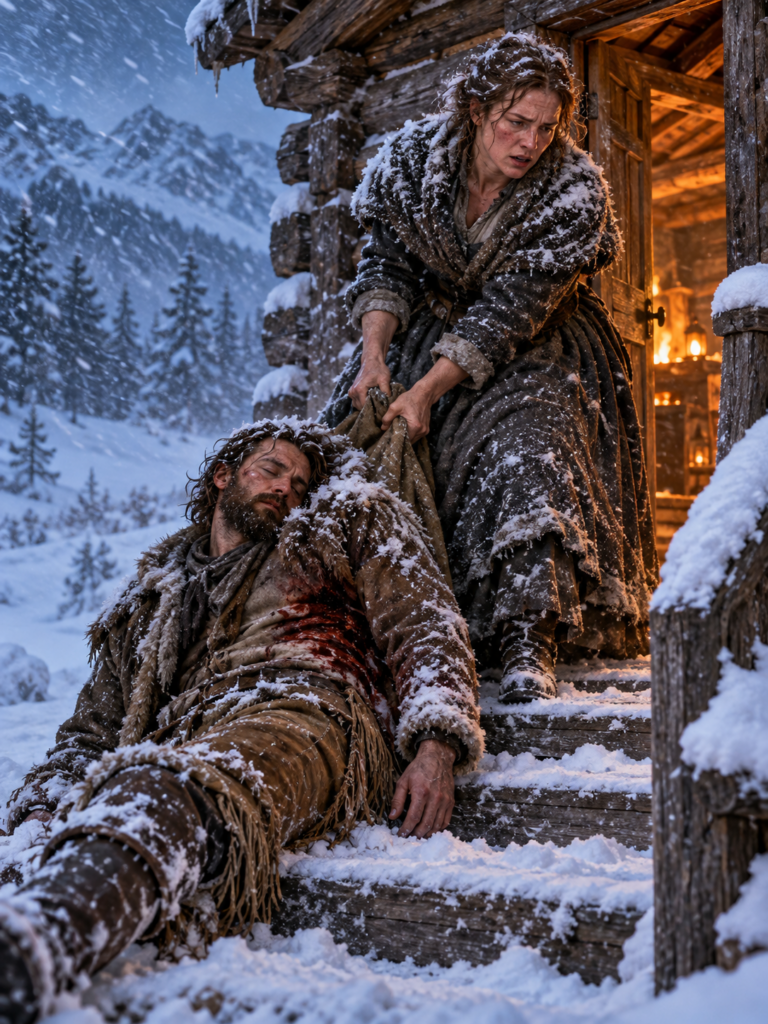
His fingers closed around hers with such desperate strength that Ruth could feel the bones in her hand pressing together.
For one frightening second, she thought he was trying to fight her again.
But his gray eyes were no longer wild.
They were fixed on her face.
“Don’t,” he whispered.
The word was barely more than breath.
“Don’t what?”
He swallowed painfully.
“Leave.”
Something inside Ruth tightened.
She had expected threats, curses, perhaps another attempt to reach for a weapon.
Not that.
“I’m not leaving,” she answered. “But if you keep moving, neither of us is going to enjoy this night.”
His grip weakened.
She waited until his fingers released hers before pressing the linen more firmly against his side.
“Can you understand me?”
A faint nod.
“Good. I’ve got to clean this injury. It will hurt. I’ll tell you before I touch it.”
His eyelids lowered.
“Do it.”
Then consciousness slipped away again.
Ruth worked beside the stove, where the warmth was strongest.
She cut away the remaining wet cloth, washed the dirt from around the wound as carefully as she could, and tried to judge how much damage the bullet had done.
The bleeding slowed under pressure.
But the torn flesh frightened her.
She had clean linen, boiled water, a needle, and thread. She had no physician, no proper surgical instruments, and no guarantee that anything she did would be enough.
She cleaned what she could, brought the wound’s edges together where necessary, and bound his side.
By the time she finished, her hands were shaking.
His breathing remained shallow.
His skin felt terribly cold.
Ruth covered him with her thickest quilt and two heavy hides, keeping him close enough to the stove for warmth without risking the fire.
Then she dragged a chair beside him.
Outside, the wind battered the cabin walls.
Inside, she watched a stranger struggle to remain among the living.
Hours passed.
She tended the fire, checked the bandage, and listened for changes in his breathing.
Near midnight, he began to shiver violently.
His lips moved.
Ruth leaned closer.
A name escaped him.
“Miller.”
She frowned.
He whispered something else, but the words broke apart.
Then, suddenly, his face twisted.
“No… my horse…”
His hand clawed weakly at the quilt.
“Leave him… leave him…”
Ruth caught his wrist, gently this time.
“Easy. You’re not out there anymore.”
His eyes opened without recognition.
“Shot me,” he breathed.
The words sent cold through her.
She looked toward the rifle she had retrieved from the snow and placed safely beyond his reach.
Someone had shot this man.
Someone had left him in a storm with no horse, no supplies, and scarcely enough strength to crawl.
Whoever had done it might still be somewhere in the mountains.
Ruth glanced at her locked door.
Her cabin had always been her refuge because no one knew much about her life beyond the settlement.
Now she had brought another person’s danger inside.
The thought frightened her.
But when she looked back, the stranger’s face had gone slack again, and his breathing had become uneven.
She set her fear aside.
“Well, whoever Miller is,” she murmured, “he isn’t getting you tonight.”
By morning, the storm had buried the bottom of the door.
Ruth cleared enough snow to reach the sheltered woodpile and check the mules.
She moved slowly, exhausted from the night’s work.
Every task took twice its usual effort.
And every time she returned to the cabin, she feared finding the stranger still.
Yet his chest continued to rise.
During the next day, fever came.
He could not manage more than a few sips of water when awake. At times he was restless, at others frighteningly quiet.
Ruth washed his face, changed the linen when needed, and kept watch for fresh bleeding.
She did not know whether the wound would turn foul.
She did not know how long the storm would hold.
And she did not know whether the stranger would ever wake enough to explain who had shot him.
Late that evening, as she knelt beside him, his eyes opened again.
This time they seemed to recognize her.
“Your name?” he whispered.
“Ruth.”
He studied her face.
“Boon,” he said.
Then he glanced around the cabin.
“You live here alone?”
“I do.”
His expression changed.
Perhaps he understood, finally, what she had risked by bringing him inside.
“Why?”
Ruth thought of Oak Haven.
Of the laughter.
Of the years spent becoming smaller in spirit because her body would not become smaller for anyone.
She tightened the edge of his quilt.
“Because people are easier to live without than to live beside.”
Boon looked at her for a long moment.
Then he whispered, “I know something about that.”
Before she could ask what he meant, his eyes closed.
His breathing grew rough.
Ruth laid fresh linen beside the stove, poured more water into the kettle, and reached beneath his quilt to check whether the bandage had begun bleeding again.
Ruth’s fingers found the damp edge of the bandage beneath the quilt.
For an awful moment, she feared the wound had opened again.
She lifted the covering carefully.
A small stain had spread through the linen, but it was not the fresh, heavy bleeding she remembered from the night she found him.
She checked the dressing, settled the quilt again, and sat back on her heels.
“You’re making more work than two stubborn mules,” she muttered.
Boon did not answer.
She had not expected him to.
Outside, the wind carried another long howl through the trees.
Ruth fed another split of pine into the stove.
There was nothing left to do except continue.
And so she did.
The storm held the mountains for three full days.
By the fourth morning, the wind had quieted enough for pale sunlight to touch the cabin windows.
Ruth stood at her kitchen table, kneading dough with slow, powerful strokes.
Her shoulders ached. Her wrists were bruised. She had scarcely slept.
Still, bread needed making.
The mules needed feed.
The stove needed wood.
A household did not stop requiring care simply because its owner was exhausted.
She pushed her palms into the dough again.
A dry voice came from behind her.
“That table offend you somehow?”
Ruth stopped.
Very slowly, she turned.
Boon was watching her.
His gray eyes were clearer than they had been since she dragged him inside.
There was weakness in his face, and he lay carefully on his uninjured side, but the feverish confusion seemed to have lifted.
Ruth wiped flour onto her apron.
“That table has survived me for six years. It’ll survive another morning.”
“Wouldn’t wager on it.”
His mouth twitched.
Ruth stared.
She had spent days preparing herself for the moment he truly looked at her.
Now it had come.
Her shoulders stiffened instinctively.
She knew what men saw when they noticed her.
A very large woman.
A woman whose heavy arms strained her sleeves, whose broad hips required extra cloth, whose footsteps made old timber complain.
She waited for his smile to become a smirk.
It did not.
Instead, Boon glanced around the cabin.
“Where am I?”
“Above Oak Haven. In the Wind River high country.”
He closed his eyes briefly.
“How long?”
“Four days since I found you.”
“Four?”
“Three of those you spent making a terrible nuisance of yourself.”
He looked down at the bandage beneath his borrowed shirt.
“You did this?”
“Unless you know another woman wandering around my kitchen with a needle.”
His gaze returned to her face.
“You saved me.”
“I’ve been trying.”
He started to push himself upright.
The movement lasted only a moment.
Pain seized him, and his face drained of color.
Ruth crossed the room.
“Don’t.”
He fell back against the folded blanket, breathing hard.
“You’d think a man who survived a bullet would have more sense,” she said.
Boon looked faintly annoyed.
That reassured her more than gratitude would have.
She brought him warm mint water and helped him hold the cup until his trembling hand steadied.
He drank a little.
Then he asked, “Why did you bring me in?”
Ruth stood.
“Didn’t care to have you freezing beside my porch.”
“You didn’t know me.”
“Still don’t.”
“Could’ve been dangerous.”
“You were unconscious. I reckoned I had the advantage.”
A rough laugh escaped him.
It immediately turned into a grimace.
Ruth shook her head.
“That’s what comes of finding everything amusing.”
But as she returned to her dough, she felt something unfamiliar settle inside her.
He had looked at her without cruelty.
Not once had his eyes carried the expression she knew so well.
That should not have mattered.
Yet it did.
Over the following days, Boon’s recovery came slowly.
The wound remained tender. His strength returned in frustrating increments, and any careless movement reminded him how close he had come to dying.
Ruth kept him warm, fed, and stubbornly away from heavy work.
He complained.
She ignored him.
At first.
Then she discovered that arguing with Boon was considerably less unpleasant than talking to most people.
He was sharp-tongued without being spiteful.
When he asked a question, he listened to the answer.
And when she told him something belonged to her, he left it alone.
One morning, she found him studying the shelves above the stove.
“You’re counting my provisions?” she asked.
“Trying to understand how you keep a place this far up supplied.”
“Planning to steal my secrets?”
“Planning to learn them.”
She raised an eyebrow.
He nodded toward the dried herbs hanging from the rafters.
“You grew those?”
“Some. Gathered the rest.”
“And the shelves?”
“Built them.”
“The chair?”
“That too.”
He looked at the broad wooden rocker by the stove.
“Stout piece of work.”
“It had to be.”
She spoke more sharply than intended.
Boon glanced at her.
Then he said, “Joinery’s good. Better than a fair amount I’ve seen in trading posts.”
And went back to his tea.
Ruth stood motionless for a moment.
He had understood her answer without making her defend it.
That was becoming a habit of his.
On the twelfth day, while she changed his dressing, Ruth finally asked the question that had troubled her since the storm.
“Who shot you?”
Boon’s expression hardened.
For a while, he said nothing.
Then he answered.
“Man named Miller.”
The name struck her immediately.
She remembered hearing it while he lay feverish.
“What happened?”
“Found him running traps in a valley I’d worked for years. Told him to clear out.”
“And?”
“He didn’t take kindly to being told.”
Boon looked toward the window.
“I was dressing a deer when he shot me from the trees.”
Ruth’s hands went still.
“He took my horse. Took my supplies.”
“Left you there?”
Boon nodded.
“I got as far as I could on foot.”
“Which was my porch.”
“Near enough.”
Ruth looked down at the healing injury.
There was no glory in it.
No grand adventure.
Only a man who had nearly been killed because another man wanted what he had.
“Is he likely to come looking?”
“I can’t say.”
She finished the bandage, then sat back.
“If he does, I expect you to tell me the truth.”
Boon met her gaze.
“I will.”
“And you’ll remember whose roof you’re under.”
A faint smile returned.
“Hard to forget.”
Ruth rose and took the basin away.
But she noticed, afterward, that Boon never again treated her questions as though she had no right to ask them.
By the fourth week, he could walk around the cabin.
His strength remained limited. He could tend the stove, prepare coffee, and perform small tasks, but Ruth refused to let him carry heavy firewood.
He disliked being idle.
She disliked having a man occupying her kitchen.
Or so she repeatedly told herself.
The truth became more complicated with each passing day.
Boon learned where she kept the flour and how she liked her coffee.
He discovered that she hummed beneath her breath while sewing.
She discovered that he disliked wasting even a crooked nail and could repair almost anything made of wood.
Sometimes they sat for an hour without speaking.
Those hours frightened her most.
They began to feel comfortable.
One evening, Ruth was mending winter trousers at the table when Boon approached carrying a small object.
He placed it beside her sewing.
“Thought you might have use for this.”
She looked down.
A wooden spoon.
But unlike the narrow utensils she had bought over the years, this one had a broad, carefully shaped handle.
Its surface was smooth.
Its bowl was deep and balanced.
She lifted it.
The handle rested naturally in her large hand.
For a moment, she could not speak.
“Your old spoon’s cracked,” Boon explained. “Saw it catch your palm yesterday.”
Ruth stared at the wood.
All her life, people had noticed what was inconvenient about her body.
The room she occupied.
The fabric she required.
The way she moved.
This man had noticed something entirely different.
That a spoon hurt her hand.
And he had quietly made one that did not.
“Why?” she asked.
Boon frowned slightly.
“Because you needed another.”
“No. Why make it like this?”
He looked at her hand.
“Because that’s the hand that’s going to use it.”
Ruth lowered her eyes.
She could not remember the last time someone had considered her comfort without making a spectacle of it.
Boon pulled out the opposite chair.
“May I ask you something?”
“Depends.”
“Why do you stay up here?”
Ruth turned the spoon between her fingers.
She might have told him to mind his affairs.
She had certainly told other people worse.
But the careful curve of the handle made lying feel oddly ungrateful.
“Because I’m large,” she said.
Boon waited.
“I’m not pretending otherwise. I was large as a girl. Larger as a woman. People in Oak Haven never let me forget it.”
Her fingers tightened around the spoon.
“I worked hard. I minded my business. I was useful to people who wouldn’t be seen walking beside me.”
Boon remained silent.
“Men laughed. Women looked sorry for me. Every trip into town felt like walking past a row of judges.”
Her voice roughened.
“I got tired of giving strangers the power to make me ashamed of being alive.”
She looked toward the cabin walls.
“So I bought land where nobody had cause to bother me. Built a home that fit me. Made my own living.”
“And you did well.”
Ruth gave a short, bitter laugh.
“Did I? I haven’t spoken to anyone proper in years.”
Boon leaned forward.
“You kept yourself alive in country that kills careless men. You made a house out of logs and a living out of what you could carry and grow.”
He paused.
“Sounds like doing well to me.”
Ruth swallowed.
“You’re only saying that because I saved you.”
“No.”
The word was simple.
Certain.
She raised her eyes.
“Then why?”
“Because I’ve spent my life measuring people by what they do when things get difficult.”
He glanced at the stove, the stacked wood, and the neatly repaired tools.
“You’re capable, Ruth. And you’ve been fair to a man you had every reason to fear.”
She looked down.
Boon reached across the table but stopped before touching her hand.
“May I?”
Ruth hesitated.
Then she nodded.
His rough fingers rested lightly against hers.
No demand.
No mockery.
No pity.
Just warmth.
“You shouldn’t have had to come all the way up a mountain to be treated decently,” he said.
A tear slipped down Ruth’s cheek.
She quickly wiped it away.
Boon did not pretend he hadn’t seen.
Nor did he make anything of it.
He simply left his hand where she could take it or leave it.
For the first time in many years, Ruth chose not to withdraw.
Outside, the winter wind pressed against the cabin.
Inside, two people sat at a table built for one, neither willing to name what was beginning between them.
Weeks passed.
The snow began to soften.
Boon’s strength returned.
And with every day that brought spring closer, Ruth felt a new fear growing.
The storm had given her a reason to keep him.
His recovery was taking that reason away.
Then, one pale afternoon, while Boon stood beside the woodpile, he looked down toward the opening trail.
“Once the lower crossing clears,” he said, “I’ll be able to travel.”
Ruth kept her eyes on the work in her hands.
“I know.”
Boon waited.
She did not look up.
He set down the piece of wood he had been carrying.
“Ruth, there’s something I ought to ask before I make plans.”
She finally turned.
“What?”
“Would you want me to stay?”
The question landed harder than any insult she had ever endured.
Because for the first time, the answer mattered more than her fear of giving it.
Ruth’s fingers tightened around the bundle of kindling she was holding.
Boon stood beside the woodpile, watching her with an expression she could not easily read.
He had asked whether she wanted him to stay.
A simple question.
One that should have been easy to answer.
Instead, Ruth felt every cruel memory of Oak Haven rise inside her.
The laughter outside the mercantile.
The pitying voices.
The men who had treated her kindness as an invitation to make a joke.
She looked down at the kindling.
“You’re well enough to travel,” she said.
“That’s not what I asked.”
“I know what you asked.”
Boon waited.
Ruth swallowed.
“This is a hard place to live.”
“I’ve lived in harder.”
“There’s not much company.”
“I’ve noticed.”
“I’m not an easy woman.”
“Nor am I an easy man.”
Her eyes flashed.
“You always have an answer?”
“Only when you keep giving me something worth answering.”
She wanted to laugh.
She wanted to cry.
Most of all, she wanted to tell him to stay.
Instead, she turned toward the cabin.
“The crossing isn’t clear yet. No sense discussing it before then.”
Boon did not follow.
He let her go.
That small kindness nearly undid her.
For the next several days, they lived together under the heavy weight of everything left unsaid.
Spring came slowly to the high mountains.
Snow melted along the south-facing slopes.
Water dripped from the roof and gathered in cold puddles beneath the eaves.
The trail remained muddy, but each afternoon more dark earth appeared through the remaining white.
Boon was no longer the helpless stranger Ruth had pulled into her cabin.
He split wood without difficulty.
He repaired the loose hinges on the mule shelter.
He cleared fallen branches from the narrow path leading to the creek.
He worked without being asked, but never assumed the place was his to command.
When he wanted to move a shelf, he asked.
When he thought the mule shelter needed a stronger brace, he showed Ruth the damaged timber and let her decide how to repair it.
And when she refused help, he sometimes grumbled but accepted her answer.
Ruth began to notice how much those things mattered.
She had built this cabin so no one could make her smaller.
Boon was the first man who had entered it without trying to make himself its master.
Still, the thought of his departure hung over every meal.
One afternoon, she took the wooden spoon he had carved from its usual place beside the stove.
The handle had already darkened slightly from use.
She turned it in her palm.
It fitted her as though the wood had always belonged there.
For a moment, she wondered whether she would be able to look at it after he was gone.
Then she heard a mule snort sharply outside.
Ruth set the spoon down.
A horse was approaching.
She stepped onto the porch.
Down the muddy trail came a rider in a battered coat, mounted on a tired roan horse.
He looked from the cabin to the mule shelter.
Then his gaze settled on Ruth.
He drew the horse to a halt.
A slow, ugly smile crossed his face.
“Well, I’ll be,” he said. “Didn’t reckon anybody lived up this high.”
Ruth stood with one hand resting against the porch post.
“What do you want?”
The man looked her over.
His smile widened.
“That’s quite a woman they’ve got hiding up here.”
Ruth felt the old familiar burn of humiliation.
But this was not Oak Haven.
This was her home.
She straightened.
“State your business.”
“Looking for somebody.”
“Then say who.”
“A mountain fellow. Calls himself Boon.”
Ruth’s blood went cold.
The rider leaned forward in his saddle.
“Heard he’d been traveling these mountains. Tall man. Gray eyes. Carries himself like he owns whatever ground he’s standing on.”
Ruth did not answer.
The stranger studied the cabin.
His gaze lingered on the freshly stacked firewood.
Then on the repaired mule shelter.
“Name’s Miller,” he said.
Ruth felt her stomach tighten.
The name Boon had spoken through his fever.
The man who had shot him.
The man who had taken his horse and supplies.
She kept her expression steady.
“No such man here.”
Miller’s smile disappeared.
“That so?”
“That’s so.”
He looked at the axe near the woodpile and the cleanly cut logs.
“Doing all that yourself?”
“Been doing it for years.”
Miller gave a short, contemptuous laugh.
“Don’t expect me to believe every word out of your mouth.”
Ruth descended one porch step.
“I don’t require your belief.”
His eyes narrowed.
He swung down from his horse.
“Maybe I’ll have a look inside.”
“No.”
It came from her without hesitation.
Miller stopped.
“What did you say?”
“I said no. This is my land. You weren’t invited.”
His hand drifted toward the pistol at his hip.
Ruth’s pulse quickened.
She had faced harsh winters, injuries, and months of isolation.
But this was different.
Miller carried the kind of cruelty that had driven her away from people in the first place.
And now he was standing in her yard.
“Move aside,” he said.
Ruth planted her boots.
“I won’t.”
Behind her, the cabin door opened.
A voice spoke from the porch.
“She told you to leave.”
Boon stood in the doorway holding Ruth’s Winchester.
He kept the rifle steady and the muzzle directed away from her.
His face was quiet.
Not angry.
Not theatrical.
Simply determined.
Miller froze.
“Boon.”
“You’ve found me.”
The other man’s eyes moved to the healed trapper’s side.
“Thought you were dead.”
“I gathered that was your intention.”
Miller glanced toward his horse.
“Now, we don’t need trouble.”
“You brought it.”
Ruth looked from one man to the other.
Boon stepped down onto the porch but did not pass her.
He understood the difference between helping her defend her home and treating her as incapable of defending it herself.
“Miller,” he said, “take your hand away from that pistol.”
Miller obeyed slowly.
“I came to talk.”
“You had your chance to talk before you shot me.”
“That valley was mine to work.”
“It wasn’t yours to take from another man’s traps.”
“You’re making more of this than there is.”
Boon’s expression did not change.
“You took my horse and left me bleeding.”
For the first time, Ruth heard the words spoken directly to the man responsible.
Miller said nothing.
Boon continued.
“Get on your horse. Go back down the trail. Stay away from this cabin.”
Miller’s gaze shifted toward Ruth.
A nasty smile threatened to return.
“Seems you’ve found yourself a fine hiding place.”
Ruth stepped forward.
“You’ve heard him. And you’ve heard me.”
Her voice carried across the yard.
“This is my home. You will not enter it.”
For a moment, Miller appeared ready to argue.
Then his attention returned to the rifle.
He backed toward his horse.
He mounted awkwardly, gathered the reins, and turned down the trail.
Neither Ruth nor Boon moved until the rider disappeared behind the pines.
Only then did Boon lower the Winchester.
Ruth stood in the mud, breathing hard.
She should have felt relief.
Instead, she felt something worse.
The quiet she had built around herself had been broken.
Miller had come because of Boon.
The danger she had kept outside for six years had found her again.
She walked slowly toward the cabin.
Boon did not speak.
He followed her inside, placed the rifle where she kept it, and stood for a long moment beside the table.
Then he pulled his traveling blanket from beneath the cot.
Ruth watched him begin to pack.
At first, she could not make herself ask.
Finally, she said, “What are you doing?”
Boon tightened a leather strap around the folded blanket.
“Getting ready to leave.”
Her chest hurt.
“Why?”
He looked up.
“Because Miller came here looking for me.”
“He’s gone.”
“Today he is.”
“You think he’ll come back?”
“I can’t promise he won’t.”
Ruth crossed her arms.
“So you’ll run?”
Boon’s expression tightened.
“I’ll keep him from having reason to return.”
“And you reckon leaving will do that?”
“I reckon staying might bring you more trouble.”
She stared at him.
He lowered the pack.
“You built this life to get away from people like him. I know that. You told me what it cost you.”
Ruth looked away.
Boon continued quietly.
“I won’t repay your kindness by taking away the peace you worked so hard to find.”
He reached into his coat and brought out a small leather pouch.
He placed it on the table.
It made a faint metallic sound.
“Gold dust,” he said. “From what I had left before all this. It’s yours.”
Ruth looked at the pouch.
“For what?”
“Food. Firewood. The supplies you used keeping me alive.”
“I didn’t send you a bill.”
“I know.”
“Then take it back.”
Boon sighed.
“Ruth—”
“I said take it back.”
He studied her face.
She could see that he was trying to be honorable.
That was what made it hurt.
He genuinely believed leaving was the decent thing to do.
He believed he was protecting her.
And he had never stopped to consider that his departure might be the thing she feared most.
“You’re a fool,” Ruth whispered.
Boon went still.
“Could be.”
“No. You are.”
She stepped closer.
“You think because I live alone, I need to keep living alone?”
“I think you deserve to feel safe.”
“And you think you get to decide what makes me feel safe?”
He opened his mouth.
Then closed it.
Ruth’s hands trembled.
For years, she had measured her words carefully whenever another person might hear them.
She had learned to make herself agreeable.
To apologize when someone brushed against her in a narrow shop aisle.
To pretend she had not heard cruel laughter.
To ask for less than she needed because people already thought she occupied too much space.
She had left all of that behind.
Yet here she was, standing inside the home she owned, still afraid to say what she wanted.
No more.
“I lived down there for years,” she began, her voice rough. “I worked harder than men who laughed at me. I let women speak to me as though I ought to be grateful anybody noticed me at all.”
Boon did not move.
“I saved money until my hands were cracked and my back felt ready to break. Then I came up here.”
She gestured toward the walls.
“I built this place because I couldn’t stand being looked at anymore.”
Boon’s face softened.
“I know.”
“No,” she said. “You don’t know all of it.”
A tear rolled down her cheek.
“I was peaceful here, Boon. I was safe. But sometimes I sat at that table and realized an entire day had passed without hearing another human voice.”
He swallowed.
“I wasn’t miserable every day. I had my work. I had the mountains. I had my animals.”
Her voice faltered.
“But I had started believing this was all the life I was allowed to want.”
Boon looked toward the chair where he had sat through the winter.
Ruth followed his gaze.
“You came here bleeding and half frozen. I dragged you inside because leaving you would’ve made me no better than the people I despised.”
She wiped her cheeks with the back of her hand.
“I didn’t expect anything.”
“I know you didn’t.”
“I certainly didn’t expect you to notice my hands.”
Boon frowned slightly.
“My hands,” she repeated, almost laughing through her tears. “You made me a spoon. A stupid wooden spoon.”
His mouth moved faintly.
“Not stupid. Took me three days.”
She gave a broken laugh.
Then her face became serious again.
“No man ever did something like that for me.”
Boon stepped closer but stopped when she raised a hand.
She needed to finish.
“You listened when I spoke. You helped without treating me like I was helpless. You looked at me as though there was something worth seeing.”
“There is.”
The words came so naturally that Ruth nearly lost her courage.
She drew a slow breath.
“You didn’t ruin this place, Boon. You made me remember that a home can hold more than one person.”
His eyes shone.
“Ruth—”
“And now you’re packing because you think I need you to make another decision for me.”
He lowered his gaze.
After a long silence, he said, “You’re right.”
Ruth blinked.
She had expected an argument.
Boon looked up.
“I was afraid.”
“Of Miller?”
“Of what might happen to you because of me.”
He took a breath.
“And I was afraid you didn’t truly want me here.”
Ruth stared.
“Why would you think that?”
“Because each time the trail cleared a little more, you stopped talking when I came into the room. You put away the spoon. You hardly looked at me.”
Ruth remembered.
She had done every one of those things.
She had been preparing herself for abandonment before he had even chosen to leave.
Boon gave a faint, rueful smile.
“I thought I was making your days harder.”
“You were.”
He flinched.
Ruth stepped closer.
“Because I didn’t know how to ask you to stay.”
The room fell silent.
Boon’s shoulders lowered.
“Then I’ll ask something plainly,” he said.
She waited.
“Do you want me here because you’re afraid of being alone again? Or because you want me?”
The question was difficult.
And Ruth understood why he asked it.
She had a home.
She could survive.
She had survived long before he came.
What she felt was not need for a rescuer.
It was something she had never permitted herself to believe she could have.
She looked into his gray eyes.
“Because I want you.”
Boon closed his eyes for a moment.
When he opened them, there was no uncertainty left in his expression.
“Then I want to stay.”
Ruth stared at him.
“Don’t say it just because I’m crying.”
“I’m saying it because I’ve been wanting to for weeks.”
He glanced toward the cabin window.
“I lived alone because moving was easier than staying anywhere long enough to care what happened there. I knew the mountains. I knew my traps. I knew how to survive without depending on anybody.”
He looked back at her.
“Then I woke up here.”
A small smile touched his face.
“You were making bread and threatening to bury me if I tore your stitching.”
“That was a reasonable warning.”
“Very reasonable.”
He came a step closer.
“And every day after that, I found another reason I didn’t want to leave.”
Ruth’s throat tightened.
“The coffee?”
“Terrible coffee.”
She gasped in outrage.
He smiled.
“The woman making it.”
For a long moment, neither spoke.
Then Boon held out his hand.
“May I?”
Ruth looked at it.
The hand that had once grabbed her wrist in terror.
The hand that had carved her spoon.
The hand that had repaired her shelter.
The hand now waiting for permission.
She placed hers inside it.
His fingers closed gently around hers.
“I can’t promise Miller won’t cause more trouble somewhere,” Boon said. “But I can promise I won’t hide the truth from you or make decisions about your home without you.”
Ruth studied him.
“And if you decide someday you want to go trapping again?”
“Then we’ll speak of it. I won’t disappear without a word.”
“And if I want you out of my kitchen for an afternoon?”
“I’ll be outside before you finish saying it.”
She smiled.
It felt strange, smiling so openly in front of another person.
Boon noticed.
She could tell.
But he did not make her self-conscious.
He simply smiled back.
“There’s one more thing,” Ruth said.
“What’s that?”
“If you stay, you’re not staying because you owe me your life.”
“I know.”
“And this remains my land.”
“It does.”
“And the work gets shared.”
“I’d expect nothing less.”
She nodded slowly.
“Then I suppose you can unpack.”
Boon looked down at the bundle beside the table.
He released her hand, lifted the pack, and returned it to the corner.
When he turned back, Ruth was still standing where he had left her.
Her expression had changed.
She looked almost frightened.
“Ruth?”
“I’ve never done this before.”
“Asked a man to stay?”
“Let one.”
Boon crossed the room slowly.
He stopped close enough that she could see the fine lines around his eyes.
“Would you mind if I kissed you?”
Ruth stared at him.
Then, very softly, she answered, “I’d mind if you didn’t.”
His hands rose to her face.
He waited one last instant.
Ruth leaned toward him.
And Boon kissed her.
There was no audience.
No cruel laughter.
No one measuring her body or deciding whether she deserved tenderness.
There was only the warmth of his hands, the roughness of his beard, and the astonishing discovery that she could be held without having to apologize for the space she occupied.
When they parted, Ruth rested her forehead against his.
“You’re a troublesome man.”
“So you’ve said.”
“And stubborn.”
“That too.”
She slipped her arms around him carefully, mindful of the old injury.
“Then I suppose you’ll fit right in.”
Boon laughed.
A real laugh, warm and unguarded.
Ruth had never heard anything sweeter.
But their choice to remain together did not turn the mountains into an easy place to live.
There was still wood to split.
Still water to carry.
Still a mule shelter to keep sound against the weather.
The spring runoff made the lower trail difficult, and Ruth insisted that they wait until travel was safe before going to Oak Haven for supplies.
Boon agreed.
When they finally rode down together, Ruth felt the old dread gather in her chest.
The settlement had not changed very much.
The same narrow boardwalk.
The same mercantile.
The same familiar faces.
A man outside the store looked up as Ruth approached.
His eyes moved over her broad figure.
She recognized the beginning of a smirk.
Then she realized Boon was standing beside her.
Not in front.
Not behind.
Beside her.
He carried part of their supply list.
She carried the money.
When the shopkeeper asked Boon what they needed, he glanced toward Ruth.
“She’s the one who keeps the accounts,” he said.
The shopkeeper turned to her.
For an instant, Ruth felt the old temptation to lower her voice.
Instead, she unfolded the list and began naming what they had come to purchase.
Flour.
Salt.
Coffee.
Lamp oil.
Iron nails for the shelter.
Boon listened as she checked the quantities and challenged a price she knew was too high.
And when they finished, he carried the heavier sacks to the waiting animals while she settled the account.
No grand speech was made.
No crowd suddenly repented of years of cruelty.
Some people stared.
One woman offered a stiff greeting.
An older storekeeper, who had once relied on Ruth’s labor, asked whether her mountain place had survived the winter.
“It did,” Ruth answered.
Then she looked toward Boon.
“We did.”
On the journey home, she felt the wind against her face and realized something had changed.
Oak Haven still held people capable of wounding her.
But their opinions no longer had the power to decide the whole shape of her life.
She had not become a different woman.
She had simply stopped believing she needed to.
Back at the cabin, Ruth and Boon settled into a rhythm of shared work.
He repaired the damaged section of the roof.
She planned their provisions and showed him where she gathered herbs along the sheltered slope.
He taught her a better way to set certain traps.
She taught him how to coax a stubborn mule into accepting a new harness without wasting half a morning arguing with it.
They disagreed often.
Over firewood.
Over whether a shelf needed moving.
Over the proper strength of coffee.
Once, Ruth threatened to throw his entire kettle into the creek after he called her brew weak.
Boon quietly made the next pot himself.
It was worse.
She reminded him of that for weeks.
Little by little, the cabin changed.
Not because Ruth’s life had been lacking order or care, but because two people now had different uses for the same rooms.
A second place was cleared beside the stove.
Boon made another chair.
Ruth insisted that he build it strong enough for anyone who might need it.
They made room for his tools without disturbing hers.
He kept his old trapping equipment ready for the journeys they agreed he would take when necessary.
And whenever he planned to leave for a few days, they discussed the route and the weather together.
He returned when he said he would.
It was a modest promise.
But to Ruth, it meant more than any extravagant declaration could have.
Through summer and into autumn, the high-country cabin remained their home.
There were hard days.
Days when Ruth’s knees ached so badly she had to rest before finishing her work.
Days when Boon’s injured side troubled him after a long climb.
Days when old fears returned without warning.
Once, after hearing two strangers make a cruel remark about her near the supply trail, Ruth spent an entire evening in silence.
Boon did not demand that she explain.
He prepared supper and left her room to speak when she was ready.
Later, sitting by the stove, she said, “I thought it wouldn’t hurt anymore.”
Boon looked up from the wooden handle he was shaping.
“What they said?”
She nodded.
He set aside the knife.
“Wish I could tell you people will always be kinder.”
Ruth gave a sad smile.
“You’ve never been much for pretty lies.”
“No.”
He reached for her hand.
“But what they say doesn’t make it true.”
Ruth looked toward the table.
The broad-handled spoon lay beside the evening meal.
She had used it so often that the wood had developed a smooth, warm sheen.
Once, she had thought of her body as the reason her life had become small.
Now she understood how much of that smallness had been forced upon her by other people’s narrow imaginations.
Her arms were still heavy.
Her hips still broad.
Her body still required effort to carry through snow and mud.
Nothing about that had changed.
But she had changed what she believed those facts meant.
She had dragged a dying man out of a blizzard.
She had kept her home.
She had refused a violent stranger.
She had asked for the future she wanted.
And when love had come, she had not mistaken it for charity.
By the time the first cold winds returned, Ruth and Boon had stacked enough firewood for the coming winter.
The mules stood sheltered beneath a repaired roof.
The cabin windows were sealed against drafts.
The shelves held provisions they had stored together.
On the evening of the season’s first snowfall, Ruth stood on the porch and watched white flakes settle over the path.
Boon came out carrying her shawl.
“Thought you might want this.”
She accepted it.
“Getting soft, are you?”
“Only where you’re concerned.”
She gave him a sideways look.
“You practice saying things like that?”
“Not nearly enough.”
He draped the shawl across her shoulders when she nodded her permission.
They stood quietly together.
The snow gathered over the same steps where Ruth had once struggled to drag him to safety.
She looked down at them.
Boon followed her gaze.
“Thinking about that night?”
“Hard not to.”
He rested one hand against the porch railing.
“I don’t remember much. The snow. Falling. Thinking I wouldn’t get back up.”
Ruth remembered every agonizing foot of that journey.
The weight of his coat in her hands.
The sting of ice against her face.
The fear that she would reach the door too late.
“I nearly left you there,” she admitted.
Boon turned toward her.
“I know.”
“You do?”
“You’ve got more sense than to trust every stranger.”
She smiled faintly.
“I thought saving you might cost me the only peace I had.”
He looked out over the mountain slope.
“Did it?”
Ruth considered the question.
The cabin behind them was no longer silent.
There were two chairs beside the stove.
Two cups on the table.
Two sets of boots near the door.
And the spoon he had made her rested in the place where she could reach it whenever she needed.
Her life was not easier in every respect.
She still worked hard.
She still had difficult days.
There were still disagreements, worries, and moments when the past hurt more than she expected.
But the quiet no longer felt like a wall separating her from the rest of the world.
It felt like a place where she could rest.
“No,” she said.
Then she took his hand.
“I think it gave me a different sort of peace.”
Boon smiled.
Snow drifted against the railing.
Somewhere inside, the stove gave a familiar metallic click as the wood settled.
Ruth turned toward the open doorway.
“Come along. Supper’s nearly ready.”
Boon followed.
At the threshold, he stopped.
“Ruth?”
She looked back.
“What now?”
He glanced at the wooden steps.
“If you hadn’t found me that day…”
“Don’t.”
He fell silent.
She stepped closer and took his face between her hands.
“I did find you.”
His hands settled gently over hers.
“And you stayed.”
Ruth smiled.
“Because we both wanted you to.”
She kissed him once, softly, then led him inside.
The heavy door closed against the falling snow.
For six years, Ruth had believed her sanctuary needed only one person.
The mountains had given her solitude when the world had denied her kindness.
She would always be grateful for that.
But the man she had dragged out of the storm had taught her something she had never expected to learn.
Being strong enough to live alone did not mean she was required to.
And being loved did not mean surrendering the independence she had fought so hard to claim.
Boon had entered her home as a stranger who could scarcely stand.
He remained because she chose him, and because he chose to build a life that respected the one she had already made.
That night, while snow quietly covered their porch, Ruth stirred the supper with the broad wooden spoon he had carved for her.
Its handle fitted her hand perfectly.
Boon sat beside the stove, mending a piece of harness.
He looked up when she passed.
“Need anything?”
Ruth glanced around the warm cabin.
At the well-stocked shelves.
At the second chair.
At the man who had never asked her to become smaller so he could feel greater.
Then she smiled.
“Just set another place at the table.”
And Boon did.
Not because he had rescued her.
Not because she owed him anything.
But because they had finally found a home where neither one had to face the winter alone.


