
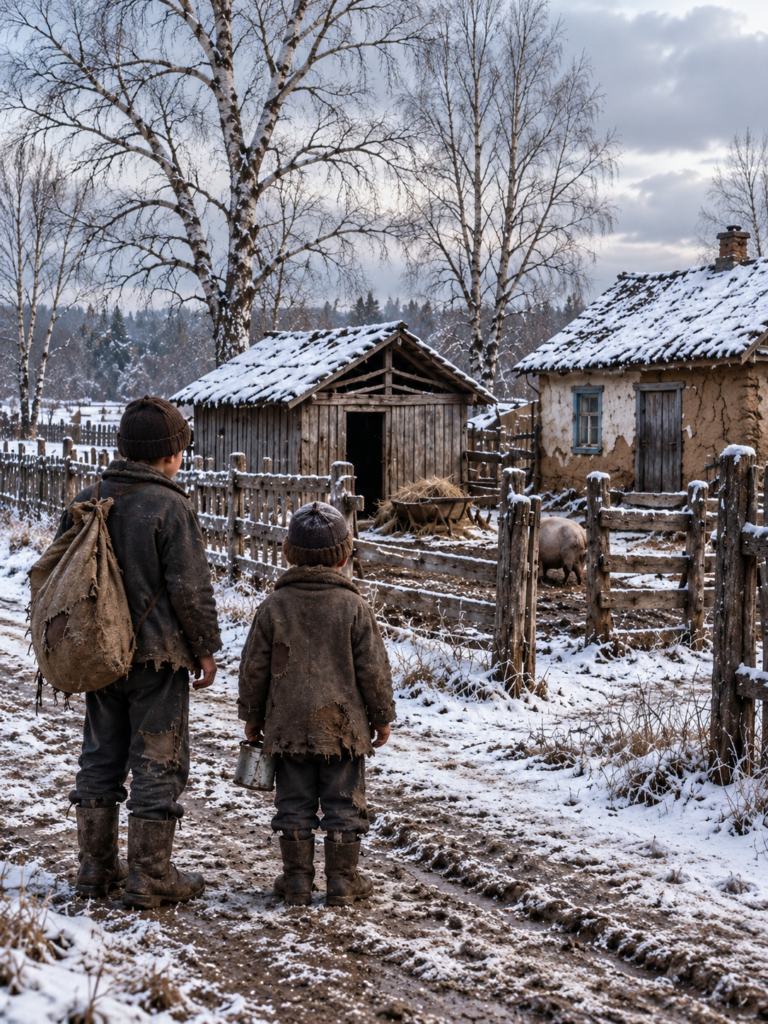
Part 1
The last thing ten-year-old Ivan Morozov saw was the back of his uncle’s pickup truck disappearing into a cloud of red Missouri dust.
He stood motionless beside the deserted county road, holding his eight-year-old brother’s hand so tightly that his fingers hurt.
Their uncle had promised to return.
He had told them to walk toward the next crossroads, where somebody would help them.
But the road stretched through miles of empty pasture, abandoned fences, and thick woods. There was no crossroads in sight.
“Vanya?” Misha whispered.
Ivan looked down at his little brother.
“Yeah?”
“Is Uncle Ray coming back?”
Ivan wanted to say yes.
He wanted to tell Misha that grown-ups didn’t abandon children in the middle of nowhere, that family meant something, and that somebody would eventually come looking for them.
But he had watched their uncle avoid looking into their eyes before driving away.
He remembered the way Ray had hurried them out of the truck, set their little cloth bag on the ground, and muttered that he had other matters to take care of.
Ivan was only ten, but he understood what cowardice looked like.
“I don’t know,” he answered.
Misha’s bottom lip trembled.
Ivan quickly added, “But we’ve got each other. Come on.”
He picked up their bag and started walking.
The bag contained two shirts, a pair of socks, their mother’s old photograph, and one piece of bread.
That was everything they owned.
Three months earlier, they had still been a family.
Their father, Sergei, worked wherever he could find paying jobs—repairing tractors, mending fences, hauling hay, and helping neighboring farmers during harvest.
Their mother, Nora, kept a small vegetable garden behind their rented farmhouse. She could turn a handful of potatoes and an onion into a supper that somehow seemed enough for everyone.
They weren’t wealthy.
Some winters, their father patched the same pair of boots three times because buying new ones meant postponing a heating bill.
Some evenings, their mother stretched soup with water and pretended she wasn’t hungry.
But there had always been warmth inside their little home.
There had been their father’s laughter, their mother’s humming, and the smell of biscuits coming out of the oven on Sunday mornings.
Then their father became sick.
At first, everyone thought it was a stubborn respiratory infection. Sergei kept working despite the fever, insisting that the family couldn’t afford for him to miss another week.
By the time he agreed to go to the hospital, the infection had become severe pneumonia.
He died twelve days later.
Their mother tried to remain strong.
She cooked, washed clothes, and helped the boys with schoolwork, though Ivan sometimes found her crying silently beside the kitchen window.
Then she grew sick herself.
Her health had already been poor, and grief seemed to drain whatever strength she had left.
Ivan remembered standing beside her hospital bed while she brushed his hair away from his forehead.
“Look after your brother,” she whispered.
“I will, Mama.”
“But remember something else.”
He leaned closer.
“You deserve looking after, too.”
He hadn’t understood why she said that.
Three weeks later, she was gone.
The funeral was held on a cold March afternoon.
Neighbors brought casseroles, church ladies offered condolences, and distant relatives gathered in the small rented house.
Everyone said the boys were brave.
Everyone said their parents had been good people.
But when the question arose of who would take responsibility for the children, the room grew strangely quiet.
“We haven’t got the space,” one relative said.
“My husband just lost his job,” said another.
“Two boys are a lot to take on.”
Ivan heard every word.
He sat on the staircase with Misha asleep against his shoulder, hoping someone would finally say they could come home with them.
Nobody did.
Uncle Ray, a cousin of their mother whom the boys had always called uncle, eventually announced that he knew relatives who might help.
He would take the boys to them.
The adults appeared relieved.
Ivan was relieved, too.
But Ray never intended to complete that journey.
He had debts of his own, a troubled marriage, and no patience for two grieving children.
After several hours of driving, he stopped on an isolated road, gave Ivan the bag, and told them there were houses farther ahead.
Then he left.
By early afternoon, the sun had become merciless.
Dust stuck to their ankles. Grasshoppers scattered beneath their shoes.
Misha began stumbling.
“My feet hurt.”
“We’ll rest soon.”
“How soon?”
Ivan looked ahead.
He had no idea.
Another mile passed.
At last, they found a large oak tree beside a dry ditch.
Ivan guided his brother into the shade.
He opened their bag and took out the bread.
It was hard around the edges and beginning to crumble.
He broke it into two pieces, giving Misha the larger one.
“Aren’t you hungry?” Misha asked.
“I ate earlier.”
It was a lie.
Ivan’s stomach had been aching since morning.
But watching his brother eat made the hunger easier to bear.
Misha chewed slowly, saving the last little corner.
“Vanya?”
“Yeah?”
“When we find another house, do you think they’ll let us stay together?”
Ivan looked away.
He remembered the whispered conversations after the funeral.
Some relatives had suggested splitting them up because finding separate homes might be easier.
Ivan had heard Misha crying that night.
He turned back and placed a hand on his brother’s shoulder.
“Nobody’s separating us.”
He said it firmly, although he possessed neither the age nor the authority to guarantee it.
For several minutes, they sat beneath the oak tree.
Then something beyond the roadside caught Ivan’s attention.
Between the trees, half hidden by blackberry bushes, stood a weathered wooden fence.
Beyond it, he could make out the roof of an old farmhouse.
He stood.
“Misha, come here.”
His brother hurried to his side.
“What’s that?”
“Looks like a farm.”
“Are there people?”
“Maybe.”
They left the road and pushed through the grass.
As they approached, the place slowly revealed itself.
The fence was broken in several places. Tall weeds surrounded a sagging barn. The farmhouse had peeling white paint, crooked shutters, and a porch that seemed ready to collapse.
But there was movement in the yard.
Misha stopped.
“Pigs!”
Five of them wandered through a muddy enclosure near the barn.
They were thin, dirty, and hungry-looking, but very much alive.
One lifted its head and grunted when it saw the boys.
Ivan studied the property.
There was no truck.
No smoke coming from the chimney.
No sound of anybody working.
The place looked forgotten.
Misha tugged his sleeve.
“Vanya, maybe the people here have something to eat.”
“Maybe.”
They approached the house cautiously.
Ivan knocked.
Nobody answered.
He knocked again, louder.
The only response was a faint creak as the wind moved a loose shutter.
He pushed the door.
It opened.
Inside stood an old table, two mismatched chairs, a rusted woodstove, and a cupboard hanging crookedly from the wall.
Dust covered everything.
Sunlight filtered through a cracked window, illuminating cobwebs across the ceiling.
Misha stepped inside.
“Nobody lives here.”
“Doesn’t look like it.”
“Can we stay?”
Ivan looked around.
Their father had taught him never to enter somebody else’s property without permission.
But their father had also taught him that a man must protect his family.
Ivan was not a man.
He was a frightened little boy with an empty stomach.
Yet Misha was looking at him as though he held all the answers in the world.
“Just for tonight,” Ivan said.
Misha smiled for the first time that day.
“Then we have a house?”
Ivan swallowed.
“We have somewhere to sleep.”
Outside, a pig grunted against the fence.
And inside that forgotten farmhouse, two brothers who had lost everything began their first night alone.
Neither knew that the property belonged to a man who had sworn never to return.
Or that the five hungry pigs outside would eventually become the reason he did.
Part 2
The first night was colder than Ivan expected.
By sunset, the warmth had disappeared from the Ozark hills, leaving a damp chill that crept through the gaps in the farmhouse walls.
Ivan found an old blanket in a cupboard.
It smelled of dust and mice, but after shaking it outside, he folded it around Misha’s shoulders.
“What about you?” Misha asked.
“I’m fine.”
“You’re shaking.”
“Just tired.”
Misha pulled back one side of the blanket.
“We can share.”
They lay beside each other on the wooden floor, using their clothes bag as a pillow.
The wind whistled through the broken window.
Somewhere outside, a loose piece of roofing rattled.
Every unexpected noise made Misha flinch.
“Is somebody coming?”
“No.”
“How do you know?”
Ivan listened.
Beyond the house, the pigs were moving around their enclosure.
“Because that’s just the animals.”
“Can pigs come inside?”
“Not if we shut the door.”
He stood, pushed the door closed, and wedged a chair beneath its handle.
Then he returned to his brother.
For a while, neither spoke.
Finally, Misha whispered, “I miss Mama.”
Ivan closed his eyes.
He had been trying not to think about her.
“I know.”
“She always said goodnight.”
“I remember.”
“And she’d kiss us right here.”
Misha touched his forehead.
Ivan leaned toward him and kissed the same spot.
“Goodnight, Mish.”
His brother pressed closer.
“Goodnight, Vanya.”
Ivan stayed awake long after Misha fell asleep.
He remembered his mother’s last words.
You deserve looking after, too.
But nobody was looking after him now.
Before dawn, he finally slept.
Morning brought hunger.
The boys woke to the sound of pigs squealing outside.
Misha sat up, rubbing his eyes.
For one confused moment, he looked around as if he expected to find their mother’s kitchen.
Then his expression changed.
“We’re still here.”
“Yeah.”
Ivan opened the door.
Morning mist hung above the surrounding fields.
The farmhouse stood on several neglected acres bordered by trees and a narrow creek.
Beyond the barn was a collapsed shed, a small orchard, and what appeared to be an old vegetable garden.
He noticed something else.
The pigs had gathered around an empty feeding trough.
One was pushing its snout against the wooden fence.
“They’re hungry,” Misha said.
“So are we.”
They explored the house first.
Most cupboards were empty.
But in a lower pantry, Ivan discovered several sealed cans of beans, an unopened bag of rice inside a metal tin, and two jars of preserved peaches.
He stared at them.
“Look!”
Misha hurried over.
“Food?”
“Food.”
Their excitement quickly gave way to another problem.
The electric stove didn’t work.
Neither did the light switches.
Ivan found an old manual can opener in a kitchen drawer.
He carefully inspected a can, rejecting the ones that appeared damaged.
The undamaged beans were cold, but they tasted better than anything he could remember eating.
They shared one can and saved the rest.
Then they went looking for water.
Behind the farmhouse stood an old hand pump.
Ivan tried the handle.
It moved stiffly, producing only a rusty groan.
After several attempts, a little muddy water splashed from the spout.
Misha raised his hands excitedly.
But Ivan stopped him.
“Don’t drink that.”
“Why?”
“Because we don’t know if it’s clean.”
Their father had been particular about well water.
Ivan remembered him explaining that old wells could become contaminated if nobody maintained them.
Farther down the slope, they found a small creek.
The water looked clear, but Ivan knew appearance was no guarantee of safety.
They gathered what they could in clean containers and boiled it on the woodstove after Ivan managed to build a cautious little fire with dry kindling.
The effort took most of the morning.
But eventually they had drinking water.
That afternoon, they explored the barn.
Inside were rusted tools, broken crates, a cracked wheelbarrow, and several partially filled sacks of old livestock feed.
Misha pointed toward them.
“Can the pigs eat that?”
“Maybe some of it.”
Ivan examined the sacks, setting aside the damp and moldy ones.
Their father had warned him never to feed spoiled grain to livestock.
One sealed container held dry feed that still appeared usable.
Ivan carried a little to the enclosure.
The pigs immediately crowded toward him.
“Easy!” he cried.
Misha laughed.
For a few wonderful seconds, the sound filled the yard.
Ivan had nearly forgotten what his brother’s laughter sounded like.
They worked until their arms ached.
The feeding trough needed cleaning.
Part of the fence had fallen inward.
The pigs’ water container was tipped over, and the enclosure gate barely stayed closed.
Ivan found a hammer in the shed.
It had a cracked wooden handle, but it still worked.
He gathered loose boards, straightened bent nails where possible, and began repairing the gate.
Misha held boards in place.
Sometimes the hammer missed.
Sometimes the wood split.
Once, Ivan struck his thumb so hard that tears sprang into his eyes.
He turned away before Misha could see them.
“Are you hurt?”
“No.”
“Your hand’s bleeding.”
“It’s just a little cut.”
Misha disappeared into the house and returned carrying a piece of cloth.
“Mama used to wrap things.”
He gently tied it around Ivan’s hand.
Ivan stared at the little knot.
Their mother used to make knots exactly like that.
“Thanks, Mish.”
By evening, they had managed to secure the gate.
It wasn’t pretty.
But it held.
Over the next several days, the boys established a routine.
Ivan woke first.
He checked the animals, carried water, and inspected the fences.
Misha gathered fallen apples from the orchard and helped sort the remaining feed.
They ate sparingly, supplementing their dwindling pantry supplies with food they could identify safely from the property.
They found late-season potatoes beneath a layer of weeds in the old garden, along with a few onions and several squash that had survived neglect.
The discoveries made them feel rich.
But their hunger never completely disappeared.
There were days when Ivan gave Misha the larger portion and pretended he’d already eaten.
Other days, Misha quietly divided his food in half and refused to finish unless Ivan ate too.
They became skilled at recognizing each other’s lies.
One afternoon, Misha discovered a small wooden box beneath the farmhouse table.
Inside were old photographs, a broken pocket watch, and a notebook.
The pictures showed a gray-haired man standing proudly beside the barn.
In one photograph, the property looked entirely different.
The fences were straight.
The farmhouse was freshly painted.
A vegetable garden stretched behind the house.
Several large pigs stood beside a clean feeding trough.
Misha stared.
“This used to be beautiful.”
Ivan took the picture.
“Yeah.”
“Can we make it look like that again?”
Ivan looked through the window.
Weeds covered the yard. A section of the barn roof had collapsed. Everything seemed impossibly large.
“We can try.”
Misha considered that.
“Papa always said broken things weren’t always finished things.”
Ivan smiled faintly.
Their father had said that whenever he repaired an old tractor or fixed something their mother wanted to throw away.
“That’s right.”
That night, Ivan opened the notebook.
Most pages were filled with handwritten farm records—feed purchases, fence repairs, breeding dates, and expenses.
The last entries were several months old.
On one page, the handwriting became shakier.
The final sentence read:
The place is getting away from me, but I can’t bear to let it go.
There was no signature.
Ivan stared at the words.
He understood them more than he wanted to.
The farm had been losing its battle against time.
And someone had loved it enough to care.
He closed the notebook and placed it beside their mother’s photograph.
Outside, the animals settled beneath the darkening sky.
For the first time since Uncle Ray abandoned them, Ivan wondered whether the farm might offer them something beyond temporary shelter.
Maybe it was possible to stay.
Maybe they could make themselves useful enough that whoever owned the place wouldn’t send them away.
He looked at his sleeping brother.
“We’re going to fix it, Mish,” he whispered.
“I promise.”
But promises were dangerous things.
Ivan had already learned that.
And the farm was about to test his promise in ways no ten-year-old should ever have to face.
Part 3
By the third week, the boys knew every creaking board and crooked fence post on the property.
They knew which section of the porch became slippery after rain.
They knew where the orchard dropped its ripest fruit.
They knew which patches of earth remained damp even during dry weather.
And they knew the five pigs almost as well as they knew each other.
Misha named them.
The largest sow became Daisy.
The smallest was Button.
The others were Rusty, Clover, and Big Red.
Ivan protested at first.
“You don’t name farm animals like pets.”
“Why not?”
“Because farmers don’t.”
“Papa named his favorite rooster.”
Ivan remembered.
The rooster’s name had been General.
He had attacked the mail carrier twice.
“All right,” Ivan conceded. “You can name them.”
Misha grinned.
Soon he was greeting the pigs every morning as though they were neighbors.
“Good morning, Daisy. Morning, Button.”
The animals learned to recognize his voice.
One would often come trotting toward the fence whenever he appeared.
It was a small thing.
But to Misha, who had lost everyone except his brother, being recognized mattered.
The boys continued repairing the farm.
Ivan cleared a narrow path from the house to the barn.
Misha collected stones and arranged them along the edges.
They cleaned the feeding trough and strengthened the pig enclosure.
Ivan used an old hoe to break the hard soil behind the house.
Beneath the weeds, he discovered rows that had once formed a garden.
He remembered his father teaching him to loosen soil without cutting too deeply into the roots.
“Don’t fight the earth,” Sergei used to say. “Learn what it’s trying to tell you.”
Ivan had never paid much attention then.
Now every remembered word felt valuable.
They saved seeds from vegetables and set aside a small patch for planting when the season allowed.
Each evening, Ivan recorded their work in the old farm notebook.
Fixed back gate.
Cleaned hog trough.
Found three good boards.
Daisy eating better.
His handwriting was uneven, with some words misspelled.
But the notebook made their days feel purposeful.
He no longer counted only how much food they had left.
He counted the things they had accomplished.
Still, the work was hard.
Their hands developed blisters.
Their shoes began falling apart.
The last good canned beans disappeared from the pantry.
As the weather turned cooler, Ivan grew increasingly worried about how they would manage if they couldn’t find more food.
They had no money.
No transportation.
No adult to ask for help without risking being separated.
One evening, Misha caught him studying the road.
“Are you thinking about leaving?”
Ivan shook his head.
“Just thinking.”
“About what?”
“How to get enough food.”
Misha looked down.
“We could eat less.”
Ivan turned toward him.
“We’re already eating less.”
“Then we could give the pigs less.”
Ivan watched Daisy moving slowly across the enclosure.
He understood that keeping the animals healthy was essential if the farm was ever going to become useful.
But the boys couldn’t survive on hope alone.
He sat beside Misha on the porch.
“Tomorrow, we need to make a proper plan.”
“A farming plan?”
“A staying-alive plan.”
Misha thought about that.
“Papa would’ve known what to do.”
The words struck Ivan harder than he expected.
He stood abruptly.
“I’m going inside.”
Misha remained on the porch.
Inside, Ivan leaned against the kitchen wall and pressed his fists to his eyes.
He missed his father.
He missed his mother.
He missed being a child who could ask somebody else what to do.
He was tired of pretending he wasn’t frightened.
After several minutes, the door creaked open.
Misha entered quietly.
He didn’t say anything.
He simply wrapped his arms around Ivan’s waist.
Ivan tried to remain still.
Then his face crumpled.
He began crying.
Not loudly.
Not dramatically.
Just the exhausted, helpless crying of a boy who had been strong for too long.
Misha held him.
“It’s okay, Vanya.”
Ivan shook his head.
“No, it isn’t.”
For a long moment, neither brother moved.
Finally, Ivan wiped his face.
“I’m sorry.”
Misha looked confused.
“For what?”
“For crying.”
Misha tightened his arms.
“Mama said crying wasn’t wrong.”
Ivan let out a trembling laugh.
“Yeah. She did.”
The following morning, something happened that shifted their attention away from their own troubles.
Daisy wasn’t eating.
Normally, she hurried toward the trough before the others.
That morning, she remained lying in the far corner of the enclosure.
Ivan called her.
She lifted her head but didn’t get up.
Misha became frightened.
“She’s dying.”
“We don’t know that.”
Ivan approached carefully, keeping the other animals away.
Daisy appeared uncomfortable and exhausted.
Her breathing was heavy.
He remembered that she had been moving differently for several days.
Then he noticed her swollen belly.
He thought of the breeding records in the notebook.
One of the final entries mentioned a sow that had been bred before the previous owner stopped keeping records.
Ivan ran to the house.
He turned the pages, studying the dates.
When he returned, Misha was kneeling outside the fence.
“What’s wrong with her?”
Ivan swallowed.
“I think she might be having babies.”
Misha’s eyes widened.
“Piglets?”
“Maybe.”
They had both seen newborn farm animals before, but never without their father nearby.
Ivan remembered that a sow needed a clean, sheltered space and that frightened animals could become dangerous.
The boys didn’t try to force Daisy to move.
Instead, they prepared the sheltered corner of the enclosure as best they could, replacing wet bedding with clean dry straw from the barn.
They kept fresh water nearby and watched from a safe distance.
By afternoon, Daisy still hadn’t delivered.
The sky darkened.
Clouds gathered above the hills.
Thunder rolled somewhere far away.
Ivan looked toward the farmhouse.
A storm was coming.
And it was coming fast.
The first drops fell just before sunset.
Within minutes, rain hammered the old roof.
Wind swept across the pasture.
The pigs became restless.
Misha stood in the doorway, watching the enclosure.
“Vanya, Daisy’s scared.”
“I know.”
“What if the babies come during the storm?”
Ivan tightened his grip on the flashlight he’d found in the kitchen drawer.
“Then we’ll have to keep an eye on her.”
They remained near the house as the storm intensified.
Water poured from the gutters.
Lightning illuminated the barn.
At one point, an enormous crack echoed across the yard.
A dead branch had fallen onto the outer fence.
Ivan’s heart jumped.
He waited for the thunder to pass before shining the flashlight toward the enclosure.
Part of the fence had shifted.
One of the pigs was already investigating the opening.
If the animals escaped into the woods, the brothers might never recover them.
But the lightning and falling branches made going outside dangerous.
Ivan forced himself to remain inside until the worst of the storm moved away.
Misha pressed his face against the window.
“Please don’t let them go.”
The boys watched helplessly.
Then, as the rain weakened, Ivan pulled on his shoes.
“Stay in the doorway.”
“You’re going out?”
“The fence.”
“Be careful.”
Ivan hurried through the wet grass.
The ground was muddy, and every step threatened to send him sprawling.
He reached the damaged section and pushed the loose board back into place.
Using a length of wire from the shed, he secured it temporarily.
The pigs retreated toward their shelter.
Then Ivan heard a faint squealing sound.
It was smaller and sharper than the grunts he had grown accustomed to.
He turned.
Daisy lay beneath the shelter.
Beside her, something tiny moved in the straw.
Ivan stood motionless.
Then he called toward the house.
“Misha!”
His brother appeared in the doorway.
“What?”
“Come look! But stay outside the fence!”
Misha hurried down the path.
A tiny piglet struggled to its feet beside Daisy.
Then another appeared.
Both were wet, trembling, and astonishingly small.
Misha covered his mouth.
“She had babies!”
Ivan nodded.
For the first time all evening, he smiled.
The boys watched from outside the enclosure as Daisy settled and the piglets began nursing.
The storm had damaged the farm.
Their food was running low.
The roof still leaked.
They still didn’t know whether anyone would let them stay.
But two new lives had arrived in the middle of it all.
Misha leaned against his brother.
“Do you think Mama can see them?”
Ivan looked toward the clearing sky.
“I don’t know.”
“I hope she can.”
Ivan put an arm around his shoulders.
“Me too.”
Then Misha said something Ivan would remember for the rest of his life.
“Maybe this farm was lonely before we came.”
Ivan looked around at the broken fences, the wet barn, and the battered farmhouse.
“Maybe.”
“And maybe we were lonely, too.”
Ivan held him closer.
The following morning, he wrote a new entry in the notebook.
Daisy had two babies after the storm.
Beneath it, he added:
We are still here.
He didn’t know it yet, but someone else would eventually read those words.
And when that person did, the future of the farm would change.
Part 4
Autumn settled slowly over the Missouri countryside.
The trees along the creek turned yellow and rust-colored.
Cool mornings gave way to warmer afternoons, but the nights grew increasingly cold.
The two piglets became stronger.
Misha named them Hope and Lucky.
Ivan pretended the names were silly, though he secretly liked them.
Every morning, Misha checked on the piglets before doing anything else.
He had learned to tell them apart by the little white marking above Hope’s eye.
Sometimes he sat outside the enclosure, talking to them about ordinary things.
He told them about their old school.
He told them about their mother’s cooking.
He told them how their father once built a wooden wagon that broke apart the first time they tried pulling it downhill.
Ivan often overheard these conversations while repairing something nearby.
He never interrupted.
He understood that Misha wasn’t really talking to the pigs.
He was trying to keep their old life alive.
The farmhouse had begun to change.
The floor was cleaner.
Loose boards had been secured.
Ivan had patched the worst roof leaks with materials he found in the barn, although the damaged roof still needed proper repair.
Misha hung their mother’s photograph above the kitchen table.
Every evening, they ate beneath it.
There wasn’t always much food.
Sometimes supper consisted of boiled potatoes and a little onion.
Sometimes they shared the last of the preserved fruit.
But Misha had begun calling the kitchen “our kitchen.”
And Ivan had stopped correcting him.
One afternoon, the brothers discovered a rusted metal sign behind the barn.
Most of the lettering had faded, but one word remained clear.
Whitcomb.
Ivan carried it into the house.
He searched the old notebook.
There, written on the inside cover, was the name Samuel Whitcomb.
“That must’ve been the farmer,” Ivan said.
Misha examined the sign.
“Where is he now?”
“I don’t know.”
“Do you think he’s dead?”
Ivan glanced at the empty chair beside the kitchen table.
“Maybe.”
“Then who’s going to tell us if we can stay?”
Ivan had no answer.
The question troubled him for days.
He had begun to love the farm.
That made the uncertainty worse.
At first, the property had been just a roof.
Now it held their routines, their work, and the little signs of life they had helped restore.
Losing it would feel like losing another family.
One evening, Ivan sat on the porch studying the notebook.
Misha came outside carrying their mother’s photograph.
“Why’d you take that down?” Ivan asked.
“Just cleaning.”
He set it beside his brother.
For a long while, they watched the sunset.
Then Misha asked, “Do you think Uncle Ray forgot us?”
Ivan stared across the field.
“No.”
“Then why didn’t he come back?”
Ivan considered lying.
He could say Ray had gotten lost.
He could say there had been an accident.
But Misha had already been hurt by too many false promises.
“Because he didn’t want to take care of us.”
Misha’s eyes filled.
“Did we do something wrong?”
Ivan turned sharply.
“No.”
“Maybe we were too much trouble.”
“No, Misha.”
“But everybody kept saying two kids were hard to take care of.”
Ivan placed both hands on his brother’s shoulders.
“Listen to me. Mama and Papa loved us. They worked hard for us every day. That wasn’t because we were trouble. It was because we were their boys.”
Misha looked down.
“Then why couldn’t anybody else love us?”
Ivan felt the question settle inside him.
He wished he had an answer.
Instead, he drew Misha close.
“I love you.”
“I know.”
“And I won’t leave.”
Misha hugged him.
That night, Ivan made a decision.
If the owner ever appeared, he would tell the truth.
He would explain what happened.
He would show everything they’d repaired.
He wouldn’t steal or pretend the land belonged to them.
And if the owner told them to leave, he would ask for help finding somewhere they could remain together.
It was the bravest promise he could make.
Three days later, another storm swept through the valley.
This one came with a fierce wind that bent trees and tore loose branches from the orchard.
The boys were inside when a loud crash came from the barn.
Ivan grabbed the flashlight.
Misha followed him to the doorway.
A section of the roof had peeled back, exposing the hay below.
Rain blew through the opening.
The animals were frightened.
But the greater danger lay along the back fence.
A falling limb had destroyed several boards.
The pigs crowded toward the opening.
Ivan couldn’t repair it while the wind was still dangerous, so he watched anxiously through the window until the storm weakened.
When he finally ventured out, he discovered that Button, the smallest pig, had escaped.
Misha immediately started searching.
“Button! Button!”
“Don’t go into the woods,” Ivan warned.
But the pig had disappeared beyond the broken fence.
As the rain diminished, Ivan followed the hoofprints toward the orchard, keeping Misha close.
They found Button trapped in a shallow drainage ditch.
Mud had collected around the animal’s legs.
The pig squealed and struggled.
Ivan knew they couldn’t safely pull a frightened animal out with their bare hands.
He found a wide board and positioned it to create a gradual slope.
Then the brothers backed away, coaxing Button toward the opening with a little feed.
It took nearly half an hour.
At last, Button scrambled up the makeshift ramp and hurried toward the barn.
Misha cheered.
Ivan laughed in relief.
But their victory was short-lived.
When they returned to the house, they discovered water spreading across the kitchen floor.
The roof above the stove had developed a serious leak.
Their sleeping blanket was soaked.
The bag of rice had gotten wet.
Several jars had fallen from the cupboard.
For the first time, Ivan looked around the room and wondered whether the farm was becoming too much for them.
They had repaired one thing only to watch another break.
Every storm erased days of work.
Every meal consumed supplies they couldn’t easily replace.
And winter was approaching.
Misha stood beside the kitchen table, staring at the water.
“What are we going to do?”
Ivan rubbed his forehead.
He couldn’t tell his brother that everything would be fine.
He no longer believed words alone could make things better.
“We’ll clean up first.”
They spent the next hours moving belongings away from the leaks, collecting water in buckets, and finding the driest corner of the house.
By midnight, they were exhausted.
Misha fell asleep wrapped in his coat.
Ivan sat beside the cold stove, holding his mother’s photograph.
The glass frame had cracked during the storm.
He traced the picture with his thumb.
“I tried, Mama,” he whispered.
His voice shook.
“I really tried.”
He looked toward his sleeping brother.
“I don’t know how much longer I can do this.”
No answer came.
Only the dripping water.
The next morning, however, Ivan got up.
He checked the pigs.
He carried water.
He moved the remaining dry feed under shelter.
And he opened the notebook.
His hand trembled as he wrote:
Storm broke barn roof and fence. Button got out. We got him back.
Then he paused.
At the bottom of the page, he added:
Papa said you don’t leave a job half-finished just because it’s hard.
He closed the notebook.
A few hours later, the brothers were clearing branches from the front yard when they heard something unfamiliar.
An engine.
Ivan straightened immediately.
A pickup truck was moving slowly along the dirt road.
Misha dropped the branch he was carrying.
“Vanya. Somebody’s coming.”
The truck approached the broken fence.
Its tires rolled through the muddy ruts.
Then it stopped.
For a long moment, nothing happened.
Finally, the driver’s door opened.
A tall man in his late fifties stepped out.
He wore a brown work jacket, weathered jeans, and a faded cap.
His face was lined by years of outdoor work.
He looked toward the farmhouse.
Then the barn.
Then the freshly repaired pig enclosure.
He seemed puzzled.
His eyes settled on the two children standing beside the gate.
“Well, I’ll be…”
Ivan instinctively moved in front of Misha.
The man approached slowly.
“Who are you boys?”
Ivan swallowed.
“My name’s Ivan. That’s my brother, Misha.”
The stranger studied them.
“Are your parents around?”
Neither answered.
The man’s expression changed.
“How long have you been here?”
Ivan looked toward the house.
“Several weeks.”
“Several weeks?”
The man stared at him.
“Are you telling me you’ve been living here by yourselves?”
Ivan nodded.
The stranger removed his cap.
For a moment, he seemed unable to speak.
Then he looked toward the old farmhouse.
“My name’s Walter Whitcomb.”
He pointed toward the property.
“This farm belonged to my uncle.”
Ivan felt his stomach turn.
He knew what was coming.
He had imagined this moment a hundred times.
Misha gripped his hand.
Walter looked over the repaired fence, the cleaned yard, and the animals gathered near the trough.
Then he turned back toward the boys.
“Now somebody had better tell me exactly what’s been going on here.”
Ivan took a breath.
And for the first time since that terrible afternoon on the road, he began telling an adult the truth.
Part 5
Walter Whitcomb listened without interrupting.
Ivan told him about their parents.
About the hospital.
About the funeral.
About Uncle Ray putting them out of his truck and driving away.
He explained how they had walked until Misha couldn’t go farther.
How they had seen the broken fence through the trees.
How they had entered the farmhouse because they had nowhere else to sleep.
When he finished, Walter remained silent.
The old man’s gaze moved from Ivan’s worn shoes to Misha’s oversized coat.
Both boys were thinner than children their age should have been.
Their hands were rough and scratched.
Their clothes had been washed so many times that the fabric had begun wearing thin.
Walter had spent most of his life around difficult people.
He had seen grown men lie about debts, property, and money.
But the boy standing in front of him wasn’t asking for money.
He was asking not to be thrown back onto the road.
“Where’s this Uncle Ray now?” Walter asked.
“I don’t know, sir.”
“Did he know where he left you?”
Ivan nodded.
“He told us to wait. Then he drove away.”
Walter looked toward his truck.
His jaw tightened.
“That’s a mighty sorry thing to do.”
Ivan lowered his eyes.
“We didn’t mean to trespass.”
Walter looked back at him.
“What?”
“We didn’t know this was your property.”
The boy’s voice began trembling.
“We cleaned the house. And fixed some fences. We took care of the pigs. We didn’t sell anything.”
Walter stared at him.
Ivan hurried on.
“We can leave if we have to. But please…”
He stopped.
Misha was standing so close that their shoulders touched.
“Please don’t make us go separately.”
Walter removed his cap again.
He had come to the property that morning intending to make a final decision about selling it.
His Uncle Samuel had died the previous year.
The old man had spent the final months of his life alone, too stubborn to accept help and too proud to admit that maintaining the farm had become impossible.
Walter had promised to visit more often.
He hadn’t kept that promise.
His own life had been unraveling.
His wife had died five years earlier.
His grown son lived several states away.
The old farm reminded him of too many unfinished conversations and too many chances he had wasted.
When Samuel died, Walter inherited the property.
He came once, shortly after the funeral.
Everything needed repairs.
The bills exceeded what the farm could earn.
A neighbor who had occasionally checked the livestock had moved away, and Walter assumed the remaining animals had been removed or would have wandered off.
He locked what doors he could, drove away, and told himself he’d return when he had time.
Months passed.
He never did.
Until now.
Walter looked around.
The front yard had been cleared.
The pig enclosure had been strengthened with mismatched boards.
Someone had arranged stones beside the path.
There were vegetables growing near the house.
And seven pigs, including two healthy young piglets, moved beneath the shelter.
He turned toward Ivan.
“All this work. You boys did it?”
“Yes, sir.”
“Just the two of you?”
Ivan nodded.
Walter walked toward the enclosure.
The repairs were rough.
Some boards were crooked.
The gate needed stronger hinges.
But the fence was standing.
The animals had water.
The enclosure was cleaner than he remembered.
He looked at the little vegetable patch.
“You planted that?”
“We found the old garden. Some things were already growing. We tried to save what we could.”
Walter crouched beside a row of young plants.
The soil had been turned by hand.
There were small footprints between the rows.
He slowly stood.
“My uncle would’ve liked this.”
Ivan glanced toward him.
“Mr. Samuel?”
Walter turned sharply.
“How’d you know his name?”
“His notebook.”
“The old farm ledger?”
Ivan nodded.
“We found it in the house.”
Walter followed the boys inside.
As he crossed the threshold, he stopped.
The farmhouse had been neglected, but it was no longer simply abandoned.
The floors had been swept.
Old tools were stacked neatly near the kitchen wall.
A few rescued jars stood on the shelf.
At the table sat the notebook.
Beside it was a photograph of a smiling woman.
Walter pointed toward it.
“Who’s that?”
“Our mama,” Misha said.
Walter studied the picture.
“She looks kind.”
“She was.”
Ivan picked up the notebook and offered it.
“We wrote in it. I hope that’s all right.”
Walter opened the cover.
He recognized his uncle’s handwriting immediately.
For several pages, Samuel had recorded ordinary farm matters.
Feed purchases.
Fence repairs.
Veterinary expenses.
Then the handwriting ended.
A few pages later, a child’s uneven letters began.
Walter read slowly.
Fixed back gate.
Cleaned hog trough.
Found three good boards.
Daisy eating better.
He turned another page.
Daisy had two babies after the storm.
And beneath it:
We are still here.
Walter felt something tighten in his chest.
He turned more pages.
There were notes about rain, leaking roofs, and food.
There were simple records of ordinary work performed by two children who should have been sitting in classrooms instead of struggling to survive.
At the bottom of the most recent page, he found another sentence.
Papa said you don’t leave a job half-finished just because it’s hard.
Walter stared at the words.
His uncle had said something almost identical when Walter was a boy.
Years ago, Walter had helped Samuel repair a tractor in this very yard.
After several frustrating hours, Walter had thrown down a wrench and announced that the machine was worthless.
Samuel had quietly handed him the wrench.
“Hard doesn’t mean finished,” he’d said.
Walter remembered it now as clearly as if the old man were standing beside him.
He closed the notebook.
“Your father sounds like he was a good man.”
Ivan nodded.
“He was.”
Walter looked around the kitchen.
“I knew one like that.”
For a while, nobody spoke.
Then Walter reached into his jacket and took out his phone.
Ivan’s heart began pounding.
“Are you calling the police?”
Walter looked at him.
“I’m calling people who can help.”
Misha began crying.
“They’ll take us away.”
Walter crouched so he was level with the boys.
“Listen to me. You two aren’t in trouble. But children shouldn’t have to live out here alone. You need proper food, doctors, school, and somebody responsible for keeping you safe.”
Ivan moved closer to Misha.
“Will they split us up?”
Walter paused.
He knew better than to promise something he didn’t control.
“I’m going to tell them how important it is that you stay together. And I’m going to do everything I can to help make that happen.”
Ivan studied his face.
There was something different about Walter’s words.
He wasn’t telling them everything would magically be fine.
He was telling them what he intended to do.
Walter made several calls.
He contacted the county authorities, explained that he had found two missing children, and asked for immediate assistance.
Then he called Mrs. Ruth Talley, a retired schoolteacher who lived several miles away.
Ruth had known Samuel for years.
She had also provided temporary care for children through county-approved arrangements.
When Walter told her what had happened, she was quiet for a moment.
Then she said, “Keep those boys warm. I’m bringing food.”
She arrived less than an hour later carrying a basket of sandwiches, fresh fruit, milk, and homemade chicken soup.
Misha stared at the food.
Ruth noticed.
She didn’t ask why he was so hungry.
She simply placed the basket on the table.
“Would you boys like some lunch?”
Ivan nodded.
Then, before eating, he carefully moved two sandwiches aside.
Ruth watched him.
“Saving those for later?”
Ivan looked embarrassed.
“Just in case.”
Her expression softened.
“There’s plenty more where that came from, sweetheart.”
He didn’t answer.
But he left the sandwiches on the table.
It would take time before he could believe that food didn’t always have to be rationed.
The next several days brought changes the brothers hadn’t expected.
A county worker helped arrange medical checks and temporary care while the authorities worked to establish what had happened after their parents’ deaths.
Ruth agreed to provide an approved temporary home where both boys could remain together.
Ivan resisted at first.
He didn’t want to leave the farm.
He didn’t want the pigs to go hungry.
Most of all, he didn’t want another adult making promises that might disappear.
Walter understood.
He took Ivan outside and stood beside the enclosure.
“I’ll look after them.”
Ivan studied him.
“Every day?”
“Every day.”
“What if you get busy?”
Walter glanced toward the farmhouse.
“Then I’ll make time.”
Ivan looked down.
“Uncle Ray said he’d come back.”
Walter was silent.
Then he said, “I know.”
He didn’t offer another easy promise.
Instead, the following morning, he arrived at Ruth’s house carrying the farm notebook.
He showed Ivan the day’s entry.
Fed Daisy and the others. Fixed water trough. Piglets doing fine.
Ivan examined it.
Walter had written beneath his own note:
I’ll be back tomorrow.
And he was.
He returned the following day.
And the next.
And the next.
Sometimes he brought photographs of the pigs.
Sometimes he brought vegetables harvested from the garden.
Sometimes he took the boys, with Ruth’s permission, to visit the farm and help with small, age-appropriate chores.
Slowly, Ivan began trusting him.
Walter also began changing.
For years, he had allowed grief and regret to make his world smaller.
He had avoided the farm because it reminded him of his uncle.
He had avoided his son’s phone calls because their conversations were uncomfortable.
He had convinced himself that being alone was easier than risking another loss.
But now two boys were waiting to see whether he would keep his word.
And keeping it gave his days purpose.
He hired a carpenter to repair the farmhouse roof.
He replaced the dangerous wiring.
He had the well inspected and properly serviced.
He contacted a veterinarian to examine the pigs.
He repaired the barn and purchased appropriate feed.
The work wasn’t cheap.
Walter had planned to sell the property to cover some of his expenses.
But every time he stood in the yard and looked at the boys’ crooked little fence, he found it harder to imagine handing the place to strangers.
Several weeks later, the county worker informed him that Uncle Ray had been located.
Ray initially claimed he’d delivered the children to relatives.
His story fell apart when investigators compared it with the boys’ account and other evidence.
The case was referred for further action.
When Ivan heard, he became quiet.
Walter sat beside him on Ruth’s porch.
“Want to talk about it?”
Ivan shook his head.
After several minutes, he asked, “Do you think he’ll say he’s sorry?”
Walter considered the question.
“He might.”
“Would that make it better?”
“No,” Walter answered gently. “Not by itself.”
Ivan looked toward the road.
“I used to think if he came back, everything would be okay.”
“And now?”
Ivan was silent.
Then he said, “Now I think I just wanted somebody to come back.”
Walter placed a hand on his shoulder.
“I can understand that.”
As autumn gave way to winter, Walter began working with the appropriate agencies to become a long-term caregiver for the boys.
There were interviews.
Background checks.
Home inspections.
Conversations about finances, schooling, and the responsibility involved in raising two children.
Walter didn’t pretend the process was simple.
He had to make adjustments.
He prepared bedrooms in the renovated farmhouse.
He arranged reliable transportation to school.
He promised Ruth that he would ask for help when he needed it rather than try to manage everything alone.
Most importantly, he told the boys what was happening at every stage.
He didn’t want them to feel that their future was being decided in whispered conversations behind closed doors.
Months passed before the necessary arrangements were approved.
During that time, the boys continued staying with Ruth, attending school, and visiting the farm regularly.
They grew healthier.
Misha gained weight.
Ivan’s face lost some of its permanent tension.
And on a bright spring morning, the final arrangements were completed.
The brothers could live together at the farm with Walter responsible for their care.
When Walter told them, Misha shouted so loudly that Ruth came running from the kitchen.
“Are we going home?” he cried.
Walter smiled.
“If you still want to.”
Misha threw his arms around him.
Ivan stood still.
Walter looked toward the older boy.
“How about you?”
Ivan’s eyes filled.
He tried to speak, but nothing came out.
Finally, he nodded.
“Yes, sir.”
Walter opened his arms.
And Ivan, who had spent so long trying to be strong enough for two people, stepped forward.
He let himself be hugged.
That afternoon, Walter drove the brothers back along the same winding country roads where their ordeal had begun.
But everything looked different.
The trees were green.
Wildflowers covered the roadside.
The old farmhouse stood beneath a clear blue sky, its repaired roof shining in the sunlight.
The fence was straight.
The garden was planted.
The barn had been painted.
And the pigs were waiting.
Misha jumped from the truck as soon as Walter parked.
“Daisy!”
The sow grunted from her enclosure.
Hope and Lucky, now much larger, trotted after her.
Misha laughed and ran toward the fence.
Ivan followed more slowly.
He stood in the yard, taking in the changes.
The house looked almost like the photograph they had found months earlier.
Walter approached him.
“Well?”
Ivan smiled.
“It’s beautiful.”
“Your work started it.”
Ivan shook his head.
“You did all this.”
Walter looked toward the old repaired gate.
“Maybe. But I wouldn’t have come back if you hadn’t.”
He led Ivan toward the farmhouse.
Inside, the kitchen table had been refinished.
New curtains hung beside the windows.
The stove worked.
The cupboards held food.
On the wall was the photograph of Ivan and Misha’s parents.
Beside it hung a second picture.
Samuel Whitcomb stood proudly in front of the barn, back when the farm had been prosperous.
Below the photographs, Walter had placed a small wooden shelf.
On it rested the old notebook.
Ivan picked it up.
The cover had been cleaned, but Walter had preserved every page.
All the frightened, uneven entries remained.
Ivan opened it to the sentence he’d written after the storm.
We are still here.
He stared at it.
Then he looked toward the kitchen, where Misha was happily telling Walter what he wanted to plant in the garden.
For a moment, Ivan could almost hear his father’s laughter.
He could imagine his mother standing beside the stove, smiling at the sight of her boys together.
He had spent so many nights afraid of forgetting their voices.
Now he understood that remembering them didn’t have to mean living in sorrow.
Their love was still with him.
In the garden his father had taught him to tend.
In the kindness his mother had taught him to show.
In the way he and Misha had refused to abandon each other.
And in the home they had helped bring back to life.
Later that evening, the three of them sat on the porch watching the sun settle behind the hills.
Walter had brought out lemonade.
Misha rested against his brother’s shoulder.
“Vanya?”
“Yeah?”
“Do you remember the day we found this place?”
Ivan nodded.
“How could I forget?”
“I thought it was the ugliest house I’d ever seen.”
Walter chuckled.
“Wasn’t far from it.”
Misha grinned.
“But I liked it anyway.”
“Why?” Walter asked.
The little boy considered that.
“Because it had walls. And a roof. And pigs.”
Walter laughed softly.
Misha looked toward the yard.
“And because Vanya said we’d be okay.”
Ivan lowered his eyes.
“I didn’t know if we would.”
“I know,” Misha answered.
Ivan looked at him.
“You knew?”
Misha nodded.
“You were scared, too.”
For a moment, Ivan couldn’t speak.
Then Misha took his hand.
“But you stayed.”
Walter watched them quietly.
He thought of all the times he’d told himself that the farm was beyond saving.
He thought of his uncle dying with unfinished work.
And he thought of two little boys carrying a single bag down a road where nobody had bothered to stop.
He had inherited the farm.
But the boys had given it a future.
As darkness settled over the property, Walter stood and opened the front door.
“Come on, boys. Supper’s ready.”
Misha hurried inside.
Ivan remained on the porch for a moment longer.
He looked toward the fence where they had first entered.
Beyond it lay the dirt road.
The same road where Uncle Ray had abandoned them.
For months, that road had represented everything Ivan feared.
The possibility of being unwanted.
The terror of having nowhere to go.
The sound of an engine disappearing while his little brother asked whether anyone would come back.
But now the road was simply a road.
It no longer decided their future.
Ivan turned toward the warm light spilling from the kitchen.
Walter was setting plates on the table.
Misha was laughing about something.
The smell of fresh bread drifted through the doorway.
And for the first time since losing his parents, Ivan felt no need to count how much food remained or wonder where they would sleep tomorrow.
He walked inside.
Walter looked up.
“There you are.”
Ivan sat beside his brother.
On the table lay three generous plates and a basket of warm biscuits.
Misha reached for one.
Then stopped.
He looked at Ivan.
“Do we have to save some for tomorrow?”
Walter gently pushed the basket closer.
“No, son.”
His voice was steady.
“There’s more for tomorrow.”
Misha smiled.
Ivan looked at the food, then at the two people beside him.
And finally, he believed it.
Outside, the pigs settled in their clean shelter.
The barn stood firm.
The old farmhouse glowed against the darkness.
The land that had once seemed worthless was alive again.
Not because somebody had discovered buried treasure.
Not because a fortune had suddenly appeared.
But because two abandoned children had believed a broken place deserved another chance, even when the world had stopped giving chances to them.
They had saved seven pigs, repaired a forgotten farm, and held on to one another through hunger, storms, and fear.
In return, they had found something far more valuable than land.
They had found a family willing to stay.
And the old farmhouse, which had spent so many lonely years waiting for somebody to love it again, finally had voices inside its walls.
Two boys had arrived there with almost nothing.
Now they had a place at the table.
A door that opened for them.
And someone who would be there when morning came.
For Ivan and Misha, that was the greatest treasure the old farm could ever have given them.
Cho đến nay, cuộc hội thoại này có hữu ích với bạn không?


