
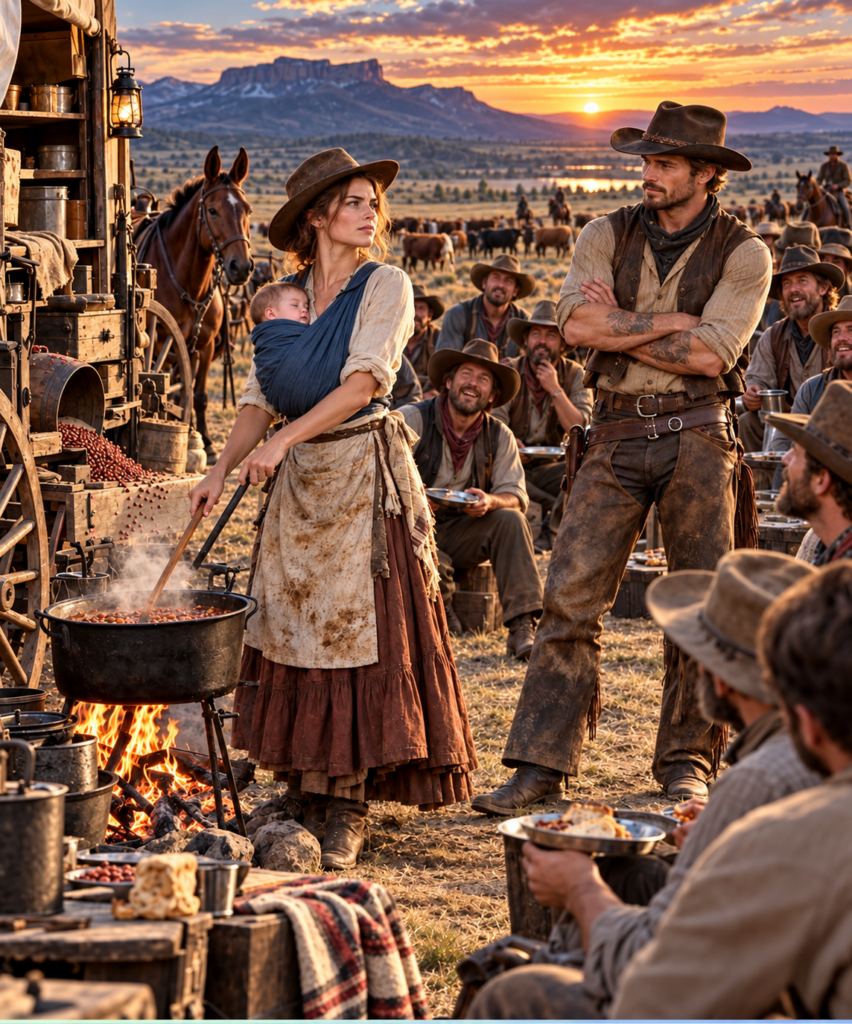
“And the baby?”
“Comes with the cook.”
Walker looked toward Bidwell lying beneath the wagon canvas.
From inside came a weak voice.
“Hire her, Boone.”
The crew erupted.
Even Walker laughed once despite himself.
He pointed at Josephine.
“One complaint.”
“There won’t be one.”
“One problem involving the boy—”
“Sam.”
“One problem involving Sam, and you go back.”
Josephine extended her hand.
“Fair enough.”
Walker looked at it.
Then shook.
Her grip surprised him.
Strong.
Callused.
Certain.
That night, as the camp settled beneath a sky crowded with stars, Walker rode the perimeter telling himself he had made a practical decision.
Nothing more.
He would remember that later.
Mostly because it was the first lie he told himself about Josephine Vance.
The trail changed after she took the wagon.
That was how the men described it afterward.
Not after Josephine joined them.
After she took the wagon.
Because within three days, it had become hers.
She knew where every spoon belonged, how much flour remained without checking, how many biscuits each man ate, which horse pulled strongest on an incline and exactly how long coffee could sit before Dusty complained that it tasted old.
She cooked through wind.
She cooked through rain.
She cooked in a dust storm so fierce the biscuits came off the Dutch oven wearing a gray skin.
Nobody complained.
Hot gray biscuits beat cold jerky.
Sam rode in a wooden crate Josephine lined with two quilts and lashed beside the wagon seat.
Within a week, he belonged to the entire outfit.
At noon stops, Ellis would appear first.
“My turn.”
“You had him yesterday,” Perry said.
“For four minutes.”
“You counted?”
“Of course I counted.”
Dusty shoved between them.
“Move aside. Boy needs masculine instruction.”
Josephine looked over from her stew.
“You plan to teach him cards or bad language?”
“Both eventually.”
“You’re not holding my son.”
Dusty looked wounded.
“Mrs. Vance.”
“You taught him to spit yesterday.”
“He’s six months old. He drools.”
“He looked proud of himself.”
Dusty could not argue with that.
Even Walker was not immune.
He resisted longer than the others.
Then one evening Josephine handed Sam to him while she repaired a tear in the flour sack.
Walker held the baby as he might have held unstable dynamite.
Sam stared up at him.
Walker stared down.
“You’re small.”
Sam grabbed his shirt.
“Strong, though.”
Sam pulled a button loose.
Walker looked toward Josephine.
“Your son robbed me.”
“He has good instincts.”
After that, Walker started stopping beside the wagon more often.
Never for the baby, he told himself.
Never for Josephine either.
There was always a reason.
Wheel grease.
Water ration.
Salt inventory.
Weather.
Cattle count.
Yet Josephine noticed something.
Walker ate last.
Always.
He spent his days at drag, breathing dust behind hundreds of cattle, where strays broke away and trouble usually began.
By the time he reached the fire, most men were finishing.
One evening she held out a plate.
“You could ride point.”
“Could.”
“Then somebody else eats the dust.”
“Could.”
“Do you answer every question with one word?”
“No.”
She stared.
The corner of his mouth moved.
That was the first time she realized Walker Boone might possess a sense of humor.
It was merely buried under several feet of stubbornness.
He sat away from the fire.
Josephine handed him coffee.
“Why drag?”
“Trouble happens there.”
“Trouble happens at point too.”
“I know how to handle trouble.”
“And you don’t know how to handle people?”
He glanced at her.
“That obvious?”
“Painfully.”
He laughed quietly.
The sound stopped her.
Not because it was remarkable.
Because she had never heard it before.
Later, when the others were asleep, she sat beside the wagon stitching one of Sam’s shirts.
Walker remained at the dying fire.
“He has Amos’s hands,” she said without knowing why.
Walker looked at Sam sleeping nearby.
“Your husband?”
“Long fingers. Strong grip.”
“You loved him.”
It was not a question.
Josephine pulled the needle through cloth.
“Yes.”
She expected awkward silence.
People often grew uncomfortable when widows admitted that the dead remained loved.
Walker only nodded.
“My brother died in the same stampede.”
Her hands stopped.
“What?”
“Ethan Boone.”
She searched her memory.
“I heard the name.”
“He rode for another outfit. Same crossing. Same storm.”
Walker watched the fire.
“He was twenty-six. Younger than me. Better with horses. Better with people too, if you listen to Dusty.”
“I don’t generally.”
“Smart.”
Josephine smiled faintly.
Walker’s expression became serious again.
“After Ethan died, I started making rules.”
“What kind?”
“No women. No children. No unnecessary passengers. No strangers who looked like trouble.”
“And how has that worked?”
“Until you showed up?”
“Yes.”
“Fine.”
“And since?”
Walker glanced toward the wagon, where Ellis had hung a small carved wooden horse above Sam’s crate.
Dusty had made the baby a rattle from beans in a tin cup.
Perry had given up half a good wool blanket after the first cold night.
Even Bidwell, miserable with his broken leg, had taken to telling Sam outrageous stories about cattle drives while Josephine kneaded dough.
“Better,” Walker admitted.
She lowered her eyes to the shirt.
“Careful, Mr. Boone.”
“Why?”
“You’re close to admitting you were wrong.”
“Wouldn’t go that far.”
The river nearly killed Sam three days later.
They reached the Cimarron after rain upstream had turned it broad, brown and fast.
Walker inspected the crossing twice.
Dusty rode it once.
The water reached his horse’s belly.
“Fast,” Dusty said.
“Bottom’s solid,” Walker replied.
They could wait.
But every day cost grass, supplies and money.
Storm clouds were building west.
If more rain came, the crossing could become impossible for a week.
Walker made the decision.
“Take them through.”
The cattle entered first.
Then riders.
Then the wagon.
Josephine sat high with the reins wrapped firmly around both hands. Sam’s crate was tied beside her with doubled rope.
Halfway across, everything changed.
One wheel dropped into a hidden channel.
The wagon lurched.
A horse screamed.
Josephine slammed against the side rail.
The current struck broadside.
One of the ropes holding Sam’s crate snapped.
Josephine heard it.
A small sound.
Barely anything beneath the river.
She turned.
The second rope stretched.
“No.”
It broke.
The crate disappeared over the side.
“SAM!”
Her scream stopped every man in the crossing.
Walker was already moving.
He threw himself from his horse into the water.
The crate spun once.
Sam began screaming.
Josephine tried to climb from the wagon.
Dusty grabbed her skirt.
“Let go of me!”
“You’ll drown!”
“My baby!”
Walker vanished beneath the surface.
For one terrible second Josephine saw only water.
She saw Amos’s coffin.
Her sister telling her she could not survive alone.
The small graveyard outside Caldwell where she had once stood in winter and wondered whether grief could actually stop a human heart.
Then Walker’s head broke the surface.
Twenty feet downstream.
He had the crate.
One arm locked around it.
The current dragged him sideways.
Dusty threw a rope.
Missed.
Threw again.
Walker caught it with his free hand.
Three men hauled.
Josephine was waist-deep before the wagon had fully reached shore.
Someone shouted at her.
She heard nothing.
Walker came close enough.
She took Sam.
The baby was soaked.
Cold.
Furious.
Alive.
Josephine fell to her knees in the mud.
Sam screamed into her neck.
She sobbed harder than he did.
Walker collapsed beside them, coughing river water.
“He’s all right,” he gasped.
Josephine clutched Sam tighter.
“He’s all right, Jo.”
She looked up.
It was the first time Walker had called her Jo.
His face was pale beneath the trail dirt.
Blood ran from a cut at his temple.
She touched his cheek without thinking.
“You went after him.”
“Course I did.”
“You could have died.”
Something changed in his eyes.
“So could he.”
That night, nobody complained when Josephine burned supper.
Nobody even mentioned it.
Sam developed a cough before dawn.
By morning he was feverish.
Josephine sat in the wagon with him wrapped against her chest while fear returned cold and familiar.
Walker came to the wheel.
“We’re stopping.”
“No.”
“Jo.”
“You lose another day, you risk reaching Kansas late.”
“We’re stopping.”
“I can cook. Keep moving.”
“He needs rest.”
“So does every man here.”
Walker leaned closer.
“I’m not arguing.”
She almost laughed.
“Since when?”
“Since right now.”
The crew camped beside the river for an entire day.
Dusty rode eight miles to a homestead and returned with goat milk, clean cloth and a jar of honey.
Perry gathered dry wood.
Ellis sat beside the wagon for four hours waving flies away.
Nobody was ordered.
Nobody asked about lost time.
By sunset, Sam’s fever broke.
Josephine walked alone beyond camp and cried where nobody could see her.
She cried for Sam.
For Amos.
For Walker diving into the river.
For eleven months of carrying every decision alone.
When she returned, Walker was sitting beneath the wagon.
He did not ask where she had been.
He simply held out a cup of coffee.
She sat beside him.
For a while they watched darkness settle over the plains.
“Thank you,” she finally said.
“For coffee?”
“For stopping.”
Walker rested his forearms on his knees.
“No herd’s worth a child.”
“You might tell that to your ledger.”
“My ledger doesn’t talk back as much as you do.”
She smiled.
Then her smile disappeared.
“My sister said bringing Sam out here was selfish.”
Walker looked at her.
“Maybe she was right.”
“No.”
“You don’t even know her.”
“Don’t need to.”
“He almost drowned.”
“So did I.”
“That doesn’t make me feel better.”
“Jo, a roof can fall on a child. Horse can kick one in a yard. Fever can come through a town. You could spend your whole life trying to build a fence high enough to keep grief outside.”
His voice became quieter.
“I tried.”
She looked at him.
“Did it work?”
He shook his head.
“No.”
Neither spoke for a while.
Then Walker added, “But it did keep everything else outside too.”
Josephine understood him then.
Not the trail boss.
Not the hard man who lived by rules.
The brother who had watched grief enter his life once and spent eleven years refusing to leave another door open.
She leaned against the wagon wheel.
“You let us in.”
“I noticed.”
“Regret it?”
Walker looked toward Sam sleeping.
Then at her.
“Not for a single mile.”
They reached Abilene nine days later.
The town smelled of cattle, mud, whiskey, sawdust and money.
Their buyer was a thick-necked man named Harlan Greer, who wore a diamond pin and acted as if standing were an inconvenience other people should apologize for causing.
He examined the cattle from horseback.
Walker waited.
Greer chewed a toothpick.
“Five dollars less a head than we discussed.”
Walker went still.
“That wasn’t the agreement.”
“Market changed.”
“Not that much.”
Greer shrugged.
“Take it or drive them elsewhere.”
Walker’s voice hardened.
“What changed?”
Greer glanced past him.
Josephine stood near the wagon holding Sam.
Greer smiled.
“Heard stories about this outfit.”
“What stories?”
“Woman in the chuck wagon. Infant on the trail. Stopped a whole day for a sick baby.”
Josephine felt every man near her go rigid.
Greer continued.
“Buyers like dependable outfits, Boone. Not traveling families.”
Walker stepped closer.
“You’re buying cattle.”
“I’m buying risk.”
“You inspected the herd.”
“Sure did.”
“Best weight you’ll see this week.”
“Maybe.”
Greer spit out the toothpick.
“My number stands.”
Walker stared at him.
Josephine knew what five dollars a head meant.
More than three thousand dollars.
Enough to reduce every man’s pay.
Enough to wipe out months of margin.
Enough to turn a successful drive into a disappointment.
That evening, she approached Walker.
“I’ll leave tomorrow.”
He looked up sharply.
They were camped outside town.
The men sat silently around the fire.
“I can take the mule back to Caldwell.”
“No.”
“If Greer thinks—”
“No.”
“Walker, listen.”
“I am listening.”
“Then be practical.”
He stood.
“You think letting that man decide what you’re worth is practical?”
“This isn’t about my worth.”
“That is exactly what he made it about.”
She lowered her voice.
“You have twelve men depending on you.”
“And one woman.”
Her jaw tightened.
“I can take care of myself.”
“I know.”
“Then let me.”
He stepped closer.
“Jo, taking care of yourself doesn’t mean disappearing every time somebody decides your presence is inconvenient.”
The words struck harder than he intended.
She looked away.
Walker softened.
“You cooked through dust, rain and wind. You held this crew together when Bidwell couldn’t stand. Your boy near went downriver and you were making biscuits again the next morning.”
He turned toward the men.
“Anybody here want to sell to Greer?”
“No,” Dusty said immediately.
“Nope,” Perry added.
Ellis shook his head.
One voice after another joined.
Josephine looked around the circle.
“You’d lose days.”
Dusty shrugged.
“Wouldn’t be first bad decision I made.”
Perry grinned.
“Difference is this one feels good.”
Walker looked at her.
“We drive to Ellsworth.”
Eight more days.
Josephine swallowed.
“You’re all fools.”
Dusty smiled.
“Maybe.”
His expression softened.
“But you’re our cook.”
Ellis corrected him.
“She’s family.”
Nobody laughed at him.
Not one man.
The eight days to Ellsworth became the hardest stretch of the drive.
The grass thinned.
Two steers went lame.
Bidwell’s leg swelled badly enough that Josephine forced Walker to stop and clean the splint.
Then a thunderstorm found them near midnight.
Lightning split the sky.
The herd exploded.
Walker heard the first rumble of hooves and shouted before he was fully awake.
“STAMPede!”
Men ran for horses.
Josephine grabbed Sam.
Dusty galloped into darkness.
Walker and Perry raced toward the lead cattle, trying to bend the herd into a circle.
Then Josephine saw something none of the riders could see from inside the stampede.
The wagon stood directly in the path of a smaller breakaway group.
Bidwell could not move.
He lay beneath the canvas shouting.
Josephine shoved Sam into Ellis’s arms.
“Take him!”
“What?”
“TAKE HIM!”
She climbed onto the wagon seat.
“Jo!” Ellis screamed.
She snapped the reins.
The team lunged.
The wagon rolled hard across uneven ground.
Behind her, fifty frightened cattle thundered closer.
She could hear them.
Feel them.
The ground shook through the wheels.
Josephine drove toward a shallow ravine she had noticed at sunset.
At the last possible moment, she turned the wagon sharply along its edge.
The cattle followed the movement.
The first animals angled.
The rest followed.
The entire breakaway group curved away from camp.
Away from Bidwell.
Away from Sam.
Walker saw the turn from two hundred yards away.
He would remember it until the day he died.
Josephine Vance standing on the wagon board beneath white flashes of lightning, reins locked in both hands, hair torn loose by wind, driving directly ahead of fifty terrified cattle as though fear had somehow forgotten to include her.
The men recovered the herd before dawn.
Nobody died.
They lost only three cattle.
When Walker returned to camp, Josephine was sitting on the ground holding Sam.
Her hands were shaking so badly she could barely button her blouse.
Walker dismounted.
“What in God’s name were you thinking?”
She looked up.
“Good morning to you too.”
“You drove in front of a stampede.”
“Small one.”
“Fifty head!”
“Forty-six.”
“Jo.”
“Did you count differently?”
He stared at her.
Then suddenly dropped to his knees and pulled her against him.
She froze.
So did every man close enough to see.
Walker buried his face against her hair.
“You scared ten years off my life.”
Josephine’s arms slowly went around him.
“Only ten?”
“Don’t joke.”
“I joke when I’m frightened.”
“I noticed.”
Sam, trapped between them, made an annoyed sound.
Walker pulled back.
Josephine’s eyes were wet.
“So,” she whispered, “are you sending me back to Caldwell?”
Walker stared at her for a second.
Then laughed.
A full laugh this time.
Dusty turned away, grinning.
Ellis whispered to Perry, “About damn time.”
Perry elbowed him.
Ellsworth appeared three afternoons later.
Its stockyards seemed endless.
Cattle bawled from crowded pens. Trains hissed. Men shouted numbers over fences.
Walker rode straight to a buyer named Nathan Castle.
Castle was lean, sun-browned and practical.
He spent nearly an hour walking among the cattle.
Finally he climbed the fence.
“Good herd.”
Walker waited.
Castle looked toward Josephine.
“You the outfit with the woman running the chuck wagon?”
Walker’s expression hardened.
“Why?”
Castle smiled.
“Because half the trail is talking about her biscuits.”
Josephine, standing nearby with Sam on one hip, turned red.
Castle continued.
“Fellow outside Wichita told me Boone’s crew came through looking better fed than the town council.”
Dusty called, “That fellow was telling the truth.”
Castle laughed.
Then he named his price.
Walker stared at him.
Full market value.
A little better, actually.
“Deal?” Castle asked.
Walker shook his hand.
“Deal.”
The cheer from the crew startled horses in the next pen.
Josephine turned away before anyone noticed she was crying.
They had made it.
Not gracefully.
Not cleanly.
But together.
That evening, Walker paid every man.
He gave Josephine the same full cook’s wage Bidwell would have earned, plus a bonus.
She frowned at the money.
“This is too much.”
“No.”
“It is.”
“Hazard pay.”
“For what?”
“River rescue, stampede insanity, emotional damage inflicted on trail boss.”
“I didn’t rescue anyone in the river.”
“You caused the emotional damage.”
She smiled.
Around them the crew prepared to scatter.
Dusty planned to spend two weeks doing things Josephine told him she did not want described.
Perry had a sister in Missouri.
Ellis wanted to buy a proper saddle.
Bidwell intended to find a doctor and then, according to him, never look at another horse hole again.
For the first time since joining the drive, Josephine did not know what tomorrow looked like.
She should return to Caldwell.
Her sister expected her.
There was a room there.
A roof.
Safety.
Charity.
She packed the coffee pot.
Walker approached.
“Don’t.”
She glanced at him.
“Don’t what?”
“Pack that.”
“It belongs to your wagon.”
“No.”
“It certainly does.”
“It belongs to the woman who stopped twelve men from starving.”
“Eleven. Ellis did occasionally produce edible bacon.”
“Once.”
“Still counts.”
Walker looked unusually uncomfortable.
Josephine waited.
He rubbed one hand over the back of his neck.
“I own a place west of town.”
She said nothing.
“Not much. Hundred and sixty acres. House needs work. Barn roof leaks along the north side.”
“This is a remarkable sales pitch.”
“I’m bad at this.”
“I noticed.”
He exhaled.
“There’s a kitchen.”
Josephine laughed softly.
“Does it work?”
“Probably.”
“That doesn’t inspire confidence.”
“I haven’t cooked in it.”
“Thank God.”
He smiled.
Then became serious.
“I’m not asking you to marry me.”
Her eyebrows rose.
“Well, that ruins the proposal.”
“Jo.”
She waited.
“I’m asking you not to go back somewhere just because it’s the only place waiting.”
Her smile faded.
Walker continued.
“You have wages. I have land. I need somebody who knows more about running a house than I do.”
“I’m not becoming your housekeeper.”
“I didn’t say housekeeper.”
“What are you saying?”
“Partner.”
She studied him.
“In what?”
He looked toward Sam.
“In figuring out what comes next.”
Josephine swallowed.
Walker spoke carefully.
“You pay your share from your wages if that matters to you. Keep your own money. Keep the wagon. Cook or don’t cook. Leave if you hate it.”
“You make partnership sound romantic.”
“I specifically said I wasn’t proposing.”
“I remember.”
“But if six months from now I happened to—”
“Walker.”
“Yes?”
“You’re talking too much.”
He closed his mouth.
Josephine looked toward the chuck wagon.
Three months earlier, she had left Caldwell on a mule with fourteen dollars, three dresses, an iron skillet and the certainty that remaining dependent on her sister would slowly turn gratitude into resentment.
She had expected work.
She had not expected twelve ridiculous cowhands.
She had not expected a river.
Or a stampede.
Or Walker Boone.
Most of all, she had not expected to feel necessary again.
Her hand tightened around the coffee pot.
“I keep the wagon.”
Walker blinked.
“What?”
“If I come to the ranch, I keep the wagon.”
“You can have a kitchen.”
“I heard you.”
“Then why keep a wagon?”
Josephine looked at him.
“Because a woman should keep something that reminds her she knows how to leave.”
Walker considered that.
Then nodded.
“Fair.”
“And my wages remain mine.”
“Yes.”
“And Sam is not treated like a guest.”
Walker looked offended.
“That boy stole two buttons from me and threw mashed beans into my hat. He passed guest status around Oklahoma.”
Josephine laughed.
Walker held out his hand.
“Partner?”
She looked at it.
The same hand she had shaken beside the burned beans.
The same hand that had dragged her son from a river.
She took it.
“Partner.”
Their first winter on the ranch was not romantic.
It was cold.
The north barn roof leaked exactly as promised.
The kitchen chimney smoked when the wind shifted east.
Two hens vanished to a fox.
Sam learned to crawl and immediately dedicated himself to discovering everything on the property capable of killing him.
Walker discovered that Josephine snored when exhausted.
Josephine discovered Walker left muddy boots in doorways despite repeated threats against his life.
They argued about money.
Fence lines.
Firewood.
Whether Sam needed another blanket.
Whether Walker needed to see a doctor after a horse kicked him.
He claimed he did not.
Josephine won.
In March, Dusty appeared carrying a sack of coffee and announced he had spent every dollar from the drive.
Nobody expressed surprise.
In April, Perry arrived looking for work.
In May, Ellis showed up wearing a new saddle and admitted he missed Sam.
By early summer, the ranch had become an unofficial stopping point for trail hands traveling through Ellsworth.
Josephine began cooking meals for them.
Then charging.
Then saving.
By August, she purchased a half interest in ten additional acres adjoining Walker’s land.
She made him sign a proper paper.
He pretended to be insulted.
She reminded him that trust and paperwork could coexist.
He signed.
The wagon remained beside the barn.
Clean.
Oiled.
Ready.
On the anniversary of Amos Vance’s death, Josephine rode alone to a hill overlooking the property.
She carried Sam with her.
Walker did not follow.
He understood some grief needed privacy.
She sat beneath a cottonwood and told Sam about his father.
How Amos laughed with his whole chest.
How he hated onions.
How he once rode fifteen miles in rain because she had mentioned craving peaches.
How brave men could die.
How good men could be gone.
How loving someone new did not erase someone who came before.
When she returned near sunset, Walker was repairing the gate.
He looked at her.
She looked at him.
“You all right?”
“No,” she said.
He nodded.
“All right.”
She smiled through tears.
That was one reason she loved him.
He never demanded that sorrow become something prettier before he could stand beside it.
Six weeks later, Walker proposed.
Poorly.
He had planned a speech.
Josephine knew this because she found three scratched-out versions in the barn.
In the end, he stood in the kitchen while she rolled biscuit dough.
Sam, now nearly eighteen months old, sat on the floor attacking a wooden spoon.
Walker cleared his throat.
“Jo.”
“Yes?”
“I was thinking.”
“That’s dangerous.”
“I’m serious.”
She looked up.
He held a ring.
Simple silver.
Nothing grand.
His expression made her heart hurt.
“I know you had a husband.”
Josephine became still.
“I know Sam had a father. I’m not asking either of you to replace anybody.”
He swallowed.
“I just want to know if there’s room beside what you already had.”
Josephine stared at him.
Walker continued.
“I loved my brother for eleven years after he died by trying not to love anybody enough to lose them. Didn’t work. Just made those years quieter than they needed to be.”
He glanced toward Sam.
“The two of you made things noisy again.”
Sam banged the spoon against the floor.
Walker nodded toward him.
“Very noisy.”
Josephine laughed and cried at the same time.
Walker stepped closer.
“I love you. I love that boy. I love the wagon even though I still don’t understand why we own a perfectly good wagon we never use.”
“We’ve discussed this.”
“I know.”
He took her flour-covered hand.
“Josephine Vance, would you stay with me on purpose?”
She stared at him.
“Is that your proposal?”
“It sounded better in the barn.”
“It was terrible.”
“I know.”
“Yes.”
Walker blinked.
“Yes?”
“Yes.”
She kissed him before he could ruin the moment by asking again.
Sam began laughing from the floor.
They married three weeks later beneath the cottonwood on the hill.
Dusty stood beside Walker.
Perry brought flowers from town.
Ellis held Sam and cried harder than Josephine.
Bidwell attended on a cane and complained that none of it would have happened if he had not broken his leg.
Nobody let him forget that Josephine had replaced him because twelve grown men nearly starved after he did.
Years later, travelers passing west of Ellsworth sometimes noticed an old chuck wagon beside a white farmhouse.
The wheels were maintained.
The canvas remained patched but strong.
Children played inside it.
Josephine never sold it.
When people asked why, she usually smiled.
Sometimes she said it reminded her of the trail.
Sometimes she said it was useful.
Sometimes she simply told them it belonged to her.
But Walker knew the truth.
That wagon represented the first thing Josephine had claimed after grief stripped nearly everything else away.
A job.
A wage.
A direction.
A place among people who needed her.
It had carried her son.
It had carried injured men.
It had raced ahead of frightened cattle beneath lightning.
And it had carried a widow who believed she was riding north for employment into a life she could never have imagined when she first smelled burned beans from the tall grass.
Walker never forgot that evening.
Twelve hungry cowboys.
One ruined pot.
A mule coming slowly out of the sunset.
A tired woman with a baby against her chest looking at his disaster of a camp and deciding, without permission, that she belonged there.
He had thought he was giving Josephine Vance a place on his trail.
Years later, sitting on the porch with her beside him and grandchildren racing around the same old wagon, Walker finally understood.
She had given all of them something first.
A reason to sit around the same fire.
A reason to care whether the man beside them ate.
A reason to stop pretending grief was strength and loneliness was freedom.
And for Walker Boone, she had given him something he once believed no trail could ever lead him back to.
Home.
THE END


