
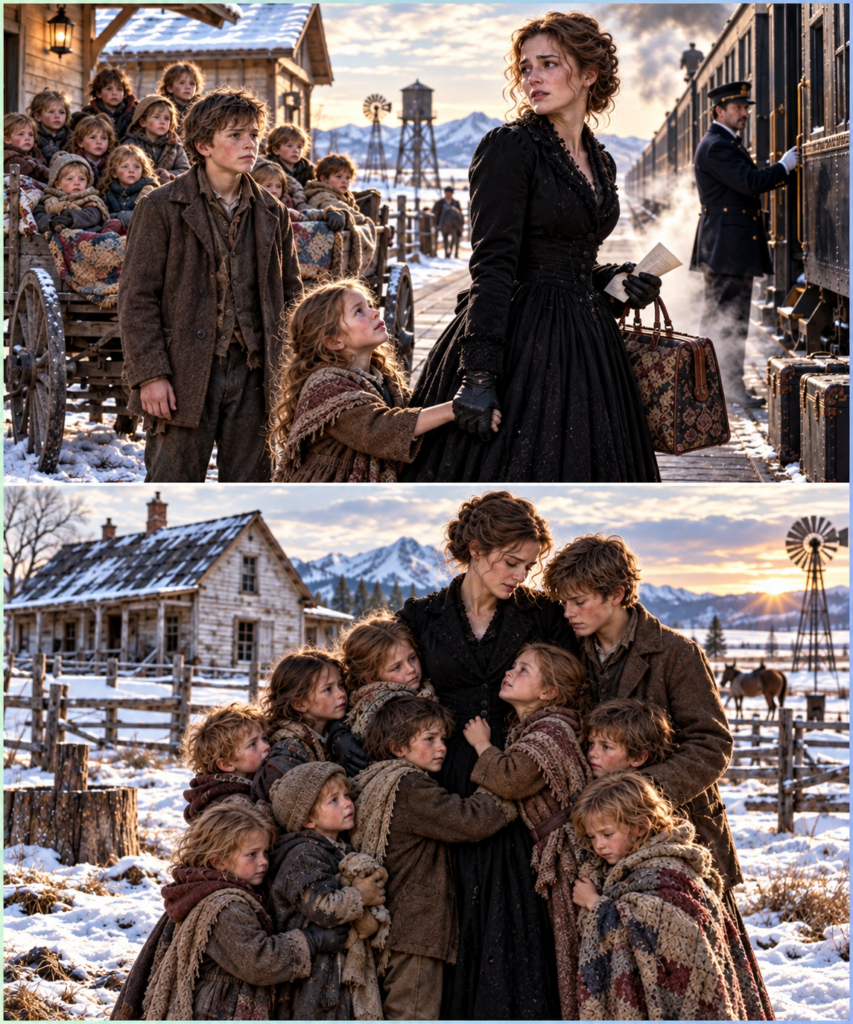
The Bennett house looked worse than Clara had imagined.
The porch leaned.
One chimney had lost several bricks.
A length of canvas covered part of the roof.
The barn listed toward the east like a tired old man.
Jacob had described the place as needing “a woman’s touch.”
Clara almost laughed when she remembered that.
It needed six carpenters, a roof, a banker, and divine intervention.
Inside was worse.
Cold ashes.
Dirty blankets.
Unwashed bowls.
Laundry piled against a wall.
The smell of sickness.
Yet Clara noticed something else.
Small boots lined neatly beside the door.
Children’s drawings tacked beside the kitchen.
Names scratched into a wooden measuring board.
Jacob had made a mark for every child each birthday.
This had been a poor house.
It had not been an unloved one.
“Put the baby near the stove,” Clara said.
The eleven-year-old girl stiffened.
“His name is Noah.”
“You must be Hannah.”
The girl looked surprised.
“Papa wrote about you.”
Clara knelt beside the bundle.
Noah was ten months old and frighteningly light.
She touched his forehead.
Cool.
Too cool.
“How much molasses water today?”
“Not much.”
“Why?”
“He spits it out.”
Clara stood.
“Eli, hitch the wagon again.”
He frowned.
“We just got here.”
“We need milk.”
“Nearest place is Mrs. Talley’s, two miles south.”
“Good.”
“She won’t give it free.”
“I didn’t ask her to.”
Clara opened her purse.
Forty-three dollars.
It had taken almost four years to save.
She counted ten into her palm.
“For milk, eggs, flour, beans, bacon if she has it.”
Eli stared at the money.
“You’ll need that.”
“So will Noah if we don’t feed him.”
He did not argue again.
By sundown there was food on the table.
Not enough.
But food.
The children ate beans and biscuits so fast Clara had to slow them down because she feared they would make themselves sick.
Five-year-old Lucy tucked half a biscuit into her dress pocket.
“You can have another,” Clara said.
Lucy shook her head.
“This is for tomorrow.”
Clara’s heart twisted.
“There will be food tomorrow.”
The child looked unconvinced.
Across the table, Eli watched Clara.
“You don’t know that.”
“No,” Clara admitted. “But I intend to make it true.”
That night she learned all ten names.
Eli, thirteen.
Hannah, eleven.
Twins Matthew and Mark, nine.
Daniel, seven.
Rose, six.
Lucy, five.
Peter, four.
Katie, two.
Noah, ten months.
Their mother, Rebecca, had died after Noah’s birth.
Jacob’s sister had planned to come west to help, but she had died unexpectedly before making the trip.
Then Jacob had placed the advertisement.
Then Clara had answered.
Then the well collapsed.
A family could be destroyed in such ordinary steps.
Clara slept in Jacob’s room but did not touch his things.
At dawn she woke to someone coughing.
Matthew.
By breakfast, he was feverish.
Clara had spent seven years married to a physician. She was not a doctor, but she knew enough to understand when a child was in danger.
She boiled water.
Changed bedding.
Opened the room to fresh air for a few minutes despite Eli insisting it was too cold.
Made broth.
Sat beside Matthew while Mark refused to leave his twin’s side.
By afternoon the fever eased slightly.
That was when a black carriage appeared outside.
The man who stepped down wore polished boots unsuited to farm mud.
He introduced himself as Silas Rourke.
“I held Jacob’s note.”
Clara remained in the doorway.
“What note?”
“Mortgage.”
Eli appeared behind her.
Rourke glanced past Clara at him and smiled.
The smile contained no kindness.
“Your father owed me four hundred and sixty dollars.”
Clara felt the number in her stomach.
“What happens now?”
“The note comes due March first.”
“That’s three weeks.”
“Correct.”
“He died.”
“Debts generally survive their owners.”
Clara folded her arms.
“And the children?”
“County magistrate will need to determine placement. No legal parent remains.”
“I’m here.”
Rourke’s smile returned.
“You are a stranger who intended to marry their father. Unfortunately, intention is not marriage.”
Eli stepped forward.
“She’s staying.”
Rourke looked amused.
“For how long?”
Clara heard Eli’s breathing change.
She understood immediately.
That question was not meant for her.
It was meant for the boy.
To remind him not to trust.
Clara opened the door wider.
“Mr. Rourke, you have delivered your message.”
His eyes hardened.
“I can simplify matters.”
“How?”
“Sign over the farm. I forgive the debt. I’ll even give you fifty dollars for your trouble.”
“And the children?”
“They become the county’s responsibility.”
“No.”
“You should consider—”
“No.”
“You haven’t heard—”
“I heard enough.”
Rourke stared at her.
Then he lowered his voice.
“Jacob’s land is worthless for farming. Half his north field floods every spring. The barn is failing. The house needs more money than it is worth.”
“Then why do you want it?”
For the first time, the man’s expression changed.
Only slightly.
But Clara saw it.
Rourke put on his hat.
“Three weeks, Miss Whitmore.”
After his carriage disappeared, Clara turned.
All ten children had gathered behind her.
Even Matthew had left his bed.
Eli’s face was pale.
“He’s gonna take us.”
“No.”
“He can.”
“I said no.”
“He’ll split us up.”
Hannah suddenly began crying.
Not loudly.
That was worse.
She covered her mouth with both hands.
Katie clung to her skirt.
Peter asked, “Do we gotta get different families?”
Nobody answered.
Then Lucy asked something Clara would remember for the rest of her life.
“If they split us up, do we still get to have the same last name?”
Clara crossed the room.
She crouched in front of them.
“Listen to me.”
Ten frightened faces turned toward her.
“I cannot promise you things I do not control.”
Eli watched carefully.
“But I can promise what I control. I will not hand you over because a man with polished boots tells me life is difficult.”
“You could still leave,” Eli said.
“Yes.”
The room went silent.
Clara continued.
“I could leave tomorrow. I could leave tonight. And you know what? Some mornings I may want to.”
The honesty startled him.
“But wanting to run and running are two different things.”
She looked at each child.
“I stayed yesterday.”
Then at Eli.
“I am staying today.”
She took Hannah’s trembling hand.
“And tomorrow morning, when you wake up, I intend to be standing in that kitchen figuring out how to feed eleven people with thirty dollars and a dying chicken.”
Daniel frowned.
“Twelve.”
Clara looked around.
“What?”
“If you’re staying, there’s twelve people.”
For one second, nobody moved.
Then Mark laughed.
A tiny, nervous sound.
Hannah laughed through her tears.
Even Eli’s mouth twitched.
Clara smiled.
“Twelve, then.”
It was the first time the Bennett house had heard laughter since Jacob died.
It did not solve the mortgage.
But it was a beginning.
Clara sold her return ticket.
She sold one of her two good dresses.
Then she opened the largest trunk she had brought from Boston.
Inside was the one possession she had refused to sell after Henry died.
Her sewing machine.
By Monday morning, Clara Whitmore had hung a hand-painted board in the Mercy Ridge general store.
Mending, alterations, children’s clothes, curtains and work shirts.
Fair prices.
Fast work.
Henderson, the shopkeeper, stared at it.
“You think women will carry sewing six miles out to that farm?”
“No.”
Clara placed three finished shirts on his counter.
“You’ll take orders here, keep ten percent, and send the work with anyone heading north.”
Henderson raised an eyebrow.
“You’ve got nerve.”
“I have ten children.”
“Fair argument.”
Her first order was a torn pair of men’s trousers.
Her second was six shirts for the schoolmaster’s sons.
Her third came from a woman named Martha Hayes.
Martha ordered curtains she did not need and paid twice Clara’s price.
When Clara objected, Martha said, “My brother told me you walked two miles through snow to buy milk for a baby that wasn’t yours. Let me overpay for curtains I don’t need.”
“Your brother?”
“Nathan Hayes.”
Clara met him two days later.
He arrived with lumber in the back of his wagon.
Tall.
Broad-shouldered.
Thirty-five, perhaps.
Dark hair touched with gray at the temples.
A scar along one hand.
He looked at Clara’s roof for approximately six seconds.
“Your chimney’s trying to kill you.”
Clara stared at him.
“Good morning to you too.”
“It leans six inches.”
“I’ve been busy.”
“So has gravity.”
She almost smiled.
“Mrs. Talley said you repair wagons.”
“And roofs when children sleep under them.”
“I can’t afford a carpenter.”
“Good thing I’m not charging carpenter prices.”
“I’m not accepting charity.”
Nathan leaned against the wagon.
“Then sew canvas covers for three freight wagons at my shop. I fix your chimney and patch the roof.”
Clara considered.
“That sounds suspiciously fair.”
“I have my moments.”
Nathan did not ask why she stayed.
Clara liked him for that.
Most people did.
The story had already spread through town.
The Boston widow who came west to marry a dead man.
The ten starving Bennett children.
The mortgage.
Some called Clara brave.
Others called her desperate.
One woman suggested she wanted Jacob’s land.
Clara wished that woman could see the land.
Still, the work came.
Clara sewed after the children slept.
During the day, she organized the house like a military campaign without the uniforms.
Eli chopped wood before breakfast but attended school three days a week after Clara discovered he had stopped going when his mother died.
Hannah was forbidden from carrying Noah all day.
“You are eleven,” Clara told her.
“I’m useful.”
“You can be useful and still be eleven.”
“What am I supposed to do?”
“Read. Fight with your brothers. Complain about chores. Become unreasonable over ribbons.”
Hannah stared.
Then smiled.
The twins returned to lessons.
Daniel repaired chicken fencing with Nathan.
Rose and Lucy learned stitches.
Peter was placed in charge of collecting eggs and took the responsibility with such seriousness he saluted the hens each morning.
Katie followed Clara everywhere.
Noah gained weight.
Slowly, almost invisibly, the Bennett children began to look like children again.
Then, one afternoon, Clara found Jacob’s ledger.
It had fallen behind the bottom drawer of his desk.
Inside were years of payments to Silas Rourke.
Clara read every line.
Then she read them again.
Something was wrong.
Jacob’s original loan had been three hundred dollars.
According to Jacob’s careful records, he had already paid two hundred and eighty-five.
Yet Rourke claimed he owed four hundred and sixty.
Nathan examined the book that evening.
“Rourke says Jacob missed interest payments.”
“Enough to turn fifteen dollars into four hundred and sixty?”
Nathan looked grim.
“Not unless arithmetic changed while I was sleeping.”
There were notations beside several payments.
Receipt missing.
Rourke disputed.
Cash delivered.
No receipt.
Clara tapped the page.
“Jacob knew.”
“He suspected.”
“Why didn’t he fight it?”
Nathan looked around the room.
Hannah was reading to the younger children.
Eli was helping Matthew with sums.
Noah slept near the fire.
“Maybe surviving kept getting in the way.”
Clara understood that better than she wanted to.
Nathan turned another page.
“What’s this?”
A rough map had been drawn inside the back cover.
The north field.
The creek.
Several measurements.
A circle marked beneath the bluff.
Beside it Jacob had written one word.
Spring.
Nathan became very still.
“What?”
“I heard Jacob talking about this once.”
“Talking about what?”
“Underground water.”
“There’s a creek.”
“Creek freezes and runs low every August. But an underground spring this size…” Nathan traced the measurements. “It could supply half the farms between here and town.”
Clara looked toward the window.
“Rourke said the land was worthless.”
Nathan gave her a humorless smile.
“Rourke lies when breathing.”
The reason he wanted the farm was suddenly clear.
It was not the house.
Not the barn.
Not even the acreage.
It was the water beneath it.
Two days later Rourke returned.
This time he offered Clara three hundred dollars.
She invited him inside.
He glanced around.
The floor had been scrubbed.
Fresh bread cooled beside the stove.
Noah slept in a repaired cradle.
“Things look improved.”
“They are.”
“Then you understand how expensive improvement is.”
Clara placed Jacob’s ledger on the table.
Rourke’s eyes flicked toward it.
“You recognize this?”
“A farmer’s notebook.”
“A record of every payment Jacob made you.”
“A dead man can write whatever he wishes.”
“And a living man can lie.”
His jaw tightened.
“Careful.”
“Why?”
“You’re alone out here.”
Clara’s skin went cold.
But she did not step back.
“No, Mr. Rourke.”
She looked past him.
Eli stood in the doorway to the kitchen.
Behind the barn window, Nathan was repairing a wagon wheel.
Mrs. Talley’s hired boy was delivering milk.
Hannah and the twins were returning from school down the road.
“I am many things,” Clara said quietly. “But I am no longer alone.”
Rourke leaned over the table.
“The hearing is next Friday. You are not their mother. You are not their relative. You have no husband, no substantial income, and a property in debt.”
“Then I suppose we both have work to do before Friday.”
He smiled coldly.
“You cannot win.”
Clara looked at Jacob’s ledger.
“I don’t need to win everything.”
She met his eyes.
“I only need to stop you.”
That night Eli overheard Clara and Nathan discussing the hearing.
He heard the words county placement.
He heard Nathan say the court might separate the youngest children.
He heard Clara say she was terrified.
Eli did not hear the next sentence.
He left before Clara said, “But terrified people can still fight.”
The following morning Eli was gone.
His coat was missing.
So was Jacob’s rifle.
Clara found a note beneath his pillow.
If I leave, there are only nine.
Maybe the county lets you keep them.
Tell them I ran away.
Don’t come looking.
Clara did not scream.
She wanted to.
Instead she grabbed her coat.
Nathan saddled two horses.
Snow had begun falling.
They found Eli’s tracks leading north.
Toward the cemetery.
By the time Clara reached Jacob’s grave, the snowfall had thickened.
Eli was sitting beside the wooden marker.
The rifle lay untouched in the snow.
Clara dismounted so fast she nearly fell.
“Eli Bennett!”
He stood.
“You weren’t supposed to—”
She slapped his shoulder.
Not his face.
Not hard enough to hurt.
Hard enough to shock him.
Then she grabbed him and pulled him against her.
“You foolish, impossible child.”
Eli froze.
“I was helping.”
“No.”
“If there’s nine—”
“No.”
“They’ll let you—”
“No!”
Her voice broke across the cemetery.
Eli began crying.
“I can work somewhere. Men hire boys.”
“You are thirteen.”
“I can work.”
“You belong with your family.”
“If they split us because there’s too many—”
“Then we fight because there are too many!”
Clara held his face between her gloved hands.
“We do not save a family by removing pieces of it.”
His mouth trembled.
“You said you were scared.”
“I am.”
“You said you might lose.”
“I might.”
“Then what happens?”
Clara looked at Jacob’s grave.
Snow gathered along the rough wooden cross.
“I don’t know.”
Eli’s face crumpled.
Adults were not supposed to say that.
Perhaps children needed them to.
Clara pulled him close.
“But this is what I do know. If we lose Friday, I fight Saturday. If they move you, I follow. If they separate you, I find every house. If they send one of you a hundred miles away, I get on a train.”
She pressed her cheek against his cold hair.
“You asked me not to leave at the station.”
“That was Lucy.”
“All of you asked.”
Eli cried harder.
“And I stayed.”
They returned through worsening snow.
Halfway home, Clara’s horse stumbled.
She fell badly, twisting her ankle.
Nathan got her into his saddle and walked beside them the rest of the way.
By the time they reached the farmhouse, Clara was shaking violently from cold.
The children surrounded her.
Hannah heated water.
The twins brought blankets.
Daniel fed the stove.
Lucy rubbed Clara’s fingers.
Peter stood guard beside the bed even after everyone told him guarding was unnecessary.
For the first time since she arrived, Clara was the one being cared for.
She woke near midnight.
Eli sat beside her.
“Miss Clara?”
“Yes?”
“I’m sorry.”
“I know.”
He looked at his hands.
“Can I ask something?”
“Anything.”
“Why us?”
Clara stared toward the ceiling.
For weeks she had been too busy to ask herself.
Finally she said, “Because after my husband died, I spent four years believing the worst thing that could happen to a person was loving someone and losing them.”
Eli waited.
“I was wrong.”
“What’s worse?”
“Being too afraid of losing people to love anyone at all.”
The boy looked at her.
Then, carefully, almost awkwardly, he rested his head against her arm.
Clara closed her eyes.
Outside, the storm covered Jacob Bennett’s grave in white.
Inside, his children finally stopped waiting for Clara to leave.
The guardianship hearing took place the following Friday in a room above the Mercy Ridge mercantile.
Clara wore her best remaining dress.
Hannah had repaired the hem.
Nathan drove them into town.
All ten children came.
Silas Rourke arrived with an attorney.
Clara had no attorney.
She had Jacob’s ledger.
A box of sewing receipts.
Thirty-two dollars in cash.
And a stomach so tight she thought she might be sick.
Magistrate Walter Bell was an older man with tired eyes and a reputation for disliking speeches.
He began simply.
“Miss Whitmore, what exactly are you asking this court to do?”
“Let the children remain together under my care.”
“You are unrelated.”
“Yes, sir.”
“You were never legally married to Jacob Bennett.”
“No, sir.”
“You have known these children less than one month.”
“Twenty-three days.”
Rourke’s attorney almost smiled.
Bell noticed.
“So why should I place ten children with a woman who was a stranger twenty-three days ago?”
Clara could have talked about duty.
She could have talked about Jacob’s letters.
Instead she turned toward the children.
“Because twenty-three days ago, Your Honor, Noah Bennett was being fed molasses water because there was no milk.”
The room became quiet.
“Matthew had a fever. Lucy was hiding biscuits because she believed there would be no food the next morning. Hannah had spent nearly a year raising children while being a child herself. Eli thought the best way to save his family was to disappear.”
Eli looked down.
Clara continued.
“I cannot change what happened before I arrived. I cannot become their mother by saying I love them. I haven’t earned that word.”
Hannah started crying softly.
“But I can tell you what happened in twenty-three days.”
Clara lifted her sewing receipts.
“They returned to school.”
She placed them down.
“Noah gained four pounds.”
Another paper.
“Matthew’s healthy.”
Another.
“The roof no longer leaks over the little children’s room.”
Nathan looked down with a faint smile.
“There is food in the pantry. There is money coming in. Not much, but honest money.”
Bell studied her.
“And the mortgage?”
Rourke’s attorney stood.
“My client holds a valid note for four hundred and sixty dollars.”
Clara faced him.
“No.”
Rourke’s head snapped toward her.
She opened Jacob’s ledger.
“The original loan was three hundred. Jacob recorded two hundred and eighty-five dollars in payments.”
“Unverified notes.”
“Some.”
The door opened behind them.
Everyone turned.
Henderson, the general store owner, entered carrying a small metal cashbox.
Beside him walked Martha Hayes.
And Mrs. Talley.
And three other townspeople.
Magistrate Bell frowned.
“What is this?”
Henderson cleared his throat.
“Records.”
Rourke went pale.
Henderson put the box on the table.
“Jacob Bennett paid through my store four times when Mr. Rourke wasn’t in town. I found my old books.”
Clara stared.
She had not known.
Henderson opened a ledger.
“Twenty dollars May fourth. Thirty in June. Fifteen September ninth. Forty in November.”
Rourke stood.
“This is absurd.”
Henderson looked at him.
“No. What’s absurd is me being scared of losing your business long enough to keep my mouth shut.”
Mrs. Talley stepped forward.
“I witnessed two payments myself.”
Another farmer raised his hand.
“So did I.”
Nathan placed Jacob’s map on the table.
“And there is something else Mr. Rourke forgot to mention while claiming this property is worthless.”
Rourke’s attorney whispered urgently to him.
Bell examined the map.
“What am I looking at?”
“An underground spring,” Nathan said. “Surveyed by Jacob Bennett last fall. Mr. Rourke owns property immediately east. Without access through the Bennett tract, he cannot reach it cheaply.”
Bell turned toward Rourke.
“Is that why you want this land?”
Rourke’s face hardened.
“I want repayment of a lawful debt.”
“Then lawful repayment is what you’ll receive.”
For the next hour, numbers were checked.
Books compared.
Receipts matched.
When it was finished, Jacob Bennett had not owed four hundred and sixty dollars.
He had owed sixty dollars plus a small amount of legitimate interest.
Clara had thirty-two.
Not enough.
Her heart sank.
Then Nathan asked permission to speak again.
“I’d like to lease water access.”
Clara turned.
“What?”
Nathan looked at her.
“Not buy. Lease.”
“To whom?”
“Me. My workshop, the Talley farm, Henderson’s store, and four properties on the south road all haul summer water. We’ve discussed building a shared pipe from the Bennett spring.”
“You discussed this when?”
“This week.”
Clara stared at him.
Nathan shrugged.
“You were busy sewing.”
Bell cleared his throat.
“Mr. Hayes, what would this lease pay?”
“Twenty dollars up front from my property. Others have agreed to the same.”
Henderson raised his hand.
“Twenty.”
Mrs. Talley did too.
“Twenty.”
Two farmers followed.
Clara suddenly understood.
“No charity,” Nathan said quietly. “We pay for water access. You keep ownership.”
Her eyes burned.
Rourke shoved back his chair.
“This entire town has lost its senses.”
Magistrate Bell looked at him.
“Sit down.”
Rourke did.
Bell reviewed the papers another ten minutes.
Then he looked at Clara.
“The debt can be satisfied.”
Clara gripped the edge of the table.
Bell continued.
“The more difficult question is guardianship.”
The children became completely still.
“Miss Whitmore, you have no legal relationship to them.”
“I know.”
“You have limited means.”
“I know.”
“You have undertaken a responsibility most people would call unreasonable.”
A few people smiled.
Bell removed his glasses.
“Fortunately for these children, family courts have been dealing with unreasonable people since families began.”
Clara stopped breathing.
“I am granting temporary guardianship for six months, subject to monthly review.”
Hannah gasped.
Lucy whispered, “Does that mean we stay?”
Bell heard her.
He looked directly at the little girl.
“It means you all go home together today.”
The room erupted.
Lucy threw herself into Clara.
Peter shouted.
The twins grabbed each other.
Hannah began sobbing.
Noah woke and joined the noise simply because everyone else was making it.
Eli stood frozen.
Clara looked at him.
He mouthed one word.
Together?
Clara nodded.
Together.
Silas Rourke left without speaking.
Clara watched him go.
She felt no triumph.
Only exhaustion.
Nathan came to stand beside her.
“You all right?”
“No.”
“That sounds reasonable.”
“I think my knees stopped working.”
“Also reasonable.”
She laughed.
It turned into crying before she could stop it.
Nathan did not pull her into his arms.
He simply stood near enough that she could choose.
After a moment, Clara leaned against him.
Only for a second.
Then ten children surrounded them, and dignity became impossible.
Six months passed.
Then twelve.
The Bennett house did not become beautiful overnight.
Life did not turn into a fairy tale because one court ruling went their way.
The roof leaked again that spring.
The cow kicked Eli.
Mark broke his wrist falling from the barn loft after doing exactly what Clara had told him not to do.
Lucy continued hiding food for months.
Hannah had nightmares whenever anyone stayed away after dark.
Noah caught pneumonia and frightened twenty years off Clara’s life.
Money remained tight.
Clara sewed until her fingers cramped.
Nathan’s water line cost twice what he predicted.
Peter accidentally let thirty-seven chickens into the kitchen.
Clara threatened to move to California.
The children knew by then that she was joking.
That was the difference.
They knew.
By autumn the spring lease paid enough to keep the farm secure.
The north field was turned into pasture.
Eli returned to school full-time after Nathan hired him only on Saturdays.
Hannah discovered she liked mathematics better than stories and announced she intended to become a teacher.
The twins remained impossible.
Daniel learned carpentry.
Rose grew flowers beside Jacob’s grave.
Lucy stopped saving biscuits beneath her pillow.
The day Clara discovered that, she sat alone in the pantry and cried.
Not because Lucy had wasted food.
Because the child finally believed there would be breakfast.
On the first anniversary of Clara’s arrival, the children insisted on going to the station.
“Why?” Clara asked.
Lucy looked offended.
“It’s our family birthday.”
So Nathan hitched the wagon.
All twelve of them rode to Mercy Ridge.
Twelve because Nathan had somehow become part of everything without anybody formally deciding it.
They stood on the same platform where Clara had once watched the eastbound train leave.
Lucy found the place behind the freight shed where Clara had buried Jacob’s final letter.
The snow was gone.
Grass had grown there.
“Did you really bury it?” Hannah asked.
“I did.”
“Why?”
Clara looked down at the earth.
“Because I thought everything I had come west for was gone.”
Eli stood beside her.
“It was.”
Clara looked at him.
He smiled.
“You came for Pa.”
“Yes.”
“He was gone.”
“Yes.”
“But we were here.”
Clara felt tears rise.
“You were.”
Lucy slipped her hand into Clara’s.
“Good thing you missed the train.”
Clara laughed.
“It was not an accident.”
“I know.”
A whistle sounded far down the track.
For one strange second Clara was back there again.
Black dress.
Two trunks.
Forty-three dollars.
No husband.
No plan.
Ten starving children staring at her.
She wondered what would have happened if she had stepped onto that train.
She would have survived.
That was the strange part.
She would have returned to Boston.
Sewn dresses.
Paid rent.
Drunk coffee alone.
Maybe eventually she would even have convinced herself she made the sensible choice.
There were lives that ended without anyone dying.
Lives reduced quietly by fear.
She had nearly chosen one.
“Clara.”
She turned.
Nathan stood several yards away holding something.
The children immediately began behaving suspiciously.
Hannah shoved one twin backward.
Daniel whispered, “Not yet.”
Clara narrowed her eyes.
“What have you people done?”
Nathan looked embarrassed.
That alone was alarming.
He walked toward her.
“I had a speech.”
“Oh no.”
“It was excellent.”
“I’m sure.”
“Forgot most of it.”
The children groaned.
Nathan ignored them.
“I know you came here expecting to become someone’s wife.”
Clara’s smile faded.
Nathan continued.
“And I know the worst thing I could do is make you believe that is still what gives you a place here.”
Her throat tightened.
“You already built your place.”
He glanced toward the children.
“You built it with them.”
Then back at her.
“So I’m not asking you to stay.”
He removed a small ring from his pocket.
“I know you’re staying.”
Clara stared at it.
“I’m asking whether I can stay beside you.”
Lucy whispered loudly, “That was better than the speech.”
Everyone shushed her.
Nathan smiled.
“I love you, Clara Whitmore. I love those ten loud, expensive, argumentative children.”
“Hey,” Matthew protested.
Nathan kept going.
“I love the farm even when the barn smells like death. I love that you refuse help until someone disguises it as a business arrangement.”
Clara laughed through her tears.
“And if you never marry me, I’ll still fix your roof every time you pretend it isn’t leaking.”
“It wasn’t leaking badly.”
“Water landed in a soup bowl.”
“That was convenient.”
Nathan shook his head.
“Clara.”
She looked at him.
For four years after Henry died, Clara had thought love was something life gave once.
Then Jacob’s letters taught her to hope.
Jacob’s death taught her hope could break.
Ten hungry children taught her something else.
Love was not the promise that nobody would leave.
People left.
People died.
Storms came.
Wells collapsed.
Bodies failed.
Plans broke.
Love was knowing all of that and choosing to set another place at the table anyway.
Clara held out her hand.
“Yes.”
The children screamed.
Nathan slid the ring onto her finger.
Lucy immediately asked, “Does this mean we get cake?”
“It means,” Clara said, “that apparently the most important event of my adult life concerns cake.”
“It does,” Peter said seriously.
They married six weeks later beneath the cottonwood behind the Bennett house.
Clara kept her own name.
Nobody objected.
Eli stood beside Nathan.
Hannah carried flowers Rose had grown.
The twins argued during the ceremony.
Noah cried.
Katie fell asleep.
Peter dropped the rings once.
It was imperfect.
Clara loved every second.
Before supper, she walked alone to Jacob’s grave.
The marker had been replaced with a proper stone.
Jacob Bennett
Beloved husband and father
He taught us to leave the door open for hope
Clara touched the cold stone.
“I kept my promise,” she whispered.
Wind moved gently across the prairie.
There was no answer.
She had stopped needing one.
Behind her came laughter.
Ten children.
Nathan calling for Eli.
Hannah complaining that the twins had stolen frosting.
Lucy shouting that Noah was eating cake with both hands.
Home.
Clara turned toward the house.
Years later, people in Mercy Ridge would tell different versions of the story.
Some said Clara Whitmore saved ten orphaned children.
Others said she outsmarted Silas Rourke.
Some remembered the water spring.
Some remembered the guardianship hearing.
A few romantic souls preferred to tell the part about Nathan proposing on the station platform.
Clara always corrected them.
“No,” she would say. “You’re telling it backward.”
Because the truth was simpler.
A grieving woman stepped off a train believing she had traveled halfway across the country for nothing.
She learned the man she intended to marry was dead.
She had every reason to leave.
Then ten hungry children looked at her as if she were the last door in a burning house.
And they asked her to stay.
People liked to say Clara saved them.
But late at night, when the house was quiet and Nathan slept beside her and ten children breathed safely beneath one roof, Clara knew better.
They had saved one another.
At the Mercy Ridge station, she had buried what she thought was her last hope.
She simply had not known that ten new ones were already waiting for her on the platform.
THE END


