
Part 1
For twelve years, the trucks from Mercer Sawmill had been leaving their unwanted hardwood behind Mara Collins’s barn.
By the time she began to understand what those trucks had brought onto her property, the pile had grown so large that it almost looked like another building.
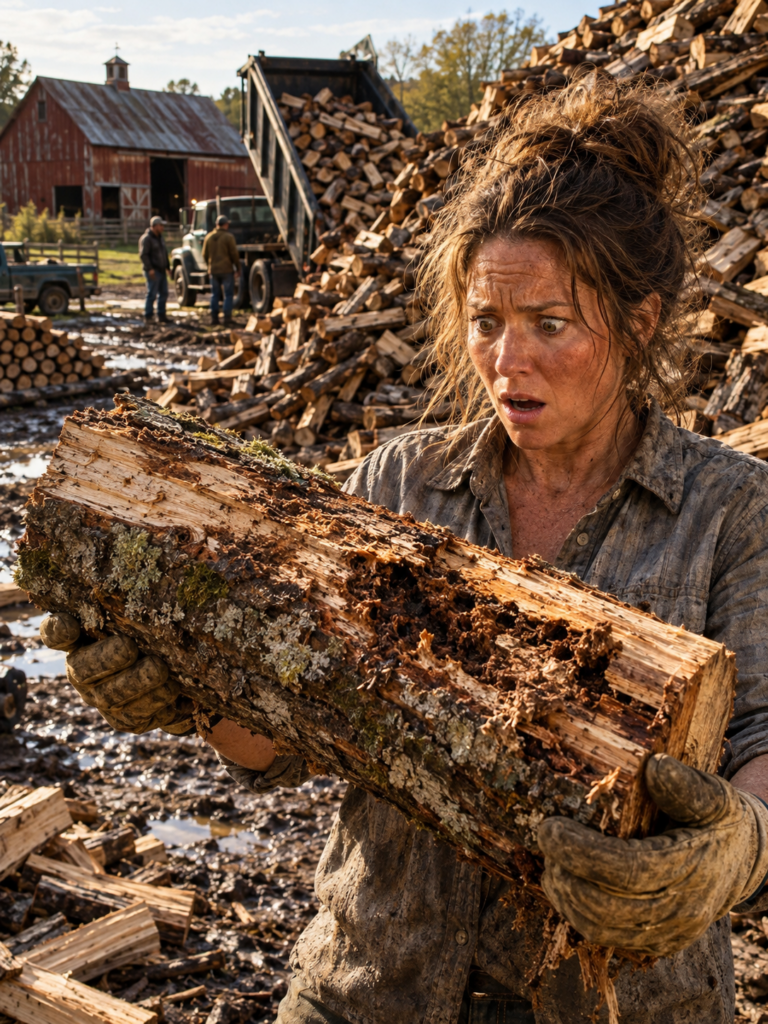
From the kitchen window of her farmhouse in rural Missouri, Mara could see the tangled mass rising above the weeds. Long, uneven slabs of wood leaned against one another at crooked angles. Some had turned silver-gray under years of summer sunlight. Others were nearly black where rainwater had collected between layers of bark and timber.
Oak. Hickory. Maple. Cherry.
Hundreds upon hundreds of pieces, all cut away from valuable logs because they were too curved, too irregular, or too rough around the edges to become ordinary lumber.
Mercer Sawmill called it waste.
Most of the people in town called it junk.
For years, Mara had thought of it as one more problem she couldn’t afford to solve.
The arrangement had begun with her father, back when the Collins farm was still a place where unexpected expenses didn’t always mean disaster.
Mercer Sawmill needed somewhere nearby to dispose of its bark-edged slabs. Her father had a low piece of ground behind the cattle barn that wasn’t being used for much. The trucks could dump there, and whenever the family needed a piece of rough lumber for a fence repair or a little extra firewood, they were welcome to take it.
At the time, it had seemed like a harmless understanding between neighbors.
Nobody had imagined the deliveries would continue for twelve years.
Her father died, but the trucks kept coming.
Years afterward, Mara lost her husband, too.
The farm didn’t become any smaller when he was gone. The fences still broke. The cattle still needed feed. Equipment still chose the worst possible mornings to fail. The bank still expected its mortgage payment, regardless of whether the livestock market had been good or bad.
And there was Caleb.
At seventeen, her son was old enough to recognize when his mother was worried, even when she thought she had hidden it.
Mara had become skilled at concealing the worst of things.
At thirty-nine, she knew how to smile while someone made a joke about her property. She knew how to tell a feed supplier she’d be back next week without revealing how much that promise frightened her. She knew which household bills could be delayed a few days and which ones would cause serious trouble if they weren’t paid.
What she didn’t know was how to make the money stretch any further.
Behind the barn, the pile of wood continued growing.
One neighbor had begun calling it the Collins Lumber Dump. Another joked that she ought to sell tickets to anyone who wanted to see the biggest heap of worthless lumber in Missouri.
Mara laughed along with them.
Then she went home to the kitchen table, pulled another bill from the drawer, and tried to decide whether she could afford what the cattle needed before paying what the bank demanded.
Removing the wood was out of the question. Hiring equipment and paying someone to haul away that much material would cost money she simply didn’t have.
So she left it where it was.
The years passed. Seasons of leaves collected between the slabs. Grass pushed through the lower edges. New truckloads covered old ones, and the mountain grew until Mara stopped noticing the sound of wood crashing onto the ground.
It was simply part of living on the Collins farm.
Then December arrived with a cold front that seemed determined to find every crack in the farmhouse.
The wind swept across the bare fields and rattled the old windows. Frost gathered along the barn doors. The cattle huddled out of the worst of the weather, and Mara spent her mornings carrying feed through air that made her fingers ache inside her gloves.
The furnace worked longer every night.
The propane gauge kept falling.
One evening, she stood beside the kitchen stove, staring at the dwindling stack of purchased firewood outside the porch.
Caleb was upstairs.
The farmhouse had grown quiet except for the furnace cycling and the occasional groan of timber as the building contracted in the cold.
Mara had already looked through the bills twice that day.
There was no extra money waiting to be found.
She turned toward the window.
Beyond the dark outline of the barn, the mountain of discarded wood stood against the winter sky.
Twelve years of slabs.
Twelve years of something she had been told was worthless.
She watched it for a long moment.
Then she pulled on her coat.
Outside, the cold struck her cheeks as soon as she stepped off the porch. She crossed the hard ground toward the barn, carrying a splitting maul.
Up close, the pile looked even less promising.
Bark hung loose from the exposed pieces. Some slabs were cracked. Others showed dark patches where moisture had remained trapped. Dead leaves had settled into narrow spaces between the wood.
Mara chose a thick piece near the outer edge and dragged it free.
It was heavy, but not damp to the touch.
She laid it across a chopping block, adjusted her grip, and brought down the maul.
The blade struck with a clean, sharp crack.
The slab split apart.
Mara stopped.
Under the gray, weather-beaten surface was a dense, dry interior, the warm brown of solid hardwood.
She bent down and picked up one of the pieces.
Then she split another.
And another.
The wood broke cleanly, revealing the same sound interior beneath the rough exterior.
She carried an armload back to the farmhouse.
Within minutes of feeding several pieces into the stove, Mara noticed the difference.
The flames took hold quickly. Heat spread through the kitchen. The dense hardwood burned steadily, producing coals that remained bright long after she had expected the fire to weaken.
She stayed beside the stove longer than necessary, watching the orange light move across the iron door.
Before sunrise the following morning, she came downstairs with a mug of coffee.
She had expected cold ashes.
Instead, red-orange coals still glowed inside the stove.
For several seconds, she stood absolutely still.
Then she looked toward the kitchen window.
The enormous heap behind the barn hadn’t changed overnight.
But something about the way Mara saw it had.
She had spent twelve years wondering how she would ever get rid of that wood.
Now she wondered what else was hidden inside it.
Over the following days, curiosity became part of her winter routine.
She still had cattle to feed and equipment to maintain. The Ford tractor had developed a hydraulic leak, and a veterinary bill from a sick calf remained on the kitchen table, waiting for money that hadn’t arrived.
But whenever the chores were finished, Mara went behind the barn.
She began pulling out slabs that had been exposed long enough to dry. She cut them into lengths that would fit the stove, split the thickest pieces, and stacked them where they would stay protected from fresh rain and snow.
It was difficult work.
Bark crumbled into her gloves. Sawdust gathered in the folds of her coat. Her shoulders ached after hours of swinging the maul.
Still, she kept going.
Soon she began noticing differences between the kinds of hardwood.
Maple caught fire readily.
Oak provided steady, dependable heat.
Hickory was especially dense, and once burning properly, it left long-lasting coals that could hold warmth through the night.
One morning, after loading the stove with hickory before bed, Mara found the fire still glowing brightly at dawn.
She stood with her coffee and watched the coals.
There was a difference between having something to burn and having good firewood.
That distinction began to occupy her thoughts.
She stopped throwing every usable piece into the same stack. Oak went in one area, hickory in another, and maple in a third. She started paying attention to which pieces were dry enough to use immediately and which needed more time.
Caleb noticed the rows appearing beside the barn.
One afternoon, he came around the corner while Mara was stacking another armload.
“How much of that stuff are you planning to burn?”
Mara looked toward the mountain.
“At the rate I’m going? Probably enough to keep me busy until I’m ninety.”
Caleb laughed.
Then he glanced toward the highway beyond the farm entrance.
“Why don’t you sell some?”
Mara kept arranging the pieces.
“Sell what?”
“The firewood.”
She gave him a look.
“Caleb, people around here can buy firewood about anywhere.”
“Maybe. But yours is already dry.”
“That doesn’t mean anybody’s going to pay for sawmill scraps.”
He picked up a split piece of oak and examined the clean interior.
“Nobody has to know where it came from. They just need wood that burns.”
Mara looked at her son.
He said it as though the answer were obvious.
Perhaps that was why the idea stayed with her.
The following Saturday, they decided to try.
They worked together behind the barn, splitting oak and hickory until they had enough for twenty bundles. Caleb helped tie them neatly, keeping the pieces roughly the same length and making sure each bundle could be carried without falling apart.
They stacked them beside the farm entrance.
For a sign, they used a piece of plywood.
DRY HARDWOOD FIREWOOD
A cash box went beneath it.
Mara stepped back and looked at their little roadside operation.
It wasn’t impressive.
There was no store, no proper business name, and certainly no advertising budget. Just twenty bundles of wood that had spent years lying behind a cattle barn.
She expected most of them to be sitting there when the sun went down.
By lunchtime, six were gone.
Mara had gone down the driveway to check the box and stood there counting the empty spaces.
Later, a couple traveling toward a nearby cabin bought four bundles.
A pickup stopped and took five more.
By late afternoon, the remaining wood had disappeared.
Mara stood beside the empty stand, holding the cash box.
Every bundle had sold.
She brought the money into the farmhouse and counted it twice at the kitchen table.
It wasn’t enough to pay the mortgage. It wouldn’t cover the feed bills or fix the tractor. But it was money earned from something that had cost her nothing to acquire.
And there was still a mountain of it outside.
The next morning, the pickup returned.
The driver didn’t ask whether she had any wood left.
He asked whether she had more hickory.
Mara looked at him for a moment.
Then she turned toward the barn.
That question changed the way she thought about the entire operation.
People weren’t merely buying whatever wood happened to be available.
Some of them knew exactly what they wanted.
Over the next few weeks, Mara began keeping a record of every sale in a worn notebook.
She wrote down the type of wood, the number of bundles, and whether the customer had purchased from her before.
Patterns emerged.
People who heated their homes with wood stoves returned for oak.
Campers preferred maple because it started more easily.
Several buyers asked for hickory by name, especially after discovering how long it could burn.
One man drove nearly thirty miles to purchase twelve bundles.
Mara could hardly believe someone would come that far for firewood.
She asked him why.
He pointed toward her hickory stack.
“The wood they sell near my place is half green. Yours actually burns.”
Mara thought about that sentence all evening.
Yours actually burns.
Not hers was cheaper.
Not hers was closer.
Hers worked.
She borrowed a moisture meter and began testing pieces from different sections of the pile.
The readings surprised her.
Much of the older wood near the exposed edges was considerably drier than freshly cut firewood being offered around the county.
Nobody had deliberately seasoned it.
Twelve Missouri summers, cold winters, and long stretches of moving air had done the work.
Not every piece was good. Some material buried deep inside had retained moisture or begun to rot. Those pieces would never belong in a customer’s stove.
But along the outside and throughout the better-ventilated sections, Mara found thousands of pieces of solid, seasoned hardwood.
The enormous pile wasn’t one uniform mass of rubbish.
It contained several different kinds of usable material.
All she had to do was separate them.
She began making individual stacks and labeling them according to the wood and its intended use.
Customers understood immediately.
Sales improved.
Then, one Tuesday morning, Dale Mercer arrived.
He owned Mercer Sawmill, the business that had been delivering slabs to the Collins property for more than a decade.
Dale was in his late fifties, broad-shouldered, with sawdust that seemed permanently worked into his clothes. His family had been cutting timber in the county for three generations, and he carried himself with the confidence of someone who had spent most of his life knowing exactly what his business produced.
He pulled his pickup beside the roadside stand and stepped out.
Twenty fresh bundles sat beneath a small wooden shelter Caleb had built.
Dale examined them, then laughed.
“You’re selling mill scrap now?”
Mara wiped her gloves against her jeans.
“People are buying it.”
Dale picked up a bundle of hickory and studied the label Caleb had printed on their home computer.
He turned it in his hands, shaking his head.
“Nobody pays real money for mill scrap.”
Mara felt the familiar sting of being dismissed.
She could have told him about the first twenty bundles disappearing in a single day. She could have mentioned the repeat customers or the man who had driven nearly thirty miles for her hickory.
Instead, she took the bundle from him and put it back where it belonged.
“We’ll see,” she said.
Dale climbed back into his truck.
After he drove away, Mara returned to her work.
She had spent too many years worrying about other people’s opinions.
What mattered now was whether the cash box kept filling.
Not long afterward, a local hunting lodge called.
The owner had purchased several bundles of her hardwood and wanted to arrange regular deliveries for six cabins.
“How much are we talking about?” Mara asked.
“Half a cord every week through February.”
She looked through the window toward the barn.
A few weeks earlier, twenty roadside bundles had seemed ambitious.
Now someone wanted a standing weekly order.
She agreed, then sat with the telephone in her hand for a moment after the call ended.
The first week almost defeated her.
She spent two days selecting slabs, cutting them to consistent lengths, and splitting the heavy pieces by hand. Caleb helped after school, but both of them were exhausted by Thursday evening.
Mara’s shoulders hurt so badly that lifting her coffee cup became uncomfortable.
She understood something important.
The wood might be free.
Her labor wasn’t.
If the business was going to grow, she couldn’t build it on the strength of her arms alone.
At a farm auction about twenty miles away, she found an old hydraulic log splitter.
Its paint was faded. Several hoses were cracked. The engine sounded rough when it started.
The owner wanted sixteen hundred dollars.
Mara had less than two thousand dollars in savings she could safely use.
She stood beside the machine, studying it.
That money was supposed to protect the farm from emergencies.
A tractor breakdown.
Another sick calf.
One bad month.
She knew what it meant to spend nearly everything she had available on a machine that might not pay for itself.
But she also knew she couldn’t keep filling larger orders by splitting every piece herself.
She negotiated the price down to fourteen hundred and fifty dollars.
Then she paid for it.
Three days later, the splitter sat behind her barn.
The difference was immediate.
Thick pieces of hickory that had taken repeated swings of the maul now split in seconds.
Mara could process more wood without exhausting herself before the day’s other work was finished.
Soon she began making the bundles more consistent.
Same approximate length.
Similar volume.
Wood separated by species.
Loose bark and dirt removed before packaging.
Customers could carry a bundle into a cabin without leaving a trail of debris behind them.
One evening, Caleb brought a printed label into the kitchen.
At the top were two words.
COLLINS HEARTHWOOD
Below them, in smaller letters:
Naturally Seasoned Missouri Hardwood.
Mara held the paper beneath the kitchen light.
It was such a small thing, just a few words printed on an ordinary sheet.
But the name looked like it belonged to a real business.
She imagined it attached to neatly stacked bundles in a store rather than hanging from the edge of a roadside sign.
For a moment, she smiled.
Then she told Caleb they would need more labels.
The next week, Mara approached the owner of a rural convenience store near a popular campground.
He agreed to take twenty bundles.
They sold in four days.
Another store ordered thirty.
The hunting lodge increased its weekly request.
By February, Mara had started keeping a separate notebook for Collins Hearthwood. She recorded revenue, equipment expenses, fuel, packaging, and delivery costs.
She wanted to know whether she was actually making money or merely staying busy.
When she totaled the numbers near the end of winter, she sat for a long time looking at the page.
The business had brought in several thousand dollars.
Enough to cover the splitter.
Enough to help with the heating bills.
Enough to make the next purchase or repair seem less frightening.
Outside, the towering pile behind the barn still looked almost untouched.
Mara closed the notebook and went to the window.
She had once prayed for a way to make that mountain disappear.
Now she was beginning to think she might need it to stay.
Part 2
Spring arrived with soft ground, wet fence posts, and the familiar work of keeping a Missouri cattle farm running.
For Mara, the change in seasons should have meant a quieter firewood business.
Instead, Collins Hearthwood kept receiving orders.
The convenience stores wanted more bundles. The hunting lodge still needed dependable deliveries. Customers who had purchased wood during the coldest weeks of winter were returning to ask what would be available the following season.
Mara had survived the first rush.
Now she needed to understand what she had built.
Whenever the farm work allowed, she walked through the enormous slab pile with a notebook, work gloves, and the borrowed moisture meter.
She began by identifying species.
Oak was everywhere. Maple appeared in long sections. There was more hickory than she had expected, and scattered among the larger stacks were smaller amounts of cherry.
But the longer she studied the pile, the more she realized that identifying the trees was only part of the problem.
The age and condition of the wood mattered just as much.
Some slabs near the outer edges had dried for years. Others, trapped beneath more recent deliveries, were still damp. Pieces touching the ground had sometimes begun to decay.
Mara started marking separate areas in her notebook.
Usable now.
Season later.
Reject.
It was a simple system, but it changed everything.
She no longer looked at the mountain and saw one enormous quantity of wood. She saw different materials at different stages of usefulness.
Then another Mercer Sawmill truck arrived.
Mara was standing near the barn when the driver backed toward the dumping area.
The hydraulic bed rose.
Several tons of new slabs slid backward, crashed against the old pile, and sent loose bark scattering across the ground.
For years, she had heard that noise without giving it much thought.
This time, she watched every piece fall.
She realized that some of those fresh slabs would eventually become the same kind of dry hardwood she was already selling.
And Mercer was still delivering them.
A few days later, she drove to the sawmill.
She stood near the edge of the yard, watching its ordinary work unfold.
Logs entered the cutting operation. Straight boards were separated from the rough outer portions. Bark-edged slabs accumulated beside the production area, waiting to be removed.
Every useful board produced material the mill didn’t want.
That material occupied space.
Someone had to move it.
Someone had to haul it away.
For twelve years, the Collins farm had been receiving it.
Driving home, Mara began to see the old arrangement differently.
She had always assumed Mercer was doing her family a favor by allowing them to take occasional pieces from the discarded wood.
But the farm had been doing something for the sawmill, too.
It had been providing a convenient place for Mercer to put an endless stream of unwanted material.
That evening, Mara opened her notebook.
On one page, she wrote:
Old inventory.
Underneath it:
New material — process — season — sell.
She drew a line between the two.
For the first time, she understood that the old mountain was not simply a one-time opportunity.
As long as sawmills cut hardwood logs, there would be irregular slabs left over.
And as long as customers needed dependable firewood, somebody could turn suitable slabs into a product worth buying.
The question was whether she could become that somebody on a larger scale.
Using part of her winter earnings, Mara built three simple covered storage bays.
Incoming material had one place.
Wood waiting to be cut or seasoned had another.
Finished firewood was stacked off the ground, protected from rain but exposed to circulating air.
The improvement wasn’t particularly impressive to look at.
The roofs were plain. The racks were practical. The space behind the barn still smelled of bark, damp earth, and sawdust.
But Mara knew where everything belonged.
One afternoon, Tom Avery stopped to purchase several bundles.
He watched her moving between the storage bays and looked toward the old pile.
“You know what you’ve got back there?”
Mara glanced over her shoulder.
“A mess?”
Tom shook his head.
“Inventory.”
Mara smiled.
Inventory.
It sounded like something a person might find in a lumberyard or warehouse, not an ugly heap behind a cattle barn.
But that was exactly what it had become.
By autumn, Collins Hearthwood had changed visibly.
Mara no longer offered only bundles marked dry firewood.
She had developed products around the needs customers had shown her.
Oak became premium heatwood for households relying on wood stoves.
Hickory was packaged for customers who wanted dense, long-burning hardwood.
Maple and selected lighter hardwoods became a campfire mix.
Cherry was included in a smaller fireplace blend aimed at cabin owners and customers who wanted an attractive, comfortable fire as much as practical heat.
Each bundle was labeled.
Each was made to a consistent size.
Finished firewood was kept dry and raised off the ground.
The wood hadn’t changed in any mysterious way.
Mara had simply learned to handle it with greater care.
Retailers began taking notice.
The convenience store that had first agreed to twenty bundles now ordered regularly.
A campground stocked Collins Hearthwood alongside charcoal and bags of ice.
Two cabin rental operators began leaving bundles beside outdoor fire pits and offering additional wood to their guests.
Then a hardware store manager called after seeing the bundles at another location.
He wanted to try selling an entire pallet.
Mara accepted the order.
Only after she hung up did she calculate how much labor it would require.
She needed help.
Tom Avery had a nephew named Luke who was looking for part-time work.
Luke already knew his way around farm equipment, and Mara hired him to help cut slabs and move finished firewood three afternoons a week.
A month later, she brought in another local worker for Saturdays.
The difference reached far beyond how many bundles they could produce.
For the first time since her husband’s death, Mara could look across the barnyard and see someone else handling work she once would have had to finish alone.
She still supervised production.
She still worried about bills.
But she no longer had to carry every log, load every trailer, or complete every task with her own hands.
One cold November morning, Mara stepped outside and watched the operation.
Luke was loading bundles onto a trailer.
Caleb stood nearby applying labels.
The hydraulic splitter worked steadily behind the barn.
Pallets of finished firewood waited under cover, and an order sheet hung where everyone could see what needed to be delivered next.
The routine had become familiar.
Cut.
Split.
Sort.
Bundle.
Deliver.
Mara listened to the splitter for a moment and remembered the silence of the previous winter, when she had been the only one outside trying to keep enough wood beside the porch.
Collins Hearthwood hadn’t made the farm wealthy.
But the family was no longer relying entirely on cattle for income.
By December, the business supplied seven retail locations.
Some customers drove directly to the farm because they trusted the name on the label.
And gradually, Mara began to see patches of ground behind the barn that had been covered for years.
The mountain was shrinking.
Not quickly enough for a stranger to notice at first glance.
But she noticed.
Every cleared patch represented wood that had been cut, packaged, sold, and delivered.
Then, one evening, a black pickup appeared in the driveway.
Dale Mercer climbed out.
He looked past Mara toward the storage bays, the hydraulic splitter, the loaded trailer, and the rows of firewood waiting to be shipped.
For a while, he said nothing.
He picked up a bundle and examined the printed label.
Then he looked at the price.
“You’re charging this much?”
Mara nodded.
“And people pay it.”
Dale glanced toward the workers.
“How much of this stuff are you selling?”
“Enough to keep us busy.”
He studied the pallets again.
This time, he didn’t laugh.
Mara watched his expression change and understood that he was seeing more than bundled firewood.
He was seeing a business built around something his sawmill had spent years throwing away.
A week later, Dale called.
Mercer Sawmill would no longer deliver fresh hardwood slabs to the Collins farm free of charge.
Mara had suspected the conversation would happen eventually.
She had no objection to paying a fair price for usable material.
“I’ll pay something reasonable,” she told him.
Dale named his price.
Mara frowned.
She asked him to repeat it.
The amount was several times higher than she believed unprocessed mill residue was worth.
Worse, Dale wanted payment for every load, regardless of how much usable hardwood it actually contained.
Rotten pieces, excess bark, unsuitable species—it would all be charged the same way.
“That doesn’t work for me,” Mara said.
“You’ve been getting it free for twelve years.”
“Because you needed somewhere to put it.”
Dale reminded her that the wood belonged to Mercer Sawmill before it was delivered.
Mara agreed.
She wasn’t disputing ownership of the fresh slabs.
She was disputing the price.
There was a difference between a truckload of irregular, unprocessed wood and a finished product that customers trusted enough to purchase again.
She had spent long days learning that difference.
Dale seemed determined to ignore it.
The conversation ended without an agreement.
Three days later, the trucks stopped arriving.
For a while, the change was almost invisible.
The old slab mountain remained behind the barn. Finished bundles continued leaving the farm. Luke kept working. Caleb kept applying labels.
But the news spread through town.
At the feed store, someone asked Mara whether Collins Hearthwood was in trouble.
A retailer called to make sure his winter orders would still arrive.
That evening, Caleb found his mother reviewing her records.
“What happens when we run out?”
Mara looked up.
She had been asking herself the same question.
She turned toward the window, where the old pile rose above the barnyard.
“We’re not running out tomorrow.”
But she knew that wasn’t enough of an answer.
After Caleb went upstairs, Mara spread her notebooks across the kitchen table.
She calculated the number of bundles they were producing each week.
She compared those figures with recent orders, estimated waste percentages, and the amount of usable wood that remained.
Then she put on her coat, took a flashlight, and went outside.
For hours, she walked around the pile, measuring sections and checking the material beneath the outer layers.
The night grew colder.
Her flashlight moved across cracked bark and stacks of gray hardwood.
She kept writing numbers.
Well past midnight, she finally returned to the kitchen.
The following morning, she checked her calculations again.
The result relieved her.
Even at the current production rate, she estimated the usable older hardwood could keep Collins Hearthwood running for more than a year.
Much of it was better seasoned than anything Mercer would have delivered fresh.
Dale had assumed stopping the trucks would force Mara to accept his terms.
He had overlooked what twelve years of dumping had already provided.
Time.
Mara didn’t know exactly how long the reserve would last as orders increased.
But she knew it gave her enough breathing room to find another source.
She began calling other sawmills.
The first wasn’t interested.
The second already had someone buying its residue.
At the third, the owner seemed surprised by her proposal.
“You’ll haul the slabs yourself?”
“If the price makes sense.”
“All of them?”
“The usable hardwood. We can work out the details.”
The man paused.
“When can you start?”
That conversation opened a door Mara had previously been too dependent on Mercer to see.
Within six weeks, she arranged supplies from three smaller sawmills within practical hauling distance.
Two charged modest prices.
The third was pleased to have suitable material removed on a regular basis.
Mara didn’t need any one of them to replace Mercer entirely.
Together, they offered something more valuable than a single supplier.
Options.
Meanwhile, Mercer Sawmill’s unwanted slabs began piling up in its own yard.
Without the Collins farm receiving regular deliveries, Dale had to dedicate space to the material or pay to have it taken elsewhere.
One afternoon, Mara drove past the mill.
Behind the main building, a new mountain of hardwood was growing.
She slowed her truck.
For twelve years, she had been embarrassed by a pile that looked exactly like that.
Now hers was getting smaller, and Dale’s was getting bigger.
She continued down the road without stopping.
There were orders waiting at the farm.
The following months were full of work.
Mara became stricter about separating old, seasoned wood from fresh slabs that needed time under the storage roofs.
She marked piles by age and condition, checked moisture levels, and kept the driest material moving toward production.
She also began visiting potential retail customers before winter arrived.
Campgrounds.
Cabin operators.
Hardware stores.
Convenience stores.
Farm supply shops.
She carried sample bundles in the pickup and explained what Collins Hearthwood offered.
Dry hardwood.
Consistent sizes.
Clearly identified products.
Reliable delivery.
That last promise proved especially valuable.
Plenty of people could cut and sell firewood.
Fewer could tell a store manager that fifty bundles would arrive on Friday and make certain all fifty were there.
Mara began building the business around keeping her word.
By October, Collins Hearthwood was selling in two neighboring counties.
She added another hydraulic splitter and bought a used conveyor to help move wood through production.
Caleb built additional storage racks from salvaged lumber.
During busy periods, Luke brought his brother in to help.
The barnyard grew crowded with pallets, trailers, packaging, and stacks of incoming slabs.
Mara still remembered the early days when it had been only her and Caleb working beside the barn.
Now she sometimes had to raise her voice just to be heard over the equipment.
Then winter arrived early.
A powerful cold front settled over Missouri.
Phone calls multiplied.
Retailers that normally ordered forty bundles asked for eighty.
Cabin operators wanted reserve supplies.
Customers with wood stoves drove to the farm in pickups and trailers.
Commercial orders that once would have taken Mara days to fill became ordinary entries on the weekly schedule.
For ten days, the splitters barely rested.
Mara started before sunrise.
Some evenings, she finished long after dark.
Her gloves stayed wet. Her shoulders ached. Orders covered a wall of the barn, and the smell of fresh-cut hardwood clung to her clothes.
One night, she stood alone beneath those papers.
There were so many names.
So many deliveries.
So many people expecting her to produce exactly what she had promised.
A familiar pressure tightened in her chest.
She remembered sitting at the kitchen table with overdue bills, calculating which debt could wait and which creditor might call first.
Back then, the numbers had seemed impossible.
Now the numbers were bigger.
For a moment, she felt the same old fear.
Then she looked out through the barn doors.
Luke was loading a trailer.
Caleb was checking finished bundles.
Another customer waited to pay.
The difference became clear.
In the old days, people had been waiting for money she didn’t have.
Now customers were waiting to give her money for something her family had learned to produce.
Mara rubbed her tired hands together and returned to work.
By the end of that winter, Collins Hearthwood was supplying fourteen retail locations, along with cabin properties, commercial customers, and a growing list of people purchasing directly from the farm.
What had begun as individual bundles had become pallets and trailer loads.
Repeat orders now formed the foundation of the business.
One evening, Mara sat at her kitchen table and totaled the year’s revenue.
She stared at the result.
Then she calculated it again.
And once more.
More than two hundred and fifty thousand dollars.
She leaned back in her chair.
The number was larger than anything she had imagined when Caleb first suggested selling firewood beside the highway.
But her eyes eventually moved away from the business records.
Across the table sat an envelope from the bank.
Inside was the remaining balance on the farm loan.
For years, that debt had followed Mara through every difficult season.
It had been there after her father died.
It had remained after she buried her husband.
It had been waiting through tractor repairs, veterinary emergencies, poor cattle prices, and cold winters when she wasn’t sure how to keep the house warm.
Now, for the first time, she had enough money available to end it.
After accounting for the business’s obligations, she arranged the final payment.
Weeks later, the confirmation arrived.
PAID IN FULL.
Mara carried the letter behind the barn.
She stood where the old mountain had once reached almost to the roofline and looked toward the open ground appearing beneath it.
She read the words again.
The farm was paid for.
Her father had worked that land.
She and her husband had tried to keep it going.
She had spent years fearing that one more unexpected expense might finally take it away.
Mara pressed the paper against her chest.
Her eyes filled.
There was nobody standing beside her to hear what she might have said.
Only the wind, the cattle moving beyond the fence, and the familiar sound of the wood splitter working in the distance.
She looked toward the remaining slabs.
For twelve years, she had wished that mountain would disappear.
Now she understood that it had helped save the place she loved.
And yet, as she watched the workers preparing another delivery, she also knew something else.
The old mountain was disappearing faster than ever.
If Collins Hearthwood was going to survive, Mara would have to build a future that didn’t depend on it.
Part 3
The year Collins Hearthwood passed two hundred and fifty thousand dollars in revenue was the year Mara finally stopped thinking of the business as something she had built to escape financial trouble.
It was a business that other people now depended on.
Luke needed his wages.
The part-time workers needed theirs.
Retailers had promised customers that Collins Hearthwood would be available through the winter.
Cabin operators counted on regular deliveries.
And Caleb, who had been there when the first twenty bundles were tied together beside the barn, had watched the operation grow into something much larger than either of them had imagined.
Mara knew she couldn’t afford to become careless simply because the mortgage was gone.
The old mountain was shrinking.
Its disappearance no longer frightened her the way Dale Mercer’s decision to stop delivering wood once had.
But it reminded her of something important.
An enormous reserve could give a business time.
It couldn’t provide raw material forever.
Mara began visiting the smaller sawmills that had helped keep Collins Hearthwood operating after Mercer stopped its deliveries.
This time, she wasn’t simply asking whether they had slabs available.
She wanted dependable arrangements.
She discussed regular pickup schedules, acceptable wood species, pricing, and the condition of the material.
The mills benefited from having someone collect residue that would otherwise occupy valuable yard space.
Collins Hearthwood benefited from predictable access to usable hardwood.
They worked out written supply agreements.
Mara made certain no single mill would become her exclusive source.
She had learned what happened when one supplier believed it could dictate every term of a relationship.
She had no intention of learning that lesson twice.
Back at the farm, she tightened production standards.
Fresh hardwood went into designated seasoning areas.
Rotten material was rejected.
Oak, hickory, maple, and cherry were separated according to how they would be processed and sold.
She purchased additional moisture meters so workers could check wood before it was packaged.
The finished bundles were inspected more carefully.
It cost time to maintain those standards.
Sometimes it meant holding back a batch that could have been sold sooner.
But Mara knew why customers kept returning.
They trusted what was printed on the label.
If the wood was supposed to be dry, it needed to be dry.
If a retailer ordered fifty bundles, fifty acceptable bundles needed to arrive.
There was no point building a recognized name if she allowed careless work to destroy it.
The business continued growing.
Then an opportunity arrived that made even the hardware store’s first pallet order seem small.
A buyer from a regional outdoor products distributor contacted Mara.
The company supplied retailers across Missouri and parts of neighboring states.
Its buyer had seen Collins Hearthwood at several campgrounds and wanted to discuss larger shipments.
Could she supply firewood by the pallet?
Not twenty bundles.
Not fifty.
Commercial quantities on a dependable schedule.
Mara stood at the office window looking across the barnyard while she listened.
The conveyor was moving split wood toward the sorting area. Finished pallets stood beneath the storage roof. A trailer waited for another delivery.
A few years earlier, the whole operation had consisted of a plywood sign and a cash box.
Now someone was considering moving her firewood beyond the county, into stores where customers had never heard of Mara Collins or Mercer Sawmill.
She could have said yes immediately.
There had been a time when she would have accepted any order simply because turning down money seemed impossible.
Instead, she told the buyer she needed to review her production capacity.
For three evenings, the kitchen table disappeared beneath spreadsheets, notebooks, and order records.
Mara calculated labor costs.
Packaging.
Fuel.
Transportation.
Raw material.
Storage.
The number of bundles the crew could process without sacrificing quality.
She studied what would happen if she accepted more than they could produce.
A large customer could help Collins Hearthwood grow.
It could also damage the business if she made promises she couldn’t keep.
Finally, she proposed a limited contract.
Enough volume to test the relationship.
Not so much that one order could overwhelm the farm.
The distributor accepted.
On a gray November morning, the first commercial truck arrived.
Mara stood near the loading area as pallet after pallet of Collins Hearthwood disappeared into the trailer.
Workers checked the shipments against the order sheets.
Caleb stood beside his mother, watching the forklift and the loaded pallets.
“Remember our first sign?” he asked.
Mara laughed.
“Hard to forget.”
“Twenty bundles.”
“And a cash box.”
“We didn’t even know if anybody would stop.”
“No,” Mara said. “We didn’t.”
The truck doors closed.
Soon, Collins Hearthwood would be leaving the county in quantities she once couldn’t have imagined producing.
Mara watched the truck pull away.
She was proud of what they had built.
But she understood that the real accomplishment wasn’t sending one large shipment.
It was creating an operation that could send the next one, and the one after that, without depending on a lucky break.
Several miles away, another business was dealing with a problem of its own.
Mercer Sawmill was still cutting hardwood logs.
Every working day produced more slabs.
Some of the residue could be sold cheaply. Other portions required handling, storage, or hauling.
Without the Collins farm accepting most of the material, the mill had been forced to deal with an increasingly inconvenient pile.
Space that could have been used for ordinary operations was being occupied by unwanted wood.
Disposal wasn’t free.
And the longer the situation continued, the more expensive the old problem became.
Eventually, Dale Mercer called.
“I think we should talk.”
Mara had been expecting it.
Two days later, Dale arrived at the farm with a proposed contract.
He sat across from her at the same kitchen table where she had once sorted overdue bills.
His offer gave Collins Hearthwood regular access to hardwood slabs from Mercer Sawmill.
In exchange, he wanted a long-term agreement at a price considerably higher than Mara was paying her other suppliers.
The contract also favored Mercer in several important provisions.
Mara read through the pages without interrupting him.
Years earlier, the sight of an agreement like that might have frightened her into signing.
She would have worried about losing access to the wood.
She would have imagined the employees without work, the retailers without deliveries, the farm sliding backward into debt.
Now she had three other mills supplying material.
She had organized inventory, established customers, trained workers, and dependable production equipment.
She knew exactly what Mercer Sawmill was offering.
And she knew what it was worth.
She closed the contract.
“I can’t sign this.”
Dale frowned.
“You know what my hardwood is worth now?”
Mara rested a hand on the papers.
“I know what finished firewood is worth.”
“It’s the same wood.”
“No, Dale. It isn’t the same product.”
She turned slightly toward the window.
Outside, Luke was working near the sorting area.
“Your slabs are where the process starts. Somebody still has to haul them here, sort them, throw out the rotten pieces, season the fresh wood, cut it, split it, check the moisture, package it, and deliver it.”
Dale remained quiet.
“And if a customer gets bad firewood, we’re the ones who have to make it right.”
Mara looked back at him.
“That’s what Collins Hearthwood does.”
She wasn’t angry.
That surprised her.
There had been a time when Dale’s laughter at her roadside stand had hurt more than she wanted to admit.
There had been another time when his decision to stop delivering wood had frightened her badly enough to keep her awake with a calculator and flashlight.
But she wasn’t standing in either of those moments anymore.
She knew her business.
She knew her costs.
And she knew she didn’t need to accept an unfair contract.
Mara placed her own proposal on the table.
Collins Hearthwood would agree to regular pickups of selected hardwood slabs.
Payment would be based on usable material.
Loads containing excessive rot, unsuitable species, or unacceptable waste could be rejected.
Mercer would receive a guaranteed minimum pickup volume.
But the contract would not prevent Collins Hearthwood from purchasing wood elsewhere.
Dale read the proposal.
Then he read it again.
“You want to inspect my waste before you buy it?”
Mara held his gaze.
“I want to inspect my raw material before I buy it.”
The kitchen grew quiet.
Outside, equipment continued running.
For twelve years, Mara had accepted whatever the sawmill trucks left behind her barn.
Now she was explaining the conditions under which she would accept another load.
Dale folded the proposal.
He didn’t sign.
When he drove away, Mara watched his pickup disappear beyond the farm entrance.
She stood beside the window for a moment.
Then she returned to her work.
The next morning, nothing fell apart.
The other mills continued supplying slabs.
Employees continued producing bundles.
Retail deliveries went out on schedule.
The distributor requested another shipment.
Collins Hearthwood kept operating exactly as it had before Dale’s visit.
Three weeks later, the telephone rang.
It was Dale.
His yard was filling with slabs faster than he had expected.
A disposal company had increased its hauling rate.
The accumulating material was beginning to occupy space Mercer needed for its normal operations.
Dale wanted to discuss Mara’s proposal again.
The second negotiation took less than an hour.
They adjusted the price.
Mara agreed to a minimum pickup volume.
Dale accepted her inspection and rejection standards.
He also accepted that Mercer Sawmill would never become Collins Hearthwood’s exclusive supplier.
This time, they signed.
Several days later, a black Mercer truck returned to the Collins farm.
It backed toward the designated raw-material area.
But the driver didn’t immediately raise the hydraulic bed.
Luke approached the truck and inspected the load.
He checked the hardwood, its condition, and the visible material mixed among the slabs.
Only after he finished did he look toward Mara and nod.
Mara signaled the driver.
The hydraulic bed began rising.
Several tons of hardwood slabs slid backward and crashed onto the ground.
The sound echoed against the barn.
Mara recognized it instantly.
She had heard that same crashing noise for twelve years.
When she was younger, it had meant another load of junk.
After her father’s death, it had meant another problem she couldn’t afford to remove.
During the worst financial years, it had been one more reminder of how little control she seemed to have over the farm.
Then it had become firewood.
And then a business.
Now the material arrived under a written contract, at an agreed price, after being inspected by one of her employees.
The sound hadn’t changed.
Everything around it had.
Mara smiled as the truck lowered its bed.
She had never needed Dale to admit that he had underestimated her.
She only needed to understand the value of what she had built.
The next major milestone came quietly.
There was no celebration waiting in the barn.
No crowd gathered around the farmhouse.
It was after midnight when Mara sat at her computer, reviewing the latest financial reports.
The screen showed the year’s total revenue.
$420,000.
She stared at it.
Then she looked away.
For a moment, she wondered whether she had entered something incorrectly.
She checked the report again.
Four hundred and twenty thousand dollars in annual revenue.
Not profit.
Mara understood that distinction better than almost anyone who might have heard the number.
Employees needed to be paid.
Fuel and packaging cost money.
Equipment required maintenance.
Trucks needed repairs.
Insurance, transportation, raw materials, and taxes consumed substantial portions of what the business earned.
Growth brought opportunities, but it also brought expenses and responsibilities.
Still, the number meant something.
Mara leaned back in her chair.
She looked toward the old kitchen drawer where she had once kept bills she didn’t want to open.
She could remember sitting at that same table, moving amounts between columns, trying to decide which payment could be delayed without making the situation worse.
She remembered the veterinary bill.
The tractor repair.
The propane gauge falling in the middle of winter.
She remembered feeling as though the farm might be lost because of one more problem she couldn’t afford to solve.
Now the computer screen held payroll records, supplier contracts, delivery schedules, and inventory reports.
It was a different kind of responsibility.
Sometimes exhausting.
Sometimes frightening.
But there was a difference between fearing that everything might be taken from her and managing something she had built through years of work.
Mara closed the report.
For a while, she simply sat at the table.
If she could have spoken to the woman who had stood outside with a splitting maul that cold December evening, she wouldn’t have promised her an easy life.
It hadn’t been easy.
She wouldn’t have promised that every business decision would turn out well.
Some hadn’t.
She wouldn’t have said fear would disappear.
It never completely did.
But she would have wanted that exhausted woman to know that the next effort mattered.
That the first small success mattered.
That a single good idea, followed by another day of difficult work, could eventually change the direction of an entire life.
Outside, Collins Hearthwood had grown far beyond the little operation beside the barn.
The original hydraulic splitter that Mara had purchased for fourteen hundred and fifty dollars still worked alongside newer machinery.
A conveyor moved split wood into sorting areas.
Covered sheds protected seasoned inventory.
Pallets stood beneath loading roofs.
Trucks arrived from several sawmills and departed with finished products for stores, campgrounds, cabin operators, and commercial customers across the region.
Several local families now received part of their income from the business.
The farm itself had changed, too.
Mara repaired the barn roof that had leaked for years.
Damaged fences were replaced instead of being patched endlessly.
Equipment could be serviced before a minor problem became an expensive failure.
And the mortgage was gone.
That last fact sometimes still surprised her.
Occasionally, Mara woke before sunrise with the old familiar worry already forming.
What bill is waiting?
Then she remembered.
The farm belonged to her family.
No bank payment stood between them and keeping the land.
One afternoon, she walked behind the barn and stopped.
For the first time in more than a decade, she could see almost the entire back wall.
The old mountain was nearly gone.
Only organized stacks of incoming material remained in the areas designated for raw wood.
Bare ground stretched across places that had been buried since Caleb was a small boy.
Mara walked slowly over the cleared space.
The ground was uneven where the slabs had rested for years.
She remembered the first winter night she had dragged out a weathered piece of wood because she couldn’t afford enough heating fuel.
She remembered splitting it open and finding solid hardwood beneath the gray surface.
She remembered the first twenty bundles, the empty roadside stand, and the cash box she had counted twice.
She remembered Dale laughing.
Then she remembered the telephone call when he stopped the deliveries.
The late-night calculations.
The flashlight moving across the old pile.
The first new supply agreements.
The letter from the bank stamped paid in full.
And finally, the number on her computer.
Four hundred and twenty thousand dollars.
For a while, she had believed that reaching a number like that would be the greatest accomplishment of her life.
Now, standing on ground she had once wanted desperately to clear, she realized that what mattered most couldn’t be measured by annual revenue.
It was the freedom to repair a fence without wondering whether the expense would cost her the farm.
It was knowing the cattle could be fed.
It was seeing Caleb grow up without the constant fear of losing the place his family had worked for generations.
It was knowing that other people now earned wages from something she had once been embarrassed to have behind her barn.
Caleb found her standing there that evening.
He looked across the cleared ground, then toward the storage bays.
“You know what’s strange?”
“What?”
“I almost miss that mountain.”
Mara laughed.
For a moment, she considered his words.
The pile had been there for so much of his childhood that its absence made the farm look unfamiliar.
She looked across the barnyard, where the crew was finishing another shipment.
“No,” she said softly. “I don’t miss it.”
Then she smiled.
“But I’m glad it was here.”
One Saturday morning in early autumn, Mara carried a single hardwood slab into the barn.
It was an ugly piece.
The surface was faded gray. Rough bark clung to one side, and deep cracks ran along its length.
She had found it near the bottom of what remained of the original pile.
Judging by where it had been buried, it might have been among the earliest pieces Mercer Sawmill delivered to the farm.
There was nothing particularly valuable about it.
She could have cut it, split it, and bundled it with the rest.
Instead, she carried it to the workbench.
Caleb came inside and found her studying the slab beneath the lights.
“What are you doing with that?”
“Keeping it.”
He looked at the rough piece of wood.
“For what?”
Mara glanced toward the open barn doors.
Beyond them, the storage bays were full of material waiting to be processed.
Employees were sorting oak and hickory.
A truck had arrived from one of the smaller mills, and Luke was checking the load.
Finished pallets stood beneath cover, ready to leave for customers throughout the region.
Mara looked back at Caleb.
“I think it belongs here.”
Together, they mounted the slab high on the barn wall.
Caleb reached for sandpaper.
Mara stopped him.
“Leave it the way it is.”
He looked at the rough bark and deep cracks.
“You’re sure?”
“I’m sure.”
She wanted the gray surface to remain.
She wanted the uneven edges.
She wanted to remember what the wood had looked like when she believed it was worthless.
The slab stayed above the workbench.
Workers passed beneath it.
Orders were filled.
Trucks arrived and departed.
As the months went by, the business continued its ordinary routines.
Collins Hearthwood no longer depended on the mountain that had once stood behind the barn.
It no longer depended on Mercer Sawmill.
And it no longer depended entirely on Mara’s ability to work from dawn until dark.
The business had become something other people could help operate, something with systems and standards and relationships that extended beyond her own two hands.
Sometimes, Mara thought that was the strangest accomplishment of all.
The first night had begun with a cold farmhouse and one woman swinging a splitting maul.
Now the same idea helped support several families.
Months later, Dale Mercer came to discuss the following year’s supply schedule.
He and Mara reviewed the arrangements, talked about projected pickup volumes, and settled the practical details.
Before leaving, Dale noticed the old slab mounted above the workbench.
He stood beneath it for a moment.
“You saving that for something?”
Mara followed his gaze.
“I already used it.”
Dale looked at her.
Then he looked toward the open doors.
Outside, workers moved finished firewood onto pallets. Bundles carrying the Collins Hearthwood label waited in neat rows. The sound of a hydraulic splitter carried through the building.
Dale looked back at the slab.
For most of his life, he had seen the curved, bark-edged pieces produced by his sawmill as the part of a log that couldn’t become something useful.
They couldn’t become straight boards.
They weren’t suitable for ordinary lumber orders.
They occupied space and cost money to remove.
Mara had looked at the same material and eventually found a different purpose for it.
First, it had kept her farmhouse warm.
Then it had become twenty roadside bundles.
Those bundles had become repeat customers.
The customers had become retail accounts.
The accounts had become employees, equipment, storage buildings, and supplier contracts.
And together, all of it had become Collins Hearthwood.
Dale looked at the old piece of timber one more time.
Then he nodded and walked outside.
Mara remained beneath the slab.
She thought about her father allowing the first trucks onto the property.
She thought about her husband, the years they had worked together, and how lonely the farm had seemed after he was gone.
She thought about Caleb as a little boy, when the mountain had already been growing behind the barn.
She remembered laughing at jokes about the Collins Lumber Dump because admitting how badly they hurt would have meant admitting how frightened she was.
She remembered that December evening when she had finally walked outside and split open a weathered slab.
It had been such a small decision.
She hadn’t been trying to start a company.
She hadn’t been dreaming about hundreds of thousands of dollars in sales.
She had been trying to keep the house warm.
Mara reached up and rested her fingers against the rough wood.
She didn’t regret leaving the slab exactly as she had found it.
The cracks were part of its history.
So was the bark.
So was the weathering that had made it look unimportant.
She stepped back and looked at it one last time before switching off the workbench lights.
Outside, the sun was beginning to set.
The day’s final work was winding down.
Mara walked beyond the barn to the western edge of the cleared ground.
For the first time in twelve years, nothing blocked her view of the field.
Warm autumn light stretched across the earth where hundreds of tons of unwanted hardwood had once stood.
The ground was quiet now.
She could see the fence line.
Beyond it lay the fields her family had struggled so long to keep.
Mara stood there for several minutes.
For years, she had looked at the mountain behind the barn and asked herself how she would ever get rid of it.
She had never considered that the better question might be what she could make from it.
She couldn’t change the losses that had brought her to that cold December night.
She couldn’t bring back her father or her husband.
She couldn’t erase the years when every bill felt like a threat.
But she had kept the farm.
Caleb still had a home.
Other families had steady work.
And the old pile of unwanted hardwood had helped build something that would continue long after the last original slab was gone.
Mara watched the evening sunlight move across the open field.
Then she turned toward the farmhouse, its windows glowing softly against the approaching darkness.
The place was still hers.
After everything, that was enough.
She smiled and started walking home.
Behind her, the barn stood against the Missouri sky, with one weathered slab mounted high on its wall.
A reminder that sometimes the difference between waste and something valuable isn’t the material itself.
It’s the person who finally sees what it can become.


