
Part 1
On the morning Elizabeth Thorne turned eighteen, her mother did not wish her a happy birthday.
Her father did not look up from his breakfast.
And by the following Thursday, they had packed their belongings, sold the family farm, and left their only daughter standing beside a dirt road with three silver dollars and nowhere to sleep.
But what happened to Elizabeth after she walked into the Montana mountains would become a story the people of Garnet Creek would tell their grandchildren for generations.
It began in the autumn of 1888, in a narrow valley of western Montana where the Bitterroot Mountains rose above fields of yellow grass and scattered pine.
Elizabeth was born during a cold October rain.
Her father, Jonathan Thorne, had been hoping for a son.
He owned eighty acres of rocky farmland, a weather-beaten barn, and a herd of dairy cows that never produced quite enough milk to satisfy him. The farm required constant work, and Jonathan believed that children were valuable primarily for the labor they could provide.
When the midwife announced that the baby was a girl, he merely nodded.
“Well,” he said, “I suppose she’ll be some help around the house.”
Elizabeth’s mother, Mary, said nothing.
Mary had once dreamed of leaving Montana and living in a fine house somewhere back east. She kept a little trunk in the attic filled with silk ribbons, old fashion magazines, and letters from relatives in Philadelphia.
Sometimes Elizabeth found her mother looking through those things with an expression she could not understand.
It was the look of someone remembering a life that had never happened.
Elizabeth learned early that she was not the daughter her parents had imagined.
By six, she carried water from the pump.
By eight, she gathered eggs, washed laundry, and helped her mother preserve vegetables for winter.
At twelve, she could milk a cow, mend a torn dress, and prepare supper while her parents worked in the fields.
She rarely complained.
Complaining only brought her father’s sharp disapproval.
“There’s no profit in whining,” Jonathan would say.
Her mother had another expression.
“Be grateful you have a roof over your head.”
Elizabeth was grateful for the roof.
She simply wished the people living beneath it had been kinder.
At the far edge of the property, where the hayfield ended and the pines began, stood a small cabin built from lodgepole logs and riverstone.
That was where Angus Thorne lived.
Angus was Jonathan’s father, a widowed carpenter with a thick gray beard, broad shoulders, and hands permanently marked by decades of work.
He had built the cabin himself after his wife died.
He preferred the smell of sawdust to the smell of Jonathan’s sour moods.
And from the time Elizabeth could walk, she had been welcome there.
The cabin contained only one large room, a stone fireplace, a narrow bed, and a workbench beneath the south-facing window.
Tools hung neatly along the wall.
There were hand saws, planes, chisels, augers, measuring squares, and wooden mallets worn smooth by use.
To Elizabeth, it was the most wonderful place in the world.
One afternoon when she was six, Angus found her standing in the doorway watching him shape a piece of maple.
“You planning to stay there all day, little bird?”
She nodded.
“Would you like to learn something?”
Her face brightened.
“Yes, Grandpa.”
He brought a stool beside the workbench.
“Then come here.”
That was the beginning of her education.
Angus taught her the names of trees and the character of different woods. He showed her how to cut with the grain, how to sharpen a blade, and how to recognize when a board was beginning to split.
He explained that a good carpenter never blamed his tools for a poor cut.
“Measure twice,” he would say, “and give yourself time to think before you strike.”
Elizabeth loved every lesson.
Her grandfather never treated her abilities as less valuable because she was a girl.
When she made a mistake, he showed her how to correct it.
When she succeeded, he nodded with quiet satisfaction.
Once, at nine years old, she built a small wooden box with dovetail joints.
The corners were uneven, and the lid did not close properly.
Jonathan saw it on the supper table.
“What’s that supposed to be?”
“A keepsake box,” Elizabeth answered.
He examined it briefly.
“Looks crooked.”
Angus, who had come for supper, reached across the table.
“May I?”
Elizabeth handed it to him.
He opened the lid, examined the joints, and ran a finger along the unfinished edge.
“She made every cut herself,” he said.
Jonathan shrugged.
“Seems like wasted time.”
Angus placed the box carefully before Elizabeth.
“Nothing is wasted when a child learns how to make something useful.”
Her grandfather rarely challenged her father.
But on that evening, he did.
And Elizabeth remembered.
When she turned ten, Angus gave her a small carving knife with a Sheffield steel blade and a handle he had shaped from stag horn.
He wrapped it in a clean piece of cloth.
“This belonged to my brother,” he told her. “He carried it through thirty winters.”
Elizabeth held it as if it were made of gold.
“Are you sure I can have it?”
“Wouldn’t give it to you if I wasn’t.”
He sat beside her on the porch.
“Listen carefully, Lizzie. A tool can build something worth keeping, or it can destroy something that can’t be replaced. What matters is the person holding it.”
She nodded solemnly.
“Keep it sharp. Keep it clean. And never use it when anger is doing your thinking.”
Elizabeth never forgot those words.
Under Angus’s patient instruction, she began carving small wooden animals.
Her first rabbit looked more like a potato with ears.
Her second was better.
By thirteen, she could carve a deer with delicate legs, a fox curled around its tail, and tiny birds whose feathers seemed almost real.
Angus displayed them on the mantel.
When visitors admired them, he never claimed to have helped.
“My granddaughter made those,” he would say proudly.
Those were the happiest years of Elizabeth’s childhood.
Then, when she was sixteen, winter came early.
A heavy snowfall covered the valley in November.
Angus had been coughing for several weeks, but he dismissed it as an ordinary cold.
One evening, Elizabeth brought him warm broth and found him struggling to rise from his chair.
She helped him into bed and stayed beside him.
“You’re getting old, Grandpa,” she said, trying to smile.
He chuckled weakly.
“Been working on that for quite some time.”
She pulled the quilt over his shoulders.
“Promise you’ll get better.”
Angus studied her face.
Then he reached for her hand.
“Can’t promise a thing like that, little bird.”
Tears rose in her eyes.
He squeezed her fingers.
“But I can tell you this. Everything you need to make a good life is already in those two hands and that head of yours.”
She shook her head.
“I need you.”
His expression softened.
“Everybody needs somebody, Lizzie. But there’ll be good people down the road who haven’t met you yet.”
He died three nights later.
Elizabeth was sitting beside his bed when his breathing stopped.
For a long time, she continued holding his hand.
She could not understand how someone so strong could become so still.
Jonathan buried Angus in the little churchyard beyond the valley.
A week afterward, he sold the carpenter’s tools to a traveling merchant.
Elizabeth watched the man load her grandfather’s saws and planes into a wagon.
“Father, please. Could I keep the smoothing plane?”
Jonathan did not look at her.
“We need the money.”
“Grandpa wanted me to have his tools.”
“He left no written instructions.”
She looked toward the cabin.
“What about his workbench?”
“That wood might be useful come winter.”
Jonathan nailed the cabin shut before Christmas.
Elizabeth kept only the carving knife hidden beneath her pillow.
Over the next two years, the farmhouse became an even colder place.
Jonathan struggled with debts and poor harvests.
Mary grew increasingly restless.
There were arguments behind closed doors, whispered discussions about bankers, and letters from Philadelphia.
Elizabeth worked harder than ever.
She rose before dawn to milk the cows, helped repair fences after storms, and spent long evenings sewing clothes for her mother.
Yet nothing she did seemed sufficient.
When she turned eighteen in September 1906, there was no cake or celebration.
At supper, Jonathan mentioned that the potato harvest had been disappointing.
Mary talked about the cost of keeping the house heated.
Neither acknowledged the date.
Elizabeth ate quietly, washed the dishes, and went upstairs.
She took the little carving knife from beneath her mattress.
Its stag-horn handle had grown smooth from years of use.
She ran her thumb across it and whispered, “I wish you were here, Grandpa.”
Two mornings later, she woke to a sound she did not recognize.
Wagon wheels.
Heavy trunks scraping across the porch.
Men calling to one another.
She dressed quickly and opened her bedroom door.
A small leather valise had been placed outside.
Inside were one spare dress, a loaf of dark bread, and a plain envelope.
Her name was written on the front in Jonathan’s sharp handwriting.
She opened it.
Three silver dollars fell into her palm.
No letter.
No explanation.
Just three coins.
Elizabeth descended the stairs.
Her father stood beside the front window.
Mary wore her traveling coat and held a small handbag.
Outside, the wagon was loaded with furniture and trunks.
Elizabeth stopped in the doorway.
“What’s happening?”
Jonathan continued looking out the window.
“The farm has been sold.”
She waited.
“We’re moving to Philadelphia,” he said. “Your mother’s brother has arranged work for me.”
Elizabeth looked toward Mary.
“When?”
“This morning,” her mother answered.
A cold feeling spread through Elizabeth’s chest.
“What about me?”
Neither parent spoke immediately.
Then Jonathan turned.
“You’re eighteen now.”
She stared.
“Yes.”
“Old enough to make your own way.”
Elizabeth’s fingers tightened around the three silver dollars.
“You’re leaving me?”
Mary looked uncomfortable.
“We’ve done all we can for you, Elizabeth.”
“Where am I supposed to go?”
“There are households in town that need girls for domestic work,” Jonathan said. “You’re strong. You know how to keep house.”
“But I don’t have anywhere to live.”
Her father frowned.
“Then find employment that includes lodging.”
Elizabeth looked at the wagon.
There was room for another person.
She knew there was.
There was room among the trunks and boxes for the daughter who had spent eighteen years helping keep their farm alive.
Yet neither parent had thought to invite her.
“Did you ever intend to take me?” she asked.
Mary lowered her eyes.
Jonathan answered.
“No.”
The word struck harder than a slap.
Elizabeth felt the familiar desire to make herself useful enough to deserve kindness.
She could offer to cook.
To clean.
To take care of Mary when she was older.
But something inside her had finally grown tired.
“All right,” she said.
Jonathan looked surprised.
“That’s all?”
She nodded.
She went upstairs and packed her own canvas satchel.
Inside she placed her spare dress, her grandfather’s knife, a whetstone, flint and steel, and the loaf of bread.
She slipped the three silver dollars into a deep pocket.
Then she came down.
Mary stood beside the open door.
For one moment, Elizabeth hoped her mother might embrace her.
Instead, Mary adjusted the collar of her coat.
“Don’t make things harder than they need to be.”
Elizabeth studied her face.
“I hope Philadelphia is everything you wanted.”
Mary’s lips trembled.
But she said nothing.
Elizabeth walked out of the farmhouse.
She did not watch the wagon leave.
At the end of the lane, she turned north toward the mountains.
The sun was rising over the Bitterroot Valley.
Frost glittered on the grass.
Somewhere behind her, a door closed.
She was eighteen years old, homeless, and carrying everything she owned.
For the first time in her life, she was not walking away from a home.
She was walking away from a place where she had never truly belonged.
Part 2
The first night nearly broke her.
Elizabeth had imagined that freedom would feel like a warm wind at her back.
Instead, it felt like cold earth beneath her bones and the sound of coyotes calling somewhere beyond the trees.
She had walked fifteen miles along a wagon road before finding shelter in an abandoned hay barn.
The roof sagged in the middle, and half the walls had lost their boards.
But the remaining hay was dry.
She made herself a bed beside a timber support and wrapped her coat tightly around her shoulders.
Her feet throbbed.
Blisters had formed across both heels.
She had eaten only two slices of bread since morning.
For the first time, she understood the full meaning of being alone.
There would be no kitchen fire waiting at the end of the day.
No dry bed.
No familiar sounds of cows in the barn.
Even the strained security of her parents’ farmhouse was gone.
She pulled her grandfather’s carving knife from her pocket.
The familiar handle rested comfortably in her palm.
“Well, Grandpa,” she whispered, “I suppose this is where the lessons begin.”
She slept badly.
By dawn, her fingers were stiff with cold.
She rose, shook the dust from her skirt, and continued north.
Over the next several days, the country became wilder.
The farms grew farther apart.
Ponderosa pines rose along the hillsides.
Clear creeks cut across rocky valleys, and the mountains appeared to grow taller with each mile.
Elizabeth followed wagon tracks whenever possible, but sometimes the road disappeared into open meadows or divided around steep slopes.
Her grandfather had taught her how to read a compass and map, although she possessed neither.
She used the sun, the shape of the valleys, and landmarks described by passing travelers.
At night, she searched for abandoned sheds, dry overhangs, or stands of trees thick enough to break the wind.
She collected fallen branches and built small fires only where it was safe.
She drank from clear streams after boiling the water when she could.
She gathered edible berries she recognized, but refused to gamble on unfamiliar plants.
Her bread grew hard.
She rationed it carefully.
On the fourth day, rain swept across the mountains.
By noon, her dress was soaked.
She tried to shelter beneath a pine, but water ran down the branches and soaked her shoulders.
The temperature dropped.
Her hands began shaking.
She knew that wet clothing in cold weather could kill a person.
She searched desperately for cover.
Near dusk, she found an abandoned shepherd’s hut.
Its door was gone, and one wall had collapsed, but the stone fireplace remained.
She gathered dry inner bark from fallen branches and used her flint and steel to coax a small flame into life.
It took several attempts.
By the time the fire caught, she was crying from frustration.
She held her trembling hands near the warmth.
Then she took off her wet outer clothes and hung them beside the hearth.
Her grandfather had once told her that survival was seldom glorious.
“Most times,” he said, “it’s doing the next necessary thing when you’re tired of doing anything at all.”
Elizabeth thought about that while she watched the little fire.
She did not need to conquer the mountains.
She only needed to survive the night.
By morning, the storm had passed.
She dried her clothes as much as possible, packed her satchel, and continued walking.
On the seventh day, she met a freight driver hauling sacks of grain toward a mining settlement.
His wagon was drawn by two tired mules.
The man slowed when he saw her.
“Where you headed, miss?”
“North.”
He studied her worn boots.
“That covers a mighty lot of country.”
She gave a small smile.
“I’m looking for work.”
“Got family up here?”
“No, sir.”
His expression changed.
He glanced at the empty stretch of road behind her.
“There’s a town called Garnet Creek another three days north if you’re walking. Used to have silver mines. Not much business now, but there’s a store and a few decent folks left.”
Elizabeth considered his words.
“Can a person find a place to stay there?”
“Maybe. Depends what they’re willing to work for.”
He offered her a ride as far as the next junction.
She accepted after noticing that the wagon carried only grain and that the driver spoke respectfully.
For two hours, they traveled together.
His name was Thomas Bell.
He had a wife and three children on a farm west of Missoula.
When he offered her bread and cheese, Elizabeth reached into her pocket.
“How much do I owe you?”
Thomas shook his head.
“Nothing. My wife would skin me if she knew I let a hungry girl ride without feeding her.”
Elizabeth hesitated.
She had grown so accustomed to kindness coming with conditions that she hardly knew how to accept it.
“Thank you,” she said.
Thomas nodded toward the mountains.
“Whatever you’re running from, miss, I hope you find something worth walking toward.”
She remembered those words long after his wagon disappeared.
Three days later, Elizabeth climbed a high ridge and looked down into Garnet Creek.
The town lay beside a narrow stream, surrounded by steep wooded hills.
Smoke rose from a handful of chimneys.
Several buildings stood empty.
Others leaned beneath weathered roofs.
An old mine tramway crossed the slope above town, its cables rusted and its wooden supports tilting.
Elizabeth could see that prosperity had once lived there.
Now only its bones remained.
She descended the trail slowly.
Her feet were sore, and the seams of her boots had begun to separate.
Her dress was stained with mud.
But she walked with her head high.
At the center of town stood a general store with broad front windows and a faded sign.
ABERNATHY’S GOODS AND SUPPLIES.
A bell rang when she entered.
The store smelled of coffee beans, leather, kerosene, and cinnamon.
Sacks of flour stood against one wall.
Tin lanterns hung from hooks.
A small cast-iron stove glowed near the counter.
Behind it stood a man with a graying beard and wire-rimmed spectacles.
He looked up from a ledger.
“Morning.”
“Good morning, sir.”
“Something I can get for you?”
Elizabeth approached the counter.
“I’m looking for the county claims agent.”
The man raised one eyebrow.
“That would be me, most days. Amos Abernathy.”
“I’m Elizabeth Thorne.”
He studied her.
“You’re a long way from home, Miss Thorne.”
She glanced at her worn boots.
“Yes, sir.”
“What can I do for you?”
She took a breath.
“I’d like to buy a piece of land.”
Abernathy looked genuinely surprised.
“Land?”
“Yes, sir.”
“How much money have you got?”
Elizabeth placed the three silver dollars on the counter.
They made a small, clear sound against the wood.
Abernathy stared at them.
Then he looked at her face.
“That’s everything?”
“Yes.”
“Miss Thorne, three dollars won’t buy you a decent wagon wheel.”
“I don’t need a wagon wheel.”
“What do you need?”
She thought about her grandfather’s cabin.
The smell of wood shavings.
A fire burning in the hearth.
A door she could close without waiting for someone else to give permission.
“A place where I can build something,” she said.
Abernathy was quiet.
Then he stepped from behind the counter.
“Come here.”
He led her to a large county map nailed to the wall.
The paper was stained with age and covered in handwritten labels.
“Most of the useful claims were bought years ago,” he explained. “Some still have owners. Others reverted to the county after taxes went unpaid.”
He traced the map with one finger.
“There’s one parcel I was authorized to dispose of at the last tax sale. Nobody bid on it.”
His finger stopped beside a narrow creek east of town.
“Ten acres. Old patented mining ground. Name’s Sparrow’s Hope.”
Elizabeth leaned closer.
“What’s wrong with it?”
Abernathy gave a humorless laugh.
“Near enough everything.”
He explained that the mine had been abandoned for decades.
The entrance had collapsed.
The ground was steep and rocky.
The timber was mostly lodgepole pine, too small and inconveniently situated to be worth hauling for commercial milling.
There was no workable pasture.
The original cabin had fallen apart.
The county had held the property for years without finding a buyer.
“What’s the price?” Elizabeth asked.
Abernathy looked at the coins on the counter.
“Three dollars. The amount fixed for the disposal, assuming you accept it as it stands. No promises about what’s under the ground, and no guarantees about the old structures.”
Elizabeth looked at the map.
“Does it have water?”
“A spring nearby. Runs most years.”
“South-facing slope?”
“Mostly.”
“Road access?”
“An old mule track. You’ll be walking the last stretch.”
She nodded.
“I’ll take it.”
Abernathy blinked.
“Miss, did you hear me say the mine’s collapsed?”
“Yes.”
“And the cabin’s gone?”
“Yes.”
“And winter’s coming?”
She met his eyes.
“I know.”
He removed his glasses.
“Why would you spend your last three dollars on that place?”
Elizabeth looked down at her hands.
They were rough, scraped, and marked by years of work.
“Because if I own the ground,” she said, “nobody can tell me I don’t belong on it.”
Abernathy regarded her for a long moment.
Then he returned to the counter.
He opened the county ledger, completed the necessary paperwork, and prepared the deed for recording.
When he handed her the signed documents and receipt, his voice was unusually gentle.
“Well, Miss Thorne. Sparrow’s Hope is yours.”
She looked at the paper.
Ten acres.
A mountain slope.
An abandoned mine.
A ruined cabin.
And the right to call the land her own.
For the first time since leaving the farm, Elizabeth smiled without having to force it.
She thanked Abernathy and stepped outside.
The morning sun had climbed above the eastern mountains.
She tucked the deed deep into her satchel and began following the creek toward her new property.
The trail was steep and overgrown.
Twice she had to stop and catch her breath.
Near the top, she found the ruins.
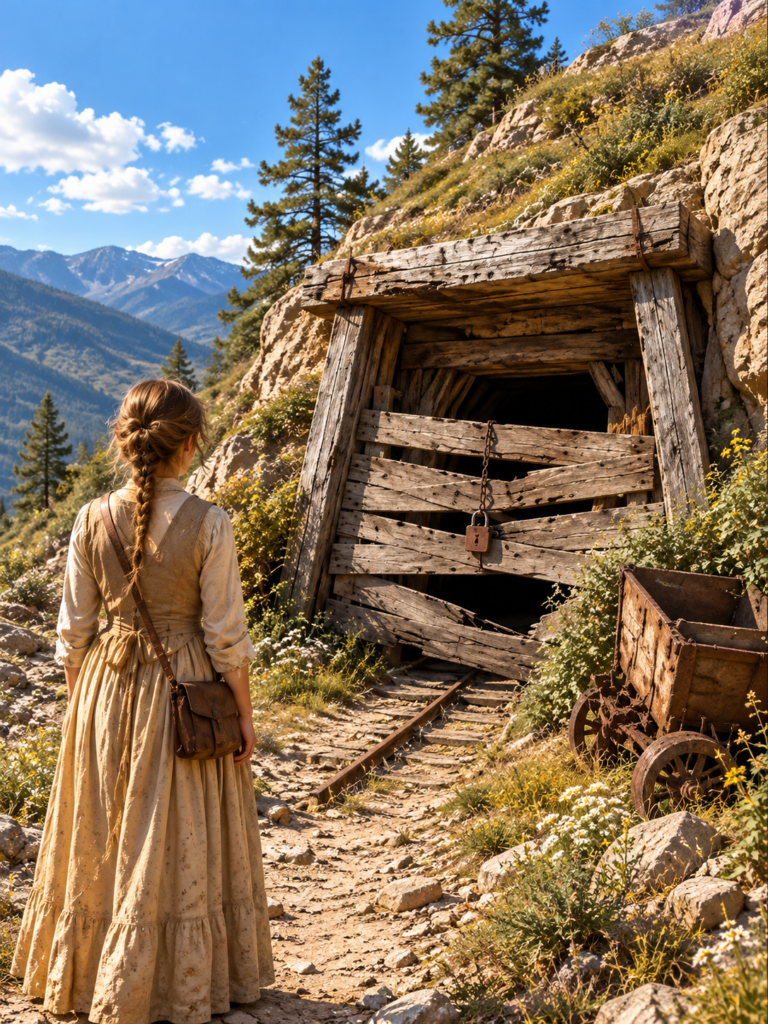
The mine entrance was blocked by fallen rock and decaying timbers.
An overturned ore cart lay half buried in the weeds.
A stone foundation stood nearby, approximately twelve feet wide and sixteen feet long.
Only one part of the old cabin remained standing.
A tall granite chimney.
Elizabeth walked around the ruins.
She examined the foundation stones.
They were large, carefully fitted, and surprisingly level.
The chimney appeared sound at the base.
Pine trees sheltered the site from the north wind.
A small spring ran from the rock face a short distance uphill.
She knelt beside it and cupped water in her hands.
Then she looked across the valley.
From there, she could see Garnet Creek far below.
Smoke rose from its chimneys.
The mountains stood blue and silent beyond it.
Elizabeth took the deed from her satchel.
She unfolded it carefully and read her name.
ELIZABETH THORNE.
For eighteen years, she had lived on land belonging to her father.
She had worked fields she would never inherit.
She had repaired fences for cattle she did not own.
Now, standing among broken timbers and stones, she possessed a piece of the world.
It was poor land.
Dangerous land.
Land everyone else had rejected.
But it was hers.
“Well, Grandpa,” she said softly, looking toward the ruined chimney, “I think I found a place.”
The wind moved through the pines.
She folded the deed and put it away.
Then she picked up a fallen branch and began clearing the foundation.
She did not yet know that beneath the old hearth lay a secret untouched for nearly half a century.
She only knew that the first thing she needed was a roof before the snow came.
Part 3
Elizabeth spent her first night at Sparrow’s Hope beneath a shelter made from fallen branches and strips of canvas she found among the mining debris.
It was hardly more than a lean-to.
She placed the branches against the remaining stone wall of the old cabin and covered them with pine boughs. She used her knife to cut small stakes and secured the canvas against the wind.
By the time darkness settled, her hands were raw and her back ached.
She ate the last of her bread beside a tiny fire.
The mountain was quiet except for the movement of wind through pine needles and the occasional snapping of branches in the forest.
Elizabeth looked up at the stars.
They seemed brighter here than anywhere she had ever known.
She wondered where her parents were.
Perhaps they had already reached a railroad station.
Perhaps Mary was discussing new dresses and respectable houses in Philadelphia.
Perhaps Jonathan was calculating how much money they had saved by leaving their daughter behind.
Elizabeth tried not to care.
But when she closed her eyes, she saw her mother’s face at the farmhouse door.
The silence hurt more than anger would have.
She had not asked for riches or fine clothes.
She had wanted someone to say, Come with us.
A tear slipped down her cheek.
She wiped it away with an impatient hand.
Then she drew the stag-horn knife from her pocket and examined its blade in the firelight.
Her grandfather had taught her that a useful tool needed care even when its owner was exhausted.
She cleaned the knife, checked its edge, and returned it to its sheath.
Tomorrow, she would begin building.
That thought helped her sleep.
At dawn, she rose stiff and cold.
The ground glittered with frost.
She warmed her hands over the remains of the fire and surveyed the ruined cabin.
The foundation was filled with dirt, fallen timber, broken stone, and pine needles accumulated over decades.
The old chimney stood at one end.
If it remained sound, she might be able to use it.
She inspected its joints and discovered that many were firm, although several stones near the top would need attention.
She was grateful for the careful workmanship of whoever had built it.
“Good bones,” she murmured.
Angus had always said that the bones of a building mattered more than its paint.
Elizabeth began clearing.
She found a rusted piece of sheet metal near the overturned ore cart and fashioned it into a makeshift shovel by binding it to a wooden handle.
The tool was awkward and heavy.
But it worked.
She scooped dirt into an old metal bucket and carried it outside the foundation.
Again.
And again.
By noon, sweat soaked the back of her dress despite the chilly air.
She had cleared only a small section.
Her hands blistered.
Her shoulders burned.
She stopped long enough to drink from the spring and eat a few berries gathered along the creek.
Then she returned to work.
By evening, she could barely straighten her back.
She sat beside the foundation and stared at the enormous amount of labor remaining.
For one frightening moment, she wondered whether she had made a terrible mistake.
She had spent everything she owned on land that could not shelter her from a snowstorm.
She had no proper axe.
No nails.
No stove.
No food except what she could gather or earn.
Winter was approaching.
If she failed to build a cabin, Sparrow’s Hope might become her grave.
The thought made her shiver.
She considered walking back to town and asking for employment.
Perhaps she could find a kitchen where she could wash dishes in exchange for a bed.
Perhaps she could abandon the mountain until spring.
But she knew that if she walked away without trying, she would never stop wondering whether she had possessed the strength to make the place livable.
She stood slowly.
“One bucket at a time,” she told herself.
The next morning, she walked down to Garnet Creek.
Abernathy looked up when the store bell rang.
“Well, Miss Thorne. How’s the mining business?”
“I haven’t started mining.”
“That’s probably wise.”
“I’m rebuilding the cabin.”
He examined her blistered hands.
“With what?”
“Whatever I can find.”
Abernathy removed his spectacles.
“You’ll need tools.”
“I know.”
“And lumber.”
“There’s timber on the property.”
“Timber won’t cut itself.”
Elizabeth smiled faintly.
“No, sir.”
He looked at her for a moment.
Then he nodded toward several crates stacked behind the counter.
“Can you read inventory figures?”
“Yes.”
“Can you add a column without using your fingers?”
She straightened.
“Yes, sir.”
“Good. My delivery boy’s visiting his sister. I’ve got stock to sort and a storeroom to clean. I can pay you in provisions and a few useful things from the secondhand shelf.”
Elizabeth studied him.
“You’d be paying me for work?”
“That’s generally how I prefer to do business.”
She smiled.
“I’d be grateful.”
She spent the next six hours moving crates, organizing supplies, and recording stock in Abernathy’s ledger.
He discovered that she wrote clearly and calculated figures quickly.
When the work was finished, he gave her a small sack of flour, dried beans, salt, a tin cup, several candles, and a coil of usable rope.
He also found an old handsaw with a missing handle.
“Blade’s still good,” he said. “You can make yourself a new grip.”
Elizabeth held the saw carefully.
“Thank you.”
“Don’t thank me. You’ve earned it.”
Those words warmed her more than the stove.
She returned to Sparrow’s Hope carrying the supplies in her satchel.
That evening, she boiled beans in a battered cooking pot found among the ruins after scrubbing it thoroughly.
The meal was plain.
But it was the first hot food she had prepared on her own land.
She ate beside the fire, listening to the creek.
For a few moments, she felt almost content.
The following days became a pattern of exhausting labor.
She rose before sunrise.
She cleared the foundation.
She collected usable stones and stacked them by size.
She cut away brush from the spring and dug a shallow drainage channel to keep runoff from flowing toward the cabin site.
She repaired the old saw with a handle carved from maple.
When she needed supplies, she walked to Garnet Creek and worked at the general store.
Sometimes Abernathy paid her in food.
Sometimes he set aside scrap iron or old hardware that nobody else wanted.
Each evening, she returned to her mountain.
Her hands grew stronger.
Her shoulders hardened.
She began recognizing the sounds of the forest.
The scolding call of a squirrel.
The knocking of a woodpecker.
The low rush of wind that warned of changing weather.
She learned where sunlight lingered longest and which rocks stayed dry after rain.
Her grandfather had taught her to observe the land before trying to change it.
Now those lessons became the difference between progress and wasted labor.
On the third afternoon, while clearing the old hearth, Elizabeth noticed a curious patch of mortar.
Most of the foundation stones were rough granite fitted together with old, dark joints.
But one large flat slab near the chimney was made of smooth black slate.
The material did not match.
She knelt beside it.
The mortar around its edges was lighter than the surrounding joints.
It seemed to have been placed after the original hearth was built.
Elizabeth brushed away the dirt.
Her grandfather’s voice returned.
When something doesn’t belong in the pattern, find out why.
She examined the slate more closely.
Its edges formed a deliberate rectangle.
A narrow seam ran around all four sides.
At first, she wondered whether it covered an old drainage channel or ash pit.
She tapped it with a stone.
The sound was different from the granite.
Duller.
Almost hollow.
Elizabeth sat back on her heels.
“Well now.”
She searched for a loose edge, but the slate was firmly set.
She tried digging beside it with her makeshift shovel.
The metal bent.
She stopped before damaging the tool further.
As evening approached, clouds gathered above the western ridge.
The wind carried the smell of approaching rain.
Elizabeth covered the hearth with canvas and returned to her shelter.
She lay awake for a long time.
Something had been deliberately sealed beneath that stone.
It might be nothing more than an old storage space.
Or it might contain something the first owner had wanted hidden.
But she could not investigate without proper tools.
The next morning, she searched the mining ruins.
Near the collapsed entrance, she found a long iron pry bar partly buried beneath gravel.
Its tip was worn, but the metal remained solid.
She dragged it to the cabin and worked the end into the seam around the slate.
The first attempt accomplished nothing.
She shifted her position.
Pressed harder.
Still nothing.
By midday, her palms were blistered again.
She rested, drank water, and studied the stone.
Then she began removing the old mortar a little at a time.
She used a narrow piece of scrap metal as a chisel and tapped it carefully with a rock.
Dust collected around her knees.
The sun moved slowly across the sky.
At last, the pry bar slipped beneath one edge.
Elizabeth leaned against it.
The mortar cracked.
A thin dark line appeared.
She worked around the remaining sides, loosening the slab inch by inch.
Then she braced her boots against the foundation and pushed with everything she had.
The slate shifted.
A heavy scraping sound rose from beneath it.
Elizabeth nearly fell backward.
She caught herself against the wall.
For several seconds, she sat breathing hard.
Then she moved the slab aside.
Beneath it was a narrow chamber lined with sheets of tin.
The edges had been carefully folded and sealed with old pitch.
Someone had gone to considerable trouble to protect whatever lay inside.
Elizabeth leaned closer.
The space was dry.
She reached into the darkness.
Her fingers touched rough canvas.
Then leather.
And finally something small, smooth, and cold.
She drew back her hand.
Her heart began beating faster.
She looked over her shoulder toward the empty hillside.
There was nobody there.
Only trees and wind and the silent ruins of a forgotten mine.
Elizabeth removed the objects carefully.
A heavy canvas sack.
A small leather-bound journal.
And an object wrapped in faded blue cloth.
She placed them on the grass beside the foundation.
The canvas sack made a faint metallic sound when she set it down.
Elizabeth stared at it.
Then she untied the cord.
Inside were several tightly wrapped bundles.
She opened one.
Silver gleamed beneath the afternoon light.
Coins.
Dozens of them.
She opened another bundle.
More silver.
Beneath them lay a smaller packet that felt surprisingly heavy.
But before she could examine it, thunder rolled across the mountains.
A drop of rain struck the open journal.
Elizabeth snatched it up immediately.
The pages were old and fragile.
She wrapped everything in her canvas and carried the bundle beneath her shelter.
Rain began falling hard.
She sat beside the little fire, looking at the strange objects.
Her grandfather had once told her that every old building held the marks of the people who came before.
But Elizabeth had never imagined that a ruined hearth might conceal the story of an entire life.
She lifted the journal.
On its first page, written in faded brown ink, was a name.
SILAS CROFT.
And beneath it, a sentence that made her stop breathing.
If these words are found, I ask only that the person who reads them finish what I could not.
Part 4
The rain lasted two days.
It swept across Sparrow’s Hope in cold gray sheets, turning the trail into mud and filling the creek with rushing water.
Elizabeth remained beneath her little shelter, feeding the fire with wood she had gathered before the storm.
Her canvas roof leaked in three places.
She moved her blankets away from the drips and placed the tin cup beneath the worst one.
The old foundation offered some protection from the wind, but the cold crept into her bones.
She counted the remaining beans.
Calculated how much flour she could spare.
Then she looked at the objects recovered from beneath the hearth.
They lay wrapped in dry cloth beside her.
For hours, she had resisted examining them further because the journal was damp and needed careful drying.
She spread its pages near the fire, far enough from the heat to keep the paper from curling.
The book was small, with a cracked leather cover and stitching that had begun to separate along the spine.
Inside, the handwriting was steady and precise.
Silas Croft had been a miner.
He had arrived in the Garnet Range nearly half a century earlier, when prospectors still believed that every mountain might hide a fortune.
His first entries described the construction of the cabin.
He wrote about clearing the slope, fitting granite stones into the foundation, and building a chimney that would draw even in bitter weather.
Elizabeth smiled despite herself.
She recognized the work.
She had spent days admiring those same stones.
Silas had been a careful builder.
He wrote about a woman named Eleanor.
She says the house must have a south-facing window, because she wants sunlight in the kitchen even when snow covers the valley.
Elizabeth glanced toward the ruined south wall.
The original window opening was still visible.
Another entry described Silas carving a small heart from rose quartz he found near the creek.
Eleanor says the mountains turn the same color at dawn. I mean to polish the stone and give it to her when the cabin is finished.
Elizabeth unfolded the faded blue cloth.
Inside lay a rose-quartz heart, polished smooth, its pink surface catching the glow of the fire.
It was small enough to rest in her palm.
For a moment, she forgot the silver coins.
She could picture Silas sitting beside the old hearth, patiently rubbing the stone smooth while thinking about the woman he loved.
She wondered whether Eleanor had ever seen the cabin.
The answer came several pages later.
A letter from Eleanor had been copied into the journal.
Her family had fallen ill during an outbreak of fever.
She had delayed traveling west.
Silas had promised to send for her as soon as he had enough money to support them both.
He wrote that the mine was producing little.
That winter supplies were expensive.
That he had considered abandoning the claim and finding work in a larger settlement.
But then the entries changed.
Silas began describing an unusual mineral formation deep inside the mine.
He believed he had discovered a small, concentrated deposit of gold.
The first samples were promising.
He wrote excitedly about the future.
A proper roof.
A garden.
A horse and wagon.
Perhaps children.
Elizabeth turned the pages carefully.
Then the tone darkened.
The mine roof had begun shifting.
Timbers creaked.
Small rockfalls blocked parts of the workings.
Silas knew the ground was unstable.
He wrote about reinforcing the tunnels, but supplies were scarce and the work was dangerous.
One entry contained a warning to himself.
No amount of gold is worth going back into the north passage until the timbers are replaced.
Elizabeth looked toward the collapsed mine entrance outside.
She knew how the story ended.
The north passage had failed.
Someone had died, or disappeared, and the mine had been abandoned.
But the journal contained more.
Silas had recovered enough gold to secure a comfortable life if he could carry it to a buyer.
He intended to leave the mine closed until he could obtain proper support timber.
He also feared that news of his discovery would attract claim jumpers.
There are men in these mountains who would slit a stranger’s throat for less than what I have taken from the rock.
Elizabeth shivered.
She looked toward the heavy canvas sack.
Inside were the coins he had hidden.
She untied the remaining bundles and examined their contents.
There were numerous silver dollars and other older silver coins.
The smaller packet contained gold eagles, each heavy and bright.
Elizabeth laid them carefully on a piece of cloth.
She had never seen so much money.
A single gold coin represented more than she had ever possessed at one time.
There were enough coins to buy lumber, tools, winter provisions, and perhaps even livestock.
Enough to build a proper home.
Enough to live without wondering where her next meal would come from.
She stared until her eyes blurred.
Then she began crying.
Not because she suddenly believed herself rich.
But because, only days earlier, she had been sleeping beneath a leaking roof with an empty stomach.
Her parents had calculated that three silver dollars were sufficient to send her into the world.
Now those same three dollars had brought her to a place where a forgotten man’s savings lay hidden beneath the floor.
She covered the coins with cloth.
“Thank you,” she whispered, though she did not know whom she was thanking.
Silas.
Her grandfather.
Or the providence that had guided her steps.
The following morning, the rain stopped.
Mist hung among the pines.
Elizabeth walked to the spring and washed her face in the cold water.
Then she returned to the journal.
Its final pages were damaged.
Several had stuck together.
She separated them carefully, working along the edges without tearing the paper.
The last entries told of Silas preparing the cabin for Eleanor’s arrival.
He had moved the coins into the hidden chamber beneath the hearth.
The rose-quartz heart was nearly finished.
He planned to travel to town, purchase supplies, and send word that she could join him.
Then came an entry dated October 12, 1858.
The handwriting was unsteady.
The north wall gave way while I was inspecting the timbers. I escaped through the lower passage, though I thought the mountain had taken me.
The mine is no longer safe.
I have sealed what I recovered beneath the hearth. The stone heart goes with it until Eleanor arrives.
Tomorrow I will make one final inspection from the upper opening and determine whether the remaining supports can be secured.
Elizabeth stared at the page.
Silas had known the danger.
Yet he had returned to the mine.
She imagined him standing outside the entrance, looking toward the home he had built and the life he hoped to share.
Perhaps he had believed he needed one more good day of work.
Perhaps he had convinced himself that the unstable passage could be made safe.
Elizabeth knew that feeling.
She had been pushing herself beyond exhaustion for days, determined to complete the cabin before winter.
But now the abandoned mine seemed to hold a warning.
No dream was worth dying for through carelessness.
She closed the journal and looked toward the hillside.
The opening was still blocked by rock.
She made a decision.
She would not enter it.
The mine could keep whatever remained underground.
She had enough to build a life above it.
That afternoon, Elizabeth carried the journal and a small selection of coins down to Garnet Creek.
Abernathy was behind the counter when she arrived.
He looked up.
“Morning, Miss Thorne. Survive the storm?”
“Barely.”
He smiled.
“That’s the mountain teaching you manners.”
She placed one of the gold coins on the counter.
Abernathy’s smile disappeared.
He picked it up and examined it carefully.
“Where did you get this?”
Elizabeth hesitated.
Then she told him about the hidden chamber.
The coins.
The journal.
The quartz heart.
She did not reveal the exact amount she had recovered.
But she showed him the entry bearing Silas Croft’s name.
Abernathy listened without interrupting.
When she finished, he sat down heavily.
“Well, I’ll be.”
“You knew about Silas?”
“My father did. Used to tell stories about him when I was a boy.”
Elizabeth leaned forward.
“What happened?”
Abernathy looked toward the window.
“Silas was a quiet man. Worked hard. Didn’t drink much. Kept mostly to himself.”
“And the mine?”
“Collapsed. Folks said he went inside to check the workings and never came out.”
Elizabeth lowered her eyes.
“Did anybody try to find him?”
“They did. But the passage was gone. Too much loose rock. They couldn’t reach him without risking more lives.”
She thought of the journal.
“He was building a house for someone named Eleanor.”
Abernathy nodded slowly.
“I remember the name. She never came west. I believe she died some years later, back east.”
Elizabeth’s chest tightened.
Two people had planned a life together.
A house.
A garden.
Ordinary happiness.
And the mountain had taken it from them.
She looked toward the window.
“Then nobody ever lived in the cabin?”
“Not for long.”
Abernathy examined the coin again.
“Miss Thorne, before you spend any of this, we’ll need to establish where you stand legally. The claim reverted to the county, and you bought the property, but abandoned personal property can raise questions.”
Elizabeth nodded.
“I don’t want anything that doesn’t belong to me.”
“That’s why we’re going to do it properly.”
He explained that the records would need to be examined and that he could help her seek advice from the county attorney.
The old coins might be valuable, but she would not risk losing everything through a careless transaction.
For the first time, Elizabeth felt grateful that she had trusted Abernathy rather than rushing to spend the money.
As they spoke, a tall elderly man rose from the chair beside the stove.
He had broad shoulders, a bent back, and hands marked by decades of blacksmithing.
“Name’s Jedediah Stone,” he said.
Elizabeth turned.
“How do you do?”
“Can’t complain much. Nobody listens.”
She smiled.
He gestured toward the old pry bar strapped to her satchel.
“That yours?”
“Yes, sir.”
“Tip’s worn down.”
“I know.”
“Bring it by my shop. I’ll put a proper edge on it.”
Elizabeth looked surprised.
“How much would you charge?”
Jedediah studied her.
“Depends. You planning to put it to work?”
“Every day.”
“Then we’ll talk about payment after you show me what you’re building.”
He returned to his chair.
Abernathy smiled.
“That’s about as friendly as Jed gets.”
Elizabeth looked down at the journal in her hands.
She had come into town afraid that the discovery would bring trouble.
Instead, she had found people willing to help her handle it honestly.
But there was still one unfinished part of Silas’s story.
The final pages of the journal had been sealed together by age.
She could see writing beneath them, but had not yet dared to separate the fragile paper.
That evening, back at Sparrow’s Hope, she set the journal beside her fire.
She looked toward the old chimney and the mountain beyond.
A man had hidden his hopes beneath that hearth.
Now she needed to understand what he had wanted the next person to do with them.
Part 5
On the first clear morning after the storm, Elizabeth sat beside the ruined chimney and opened Silas Croft’s journal for the final time.
She had warmed the fragile pages near the fire and carefully loosened the places where age and moisture had joined them.
Now she could read the last message.
The writing was smaller than the earlier entries, as though Silas had been trying to fit everything he wanted to say onto the remaining paper.
To whoever finds this:
My name is Silas Croft. I came into these mountains believing that gold would give me the life I wanted.
But the longer I worked, the more I understood that the gold was never the thing I truly wanted.
I wanted a home.
I wanted a woman I loved sitting beside the fire.
I wanted children running through the yard and a door that opened when I came back from work.
I built this cabin for that life.
If the mountain should take me before I see it finished, I ask that whoever finds my savings use them to build something good.
Buy sound timber. Buy honest tools. Make a place where someone can be warm when the wind is cold.
Do not let this money make you cruel.
Do not let it sit buried in the darkness.
And do not let the mountain have the last word.
Elizabeth finished reading.
For a long time, she remained motionless.
She looked at the empty foundation surrounding her.
The old stones.
The standing chimney.
The spring flowing through the trees.
Silas had built this place for a future he never lived to see.
She had come here because her own family had refused to give her a future at all.
And somehow, the two unfinished lives had met in the ruins of Sparrow’s Hope.
Elizabeth placed the journal carefully in her lap.
“I’ll finish it,” she whispered.
Then she stood and went to work.
Within the following week, Abernathy helped her obtain legal advice concerning the recovered property.
The county records confirmed her ownership of the patented claim, and after the necessary inquiries, no surviving claimant came forward with a superior right to the personal property recovered from the sealed chamber.
The attorney advised her to keep careful records, preserve the journal, and avoid making public announcements about the amount she had found.
Elizabeth followed that advice.
She had no desire to become the subject of another mining rush.
The abandoned mine remained dangerous, and she wanted no strangers climbing into its ruined workings.
She used a portion of the coins to purchase the things she needed most.
A good felling axe.
A buck saw.
A broad axe for shaping logs.
Chisels, an auger, nails, and hinges.
Heavy wool blankets.
Flour, beans, salt pork, coffee, and dried apples.
A cast-iron stove.
Window glass.
Lamp oil.
And enough supplies to survive the approaching winter.
Abernathy helped arrange delivery by mule.
He watched Elizabeth examine each tool before agreeing to buy it.
“You know your equipment,” he remarked.
“My grandfather taught me.”
“Carpenter?”
“The best one I ever knew.”
Abernathy smiled.
“Then I reckon he’d be proud of you.”
Elizabeth looked down at the saw in her hands.
“I hope so.”
The first weeks of construction were exhausting.
She selected straight lodgepole pines from a stand near the upper edge of her property.
She marked the trees carefully, considering their direction of fall and leaving enough healthy timber to protect the slope.
Then she began cutting.
Her grandfather had taught her proper technique, but knowing how to swing an axe was different from felling full-sized trees day after day.
The work left her shoulders trembling.
She stopped often to sharpen the blade, drink water, and rest.
Once, a log rolled unexpectedly while she was stripping its bark.
Elizabeth jumped aside just before it struck her leg.
She sat on the ground afterward, shaking.
Silas’s warning returned to her.
No dream is worth dying for through carelessness.
From then on, she worked more cautiously.
She cut logs to length, stripped their bark, and shaped the notches that would allow the walls to fit together.
She repaired weak portions of the stone foundation and checked the old chimney before connecting it to the new stove.
Every evening, she studied her work.
Some days, progress seemed painfully small.
Other days, she could see the cabin beginning to rise.
Jedediah Stone visited during the second week.
He arrived carrying the repaired pry bar and a bundle wrapped in canvas.
Elizabeth greeted him beside the foundation.
“Mr. Stone.”
“Jed’s good enough.”
He examined the first course of logs.
“Those your cuts?”
“Yes, sir.”
He ran a thick finger along one of the notches.
“Good fit.”
Elizabeth smiled.
“Thank you.”
He unwrapped his bundle.
Inside were hand-forged hinges and a heavy door latch.
“Made these from scrap iron. Figured you’d need them.”
She stared.
“They’re beautiful.”
Jed grunted.
“They’re hinges, girl. They’re supposed to hold a door.”
She laughed.
Then she looked at him seriously.
“What do I owe you?”
“How about you carve me one of those little birds Abernathy says you make?”
Elizabeth’s expression softened.
“I’d be honored.”
Jed nodded.
“Good. Now show me how you’re planning to raise these walls.”
For the next hour, he walked around the foundation, offering advice.
He showed her how to improve the log notches and where to reinforce the frame.
He did not take over her work.
He treated her as a craftsperson who was learning.
That mattered more to Elizabeth than she could explain.
A few days later, Martha Gable appeared on the trail.
She was a stout woman in her fifties with rosy cheeks and a basket covered by a clean cloth.
“I hear you’re the young lady building a cabin up here.”
Elizabeth wiped her hands on her apron.
“Yes, ma’am.”
“I’m Martha. My husband runs the bakery.”
She lifted the cloth.
Inside lay a loaf of sourdough bread, a crock of butter, and a pot of hot beef stew.
Elizabeth stared.
“Mrs. Gable, I can’t accept all that without paying you.”
Martha gave her a gentle look.
“Honey, I’ve raised four boys. I know what hard work does to a person’s appetite.”
She handed over the basket.
“Besides, a warm meal is meant to be shared.”
Elizabeth thanked her.
After Martha left, she sat on a foundation stone and ate the stew.
It was rich with potatoes, carrots, and tender beef.
Halfway through the meal, tears filled her eyes.
She remembered her mother warning her not to expect kindness from strangers.
Yet here was a stranger who had climbed a steep mountain trail simply because she thought a young woman might be hungry.
Elizabeth finished every bite.
That evening, she carved a small wooden fox for Martha’s youngest granddaughter.
The next morning, she carried it down to town.
Martha was delighted.
Soon the people of Garnet Creek began treating Elizabeth as one of their own.
A farmer gave her a bundle of cedar shakes left over from repairing his barn.
A retired carpenter lent her a brace and bit.
Abernathy kept aside supplies she ordered and made sure they were delivered when a wagon was available.
When the walls reached shoulder height, Elizabeth faced her greatest challenge.
The ridgepole.
It was a long, heavy timber that would support the roof.
She could shape it.
She could prepare its resting points.
But she could not lift it into place alone.
She stood beside the cabin one afternoon, studying the problem, when she heard footsteps on the trail.
A young man approached leading a mule.
He was tall, with clear gray eyes and a quiet manner.
“Miss Thorne?”
“Yes?”
“I’m Liam Mercer. Mr. Abernathy said you might need some help.”
Elizabeth looked at the mule.
Then at the rope and pulley equipment strapped behind its saddle.
She smiled.
“He said that, did he?”
Liam nodded toward the unfinished roof.
“Looks like he was right.”
Jedediah arrived soon afterward.
Together, the three of them rigged a simple lifting arrangement.
They checked the rope.
They secured the supports.
Then they slowly raised the heavy beam.
Elizabeth guided it into position while Jed and Liam controlled the tension.
For several minutes, the timber hung above the walls.
Then it settled into its notches.
A solid wooden thump echoed through the clearing.
Elizabeth stepped back.
The roof had its backbone.
She pressed one hand against her chest.
“We did it.”
Liam grinned.
“Sure did.”
Jed examined the connections.
“Looks sound.”
Elizabeth looked toward the mountains.
For an instant, she imagined Angus standing beside her, nodding with quiet approval.
She wished he could have seen it.
But perhaps, in a way, he already had.
Every cut she made carried something he had taught her.
Every joint reflected his patience.
Every decision to keep working reflected the dignity he had shown her.
By late November, Sparrow’s Hope had a roof.
Cedar shakes covered the rafters.
The walls were carefully fitted and sealed against drafts.
A glazed window faced south, catching the weak winter sunlight.
A sturdy wooden door hung on Jedediah’s iron hinges.
Inside stood a cast-iron stove, a simple table, two chairs, a narrow bed, and shelves made from leftover lumber.
Elizabeth had built most of the furniture herself.
The table was not perfectly square.
One chair rocked slightly until she adjusted its legs.
But everything was strong.
Everything was useful.
And everything belonged to her.
On the evening she first slept inside the completed cabin, snow began falling.
Only a few flakes at first.
Then enough to whiten the branches beyond the window.
Elizabeth stood beside the stove watching the snow settle.
Warmth filled the room.
The smell of pine smoke drifted through the air.
She had fresh bread on the table, dry blankets on her bed, and firewood stacked beneath a covered shelter.
She no longer had to search for an abandoned barn when darkness fell.
She no longer had to wonder whether someone would tell her to leave.
She owned the floor beneath her feet.
She had built the walls around her.
She placed the rose-quartz heart on a small shelf beside the fireplace.
Next to it, she laid her grandfather’s carving knife.
One was a symbol of the home someone had dreamed of building.
The other was the tool that had helped her build it.
That winter, Elizabeth began carving again.
At night, when the work outside was finished, she sat beside the stove shaping animals from scraps of pine and maple.
She carved deer, bears, owls, and little birds with carefully detailed wings.
Abernathy offered to display a few in his store.
They sold within two days.
He asked for more.
Soon, travelers passing through Garnet Creek began buying her carvings as gifts.
Elizabeth earned her own money.
It was modest income compared with the coins hidden in her cabin.
But every dollar mattered to her.
She was proud that people valued something she had made with her hands.
One bitter December evening, a blizzard swept down from the mountains.
The wind roared through the valley.
Snow piled against the cabin walls.
Pine branches cracked beneath the weight.
Elizabeth checked the stove, secured the door, and brought another armful of firewood inside.
Then she sat beside the hearth.
Outside, the storm raged.
Inside, the cabin remained warm.
She looked at the walls she had raised.
The roof she had helped secure.
The table she had shaped.
The small carved animals waiting to be taken into town.
She remembered her father’s voice.
You’re eighteen now. Old enough to make your own way.
At the time, those words had been a dismissal.
Now they sounded different.
Not because Jonathan had been right to abandon her.
He had not.
But because Elizabeth had discovered something her parents never understood.
A person’s worth could not be measured by whether someone else found them useful.
She thought of Mary, who had spent her life dreaming of a finer house.
She wondered whether her mother had found happiness in Philadelphia.
She hoped so.
But Elizabeth no longer needed her mother’s approval.
She had learned that a home was not created by expensive furniture or respectable neighbors.
It was created by care.
By work.
By people who made room for one another.
And by the knowledge that the door would open when someone needed shelter.
Elizabeth rose and placed another log in the stove.
As she did, she heard a faint sound beneath the wind.
A knock.
She stopped.
Then it came again.
Three weak blows against the door.
Elizabeth lifted the lantern and approached cautiously.
“Who’s there?”
A man’s voice answered.
“Liam Mercer. Sorry to trouble you.”
She opened the door.
Liam stood outside covered in snow, his hat pulled low and his shoulders shaking from cold.
His mule had slipped on the icy trail while he was returning from a neighboring claim.
He had managed to free the animal and secure it in a sheltered stand of trees, but darkness had overtaken him before he could reach town.
Elizabeth stepped aside immediately.
“Come in before you freeze.”
He entered, stamping snow from his boots.
She gave him a dry blanket and poured coffee into a tin cup.
Liam sat beside the stove, warming his hands.
“Didn’t mean to bother you.”
“You’re not bothering me.”
He looked around the cabin.
“Sure is warm in here.”
Elizabeth smiled.
“That’s what I built it for.”
For a while, they sat quietly listening to the storm.
Liam noticed the rose-quartz heart on the shelf.
“That’s pretty.”
Elizabeth looked at it.
“It belonged to the man who built the first cabin.”
“Silas Croft?”
She nodded.
“He wanted this place to be a home.”
Liam glanced around.
“Looks like he finally got his wish.”
Elizabeth turned toward the window.
Snow swirled against the glass.
The mountain remained dark and dangerous beyond the little circle of light from her cabin.
But inside, there was warmth.
Coffee.
A shared meal.
And another human being who had found shelter from the storm.
Elizabeth felt tears rise unexpectedly.
She looked at the knife beside the quartz heart.
She thought of Angus, whose kindness had given her the skills to survive.
She thought of Silas, whose buried savings had allowed her to build.
And she thought of the parents who had sent her away with three silver dollars because they believed she was a burden.
They had left her homeless.
They had left her frightened.
They had left her with almost nothing.
But they had not taken away her courage.
They had not taken away the lessons her grandfather had taught her.
And they had not taken away her right to build a life of her own.
Months earlier, Elizabeth had stood outside her childhood home while her parents packed a wagon for Philadelphia.
She remembered how small she had felt.
How unwanted.
How certain she was that nobody in the world had a place for her.
Now she sat beside a fire in a cabin she had built with her own hands.
And for the first time in eighteen years, she understood what it meant to belong.
Liam finished his coffee.
“Mind if I stay till morning? Trail’s too dangerous in this weather.”
Elizabeth took another blanket from the shelf.
“Of course.”
She smiled.
“There’s room.”
Outside, the blizzard continued through the night.
But the little cabin stood firm against the wind.
The following spring, Elizabeth planted a garden beside the south wall.
She repaired the path to the spring, built a small woodshed, and fenced a patch of ground for chickens.
Her woodcarvings became known throughout the valley.
Families began stopping at Sparrow’s Hope to purchase toys for their children, commission furniture repairs, or ask her advice about practical woodwork.
Sometimes Elizabeth invited visitors to sit on her porch and drink coffee.
Sometimes she told them about her grandfather.
Sometimes she spoke about Silas Croft and the man who had dreamed of a home but never lived to enjoy it.
She never reopened the collapsed mine.
She had found everything she needed above the ground.
As the years passed, the people of Garnet Creek stopped calling Sparrow’s Hope an abandoned claim.
They called it Elizabeth’s place.
And when travelers asked how a young woman had managed to build such a home alone on a forgotten mountainside, the townspeople told them about the eighteen-year-old girl who arrived with three silver dollars, bought ten acres nobody wanted, and refused to surrender to the wilderness.
Some spoke of the hidden coins.
Others praised her remarkable skill with tools.
But those who knew Elizabeth best understood that the treasure beneath the hearth was only part of the story.
The gold had helped her buy lumber.
The silver had helped her survive.
Yet neither could have built the home without her patience, courage, and willingness to accept kindness.
One evening, several years after her arrival, Elizabeth sat on her porch watching the sun disappear behind the Bitterroot Mountains.
A gentle breeze carried the smell of pine and fresh earth.
Her garden was growing.
Smoke drifted from the chimney.
The rose-quartz heart rested safely on the mantel inside, beside the stag-horn knife.
Elizabeth thought about the first morning she had walked away from her parents’ farm.
She had believed she was being sent into the world because she was worth so little.
Now she understood something different.
Those three silver dollars had never represented her worth.
They had only represented the limits of what her parents were willing to give.
What Elizabeth made of her life was hers alone.
She looked across the peaceful valley.
Then she smiled and whispered the words Silas Croft had left in his journal.
“Don’t let the mountain have the last word.”
And at Sparrow’s Hope, where a ruined mine had once stood forgotten beneath the pines, the mountain never did.


