
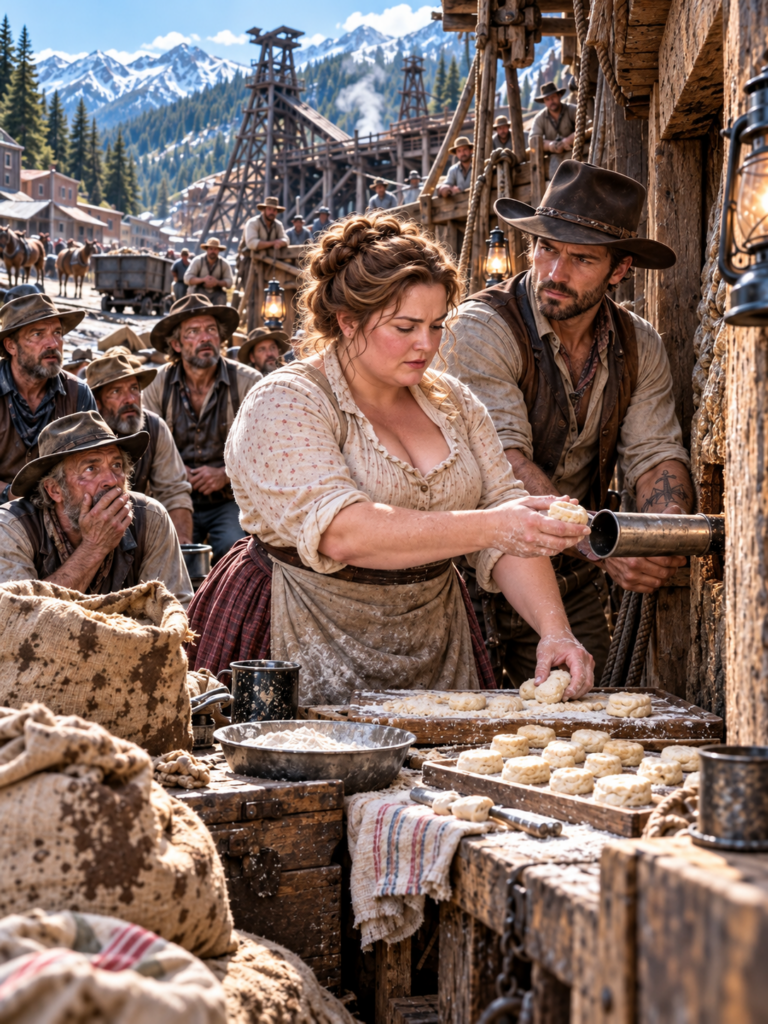
Her knees hurt from kneeling on the dirt.
But lined along one wall were covered tins containing more than two hundred pounds of clean, dry flour.
She sat on an empty sack and started laughing.
Not loudly.
Not triumphantly.
Just one exhausted breath of laughter.
The town thought she had purchased six hundred pounds of ruined flour.
What she had actually purchased was two hundred pounds of usable flour, building material, and enough opportunity to make the next move.
All for eight dollars.
A knock came at sunrise.
A nineteen-year-old named Percy Dunn stood outside.
He was thin, nervous, and walked with a permanent limp.
Four months earlier, a mine timber had shattered his left leg.
Before the accident, he had been a runner underground.
Afterward, the mine had found him less useful.
“I heard you bought the flour,” he said.
“So did everybody.”
“I’m looking for work.”
Dorothy glanced at his leg.
Percy noticed.
His expression closed.
“I can still work.”
“I didn’t ask whether you could.”
He blinked.
“Can you wash dishes?”
“Yes.”
“Count money?”
“Yes.”
“Read?”
“Yes.”
“Write clearly?”
“Yes.”
“Carry thirty pounds?”
“Yes.”
“Forty?”
“Probably.”
“That means no.”
Percy almost smiled.
Dorothy pointed inside.
“I pay forty cents a day until I know whether you’re worth more. Meals included.”
“You’re hiring me?”
“I’m attempting to.”
Percy stepped inside.
Three days later, the abandoned assay shed had shelves, scrubbed tables, drying racks, a secondhand iron stove, and a charcoal sign nailed outside.
THE LANTERN KITCHEN
Supper 15¢
Beans, biscuits, gravy, coffee.
Seven customers came the first night.
Most came because they wanted to see the foolish fat woman serving food made from creek flour.
Dorothy knew.
She served them anyway.
The biscuits were hot.
The gravy contained actual beef.
The beans had simmered all afternoon with onions and salt pork.
The coffee was strong enough to make a tired man forgive the world for another hour.
Nobody laughed after the first bite.
By the end of the second week, Dorothy was feeding forty men a day.
By the third, she added portable meal packets for miners working double shifts.
Percy suggested it.
Dorothy made him write down the costs.
Two biscuits.
Mashed beans.
Dried fruit.
Ten cents.
Bellamy noticed because men started walking past his lunch counter carrying Dorothy’s packets.
Dorothy noticed Bellamy noticing.
Neither mentioned it.
Then Wesley Cade began coming in.
Wesley owned a small horse ranch north of town and occasionally contracted timber horses to the mine.
He had broad shoulders, a weathered face, blue eyes, and the strange habit of speaking only when he had something to say.
The first Thursday, he ordered biscuits and gravy.
The second Thursday, he ordered the same thing.
The third Thursday, Dorothy said, “You know I cook other food.”
“I know.”
“Then why do you keep ordering that?”
“Because I like it.”
“That’s suspiciously simple.”
Wesley took another bite.
“Most good things are.”
Dorothy narrowed her eyes.
She waited for the joke about her weight.
It never came.
She waited for a compliment that was really pity.
That never came either.
Wesley talked about horses.
Timber.
Weather.
The uneven heat of her stove.
Once he looked at her new shelving and said, “Smart placement.”
Dorothy distrusted him for two weeks.
Then she started saving the end seat at the counter without admitting she was doing it.
The mine collapsed on a Tuesday afternoon.
Dorothy felt it through the soles of her boots.
Not a violent shaking.
A deep vibration.
Like the mountain had struck a drum somewhere beneath the earth.
Percy froze beside the dish basin.
Then the accident bell began ringing.
His face lost all color.
“That’s underground.”
They ran outside.
Men were already moving toward the mine head.
Within an hour, the news reached town.
A forty-foot section of the lower workings had collapsed.
No one had been directly beneath the fall.
That was the miracle.
The disaster was what came next.
The collapse had sealed a secondary gallery.
Twenty-eight miners were trapped behind it.
Alive.
The mine crew knew because the trapped men were tapping against a pipe.
Twenty-eight separate signals.
Twenty-eight men.
But the blocked tunnel was unstable.
The rescue crew could not simply dig through.
They would have to brace every few feet before removing more rock.
“How long?” somebody asked.
The foreman stared at the mountain.
“Three days.”
He looked again.
“Maybe four.”
Dorothy walked back to the Lantern Kitchen.
Then she started cooking.
By sunset, Copper Jack had become a town divided into two groups.
People working at the mine.
And people waiting for somebody working at the mine.
Dorothy refused to belong to the second group.
She fed the rescue crew first.
Beans.
Beef stew.
Coffee.
Biscuits.
Anything fast and hot.
Percy ran between the mine and the kitchen despite his limp worsening by the hour.
Near midnight he returned carrying news.
“There’s a ventilation line.”
Dorothy stopped chopping onions.
“What kind?”
“Secondary air shaft. Runs near the trapped gallery.”
“How wide?”
Percy hesitated.
“I don’t know.”
Dorothy pointed the knife toward the door.
“Find out.”
He left.
Wesley arrived an hour later covered in rock dust.
He sat at the counter.
Dorothy poured coffee.
“My cousin’s down there,” he said.
Dorothy stopped.
“Nathaniel?”
Wesley nodded.
Twenty-two years old.
She had heard him mention the boy before.
“Have they heard his signal?”
“Twice.”
Dorothy put a plate in front of Wesley.
“I’m not hungry.”
“I didn’t ask.”
He looked up at her.
Under any other circumstance, he might have smiled.
He ate.
Percy returned at eleven.
He carried a length of string.
“The ventilation opening is just under four inches across.”
Dorothy stared at him.
Four inches.
She pulled her biscuit cutter from a drawer.
Then she formed Percy’s measuring string into a circle.
Almost exactly the same.
She set the cutter on the counter.
“What can we send through that?”
Percy looked at the cutter.
“Nothing we make now.”
Dorothy nodded.
“Then tomorrow we make something we don’t make now.”
She worked until two in the morning.
Calories.
Diameter.
Wrapping.
Weight.
Rope tension.
What could survive ninety feet of descent.
What would spoil.
What would crush.
What men could eat underground without plates or utensils.
Then Percy brought another problem.
Water.
The trapped gallery had access to an old seep, but timber work before the collapse had apparently redirected most of it.
“How much water do they have?” Dorothy asked.
“Unknown.”
“No.”
Percy frowned.
“No what?”
“Unknown isn’t enough. Send a question.”
“They’re hungry.”
“I know they’re hungry.”
Her voice sharpened.
“If I send twenty-eight frightened men dry biscuits and salted meat with barely any water, I could make them worse. Find out exactly what they have.”
The answer returned before noon.
Two barrels.
Twenty-eight men.
Possibly four days.
Dorothy stared at the message.
Every ration she had designed overnight became wrong.
Dry biscuits would increase thirst.
Salted meat would increase thirst.
Dried fruit would help morale but carried little moisture.
She tore her calculations in half.
Percy stared.
“That was six hours of work.”
“Then we wasted six hours learning what not to do.”
She pulled out clean paper.
“We start again.”
Adeline Mercer arrived carrying eggs and preserves.
At forty-four, Adeline ran the boarding house laundry and had become Dorothy’s closest friend through the particular friendship of two practical women who had no patience for ceremonial affection.
“What do you need?”
“Rendered fat. Fruit preserves. Low salt. Any beans you can spare. And your copper pot.”
Adeline nodded.
No questions.
She left.
Dorothy made broth biscuits first.
Beef stock reduced until thick, worked into flour with fat so the biscuits carried moisture internally.
Too fragile.
She changed the ratio.
Better.
Then they discovered another problem.
Packaging.
Bundles wrapped in cloth compressed during the ninety-foot descent.
Dorothy sent Percy to Bellamy for waxed paper.
He returned furious.
“He tripled the price.”
Dorothy continued stirring.
“Of course he did.”
“He knows why we need it.”
“Of course he does.”
Percy waited for an explosion.
None came.
Dorothy sent him back with an offer of Bellamy’s normal rate plus ten percent.
Bellamy refused.
So Dorothy found another method.
Adeline remembered cloth saturated with rendered tallow, an old technique her husband had once used for wrapping cheese.
They tested it.
Better.
Not perfect.
Dorothy dropped bundles from the roof.
Two survived.
One split.
“Two out of three,” Percy said.
Dorothy shook her head.
“There are men underneath that mountain, Percy. Not arithmetic. Two out of three is failure.”
They tightened the weave.
Changed the folds.
Reduced the diameter.
Tested again.
All survived.
At four forty-seven that afternoon, the first food bundle descended through the ventilation shaft.
Dorothy did not celebrate.
She watched the rope disappear into darkness.
Three minutes later, it went slack.
Someone below had received it.
A wooden message strip came back.
Food received.
All present.
Dorothy closed her eyes.
Only for a second.
Then she went back to work.
The next message changed everything again.
Water lower than expected.
One miner injured.
Another developing fever.
Dorothy redesigned the ration a third time.
She mixed finely worked bread, mashed beans, reduced beef broth, rendered fat, and preserved peaches into soft cylinders narrow enough to pass through the biscuit cutter.
Low salt.
High moisture.
High calorie.
Soft enough for a dehydrated man to swallow.
The first batch collapsed.
The second tore.
The third held.
Percy began writing every ratio into a notebook.
“Why are you recording failures?” Wesley asked.
Percy did not look up.
“Because she says failures are expensive if you have to buy them twice.”
Dorothy heard him from the stove.
She said nothing.
But something warm moved through her exhaustion.
Percy had spent months believing a crooked leg had reduced him from a useful man to damaged property.
Now he was organizing the most important supply operation in Copper Jack.
Not because he could run.
Because he could think.
On the second night, supplies began disappearing faster than Dorothy could replace them.
Adeline emptied half her pantry.
The butcher donated bones.
A ranch family brought potatoes.
A miner’s wife arrived with six cups of flour wrapped in a pillowcase.
Another brought three.
A boy delivered half a jar of molasses.
Nobody had much.
Together, they had enough.
Then Rufus Bellamy entered the Lantern Kitchen.
He looked at Dorothy’s shelves.
Nearly empty.
“You’re running out.”
“I can see that.”
“The freight road washed out near Garrison Creek. No replacement shipment for at least four days.”
Dorothy stopped wiping a pot.
Bellamy sat down.
“My store has sufficient inventory.”
“I know.”
“I can supply everything you need.”
“At what price?”
Bellamy looked at Percy.
Then Adeline.
Then back at Dorothy.
“No cash today.”
Dorothy went still.
Bellamy continued.
“I’ve been considering an arrangement. You need stock. I can extend credit. In return, when this is finished, we combine operations. Your kitchen becomes Bellamy’s Lantern Dining Room. I provide purchasing and capital. You run food.”
Percy stared at him.
Adeline whispered something that sounded unfit for church.
Dorothy remained quiet.
Bellamy leaned closer.
“You’re good at this, Dorothy. Better than I expected.”
There it was.
Not apology.
Not respect.
A valuation.
He had dismissed her when she needed a job.
Now that twenty-eight men needed her, he wanted ownership.
“How much of the kitchen?” Dorothy asked.
“Fifty-one percent.”
Wesley, standing near the stove, slowly turned.
Bellamy raised a hand.
“I’m taking the financial risk.”
Dorothy looked at the nearly empty flour shelf.
Then toward the mountain outside the window.
Twenty-eight men.
Water falling.
A fever underground.
And Bellamy had exactly what she needed.
This was the kind of moment people later simplified.
They would say pride nearly killed twenty-eight men.
Or greed threatened them.
Or courage saved them.
Real life was uglier.
Dorothy needed Bellamy’s food.
Bellamy wanted her future.
She could sign.
The men would eat.
She could tell herself she had no choice.
She had heard those words before.
No choice.
They had been used to justify low wages.
Bad rooms.
Hands where hands did not belong.
Humiliation disguised as practicality.
Dorothy removed her apron.
Bellamy’s expression softened slightly.
He thought she was surrendering.
Instead she walked outside.
Percy followed.
“What are you doing?”
“Finding flour.”
“Where?”
“The town.”
“There isn’t enough.”
“We don’t know that.”
Dorothy walked first to the saloon.
Then the boarding house.
Then the livery.
Then every home within walking distance.
She did not ask for charity.
She explained the numbers.
Twenty-eight men.
Possibly two days remaining.
This many pounds required.
This much fat.
This much fruit.
This much bean stock.
Contribute only what your household could safely spare.
She wrote everything down.
A cup from one house.
Four pounds from another.
Cornmeal.
Beans.
Apples.
Tallow.
A rancher offered beef.
A widow contributed sugar she had been saving for Christmas.
Even Red Neckerchief, the cowboy who had mocked Dorothy at the creek, appeared carrying a sack.
He stood awkwardly at the door.
“Seven pounds.”
Dorothy looked at him.
“My bunkhouse.”
She took the flour.
He did not leave.
“I was a bastard to you.”
“Yes.”
His mouth opened.
Closed.
Dorothy pointed to the wrapping table.
“You know how to tie a square knot?”
“Yes.”
“Then apology accepted for the next six hours.”
He worked until midnight.
At two in the morning, Dorothy counted supplies.
Barely enough.
Barely was still enough.
Until the next message came.
Calebson fever worsening.
Young Harmon weak.
Three others struggling.
Water half barrel.
Dorothy read it twice.
Then looked toward the shelf where she had stored the borderline flour from the original creek shipment.
Not the wet flour.
That had been discarded weeks before.
These were dry portions she had judged usable only after extended inspection but had avoided putting into normal service because she had not needed them.
Now she needed everything.
She examined every ounce again.
Smelled it.
Sifted it.
Rejected half.
Kept the safest remainder.
Percy watched.
“Is it enough?”
“No.”
His face fell.
Dorothy continued.
“But it closes the gap.”
For eighteen straight hours, the Lantern Kitchen produced food.
Broth cylinders.
Soft bean cakes.
Low-salt biscuits.
Tiny tins of thickened broth.
Each package had to pass through Dorothy’s iron biscuit cutter before it was approved.
If it did not fit through the circle, it did not go underground.
The ridiculous old kitchen tool became the law of the rescue.
Four inches.
No exceptions.
At dawn on the fourth day, the final bundles were ready.
The rescue foreman arrived personally.
“Last load.”
Dorothy looked up.
“Why?”
“We start blasting after seven. Once we do, the ventilation shaft closes.”
“How long until breakthrough?”
“If the mountain behaves?”
He hesitated.
“Tonight.”
“And if it doesn’t?”
He did not answer.
Dorothy understood.
She doubled the final emergency packets.
Percy carried them to the mine.
Then the mountain closed.
At seven forty-three, the first rescue charge detonated.
Dorothy felt it in her coffee cup.
The surface trembled.
The ventilation opening could no longer be used.
For the first time in four days, Dorothy had no action left to take.
That nearly broke her.
She scrubbed the stove.
Then the tables.
Then shelves that were already clean.
Adeline finally took the cloth from her hand.
“You cannot scrub through a mountain.”
Dorothy looked at her.
“I know.”
“Then sit.”
“I don’t sit well.”
“I know that too.”
Dorothy sat.
For eleven minutes.
Then Bellamy returned.
The mercantile owner did not mention partnership this time.
He placed a paper on the counter.
“What’s this?”
“Credit.”
Dorothy did not touch it.
Bellamy sighed.
“Standard prices. No ownership. No partnership. Thirty days.”
“Interest?”
“None.”
Dorothy studied him.
“What changed?”
Bellamy glanced toward the mine.
“Twenty-eight men may come out of there because this town found six pounds of flour at a time after I tried to turn an emergency into leverage.”
Dorothy waited.
Bellamy shifted uncomfortably.
“I am not saying I became a saint overnight.”
“Good. I wouldn’t believe you.”
His mouth tightened.
“But I know a bad calculation when I make one.”
Dorothy read the agreement.
Then handed it to Percy.
“Check the numbers.”
Bellamy almost smiled.
Percy checked every line.
Then Dorothy signed.
Not because Bellamy had earned forgiveness.
Because the terms were fair.
That mattered more.
At four thirty the following afternoon, the mine bell rang differently.
Percy’s head snapped up.
“Recovery bell.”
Dorothy stood so quickly the chair fell backward.
People poured into the street.
She walked toward the mine.
Then slowed.
The crowd was already enormous.
Families pressed toward the entrance.
Men shouted.
Women cried.
Dorothy stopped at the back.
For one terrible moment, an old thought returned.
This is how it always ends.
You work.
Someone else stands in the picture.
You become necessary.
Then invisible.
She nearly turned around.
Then she heard somebody yell.
“One!”
The first miner emerged.
Gray with dust.
Blinking at daylight.
A woman broke through the crowd and threw herself against him.
Another miner came.
Then another.
Dorothy counted.
Five.
Nine.
Fourteen.
Eighteen.
Twenty-one.
Some walked.
Some were carried.
All looked smaller than men had any right to look after only four days.
Twenty-four.
Twenty-five.
Dorothy could not breathe normally.
Twenty-six.
Percy appeared closer to the entrance.
He had somehow pushed through despite his leg.
Twenty-seven.
Wesley emerged with the rescue crew.
Rock dust covered his face.
His eyes moved frantically through the crowd.
Then Nathaniel appeared.
The twenty-two-year-old stumbled into the light.
Wesley reached him.
Dorothy looked away.
Some reunions belonged to the people inside them.
Then the final miner appeared.
Calebson.
Two men supported him.
His face was pale and hollow from fever.
But his feet touched the ground.
Twenty-eight.
Dorothy whispered the number.
“Twenty-eight.”
All present.
Just like the first underground signal.
She turned toward town.
Her work was finished.
“Dorothy!”
Percy was pushing toward her.
He held something in his hand.
Her biscuit cutter.
Dorothy stared.
She had sent it with the final delivery so the men below could verify emergency ration size if necessary.
Percy handed it to her.
Something had been scratched into the blackened iron.
D.V.
Thank you.
Lower Gallery.
Dorothy ran her thumb over the letters.
Then the crowd shifted.
One of the rescued miners was walking toward her.
Older man.
Maybe fifty-five.
Dust still in his eyebrows.
He carried a narrow strip of wood.
He stopped directly in front of Dorothy.
“My name’s Alden Reece.”
Dorothy nodded.
“I know who you are.”
He held out the wood.
She took it.
Seven words had been scratched into it.
We knew supper was coming every night.
Dorothy stared.
Alden cleared his throat.
“You know what that did?”
She looked up.
“What?”
“When men started getting scared?”
He glanced toward the mountain.
“We knew the rope would come down.”
His voice cracked slightly.
“Didn’t know if the rescue would. Didn’t know if the roof would hold. Didn’t know how much water we had.”
He tapped the wood.
“But supper came.”
Dorothy could no longer see the letters clearly.
Alden continued.
“Calebson couldn’t keep anything down until those soft things you made.”
“Bread, beans, broth, fat, peaches.”
He laughed weakly.
“Whatever they were.”
He looked directly at her.
“They tasted like somebody gave a damn whether we came home.”
Dorothy had survived insults without crying.
She had survived employers cheating her.
She had survived hunger.
Loneliness.
Twelve years of sleeping in rooms that belonged to men who could tell her to leave before breakfast.
But those words nearly undid her.
So she did what she knew.
She put the message into her apron pocket.
Closed her hand around the biscuit cutter.
And said, “You should eat something.”
Alden smiled.
“That’s what I came to ask.”
The next morning, twenty-one of the rescued miners came to the Lantern Kitchen.
Dorothy fed every one who could walk.
Nobody paid.
Bellamy tried.
She refused his money.
Wesley tried.
She refused his too.
“This one is mine,” she said.
Nobody argued.
Red Neckerchief stood near the wall tying packages for families.
His name, Dorothy finally learned, was Everett Boone.
He never made another joke about her weight.
Neither did anyone else within Dorothy’s hearing.
But the strangest change was that Dorothy no longer cared very much whether they did.
Three months later, the Lantern Kitchen had sixteen tables.
The assay shed was gone.
Dorothy had bought a larger building across from the boarding house using profits, a modest loan, and an arrangement negotiated entirely on her terms.
Percy owned twelve percent.
Dorothy had insisted.
He refused twice.
Then she showed him his accounting books.
“You built systems I didn’t know I needed.”
“I washed dishes.”
“You stopped washing dishes six weeks ago.”
“What am I now?”
“My business partner.”
Percy looked down at his crooked leg.
Dorothy followed his eyes.
“Your leg was never the most useful part of you.”
He swallowed.
“I wish somebody had told me that earlier.”
“Somebody just did.”
Adeline handled breakfast three mornings a week because Dorothy had finally learned that independence was not the same thing as exhaustion.
Bellamy supplied flour, sugar, and lard under a written fixed-price agreement.
They never became friends.
Dorothy preferred it that way.
Fair terms were enough.
Calebson became a regular customer.
His stomach remained sensitive after the fever, so Dorothy modified the soft emergency ration into something better suited for the menu.
She called it the Miner’s Supper.
Customers who did not know the story asked about the name.
Dorothy never explained.
Copper Jack did it for her.
Wesley continued coming on Thursdays.
Then Tuesdays.
Then whenever the excuse seemed thin enough that neither of them bothered pretending it was an excuse.
In January, he approached the counter wearing his good coat.
Dorothy noticed immediately.
“You’re dressed suspiciously.”
“I came to ask you something.”
“If this is about investing, the answer is no.”
“It isn’t.”
“If it involves horses, Percy handles delivery schedules now.”
“It doesn’t.”
Dorothy folded her arms.
Wesley looked almost nervous.
That interested her.
“Would you have dinner with me Friday?”
She stared.
“You eat dinner here constantly.”
“Not here.”
“Oh.”
“At the hotel.”
She continued staring.
Wesley added, “As dinner. With me. Not business.”
Dorothy understood.
She also understood why he looked uncomfortable.
“I have terms,” she said.
“I assumed you would.”
“Honesty.”
“Yes.”
“No deciding what I need without asking me.”
“Agreed.”
“No rescuing me from problems I can solve.”
“Agreed.”
“If you buy dinner Friday because you invited me, I buy the coffee afterward.”
Wesley nodded.
“Agreed.”
Dorothy considered.
“One more.”
He waited.
“Never call me little lady.”
Wesley looked at her 270-pound frame.
Then back at her face.
“I wouldn’t survive the dishonesty.”
Dorothy laughed so hard Percy came out from the office to see what had happened.
The following Friday, Dorothy ate a meal she had not cooked for the first time in months.
The hotel food was mediocre.
She did not say so.
Wesley apparently knew anyway.
Halfway through the meal he asked, “How much salt would you have used?”
“Less.”
He laughed.
Walking home, snow began falling.
Copper Jack looked softer under snow.
Less like a mining town.
More like somewhere people could stay.
At the Lantern Kitchen door, Wesley stopped.
Dorothy looked up at the old iron lantern she had moved from the assay shed and hung above the new entrance.
Beside it hung another object.
Her biscuit cutter.
Percy had put it there.
Dorothy had protested.
“It’s a kitchen tool.”
Percy had answered, “Exactly.”
She had left it.
Wesley followed her gaze.
“Twenty-eight men fit through that.”
Dorothy smiled.
“Their supper did.”
He looked at her.
“Are you glad you stayed?”
Dorothy thought about the answer.
She remembered arriving with thirty-seven dollars.
Bellamy refusing to hire her.
Cowboys laughing.
Six hundred pounds of wet flour everyone else had called garbage.
Sleeping on a dirt floor between sacks because she could not afford a room.
Percy standing at her door believing a limp had made him useless.
Adeline appearing with eggs and staying because sometimes friendship began by refusing to leave.
Wesley covered in mine dust asking how much flour she had left instead of telling her she was heroic.
Twenty-eight signals coming from beneath a mountain.
Twenty-eight men walking back into daylight.
“I didn’t plan to stay,” Dorothy said.
“That wasn’t my question.”
“No.”
She thought longer.
Then she understood.
“Yes.”
Wesley nodded.
He did not kiss her.
Dorothy liked that.
Some endings were improved by not rushing them.
By February, the kitchen employed six people.
One afternoon a new waitress named Vera noticed the battered biscuit cutter above the door.
“Why do you keep that old thing?” she asked. “We have better ones.”
Percy walked past carrying a ledger.
“Ask Dorothy.”
Vera looked toward the stove.
Dorothy heard her.
She kept stirring gravy.
Wesley entered carrying a flour sack from Bellamy’s store.
He set it down.
Then he pointed at the cutter.
“Because twenty-eight men once fit through that circle.”
Vera looked confused.
Dorothy finally turned.
“Their food did.”
That was all she said.
The lunch rush continued.
Plates moved.
Coffee poured.
Boots scraped against the floor.
People argued over cards.
Somebody complained about the weather.
Somebody asked for another biscuit.
Ordinary life filled the room.
At two, Percy brought Dorothy a plate.
“Eat.”
“I’m busy.”
“No, you’re pretending to be busy.”
Dorothy looked around.
For twelve years, she had eaten only after everyone else.
Usually standing.
Usually cold.
Sometimes not at all.
She had confused being necessary with belonging.
She had believed that if people needed her enough, eventually one of those kitchens would become home.
None had.
Because home was not the place where people could not function without you.
Home was the place where you were allowed to sit down.
Dorothy removed her apron.
She sat at her own counter.
Percy placed the plate in front of her.
Biscuits.
Gravy.
Beans.
Nothing fancy.
Dorothy took a bite.
Above her, afternoon light caught the edge of the old biscuit cutter.
She thought about something she had finally understood.
The mine collapse had not made her valuable.
The rescue had not transformed a ridiculous woman into a worthy one.
She had been valuable before anyone noticed.
She had been valuable when Bellamy refused to hire her.
When the cowboys laughed.
When all she owned was thirty-seven dollars and a bedroll.
When six hundred pounds of damaged flour looked like failure to everyone standing beside that creek.
The crisis had changed only one thing.
It had made other people see what had already been there.
Skill.
Judgment.
Discipline.
Courage.
And the stubborn ability to look at something everyone else had discarded and ask one more question.
Is all of it really ruined?
Dorothy looked across the kitchen.
Percy was correcting an invoice.
Adeline was arguing with a supplier.
Wesley sat at the end of the counter drinking coffee.
On a shelf in the corner, the sourdough starter Dorothy had begun from the first usable flour still lived in its crock.
The thing everyone had called ruined had been feeding people for months.
Dorothy smiled.
Then she finished her lunch while it was still hot.
THE END


