
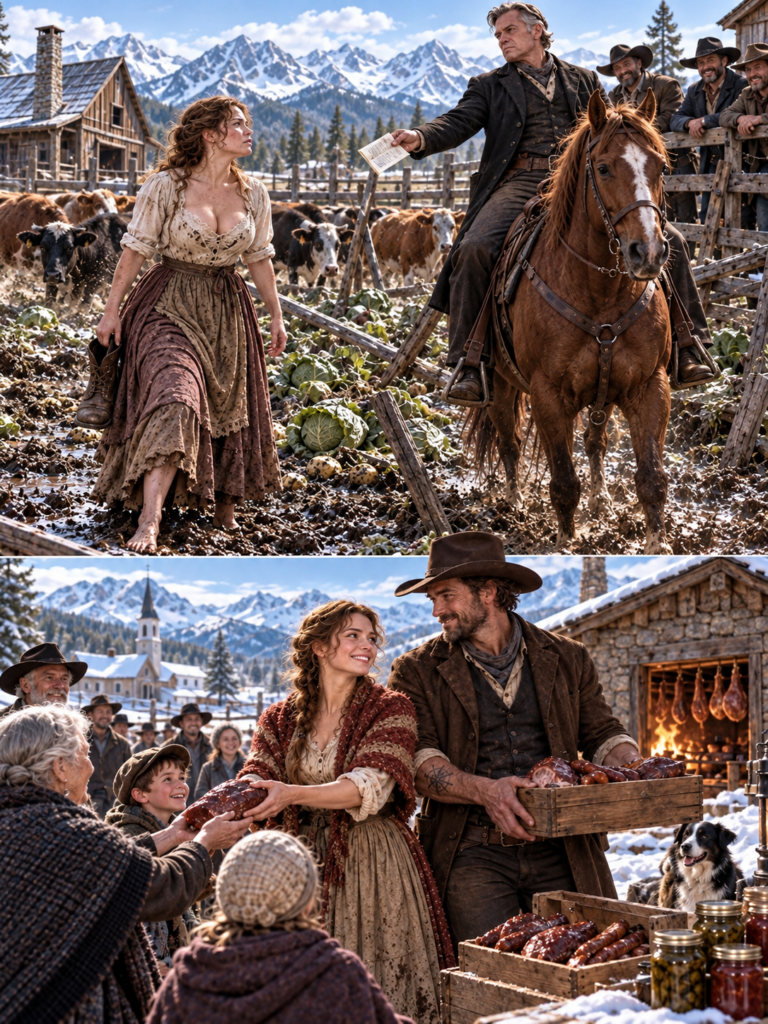
“What are they?”
“I’m not entirely sure yet.”
Lucy looked delighted.
“You planted something and don’t know what it is?”
“I know what family it belongs to. Your grandfather would call it a field turnip.”
“What do you call it?”
“Currently? T-three.”
“That’s a terrible name.”
“It’s scientifically efficient.”
“It sounds like a broken stove.”
Clara laughed.
It surprised both of them.
By September, T3 was outperforming everything else on the farm.
Then the first frost came eleven days early.
Cedar Valley woke under white.
Tom Harmon lost nearly half his late potatoes.
The Widow Marsh lost every bean vine beside her house.
Garrett Pike’s squash collapsed into black leaves.
Silas Rourke had no vegetable crop worth discussing because ranchers like Silas purchased what they did not grow.
Clara walked to the hollow before sunrise.
Ice glittered on the ridge.
Her breath floated white.
The plants stood green.
Not untouched.
Not magical.
The leaf edges had curled.
Several had burned.
But the roots beneath the soil were alive.
Clara sank to her knees.
For a moment she forgot the cold.
Forgot Silas.
Forgot the valley.
Forgot the money she owed Garrett.
She put both hands flat against the frozen earth and whispered, “You did it, Amos.”
Then she corrected herself.
“No.”
She looked over the rows.
“We did.”
By October, smoke began rising from the Bell smokehouse every morning.
Clara butchered one pig.
She traded the other to the Marsh family for two hundred pounds of potatoes and three days of labor.
Eli brought a deer.
Tom Harmon brought another.
A ranch hand named Warren Cable brought forty pounds of beef from an injured steer.
Garrett Pike supplied salt after Clara offered him six percent of whatever meat his salt preserved.
He stared at her.
“You made that up.”
“Yes.”
“You offering me interest on salt?”
“I’m offering you preserved meat.”
Garrett scratched his chin.
“How much?”
“Six percent.”
“Eight.”
“Six.”
“Seven.”
“Six and you eat supper.”
He grinned.
“Now you’re negotiating.”
“I have always been negotiating. You just thought I was failing.”
By November, the shelves inside Clara’s root cellar were full.
The smokehouse beams held rows of cured meat.
Dried onions hung in braided ropes.
Squash filled the cool side room.
Turnips lay packed in sand.
Beans rested in sacks labeled by weight.
Clara maintained a ledger recording every contribution and every withdrawal.
Nobody understood why.
Not yet.
Then winter came three weeks early.
The first storm closed Cedar Pass for nine days.
The second buried the road to Miles Junction.
The third killed six of Silas Rourke’s cattle in one night.
By December 12, snow stood against Clara’s porch rail.
Cedar Valley had seen difficult winters before.
The difference was that this one arrived after a poor harvest.
The general store began rationing flour.
Coffee disappeared.
Sugar followed.
Garrett Pike sold his last barrel of salt pork before Christmas.
The freight wagon expected from the south never arrived.
Two drivers attempted the pass and returned after losing a mule.
The valley stopped laughing at Clara’s farm.
But it had not yet begun asking for help.
Pride survives hunger longer than people admit.
The first knock came on December 21.
Clara opened the door to find Ruth Casper holding a little boy wrapped in a quilt.
Ruth’s husband had broken his leg felling timber in November.
They had four children.
Ruth looked exhausted.
“I heard you’ve got food.”
Clara stepped aside.
Ruth did not enter.
“I can pay in March.”
“I’m not lending food.”
Ruth’s face tightened.
Clara continued.
“I’m trading it.”
“With what? We’ve got nothing.”
“You sew?”
Ruth blinked.
“Yes.”
“I have grain sacks that need turning into storage bags. The Widow Marsh needs two blankets repaired. Eli Mercer has shirts his daughter has apparently decided should remain missing buttons forever.”
From behind Clara came Lucy’s offended voice.
“I can sew buttons.”
“You have been able to sew buttons for four months.”
“That is not the same as wanting to.”
Ruth stared past Clara.
Then, against every expectation she had brought to the door, she laughed.
Clara handed her a basket.
Potatoes.
Beans.
Two winter squash.
A strip of smoked venison.
A jar of rendered fat.
Ruth looked inside.
Her laughter vanished.
Her eyes filled instead.
“How much work?”
“Six hours.”
“That’s all?”
“That’s the rate.”
“Clara…”
“Six hours.”
Ruth gripped the basket.
“Thank you.”
Clara shook her head.
“Don’t thank me yet. Widow Marsh is particular about blankets.”
Word spread by supper.
The next morning, three families came.
Then five.
Within a week, the Bell kitchen became the most organized room in Cedar Valley.
Clara did not hand out food randomly.
She created assignments.
The Harmons had two strong sons and almost no meat.
They cut firewood.
Warren Cable repaired roofs.
Widow Marsh could no longer do heavy labor, but she knew how to stretch flour with potatoes better than anyone Clara had met.
She cooked twice each week for elderly households.
Garrett had wagons.
He distributed supplies when roads were passable.
Eli hunted and maintained the creek crossing.
Lucy copied ledger entries.
“Why do I have to write every pound?” she complained.
“Because memory becomes dishonest when people get scared.”
Lucy thought about that.
“Adults especially?”
“Adults especially.”
The smokehouse became the center of everything.
Its stone walls held heat with astonishing efficiency.
Its rafters carried hams, venison, beef strips, and sausage.
The side room became an exchange station.
People arrived with labor, hides, timber, tools, grain, preserved fruit, candles, or skills.
They left with whatever their households lacked most.
Nobody received according to wealth.
Nobody received according to reputation.
Clara used only three measurements.
Need.
Contribution when possible.
And what the valley could actually spare.
By January, twenty-seven households were participating.
That was when Silas Rourke came.
He arrived alone.
That fact told Clara more than the expensive coat he wore.
She met him outside the smokehouse.
“I need beef cured,” he said.
“How much?”
“Six hundred pounds.”
“That’s a great deal of beef.”
“I’m losing cattle.”
“So is everyone.”
“I can pay.”
Clara shook her head.
Silas looked at her.
“I beg your pardon?”
“I don’t need money.”
“Everybody needs money.”
“I cannot burn money in the stove.”
His jaw tightened.
“I’ll pay twice the market price.”
“No.”
He glanced toward the smokehouse.
“Then name a number.”
“I did.”
“You didn’t.”
“Because the price isn’t dollars.”
His expression changed.
He had spent his life in transactions he could dominate by increasing the offer.
Clara had removed the currency.
“What do you want?”
“Two cattle for the community reserve.”
Silas laughed once.
It was not amusement.
“For curing my own beef?”
“For using community capacity.”
“That building is on your land.”
“Yes.”
“So it’s your capacity.”
“No.”
Silas stared at her.
Clara pointed toward the roof.
“Warren Cable repaired those rafters. Garrett supplied the salt. Eli cut half the firewood. Widow Marsh and Ruth Casper cleaned casings. Tom Harmon butchered meat here for two days. The shelves were built from lumber traded by three families. That building is on my land. Its capacity belongs to the people keeping it running.”
Silas’s mouth hardened.
“You’re running a charity.”
“No.”
“What do you call it?”
“A winter.”
For once, Silas Rourke had no immediate answer.
Clara continued.
“Two cattle. Four men for five days. One wagon whenever Garrett needs it until the pass opens.”
“That is robbery.”
“No. Robbery is destroying someone’s field and offering to buy the land afterward.”
His eyes sharpened.
There it was.
The thing neither had forgotten.
Clara’s voice remained calm.
“You asked my price.”
Silas turned toward his horse.
She thought he was leaving.
Then he stopped.
“One cattle.”
“Two.”
“Three men.”
“Four.”
“Three men and Hollis.”
Clara paused.
Hollis was an older ranch hand who had worked in commercial smokehouses before coming west.
She knew because Amos had written it down nine years earlier.
“Hollis counts as two.”
Silas looked back.
“You knew?”
“My uncle knew.”
A bitter smile crossed his face.
“Amos Bell collected information like other men collected debts.”
“He paid attention.”
Silas looked toward the smoke curling from the chimney.
“Two cattle,” he said. “Three men and Hollis. Wagon access.”
“Agreed.”
The first Rourke beef entered the smokehouse the following morning.
With it came something Cedar Valley had not expected.
Silas Rourke entered Clara Bell’s system.
He did not control it.
He joined it.
That mattered.
People who had been embarrassed to accept food began arriving openly.
If Rourke could trade labor for preservation, so could anyone.
The laughter disappeared.
What replaced it was harder for Clara to receive.
Respect.
Respect is heavier than ridicule because eventually someone expects you to deserve it.
The cold deepened.
January became brutal.
For six consecutive nights, temperatures fell far below zero.
A family east of town abandoned their house after the stove pipe split.
Eli found them before dawn and brought them to the schoolhouse, which Clara had already stocked with emergency food.
Three horses died.
A roof collapsed.
Then, on January 19, Garrett Pike rode to Bell Farm with news nobody wanted.
“The south freight train turned back.”
Clara looked up from her ledger.
“For how long?”
“Driver says Cedar Pass won’t clear before February.”
Eli stood near the stove.
“How much flour is left in town?”
Garrett took off his hat.
“Maybe twelve days if folks eat the way they’re eating.”
Silence.
Lucy stopped writing.
Clara turned to her inventory.
Potatoes.
Turnips.
Squash.
Beans.
Smoked meat.
Rendered fat.
Dried apples.
Cornmeal.
Not enough to make anyone comfortable.
Possibly enough to keep everyone alive.
“How many households outside the system?” Clara asked.
Garrett hesitated.
“Eleven.”
“Why?”
“Some didn’t think they needed it.”
Clara looked at him.
He sighed.
“Some didn’t want to take orders from you.”
“Those are different statements.”
“I know.”
Eli stepped closer.
“You’re thinking about bringing them in.”
“They’re already in.”
Garrett frowned.
“They haven’t contributed.”
Clara turned a ledger page.
“Neither have children.”
“That’s different.”
“Not to hunger.”
Garrett rubbed both hands over his face.
“So what do we do?”
Clara looked at the numbers.
She had always believed courage would feel like certainty.
It did not.
Sometimes courage felt exactly like arithmetic you were terrified to have wrong.
“We cut every meat ration by twenty percent.”
Garrett swore softly.
“We substitute turnips for half the flour in every communal meal.”
“People will complain.”
“They can complain while eating.”
Eli almost smiled.
Clara continued.
“No household stores food privately beyond three days.”
Garrett stared.
“You’re going to start a riot.”
“No. I’m going to ask.”
“And if they refuse?”
“Then we know how much community we actually built.”
That evening, thirty-eight families crowded into Cedar Valley’s schoolhouse.
Clara stood near the blackboard with her ledger.
Men who had once laughed at Bell’s Folly filled the benches.
Tom Harmon.
Mr. Crowley.
Garrett.
Rourke hands.
Widow Marsh.
Mothers with babies.
Children wrapped in coats indoors.
Silas stood at the back.
Clara explained the numbers.
No speech.
No inspiration.
No promise that everything would be fine.
She told them how much food remained.
How much winter might remain.
How many calories an adult needed.
How much less could be survived temporarily.
How many pounds of meat hung in the smokehouse.
How many sacks of beans.
How many squash had begun softening and therefore needed to be eaten first.
When she finished, nobody spoke.
Then Mr. Crowley stood.
Months earlier he had asked whether she intended to hire a husband before winter.
Now he removed his hat.
“I’ve got twenty pounds of flour hidden under my floor.”
His wife turned toward him.
“You told me we were out.”
He looked ashamed.
“I was scared.”
Clara said nothing.
Mr. Crowley swallowed.
“I’ll bring it.”
Tom Harmon stood.
“Eight pounds at our place.”
Another voice.
“Three.”
“Eleven.”
“We’ve got dried corn.”
“My cellar has apples.”
“My sister’s got lard.”
One by one, Cedar Valley confessed its fear.
By the end of the meeting, Clara’s estimated reserves had increased by nearly eighteen percent.
Silas was the last to speak.
“I’ve got grain.”
Everyone turned.
Garrett frowned.
“How much?”
Silas looked toward Clara.
“Enough for livestock.”
“That wasn’t the question,” she said.
His jaw moved.
“Enough to mill perhaps four hundred pounds.”
The room erupted.
Clara raised a hand.
Silence returned slowly.
“Is it fit for people?”
“Yes.”
“Will you release it?”
Silas looked around the room.
Months ago, these people would have followed him before they followed Clara Bell.
He knew it.
They knew it.
That winter had changed the arrangement without asking permission.
“Yes,” he said.
Clara nodded.
“Then we mill it tomorrow.”
Nobody applauded.
That was important.
Applause would have made the moment cheap.
Instead, people went home and brought food out of hiding.
And Cedar Valley entered the hardest six weeks of its winter together.
The disaster came at two in the morning.
Lucy woke Clara by pounding on the bedroom door.
“Smoke!”
Clara was out of bed before she understood the word.
“Where?”
“The smokehouse!”
She ran outside barefoot again.
Just as she had the morning Silas destroyed her field.
But this time the ground was frozen solid.
Orange light flashed beneath the smokehouse roof.
The chimney had overheated.
A spark had found dry timber near an old beam.
Flames crawled along the underside of the roof.
“No,” Clara whispered.
Everything was inside.
Not everything they owned.
Everything standing between Cedar Valley and hunger.
She grabbed the water bucket.
Eli caught her arm.
“You can’t go in.”
“I have to close the draft.”
“The roof could come down.”
“If the draft stays open, the whole building burns.”
“Clara.”
She looked at him.
“Thirty-eight families.”
He released her arm.
“Then I’m going with you.”
They entered low.
Smoke rolled across the ceiling.
Clara crawled toward the firebox.
Heat struck her face.
Eli pulled wet canvas over a burning support while Clara kicked the lower vent closed.
Outside, Lucy was ringing the old dinner bell.
Once.
Twice.
Again.
The sound carried through the frozen valley.
The first person to arrive was Garrett.
Then Tom Harmon.
Then Ruth Casper.
Then two Rourke hands.
Then Silas himself.
Within twenty minutes, more than forty people stood in the snow.
Bucket lines formed from the creek.
Men climbed ladders.
Women carried meat from the side room.
Children old enough to help dragged sacks toward the house.
Nobody waited to be told whose job it was.
The smokehouse had taught them that already.
Hollis climbed onto the roof.
“Cut that section loose!” he shouted.
Warren Cable swung an axe.
“If I cut it, we lose the north beam!”
“If you don’t, we lose the building!”
Clara came stumbling through the door, coughing.
Eli followed.
Silas grabbed her before she fell.
“You all right?”
“The east hooks,” she gasped.
“What?”
“Get the meat off the east hooks.”
Silas stared at the burning roof.
“Forget the meat.”
“No.”
“Clara—”
“That’s February!”
He understood.
Not meat.
February.
Meals.
Children.
Old people.
The weeks before roads opened.
Silas turned.
“East hooks!” he roared. “Move everything!”
The roof burned for another forty minutes.
Then Warren cut through the flaming section.
It collapsed outward into the snow.
Men buried it beneath shovelfuls of white.
Hollis closed the damaged chimney.
And just before four in the morning, the fire died.
The smokehouse remained standing.
Half the roof was gone.
One wall was scorched.
Seventy pounds of meat had been lost.
Everything else survived.
Clara sat in the snow wrapped in Eli’s coat.
Her feet were numb.
Her hair smelled like smoke.
Her face was streaked black.
Silas came toward her.
For several seconds he said nothing.
Behind him, people moved through the dark carrying salvaged food.
Months before, his cattle had trampled Clara’s field while the valley watched.
Now the valley was rebuilding her smokehouse before sunrise.
Silas looked at the damaged roof.
“I was wrong about you.”
Clara coughed.
“That sounds painful.”
His mouth twitched.
“I’m serious.”
“So am I.”
He looked at her.
“I thought you were trying to prove you could survive alone.”
Clara watched Ruth Casper carry a sack toward the house while Garrett argued with Hollis about temporary roofing.
“So did I,” she said.
Silas frowned.
She looked at him.
“That was the part I was wrong about.”
By noon, a temporary roof covered the smokehouse.
By sunset, smoke rose from the chimney again.
February was colder than January.
But Cedar Valley ate.
Not well.
Nobody pretended otherwise.
Children complained about turnips.
Adults complained more quietly.
Coffee remained a memory.
Sugar became something people discussed with inappropriate emotion.
But nobody starved.
Widow Marsh created a soup so thick with potatoes and smoked beef that Lucy named it Roof Fire Stew.
The name stayed.
Ruth turned flour sacks into storage bags.
Garrett made distribution rounds.
Silas’s men hauled wood.
Hollis operated the smokehouse beside Clara until she could identify proper temperature by smell.
“Too hot,” he would say.
Clara adjusted the draft.
“How do you know?”
“Smoke’s bitter.”
She would smell again.
At first she detected nothing.
By March, she could.
The first wagon crossed Cedar Pass on March 11.
People cheered when it appeared.
Clara did not.
She sat on the Bell porch with a cup of coffee Garrett had personally delivered and watched muddy wheels enter town.
Lucy sat beside her.
“So winter’s over?”
“Winter doesn’t respect calendars.”
“But mostly?”
“Mostly.”
Lucy considered this.
“People don’t laugh at your farm anymore.”
Clara drank her coffee.
“I noticed.”
“Do you miss it?”
Clara turned.
“Why would I miss that?”
“Because now they ask you things all the time.”
Clara laughed so suddenly she spilled coffee on her skirt.
“You may be the smartest person in this valley.”
“I know.”
That afternoon Silas Rourke rode onto Bell property.
He stopped at the gate.
He did not open it.
Clara saw him from the hollow.
For nearly a year, Silas had treated boundaries as inconveniences.
This time he waited.
Clara walked toward him.
“You fixing to buy my farm again?”
“No.”
“Price went up.”
“I assumed.”
He held a document.
Clara glanced at it.
“What is that?”
“A water agreement.”
Her expression changed.
Silas continued.
“Your creek access remains yours. My cattle use the southern corridor only on the dates listed. Any damage to Bell fencing or crops gets paid at replacement value.”
Clara looked at him.
“What do you want?”
“Access to your seed when it’s ready.”
There it was.
The thing Amos had spent eleven years creating.
The thing everyone once considered foolish.
T3 had survived a season that destroyed ordinary crops.
Clara had saved enough seed for expansion.
Within two years, perhaps less, farms across Cedar Valley could grow food capable of surviving earlier frost.
“You want exclusivity?” she asked.
Silas shook his head.
That surprised her.
“No.”
“What, then?”
“An allotment.”
“After households that participated in the winter network.”
He nodded.
“Fair.”
“Same price as everyone else.”
“Fair.”
“You don’t control distribution.”
He exhaled through his nose.
“That one hurts.”
“It was supposed to.”
He almost smiled.
Then he became serious.
“Clara.”
“Yes?”
“Why give me any?”
She understood the real question.
After the cattle.
After the pressure.
After the contract.
After months of trying to force her into surrender.
Why let Silas Rourke benefit from what he had tried to destroy?
Clara looked toward the hollow.
Lucy was kneeling between the rows preparing spring soil.
Eli worked near the smokehouse roof.
Across the valley, thin columns of chimney smoke rose from homes that had survived February.
“Because revenge is expensive,” Clara said.
Silas was quiet.
“And I have more important things to build.”
He lowered his eyes to the agreement.
“My cattle destroyed your first field.”
“Yes.”
“I knew they were going through.”
“I know.”
“I thought if the season got hard enough, you’d sell.”
“I know that too.”
He looked up.
“I’m sorry.”
Clara studied him.
She did not smile.
She did not tell him everything was forgiven.
Some injuries deserved the dignity of remaining true.
“I believe you,” she said.
Silas waited.
“That doesn’t erase it.”
“I know.”
“It does affect what you do next.”
He nodded.
“That’s why I brought the agreement.”
Clara opened the gate.
They signed it at Amos’s kitchen table.
Silas drank no coffee.
Clara remembered suddenly that he never did.
She found this amusing for reasons she could not explain.
When he left, Eli was standing beside the repaired smokehouse.
“You let him into the seed program?”
“Yes.”
“He tried to take your land.”
“Yes.”
“You’re irritatingly practical.”
“I’ve been told worse.”
Eli wiped sawdust from his hands.
“Lucy says I’m supposed to ask you something.”
Clara raised an eyebrow.
“That sentence concerns me.”
“She wants to plant two rows in the hollow.”
“She can.”
“She also thinks I should ask you to supper.”
Clara folded her arms.
“And which part is Lucy’s idea?”
“The wording.”
“And the supper?”
He met her eyes.
“Mine.”
The wind moved softly over the field.
It smelled different than winter wind.
Wet earth.
Thawing creek banks.
Wood smoke.
Something green that had not yet fully appeared.
Clara looked toward the gate.
For most of her life, people had offered her futures with conditions attached.
Sell the farm.
Find a husband.
Be sensible.
Be grateful.
Accept help in the form someone else had chosen.
Eli waited.
That mattered more than the question.
“Sunday,” she said.
His face changed.
Not dramatically.
Just enough.
“Sunday.”
“And Lucy comes.”
“She would arrive whether invited or not.”
“I assumed.”
Spring came slowly.
Cedar Valley planted differently that year.
People still planted potatoes and beans and squash.
But eleven farms also planted trial rows from Bell seed stock.
Nobody called them miracle crops.
Clara would not allow it.
“Miracles teach people nothing,” she told Garrett. “Records do.”
So everyone kept records.
Frost dates.
Rainfall.
Yield.
Soil.
Failures.
Especially failures.
The Bell smokehouse was rebuilt with a new stone chimney and heavier roof.
A wooden sign appeared above the door one morning.
BELL VALLEY PRESERVATION HOUSE.
Clara stared at it.
Then at Garrett.
“Did you do this?”
“No.”
Tom Harmon became very interested in his boots.
Clara turned to Silas.
He looked offended.
“My lettering is better than that.”
Finally Lucy confessed.
“I organized it.”
“Of course you did.”
“Everybody voted.”
Clara looked around.
“Everybody?”
Seventeen adults suddenly found other things to examine.
She sighed.
“The name stays until the board rots.”
Lucy grinned.
“That roof will protect it.”
Clara looked at the sign again.
Then toward the road where, almost one year earlier, men had stood laughing while Silas Rourke’s cattle crushed her first crop.
The road looked smaller now.
Or perhaps she had stopped measuring herself against the people standing beside it.
By harvest, the Bell farm produced more than Clara could store alone.
Not because the soil had become generous.
It had not.
The land remained difficult.
The rain came at inconvenient times.
Insects ate things.
A windstorm destroyed half the bean poles.
One T3 trial failed completely.
Another produced roots too fibrous to eat.
A third performed beautifully.
Clara wrote every result down.
That autumn, families arrived before winter without being asked.
Garrett brought salt.
Tom brought pork.
Silas contributed beef.
Widow Marsh brought onions.
Ruth brought cloth bags.
Warren inspected the roof.
Hollis checked the flue.
Nobody waited for desperation this time.
They prepared while the roads were clear.
That was the real change.
Not that one remarkable woman had saved a valley.
Clara hated when traveling merchants told the story that way.
It made everybody else useless.
And worse, it made survival sound like a personality trait.
What saved Cedar Valley was less glamorous.
A woman paid attention to old notebooks.
A child knew how to read a slope.
A widower knew how to repair a roof.
An old ranch hand understood smoke.
A merchant owned wagons.
A widow knew how to stretch flour.
A proud rancher eventually admitted when he was wrong.
Families contributed what they possessed instead of being ashamed of what they lacked.
And when winter came, they had built enough trust that fear did not send everyone behind locked doors.
Years later, people still told stories about the winter Bell Farm fed Cedar Valley.
The story grew with time.
The snow became deeper.
The smokehouse became larger.
Clara became braver.
Silas became crueler.
Eli became more handsome depending on who told it.
Lucy insisted that part was historically inaccurate.
But one detail remained true in every version.
When the first brutal winter came, smoke rose from Clara Bell’s little stone building day after day.
And people followed it.
Not because it promised rescue.
Because it meant someone had prepared a place where what one family had could become what another family needed.
Clara never sold the farm.
She never renamed it.
She never merged it with Eli Mercer’s ranch either, even after the Sunday suppers became regular and regular became courtship and courtship, eventually, became marriage.
The Bell Farm remained the Bell Farm.
Eli seemed entirely untroubled by that.
Lucy eventually became keeper of Amos Bell’s notebooks.
She added fourteen of her own.
Silas Rourke received his first seed allotment two years after the fire.
He signed for it personally.
Garrett Pike continued insisting that seven percent would have been a fairer salt arrangement.
Nobody agreed.
And every autumn, before the first frost, Clara walked through the smokehouse alone.
She checked the beams.
The vents.
The hooks.
The salt barrels.
The shelves.
Then she opened Amos’s first notebook.
Inside the cover was the sentence she had nearly missed during the worst night of her first year.
A farm does not survive winter by producing the most food.
It survives by losing the least.
Clara had eventually written something beneath it.
The handwriting was hers.
Darker.
Straighter.
Certain.
And people survive winter the same way.
Not by needing no one.
By refusing to waste one another.
Outside, Cedar Valley prepared for cold.
Axes struck wood.
Children carried baskets.
Wagons rolled toward the smokehouse.
Somewhere near the gate, Lucy was arguing with Garrett over inventory.
Eli was repairing something Clara had not yet authorized him to repair and would probably be reminded of this shortly.
And from the chimney above the building everyone had once laughed at, a long blue ribbon of smoke climbed into the white Montana sky.
THE END


