
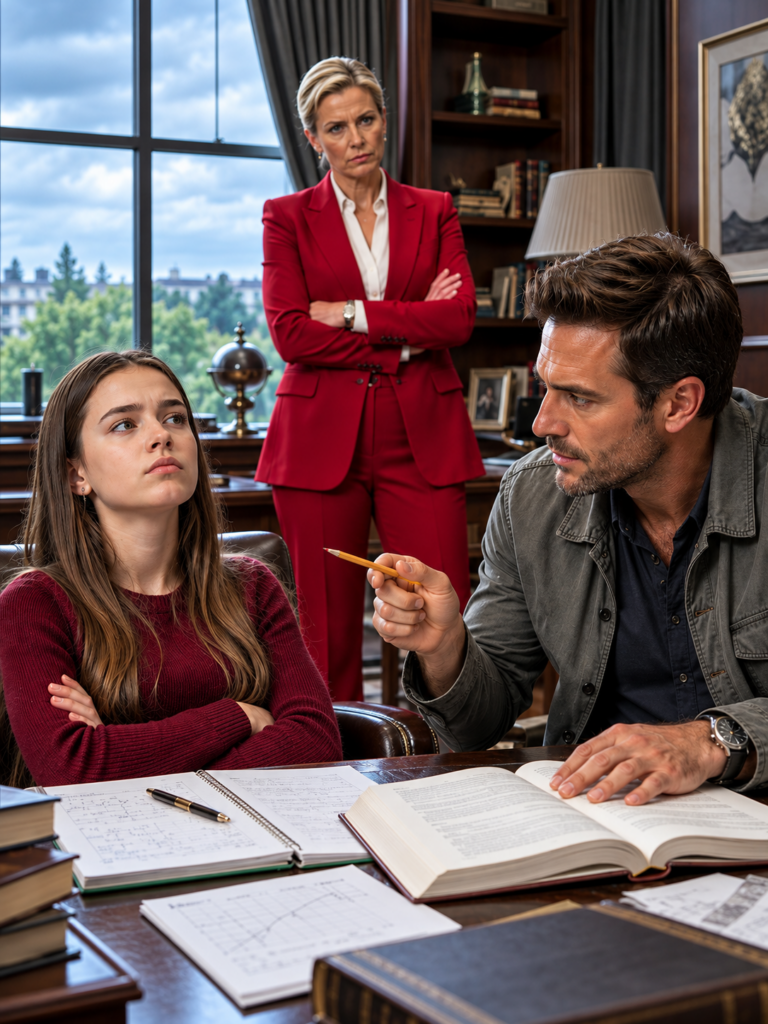
No tutor lasted more than two weeks with billionaire heiress Alara Voss over the course of three years. She was brilliant, stubborn, and impossible to control. She had driven away professors, psychologists, and private tutors twice her age. Then her mother hired Ronan Hale, a quiet single father who wore a maintenance worker’s uniform and hid a past no one knew about.
On his first morning, Alara deliberately tore up his lesson plan and challenged him to make her learn. Ronan simply smiled and said, “I’m not here to control you.”
Hours later, the impossible happened. Alara opened her textbook willingly. But when her mother discovered why Ronan understood her daughter so deeply, she realized she had hired someone far more dangerous than an ordinary tutor.
Vivian Voss ran boardrooms the way other people ran small countries. She had built an empire from nothing but ambition and a willingness to outwork every man who had ever doubted her. By the time she turned forty, her name alone was enough to move markets.
Behind the marble halls and private jets, there was only one person who could soften her sharp expression: her daughter.
Alara was the only part of Vivian’s life that money had never been able to protect completely, and for three long years, that truth had haunted her more than any hostile takeover.
The girl was extraordinarily intelligent, capable of reading corporate contracts at twelve and spotting a loophole an entire team of lawyers had missed. Yet she treated every tutor who entered her life as an enemy to defeat rather than a mentor to trust.
The string of failures had become something of a quiet legend among the Voss household staff.
A Harvard-educated literature professor lasted only four days before packing his bags and leaving without even saying goodbye.
A renowned child psychologist, brought in from London at enormous expense, resigned after Alara answered every question with another question until the woman gave up completely.
Tutors arrived with impressive qualifications and left looking as though they had survived an experience they never wanted to discuss again.
Vivian began to suspect, quietly and with growing fear, that the problem was not the competence of the people she hired.
It was something within Alara herself, something none of them had possessed the patience or wisdom to reach.
The staff began calling her, in whispers never intended for Vivian to hear, the girl no one could teach.
It wasn’t that Alara lacked intelligence. Quite the opposite. She had more than enough of it, and she used that intelligence as a weapon against anyone who tried to shape her.
She memorized her teachers’ patterns within days, then dismantled them piece by piece, finding the precise question that could make an adult doubt themselves in front of a child.
Vivian watched it happen again and again from the security monitor in her office, unable to intervene without making things worse. Every failure stripped away another piece of the confidence she had spent decades building in every other aspect of her life.
She had tried everything a billionaire’s resources could provide.
Elite academies, specialized programs, and even a brief, disastrous experience with a celebrity tutor who resigned after a single afternoon.
Nothing worked because nothing addressed the real wound beneath all that intelligence and defiance.
One evening, sitting alone with a pile of resignation letters scattered across her desk, Vivian finally admitted to herself that she needed to stop searching for someone impressive and start searching for someone different.
She needed someone who was neither intimidated by wealth nor tempted by it.
And she had absolutely no idea where to begin looking for such a person.
It was her head of household staff who mentioned, almost as an afterthought, the quiet man who handled maintenance work at one of the properties managed by her company.
His name was Ronan Hale.
A single father with no advanced degree and no polished résumé. A man who fixed leaking pipes and broken fences for a modest hourly wage.
There was nothing on paper to explain why anyone would suggest him for the position of private tutor to one of the wealthiest young women in the country.
Vivian nearly dismissed the idea entirely.
Then the employee added one detail that made her pause.
Ronan’s own daughter, who had once been withdrawn and struggled academically, had transformed under his quiet, patient guidance into a confident, curious child.
Still, Vivian couldn’t shake her uneasiness.
Why would a man with no formal educational background, no institutional standing, and no visible ambition beyond raising his daughter be the solution to a problem that had defeated some of the most qualified minds in the country?
She stared at the thin, unremarkable file someone had assembled on Ronan Hale and found almost nothing worth reading.
Just a name, an address, and a handful of odd jobs stretching across several years.
It was the emptiness of that file, more than anything written in it, that made her decide to call him.
If everyone else’s expertise had failed, perhaps what her daughter needed was someone the world had never bothered to notice.
Ronan arrived at the Voss estate on a gray Tuesday morning, and nothing about him matched the image the staff had imagined.
He wore an ordinary gray jacket instead of a tailored suit. He carried no briefcase, and no assistant followed him with stacks of documents.
To the housekeeper who let him in, he looked like a man who had just finished repairing someone’s roof and had simply forgotten to leave.
Vivian greeted him in the foyer with her arms crossed, studying him the way she examined underperforming executives, searching for a weakness she could identify before the meeting even began.
He didn’t falter under her scrutiny.
Nor did he try to sell himself.
He answered her questions simply, without exaggeration, freely admitting that he had neither a teaching certificate nor experience with complicated children like her daughter.
Vivian found herself almost offended by his honesty, as though she had expected a performance and received indifference instead.
Somewhere deep in her mind, a small skeptical voice told her this was already a mistake, that she had allowed herself to be drawn into an experiment by an employee who barely knew the man beyond a rumor about his daughter’s improved grades.
But her options had run out.
So she allowed him upstairs anyway, toward the room where Alara waited to destroy him like all the others.
Alara didn’t even look up when Ronan entered the study.
She sat curled up in a large leather chair with a book she wasn’t reading. Her posture radiated the boredom of someone who had already decided how the next hour would unfold.
When she finally raised her eyes to examine him, something close to disappointment flickered across her face, as though she had hoped for a more worthy opponent.
Without introduction, she asked what made him think he could teach her anything at all.
Her voice carried the practiced cruelty of a girl who had learned that words could wound faster than any weapon.
Ronan didn’t answer the question the way she expected.
He slowly set down his bag, glanced around the room and at the bookshelves filled with volumes she clearly had never opened, and asked a question of his own.
He wanted to know why she had decided, long before he walked through that door, that she didn’t want to learn from him.
Alara blinked, caught off guard by the shift.
For a moment, the carefully manufactured boredom in her expression cracked before she regained her composure.
She snapped that the reason didn’t matter because the result would be the same as always.
He would leave within a week, just like everyone before him.
He asked her to prove it.
Not with anger or wounded pride, as the other tutors had responded during their sessions with her, but with something closer to genuine curiosity, as though her rebellion were a puzzle worth solving rather than an obstacle to overcome.
Alara narrowed her eyes and reached for the nearest folder of lesson plans, the one Vivian’s assistant had spent an entire week preparing.
Without warning, she tore it apart in front of him.
The papers scattered across the floor between them, and a silence settled over the room that felt heavier than any shouting could have been.
Ronan looked at the torn pages, then raised his eyes to hers.
He didn’t raise his voice.
He bent down, absentmindedly gathered a few scattered sheets, and told her the lesson plan hadn’t mattered to him anyway.
He said what mattered was understanding what she was truly afraid of, because a girl as intelligent as she was wouldn’t fight so fiercely unless she was protecting something.
Alara opened her mouth to deliver another insult, but nothing came out.
Because for the first time in three years, someone had looked behind her mask and named the thing hiding beneath the performance.
He told her plainly that he wasn’t there to control her.
Control had never been the goal.
She could spend the rest of the morning testing him if she wanted, because he wasn’t going anywhere.
Alara studied him for a long moment, searching his face for the crack that always appeared eventually, that flash of frustration or fear that told her she had won.
It never came.
Instead, Ronan pulled a chair across from hers, sat down without asking permission, and simply waited, patient as stone, for her to decide what she wanted to do next.
Somewhere down the hallway, beyond their sight, Vivian stood frozen in front of the security monitor, watching a man maintain his composure in front of her daughter in a way she herself had never managed.
By midmorning, something had changed in the study that no one in the house could fully explain.
Alara spent the first hour testing Ronan with increasingly difficult and obscure questions, hoping to expose his ignorance as she had done with every tutor before him.
He answered honestly when he knew something, admitted plainly when he didn’t, and asked her to explain the parts he didn’t understand instead of pretending to possess expertise he lacked.
It was such a simple thing, that admission of not knowing, but it affected Alara in a way nothing else had.
Because none of the credentialed adults who came before him had ever allowed themselves to be that vulnerable in front of her.
Almost against her will, she decided to raise the difficulty.
Alara pulled a worn notebook from beneath a stack of unread books and produced a mathematical proof so deliberately complex and obscure that even her most recent tutor, a doctoral student in applied mathematics, had refused to attempt it.
She pushed the page across the table toward Ronan with a hard, challenging stare, the look of a girl who had learned that winning meant making adults feel small.
She told him that if he couldn’t solve it, there was no reason for either of them to continue pretending the arrangement would work.
Ronan studied the page for a long time.
Instead of reaching for a pencil, he asked why she had chosen that particular problem out of everything in her notebook.
The question unsettled her in a way she hadn’t expected.
No one had ever asked her to justify her weapons before. They had only tried to survive them.
She stammered that it was the hardest problem she had.
Ronan slowly shook his head and told her that wasn’t what he had asked.
He wanted to know what she thought would happen if he actually solved it.
Because people don’t choose the hardest possible test unless some part of them is finally hoping to be surprised.
The room grew quiet in a way she had never experienced before.
It wasn’t the silence of a hostile confrontation, but something more uncertain and more exposed.
Alara opened her mouth to deflect the question with sarcasm, as she always did, but this time the words didn’t come easily.
Instead of solving the proof directly, Ronan began walking through the logic with her, asking what each variable represented and discussing her assumptions as a fellow mathematician might, rather than lecturing her like a teacher addressing a student.
Slowly, Alara found herself leaning forward without meaning to, pointing at a step in her own proof and admitting, almost involuntarily, that she wasn’t entirely sure it was correct.
It was the first time in three years that an adult in that room had managed to make her say the words, “I’m not sure.”
Ronan didn’t exploit it or celebrate it.
He simply nodded and asked what she thought they should try instead, treating her uncertainty as an invitation to collaborate rather than a weakness.
For nearly forty minutes, they worked through the problem together.
And somewhere along the way, Alara Voss began learning without even noticing that she had started.
At the far end of the hallway, Vivian stood completely motionless before the small monitor mounted in her office.
Her coffee had long since gone cold in her hand.
For three years, she had watched failure after failure unfold on that same screen.
She had seen confident adults reduced to stammering wrecks before her daughter’s sharp intelligence, and she had nearly lost hope of ever witnessing a change.
What she saw now was Alara laughing, quietly and briefly, at something Ronan had said about his own mathematics professor years earlier.
It was a spontaneous sound Vivian hadn’t heard from her daughter in a very long time.
And for the first time since tutors had begun rotating through her home, Vivian allowed herself to believe that something might actually be working.
The moment didn’t last uninterrupted.
Ronan’s phone vibrated once on the table.
He glanced at the screen with a flicker of something Vivian couldn’t identify from behind the monitor.
Something between caution and recognition.
He quietly excused himself and stepped into the hallway to answer the call.
Through the glass door, Vivian could see his posture change completely.
His shoulders straightened, his jaw tightened, and the easy, quiet warmth he had shown Alara all morning vanished, replaced by something colder and more controlled.
She couldn’t hear the words, but she didn’t need to.
She had spent enough years reading rooms full of powerful men to recognize when someone was speaking to a person who expected obedience.
Whoever was on the other end, Ronan answered in short, clipped sentences.
At one point, Vivian saw his eyes move toward the study door, where Alara was still sitting, as though he were checking on her safety before continuing the conversation.
When he ended the call, he stood in the hallway for several seconds longer than necessary, gathering himself before returning to the room with the same calm expression he had worn all morning.
But Vivian had seen enough.
She had glimpsed the person beneath the mask of the quiet, patient tutor.
And it unsettled her more than anything Alara had ever done to drive away her previous employees.
That night, long after Alara had gone to bed still smiling faintly over the problem she had finally solved, Vivian sat at her desk and made a call of her own.
She contacted a private security investigator her company used for background checks, someone accustomed to uncovering everything people preferred to keep buried.
She gave him Ronan Hale’s name and told him she wanted to know everything, no matter how long it took or how much it cost.
She had learned the hard way that mysteries left unexamined tended to become disasters later.
As she hung up, her thoughts returned to the single word she had overheard drifting from the hallway earlier that morning.
A rank. A title.
Spoken by an unfamiliar voice as though it still meant something to the man standing inside her home.
The report arrived three days later, thinner than Vivian had expected, yet somehow heavier than any file she had ever read.
Ronan Hale’s public record was almost excessively ordinary.
A series of maintenance jobs, a modest apartment lease, and a daughter enrolled in a public school in another town.
But buried within that unremarkable record was a gap lasting nearly six years.
A period with no employment history, no tax filings, nothing except a single redacted line connecting him to federal service.
Vivian stared at that empty space longer than anything else in the file, because in her experience, gaps were rarely accidental.
She pushed harder, calling in a favor from a former board member with close connections inside the defense industry.
What came back this time arrived with warnings about how far she should pursue the matter.
Ronan Hale had served in the United States Navy.
During that service, he had been selected for one of the most demanding and secretive units in the entire military: the Navy SEALs.
He had deployed multiple times to conflict zones described in the report only through vague geographical references.
His record contained commendations quietly buried beneath levels of classification most civilians would never encounter.
Vivian read the sparse details twice, trying to reconcile the quiet, modest man who had spent the morning solving mathematics problems with her daughter with the operative described in those terse official statements.
Somewhere within those missing six years, something had happened.
Something significant enough to end a promising military career and drive a decorated operative into a quiet life of manual labor.
The report offered no clear answer.
Only a note that Ronan’s separation from service had been sudden and had occurred around the time of his daughter’s birth and the disappearance of the child’s mother from all subsequent records.
Vivian sat with that information for a long time, turning it over in her mind, trying to imagine what kind of event could break a man of that caliber into someone content to repair broken pipes and mow lawns for a living.
Slowly, and with an unfamiliar sense of discomfort, she began to understand why Ronan possessed that strange, unsettling ability to read people the way he had read Alara in a single morning.
Men who spent years learning to assess threats, noticing the smallest changes in a stranger’s posture or tone of voice, did not simply lose those skills when they left the service.
He had likely spent years learning to detect fear and deception in life-or-death situations.
Now he was applying that same precise, unsettling attention to a fifteen-year-old girl who had spent years hiding her fear behind sharp words and closed doors.
It explained everything about how quickly he had seen through Alara’s rebellion and recognized the loneliness beneath it.
But it explained nothing about why a man with that history had chosen this particular quiet life.
The larger question still lingered at the edges of Vivian’s thoughts.
Why would someone capable of operating in the most dangerous environments on earth voluntarily come into her home to tutor a difficult teenager for a fraction of what his skills could earn elsewhere?
She convinced herself that it was simply about his daughter, his need for flexible local work that allowed him to be present for the child he was raising alone.
The explanation made sense on paper, though something in her instincts refused to accept it completely.
Whatever the reason, she decided not to confront him yet.
Not while Alara was finally, cautiously, opening a book without being forced to.
Meanwhile, upstairs, Alara began noticing things about Ronan that no file or background report could capture.
She noticed that loud noises never seemed to startle him.
The way he positioned himself in a room with a clear line of sight to the door.
The careful economy of his movements, even when nothing around them required caution.
She also noticed the exhaustion that sometimes crossed his face when his guard was down, a weariness that had nothing to do with sleep.
One evening, when he stayed later than their scheduled lessons required, Alara quietly admitted that she had trouble sleeping most nights.
The house felt too large and too silent once everyone had gone to bed.
Ronan didn’t offer empty words of comfort or suggest a therapist, as every other adult in her life had done.
He simply nodded, told her he understood the feeling of silence pressing heavily against a person, and sat with her a little longer without demanding any further explanation.
Within weeks, the girl who once tore up lesson plans to prove a point began arriving early to her sessions, her notebook already open, waiting for Ronan before he even reached the study door.
Her grades, which had remained stagnant for years despite her obvious intelligence, began climbing in ways that surprised even the administrators at her prestigious private school.
But the most important changes appeared in smaller places.
In the way she began making eye contact during conversations.
In the rare, spontaneous laugh that sometimes escaped her when Ronan made a dry, understated joke about his own failures as a student decades earlier.
Vivian noticed all of it, cataloging each small change the way she had once cataloged quarterly earnings.
She was both astonished and confused by the ease with which this quiet stranger had accomplished what money and status could not.
But the deeper transformation was taking place in the space between them, not in Alara’s test scores.
She began offering Ronan fragments of herself.
Small confessions dropped casually into the middle of unrelated conversations, the way frightened people test the ground before putting their full weight on it.
One afternoon, while working on an essay about family, Alara casually mentioned that her father had left when she was six years old and hadn’t called her on her birthday in almost four years.
She said it lightly, almost offhandedly, in the practiced tone of someone who had learned to speak painful truths as though they carried no weight.
She was testing whether Ronan would become uncomfortable or pity her, as the other adults always had.
Ronan did neither.
Nor did he offer the hollow comfort she had learned to despise from teachers and therapists alike.
Instead, he simply asked how she felt about people who were supposed to stay.
The question hung in the room, patient and unafraid, waiting for her to decide whether she would answer honestly.
Alara’s expression hardened immediately.
The familiar wall rose to close everything off again.
She exploded at him, saying she didn’t need him analyzing her as though she were one of his textbooks.
Her voice rising, she told him she didn’t need a father, that she had managed perfectly well without one for nine years, and that she didn’t need Ronan or anyone else to fill that particular gap in her life.
He let the outburst pass without retreating.
When the silence stretched long enough for Alara to expect an apology or a change of subject, he did neither.
Instead, he quietly told her he understood the instinct to convince yourself that you didn’t need anyone.
Because he had spent a long period of his own life believing exactly the same thing.
He didn’t elaborate on what those years had cost him.
He simply said they had taught him the difference between not needing people and being so afraid of letting them close again that they might disappoint you.
Alara stared at him, caught off guard by the admission, unprepared for an adult who offered his own vulnerability instead of demanding hers first.
For the first time since Ronan entered her life, Alara realized that the man sitting across from her wasn’t patient simply because patience came naturally to him.
He was patient because he understood, through some unspoken personal cost, exactly what it meant to be abandoned.
To build walls faster than anyone could tear them down.
To confuse isolation with strength.
She didn’t apologize for her outburst, because apologies had never come easily to her.
But she stayed in the room instead of storming out as she had with every tutor before him.
Something changed between them that evening.
Something neither spoke aloud, but both understood.
Over the following weeks, their sessions began extending beyond their scheduled hours, drifting into conversations that had nothing to do with textbooks or examinations.
Alara began asking cautious, indirect questions about his life, his daughter, and what it felt like to raise a child completely alone.
Ronan answered as much as he allowed himself, always careful not to make the conversation about his own pain instead of hers.
She learned that his daughter’s name was Josie, that she loved drawing horses she had never seen in real life, and that Ronan stayed up late repairing her broken toys instead of buying replacements because he wanted her to understand that broken things could still be worth fixing.
Watching all of this from the monitor in her office, Vivian felt an emotion she had neither expected nor entirely welcomed.
She felt, unmistakably, a flash of envy.
Not envy of Ronan’s presence in her daughter’s life specifically, but of his ability to reach a place inside Alara that Vivian herself had never managed to reach, despite being her mother.
She thought of every missed dinner sacrificed for a board meeting.
Every birthday celebrated with a carefully chosen gift selected by an assistant instead of her personal presence.
And she wondered, with a pain she rarely allowed herself to feel, whether her daughter’s walls had been built partly in response to her own absence.
It was a truth harder to accept than any hostile takeover she had ever faced.
And there was no team of lawyers or consultants who could help her repair it.
The night everything changed began like any other.
Alara was finishing a late study session while Vivian worked through a pile of documents in her private office two floors below.
Shortly after eleven, the mansion’s normally silent and unobtrusive security system activated with an alert indicating a breach along the eastern perimeter fence.
Within seconds, the house’s calm dissolved into organized chaos.
Security personnel moved through the hallways, their radios crackling.
Household staff hurried toward designated safe rooms under protocols no one had ever expected to use.
Two guards intercepted Vivian before she fully understood what was happening and quickly escorted her toward a fortified room downstairs while questions raced through her mind faster than anyone could answer them.
Alara, who had been alone upstairs when the alarms began screaming through the halls, reacted as any frightened fifteen-year-old girl might.
She rushed out of her room in panic, with no idea where safety actually lay.
She ran into the dark corridor just as the lights began flashing under the security system’s emergency protocols.
And in one terrifying moment, she found herself completely alone in a house that had suddenly transformed from a place of comfort into something unfamiliar and frightening.
Ronan, who had stayed later than usual to review notes for the next day’s lesson, was the first to reach her.
He moved through the chaos with a calm, deliberate purpose that sharply contrasted with the panic gripping everyone else in the house.
He didn’t shout at her to run.
He didn’t grab her the way a terrified adult might.
He bent slightly to meet her eyes and told her in a low, steady voice that she needed to stay close to him and move exactly where he directed her.
Something in his tone cut through her panic in a way the alarms and shouting never could.
Alara found herself obeying without question.
She followed him through a hallway she barely recognized in the dim emergency lighting, watching how he examined corners and doorways with a precision that seemed to belong to an entirely different version of the quiet tutor she had come to trust.
He moved like a man who had done this before, who understood exactly how to read a dangerous space without wasting a single unnecessary movement.
Within minutes, Ronan had brought Alara into a small interior room with no outside windows.
He positioned himself between her and the door without making the movement seem dramatic or frightening.
He kept his voice low and steady throughout, asking her simple questions to calm her, guiding her breathing and having her count backward.
These were techniques she would later realize had been designed to keep her mind occupied and calm rather than allowing it to spiral into fear.
The security teams eventually confirmed that the intruder had been detected and driven off the property before reaching any of the residential buildings.
But by the time the all-clear was given, something fundamental had changed in Alara’s perception of the man standing quietly beside her.
Vivian reached the room only minutes after the incident ended.
Her carefully composed exterior had crumbled under the fear she felt for her daughter in a way very few people had ever witnessed.
She found Alara sitting quietly beside Ronan.
The girl was visibly shaken, but composed.
The sight of her daughter maintaining control in the middle of what should have been terrifying chaos struck Vivian more deeply than the security breach itself.
Without being asked and without her usual caution, Alara crossed the room and wrapped her arms around Ronan in a hug that surprised everyone present, including Ronan himself.
He stood frozen for a moment, unaccustomed to receiving genuine gratitude from anyone, before finally placing his hand awkwardly against her back.
Vivian watched the scene with an unfamiliar tightening in her chest, realizing in that moment that the man she had hired to teach her daughter mathematics and literature had become something closer to a protector.
Perhaps even something closer to family.
She thanked him quietly, her voice uncharacteristically unsteady.
Ronan simply nodded, minimizing his actions the way people who had truly done dangerous things often did, insisting he had only done what anyone in his position would have done.
Vivian now knew, from the report locked in her desk drawer, that this wasn’t true.
Very few people possessed the training or composure to handle a security breach the way he just had.
Later that night, after Alara had gone to sleep and the security team had finished sweeping the property, Vivian received a call from the head of her private investigative team.
The information turned an already unsettling night into something far more sinister.
They explained that the breach did not appear to be random.
Whoever had attempted to enter the property had bypassed several outer security measures with a level of planning that suggested prior knowledge of the estate’s layout.
Preliminary analysis indicated that the timing had been deliberate rather than coincidental.
Vivian sat alone in her office long after the call ended, staring into the dark window, realizing with growing horror that someone had specifically targeted her family.
And the danger was not over.
In the days that followed, Vivian learned the full extent of the threats surrounding her family.
Those threats were connected to a particular name.
A rival industrialist named Weston Holt, who had spent much of the previous two years unsuccessfully attempting to force a hostile takeover of one of her most important subsidiaries.
Holt had a reputation for ruthlessness that extended beyond ordinary business tactics, and her investigators believed he had become desperate enough to seek leverage through unconventional means.
If he couldn’t break Vivian through the courts or markets, the theory went, perhaps he believed he could break her through fear.
Through her daughter.
The one weakness no boardroom victory could fully protect.
The realization changed everything about the way Ronan approached his role in the household.
His work was no longer limited to lessons and essays.
He quietly assumed a broader responsibility for Alara’s safety, something never formally announced but understood by everyone in the house without needing to be said.
He walked the property’s perimeter before and after each session, studied the security team’s protocols with a critical eye that made even the hired guards uncomfortable, and began teaching Alara small, practical habits.
How to identify exits in unfamiliar rooms.
How to remain calm when her heartbeat accelerated under pressure.
He presented all of it not as fear, but as simple preparation.
Alara absorbed these lessons the same way she absorbed mathematics, hungry for anything that made her feel less helpless in a world that had suddenly become frightening again.
Yet Vivian grew increasingly uneasy as she watched Ronan take on a role that extended far beyond his original job description.
One evening, the tension between them finally erupted into an open disagreement.
She confronted him in the hallway outside Alara’s study, her voice sharper than she intended, accusing him of crossing boundaries he had never been hired to cross and turning her daughter’s education into something resembling combat training.
Ronan listened without interrupting.
When she finished, he answered with a calm that made his words land harder than if he had raised his voice to match hers.
He told her plainly that he wasn’t protecting her company, her assets, or her reputation, because none of those things had ever mattered to him.
He was protecting a person.
A specific, frightened fifteen-year-old girl who had finally begun trusting the adults around her.
And he wasn’t going to stand by while that trust was destroyed by someone else’s greed.
The words settled in the space between them.
Vivian found herself without an immediate response.
Because for the first time in a very long time, someone had reframed a crisis in terms that had nothing to do with the language she spoke fluently: assets, liabilities, and strategic positions.
She studied Ronan for a long moment.
She no longer saw the maintenance uniform he had worn when he first arrived, but the quiet, steady certainty of a man who had clearly devoted his life, more than once, to protecting people who could never reward him for it.
Something in her posture softened almost imperceptibly.
She quietly admitted that she didn’t know how to be the kind of protector her daughter seemed to need.
Ronan told her that wasn’t entirely true.
The kind of protection Alara needed from her mother had nothing to do with fences or guards.
Over the following days, an unfamiliar respect began forming between Vivian and Ronan.
It wasn’t built on charm or flattery, but on the simple recognition that both of them were fighting, in very different ways, for the same fragile and precious thing.
Vivian noticed, with a mixture of curiosity and something she wasn’t yet willing to name, that Ronan remained completely unaffected by the scale of her wealth.
He was not impressed by mansions or cars, or even by the mention of numbers that would leave most people stunned.
He treated her in conversation not as a billionaire who needed to be managed, but as another exhausted, frightened parent trying to do right by a child she loved, flaws and all.
And that simple, direct honesty stripped away her defenses more effectively than any compliment ever could.
Meanwhile, despite the shadows hanging over the household, Alara’s academic transformation continued at a pace that astonished everyone who had once considered her impossible to teach.
She finished her assignments early, volunteered answers during the rare group sessions Vivian arranged with experts, and began speaking about universities and future ambitions with genuine enthusiasm instead of the manufactured indifference she had worn as armor for years.
Teachers who had once dreaded hearing her name began requesting her participation in academic competitions, unable to reconcile the confident, articulate girl before them with the reports written three years earlier that had declared her a hopeless case.
None of them knew that the real turning point had never been about mathematics.
It had been about a quiet man who simply refused to give up on her the way others had.
The confrontation Vivian had been dreading came without warning on an ordinary afternoon.
When she finally gathered the courage to ask Ronan directly about the six missing years in his file, she invited him into her office after Alara’s lesson ended.
She closed the door behind them and told him plainly that she knew about his military service, the special operations units, and the classified gap where six years of a man’s life should have been documented.
Ronan denied none of it.
Nor did he seem surprised that a woman with her resources had eventually uncovered the truth.
He sat across from her in silence for a long moment, weighing something deep within himself, before finally beginning to speak about a part of his life he had not discussed with anyone in years.
In measured, carefully chosen sentences, he told her about a mission that had gone wrong in ways no amount of training could have fully prepared him for.
About a moment when the plan collapsed and he had only seconds to choose between completing the objective his superiors had ordered or turning back to rescue an injured teammate left behind in the chaos.
He chose his teammate.
It was a decision that saved a life and effectively ended Ronan’s career.
The consequences of that choice, the mission’s failure, and the political fallout that followed made it impossible for him to continue serving the way he once had.
He added no drama to his account, speaking of violence and loss with the careful, quiet restraint of a man who had trained himself for years to suppress those memories.
He explained that when he returned home after that final mission, his life felt almost unrecognizable.
His relationship with Josie’s mother, already strained by years of absence and military deployments, did not survive what followed.
Within a few short months, Ronan found himself raising his infant daughter completely alone.
Without a job.
Without a clear plan.
Without any idea how to be a father when the only identity he had ever known had been taken from him in a single moment.
He told Vivian that the years that followed were the hardest of his life.
Harder even than combat, because there was no training manual for learning how to be present for a child while carrying a particular kind of guilt that never completely faded.
He said those difficult early years had taught him the truth that eventually led him to her home.
He told her that people, especially those who were frightened and wounded, did not need someone perfect standing over them demanding strength they did not feel.
What they needed, more than anything else, was someone who simply refused to leave.
Someone steady enough to remain present through chaos, fear, and mistakes without retreating or running away.
He said he had recognized that need in Alara from the very first morning, from the way she tested every adult who entered her life.
Because testing people was the only tool she had to discover who would truly stay.
Vivian sat contemplating his words long after he finished speaking, feeling something open in her chest in a way no boardroom negotiation ever had.
She realized, with a clarity that was almost physically painful, that the sentence Ronan had just spoken described her failure as a mother with disturbing precision.
She had spent years replacing the simple, difficult work of actually being present with private schools, expensive tutors, and carefully selected gifts.
And somewhere along the way, her daughter had learned the same lesson Ronan himself had once learned.
That the people who mattered most were the ones most likely to leave in the end.
It was not an easy truth to live with.
Vivian didn’t pretend otherwise.
But for the first time in years, she allowed herself to feel its full weight instead of burying it beneath another meeting or another deal.
That conversation became a quiet turning point in Vivian’s own life, although the change did not happen all at once.
It began in small, deliberate ways.
She canceled meetings she would once have prioritized without a second thought.
She attended dinner instead of sending an assistant with an apology.
She sat in on Alara’s lessons, not to monitor Ronan’s methods, but to be present for her daughter in a way she rarely had before.
Alara noticed the change with the same caution and suspicion she brought to everything new in her life.
At first, she wasn’t sure whether her mother’s sudden presence would last.
But slowly, with each meeting and each dinner, something between mother and daughter that had lain dormant for years began cautiously coming back to life.
The calm the household had begun to recover shattered less than two weeks later, when Weston Holt made his final and most destructive move.
A fabricated story spread through the financial media, alleging serious ethical violations within Vivian’s company.
It came with forged documents designed to look incriminating at first glance and difficult to disprove quickly enough to prevent real damage.
Within hours, a multibillion-dollar deal Vivian had spent more than a year negotiating was on the verge of collapse as anxious investors and partners rushed to distance themselves from the unfolding scandal.
By every practical measure, it was the most dangerous threat her company had faced in a decade.
And it came at the very moment her personal life had finally begun to feel stable.
Alara, who had been working on homework in the next room, overheard fragments of the frantic phone calls flooding the house.
From the panic in her mother’s voice, she understood that something catastrophic was happening.
The old instinct surfaced immediately.
That familiar urge to withdraw, to shut down, to become the guarded, difficult girl who trusted no one.
Because trusting people had always seemed to come before losing them.
She found Ronan in the study and told him, her voice trembling, that she wanted to run away.
That she didn’t want to watch everything collapse the way it always did in the end.
That perhaps it would be better to stop caring before caring hurt her again.
Ronan didn’t allow her to retreat into that old, familiar armor.
He sat her down and told her, gently but without hesitation, that the most important lesson of the past few months had never appeared in any of her textbooks.
He reminded her of the problem they had solved together on their first morning.
How she hadn’t given up even when it seemed impossible.
How the difference between winning and losing had never truly been about talent, but about refusing to walk away before the work was finished.
He told her that running from difficulties now would destroy everything she had built within herself over the previous months.
Not because failure was shameful, but because avoidance would teach her, once again, that she couldn’t get through difficult things.
Something in his words reached her more deeply than panic ever could.
Instead of running, Alara made a decision that surprised even herself.
She walked into her mother’s office, interrupted a call with a nervous board member, and simply asked how she could help.
Vivian, exhausted and cornered by a crisis threatening to destroy everything she had built, looked at her daughter for a long moment.
Then, perhaps for the first time, she treated her not as a child who needed to be shielded from hardship, but as a capable young woman who deserved to be part of the fight.
Together, mother and daughter began sorting through the forged documents late into the night.
Alara’s sharp analytical mind, the same mind she had used as a weapon against every tutor who entered her life, was now directed toward finding contradictions buried within Holt’s manufactured evidence.
Ronan, working quietly beside them, was the one who eventually uncovered the thread that unraveled the entire scheme.
He drew on skills honed through years of intelligence work far more dangerous than corporate espionage.
He traced the digital fingerprints behind the leaked documents through a chain of shell accounts to a company with known, though carefully concealed, connections to Weston Holt.
He didn’t present the discovery as an individual act of heroism.
Instead, he laid out the evidence clearly and allowed Vivian’s legal team to build the case from there, instinctively understanding that Vivian needed to reclaim her victory herself rather than have it handed to her.
By dawn, the family had assembled enough evidence not only to disprove the fabricated scandal, but to publicly expose Holt’s involvement.
His final desperate attack had become the very thing that would end his campaign against them forever.
In the exhausted, quiet hours after the crisis began turning in their favor, Vivian looked across the desk covered with papers and scattered coffee cups at her daughter.
She felt something she had not experienced in a very long time.
Genuine, spontaneous closeness, built not on obligation, but on having survived something difficult together.
Alara, for her part, looked different too.
Steadier.
Less fragile.
As though the fear that had driven so much of her defiance over the years had finally loosened its grip, even if only a little.
Neither of them spoke much about what had changed between them that night.
But both understood that something fundamental had shifted, and that whatever came next, they would face it together instead of hiding behind separate walls.
Within days, Weston Holt’s manufactured scandal collapsed completely beneath the weight of the evidence presented by Vivian’s legal team.
The damage to his reputation proved far more permanent than anything he had managed to inflict on the Voss family.
Financial analysts who had briefly speculated about the deal’s collapse praised Vivian’s composure under pressure.
The billion-dollar agreement she had feared losing was successfully finalized within the month, stronger for having survived the attempted sabotage.
But within the walls of the mansion, none of that mattered as much as the quieter victory unfolding alongside it.
Alara Voss, once declared impossible to teach by every expert who encountered her, entered her final examinations that season with a calm, focused confidence that no one who had known her three years earlier would have recognized.
She completed the examinations with results that astonished even the administrators who had long considered her a lost cause.
Her scores placed her among the top students in her entire academic program.
The household staff who had once whispered about the girl no one could teach now found themselves discussing her sudden, remarkable transformation.
They couldn’t explain how a modest tutor had accomplished what an army of credentialed specialists had failed to achieve.
Vivian, sitting among the audience at a small ceremony honoring outstanding students, watched her daughter accept her certificate with quiet pride.
It had nothing to do with wealth or status.
It was entirely about seeing someone she loved finally believe in her own abilities.
Afterward, Vivian approached Ronan with an offer she had been considering for weeks.
She proposed that he become Alara’s permanent academic advisor, with a salary far exceeding anything he had ever earned in his life.
Enough to secure both his future and Josie’s many times over.
Ronan listened respectfully, then declined without hesitation or any sign of temptation.
He told Vivian that what Alara had needed was never a wealthier teacher or a more impressive title.
It was simply having people in her life who genuinely believed in her.
And that kind of belief, he said, “cannot be bought at any price, no matter how generous.”
Instead, he offered to continue working with her at his current modest rate and on his own schedule, as a mentor rather than an employee bound by a contract.
Alara entered the room, having overheard part of the conversation from the doorway.
She told her mother plainly that Ronan was the first person in her life who had made her want to become a better version of herself.
Not because he had forced her to, but because he had simply never stopped believing she was capable of it.
Vivian looked back and forth between her daughter and the quiet, humble man who had entered her home wearing a maintenance uniform.
Somehow, he had managed to rebuild something inside both of them that all her wealth had never been able to repair.
She realized, with a clarity that felt both humbling and liberating, that Ronan Hale had changed her life just as profoundly as he had changed her daughter’s.
Without intending to, he had taught her that being present mattered more than providing material things.
And that no amount of money could replace the choice to stay, every single day.
In the months that followed, something quiet and natural began growing between Vivian and Ronan.
A mutual respect neither rushed to name or define, allowing it simply to develop at its own unforced pace.
By every outward measure, he remained the same man he had always been.
He lived simply, picked Josie up from school himself every afternoon, and refused anything that felt like charity rather than genuine partnership.
Meanwhile, Alara continued becoming someone almost unrecognizable compared to the guarded, defiant girl who had once torn up a lesson plan on principle.
She was growing into a confident young woman capable of facing difficulties without immediately retreating behind her old defenses.
On an ordinary afternoon, many months after that difficult first morning, Ronan gathered his belongings at the end of a lesson and made his way toward the front door, as he always did, with his usual quiet humility.
Before he could reach it, Alara ran down the hallway after him, calling his name and reminding him with mock seriousness that he couldn’t simply leave without confirming their plans for tomorrow’s session.
Ronan turned, a small, genuine smile appearing on his face, and told her he wouldn’t dream of missing it.
Vivian stood quietly watching from the doorway, finally understanding completely that the man she had once regarded with suspicion had given her family something she could never have purchased with all the treasures in the world.
People once said that no one could teach Alara Voss anything at all.
They were wrong.
She had never needed someone to dictate who she should become.
She had only needed someone patient enough to help her discover who she had the capacity to be, on her own terms and in her own time.


