
Eli pulled the stake free with a sharp wrench, sending a clump of dark earth tumbling onto his boot.
Clara leaned forward from the wagon.
“Who put that there?”
“Don’t know.”
He turned the wood over.
A number had been marked near its base.
Forty-one.
The red cloth tied around the top was damp with the afternoon mist.
“Is it a flag?” Pearl asked.
“Something like that, sweetheart.”
“Can I keep it?”
Eli considered the stake.
“Not yet. I need to find out who owns it.”
He placed it beneath the wagon seat and climbed back beside Clara.
Neither spoke as they crossed the pasture.
The ranch house appeared beyond a stand of cottonwoods, white-painted and sturdy, with a long porch facing the yard.
A red barn stood nearby, and cattle grazed farther down the valley.
Pearl pressed her nose against the wagon’s side.
“That’s your house?”
“Yes.”
“All of it?”
“All of it.”
“Does anybody live there besides you?”
“Mrs. Tuttle and her husband help with the place.”
“Do they like children?”
Eli hesitated.
“I reckon we’ll soon find out.”
They found out the moment Odessa Tuttle opened the front door.
She was a broad, warm-faced woman with flour on her sleeves.
Her husband, Gus, followed from the barn, squinting at the new arrivals.
Odessa looked at Pearl’s numbered tag.
Her expression changed.
“Come here, little one.”
Pearl approached cautiously.
Odessa unfastened the tag and folded it into her apron.
“Nobody in this house needs a number to tell us who they are.”
Pearl touched the place where the tag had been.
Then she looked up at Eli.
“Can I still be Pearl?”
Eli felt something pull painfully beneath his ribs.
“That’s exactly who you should be.”
That evening, Pearl ate three biscuits at supper and slipped a fourth into her pocket.
Clara noticed.
So did Eli.
Neither embarrassed her by mentioning it.
Later, when Eli came upstairs to say goodnight, he found the biscuit hidden beneath Pearl’s pillow.
He understood immediately.
Children who had gone hungry learned to save food against the next empty day.
Without comment, he placed another biscuit beside it.
Pearl watched him.
“Can I keep both?”
“Of course.”
“Even tomorrow?”
“Even tomorrow.”
She considered that.
Then she pulled the blanket beneath her chin.
“I don’t like this bed.”
Eli looked at the narrow mattress.
“What’s wrong with it?”
“It doesn’t move.”
“Beds usually don’t.”
“The train did.”
He stood uncertainly in the doorway.
Then his eyes fell on an old rocking chair.
He sat down and began rocking.
The floorboards creaked beneath its runners.
Pearl smiled faintly.
“A little faster.”
He obliged.
By the time she fell asleep, his back ached and his legs had gone stiff.
He stayed another quarter hour anyway.
Downstairs, Clara sat with Odessa at the kitchen table.
When Eli finally appeared, she noticed his tired expression.
“Trouble settling her?”
“Not exactly.”
“Then what happened?”
“I became a railroad.”
Clara stared.
Odessa burst out laughing.
And Eli, who had not expected to be happy that evening, found himself smiling.
But after the house grew quiet, he carried the numbered survey stake into his small office.
He examined it beneath the lamp.
The fresh cut in the wood troubled him.
So did Bell’s warning.
The banker had specifically mentioned the creek-bottom property.
Eli owned four hundred head of cattle and worked hard enough to keep them fed, but he was not wealthy. A substantial part of the ranch still depended upon the bank’s willingness to renew his six-hundred-dollar note.
If Bell chose to press him, he could face serious trouble before spring cattle sales brought in money.
Clara appeared at the office doorway.
“You’re worried about the stake.”
Eli nodded.
“Somebody’s surveying along my creek.”
“Perhaps there’s a road planned.”
“Perhaps.”
“And perhaps Mr. Bell knows something you don’t.”
Eli looked at her.
“Why would you say that?”
“Because he mentioned your creek land before he’d even met Pearl properly.”
Eli considered her words.
Clara moved closer.
“Whatever this means, you should keep your records in order.”
“I pay what I owe.”
“I’m sure you do. But can you prove every payment?”
He pointed toward a pile of papers.
“Receipts are in there somewhere.”
Clara surveyed the untidy desk.
“Then tomorrow we’ll make certain they’re somewhere we can actually find them.”
She turned to leave.
“Miss Whitcomb?”
She stopped.
“Thank you for coming.”
Her expression softened.
“I came for honest work, Mr. Hartwell.”
“I know.”
“And for Pearl.”
He nodded.
“That too.”
She left him beside the lamp.
Eli studied the survey stake once more, then set it against the wall.
Outside, the creek moved quietly beneath the cottonwoods.
He thought of Pearl sleeping upstairs with two biscuits beneath her pillow.
He thought of the thirty-day trial.
And he understood that the greatest danger to the child might not come from his lack of experience as a father.
It might come from a man who already held the ranch’s mortgage and could decide whether she remained there.
He opened the drawer containing his loan papers.
The latest note lay on top.
Six hundred dollars.
Due December first.
Eli unfolded it and examined the date again.
Eli examined the date again, holding the note beneath the yellow light.
December first.
A little more than a month away.
Ordinarily, he would have expected the bank to renew the loan, just as it had three times before.
But Harlan Bell’s warning at the opera house had changed the meaning of that expectation.
For the first time, Eli began wondering what would happen if the bank refused.
The following morning, Clara found him asleep at his desk.
The paper lay open beneath his hand.
She did not wake him immediately.
Instead, she gathered the scattered receipts and began arranging them by date.
When Eli stirred, she had already placed three years of payments into neat piles.
“Did I hire a housekeeper or a bank examiner?” he asked.
“A housekeeper who can add.”
“That’s a dangerous sort.”
“Only to careless men.”
He smiled despite himself.
It was the first of many mornings when Clara’s presence changed the way the house felt.
Within a week, the clock on the mantel was ticking again.
The kitchen smelled of cinnamon and warm bread.
Pearl followed Clara with a slate tucked beneath her arm, practicing letters while Odessa prepared meals.
Gus found himself learning alongside her.
One morning, Pearl marched into the barn and announced that he had been promoted.
“Promoted to what?” Gus asked, cupping one ear.
“Student.”
“Steward?”
“Student!”
Gus looked at Eli.
“What’d she say?”
Eli laughed so hard he had to lean against a stall.
Pearl was not amused.
She took Gus’s hand and patiently showed him the letter she had written.
From then on, the old ranch hand treated her lessons with exaggerated seriousness.
And Pearl, who had once carried a number instead of a name, became the most important little person on the Hartwell ranch.
***
Eli discovered fatherhood through mistakes.
He learned that a child might cry because the bread was cut incorrectly.
That she might be terrified of an empty bedroom but entirely unafraid of a cow three times her height.
That questions could begin before sunrise and continue long after dark.
He also learned that Pearl noticed everything.
When he set an extra biscuit beside her plate, she saved half for Odessa.
When Gus repaired a broken toy wagon, she declared him the finest carpenter in Nebraska.
And when Eli forgot to smile, she climbed onto the bench beside him and demanded to know whether his face was tired.
But the most difficult lesson came when Clara traveled into town one afternoon.
She had gone for flour and winter supplies.
The road was slow, and she returned after dark.
Eli had spent the last hour walking between the porch and the front gate, telling himself that he was merely concerned about the approaching frost.
By the time Clara’s wagon appeared, a lantern hung from the porch post and another glowed behind the front window.
“Was there trouble?” he asked.
“Only a stubborn wheel rut.”
“You should have returned earlier.”
Clara looked at the lanterns.
“You were worried.”
“I was being practical.”
“Of course.”
She climbed down.
“Thank you for the lights.”
Eli hesitated.
“An old cook on the farm where I grew up used to leave one burning when I came home late. Wasn’t much kindness shown there, but she managed that.”
Clara’s expression changed.
“Then I suppose we ought to keep the practice.”
He looked at her.
“We?”
She smiled.
“The lamps won’t light themselves.”
Neither spoke of the small warmth that passed between them.
***
The ranch’s troubles became clearer in early November.
Harlan Bell arrived in his fine carriage with a nervous bank clerk named Tibbs.
Bell sat at Eli’s table as though it already belonged to him.
“The bank won’t renew your note,” he announced.
Eli stared at him.
“I’ve never missed a payment.”
“The bank’s circumstances have changed.”
“Then tell me what changed.”
Bell ignored the question.
“Six hundred dollars is due December first.”
Clara stood near the kitchen doorway.
Pearl sat on the stairs above her.
Bell glanced toward them.
“The committee may also have concerns about an unmarried gentleman employing a young woman in his household.”
“Mrs. Tuttle lives here as well,” Clara answered.
“Appearances matter.”
“Then perhaps people should look more carefully.”
Bell’s smile disappeared.
Pearl spoke from the stairs.
“Mr. Bell smells like peppermint, and he doesn’t like me.”
“Children should be seen and not heard,” Bell snapped.
Pearl stood up.
“Then look at me.”
Odessa hurried from the kitchen before the exchange became worse.
Bell collected his papers and left.
Eli remained seated.
He had perhaps two hundred dollars available.
The cattle would not bring their best return until spring.
And now the banker was threatening the ranch and Pearl’s placement at the same time.
Clara sat across from him.
“He’s not doing this because you’re a poor risk.”
“How can you be certain?”
“Because your records are excellent.”
She placed the receipts before him.
“Every installment made. Every one acknowledged by his clerk.”
Eli studied them.
“And still he calls the note.”
“Yes.”
“Why?”
Clara thought of the survey stake.
“That’s what we need to discover.”
***
The answer arrived by accident.
A young surveyor named Ollie Dunning stopped at the ranch for water.
He noticed the numbered stake beside the barn door and became visibly uncomfortable.
“Where did you find that?”
“Near my creek,” Eli answered.
Dunning glanced toward the pasture.
“That belongs to a railroad survey.”
Eli went still.
“A railroad?”
“The company is considering a branch through this valley.”
Dunning hesitated.
“I’m not supposed to discuss the route.”
“Then tell me this,” Eli said. “Does it cross my property?”
The young man studied his boots.
His silence was answer enough.
After he left, Clara spread Eli’s rough map across the table.
“A railroad needs a station,” she said.
“And the creek bend is level enough for one.”
“Which means the land might become valuable.”
Eli looked toward the yard.
“Bell wants the creek.”
Clara nodded.
“And he has a mortgage he can use to pressure you.”
They could suspect his purpose.
But proving it was another matter.
***
The first snow fell on November eighteenth.
By afternoon, the fields were disappearing beneath a white covering.
Pearl had been playing near the barn with her spotted hen, Biscuit.
When Clara called her in, the hen was alone on the porch rail.
A line of little footprints led away across the yard.
Toward the creek.
Eli grabbed his coat.
“Pearl!”
No answer.
He followed the tracks with Clara close behind him.
The wind was rising, making the trail harder to see.
They found the child near the willows by the frozen creek bank.
Her boots were soaked.
Her cheeks were pale.
And she was holding another survey stake.
“I was counting the flags,” she explained through chattering teeth.
Eli swept her into his coat.
“You frightened us half to death.”
“I wanted to know how many there were.”
“That can wait till summer.”
He carried her home while Clara hurried ahead to prepare dry clothes and warmth.
Pearl recovered from the exposure, but a cough developed, and for several nights the adults watched her carefully.
Eli sat beside her bed in the rocking chair.
Sometimes she woke and asked whether he would still be there when morning came.
Every time, he answered yes.
He was discovering that a father could make promises with very few words.
But the responsibility frightened him.
He had known too many promises that were broken.
***
Dunning returned the next morning.
He had heard about the child wandering onto the surveyed line.
In the kitchen, with snow melting from his hat, he admitted what he knew.
The railroad intended to place a depot near Eli’s creek bend.
And Bell had been corresponding with the railroad’s land agent for months.
“He expects to acquire the property before the new year,” Dunning said.
Eli stared at him.
“Does the company know I’m the owner?”
“They know the tract. I can’t say what they’ve been told about the title.”
Clara asked whether Dunning would testify.
He looked frightened.
“My mother depends on my wages.”
“Then don’t answer now,” she said. “But keep your field book safe.”
After he left, Eli stood at the window.
The banker wanted the land.
The banker could call the loan.
And the banker could influence the committee deciding Pearl’s future.
For the first time, Eli understood how tightly the trap had been set.
***
On November twentieth, Bell returned.
This time, he brought a document.
“Transfer the creek bend to me,” he said, “and I’ll cancel your debt.”
Eli looked at the paper.
“And Pearl?”
“I believe the committee could be persuaded to approve the placement.”
Clara stood in the pantry doorway, listening.
Bell’s voice remained pleasant.
“The hearing is on the twenty-fourth. You have very little time.”
When he left, Clara came into the kitchen.
“You’re not considering it.”
Eli kept his eyes on the paper.
“If I refuse, he can take the ranch.”
“He’s trying to buy land with a little girl’s future.”
“I know what he’s doing.”
“Then fight him.”
Eli turned.
“And risk Pearl being sent away?”
“We have the receipts. We have the survey stakes. Dunning knows about the railroad.”
“He hasn’t agreed to testify.”
“Then we find a way to make the truth known.”
Eli’s fear turned sharp.
“You don’t understand what I stand to lose.”
Clara stopped.
“Don’t I?”
“I built this place. And that child—”
“That child is worth fighting for without surrendering everything she’ll someday need.”
“Easy for you to say. You’re only an employee here.”
The room became terribly quiet.
Eli knew immediately what he had done.
Clara’s face lost all color.
“Only an employee.”
“Clara, I didn’t mean—”
“Those are the words you chose.”
He took a step toward her.
She stepped back.
“I have fulfilled every term of our arrangement, Mr. Hartwell. I won’t stay where my judgment is welcome only when it agrees with yours.”
That night, she packed her trunk.
Odessa pleaded with her to reconsider.
But Clara had made her decision.
She went upstairs to say goodbye to Pearl.
The little girl was half asleep.
“Are you coming back?” she whispered.
Clara stroked her hair.
“I’ll see you at the hearing.”
“Promise?”
Clara could not bring herself to answer.
At dawn, Gus drove her into town.
Eli stood in the yard until the wagon disappeared.
For the first time since Pearl had arrived, the house felt empty again.
***
That evening, Pearl refused her supper.
She sat on the bottom stair with Biscuit in her lap.
Eli tried to speak to her.
She turned away.
Later, he came into her room and sat in the rocking chair.
For a long while, neither spoke.
Then Pearl asked, “Did you send Clara away?”
Eli swallowed.
“I made her want to leave.”
“Why?”
“Because I was afraid.”
“Of Mr. Bell?”
Eli looked toward the window.
“Of losing people I’ve come to care about.”
Pearl thought carefully.
“But if you make them go away, you’ve lost them anyway.”
Eli stopped rocking.
The child’s words settled over him with the weight of something undeniable.
He had spent most of his life believing affection was safest when held at a distance.
Now he had hurt the woman who was helping him save a child.
And all because he was frightened of needing them both.
***
Clara rented a small room above Abernathy’s dry-goods store.
On November twenty-third, she found Ollie Dunning at the railroad survey camp.
He was cleaning his instrument when she approached.
“Miss Whitcomb, I shouldn’t be seen speaking to you.”
“Then I’ll be brief.”
She sat beside him on an overturned bucket.
“I need the field records showing where the railroad intends to put its depot.”
Dunning looked toward the tents.
“Bell could make trouble for me.”
“I know.”
“My mother relies on the money I send.”
“I know that too.”
“Then why ask?”
Clara drew a slow breath.
“Because tomorrow a little girl may lose the only home she’s ever chosen. And a good man may lose the land he’s worked for years because somebody powerful believes nobody will tell the truth.”
Dunning looked down.
After a long silence, he opened his leather field book.
The route was recorded clearly.
So was stake number forty-one.
And tucked inside was a letter showing Bell had told the railroad’s land agent he expected to control Eli’s creek tract before January.
Clara read it twice.
“Will you stand beside me tomorrow?”
Dunning closed his eyes briefly.
Then he nodded.
“I’ll come.”
***
The opera house was crowded on November twenty-fourth.
The same benches that had held the orphan children were now filled with townspeople.
Five committee members sat at the front.
Bell spoke first.
He described Eli as financially unstable.
He questioned the household arrangements.
And he emphasized Clara’s departure.
“A child cannot thrive in a home threatened by debt,” he declared.
Eli stood before the committee with his hat in his hands.
He tried to explain the payments he had made.
Bell dismissed them as irrelevant to the approaching due date.
The committee withdrew briefly.
When the members returned, the vote was three to two.
Pearl’s placement would be ended.
Mr. Bright looked miserable.
“The eastbound train leaves at four,” he said quietly.
Pearl climbed down from her chair.
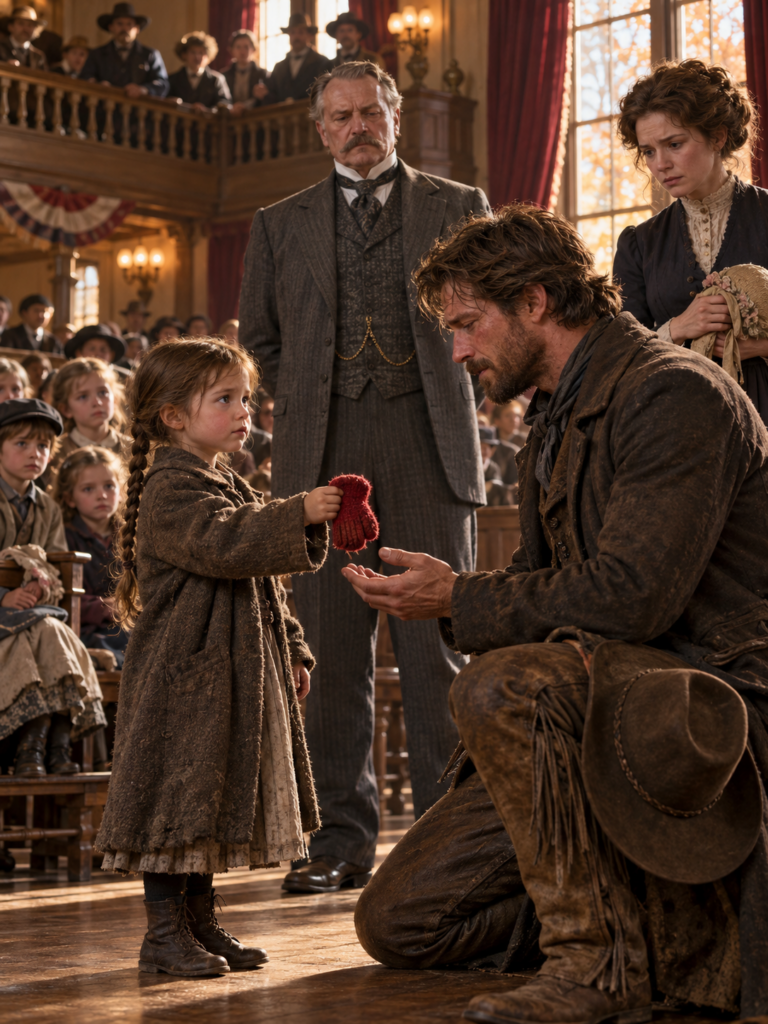
She approached Eli and pressed her little red mitten into his hand.
“So you’ll have half,” she whispered.
Eli looked at the mitten.
Then at the document Bell had placed before him.
If he signed away the creek land, Bell had offered to intervene for the child.
If he refused, Pearl might leave that afternoon.
His hand began to tremble.
At that moment, the opera-house doors opened.
Clara Whitcomb entered carrying a tin box.
Ollie Dunning followed with his leather field book.
She walked straight down the aisle.
“Before Mr. Hartwell signs anything,” she said, “this committee needs to hear why Mr. Bell wants his land.”
Bell rose abruptly.
“This is highly irregular.”
Clara placed the box on the table.
“So is using an orphan child to force a property transfer.”
Every face turned toward her.
She opened the box.
Clara opened the tin box and lifted out a careful stack of receipts.
“Three years of payments,” she said. “Every installment made on time. Every acknowledgment signed by Mr. Bell’s own clerk.”
She passed the papers to Mr. Bright.
The placement agent adjusted his spectacles.
Beside him, Reverend Marsh leaned forward.
Bell’s expression tightened.
“Miss Whitcomb, the payments don’t alter the terms of the loan.”
“No,” Clara answered. “But they establish that Mr. Hartwell is not a man who neglects his obligations.”
She turned toward the committee.
“Now I ask you to consider why the bank has suddenly refused renewal after granting it repeatedly.”
Bell struck the table with his palm.
“This hearing concerns the welfare of a child.”
“Exactly,” Clara replied.
She looked toward Ollie Dunning.
“Mr. Dunning, would you explain what your survey crew has been doing along the Loup Valley?”
The young man swallowed.
He seemed very small standing beneath the opera-house lamps.
But he opened his field book.
“The railroad company is considering a branch through this district,” he said. “The proposed route crosses Mr. Hartwell’s creek property.”
Murmurs spread through the room.
Dunning continued.
“The company wants the bend for a depot. The ground is favorable for the approach and the loading area.”
Bell rose.
“Those are private commercial matters.”
Dunning took a folded letter from his coat.
“This correspondence concerns the same property.”
He handed it to Mr. Bright.
“The land agent was told Mr. Bell expected to acquire the tract before the new year.”
For a moment, nobody spoke.
Then Abernathy, the dry-goods merchant, cleared his throat.
“Mr. Bell, is that why you’ve called the loan?”
Bell stared at him.
“A bank has a right to conduct its affairs.”
“That wasn’t the question,” Mrs. Crane said.
Her voice was quiet but firm.
Bell looked around the committee table.
For the first time, the authority he had relied upon seemed uncertain.
Clara stepped forward.
“A rancher who has paid his debts faithfully is suddenly declared unsuitable to care for a child. He is then offered a choice between surrendering valuable land and losing that child.”
She paused.
“Those circumstances deserve scrutiny.”
Eli watched her.
Only four days earlier, he had told this woman she was merely an employee.
Now she stood before a room full of people, risking the little security she had left to defend his family.
He had never felt so ashamed.
Or so grateful.
***
Odessa Tuttle rose from the third row.
“If you’re judging what kind of home that little girl has,” she said, “then you ought to hear from someone who lives in it.”
Bell opened his mouth.
Odessa ignored him.
“I’ve worked for Eli Hartwell eight years. He’s a stubborn man. Half the time he works longer than he ought, and the other half he forgets he needs his dinner.”
A ripple of laughter moved through the audience.
“But since Pearl came, that man has learned to braid hair badly, read picture books slowly, and sit in a rocking chair until his back nearly gives out because the child can’t sleep unless she hears it creak.”
Pearl, sitting beside Mr. Bright, brightened.
“He does it better now,” she volunteered.
More laughter.
Odessa pointed toward Eli.
“He hasn’t asked that child for a thing. He feeds her, keeps her warm, watches her when she’s sick, and calls her by her name.”
She looked at the committee.
“That may not tell you what sort of banker he is. But it tells you plenty about what sort of father.”
Mr. Bright removed his spectacles.
Eli lowered his head.
He had never been comfortable with praise.
That afternoon, he found it nearly unbearable.
Mrs. Crane turned toward the other committee members.
“I believe we should reconsider.”
Reverend Marsh agreed.
So did Abernathy.
The committee voted again.
Four to one.
Pearl could remain with Eli, subject to the ordinary completion of her placement arrangements.
Mr. Bright stood and announced the decision.
The room erupted in applause.
Pearl did not wait for permission.
She ran straight down the aisle.
Eli caught sight of her little red mitten reaching toward him.
And suddenly he was back in that same opera house one month earlier, facing a child who had asked a question he had been too frightened to answer.
She stopped before him.
“Will you be my father now?”
Eli Hartwell knelt.
He took both her small hands.
“Pearl,” he said, his voice thick, “I already am.”
For one breath, she stared at him.
Then she threw her arms around his neck.
Eli held her.
Not because the committee had granted him permission.
Not because he had proved himself worthy to a banker.
But because, somewhere between the biscuits beneath her pillow and the nights in the rocking chair, he had become what she needed.
And she had become what he had not known his life was missing.
***
Clara stood several steps away.
She had been smiling through her tears when Pearl turned toward her.
“Clara!”
The little girl ran over.
Clara knelt and reached into her coat pocket.
“I’ve something for you.”
She drew out a second red mitten.
It matched the first in size and color.
The wool was fresh, and the stitches were tight.
Pearl stared.
“My other mitten?”
“Not the one from the train,” Clara said gently. “I couldn’t bring that one back. But I made you another.”
Pearl held out her bare hand.
Clara pulled the mitten over her fingers.
For a moment, the little girl simply looked from one hand to the other.
Two red mittens.
A matching pair.
Something she had not possessed since the journey west.
Then she threw her arms around Clara.
Eli watched them.
The room was still filled with voices, but he barely heard them.
He saw the child he loved embracing the woman he had driven away.
And he understood that saving the ranch would mean very little if pride kept him from repairing what he had broken.
When Clara finally rose, he approached her.
“Miss Whitcomb.”
She looked at him.
“Eli.”
He swallowed.
“I owe you an apology.”
“You do.”
“I had no right to speak to you the way I did.”
“No, you didn’t.”
“You were trying to help Pearl. And me. I treated that as though it gave me permission to decide what mattered to you.”
Clara studied his face.
“Why?”
Eli looked toward Pearl, who was showing her matching mittens to Mr. Bright.
“Because I was afraid,” he admitted. “I’d spent so many years keeping people at a distance that when two of you came close, I didn’t know what to do.”
“And so you pushed me away.”
“Yes.”
Clara drew a breath.
“I’m not interested in becoming somebody’s servant merely because he is afraid of caring for me.”
“I know.”
“Nor will I stay in a house where my ideas are worth less because I earn wages there.”
“I know that too.”
Eli looked directly at her.
“If you ever choose to return, those things will be different. Not because you saved us today. Because you were right.”
For a long moment, she said nothing.
Then a small smile moved across her face.
“That sounds almost like you’ve learned something, Mr. Hartwell.”
“More than I expected.”
“Good.”
She glanced toward Pearl.
“Then perhaps we ought to finish helping that child build a home.”
***
Bell’s defeat before the committee was only the beginning of his difficulties.
Dunning’s evidence did not automatically cancel the bank’s note, but it exposed the banker’s interest in the disputed property.
The railroad company’s willingness to pay for the depot site offered Eli a way out that Bell had never intended him to discover.
Dunning contacted the land agent.
Negotiations followed.
The company agreed to purchase the portion of the creek bend it needed for the depot at a price sufficient to cover Eli’s loan and leave money for improvements elsewhere on the ranch.
The remainder of the property stayed in Eli’s hands.
On December first, Eli walked into Low Valley Bank carrying the proceeds.
Bell sat behind his desk.
Eli counted out six hundred dollars.
“Payment in full.”
Tibbs, the clerk, prepared the receipt.
Bell hardly spoke.
Eli inspected the acknowledgment carefully before leaving.
Then he carried the paper home.
That evening, he placed it in Clara’s tin box beside the earlier receipts.
The little collection of documents had become more valuable than any fine furnishing in the house.
It represented years of work.
And the proof that an honest record, properly kept, could protect a family when a powerful man tried to use confusion against it.
***
Bell did not forgive Clara.
He pursued the outstanding debt against her late father’s house.
The property was eventually sold.
For weeks, Clara had dreaded that loss.
The little house had held her childhood, her father’s books, and the few happy possessions left from her parents.
But when she saw it pass into a stranger’s hands, she found herself grieving less for the timber and plaster than for the life that had already ended there.
Eli offered to help her settle what remained.
Clara thanked him but declined any arrangement that would leave her indebted to him without her choosing it.
She had taken pride in earning her own living.
She intended to keep that pride.
He respected her decision.
And because she had experienced his respect as something new and genuine, it mattered more to her than the offer itself.
They returned to the ranch in the evening.
Pearl slept against Clara’s arm beneath the buffalo robe.
Ahead of them, a lamp burned in the front window.
Eli had arranged for Odessa to light it before dusk.
Clara noticed it from the road.
For a moment, she remembered the story he had told about the old cook who once kept a kitchen lamp burning when he came home late.
Someone had done that for Eli long before he owned a ranch.
And now he had chosen to do the same for somebody else.
Her eyes filled.
Eli glanced toward her.
“What’s wrong?”
“Nothing.”
“Clara.”
She smiled.
“I was just thinking that my father’s house is gone.”
“I’m sorry.”
“So am I.”
She looked toward the lamp.
“But I believe I know where I’d like my home to be.”
***
After Pearl had been carried upstairs, Eli found Clara on the porch.
The November night was cold, but clear.
The cattle were quiet in the distant pasture.
Clara stood beside the railing, her shawl drawn around her shoulders.
Eli approached slowly.
“May I sit?”
“It’s your porch.”
“That wasn’t what I asked.”
She looked at him.
Then she moved aside.
“Yes.”
He sat beside her.
For several minutes, they listened to the wind moving through the cottonwoods.
Then Eli spoke.
“When I was sixteen, I left the man who’d taken me from the orphan train. He had a roof, food, work, and all the things folks might have counted as a proper home.”
Clara waited.
“But he never called me Eli.”
“I know.”
“I spent the next years thinking that if I owned enough land and kept enough distance between myself and everybody else, nobody could ever make me feel like that boy again.”
He looked down at his hands.
“Then Pearl walked up to me with one mitten.”
Clara smiled faintly.
“She has a way of making decisions.”
“She does.”
“And what did you learn?”
“That I’d been protecting myself from the very thing I needed.”
Clara turned toward him.
Eli continued.
“When you left, I discovered the house could be full of people and still feel empty.”
She looked away.
“You hurt me, Eli.”
“I know.”
“And I won’t pretend otherwise simply because today turned out well.”
“I wouldn’t ask you to.”
She considered that.
Then she said, “I was engaged once.”
Eli waited.
“His name was Warren Ames. When my father died and the debts became clear, Warren decided love was one thing, but carrying another person’s troubles was quite another.”
“He left?”
“For Omaha. I didn’t ask him to stay.”
Clara gave a small, humorless laugh.
“I told myself I would rather be alone than beg somebody to choose me.”
Eli looked at her.
“Sounds familiar.”
“Doesn’t it?”
They sat quietly.
Then Eli moved his hand onto the porch rail, palm upward.
Not reaching for her.
Simply offering.
“Clara, I’m asking you to stay.”
She looked at his hand.
“On what terms?”
“Your own work. Your own wages until we decide otherwise together. A say in Pearl’s schooling. A say in the home. And no pretending that your judgment matters less than mine.”
“And beyond that?”
He swallowed.
“Beyond that, I’d like the chance to court you properly, if you’ll allow it.”
Clara stared at him.
For once, she had no clever answer ready.
Eli smiled nervously.
“I know I’m not much practiced at it.”
“No,” she said softly. “I don’t suppose you are.”
“But I’m willing to learn.”
She placed her hand in his.
“I’d like that.”
***
In the weeks that followed, the household settled into a new kind of peace.
Not everything became easy.
Eli still had a habit of making decisions without consulting anyone when ranch business grew urgent.
Clara still had to remind herself that accepting help did not mean surrendering independence.
But they were learning to speak before resentment took root.
Pearl found their adjustment fascinating.
One morning, she caught Eli asking Clara’s opinion about repairing the upstairs room.
“Why are you asking her?” Pearl demanded.
“Because she has good ideas.”
Pearl considered that.
“Then you ought to ask me too.”
Eli bent down.
“What do you think?”
“I want yellow curtains.”
Clara laughed.
Eli nodded solemnly.
“Then yellow curtains it shall be.”
The room received them before Christmas.
Pearl stood in the doorway afterward, studying the bright cloth.
“Did you do that because I asked?”
“Yes,” Eli answered.
She smiled with enormous satisfaction.
“That’s what fathers do.”
Eli looked toward Clara.
Her eyes were shining.
***
They married on Christmas Eve in the small white church at Low Crossing.
The ceremony was simple.
Eli wore his best dark coat.
Clara wore a modest dress she had altered herself.
Pearl insisted upon carrying her spotted hen, Biscuit, down the aisle in a small basket.
Odessa protested that chickens did not belong at weddings.
Pearl replied that Biscuit was family.
Nobody found a convincing argument against that.
Gus announced afterward that Clara was the finest foreman the ranch had ever known.
Mrs. Fenwick, who had once whispered about the arrangement, wept openly through the vows.
Even Boyd, the young lawyer who had occasionally paid Clara particular attention, attended with good grace and brought a pie for the wedding supper.
When Eli took Clara’s hand, he did not promise her a life without trouble.
They both knew better.
He promised honesty.
He promised partnership.
And he promised that their home would never become a place where one person’s fears ruled everybody else’s choices.
Clara promised to speak plainly, to work beside him, and to stay not from obligation but from love.
Pearl watched them with her matching red mittens folded in her lap.
Afterward, she tugged Eli’s sleeve.
“Does this mean Clara is staying forever?”
Eli crouched beside her.
“It means we’ve chosen to make a home together.”
Pearl thought about that.
Then she held out both arms.
“Well, you could have asked me. I would’ve said yes.”
***
Spring came slowly to the Loup Valley.
The railroad crews arrived as the ground thawed.
Work began near the creek bend, and the first train eventually crossed the valley beneath a plume of smoke.
Eli watched the construction with mixed feelings.
He had surrendered a portion of land he had once expected to keep for the rest of his life.
But the sale had saved the ranch, ended the bank’s hold over him, and opened a route that brought new business into the district.
He made improvements to the pastures beyond the depot land and continued working his cattle with Gus.
Clara resumed teaching.
With the railroad bringing more families into the valley, the demand for schooling grew.
The new arrangements gave her the opportunity to return to the classroom without depending upon Bell’s former favor.
She kept helping with the ranch accounts, but she was no longer merely the woman who had answered Eli’s desperate need for a housekeeper.
She was a teacher.
A wife.
A partner.
And a woman whose judgment had helped preserve a home.
Pearl grew stronger and more confident.
She learned her letters quickly, though she still believed the letter B ought to stand chiefly for Biscuit.
She sometimes rode beside Eli on the gentlest of the ranch horses.
And every evening, when he returned from work, she came running toward the gate.
He no longer needed to be reminded to leave a lamp burning.
Some habits had become part of the household itself.
***
One bright morning in May, the first train passed through the completed stretch of railroad.
Pearl stood on the porch wearing her two red mittens despite the warm weather.
The locomotive’s whistle sounded across the valley.
She watched the smoke rise above the cottonwoods.
“Papa?”
Eli stood beside her.
“Yes, Pearl?”
“I’m five now.”
“I’ve noticed.”
She considered him carefully.
“When I asked you to be my father in the opera house, you didn’t answer.”
Eli looked down.
He remembered the frightened little girl in the oversized coat.
The twenty-two children on the benches.
The numbered tags.
And his own childhood, returning to him in the face of a child he had never expected to meet.
“You’re right,” he said.
“I had to ask twice.”
“You did.”
“Why?”
Eli crouched beside her.
“Because I was scared.”
Pearl frowned.
“Of me?”
“Not of you. I was scared of caring so much about somebody that losing them would hurt.”
She considered that.
“That’s silly.”
Eli laughed.
“A little.”
“I wasn’t scared of you.”
“I know.”
“You had nice horses.”
“So you said.”
“And you didn’t smile at me like a puppy in a shop.”
“No.”
Pearl lifted her mittened hands.
“Did you love me the first time?”
Eli looked toward the doorway.
Clara stood there watching them, with the ticking clock audible behind her.
He turned back to Pearl.
“I think part of me answered you that very day,” he said. “It just took the rest of me a little longer to understand.”
Pearl threw her arms around his neck.
“Then that’s all right.”
Eli held her close.
Behind them, Clara stepped onto the porch.
He rose and drew her gently beside him.
The train continued along the valley, carrying passengers toward lives none of them could yet imagine.
Once, Eli Hartwell had been such a passenger.
A lonely nine-year-old with a number on his coat.
He had spent twenty-five years trying never to need another soul.
But a little girl with one red mitten had walked up to him in an opera-house aisle and asked for the one thing he believed himself incapable of giving.
A home.
A family.
A promise that would not vanish when the train departed.
Now, standing between his wife and daughter, with the ranch stretching into the morning sunlight, he understood something the frightened boy he once had been could never have imagined.
Love was not a debt that could be called due.
It was not a favor bestowed by a banker or permission granted by a committee.
It was the biscuit left beside a hungry child’s pillow.
The rocking chair creaking through the night.
The lamp burning in the window.
The woman who returned to speak the truth even after she had been wounded by the man she loved.
And the little girl who asked twice because she knew what her heart had chosen.
Pearl reached for his hand with one red mitten.
Clara took the other.
Together, they turned toward the house.
And Eli Hartwell, who had once left a farm with nothing but a tin cup and a Bible, walked through his own front door knowing that everything precious in his life was waiting there by choice.
Not because he owned them.
Because they belonged with one another.
And this time, when Pearl called him Papa, he answered without hesitation.

