
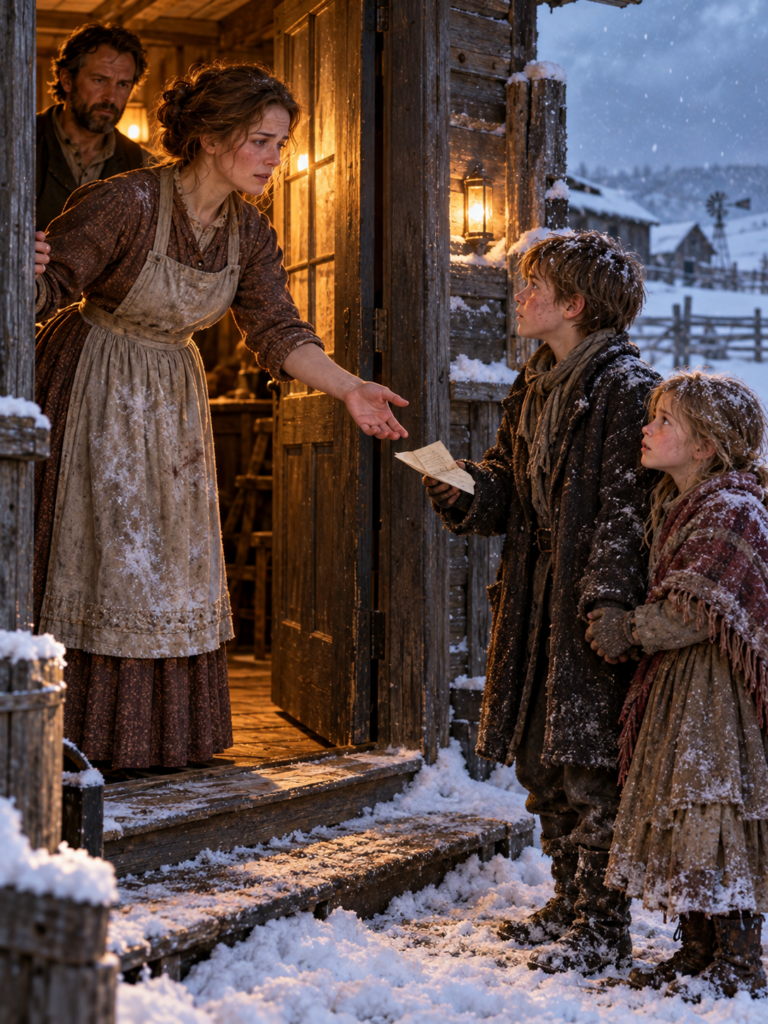
Jed slipped his fingernail beneath the pocket watch’s clasp and gently opened the outer cover.
The mechanism did not start.
Instead, a little dust fell into his palm.
He examined the tiny gears, then looked toward the kitchen door.
Silas had left the house without even putting on his coat properly.
Jed closed the watch.
He understood that some things needed permission more than they needed fixing.
At breakfast the next morning, he placed it beside Silas’s plate.
“I think I could make it run,” he said. “But I won’t try unless you want me to.”
Silas looked at the watch.
Then at the boy.
“You know how?”
“A little. I’ve watched a clockmaker. And I’ve fixed small things before.”
Silas picked it up.
The gift had remained useless in his drawer ever since Caleb’s death.
He had told himself that keeping it untouched was an act of remembrance.
Now a ten-year-old boy was asking him to believe that something damaged might work again.
“You may try,” he said.
Jed nodded solemnly.
“I’ll be careful.”
Naomi watched the exchange from the stove.
The children had been there only two days, yet the house was changing around them.
Ruthie asked questions through breakfast.
Jed offered to help with the broken harness.
Silas found himself explaining things he had not bothered to explain to another person in years.
And Naomi had begun putting four places at the table without thinking.
That morning, however, Ruthie interrupted their brief happiness by asking what would happen when Mr. Cobb returned.
“Will we have to go somewhere else?”
Naomi’s hand stopped over the bread dough.
Jed answered before she could speak.
“That’s what the letter says.”
“But I like it here.”
“Ruthie.”
“I do.”
The little girl looked toward Naomi.
“Would it be bad if I liked it here?”
Naomi knelt beside her.
“No, sweetheart. Not bad at all.”
She wanted to say more.
She wanted to promise that nobody would make Ruthie pack her belongings again.
But promises about another person’s future could not be made lightly.
So she merely straightened the child’s collar.
“We’ll do our best to make sure you’re cared for.”
Ruthie considered the answer.
Then she put both arms around Naomi’s neck.
Naomi closed her eyes.
Across the room, Silas watched without speaking.
He had spent four years keeping himself occupied enough to avoid remembering the barn fire.
He had spent the years since their baby’s death avoiding every corner of the house that might remind Naomi of what they had lost.
Yet now two children were living among those memories, asking questions no adult had dared ask.
By the following week, Jed had begun taking the watch apart under Silas’s supervision.
Ruthie had persuaded Naomi to let Butter sleep beside the kitchen stove.
The promised return of Mr. Cobb had not occurred.
And for one brief evening, the Whitcomb household almost felt peaceful.
Then Horace Deed arrived.
He rode up to the farmhouse in a heavy winter coat, carrying papers from the bank.
Silas recognized him immediately.
Deed held the note secured against the Whitcomb property.
Silas had assumed that debt after purchasing his late brother’s interest in the family claim.
The amount remaining was considerable.
Payment would fall due at harvest.
Deed dismounted and observed Ruthie playing near the porch.
He glanced toward Jed, who was working on a harness strap.
“Taking in stray children now, Whitcomb?”
Naomi stepped into the doorway.
“They aren’t strays. Their arrangements were interrupted by the weather.”
Deed offered a thin smile.
“I’m involved with the local placement committee. Naturally, we take an interest in the character and circumstances of families keeping society children.”
Silas remained still.
Deed’s gaze hardened.
“There are old questions about your household.”
No one had to ask which questions.
The barn fire.
Caleb’s death.
The rumors that Silas had been negligent.
Deed continued.
“And there is the financial matter. Your note remains due at harvest. A family unable to preserve its own farm may not be the most suitable placement.”
Ruthie stopped playing.
Naomi felt the girl move closer to her skirts.
“My sister, Mrs. Ashworth, maintains a comfortable household in town,” Deed added. “No debts. Plenty of room.”
Silas took one step forward.
Naomi touched his arm.
Deed replaced his hat.
“I expect the committee will be interested in all the circumstances.”
He mounted and rode away.
For several moments nobody moved.
Then Ruthie asked a question in a tiny voice.
“Is that man going to take us?”
Naomi crouched beside her.
“Not without our having something to say about it.”
Jed stood near the porch steps with Caleb’s watch in his hand.
His face had gone completely still.
“Ma’am,” he asked, “if the bank takes the farm, do we have to go too?”
Naomi had no answer she could honestly promise.
She looked toward Silas.
He was staring at the road where Deed had disappeared.
Then Jed opened the watch, studied the mechanism one final time, and placed it in Silas’s hand.
A faint, regular ticking sounded between them.
The watch was running.
Silas stared down at the gift from his dead brother.
And Naomi realized that before they could fight for the children’s future, her husband would have to confront the past he had refused to explain.
The watch continued ticking in Silas Whitcomb’s open palm.
For a moment he seemed almost afraid to close his fingers around it.
Jed watched anxiously.
“I cleaned the little wheel,” the boy explained. “And straightened a part that was rubbing. It might stop again, but it runs now.”
Silas brought the watch nearer his ear.
Tick.
Tick.
Tick.
For four years, the last hour of Caleb’s life had lived inside that silent piece of metal.
Now its hands moved.
“You did good work,” Silas said.
Jed’s expression changed.
He was accustomed to hearing that he had been useful.
But the kindness in Silas’s voice was something different.
“Could I keep looking after it?” he asked.
Silas considered.
“Yes. I think Caleb would have liked that.”
Naomi noticed that Silas spoke his brother’s name without looking away.
It was a small beginning.
But it was a beginning.
They went inside because Ruthie’s hands were cold, and because Horace Deed’s visit had brought questions that could not be answered standing in the yard.
At the kitchen table, Silas spread out the bank papers.
Naomi sat beside him.
Jed and Ruthie occupied their usual chairs.
The papers concerned the farm’s unpaid note, an obligation Silas had accepted after Caleb’s death when he purchased his brother’s interest in the Whitcomb land.
Silas had worked for years to establish the property and meet its expenses.
But a poor season, accumulated repairs, and the cost of maintaining the operation had left the note dangerously close to maturity.
Deed expected the remainder when the wheat harvest was sold.
There was no guarantee the crop would bring enough.
Naomi listened while Silas explained.
“Why didn’t you tell me how close we were?” she asked.
“I didn’t want you worrying.”
“I’ve been worrying anyway.”
He lowered his eyes.
“I know.”
She set her hand on the paper.
“We cannot repair a problem you keep hidden from me.”
Silas looked at her.
In the past, he might have responded with silence.
This time he nodded.
“You’re right.”
Jed remained quiet until the discussion turned to the amount owed.
Then he asked whether Silas had included the last interest entry in his calculations.
Silas glanced up.
“What do you know about interest?”
“Not much. But I’ve seen a family lose a place after they misunderstood their bank book.”
Naomi’s heart tightened.
Jed spoke of such things in the matter-of-fact voice of someone who had already witnessed too much.
Silas reviewed the entries.
The boy had been right to ask.
It did not erase the debt.
But it helped them understand the exact amount they would need.
“Thank you, Jed,” Silas said.
The boy looked down at his plate.
Ruthie leaned toward Naomi.
“Does that mean we can stay?”
No one wanted to give the wrong answer.
Naomi took the little girl’s hand.
“It means we’re going to find out everything we can before anyone decides.”
The week passed without Mr. Cobb.
Then another.
The railway delays stretched longer than promised.
Naomi wrote to the agent for clearer information about the children’s placement.
She also began recording their daily needs and the arrangements made for their care, knowing that a committee might require proof of a stable household.
Ruthie helped her fold linens and learned to recognize simple words from the family Bible.
Jed watched Silas work with the horses and mended small tools whenever permission was given.
Neither child’s shelter depended upon those tasks.
Still, each liked having a place in the household’s ordinary life.
And slowly their presence changed the adults.
Silas began coming inside earlier in the evenings.
Naomi stopped eating her supper in silence.
They spoke about the children’s lessons, the coming harvest, and small things that had once filled their marriage.
One evening, Ruthie fell asleep with her head against Naomi’s shoulder.
Silas lifted the child carefully and carried her to bed.
As he came downstairs, Naomi was standing beside the kitchen stove.
“You look happy,” he said.
She looked startled.
“Does that trouble you?”
“No.”
He hesitated.
“I think I was afraid it might.”
She knew what he meant.
Their own baby had died before there had been time to know much about the life they had imagined together.
For a long while Naomi had believed that allowing herself joy would somehow diminish the child they had lost.
But Ruthie’s warmth against her shoulder had not erased that grief.
It had merely reminded her that love could survive alongside it.
She crossed the room and took Silas’s hand.
“We don’t have to forget what happened to welcome what is happening now.”
He held her fingers.
“No,” he said. “We don’t.”
A letter arrived near the end of the month.
Mr. Cobb wrote that the rail line beyond North Platte remained disrupted and that he could not yet return to resolve the placement.
He thanked the Whitcombs for their assistance and hoped the children could remain safely with them until further arrangements were made.
Naomi read the letter twice.
“Until the new year, perhaps,” she said.
Silas looked toward the yard, where Jed was helping Cody, a neighboring farmer’s hired hand, repair a gate.
“Perhaps longer.”
Naomi studied her husband.
“Would that trouble you?”
He considered before answering.
“No. It would trouble me more to see them go.”
That evening, they sat together on the porch.
The air was bitter, but the wind had fallen.
Inside, the children were asleep.
Silas turned Caleb’s repaired watch over in his hands.
Then he spoke.
“There’s something I’ve never told you about the fire.”
Naomi waited.
Silas had been blamed for his brother’s death for four years.
The official investigation had described the fire as accidental, caused when a frightened horse knocked a lamp from its place.
But neighbors had whispered that Silas had been careless.
He was known to have been inside the barn.
He had escaped.
Caleb had not.
Silas had refused to explain himself publicly.
“I knew Caleb had been drinking heavily that winter,” he said.
Naomi listened.
“He went out to the barn with a lamp. I heard something fall and followed him.”
Silas lowered his gaze to the watch.
“He was down when I found him. I got him partway toward the door before the fire spread. There was smoke everywhere.”
His voice roughened.
“I tried to carry him. I couldn’t get him out.”
Naomi tightened her hold on his hand.
“I left him there.”
“You escaped because you couldn’t save him.”
He shook his head.
“That isn’t how it felt.”
“Of course it isn’t.”
Silas looked toward the dark pasture.
“People blamed me. I let them. I couldn’t bear the thought of telling everyone about his drinking. It seemed like betraying him.”
“And the story they believed?”
“It made me feel I deserved the blame anyway.”
Naomi leaned closer.
“You tried to save him.”
“I failed.”
“You couldn’t do what was impossible.”
For a long while he said nothing.
Then he closed his hand around the watch.
“Jed asked whether I loved Caleb.”
“What did you tell him?”
“That I did.”
Naomi rested her head against his shoulder.
“Then perhaps that’s where you should begin.”
The next morning, Cornelia Ashworth arrived.
She was Horace Deed’s sister, a stern woman with a comfortable house in town and an interest in the placement of society children.
She brought a basket of apples.
Naomi accepted them politely.
But as Cornelia toured the rooms, her interest became increasingly uncomfortable.
She examined the pantry.
Noted the mended dresses.
Looked into the small upstairs room where the cradle still stood.
Then she returned to the kitchen and asked whether the Whitcombs truly believed they were suited to raising two children.
Naomi set down her cup.
“We provide food, shelter, care, and instruction.”
“Your husband has an unfortunate reputation.”
“Rumors about a tragedy don’t establish a man’s character.”
“And your financial position?”
“We are working to meet our obligations.”
Cornelia folded her hands.
“My brother worries the children may find themselves displaced again.”
Naomi knew the concern was not entirely imaginary.
The debt was real.
But she also knew that Cornelia had shown little interest in what Jed and Ruthie wanted.
“Have you asked the children how they are doing here?” Naomi inquired.
Cornelia looked surprised.
“Children are not always equipped to judge such matters.”
“They are certainly equipped to tell you whether they feel frightened, neglected, or welcome.”
Cornelia rose to leave.
“The committee will make its own assessment.”
After she departed, Silas began pacing.
“Deed means to use that note against us.”
“Then we need to show the committee the truth,” Naomi answered.
“What truth?”
“That we are willing and able to care for the children. That your brother’s death was not caused by your negligence. And that we’re taking the debt seriously.”
He stopped.
“You make it sound simple.”
“It isn’t simple. But it is something we can do.”
Within days, the pressure increased.
A formal bank notice confirmed that payment would be expected at the end of harvest.
The same week, the placement committee announced a review within ten days.
Cornelia’s home was identified as a possible alternative.
The stated concerns were Silas’s reputation, the household’s financial position, and uncertainty about its suitability as a permanent placement.
Naomi read the notice standing beside the kitchen window.
Silas watched her.
“What do we do?”
She laid the paper down.
“We harvest everything we can before the next hard frost.”
“And after that?”
“We bring the committee the best evidence we have.”
The wheat was ready.
But the weather threatened.
Silas worked from dawn until darkness.
Neighbors began helping after Reverend Cole heard what was happening.
Widow Pruett came with food for the workers.
Two nearby farming families brought extra hands.
Their help was not charity.
They understood what it meant for a bank to hold a family under a deadline.
Even with the assistance, the days were exhausting.
One evening, Jed made a mistake while fastening a harness.
Silas, weary and frightened, snapped at him.
The boy went pale.
He said nothing throughout supper.
Naomi found her husband alone in the barn afterward.
“You frightened Jed.”
“I know.”
“Then tell him you were wrong.”
Silas stared at the wall.
“I sounded like the kind of man I never wanted to become.”
“You were angry. What matters now is what you do about it.”
Silas went outside.
Jed sat on the porch steps holding Caleb’s watch.
The boy did not look up when Silas approached.
Silas sat beside him.
“I spoke harshly to you.”
Jed remained silent.
“You didn’t deserve it. I was worried about the harvest and took my temper out on you.”
The boy rubbed the watch case with his thumb.
“People get angry,” he said.
“That doesn’t excuse me.”
Jed finally looked at him.
“Ruthie’s mother used to shout. Sometimes she’d leave for days afterward.”
Silas felt the words settle heavily between them.
“Are you afraid I’m going to leave you?”
“I don’t know.”
Silas took a slow breath.
“I’m sorry I gave you reason to wonder.”
Jed watched him carefully.
“Do grown men usually say they’re sorry?”
“Not often enough.”
The boy considered that answer.
Then he moved the watch closer to Silas.
“It still runs.”
Silas nodded.
“Yes, it does.”
Two days before the committee meeting, Naomi was repairing Ruthie’s rag doll.
One seam had come loose.
As she gently opened it to replace the stuffing, a small folded paper appeared inside.
The edges were worn.
The writing had faded.
Naomi carefully unfolded it.
It was a letter from the children’s mother.
The woman had written before surrendering Jed and Ruthie to the society.
Illness and poverty had left her unable to support them.
Their father had gone away years earlier.
She had written of her shame, her helplessness, and her hope that her children might find a household where they would be cherished rather than merely tolerated.
Naomi read the letter a second time.
Then she covered her mouth.
When Silas found her, she was crying at the kitchen table.
He approached quietly.
“What’s happened?”
She handed him the letter.
He read it.
The room remained silent except for the sound of Caleb’s watch ticking from the shelf.
At last Naomi said, “Their mother didn’t stop loving them.”
“No.”
“She couldn’t keep them. That’s different.”
Silas folded the letter carefully.
“Have you told Jed?”
“Not yet.”
“We should.”
“Together.”
They called the children to the table.
Naomi explained where the letter had been found.
She read it aloud, preserving the mother’s words without pretending to know more than the letter said.
Ruthie began to cry.
Jed listened without moving.
When Naomi finished, the boy asked, “She wanted us?”
Silas answered gently.
“Yes. She wanted you safe, even when she couldn’t keep you with her.”
Jed held the letter for a long time.
Then he asked whether he could keep it.
“Of course,” Naomi said.
The following morning, with the harvest money collected and the bank payment arranged, the Whitcombs prepared for the committee hearing.
Silas fastened his coat.
Naomi put the children’s mother’s letter inside her satchel.
Jed brought the repaired watch.
And as they climbed into the wagon, Ruthie looked up at Naomi with frightened eyes.
“If they send us away,” she whispered, “will you come find us?”
Naomi bent and kissed her forehead.
“I will make certain they hear how much you want to stay.”
Then she climbed onto the wagon beside Silas.
There were no guarantees waiting in town.
Only the truth, the neighbors willing to speak it, and two children who had finally begun to believe that a door might open without closing behind them.
The wagon wheels rolled over the frozen road toward the little church where the placement committee had agreed to meet.
Ruthie sat close against Naomi.
Jed sat beside Silas, holding the repaired pocket watch in both hands.
Nobody spoke much.
The boy had spent much of his short life learning that adults made decisions about him while he waited nearby.
He knew how to fold his clothes quickly.
How to keep his belongings together.
How to answer questions politely, even when the person asking them had no intention of listening to the answer.
But this morning felt different.
Naomi had brought a satchel of records.
Silas had brought the bank’s acknowledgment of payment.
And neither had told the children to be grateful simply for having been allowed to stay so long.
Instead, they had asked what Jed and Ruthie wanted.
Jed had answered immediately.
“We want to stay together.”
Ruthie had added, “And I want to stay with you.”
Now, as the church came into view, Silas set his hand briefly on the boy’s shoulder.
“We’ll do our best.”
Jed nodded.
He understood that those words were not a promise of victory.
But he had learned that Silas Whitcomb meant the promises he did make.
Inside, several rows were already occupied.
Horace Deed stood near the front speaking quietly with his sister Cornelia.
Both turned when the Whitcombs entered.
Naomi noticed the look Cornelia gave Ruthie’s mended dress.
A small judgment.
Practiced and immediate.
She also noticed Widow Pruett seated near the center aisle.
The widow gave her a firm nod.
Behind her sat several neighboring farmers who had helped bring in the wheat.
Reverend Cole stood near the committee table.
Not everyone had come to condemn the Whitcombs.
Naomi drew comfort from that.
The committee’s chairman began by explaining the purpose of the meeting.
Jedediah and Ruth remained children under the supervision of the placing society.
The Whitcombs had accepted them temporarily after their intended placement failed.
Now the committee would make a recommendation concerning continued care while the society agent’s arrangements were reviewed.
The chairman acknowledged that the final placement could not rest solely upon the committee’s opinion.
There would be correspondence with Mr. Cobb and further documentation before any permanent arrangement could be settled.
Naomi appreciated the clarification.
She wanted those children in her home.
But she did not want them bound to another uncertain promise.
Horace Deed spoke first.
He described the Whitcomb farm’s recent financial difficulties.
He mentioned the outstanding bank obligation, although he avoided stating that payment had now been made.
Then he referred to the barn fire.
“One must consider a household’s reputation,” Deed said. “Children who have already suffered instability deserve something better than further uncertainty.”
Silas sat very still.
Four years earlier, he would have endured those words without answering.
He would have treated public explanation as humiliation.
But now Jed was beside him.
And Ruthie was holding Naomi’s hand.
Silas rose.
“I’d like to answer that.”
The room quieted.
He began with the bank note.
“The obligation was mine. I signed it after my brother’s death when I purchased his interest in the property. I understood its terms.”
He placed the bank acknowledgment on the table.
“The amount due has been paid.”
Deed’s expression tightened.
Silas continued.
“Our neighbors helped bring in the wheat before the frost. We sold the crop, met the obligation, and obtained the bank’s receipt.”
The chairman examined the paper.
Then he passed it to the other members.
Deed did not dispute the receipt.
Silas remained standing.
“There’s also the question of my brother.”
For a moment he seemed unable to continue.
Naomi watched him.
She knew how much this would cost.
Caleb’s death had become a wound Silas kept hidden beneath work and silence.
Now he would have to speak of it before men and women who had spent years believing the worst.
He opened the pocket watch.
Its quiet ticking carried no farther than the nearest chairs.
“Caleb died four years ago,” Silas said. “The coroner found the barn fire accidental. But there have been rumors that I caused it through carelessness.”
He looked toward the assembled townspeople.
“I let those rumors stand.”
A faint murmur passed through the church.
Silas continued.
“My brother had been drinking heavily that winter. I didn’t tell anyone because I thought speaking about it after his death would dishonor him.”
He paused.
“On the night of the fire, he took a lamp into the barn. I heard him fall. When I reached him, the lamp had been knocked loose and the fire was spreading.”
His fingers tightened around the watch.
“I tried to bring him out.”
Naomi saw the strain in his face.
“He was difficult to move. The smoke grew thick. I got him partway toward the door, but I could not carry him the rest of the way.”
Silas looked down.
“I had to leave him.”
Nobody interrupted.
“I’ve lived with that every day since. I thought if people knew Caleb had been drinking, they’d remember him only for that. So I let them believe I was responsible.”
His eyes moved to Jed.
“But a boy came to my home carrying his little sister through the snow. He found this watch in a drawer and asked whether he could repair it.”
Silas raised the watch.
“I had kept it stopped because I could not bear to touch it. Jed got it running again.”
The boy looked down at his boots.
Silas’s voice steadied.
“I could not save my brother. That is true. But it is not true that I abandoned him through carelessness. And I won’t allow my silence to become a reason for taking these children away from a home where they are cared for.”
He sat.
Naomi reached across and took his hand.
Reverend Cole rose from his place.
He did not claim to know what had happened inside the burning barn.
He had not witnessed it.
But he reminded the committee that the official finding had been an accident, not misconduct.
He also spoke of the Whitcombs’ conduct since the children arrived.
He had seen Jed attending lessons.
He had seen Ruthie welcomed by neighboring families.
He knew the Whitcombs had provided for the children during a period when the society could not immediately arrange further travel.
Widow Pruett spoke next.
She described Silas’s work on the farm and Naomi’s steady care for the children.
Other neighbors confirmed the assistance given with the harvest and the payment of the note.
The hearing was no longer simply a recital of rumor.
There were people prepared to give direct testimony.
Then Naomi rose.
She had rehearsed the words she meant to say.
But when she looked toward Jed and Ruthie, the speech she had prepared no longer seemed sufficient.
She opened her satchel and removed the letter found inside Ruthie’s doll.
“This was written by the children’s mother,” she said.
She explained how it had been discovered.
Jed had agreed that it could be read.
Naomi took her time.
The letter described a woman who had become desperately ill and impoverished after losing the support she had once depended upon.
It described her fear that she could not feed and protect her children.
And it expressed her hope that somewhere, someone would offer them lasting care.
Naomi did not embellish the words.
She did not turn the mother’s hardship into evidence of indifference.
When she finished, she carefully refolded the paper.
“Jed and Ruthie have already endured the loss of their home and their mother’s care,” she said. “Then they traveled across the country expecting another household to receive them. That arrangement failed.”
She looked toward the committee.
“They arrived at our door cold, hungry, and uncertain where they would sleep.”
Her voice trembled.
“We fed them that night. Since then we’ve tried to give them something they could begin to trust.”
She paused.
“I won’t pretend we are wealthy. I won’t pretend grief has never lived in our house. We lost a child of our own, and there were years when we scarcely knew how to speak of it.”
Silas lifted his face.
“But we are not asking you to place these children with us because we have an empty cradle.”
Naomi turned toward Jed and Ruthie.
“We are asking because they are people with their own feelings and hopes. Because we have come to know them. And because we want to continue caring for them, if that is what they wish.”
She faced the committee again.
“I ask you to consider the home they actually have here, not merely the fears other people carry about us.”
The chairman nodded.
Then he asked a question that surprised several people in the room.
“Would the children care to speak?”
Jed looked toward Naomi.
She gave him a reassuring nod.
“You may say what you truly think.”
The boy stood.
He was smaller than nearly everyone present.
But he held his shoulders straight.
“When we came on the train,” he began, “I thought Ruthie and me would get a new family.”
His voice caught.
“Then that family didn’t want us.”
He glanced toward his sister.
“Mrs. Whitcomb gave us soup. She didn’t ask us to work for it. And Mr. Whitcomb lets me help him, but he says I can learn without having to earn my place.”
The boy swallowed.
“I broke something once. And he got angry about a harness. But he came and told me he was sorry.”
Silas lowered his eyes.
“People don’t always do that,” Jed continued. “Not where we’ve been.”
Then he looked directly at the committee.
“I want to stay with them. And I want Ruthie to stay with me.”
The chairman thanked him.
Ruthie stood without being asked.
She held her rag doll against her chest.
“I want Butter,” she announced.
A few people smiled.
“And I want Mrs. Whitcomb to read to me. And I want Mr. Whitcomb to show me the horses when it’s not too cold.”
She hesitated.
“And I don’t want Jed to have to worry about us getting sent to different places.”
Naomi pressed her lips together.
Ruthie sat.
The committee withdrew to discuss its recommendation.
No one inside the church could make the waiting easier.
Deed stood apart from the others.
Cornelia sat with folded hands, saying little.
The Whitcombs remained together near the front.
Silas turned Caleb’s watch in his palm.
Jed finally asked, “Did I speak all right?”
Silas looked at him.
“You told the truth.”
“Was that enough?”
“We’ll hear soon.”
Naomi put an arm around Ruthie.
For once, she was not ashamed of wanting something so badly.
She wanted these children to remain.
Not to replace the baby she had lost.
Not to make her marriage whole through some imagined cure for grief.
She wanted them because she knew Jed’s careful seriousness and Ruthie’s lively curiosity.
Because she had learned which foods they liked.
Because Ruthie spoke to the barn cat as though it were an elderly aunt, and Jed could coax a damaged mechanism back into motion with extraordinary patience.
Because they had begun to belong to the daily life of the farm.
And because when a child finally found somewhere to feel secure, that security mattered.
The committee returned.
Its chairman announced that the bank obligation had been satisfactorily addressed.
He also noted that no evidence presented established Silas Whitcomb as an unsafe guardian.
The committee would recommend that Jedediah and Ruth remain with the Whitcombs while Mr. Cobb and the society completed their review.
If the necessary permissions and legal requirements could be satisfied, the committee would support a permanent placement.
Naomi closed her eyes.
It was not yet adoption.
It was not an unbreakable promise.
But it was permission for the children to go home with them.
Ruthie turned toward Jed.
“Does that mean we don’t have to pack?”
“Not today,” he whispered.
Naomi knelt beside them.
“You can put your things back in your drawers when we get home.”
Ruthie wrapped her arms around her.
Jed stood nearby, blinking rapidly.
Silas placed one hand on the boy’s shoulder.
“You did well, son.”
The word escaped before he considered it.
Jed looked up sharply.
Silas did not take it back.
And after a moment, the boy moved closer to him.
The return journey felt different.
The sky had begun to clear.
The snow remained deep along the fences, and the horses moved carefully over the frozen ruts.
But the children spoke all the way home.
Ruthie asked whether Butter had missed her.
Jed wondered whether the committee chairman had noticed the watch.
Naomi answered when she could.
Silas listened, occasionally offering a quiet remark that made Ruthie laugh.
At the farmhouse, the ordinary work of living resumed.
There was wood to carry.
Supper to prepare.
Animals to tend.
Nothing in the committee’s decision had made the chores disappear.
Yet that evening, Naomi set four bowls on the table with a feeling she could scarcely describe.
They were not merely accommodating visitors.
They were making room for a family that might be allowed to stay.
After supper, Silas called Jed to the kitchen table.
He placed Caleb’s watch between them.
“I’d like you to keep looking after this.”
Jed touched it carefully.
“Until Mr. Cobb comes?”
“Longer, if you wish.”
“But it belonged to your brother.”
“It did. And now it reminds me of something I needed to learn.”
“What?”
“That remembering someone doesn’t require everything associated with him to remain broken.”
Jed looked at the watch for a long moment.
Then he closed his fingers around it.
“I’ll take good care of it.”
“I know.”
Upstairs, Naomi sat beside Ruthie until the little girl fell asleep.
She looked toward the small room where the cradle stood.
She no longer felt compelled to leave its door shut.
But she also knew that the cradle held a memory belonging to the child she had lost.
It did not need to be transformed into something else.
She and Silas could remember that baby without asking Jed or Ruthie to become a substitute.
The next morning, Naomi moved the cradle into a clean, dry storage room with Silas’s help.
They wrapped it carefully.
Then they furnished the upstairs bedroom for the children with two proper beds and shelves for their belongings.
Ruthie insisted that her doll needed a place beside her pillow.
Jed asked for a small table where he could work on mechanical things.
Silas built it from boards left over after repairing the winter fencing.
Naomi made a curtain for the window.
The room changed through small, deliberate choices.
Each child had a place to sleep.
A place to keep possessions.
A place that would not disappear overnight without explanation.
The weeks that followed were not free of uncertainty.
Mr. Cobb still had to return.
The society had to consider the committee’s recommendation and the children’s circumstances.
Letters traveled slowly, and winter delayed many ordinary arrangements.
Naomi sometimes felt the old fear rise when the post arrived.
She dreaded receiving a decision that would undo their hopes.
Silas shared that fear.
But they no longer hid every difficult thought from one another.
One night, after the children had gone upstairs, Naomi found him sitting beside the stove.
“You’ve been quiet,” she said.
“I’m thinking about what happens if the society decides otherwise.”
“So am I.”
He looked at her.
“I don’t want to go back to that house we had before.”
She sat opposite him.
“Neither do I.”
For a while they listened to the wind.
Then Naomi said, “Whatever happens, we shouldn’t retreat into silence again.”
Silas took her hand.
“No.”
He had once believed that strength meant carrying sorrow without asking anyone to help.
Now he understood that keeping his grief hidden had also kept his wife at a distance.
Naomi had once believed that opening her heart to children again would betray the memory of the baby she had lost.
Now she knew affection did not work like money in an account.
Giving more of it did not necessarily diminish what remained.
In time, Mr. Cobb’s correspondence became more encouraging.
The children were thriving.
The Whitcombs had met the immediate financial obligation.
The committee had found their care satisfactory.
The agent still needed to inspect the household and complete the society’s requirements.
But the possibility of a permanent family was no longer merely Naomi’s private wish.
When he finally arrived, he spoke separately with the adults and the children.
He asked about the sleeping arrangements, food, schooling, health, and duties expected of Jed and Ruthie.
He examined the committee’s recommendation.
He reviewed the history of the interrupted placement.
He also asked the children whether they wanted to remain.
Jed answered clearly.
Ruthie gave him an extended explanation of the barn cat’s name.
Mr. Cobb listened with a patient smile.
Afterward he told Naomi and Silas that he would support the placement proceeding toward permanency, subject to the necessary approvals.
Naomi thanked him.
Silas shook his hand.
Neither pretended the matter was finished before the required paperwork was completed.
But that evening, when the children asked what Mr. Cobb had said, Naomi answered with the clearest words she possessed.
“He believes this can become your permanent home.”
Ruthie looked delighted.
Jed remained cautious.
“Truly?”
“Yes,” Silas said. “And we’re going to do the work needed to make it so.”
Spring came slowly to Nebraska.
The snow receded from the fields.
The ground softened beneath the sun.
Silas repaired the fences that winter had damaged, and Jed worked beside him when his lessons and other responsibilities permitted.
Ruthie began tending a little patch of garden with Naomi.
She planted more seeds than the patch could possibly hold.
Naomi showed her how to leave space for things to grow.
When the first shoots appeared, Ruthie ran across the yard calling for everyone to come see.
Silas left his work to look.
Jed examined the rows solemnly.
“Looks like the peas are too close together.”
“They like each other,” Ruthie declared.
Naomi laughed.
The farmhouse had become a place where laughter no longer startled its occupants.
In the spring, after the necessary approvals were obtained, the final adoption papers were signed.
The ceremony was modest.
Reverend Cole attended.
So did Widow Pruett and several neighbors.
Mr. Cobb witnessed the conclusion of the arrangement he had once hoped would last only a week.
Jedediah and Ruth became members of the Whitcomb family in law as well as in daily life.
The children’s feelings about their mother were not erased.
Naomi preserved her letter.
When Jed wanted to read it, he could.
When Ruthie asked about the woman who had written it, Naomi answered truthfully from what they knew.
Love for the new family did not require forgetting the old one.
After the signing, Silas asked Jed to walk with him outside.
They stopped near the fence.
Silas took Caleb’s watch from his pocket.
He had cleaned the case and kept it running throughout the winter.
“This was given to my brother many years ago,” he said.
Jed nodded.
“I remember.”
“I gave it to him at Christmas. After he died, I kept it hidden away because I didn’t know what else to do.”
He placed it in Jed’s hand.
“Now I’d like you to have it.”
The boy stared at him.
“For good?”
“For good.”
“But it’s valuable.”
“Yes.”
“Are you certain?”
Silas looked toward the farmhouse.
Through the window he could see Naomi and Ruthie laughing with their neighbors.
“I’m certain.”
Jed closed his hand around the watch.
Then he stepped forward and embraced Silas.
It was sudden and awkward.
Silas held him carefully.
For four years he had imagined that Caleb’s death had left an emptiness he would carry until his own life ended.
That grief had not disappeared.
But now, when he thought of his brother, he could remember more than the fire.
He could remember Christmas morning.
The watch.
The young man Caleb had been before his troubles deepened.
And the affection that had existed between them long before the night that took him away.
As the gathering continued, Ruthie discovered that Silas had another surprise.
A small, floppy-eared dog had arrived from a neighboring farm.
The little creature trotted uncertainly across the yard.
Ruthie squealed.
“He’s mine?”
“If you and Jed help care for him,” Silas answered.
She knelt and gathered the puppy into her arms.
“What will you call him?” Naomi asked.
Ruthie barely hesitated.
“Butter the Second.”
Jed groaned.
“We already have Butter.”
“That’s why this one is the second.”
The adults laughed.
Even Silas.
That evening, neighbors remained for supper.
Someone brought a fiddle.
The children played until they were too tired to stand.
When dusk settled over the prairie, Naomi went to the front porch carrying an oil lamp.
Her mother had once kept a lamp burning there on evenings when travelers might lose their way.
Naomi had abandoned the practice during the years when sorrow had made the house feel closed to the world.
Now she set the lamp upon the porch rail.
Its light spread over the steps.
Silas came to stand beside her.
Inside, Jed was showing Ruthie how to wind his watch properly.
The little dog slept near their feet.
The barn cat watched from a chair with obvious disapproval.
Silas slipped his hand into Naomi’s.
“Do you remember the night they came?”
“Every moment.”
“I thought I had nothing left to offer anyone.”
Naomi looked toward the warm windows.
“You had more than you knew.”
He glanced at her.
“So did you.”
She rested her head against his shoulder.
For a while they watched the stars appear over the darkening fields.
Then Naomi spoke.
“I used to believe that opening my heart again meant leaving our baby behind.”
Silas tightened his fingers around hers.
“And now?”
“Now I know we carry that love with us. It belongs here too.”
They stood together until the cold sent them indoors.
Years later, travelers along that stretch of Nebraska road would recognize the Whitcomb farmhouse by the lamp burning on its porch.
Sometimes it guided a neighbor returning late.
Sometimes it welcomed a tired visitor.
Sometimes it was simply a light waiting for four familiar people to return from their day’s work.
The farm did not become wealthy overnight.
There were difficult seasons, repairs, disappointments, and ordinary disagreements.
Jed grew into a thoughtful young man who could repair nearly any small mechanism he was given.
Ruthie continued to ask questions that made the adults laugh, even after she grew old enough to recognize how often those questions embarrassed them.
Naomi maintained the household and helped make the decisions affecting their land and livelihood.
Silas learned to speak about his worries before they hardened into silence.
They remained imperfect people.
But they were no longer trying to face every hardship alone.
And the two children who had once arrived with a stranger’s note pinned to a thin coat were no longer waiting for a train to carry them toward an unknown future.
They had a home.
A family.
A place to grow.
And on certain evenings, when Jed opened the pocket watch and heard its familiar ticking, he would remember a winter when a grieving man had trusted him with something broken.
He would remember that some things could be repaired.
Others could not.
But both could be held with care.
For Naomi, the deepest change was found in the simplest moment of all.
Sometimes, while kneading bread, she would hear a knock at the farmhouse door.
Then she would wipe the flour from her hands and go to answer it.
She no longer feared that opening the door meant inviting grief inside.
She knew instead what that cold winter evening had taught her.
A home becomes something greater when those who live within it freely make room for another.
And the light on the Whitcomb porch burned on, long after the children had stopped asking whether they were allowed to stay.

