
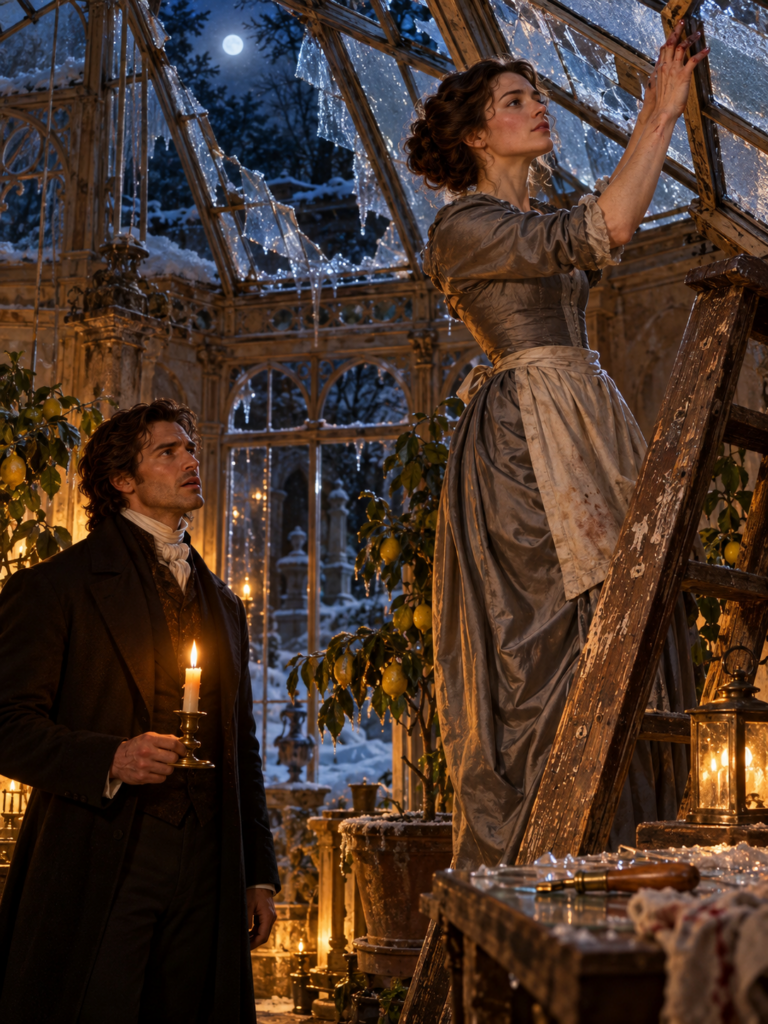
Anselm caught the bench with both hands and drove its legs back against the stone.
“Let go of the glass,” he said.
“No.”
“Isabel, the frame will not hold your weight.”
“It will if you steady the bench.”
He looked up at her.
Her injured hand gripped the iron, and the pane trembled beneath her other arm.
For a moment, he nearly ordered her down again.
Instead, he planted his feet and held the bench still.
“Then finish what you began.”
She pressed the pane into its frame.
Only when it was secured did she climb down.
The moment her shoes touched the floor, Anselm noticed that fresh blood had soaked through her bandage.
“Let me see.”
“It is a small cut.”
“It is bleeding.”
“So was my father’s business when your family left his accounts unpaid.”
The words struck harder than she intended.
He released the bench.
Neither spoke.
Outside, wind moved over the frozen grounds.
At last, Anselm asked, “How long have my sisters called you that?”
She understood immediately.
“Since the first dinner after our wedding.”
“I did not know.”
“You were sitting beside them.”
“I did not hear.”
She met his eyes.
“You heard enough to know I was unhappy. You simply preferred not to know why.”
He looked away.
She gathered the little brass cutter and placed it inside her apron pocket.
“My father did not sell me willingly, Your Grace. He believed he was keeping me safe.”
Anselm’s expression changed.
Isabel continued before he could reply.
“He was ill. The bank was pressing him. His workers had gone unpaid. Your lawyers made marriage sound like mercy.”
“I know what the agreement said.”
“Do you know what happened afterward?”
He said nothing.
“The glassworks closed. My father died. The men who had worked beside him for thirty years lost their employment.”
She swallowed.
“And I came here.”
He stared at the new glass above them.
“I knew about the debt.”
“Yes.”
“I did not understand the rest.”
“Understanding would have required a conversation.”
There was no accusation in her voice now.
Only exhaustion.
That made it worse.
Anselm glanced toward the doorway.
“Why did you never tell me?”
She almost smiled.
“When?”
He remembered the dinners he had left early, the mornings when he had passed her without greeting, the evenings when she had eaten alone.
“Your rooms,” he said. “Are they comfortable?”
“The north chimney smokes.”
“Why were you placed there?”
“Laetitia thought a tradesman’s daughter would be accustomed to smoke.”
His jaw tightened.
“And your correspondence?”
Isabel hesitated.
“Cressida enjoys reading my letters aloud. Sometimes she attempts my father’s accent.”
“Surely the letters are sent afterward.”
“Not always.”
Anselm looked at her injured hands.
The room seemed suddenly colder.
“Tomorrow,” he said, “I shall put a stop to this.”
She drew herself straighter.
“I do not want another scene in which I stand silent while your family decides what I am.”
“Then tell me what you want.”
It was such an unfamiliar question that she needed a moment.
“I want my letters left unopened. I want a room with a working chimney. I want the orangery finished before the frost.”
He nodded.
“And I want the choice of whether to forgive you.”
The last sentence left him perfectly still.
“Can you give me that, Your Grace?”
“Yes.”
“Even if I never do?”
He lowered his eyes.
“Yes.”
For the first time, she believed the answer might cost him something.
She collected the lamp.
“The gardener will need his ladder returned.”
“I shall see to it.”
“And my father made these windows. They are not merely your family’s ornaments.”
“I know that now.”
“No,” she said quietly. “You have begun to know it.”
She walked toward the doorway.
He moved aside, leaving the passage clear.
Before she reached him, he spoke again.
“Isabel, tomorrow I intend to gather the household.”
She stopped.
“Why?”
“Because I permitted my sisters to humiliate you before witnesses. I shall correct that before witnesses.”
Her grip tightened around the lamp.
“Do not make promises merely because you are ashamed.”
“I am ashamed.”
“That is not the same as being changed.”
“I know.”
She studied him for a moment, then walked past.
Anselm remained beside the bench after her light disappeared.
By dawn he had summoned Mrs. Crewe, the housekeeper, and heard enough to understand that an apology behind closed doors would never repair what his silence had allowed.
At eight, the servants gathered in the breakfast room.
Laetitia entered with her usual air of authority.
Cressida followed, the stolen keys ringing at her waist.
Then Isabel appeared in the doorway.
Anselm rose, crossed to his younger sister, and held out his hand.
“Cressida,” he said, “give me the keys.”
Cressida stared at her brother’s outstretched hand.
For an instant, she seemed certain he was making a joke.
Then she looked toward Laetitia.
“Anselm, surely you cannot mean—”
“The keys.”
Laetitia set down her chocolate cup.
“I have managed this household since Mother died. You have never troubled yourself with the matter.”
“That is true.”
“Then why should you interfere now?”
“Because the woman entitled to manage it has been treated as a guest in her own home.”
A movement passed through the servants standing along the wall.
Isabel remained near the doorway.
She had not been warned what her husband intended.
That troubled her almost as much as the attention fixed upon her.
Cressida unclasped the iron ring.
She held it out reluctantly.
Anselm took it and crossed the room.
He stopped before Isabel.
“These should have been yours from the day we married.”
He offered them, but did not close her hand around them.
She looked from the keys to his face.
“May I decide how they are used?”
“Of course.”
“Even when my decisions differ from yours?”
“Then we shall discuss them.”
A faint, disbelieving expression crossed her face.
She accepted the keys.
Their weight settled into her wounded palm.
Anselm turned toward the household.
“The duchess’s correspondence will leave this house unopened. Her rooms are to be moved to the east wing. Instructions concerning the household will come from her, with Mrs. Crewe’s assistance.”
Laetitia rose.
“You cannot expect the servants to obey a glassmaker’s daughter.”
The duke faced her.
“They will obey the Duchess of Stainmore.”
“And what of us?”
“You will refrain from interfering.”
Cressida reddened.
“We were only amusing ourselves.”
“Yes,” Anselm said. “At her expense.”
He looked around the room.
“I heard what you called my wife on the staircase. I ought to have put an end to such treatment long before that evening.”
Then, to everyone’s astonishment, he turned back toward Isabel.
“I owe you an apology, not a performance. What I do afterward will matter more than what I say now.”
Mrs. Crewe lowered her eyes.
The gardener, standing uneasily near the door, cleared his throat.
“Begging your pardon, Your Grace. Shall I bring the orangery ladder back?”
“Yes.”
Anselm looked at his wife.
“And with your permission, I shall hold it.”
Isabel considered him.
“At noon,” she said. “There are six panes left in the eastern frame.”
A startled smile almost reached his face.
“At noon, then.”
Laetitia walked out before breakfast was served.
Cressida hurried after her.
Neither took the keys.
By noon, the ladder stood beneath the damaged roof.
Isabel arrived carrying her father’s brass diamond and a fresh piece of glass.
The duke waited in an old coat, without a servant.
“You need not supervise this,” she said.
“I promised to hold the ladder.”
“And dukes always keep their promises?”
“Not nearly often enough.”
She glanced at him.
“That, at least, is true.”
He steadied the ladder while she climbed.
For an hour they worked with barely a word.
She measured, scored, and fitted each pane.
He passed up tools and held the frame when the wind pressed against it.
Then a narrow piece of glass slipped from her hand.
Anselm reached for it instinctively.
The sharp edge cut his palm.
“Your Grace!”
“It is nothing.”
“That is what people always say immediately before making a mess of the floor.”
He looked down.
Blood was gathering along his hand.
She descended and fetched clean linen.
“Sit.”
He obeyed.
She washed the cut and bound it carefully.
“Now we both have inconvenient hands.”
He examined her scarred fingers.
“Did your father teach you everything about glass?”
“Everything he could before he became ill.”
“Would you teach me?”
She stopped winding the bandage.
“Why?”
“Because I have spent my life looking through his work without once considering how it was made.”
Something in her expression softened.
She handed him the brass diamond.
“Hold it lightly. One steady stroke.”
His first attempt produced an uneven scratch.
Isabel winced.
“You are pressing too hard.”
He tried again.
The tool skittered sideways.
For the first time, she laughed.
It was a small laugh, quickly suppressed.
Anselm looked at her.
“Have I offended the glass?”
“Very seriously.”
“Can it forgive me?”
“Only if you begin with a fresh piece.”
He did.
This time, the cutter gave a clear, delicate note.
Isabel laid the glass over the edge of the bench and pressed.
It divided exactly along the score.
Anselm stared.
Then he smiled.
It was the first true smile she had seen from him.
And because she had spent so long believing him incapable of warmth, she remembered it for the rest of the day.
They continued working.
During the weeks that followed, their conversations grew from short instructions into something neither had expected.
She explained how her father’s craftsmen made crown glass and why certain panes carried a greenish thickness near the center.
He told her about his mother’s love of the orangery, and how she had once insisted that every lemon tree be brought inside before the first hard frost.
He admitted that after his father died he had found unpaid bills filling an entire drawer.
“I was furious with him,” he said one afternoon.
“Yet it was easier to resent me.”
“Yes.”
She appreciated that he did not deny it.
“I saw your father’s debt whenever I looked at you,” he continued. “I persuaded myself that keeping away was better than making us both miserable.”
“And was it?”
“No. I merely left you to be miserable alone.”
She pressed putty beneath a frame.
“I was not always miserable.”
He glanced upward.
“No?”
“Sometimes I was angry.”
He almost laughed.
“I deserved that.”
“You did.”
The winter light shifted across the glass.
After a while, Isabel handed him another pane.
He took it carefully.
Her fingers touched his.
Neither moved away at once.
The orangery was not the only part of Stainmore changing.
With Mrs. Crewe beside her, Isabel began learning the enormous household’s routines.
She discovered linen locked away while servants slept beneath mended blankets.
She found that the attic rooms received too little coal.
She studied the storeroom accounts, spoke to the cook, and listened when the gardener explained what the estate needed.
She was not trained to manage forty servants.
She was, however, accustomed to keeping a glassworks account book beside her father.
Numbers did not frighten her.
Neither did asking questions.
When she arranged for the maids to receive better bedding, Laetitia attempted to reverse the order.
Mrs. Crewe quietly refused.
“The duchess has the keys, my lady.”
That sentence traveled through the house faster than any dinner invitation.
But authority alone did not make Isabel feel secure.
One evening, Anselm found her standing before the windows in the east drawing room.
“Are these rooms more comfortable?” he asked.
“Yes.”
“Then why do you look troubled?”
She folded her hands.
“Because I cannot forget how quickly these things were taken from me before.”
He understood.
“You want assurances beyond my good intentions.”
“I want a life that cannot disappear because someone changes his mind.”
He was silent.
“Your father had a business,” he said eventually. “You understood its accounts?”
“Yes.”
“And you could run it?”
“With the foreman’s help. I knew the men, the furnace, the orders. I was not merely a daughter sitting in the office.”
He nodded slowly.
“Then perhaps I have been overlooking something important.”
She did not ask what he meant.
She had learned that hope could be dangerous when built on unspoken intentions.
At church, the following Sunday, Cressida again mocked Isabel’s hands.
The scars showed beneath the pale winter light.
“A duchess ought at least to know when to wear gloves,” she murmured loudly.
Anselm stopped on the church path.
He looked at Isabel.
“May I?”
She knew what he meant.
After a moment, she offered him her hand.
He tucked it into the bend of his arm and escorted her past his sisters and the assembled parishioners.
He neither threatened nor scolded.
But he did not let her stand alone.
That evening Isabel discovered an unexpected kindness.
A small fire had been laid in her sitting room, and beside it was a sturdy worktable for cutting glass.
Anselm stood near the door.
“I thought you might need somewhere to work without freezing.”
She touched the smooth wooden surface.
“You asked the carpenter?”
“Yes.”
“Did you tell him what to make?”
“I described what I thought useful. He advised me that I understood very little.”
She smiled.
“A sensible carpenter.”
“I am beginning to value sensible instruction.”
They remained together until the fire burned low.
Neither spoke of love.
But when he rose to leave, Isabel wished he would stay.
That frightened her.
She had survived his indifference.
She was not certain she could survive learning to love him only to discover that his kindness came from guilt.
The week before Christmas, Anselm sent for his solicitor from Kendal.
He instructed him to investigate the sale of the Farrance glassworks.
When the solicitor returned with the available records, Anselm learned that the premises had not yet passed into another family’s hands.
The bank was willing to sell.
Anselm gave orders that the property be acquired for Isabel, with independent income and arrangements to settle the unpaid wages.
He did not want the transfer to depend upon her remaining his wife in his house.
He wanted her to have something no Carey could take away.
But he made a grave mistake.
He decided to keep the plan secret until Twelfth Night.
He imagined presenting Isabel with the glassworks before their assembled guests, not as a payment for affection, but as acknowledgment of the debt his family had never truly repaid.
The solicitor prepared the papers.
Then, while Anselm was away at Appleby, a sealed packet arrived at Stainmore.
Laetitia found it upon the hall table.
By the time she had finished reading the letter, she was smiling.
That afternoon, Isabel sat alone in the orangery beneath the nearly completed roof.
Only four panes remained.
She had kept them unfinished because Anselm had helped with every other section.
She was thinking of asking him to cut one pane entirely by himself.
The door opened.
Laetitia entered with Cressida.
“We thought you should know what our brother has arranged,” Laetitia said.
She held out the solicitor’s letter.
Isabel did not accept it.
But the paper was already open, and she could see enough to understand the language.
A separate establishment.
Independent provision in Bristol.
Arrangements completed before Twelfth Night.
“He is sending you away,” Cressida said softly.
Isabel stared at the letter.
“He would have told me.”
Laetitia gave her a pitying smile.
“Would he? After a year of silence?”
Isabel looked up at the new glass.
She remembered his hand steadying the ladder.
His smile.
The evenings by the fire.
The worktable in her sitting room.
And she remembered the first day of their marriage, when he had told her not to expect his company.
Perhaps she had misunderstood everything.
Perhaps a guilty man could become kind without becoming loving.
Laetitia folded the paper.
“He means to settle you comfortably in Bristol. You should be grateful.”
Isabel lifted her chin.
“Please leave.”
When they had gone, she sat for a long time without moving.
Then she returned to her room and packed the small trunk she had brought from Bristol.
She took her father’s diamond, her plain gray gown, and the unsent letters to the old glassworks foreman.
She left everything else.
In Anselm’s study, she placed the housekeeping keys at the center of his desk.
Beside them she laid a brief note.
She had no wish to remain where she was not wanted.
She would make her own way.
By evening, she was traveling south.
When Anselm returned after dark, the keys were the first things he saw.
He read the note once.
Then again.
Mrs. Crewe told him what had happened.
He went straight to his sisters.
“You opened my solicitor’s letter.”
Laetitia did not deny it.
“We merely helped her understand.”
“You told her I intended to cast her off.”
“Did the letter not say she would have a separate establishment?”
“It said she would own her father’s glassworks.”
Silence.
“I bought the works from the bank. I arranged an income in her name. I meant her to have somewhere she could return to without asking my permission or depending upon my money.”
Cressida’s face drained of color.
“She was to be free to stay,” Anselm continued, “or free to leave.”
He looked at Laetitia.
“And you persuaded her that I wanted her gone.”
“We have only tried to protect the family.”
“No. You have tried to protect your place in it.”
He ordered the sisters to cease managing his household and arranged for their removal to the family’s dower house after Twelfth Night.
Then he summoned Mrs. Crewe.
“I am going to Bristol.”
“The roads over Shap are bad, Your Grace.”
“I know.”
“She may refuse to see you.”
He picked up Isabel’s note.
“Then I shall respect her refusal.”
He closed his traveling case.
“But she will not spend another day believing that my attempt to give her freedom was a polite way of throwing her away.”
The traveling case closed with a hard snap.
Anselm stood beside it for a moment, looking at the ring of iron keys lying on his desk.
He had given them to Isabel publicly.
He had believed that act would begin to repair the damage of their first year.
Now she had left them behind.
Not because she was ungrateful.
Because she had learned that possession meant little when the power to take something away remained in another person’s hands.
He lifted the keys and placed them carefully in his pocket.
Then he went downstairs.
His carriage was waiting.
Mrs. Crewe stood at the door, wrapped in a thick shawl.
“Your Grace,” she said, “if you find her, do not begin by telling her what you have done for her.”
Anselm paused.
“What should I say?”
“The truth, sir.”
He looked down.
“I have been rather poor at that.”
“Yes, Your Grace.”
She did not soften the answer.
“And if she chooses Bristol?”
“Then Bristol shall be hers.”
Mrs. Crewe nodded.
“Perhaps you are ready to speak to her now.”
He climbed into the carriage.
The first stage south was slow.
Snow lay thick upon the higher road, and near Shap the carriage could go no farther.
The postilion advised waiting until daylight.
Anselm wanted to continue at once.
For several minutes, he struggled against the thought of another lost hour.
Then he looked at the exhausted horses.
He had spent a year mistaking impatience and avoidance for decisions.
He would not put another creature at risk simply to ease his conscience.
The horses were sheltered, and he waited until a safer passage could be made.
When the southbound coach became available, he took it.
Every town brought another opportunity to rehearse what he would say.
And every rehearsal sounded inadequate.
He could tell her that he loved her.
But she might reasonably ask why love had remained silent while she suffered.
He could tell her that he had purchased the glassworks.
But money had helped trap her in their marriage once before.
He could apologize.
He already had.
What remained was the harder task of becoming a husband she could choose without surrendering herself.
Meanwhile, Isabel was traveling toward Bristol.
For three days she sat among strangers, her plain cloak wrapped closely around her shoulders.
A farmer’s wife shared bread with her.
A clergyman slept through most of the journey.
Nobody addressed her as Your Grace.
Nobody knew that she had been married to one of the wealthiest men in Westmorland.
She found the anonymity both comforting and painful.
Whenever the coach stopped, she thought of the orangery.
She remembered Anselm’s first crooked score in a sheet of glass.
She remembered the day he had laughed at himself.
She remembered his injured palm lying open in her hands.
Then she would recall Laetitia’s letter.
A separate establishment.
Perhaps her husband had wished to spare her public humiliation by sending her away quietly.
Perhaps everything she had mistaken for affection had been remorse.
She refused to let the uncertainty destroy what little future remained to her.
In the purse sewn inside her cloak lay the pin money she had saved throughout her marriage.
She had spent almost none of it.
She would use it now.
When she reached Bristol, she went directly to the old glassworks.
The great furnace house stood beside the river, its brick cone black against the winter sky.
No smoke rose from it.
The yard was silent.
But a dozen men waited outside the locked gates.
She recognized them immediately.
Thomas Hales, her father’s old foreman, stepped forward.
His hair had grown almost entirely white.
“Miss Bell?”
Her throat tightened.
He removed his hat.
“Beg pardon. Your Grace.”
“Bell will do, Mr. Hales.”
He stared at her.
“We heard the works had been sold.”
“To whom?”
“A gentleman from the north, they said. We were told there might be work again after Christmas.”
Isabel looked at the chained gate.
“Has anyone come?”
“No, miss.”
“Have the men received their old wages?”
Hales shook his head.
She opened her purse.
“This will not settle everything my father owed, but it will make a beginning.”
He stepped backward.
“We cannot take your money.”
“You can take wages earned honestly.”
She pressed the purse into his hand.
“Please see that every man receives a fair share. Keep accounts. I shall want to examine them.”
He blinked.
“Then you mean to stay?”
“I mean to work.”
She looked through the iron bars.
“First, we must find who holds the keys to that gate.”
It took most of the day to establish the bank’s instructions and obtain permission to enter.
The sale, Hales explained, had been arranged by a northern purchaser, but the formal change of possession was not yet understood by the workers.
Isabel refused to damage the lock or risk losing the premises through an act of desperation.
Instead, she used what little money remained to arrange coal and supplies while Hales contacted the responsible agent.
By afternoon, the gate was opened for the new owner’s representative.
The old foreman held the authorization in his hands.
He looked from the paper to Isabel.
“Miss Bell, whoever bought the works intends to reopen them.”
She looked inside.
The old furnace pots would require inspection, and several were useless.
The building needed repairs.
There could be no immediate return to full production.
But the furnace house could be prepared.
With the men beside her, Isabel entered the yard.
She laid aside her cloak and tied up her gray skirt.
There was dust on every ledge and old ash beneath the furnace mouth.
She helped clear the working space while Hales inspected the hearth.
The men worked until their breath clouded in the gathering dark.
When at last a small preparatory fire was lit, Isabel stood before it, watching the first orange light spread over the bricks.
Her father had stood in this place for thirty years.
As a little girl, she had followed him through the yard, asking questions until even the most patient workmen laughed.
Later, when his illness worsened, she had kept the accounts and learned which orders could be completed with the dwindling supplies.
She had known the business was failing.
She had not known that his hope of saving her would cost them both so dearly.
Hales approached.
“You ought to rest, miss.”
“I shall, when the fire is properly tended.”
“I can stay.”
“You have done enough today. We shall arrange watches.”
He smiled faintly.
“That sounds like your father.”
After the men departed, Isabel remained with the small fire, reviewing the accounts they had found and considering what repairs were needed before real work could begin.
She heard the outer door open.
“Mr. Hales?”
No answer.
She turned.
Anselm stood in the entrance.
His boots were dirty from the road. His coat was creased. He looked exhausted.
For a moment, neither moved.
Then Isabel set down the account book.
“Your Grace.”
He took off his hat.
“Isabel.”
“You should not have come.”
“Perhaps not.”
“Your solicitor’s arrangements were plain enough.”
“They were not plain enough. That was my fault.”
She looked away.
“I have already left Stainmore.”
“I know.”
“I have no wish to return merely because your sisters were unkind.”
“I would not ask that of you.”
He glanced around the furnace house.
“May I come closer?”
After a moment, she nodded.
He stopped several feet away.
“I bought this glassworks,” he said.
Her eyes lifted sharply.
“The gentleman from the north?”
“Yes.”
“And the separate establishment?”
“A house and income held for your benefit, apart from Stainmore. The glassworks and its business are to be yours, subject to completing the proper papers.”
She stared at him.
He went on.
“The unpaid wages are provided for. There will be money to restore the works and employ the men again.”
“Why?”
It was one word.
But it contained the whole year.
Anselm looked at the dark brick walls.
“Because my father enjoyed the work of yours and never paid for it.”
She said nothing.
“Because I inherited his house, his title, and the benefit of his dishonesty.”
He lifted his eyes.
“And because I allowed our marriage to become another injustice.”
Her breathing changed.
“You cannot purchase forgiveness.”
“No.”
“Or affection.”
“No.”
“Or another chance.”
“I know.”
He drew a folded document from his coat.
“My solicitor will explain every provision to you. You may choose someone independent to advise you before signing anything. If any arrangement fails to give you the control I promised, I shall have it corrected.”
He placed the paper on the nearby bench.
“I should have told you before preparing it. Keeping it secret gave my sisters the opportunity to hurt you again.”
Isabel looked at the document.
“And if I refuse to go back?”
“Then I shall return to Stainmore without you.”
“And this?”
“Still yours.”
She pressed her fingertips against the edge of the bench.
For a long time, she could not speak.
Finally she asked, “Was it all pity?”
His face changed.
“No.”
“Then what was it?”
He took a breath.
“I thought I hated what our marriage represented.”
Her expression closed.
“I know.”
“But I came to know the woman I had refused to see.”
He looked toward the furnace.
“I learned that you would risk your own comfort to preserve my mother’s trees. That you knew more of honest work than I had ever troubled myself to learn. That you could make a household better simply by listening to the people in it.”
His voice grew unsteady.
“And I learned that I was happier holding a ladder for you than I had ever been presiding over my own table.”
Isabel closed her eyes.
“I love you,” he said.
She opened them.
“I did not intend to say that tonight. I had imagined I would find some better way to prove it first.”
He smiled sadly.
“But I have wasted too many words by leaving them unspoken.”
Tears shone in her eyes.
“Anselm.”
It was the first time she had called him by his given name.
He stood very still.
“I was beginning to love you,” she whispered. “And then I believed you were sending me away.”
“I know.”
“You cannot imagine what that letter did to me.”
“I can only answer for the harm I caused.”
She wiped her cheek.
“If I return, I will not return as a debt discharged.”
“No.”
“Nor as a woman whose place depends upon your family’s approval.”
“No.”
“I want to help manage the glassworks. I want the men paid and the furnace working. I want to know what I own and what decisions are mine.”
He nodded.
“And I want a husband who speaks to me when the truth is difficult.”
Anselm swallowed.
“I shall have to learn.”
“Yes,” she said. “You shall.”
They looked at each other across the old furnace house.
Then a faint crack came from the small fire.
Isabel glanced toward the hearth.
“The fire needs tending.”
Anselm removed his coat.
“What should I do?”
She studied him.
“The coal is there. Put a little on the fire. Slowly.”
He obeyed.
After a moment, she said, “Not all at once.”
He stopped.
“I see I remain a poor apprentice.”
“An exceptionally poor one.”
“But willing.”
This time her laughter came freely.
The sound filled the furnace house.
He turned toward her.
She crossed the floor and took his injured hand, examining the nearly healed cut.
“You must stop catching falling glass.”
“I shall try.”
“And stop hiding important things from me.”
“That will require more effort.”
“I expect it will.”
She touched his cheek.
He waited until she drew him closer.
Then he kissed her.
There was no audience.
No applause.
No one to congratulate him for becoming a decent husband.
Only the warmth of the fire and a woman who had finally been given the freedom to decide whether she wanted him.
When they parted, she rested her forehead briefly against his.
“I am not ready to leave Bristol tonight,” she said.
“I had not intended to ask.”
“The men have been waiting too long. I need to see the property papers and make plans with Mr. Hales.”
“Then I shall stay long enough to help, if you wish.”
She considered him.
“Can you keep an account book?”
“Better than I can cut glass.”
“That remains to be seen.”
He laughed.
The next morning, Hales arrived with two workmen and stopped in astonishment at the sight of the Duke of Stainmore carrying coal.
Isabel introduced her husband.
“Mr. Hales, His Grace wishes to make himself useful.”
The old foreman examined Anselm’s blackened cuffs.
“Can he take instruction, miss?”
“Sometimes.”
“Then there may be hope for him.”
They spent the following days inspecting the works, making arrangements for necessary repairs, and discussing the reopening.
The duke met with the appropriate agents and ensured that the promised ownership and financial provisions were documented for Isabel’s independent benefit.
Hales reviewed the outstanding wages.
Isabel insisted that every account be entered properly.
She would not build her father’s business upon vague promises, however loving the man making them.
And Anselm did not object.
For the first time, they were planning a future as two people with distinct responsibilities and a shared desire to remain together.
One afternoon, when the furnace had reached a suitable heat for a carefully supervised trial, Hales and the workers prepared a gathering of molten glass.
Isabel stood beside them, watching the old movements return.
The glowing gather turned at the end of the rod.
Under practiced hands, it expanded into a broad disc of crown glass.
Anselm watched in wonder.
When the cooled glass was ready for cutting, Isabel took out her father’s diamond.
She drew one clean line.
The pane separated beneath her hands.
Then she offered the cutter to Anselm.
“Make a mark.”
“What kind?”
“A star. Like my father’s.”
He looked at her.
“Are you certain?”
She nodded.
“In one corner. Put an I inside it.”
“For Isabel?”
“For the last pane in the orangery.”
He worked slowly.
The little star was not quite as fine as her father’s.
But the letter was clear.
Isabel held the glass up to the winter light.
A new signature.
Not one that erased the old.
One that belonged to the woman her father had taught.
They packed the pane carefully and arranged for Hales to continue preparations at the works.
Before leaving Bristol, Isabel reviewed the wage records and received confirmation of the arrangements for the business.
She also chose to return to Stainmore.
Not because she had nowhere else to live.
Not because the duke expected her.
Because she wanted to see what they might build there together.
The journey north was difficult.
Winter roads delayed them, and the journey required careful changes of horses and proper rest.
They could not travel as quickly as Anselm hoped.
But Isabel had learned something about her husband.
He was a man accustomed to controlling accounts, servants, horses, and estates.
He could not control every road.
And she rather enjoyed reminding him.
By Twelfth Night, they finally approached Stainmore.
The long windows glowed with candlelight.
Carriages stood before the entrance.
Inside, the county’s guests had gathered for the traditional celebration.
Many had come expecting to witness the duke’s humiliation.
Cressida had spread the story that his wife had been sent away.
Laetitia had encouraged the rumor that their marriage was finished.
Neither sister expected Isabel to return.
Mrs. Crewe met her at the private staircase.
The housekeeper had pressed the gray silk gown.
“It is ready, Your Grace.”
Isabel touched the familiar fabric.
“That was the gown they laughed at.”
Mrs. Crewe nodded.
“I thought you might prefer another.”
“No.”
Isabel took it.
“This one will do.”
A little later, the doors of the great hall opened.
Anselm entered with his wife on his arm.
Conversation faded.
Then the musicians stopped.
Faces turned.
Above the hall, Laetitia and Cressida stood near the gallery.
Anselm led Isabel to the foot of the staircase.
He looked up at his sisters.
“Some of you have heard that my wife has left Stainmore permanently.”
Whispers moved through the crowd.
“You were told I had settled her elsewhere because she was unsuitable for this family.”
He paused.
“That account came from my sisters. It was false.”
Laetitia went white.
Anselm continued.
“My wife’s father made the windows of this house. My father never paid him what was owed. Our marriage was arranged to end that obligation.”
He turned toward Isabel.
“I believed I could put the matter behind me by refusing to see what it had cost her.”
A hush settled over the hall.
“For a year, I failed her as a husband. My sisters added cruelty to that neglect, and I permitted it.”
He took her hand.
“These hands have cut and fitted the glass through which this house receives its light. They have helped preserve the orangery my mother loved. They belong to a woman whose skill and character deserve respect.”
He looked toward the gallery.
“Lady Laetitia and Lady Cressida will leave for the dower house tomorrow. They will no longer direct this household or interfere with my wife’s correspondence.”
Neither sister answered.
But Anselm was no longer speaking to them.
He faced Isabel.
“I cannot recover the year I wasted. I cannot demand that you forget it.”
His voice carried through the silent hall.
“But I love you, Isabel. And I intend to spend the years ahead being a husband worthy of the choice you have made.”
Her eyes filled.
She looked at the assembled guests.
Then she turned back to him.
“I have not returned because I had to.”
“I know.”
“I have returned because I want our marriage to become what neither of us knew how to make it at first.”
She took both his hands.
“And because I love you, too.”
He leaned closer.
She smiled.
Then she kissed him before the whole county.
For a heartbeat, nobody moved.
Then applause rose from the far end of the hall.
The musicians began playing again.
Anselm kept her hand in his as the guests approached.
The vicar’s wife came first.
She looked at Isabel’s scarred fingers.
“Your Grace, I once watched you suffer an insult and said nothing. I have regretted it.”
Isabel studied her.
“Then perhaps we can both do better next time.”
The woman bowed her head.
One by one, the guests offered their greetings.
Some were sincere.
Others were embarrassed.
Isabel accepted what courtesy she wished and did not trouble herself over the rest.
Above them, Laetitia and Cressida watched in silence.
The following morning they departed for the dower house near Appleby.
Isabel did not celebrate their discomfort.
She merely made certain that the household knew whose instructions it was to follow.
After breakfast, she and Anselm carried the final pane to the orangery.
The gardener had kept the stove burning through the hardest nights of winter.
Mrs. Crewe had helped him after Laetitia attempted to order the heat withdrawn.
The lemon trees had survived.
Their leaves were green again.
Anselm positioned the ladder beneath the one remaining gap.
Isabel climbed with the glass held carefully against her arm.
“Steady?” she called.
“Steady.”
She fitted the pane.
Pressed the putty.
Checked the edges.
Then she looked down.
“Finished.”
He smiled.
“Come and see what you have done.”
She descended.
Together they stood beneath the completed roof.
Sunlight passed through the glass and fell across the stone floor.
Near the bottom corner of the final pane was the little five-pointed star.
And inside it, the letter I.
Isabel touched the brass cutter in her pocket.
“My father would have liked this room.”
Anselm glanced at the trees.
“I think my mother would have liked him.”
They remained there until the gardener came to examine the finished work.
Spring arrived slowly.
The lemon trees flowered.
Later, they carried fruit for the first time in many years.
In Bristol, the Farrance glassworks reopened its furnaces and gradually returned to production.
The former workers received the wages they had been owed, and new work was entered honestly into the accounts.
Isabel traveled south when the business needed her.
She corresponded with Hales regularly and kept the letters in her own desk.
Nobody opened them without permission.
At Stainmore, Mrs. Crewe remained her trusted adviser in the running of the household.
The servants received proper coal and clean linen.
The orangery became a place where Isabel and Anselm spent quiet afternoons.
Sometimes they worked.
Sometimes they talked.
Sometimes they simply watched the light change over the lemon leaves.
Their marriage did not become perfect because of one public declaration.
They disagreed.
Anselm occasionally returned to old habits of deciding things without sufficient discussion.
Isabel refused to accept them.
He learned to stop, listen, and ask.
And she learned that a disagreement need not be followed by a year of silence.
One evening, nearly a year after their reconciliation, Isabel found him examining a pane of glass on her worktable.
“What are you doing?”
“Attempting to improve my technique.”
She inspected the line.
It was crooked.
“Anselm.”
“Yes?”
“You are still pressing too hard.”
He sighed.
“I fear your father would have dismissed me.”
“Almost certainly.”
He smiled.
“But you have not.”
“No.”
“Why?”
She laid her hand over his.
“Because you have learned to begin again.”
At dusk they walked together toward the great staircase.
The iron keys rested at Isabel’s waist.
Her gray silk moved softly as she climbed.
Anselm followed, carrying the lamp.
On the landing, she stopped and looked back.
He was smiling at her.
“What is it?” she asked.
“Nothing.”
She raised an eyebrow.
“Your Grace, I think we have had quite enough of silence.”
He laughed and took her hand.
“Then I shall tell you.”
And he did.
That became their ordinary miracle.
Not a fortune restored, nor a grand house reclaimed, nor the judgment of a county overturned.
It was a man who had once hidden from his wife learning to meet her openly.
And a woman once treated as the payment of a debt becoming free to possess her own work, her own voice, and the love she had chosen.
Behind them, the windows of Stainmore caught the last light.
In their corners, the little stars of Farrance still shone.
And beneath the orangery roof was one newer star, marked with the letter I.
A reminder that glass could break under careless pressure.
But placed in patient hands, it could also let the light through.


