
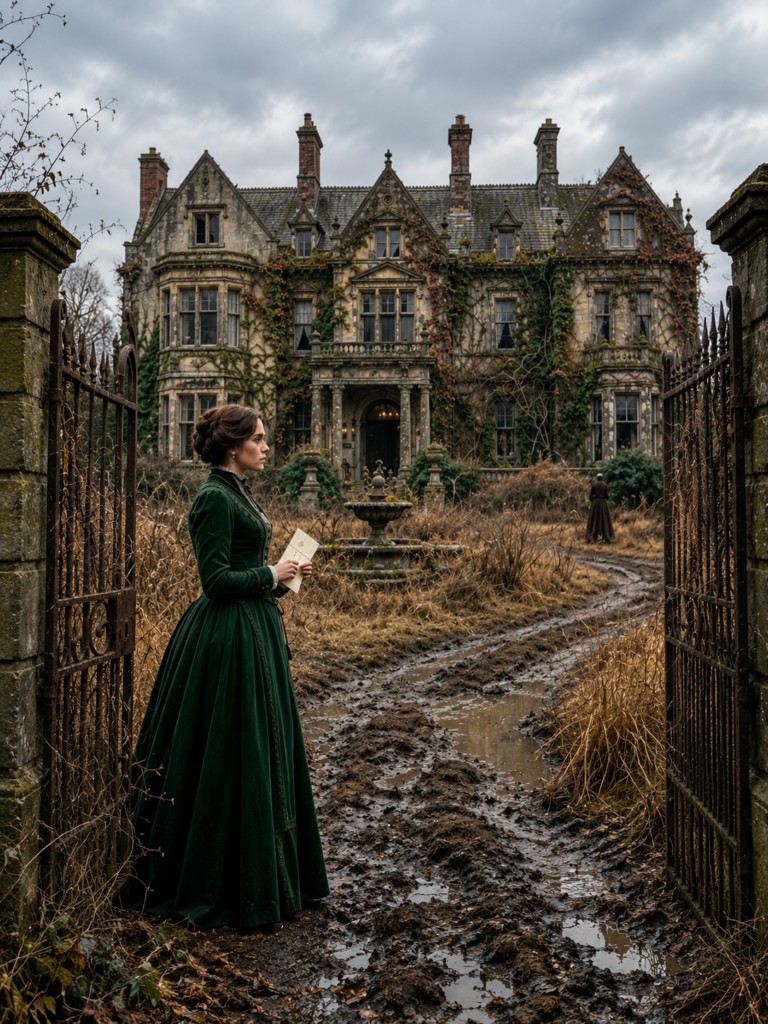
they gave her a ruined manor and a silent mill instead of the profitable land and she built a working fortune from nineteen pounds and the refusal to quit
Part 1
Rain struck the broken windows of Bell Mere Hall as if it had waited years for the chance. In the entrance hall a tin bucket caught the steady drip from the ceiling. The carpet under it was already ruined. A long crack ran down one wall from the staircase to the floor. Cold air moved through the gaps around the frames. Florence Ashcombe stood beside the solicitor’s table with a single sheet of paper in her hand. Across from her, her cousin Charles adjusted his gloves. He had taken the good farmland, the investments, and the properties that paid a steady income. She had been left Bell Mere Hall, the crumbling manor, the abandoned wool mill beyond the eastern fields, and debts that came to six hundred pounds.
Charles glanced up as another drop hit the bucket. “You always wanted something of your own,” he said. “Now you have it.”
Florence looked at him. “Did you know the mill was closed?”
“I knew it was no longer profitable.”
“That is not what I asked.”
For a moment his face tightened. Then he smiled. “My dear Florence, you should be grateful you have a roof over your head.” A piece of plaster fell behind him. He laughed under his breath, walked to the door, and turned once more. “Do not expect the family to rescue you when this place finally falls in.” The door shut. She was alone.
She had nineteen pounds in her purse. The estate owed six hundred. The mill had not run properly in months. She had no husband with money, no friends with influence, and no hidden sum waiting in a bank. She walked to the nearest window and watched Charles’s carriage disappear down the drive. For a moment she let herself think of leaving. She could find work in a town, rent a small room, and stop counting every broken tile. Then she looked at the hall again. Her father had spent years trying to keep Bell Mere standing. Even at the end he had refused to sell it off piece by piece. She had once called that stubbornness foolish. Now she wondered whether he had seen something she had not. A ruined building was not always a worthless one. The question was whether anything inside it could still be made to work, and she did not have much time to find out.
The next morning she walked across the wet fields to the mill. It stood beside a narrow water channel that had once helped turn the wheels. The brick was stained dark from years of rain. Weeds grew between the stones. Rust covered the iron fittings around the doors. When she opened the main door the smell of damp wool, old oil, and wet timber met her. The machinery stood silent. Belts hung loose. A broken wooden frame leaned against one wall. Dust covered the tables. A thin stream of water crept under one of the side doors.
“Miss Ashcombe.” An older man came out of the workshop. Joseph Turner had been the mill’s foreman before it closed. His sleeves were rolled. He carried a small notebook. “I was not sure anyone would come back here.”
“Neither was I.” Florence stepped toward the nearest machine. “Can it work?”
Joseph did not answer at once. “The main frame can. Two of the smaller looms need repairs. The drive belt is worn. The water channel needs clearing. We would also need wool, oil, and wages for anyone who works here.”
“How much?”
“More than you have.”
It was not the answer she wanted, but it was the first honest one she had heard since the will was read. She asked him to show her the accounts. They spent the afternoon sorting invoices and damaged ledgers. Most of the figures were ordinary: repairs, raw wool, wages, cartage. Then she found a torn page folded between two books. At the top were the words Hargreaves and Sons. Below them was a reference to a shipment that appeared to have been prepared but never properly settled. The page was incomplete. No clear date. No full invoice. No proof the money had ever reached the mill. Still, it was a lead.
“Did the mill supply Hargreaves?” she asked.
“Years ago,” Joseph said. “They were a respectable buyer. I do not know whether they would deal with us now.”
“There is only one way to find out.”
Part 2
The next morning Florence traveled to their offices with a sample of the old cloth and a copy of the surviving records. The merchant who received her examined the fabric without enthusiasm. “Your mill has been closed for months.”
“I know.”
“And your machinery?”
“Some of it can be repaired.”
“Some of it,” he repeated.
She placed the sample on his desk. “Give me an order small enough that I can fill it. Judge the cloth, not the building it came from.”
He studied her for several seconds. At last he agreed to consider a trial. If she could deliver a specified quantity of consistent woolen cloth within six weeks, Hargreaves and Sons would pay the agreed price for what they accepted. If she failed, they would owe her nothing for the rest. It was a narrow chance, not a rescue. But she left with a written specification and a deadline. For the first time since she had inherited Bell Mere she had something more useful than hope.
She sold several pieces of unused furniture from the manor. The money would not clear the debts, but it bought wool, oil, fittings, and the materials for the first repairs. Joseph persuaded two former workers to return for a short trial. One needed the wages. The other had found occasional work elsewhere and could not afford to wait weeks on a mill that might never reopen. Florence understood. She could offer no certainty, only a plan.
For several days the workshop echoed with hammering and the scrape of tools. The first repaired loom began to move. She watched the thread pass through the frame. At first it seemed to work. Then the cloth began to gather unevenly. Joseph stopped the machine. The weave was inconsistent. They tried again with a different tension. The second attempt failed in nearly the same place. By late afternoon she stood over a length of cloth that would never meet the order.
“We cannot send this,” Joseph said.
“I know.”
“We have already used some of the wool.”
“I know that too.”
He looked at the ruined sample. “If we continue like this we will lose the order before we have properly begun.”
Florence wanted to defend the attempt. Instead she asked him to show her exactly where the thread was failing. They worked through the problem one detail at a time. The old frame had shifted slightly. One component was worn more deeply than the others, so the thread pulled unevenly. Replacing the whole mechanism would cost money they did not have. Joseph believed he could adjust the damaged part, but it would take time. She spent the following day helping him measure, test, and reset the frame. The work was slow. Her fingers grew sore. Twice they had to undo hours of adjustments. On the third attempt the cloth came out evenly. Joseph examined it under the workshop light, then passed it to her. It was plain practical woolen cloth, not beautiful the way expensive silk was beautiful, but the weave was consistent and the edges held. She ran her hand across it.
“Send this sample.”
Joseph nodded. For the first time he smiled. Neither of them celebrated long. They still had six weeks to fill the order, and the mill had produced only a small piece.
Part 3
The work began before sunrise. Florence recorded every length of cloth, every measure of wool, and every payment. Joseph managed the machinery. The two workers handled the preparation and weaving. Progress was slower than she had calculated. One morning a delivery of wool arrived damp from the journey. It had been stored badly before it was sent, and part of the consignment was unsuitable. The supplier refused to replace it without further payment. Florence examined the wool herself. Some could be dried and salvaged. The rest would have to be set aside. She could accept the loss quietly or spend another day arguing. She chose to negotiate. After she showed the supplier the condition of the delivery and explained the extra labor required, she secured a partial credit against the next purchase. It was not a victory large enough to save the mill. It was simply money she could not afford to waste.
By the end of the second week the mill was producing cloth that met the agreed standard. Every delay still narrowed the margin. Then Joseph brought her another problem. “The water is running badly.”
She followed him outside. The channel that supplied the mill was obstructed by fallen branches, accumulated silt, and damaged timber near a narrow crossing. Water was passing, but not with enough consistency to keep the schedule. Rain was forecast again. If the channel grew worse the machinery could stop for days. She looked at the damaged section, then at the mill.
“How long to repair it?”
“With the right timber and enough hands, perhaps two days.”
“And the cost?”
He gave her a figure. She had already spent most of the money from the furniture. She could not pay for the repairs and buy the remaining wool without borrowing. She returned to the hall and opened the estate ledger. The debts were still there. So were the ordinary costs of keeping the manor from falling further. She could postpone the repairs and risk the order, or she could borrow and risk making her situation worse.
That evening she visited Mr. Hales, a local grocer who had known her father. She showed him the order, the merchant’s written specifications, and the accounts of the work completed so far. “I am not asking you to believe that Bell Mere will become wealthy,” she told him. “I am asking you to consider whether this particular order can be completed.”
He studied the figures. “You could lose the money.”
“Yes.”
“And if the buyer rejects the cloth?”
“I will still owe you.”
He leaned back. At last he agreed to a small short-term loan with the terms written down clearly. Florence left knowing she had bought time, not safety.
The next morning she and Joseph began clearing the channel. The rain started before they finished. At first it was a cold drizzle. By midday it had become a steady downpour that turned the ground to mud. One of the workers slipped while carrying timber. He was not badly hurt, but the incident forced her to stop and reorganize. She would not risk another person getting injured simply because she was frightened of missing a deadline. They secured the loose timber, moved the tools away from the rising water, and waited until the most dangerous part of the crossing could be approached safely. By late afternoon Joseph had identified the main obstruction. Fallen branches and packed silt were forcing water away from the proper course. They cleared the debris in stages and reinforced the damaged section with the timber they had purchased. The work was exhausting. Mud covered her boots. Rain soaked the sleeves of her dress beneath her coat. More than once she wanted to leave the workers to finish without her. She stayed, carrying smaller pieces, fetching tools, and checking the list of materials against what remained. When the channel finally began to run more evenly, Joseph watched the water for several minutes.
“That should hold,” he said.
“Should?”
He gave her a tired look. “I will not promise what I cannot know.”
She almost laughed. It was the most reassuring thing anyone had said to her all week. The mill restarted the following morning. For several hours the machinery ran smoothly. Then one of the belts began to slip. Joseph stopped the frame before it could damage the cloth. The replacement fitting had been delayed, and the old belt could not safely carry the full load. She looked at the unfinished order. They had less than two weeks remaining.
“Can we work at a lower speed?” she asked.
“For part of the process, yes, but it will cost us time.”
“Then we change the schedule. We will not risk ruining the cloth to make the clock look better.”
They adjusted the plan, concentrated on the stages that could be completed safely, and arranged for the missing fitting to be brought from a nearby supplier. The decision left almost no room for another mistake. Every evening she checked the completed lengths against the specifications. Every morning she returned to learn whether the next stage had gone according to plan. She began to understand that running the mill was not about making one brave decision. It was about making dozens of small decisions without letting fear, pride, or impatience make them careless.
The final week arrived with too much still to do. One length of cloth failed inspection because its edges were uneven. Joseph believed the problem could be corrected, but doing so meant sacrificing several hours of production. Florence examined the cloth. They could send it and hope the buyer overlooked the flaw, or they could correct it and risk a late delivery. She chose the correction. They worked carefully, refusing to let the deadline turn a manageable problem into a rejected shipment. On the final day the cloth was packed and loaded. Florence traveled with the shipment to Hargreaves and Sons, carrying her records and the signed order. The merchant inspected the first length, then another. He checked the weave, the finish, and the measurements. She waited without speaking. At last he set the cloth aside.
“The order meets our specification.”
Only then did she allow herself to breathe properly. The payment would not make her rich. It would not clear six hundred pounds of estate liabilities. But it would cover the cost of the order, allow the workers to be paid, and leave enough to repay Mr. Hales according to their agreement. She checked the figures twice before she accepted the payment. Back at Bell Mere she paid the loan as promised and recorded every transaction. Joseph found her later that evening in the workshop studying the next set of costs.
“You should be celebrating,” he said.
“I am.”
“You do not look like it.”
She looked around the mill. “Six weeks ago this place could barely produce a sound length. Now someone has paid us for what we made.” She closed the ledger. “But one order is not a business. We need another customer, and we need enough money to do the next job without borrowing again.”
Joseph nodded. He had been thinking the same thing.
Part 4
The next morning Florence wrote to Hargreaves, thanking them for the opportunity and asking whether they would consider a second order. She did not demand a promise. She sent samples, listed the improvements made to the machinery, and offered a realistic production schedule. Two weeks later the reply arrived. They were willing to place another order, smaller than she had hoped, but large enough to keep the mill operating. For the first time Bell Mere had a chance to earn money twice from the same customer. That mattered more than a single impressive payment.
While she was reviewing the old ledgers she discovered that four hundred twenty pounds had been transferred from the mill’s funds to an account associated with her late uncle Richard. The estate listed it as a debt, but no signed loan agreement or clear explanation could be found. Mr. Whitaker, an accountant, confirmed that the discrepancy deserved investigation, though it was not proof of dishonesty. After the solicitor reviewed the records, the unsupported amount was withdrawn from the claim. Florence recovered no money, but she avoided accepting an unproven debt.
“The legitimate debts are still ours,” she told Joseph. “We must pay what we truly owe.”
She locked the documents away and returned to the mill. As the work improved, another merchant offered her a large contract that would require more wool, extra workers, and the machinery running at full capacity.
“You cannot remain small forever,” he insisted.
“Nor can I promise what I cannot produce,” she replied.
She refused the risky offer and expanded gradually, repairing another loom and hiring one experienced worker. When a supplier later delayed a delivery, her small savings allowed her to pay the workers while she found replacement materials. The setback cost time and profit, but the business survived. Bell Mere was growing slowly, but it was finally becoming stable.
At a gathering of merchants Charles learned that the mill was succeeding. “I expected you to sell Bell Mere by now,” he remarked.
“It was failing,” Florence said, “but that did not mean it had to stay that way.”
Seeing the estate’s growing value, he offered to buy it. The sum would have given her a comfortable life free from the constant burden of repairs and debts. For a moment she considered accepting. Then she remembered how hard she had fought to get the mill running again.
“I will not sell.”
“You may regret that,” Charles warned.
“Perhaps. But it will be my regret to make.”
He left. Florence returned to her work. She no longer needed his approval.
Part 5
Three years after she inherited Bell Mere Hall, Florence stood in the entrance hall and watched the morning shift begin at the mill. The machinery was operating reliably. Repeat orders were arriving. The legitimate debts had decreased. The manor was being restored room by room. The great hall no longer needed a bucket beneath a leaking ceiling. She had not become wealthy overnight. She had faced failed samples, delayed deliveries, damp wool, a blocked channel, and a dozen small decisions that could have ruined the work if she had chosen carelessly. She had learned to build carefully rather than risk everything for quick success.
She walked to the window that looked toward the eastern fields. The mill stood there, brick still stained but the doors open and the sound of the frames carrying across the wet grass. She had begun with nineteen pounds and an estate everyone considered worthless. No hidden treasure had saved her. No sudden inheritance had arrived. She had built what she had through patience, steady work, and the refusal to accept that something neglected had to stay that way. The debts that remained were real and would be paid. The roof over her head no longer threatened to fall. Charles had taken the easy land. She had taken the ruined hall and the silent mill and made them answer. That was enough.


