
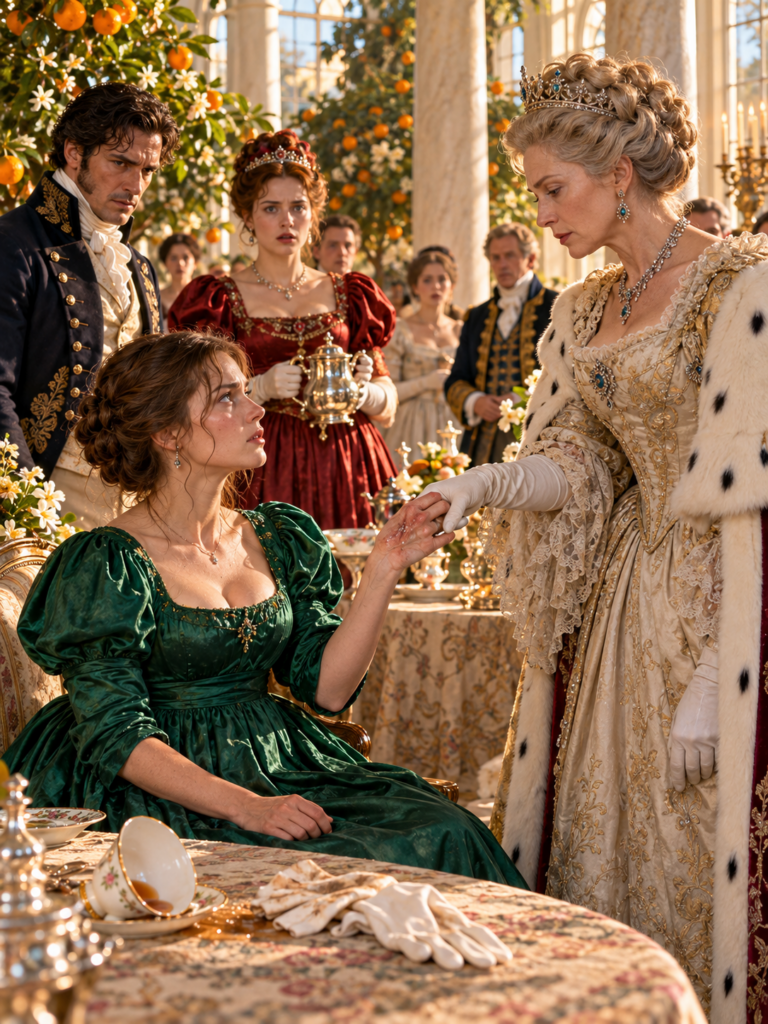
The glove resisted her fingers.
Betsy pulled again, slowly, as the damp leather dragged across the tender skin of her palm.
She clenched her teeth.
A narrow streak of blood appeared at the opening.
Lady Vavasour watched with unconcealed satisfaction.
The Duke pushed back his chair a fraction but did not rise.
“Carefully, child,” the Queen said.
Betsy stopped.
For the first time that afternoon, someone had spoken to her as though her pain mattered.
She eased the glove away.
Then she removed the other.
Both lay on the white tablecloth, stained brown with tea.
Her hands were exposed.
No silk or fine leather could disguise them now.
The knuckles were cracked. The palms were roughened and red. A fresh burn crossed her left hand, while dark soil remained deep within the lines of her fingers.
A lady-in-waiting drew in a startled breath.
An elderly general shifted uncomfortably.
Lady Vavasour lifted her chin.
“There, Your Majesty. You see what my brother has brought to your table.”
Betsy stood.
“I beg your pardon for the disturbance, ma’am.”
The Queen did not answer immediately.
Instead, she reached across the corner of the table.
“Your hand, my dear.”
Betsy offered her left hand.
The old Queen turned it gently toward the sunlight.
She examined the hard skin beneath the fingers, the narrow cuts near the thumb, the ingrained soil.
Her expression changed.
Not to disgust.
To recognition.
“These are not merely kitchen hands.”
Lady Vavasour’s smile faltered.
The Queen looked up.
“These are the hands of someone who works among growing things.”
Betsy hardly dared breathe.
“What is your name?”
The Duke opened his mouth.
The Queen raised one finger.
“I asked the young woman.”
A long silence followed.
Then Betsy spoke.
“Betsy, ma’am.”
“Betsy. Who has been tending these orange trees?”
Nobody answered.
The Duke stared toward the far end of the glasshouse.
And from among the painted tubs came an elderly voice.
“She has, Your Majesty.”
Mahaffey stepped forward, his cap crushed between his swollen fingers.
“Every night since autumn. When the kitchen was finished and the rest of us were sleeping.”
Lady Vavasour stiffened.
The old gardener continued.
“The trees were nearly lost to scale. I couldn’t manage the leaves with these hands anymore.”
He lifted his damaged knuckles.
“That girl washed them one by one. The oranges you came to admire are standing here because she refused to let them die.”
The Queen studied Betsy again.
“Is this true?”
Betsy glanced toward the Duke.
For weeks she had obeyed his instructions.
Look at him.
Allow him to answer.
Remain quiet.
But there was nothing dishonest about her work.
“Yes, ma’am.”
The Queen’s fingers closed gently around hers.
“At Frogmore, four of my orange trees have died this winter. My gardeners insist nothing could have saved them.”
“Sometimes the scale can be removed before the tree is too weakened,” Betsy answered.
“And you have done so?”
“Yes, ma’am.”
“Then you shall show me how.”
The Queen rose.
Betsy instinctively stepped back.
“Your Majesty, my hands—”
“Are precisely what interests me.”
She took Betsy’s arm.
The assembled company stared as England’s Queen walked away beside a kitchen maid.
Betsy led her toward the tallest orange tree.
She turned over a leaf, showing the clean underside.
The Queen leaned closer.
“What did you use?”
“Soft soap in warmed rainwater. And patience, ma’am.”
The Queen smiled.
“A commodity notably scarce in royal gardens.”
Betsy almost laughed.
Behind them, the elderly general approached and bowed to her.
“I owe you an apology, Miss Betsy. I laughed at you yesterday.”
She inclined her head.
“Thank you, sir.”
At the far table, Lady Vavasour still stood beside the silver teapot.
The Queen turned.
“My lady, you may leave us. I believe you have poured quite enough tea.”
Lady Vavasour went pale.
Then crimson.
She set down the pot and departed.
Betsy watched her go.
For one extraordinary moment, the woman who had ordered her hands scrubbed raw could no longer command the room.
The Queen turned back toward the oranges.
“Now, Betsy, show me the tree that gave you the greatest difficulty.”
Betsy lifted a branch and guided the royal hand toward its leaves.
But at the head of the abandoned table, the Duke remained seated, looking down at the bloodstained gloves.
And when the Queen asked whether Betsy had been properly rewarded for saving the trees, he finally raised his eyes.
Betsy was already turning toward him.
Betsy met the Duke’s eyes across the orangery.
For a moment, she thought he might answer the Queen’s question honestly.
He had watched her work without understanding it. He had seen her damaged hands. He had stood beside his sister while the household prepared her for the deception.
Now the Queen was asking what reward she had received.
The Duke rose.
“Miss Rogby has been treated according to her position, ma’am.”
The Queen’s expression remained perfectly still.
“And what position is that?”
He hesitated.
Betsy felt her injured palm throb.
She could endure being called a servant. That was what she was.
What she could no longer endure was being treated as though the truth about her labor were something shameful.
“I am employed in the kitchens, ma’am,” she answered.
The Duke looked sharply toward her.
The Queen did not.
“And are you employed in these gardens?”
“No, ma’am.”
“Yet you have restored them.”
“Yes, ma’am.”
“Remarkable.”
The Queen touched the nearest orange leaf.
Its surface gleamed beneath her fingers.
“My dear, I believe you have been doing the work of two people while receiving the wages of one.”
Betsy lowered her gaze.
“That was my choice, Your Majesty. I couldn’t bear to see them perish.”
“Which makes your choice generous. It does not make your work worthless.”
The Queen continued examining the trees.
Betsy explained how she had found the scale beneath the leaves, how Mahaffey had taught her which branches to prune, and how she had recognized a drainage problem in the older tubs.
Her explanations were plain.
She did not embellish.
Yet every sensible answer seemed to delight the Queen more.
When Betsy described the black growth that followed the scale infestation, the Queen listened closely.
“So the blackening is a consequence of the insects?”
“That’s how it was here, ma’am. We could wash it away once we dealt with the cause.”
The Queen sighed.
“I wish my gardeners would turn over a leaf before announcing that all hope is lost.”
This time Betsy did laugh.
The Queen laughed with her.
By dinner, the entire household knew that the royal guest preferred the company of the kitchen maid to that of several titled visitors.
Betsy sat beside the Queen with her injured hands uncovered.
Nobody suggested gloves.
The Queen asked about her childhood.
Betsy told her of Yorkshire, of her mother who had worked among glasshouses, and of learning plant names from the labels on pots.
She did not pretend to have an estate.
She did not mention the invented father.
The Queen seemed to understand more than she said.
Late that night, Betsy returned to the orangery.
The trees still required attention.
Mahaffey had banked the stove, but she wanted to check the upper vents before retiring.
She discovered the Duke standing among the tubs.
Moonlight fell across his dark coat.
For several moments, neither spoke.
Then he said, “I did not know you had saved them.”
Betsy inspected the stove.
“No, Your Grace.”
“Why did you never tell me?”
She turned.
“You never asked.”
The words were quiet.
He appeared to feel them more sharply than if she had shouted.
She continued.
“When I came to this house, I was hired to clean pans and carry water. You asked whether meals were ready. You asked whether the kitchens were properly supplied. But you never asked about the people doing the work.”
He looked toward the orange trees.
“They belonged to my mother.”
“I know.”
“She was particularly fond of this one.”
He rested his hand against the trunk of the tallest tree.
Betsy waited.
The Duke had rarely spoken of his mother.
Since her death, he had avoided the orangery almost entirely.
At last he said, “I thought it was dying.”
“It nearly did.”
“And you brought it back.”
“With Mahaffey’s help.”
He nodded.
Something resembling shame crossed his face.
But when he spoke again, his voice had recovered its old distance.
“The Queen leaves Thursday. Afterward, the arrangement will end.”
Betsy stood motionless.
“You will return to your ordinary duties. You shall receive additional payment for the inconvenience.”
“And the garden?”
“Mahaffey will manage.”
“He cannot manage alone.”
“Then another servant will assist him.”
“Someone must know what to do.”
“He will be instructed.”
Betsy stared at him.
For an instant she saw the possibility of a different answer: recognition, perhaps, or some arrangement that allowed her to remain among the plants she had saved.
Then the Duke turned toward the door.
“Good night, Miss Rogby.”
The borrowed name sounded colder than ever.
He walked away.
Betsy remained in the orangery until the stove had been properly banked.
She knew then that the Queen’s admiration had changed nothing in the Duke’s mind.
He still believed that rank could determine another person’s worth.
And he expected her to return quietly to the scullery once his deception was no longer required.
Thursday morning brought a bright sky and bitter cold.
The royal carriages stood waiting before the great entrance.
The servants assembled in the hall.
Lady Vavasour occupied a position close to her brother, her face composed but her eyes restless.
Betsy stood apart in the emerald gown.
She wore no gloves.
The Queen descended the staircase on the general’s arm and stopped before reaching the doors.
She looked toward Betsy.
Then toward the Duke.
“I have one question before I depart.”
The room fell silent.
“Your sister has conveyed a most curious account of this young lady.”
The Duke’s expression tightened.
The Queen spoke clearly.
“Is Miss Rogby truly the woman you intend to marry?”
Betsy’s heartbeat sounded painfully loud.
She knew the answer.
The engagement was false.
The name was false.
The Duke had never promised marriage.
But she had not imagined he would choose to explain the deceit by making her the object of ridicule.
He gave a brief, careless laugh.
“A harmless jest, ma’am. Nothing more.”
Betsy went cold.
The Duke continued.
“My intended bride was unexpectedly absent. The girl fitted her gowns, and I thought the substitution might spare the household an awkward explanation.”
His sister’s lips curved.
“A regrettable amusement,” he added. “The girl is merely one of the kitchen servants.”
Merely.
Betsy heard the word distinctly.
The housekeeper stood near the stairs, unable to look at her.
Mahaffey was absent, tending the stove.
And the Queen regarded the Duke without the slightest trace of amusement.
“A jest,” she repeated.
“Yes, ma’am.”
“I understand.”
She turned away.
She did not offer him her hand.
The general escorted her to the carriage.
Before entering, the Queen glanced once toward Betsy.
There was sadness in her expression.
But she said nothing.
The carriages departed.
Only when their wheels disappeared beyond the hill did Lady Vavasour allow herself a laugh.
Betsy remained standing.
She had been humiliated before strangers.
Yet the worst pain came from remembering the Duke’s voice when he dismissed her humanity so easily.
That evening, the housekeeper entered the blue bedroom carrying Betsy’s old brown dress.
The emerald gown was removed.
Its silk was folded.
Beside the coarse dress lay a small bundle containing Betsy’s belongings.
“Her ladyship has ordered you to leave tonight.”
Betsy stared at her.
“Tonight?”
“Yes.”
“It will freeze.”
The housekeeper pressed her lips together.
“I spoke to His Grace.”
Betsy looked up.
“And?”
“He said the matter was to be settled.”
For several moments, the two women stood in silence.
Then Betsy began dressing.
She tied her mother’s shawl over her shoulders and put Mahaffey’s little jar of salve among her possessions.
The housekeeper placed a folded paper near the bundle.
Inside were a few coins.
Betsy looked at her.
The older woman whispered, “I was told to give you nothing.”
Then she departed before gratitude could embarrass them both.
Betsy walked downstairs through corridors that had already become unfamiliar.
At the garden door, she stopped.
The orangery stood beyond the lawn.
Its panes glowed faintly in the cold moonlight.
She could not leave without seeing the trees.
Inside, the stove was still warm.
Mahaffey had done his best.
But he was old, and the night ahead would be bitter.
Betsy took a pencil stub and an old seed list from the potting bench.
Then she began writing.
She recorded how frequently the stove must be fed when the frost was hard.
She explained which vents should remain closed overnight.
She described the right warmth for the water and the method of cleaning scale from the underside of leaves.
She listed the vulnerable trees.
At the bottom, she wrote four simple words.
“For whoever will do it.”
She fixed the paper beside the stove.
Then she laid her palm against the trunk of the tallest orange tree.
The bark felt reassuringly solid.
“Do your best,” she whispered.
She extinguished the lantern and walked out.
Four miles separated Karna House from the nearest town.
Betsy traveled them alone, under a hard white moon.
By the time she reached the coaching inn called the Crown, her boots were soaked and her fingers had gone numb.
The landlady almost refused her.
Then she noticed Betsy’s hands.
“You’ve worked before.”
“Yes, ma’am.”
“Can you wash pots?”
“I can.”
“There’s a bed above the washhouse and food when the work is finished. No wages to begin with.”
Betsy understood the unfairness.
She also understood that she required shelter immediately.
“I’ll take it for tonight.”
The next morning she began scouring iron pans in water so cold that steam from the kitchen seemed to freeze against the washhouse windows.
For four days, she washed.
For four nights, she lay awake thinking about the orangery.
The cold had intensified.
Mahaffey would struggle to keep the stove alight.
She pictured the orange leaves curling beneath a glass roof filmed with frost.
And though she tried not to think of the Duke, his words remained.
A harmless jest.
Merely a kitchen servant.
On the fourth night, the cracks across her knuckles reopened.
She wrapped them in strips of rag.
Then she lay down on her narrow bed, pressed her wounded hands against her chest, and tried to sleep.
At Karna House, the frost had already entered the orangery.
Mahaffey had fallen ill after tending the stove through successive nights.
When the Duke came to inspect the damage, he found ice coating the inside of the glass.
Leaves covered the tiles.
His mother’s favorite orange tree stood with its foliage curled and drooping.
The old gardener was confined to bed.
There was nobody left who understood the work.
The Duke approached the stove.
And there, fastened beside its iron door, he discovered a sheet of paper covered in Betsy’s careful handwriting.
He reached for it.
The Duke pulled the paper gently from its nail.
He stood in the freezing orangery, reading the instructions his former kitchen maid had left behind.
Every line concerned the trees.
When to tend the stove.
How warm to make the water.
Where the scale was most likely to return.
Which windows admitted the cold.
What to watch for as the weather changed.
The handwriting was small and careful, with occasional words pressed more heavily into the paper.
At the bottom he read:
“For whoever will do it.”
He read those words twice.
Betsy had been dismissed without a recommendation, without wages sufficient to support her, and without even the courtesy of being allowed to remain until daylight.
Yet she had left instructions to save the trees.
Not for him.
Not for his sister.
Not for a reward.
She had written them because living things would suffer if nobody knew what to do.
The Duke looked toward his mother’s favorite orange tree.
For years he had regarded the orangery as a place too full of memory to enter.
He had walked past its glass walls while the plants declined.
He had assumed someone would manage.
And when they recovered, he had assumed someone had managed.
Someone invisible.
Someone whose name he had scarcely troubled to learn.
Now that young woman was gone.
He looked again at the paper.
Then he removed his coat.
He carried a scuttle into the coal store, filled it awkwardly, and returned to the stove.
The first load spilled across the tiles.
The second bruised his wrist.
By the third, he understood why the old gardener moved slowly.
He fed the fire.
He adjusted the draught.
And he waited until warmth began to rise into the cold air.
Then he fetched a bucket, sponge, and soft soap.
He began with the tallest orange tree.
The work was far more difficult than it appeared.
The leaves grew at different angles.
Some branches were too high to reach from the floor.
And the scale clung stubbornly to the younger stems.
He worked until the first bucket of water turned foul.
Then he emptied it and began again.
When Lady Vavasour found him that evening, his white shirt was streaked with soot.
“What in heaven’s name are you doing?”
“Keeping the trees alive.”
“Where are the gardeners?”
“Mahaffey is ill. The men we dismissed have not been replaced.”
“Then employ someone.”
“There is no one nearby who knows these trees well enough to take charge tonight.”
His sister stared at the bucket.
“You cannot mean to do a servant’s work.”
He looked at his blackened fingers.
“Apparently I can.”
Her expression hardened.
“This is because of that kitchen girl.”
“This is because the trees are dying.”
“She is gone. You need not trouble yourself about her.”
He set down the sponge.
“That is precisely the trouble.”
Lady Vavasour said nothing.
For once, her brother had spoken without giving her an order.
He had simply told her something she did not wish to hear.
He returned to the stove.
She left in anger.
But the matter did not end there.
During the following nights, the Duke rose repeatedly to feed the fire.
He carried coal across the frozen yard.
He checked the panes.
He washed the leaves.
He discovered that the oldest lemon tree required less water than he had expected.
He learned that the tallest orange tree was putting out new growth near the upper branches.
And he began to understand the devotion required to notice such things.
His hands changed.
First came blisters.
Then broken skin.
Then the dark grime of coal settled deep into every crease.
When he attempted to close his fingers, the wounds pulled painfully.
On the third evening, Lady Vavasour ordered the coal store locked.
She believed the situation had become intolerable.
Servants were talking.
Guests would soon hear.
Her brother was behaving, she said, like a common laborer.
The Duke asked for the key.
She refused.
“The trees will die if the stove goes out,” he told her.
“Then let them die.”
He studied his sister.
For the first time, he saw plainly what her pride demanded.
It was not merely that servants should work and aristocrats should command.
It was that the lives of those beneath them, and even the living things dependent upon them, could be sacrificed to preserve appearances.
He had acted upon the same belief himself.
He had stood before the Queen and called Betsy a jest.
He had sacrificed her reputation to protect his own.
Now his sister expected him to sacrifice the orangery to protect the family’s dignity.
He took a spade from the potting shed.
Three hard blows broke the lock.
He carried the coal inside.
That night, while the household dined, the Duke remained beside the stove.
He ate bread and cold meat from a plate placed on the potting bench.
His fingers were too stiff to manage his knife comfortably.
He thought of Betsy eating in the servants’ quarters after spending long hours among the trees.
Had she ever been given a proper meal after her work?
Had he ever thought to ask?
The answer was painfully obvious.
He had not.
On the sixth night, Mahaffey came into the orangery wrapped in blankets.
His cough was still deep, but his color had improved.
He lowered himself onto a bench.
The Duke continued working.
Neither spoke for some time.
Then Mahaffey nodded toward the Duke’s hands.
“You’d better put grease on those.”
“I haven’t any.”
“Betsy had the last jar.”
The Duke looked down at the cracks across his knuckles.
“She must have been in terrible pain.”
“Aye.”
“And I made her wear those gloves.”
Mahaffey did not answer.
The Duke sat beside him.
“I told the Queen she was a joke.”
“Yes, Your Grace.”
“In front of the servants. In front of everyone.”
“Yes.”
“And when my sister ordered her out, I allowed it.”
Mahaffey looked toward the stove.
“There’s no sense asking me to make that smaller than it was.”
The Duke swallowed.
“No.”
The old gardener shifted his swollen hands beneath the blanket.
“She loved these trees.”
“I know that now.”
“She loved them before she knew anybody would notice.”
The Duke sat very still.
It was an accusation more powerful than anger.
Betsy had given her labor freely to the orangery.
And he had mistaken that devotion for something of no importance because it came from a woman who washed dishes.
“Where is she?” he asked.
“At the Crown. Washing pots, last I heard.”
The Duke’s gaze returned to his hands.
He thought of the cold water, the harsh cleaning sand, and the cracks already covering Betsy’s palms when she left.
He rose.
“I must go to her.”
Mahaffey regarded him carefully.
“What will you say?”
The Duke opened his mouth.
Then closed it.
At last he answered, “I don’t yet know.”
He rode into town after banking the stove.
The Crown’s yard was dimly lit.
A lamp burned behind the washhouse window.
Through the misted glass he saw Betsy.
She stood at a stone trough, scouring a heavy black pan.
Her sleeves were rolled above her elbows.
Her chestnut hair had slipped loose.
The bandages around her fingers were stained.
She stopped suddenly, pressed one hand against her apron, and shut her eyes.
Pain had interrupted her work.
But after a moment she resumed scrubbing.
The Duke stood outside.
He had come intending to apologize.
He knew the words.
He could say he regretted his conduct.
He could explain that he had been foolish and proud.
He could offer her money.
But watching her in the cold washhouse, he understood how small such gestures would be.
He had made her dependent upon his favor.
He had used her fear of unemployment to force her into a deception.
He had permitted his sister to injure her.
And when the truth threatened his dignity, he had abandoned her publicly.
He could not undo those things with one convenient apology.
He stood there until the cold reached through his riding coat.
Then he returned to Karna House.
Not because he had forgotten her.
But because he finally understood that she owed him neither forgiveness nor an audience.
The following morning, Mahaffey visited the Crown.
He arrived leaning heavily on a stick, breathless from the journey.
Betsy hurried toward him.
“You should be resting!”
“And you should be tending an orange tree, not tearing your hands to pieces on iron pots.”
He sat on an overturned tub.
From his pocket he produced another stone jar.
“Give me those hands.”
Betsy hesitated.
Then she unwrapped the rags.
Mahaffey examined the damaged skin and began applying the salve with careful fingers.
“The trees are alive,” he said.
Betsy looked up sharply.
“All of them?”
“All.”
“The tallest one?”
“Putting out new leaves.”
“The lemons?”
“Flowering.”
She exhaled.
For the first time in days, she felt something within her loosen.
“Thank God.”
Mahaffey smiled faintly.
“And thank His Grace, though you needn’t say it aloud.”
Betsy frowned.
“What has the Duke to do with it?”
“He’s been working in the orangery.”
“Working?”
“Carrying coal. Feeding the stove. Washing leaves.”
She stared.
“You cannot mean the Duke.”
“The very same.”
“He does not know how.”
“He found your instructions.”
The old gardener continued applying the salve.
“Learned the hard way. Made a fair mess of himself at first.”
Betsy gave a small, incredulous laugh.
“He must have ordered the footmen to do it.”
“No. He did most of it himself.”
“Why?”
Mahaffey paused.
“Perhaps because you were right.”
Betsy withdrew her hands.
“He called me a jest.”
“I know.”
“He let them turn me out.”
“I know that too.”
“He cannot expect a few nights carrying coal to make me forget.”
“Nor should he.”
Mahaffey replaced the lid on the jar.
“I came to tell you the trees are living. What you choose to think about their keeper is your affair.”
Betsy lowered her head.
The old man touched her shoulder.
“You’ve a gift, girl. Don’t bury it in a washhouse forever.”
Then he took up his stick and went outside.
Betsy remained beside the trough, looking at the salve shining on her hands.
A carriage entered the inn yard.
It was not one of the ordinary coaches.
The horses were finely harnessed, and the man who descended wore royal livery.
The landlady hurried to meet him.
A moment later, she appeared in the washhouse doorway.
“Betsy. There’s a gentleman asking for you.”
Betsy wiped her hands carefully.
The gentleman bowed.
“Miss Rog. I come on Her Majesty’s behalf.”
Her heart seemed to stop.
He produced a sealed letter.
“The Queen wishes to appoint you to the care of her glasshouses at Frogmore.”
Betsy stared.
“Me?”
“Yes, madam. There is a cottage attached to the position, with wages and accommodation.”
She looked down at the letter.
The royal seal was unmistakable.
The gentleman continued.
“Her Majesty has expressed dissatisfaction with the condition of several valuable plants. She believes your skill will be of considerable service.”
Betsy could scarcely speak.
“A cottage?”
“By the garden wall.”
“And I would direct the work?”
“That is Her Majesty’s intention.”
She thought of the cold washhouse.
The narrow bed.
The cruel uncertainty of employment without a reference.
Then she thought of the orangery at Karna House and the years she had spent working without acknowledgment.
The Queen was not offering her a gown.
Or a borrowed name.
Or a place at a table for two days.
She was offering her work.
Real work.
With responsibility.
Wages.
And a home.
Betsy broke the seal.
She read the letter.
Then she looked at the gentleman.
“Please tell Her Majesty that I accept.”
That afternoon she left the Crown.
The landlady watched her climb into the carriage.
She made no attempt to keep her.
Betsy thanked her for the shelter she had given.
Then she settled against the upholstered seat, her mother’s shawl folded beside her.
As the carriage passed beyond the town, she watched the countryside move slowly past the window.
For the first time since leaving Yorkshire, she was traveling toward something she had chosen for herself.
She did not know what future awaited her at Frogmore.
But she knew she would not return to Karna House as a kitchen maid.
Nor as the Duke’s convenient deception.
At Karna House, the news reached the Duke before noon.
The housekeeper found him carrying coal.
“A gentleman from Windsor came seeking Betsy Rog, Your Grace.”
The Duke stopped.
“From Windsor?”
“She has been offered charge of the royal glasshouses.”
He lowered the scuttle.
“She has accepted?”
“Yes.”
He looked toward the orange trees.
For several moments he said nothing.
Then he smiled faintly.
“She deserves it.”
The housekeeper hesitated.
“You will not persuade her to return.”
“No.”
His answer was immediate.
“Nor would I ask her to surrender such an appointment.”
He looked at his injured hands.
“But there is something I owe her that I have not yet given.”
The housekeeper waited.
“A truthful account of what I did.”
He ordered his horse prepared.
The journey to Frogmore required more than a short ride through familiar country.
He traveled with brief rests for the animal, arriving exhausted and dusty.
But he did not ask to see Betsy privately.
He presented himself at the Queen’s residence and requested an audience.
The following morning, Betsy was inspecting the royal glasshouse.
It was crowded with rare plants.
Some were flourishing.
Others were not.
She found scale insects on several stems, waterlogged pots along a bench, and a troublesome stove flue that required cleaning before it could be relied upon.
The Queen sat in a wicker chair with her botanical books open.
“Well?” she asked.
Betsy straightened.
“Your Majesty, I believe some of these plants can be saved, though I cannot promise all of them will recover.”
The Queen nodded approvingly.
“That is already a more sensible answer than I have received for months.”
Betsy smiled.
Then an equerry appeared at the door.
“The Duke of Karna requests permission to be received.”
Betsy froze.
The Queen turned toward her.
“He has asked to see me. But I believe his real business concerns you.”
Betsy looked down at her hands.
The cracks were beginning to heal.
The fresh salve had eased their soreness.
She remembered the Duke standing silent while his sister humiliated her.
She remembered the great hall.
The laughter.
The word merely.
Then she lifted her head.
“I will hear what he has to say, ma’am.”
The Queen nodded to the equerry.
“Admit him.”
The Duke entered wearing a travel-stained coat.
His face was pale with fatigue.
He bowed deeply to the Queen.
Then he turned toward Betsy.
And bowed again.
Lower.
When he straightened, he began removing his riding gloves.
The leather resisted his damaged fingers.
Betsy stared as he pulled them free.
His hands were scarcely recognizable.
The palms were blistered.
The knuckles were split.
Coal dust remained ingrained beneath his nails.
He held them before him without attempting to hide them.
The Queen examined them.
“These are curious hands for a duke.”
“Yes, ma’am.”
“What have you been doing?”
“Learning to keep my mother’s trees alive.”
He looked toward Betsy.
“By following instructions written by a woman I treated shamefully.”
The Queen remained silent.
So did Betsy.
The Duke continued.
“I compelled you to pretend to be my intended bride because I feared embarrassment.”
His voice was steady.
“I threatened you with dismissal if you refused. I allowed my sister to injure your hands. I stood by while she humiliated you.”
Betsy felt her throat tighten.
“And when Her Majesty asked me the truth, I called you a jest.”
He looked at the Queen.
“Everything false in that arrangement was of my making. Miss Rog did not invent her position or seek to deceive anyone.”
The Queen folded her hands in her lap.
“Continue.”
The Duke faced Betsy again.
“I allowed you to be dismissed without a character. I knew you would struggle to find employment.”
His expression tightened.
“I knew, and still I did nothing.”
Betsy could scarcely believe he was saying these things before the Queen and her attendants.
He had spent his life protecting appearances.
Now he was exposing his own wrongdoing in the most public manner available to him.
“I have no excuse,” he said.
He lowered his eyes briefly.
“Only my regret, and the knowledge that I have earned no right to ask your forgiveness.”
There was a long silence.
Then Betsy spoke.
“Why did you tend the trees?”
He looked up.
“Because they were dying.”
“That never troubled you before.”
“No.”
“Then why now?”
He considered his answer.
“When I found your instructions, I realized you had been caring for them while I neglected them. I wanted to preserve something you had worked so hard to save.”
His gaze returned to his ruined hands.
“And perhaps I wanted to understand what your labor had cost.”
Betsy watched him carefully.
“You cannot understand all of it by carrying coal for a week.”
“No.”
“You can take those gloves off and put them on again whenever you please.”
“Yes.”
“I could not refuse the gloves you gave me without losing my work.”
He swallowed.
“I remember.”
“You may leave this room and still be a duke.”
“I know.”
“I had to leave your house in the dark.”
His expression changed with pain.
“I will always regret allowing that.”
Betsy stood very still.
She had imagined this conversation many times during the nights above the washhouse.
In some versions, she had shouted.
In others, she had refused to speak to him at all.
Now she felt neither triumph nor vengeance.
Only the weight of what had happened.
And the strange fact that he had finally stopped trying to excuse it.
The Duke glanced toward the Queen.
Then back to Betsy.
“There is something further I wish to ask.”
Betsy waited.
“I have come to love you.”
The words seemed almost to surprise him.
He did not withdraw them.
“I cannot tell you when that began. Perhaps while watching you tend those trees. Perhaps only when I discovered what an empty place my house became after you left.”
He stopped.
“That is not an excuse for what I did. It is merely the truth.”
Betsy’s fingers tightened against her skirt.
The Duke continued quietly.
“I wish to marry you, if you could ever freely choose it.”
The Queen did not move.
“I know I have given you more reason to refuse than to accept,” he said. “And I will not ask you to leave your position or return to my house because I desire it.”
Betsy looked at him for a long moment.
“You ask me to marry you?”
“Yes.”
“After telling the Queen I was only a joke?”
His face flushed.
“Yes.”
“After letting me walk out into the frost?”
“Yes.”
“After standing by while your sister hurt me?”
His voice lowered.
“Yes.”
She looked at his outstretched hands.
They were injured.
But not as hers had been.
Not from years of labor undertaken with no possibility of refusing the next day’s work.
She understood the difference.
And so, at last, did he.
“I will never wear those white gloves again,” she said.
“You shall never be asked to.”
“I will not hide my hands when guests come.”
“I would be ashamed if you did.”
“I will not pretend to be a lady who cannot speak of her work.”
“You would not need to.”
“And I will keep my position here.”
The Duke nodded.
“If Her Majesty wishes you to remain, I would not presume to interfere.”
The Queen cleared her throat.
“I most certainly wish her to remain.”
A faint smile passed across Betsy’s face.
The Duke looked at the Queen.
“Then I shall have to become accustomed to journeys to Frogmore.”
“You shall,” the Queen answered dryly.
Betsy studied him again.
She saw the fatigue around his eyes.
The awkward honesty in his posture.
The hands he no longer concealed.
But she also saw the man who had once believed that her life could be rearranged for his convenience.
A week of hardship had changed something in him.
It had not erased his past.
Whether it would endure was another matter.
So she gave him neither a hurried acceptance nor a punishment disguised as silence.
“I am willing to know you,” she said.
The Duke went still.
“Not as your servant. Not as Miss Rogby. As myself.”
He nodded slowly.
“If you will permit me.”
“I will permit you to write. And to visit when I agree. We shall see what becomes of us.”
The Queen smiled into her handkerchief.
The Duke looked toward Betsy.
For the first time, there was no command waiting behind his expression.
“Thank you.”
She glanced at his injured palms.
“Mahaffey would tell you to use salve.”
“He already has.”
“Then you ought to listen to him.”
For the first time since entering, the Duke smiled.
“I am learning.”
He left Frogmore that afternoon without an engagement.
But he carried something he had never possessed before.
Not certainty.
Not control.
A chance to earn trust.
In the weeks that followed, he wrote to Betsy.
His letters were not grand declarations.
He described the trees at Karna House.
He told her when the first orange blossoms opened.
He admitted when he had misjudged the watering.
He asked questions about damaged leaves rather than pretending to know the answers.
And he reported that Mahaffey was recovering, though still too frail to manage the orangery alone.
Betsy answered when her work allowed.
She corrected his mistakes.
She sent instructions.
She told him about the plants at Frogmore, the neglected myrtles, and the improvements she was making with the Queen’s approval.
The Duke began to write about more than the trees.
He told her how difficult he found it to speak honestly after so many years of being obeyed.
He told her he had reassigned the management of the household and made it clear that his sister no longer had authority to dismiss or punish servants on her own whim.
And he told her that the housekeeper had been instructed to provide fair references to workers seeking other employment.
Betsy noticed these changes.
She also understood that declarations were easy.
Habits took longer.
When the Duke visited Frogmore, she did not abandon her duties to entertain him.
Sometimes he walked beside her while she examined plants.
Sometimes he held a ladder.
Sometimes the Queen found him carrying a watering can and remarked that the peerage had discovered a useful occupation.
He accepted the teasing.
He listened when Betsy spoke.
He began asking what she wanted before arranging anything involving her.
And gradually, without either of them announcing it, their conversations became something to anticipate.
One afternoon, Betsy took him to a neglected myrtle she had been nursing back to health.
Tiny green shoots had appeared along the stems.
“I thought this one might not recover,” she told him.
He bent closer.
“What changed?”
“I moved it where the light was better. Cut away the dead wood. Gave the roots room.”
He examined the fresh shoots.
“And that was enough?”
“Not by itself.”
She touched one of the leaves.
“It still had to grow.”
The Duke looked at her.
Betsy met his eyes.
Neither needed to explain the comparison.
Their affection grew slowly, through choices repeated often enough to become trustworthy.
When spring deepened, he asked again whether she would consider marriage.
This time there were no royal witnesses.
They stood in the garden outside the Frogmore glasshouse.
Betsy had spent the morning supervising the repotting of several tender plants.
Her hands were marked with soil.
The Duke stood beside her with his gloves tucked into his coat pocket.
“I wish to build a life with you,” he said.
She studied him.
“And what would that life look like?”
He answered carefully.
“Your work would remain your own. You would continue at Frogmore as long as you wished. We would make arrangements for your responsibilities here and at Karna, with your agreement.”
“And your sister?”
“She has been told she cannot govern our household. She is making plans to spend the summer in Bath.”
Betsy raised an eyebrow.
“Has she apologized?”
“No.”
“Then I do not wish to share a house with her.”
“You need not.”
He hesitated.
“I cannot promise I shall never make another foolish decision. But I can promise not to hide behind my position when I do.”
Betsy considered that.
It was not the sweeping assurance a more practiced suitor might offer.
It was better.
Because it allowed for the hard work of living alongside another imperfect person.
“And if I disagree with you?”
“I imagine you frequently will.”
She smiled.
“And if I refuse you?”
“Then I shall be disappointed. But I shall respect your decision.”
She looked toward the glasshouse.
There were plants inside that needed her.
There was work that belonged to her.
For the first time in her adult life, she possessed a position and a home that no duke could take away merely by withdrawing his favor.
She could refuse him.
She could remain.
She could choose a future entirely separate from his.
Knowing that made her answer possible.
“Yes,” she said.
He stared at her.
“Yes?”
“I will marry you.”
He drew a breath.
She lifted one finger.
“But not because you saved those trees.”
He shook his head.
“I know.”
“And not because you have a title.”
“I should hope not.”
“And certainly not because you require someone to tell you when to bank a stove.”
He laughed.
“Though I do.”
Betsy reached for his hand.
“Because I have come to love the man you are choosing to become.”
He closed his fingers around hers.
This time there was no audience.
No borrowed gown.
No threat waiting behind the gesture.
Only two people standing in the spring sunshine, making a decision together.
They married before Easter in the small church near Karna House.
Mahaffey escorted Betsy in a borrowed coat, walking with solemn pride despite his troublesome joints.
The Queen sent a handsome myrtle in a painted tub as a wedding gift.
Betsy insisted upon choosing her own gown.
It was beautiful but practical enough that she could move comfortably.
She wore no gloves.
And when the Duke took her hand during the ceremony, her fingers were still marked by the work she loved.
Lady Vavasour departed for Bath.
By then, news of the deliberate spilling of tea before the Queen had traveled farther than she would have liked.
At Karna House, other changes followed.
Betsy did not surrender her appointment at Frogmore. With the Queen’s approval, she divided her time between the royal glasshouses and Karna’s orangery, relying upon capable gardeners for the daily work at each.
The Duke employed additional help for the orangery.
He paid for necessary repairs to the glazing.
He ensured Mahaffey had assistance appropriate to his age and health.
And he no longer treated the servants as though their work happened invisibly.
Those changes mattered more to Betsy than any expensive jewel he could have purchased.
Her husband still made mistakes.
Sometimes he spoke too quickly.
Sometimes he tried to arrange matters without asking.
When that happened, Betsy told him plainly.
And he learned to listen.
The emerald gown remained in the wardrobe for a time, then was altered to Betsy’s own preference.
The white kid gloves were another matter.
She kept them.
They lay in a drawer of the potting bench among the twine, plant labels, and small pruning tools.
Their once-perfect leather had darkened with tea.
One palm was permanently stained.
The Duke found them there one evening.
“Why keep those?”
Betsy looked over his shoulder.
“Because I remember what they were meant to hide.”
He touched the stiff leather.
“Do they trouble you?”
“Sometimes.”
“I can have them taken away.”
“No.”
She closed the drawer.
“I don’t want to forget.”
He nodded.
Neither did he.
Years later, visitors to the orangery sometimes expressed surprise at seeing the Duchess herself tending plants.
Betsy would smile, lift a leaf, and explain whatever problem she had discovered.
She never hid her fingers.
And the Duke never interrupted to answer for her.
When guests praised the oranges, he told them whose knowledge had preserved them.
When they asked how she had learned so much, he listened with pleasure while she described her mother’s glasshouses in Yorkshire.
When winter returned and frost gathered upon the panes, husband and wife still visited the orangery together.
The stove required tending.
The trees required watching.
And although there were now gardeners to perform the regular work, neither had forgotten what those cold nights meant.
One evening, the Duke carried a small scuttle to the stove while Betsy examined the tallest orange tree.
She turned over a leaf.
It was clean.
She smiled.
“Still thriving.”
He came to stand beside her.
“My mother’s favorite.”
“And yours?”
He looked at her.
“Mine too.”
She rested her scarred palm against the bark.
The same tree she had touched on the night she left the house in disgrace.
The same trunk beneath which she had believed her life was broken beyond repair.
Then she turned toward her husband.
He reached for her hand.
His own bore faint traces of the work that had changed him.
Her skin retained the older marks of a lifetime’s labor.
Their fingers fitted together.
Beyond the glass, frost silvered the dark garden.
Inside, the oranges hung golden among the leaves.
And in the warm, fragrant air, the Duke bent and kissed the scar across his wife’s palm.
Not to honor a title.
Not to reward obedience.
Not to claim her.
But because those hands belonged to the woman he loved, whose worth had never depended upon silk, rank, or anyone’s permission.
Betsy smiled and leaned against his shoulder.
The stove glowed steadily.
The trees were alive.
And neither of them wore gloves.

